EP0498290B1 - Pyridobenzodiazépines, dipyrido [3,2-b:2',3'-e) [1,4]diazépines et leur utilisation pour la prévention et le traitement du SIDA - Google Patents
Pyridobenzodiazépines, dipyrido [3,2-b:2',3'-e) [1,4]diazépines et leur utilisation pour la prévention et le traitement du SIDA Download PDFInfo
- Publication number
- EP0498290B1 EP0498290B1 EP92101462A EP92101462A EP0498290B1 EP 0498290 B1 EP0498290 B1 EP 0498290B1 EP 92101462 A EP92101462 A EP 92101462A EP 92101462 A EP92101462 A EP 92101462A EP 0498290 B1 EP0498290 B1 EP 0498290B1
- Authority
- EP
- European Patent Office
- Prior art keywords
- carbon atoms
- alkyl
- hydrogen
- methyl
- halogen
- Prior art date
- Legal status (The legal status is an assumption and is not a legal conclusion. Google has not performed a legal analysis and makes no representation as to the accuracy of the status listed.)
- Expired - Lifetime
Links
- 0 Cc1c(C)c(*)c(*)c(*)c1* Chemical compound Cc1c(C)c(*)c(*)c(*)c1* 0.000 description 11
Classifications
-
- C—CHEMISTRY; METALLURGY
- C07—ORGANIC CHEMISTRY
- C07D—HETEROCYCLIC COMPOUNDS
- C07D471/00—Heterocyclic compounds containing nitrogen atoms as the only ring hetero atoms in the condensed system, at least one ring being a six-membered ring with one nitrogen atom, not provided for by groups C07D451/00 - C07D463/00
- C07D471/02—Heterocyclic compounds containing nitrogen atoms as the only ring hetero atoms in the condensed system, at least one ring being a six-membered ring with one nitrogen atom, not provided for by groups C07D451/00 - C07D463/00 in which the condensed system contains two hetero rings
- C07D471/04—Ortho-condensed systems
-
- A—HUMAN NECESSITIES
- A61—MEDICAL OR VETERINARY SCIENCE; HYGIENE
- A61P—SPECIFIC THERAPEUTIC ACTIVITY OF CHEMICAL COMPOUNDS OR MEDICINAL PREPARATIONS
- A61P31/00—Antiinfectives, i.e. antibiotics, antiseptics, chemotherapeutics
- A61P31/12—Antivirals
-
- C—CHEMISTRY; METALLURGY
- C07—ORGANIC CHEMISTRY
- C07D—HETEROCYCLIC COMPOUNDS
- C07D471/00—Heterocyclic compounds containing nitrogen atoms as the only ring hetero atoms in the condensed system, at least one ring being a six-membered ring with one nitrogen atom, not provided for by groups C07D451/00 - C07D463/00
- C07D471/12—Heterocyclic compounds containing nitrogen atoms as the only ring hetero atoms in the condensed system, at least one ring being a six-membered ring with one nitrogen atom, not provided for by groups C07D451/00 - C07D463/00 in which the condensed system contains three hetero rings
- C07D471/14—Ortho-condensed systems
-
- C—CHEMISTRY; METALLURGY
- C07—ORGANIC CHEMISTRY
- C07D—HETEROCYCLIC COMPOUNDS
- C07D495/00—Heterocyclic compounds containing in the condensed system at least one hetero ring having sulfur atoms as the only ring hetero atoms
- C07D495/12—Heterocyclic compounds containing in the condensed system at least one hetero ring having sulfur atoms as the only ring hetero atoms in which the condensed system contains three hetero rings
- C07D495/14—Ortho-condensed systems
-
- C—CHEMISTRY; METALLURGY
- C07—ORGANIC CHEMISTRY
- C07F—ACYCLIC, CARBOCYCLIC OR HETEROCYCLIC COMPOUNDS CONTAINING ELEMENTS OTHER THAN CARBON, HYDROGEN, HALOGEN, OXYGEN, NITROGEN, SULFUR, SELENIUM OR TELLURIUM
- C07F9/00—Compounds containing elements of Groups 5 or 15 of the Periodic Table
- C07F9/02—Phosphorus compounds
- C07F9/547—Heterocyclic compounds, e.g. containing phosphorus as a ring hetero atom
- C07F9/6561—Heterocyclic compounds, e.g. containing phosphorus as a ring hetero atom containing systems of two or more relevant hetero rings condensed among themselves or condensed with a common carbocyclic ring or ring system, with or without other non-condensed hetero rings
Definitions
- the invention relates to novel dipyrido[3,2-b:2',3'-e][1,4] diazepines, pyrido[2,3-b][1,5]benzodiazepines, pyrido[2,3-b] [1,4]benzodiazepines and pharmaceutically acceptable acid addition salts thereof, methods for preparing these compounds, the use of these compounds in the prevention or treatment of HIV infection, and to pharmaceutical compositions containing these compounds.
- HIV Human Immunodeficiency Virus
- HIV-1 cannot replicate without commandeering the biosynthetic apparatus of the host cell it infects. It causes this apparatus to produce the structural proteins which make up the viral progeny. These proteins are coded for by the genetic material contained within the infecting virus particle, or virion. Being a retrovirus, however, the genetic material of HIV is RNA, not DNA as in the host cell's genome. Accordingly, the viral RNA must first be converted into DNA, and then integrated into the host cell's genome, in order for the host cell to produce the required viral proteins. The conversion of the RNA to DNA is accomplished through the use of the enzyme reverse transcriptase (RT), which is included within the infecting virion along with the RNA.
- RT reverse transcriptase
- Reverse transcriptase has three enzymatic functions; it acts as an RNA-dependent DNA polymerase; as a ribonuclease, and as a DNA-dependent DNA polymerase. Acting first as an RNA-dependent DNA polymerase, RT makes a single-stranded DNA copy of the viral RNA. Next, acting as a ribonuclease, RT frees the DNA just produced from the original viral RNA and then destroys the original RNA. Finally, acting as a DNA-dependent DNA polymerase, RT makes a second, complementary DNA strand, using the first DNA strand as a template. The two strands form double-stranded DNA, which is integrated into the host cell's genome by another enzyme called an integrase.
- HIV-1 reverse transcriptase Compounds which inhibit the enzymatic functions of HIV-1 reverse transcriptase will inhibit replication of HIV-1 infected cells. Such compounds are useful in the prevention or treatment of HIV-1 infection in human subjects.
- EP-0 410 148 are already disclosed 5,11-dihydro-6H-dipyrido[3,2-b:2',3'-e][1,4]diazepin-6-ones and thiones possessing inhibitory activity against HIV-1 reverse transcriptase.
- the 6,11-dihydro-5H-pyrido[2,3-b][1,5]benzodiazepin-5-ones and thiones described in EP-0 393 604 exhibit the same activity profile.
- the invention comprises dipyrido[3,2-b:2'3'-e][1,4]diazepines of the formula Ia
- Another subgeneric aspect of the invention comprises compounds of formula Ia, wherein,
- a particular subgeneric aspect of the invention comprises compounds of formula Ia wherein,
- a more particular subgenic aspect of the invention comprises compounds of formula Ia wherein,
- the invention comprises compounds of the formula Ic wherein,
- the invention comprises compounds of the formula Ic, wherein,
- a subgeneric aspect of the compounds of formula Id comprises compounds of the formula Ie wherein,
- a further subgeneric aspect of the compounds of formula Id comprises compounds of formula Ie, wherein,
- a more particular subgeneric aspect of the compounds of formula Id comprises compounds of formula Ie, wherein,
- the compounds of Formula I and their salts can be prepared by known methods or obvious modifications thereof. Methods A-J, described below, are illustrative of the methods for preparing the compounds of Formula I.
- Compounds of the formula I, wherein R 2 through R 20 are as defined above and R 1 is cyano can be obtained by treating a trifluoromethanesulfonate of formula I, wherein R 2 through R 13 are as defined above and R 1 is trifluoromethanesulfonate, with cyanide ion.
- Convenient sources of cyanide ion include, for example, tetraethylammonium cyanide, diethylaluminum cyanide, potassium cyanide, or sodium cyanide.
- the reaction is preferably carried out in an inert solvent, for example, methylene chloride, chloroform, dimethylformamide, dimethylsulfoxide, diethylether, or tetrahydrofuran, at a temperature between 0°C and the boiling point of the reaction mixture.
- an inert solvent for example, methylene chloride, chloroform, dimethylformamide, dimethylsulfoxide, diethylether, or tetrahydrofuran
- Compounds of the formula I, wherein R 2 through R 20 are as defined above and R 1 is chloro or bromo, can be obtained by treating a lactam of the formula II in which one of X 1 is and the other is provided X 1 is when is wherein R 2 through R 8 are as defined above and Z is oxygen, with a halogenating agent in an inert solvent.
- Chlorinating agents which may be used include, for example, phosphorus pentachloride, phosphorus oxychloride, and sulfuryl chloride.
- Brominating agents which may be used include, for example, phosphorus pentabromide or phosphorus oxybromide.
- reaction is conveniently carried out at temperatures of between 0°C and the boiling point of the reaction mixture, preferably at temperatures above ambient temperature, and inert solvents which may be used include, for example, toluene, xylene, dichloroethane, or trichlorobenzene.
- the condensation is conveniently carried out in the presence of a base including, but not limited to, an alkali metal or alkaline earth metal hydroxide, such as lithium hydroxide, barium hydroxide, sodium hydroxide or potassium hydroxide, or an alkali metal alkoxide, such as sodium methoxide or potassium tert-butoxide, and using the alcohol as solvent, at a temperature between - 20°C and +50°C.It is preferable that the alkali metal alkoxide utilized be derived from the alcohol which is used as solvent.
- a base including, but not limited to, an alkali metal or alkaline earth metal hydroxide, such as lithium hydroxide, barium hydroxide, sodium hydroxide or potassium hydroxide, or an alkali metal alkoxide, such as sodium methoxide or potassium tert-butoxide, and using the alcohol as solvent, at a temperature between - 20°C and +50°C.It is preferable that the alkali metal alkoxide utilized
- the conversion of a compound of formula II into the corresponding alkali metal or alkaline earth metal compound may be effected by reacting a compound of formula II with an alkali metal or alkaline earth metal hydroxide, such as lithium hydroxide, barium hydroxide, sodium hydroxide or potassium hydroxide, with an alkali metal alkoxide, such as sodium methoxide or potassium tert-butoxide, with an alkali metal amide, such as sodium amide or potassium amide, or with an alkali metal hydride such as sodium hydride or potassium hydride.
- the reaction is preferably carried out at temperatures between -78°C and +50°C, and in the presence of a suitable organic solvent.
- Inert organic solvents such as dimethylformamide, dimethylsulfoxide, tetrahydrofuran, glycoldimethyl ether, toluene, pyridine, or methylene chloride are preferred.
- the solution or suspension of the alkali or alkaline earth metal compound is reacted directly, i.e. without isolation, with a compound of formula III. Substitution takes place at the sulfur atom in the 6-position of the dipyridodiazepinone, even if R 2 in the starting material of formula II is a hydrogen atom, provided that one equivalent of base and one equivalent of a compound of formula III are used.
- nucleophilic substituents in the compounds of formula II may require the use of an intermediate of formula II having substituents which are, other than the 11-position nitrogen, not nucleophilic but which can be derivatized to yield the required group.
- amino or monoalkylamino substituents at any of R 3 through R 13 may be obtained by alkylating or acylating an intermediate of formula II having a nitro group at any of R 3 through R 13 , and subsequently reducing the nitro group, and alkylating, if appropriate, to yield the find product.
- Oxidizing agents which may be used include peroxides such as 30% hydrogen peroxide, peracids such as m -chloroperbenzoic acid or trifluoroperacetic acid, sodium periodate, sodium perborate, or t -butyl hypochlorite.
- the reaction is carried out in inert solvents such as methylene chloride, dichloroethane, acetic acid, acetone, and toluene at temperatures generally from -78°C up to the boiling point of the reaction mixture, e.g. up to 25°C.
- inert solvents such as methylene chloride, dichloroethane, acetic acid, acetone, and toluene
- Oxidizing agents which may be used include peroxides such as 30% hydrogen peroxide, potassium permanganate, potassium hydrogen persulfate, peracids such as m -chloroperbenzoic acid or trifluoroperacetic acid, sodium periodate, sodium perborate, or t -butyl hypochlorite.
- the reaction can be carried out in inert solvents such as methylene chloride, dichloroethane, acetic acid, acetone, and toluene at temperatures generally from -78°C to 25°C.
- inert solvents such as methylene chloride, dichloroethane, acetic acid, acetone, and toluene
- these reactions are performed analogous to those for for the preparation of the corresponding sufoxides, except that an additional equivalent of oxidizing agent is utilized, and the reaction may be carried out at higher temperatures.
- the condensation is generally carried out in an inert solvent such as methylene chloride, 1,4-dioxane, dimethylformamide, dimethylsulfoxide, tetrahydrofuran, or toluene, at temperatures between -20°C up to the boiling point of the solvent.
- an inert solvent such as methylene chloride, 1,4-dioxane, dimethylformamide, dimethylsulfoxide, tetrahydrofuran, or toluene
- R 1 is a group of the formula -PR 14 R 15 , - P(OR 14 )(OR 15 ), -P(O)(OR 14 )(OR 15 ),-P(NR 14 R 15 )(NR 14 R 15 ),-P(O)(NR 14 R 15 )(NR 14 R 15 ), P -phosphetanyl, P -phospholanyl, or P -phosphorinanyl, and R 2 through R 15 are as defined above, may be obtained by transmetallation of a compound of formula I, wherein R 1 is halogen with a bulky alkyllithium reagent such as t -butyllithium.
- the reaction is generally carried out in inert solvents such as tetrahydrofuran, diethyl ether, 1,4-dioxane, and glycoldimethyl ether.
- the lithio derivative thus formed is then reacted with an appropriate halophosphorous compound of the formula XPR 14 R 15 , XP(OR 14 )(OR 15 ),XP(O)(OR 14 )(OR 15 ), XP(NR 14 R 15 )(NR 14 R 15 ),XP(O)(NR 9 R 14 R 15 )(NR 14 R 15 ), P -halophosphetanyl, P -halophospholanyl, or P -halophosphorinanyl, wherein X is halogen.
- These reactions are generally carried out in a single reaction vessel at temperatures between - 78°C and room temperature.
- a nitro group can be reduced to yield an amine; a methoxy group can be converted to hydroxy by standard demethylation procedures and hydroxy can, in appropriate settings, be in turn replaced with amine via the trifluoromethanesulfonyloxy derivative; an amine can be acylated to yield an alkanoylamine or can be alkylated to yield the mono- or dialkylamine; a halogen can be replaced, in appropriate settings, by an amine; and a protecting group can be removed.
- Compounds of formula I may, if desired, be converted into their non-toxic, pharmaceutically acceptable addition salts by conventional methods; for example, by dissolving a compound of formula I in a suitable solvent and treating the solution with one or more molar equivalents of the desired acid or base, as appropriate.
- the invention also comprises such salts.
- inorganic and organic acids which may form nontoxic, pharmaceutically acceptable acid addition salts with a compound of the formula I are the following: hydrochloric acid, hydrobromic acid, sulfuric acid, phosphoric acid, nitric acid, methanesulfonic acid, tartaric acid, fumaric acid, acetic acid, and the like.
- inorganic and organic bases which may form nontoxic, pharmaceutically acceptable basic addition salts with a compound of the formula I are the following: Sodium hydroxide, potassium hydroxide, magnesium hydroxide, ammonia, tromethamine, and the like.
- Compounds of formula I may form addition salts with one molar equivalent of the acid or base, as appropriate.
- Another aspect of the invention is a method for preventing or treating HIV-1 infection which comprises administering to a human being, exposed to or infected by HIV-1, a prophylactically or therapeutically effective amount of a novel compound of Formula I, as described above.
- the compounds of formula I may be administered in single or divided doses by the oral, parenteral or topical routes.
- a suitable oral dosage for a compound of formula I would be in the range of about 0.5 mg to 1 g per day, e.g. 5 to 1000 mg/day.
- a suitable dosage unit may contain from 0.1 to 250 mg of said compounds, whereas for topical administration, formulations containing 0.01 to 1% active ingredient are preferred. It should be understood, however, that the dosage administration from patient to patient will vary and the dosage for any particular patient will depend upon the clinician's judgement, who will use as criteria for fixing a proper dosage the size and condition of the patient as well as the patient's response to the drug.
- the compounds of the present invention When the compounds of the present invention are to be administered by the oral route, they may be administered as medicaments in the form of pharmaceutical preparations which contain them in association with a compatible pharmaceutical carrier material.
- a compatible pharmaceutical carrier material can be an inert organic or inorganic carrier material suitable for oral administration. Examples of such carrier materials are water, gelatin, talc, starch, magnesium stearate, gum arabic, vegetable oils, polyalkylene-glycols, petroleum jelly and the like.
- the pharmaceutical preparations can be prepared in a conventional manner and finished dosage forms can be solid dosage forms, for example, tablets, dragees, capsules, and the like, or liquid dosage forms, for example solutions, suspensions, emulsions and the like.
- the pharmaceutical preparations may be subjected to conventional pharmaceutical operations such as sterilization. Further, the pharmaceutical preparations may contain conventional adjuvants such as preservatives, stabilizers, emulsifiers, flavor-improvers, wetting agents, buffers, salts for varying the osmotic pressure and the like.
- Solid carrier material which can be used include, for example, starch, lactose, mannitol, methyl cellulose, microcrystalline cellulose, talc, silica, dibasic calcium phosphate, and high molecular weight polymers (such as polyethylene glycol).
- a compound of formula I can be administered in an aqueous or non-aqueous solution, suspension or emulsion in a pharmaceutically acceptable oil or a mixture of liquids, which may contain bacteriostatic agents, antioxidants, preservatives, buffers or other solutes to render the solution isotonic with the blood, thickening agents, suspending agents or other pharmaceutically acceptable additives.
- Additives of this type include, for example, tartrate, citrate and acetate buffers, ethanol, propylene glycol, polyethylene glycol, complex formers (such as EDTA), antioxidants (such as sodium bisulfite, sodium metabisulfite, and ascorbic acid), high molecular weight polymers (such as liquid polyethylene oxides) for viscosity regulation and polyethylene derivatives of sorbitol anhydrides.
- complex formers such as EDTA
- antioxidants such as sodium bisulfite, sodium metabisulfite, and ascorbic acid
- high molecular weight polymers such as liquid polyethylene oxides for viscosity regulation and polyethylene derivatives of sorbitol anhydrides.
- Preservatives may also be added if necessary, such as benzoic acid, methyl or propyl paraben, benzalkonium chloride and other quaternary ammonium compounds.
- the compounds of this invention may also be administered as solutions for nasal application and may contain in addition to the compounds of this invention suitable buffers, tonicity adjusters, microbial preservatives, antioxidants and viscosity-increasing agents in an aqueous vehicle.
- suitable buffers tonicity adjusters
- microbial preservatives antioxidants
- viscosity-increasing agents examples include polyvinyl alcohol, cellulose derivatives, polyvinylpyrrolidone polysorbates or glycerin.
- Microbial preservatives added may include benzalkonium chloride, thimerosal, chloro-butanol or phenylethyl alcohol.
- the compounds provided by the invention can be administered by suppository.
- the compounds provided by the invention inhibit the enzymatic activity of HIV-1 RT. Based upon testing of these compounds, as described below, it is known that they inhibit the RNA-dependent DNA polymerase activity of HIV-1 RT. It is known (data not shown) that they also inhibit the DNA-dependent DNA polymerase activity of HIV-1 RT.
- RT Reverse Transcriptase
- HIV-1 Human Immunodeficiency Virus
- a reverse transcriptase (1) so-named because it transcribes a DNA copy from an RNA template.
- This activity can be quantitatively measured in a cell-free enzyme assay, which has been previously described (2), and is based upon the observation that reverse transcriptase is able to use a synthetic template [poly r(C) primed with oligo d(G)] to transcribe a radio-labelled, acid-precipitable DNA strand utilizing 3 H-dGTP as a substrate.
- An overnight culture grown in 2XYT medium (37°C, 225 rpm) (5) supplemented with 100 ⁇ g/ml ampicillin for positive selection is inoculated at a 1:40 dilution into M9 medium supplemented with 10 ⁇ g/ml thiamine, 0.5% casamino acids, and 50 ⁇ g/ml ampicillin (5).
- the culture is incubated (37°C, 225 rpm) until it reaches an OD540 of 0.3-0.4.
- IPTG isopropyl ⁇ -D-thiogalactopyranoside
- Bacteria are pelleted, resuspended in a 50mM Tris, 0.6mM EDTA, 0.375M NaCl buffer and digested by the addition of lysozyme (1mg/ml) for 30 minutes on ice.
- the cells are lysed by the addition of 0.2% NP-40 and brought to 1M NaCl.
- the protein is precipitated by the addition of 3 volumes of saturated aqueous ammonium sulfate.
- the enzyme is pelleted, resuspended in RT buffer (50mM Tris pH 7.5, 1mM EDTA, 5mM DTT, 0.1% NP-40, 0.1M NaCl, and 50% glycerol), and stored at -70°C for further use.
- composition of 2X concentrated stock reaction mixture used in testing compounds 16 and 17 Stock Reagent 2X Mix Concentration 1M Tris pH 7.4 100mM 1M Dithiothrietol 40mM 1M NaCl 120mM 1% Nonidet P-40 0.1% 1M MgCl 4mM [poly r(C)/oligo d(G)](5:1) 2 ⁇ g/ml 3 H-dGTP (81 ⁇ M) 0.6 ⁇ M
- the 2X concentrated stock reaction mixture is aliquoted and stored at - 20°C. The mixture is stable and thawed for use in each assay.
- This enzyme assay has been adapted to a 96 well microtiter plate system, and has been previously described (6). Tris buffer (50 mM, pH 7.4), vehicle (solvent diluted to match the compound dilution), or compounds in vehicle are dispensed into 96-well microtiter plates (10 ⁇ l/well; 3 wells/compound).
- the HIV-1 RT enzyme is thawed, diluted in 50mM Tris pH 7.8 (50mM Tris pH 7.4 in the case of compounds 16 and 17) so that fifteen ⁇ l of diluted enzyme contain 0.001 Unit (one unit is that amount of enzyme to transform 1 micromole of substrate per minute at 25°C), and fifteen ⁇ l are dispensed per well.
- Twenty ⁇ l of 0.12-0.5M EDTA are added to the first three wells of the microtiter plate. EDTA chelates the Mg ++ present and prevents reverse transcription. This group serves as background polymerization which is subtracted from all other groups. Twenty-five ul of the 2X reaction mixture are added to all wells and the assay is allowed to incubate at room temperature for 60 minutes.
- the assay is terminated by precipitating the DNA in each well with 50 ⁇ l of 10% trichloracetic acid (TCA) (10% w/v) in sodium pyrophosphate (1% w/v).
- TCA trichloracetic acid
- the microtiter plate is incubated for 15 minutes at 4°C and the precipitate is fixed onto #30 glass fiber paper (Schleicher & Schuell) using a Skatron semi-automatic harvester.
- the filters are then washed with additional TCA (5%) containing sodium pyrophosphate (1%), rinsed with aqueous ethanol (70%), dried, and transferred to scintillation vials (6). Each vial receives 2 mls of scintillation cocktail and is counted in a Beckman beta counter.
- syncytia Formation of syncytia is a feature of in vitro cultures of CD4+ T-cells infected with HIV-1.
- T-cells are treated with a putative replication inhibiting compound and then infected with HIV-1. After incubation, the culture is checked for the formation of syncytia. The absence or reduction in the number of syncytia is used as a measure of the test compound's ability to inhibit HIV replication.
- the target cells are a subclone of human lymphoma cells of T-cell origin and are established at an initial density of 5x10 4 per 100 ul in RPMI 1640 (+ 10% fetal bovine serum) culture medium in 96 well flat bottom plates. A selected amount of test compound, dissolved in DMSO, is included. After 24 hours, 50-100 TCID 50 's (the dose that results in induced effect in 50% of test cultures) of the HTLV-IIIB strain of HIV-1 (2) are inoculated into each culture. Control cultures receive compound or virus only. Four days after virus challenge, cultures are visually examined for the frequency and distribution of virus-induced giant cell syncytia.
- the percent inhibition by the test compound is determined by comparison with control values. Confirmation of the presence or absence of virus replication is accomplished by harvesting the cell free culture fluids from all experimental groups to determine the presence or absence of infectious progeny through the induction of syncytia formation in secondary human T-cell cultures after 3 days.
- the MTT [3-(4,5-dimethylthiazol-2-yl)-2,5 diphenyl tetrazolium bromide) assay is based on cleavage of tetrazolium bromide by metabolically active cells, resulting in a highly quantitative blue color. This assay has been previously described (1) but has been optimized for the purposes of the testing reported herein.
- the c8166 cell line (2) an established human lymphoma suspension cell line grown in RPMI 1640 supplemented with 10% fetal bovine serum, is used as the target cell line in the assay.
- Cells (100 ⁇ l) are plated in microtest plate wells at a concentration of 10 5 cells per ml in the presence of varying concentrations of inhibitor. The cells are incubated at 37°C in a humidified CO 2 incubator. Five days later, 20 ⁇ l of MTT (5mg/ml in RPMI 1640, sonicated, 0.2 micron filtered, and stored at 4°C) is added to each well.
- Triton-X is added to each well and thoroughly mixed to aid the solubilization of the crystals.
- Absolute ethanol (5 ⁇ l) is added to each well and the resulting mixture is incubated for 30 minutes at 60°C and immediately read on a plate reader (Dynatech) at a wavelength of 570nm.
- Trifluoromethanesulfonic anhydride (5.02 g, 17.8 mmole) was added dropwise to a cooled mixture of 3.00 g (11.3 mmole) of 11-cyclopropyl-5,11-dihydro-4-methyl-6 H -dipyrido[3,2- b :2',3'- e ][1,4]diazepin-6-one, 2.32 g (18.0 mmole) of diisopropylethylamine, and 45 mL of methylene chloride. After the addition was complete, the ice bath was removed and the mixture was stirred for one hour.
- Trifluoromethanesulfonic anhydride (0.24 mL, 14 mmol) was added to a solution of 0.314g (1.2 mmol) 5,11-dihydro-2,4-dimethyl-11-ethyl-6 H -dipyrido[3,2- b :2',3'- e ][1,4]diazepin-6-one in 15 mL of methylene chloride containing 0.25 mL (14 mmol) of diisopropylethylamine. The resulting mixture was refluxed under Ar for 3 hr. Ethyl acetate ( ⁇ 200 mL) was then added and the solution was washed three times with water and four times with brine.
- Methylamine (3 mL) was added to a solution of 2,4-dimethyl-11-ethyl-6-trifluoromethanesulfonyloxy-11 H -dipyrido[3,2- b :2',3'- e ][1,4]diazepine (0.16 g, 0.4 mmole) in methylene chloride (0.5 mL). The mixture was sealed in a pressure bottle and stirred at room temperature for 4 days. The mixture was diluted with ethyl acetate, washed with water, dried, filtered and concentrated in vacuo to give crude product.
- Example 2 The compound of Example 2 is blended into a powder mixture with the premixed excipient materials as identified above with the exception of the lubricant. The lubricant is then blended in and the resulting blend compressed into tablets or filled into hard gelatin capsules.
- the excipient materials are mixed with the water and thereafter the compound of Example 2 is added. Mixing is continued until the solution is clear. The pH of this solution is adjusted to 3.0 and is then filtered into the appropriate vials or ampoules and sterilized by autoclaving.
- the excipient materials are mixed with the water and thereafter the compound of Example 2 is added and mixing is continued until the solution is clear.
- the pH of this solution is adjusted to 4.0 and is then filtered into the appropriate vials or ampoules.
- Example 17 The compound of Example 17 is blended into a powder mixture with the premixed excipient materials as identified above with the exception of the lubricant. The lubricant is then blended in and the resulting blend compressed into tablets or filled into hard gelatin capsules.
- the excipient materials are mixed with the water and thereafter the compound of Example 17 is added. Mixing is continued until the solution is clear. The pH of this solution is adjusted to 3.0 and is then filtered into the appropriate vials or ampoules and sterilized by autoclaving.
- the excipient materials are mixed with the water and thereafter the compound of Example 17 is added and mixing is continued until the solution is clear.
- the pH of this solution is adjusted to 4.0 and is then filtered into the appropriate vials or ampoules.
- the compound is blended into a powder mixture with the premixed excipient materials as identified above with the exception of the lubricant.
- the lubricant is then blended in and the resulting blend compressed into tablets or filled into hard gelatin capsules.
- the excipient materials are mixed with the water and thereafter the compound is added. Mixing is continued until the solution is clear. The pH of this solution is adjusted to 3.0 and is then filtered into the appropriate vials or ampoules and sterilized by autoclaving.
- the excipient materials are mixed with the water and thereafter the compound is added and mixing is continued until the solution is clear.
- the pH of this solution is adjusted to 4.0 and is then filtered into the appropriate vials or ampoules.
Landscapes
- Chemical & Material Sciences (AREA)
- Organic Chemistry (AREA)
- Health & Medical Sciences (AREA)
- Life Sciences & Earth Sciences (AREA)
- General Health & Medical Sciences (AREA)
- Chemical Kinetics & Catalysis (AREA)
- Pharmacology & Pharmacy (AREA)
- Virology (AREA)
- Communicable Diseases (AREA)
- Oncology (AREA)
- Biochemistry (AREA)
- General Chemical & Material Sciences (AREA)
- Medicinal Chemistry (AREA)
- Nuclear Medicine, Radiotherapy & Molecular Imaging (AREA)
- Molecular Biology (AREA)
- Animal Behavior & Ethology (AREA)
- Public Health (AREA)
- Veterinary Medicine (AREA)
- Pharmaceuticals Containing Other Organic And Inorganic Compounds (AREA)
- Nitrogen Condensed Heterocyclic Rings (AREA)
- Acyclic And Carbocyclic Compounds In Medicinal Compositions (AREA)
- Heterocyclic Carbon Compounds Containing A Hetero Ring Having Oxygen Or Sulfur (AREA)
Claims (14)
- Composé de formule I

l'un parmi X et Y est -N= et l'autre est


 R1 est cyano, chloro, bromo, imidazolyle, phosphétanyle, phospholanyle ou phosphorinanyle, ou un groupe de formule
-OR14, -SR14, -SOR14, -SO2R14, -NH2,
-NHR14, -NR14R15, -PR14R15,
-P(OR14)(OR15), -P(O)(OR14)(OR15), -PO3H2,
-P(NR14R15)(NR14R15) ou
-P(O)(NR14R15)(NR14R15), où R14 et R15
sont chacun indépendamment alkyle de 1 à 4 atomes de carbone, qui peut éventuellement être substitué par un groupe cyano ou alcoxycarbonyle de 2 à 4 atomes de carbone, cyclopropyle ou cyclobutyle, ou le groupe -NR14R15 peut être pyrrolidine, pipéridine ou morpholine;R2 est hydrogène, alkyle ou fluoroalkyle de 1 à 6 atomes de carbone, cycloalkyle de 3 à 6 atomes de carbone, alcényle ou alcynyle de 2 à 6 atomes de carbone, alcoxyalkyle ou alkylthioalkyle de 2 à 5 atomes de carbone, alcanoyle de 2 à 5 atomes de carbone, hydroxyalkyle de 2 à 6 atomes de carbone, aryle ou arylméthyle (où aryle signifie thiazolyle, oxazolyle ou isoxazole, qui est non substitué, ou est phényle, thiényle ou furanyle, qui est non substitué ou substitué par alkyle ou alcoxy de 1 à 3 atomes de carbone, hydroxyle ou halogène), alcoxycarbonylméthyle où la partie alcoxy contient 1 à 5 atomes de carbone, oxétanyle, thiétanyle, tétrahydrothiényle, tétrahydrofuranyle, cyano;R3, R4 et R5 sont chacun indépendamment hydrogène, alkyle de 1 à 3 atomes de carbone ou chloro, à condition qu'au moins l'un de ces substituants soit hydrogène ou méthyle; ou
l'un parmi R3, R4 et R5 est alkyle de 1 à 6 atomes de carbone, alcanoyle de 1 à 6 atomes de carbone, cycloalkyle de 3 à 6 atomes de carbone, alcoxycarbonyle de 2 à 4 atomes de carbone, alcényle ou alcynyle de 2 à 6 atomes de carbone, hydroxyalkyle de 1 à 6 atomes de carbone, alcoxyalkyle ou alkylthioalkyle de 2 à 5 atomes de carbone, alcoxycarbonylalkyle où les parties alcoxy et alkyle contiennent chacune 1 à 2 atomes de carbone, halogène, trihalogénométhyle, hydroxyle, alcoxy de 1 à 5 atomes de carbone, alkylthio de 1 à 5 atomes de carbone, aryle ou arylalkyle (où la partie alkyle contient 1 à 3 atomes de carbone et la partie aryle est phényle, thiényle, furanyle, pyridyle ou imidazolyle, qui est non substitué ou substitué par alkyle ou alcoxy de 1 à 3 atomes de carbone, hydroxyle ou halogène), alcanoyle de 2 à 6 atomes de carbone, alcoxycarbonyle où la partie alkyle contient 1 à 3 atomes de carbone, hydroxyalcoxy de 2 à 4 atomes de carbone, alcanoyloxy de 2 à 4 atomes de carbone, alkylsulfinyle ou alkylsulfonyle de 1 à 4 atomes de carbone, alcanoylamino de 1 à 3 atomes de carbone, aminoalkyle de 1 à 4 atomes de carbone, mono- ou dialkylamino ou mono- ou dialkylaminocarbonyle, où chaque partie alkyle contient 1 à 3 atomes de carbone, un groupe de formule -NR16R17, N-pyrrolidino, N-pipéridino, N-morpholino, carboxyalkyle de 2 à 3 atomes de carbone, cyano, nitro, carboxyle, carbamyle, amino, azido, mono- ou dialkylaminoalkyle où chaque partie alkyle contient 1 à 3 atomes de carbone, à condition que les deux substituants restants soient hydrogène, méthyle ou chloro; ou
deux parmi R3, R4 et R5 sont indépendamment alkyle ou hydroxyalkyle de 1 à 2 atomes de carbone, trihalogénométhyle, alkyloxy ou alkylthio de 1 à 2 atomes de carbone, halogène ou un groupe de formule NR16R17, le substituant restant étant hydrogène, méthyle ou chloro;R6, R7, R8 et R9 sont chacun hydrogène; ou
l'un parmi R6, R7, R8 et R9 est alkyle de 1 à 4 atomes de carbone, alcényle ou alcynyle de 2 à 4 atomes de carbone, alcoxyalkyle ou alkylthioalkyle de 2 à 4 atomes de carbone, alcanoyle de 1 à 6 atomes de carbone, alcoxycarbonyle de 2 à 4 atomes de carbone, hydroxyalkyle de 1 à 4 atomes de carbone, alcoxycarbonylalkyle où les parties alcoxy et alkyle contiennent chacune 1 à 2 atomes de carbone, halogène, trihalogénométhyle, hydroxyle, alcoxy de 1 à 4 atomes de carbone,
alkylthio de 1 à 4 atomes de carbone, hydroxyalkyloxy de 2 à 4 atomes de carbone, alcanoyloxy de 2 à 4 atomes de carbone, alkylsulfinyle ou alkylsulfonyle de 1 à 4 atomes de carbone, alcanoylamino de 1 à 3 atomes de carbone, aminoalkyle de 1 à 3 atomes de carbone, mono- ou dialkylamino ou mono- ou dialkylaminocarbonyle où chaque partie alkyle contient 1 à 2 atomes de carbone, carboxyalkyle de 2 à 3 atomes de carbone, halogène, cyano, nitro, carboxyle, carbamyle, amino, azido, aminoalkyle de 1 à 4 atomes de carbone, mono- ou dialkylaminoalkyle où chaque partie alkyle contient 1 à 2 atomes de carbone, un groupe de formule -NR18R19, et les deux ou trois substituants restants sont hydrogène ou deux des trois substituants restants sont hydrogène et l'un est méthyle, éthyle ou halogène;
lorsque seulement R6, R7 et R8 sont présents, deux d'entre eux sont indépendamment alkyle de 1 à 2 atomes de carbone, trihalogénométhyle, alkyloxy ou alkylthio de 1 à 2 atomes de carbone, halogène, ou un groupe de formule -NR18R19, le substituant restant étant hydrogène;R10 et R11 sont choisis parmi hydrogène, alkyle de 1 à 4 atomes de carbone, halogène, cyano, nitro et alcanoyle de 1 à 3 atomes de carbone, etR12 et R13 sont chacun indépendamment hydrogène, alkyle de 1 à 4 atomes de carbone, halogène ou nitro;R16, R17, R18 et R19 sont chacun indépendamment hydrogène, alkyle de 1 à 4 atomes de carbone, alcénylméthyle ou alcynylméthyle de 2 à 4 atomes de carbone, aryle ou arylméthyle (où la partie aryle est phényle, thiényle ou furanyle, qui est non substitué ou substitué par méthyle, méthoxy ou halogène), mono- ou dihydroxyalkylméthyle de 2 à 4 atomes de carbone, alkyloxy de 1 à 3 atomes de carbone, hydroxyle, alkyloxyéthyle ou alkylthioéthyle de 3 à 4 atomes de carbone, aminoalkylméthyle de 1 à 4 atomes de carbone, mono- ou dialkylaminoalkylméthyle où chaque partie alkyle contient 1 à 2 atomes de carbone, ou alcanoyle de 1 à 4 atomes de carbone; ouR16, R17, R18 et R19, avec les atomes d'azote entre eux, forment respectivement et indépendamment azétidin-1-yle ou un cycle à 5, 6 ou 7 chaînons qui est saturé ou insaturé, qui contient éventuellement jusqu'à un hétéroatome supplémentaire qui peut être choisi parmi O, S ou N, ou qui contient éventuellement à la place d'un atome de carbone un groupe de formule =NR20 où R20 est hydrogène ou alkyle de 1 à 2 atomes de carbone, et lequel cycle est éventuellement substitué indépendamment avec hydroxyméthyle, aminométhyle, 1 à 4 groupes méthyle et 1 à 2 groupes hydroxyle;
ou sel d'addition d'acide pharmaceutiquement acceptable de celui-ci. - Composé selon la revendication 1 ayant la formule Ia
 R1 est cyano, chloro, bromo, imidazolyle, phosphétanyle, phospholanyle ou phosphorinanyle, ou un groupe de formule
-OR14, -SR14, -SOR14, -SO2R14, -NH2,
-NHR14, -NR14R15, -PR14R15,
-P(OR14)(OR15), -P(O)(OR14)(OR15), -PO3H2,
-P(NR14R15)(NR14R15) ou
-P(O)(NR14R15)(NR14R15), où R14 et R15
sont chacun indépendamment alkyle de 1 à 4 atomes de carbone, qui peut éventuellement être substitué par un groupe cyano ou alcoxycarbonyle de 2 à 4 atomes de carbone, cyclopropyle ou cyclobutyle, ou le groupe -NR14R15 peut être pyrrolidine, pipéridine ou morpholine;R2 est hydrogène, alkyle de 1 à 6 atomes de carbone, fluoroalkyle de 1 à 6 atomes de carbone et 1 à 3 atomes de fluor, cycloalkyle de 3 à 6 atomes de carbone, oxétanyle, thiétanyle, tétrahydrofuranyle ou tétrahydrothiényle, alcényle ou alcynyle de 2 à 6 atomes de carbone, alkyloxyalkyle ou alkylthioalkyle de 2 à 5 atomes de carbone, alcanoyle de 2 à 5 atomes de carbone, cyano, hydroxyalkyle de 2 à 6 atomes de carbone, aryle ou arylméthyle (où la partie aryle est thiazolyle, oxazolyle ou isoxazolyle, oui est non substitué, ou est phényle, thiényle ou furanyle, oui est non substitué ou substitué par alkyle ou alkyloxy de 1 à 3 atomes de carbone, hydroxyle ou halogène), ou alkyloxycarbonylméthyle où la partie alkyle contient 1 à 5 atomes de carbone;
l'un parmi R3, R4 et R5 est alkyle de 1 à 6 atomes de carbone, cycloalkyle de 3 à 6 atomes de carbone, alcényle ou alcynyle de 2 à 6 atomes de carbone, trihalogénométhyle, hydroxyalkyle de 1 à 6 atomes de carbone, alkyloxyalkyle ou alkylthioalkyle de 2 à 5 atomes de carbone, alkyloxycarbonylalkyle où les parties alkyle contiennent chacune 1 à 2 atomes de carbone, hydroxyle, alkyloxy ou alkylthio de 1 à 5 atomes de carbone, hydroxyalkyloxy de 2 à 4 atomes de carbone, alcanoyloxy de 2 à 4 atomes de carbone, alkylsulfinyle ou alkylsulfonyle de 1 à 4 atomes de carbone, alcanoyle de 2 à 6 atomes de carbone, alkyloxycarbonyle où la partie alkyle contient 1 à 3 atomes de carbone, mono- ou dialkylaminocarbonyle où chaque partie alkyle contient 1 à 3 atomes de carbone, aminoalkyle de 1 à 4 atomes de carbone, mono- ou dialkylaminoalkyle où chaque partie alkyle contient 1 à 3 atomes de carbone, aryle ou arylméthyle (où la partie aryle est phényle, thiényle ou furanyle, qui est non substitué ou substitué par alkyle ou alkyloxy de 1 à 3 atomes de carbone, hydroxyle ou halogène), un groupe de formule -NR16R17, halogène, cyano, nitro, azido ou carboxyle, les deux autres substituants étant hydrogène, méthyle ou chloro; ou
deux parmi R3, R4 et R5 sont indépendamment alkyle ou hydroxyalkyle de 1 à 2 atomes de carbone, trihalogénométhyle, alkyloxy ou alkylthio de 1 à 2 atomes de carbone, halogène ou un groupe de formule NR16R17, le substituant restant étant hydrogène ou méthyle; ouR3, R4 et R5 sont chacun hydrogène;
l'un parmi R6, R7 et R8 est alkyle de 1 à 4 atomes de carbone, alcényle ou alcynyle de 2 à 4 atomes de carbone, trihalogénométhyle, hydroxyalkyle de 1 à 4 atomes de carbone, alkyloxyalkyle ou alkylthioalkyle de 2 à 4 atomes de carbone, alkyloxycarbonylalkyle où les parties alkyle contiennent chacune 1 à 2 atomes de carbone, hydroxyle, alkyloxy ou alkylthio de 1 à 4 atomes de carbone, hydroxyalkyloxy de 2 à 4 atomes de carbone, alcanoyloxy de 2 à 4 atomes de carbone, alkylsulfinyle ou alkylsulfonyle de 1 à 4 atomes de carbone, alcanoyle de 2 à 6 atomes de carbone, alcoxycarbonyle où la partie alkyle contient 1 à 3 atomes de carbone, aminoalkyle de 1 à 4 atomes de carbone, mono- ou dialkylaminoalkyle où chaque partie alkyle contient 1 à 2 atomes de carbone, un groupe de formule -NR18R19, halogène, cyano, nitro, azido ou carboxyle, les deux autres substituants étant hydrogène; ou
deux parmi R6, R7 et R8 sont indépendamment alkyle de 1 à 2 atomes de carbone, trihalogénométhyle, alkyloxy ou alkylthio de 1 à 2 atomes de carbone, halogène ou un groupe de formule -NR18R19, le substituant restant étant hydrogène; ouR6, R7 et R8 sont chacun hydrogène; etR16, R17, R18 et R19 sont chacun indépendamment hydrogène, alkyle de 1 à 4 atomes de carbone, alcénylméthyle ou alcynylméthyle de 2 à 4 atomes de carbone, aryle ou arylméthyle (où la partie aryle est phényle, thiényle ou furanyle, oui est non substitué ou substitué par méthyle, méthoxy ou halogène), mono- ou dihydroxyalkylméthyle de 2 à 4 atomes de carbone, alkyloxy de 1 à 3 atomes de carbone, hydroxyle, alkyloxyéthyle ou alkylthioéthyle de 3 à 4 atomes de carbone, aminoalkylméthyle de 1 à 4 atomes de carbone, mono- ou dialkylaminoalkylméthyle où chaque partie alkyle contient 1 ou 2 atomes de carbone, ou alcanoyle de 1 à 4 atomes de carbone; ouR16, R17, R18 et R19, avec les atomes d'azote entre eux, forment respectivement et indépendamment azétidin-1-yle ou un cycle à 5, 6 ou 7 chaînons oui est saturé ou insaturé, qui contient éventuellement jusqu'à un hétéroatome supplémentaire oui peut être choisi parmi O, S ou N, ou qui contient éventuellement à la place d'un atome de carbone un groupe de formule =NR20 où R20 est hydrogène ou alkyle de 1 à 2 atomes de carbone, et lequel cycle est substitué éventuellement et indépendamment avec hydroxyméthyle, aminométhyle, 1 à 4 groupes méthyle et 1 à 2 groupes hydroxyle;
ou sel d'addition d'acide pharmaceutiquement acceptable de celui-ci. - Composé de formule Ia selon la revendication 2 oùR1 est cyano, chloro, bromo, imidazolyle ou un groupe de formule -OR14, -SR14, -SOR14, -SO2R14,
-NH2, -NHR14, -NR14R15, où R14 et R15
sont chacun indépendamment alkyle de 1 à 4 atomes de carbone, qui peut éventuellement être substitué par un groupe cyano ou alcoxycarbonyle de 2 à 4 atomes de carbone, cyclopropyle ou cyclobutyle, ou le groupe -NR14R15 peut être pyrrolidine, pipéridine ou morpholine;R2 est hydrogène, alkyle de 1 à 5 atomes de carbone, fluoroalkyle de 1 à 5 atomes de carbone, cycloalkyle de 3 à 5 atomes de carbone, oxétanyle, thiétanyle, alcénylméthyle ou alcynylméthyle de 3 à 5 atomes de carbone, alkyloxyalkyle ou alkylthioalkyle de 2 à 4 atomes de carbone, alcanoyle de 2 à 4 atomes de carbone, hydroxyalkyle de 2 à 5 atomes de carbone, aryle ou arylméthyle (où la partie aryle est phényle, thiényle ou furanyle, qui est non substitué ou substitué par alkyle ou alkyloxy de 1 à 3 atomes de carbone, hydroxyle ou halogène), ou alkyloxycarbonylméthyle où la partie alkyle contient 1 à 4 atomes de carbone;
l'un parmi R3, R4 et R5 est alkyle de 1 à 4 atomes de carbone, alcényle ou alcynyle de 2 à 4 atomes de carbone, trihalogénométhyle, hydroxyalkyle de 1 à 4 atomes de carbone, alkyloxyalkyle ou alkylthioalkyle de 2 à 4 atomes de carbone, alkyloxycarbonylalkyle où les parties alkyle contiennent chacune 1 à 2 atomes de carbone, hydroxyle, alkyloxy ou alkylthio de 1 à 3 atomes de carbone, hydroxyalkyloxy de 2 à 3 atomes de carbone, alcanoyloxy de 2 à 3 atomes de carbone, alkylsulfinyle ou alkylsulfonyle de 1 à 3 atomes de carbone, alcanoyle de 2 à 4 atomes de carbone, alkyloxycarbonyle où la partie alkyle contient 1 à 2 atomes de carbone, aminoalkyle de 1 à 3 atomes de carbone, mono- ou dialkylaminoalkyle où chaque partie alkyle contient 1 à 2 atomes de carbone, amino, mono- ou dialkylamino où chaque partie alkyle contient 1 à 4 atomes de carbone, azétidin-1-yle, pyrrol-1-yle, pyrrolin-1-yle, pyrrolidin-1-yle, pyrazol-1-yle, pyrazolin-1-yle, pyrazolidin-1-yle, imidazol-1-yle, imidazolin-1-yle, imidazolidin-1-yle, tétrahydropyridin-1-yle, pipéridin-1-yle, morpholin-1-yle, (4-méthyl)pipérazin-1-yle, pipérazin-1-yle, N,N-bis(2-hydroxyéthyl)amino, N,N-bis(2-méthoxyéthyl)amino, ou halogène, les deux autres substituants étant hydrogène, méthyle ou chloro; ou deux parmi R3, R4 et R5 sont indépendamment alkyle de 1 à 2 atomes de carbone, alkyloxy ou alkylthio de 1 à 2 atomes de carbone, amino, mono- ou dialkylamino où chaque partie alkyle contient 1 à 3 atomes de carbone, azétidin-1-yle, pyrrol-1-yle, pyrrolin-1-yle, pyrrolidin-1-yle, pyrazol-1-yle, pyrazolin-1-yle, pyrazolidin-1-yle, imidazol-1-yle, imidazolin-1-yle, imidazolidin-1-yle, tétrahydropyridin-1-yle, pipéridin-1-yle, morpholin-1-yle, (4-méthyl)pipérazin-1-yle, pipérazin-1-yle, N,N-bis(2-hydroxyéthyl)amino, N,N-bis(2-méthoxyéthyl)amino, ou halogène, le substituant restant étant hydrogène, méthyle ou chloro; ouR3, R4 et R5 sont chacun hydrogène; et
l'un parmi R6, R7 et R8 est alkyle de 1 à 2 atomes de carbone, vinyle, trifluorométhyle, hydroxyalkyle de 1 à 2 atomes de carbone, hydroxyle, alkyloxy ou alkylthio de 1 à 2 atomes de carbone, hydroxyalkyloxy de 2 à 3 atomes de carbone, alcanoyloxy de 2 à 3 atomes de carbone, amino, mono- ou dialkylamino où chaque partie alkyle contient 1 à 2 atomes de carbone, azétidin-1-yle, pyrrol-1-yle, pyrrolin-1-yle, pyrrolidin-1-yle, pyrazol-1-yle, pyrazolin-1-yle, pyrazolidin-1-yle, imidazol-1-yle, imidazolin-1-yle, imidazolidin-1-yle, tétrahydropyridin-1-yle, pipéridin-1-yle, morpholin-1-yle, (4-méthyl)pipérazin-1-yle, pipérazin-1-yle, N,N-bis(2-hydroxyéthyl)amino, N,N-bis(2-méthoxyéthyl)amino, ou halogène, les deux autres substituants étant hydrogène; ouR6, R7 et R8 sont chacun hydrogène;
ou sel d'addition d'acide pharmaceutiquement acceptable de celui-ci. - Composé de formule Ia selon la revendication 2 oùR1 est cyano, chloro, imidazolyle ou un groupe de formule
-OR14, -SR14, -SOR14, -SO2R14, -NH2,
-NHR14, -NR14R15, où R14 et R15
sont chacun indépendamment alkyle de 1 à 4 atomes de carbone, qui peut éventuellement être substitué par un groupe cyano ou alcoxycarbonyle de 2 à 4 atomes de carbone, cyclopropyle ou cyclobutyle, ou le groupe -NR14R15 peut être pyrrolidine, pipéridine ou morpholine;R2 est alkyle de 2 à 3 atomes de carbone, ou cycloalkyle de 3 à 4 atomes de carbone;R3 est hydrogène, méthyle, alkyloxy ou alkylthio de 1 à 3 atomes de carbone, chloro, amino, mono- ou dialkylamino où chaque partie alkyle contient 1 à 3 atomes de carbone, allylamino, azétidin-1-yle, pyrrol-1-yle, pyrrolin-1-yle, pyrrolidin-1-yle, pyrazol-1-yle, pyrazolin-1-yle, pyrazolidin-1-yle, imidazol-1-yle, imidazolin-1-yle, imidazolidin-1-yle, tétrahydropyridin-1-yle, pipéridin-1-yle, morpholin-1-yle, (4-méthyl)pipérazin-1-yle, pipérazin-1-yle ou N,N-bis(2-hydroxyéthyl)amino;R4 est hydrogène, méthyle ou chloro;R5 est hydrogène, méthyle, éthyle, chloro ou trifluorométhyle;R6 et R8 sont hydrogène; etR7 est hydrogène ou amino; ou sel d'addition d'acide pharmaceutiquement acceptable de celui-ci. - Composé de formule Ia selon la revendication 2 oùR1 est cyano, chloro, imidazolyle ou un groupe de formule
-OR14, -SR14, -SOR14, -SO2R14, -NH2,
-NHR14, -NR14R15, où R14 et R15
sont chacun indépendamment alkyle de 1 à 4 atomes de carbone, qui peut éventuellement être substitué par un groupe cyano ou alcoxycarbonyle de 2 à 4 atomes de carbone, cyclopropyle ou cyclobutyle, ou le groupe -NR14R15 peut être pyrrolidine, pipéridine ou morpholine;R2 est alkyle de 2 à 3 atomes de carbone, ou cycloalkyle de 3 à 4 atomes de carbone;R3 est hydrogène, méthyle, chloro, méthoxy, éthoxy, amino, mono- ou dialkylamino où chaque partie alkyle contient 1 à 2 atomes de carbone, allylamino, allylméthylamino, pyrrolin-1-yle, pyrrolidin-1-yle, tétrahydropyridin-1-yle, pipéridin-1-yle ou morpholin-1-yle;R4 est hydrogène;R5 est hydrogène, méthyle, éthyle, chloro ou trifluorométhyle;R6 et R8 sont hydrogène; etR7 est hydrogène ou amino;
ou sel pharmaceutiquement acceptable de celui-ci. - Composé selon la revendication 1 ayant la formule Id

A est un cycle fusionné de formule R1 est cyano, chloro, bromo, imidazolyle, phosphétanyle, phospholanyle ou phosphorinanyle, ou un groupe de formule -OR14, -SR14, -SOR14, -SO2R14, -NH2, -NHR14, -NR14R15, -PR14R15, -P(OR14)(OR15), -P(O)(OR14)(OR15), -PO3H2, -P(NR14R15)(NR14R15) ou -P(O)(NR14R15)(NR14R15) où R14 et R15 sont chacun indépendamment alkyle de 1 à 4 atomes de carbone, qui peut éventuellement être substitué par un groupe cyano ou alcoxycarbonyle de 2 à 4 atomes de carbone, cyclopropyle ou cyclobutyle, ou le groupe -NR14R15 est pyrrolidine, pipéridine ou morpholine;R2 est alkyle ou fluoroalkyle de 1 à 5 atomes de carbone, cycloalkyle de 3 à 5 atomes de carbone, alcényle ou alcynyle de 2 à 5 atomes de carbone, alcoxyalkyle ou alkylthioalkyle de 2 à 4 atomes de carbone, alcanoyle de 2 à 4 atomes de carbone, hydroxyalkyle de 2 à 5 atomes de carbone, arylméthyle (où la partie aryle est phényle, thiényle ou furanyle, qui est non substitué ou substitué par alkyle ou alcoxy de 1 à 3 atomes de carbone, hydroxyle ou halogène), phényle (qui est non substitué ou substitué par alkyle ou alcoxy de 1 à 3 atomes de carbone, halogène ou hydroxyle) ou alcoxycarbonylméthyle où la partie alcoxy contient 1 à 5 atomes de carbone;R3, R4 et R5 sont chacun indépendamment hydrogène, alkyle de 1 à 3 atomes de carbone ou chloro, à condition qu'au moins l'un de ces substituants soit hydrogène; ou
l'un parmi R3, R4 et R5 est butyle, alcanoyle de 1 à 3 atomes de carbone, hydroxyalkyle de 1 à 4 atomes de carbone, alcoxycarbonyle de 2 à 3 atomes de carbone, alcoxycarbonylalkyle où les parties alcoxy et alkyle contiennent chacune 1 à 2 atomes de carbone, halogène, trihalogénométhyle, hydroxyle, alcoxy de 1 à 3 atomes de carbone, alkylthio de 1 à 3 atomes de carbone, alcanoyloxy de 2 à 3 atomes de carbone, alcanoylamino de 1 à 3 atomes de carbone, aminoalkyle de 1 à 3 atomes de carbone, mono- ou dialkylamino ou mono- ou dialkylaminocarbonyle où chaque partie alkyle contient 1 à 2 atomes de carbone, carboxyalkyle de 2 à 3 atomes de carbone, cyano, nitro, carboxyle, carbamyle, amino, azido ou mono- ou dialkylaminoalkyle où les parties alkyle contiennent chacune 1 à 2 atomes de carbone, et les deux substituants restants sont hydrogène ou méthyle;R6, R7, R8 et R9 sont chacun hydrogène; ou
l'un parmi R6, R7, R8 et R9 est alkyle de 1 à 4 atomes de carbone, alcanoyle de 1 à 3 atomes de carbone, alcoxycarbonyle de 2 à 3 atomes de carbone, hydroxyalkyle de 1 à 4 atomes de carbone, alcoxycarbonylalkyle où les parties alcoxy et alkyle contiennent chacune 1 à 2 atomes de carbone, halogène, trihalogénométhyle, hydroxyle, alcoxy de 1 à 3 atomes de carbone, alkylthio de 1 à 3 atomes de carbone, alcanoyloxy de 2 à 3 atomes de carbone, alcanoylamino de 1 à 3 atomes de carbone, aminoalkyle de 1 à 3 atomes de carbone, mono- ou dialkylamino ou mono- ou dialkylaminocarbonyle où chaque partie alkyle contient 1 à 2 atomes de carbone, carboxyalkyle de 2 à 3 atomes de carbone, cyano, nitro, carboxyle, carbamyle, amino, azido ou mono- ou dialkylaminoalkyle où chaque partie alkyle contient 1 à 2 atomes de carbone, et les trois substituants restants sont hydrogène ou deux des trois substituants restants sont hydrogène et l'un est méthyle, éthyle ou halogène;R10 ou R11 est hydrogène, alkyle de 1 à 4 atomes de carbone, cyano, nitro, halogène ou alcanoyle de 1 à 3 atomes de carbone, le substituant restant étant hydrogène, chloro, méthyle ou éthyle; etR12 et R13 sont chacun indépendamment hydrogène, alkyle de 1 à 4 atomes de carbone, halogène ou nitro; ou sel d'addition pharmaceutiquement acceptable de celui-ci. - Composé selon la revendication 6 ayant la formule Ie
 R1 est cyano, chloro, imidazolyle ou un groupe de formule -OR14, -SR14, -SOR14, -SO2R14, -NH2, -NHR14 ou -NR14R15 où R14 et R15 sont chacun indépendamment alkyle de 1 à 4 atomes de carbone, qui peut éventuellement être substitué par un groupe cyano ou alcoxycarbonyle de 2 à 4 atomes de carbone, cyclopropyle ou cyclobutyle, ou le groupe -NR14R15 est pyrrolidine, pipéridine ou morpholine;R2 est alkyle de 1 à 4 atomes de carbone, cycloalkyle de 3 à 4 atomes de carbone, alcénylméthyle ou alcynylméthyle de 2 à 4 atomes de carbone, alcoxyalkyle ou alkylthioalkyle de 2 à 4 atomes de carbone, alcanoyle de 2 à 3 atomes de carbone, hydroxyalkyle de 2 à 4 atomes de carbone, arylméthyle (où la partie aryle est phényle ou thiényle, qui est non substitué ou substitué par méthyle, méthoxy, hydroxyle ou halogène), phényle (oui est non substitué ou substitué par méthyle, méthoxy, hydroxyle ou halogène) ou alcoxycarbonylméthyle où la partie alcoxy contient 1 à 5 atomes de carbone;R3, R4 et R5 sont chacun indépendamment hydrogène ou méthyle, à condition qu'au moins l'un de ces substituants soit hydrogène, ou R5 est éthyle, propyle ou butyle, les deux autres substituants étant hydrogène;R6 est hydrogène ou, lorsque R7 est hydrogène, méthyle ou chloro, peut être méthyle, éthyle, chloro ou trifluorométhyle;R7 est hydrogène ou, lorsque R8 est hydrogène, méthyle ou chloro, peut être alkyle de 1 à 3 atomes de carbone, alcanoyle de 1 à 3 atomes de carbone, alcoxycarbonylalkyle où les parties alcoxy et alkyle contiennent chacune 1 à 2 atomes de carbone, halogène, trifluorométhyle, hydroxyle, alcoxy ou alkylthio de 1 à 2 atomes de carbone, acétyloxy, alcanoylamino ou aminoalkyle de 1 à 2 atomes de carbone, cyano, nitro, amino ou mono- ou diméthyl- ou éthylamino;R8 est hydrogène ou, lorsque R7 est hydrogène, méthyle ou chloro, peut être alkyle de 1 à 3 atomes de carbone, alcanoyle de 1 à 3 atomes de carbone, alcoxycarbonyle de 1 à 3 atomes de carbone, hydroxyalkyle de 1 à 3 atomes de carbone, alcoxycarbonylalkyle où les parties alcoxy et alkyle contiennent chacune 1 à 2 atomes de carbone, halogène, trifluorométhyle, hydroxyle, alcoxy ou alkylthio de 1 à 2 atomes de carbone, acétyloxy, alcanoylamino ou aminoalkyle de 1 à 2 atomes de carbone, cyano, nitro, amino ou mono- ou diméthyl- ou -éthylamino; etR9 est hydrogène ou, lorsque R8 est hydrogène, méthyle ou chloro, peut être méthyle, éthyle, chloro ou trifluorométhyle;
ou sel d'addition pharmaceutiquement acceptable de celui-ci. - Composé selon la revendication 7 ayant la formule Ie dans laquelleR1 est cyano, chloro, imidazolyle ou un groupe de formule -OR14, -SR14, -SOR14, -SO2R14, -NH2, -NHR14 ou -NR14R15 où R14 et R15 sont chacun indépendamment alkyle de 1 à 4 atomes de carbone, qui peut éventuellement être substitué par un groupe cyano ou alcoxycarbonyle de 2 à 4 atomes de carbone, cyclopropyle ou cyclobutyle, ou le groupe -NR14R15 est pyrrolidine, pipéridine ou morpholine;R2 est alkyle de 1 à 4 atomes de carbone, cycloalkyle de 3 à 4 atomes de carbone, alcényle ou alcynyle de 2 à 4 atomes de carbone, alkyloxyalkyle ou alkylthioalkyle de 2 à 3 atomes de carbone, alcanoyle de 2 à 3 atomes de carbone, hydroxyalkyle de 2 à 4 atomes de carbone, arylméthyle (où la partie aryle est phényle ou thiényle, qui est non substitué ou substitué par méthyle, méthoxy ou halogène) ou alcoxycarbonylméthyle où la partie alcoxy contient 1 à 5 atomes de carbone; etR3 à R9 sont tels que présentés ci-dessous dans le tableau A.
TABLEAU A ou sel d'addition pharmaceutiquement acceptable de celui-ci.R3 R4 R5 R6 R7 R8 R9 a H H H H H CF3 H b H H H H Cl H H c H H H H CH3 CH3 H d CH3 H H H CH3 CH3 H e CH3 CH3 H H CH3 CH3 H f H H H CH3 CH3 H H g H H H H H Cl H h H H H H H H H i H H H CH3 H H H j H H H H CH3O2C- H H k H H H H C2H5O2C- H H l H H H H NC- H H m H H H H CH3CO- H H n H H H H H CH3O2C- H o H H H H H C2H5O2C- H p H H H H H NC- H q H H H H H CH3CO- H r H H H H Cl Cl H s H H H CH3 H CH3 H - Composé selon la revendication 6 ayant la formule Ie dans laquelle
R1 est cyano, chloro, imidazolyle ou un groupe de formule -OR14, -SR14, -SOR14, -SO2R14, -NH2, -NHR14 ou -NR14R15 où R14 et R15 sont chacun indépendamment alkyle de 1 à 4 atomes de carbone, qui peut éventuellement être substitué par un groupe cyano ou alcoxycarbonyle de 2 à 4 atomes de carbone, cyclopropyle ou cyclobutyle, ou le groupe -NR14R15 est pyrrolidine, pipéridine ou morpholine;R2 est alkyle de 2 à 3 atomes de carbone, cyclopropyle ou allyle;R3 à R9 sont chacun hydrogène; ouR3, R4, R5, R6 et R9 sont chacun hydrogène; etR7 et R8 sont chacun indépendamment hydrogène, méthyle ou chloro, à condition qu'au moins l'un parmi R7 et R8 soit méthyle ou chloro;
ou sel d'addition pharmaceutiquement acceptable de celui-ci. - Composé de formule Ib
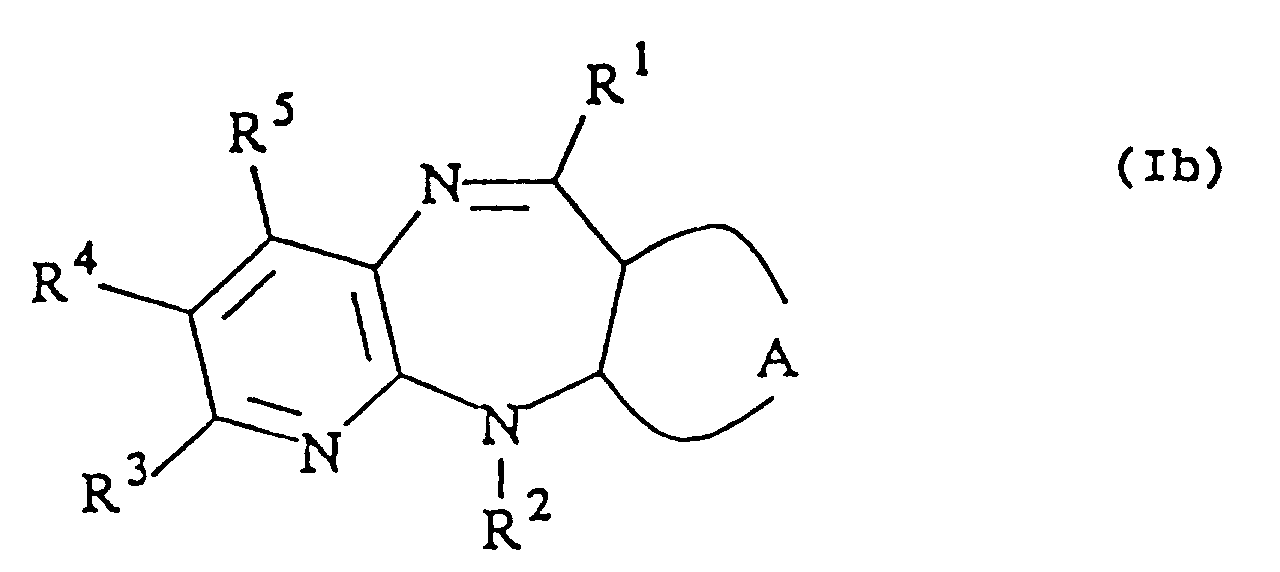
A est un cycle fusionné de formule R1 est cyano, chloro, bromo, imidazolyle, phosphétanyle, phospholanyle ou phosphorinanyle, ou un groupe de formule
-OR14, -SR14, -SOR14, -SO2R14, -NH2, -NHR14, -NR14R15, -PR14R15, -P(OR14)(OR15), -P(O)(OR14)(OR15), -PO3H2, -P(NR14R15)(NR14R15) ou -P(O)(NR14R15)(NR14R15), où R14 et R15 sont chacun indépendamment alkyle de 1 à 4 atomes de carbone, qui peut éventuellement être substitué par un groupe cyano ou alcoxycarbonyle de 2 à 4 atomes de carbone, cyclopropyle ou cyclobutyle, ou le groupe -NR14R15 peut être pyrrolidine, pipéridine ou morpholine;R2 est alkyle ou fluoroalkyle de 1 à 4 atomes de carbone, cycloalkyle de 3 à 5 atomes de carbone, alcényle ou alcynyle de 2 à 4 atomes de carbone, alcoxyalkyle ou alkylthioalkyle de 2 à 3 atomes de carbone, alcanoyle de 2 à 3 atomes de carbone, hydroxyalkyle de 2 à 4 atomes de carbone, arylméthyle (où la partie aryle est phényle, thiényle ou furanyle, qui est non substitué ou substitué par alkyle ou alcoxy de 1 à 3 atomes de carbone, hydroxyle ou halogène), phényle (qui est non substitué ou substitué par alkyle ou alcoxy de 1 à 3 atomes de carbone, halogène ou hydroxyle) ou alcoxycarbonylméthyle où la partie alcoxy contient 1 à 5 atomes de carbone;R3, R4 et R5 sont chacun indépendamment hydrogène, alkyle de 1 à 3 atomes de carbone ou chloro, à condition qu'au moins l'un de ces substituants soit hydrogène ou méthyle; ou l'un parmi R3, R4 et R5 est butyle, alcanoyle de 2 à 4 atomes de carbone, alcoxycarbonyle de 2 à 4 atomes de carbone, hydroxyalkyle de 1 à 4 atomes de carbone, alcoxycarbonylalkyle où les parties alcoxy et alkyle contiennent chacune 1 à 2 atomes de carbone, halogène, trihalogénométhyle, hydroxyle, alcoxy de 1 à 3 atomes de carbone, alkylthio de 1 à 3 atomes de carbone, aryle ou arylalkyle (où la partie alkyle contient 1 à 3 atomes de carbone et la partie aryle est phényle, thiényle, furanyle, pyridyle ou imidazolyle, qui est non substitué ou substitué par alkyle ou alcoxy de 1 à 3 atomes de carbone, hydroxyle ou halogène), alcanoyloxy de 2 à 3 atomes de carbone, alcanoylamino de 1 à 3 atomes de carbone, aminoalkyle de 1 à 3 atomes de carbone, mono- ou dialkylamino où chaque partie alkyle contient 1 à 3 atomes de carbone, N-pyrrolidino, N-pipéridino, N-morpholino, carboxyalkyle de 2 à 3 atomes de carbone, cyano, nitro, carboxyle, carbamyle, amino, azido, mono- ou dialkylaminoalkyle où chaque partie alkyle contient 1 à 2 atomes de carbone, à condition que les deux substituants restants soient hydrogène ou méthyle;R6, R7, R8 et R9 sont chacun hydrogène; ou
l'un parmi R6, R7, R8 et R9 est alkyle de 1 à 4 atomes de carbone, alcanoyle de 2 à 4 atomes de carbone, alcoxycarbonyle de 2 à 4 atomes de carbone, hydroxyalkyle de 1 à 4 atomes de carbone, alcoxycarbonylalkyle où les parties alcoxy et alkyle contiennent chacune 1 à 2 atomes de carbone, halogène, trihalogénométhyle, hydroxyle, alcoxy de 1 à 3 atomes de carbone, alkylthio de 1 à 3 atomes de carbone, alcanoyloxy de 2 à 3 atomes de carbone, alcanoylamino de 1 à 3 atomes de carbone, aminoalkyle de 1 à 3 atomes de carbone, mono- ou dialkylamino où chaque partie alkyle contient 1 à 2 atomes de carbone, carboxyalkyle de 2 à 3 atomes de carbone, cyano, nitro, carboxyle, carbamyle, amino, azido, mono- ou dialkylaminoalkyle où chaque partie alkyle contient 1 à 2 atomes de carbone et les trois substituants restants sont hydrogène ou deux des trois substituants restants sont hydrogène et l'un est méthyle, éthyle ou halogène;R10 et R11 sont chacun indépendamment hydrogène, alkyle de 1 à 3 atomes de carbone ou halogène; etR12 et R13 sont chacun indépendamment hydrogène, méthyle, éthyle ou halogène;
ou sel d'addition pharmaceutiquement acceptable de celui-ci. - Composé selon la revendication 10 ayant la formule Ic
 R1 est cyano, chloro, imidazolyle ou un groupe de formule -OR14, -SR14, -SOR14, -SO2R14, -NH2, -NHR14 ou -NR14R15 où R14 et R15 sont chacun indépendaament alkyle de 4 atomes de carbone, qui peut éventuellement être substitué par un groupe cyano ou alcoxycarbonyle de 2 à 4 atomes de carbone, cyclopropyle ou cyclobutyle, ou le groupe -NR14R15 peut être pyrrolidine, pipéridine ou morpholine;R2 est alkyle de 1 à 4 atomes de carbone, cycloalkyle de 3 à 4 atomes de carbone, alcényle ou alcynyle de 2 à 4 atomes de carbone, alcoxyalkyle ou alkylthioalkyle de 2 à 3 atomes de carbone, alcanoyle de 2 à 3 atomes de carbone, hydroxyalkyle de 2 à 4 atomes de carbone, arylméthyle (où la partie aryle est phényle ou thiényle, qui est non substitué ou substitué par méthyle, méthoxy ou halogène) ou alcoxycarbonylméthyle où la partie alcoxy contient 1 à 4 atomes de carbone;R3, R4 et R5 sont chacun indépendamment hydrogène, méthyle, chloro, mono- ou dialkylamino où chaque partie alkyle contient 1 à 3 atomes de carbone, N-pyrrolidino, N-pipéridino ou N-morpholino, à condition qu'au moins l'un de ces substituants soit hydrogène ou méthyle, ou R5 est éthyle, propyle ou butyle, les deux autres substituants étant hydrogène;R6 est hydrogène ou, lorsque R7 est hydrogène ou méthyle, peut être méthyle ou éthyle;R7 est hydrogène ou, lorsque R8 est hydrogène, peut être alkyle de 1 à 2 atomes de carbone, acétyle, hydroxyalkyle de 1 à 2 atomes de carbone, alcoxycarbonyle de 2 à 3 atomes de carbone, alcoxycarbonylalkyle où les parties alcoxy et alkyle contiennent chacune 1 à 2 atomes de carbone, halogène, trifluorométhyle, hydroxyle, alcoxy de 1 à 2 atomes de carbone, alkylthio de 1 à 2 atomes de carbone, acétyloxy, alcanoylamino de 1 à 2 atomes de carbone ou cyano;R8 est hydrogène ou, lorsque R7 est hydrogène, peut être alkyle de 1 à 2 atomes de carbone, acétyle, hydroxyalkyle de 1 à 2 atomes de carbone, alcoxycarbonyle de 2 à 3 atomes de carbone, alcoxycarbonylalkyle où les parties alcoxy et alkyle contiennent chacune 1 à 2 atomes de carbone, halogène, trifluorométhyle, hydroxyle, alcoxy de 1 à 2 atomes de carbone, alkylthio de 1 à 2 atomes de carbone, acétyloxy, alcanoylamino de 1 à 2 atomes de carbone ou cyano; ouR7 et R8 sont tous deux hydrogène, méthyle ou halogène; etR9 est hydrogène ou, lorsque R8 est hydrogène ou méthyle, peut être méthyle;
ou sel d'addition pharmaceutiquement acceptable de celui-ci. - Composé selon la revendication 11 ayant la formule Ic dans laquelleR1 est cyano, chloro, imidazolyle ou un groupe de formule -OR14, -SR14, -SOR14, -SO2R14, -NH2, -NHR14 ou -NR14R15 où R14 et R15 sont chacun indépendamment alkyle de 4 atomes de carbone, qui peut éventuellement être substitué par un groupe cyano ou alcoxycarbonyle de 2 à 4 atomes de carbone, cyclopropyle ou cyclobutyle, ou le groupe -NR14R15 peut être pyrrolidine, pipéridine ou morpholine;R2 est alkyle de 1 à 4 atomes de carbone ou cycloalkyle de 3 à 4 atomes de carbone;R3 est hydrogène, méthyle, chloro, méthoxy, mono- ou dialkylamino où chaque partie alkyle contient 1 à 3 atomes de carbone, ou N-pyrrolidino;R4 et R5 sont chacun indépendamment hydrogène ou méthyle; etR6 à R9 sont chacun hydrogène;
ou sel d'addition pharmaceutiquement acceptable de celui-ci. - Utilisation d'un composé ou d'un sel d'addition d'acide pharmaceutiquement acceptable selon l'une quelconque des revendications 1 à 12 pour la production d'une préparation pharmaceutique pour le traitement prophylactique ou thérapeutique d'un humain exposé à ou infecté par VIH-1.
- Composition pharmaceutique qui convient pour la prévention ou le traitement d'une infection à VIH-1 comprenant une quantité efficace du point de vue prophylactique ou thérapeutique d'un composé selon l'une quelconque des revendications 1 à 12 ou d'un sel d'addition d'acide pharmaceutiquement acceptable de celui-ci et un support pharmaceutiquement acceptable.
Applications Claiming Priority (6)
| Application Number | Priority Date | Filing Date | Title |
|---|---|---|---|
| US65214691A | 1991-02-07 | 1991-02-07 | |
| US65214791A | 1991-02-07 | 1991-02-07 | |
| US65215791A | 1991-02-07 | 1991-02-07 | |
| US652157 | 1991-02-07 | ||
| US652147 | 1991-02-07 | ||
| US652146 | 2000-08-31 |
Publications (2)
| Publication Number | Publication Date |
|---|---|
| EP0498290A1 EP0498290A1 (fr) | 1992-08-12 |
| EP0498290B1 true EP0498290B1 (fr) | 1996-09-18 |
Family
ID=27417873
Family Applications (1)
| Application Number | Title | Priority Date | Filing Date |
|---|---|---|---|
| EP92101462A Expired - Lifetime EP0498290B1 (fr) | 1991-02-07 | 1992-01-29 | Pyridobenzodiazépines, dipyrido [3,2-b:2',3'-e) [1,4]diazépines et leur utilisation pour la prévention et le traitement du SIDA |
Country Status (7)
| Country | Link |
|---|---|
| EP (1) | EP0498290B1 (fr) |
| JP (1) | JPH06122683A (fr) |
| AT (1) | ATE143018T1 (fr) |
| CA (1) | CA2060687A1 (fr) |
| DE (1) | DE69213777T2 (fr) |
| DK (1) | DK0498290T3 (fr) |
| GR (1) | GR3021428T3 (fr) |
Families Citing this family (7)
| Publication number | Priority date | Publication date | Assignee | Title |
|---|---|---|---|---|
| US6177435B1 (en) | 1992-05-13 | 2001-01-23 | Glaxo Wellcome Inc. | Therapeutic combinations |
| US5897858A (en) | 1994-02-03 | 1999-04-27 | Schering-Plough Healthcare Products, Inc. | Nasal spray compositions exhibiting increased retention in the nasal cavity |
| CO4340691A1 (es) * | 1994-02-18 | 1996-07-30 | Boehringer Ingelheim Pharma | 2-HETEROARIL-5,11-DIHIDRO-6H-DIPIRIDO(3,2-b:2´, 3´ -e) (1, 4)-DIAZEPINAS . |
| US5747488A (en) * | 1996-01-30 | 1998-05-05 | Boehringer Ingelheim Pharmaceuticals, Inc. | 2-aryl-5,11-dihydro-6H-dipyrido 3,2-B:2',3'-E! 1, 4!diazepines and their use in the treatment of HIV infection |
| US6106179A (en) * | 1998-12-28 | 2000-08-22 | Kuo; Chen-Hui | Dual color lipstick in a single case |
| WO2008099021A1 (fr) * | 2007-02-16 | 2008-08-21 | Tibotec Pharmaceuticals Ltd. | Dibenzodiazépinones utiles comme inhibiteurs du virus de l'hépatite c |
| CU20090172A7 (es) | 2009-10-09 | 2011-10-05 | Ct De Investigación Y Desarrollo De Medicamentos | Sistemas tricíclicos y tetracíclicos con actividad sobre el sistema nervioso central y vascular |
Family Cites Families (2)
| Publication number | Priority date | Publication date | Assignee | Title |
|---|---|---|---|---|
| DE69031845T2 (de) * | 1989-04-20 | 1998-05-07 | Boehringer Ingelheim Pharma | 6,11-Dihydro-5H-pyrido(2,3-b)(1,5)benzodiazepin-5-one und Thione und ihre Verwendung für die Vorbeugung oder Behandlung von AIDS |
| EP0410148B1 (fr) * | 1989-06-28 | 1994-04-06 | Boehringer Ingelheim Pharmaceuticals Inc. | 5,11-dihydro-6H-dipyrido[3,2-b:2',3'-e][1,4]diazépin-6-ones et -thiones et leur utilisation pour la prévention ou le traitement du SIDA |
-
1992
- 1992-01-29 DK DK92101462.7T patent/DK0498290T3/da active
- 1992-01-29 EP EP92101462A patent/EP0498290B1/fr not_active Expired - Lifetime
- 1992-01-29 AT AT92101462T patent/ATE143018T1/de not_active IP Right Cessation
- 1992-01-29 DE DE69213777T patent/DE69213777T2/de not_active Expired - Fee Related
- 1992-02-05 CA CA002060687A patent/CA2060687A1/fr not_active Abandoned
- 1992-02-06 JP JP4066588A patent/JPH06122683A/ja active Pending
-
1996
- 1996-10-23 GR GR960402800T patent/GR3021428T3/el unknown
Also Published As
| Publication number | Publication date |
|---|---|
| DE69213777D1 (de) | 1996-10-24 |
| CA2060687A1 (fr) | 1992-08-08 |
| DE69213777T2 (de) | 1997-03-13 |
| DK0498290T3 (fr) | 1997-02-10 |
| JPH06122683A (ja) | 1994-05-06 |
| EP0498290A1 (fr) | 1992-08-12 |
| GR3021428T3 (en) | 1997-01-31 |
| ATE143018T1 (de) | 1996-10-15 |
Similar Documents
| Publication | Publication Date | Title |
|---|---|---|
| EP0429987B1 (fr) | 5,11-Dihydro-6H-dipyrido[3,2-b:2'3'-e] [1,4]diazépines et leur utilisation pour prévenir ou traiter l'infection par le VIH | |
| US5908841A (en) | 5,11-dihydro-6H-dipyrido 3,2-b:2',3'-e!azepine-6-ones and their use in the prevention of treatment of HIV infection | |
| EP0410148B1 (fr) | 5,11-dihydro-6H-dipyrido[3,2-b:2',3'-e][1,4]diazépin-6-ones et -thiones et leur utilisation pour la prévention ou le traitement du SIDA | |
| EP0498290B1 (fr) | Pyridobenzodiazépines, dipyrido [3,2-b:2',3'-e) [1,4]diazépines et leur utilisation pour la prévention et le traitement du SIDA | |
| US5087625A (en) | Pyridodiazepines and their use in the prevention or treatment of HIV infection | |
| EP0393604B1 (fr) | 6,11-Dihydro-5H-pyrido(2,3-b)(1,5)benzodiazépine-5-ones et thiones et leur utilisation pour la prévention ou le traitement du SIDA | |
| EP0745083B1 (fr) | 2-HETEROARYL-5,11-DIHYDRO-6H-DIPYRIDO[3,2-b:2',3'-e][1,4] DIAZEPINES ET LEUR UTILISATION DANS LA PREVENTION OU LE TRAITEMENT DE L'INFECTION A VIH | |
| EP0419861B1 (fr) | Utilisation de dibenzo[b,f][1,4]oxazépine (et thiazépine)-11(10H)-ones et -thiones pour l'obtention d'un médicament destiné à la prévention ou le traitement du SIDA | |
| US5550117A (en) | Dipyrido[3,2-B:2 ',3'-E][1,4]Diaqzepines and their use in the treatment of HIV infection | |
| US5747488A (en) | 2-aryl-5,11-dihydro-6H-dipyrido 3,2-B:2',3'-E! 1, 4!diazepines and their use in the treatment of HIV infection | |
| CA2014884C (fr) | 5,11-dihydro-6h-pyrido[2,3-b] [1,4] benzodiazepin-6-ones et-thiones et leur utilisation dans la prevention ou le traitement du sida | |
| US5602113A (en) | Pyridobenzo- and pyridiothieno-diazepines useful for the treatment of HIV infection | |
| EP0415303B1 (fr) | Pyrido [2,3-b][1,5]benzoxazépine (et thiazépine)-5(6H)-ones et thiones et leur utilisation pour la prévention et le traitement de l'infection par le HIV | |
| AP190A (en) | Pyrido(2,3-b) (1.5) benzoxazepin (and thiazepin)-5 (6H)-ones and thiones and prevention or treatment of HIV infection. | |
| US5837704A (en) | 2-heteroaryl-5,11-dihydro-6H-dipyrido 3,2-B:2',3'-E! 1,4!diazepines and their use in the prevention or treatment of HIV infection | |
| US5593979A (en) | Pyridobenzo-and pyridiothieno-diazepines useful for the treatment of HIV infection | |
| EP0417534A1 (fr) | Pyrido[2,3-b][1,4]benzoxazépin- (et -thiazépin)-6(5H)-ones et -thiones et leur utilisation pour la prévention ou le traitement du SIDA | |
| EP0415304A2 (fr) | Dipyrido[3,2-b:2',3'-e][1,4]oxazépine, (et thiazépine)-6(5H)-ones et leur utilisation pour la prévention ou le traitement du SIDA | |
| HK1011025B (en) | 5,11-dihydro-6h-dipyrido[3,2-b:2',3'-e][1,4]diazepines and their use in the preventionor treatment of hiv infection | |
| MXPA96003359A (en) | 2-heteroaril-5,11-dihydro-6h-dipiride [3,2-b: 2 ', 3'-e] [1-4] -diazepines and their use in the prevention or treatment of infection of |
Legal Events
| Date | Code | Title | Description |
|---|---|---|---|
| PUAI | Public reference made under article 153(3) epc to a published international application that has entered the european phase |
Free format text: ORIGINAL CODE: 0009012 |
|
| AK | Designated contracting states |
Kind code of ref document: A1 Designated state(s): AT BE CH DE DK ES FR GB GR IT LI LU NL PT SE |
|
| 17P | Request for examination filed |
Effective date: 19920826 |
|
| 17Q | First examination report despatched |
Effective date: 19941202 |
|
| GRAH | Despatch of communication of intention to grant a patent |
Free format text: ORIGINAL CODE: EPIDOS IGRA |
|
| GRAH | Despatch of communication of intention to grant a patent |
Free format text: ORIGINAL CODE: EPIDOS IGRA |
|
| GRAA | (expected) grant |
Free format text: ORIGINAL CODE: 0009210 |
|
| AK | Designated contracting states |
Kind code of ref document: B1 Designated state(s): AT BE CH DE DK ES FR GB GR IT LI LU NL PT SE |
|
| PG25 | Lapsed in a contracting state [announced via postgrant information from national office to epo] |
Ref country code: ES Free format text: THE PATENT HAS BEEN ANNULLED BY A DECISION OF A NATIONAL AUTHORITY Effective date: 19960918 |
|
| REF | Corresponds to: |
Ref document number: 143018 Country of ref document: AT Date of ref document: 19961015 Kind code of ref document: T |
|
| REF | Corresponds to: |
Ref document number: 69213777 Country of ref document: DE Date of ref document: 19961024 |
|
| REG | Reference to a national code |
Ref country code: CH Ref legal event code: NV Representative=s name: SCHMAUDER & WANN PATENTANWALTSBUERO, INHABER KLAUS |
|
| ET | Fr: translation filed | ||
| ITF | It: translation for a ep patent filed | ||
| REG | Reference to a national code |
Ref country code: GR Ref legal event code: FG4A Free format text: 3021428 |
|
| REG | Reference to a national code |
Ref country code: DK Ref legal event code: T3 |
|
| REG | Reference to a national code |
Ref country code: PT Ref legal event code: SC4A Free format text: AVAILABILITY OF NATIONAL TRANSLATION Effective date: 19961210 |
|
| PLBE | No opposition filed within time limit |
Free format text: ORIGINAL CODE: 0009261 |
|
| STAA | Information on the status of an ep patent application or granted ep patent |
Free format text: STATUS: NO OPPOSITION FILED WITHIN TIME LIMIT |
|
| 26N | No opposition filed | ||
| PGFP | Annual fee paid to national office [announced via postgrant information from national office to epo] |
Ref country code: GB Payment date: 19971211 Year of fee payment: 7 |
|
| PGFP | Annual fee paid to national office [announced via postgrant information from national office to epo] |
Ref country code: SE Payment date: 19971217 Year of fee payment: 7 |
|
| PGFP | Annual fee paid to national office [announced via postgrant information from national office to epo] |
Ref country code: PT Payment date: 19971223 Year of fee payment: 7 Ref country code: NL Payment date: 19971223 Year of fee payment: 7 Ref country code: AT Payment date: 19971223 Year of fee payment: 7 |
|
| PGFP | Annual fee paid to national office [announced via postgrant information from national office to epo] |
Ref country code: GR Payment date: 19971230 Year of fee payment: 7 Ref country code: DK Payment date: 19971230 Year of fee payment: 7 |
|
| PGFP | Annual fee paid to national office [announced via postgrant information from national office to epo] |
Ref country code: FR Payment date: 19971231 Year of fee payment: 7 |
|
| PGFP | Annual fee paid to national office [announced via postgrant information from national office to epo] |
Ref country code: DE Payment date: 19980107 Year of fee payment: 7 Ref country code: CH Payment date: 19980107 Year of fee payment: 7 |
|
| PGFP | Annual fee paid to national office [announced via postgrant information from national office to epo] |
Ref country code: BE Payment date: 19980108 Year of fee payment: 7 |
|
| PGFP | Annual fee paid to national office [announced via postgrant information from national office to epo] |
Ref country code: LU Payment date: 19980119 Year of fee payment: 7 |
|
| PG25 | Lapsed in a contracting state [announced via postgrant information from national office to epo] |
Ref country code: LU Free format text: LAPSE BECAUSE OF NON-PAYMENT OF DUE FEES Effective date: 19990129 Ref country code: GB Free format text: LAPSE BECAUSE OF NON-PAYMENT OF DUE FEES Effective date: 19990129 Ref country code: AT Free format text: LAPSE BECAUSE OF NON-PAYMENT OF DUE FEES Effective date: 19990129 |
|
| PG25 | Lapsed in a contracting state [announced via postgrant information from national office to epo] |
Ref country code: SE Free format text: LAPSE BECAUSE OF NON-PAYMENT OF DUE FEES Effective date: 19990130 |
|
| PG25 | Lapsed in a contracting state [announced via postgrant information from national office to epo] |
Ref country code: LI Free format text: LAPSE BECAUSE OF NON-PAYMENT OF DUE FEES Effective date: 19990131 Ref country code: GR Free format text: LAPSE BECAUSE OF NON-PAYMENT OF DUE FEES Effective date: 19990131 Ref country code: CH Free format text: LAPSE BECAUSE OF NON-PAYMENT OF DUE FEES Effective date: 19990131 Ref country code: BE Free format text: LAPSE BECAUSE OF NON-PAYMENT OF DUE FEES Effective date: 19990131 |
|
| PG25 | Lapsed in a contracting state [announced via postgrant information from national office to epo] |
Ref country code: DK Free format text: LAPSE BECAUSE OF NON-PAYMENT OF DUE FEES Effective date: 19990202 |
|
| BERE | Be: lapsed |
Owner name: BOEHRINGER INGELHEIM PHARMACEUTICALS INC. Effective date: 19990131 |
|
| PG25 | Lapsed in a contracting state [announced via postgrant information from national office to epo] |
Ref country code: PT Free format text: LAPSE BECAUSE OF NON-PAYMENT OF DUE FEES Effective date: 19990731 |
|
| PG25 | Lapsed in a contracting state [announced via postgrant information from national office to epo] |
Ref country code: NL Free format text: LAPSE BECAUSE OF NON-PAYMENT OF DUE FEES Effective date: 19990801 |
|
| GBPC | Gb: european patent ceased through non-payment of renewal fee |
Effective date: 19990129 |
|
| REG | Reference to a national code |
Ref country code: CH Ref legal event code: PL |
|
| PG25 | Lapsed in a contracting state [announced via postgrant information from national office to epo] |
Ref country code: FR Free format text: LAPSE BECAUSE OF NON-PAYMENT OF DUE FEES Effective date: 19990930 |
|
| PG25 | Lapsed in a contracting state [announced via postgrant information from national office to epo] |
Ref country code: DE Free format text: LAPSE BECAUSE OF NON-PAYMENT OF DUE FEES Effective date: 19991103 |
|
| REG | Reference to a national code |
Ref country code: FR Ref legal event code: ST |
|
| REG | Reference to a national code |
Ref country code: PT Ref legal event code: MM4A Free format text: LAPSE DUE TO NON-PAYMENT OF FEES Effective date: 19990731 |
|
| REG | Reference to a national code |
Ref country code: DK Ref legal event code: EBP |
|
| PG25 | Lapsed in a contracting state [announced via postgrant information from national office to epo] |
Ref country code: IT Free format text: LAPSE BECAUSE OF NON-PAYMENT OF DUE FEES;WARNING: LAPSES OF ITALIAN PATENTS WITH EFFECTIVE DATE BEFORE 2007 MAY HAVE OCCURRED AT ANY TIME BEFORE 2007. THE CORRECT EFFECTIVE DATE MAY BE DIFFERENT FROM THE ONE RECORDED. Effective date: 20050129 |