EP0498997A2 - Telefonapparat mit Anruferidentifikation - Google Patents
Telefonapparat mit Anruferidentifikation Download PDFInfo
- Publication number
- EP0498997A2 EP0498997A2 EP91311707A EP91311707A EP0498997A2 EP 0498997 A2 EP0498997 A2 EP 0498997A2 EP 91311707 A EP91311707 A EP 91311707A EP 91311707 A EP91311707 A EP 91311707A EP 0498997 A2 EP0498997 A2 EP 0498997A2
- Authority
- EP
- European Patent Office
- Prior art keywords
- telephone
- telephone apparatus
- numeric
- display
- field
- Prior art date
- Legal status (The legal status is an assumption and is not a legal conclusion. Google has not performed a legal analysis and makes no representation as to the accuracy of the status listed.)
- Granted
Links
- 230000001413 cellular effect Effects 0.000 abstract description 7
- 230000006870 function Effects 0.000 description 12
- 238000012552 review Methods 0.000 description 4
- 238000010586 diagram Methods 0.000 description 3
- 230000000881 depressing effect Effects 0.000 description 2
- 230000004044 response Effects 0.000 description 2
- 238000012216 screening Methods 0.000 description 2
- 230000008901 benefit Effects 0.000 description 1
- 238000013479 data entry Methods 0.000 description 1
- 230000000977 initiatory effect Effects 0.000 description 1
- 239000004973 liquid crystal related substance Substances 0.000 description 1
- 238000000034 method Methods 0.000 description 1
- 238000012986 modification Methods 0.000 description 1
- 230000004048 modification Effects 0.000 description 1
- 230000008520 organization Effects 0.000 description 1
- 230000001105 regulatory effect Effects 0.000 description 1
- 238000012546 transfer Methods 0.000 description 1
Images


Classifications
-
- H—ELECTRICITY
- H04—ELECTRIC COMMUNICATION TECHNIQUE
- H04M—TELEPHONIC COMMUNICATION
- H04M1/00—Substation equipment, e.g. for use by subscribers
- H04M1/57—Arrangements for indicating or recording the number of the calling subscriber at the called subscriber's set
- H04M1/575—Means for retrieving and displaying personal data about calling party
-
- H—ELECTRICITY
- H04—ELECTRIC COMMUNICATION TECHNIQUE
- H04M—TELEPHONIC COMMUNICATION
- H04M1/00—Substation equipment, e.g. for use by subscribers
- H04M1/66—Substation equipment, e.g. for use by subscribers with means for preventing unauthorised or fraudulent calling
- H04M1/663—Preventing unauthorised calls to a telephone set
-
- H—ELECTRICITY
- H04—ELECTRIC COMMUNICATION TECHNIQUE
- H04M—TELEPHONIC COMMUNICATION
- H04M1/00—Substation equipment, e.g. for use by subscribers
- H04M1/72—Mobile telephones; Cordless telephones, i.e. devices for establishing wireless links to base stations without route selection
- H04M1/724—User interfaces specially adapted for cordless or mobile telephones
-
- H—ELECTRICITY
- H04—ELECTRIC COMMUNICATION TECHNIQUE
- H04M—TELEPHONIC COMMUNICATION
- H04M19/00—Current supply arrangements for telephone systems
- H04M19/02—Current supply arrangements for telephone systems providing ringing current or supervisory tones, e.g. dialling tone or busy tone
- H04M19/04—Current supply arrangements for telephone systems providing ringing current or supervisory tones, e.g. dialling tone or busy tone the ringing-current being generated at the substations
-
- H—ELECTRICITY
- H04—ELECTRIC COMMUNICATION TECHNIQUE
- H04M—TELEPHONIC COMMUNICATION
- H04M19/00—Current supply arrangements for telephone systems
- H04M19/02—Current supply arrangements for telephone systems providing ringing current or supervisory tones, e.g. dialling tone or busy tone
- H04M19/04—Current supply arrangements for telephone systems providing ringing current or supervisory tones, e.g. dialling tone or busy tone the ringing-current being generated at the substations
- H04M19/048—Arrangements providing optical indication of the incoming call, e.g. flasher circuits
Definitions
- This invention relates to a telephone apparatus adapted to respond to a signal conveying a number identifying the source of an incoming telephone call.
- the identifying number may be the telephone number of the telephone making the incoming call.
- CLI Calling Line Identification
- Prior art telephones have been adapted to respond to CLI signals and have been provided with a facility for displaying the telephone numbers of incoming calls. Hence the user can see the telephone number before answering the call.
- a so-called 'call-in-absence' memory has also been provided for storing the telephone numbers of incoming calls which have not been answered within a predetermined period of time. The stored numbers can be recalled at a later time so that the user has a record of calls received but not answered.
- GB-A-2014825 discloses a telephone apparatus in which the number of a caller is stored in a memory and can be recalled at a later stage if the call is not answered initially.
- a drawback with prior art telephones is that because the system conveys only the telephone number of the incoming call, it is only the telephone number which is displayed to the user.
- the telephone number alone is of limited value because it can be difficult for the user to recognize telephone numbers, especially those which are used less frequently.
- a telephone apparatus adapted to respond to a signal conveying a number identifying the source of an incoming telephone call, comprising memory means having a plurality of numeric fields for storing numbers in encoded form, each numeric field having an associated text field for storing alphanumeric characters in encoded form, characterized by means for selecting the numeric field containing the encoded number corresponding to the number identifying the source of the incoming call, and means adapted to display the alphanumeric characters stored in encoded form in the text field associated with the selected numeric field.
- 'field' relates to a portion of memory intended for storing a specific item of data of a given type such as a telephone number (numeric characters only) or a name (alphabet or alphanumeric characters).
- a 'record' comprises a collection of individual fields linked by a common feature, e.g. all items of data (fields) relating to the same telephone number.
- a telephone apparatus in accordance with the invention has the advantage that it can display to the user not only the telephone number, but also associated textual information, for example the name of the caller, stored in the memory means. The user is thus able to recognize far more readily the identity of the caller.
- the display means are adapted to display the telephone number in addition to the associated text information.
- the telephone number and the associated text may be displayed either simultaneously or intermittently.
- the display means may also be adapted to indicate that no text is available if the text field associated with the selected numeric field contains an empty code. For example, the location of the selected numeric field may be displayed. This will tell the user that the incoming call originated from a number stored in the memory means, although no text is associated with the number in question.
- the display means may be adapted to indicate, e.g. by means of a suitable message, when the numeric fields do not contain a number in encoded form corresponding to the number identifying the source of the incoming call.
- the telephone apparatus comprises a keypad enabling data to be entered selectively by the user into the numeric and/or associated text fields.
- a keypad enabling data to be entered selectively by the user into the numeric and/or associated text fields.
- alpha-tag i.e. text data
- the alpha-tag will then be displayed to the user whenever a call is received from the associated number.
- the telephone apparatus shown in Figure 1 is a portable cellular telephone 1 powered by a rechargeable battery pack 2.
- the telephone 1 includes a transceiver and all the other features conventionally found in a cellular telephone, as shown schematically in Figure 2. Since these aspects of the telephone are not directly relevant to the instant invention no further details will be given here, except to say that a microprocessor 4 (see Figure 2) is employed to control all the basic functions of the telephone l and to control the keypad and display functions. Alternatively, however, the telephone functions may be controlled by a master microcomputer, while the keypad and display functions are under the control of a separate slave microcomputer coupled to communicate with the master microcomputer. Additionally a memory 100 is provided for storing subscriber telephone numbers, as described in more detail below.
- the user-interface of telephone 1 comprises a display, e.g. a liquid crystal display 5, itself well-known in the art and a keypad 6 on the front of the telephone 1.
- the display is coupled to and regulated by the microprocessor 4 in the usual manner.
- the keypad 6 essentially comprises two main sets of keys, namely alphanumeric keys 6a associated with alphanumeric data especially for dialing telephone numbers, but also for entering alphanumeric data into the telephone number store 100; and a set of function keys 6b for enabling various predetermined functions or operations.
- the keys 6a are arranged in four rows of three keys each. As is conventional for the numeric key layout of a telephone, the top row comprises keys for numbers 1, 2 and 3 respectively, the second row down for numbers 4, 5 and 6 respectively, the next row down for numbers 7, 8 and 9 respectively, and the bottom row for *, 0 and # respectively.
- the keys 6a are also associated with alphabet information, as again is quite conventional.
- the alphabetic rather than numeric data is selected for example by preceding the alphanumeric keystroke with another predetermined keystroke or set of keystrokes, specifically using the function keys in the data entry mode as discussed in more detail below.
- the keys 6b include a "SEND” and "END” key for respectively initiating and terminating a telephone call.
- Another key, specifically located in the top left-hand corner is an “ON/OFF” key for turning the telephone on and off, i.e. by connecting and disconnecting the battery pack power supply.
- Another of the function keys may be a menu or function key labeled, for example, "MENU” or "FUNCTION” or with a suitable abbreviation thereof. Depression of this key enables a variety of pre-set menus, the related instructions of which are stored in memory, to be viewed and selectively enabled. The various menus are selected by depressing the appropriate alphanumeric keys after depressing the "MENU” or "FUNCTION” key.
- the relevant menu is shown to the user in words or abbreviations on the display panel 5. For example, the user may be able to select the ringing tone by appropriate menu selection.
- the telephone number store comprises n+1 records, each record having a length of 25 bytes (200 bits).
- Record 0 is merely an information record and contains information on the size and allocation of the telephone number store.
- This record is the first in the memory 100 and constitutes record number 0, i.e. abbreviated subscriber number 0.
- the header like the n other records, has a length of 25 bytes and is structured as follows. The first byte is used to store the maximum number of records in the telephone number store, and the remaining 24 bytes are used as a bit map to indicate unassigned and assigned records. For example a binary "1" indicates an unassigned record and binary "0" indicates an assigned record.
- the first telephone number record (Record 1) is represented by the most significant bit (bit 8) in byte 2 (i.e. abbreviated subscriber number 1), whilst the last subscriber number record (maximum 192) is represented by the least significant bit (bit 1) in byte 25 of the header.
- subscriber number records each consist of a numeric field 8 bytes long for storing the directory number; a text field, which is 16 bytes long, for storing any accompanying optional text, such as the name of the subscriber; a counter field 4 bits (1/2 byte) long; and an instruction field also 4 bits (1/2 byte) long.
- the subscriber number is stored right-justified in the "numeric" field (bytes 1 to 8) and filled to the left with "F" (in hexadecimal), as shown in Figure 4 for the telephone number 0276 686116.
- the numeric field (bytes 1 to 8) is filled with F's (hexadecimal).
- the text is stored left-justified in the text field (bytes 9 to 24) and filled to the right with spaces, ASCII code "20" (hexadecimal), as shown in Figure 4 for the words "TECHNOPHONE LTD".
- ASCII code "20" herein, the text field (bytes 9 to 24) is filled with ASCII code spaces "20" (hexadecimal).
- the counter field (the four most significant bits of byte 25) stores the number of times a call has been received from the telephone number contained in that record. So, for example, as shown in Figure 4 a call has been received from the telephone number 0276 686116 once before.
- the instruction field (the four least significant bits of byte 25) are available for storing special instructions to modify the manual operation of the telephone. If this field is empty (0000) the operation of the telephone will proceed uninterrupted in the normal manner. However, special instructions may be programmed into this field by the user from the keyboard. For example, in Figure 4 the code 1111 is used as a "TELEPHONE BUSY" instruction which can be used to block calls from selected telephone numbers, as described in more detail below.
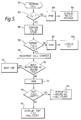
- FIG. 5 is a flowchart which may be used to implement the operation of the microprocessor 4 of Figure 2 insofar as use of the telephone number store 100 is concerned.
- the flowchart begins at block 101 when the portable telephone receives an incoming call.
- the telephone establishes the telephone number of the caller if a calling line identification (CLI) signal is present. If there is no CLI signal the flow proceeds to block 103 where the telephone is rung and the call will proceed in the conventional manner. Also, as indicated at block 104, the telephone may display a message such as "NO CLI" to indicate that no CLI information is available.
- CLI calling line identification
- the telephone number will be established in known manner and the flow will proceed from block 102 to block 105.
- the telephone numbers stored in the numeric fields of the telephone number store 100 are compared with the CLI number. If none of the stored numbers match the CLI number, see block 106, the flow proceeds to block 107.
- the telephone is rung and the CLI number is displayed on the display, as illustrated at block 108. Additionally a message such as "NOT IN MEMORY" may be displayed to indicate to the user that the number of the incoming calls is not stored in memory 100.
- the CLI number may remain on the display for reference purposes even after the call has been answered and the user may have the opportunity to permanently transfer the displayed number into the telephone number store 100 while the call is in progress.
- the message on the display changes, for example to "STORE?".
- the user can confirm that he wishes to store the displayed number by pressing a "STORE" key disposed among the keys 6b.
- the display 5 will show the first available record or memory location.
- the user may store the number at that or indeed at any other available location of his choice, and also store text to accompany the telephone number, e.g. the caller's name, in accordance with the general procedure for entering data as discussed in greater detail below. If the user does not press the "STORE" key while the "STORE?" message is displayed the CLI number will not be transferred into the telephone number store 100.
- a "BUSY SIGNAL" instruction e.g. 1111
- the instruction field is found to be empty (contents (0000))
- flow will proceed to block 112 and the telephone will be rung.
- a check is made on the text field of the selected record. If the text field does not contain any information (i.e. 16xF(hex)) the telephone number stored in the numeric field of the selected record will be displayed on LCD 5, as indicated at block 114. Also, the record number will be displayed, e.g. in the form "RECORD 99", thus giving the user the maximum amount of information available, in the absence of text, which may help to identify the caller. Additionally the display will show a message indicating the number of times a call has been received from the same telephone number since the call counter was last cleared.
- This message may, for example, be in the form "CALL COUNT: 2", indicating that this is the second call which has been received from the number displayed.
- the three items of information i.e. the CLI number, the record number, and the call count may be displayed simultaneously if the capacity of the display permits, or the various items of information may be displayed sequentially.
- the flow proceeds to block 115 and the telephone will display the text stored in encoded form in the text field of the selected record, e.g. "TECHNOPHONE LTD", see Figure 4. Also, the CLI number viz. 0276 686116 in this case, may be displayed together with the call count, e.g. in the form "CALL COUNT: 2".
- All of the information contained in the telephone number store 100 may be entered or programmed by the user from the keypad 6.
- the store mode may be accessed by pressing the "STORE” key disposed among the keys 6b.
- the user then enters the desired telephone number up to 16 digits long using the alphanumeric keys 6a.
- the "STORE” key is pressed again.
- the display 5 will show the keyed telephone number e.g. 0276 686116, followed by the first available record or memory location, indicated for example as "RECORD 005", assuming records 001 through 004 are already assigned.
- the record number can be changed at this stage using the "#" key to scroll up to the next location (record 006), or using the "*" key to reach the previous location (record 004).
- the number keys 6a may be pressed to enter a specific location, e.g. by pressing the key “9” twice for record number 99.
- the "STORE” key is pressed to store the entered number at the desired location.
- the display then returns a prompt such as "ENTER NAME”.
- the alphabet function of the numeric keys 6a is enabled.
- each number key has three sequential alphabetic characters associated therewith. For example the key “8” also has the letters "T” "U” and "V” associated with it.
- a single press of the numeric key will display the first letter (i.e. "T” for the "8” key), two key presses will display the second letter (i.e. "U” for the “8 key"), and three key presses will display the third letter (i.e. "V” for the "8” key).
- a fourth key press displays the number itself. Further key presses cause this sequence to be repeated.
- upto 16 alphanumeric characters can be entered into the text field using the alphanumeric keys 6a.
- the text characters are stored by pressing the "STORE” key once again. If the "STORE” key is pressed before any text has been entered the text field will be left empty.
- the user may at any time review what calls have been received using the "MENU” key. For example by pressing the "MENU” key followed by "5" the display may show the message “REVIEW CALLS". To enable this feature the user presses, for example, the "STORE” (or “ENTER”) key. On the other hand by pressing the "#” or “*” keys the message toggles between “REVIEW CALLS” and "ERASE CALL COUNT”. If the "STORE” (or “ENTER”) key is pressed while the "ERASE CALL COUNT” message is displayed, the counter fields of all records will be reset to zero (0000).
- the telephone number store may be implemented and configured in any suitable manner.
- a telephone in accordance with the present invention need not necessarily include a call counter facility or a call screening facility in which case less memory space is required.
- each record may comprise only 24 rather than 25 bytes without loss of any alphanumeric storage space.
- the present invention is applicable to telephone apparatuses other than portable cellular telephones.
Landscapes
- Engineering & Computer Science (AREA)
- Signal Processing (AREA)
- Computer Security & Cryptography (AREA)
- Human Computer Interaction (AREA)
- Computer Networks & Wireless Communication (AREA)
- Mobile Radio Communication Systems (AREA)
Applications Claiming Priority (2)
| Application Number | Priority Date | Filing Date | Title |
|---|---|---|---|
| GB9100656A GB2251764B (en) | 1991-01-11 | 1991-01-11 | Telephone apparatus with calling line identification |
| GB9100656 | 1991-01-11 |
Publications (3)
| Publication Number | Publication Date |
|---|---|
| EP0498997A2 true EP0498997A2 (de) | 1992-08-19 |
| EP0498997A3 EP0498997A3 (en) | 1992-12-16 |
| EP0498997B1 EP0498997B1 (de) | 1997-06-04 |
Family
ID=10688327
Family Applications (1)
| Application Number | Title | Priority Date | Filing Date |
|---|---|---|---|
| EP91311707A Expired - Lifetime EP0498997B1 (de) | 1991-01-11 | 1991-12-17 | Telefonapparat mit Anruferidentifikation |
Country Status (4)
| Country | Link |
|---|---|
| EP (1) | EP0498997B1 (de) |
| JP (1) | JPH04304756A (de) |
| DE (1) | DE69126422T2 (de) |
| GB (1) | GB2251764B (de) |
Cited By (9)
| Publication number | Priority date | Publication date | Assignee | Title |
|---|---|---|---|---|
| GB2327556A (en) * | 1997-07-18 | 1999-01-27 | Ericsson Telefon Ab L M | Telecommunications system |
| GB2331669A (en) * | 1997-09-30 | 1999-05-26 | Nec Corp | Identifying, grouping and reading received message data in a mobile telephone |
| GB2342003A (en) * | 1998-09-21 | 2000-03-29 | Riva Limited | Telephone apparatus for handling anonymous calls |
| WO2000018084A1 (de) * | 1998-09-17 | 2000-03-30 | Siemens Aktiengesellschaft | Telekommunikationsendgerät |
| US6049713A (en) * | 1997-10-08 | 2000-04-11 | Telefonaktiebolaget Lm Ericsson (Publ) | System and method of providing calling-line identification (CLI) information to a mobile terminal in a radio telecommunications network |
| WO2001076291A1 (en) * | 2000-03-31 | 2001-10-11 | British Telecommunications Public Limited Company | Telephone device for remote selection of a menu function |
| WO2005053280A3 (en) * | 2003-11-21 | 2005-07-28 | Intellprop Ltd | Telecommunications services apparatus and methods |
| US10255327B2 (en) | 2013-02-22 | 2019-04-09 | Nokia Technology Oy | Apparatus and method for providing contact-related information items |
| US10402914B2 (en) | 2013-02-22 | 2019-09-03 | Nokia Technologies Oy | Apparatus and method for providing contact-related information items |
Families Citing this family (12)
| Publication number | Priority date | Publication date | Assignee | Title |
|---|---|---|---|---|
| JPH066428A (ja) * | 1992-06-18 | 1994-01-14 | Nec Corp | 着呼識別機能付電話機 |
| US5301246A (en) * | 1992-07-29 | 1994-04-05 | At&T Bell Laboratories | Data communications equipment security device using calling party directory number |
| CA2098356A1 (en) * | 1993-06-14 | 1994-12-15 | Yuan-Neng Fan | Calling party identifying apparatus |
| JP2812224B2 (ja) | 1993-12-28 | 1998-10-22 | 日本電気株式会社 | メモリ発呼式電話装置 |
| US5649305A (en) * | 1993-12-28 | 1997-07-15 | Nec Corporation | Memory call origination system for automatically originating a call to a calling party |
| GB2299239B (en) * | 1995-03-22 | 1999-09-01 | Lim Boon Chen | A telephone with data acquisition means |
| GB2303025A (en) * | 1995-06-30 | 1997-02-05 | Samsung Electronics Co Ltd | Receiving and displaying a caller's telephone number in a mobile cordless telephone |
| US6597905B1 (en) | 1996-10-31 | 2003-07-22 | Nec Corporation | Cordless telephone system and method for transferring caller line identification information to wireless remote handsets |
| US6101382A (en) * | 1997-08-15 | 2000-08-08 | Telefonaktiebolaget Lm Ericsson | Transfer of calling party identification in a mobile communication system |
| JPH11234387A (ja) | 1998-02-12 | 1999-08-27 | Nec Saitama Ltd | 携帯型電話機の電話帳メモリ検索方法とその装置 |
| JP2002084360A (ja) * | 2000-06-29 | 2002-03-22 | Toshiba Corp | 発信者識別情報の表示機能を備えた通信端末 |
| GB0107642D0 (en) | 2001-03-27 | 2001-05-16 | Nokia Mobile Phones Ltd | Communication terminal handling user-to-user information received during a call |
Family Cites Families (7)
| Publication number | Priority date | Publication date | Assignee | Title |
|---|---|---|---|---|
| US4304968A (en) * | 1979-09-24 | 1981-12-08 | Klausner Industries | Telephone electronic answering device |
| DE3128529C2 (de) * | 1981-07-18 | 1984-10-31 | Telefonbau Und Normalzeit Gmbh, 6000 Frankfurt | Verfahren zur Anzeige von Informationen an einer Fernsprechteilnehmerstation |
| US4800582A (en) * | 1986-08-08 | 1989-01-24 | Dictaphone Corporation | Method and apparatus for creating and storing telephone directory listings |
| US4924496A (en) * | 1988-05-12 | 1990-05-08 | Romek Figa D/B/A Abraham & Sons | Automatic incoming telephone call originating number and party display system |
| EP0355777B1 (de) * | 1988-08-22 | 1995-12-27 | Canon Kabushiki Kaisha | Kommunikationsgerät zur Darstellung von Informationen bezüglich empfangener Anrufe |
| US4873719A (en) * | 1988-11-18 | 1989-10-10 | Morris Reese | Enhanced calling number delivery service system |
| US4984861A (en) * | 1989-03-27 | 1991-01-15 | United Technologies Corporation | Low-loss proton exchanged waveguides for active integrated optic devices and method of making same |
-
1991
- 1991-01-11 GB GB9100656A patent/GB2251764B/en not_active Expired - Lifetime
- 1991-12-17 DE DE69126422T patent/DE69126422T2/de not_active Expired - Lifetime
- 1991-12-17 EP EP91311707A patent/EP0498997B1/de not_active Expired - Lifetime
-
1992
- 1992-01-10 JP JP4002490A patent/JPH04304756A/ja active Pending
Cited By (12)
| Publication number | Priority date | Publication date | Assignee | Title |
|---|---|---|---|---|
| GB2327556A (en) * | 1997-07-18 | 1999-01-27 | Ericsson Telefon Ab L M | Telecommunications system |
| GB2331669A (en) * | 1997-09-30 | 1999-05-26 | Nec Corp | Identifying, grouping and reading received message data in a mobile telephone |
| US6195544B1 (en) | 1997-09-30 | 2001-02-27 | Nec Corporation | Method of readily reading a received message and mobile telephone using the same |
| GB2331669B (en) * | 1997-09-30 | 2002-09-11 | Nec Corp | Method of readily reading received message,and mobile telephone using the same |
| US6049713A (en) * | 1997-10-08 | 2000-04-11 | Telefonaktiebolaget Lm Ericsson (Publ) | System and method of providing calling-line identification (CLI) information to a mobile terminal in a radio telecommunications network |
| WO2000018084A1 (de) * | 1998-09-17 | 2000-03-30 | Siemens Aktiengesellschaft | Telekommunikationsendgerät |
| GB2342003A (en) * | 1998-09-21 | 2000-03-29 | Riva Limited | Telephone apparatus for handling anonymous calls |
| GB2342005A (en) * | 1998-09-21 | 2000-03-29 | Riva Limited | Telephone apparatus for unlocking entry phone door |
| WO2001076291A1 (en) * | 2000-03-31 | 2001-10-11 | British Telecommunications Public Limited Company | Telephone device for remote selection of a menu function |
| WO2005053280A3 (en) * | 2003-11-21 | 2005-07-28 | Intellprop Ltd | Telecommunications services apparatus and methods |
| US10255327B2 (en) | 2013-02-22 | 2019-04-09 | Nokia Technology Oy | Apparatus and method for providing contact-related information items |
| US10402914B2 (en) | 2013-02-22 | 2019-09-03 | Nokia Technologies Oy | Apparatus and method for providing contact-related information items |
Also Published As
| Publication number | Publication date |
|---|---|
| GB2251764B (en) | 1995-06-28 |
| EP0498997B1 (de) | 1997-06-04 |
| DE69126422T2 (de) | 1997-11-06 |
| EP0498997A3 (en) | 1992-12-16 |
| DE69126422D1 (de) | 1997-07-10 |
| GB2251764A (en) | 1992-07-15 |
| JPH04304756A (ja) | 1992-10-28 |
| GB9100656D0 (en) | 1991-02-27 |
Similar Documents
| Publication | Publication Date | Title |
|---|---|---|
| US5398279A (en) | Telephone apparatus with calling line identification | |
| US5553125A (en) | Telephone apparatus with calling line identification | |
| EP0498997A2 (de) | Telefonapparat mit Anruferidentifikation | |
| US5977887A (en) | Data storage apparatus | |
| US4709387A (en) | Multifunctional telephone | |
| EP0477854B1 (de) | Kurzwahl-Verfahren für eine Fernsprechstelle | |
| US6185295B1 (en) | Phone number database for a phone | |
| EP0494525B1 (de) | Telefongerät mit Identifizierung der Rufleitung | |
| US4907264A (en) | Telephone set with subscriber listing | |
| US5583921A (en) | Data transmitting/receiving apparatus and data communication system | |
| US5710810A (en) | Quick dialing in a mobile phone | |
| SE521191C2 (sv) | Apparat,mobil kommunikationsterminal och förfarande för samverkan mellan ett inre minne och ett yttre minne i en mobil kommunikationsterminal | |
| US8224388B2 (en) | Mobile communication terminal displaying background screen and display method thereof | |
| GB2278756A (en) | Telephone with speed dialing | |
| US6134308A (en) | Caller ID logging: entry storage on a per line basis | |
| GB2246491A (en) | A telephone incorporating a bar code reader for reading subscriber number information | |
| HK1013551A (en) | Data transmitting/receiving apparatus and data communication system | |
| GB2030423A (en) | Repertory dialler | |
| EP0637008A1 (de) | Automatische Einstellung der Zeichengrösse in der Anzeige eines tragbaren Geräts | |
| JPH02141155A (ja) | 通信装置 | |
| JPS6253552A (ja) | 電話機 | |
| JPH0353737A (ja) | 自動発呼装置 | |
| JPH05347581A (ja) | セルラー無線電話機 | |
| JPH01231494A (ja) | ボタン電話システム | |
| JPH04307846A (ja) | 電話システム |
Legal Events
| Date | Code | Title | Description |
|---|---|---|---|
| PUAI | Public reference made under article 153(3) epc to a published international application that has entered the european phase |
Free format text: ORIGINAL CODE: 0009012 |
|
| AK | Designated contracting states |
Kind code of ref document: A2 Designated state(s): CH DE FR GB LI SE |
|
| PUAL | Search report despatched |
Free format text: ORIGINAL CODE: 0009013 |
|
| AK | Designated contracting states |
Kind code of ref document: A3 Designated state(s): CH DE FR GB LI SE |
|
| 17P | Request for examination filed |
Effective date: 19930119 |
|
| RAP1 | Party data changed (applicant data changed or rights of an application transferred) |
Owner name: NOKIA MOBILE PHONES (U.K.) LIMITED |
|
| 17Q | First examination report despatched |
Effective date: 19950307 |
|
| GRAG | Despatch of communication of intention to grant |
Free format text: ORIGINAL CODE: EPIDOS AGRA |
|
| GRAH | Despatch of communication of intention to grant a patent |
Free format text: ORIGINAL CODE: EPIDOS IGRA |
|
| RBV | Designated contracting states (corrected) |
Designated state(s): CH DE FR LI SE |
|
| GRAH | Despatch of communication of intention to grant a patent |
Free format text: ORIGINAL CODE: EPIDOS IGRA |
|
| GRAA | (expected) grant |
Free format text: ORIGINAL CODE: 0009210 |
|
| AK | Designated contracting states |
Kind code of ref document: B1 Designated state(s): CH DE FR LI SE |
|
| REG | Reference to a national code |
Ref country code: CH Ref legal event code: EP Ref country code: CH Ref legal event code: NV Representative=s name: E. BLUM & CO. PATENTANWAELTE |
|
| REF | Corresponds to: |
Ref document number: 69126422 Country of ref document: DE Date of ref document: 19970710 |
|
| ET | Fr: translation filed | ||
| PLBE | No opposition filed within time limit |
Free format text: ORIGINAL CODE: 0009261 |
|
| STAA | Information on the status of an ep patent application or granted ep patent |
Free format text: STATUS: NO OPPOSITION FILED WITHIN TIME LIMIT |
|
| 26N | No opposition filed | ||
| REG | Reference to a national code |
Ref country code: CH Ref legal event code: PFA Owner name: NOKIA MOBILE PHONES (U.K.) LIMITED Free format text: NOKIA MOBILE PHONES (U.K.) LIMITED#ASHWOOD HOUSE, PEMBROKE BROADWAY#CAMBERLEY, SURREY GU15 3SP (GB) -TRANSFER TO- NOKIA MOBILE PHONES (U.K.) LIMITED#ASHWOOD HOUSE, PEMBROKE BROADWAY#CAMBERLEY, SURREY GU15 3SP (GB) |
|
| PGFP | Annual fee paid to national office [announced via postgrant information from national office to epo] |
Ref country code: FR Payment date: 20110110 Year of fee payment: 20 |
|
| PGFP | Annual fee paid to national office [announced via postgrant information from national office to epo] |
Ref country code: CH Payment date: 20110126 Year of fee payment: 20 Ref country code: DE Payment date: 20110126 Year of fee payment: 20 Ref country code: SE Payment date: 20110126 Year of fee payment: 20 |
|
| REG | Reference to a national code |
Ref country code: DE Ref legal event code: R071 Ref document number: 69126422 Country of ref document: DE |
|
| REG | Reference to a national code |
Ref country code: DE Ref legal event code: R071 Ref document number: 69126422 Country of ref document: DE |
|
| REG | Reference to a national code |
Ref country code: CH Ref legal event code: PL |
|
| REG | Reference to a national code |
Ref country code: SE Ref legal event code: EUG |
|
| PG25 | Lapsed in a contracting state [announced via postgrant information from national office to epo] |
Ref country code: DE Free format text: LAPSE BECAUSE OF EXPIRATION OF PROTECTION Effective date: 20111218 |