EP0499422A2 - Transfert d'une page dans un système de données partagées à verrouillage d'enregistrements - Google Patents
Transfert d'une page dans un système de données partagées à verrouillage d'enregistrements Download PDFInfo
- Publication number
- EP0499422A2 EP0499422A2 EP92301075A EP92301075A EP0499422A2 EP 0499422 A2 EP0499422 A2 EP 0499422A2 EP 92301075 A EP92301075 A EP 92301075A EP 92301075 A EP92301075 A EP 92301075A EP 0499422 A2 EP0499422 A2 EP 0499422A2
- Authority
- EP
- European Patent Office
- Prior art keywords
- page
- lock
- data
- unit
- record
- Prior art date
- Legal status (The legal status is an assumption and is not a legal conclusion. Google has not performed a legal analysis and makes no representation as to the accuracy of the status listed.)
- Withdrawn
Links
Images


Classifications
-
- G—PHYSICS
- G06—COMPUTING OR CALCULATING; COUNTING
- G06F—ELECTRIC DIGITAL DATA PROCESSING
- G06F12/00—Accessing, addressing or allocating within memory systems or architectures
- G06F12/02—Addressing or allocation; Relocation
- G06F12/08—Addressing or allocation; Relocation in hierarchically structured memory systems, e.g. virtual memory systems
- G06F12/0802—Addressing of a memory level in which the access to the desired data or data block requires associative addressing means, e.g. caches
- G06F12/0806—Multiuser, multiprocessor or multiprocessing cache systems
- G06F12/0815—Cache consistency protocols
-
- G—PHYSICS
- G06—COMPUTING OR CALCULATING; COUNTING
- G06F—ELECTRIC DIGITAL DATA PROCESSING
- G06F16/00—Information retrieval; Database structures therefor; File system structures therefor
- G06F16/10—File systems; File servers
- G06F16/17—Details of further file system functions
- G06F16/176—Support for shared access to files; File sharing support
- G06F16/1767—Concurrency control, e.g. optimistic or pessimistic approaches
- G06F16/1774—Locking methods, e.g. locking methods for file systems allowing shared and concurrent access to files
-
- Y—GENERAL TAGGING OF NEW TECHNOLOGICAL DEVELOPMENTS; GENERAL TAGGING OF CROSS-SECTIONAL TECHNOLOGIES SPANNING OVER SEVERAL SECTIONS OF THE IPC; TECHNICAL SUBJECTS COVERED BY FORMER USPC CROSS-REFERENCE ART COLLECTIONS [XRACs] AND DIGESTS
- Y10—TECHNICAL SUBJECTS COVERED BY FORMER USPC
- Y10S—TECHNICAL SUBJECTS COVERED BY FORMER USPC CROSS-REFERENCE ART COLLECTIONS [XRACs] AND DIGESTS
- Y10S707/00—Data processing: database and file management or data structures
- Y10S707/912—Applications of a database
- Y10S707/922—Communications
-
- Y—GENERAL TAGGING OF NEW TECHNOLOGICAL DEVELOPMENTS; GENERAL TAGGING OF CROSS-SECTIONAL TECHNOLOGIES SPANNING OVER SEVERAL SECTIONS OF THE IPC; TECHNICAL SUBJECTS COVERED BY FORMER USPC CROSS-REFERENCE ART COLLECTIONS [XRACs] AND DIGESTS
- Y10—TECHNICAL SUBJECTS COVERED BY FORMER USPC
- Y10S—TECHNICAL SUBJECTS COVERED BY FORMER USPC CROSS-REFERENCE ART COLLECTIONS [XRACs] AND DIGESTS
- Y10S707/00—Data processing: database and file management or data structures
- Y10S707/99931—Database or file accessing
- Y10S707/99938—Concurrency, e.g. lock management in shared database
-
- Y—GENERAL TAGGING OF NEW TECHNOLOGICAL DEVELOPMENTS; GENERAL TAGGING OF CROSS-SECTIONAL TECHNOLOGIES SPANNING OVER SEVERAL SECTIONS OF THE IPC; TECHNICAL SUBJECTS COVERED BY FORMER USPC CROSS-REFERENCE ART COLLECTIONS [XRACs] AND DIGESTS
- Y10—TECHNICAL SUBJECTS COVERED BY FORMER USPC
- Y10S—TECHNICAL SUBJECTS COVERED BY FORMER USPC CROSS-REFERENCE ART COLLECTIONS [XRACs] AND DIGESTS
- Y10S707/00—Data processing: database and file management or data structures
- Y10S707/99931—Database or file accessing
- Y10S707/99939—Privileged access
-
- Y—GENERAL TAGGING OF NEW TECHNOLOGICAL DEVELOPMENTS; GENERAL TAGGING OF CROSS-SECTIONAL TECHNOLOGIES SPANNING OVER SEVERAL SECTIONS OF THE IPC; TECHNICAL SUBJECTS COVERED BY FORMER USPC CROSS-REFERENCE ART COLLECTIONS [XRACs] AND DIGESTS
- Y10—TECHNICAL SUBJECTS COVERED BY FORMER USPC
- Y10S—TECHNICAL SUBJECTS COVERED BY FORMER USPC CROSS-REFERENCE ART COLLECTIONS [XRACs] AND DIGESTS
- Y10S707/00—Data processing: database and file management or data structures
- Y10S707/99951—File or database maintenance
- Y10S707/99952—Coherency, e.g. same view to multiple users
- Y10S707/99953—Recoverability
Definitions
- This invention relates to the control of access to, and maintenance of the integrity of data resources in a data sharing environment.
- An example of such an environment is where a number of workstations in a database management system (DBMS) have access to one or more permanent data storage resources.
- DBMS database management system
- DBMS database management system
- In such a systemt here is a need to provide fast access while maintaining integrity of accessed data.
- a principal architecture currently used for data sharing involves the sharing of access to non-volatile data storage resources such as disks by a number of control electronic complexes (CEC's).
- the architecture is also referred to as the "shared disks" (SD) environment.
- SD shared disks
- all disks containing the database are shared among the different CECs. Every CEC that has an instance of the DBMS executing on it may access and modify any portion of the database on the shared disks.
- a global locking facility is required for concurrency control of data units by different DBMS instances.
- Each CEC maintains its own buffer for temporary data storage. In order to maintain coherency of data units which have been buffered, a global locking facility and protocol may be provided.
- a representative shared disks architecture is the IMS/VS Data Sharing product available from the assignee of this application.
- data units are obtained and transferred in the form of "pages".
- an executing transaction requests data (usually, a "record") from the DBMS in its CEC.
- the DBMS obtains the page containing the record, places it in its buffer, and notifies the transaction of the availability and location of the page.
- the page may be obtained by the DBMS either from a disk (in the form of a direct access storage device, DASD), or from another instance of the DBMS which has previously buffered the page.
- a disk in the form of a direct access storage device, DASD
- DASD direct access storage device
- Whether a record can be immediately obtained depends upon whether the record is currently being accessed by another transaction. For example, if the record has been obtained by another transaction for the purpose of changing data in it, any subsequent requests for access must be synchronized with the updating process in order to ensure that the most current version of the data is available. Synchronization of access to a piece of data is effected by granting a "lock" to a transaction currently updating that data, which prevents all other transactions from gaining access to that data.
- a lock may not necessarily bar access to a page. If the lock is a shared (S) lock, more than one transaction may have access to the page. If the lock is exclusive (X), only the transaction possessing the lock may have access to the page.
- S shared
- X exclusive
- Shared locks permit multiple, concurrent access to a page, and an S lock will be granted in the face of another S lock on the same page. If an X lock is requested on a page which is S-locked, the requesting transaction is suspended until the S lock is surrendered.
- the transaction may release its lock on the updated unit of data, signaling to other requestors that the unit is available, and guaranteeing the integrity of the data in the unit.
- the reversibility of an update process is supported by a "log" which a DBMS maintains in a reliable storage resource such as a disk.
- the log is a chronological, or time-based, history of transaction updating activity which identifies the transaction, the unit of data being updated, the condition of the unit before updating, the condition of the unit after updating, and the time of the updating process.
- the roll back operation (also called “recovery”) uses log entries to restore a unit of data to its form before a failed update operation began.
- Locking and transaction processing are designed to meet the problems of multiple access, coherency, and recovery in a database system.
- Data integrity could be threatened when, for example, one instance of a DBMS in one CEC is updating a page to which another instance of the DBMS in another CEC is requesting access.
- the challenge is to provide the fastest access to units of data which may be either buffered or stored on disk, while maintaining the integrity of those units of data.
- an electronic data processing system comprising a plurality of central electronic complexes each operable to execute one or more processes using data stored in one or more disk storage devices to which all of the central electronic complexes are coupled, comprising first lock means for issuing a lock on a unit of data obtained from a disk by a first process in a first central electronic complex, means responsive to updating the unit of data by the first process to generate a version number for the unit of data from a series of monotonically increasing numbers, means for attaching the version number to the unit of data in the first central electronic complex and storing the version number with the lock, means for issuing from a second process in a second central electronic complex a request for a lock on a record in the unit of data, means responsive to the request for the lock on the record to provide the second process with the stored version number, second lock means for issuing a lock on the unit of data by the second process, means responsive to the lock by said second lock means to transfer the unit of data to the second process from the first process without writing to disk or
- a method for providing fast access to units of data without disk I/O and with guaranteed integrity of a transferred unit of data comprising the steps of: issuing a lock on a unit of data obtained from a disk by a first process in a first central electronic complex; updating the unit of data by the first process; in response to updating the unit of data by the first process: generating a version number for the unit of data which is a monotonically increasing number; attaching the version number to the unit of data in the first central electronic complex; and storing the version number with the lock; issuing from a second process in a second central electronic complex a request for a lock on a record in the unit of data; in response to
- each DBMS instance has its own buffer pool to cache pages and also has a local log.
- a dirty page is cached in one system (referred to as the "owner")
- another system requesting the page must get the current version of the page from the owner.
- the owner could transfer the page to the requestor by a) a memory-to-memory transfer between database systems (hereinafter, "a page transfer"), or b) writing the page to disk and then making the requestor read it from the disk.
- a page transfer a memory-to-memory transfer between database systems
- the response time and concurrency advantages lie with memory-to-memory transfer since it is possible to save two disk I/O processes (a write I/O by the owner and a read I/O by the requestor).
- Coherency can be assured in memory-to-memory transfer by a message process in which the owner writes the updated page to disk, then broadcasts a message invalidating all other buffered versions of the page, and waits for acknowledgemerts from all possible requestors before releasing the lock on the page.
- a buffer invalidation broadcast can be wasteful in cases where there is a low incidence of contention for pages. This process also increases the transaction response time and reduces concurrency.
- the invention provides propagation of an updated page from an owner to a requestor on demand of the requestor.
- the invention provides for the detection of a cached dirty page by a requesting process and speedy provision of the updated page to the requestor by the owner.
- Detection of a cached dirty page is provided in the invention by a trail kept at a global lock manager in the form of a version number associated with the page.
- the trail is easily used to detect an out-of-date copy of the page.
- the trail is made without additional messages.
- the trail is especially adapted for a multi-user, data sharing environment in which a global table of granted locks is maintained for all users.
- a lock or the purpose of updating a page is first requested on a page which is not currently buffered, the lock is granted, the page is obtained from the disk, the page is updated, a version number is generated for the page, and the version number is stored in the lock record entered in the global lock table for the page.
- any following request for a lock on the data unit will receive a response including the updated version number.
- the requestor can compare the version number received in the response with the version number attached to its copy of the data unit to determine whether it needs a new version. If the requestor's version number is less than the returned version number, the requestor can seek transfer of the latest version from the owner, or obtain it from DASD.
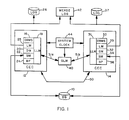
- FIG. 1 illustrates a multi-user data sharing environment in which the invention is practiced.
- a database (DB) 10 may include one or more direct access storage devices (disks) for permanent (non-volatile) storage of data.
- Data is stored to, and obtained from, the DB 10 by a plurality of central electronics complexes, two of which are indicated by 12 and 14.
- Each of the CECs serves one or more database users and includes for this purpose suitable database management functions.
- the CEC 12 includes a database management system (DBMS) 16 having a data manager (DM) 20, a buffer manager (BM) 22, and a buffer pool (BP) 24.
- the DBMS 16 maintains a log 26.
- the CEC 14 includes DBMS 30 with DM 32, BM 34, BP 36, and a log 37.
- the different DBMSs are identical, and are also referred to as "instances" of each other.
- Access to units of data stored in the DB 10 is managed by a locking system including local locking managers (LLMs) 18 and 31 and a global locking manager (GLM) 40.
- LLMs local locking managers
- GLM global locking manager
- Locking is managed by the GLM 40 in conjunction with the LLMs.
- a transaction will request access to an identified unit of data. This request is passed by a message through the DBMS where the transaction is executing. Implicit in the request is a request or a lock, which the DBMS 16 passes to its local lock manager.
- the LLM forwards the lock request to the GLM.
- the GLM receives and processes grant requests from its LLMs and processes the requests, granting locks by means of messages returned to the requesting LLMs.
- the lock management arrangement of Figure 1 provides global locking functions, but does not perform I/O on the DB 10 when the locks are granted.
- Inherent in the global locking management function is the ability of the lock manager (comprising, for a DBMS, its LLM in conjunction with the GLM) to determine and identify any other DBMS having an updated version of a unit of data for which a lock is requested. Further, given a message and a lock name, the lock manager can send the message to the current holder or holders of that lock. This is termed a "notify" message.
- the DBMS instances 16 and 30 can comprise currently available systems which operate in conjunction with a global locking function. It is assumed that these instances communicate with a lock manager by means of messages.
- An implementation of the invention enhances the DBMSs to provide a new and useful method for detecting dirty pages and effecting the memory-to-memory transfer of detected dirty pages without the need for conducting I/O operations with the DB 10.
- each DBMS instance has its own log manager which maintains its own log to which log records are first written.
- the log manager (LM) 25 manages the log 26.
- LM 35 manages log 37.
- a merge log function produces a merged version of the local logs (the "merged log” 42 in Figure 1). This function can exist in any CEC in the complex.
- a log manager associates with each log record a log sequence number (LSN) which is a monotonically increasing value.
- LSN log sequence number
- an LSN can comprise a timestamp, requiring that the clocks in the multi-user data sharing complex of Figure 1 be synchronized by a system clock 44.
- the invention employs a physical (P) lock on a page to serialize the updating of that page by multiple systems and employs a logical (L) lock on a record.
- Logical locks are held for the duration of a transaction, while physical locks need to be held only as long as the system is holding a page in its buffer pool.
- P locks are acquired by a buffer manager (BM) on behalf of the transaction system, while L locks are acquired by the data manager (DM) on behalf of individual transactions.
- BM buffer manager
- DM data manager
- locking modes include S and X, explained above, and U for "update".
- the update mode permits other systems to acquire S mode locks, but bars all other locks until the updating transaction is completed.
- P locks will be conditioned to either the S or U mode, while L locks will be conditioned to the S or X mode.
- the different elements of Figure 1 are directly connected to one another by way of high speed communication links over which the systems communicate by a conventional message-passing protocol.
- the CEC 12 communicates with global lock manager 40 over high-speed link 51a, while link 51 b connects the GLM 40 with the CEC 14.
- Direct connection between the CECs 12 and 14 is provided by high speed link (comm-link) 50.
- Direct shipping of a page between the CECs 12 and 14 is by way of the link 50.
- this is done by employing a datagram protocol which provides no delivery gurantees. This is important to assure that the cost of shipping a page directly is minimal.
- the CEC 12 is illustrated with a substantial amount of detail and with the understanding that the explanation applies equally to the CEC 14 which is shown with a minimum complement of functions.
- the GLM 40 is an N-way manager which performs lock management functions for a plurality of LLMs including those in the CECS 12, 14, and 70.
- executing transactions access data by way of the local instance of the DBMS.
- a requesting transaction (TX) 80 obtains access to data in the database in a conventional manner through the DBMS 16.
- the TX 80 when it requires access to a record for reading or updating, it passes a request to the DBMS 16 where the data manager 20 passes a request for an L lock to the local lock manager 18.
- the requested record is retrieved by the buffer manager 22 from the buffer pool 24, either from a page already resident in the pool, or from a page transferred into the pool from another DBMS or from the DB 10.
- Each page in the buffer pool 24 has a buffer control block BCB, one of which is indicated by reference numeral 85.
- the BCB 85 includes a plurality of information fields 85a-85n.
- the field 85a names the page.
- the field 85b (VRSN) holds the version number of the page controlled by the block.
- the field 85c (DONGJ/0) indicates whether the page is being obtained by an I/O process from the DB 10.
- the field 85d (NEW_PAGE_REQ) indicates whether or not a new version of the page must be brought into the buffer pool 24.
- the field 85e (PAGE_USABLE) indicates whether the current version of the page is usable.
- the field 85f (DATA MOVED) is set when the page is moved into the buffer pool after it is received from another DBMS.
- the field 85g indicates whether a U-mode P lock is held on the page, while the field 85h (U_LOCK_REQ) indicates whether a U-mode P lock has been requested for the page.
- the field 85j (WAIT _QUEUE) indicates whether transactions served by the DBMS are queued to wait for access to the page.
- the field 85k stores a recovery log sequence number (RLSN) which is the earliest log point where scanning must commence to recover the page.
- the field 851 (PAGE_DIRTY) signifies whether the page has been updated since it was read from disk.
- the field 85n is a pointer (PTR) to the page. In this case, the page is denoted as page P1 indicated in the buffer pool 24 by the reference numeral 90.
- the format of a page in the practice of the invention includes at least a field 90b for containing a value (VRSN) for the version of the page represented by the copy in the buffer pool, and at least one record field.
- the page 90 has two record fields, 90c and 90d, holding, respectively, records R1 and R2.
- the buffer manager also maintains a queue of pages which have been updated, called the "dirty" queue 92 on which are queued updated pages 93 and 94.
- a latch with two modes for each page is managed by the BM 22 for an executing transaction.
- this latch indicates, respectively, that an X or S mode latch has been acquired on page P1.
- a latch field (L) 82 is provided in the BCB to indicate the condition of the latch.
- the local lock manager 18 manages a lock table 81 where, for each cached page, a record is maintained indicating the existence and mode of a P and one or more L locks.
- the format is indicated by reference numeral 83.
- the global lock manager 40 maintains a global lock table 100 containing entries for locks which have been granted to local DBMS instances.
- An entry for P lock in the global lock table is indicated by reference numeral 103 and includes, at a minimum, fields 103a-103e.
- the field 103a identifies a locked page.
- the field 103b contains a value RLSN for the page and field 103c contains the VRSN number for the page.
- a holder of the lock is identified by the field 103d (HLDR), and the locking mode of the holder is indicated by the field 103e (MODE).
- An entry for L lock is shown by reference numeral 102 and includes, at a miminum, fields lock name, mode and holder.
- each DBMS includes a process 105 (PAGE_TRANSFER) to assemble and send a datagram transferring a page.
- Each DBMS also includes a data reception (DATA_RCV) process for receiving and caching the transmitted page.
- PAGE_TRANSFER a process 105
- DATA_RCV data reception
- a requesting transaction 80 in the CEC 12 requests access to a record in a page.
- the DM 20 receives the request and formulates an L lock request for the record.
- DM 20 invokes fix_page procedure of BM22.
- the page with the requested record is not in the buffer pool 24.
- the BM 22 on noticing that the page is not in the buffer pool, will issue a P lock request for the page.
- This P lock request triggers the lock management to invoke a page_transfer procedure in the system owning the page. If the page is buffered and a more recent version is needed, a notify message to the BM in the owning system will cause transfer of the page.
- the BM in the owning system converts its P lock, if required, so that the P lock of the requesting BM is granted.
- the fix_page processing proceeds according to the particular scheme employed to transfer the page.
- the record lock requested for the transaction is an L lock, while the page lock requested by the BM is a P lock.
- the transaction acquires an S mode L lock on the record, while its BM acquires an S mode P lock on the page before entering it into the buffer pool 24.
- the P lock is held as long as the page remains cached in the buffer pool.
- the transaction requests an X-mode L lock on the record.
- the BM must obtain a U-mode P lock on the page.
- the U-mode P lock must be held by the BM for so long as the page remains dirty and cached by this buffer manager.
- the BM of the DBMS owning a dirty page acquires its U-mode P lock to update the page, it declares to its LLM that its page_transfer procedure may be invoked if (1) there is an intersystem lock conflict caused by another system seeking to update the page or (2) a requestor in another system makes a non-conflicting lock request for the purpose of reading the page. In either case, the page_transfer procedure of the owning BM will make the page available to the requestor.
- the lock management mechanism responds by granting the record lock and the VRSN value of the page.
- DM passes the VRSN value received to BM on the fix_page call.
- the BM checks its buffer pool to determine whether it has a version of the page and, if so, compares the VRSN value received from the lock mechanism with the VRSN value in its version of the page. Assuming it has a version of the page, and that its VRSN number is greater than or equal to the received VRSN number, the requestor BM will not acquire the dirty page from the owner. If, however, the received VRSN value is greater than the VRSN value for the page version possessed by the requestor BM, the page_transfer process of the owning BM is invoked via a notify message and the page is transferred to the requestor's BP.
- the owning BM writes the page to disk. After the write is complete, the owning BM may convert its P lock depending upon the mode of the requested lock. Then the lock mechanism grants the lock to the requestor and the BM in the requesting system reads the page from disk.
- This scheme is not preferred by the inventors, but is offered to illustrate a simple transfer scheme which can be employed when conditions permit.
- This scheme is not preferred because it requires a lock message from the lock management to the owner BM and a DASD I/O by the owner to write the page to disk. Assuming that the WAL protocol is observed, the write I/O will force log processing. Also required is a message from the owner to the lock management for response to the page transfer and a disk I/O by the requesting BM to read the page from disk.
- the BM of the owner writes the requested page to disk and concurrently transfers the page to the requesting BM.
- the write to disk is done only if the request is for a U-mode lock.
- the owning BM may downgrade its P lock, following which the lock management grants a lock to the requesting BM.
- a read I/O by the requesting BM is avoided by transferring the page to the requesting BM.
- the datagram protocol does not guarantee that the requestor will receive the transferred page. In case of a system failure, only the failed system's log is needed to cover those dirty pages held in the failed system's buffer pool.
- the page may arrive before the P lock is granted to the requestor.
- the page may arrive long after the P lock is granted, in which case, the page may have been already cached by the requestor upon being read from the disk.
- the page may arrive after the requestor BM obtained the P lock, read the page from the disk, allowed it to be modified, wrote to disk, and purged it from its buffer pool.
- the first case is the normal one, that is, that the page will be transferred to the requestor buffer manager before its P lock request is granted.
- the buffer control block (BCB) 85 illustrated in Figure 2 which will have already built when P lock is requested.
- the BM 22 will request a U-mode lock on the page if not already held with COMM-LINK transfer option of NO, and then initiate a read I/O from the DB 10.
- the DONGJ/0 flag in field 85c of the BCB will be marked to indicate that the page is being read from the DB 10.
- the inventors have not provided a timeout mechanism to re-request the page from the owner.
- the requestor since the P lock was granted to the requestor after the owner wrote the page to the DB, the requestor will obtain the current version of the page from the DB. Subsequently, if the transferred page arrives and there is already a cache version, the transferred version is discarded.
- the owner BM does not write the dirty page to disk during page transfer.
- This scheme requires only three messages, that is, a lock manager's message to the owning BM, a message to send the page, and a response message to the lock manager from the owner. No disk I/O is required.
- the fast scheme provides better response time and concurrency than the simple and medium schemes. However, this scheme complicates page recovery since a dirty page can be transferred from one system to another and can contain updates from more than one system. In the simple and medium scheme, a dirty page contains updates from only the owning system. Hence, with the fast scheme, a merged log of all systems is required to recover a page.
- a dirty page is transferred from an owning to a requesting system without writing it to disk. If, as a result of this, the page's ownership is a so transferred, the transferring BM can remove the page from its dirty queue.
- the page can contain committed and/or uncommitted updates from multiple systems.
- ownership of the page is transferred to the receiving system. In the fast scheme, it is the receiving system's responsibility to write the page to disk. The owner is also responsible for recovering the page in case it fails before writing the page to disk. Of course, ownership may be further transferred without invoking recovery or writing the page to disk.
- a dirty page may contain non-externalized updates (that is, updates not entered into the disk version of the page from multiple owners)
- the transaction system which first dirties the page records the recover-log sequence number (RSLN) in the corresponding field of the lock record maintained by the global lock manager 40.
- This RLSN value is the earliest log point in the merged log from where the log must be scanned to redo the changes logged for the associated page in case the current owner of the page fails before writing it to disk. Maintaining and tracking the RLSN are discussed below.
- the log sequence number of the page's earliest unapplied (to the disk version of the page) log record is not used in computing restart recovery point checkpointed by the previous owner. For example, if there is only one dirty page in system S1 and its ownership is transferred to system S2, the next checkpoint in S1 would result in a recording of the restart recovery point to be the start of this checkpoint as opposed to the RLSN of the dirty page. However, the RLSNs of all the pages which are owned by a recovering system must be used in the calculation of the recovery point.
- This is an environment-wide checkpoint of what is effectively a dirty page list.
- This checkpoint is used to determine the restart recovery point when an environment-wide or complex failure occurs.
- the checkpoint can be implemented by having one transaction system run a low priority process which periodically queries the global lock table 100 and records the IDs and RLSNs of those pages for which U locks are being held. The lowest recorded RLSN is thus used to compute the restart recovery point during an environment-wide restart.
- a final consideration of the fast page transfer scheme concerns transfer of the page by way of the link 50.
- a short_message is sent to the requestor with the lock grant announcing the presence of the dirty page in the owner's buffer.
- the usage of a stale version of the page is avoided in the same way as in the medium scheme.
- the requestor if a stale version of a page is cached or the page is not received by the time the lock is granted, the requestor cannot read the page from disk and use it as it is.
- the requestor must first obtain a U-mode lock if it has not already become the owner as a result of obtaining the P lock.
- the requesting system submits in its lock request that the page be written to disk by the previous owner.
- the owner If the owner has not failed, it writes the page to the disk, from which the requestor can obtain it. If the current owner has failed, this permits the requestor to recover the page. Recovery in this case involves reading the older version of the page from the disk and applying the log records from the merged log to bring the page up to date. The log would be scanned from RLSN to the LSN when the owning system failed. An upper bound for the latter can be obtained by the new owner by noting, at the time it becomes the owner of the page, what the LSN would be if a new log record were written at that precise moment.
- the owning BM is not required to force its log up to the LSN of the page before transferring it.
- the cost of a page transfer is three messages, no disk I/O, and no log force.
- this scheme requires the tracking of the LSN values associated with the page on a per-system basis for all systems where the page has been updated since it was obtained from disk.
- the LSN to be remembered is the LSN of the page as it was transferred by that system to some other system.
- the page can be written to disk only after all the updating systems have forced their respective logs up to the LSNs being tracked. This is required since it is assumed that each system has its own log which makes the log force of each system independent of those of the others.
- Tracking of log records for a sequence of systems can be accomplished according to the following procedure.
- a certain number of slots in the BCB for the dirty page can be allocated, each slot being used to track the LSN at the last log record written by each one of the systems which updated the page.
- an updating system notes the LSN of the log record just written for the page. Otherwise, the system follows the fast scheme, described above. That is, it would force the log before transferring the page. If a dirty page's ownership is transferred without some updating systems' logs having been forced to the requisite points, then the information in the slots is passed on to the new owner along with the page.
- each system would, on a periodic basis, register with the GLM 40 the highest LSN up to which that system's log has been externalized by transfer to stable storage. This highest LSN is referred to as HI-LSN.
- GLM 40 would forward Hl_LSN S of other systems when it send a message to a particular system. If the log is not already known to have been forced up to the required LSN in another system, the current owner sends a message to that system and requests it to do so.
- the lock management also assists in maintaining page coherency.
- the global lock table records include a VRSN field for each lock. This field contains, for example, the LSN of a page and is in addition to the RLSN field, the log point for page recovery.
- the VRSN field is initialized by the lock manager to zero and the value in this field is replaced in the global lock table 100 only when a VRSN provided by a system is greater than the existing value.
- the lock management accepts a list of page lock names and their associated VRSNs.
- the transaction system issues an unlock request to release all of the locks for a transaction, it may also send a list of page lock names of updated pages and those pages' version numbers to the lock manager in a field included in the unlock request.
- the purpose of passing this list with the unlock request is to register the version numbers of the updated pages so that other systems that may have cached those pages may easily verify the currency of their pages.
- a list of page lock names and their current version numbers is maintained by the owner system. Such a list is indicated by a reference numeral 120 in Figure 2 the indicated list being under control of the buffer manager 34.
- the list 120 is maintained by the buffer manager 34 as page updates are performed; alternatively, it can be generated at transaction termination time by scanning the buffer pool for the dirty pages.
- the buffer manager 34 maintains the list on a system-wide basis. When the buffer manager steals a page, it passes the VRSN of the page with its unlock request for P lock. When the lock management receives the unlock request, it enters the value in VRSN field for the lock.
- a transaction may pass the VRSN for a page which it has not updated, since the system-wide list may contain the page_ID of a page updated by another uncommitted transaction. Also, a transaction may not pass the VRSN of a page which was updated by it since this number may have already been passed by another transaction or by the buffer manager.
- the lock management mechanism updates the supplied VRSNs before processing the unlock request in which they were received.
- lock requests can be generated on behalf of either a transaction or a buffer manager.
- the requested locks are L locks, when the latter is the requestor they are P locks.
- Lock requests are sent in the form of multi-field messages via the local lock manager to the global lock manager.
- a requestor is notified of the grant of a request in the form of a message forwarded from the GLM 40 through LLM of the requesting transaction or the buffer manager.
- short_messages are always passed to the grant messages
- unlock requests are sent by the system owning a lock via its local lock manager to the GLM 40.
- the lock management mechanism provides a verify option in conjunction with a lock request.
- the verify option returns the VRSN of the named page in response to a lock request.
- the verify option is used by the DM to ensure that it is reading or will read the correct version of the page in case an older version of the page is already cached in the BM's buffer pool.
- the VRSN value is looked up by the lock manager after the record lock is granted and is provided with a lock-granted message.
- the VRSN value provided in response to the verify option and a lock request is returned as a short_message.
- the short_message is returned with a granted L lock, it is referred to as an L_short_message.
- the L_short_message that was given to the original lock requestor must be provided to the new requestor.
- the local lock managers have the capacity to pass the L_short_message given to T1 with the lock for R1 to T2 also.
- the L_short_message is used in fix_page processing to determine whether or not the requestor can use an already-cached version, if any, of a requested page. If a cached page is not current and the requestor needs a more recent version of the page, then its BM needs to obtain a new version of the page.
- the lock management mechanism provides a notify option to send a message to a system which holds a lock in a certain mode. The BM would use this option to obtain a new version of the page from the owner, if there is one.
- the BM would note in its BCB that a new version has been requested by an entry into the NEW_PAGE_REQ field (85d in Figure 2), so that a subsequent requesting transaction which requires a more recent version than the cached version of the page will be suspended until the new version arrives. Transactions whose VRSN in L_short_message is less than or equal to VRSN of the cached page can continue to use the cached version of the page. If lock management indicates that there is no owner in existence for the page, the inference is that the disk version of the page is the latest one. In that case, the BM would read the page from the DB 10.
- the P_short_message acknowledges a request for the page transfer. If the owner is surrendering ownership during this operation, then the lock management updates the VRSN value of the page in the global lock table.
- the short_message includes a flag field owner_exists which indicates whether or not an owner exists for the page. This flag is set by the GLM 40. If there is no owner for a page for which a P lock or newer version has been requested, then the GLM 40 creates the P_short_message and includes the VRSN value that it has for the page. When there is no owner, the global lock table 100 will already have an entry for this page if at least one system is already holding an S lock on the page.
- the VRSN value could be non-zero as a result of the page having been updated and then the U lock having been surrendered by the updating system after the updater caused the GLM 40 to update the VRSN value in the global lock table 100. Otherwise, the VRSN number will be zero due to the fact that the global lock table entry would have been created as a result of the current lock request. In this case, as mentioned before, the VRSN field will be initialized with the value of zero.
- a transaction in the requesting system requests some data, in response to which the DM in the requesting system issues an L lock request for the record.
- Lock Manager grants the L lock with L_short_message.
- DM issues a fix_page request to BM with L_short_message as parameter if the request is for reading a record.
- L_short_message is not passed if the request is for updating the record in the page.
- the rational for passing L_short_message for the read case is to ensure that BM must provide a page in the bufferpool which has VRSN greater or equal to VRSN in the L_short_message.
- BM has to get the latest version of the page.
- the BM has to get the latest version of the page, so L_short_message need not be passed in that case.
- the BM if the page is not already cached, the BM requests a P lock on the page. In this case, the page is either owned, or not by another system.
- the lock management would invoke the page_transfer procedure in the owning system.
- the inputs to the fix_page processing are page_ID, request_type (read or update) and, possibly, L short message.
- the S and X latches are used during page accesses to provide physical consistency of the page's contents.
- the S latch 83 is used during reading access to its associated page and the X latch 82 during an update operation on the page.
- the BM always returns to the requesting transaction with the appropriate latch. The BM will always try to locate the BCB for the identified page. Consider two primary cases: (1) the BCB for the page does not already exist and (2) the BCB does exist.
- the BCB does not exist, implying that the page is not cached.
- the BM 22 allocates a buffer, builds the BCB 85 and marks the BCB field 85e to indicate that the page is unusable, sets the field 85f to off and requests a P lock on the page.
- the PAGE_UNUSABLE mark lets subsequent fix_page issuers know that no usable version of this page exists.
- the DATA MOVE flag indicates at a later point in the processing whether the DATA_RCV process has received a copy of the page and cached it.
- a P lock is requested by the BM 22 in S or U mode, depending upon the request.
- the requested lock mode is indicated in the BCB by setting the U_LOCK_HELD field to no and the U_LOCK_REQ field appropriately to no or yes.
- the BM receives a P_short_message with it. If an owner of the page exists, this message would have been generated by the owner, otherwise by the GLM 40.
- the BM 22 S-or X-latches the page depending upon the request. If the U lock was obtained, fields 85g and 85h are updated.
- the BM 22 turns the PAGE_USABLE field 85e on and awakens any transactions that might have entered the wait state pending arrival of the page.
- the BCB is marked PAGE_UNUSABLE,DOING_I/O to indicate that an attempt is in progress to obtain a page from DASD.
- the marking prevents the DATA_RCV procedure from modifying the page while the I/O is in progress.
- the BM 22 will S- orX-latch the page, depending upon the type of request and return to its caller.
- next an I/O is initiated to read the page from disk.
- the PAGE_USABLE field is set to yes in the BCB
- the DOING_I/O field is set to no
- the NEW PAGE REQUESTED flag is set to no; now, any existing waiting transactions are resumed and the call returns.
- the BM 22 inspects the BCB PAGE_UNUSABLE field. If this field indicates that the page is unusable, then the implication is that no usable version of the page is currently cached and that some other transaction is already attempting to obtain a usable version of the page. In this case, the current transaction will queue itself on the WAIT QUEUE and suspend execution. The transaction will be resumed when the page becomes usable. The remainder of the fix_page processing depends upon whether the requested lock is for an update or a read of the page.
- the BM will latch the page in the X mode by setting the X latch in the local CEC. Unlike in the case of a read request (explained below) in response to an update request, the BM does not pay attention to the L_short_message since it needs to ensure that the latest version of the page is in the local buffer pool before an update of the page can be allowed. If a U-mode lock is already held on the page, then the fix_page process returns to the caller immediately. If no U-mode lock is currently held, but has been already requested in response to another transaction's fix_page request., then the current transaction suspends itself, waiting for a grant of the earlier transaction request.
- the X latch is released and a U-mode P lock is requested after appropriately marking the U-_LOCK_REQ and NEW_PAGE_REQ fields of the BCB, thereby letting others know that a U-mode lock and a new version of the page has been requested.
- the U-mode lock request is sent as a message by BM to the lock management.
- the VRSN value of the cached page could be sent. This could be useful if it helps the current owner (assuming there is one) to discover that the requestor already has the latest version of the page. The owner can compare the VRSN values and elect not to transfer the page if the requestor's version is the current one.
- the BM Upon a grant message from the lock management granting the U-mode lock, the BM updates the BCB by clearing the U_LOCK_REQ field and setting the U_LOCK_HELD field. At this point, the page is X-latched (by the BM setting the X latch) and a check is made to ensure that the latest version of the page is already present in the buffer pool.
- the message sent by the GLM 40 to grant the U-mode lock is accompanied by a P-_short_message containing the VRSN value in the global lock table 100.
- the BM receives the messages, it sets the X latch and compares the VRSN value received with the VRSN value of the version of the page in the buffer pool. If the VRSN value of the local page version is less than the VRSN value received, the PAGE_UNUSABLE and DOING_I/O fields are set in the BCB, and the PAGE_RECOVERY routine is used to read the page from DASD.
- the page will be latched in the S mode by setting the S latch for the page.
- the BM does pay attention to L_short_message received with the lock grant message since the version of the page made available to the transaction does not always have to be the most current version. All that is required is that the version be at least as recent as that indicated by the page VRSN value present in the L_short_message.
- the S latch is set before comparing the VRSN value in the BCB with that received in the message. If the message value is smaller than or equal to the BCB value, then the fix_page processing returns to the calling transaction.
- a request for a new version of the page is issued, if such a request has not already been issued on behalf of another transaction.
- the request is made by issuing a notify_message to the owning DBMS.
- the notify_message will cause the owner to send a P_short_message which is delivered by way of LLM/GLM/ LLM. If no owner exists, the GLM will generate the message and send it via GLM/LLM.
- the transaction suspends while listening for the arrival of the P_short_message. Since the transaction has issued a read request, even though the medium fast page transfer scheme may be in effect, the owning DBMS does not write the page to disk in addition to transferring to the requestor.
- the transaction once resumed by receipt of a P_short_message from lock management will obtain the S latch on the page and check to see if the desired version of the page has arrived by comparing the page VRSN value with the VRSN value in the L_short_message. If the desired version has arrived, the call returns. Otherwise, the MUST_RECOVER field is set to the same value as the owner exists flag in the P_short_message. At this point, the page_recovery routine is invoked to obtain the required version of the page.
- the procedure When the page_transfer procedure is invoked in the BM of the DBMS owning a page, the procedure will first fix and S latch the page. This latching is required to transfer a consistent version of the page. If the page is dirty, a U-mode lock request has been submitted by the requesting system, and a write I/O for the page is not already in progress, then the owner BM will initiate an I/O for writing the page to disk. If COMM_LINK_TRANSFER is requested, the page will be transferred directly to the requestor. If a write I/O for the page is in progress, and the requested lock mode is U, then the procedure waits for the I/O to complete.
- a request to downgrade the P lock to the S mode is prepared by the owning BM and the new lock state is noted in the BCB of the owner BM.
- the page is unlatched and unfixed.
- the procedure then returns the P_short_message to the lock management, which forwards it to the requestor.
- the owner submits a lock downgrade request. If the requestor seeks a U-mode lock, then the page transfer procedure also passes the VRSN value of the page via LLM/ GLM/LLM, allowing the GLM to update the VRSN value in the global lock table entry for this page.
- the BCB does not exist, the implication is that the arrival of a previously requested page has been delayed. Since the P lock request or a notify call from fix_page triggers every page transfer, the BCB would exist if the requested page had arrived in a timely manner. If the BCB does not exist when the data_receive procedure is invoked, the received page is discarded.
- Movement of the page by the procedure is indicated by the DATA MOVED flag in the BCB. If this flag is marked "on", the page is cached in the buffer pool.
- the data_receive procedure must compare the VRSN value of the received page with the value in the BCB before overlaying it on the cached page. This is because of the uncertainty of the timely arrival of pages.
- the received page will be discarded if its VSRN value is less than or equal to the VSRN value of the cached page. Otherwise, it will be copied over the existing version. Because of record locking, a more recent version of an already cached page may arrive. One reader might have read a record from the cached version while another one requires a more recent version of the page for another record. The latter will trigger the transfer of the more recent version via a notify call to the owner from the requestor via the lock management.
- the data_receive procedure Before overlaying an already cached page, the data_receive procedure X-latches the page to ensure that no transaction is actively reading the old version of the page. Multiple date_receive procedures are also serialized by the X latch on the page.
- the data receive procedure is invoked when a page sent by the owner arrives and, when invoked, it locates the BCB for the page.
- the page will be discarded immediately for the following cases: (1) the BCB does not exist, (2) the BCB DOING_I/O flag is set, or (3) in the BCB, the PAGE_USABLE indication is ON and the NEW PAGE REQ flag is OFF.
- the data_receive process will X-latch the page.
- the procedure will immediately unlatch the page if the DOING_I/O, DATA_MOVED, or PAGE_USABLE field of the BCB is set. Otherwise, the procedure will copy the page, turn on the DATA_MOVED flag in the BCB, unlatch the page, and return.
- the DATA_RCV procedure will X-latch the page. Then, if the DOING_I/O flag is on or the NEW PAGE_REQ flag is off, or if the VRSN value of the received page is found to be less than or equal to the VRSN value of the cached page, the procedure will set NEW_PAGE_REQ to off, latch the page and return. Otherwise, it will copy the page. If U_LOCK_REQUESTED is off, the procedure will wake up the transactions queued on the WAIT_QUEUE after setting NEW_PAGE_REQ to off. Then, the procedure will unlatch the page and return. If the U-mode lock has been requested, then the wake up will be the responsibility of the transaction receiving the U-mode lock.
- FIGS. 2 and 3A-3C for an example showing use of the VRSN value in connection with record locking to detect the presence of a dirty page in an owner's buffer pool when the page is requested by another system.
- the page P1 does not currently reside in any buffer pool, but that it is available on disk.
- a transaction Tx2 in the CEC 12 requests a read on a record R2 in the page P1, in response to which its DM 20 in step 202 sends a lock request message for an S-mode L lock to the LM 40 by way of its LLM 18.
- Accompanying the lock request is a verify request asking for the current value of VRSN for the page P1 which contains R2.
- the BM 24 in step 209 begins fix_page processing according to case 1 in Table I building a BCB for P1 and sending a message requesting an S-mode P lock.
- the message sent requesting the P lock elicits a grant message from the lock manager in step 210which includes a P short message.
- the P_short_message has two relevant fields: OWNER EXISTS and VRSN value. In this case, absence of a U-mode lock causes the first field to be set to "NO", while lack of an update causes the second field to be set to 0.
- the fix_page processing begins step 5 (Table I), and executes substeps a-f by calling the page_recovery routine and obtaining the page P1 from the disk.
- step 221 slightly delayed from the acquisition of the page P1 by the BM 24, the L_short_message received in step 207 by the DM 32 in the DBMS 30 of CEC 14 is passed to the BM 34 in a fix_page call.
- the BM 34 does fix_page processing according to case 1 in Table I, building a BCB for P1 and sending a message requesting a U-mode P lock. This request results in a grant from the lock manager which includes a P_short_message. Since the existing P lock on page P1 held on behalf of the BM 24 is an S-mode lock and the page has not been updated, the GLM sets the OWNER EXISTS field to NO and the VRSN value to 0.
- step 224 the fix_page processing of the BM 34 goes to step 5 of Table I, executes substeps a-f, and obtains the page P1 from the disk.
- the VRSN value of the page P1 is still 98.
- the transaction Tx1 in step 225 updates the record R1, obtains the log value for LSN resulting from logging of the update and updates the VRSN fields of the BCB and the page.
- the VRSN value is updated to 99 and the BCB and new version of the page P1 in the buffer pool 36 of the CEC 14.
- the transaction is then committed and then an unlock request message is sent to the lock manager requesting release of the L lock on R1 and for P1 providing the VRSN value of 99 resulting from the update.
- the GLM 40 changes the VRSN value and the corresponding record of P1 and then processes the unlock request, releasing the L lock on R1. Note that the U-mode lock held by the BM 34 which is entered into the MODE field of the corresponding global lock table record has not been released.
- a dirty version of page P1 is cached in the buffer pool 36 with a VRSN value of 99, this value will have been entered into the lock record for the page P1 in the global lock table, and an earlier version of the page (number 98) has been cached in the buffer pool 26 of the DBMS 16.
- any lock or verify request received by the GLM for the page P1 will be provided with a trail in the form of a VRSN value in the lock record for the page P1 in the global lock table as long as P lock is held on P1 by any system.
- the lock record will record the owner of the U-mode P lock; in this case the owner is BM 34.
- a third transaction Tx3 in CEC 12 causes DM 20 to issue an L lock/verify request in step 229 to obtain a lock on record R1 and verify VRSN for P1.
- the GLM 40 checks the global lock table, finds the entry for record P1, obtains the updated VRSN value of 99, and sends a grant/L_short_message back to the DM 20.
- the DM 20 in step 233 passes the VRSN value to BM 24 which executes case 2 of its fix_page process in step 235.
- step 3 Since the page is usable and an update request has not been received, processing begins at step 3 of case 2 of Table I, the page is S-latched locally and the VRSN value is checked against the VRSN value in the BCB. Since the VRSN value in the L-_short_message is greater than the value in the BCB, step 5 is executed. At this point, the need for a new version of the cached page is detected and the processing is directed to transferring the new version of the page into the buffer pool 26.
- step 5 of Table I the S-latch is released, it is assumed there are no contending requests submitted to the DBMS 16 for page P1 and the processing proceeds to step 5.c. Assume that the steps 5.c.1) and 2) are completed.
- step 5.c. step 237 of Figure 3B
- the BM 24 issues a notify addressed to the owner (BM 34) of page P1 via GLM 40. The notification is to "send the page”. Now the processing suspends until the P-_short_message is sent. The notify message is forwarded through the lock management in step 239 to the BM 34 and initiates its page transfer process, described in Table II. Refer now to Figure 3C.
- step 241 in response to the notify forwarded to the BM 34, BM 34 locates the page in the buffer pool, S-latches the page and moves to step 3. In this case the page is dirty but the request is for an S-mode lock so step 3 is skipped.
- step 4 the COMM_LINK_TRANSFER default setting is "yes". Assuming default setting, the page P1 is copied, control information required is set up and the page and the information is sent to CEC 12 via comm link 50 in step 245. In this example, steps 5 and 6 of Table II are skipped, in step 7, the page is unlatched, in step 8, the page is unfixed, in step 9 of Table I, a P_short_message is sent through the lock management to the CEC 12.
- the BCB for page P1 does exist when the data_receive procedure is invoked because of the previous transaction, the page is marked as "usable" in the BCB PAGE_USABLE field.
- the process considers whether the page is more current than the cached version by comparing version numbers in step 252 of Figure 3C. In this example, this is precisely the prevailing condition. In this case, case 2 of Table III is followed (step 255 of Figure 3C) since the prior version of the page in the buffer pool 24 was usable.
- step 5 the page is unlatched the waiting transaction is awakened and the process is exited.
- step 5.c. 3 of Table I (step 257 of Figure 3C)
- the page is S-latched and the version number in the buffer pool is compared with that received in the L_short_message in step 259 of Figure 3C. If the message value is greater than the value in the BCB, the assumption is that the new version did not arrive, requiring recovery of the page (step 262 of the Figure). Otherwise, the page has arrived, been entered into the buffer pool, its VRSN value updated, and the page is therefore available to the suspended transaction.
- a page involved in redo recovery (i.e., a page for which the U lock was held at the time of system failure) is transferable to any other system which needs it after the redo pass is completed. If the failed system is in its restart recovery, then LM would queue the incoming remote lock request until the failed system indicates that its page-transfer procedure is enabled. The transaction system would enable the page-transfer procedure at the end of the redo pass (i.e., after "repeating history" for all the missing updates).
- the RLSN is assigned by the DBMS and tracked by lock management, BM assigns and tracks RLSN in the BCB when a U-mode lock is requested for a page or whenever the page's state changes from nondirty to dirty.
- the BM chooses as RLSN the LSN that would be associated with a log record if it were to be written now (essentially the end-of-log LSN).
- LLM and GLM initialize the RLSN field of a lock table entry to the maximum number that can be stored in that field (referred to as Hi-Value).
- Hi-Value An RLSN value of Hi-Value for a page implies that no recovery is needed for that page.
- the P lock request When a U-mode lock is requested for a page, the P lock request would include the RLSN value assigned by BM. BM would request that the value be set conditionally by lock management. Lock management (LKM) would set its RLSN to that value if the current RLSN value at LKM is Hi-value. This means that when a dirty page's ownership is being transferred from one system to another, without the page being written to disk, the RLSN value at LM is not modified. In any case, LM would return to BM the RLSN value that it has after processing the lock request.
- LKM Lock management
- BM in the owning system pushes the RLSN forward after writing the page to disk but before it is dirtied again by asking LKM to set RLSN to Hi-value unconditionally.
- BM would have to first update RLSN at LKM before allowing the update to take place.
- the RLSN can be pushed after the page becomes dirty again to the higher value tracked in the BCB without the value being set at LKM to Hi-value in between. Pushing the RLSN forward is not required by the methods presented here. This is an optimization to reduce the range of the log that would have to be scanned in case a failure happens and the page needs to be recovered.
- fix_page The inputs to fix_page are the same as for the Medium speed scheme.
- the processing is similar to that for the Medium scheme except for the following:
- a dirty version of a page may be transferred when the U lock is requested, such a page is queued in the Dirty_Q after the page is marked usable.
- the Medium scheme would be used. Typically, this option would be used when the lock is requested in U mode to make the owner write the page to disk. Otherwise, the procedure would first fix and S latch the page. This latching is required to transfer a consistent version of the page. If the page is dirty, the U-lock is requested by the other system and a write I/O for the page is not in progress, then, if necessary, the log is forced up to the LSN of the page and the page is removed from the Dirty_Q.
- the page is shipped directly to the requesting system along with the control information.
- write I/O for the page is in progress and the mode of the requested lock is U, then the procedure waits for the I/O to complete.
- the requested lock mode is U, then the request to downgrade the P lock to the S mode is prepared and the new lock state is noted in the BCB.
- the procedure will also pass on the LSN of the page for lock management to update the LSN value in its lock table for this page.
- the page is unlatched and unfixed.
- the procedure then returns to LM with the P-Short-message and, possibly, the downgrade request.
- the lock management for a DBMS was described above as consisting of a GLM in conjunction with a local lock manager for the system.
- a back-up GLM would be defined for monitoring the state of the primary GLM to determine when to take over the functions of the primary.
- the back-up GLM communicates with all LLMs to reconstruct the global lock table information.
- the GLM notices that an LLM has failed, it will release all the locks held by the failed LLM except those which the LLM has specifically asked to be "retained”.
- the global lock table of the GLM is periodically checkpointed.
- GLM can grant the lock to the other system along with the message "You Recover the page". This improves availability to the data. GLM can indicate the need for recovering the page before its use via the P-Short-message which is sent to the requestor. With this enhancement, if only the S-mode lock were requested, then GLM will grant the U-mode lock.
- the P-Short-message would have the following additional information:
- the requestor can query the system merging the local logs to determine the End-LSN of the failed system that held the U lock. As before, the RLSN kept at GLM would be returned when the lock is granted. The requestor can then read the page from disk, scan the merged log from RLSN to End-LSN of the failed system and recover the page. When such a recovery is done, the recovered page is marked dirty and placed in the Dirty_Q.
- a shared disk-complex failure is characterized by the loss of all the retained locks and their RLSNs.
- the start point for the redo processing scan of the log cannot be determined as in the case of a single system failure.
- a page can be transferred while it is dirty, there is a time period when it is in transit and it does not belong to any system. This can jeopardize the recovery of a page.
- An example of the problem was given earlier and the need for periodically checkpointing GLM's lock table was explained.
- a system Periodically, a system takes a GLM checkpoint by first writing a begin_GLM_checkpoint log record and then requesting the IDs of all pages and associated RLSNs for pages with RLSNs not equal to Hi-value from GLM and writes them into an end_GLM_cieckpoint log record.
- the frequency of the checkpoint can be based on the number of log records written in the SD-complex by the different systems.
- the control-information which is shipped with the page contains the following additional information to track whether the log records of the updates to this page by other systems have been externalized or not.
- the format of this additional information is as follows: there are a fixed number of slots (e.g., 8) where each slot contains a system-ID and the highest LSN of the log record written by that system for the update of the page before the page was transferred. If no slot is available, then the log would be forced by this system before the page transfer.
- the fix_page processing is the same as for the Fast scheme.
- the Data-RCV procedure gets the extended control-information and anchors it from the BCB.
- the other processing is the same as that described for the Fast scheme.
- the complex recovery is the same as that for the Fast scheme.
- GLM supports an option which can be specified with a lock request whether a lock is transferable or not while it is retained. This option allows a P lock to be transferred to another system even though it is retained. Note that the lock is transferable only if the failed system is not in its restart processing (e.g., it has not yet connected to LM during its restart). If the failed system is undergoing restart, then the page can be transferred only after the redo pass is completed.
- BM provides the RLSN (the Current-end-of-log) to LM when it requests the P lock in U mode and an indicator that the lock is transferable while retained.
- the RLSN is maintained by LM and pushed forward after a write I/O by BM as explained earlier.
- GLM When a requestor requests the P lock which is retained and the failed system is not in its restart recovery processing, GLM indicates to the requestor "You recover the page from RLSN r of System a" and grants it the U lock.
- GLM has an additional field in the lock name entry for the system-ID whose log is needed for recovery. However, when GLM tells a requestor "You recover the page", the system-ID of the lock owner would be different from that for the recovery log. The requesting system, after recovering the page and writing it to disk, will issue a request to LM to set its system-ID for the recovery log.
- BM in the requesting system recovers the page by scanning system a's log from RLSN r to a's end of log.
- a central electronic complex can include, for example, a mainframe digital computer of the multi-processing type.
- a mainframe digital computer of the multi-processing type is the IBM 3090 series machine, particularly the Model 600.
- the Model 600 can execute a plurality of processes including a DBMS instance of the DB2 type.
Landscapes
- Engineering & Computer Science (AREA)
- Theoretical Computer Science (AREA)
- Physics & Mathematics (AREA)
- General Engineering & Computer Science (AREA)
- General Physics & Mathematics (AREA)
- Data Mining & Analysis (AREA)
- Databases & Information Systems (AREA)
- Information Retrieval, Db Structures And Fs Structures Therefor (AREA)
Applications Claiming Priority (2)
| Application Number | Priority Date | Filing Date | Title |
|---|---|---|---|
| US65656791A | 1991-02-15 | 1991-02-15 | |
| US656567 | 1991-02-15 |
Publications (2)
| Publication Number | Publication Date |
|---|---|
| EP0499422A2 true EP0499422A2 (fr) | 1992-08-19 |
| EP0499422A3 EP0499422A3 (en) | 1993-07-14 |
Family
ID=24633601
Family Applications (1)
| Application Number | Title | Priority Date | Filing Date |
|---|---|---|---|
| EP19920301075 Withdrawn EP0499422A3 (en) | 1991-02-15 | 1992-02-10 | Page transfer in a data sharing environment with record locking |
Country Status (3)
| Country | Link |
|---|---|
| US (1) | US5327556A (fr) |
| EP (1) | EP0499422A3 (fr) |
| JP (1) | JPH0827755B2 (fr) |
Cited By (14)
| Publication number | Priority date | Publication date | Assignee | Title |
|---|---|---|---|---|
| US5797138A (en) * | 1995-12-06 | 1998-08-18 | Electronics And Telecommunications Research Institute | Buffer management method using buffer locking mechanism in storage system for supporting multi-user environment |
| US6393518B2 (en) | 1995-09-14 | 2002-05-21 | Nokia Telecommunications Oy | Controlling shared disk data in a duplexed computer unit |
| WO2002071229A2 (fr) | 2001-03-07 | 2002-09-12 | Oracle International Corporation | Ecriture sur disque dans un systeme de disques communs repartis |
| WO2004025505A1 (fr) * | 2002-09-09 | 2004-03-25 | Sap Aktiengesellschaft | Procedes et systemes de deplacement de donnees a l'aide de verrous |
| US6850938B1 (en) | 2001-02-08 | 2005-02-01 | Cisco Technology, Inc. | Method and apparatus providing optimistic locking of shared computer resources |
| US7065540B2 (en) | 1998-11-24 | 2006-06-20 | Oracle International Corporation | Managing checkpoint queues in a multiple node system |
| CN1315055C (zh) * | 2001-03-07 | 2007-05-09 | 甲骨文国际公司 | 对多节点系统中的检查点队列进行管理 |
| US7457933B2 (en) | 2002-09-09 | 2008-11-25 | Sap Ag | Methods and systems for archiving data |
| US7653667B2 (en) | 2002-09-09 | 2010-01-26 | Sap Ag | Methods and systems for data moving using locks |
| US7693881B2 (en) | 2002-09-09 | 2010-04-06 | Sap Ag | Methods and systems for moving data using locks |
| US7756813B2 (en) | 2002-09-09 | 2010-07-13 | Sap Ag | Electronic data structure for controlling access to data objects using locks |
| US7930278B2 (en) | 1998-02-13 | 2011-04-19 | Oracle International Corporation | Methods to perform disk writes in a distributed shared disk system needing consistency across failures |
| CN102722401A (zh) * | 2012-04-25 | 2012-10-10 | 华中科技大学 | 一种硬件事务内存系统中的伪相联多版本数据管理方法 |
| US8510334B2 (en) | 2009-11-05 | 2013-08-13 | Oracle International Corporation | Lock manager on disk |
Families Citing this family (126)
| Publication number | Priority date | Publication date | Assignee | Title |
|---|---|---|---|---|
| US5426747A (en) * | 1991-03-22 | 1995-06-20 | Object Design, Inc. | Method and apparatus for virtual memory mapping and transaction management in an object-oriented database system |
| US5499367A (en) * | 1991-11-15 | 1996-03-12 | Oracle Corporation | System for database integrity with multiple logs assigned to client subsets |
| US5555388A (en) * | 1992-08-20 | 1996-09-10 | Borland International, Inc. | Multi-user system and methods providing improved file management by reading |
| US5432929A (en) * | 1992-09-09 | 1995-07-11 | International Business Machines Corporation | Storage subsystem having a modifiable key-lock |
| US5596754A (en) * | 1992-10-29 | 1997-01-21 | Digital Equipment Corporation | Method for performing private lock management |
| US5485607A (en) * | 1993-02-05 | 1996-01-16 | Digital Equipment Corporation | Concurrency-control method and apparatus in a database management system utilizing key-valued locking |
| US5870764A (en) * | 1993-05-12 | 1999-02-09 | Apple Computer, Inc. | Method of managing a data structure for concurrent serial and parallel revision of a work |
| US5748985A (en) * | 1993-06-15 | 1998-05-05 | Hitachi, Ltd. | Cache control method and cache controller |
| US5577226A (en) * | 1994-05-06 | 1996-11-19 | Eec Systems, Inc. | Method and system for coherently caching I/O devices across a network |
| JP3699733B2 (ja) * | 1994-08-10 | 2005-09-28 | 株式会社日立製作所 | タプル単位排他制御方式 |
| US5644768A (en) * | 1994-12-09 | 1997-07-01 | Borland International, Inc. | Systems and methods for sharing resources in a multi-user environment |
| US5659757A (en) * | 1995-04-27 | 1997-08-19 | International Business Machines Corporation | Method and system for lock instrumentation in a data processing system |
| US5612865A (en) * | 1995-06-01 | 1997-03-18 | Ncr Corporation | Dynamic hashing method for optimal distribution of locks within a clustered system |
| US5699500A (en) * | 1995-06-01 | 1997-12-16 | Ncr Corporation | Reliable datagram service provider for fast messaging in a clustered environment |
| US6173306B1 (en) | 1995-07-21 | 2001-01-09 | Emc Corporation | Dynamic load balancing |
| US5860137A (en) * | 1995-07-21 | 1999-01-12 | Emc Corporation | Dynamic load balancing |
| US5692182A (en) * | 1995-10-05 | 1997-11-25 | International Business Machines Corporation | Bufferpool coherency for identifying and retrieving versions of workfile data using a producing DBMS and a consuming DBMS |
| US5745903A (en) * | 1995-10-06 | 1998-04-28 | Ncr Corporation | Method and apparatus for file change notification |
| JP3524270B2 (ja) * | 1996-06-24 | 2004-05-10 | 株式会社日立製作所 | 並列処理システム |
| US6574654B1 (en) * | 1996-06-24 | 2003-06-03 | Oracle Corporation | Method and apparatus for lock caching |
| US5805900A (en) * | 1996-09-26 | 1998-09-08 | International Business Machines Corporation | Method and apparatus for serializing resource access requests in a multisystem complex |
| US5974425A (en) * | 1996-12-17 | 1999-10-26 | Oracle Corporation | Method and apparatus for reapplying changes to a database |
| US6092084A (en) * | 1997-03-28 | 2000-07-18 | International Business Machines Corporation | One system of a multisystem environment taking over log entries owned by another system |
| US6076095A (en) * | 1997-03-28 | 2000-06-13 | International Business Machines Corporation | Method of one system of a multisystem environment taking over log entries owned by another system |
| US6237001B1 (en) * | 1997-04-23 | 2001-05-22 | Oracle Corporation | Managing access to data in a distributed database environment |
| JP3319341B2 (ja) * | 1997-06-20 | 2002-08-26 | 日本電気株式会社 | データ共有システム |
| EP0952510A4 (fr) * | 1997-11-14 | 2006-05-31 | Mitsubishi Electric Corp | Procede et dispositif pour la mise a jour de donnees |
| US6353836B1 (en) | 1998-02-13 | 2002-03-05 | Oracle Corporation | Method and apparatus for transferring data from the cache of one node to the cache of another node |
| EP1408408B8 (fr) * | 1998-02-13 | 2006-03-29 | Oracle International Corporation | Gestion d'une ressource utilisée par une pluralité de noeuds |
| EP1176510B1 (fr) * | 1998-02-13 | 2004-06-30 | Oracle Corporation | Gestion d'une ressource utilisée par une pluralité de noeuds |
| US6173292B1 (en) * | 1998-03-04 | 2001-01-09 | International Business Machines Corporation | Data recovery in a transactional database using write-ahead logging and file caching |
| US6633891B1 (en) * | 1998-11-24 | 2003-10-14 | Oracle International Corporation | Managing replacement of data in a cache on a node based on caches of other nodes |
| US6484185B1 (en) * | 1999-04-05 | 2002-11-19 | Microsoft Corporation | Atomic operations on data structures |
| US6460048B1 (en) | 1999-05-13 | 2002-10-01 | International Business Machines Corporation | Method, system, and program for managing file names during the reorganization of a database object |
| US6351744B1 (en) * | 1999-05-28 | 2002-02-26 | Unisys Corporation | Multi-processor system for database management |
| US6874104B1 (en) * | 1999-06-11 | 2005-03-29 | International Business Machines Corporation | Assigning recoverable unique sequence numbers in a transaction processing system |
| US7389493B1 (en) | 2000-05-12 | 2008-06-17 | Oracle International Corporation | Categories on a per instance basis |
| US7185005B1 (en) | 2000-05-12 | 2007-02-27 | Oracle International Corporation | Nested transactions in a file system |
| US7421541B2 (en) | 2000-05-12 | 2008-09-02 | Oracle International Corporation | Version management of cached permissions metadata |
| US7203709B2 (en) * | 2000-05-12 | 2007-04-10 | Oracle International Corporation | Transaction-aware caching for access control metadata |
| US7987217B2 (en) * | 2000-05-12 | 2011-07-26 | Oracle International Corporation | Transaction-aware caching for document metadata |
| US7725878B1 (en) | 2000-05-12 | 2010-05-25 | Oracle International Corporation | Property bundles on a per instance basis |
| US6523033B1 (en) * | 2000-07-13 | 2003-02-18 | International Business Machines Corporation | Apparatus and method for file locking for computer programs that use different size locks |
| US7146364B1 (en) * | 2000-11-03 | 2006-12-05 | International Business Machines Corporation | Method and system for recovering data in a plurality of systems |
| US6965975B2 (en) * | 2001-03-31 | 2005-11-15 | Lg Electronics Inc. | Apparatus and method for moving contents having a restricted number of copies between storage media |
| US7694302B1 (en) * | 2001-04-05 | 2010-04-06 | Network Appliance, Inc. | Symmetric multiprocessor synchronization using migrating scheduling domains |
| US7178137B1 (en) | 2001-04-05 | 2007-02-13 | Network Appliance, Inc. | Automatic verification of scheduling domain consistency |
| US7895173B1 (en) | 2001-06-27 | 2011-02-22 | Microsoft Corporation | System and method facilitating unified framework for structured/unstructured data |
| US20030004970A1 (en) * | 2001-06-28 | 2003-01-02 | Watts Julie Ann | Method for releasing update locks on rollback to savepoint |
| US7499924B2 (en) * | 2001-06-28 | 2009-03-03 | International Business Machines Corporation | Method for releasing update locks on rollback to savepoint |
| CA2453073A1 (fr) * | 2001-07-06 | 2003-01-16 | Computer Associates Think, Inc. | Systemes et procede de sauvegarde d'informations |
| EP1428149B1 (fr) * | 2001-09-21 | 2012-11-07 | Hewlett-Packard Development Company, L.P. | Systeme et procede pour environnement multinoeud a memoire partagee |
| US7565406B2 (en) | 2002-07-24 | 2009-07-21 | Sun Microsystems, Inc. | Last thread lock management for multi-threaded process and distributed data systems |
| US7093230B2 (en) * | 2002-07-24 | 2006-08-15 | Sun Microsystems, Inc. | Lock management thread pools for distributed data systems |
| US8095657B2 (en) | 2002-07-24 | 2012-01-10 | Oracle America, Inc. | First thread lock management for distributed data systems |
| US20060149696A1 (en) * | 2002-09-09 | 2006-07-06 | Thorsten Pferdekaemper | Method and systems for controlling access to a data object by means of locks |
| US7120746B2 (en) * | 2002-09-09 | 2006-10-10 | International Business Machines Corporation | Technique for data transfer |
| AU2003295356A1 (en) * | 2002-10-23 | 2004-05-13 | Onaro | Method and system for validating logical end-to-end access paths in storage area networks |
| KR100507781B1 (ko) | 2002-12-24 | 2005-08-17 | 한국전자통신연구원 | 공유 디스크 기반 다중 데이터베이스 관리시스템에서 검출및 회피 기반 일관성 유지 정책을 동시에 지원하는 버퍼장착방법 |
| US7987209B2 (en) * | 2002-12-27 | 2011-07-26 | Honda Motor Co., Ltd. | Enhanced trade compliance system: mass amendment |
| CA2422176C (fr) * | 2003-03-14 | 2009-07-21 | Ibm Canada Limited - Ibm Canada Limitee | Systeme et appareil pour interrompre les mises a jour d'une base de donnees pour assurer la consultation seulement |
| US20040193612A1 (en) * | 2003-03-31 | 2004-09-30 | Chang William I. | System and method for testing, monitoring, and tracking distributed transactions using a search engine |
| US7376744B2 (en) * | 2003-05-09 | 2008-05-20 | Oracle International Corporation | Using local locks for global synchronization in multi-node systems |
| US7660829B2 (en) * | 2003-05-30 | 2010-02-09 | Microsoft Corporation | System and method for delegating file system operations |
| US7047379B2 (en) * | 2003-07-11 | 2006-05-16 | International Business Machines Corporation | Autonomic link optimization through elimination of unnecessary transfers |
| US7373640B1 (en) | 2003-07-31 | 2008-05-13 | Network Appliance, Inc. | Technique for dynamically restricting thread concurrency without rewriting thread code |
| US8694510B2 (en) | 2003-09-04 | 2014-04-08 | Oracle International Corporation | Indexing XML documents efficiently |
| US8229932B2 (en) | 2003-09-04 | 2012-07-24 | Oracle International Corporation | Storing XML documents efficiently in an RDBMS |
| US8171480B2 (en) * | 2004-01-27 | 2012-05-01 | Network Appliance, Inc. | Method and apparatus for allocating shared resources to process domains according to current processor utilization in a shared resource processor |
| EP1566744A1 (fr) * | 2004-02-19 | 2005-08-24 | Sap Ag | Optimisation de la granularite de verrouillage par verrouillage d'intervale |
| US7627573B2 (en) * | 2004-03-27 | 2009-12-01 | Cisco Technology, Inc. | Bypassing native storage operations by communicating protected data within locking messages using a lock manager independent of the storage mechanism |
| US7146386B2 (en) * | 2004-03-29 | 2006-12-05 | Microsoft Corporation | System and method for a snapshot query during database recovery |
| US7930277B2 (en) | 2004-04-21 | 2011-04-19 | Oracle International Corporation | Cost-based optimizer for an XML data repository within a database |
| GB0409326D0 (en) * | 2004-04-27 | 2004-06-02 | Ibm | Locker manager for managing access to shared resources |
| US7383389B1 (en) | 2004-04-28 | 2008-06-03 | Sybase, Inc. | Cache management system providing improved page latching methodology |
| US20060020634A1 (en) * | 2004-07-20 | 2006-01-26 | International Business Machines Corporation | Method, system and program for recording changes made to a database |
| EP1684194A1 (fr) * | 2005-01-25 | 2006-07-26 | Sap Ag | Service de synchronisation central pour applications de type base de donnees |
| US7921076B2 (en) | 2004-12-15 | 2011-04-05 | Oracle International Corporation | Performing an action in response to a file system event |
| US7551617B2 (en) | 2005-02-08 | 2009-06-23 | Cisco Technology, Inc. | Multi-threaded packet processing architecture with global packet memory, packet recirculation, and coprocessor |
| US7627614B2 (en) * | 2005-03-03 | 2009-12-01 | Oracle International Corporation | Lost write detection and repair |
| US20060218200A1 (en) * | 2005-03-24 | 2006-09-28 | International Business Machines Corporation | Application of log records by storage servers |
| US7617180B1 (en) * | 2005-06-06 | 2009-11-10 | Infoblox Inc. | Efficient lock management |
| JP5060485B2 (ja) * | 2005-09-27 | 2012-10-31 | オナロ インコーポレイテッド | 複製データの可用性及び最新性を検証するための方法及びシステム。 |
| US20070073985A1 (en) * | 2005-09-29 | 2007-03-29 | John Wilkes | System for and method of retrieval-based data redundancy |
| US8073841B2 (en) | 2005-10-07 | 2011-12-06 | Oracle International Corporation | Optimizing correlated XML extracts |
| US8347293B2 (en) * | 2005-10-20 | 2013-01-01 | Network Appliance, Inc. | Mutual exclusion domains to perform file system processes on stripes |
| US7739426B1 (en) | 2005-10-31 | 2010-06-15 | Cisco Technology, Inc. | Descriptor transfer logic |
| US8949455B2 (en) * | 2005-11-21 | 2015-02-03 | Oracle International Corporation | Path-caching mechanism to improve performance of path-related operations in a repository |
| CA2652115C (fr) * | 2006-05-12 | 2015-11-17 | Goldengate Software, Inc. | Appareil et procede d'etablissement de coherence de lecture dans un systeme d'exploitation de journal |
| US7788243B2 (en) * | 2006-09-08 | 2010-08-31 | Sybase, Inc. | System and methods for optimizing data transfer among various resources in a distributed environment |
| US7797310B2 (en) | 2006-10-16 | 2010-09-14 | Oracle International Corporation | Technique to estimate the cost of streaming evaluation of XPaths |
| US8826032B1 (en) | 2006-12-27 | 2014-09-02 | Netapp, Inc. | Systems and methods for network change discovery and host name resolution in storage network environments |
| US8332860B1 (en) | 2006-12-30 | 2012-12-11 | Netapp, Inc. | Systems and methods for path-based tier-aware dynamic capacity management in storage network environments |
| US20080208863A1 (en) * | 2007-02-28 | 2008-08-28 | Microsoft Corporation | Compound Item Locking Technologies |
| US9042263B1 (en) | 2007-04-06 | 2015-05-26 | Netapp, Inc. | Systems and methods for comparative load analysis in storage networks |
| US20090006402A1 (en) * | 2007-06-28 | 2009-01-01 | Holger Bohle | Methods and systems for the dynamic selection of a locking strategy |
| JP5385545B2 (ja) * | 2008-04-17 | 2014-01-08 | インターナショナル・ビジネス・マシーンズ・コーポレーション | トランザクションの実行を制御する装置及び方法 |
| JP2010026933A (ja) * | 2008-07-23 | 2010-02-04 | Toshiba Corp | メモリシステム、ホスト装置 |
| US7958112B2 (en) | 2008-08-08 | 2011-06-07 | Oracle International Corporation | Interleaving query transformations for XML indexes |
| JP4702962B2 (ja) * | 2008-11-12 | 2011-06-15 | インターナショナル・ビジネス・マシーンズ・コーポレーション | メモリ制御装置、プログラム及び方法 |
| US8666958B2 (en) * | 2009-11-27 | 2014-03-04 | International Business Machines Corporation | Approaches to reducing lock communications in a shared disk database |
| US8046633B2 (en) * | 2009-12-10 | 2011-10-25 | International Business Machines Corporation | Improving data availability during failure detection and recovery processing in a shared resource system |
| US8627331B1 (en) | 2010-04-30 | 2014-01-07 | Netapp, Inc. | Multi-level parallelism of process execution in a mutual exclusion domain of a processing system |
| US8392388B2 (en) * | 2010-09-08 | 2013-03-05 | Sybase, Inc. | Adaptive locking of retained resources in a distributed database processing environment |
| RU2565519C2 (ru) * | 2011-08-31 | 2015-10-20 | Хуавэй Текнолоджиз Ко., Лтд. | Способ управления памятью вычислительной системы, блок управления памятью и вычислительная система |
| US10152500B2 (en) | 2013-03-14 | 2018-12-11 | Oracle International Corporation | Read mostly instances |
| US9672237B2 (en) * | 2013-03-15 | 2017-06-06 | Amazon Technologies, Inc. | System-wide checkpoint avoidance for distributed database systems |
| US9767178B2 (en) | 2013-10-30 | 2017-09-19 | Oracle International Corporation | Multi-instance redo apply |
| US9633070B2 (en) * | 2014-03-31 | 2017-04-25 | International Business Machines Corporation | Increase database performance by reducing required communications and information transfers |
| US9892153B2 (en) | 2014-12-19 | 2018-02-13 | Oracle International Corporation | Detecting lost writes |
| CN105893386B (zh) * | 2015-01-04 | 2021-08-06 | 伊姆西Ip控股有限责任公司 | 用于在同步复制系统中处理事务的方法和装置 |
| US9842153B2 (en) * | 2015-03-03 | 2017-12-12 | SwiftStack, Inc. | Usage and bandwidth utilization collection mechanism for a distributed storage system |
| US10747752B2 (en) | 2015-10-23 | 2020-08-18 | Oracle International Corporation | Space management for transactional consistency of in-memory objects on a standby database |
| US11657037B2 (en) | 2015-10-23 | 2023-05-23 | Oracle International Corporation | Query execution against an in-memory standby database |
| US10860568B2 (en) | 2016-04-01 | 2020-12-08 | Arista Networks, Inc. | External data source linking to queries in memory |
| US10642844B2 (en) | 2016-04-01 | 2020-05-05 | Arista Networks, Inc. | Non-materialized tables with standing queries |
| US10783144B2 (en) * | 2016-04-01 | 2020-09-22 | Arista Networks, Inc. | Use of null rows to indicate the end of a one-shot query in network switch |
| US10783147B2 (en) | 2016-04-01 | 2020-09-22 | Arista Networks, Inc. | Query result flow control in a network switch |
| US10817512B2 (en) | 2016-04-01 | 2020-10-27 | Arista Networks, Inc. | Standing queries in memory |
| US10698771B2 (en) | 2016-09-15 | 2020-06-30 | Oracle International Corporation | Zero-data-loss with asynchronous redo shipping to a standby database |
| US10891291B2 (en) | 2016-10-31 | 2021-01-12 | Oracle International Corporation | Facilitating operations on pluggable databases using separate logical timestamp services |
| US11475006B2 (en) | 2016-12-02 | 2022-10-18 | Oracle International Corporation | Query and change propagation scheduling for heterogeneous database systems |
| US10691722B2 (en) | 2017-05-31 | 2020-06-23 | Oracle International Corporation | Consistent query execution for big data analytics in a hybrid database |
| CN110716936B (zh) * | 2019-10-12 | 2022-04-05 | 浪潮云信息技术股份公司 | 一种基于SpringBoot+JPA的数据库乐观锁实现方法及系统 |
| CN112286947B (zh) * | 2020-09-29 | 2022-10-04 | 阿里云计算有限公司 | 保持不同存储系统的数据一致的方法以及装置 |
| CN119938234B (zh) * | 2024-12-30 | 2026-01-06 | 西北工业大学 | 一种基于天脉操作系统的嵌入式数据库事务并发控制方法 |
Family Cites Families (12)
| Publication number | Priority date | Publication date | Assignee | Title |
|---|---|---|---|---|
| DE2721599C2 (de) * | 1976-05-17 | 1983-05-05 | Sperry Corp., 10019 New York, N.Y. | Schaltungsanordnung zur Verhinderung der Ausgabe von Datenworten aus einer EDV-Anlage ohne Sicherheitsverifizierung |
| US4399504A (en) * | 1980-10-06 | 1983-08-16 | International Business Machines Corporation | Method and means for the sharing of data resources in a multiprocessing, multiprogramming environment |
| US4698752A (en) * | 1982-11-15 | 1987-10-06 | American Telephone And Telegraph Company At&T Bell Laboratories | Data base locking |
| US4695951A (en) * | 1983-07-07 | 1987-09-22 | Honeywell Bull Inc. | Computer hierarchy control |
| US4604694A (en) * | 1983-12-14 | 1986-08-05 | International Business Machines Corporation | Shared and exclusive access control |
| US4823261A (en) * | 1986-11-24 | 1989-04-18 | International Business Machines Corp. | Multiprocessor system for updating status information through flip-flopping read version and write version of checkpoint data |
| US5202971A (en) * | 1987-02-13 | 1993-04-13 | International Business Machines Corporation | System for file and record locking between nodes in a distributed data processing environment maintaining one copy of each file lock |
| US4937733A (en) * | 1987-05-01 | 1990-06-26 | Digital Equipment Corporation | Method and apparatus for assuring adequate access to system resources by processors in a multiprocessor computer system |
| US4965719A (en) * | 1988-02-16 | 1990-10-23 | International Business Machines Corporation | Method for lock management, page coherency, and asynchronous writing of changed pages to shared external store in a distributed computing system |
| US5089985A (en) * | 1988-04-07 | 1992-02-18 | International Business Machines Corporation | System and method for performing a sort operation in a relational database manager to pass results directly to a user without writing to disk |
| US4961139A (en) * | 1988-06-30 | 1990-10-02 | Hewlett-Packard Company | Data base management system for real-time applications |
| US5185875A (en) * | 1989-01-27 | 1993-02-09 | Digital Equipment Corporation | Method and apparatus for reducing memory read latency in a shared memory system with multiple processors |
-
1992
- 1992-01-23 JP JP4031264A patent/JPH0827755B2/ja not_active Expired - Lifetime
- 1992-02-10 EP EP19920301075 patent/EP0499422A3/en not_active Withdrawn
-
1993
- 1993-05-11 US US08/059,734 patent/US5327556A/en not_active Expired - Fee Related
Cited By (31)
| Publication number | Priority date | Publication date | Assignee | Title |
|---|---|---|---|---|
| US6393518B2 (en) | 1995-09-14 | 2002-05-21 | Nokia Telecommunications Oy | Controlling shared disk data in a duplexed computer unit |
| US5797138A (en) * | 1995-12-06 | 1998-08-18 | Electronics And Telecommunications Research Institute | Buffer management method using buffer locking mechanism in storage system for supporting multi-user environment |
| US7930278B2 (en) | 1998-02-13 | 2011-04-19 | Oracle International Corporation | Methods to perform disk writes in a distributed shared disk system needing consistency across failures |
| US8051046B2 (en) | 1998-02-13 | 2011-11-01 | Oracle International Corporation | Methods to perform disk writes in a distributed shared disk system needing consistency across failures |
| US9519589B2 (en) | 1998-02-13 | 2016-12-13 | Oracle International Corporation | Methods to perform disk writes in a distributed shared disk system needing consistency across failures |
| US7577690B2 (en) | 1998-11-24 | 2009-08-18 | Oracle International Corporation | Managing checkpoint queues in a multiple node system |
| US7065540B2 (en) | 1998-11-24 | 2006-06-20 | Oracle International Corporation | Managing checkpoint queues in a multiple node system |
| US7200623B2 (en) | 1998-11-24 | 2007-04-03 | Oracle International Corp. | Methods to perform disk writes in a distributed shared disk system needing consistency across failures |
| US7296039B2 (en) | 1998-11-24 | 2007-11-13 | Oracle International Corporation | Managing checkpoint queues in a multiple node system |
| US8745707B2 (en) | 2001-02-08 | 2014-06-03 | Cisco Technology, Inc. | Method and apparatus providing optimistic locking of shared computer resources |
| US6850938B1 (en) | 2001-02-08 | 2005-02-01 | Cisco Technology, Inc. | Method and apparatus providing optimistic locking of shared computer resources |
| WO2002071229A2 (fr) | 2001-03-07 | 2002-09-12 | Oracle International Corporation | Ecriture sur disque dans un systeme de disques communs repartis |
| AU2002335503B2 (en) * | 2001-03-07 | 2007-10-25 | Oracle International Corporation | Disk writes in a distributed shared disk system |
| WO2002071229A3 (fr) * | 2001-03-07 | 2003-08-07 | Oracle Int Corp | Ecriture sur disque dans un systeme de disques communs repartis |
| CN1311365C (zh) * | 2001-03-07 | 2007-04-18 | 甲骨文国际公司 | 分布式共享磁盘系统中的磁盘写操作 |
| CN1315055C (zh) * | 2001-03-07 | 2007-05-09 | 甲骨文国际公司 | 对多节点系统中的检查点队列进行管理 |
| WO2004025502A1 (fr) * | 2002-09-09 | 2004-03-25 | Sap Aktiengesellschaft | Procedes et systemes de controle d'acces a un objet de donnees au moyen de verrouillages |
| US7756814B2 (en) | 2002-09-09 | 2010-07-13 | Sap Ag | Methods and systems for controlling access to a data object |
| US7457933B2 (en) | 2002-09-09 | 2008-11-25 | Sap Ag | Methods and systems for archiving data |
| WO2004025479A3 (fr) * | 2002-09-09 | 2004-10-14 | Sap Ag | Procedes et systemes de transfert d'objets de donnees |
| US7653667B2 (en) | 2002-09-09 | 2010-01-26 | Sap Ag | Methods and systems for data moving using locks |
| US7693890B2 (en) | 2002-09-09 | 2010-04-06 | Sap Ag | Methods and systems for moving data objects |
| US7693881B2 (en) | 2002-09-09 | 2010-04-06 | Sap Ag | Methods and systems for moving data using locks |
| US7222142B2 (en) | 2002-09-09 | 2007-05-22 | Sap Ag | Methods and systems for moving data objects utilizing data identifiers and lock objects |
| US7756813B2 (en) | 2002-09-09 | 2010-07-13 | Sap Ag | Electronic data structure for controlling access to data objects using locks |
| WO2004025503A1 (fr) * | 2002-09-09 | 2004-03-25 | Sap Aktiengesellschaft | Procedes et systemes d'archivage de donnees |
| WO2004025506A1 (fr) * | 2002-09-09 | 2004-03-25 | Sap Aktiengesellschaft | Structure de donnees electroniques permettant de controler l'acces a des objets donnees au moyen de verrous |
| WO2004025505A1 (fr) * | 2002-09-09 | 2004-03-25 | Sap Aktiengesellschaft | Procedes et systemes de deplacement de donnees a l'aide de verrous |
| WO2004025504A1 (fr) * | 2002-09-09 | 2004-03-25 | Sap Aktiengesellschaft | Procedes et systemes pour le deplacement de donnees mettant en oeuvre des verrous |
| US8510334B2 (en) | 2009-11-05 | 2013-08-13 | Oracle International Corporation | Lock manager on disk |
| CN102722401A (zh) * | 2012-04-25 | 2012-10-10 | 华中科技大学 | 一种硬件事务内存系统中的伪相联多版本数据管理方法 |
Also Published As
| Publication number | Publication date |
|---|---|
| JPH04310148A (ja) | 1992-11-02 |
| US5327556A (en) | 1994-07-05 |
| EP0499422A3 (en) | 1993-07-14 |
| JPH0827755B2 (ja) | 1996-03-21 |
Similar Documents
| Publication | Publication Date | Title |
|---|---|---|
| US5327556A (en) | Fast intersystem page transfer in a data sharing environment with record locking | |
| JP2721780B2 (ja) | データベースアクセス方法およびシステム | |
| US9152666B2 (en) | Distributed database system providing data and space management methodology | |
| EP0541381B1 (fr) | Gestion de récupération de base de donnée d'une défaillance | |
| US6510421B1 (en) | Performing 2-phase commit with presumed prepare | |
| EP1652082B1 (fr) | Reattribution de l'appartenance dans une base de donnee de type shared nothing | |
| US6078930A (en) | Multi-node fault-tolerant timestamp generation | |
| US6012059A (en) | Method and apparatus for replicated transaction consistency | |
| US8126843B2 (en) | Cluster-wide read-copy update system and method | |
| US6353836B1 (en) | Method and apparatus for transferring data from the cache of one node to the cache of another node | |
| US6493726B1 (en) | Performing 2-phase commit with delayed forget | |
| US5701480A (en) | Distributed multi-version commitment ordering protocols for guaranteeing serializability during transaction processing | |
| Janakiraman et al. | Coordinated checkpointing-rollback error recovery for distributed shared memory multicomputers | |
| Rahm | Recovery concepts for data sharing systems | |
| Rahm | Design of Optimistic Methods for Concurrency Control in Database Sharing Systems. | |
| EP1176510B1 (fr) | Gestion d'une ressource utilisée par une pluralité de noeuds | |
| Ohn et al. | Prototyping PHLOX, a high performance transaction processing system on a workstation cluster with shared disks | |
| Kirmse | Implementation of the two-phase commit protocol in Thor | |
| Rahm | University of Kaiserslautern, FB lnformatik Postfach 3049, D-6750 Kaiserslautern, West Germany | |
| Hu et al. | Failure Handling in an Optimized Two-Safe Approach to Maintaining Remote Backup Systems |
Legal Events
| Date | Code | Title | Description |
|---|---|---|---|
| PUAI | Public reference made under article 153(3) epc to a published international application that has entered the european phase |
Free format text: ORIGINAL CODE: 0009012 |
|
| AK | Designated contracting states |
Kind code of ref document: A2 Designated state(s): DE FR GB |
|
| 17P | Request for examination filed |
Effective date: 19921210 |
|
| PUAL | Search report despatched |
Free format text: ORIGINAL CODE: 0009013 |
|
| AK | Designated contracting states |
Kind code of ref document: A3 Designated state(s): DE FR GB |
|
| 18W | Application withdrawn |
Withdrawal date: 19951228 |