EP0499612B1 - Composition polymere electroconductrice - Google Patents
Composition polymere electroconductrice Download PDFInfo
- Publication number
- EP0499612B1 EP0499612B1 EP90916048A EP90916048A EP0499612B1 EP 0499612 B1 EP0499612 B1 EP 0499612B1 EP 90916048 A EP90916048 A EP 90916048A EP 90916048 A EP90916048 A EP 90916048A EP 0499612 B1 EP0499612 B1 EP 0499612B1
- Authority
- EP
- European Patent Office
- Prior art keywords
- adhesive
- electrically conductive
- metal particles
- polymer material
- particles
- Prior art date
- Legal status (The legal status is an assumption and is not a legal conclusion. Google has not performed a legal analysis and makes no representation as to the accuracy of the status listed.)
- Expired - Lifetime
Links
Images




Classifications
-
- B—PERFORMING OPERATIONS; TRANSPORTING
- B29—WORKING OF PLASTICS; WORKING OF SUBSTANCES IN A PLASTIC STATE IN GENERAL
- B29C—SHAPING OR JOINING OF PLASTICS; SHAPING OF MATERIAL IN A PLASTIC STATE, NOT OTHERWISE PROVIDED FOR; AFTER-TREATMENT OF THE SHAPED PRODUCTS, e.g. REPAIRING
- B29C61/00—Shaping by liberation of internal stresses; Making preforms having internal stresses; Apparatus therefor
- B29C61/06—Making preforms having internal stresses, e.g. plastic memory
- B29C61/0608—Making preforms having internal stresses, e.g. plastic memory characterised by the configuration or structure of the preforms
- B29C61/0625—Preforms comprising incorporated or associated heating means
-
- B—PERFORMING OPERATIONS; TRANSPORTING
- B29—WORKING OF PLASTICS; WORKING OF SUBSTANCES IN A PLASTIC STATE IN GENERAL
- B29C—SHAPING OR JOINING OF PLASTICS; SHAPING OF MATERIAL IN A PLASTIC STATE, NOT OTHERWISE PROVIDED FOR; AFTER-TREATMENT OF THE SHAPED PRODUCTS, e.g. REPAIRING
- B29C70/00—Shaping composites, i.e. plastics material comprising reinforcements, fillers or preformed parts, e.g. inserts
- B29C70/88—Shaping composites, i.e. plastics material comprising reinforcements, fillers or preformed parts, e.g. inserts characterised primarily by possessing specific properties, e.g. electrically conductive or locally reinforced
- B29C70/882—Shaping composites, i.e. plastics material comprising reinforcements, fillers or preformed parts, e.g. inserts characterised primarily by possessing specific properties, e.g. electrically conductive or locally reinforced partly or totally electrically conductive, e.g. for EMI shielding
-
- C—CHEMISTRY; METALLURGY
- C08—ORGANIC MACROMOLECULAR COMPOUNDS; THEIR PREPARATION OR CHEMICAL WORKING-UP; COMPOSITIONS BASED THEREON
- C08K—Use of inorganic or non-macromolecular organic substances as compounding ingredients
- C08K3/00—Use of inorganic substances as compounding ingredients
- C08K3/02—Elements
- C08K3/08—Metals
-
- C—CHEMISTRY; METALLURGY
- C08—ORGANIC MACROMOLECULAR COMPOUNDS; THEIR PREPARATION OR CHEMICAL WORKING-UP; COMPOSITIONS BASED THEREON
- C08K—Use of inorganic or non-macromolecular organic substances as compounding ingredients
- C08K7/00—Use of ingredients characterised by shape
-
- H—ELECTRICITY
- H01—ELECTRIC ELEMENTS
- H01B—CABLES; CONDUCTORS; INSULATORS; SELECTION OF MATERIALS FOR THEIR CONDUCTIVE, INSULATING OR DIELECTRIC PROPERTIES
- H01B1/00—Conductors or conductive bodies characterised by the conductive materials; Selection of materials as conductors
- H01B1/20—Conductive material dispersed in non-conductive organic material
- H01B1/22—Conductive material dispersed in non-conductive organic material the conductive material comprising metals or alloys
-
- H—ELECTRICITY
- H01—ELECTRIC ELEMENTS
- H01R—ELECTRICALLY-CONDUCTIVE CONNECTIONS; STRUCTURAL ASSOCIATIONS OF A PLURALITY OF MUTUALLY-INSULATED ELECTRICAL CONNECTING ELEMENTS; COUPLING DEVICES; CURRENT COLLECTORS
- H01R13/00—Details of coupling devices of the kinds covered by groups H01R12/70 or H01R24/00 - H01R33/00
- H01R13/648—Protective earth or shield arrangements on coupling devices, e.g. anti-static shielding
- H01R13/658—High frequency shielding arrangements, e.g. against EMI [Electro-Magnetic Interference] or EMP [Electro-Magnetic Pulse]
- H01R13/6598—Shield material
- H01R13/6599—Dielectric material made conductive, e.g. plastic material coated with metal
-
- B—PERFORMING OPERATIONS; TRANSPORTING
- B29—WORKING OF PLASTICS; WORKING OF SUBSTANCES IN A PLASTIC STATE IN GENERAL
- B29K—INDEXING SCHEME ASSOCIATED WITH SUBCLASSES B29B, B29C OR B29D, RELATING TO MOULDING MATERIALS OR TO MATERIALS FOR MOULDS, REINFORCEMENTS, FILLERS OR PREFORMED PARTS, e.g. INSERTS
- B29K2995/00—Properties of moulding materials, reinforcements, fillers, preformed parts or moulds
- B29K2995/0003—Properties of moulding materials, reinforcements, fillers, preformed parts or moulds having particular electrical or magnetic properties, e.g. piezoelectric
- B29K2995/0005—Conductive
-
- H—ELECTRICITY
- H05—ELECTRIC TECHNIQUES NOT OTHERWISE PROVIDED FOR
- H05K—PRINTED CIRCUITS; CASINGS OR CONSTRUCTIONAL DETAILS OF ELECTRIC APPARATUS; MANUFACTURE OF ASSEMBLAGES OF ELECTRICAL COMPONENTS
- H05K3/00—Apparatus or processes for manufacturing printed circuits
- H05K3/30—Assembling printed circuits with electric components, e.g. with resistors
- H05K3/32—Assembling printed circuits with electric components, e.g. with resistors electrically connecting electric components or wires to printed circuits
- H05K3/321—Assembling printed circuits with electric components, e.g. with resistors electrically connecting electric components or wires to printed circuits by conductive adhesives
Definitions
- This invention relates to polymer compositions and especially to electrically conductive compositions.
- Electrically conductive adhesives are employed in a number of fields where good electrical continuity is required.
- a screened enclosure eg: in the form of a dimensionally recoverable (usually heat-shrinkable) article, may be located over the connector and cable to provide a continuous screening between the connector and cable to provide a continuous screening between the connector and the cable shield.
- a dimensionally recoverable article e.g: in the form of a dimensionally recoverable (usually heat-shrinkable) article.
- Such articles are described in US Patent No. 4,467,002. It is important to maintain a good electrical connection between the screen and the enclosure and both the connector and the cable shield, and electrically conductive adhesives have been employed for this purpose.
- Electrically conductive adhesives can be formed by blending a quantity of electrically conductive material eg, a metal into a solutions of the adhesive in a suitable solvent and evaporating the solvent.
- electrically conductive material eg, a metal
- a suitable solvent e.g., a solvent
- the bulk resistivity of the adhesive will fall sharply with the increase in volume loading of metal until a so-called “percolation threshold" is reached after which the resistivity is low and relatively constant with respect to the metal loading.
- the silver loading employed will depend on the type of adhesive, but loadings in the region of 12-15% by volume may be used.
- conductive polymer compositions containing 50-80% by weight of metal particles extruded from the molten phase are described.
- an electrically conductive adhesive composition which comprises :
- the metal particles have an aspect ratio (ie. the ratio of their largest to smallest dimension) of at least 5 and especially at least 10, the particles preferably being in the form of a flake.
- the metal flakes adhere to the surface of the polymer particles, which is at least partly due to tackiness of the polymer particles, so that when the adhesive is fused the metal flakes form a relatively nonuniform dispersion on a microscopic scale, in contrast with previously used adhesives in which a very uniform dispersion is obtained.
- the metal flakes tend to remain in the same regions as before fusion, thereby forming a large number of metal-flake-rich conductive paths throughout the fused or resolidified composition. It has been found that the quantity of metal flake required in the composition to reach the percolation threshold can, at least in some cases, be significantly reduced.
- composition produced according to the present invention may be employed for a variety of purposes.
- it may be employed as an adhesive where an electrically conductive adhesive joint is required.
- the polymer composition may for example be a hot-melt adhesive or a curable adhesive.
- the composition may be employed as a void filler or mastic.
- hot-melt adhesives those based on olefin homo- or copolymers may be used eg, low, medium or high density polyethylene, polypropylene, ethylene/vinyl acetate copolymers may be employed.
- the adhesive may be formed from a polyester, preferably one based on a polyalkyene diol having at least 3 carbon atoms or a cycloaliphatic diol, and an aromatic dicarboxylic acid, or a polyamide eg, as described in US Patent No. 4,181,775.
- the electrical resistance of the adhesive increases sharply as the loading of the metal particles is reduced below the percolation threshold.
- the loading of the metal particles should be above this and will normally be at least 1.5% by volume.
- the invention has the further advantage that it enables the manufacture of electrically conductive hot-melt adhesives based on polymers such as ethylene/vinyl acetate polymers which are not soluble in common solvents and so cannot be blended with the metal particles in solution.
- acidic copolymers are preferred.
- Polymers which have an acid number (expressed in mgKOH/g) of at least 5, but preferably less than 200 and especially less than 100 may exhibit favourable electrical stability.
- curable or thermosetting adhesives those described in US Patent No. 4,707,388 to Park et al may be used, the disclosure of which is incorporated herein by reference. These adhesives will cure by reaction of a plurality of mutually reactive components which exist separately from one another in the form of particles, and which will cure once the adhesive has been heated to fuse the particles.
- the adhesive is preferably based on an epoxy and a curing agent, for example a polyamide, carboxylic anhydride, phenolic resin or blocked isocyanate curing agent.
- the composition may include one or more other components such as fillers, pigments, antioxidants and the like or agents for subsequent cross linking.
- a binder preferred binders including water-soluable polymers eg. polyalkylene oxide, and latices.
- the binder is preferably present in the range of up to 20% by weight and especially from 1 to 10% by weight, based on the weight of the adhesive composition.
- substantially all the particles have a size in the range of from 10 to 1000 micrometres.
- the preferred particle size will depend on the type of adhesive, at least to some extent.
- the particle size is at least 100 micrometres and especially at least 180 micrometres.
- the metal particles should be sufficiently smaller than the polymer particles to enable them to coat the surface of the polymer particles.
- the ratio of the average size of the adhesive particles to that of the metal particles is in the range of from 10:1 to 200:1 and especially from 20:1 to 100:1.
- the polymer material has a melt index of less than 100.
- This invention also provides a dimensionally recoverable article which is coated on at least part of its internal surface with such an adhesive composition.
- the article may contain an electrically conductive screen, for example to provide e.m.i. shielding to a cable connection, in which case the conductive composition is preferably located in contact with part of the screen for forming an electrical connection between the screen and a substrate, eg, a cable screen or connector about which the article is recovered, for example as described in US Patent No. 4,467,002 mentioned above.
- the curable adhesive or hot-melt adhesive may equally be employed on the end of the article intended to be recovered on the connector back shell and on the other end intended to be recovered about the cable.
- the conductive adhesive may be employed in combination with a conventional hot-melt or curable adhesive which, for example, could be located on that part of the article intended to be recovered over a cable jacket.
- the adhesive composition need not be employed solely with dimensionally recoverable articles but may be used in numerous places where an electrically conductive adhesive joint is required.
- the invention also provides an electrical cable which has been terminated by means of a connector and an enclosure that extends from the connector to the cable and has an electrically conductive screen, the electrically conductive screen and the cable shield being electrically connected by means of a polymer composition as described above.
- the particulate composition produced according to the invention may be formed into a tape or sheet by heat and pressure, and in this form, may be employed for a number of purposes.
- a sheet formed from a curable material that has cured during pressing
- a tape or sheet formed from a hot-melt adhesive may be employed with a dimensionally recoverable article in the same manner as the particulate composition described above. In this case the tape or sheet may be wrapped to form a cylinder of the appropriate diameter and the article may be partially recovered about it so as to grip it.
- the invention provides a polymer composition which comprises a solid fusible polymer material and a quantity of metal particles that have been blended with the particles of polymer material to render the composition electrically conductive, the composition having a degree of inhomogeneity of at least 400 ⁇ m 2 ; preferably at least 500 ⁇ m 2 and especially at least 600 ⁇ m 2 .
- a cable 1 is terminated with a connector 2, and comprises wires 3, braid 4 for screening the cable and jacket 5.
- a dimensionally recoverable article or so-called "boot” 6 has been recovered about the connector and proximal end of the cable 1 to enclose the assembly.
- the boot 6 is provided with an internal tin coated copper e.m.i. screen 7 that extends substantially the whole length of the boot, the screen having a number of longitudinally extending corrugations or flutes that allow it to contract in circumference and accommodate recovery of the boot.
- the unrecovered boot 6 is provided with a ring of particulate conductive epoxy adhesive 8 at the connector end, the adhesive being located on the internal surface of the end portion of the screen 7.
- the boot is provided with a ring of particulate conductive hot-melt adhesive 9 and in the region of the other end, this ring also being located on the internal surface of the end portion of the screen 7.
- a second ring of conventional or particulate but electrically nonconductive adhesive 10 is provided between the adhesive 9 and the outlet of the boot.
- the boot 6 is slipped over it and positioned with engagement lip 11 in alignment with a corresponding annular recess 12 in the connector adaptor 2 of the connector.
- the boot 6 is then heated, for example, by means of a hot-air gun, until it recovers about the spin-coupling adaptor 2.
- the epoxy adhesive 8 melts and enables a conductive bond to be formed between the spin compling adaptor 2 and the boot 7.
- the other end of the boot 6 is recovered about the cable.
- the conductive hot-melt adhesive 9 and the conventional hot-melt adhesive 10 melt, the conductive adhesive 9 forming a bond with the braid 4 of the cable and the conventional hot-melt adhesive 10 forming a bond to the cable jacket.
- the following hot-melt adhesive components Parts by weight Polyamide Unirex 2647 90 Polyamide Macromelt 6156 10 were cryogenically ground to a particle size of 106 to 600 micrometres (with approximately two thirds the particles of particle size less than 300 micrometres) and blended together. To this various quantities of silver flake (Johnson Matthey FS2) of particle size 4 micrometres were incorporated and dry blended. 8.5 parts by weight of polyethylene oxide binder were blended into the resulting mixture. A slurry of the blend was then formed in approximately 100 parts water.
- the bulk resistivity of the adhesive was determined by depositing a 2 mm thick layer of the slurry onto a tinned copper plate, evaporating the water at 40°C for 24 hours, placing a further tinned copper plate on the dried adhesive, and heating the assembly to 150 to 200°C for 10 to 20 minutes under a 300g weight.
- the adhesive exhibited the resistivity values given in table I and shown graphically in figure 2.
- Example 2 The same polyamide components as in Example 1 were dissolved in dichloromethane and mixed together, after which various quantities of the silver flake were added. The dichloromethane solvent was then removed by evaporation at 40°C for 24 hours. The resulting material was cut into strips and formed into a plaque.
- the bulk resistivity of the plaqued material was determined by sandwiching the plaque between two tinned copper plates and heating the assembly as described in Example 1.
- Example 1 and comparative Example 1 were repeated with the exceptions that the polyamide adhesives were replaced by an acid functionalised ethylene/vinyl acetate hot-melt adhesive terpolymer (CXA 2002 ex Du Pont) and xylene replaced dichloromethane as solvent.
- the bulk resistivity was determined as in Example 1 and the values obtained are given in table II and values of the non-comparative Example are shown in figure 3.
- Example 2 Bulk Resistivity 10 -5 ohm m Comparative Example 2 Bulk Resistivity 10 -5 ohmm 14.32 5.625 12.5 2.18 11.17 5.4 10.0 10.63 7.73 4.06 7.5 11884 5.91 5.66 4.02 7.56 2.05 36.5 1.0 1734
- Example 1 was repeated with the exception that the polyamide adhesive components were replaced by the following reactive components: Trade name Parts by weight Epoxy resin based on bisphenol A DER 662 77 Dimerised fatty acid reactive polyamide Macromelt 6071 20 Dimethylaminopyrodine accelerator 3 Polyethylene Oxide binder 4
- the components were cryogenically ground and the particles were graded so that no particles were greater than 300 micrometres in size.
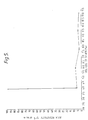
- Example 2 The eva terpolymer adhesive and silver flake employed in Example 2 (without binder) were cryogenically ground to particle size of 106 to 600 micrometres and were dry blended together. The powdered blend was then formed into a plaque at 120°C over a period of about 2 minutes. The bulk resistivity of the plaqued material was determined as in comparative Example 1, and the results are given in table IV and shown graphically in figure 5. TABLE IV % Silver (by volume) Bulk Resistivity 10 -5 ohm m 11.17 3.43 9.45 4.47 7.73 2.8 5.91 8.02 4.02 6.45 2.05 8625
- a photomicrograph of a section through the plaqued material was taken, so that the distribution of silver particles within the material could be analysed.
- a magnification of X600 was used.
- the photomicrograph thus obtained consisted of black regions corresponding to silver and white regions corresponding to the eva terpolymer adhesive.
- the photomicrograph was then scanned using an optical line scanner and the information thus obtained from it was digitally stored by computer.
- the scanning resolution was 4.41 x 10 -8 mm 2 per bit of information (that is, each area of the photomicrograph corresponding to an area of 4.41 x 10 -8 mm 2 of the sample was stored in a file as being either black or white).
- Each line, (of bits of information) corresponding to a row of squares of area 4.41 x 10 -8 mm 2 of the photomicrograph was then analysed. For each line, the largest number of consecutive bits of information corresponding to silver (ie the largest unbroken region of silver in the line) was measured and converted into units of micrometres (referred to as W). Also, for each line, the number of discrete unbroken regions of silver per micrometre was measured (referred to as H and having units of counts per micrometre).
- the value of W/H, measured in ⁇ m 2 was calculated and the best overall value of W/H for all the lines was determined using the method of least squares. This value is referred to as the "degree of inhomogeneity" and is used as a measure of the inhomogeneity of the plaqued blended material.
- the value for the degree of inhomogeneity obtained from the sample used in this example was 730 ⁇ m 2 .
- the degree of inhomogeneity of a comparative sample prepared in accordance with Comparative Example 2 was determined by this method and was found to be 180 ⁇ m 2 .
- a 10 mm wide strip of the adhesive so formed was wrapped around a copper tube, and a dimensionally recoverable article as described in US patent No. 4,467,002 was then recovered onto the adhesive strip.
- the assembly was heated to one of three temperatures, 100, 125 and 150°C for up to about 50 days, and the d.c. resistance of the adhesive bond was measured at various times. The results are shown graphically in figure 6 from which it can be seen that the bond is relatively insensitive to heat aging in this manner. The fact that the bond resistance was low and stable was not expected since the test temperature was considerably higher than the softening point of the adhesive (70 - 75°C).
- a dimensionally recoverable screened moulded part according to US patent No. 4,467,002 was recovered onto a harness having a metal braid and having a 10 mm wide strip of the adhesive so formed wrapped around the braid.
- the other end of the moulded part was recovered about a connector adaptor and bonded thereto by means of a silver flake loaded two part epoxy adhesive.
- the d.c resistance was measured between the adaptor and the braid while the article was held at 75°C, ie. just above the softening point of the adhesive.
- the results are shown in figure 7 in addition to the results obtained using a silver loaded two part epoxy adhesive. It can be seen that the results for the two adhesives are not signficantly different and that the e.v.a. adhesive exhibits a relatively stable conductivity at this temperature over a period of 200 days.
Landscapes
- Chemical & Material Sciences (AREA)
- Health & Medical Sciences (AREA)
- Chemical Kinetics & Catalysis (AREA)
- Medicinal Chemistry (AREA)
- Polymers & Plastics (AREA)
- Organic Chemistry (AREA)
- Mechanical Engineering (AREA)
- Composite Materials (AREA)
- Engineering & Computer Science (AREA)
- Physics & Mathematics (AREA)
- Dispersion Chemistry (AREA)
- Spectroscopy & Molecular Physics (AREA)
- Adhesives Or Adhesive Processes (AREA)
- Conductive Materials (AREA)
- Compositions Of Macromolecular Compounds (AREA)
- Laminated Bodies (AREA)
- Shaping By String And By Release Of Stress In Plastics And The Like (AREA)
- Insulated Conductors (AREA)
Claims (18)
- Procédé pour former une composition adhésive électroconductrice, qui comprend les étapes consistant :(i) à mélanger une matière polymère solide fusible en particules avec une quantité de particules métalliques pour former un mélange de matière polymère en particules et de particules métalliques, le mélange ne contenant pas plus de 9 % en volume des particules métalliques ;(ii) à soumettre le mélange de particules de l'étape (i) à l'action de la chaleur et/ou de la pression pour amener la matière polymère à se solidifier sans mélange.
- Procédé suivant la revendication 1, dans lequel les particules de métal ont un rapport d'aspect au moins égal à 5.
- Procédé suivant la revendication 1 ou la revendication 2, dans lequel les particules de métal comprennent des paillettes.
- Procédé suivant l'une quelconque des revendications 1 à 3, dans lequel les particules de métal comprennent de l'argent.
- Procédé suivant l'une quelconque des revendications 1 à 4, dans lequel la matière polymère est un adhésif thermofusible.
- Procédé suivant la revendication 5, dans lequel l'adhésif comprend un copolymère éthylène/acétate de vinyle, un polyester ou un polyamide.
- Procédé suivant l'une quelconque des revendications précédentes, dans lequel le mélange ne contient pas plus de 5 % en volume de particules de métal.
- Procédé suivant l'une quelconque des revendications précédentes, dans lequel le mélange ne contient pas plus de 4 % en volume des particules de métal.
- Procédé suivant l'une quelconque des revendications précédentes, dans le mélange contient au moins 1,5 % en volume des particules de métal.
- Procédé suivant l'une quelconque des revendications 1 à 5, dans lequel la matière polymère est un adhésif thermodurcissable.
- Procédé suivant la revendication 10, dans lequel l'adhésif est un adhésif époxy ayant des composants réactifs qui existent séparément l'un de l'autre sous forme de particules différentes.
- Procédé suivant l'une quelconque des revendications précédentes, dans lequel le rapport du diamètre moyen des particules de matière polymère au diamètre moyen de particules de métal se situe dans la plage de 10:1 à 200:1.
- Procédé suivant l'une quelconque des revendications précédentes, dans lequel le rapport du diamètre moyen en poids des particules d'adhésif avant l'étape de solidification (ii)au diamètre moyen des particules de métal se situe dans la plage de 20:1 à 100:1.
- Procédé suivant l'une quelconque des revendications précédentes, dans lequel la matière polymère a un indice de fluidité inférieur à 100.
- Composition adhésive électroconductrice, qui a été formée par un procédé suivant l'une quelconque des revendications précédentes et qui est sous la forme d'un ruban ou d'une feuille.
- Article thermorétractable qui est pourvu, sur une partie au moins de sa surface interne, d'une composition adhésive électroconductrice qui a été formée par un procédé suivant l'une quelconque des revendications 1 à 14.
- Article suivant la revendication 16, qui renferme un écran électroconducteur, et la composition adhésive est située au contact d'une partie de l'écran pour former une connexion électrique entre l'écran et un substrat autour duquel l'article est soumis à une reprise de forme.
- Câble électrique qui comporte une pluralité de fils conducteurs et un blindage de câble, le câble se terminant par un connecteur et une enveloppe qui s'étend depuis le connecteur jusqu'au câble et qui comporte un écran électroconducteur, l'écran électroconducteur et le blindage du câble étant connectés électriquement au moyen d'une composition adhésive formée par un procédé suivant l'une quelconque des revendications 1 à 14.
Applications Claiming Priority (5)
| Application Number | Priority Date | Filing Date | Title |
|---|---|---|---|
| GB898924616A GB8924616D0 (en) | 1989-11-01 | 1989-11-01 | Electrically conductive polymer composition |
| GB8924616 | 1989-11-01 | ||
| GB9015709 | 1990-07-17 | ||
| GB909015709A GB9015709D0 (en) | 1990-07-17 | 1990-07-17 | Electrically conductive polymer composition |
| PCT/GB1990/001677 WO1991006961A1 (fr) | 1989-11-01 | 1990-11-01 | Composition polymere electroconductrice |
Publications (2)
| Publication Number | Publication Date |
|---|---|
| EP0499612A1 EP0499612A1 (fr) | 1992-08-26 |
| EP0499612B1 true EP0499612B1 (fr) | 1997-07-23 |
Family
ID=26296136
Family Applications (1)
| Application Number | Title | Priority Date | Filing Date |
|---|---|---|---|
| EP90916048A Expired - Lifetime EP0499612B1 (fr) | 1989-11-01 | 1990-11-01 | Composition polymere electroconductrice |
Country Status (8)
| Country | Link |
|---|---|
| US (1) | US5298194A (fr) |
| EP (1) | EP0499612B1 (fr) |
| JP (1) | JPH05501425A (fr) |
| AT (1) | ATE155923T1 (fr) |
| CA (1) | CA2067488A1 (fr) |
| DE (1) | DE69031123T2 (fr) |
| IL (1) | IL96196A (fr) |
| WO (1) | WO1991006961A1 (fr) |
Families Citing this family (19)
| Publication number | Priority date | Publication date | Assignee | Title |
|---|---|---|---|---|
| GB9111633D0 (en) * | 1991-05-30 | 1991-07-24 | Raychem Ltd | Dimensionally-recoverable article |
| US6162538A (en) * | 1992-11-24 | 2000-12-19 | Clemson University Research Foundation | Filled cut-resistant fibers |
| US5851668A (en) * | 1992-11-24 | 1998-12-22 | Hoechst Celanese Corp | Cut-resistant fiber containing a hard filler |
| US5582770A (en) * | 1994-06-08 | 1996-12-10 | Raychem Corporation | Conductive polymer composition |
| TW406454B (en) | 1996-10-10 | 2000-09-21 | Berg Tech Inc | High density connector and method of manufacture |
| GB9808141D0 (en) * | 1998-04-17 | 1998-06-17 | Smiths Industries Plc | Electrical connection and connectors |
| US6534422B1 (en) | 1999-06-10 | 2003-03-18 | National Semiconductor Corporation | Integrated ESD protection method and system |
| CA2392078C (fr) * | 1999-11-03 | 2005-02-22 | Nexicor Llc | Outil a induction a main |
| CN1214455C (zh) * | 2000-04-25 | 2005-08-10 | 日立化成工业株式会社 | 电路连接用粘接剂、使用其的电路连接方法及电路连接结构体 |
| DE10032817B4 (de) * | 2000-07-06 | 2010-02-25 | Newfrey Llc, Newark | Befestigungsteil mit einem schmelzbaren Leit-Klebstoff |
| JP3991218B2 (ja) * | 2002-12-20 | 2007-10-17 | 信越化学工業株式会社 | 導電性接着剤及びその製造方法 |
| US20080015284A1 (en) * | 2003-07-29 | 2008-01-17 | The University Of Akron | Electrically-Conducting Polymers, a Method for Preparing Electrically-Conducting Polymers, and a Method for Controlling Electrical Conductivity of Polymers |
| US20070156168A1 (en) * | 2005-12-29 | 2007-07-05 | Medtronic Vascular, Inc. | Polymer marker and retention bands |
| WO2008006166A1 (fr) * | 2006-07-13 | 2008-01-17 | Orica Explosives Technology Pty Ltd | Élément électrique conducteur |
| US9024191B2 (en) * | 2011-10-03 | 2015-05-05 | Commscope Technologies Llc | Strain relief for connector and cable interconnection |
| US9024526B1 (en) | 2012-06-11 | 2015-05-05 | Imaging Systems Technology, Inc. | Detector element with antenna |
| US9472929B2 (en) * | 2014-08-07 | 2016-10-18 | Tyco Electronics Corporation | Cable assembly having a grounded cable harness |
| JP6922248B2 (ja) * | 2017-02-21 | 2021-08-18 | 東洋インキScホールディングス株式会社 | ホットメルト接着剤組成物、および積層体 |
| JP7168861B2 (ja) * | 2017-09-15 | 2022-11-10 | 株式会社スリーボンド | 粒状接着剤及びその製造方法 |
Family Cites Families (24)
| Publication number | Priority date | Publication date | Assignee | Title |
|---|---|---|---|---|
| GB363432A (en) * | 1930-09-27 | 1931-12-24 | Joseph Gloster Ltd | A new or improved process for coating moulded articles with metal |
| GB581184A (en) * | 1943-01-29 | 1946-10-03 | Marconi Wireless Telegraph Co | Improvements in or relating to electric insulating materials and dielectrics |
| GB1073567A (en) * | 1964-06-29 | 1967-06-28 | Dow Chemical Co | Metal-polymer compositions |
| FR1506143A (fr) * | 1966-01-03 | 1967-12-15 | Dow Chemical Co | Procédé de fabrication d'articles en substances formées de métal et d'un polymère, compositions de ces substances et articles ainsi obtenus |
| US3567607A (en) * | 1966-02-18 | 1971-03-02 | Dow Chemical Co | Irradiated metal-polymer compositions |
| BR7017800D0 (pt) * | 1969-04-21 | 1973-01-09 | Grace W R & Co | Processo e composicao para obtencao de adesao |
| FR2050220A1 (en) * | 1969-07-03 | 1971-04-02 | Saimap | Ptfe based self lubricating materials |
| JPS5428976B2 (fr) * | 1973-09-21 | 1979-09-20 | ||
| US4181775A (en) * | 1976-05-24 | 1980-01-01 | N.V. Raychem S.A. | Adhesive |
| JPS5478491A (en) * | 1977-12-02 | 1979-06-22 | Murata Manufacturing Co | Conductive paste |
| JPS5813108B2 (ja) * | 1980-03-17 | 1983-03-11 | 住友電気工業株式会社 | 導電性を有する粉体状接着剤およびその製造方法 |
| US4490283A (en) * | 1981-02-27 | 1984-12-25 | Mitech Corporation | Flame retardant thermoplastic molding compounds of high electroconductivity |
| CA1217310A (fr) * | 1981-09-14 | 1987-02-03 | George B. Park | Article thermoretrecissable |
| US4467002A (en) * | 1981-12-15 | 1984-08-21 | Raychem Limited | Dimensionally-recoverable article |
| JPS59189142A (ja) * | 1983-04-12 | 1984-10-26 | Ube Ind Ltd | 導電性熱可塑性樹脂組成物 |
| US4596670A (en) * | 1983-10-25 | 1986-06-24 | General Electric Company | EMI shielding effectiveness of thermoplastics |
| US4581158A (en) * | 1984-09-26 | 1986-04-08 | W. R. Grace & Co. | Conductive thermosetting compositions and process for using same |
| US4747968A (en) * | 1985-05-08 | 1988-05-31 | Sheldahl, Inc. | Low temperature cure having single component conductive adhesive |
| US4603165A (en) * | 1985-11-29 | 1986-07-29 | Gte Government Systems Corporation | Material suitable for thermal protection of electrochemical cells and other articles |
| DE3543279A1 (de) * | 1985-12-07 | 1987-06-11 | Roehm Gmbh | Verfahren zur herstellung von kunststoff-pressplatten mit elektrischer leitfaehigkeit |
| JPS63120782A (ja) * | 1986-11-10 | 1988-05-25 | Toshiba Chem Corp | 導電性接着剤 |
| FR2621328A1 (fr) * | 1987-10-05 | 1989-04-07 | Rhone Poulenc Chimie | Particules metallisees de polymere fonctionnalise reticule, leur procede de preparation et leur application a la fabrication de materiaux electro-conducteurs |
| EP0351047A3 (fr) * | 1988-07-14 | 1991-11-06 | Bowthorpe-Hellermann Limited | Adhésifs réticulables à la chaleur et procédé de collage |
| JPH03131679A (ja) * | 1989-10-17 | 1991-06-05 | Fujikura Ltd | 導電性接着剤 |
-
1990
- 1990-10-31 IL IL9619690A patent/IL96196A/en not_active IP Right Cessation
- 1990-11-01 WO PCT/GB1990/001677 patent/WO1991006961A1/fr not_active Ceased
- 1990-11-01 EP EP90916048A patent/EP0499612B1/fr not_active Expired - Lifetime
- 1990-11-01 AT AT90916048T patent/ATE155923T1/de not_active IP Right Cessation
- 1990-11-01 DE DE69031123T patent/DE69031123T2/de not_active Expired - Fee Related
- 1990-11-01 JP JP2514856A patent/JPH05501425A/ja active Pending
- 1990-11-01 CA CA002067488A patent/CA2067488A1/fr not_active Abandoned
- 1990-11-01 US US07/852,141 patent/US5298194A/en not_active Expired - Fee Related
Also Published As
| Publication number | Publication date |
|---|---|
| EP0499612A1 (fr) | 1992-08-26 |
| ATE155923T1 (de) | 1997-08-15 |
| JPH05501425A (ja) | 1993-03-18 |
| IL96196A (en) | 1995-03-30 |
| IL96196A0 (en) | 1991-07-18 |
| DE69031123D1 (de) | 1997-08-28 |
| CA2067488A1 (fr) | 1991-05-02 |
| WO1991006961A1 (fr) | 1991-05-16 |
| DE69031123T2 (de) | 1998-03-05 |
| US5298194A (en) | 1994-03-29 |
Similar Documents
| Publication | Publication Date | Title |
|---|---|---|
| US5298194A (en) | Electrically conductive polymer composition | |
| US4844959A (en) | Heat curable adhesive coating | |
| EP0169060B1 (fr) | Compositions conductrices soudables, leur utilisation comme enductions sur des substrats et compositions utiles à leur formation | |
| US4882227A (en) | Conductive resin composition and molded product using the same | |
| EP0082477B1 (fr) | Composition conductrice, flexible, imprimable par écran | |
| US4595604A (en) | Conductive compositions that are directly solderable and flexible and that can be bonded directly to substrates | |
| US4517340A (en) | Adhesive composition | |
| Genetti et al. | Polymer matrix composites: Conductivity enhancement through polypyrrole coating of nickel flake | |
| EP0312688A2 (fr) | Revêtement conducteur exothermique | |
| US4865892A (en) | Dimensionally recoverable article | |
| EP0074218A1 (fr) | Produit manufacturé manifestant la reprise thermique | |
| JPH01263156A (ja) | 導電性プラスチック | |
| US4774137A (en) | Synthetic resin powders for coatings with reduced surface resistance | |
| US5034251A (en) | Adhesive composition | |
| Marshall | Copper-based conductive polymers: a new concept in conductive resins | |
| KR20060059255A (ko) | 절연피복 도전입자 | |
| EP2788445B1 (fr) | Composition de colle fusible réactive à deux composants | |
| JP3612831B2 (ja) | シールドフラットケーブル | |
| DE2931634A1 (de) | Verfahren zum bonden von schaltungen und deren elementen mittels leitfaehigem epoxykleber | |
| JPH0368660A (ja) | 電磁シールド用樹脂製造用の充填剤ブレンド | |
| JP2523097B2 (ja) | 導電性樹脂組成物およびその成形品 | |
| CN116836639A (zh) | 一种接地保护膜及其制备方法和应用 | |
| JPS581745A (ja) | スクリ−ン印刷可能な導体組成物 | |
| Selwood et al. | The replacement of precious metal thick film inks using new conductive polymer technology | |
| DE3024069A1 (de) | Elektrisches kabel mit einem aeusseren elektrisch leitenden ueberzugsfilm |
Legal Events
| Date | Code | Title | Description |
|---|---|---|---|
| PUAI | Public reference made under article 153(3) epc to a published international application that has entered the european phase |
Free format text: ORIGINAL CODE: 0009012 |
|
| 17P | Request for examination filed |
Effective date: 19920409 |
|
| AK | Designated contracting states |
Kind code of ref document: A1 Designated state(s): AT BE CH DE DK ES FR GB GR IT LI NL SE |
|
| 17Q | First examination report despatched |
Effective date: 19941122 |
|
| GRAG | Despatch of communication of intention to grant |
Free format text: ORIGINAL CODE: EPIDOS AGRA |
|
| GRAH | Despatch of communication of intention to grant a patent |
Free format text: ORIGINAL CODE: EPIDOS IGRA |
|
| GRAH | Despatch of communication of intention to grant a patent |
Free format text: ORIGINAL CODE: EPIDOS IGRA |
|
| GRAA | (expected) grant |
Free format text: ORIGINAL CODE: 0009210 |
|
| AK | Designated contracting states |
Kind code of ref document: B1 Designated state(s): AT BE CH DE DK ES FR GB GR IT LI NL SE |
|
| PG25 | Lapsed in a contracting state [announced via postgrant information from national office to epo] |
Ref country code: IT Free format text: LAPSE BECAUSE OF FAILURE TO SUBMIT A TRANSLATION OF THE DESCRIPTION OR TO PAY THE FEE WITHIN THE PRE;WARNING: LAPSES OF ITALIAN PATENTS WITH EFFECTIVE DATE BEFORE 2007 MAY HAVE OCCURRED AT ANY TIME BEFORE 2007. THE CORRECT EFFECTIVE DATE MAY BE DIFFERENT FROM THE ONE RECORDED.SCRIBED TIME-LIMIT Effective date: 19970723 Ref country code: ES Free format text: THE PATENT HAS BEEN ANNULLED BY A DECISION OF A NATIONAL AUTHORITY Effective date: 19970723 Ref country code: DK Effective date: 19970723 Ref country code: BE Effective date: 19970723 Ref country code: LI Effective date: 19970723 Ref country code: GR Free format text: LAPSE BECAUSE OF FAILURE TO SUBMIT A TRANSLATION OF THE DESCRIPTION OR TO PAY THE FEE WITHIN THE PRESCRIBED TIME-LIMIT Effective date: 19970723 Ref country code: AT Effective date: 19970723 Ref country code: NL Free format text: LAPSE BECAUSE OF FAILURE TO SUBMIT A TRANSLATION OF THE DESCRIPTION OR TO PAY THE FEE WITHIN THE PRESCRIBED TIME-LIMIT Effective date: 19970723 Ref country code: CH Effective date: 19970723 |
|
| REF | Corresponds to: |
Ref document number: 155923 Country of ref document: AT Date of ref document: 19970815 Kind code of ref document: T |
|
| REG | Reference to a national code |
Ref country code: CH Ref legal event code: EP |
|
| REF | Corresponds to: |
Ref document number: 69031123 Country of ref document: DE Date of ref document: 19970828 |
|
| ET | Fr: translation filed | ||
| PG25 | Lapsed in a contracting state [announced via postgrant information from national office to epo] |
Ref country code: SE Effective date: 19971023 |
|
| PGFP | Annual fee paid to national office [announced via postgrant information from national office to epo] |
Ref country code: GB Payment date: 19971023 Year of fee payment: 8 |
|
| PGFP | Annual fee paid to national office [announced via postgrant information from national office to epo] |
Ref country code: DE Payment date: 19971110 Year of fee payment: 8 |
|
| PGFP | Annual fee paid to national office [announced via postgrant information from national office to epo] |
Ref country code: FR Payment date: 19971112 Year of fee payment: 8 |
|
| NLV1 | Nl: lapsed or annulled due to failure to fulfill the requirements of art. 29p and 29m of the patents act | ||
| REG | Reference to a national code |
Ref country code: CH Ref legal event code: PL |
|
| PLBE | No opposition filed within time limit |
Free format text: ORIGINAL CODE: 0009261 |
|
| STAA | Information on the status of an ep patent application or granted ep patent |
Free format text: STATUS: NO OPPOSITION FILED WITHIN TIME LIMIT |
|
| 26N | No opposition filed | ||
| PG25 | Lapsed in a contracting state [announced via postgrant information from national office to epo] |
Ref country code: GB Free format text: LAPSE BECAUSE OF NON-PAYMENT OF DUE FEES Effective date: 19981101 |
|
| GBPC | Gb: european patent ceased through non-payment of renewal fee |
Effective date: 19981101 |
|
| PG25 | Lapsed in a contracting state [announced via postgrant information from national office to epo] |
Ref country code: FR Free format text: LAPSE BECAUSE OF NON-PAYMENT OF DUE FEES Effective date: 19990730 |
|
| REG | Reference to a national code |
Ref country code: FR Ref legal event code: ST |
|
| PG25 | Lapsed in a contracting state [announced via postgrant information from national office to epo] |
Ref country code: DE Free format text: LAPSE BECAUSE OF NON-PAYMENT OF DUE FEES Effective date: 19990901 |