EP0499627B1 - Procede dynamique de reconnaissance d'objets et son systeme de traitement d'images - Google Patents
Procede dynamique de reconnaissance d'objets et son systeme de traitement d'images Download PDFInfo
- Publication number
- EP0499627B1 EP0499627B1 EP91900556A EP91900556A EP0499627B1 EP 0499627 B1 EP0499627 B1 EP 0499627B1 EP 91900556 A EP91900556 A EP 91900556A EP 91900556 A EP91900556 A EP 91900556A EP 0499627 B1 EP0499627 B1 EP 0499627B1
- Authority
- EP
- European Patent Office
- Prior art keywords
- probability
- stored
- objects
- data
- given class
- Prior art date
- Legal status (The legal status is an assumption and is not a legal conclusion. Google has not performed a legal analysis and makes no representation as to the accuracy of the status listed.)
- Expired - Lifetime
Links
Images


Classifications
-
- G—PHYSICS
- G06—COMPUTING OR CALCULATING; COUNTING
- G06V—IMAGE OR VIDEO RECOGNITION OR UNDERSTANDING
- G06V40/00—Recognition of biometric, human-related or animal-related patterns in image or video data
- G06V40/10—Human or animal bodies, e.g. vehicle occupants or pedestrians; Body parts, e.g. hands
- G06V40/16—Human faces, e.g. facial parts, sketches or expressions
- G06V40/161—Detection; Localisation; Normalisation
- G06V40/166—Detection; Localisation; Normalisation using acquisition arrangements
-
- G—PHYSICS
- G06—COMPUTING OR CALCULATING; COUNTING
- G06V—IMAGE OR VIDEO RECOGNITION OR UNDERSTANDING
- G06V10/00—Arrangements for image or video recognition or understanding
- G06V10/20—Image preprocessing
- G06V10/25—Determination of region of interest [ROI] or a volume of interest [VOI]
-
- G—PHYSICS
- G06—COMPUTING OR CALCULATING; COUNTING
- G06V—IMAGE OR VIDEO RECOGNITION OR UNDERSTANDING
- G06V30/00—Character recognition; Recognising digital ink; Document-oriented image-based pattern recognition
- G06V30/10—Character recognition
- G06V30/24—Character recognition characterised by the processing or recognition method
- G06V30/248—Character recognition characterised by the processing or recognition method involving plural approaches, e.g. verification by template match; Resolving confusion among similar patterns, e.g. "O" versus "Q"
- G06V30/2504—Coarse or fine approaches, e.g. resolution of ambiguities or multiscale approaches
Definitions
- This invention is directed to a dynamic image processing technique for recognizing objects of a given class which are graphically represented in a time series of successive relatively high-resolution frames of image data.
- Anderson et al. disclose an image-data reduction technique in which an originally wide field-of-view, high-resolution image comprised of a first given number of pixels is processed to derive a wide field-of-view, low resolution image comprised of second given number of pixels smaller than the first given number. Based on the location of a detected feature of interest present in the derived low resolution image, a movable window comprised of no more than the second given number of pixels can be employed to obtain the location of that narrow field-of-view portion of the original high-resolution image which contains the detected feature of interest.
- Anderson et al. utilize known so-called multi-resolution pyramid processor techniques to implement their image-data reduction. A pyramid processor is also disclosed in Proceedings of the IEEE, vol 76, No 8 pages 1006-1015 August 1988, P.J. BURT "Smart Sensing within a Pyramid Vision Machine.”
- the Anderson et al. data reduction technique may operate repeatedly on a time series of successive, relatively high-resolution frames of image data, the detection of the feature of interest is similar during each operation (i.e., during each repeated operation, the feature of interest is either detected or it is not, independent of whether or not the feature of interest was detected on a previous one of the repeated operations).
- Hubach et al. disclose a pattern recognition method which also employs a data reduction technique.
- a reference scene is first recorded and stored in a fine format and then in a coarse format.
- Stored coarse information of the reference scene is compared in real time with coarse information from a wide field-of-view subject scene and a correlation number (probability) indicating the percentage of match is employed to determine the location of the best match (if any) between the subject and reference scenes.
- a correlation number (probability) indicating the percentage of match is employed to determine the location of the best match (if any) between the subject and reference scenes.
- Only the narrow field-of-view area of the subject scene which is in the vicinity of the coarse match is then compared with the stored fine information of the reference scene.
- the location of the best match is precisely determined in accordance with the highest correlation number (probability) of the match of the subject scene with the fine stored information of the reference scene. It should be noted that in Hubach et al. the stored coarse and fine reference information remains fixed.
- the object to be recognized is a three-dimensional movable object which is graphically represented in a time series of successive frames of image data, each of which is comprised of a two-dimensional projection of the three-dimensional object.
- the size and shape of the two-dimensional projection in each of the respective frames will depend on the distance of the three-dimensional object in a direction perpendicular to the projection thereof and the angular orientation of the three-dimensional object with respect to its projection in that frame. If the three-dimensional object moves, the size and shape of its graphical representation will change from frame to frame. Thus, much less than complete information about such a three-dimensional moving-object can be obtained from any single frame.
- the dynamic image processing method of the present invention is directed to an efficient solution to this type of recognition problem.
- an embodiment of the dynamic image-processing method of the present invention recognizes objects of a given class which all possess a group of known generic attributes which, taken as a whole, distinguish objects of this given class from objects not of this given class.
- the method is responsive to a means for controlling this processing and for specifying a set of decision criteria.
- This method is also responsive to stored data which initially defines a limited number of separate features related to the group of generic attributes, any of which initially stored features is likely to be present in a sequence of one or more successive frames of image date if an object of the given class is graphically represented in that sequence.
- the embodiment of the method comprises the following steps:
- a multi-resolution pyramid processor comprised of at least one level that exhibits a lower resolution than that of the high-resolution frames.
- a first determination is made in accordance with the decision criteria as to a first probability with which any of the lower-resolution levels of the multi-resolution pyramid processor in a sequence of one or more relatively early-occurring frames of the time series may include as part of the image data thereof at least the first one of the separate features of objects of the given class. If this first probability is at least equal to a first predetermined threshold value, data defining at least the relative location of that part of the image data within the early-occurring frames of the sequence is added to the stored data, thereby enhancing the stored data.
- the aforesaid part of the image data is recognized as not being a graphical representation of an object of the given class.
- the further data defined by the aforesaid verification step is added to the stored data, thereby further enhancing the stored data.
- the verification step and the further enhancement of the stored data in response thereto is recursively repeated for relatively later and later occurring sequences of one or more frames of the time series until the probability determined by such repeated step either rises above this second predetermined threshold or falls below the third predetermined threshold.
- a human observer has no difficulty in recognizing objects of given class (e. g., other human beings) present in a complex scene. In fact, even though the observer knows hundreds of different individuals, he or she has no difficulty recognizing any one of them who is present in the observed scene.
- the dynamic-image processing method of the present invention mimics the ability of a human being to recognize objects of a given class which all possess a group of known generic attributes and which, taken as a whole, distinguish objects of this given class from objects which are not of the given class. Further, the dynamic image processing of the present invention is capable of distinguishing among a plurality of preselected members of the given class, each of which preselected members is individually defined by possessing a unique set of known species of each of at least a sub-group of the known generic attributes.
- Imaging means 100 having a field-of-view 102.
- Imaging means 100 may be comprised of a structure for receiving radiation reflected from objects within a field-of-view 102 which are illuminated by an external radiator.
- imager means 100 may be comprised of a structure that includes means for illuminating objects within field-of-view 102 with radiation and means for receiving reflected echoes from such objects (these echoes also may provide object-distance information).
- imaging means 100 may be responsive to radiation of any given wavelength portion of electromagnetic, ultrasonic and/or any other type of wave-energy spectrum.
- Within field-of-view 102 are located two movable objects of given class 104 (presented in FIGURE 1 as movable cubes).
- Imaging means 100 produces a two-dimensional projection of each of three-dimensional cubes 104. Since cubes 104 are movable, the shape and size of the projection of each cube varies with the orientation and distance of that cube from imager means 100 at any given time.
- the output of imaging means 100 is comprised of a time series of successive relatively high-resolution frames of image data, each of which frames graphically represents, in analog form, a two-dimensional projection of each of the cubes of the class 104 and objects 106 in its spatial position within the field-of-view at the time of occurrence of that frame in the time series.
- Analog-to-digital (A/D) converter 108 converts the image data in each successive frame to digital form for processing by a digital processor comprised of preprocessor 110, multi-resolution pyramid processor 112, object-recognition means 114, stored program 116, and stored data 118.
- the digital processor is shown as a system of interconnected functional blocks, in which each block corresponds to a subsystem.
- a digital processor system may be implemented in software (i.e., programmed computer system) and/or in hardware (i.e., hardwired elements).
- FIGURE 3 A detailed example of the subsystem of preprocessor 110 is shown in FIGURE 3 and detailed examples of object recognition means 114 and stored data 118 are shown in FIGURE 4, which FIGURES are later discussed below.
- Stored program 116 applies control inputs to each of preprocessor 110, multi-resolution pyramid processor 112, object recognition means 114 and stored data 118 for controlling the sequence of operations of these subsystems in accordance therewith. This sequence of operations is modified in accordance with information fed back to stored program 116 from object recognition means 114. Control information is also fed back from object recognition means 114 through each of imager means 100, preprocessor 110 and multi-resolution pyramid processor 112. In addition, object recognition means 114 applies enhanced data storage to stored data 118.
- Image data in digital form is applied as a signal input to preprocessor 110.
- Preprocessor 110 in accordance with the control information applied thereto from object recognition means 114 and stored program 116, modifies the image data applied as an input thereto and then applies this modified image data as an input to multi-resolution pyramid processor 112.
- Multi-resolution pyramid processor 112 which is capable of performing the type of junctions taught by the aforesaid Anderson et al patent, US-A-4 692 806 may be structurally implemented in accordance with the teachings of US Patent 4,703,514, which issued October 27, 1987 to Van der Wal and is entitled "Programmed Implementation Of Real-Time Multi-Resolution Signal Processing Apparatus.”
- Output data from pyramid processor 112 is applied as a first signal input to object-recognition means 114.
- object recognition means 114 receives second signal input information directly from preprocessor 110.
- information may be fed back from imager means 100 as an input to object recognition means 114.
- stored data 118 applies selected stored data as an input to object-recognition means 114.
- Output information from object recognition program 114 is applied as an input to output utilization means 120.
- output utilization means 120 Also shown in FIGURE 1 is an optional display monitor 122 (shown in dashed lines) for displaying the image out from imager means 100. Display monitor 122 may also display information received from output utilization means 120 (e.g., captions and other indicia identifying recognized objects in the image).
- FIGURE 1 is a generalized showing of the system of the present invention.
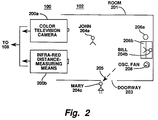
- recognition means 100 is comprised of color television camera 200a and distance-measuring means 200b.
- the field-of-view of both camera 200a and distance-measuring means 200b is the interior of a room 201 having a doorway 203.
- Chris 204a, Bill 204b and Mary 204c may or may not be situated in room 201 at any time.
- Three items, comprised of end table 206a, sofa 206b and oscillating fan 208, are permanently positioned in room 201 as shown in FIGURE 2.
- John 204a is standing in room 102 relatively close to the imager means comprised of television camera 200a and distance-measuring means 200b;
- Bill 204b seated on sofa 206b, is situated in room 102 relatively far from imager means 100; and
- Mary 204c has just left room 201 through doorway 203, as indicated by arrow 205.
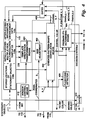
- preprocessor 110 takes the form shown in FIGURE 3 and that object recognition means 114 and stored data 118 take the form shown in FIGURE 4.
- object recognition means 114 and stored data 118 take the form shown in FIGURE 4.
- FIGURES 3 and 4 the respective connections of stored program 116 to preprocessor 110, object recognition means 114 and stored data 118 have been omitted.
- sequence of operation of each of the subsystems is controlled by stored program 116.
- preprocessor 110 is comprised of color filter, frame and distance memories 300, image orientation transformation means 302 and moving-object means 304.
- object recognition means 114 is comprised of size adjustment means 400, template orientation transformation means 401, oriented-pattern-shape correlation means 402, probability determining means 404, fleshtone detector 406, gates 408, window-control means 410 and gate 412.
- stored data 118 is comprised of initially-stored, multiple-view, multi-resolution templates 118a, stored locations of stationary objects 118b, and after-stored recognition enhancement data 118c.
- templates 118a includes previously recorded image data defining full face, left profile and right profile views of the head or selected portions thereof of each of John 204a, Bill 204b and Mary 204c at a number of different resolutions. While lower resolution templates may include the entire head or face of the specific individual, higher resolution templates would be restricted to only a relatively high information section of the individuals face. For instance, a high resolution template may comprise a horizontal strip across the individual's face that shows his or her ears, eyes and bridge of the nose (i.e., contains high recognition information that may be used to discriminate between one specific individual and another).
- templates 118a include one or more templates of a human body form, generic head or other pattern shapes that graphically distinguish the form of human objects from that of other objects.
- the portion of the input from A/D converter 108 corresponding to the real time output from color television camera 200a, in digital form, is first color filtered by the color filter portion of block 300 to separate the luminance (Y) portion from the chrominance (I, Q) portions (assuming that the output from color television camera 200a is in standard NTSC form). Should the separate luminance and chrominance portions of the output from television camera 200a be applied in digital form directly to block 300 (either as separate red, green and blue signals or as separate L, I, Q signals), the color filter portion of block 300 may be omitted. In any event, the one or more successive frames of luminance and chrominance information are temporarily stored in the frame memory portion of block 300.
- Distance-measuring means 200b and color television camera 200a are scanned vertically and horizontally over the same field-of-view 102 but not necessarily at the same frame rate.
- Distance measuring means 200b may operate by measuring the time interval between the transmission of an infra-red pulse and the receipt of an echo therefrom, with the distance being determined by the length of this interval, as in radar.
- the reason for employing infra-red radiation, rather than visual light radiation, for distance-measuring means 200b is to prevent the variable intensity of ambient light in room 201 from affecting sensitivity of distance-measuring means 200b.
- the output information from distance-measuring means 200b, in digital form is temporarily stored in the distance memory portion of block 300.
- scale and distance information can be obtained through a pattern matching process that adjusts the scale of a stored template or the current image to obtain a best match therebetween.
- the distance memory will have an individual distance storage location corresponding to each individual television pixel storage location of a television frame memory. Therefore, during synchronized readout of both a television frame memory and its corresponding distance memory, the horizontal (X) and the vertical (Y) pixel coordinates are available from the readout addresses of the frame memories, and the distance (Z) coordinate for each readout pixel is available from the information stored in the distance memory location of that pixel.
- one of the outputs from block 300 is the X, Y and Z pixel coordinates of each successively readout pixel.
- the simple, well known technique for separating moving-objects from stationary objects is to subtract corresponding pixels of two successively occurring frames of television image information, thereby substantially removing the pixels of stationary objects.
- the pixels of the difference frame correspond only to moving-objects. If the pixels of this difference frame are then subtracted from the pixels of the current frame, the resulting frame contains solely stationary objects.
- moving-object means 304 may take this well known simple form, it would not be the most preferable implementation of moving-object means 304 for the purposes of the present invention.
- oscillating fan 208 is a permanent background object in room 201
- oscillating fan 208 is also a moving-object. It would be desirable from the point of view of the present invention, to provide an implementation of moving-object means 304 in which moving background objects, such as oscillating fan 208, are regarded as stationary objects, despite the fact that they are moving. Therefore, such a moving-object means 304 would discriminate between moving foreground objects and all background objects (which are considered to be stationary).
- the locations of stationary objects are stored in section 118b of stored data 118.
- color television camera 200a and distance-measuring means 200b may be operated with all three of the individuals John 204a, Bill 204b, and Mary 204c not being present in room 201 in order to derive images of solely the permanently stationary background objects, which are all that are present in room 201 during this preliminary operation.
- the images obtained by this preliminary operation are then forwarded for storage in the stored locations of stationary objects 118b section of stored data 118, using moving-object means 304 for this purpose.
- moving-object means 304 assumes that the stationary object information forwarded from moving-object means 304 for storage in section 118b of stored data 118, is also available for use by moving-object means 304 itself.
- eliminating the background by subtracting the pixels thereof from the pixels of the current frame, in order to obtain moving (foreground) objects results in also subtracting the background from the foreground, thus distorting the foreground image.
- a less simple, but superior implementation of moving-object means 304 avoids this distortion by first performing a conditional subtraction in which a pixel of the background is subtracted from the corresponding pixel in the current image only if they are sufficiently close in value.
- the corresponding pixel itself of the current image is employed. However, if they are close in value, so that the subtraction in made, the value zero is tentatively substituted for that pixel. Should the tentative value of a pixel be zero, an estimate for the value of that pixel is computed based on a weighted average of pixels surrounding that pixel over a given region thereabout. If the weighted average is above a given threshold, the corresponding pixel value of the current image is substituted, otherwise the tentative value of zero is employed for that pixel.
- moving-object means 304 provides an output indicative of those pixels which represent moving (foreground) objects for use by object recognition means 114. Further, the moving-object information may be returned to block 300 for storage, or selectively forwarded to multi-resolution pyramid processor 112 either directly or, if desired, after further storage within block 300.
- Image orientation and transformation means 302 employs standard orientation transformation algorithms to rotate image data about each of one or more axes through a small predetermined angle on either side of an adjustable operating point with respect to that axis (i.e., the image is dithered back and forth about the operating point).
- Block 402 of object recognition means 114 feeds back a control input to transformation means 302, adjusting the value of the operating point for each axis in accordance therewith.
- Image data, as received by block 300 from color television camera 200a either before or after storage in a frame memory thereof, may be applied to block 302 for transformation of its orientation. The transformed image data is then returned to block 300 for storage in a frame memory thereof. Further, block 302 may be connected to template orientation transformation means 401 of object recognition means 114.
- Image data stored in block 300 preferably after modification by image orientation transformation means 302 and moving-object means 304, is read out of a frame memory of block 300 and applied as an input to multi-resolution pyramid processor 112.
- FIGURE 4 there is shown an illustrative embodiment of object recognition means 114 together th an illustrative embodiment of stored data 118.
- color information e.g., I and Q
- preprocessor 110 is applied from preprocessor 110 as a first input to fleshtone detector 406 and the X and Y pixel coordinates are applied from preprocessor 110 as a second input to fleshtone detector 406.
- Fleshtone detector 406 derives, as an output, the X and Y pixel coordinates of those portions, if any, of image chrominance which are fleshtone in color.
- fleshtone detector 406 is a device that plots the value of I against the value of Q, and derives a fleshtone output only if the respective values of I and Q, which define the applied color, lie within a rectangle in which the value of I is between a relatively small predetermined positive value and a relatively large predetermined positive value, and the value of Q is equal to or less than a relatively small predetermined absolute value.
- the fleshtone X, Y pixel coordinate output from detector 406 is applied both as one of three signal inputs to probability determining means 404 and to gates 408.
- Moving-object information applied from preprocessor 110 and defining the X and Y pixel coordinates of moving image data, is supplied directly as both a second signal input to probability determining means 404 and to gates 408.
- Template orientation transformation means 401 which is generally similar to the above-described image orientation transformation means 302, is capable of simultaneously receiving any combination of one or more of three inputs (designated L, C and R, respectively) from section 118a of stored data 118.
- control inputs are applied to transformation means 401 from transformation 302 of preprocessor 110 and also from the correlation-value output from correlation means 402.
- the output from transformation means 401 is applied through size adjustment means 400 as a first of three inputs to correlation means 402 from stored data 118.
- Second and third inputs from stored data 118 are applied directly to correlation means 402 from sections 118b and 118c of stored data 118.
- the Z pixel coordinate is applied as a control input to size adjustment means 400 and the X and Y pixel coordinates are applied as inputs to correlation means 402.
- Correlation means 402 receives an additional input from the output of multi-resolution pyramid processor 112.
- correlation means 402 The basic function of correlation means 402 is to correlate image data from multi-resolution pyramid processor 112 with template image data from section 118a of stored data 118 in a highly discriminating manner. The fact that the correlated pattern shape is oriented increases the precision of the correlation. Further, the availability from section 118b of stored data 118 of the pixel locations of stationary objects makes it possible for correlation means 402 to remove from consideration the presence of such stationary objects in the image data supplied thereto from pyramid processor 112. Also, correlation means 402 may make use of image information not necessarily present in the current input thereto from multi-resolution pyramid processor 112, but available from earlier operation of the object recognition system of the present invention which is stored in section 118c of stored data 118. A more detailed discussion of the operation of correlation means 402 is set forth below.
- correlation means 402 derives a first output indicative of the current computed correlation value at that time, which is applied as the third of the three inputs to probability determining means 404, and is also fed back to each of transformation means 302 and 401, as discussed above.
- correlation means 402 applies a second output as the third of the three signal inputs to gates 408.
- This second output from correlation means 402 is comprised of the X and Y pixel coordinates of image area that correspond to the size-adjusted current template then being applied to correlation means 402, which acts as the reference pattern shape with which the image data from multi-resolution pyramid processor 112 is being correlated.
- Probability determining means 404 is controlled in accordance with decision criteria currently applied thereto from stored program 116. In accordance with these decision criteria, means 104 assigns certain weights to the respective correlation value, fleshtone, and moving inputs thereto. As long as the probability computed from the weighted values of the three inputs remains below a predetermined threshold defined by the current decision criteria from stored program 116, no "enable” output is derived from probability determining means 404. However, if the computed probability rises above this predetermined threshold (but remains below a still higher threshold determined by the current decision criteria), probability determining means 404 derives an "enable-1" output. Probability determining means 404 derives an "enable-2" output in response to the computed probability rising above the aforesaid higher threshold.
- the "enable-1" output is applied as a control input to gates 408.
- gates 408 forward as first, second and third inputs to section 118c of stored data 118, for storage therein, the current correlated X, Y pixel coordinates, the current fleshtone X, Y pixel coordinates and the current moving pixel X and Y coordinates.
- the correlated X and Y pixel coordinates are applied as an input to window-control means 410 (which preferably operates in accordance with the teaching of Anderson et al), and the output from window-control means 410 is fed back as a control input to pyramid processor 112.
- the probability determining means 404 feeds back a control signal to stored program 116 for indicating that stored program 116 should initiate a new cycle of operation of the system.
- the occurrence of the "enable-2" output is indicative of the fact that an object in the imaged scene, such as John 204a or Bill 204b has been recognized as being the object depicted in one or more particular templates initially stored on section 118a of stored data 118.
- the "enable-2" output is applied as a control input to gate 412.
- gate 412 forwards a signal from stored data 118 to output utilization means 120.
- This signal (which may include graphic and/or alphanumeric data) identifies the recognized object and its location (i.e., ascertained pixel coordinates) in the image.
- Output utilization means 120 includes means responsive to the forwarded identifying signal for performing certain predetermined functions.
- output utilization means 120 may record or transmit to a central location the information contained therein along with the time of receipt, and/or provide an identifying caption for display on display monitor 122 in a location thereof which is in the immediate vicinity of the displayed image of the particular recognized object.
- the multiple-view, multiple-resolution templates initially stored in section 118a of stored data 118 which include templates respectively depicting John 204a, Bill 204b and Mary 204c, are derived, and then stored as an organized database in section 118a, in the manner described below.
- a set of images for each of the three involved individuals is taken in a training phase for use in deriving the templates stored in section 118a of stored data 118.
- Each set includes respective straight-ahead (i.e., full-face), left-profile and right-profile subsets.
- Each subset may include a substantial variety of typical expressions of that involved person.
- several variable parameters remain fixed during the training phase. These constraints include uniform lighting, fixed distance from the camera, and no rotation or tilting of the head from the pre-assigned straight-ahead, left-profile or right-profile position.
- Each of the training phase images is transformed into a Laplacian, or bandpass, pyramid.
- This pyramid may be built from level-1, which has a pixel resolution of 256 x 256, down to level-5, which has a pixel resolution of only 16 x 16. Then, one 8 x 8 section of the 16 x 16, level-5 image, which encompasses an outline of the head and face, is saved as an icon to be included in the initially-stored database of section 118a of stored data 118. Next, three 8 x 8 sections may be taken from the 32 x 32, level-4, pyramid image. These may cover the top of the head, the middle of the face, and the chin area. They then may also be included in the initially-stored database. Finally, five 8 x 8 sections of the 64 x 64, level-3, pyramid image may be included in the initially-stored database.
- section 118a of stored data 118 may also include templates defining the shape of generic human beings.
- Such generic templates should be at level-5 or even a higher level of the pyramid image, and merely show the generalized shape of a human head on top of a generalized human body in one or more positions (e.g., standing or sitting).
- a second preliminary operation of the above-described system is the storage in section 118b of stored data 118 of the locations of stationary (background) objects (e.g., end table 206a, sofa 206b and oscillating fan 208) in room 201.
- stationary (background) objects e.g., end table 206a, sofa 206b and oscillating fan 208
- Fleshtone is one known generic attribute which distinguishes those imaged objects comprised of an involved person and other types of imaged objects.
- Another generic attribute of human beings is that they are movable, although they need not be moving at any given moment. Further, not all objects are human beings. Nevertheless, a moving-object output from moving-object means 304 is employed by the system as another feature of interest related to a generic attribute of the involved individuals.
- An additional distinguishing generic attribute of human beings is the pattern shape of the human body.
- the generic templates, discussed above, initially stored in section 118a of stored data 118 are features of interest related to this generic attribute of human beings.
- the system simultaneously searches for the existence of any of these three features of interest. Determination of the X and Y coordinates of each readout frame of a moving (foreground) object feature of interest or of a fleshtone feature of interest is straight forward. However, dealing with the identification pixels of a readout frame as belonging to a human-body pattern-shape is significantly more complicated. First, the shape of the two-dimensional image pattern of a human being depends upon the orientation of the three-dimensional human being with respect to camera 200a.
- the size of this two-dimensional imaged pattern depends both on the distance of the human being from camera 200a and the then-existing size of field-of-view 102 (which may be adjustable if camera 200a has zoom capabilities). For the present, it is assumed that field-of-view 102 remains fixed. However, size adjustment means 400, described above, compensates for any difference in size of the image data in accordance with the distance-measured Z pixel coordinate applied thereto. This means that the number of templates that need be initially stored in section 118a of stored data 118 is significantly reduced.
- template transformation means 401 is not utilized.
- the two generic templates (generic human being in standing and sitting positions, respectively) are initially operated on sequentially in successive frames to determine which one, if any, of the two templates provides the higher correlation value in any given case, after which only the template exhibiting the higher correlation value is considered.
- Determining a correlation value may take the readout of several frames. From frame to frame, image orientation transformation means 302 is dithered back and forth about an initial zero operating point. Because correlation means 402 correlates oriented pattern shapes, the derived correlation value for one of the two dithered positions will normally be significantly higher than the other. In response thereto, the operating point of transformation means 302 is incrementally offset from zero in the direction indicated by the higher correlation value. This process continues until the dithered correlation values of a particular offset operating point are substantially equal to one another. In this manner, tilting of the generic human body shape image pattern is compensated for.
- the initial input from multi-resolution pyramid processor 112 and applied correlation means 402 is at a low resolution (i.e., at a high level of the pyramid processor) for the case of recognizing a generic human being. Initially the entire area of a frame is considered. However, in accordance with the foveation technique taught in the aforesaid Anderson et al.
- window-control means 410 in response to the output of correlation means 402 achieving a given correlation value, switches the output from pyramid processor 112 to the next lower (higher resolution) pyramid processor level, while limiting the area of an image frame that is outputted from pyramid processor 112 to only that of a localized window region in the neighborhood of the correlated pattern shape that provided the aforesaid-achieved correlation value.
- Correlation means 402 may employ respective inputs thereto from sections 118b and 118c of stored data 118 to modify the operation thereof so that a contribution of locations of stationary (background) objects to the correlation of pattern shape is ignored, and so that the weighting of the correlation value derived by correlation means 402 is increased in accordance with the already acquired stored recognition enhancement information supplied thereto.
- John and Bill in FIGURE 2 are situated in room 201 at the location shown, with John standing motionless facing away from the camera and Bill seated motionless and facing the camera. Further, assume that in the case of John, the difference between the low resolution image of him from multi-resolution pyramid processor 112 and the generic human being template in the standing position is sufficient to produce an "enable-one" output from probability determining means 404 (although the fleshtone and moving-object inputs to probability determining means 404 are negligible for John), and that this correlation value is sufficient to cause window-control means 410 to switch multi-resolution pyramid processor 112 to the next higher pyramid processor level.
- Enable-1 output from means 404 opens gates 408 and forwards the pixel coordinates of the respective locations of John and Bill as storage enhanced recognition data in section 118c of stored data 118. Therefore, in the next cycle of operation of the system, the correlation value is more highly weighted at these respective locations. Further, in the case of John, a higher resolution image only within a localized window neighborhood of John's location is correlated against a generic human shape pattern in a standing position. This results in a high correlation value over a higher resolution (and, therefore, more accurate) determination of the location of John.
- John may have changed positions so that: (1) moving-object information is now present as an input to probability determining means 404 and (2) fleshtone is now being imaged. This increases the probability to the point at which the system conclusively presumes that John's image is at least that of a generic human being.
- probability determining means 404 returns a signal to stored program 116 that causes stored program 116, during future cycles, to control the sequence of operations of the system in a manner required to determine the specific involved person, if any, presented by this generic human pattern shape (which is actually John's image).
- the second cycle of operation of the system will result in a higher correlation value or correlated X and Y pixels in the vicinity of Bill's imaged head because of the storage of the fleshtone X and Y pixel coordinates in section 118c of stored data 118 during the first cycle of operation of the system. It is assumed that the correlation value obtained during the second cycle of operation of the system is sufficiently high to cause window-control means 410 to switch the output from multi-resolution pyramid processor 112 to the next lower (higher resolution) pyramid processor level for use during the third cycle of operation of the system.
- means 404 in response to means 404 achieving a probability during any cycle that indicates that a generic human being is situated at an ascertained location of the image, means 404 returns a signal to stored program 116 to cause the system during the next cycle of operation thereof to start the determination of which specific one of the involved individuals, if any, is represented by such ascertained generic human being.
- Transformation means 401 operates in a manner similar that described above for transformation means 302 to dither back and forth to the left and to the right of a current operating point a transformation mix of the (C), (L) and (R) template data applied to its three inputs, always altering the operating point between successive frames in that direction which produces the highest correlation value of the resulting transformation mix of its three inputs, until an operating point is reached for which the left dithering and the right dithering produce substantially the same correlation value.
- a signal from transformation means 302 indicating the operating point of transformation means 302 may be applied as an input to transformation means 401 for fine tuning the transformation mix of transformation means 401 in accordance with the amount of image tilt that is being compensated for by transformation means 302.
- transformation means 401 can derive a synthesized template (e.g., a three-quarter left face template) output, that is forwarded as an input to size adjustment means 400, which will, to a great extent, compensate for changes in the two-dimensional image of an involved person's head due to the actual changes in the orientation of that person's head in three-dimensional space.
- correlation means 402 makes use of the initially-stored multiple-view, multi-resolution icon templates discussed above, that form a database, for the purpose of specifically recognizing which one of the three involved persons (John, Bill or Mary), if any, is represented by that particular generically recognized human being.
- the enhancement data already stored in section 118c provides a 16 x 16 image pixel window which includes the location of that generically-recognized human being.
- correlation means 402 itself includes temporary storage means employed to total sequentially derived correlation-value increments for that involved person (although it should be understood that the specific-recognition process could employ section 118c of stored data 118 for such purpose).
- the 16 x 16 image window, level-5, from pyramid processor 112 is compared to the initially-stored level-5 icon in the database for each of the three involved persons, and the resulting normalized correlation value (which can vary in value between -1.0 and +1.0) is separately temporarily stored for each of the involved persons. Similar comparisons for each of the three involved persons are then made at the level-4 resolution for each of the three level-4 icons in the database, and then, in turn, at the level-3 resolution for each of the five level-3 icons in the database.
- each of the three level-4 resolution icons in the database, and each of the five level-3 resolution icons in the database are known and are part of the stored information in section 118a.
- Each of these level-4 and level-3 resolution comparisons and their respective offsets are taken into consideration in defining the location of a 15 x 15 cell image window in each of the level-4 and level-3 resolution comparisons for each of the involved persons. This improves the speed of the system by preventing unnecessary searches of the area where icons are unlikely to be.
- probability determining means 404 determines whether it is at least equal to the second threshold value. If it is at least equal to the second threshold value, probability determining means 404 derives an "enable-2" output that opens gate 412. In response thereto, gates 412 will forward identity and pixel location of the specifically-recognized one of the three involved persons (i. e, John, Bill or Mary) to output utilization means 120. If the highest correlation value is below the threshold, it will be assumed that the generically recognized human being is not anyone of the three involved persons.
- the system will operate to continuously track the location of that specifically recognized individual, taking full advantage of the moving-object (foreground) information provided to probability determining means 404, and the location (i.e., the ascertained pixel coordinates) of that specifically recognized person stored in section 118c of stored data 118 (which is being continuously being updated).
- the location i.e., the ascertained pixel coordinates of that specifically recognized person stored in section 118c of stored data 118 (which is being continuously being updated.
- the above-describes specific-recognition process may be speeded up for a second involved person, by deleting from consideration the previously stored icons of all already specifically-recognized involved persons in the current image.
- the dynamic image-processing technique for recognizing objects of the present invention is not limited in its use to the illustrative example, described in great detail above, (i.e., recognizing (1) the presence of a generic human being within a room, and (2) then recognizing whether the generically recognized human being is a specific one of a group of known involved persons).
- Another example to which the present invention could be applied with great advantage would be complex automatically-controlled systems, such as surveillance television cameras, robotic systems and target tracking systems. Still other example would be in machine vision employed in manufacturing, wherein the present invention is particularly suitable for specifically recognizing each of various predetermined components to be automatically assembled or sorted.
- output utilization means 120 could include recording equipment for recording the object recognition information provided thereto from object recognition means 114 for later use, or such information may be telemetered by output utilization means 120 to a location remote from that which the object recognition information was gathered.
- FIGURE 1 The embodiment of the invention broadly shown in FIGURE 1 is considered to be the most efficient implementation of the present invention.
- new image information is continuously being gathered in real-time, while the object recognition process is taking place.
- the multi-resolution pyramid processor incorporates a controllably-movable window that is used to efficiently reduce the image data that need be considered to a minimum.
- imager means that image real three-dimensional objects is utilized to obtain image data.
- image data may be obtained by other means.
- the image data could be computer generated or it may be obtained by animated-cartoon techniques.
- the illustrative example of the operation of the object recognition system of the present invention uses, as features-of-interest that are employed by probability determining means 404, (1) color (i.e., fleshtone), (2) pattern shape and (3) moving of foreground objects. It should be understood that other features of interest may be used as discriminants for object recognition purposes, in addition to or instead of color, pattern shape or moving-object information.
Landscapes
- Engineering & Computer Science (AREA)
- Physics & Mathematics (AREA)
- General Physics & Mathematics (AREA)
- Multimedia (AREA)
- Theoretical Computer Science (AREA)
- Computer Vision & Pattern Recognition (AREA)
- Health & Medical Sciences (AREA)
- General Health & Medical Sciences (AREA)
- Oral & Maxillofacial Surgery (AREA)
- Human Computer Interaction (AREA)
- Image Analysis (AREA)
Claims (17)
- Procédé de traitement d'image dynamique pour reconnaítre des objets (104) d'une classe donnée, représentés graphiquement en une série dans le temps de trames de données d'image de définition relativement élevée successives ; ledit procédé réagissant à (A) un programme mémorisé (116) pour commander ledit traitement d'image et pour spécifier un jeu de critères de décision, et (B) à des données mémorisées (118) ;ledit procédé comprenant les étapes suivantes :dans lequel les objets (104) de ladite classe donnée possèdent tous un groupe d'attributs génériques connus, qui, pris dans leur ensemble, distinguent les objets de ladite classe donnée d'objets n'appartenant pas à ladite classe donnée ; etdans lequel lesdites données mémorisées (118) définissent initialement un nombre limité de caractéristiques séparées concernant ledit groupe d'attributs génériques, chacune de ces caractéristiques initialement mémorisées étant susceptible d'être présente dans une séquence d'une ou plusieurs trames successives de données d'image si un objet (104) de ladite classe donnée est représenté graphiquement dans cette séquence ;le procédé étant caractérisé par les étapes additionnelles suivantes :a) sous la commande dudit programme mémorisé (116) et en réponse à au moins une première desdites caractéristiques séparées initialement définies par lesdites données mémorisées (118), la réalisation d'une première détermination en fonction desdits critères de décision concernant une première probabilité pour qu'une ou plusieurs trames survenant relativement tôt de ladite série dans le temps puisse comprendre, à titre de partie desdites données d'image de celle-ci, au moins ladite première caractéristique desdites caractéristiques séparées d'objets de ladite classe donnée (104) ;b) en réponse au fait que ladite première probabilité est au moins égale à une première valeur de seuil prédéterminée, l'addition de données définissant au moins l'emplacement relatif de ladite partie à l'intérieur des trames survenant relativement tôt de ladite séquence auxdites données mémorisées, de façon à améliorer par conséquent lesdites données mémorisées (118) ;c) sous la commande dudit programme mémorisé (116) et en réponse auxdites données mémorisées améliorées, la réalisation d'une deuxième détermination en fonction desdits critères de décision concernant une deuxième probabilité pour qu'une ou plusieurs trames survenant relativement plus tard de ladite série dans le temps vérifient ladite partie comme comprenant au moins une deuxième desdites caractéristiques séparées en plus de ladite première caractéristique ;d) en réponse au fait que ladite deuxième probabilité est supérieure à un deuxième seuil prédéterminé, la reconnaissance de la deuxième partie comme étant une représentation graphique d'un objet de ladite classe donnée ;e) en réponse au fait que ladite deuxième probabilité est inférieure à un troisième seuil prédéterminé, ce troisième seuil prédéterminé étant significativement inférieur audit deuxième seuil prédéterminé, la reconnaissance de ladite partie comme n'étant pas une représentation graphique d'un objet de ladite classe donnée ;f) en réponse au fait que ladite deuxième probabilité est située dans une plage comprise entre lesdits deuxième et troisième seuils, l'addition d'autres données définies par la vérification de l'étape c) auxdites données mémorisées (118), de façon à améliorer par conséquent davantage lesdites données mémorisées ; etg) si ladite deuxième probabilité est située dans ladite plage, la répétition récursive des étapes c) à f) pour des séquences survenant plus tard et relativement plus tard d'une ou plusieurs trames de ladite série dans le temps jusqu'à ce que la probabilité déterminée par cette étape d) répétée s'élève au-dessus dudit deuxième seuil prédéterminé ou descende en dessous dudit troisième seuil prédéterminé.
- Procédé selon la revendication 1, dans lequel ledit procédé comprend de plus les étapes suivantes :l'analyse de chacune desdites trames de données d'image de définition relativement élevée successives en une pyramide de définition multiple comprenant au moins un niveau qui présente une définition inférieure à celle desdites trames de haute définition avant l'étape a) ;dans lequel, dans l'étape a), la première probabilité est la probabilité pour que chacun des niveaux de définition plus basse de la pyramide de définition multiple d'une séquence d'une ou plusieurs trames survenant relativement tôt de la série dans le temps puisse comprendre, comme partie desdites données d'image de celle-ci, au moins ladite première desdites caractéristiques séparées d'objets de ladite classe donnée ; etdans lequel, dans l'étape c), la deuxième probabilité est la probabilité pour que chacun des niveaux de la pyramide de définition multiple d'une séquence d'une ou plusieurs trames survenant relativement plus tard de ladite série dans le temps vérifie le fait que ladite partie comprend au moins une deuxième desdites caractéristiques séparées en plus de ladite première caractéristique.
- Procédé selon la revendication 2, dans lequel :ladite classe donnée d'objets (104) se compose d'une pluralité d'éléments présélectionnés, chacun de ces éléments présélectionnés de ladite classe donnée étant défini individuellement par le fait qu'il possède un jeu unique d'espèces connues de chacun d'au moins un sous-groupe desdits attributs génériques connus ; etpour chaque espèce de chacun desdits attributs génériques dudit sous-groupe, lesdites données mémorisées (118) comprennent une caractéristique d'espèce séparée concernant une représentation graphique de cette espèce de cet attribut générique dans un niveau de pyramide particulier desdites trames successives,ledit procédé comprenant les étapes additionnelles suivantes :h) sous la commande dudit programme mémorisé (116), et en réponse au fait que ladite partie est reconnue comme étant une représentation graphique d'un objet (104) de ladite classe donnée, la comparaison, à son tour, de chaque caractéristique d'espèce mémorisée séparée concernant chaque espèce différente d'un premier attribut donné desdits attributs génériques dudit sous-groupe à un niveau de pyramide particulier, à ladite partie, de façon à déterminer laquelle desdites espèces comparées correspond à ladite partie avec la probabilité la plus élevée, qui est supérieure à une probabilité de seuil prédéterminée ; eti) la répétition de l'étape h), à son tour, pour chaque caractéristique d'espèce mémorisée séparée concernant chaque espèce différente d'un attribut donné sur deux desdits attributs génériques dudit sous-groupe à un niveau de pyramide particulier, de façon à déterminer par conséquent le jeu unique d'espèce connue représentée graphiquement par ladite partie et l'élément individuel présélectionné, s'il existe, défini par ce jeu unique.
- Procédé selon la revendication 1, 2 ou 3, dans lequel ladite représentation graphique d'objets de ladite classe donnée comprend une représentation en deux dimensions d'un objet mobile en trois dimensions, grâce à quoi l'emplacement, la taille et/ou la forme de ladite représentation en deux dimensions dans une trame dudit objet mobile peut varier d'une trame à l'autre.
- Procédé selon la revendication 4, dans lequel ladite série dans le temps de trames successives comprend des représentations en deux dimensions d'objets en trois dimensions réels vus par une caméra, au moins l'un desdits objets en trois dimensions réels visualisés étant mobile.
- Procédé selon la revendication 5, dans lequel ladite classe donnée d'objets se compose d'êtres humains, et ledit groupe d'attributs connus comprend des attributs de la figure humaine.
- Procédé selon la revendication 1, 5 ou 6, comprenant les étapes additionnelles suivantes :h) la mesure en continu de la distance entre la caméra visualisant ledit objet mobile et ledit objet mobile de façon à obtenir des données de mesure actuelles de ladite distance ; eti) l'utilisation desdites données de mesure actuelles avec lesdites données mémorisées améliorées lors de la réalisation de l'étape c) afin de réaliser ladite deuxième détermination.
- Système de traitement d'image pour reconnaítre de façon dynamique des objets (104) d'une classe donnée représentés graphiquement en une série dans le temps de trames de donnée d'image de définition relativement élevée successives ; dans lequel les objets (104) de ladite classe donnée possèdent tous un premier groupe d'attributs génériques connus qui, pris dans leur ensemble, distinguent les objets de ladite classe donnée d'objets (106) n'appartenant pas à ladite classe donnée, et chaque élément connu de ladite classe donnée possède un deuxième groupe d'attributs spécifiques connus qui, pris dans leur ensemble, distinguent cet élément connu d'autres éléments de ladite classe donnée ; ledit système comprenant :des premiers moyens (116) pour mémoriser un programme mémorisé pour commander ledit traitement d'image et pour spécifier un jeu de critères de décision ;des deuxièmes moyens (118) pour mémoriser des données qui comprennent un jeu de données initiales, lesdites données initiales définissant un nombre limité de caractéristiques séparées concernant au moins ledit premier groupe d'attributs génériques, chacune de ces caractéristiques initialement mémorisées étant susceptible d'être présente dans une séquence d'une ou plusieurs trames successives de données d'image si un objet de ladite classe donnée est représenté graphiquement dans cette séquence ;des troisièmes moyens (114) couplés auxdits premiers et deuxièmes moyens pour réaliser une première détermination, en fonction desdits critères de décision, concernant une première probabilité pour qu'une ou plusieurs trames de ladite série dans le temps survenant relativement tôt puisse comprendre, comme partie desdites données d'image de celle-ci, au moins une première caractéristique parmi lesdites caractéristiques séparées d'objets (104) de ladite classe donnée ; en réponse au fait que ladite première probabilité est au moins égale à une première valeur de seuil prédéterminé, la mémorisation de données additionnelles dans lesdits deuxièmes moyens (118), qui définissent au moins l'emplacement relatif de ladite partie à l'intérieur des trames survenant relativement tôt de ladite séquence, de façon à améliorer par conséquent les données mémorisées dans lesdits deuxième moyens (118) ; et étant caractérisé par la réalisation d'une deuxième détermination en fonction desdits critères de décision, et en réponse auxdites données mémorisées améliorées, du fait qu'une deuxième probabilité pour qu'une ou plusieurs trames survenant relativement plus tard de ladite série dans le temps vérifient ladite partie comme comprenant au moins une deuxième caractéristique desdites caractéristiques séparées en plus de ladite première caractéristique ; en réponse au fait que ladite deuxième probabilité est supérieure à un deuxième seuil prédéterminé, la reconnaissance de ladite partie comme étant une représentation graphique d'un objet (104) de ladite classe donnée ; en réponse au fait que ladite deuxième probabilité est inférieure à un troisième seuil prédéterminé, ce troisième seuil prédéterminé étant significativement inférieur audit deuxième seuil prédéterminé, la reconnaissance de ladite partie comme n'étant pas une représentation graphique d'un objet (104) de ladite classe donnée ; en réponse au fait que ladite deuxième probabilité est située dans une plage comprise entre lesdits deuxième et troisième seuils, la mémorisation dans lesdits deuxièmes moyens (118) d'autres données additionnelles qui sont définies par ladite deuxième détermination, de façon à améliorer davantage les données mémorisées dans lesdits deuxièmes moyens (118) ; et, si ladite deuxième probabilité est située dans ladite plage, la réalisation de façon récursive de déterminations additionnelles pour des séquences survenant plus tard et relativement plus tard d'une ou plusieurs trames de ladite série dans le temps jusqu'à ce que la probabilité déterminée par la détermination additionnelle finale s'élève au-dessus dudit deuxième seuil prédéterminé ou descende en dessous dudit troisième seuil prédéterminé.
- Système selon la revendication 8, comprenant de plus :des moyens (110, 112) pour analyser chacune desdites trames de donnée d'image de définition relativement élevée successives en une pyramide de définition multiple comprenant au moins un niveau qui présente une définition inférieure à celle desdites trames de haute définition ; etdans lequel des troisièmes moyens (114) sont couplés auxdits premiers (116), deuxièmes (118) moyens et aux moyens d'analyse (110, 112) pour réaliser une première détermination en fonction desdits critères de décision du fait qu'une première probabilité pour que chacun des niveaux de définition inférieure de la pyramide de définition multiple d'une séquence d'une ou plusieurs trames survenant relativement tôt de ladite série dans le temps puisse comprendre, comme partie desdites données d'image de celle-ci, au moins ladite première caractéristique desdites caractéristiques séparées d'objets (104) de ladite classe donnée ; en réponse au fait que ladite première probabilité est au moins égale à une première valeur de seuil prédéterminée, la mémorisation de données additionnelles dans lesdits deuxième moyens (118) qui définissent au moins l'emplacement relatif de ladite partie à l'intérieur des trames de ladite séquence survenant relativement tôt, de façon à améliorer par conséquent les données mémorisées dans lesdits deuxièmes moyens (118) ; la réalisation d'une deuxième détermination, en fonction desdits critères de décision, du fait qu'une deuxième probabilité pour que chacun des niveaux de la pyramide de définition multiple d'une séquence d'une ou plusieurs trames survenant relativement plus tard de ladite série dans le temps vérifie ladite partie comme comprenant au moins une deuxième caractéristique desdites caractéristiques séparées en plus de ladite première caractéristique ; en réponse au fait que ladite deuxième probabilité est supérieure à un deuxième seuil prédéterminé, la reconnaissance de ladite partie comme étant une représentation graphique d'un objet (104) de ladite classe donnée ; en réponse au fait que ladite deuxième probabilité est inférieure à un troisième seuil prédéterminé, ce troisième seuil prédéterminé étant significativement inférieur audit deuxième seuil prédéterminé, la reconnaissance de ladite partie comme n'étant pas une représentation graphique d'un objet (104) de ladite classe donnée ; en réponse au fait que ladite deuxième probabilité est située dans une plage comprise entre lesdits deuxième et troisième seuils, la mémorisation dans lesdits deuxième moyens (118) d'autres données additionnelles qui sont définies par ladite deuxième détermination, de façon à améliorer par conséquent encore davantage les données mémorisées dans lesdits deuxième moyens (118) ; et, si ladite deuxième probabilité est située dans ladite plage, la réalisation de façon récursive de déterminations additionnelles pour des séquences survenant plus tard et relativement plus tard d'une ou plusieurs trames de ladite série dans le temps jusqu'à ce que la probabilité déterminée par la détermination additionnelle finale s'élève au-dessus dudit deuxième seuil prédéterminé ou descende en dessous dudit troisième seuil prédéterminé.
- Système selon la revendication 8 ou 9, dans lequel ladite représentation graphique d'objets de ladite classe donnée comprend une représentation en deux dimensions d'un objet mobile, grâce à quoi l'emplacement de ladite représentation en deux dimensions dans une trame dudit objet mobile peut varier d'une trame à l'autre ; et dans lequel ledit système comprend de plus :des moyens d'objet en déplacement (304) réagissant auxdites trames successives de données d'images en dérivant les emplacements de pixel respectifs dans une trame des pixels qui définissent la représentation graphique d'objets en déplacement ; etdans lequel lesdits troisièmes moyens (114) sont couplés auxdits moyens d'objet en déplacement (304) pour employer lesdits emplacements de pixel respectifs desdits objets en déplacement comme caractéristique additionnelle pour réaliser lesdites déterminations de probabilité, et, en réponse au fait qu'il est déterminé que la probabilité est située dans ladite plage, la mémorisation de ceux-ci sous la forme de données additionnelles dans lesdits deuxièmes moyens.
- Système selon la revendication 8, 9 ou 10, dans lequel ladite représentation graphique d'objets de ladite classe donnée comprend une représentation en deux dimensions d'un objet ayant des caractéristiques de nuance de couleur prédéterminées ; et dans lequel ledit système comprend :des moyens de détection de couleur (406) réagissant auxdites trames successives de données d'images en dérivant les emplacements de pixel respectifs dans une trame des pixels qui définissent la représentation graphique d'objets ayant les caractéristiques de nuance de couleur prédéterminées ; etdans lequel lesdits troisièmes moyens (114) sont couplés auxdits moyens de détection de couleur pour employer lesdits emplacements de pixel respectifs desdits objets ayant lesdites caractéristiques de nuance de couleur prédéterminées comme caractéristique additionnelle pour réaliser lesdites déterminations de probabilité, et, en réponse au fait qu'il est déterminé que la probabilité est située dans ladite plage, la mémorisation de ceux-ci comme données additionnelles dans lesdits deuxièmes moyens.
- Système selon la revendication 8, 9, 10 ou 11, dans lequel, parmi les caractéristiques définies par les données initiales mémorisées dans lesdits deuxièmes moyens (118), se trouvent des formes de motif prédéterminées associées à la représentation graphique en deux dimensions desdits objets de ladite classe donnée ; et dans lequel lesdits troisièmes moyens (114) comprennent :des moyens de corrélation (402, 404) pour corréler les formes de motif définies par les pixels constituant chaque trame successive de données d'images avec une certaine définition vis-à-vis de chacune desdites formes de motif prédéterminées, et pour employer les valeurs de corrélation dérivées de ce fait à la réalisation desdites déterminations de probabilité ; etdes moyens réagissant au fait qu'il est déterminé que la probabilité est située dans ladite plage en mémorisant les emplacements des pixels corrélés dans lesdits deuxièmes moyens (118).
- Système selon la revendication 12, dans lequel ladite série dans le temps de trames successives se compose de représentations en deux dimensions d'objets en trois dimensions réels visualisées par des moyens de réalisation d'image comprenant une caméra (200a), au moins l'un desdits objets en trois dimensions réels visualisés étant mobile.
- Système selon la revendication 13, dans lequel les moyens de réalisation d'image comprennent de plus des moyens de mesure de distance (200b), la taille d'une représentation en deux dimensions d'un objet mobile en trois dimensions réel varie en fonction de la distance dudit objet mobile en trois dimensions réel par rapport à ladite caméra, et lesdites données d'images pour chaque trame comprennent des données de distance (2) correspondant à chacun des emplacements de pixel en deux dimensions de cette trame ; et dans lequel lesdits troisièmes moyens (114) comprennent de plus :
des moyens d'ajustage de taille (400) réagissant auxdites données de distance en adaptant la taille desdites formes de motif prédéterminées qui sont corrélées par lesdits moyens de corrélation (402, 404) en fonction desdites données de distance, grâce à quoi le nombre de tailles adaptées de chaque forme de motif prédéterminée qui doit être mémorisé initialement est minimisé. - Système selon la revendication 13 ou 14, dans lequel la forme de motif d'une représentation en deux dimensions d'un objet mobile en trois dimensions réel varie en fonction de l'orientation dudit objet mobile en trois dimensions réel par rapport à ladite caméra ; et dans lequel lesdits troisièmes moyens (114) comprennent de plus :
des moyens de transformation d'orientation (401) réagissant à la valeur de corrélation dérivée par lesdits moyens d'adaptation en faisant varier de façon continue l'orientation d'au moins l'une des deux formes de motif qui sont ensuite corrélées l'une par rapport à l'autre jusqu'à ce que la valeur de corrélation soit maximisée. - Système selon la revendication 15, dans lequel lesdites formes de motif initialement mémorisées comprennent une pluralité de formes de motif mémorisées correspondant chacune à une représentation en deux dimensions du même objet en trois dimensions de ladite classe donnée dans une orientation prédéterminée différente de celui-ci ; et dans lequel lesdits moyens de transformation d'orientation comprennent :
des moyens pour dériver, à partir de ladite pluralité de formes de motif mémorisées, une forme de motif calculée qui a une orientation qui est un mélange variable des orientations différentes respectives de ladite pluralité de formes de motif mémorisées, et lesdits moyens de dérivation réagissant à la valeur de corrélation dérivée par corrélation de ladite forme de motif calculée vis-à-vis d'une forme de motif dérivée desdites données d'images en faisant varier de façon continue le mélange de ladite pluralité de formes de motif mémorisées jusqu'à ce que la valeur de corrélation des deux formes de motif qui sont ensuite corrélées l'une vis-à-vis de l'autre soit maximisée. - Système selon la revendication 13, 14, 15 ou 16, dans lequel ladite série dans le temps de trames successives comprend également des représentations en deux dimensions d'objets fixes en trois dimensions réels (106), dans lequel tous les objets (104) de ladite classe donnée dans ladite scène sont mobiles ; dans lequel lesdits deuxièmes moyens (118) mémorisent les emplacements de pixel respectifs de la forme de motif de la représentation en deux dimensions de chaque objet fixe (106) dans ladite scène visualisée par ladite caméra (200a) ; et dans lequel :
lesdits moyens de corrélation (402, 404) réagissent aux emplacements de pixel respectifs mémorisés de la forme de motif de la représentation en deux dimensions de chaque objet fixe (106) en empêchant la forme de motif d'objet fixe présente dans chaque trame de données d'image d'être corrélée vis-à-vis de chacune desdites formes de motif prédéterminées.
Applications Claiming Priority (3)
| Application Number | Priority Date | Filing Date | Title |
|---|---|---|---|
| US07/432,013 US5063603A (en) | 1989-11-06 | 1989-11-06 | Dynamic method for recognizing objects and image processing system therefor |
| US432013 | 1989-11-06 | ||
| PCT/US1990/006236 WO1991006921A1 (fr) | 1989-11-06 | 1990-11-05 | Procede dynamique de reconnaissance d'objets et son systeme de traitement d'images |
Publications (3)
| Publication Number | Publication Date |
|---|---|
| EP0499627A1 EP0499627A1 (fr) | 1992-08-26 |
| EP0499627A4 EP0499627A4 (en) | 1994-07-20 |
| EP0499627B1 true EP0499627B1 (fr) | 1998-05-20 |
Family
ID=23714384
Family Applications (1)
| Application Number | Title | Priority Date | Filing Date |
|---|---|---|---|
| EP91900556A Expired - Lifetime EP0499627B1 (fr) | 1989-11-06 | 1990-11-05 | Procede dynamique de reconnaissance d'objets et son systeme de traitement d'images |
Country Status (6)
| Country | Link |
|---|---|
| US (1) | US5063603A (fr) |
| EP (1) | EP0499627B1 (fr) |
| JP (1) | JP3178719B2 (fr) |
| DE (1) | DE69032326T2 (fr) |
| ES (1) | ES2116284T3 (fr) |
| WO (1) | WO1991006921A1 (fr) |
Cited By (1)
| Publication number | Priority date | Publication date | Assignee | Title |
|---|---|---|---|---|
| WO2014205231A1 (fr) * | 2013-06-19 | 2014-12-24 | The Regents Of The University Of Michigan | Cadre d'apprentissage en profondeur destiné à la détection d'objet générique |
Families Citing this family (317)
| Publication number | Priority date | Publication date | Assignee | Title |
|---|---|---|---|---|
| US5159647A (en) * | 1991-03-04 | 1992-10-27 | David Sarnoff Research Center, Inc. | Fast and efficient search method for graphical data |
| GB9119964D0 (en) * | 1991-09-18 | 1991-10-30 | Sarnoff David Res Center | Pattern-key video insertion |
| US6850252B1 (en) | 1999-10-05 | 2005-02-01 | Steven M. Hoffberg | Intelligent electronic appliance system and method |
| US6418424B1 (en) | 1991-12-23 | 2002-07-09 | Steven M. Hoffberg | Ergonomic man-machine interface incorporating adaptive pattern recognition based control system |
| US8352400B2 (en) | 1991-12-23 | 2013-01-08 | Hoffberg Steven M | Adaptive pattern recognition based controller apparatus and method and human-factored interface therefore |
| US6400996B1 (en) | 1999-02-01 | 2002-06-04 | Steven M. Hoffberg | Adaptive pattern recognition based control system and method |
| US5903454A (en) | 1991-12-23 | 1999-05-11 | Hoffberg; Linda Irene | Human-factored interface corporating adaptive pattern recognition based controller apparatus |
| US10361802B1 (en) | 1999-02-01 | 2019-07-23 | Blanding Hovenweep, Llc | Adaptive pattern recognition based control system and method |
| US7242988B1 (en) | 1991-12-23 | 2007-07-10 | Linda Irene Hoffberg | Adaptive pattern recognition based controller apparatus and method and human-factored interface therefore |
| US5699442A (en) * | 1992-04-10 | 1997-12-16 | Andrew Welch | System for detecting the location of a reflective object within a video field |
| US5680481A (en) * | 1992-05-26 | 1997-10-21 | Ricoh Corporation | Facial feature extraction method and apparatus for a neural network acoustic and visual speech recognition system |
| US5309522A (en) * | 1992-06-30 | 1994-05-03 | Environmental Research Institute Of Michigan | Stereoscopic determination of terrain elevation |
| US5432864A (en) * | 1992-10-05 | 1995-07-11 | Daozheng Lu | Identification card verification system |
| US5835641A (en) * | 1992-10-14 | 1998-11-10 | Mitsubishi Denki Kabushiki Kaisha | Image pick-up apparatus for detecting and enlarging registered objects |
| US5550928A (en) * | 1992-12-15 | 1996-08-27 | A.C. Nielsen Company | Audience measurement system and method |
| US5877897A (en) | 1993-02-26 | 1999-03-02 | Donnelly Corporation | Automatic rearview mirror, vehicle lighting control and vehicle interior monitoring system using a photosensor array |
| US6822563B2 (en) | 1997-09-22 | 2004-11-23 | Donnelly Corporation | Vehicle imaging system with accessory control |
| ES2151550T3 (es) * | 1993-06-04 | 2001-01-01 | Sarnoff Corp | Sistema y procedimiento para la estabilizacion electronica de imagenes. |
| CA2129206C (fr) * | 1993-08-10 | 1998-07-14 | Mark Thurman | Integration de la television et de la detection infrarouge |
| US5561753A (en) * | 1993-12-02 | 1996-10-01 | International Business Machines Corporation | Method and system for relocating selectable graphical objects in a graphical user interface environment |
| EP0664642B1 (fr) | 1994-01-20 | 2002-07-24 | Omron Corporation | Dispositif de traitement d'images d'identification d'une image d'entrée et appareil à copier équipé de celui-ci |
| US5572596A (en) * | 1994-09-02 | 1996-11-05 | David Sarnoff Research Center, Inc. | Automated, non-invasive iris recognition system and method |
| US6714665B1 (en) * | 1994-09-02 | 2004-03-30 | Sarnoff Corporation | Fully automated iris recognition system utilizing wide and narrow fields of view |
| US5578823A (en) * | 1994-12-16 | 1996-11-26 | Hitachi, Ltd. | Transmission electron microscope and method of observing element distribution by using the same |
| US5627915A (en) * | 1995-01-31 | 1997-05-06 | Princeton Video Image, Inc. | Pattern recognition system employing unlike templates to detect objects having distinctive features in a video field |
| US6891563B2 (en) | 1996-05-22 | 2005-05-10 | Donnelly Corporation | Vehicular vision system |
| US5649021A (en) * | 1995-06-07 | 1997-07-15 | David Sarnoff Research Center, Inc. | Method and system for object detection for instrument control |
| US5892554A (en) * | 1995-11-28 | 1999-04-06 | Princeton Video Image, Inc. | System and method for inserting static and dynamic images into a live video broadcast |
| US5912700A (en) * | 1996-01-10 | 1999-06-15 | Fox Sports Productions, Inc. | System for enhancing the television presentation of an object at a sporting event |
| US5842194A (en) * | 1995-07-28 | 1998-11-24 | Mitsubishi Denki Kabushiki Kaisha | Method of recognizing images of faces or general images using fuzzy combination of multiple resolutions |
| US6985172B1 (en) * | 1995-12-01 | 2006-01-10 | Southwest Research Institute | Model-based incident detection system with motion classification |
| WO1997021188A1 (fr) * | 1995-12-04 | 1997-06-12 | David Sarnoff Research Center, Inc. | Systeme et procede de reconnaissance a champ de vision grand angulaire et petit angulaire |
| JPH09212648A (ja) * | 1996-01-31 | 1997-08-15 | Toshiba Corp | 動画像処理方法 |
| US7655894B2 (en) | 1996-03-25 | 2010-02-02 | Donnelly Corporation | Vehicular image sensing system |
| US6289107B1 (en) * | 1996-05-23 | 2001-09-11 | Nike, Inc. | Apparatus and method of measuring human extremities using peripheral illumination techniques |
| US5917553A (en) * | 1996-10-22 | 1999-06-29 | Fox Sports Productions Inc. | Method and apparatus for enhancing the broadcast of a live event |
| US6542260B1 (en) * | 1997-01-13 | 2003-04-01 | Hewlett-Packard Company | Multiple image scanner |
| US5930410A (en) * | 1997-01-13 | 1999-07-27 | Hewlett-Packard Company | Method and apparatus for obtaining multiple views from one scan window |
| US5953077A (en) * | 1997-01-17 | 1999-09-14 | Fox Sports Productions, Inc. | System for displaying an object that is not visible to a camera |
| US6252632B1 (en) | 1997-01-17 | 2001-06-26 | Fox Sports Productions, Inc. | System for enhancing a video presentation |
| US6084590A (en) * | 1997-04-07 | 2000-07-04 | Synapix, Inc. | Media production with correlation of image stream and abstract objects in a three-dimensional virtual stage |
| US6160907A (en) * | 1997-04-07 | 2000-12-12 | Synapix, Inc. | Iterative three-dimensional process for creating finished media content |
| US6124864A (en) * | 1997-04-07 | 2000-09-26 | Synapix, Inc. | Adaptive modeling and segmentation of visual image streams |
| US6760061B1 (en) * | 1997-04-14 | 2004-07-06 | Nestor Traffic Systems, Inc. | Traffic sensor |
| US6151403A (en) * | 1997-08-29 | 2000-11-21 | Eastman Kodak Company | Method for automatic detection of human eyes in digital images |
| JP3584458B2 (ja) | 1997-10-31 | 2004-11-04 | ソニー株式会社 | パターン認識装置およびパターン認識方法 |
| WO1999023600A1 (fr) * | 1997-11-04 | 1999-05-14 | The Trustees Of Columbia University In The City Of New York | Detection de regions d'un visage dans un signal video |
| US6002782A (en) * | 1997-11-12 | 1999-12-14 | Unisys Corporation | System and method for recognizing a 3-D object by generating a 2-D image of the object from a transformed 3-D model |
| US6697103B1 (en) * | 1998-03-19 | 2004-02-24 | Dennis Sunga Fernandez | Integrated network for monitoring remote objects |
| US6266053B1 (en) | 1998-04-03 | 2001-07-24 | Synapix, Inc. | Time inheritance scene graph for representation of media content |
| US6249285B1 (en) | 1998-04-06 | 2001-06-19 | Synapix, Inc. | Computer assisted mark-up and parameterization for scene analysis |
| US6297825B1 (en) | 1998-04-06 | 2001-10-02 | Synapix, Inc. | Temporal smoothing of scene analysis data for image sequence generation |
| US6266100B1 (en) | 1998-09-04 | 2001-07-24 | Sportvision, Inc. | System for enhancing a video presentation of a live event |
| US6229550B1 (en) | 1998-09-04 | 2001-05-08 | Sportvision, Inc. | Blending a graphic |
| US6754663B1 (en) | 1998-11-23 | 2004-06-22 | Nestor, Inc. | Video-file based citation generation system for traffic light violations |
| WO2000031707A1 (fr) | 1998-11-23 | 2000-06-02 | Nestor, Inc. | Filtrage des situations de non-violation pour systeme de detection des violations de feu de circulation |
| US7062073B1 (en) | 1999-01-19 | 2006-06-13 | Tumey David M | Animated toy utilizing artificial intelligence and facial image recognition |
| US7966078B2 (en) | 1999-02-01 | 2011-06-21 | Steven Hoffberg | Network media appliance system and method |
| AU4211000A (en) * | 1999-04-08 | 2000-11-14 | New York University | Extremely high resolution foveated display |
| US6466275B1 (en) | 1999-04-16 | 2002-10-15 | Sportvision, Inc. | Enhancing a video of an event at a remote location using data acquired at the event |
| US6393137B1 (en) * | 1999-06-17 | 2002-05-21 | Raytheon Company | Multi-resolution object classification method employing kinematic features and system therefor |
| GB2352859A (en) * | 1999-07-31 | 2001-02-07 | Ibm | Automatic zone monitoring using two or more cameras |
| US6766058B1 (en) * | 1999-08-04 | 2004-07-20 | Electro Scientific Industries | Pattern recognition using multiple templates |
| DE19962201A1 (de) * | 1999-09-06 | 2001-03-15 | Holger Lausch | Verfahren und Anordnung zur Erfassung und Analyse des Rezeptionsverhaltens von Personen |
| JP3679953B2 (ja) * | 1999-09-14 | 2005-08-03 | 富士通株式会社 | 生体情報を用いた個人認証システム |
| US7020351B1 (en) | 1999-10-08 | 2006-03-28 | Sarnoff Corporation | Method and apparatus for enhancing and indexing video and audio signals |
| WO2001028238A2 (fr) * | 1999-10-08 | 2001-04-19 | Sarnoff Corporation | Procede et appareil permettant d'ameliorer et d'indexer des signaux video et audio |
| US6731790B1 (en) * | 1999-10-19 | 2004-05-04 | Agfa-Gevaert | Method of enhancing color images |
| US7075556B1 (en) * | 1999-10-21 | 2006-07-11 | Sportvision, Inc. | Telestrator system |
| US6909438B1 (en) | 2000-02-04 | 2005-06-21 | Sportvision, Inc. | Video compositor |
| US7107235B2 (en) * | 2000-03-10 | 2006-09-12 | Lyden Robert M | Method of conducting business including making and selling a custom article of footwear |
| US7752775B2 (en) | 2000-03-10 | 2010-07-13 | Lyden Robert M | Footwear with removable lasting board and cleats |
| JP4374759B2 (ja) * | 2000-10-13 | 2009-12-02 | オムロン株式会社 | 画像比較システムおよび画像比較装置 |
| US7095444B1 (en) * | 2000-11-06 | 2006-08-22 | Sri International | Method and apparatus for generating, distributing and reconstructing deconstructed video |
| EP1346295A4 (fr) | 2000-11-15 | 2005-01-12 | Mark Frigon | Procede et dispositif permettant d'obtenir des informations sur la presence d'au moins un objet dans une image |
| JP4106874B2 (ja) * | 2001-02-05 | 2008-06-25 | ソニー株式会社 | 画像処理装置および方法、並びに記録媒体 |
| US20020129342A1 (en) * | 2001-03-07 | 2002-09-12 | David Kil | Data mining apparatus and method with user interface based ground-truth tool and user algorithms |
| US20020169735A1 (en) * | 2001-03-07 | 2002-11-14 | David Kil | Automatic mapping from data to preprocessing algorithms |
| US6603882B2 (en) * | 2001-04-12 | 2003-08-05 | Seho Oh | Automatic template generation and searching method |
| US20030076981A1 (en) * | 2001-10-18 | 2003-04-24 | Smith Gregory Hugh | Method for operating a pre-crash sensing system in a vehicle having a counter-measure system |
| US6819991B2 (en) * | 2001-11-29 | 2004-11-16 | Ford Global Technologies, Llc | Vehicle sensing based pre-crash threat assessment system |
| US6775605B2 (en) | 2001-11-29 | 2004-08-10 | Ford Global Technologies, Llc | Remote sensing based pre-crash threat assessment system |
| US7158870B2 (en) | 2002-01-24 | 2007-01-02 | Ford Global Technologies, Llc | Post collision restraints control module |
| US6831572B2 (en) | 2002-01-29 | 2004-12-14 | Ford Global Technologies, Llc | Rear collision warning system |
| US6721659B2 (en) | 2002-02-01 | 2004-04-13 | Ford Global Technologies, Llc | Collision warning and safety countermeasure system |
| US6519519B1 (en) | 2002-02-01 | 2003-02-11 | Ford Global Technologies, Inc. | Passive countermeasure methods |
| US7009500B2 (en) | 2002-02-13 | 2006-03-07 | Ford Global Technologies, Llc | Method for operating a pre-crash sensing system in a vehicle having a countermeasure system using stereo cameras |
| US6498972B1 (en) | 2002-02-13 | 2002-12-24 | Ford Global Technologies, Inc. | Method for operating a pre-crash sensing system in a vehicle having a countermeasure system |
| US7221796B2 (en) * | 2002-03-08 | 2007-05-22 | Nec Corporation | Character input device, character input method and character input program |
| US9569746B2 (en) | 2002-03-14 | 2017-02-14 | Nike, Inc. | Custom fit sale of footwear |
| AU2003225228A1 (en) | 2002-05-03 | 2003-11-17 | Donnelly Corporation | Object detection system for vehicle |
| AU2003285161A1 (en) | 2002-11-08 | 2004-06-03 | Data Flow / Alaska, Inc. | System for uniquely identifying subjects from a target population |
| US7203338B2 (en) * | 2002-12-11 | 2007-04-10 | Nielsen Media Research, Inc. | Methods and apparatus to count people appearing in an image |
| CA2509644A1 (fr) | 2002-12-11 | 2004-06-24 | Nielsen Media Research, Inc. | Detection d'une composition d'une audience |
| US7396574B2 (en) * | 2003-05-28 | 2008-07-08 | Robert C. Bogert | Self-inflating cushion and footwear including same |
| US8896725B2 (en) | 2007-06-21 | 2014-11-25 | Fotonation Limited | Image capture device with contemporaneous reference image capture mechanism |
| US8155397B2 (en) | 2007-09-26 | 2012-04-10 | DigitalOptics Corporation Europe Limited | Face tracking in a camera processor |
| US8948468B2 (en) | 2003-06-26 | 2015-02-03 | Fotonation Limited | Modification of viewing parameters for digital images using face detection information |
| US7574016B2 (en) | 2003-06-26 | 2009-08-11 | Fotonation Vision Limited | Digital image processing using face detection information |
| US7565030B2 (en) | 2003-06-26 | 2009-07-21 | Fotonation Vision Limited | Detecting orientation of digital images using face detection information |
| US7616233B2 (en) | 2003-06-26 | 2009-11-10 | Fotonation Vision Limited | Perfecting of digital image capture parameters within acquisition devices using face detection |
| US8494286B2 (en) | 2008-02-05 | 2013-07-23 | DigitalOptics Corporation Europe Limited | Face detection in mid-shot digital images |
| US8682097B2 (en) | 2006-02-14 | 2014-03-25 | DigitalOptics Corporation Europe Limited | Digital image enhancement with reference images |
| US7620218B2 (en) | 2006-08-11 | 2009-11-17 | Fotonation Ireland Limited | Real-time face tracking with reference images |
| US7792970B2 (en) | 2005-06-17 | 2010-09-07 | Fotonation Vision Limited | Method for establishing a paired connection between media devices |
| US7844076B2 (en) | 2003-06-26 | 2010-11-30 | Fotonation Vision Limited | Digital image processing using face detection and skin tone information |
| US8593542B2 (en) | 2005-12-27 | 2013-11-26 | DigitalOptics Corporation Europe Limited | Foreground/background separation using reference images |
| US9692964B2 (en) | 2003-06-26 | 2017-06-27 | Fotonation Limited | Modification of post-viewing parameters for digital images using image region or feature information |
| US8498452B2 (en) | 2003-06-26 | 2013-07-30 | DigitalOptics Corporation Europe Limited | Digital image processing using face detection information |
| US8330831B2 (en) | 2003-08-05 | 2012-12-11 | DigitalOptics Corporation Europe Limited | Method of gathering visual meta data using a reference image |
| US9129381B2 (en) | 2003-06-26 | 2015-09-08 | Fotonation Limited | Modification of post-viewing parameters for digital images using image region or feature information |
| US7792335B2 (en) | 2006-02-24 | 2010-09-07 | Fotonation Vision Limited | Method and apparatus for selective disqualification of digital images |
| US8553949B2 (en) | 2004-01-22 | 2013-10-08 | DigitalOptics Corporation Europe Limited | Classification and organization of consumer digital images using workflow, and face detection and recognition |
| US8363951B2 (en) | 2007-03-05 | 2013-01-29 | DigitalOptics Corporation Europe Limited | Face recognition training method and apparatus |
| US7269292B2 (en) | 2003-06-26 | 2007-09-11 | Fotonation Vision Limited | Digital image adjustable compression and resolution using face detection information |
| US8989453B2 (en) | 2003-06-26 | 2015-03-24 | Fotonation Limited | Digital image processing using face detection information |
| US7440593B1 (en) | 2003-06-26 | 2008-10-21 | Fotonation Vision Limited | Method of improving orientation and color balance of digital images using face detection information |
| US7471846B2 (en) | 2003-06-26 | 2008-12-30 | Fotonation Vision Limited | Perfecting the effect of flash within an image acquisition devices using face detection |
| US20050071242A1 (en) * | 2003-09-30 | 2005-03-31 | Nike International Ltd. | Method and system for custom-manufacturing footwear |
| US7564994B1 (en) * | 2004-01-22 | 2009-07-21 | Fotonation Vision Limited | Classification system for consumer digital images using automatic workflow and face detection and recognition |
| US7526103B2 (en) | 2004-04-15 | 2009-04-28 | Donnelly Corporation | Imaging system for vehicle |
| WO2006083278A2 (fr) * | 2004-05-26 | 2006-08-10 | Bae Systems Information And Electronic Systems Integration, Inc. | Systeme et procede permettant de passer d'un systeme de detection de missiles a un systeme de poursuite de precision dans un systeme de contre-mesure infrarouge dirige |
| SE528068C2 (sv) | 2004-08-19 | 2006-08-22 | Jan Erik Solem Med Jsolutions | Igenkänning av 3D föremål |
| US7881496B2 (en) | 2004-09-30 | 2011-02-01 | Donnelly Corporation | Vision system for vehicle |
| US8320641B2 (en) | 2004-10-28 | 2012-11-27 | DigitalOptics Corporation Europe Limited | Method and apparatus for red-eye detection using preview or other reference images |
| US7620241B2 (en) * | 2004-11-30 | 2009-11-17 | Hewlett-Packard Development Company, L.P. | Artifact reduction in a digital video |
| US7796827B2 (en) * | 2004-11-30 | 2010-09-14 | Hewlett-Packard Development Company, L.P. | Face enhancement in a digital video |
| US20060114994A1 (en) * | 2004-12-01 | 2006-06-01 | Silverstein D Amnon | Noise reduction in a digital video |
| US7643088B2 (en) * | 2004-12-01 | 2010-01-05 | Hewlett-Packard Development Company, L.P. | Artifact reduction in a digital video |
| US8503800B2 (en) | 2007-03-05 | 2013-08-06 | DigitalOptics Corporation Europe Limited | Illumination detection using classifier chains |
| US7315631B1 (en) | 2006-08-11 | 2008-01-01 | Fotonation Vision Limited | Real-time face tracking in a digital image acquisition device |
| US7715597B2 (en) | 2004-12-29 | 2010-05-11 | Fotonation Ireland Limited | Method and component for image recognition |
| US8488023B2 (en) | 2009-05-20 | 2013-07-16 | DigitalOptics Corporation Europe Limited | Identifying facial expressions in acquired digital images |
| EP1844612B1 (fr) | 2005-02-04 | 2017-05-10 | Barco NV | Methode et dispositif pour une transmission d'image et de video sur des canaux de transmission a faible bande passante et a haute latence |
| US7450778B2 (en) * | 2005-03-17 | 2008-11-11 | Hewlett-Packard Development Company, L.P. | Artifact reduction in a digital video |
| US7440608B2 (en) * | 2005-05-31 | 2008-10-21 | Hewlett-Packard Development Company, L.P. | Method and system for detecting image defects |
| US10341558B2 (en) * | 2005-06-03 | 2019-07-02 | Craig P. Mowry | System and apparatus for increasing quality and efficiency of film capture and methods of use thereof |
| US11632498B1 (en) * | 2005-06-03 | 2023-04-18 | Craig P. Mowry | Multi-dimensional imaging system and method |
| US7587070B2 (en) * | 2005-09-28 | 2009-09-08 | Facedouble, Inc. | Image classification and information retrieval over wireless digital networks and the internet |
| US7599527B2 (en) * | 2005-09-28 | 2009-10-06 | Facedouble, Inc. | Digital image search system and method |
| US8369570B2 (en) * | 2005-09-28 | 2013-02-05 | Facedouble, Inc. | Method and system for tagging an image of an individual in a plurality of photos |
| US8600174B2 (en) | 2005-09-28 | 2013-12-03 | Facedouble, Inc. | Method and system for attaching a metatag to a digital image |
| US8311294B2 (en) | 2009-09-08 | 2012-11-13 | Facedouble, Inc. | Image classification and information retrieval over wireless digital networks and the internet |
| US7450740B2 (en) | 2005-09-28 | 2008-11-11 | Facedouble, Inc. | Image classification and information retrieval over wireless digital networks and the internet |
| US7804983B2 (en) | 2006-02-24 | 2010-09-28 | Fotonation Vision Limited | Digital image acquisition control and correction method and apparatus |
| JP2007257078A (ja) * | 2006-03-20 | 2007-10-04 | Fujitsu Ltd | 画像検索装置 |
| DE602007012246D1 (de) | 2006-06-12 | 2011-03-10 | Tessera Tech Ireland Ltd | Fortschritte bei der erweiterung der aam-techniken aus grauskalen- zu farbbildern |
| JP4764273B2 (ja) * | 2006-06-30 | 2011-08-31 | キヤノン株式会社 | 画像処理装置、画像処理方法、プログラム、記憶媒体 |
| US7515740B2 (en) | 2006-08-02 | 2009-04-07 | Fotonation Vision Limited | Face recognition with combined PCA-based datasets |
| US7972045B2 (en) | 2006-08-11 | 2011-07-05 | Donnelly Corporation | Automatic headlamp control system |
| US7916897B2 (en) | 2006-08-11 | 2011-03-29 | Tessera Technologies Ireland Limited | Face tracking for controlling imaging parameters |
| US7403643B2 (en) | 2006-08-11 | 2008-07-22 | Fotonation Vision Limited | Real-time face tracking in a digital image acquisition device |
| US8648867B2 (en) | 2006-09-25 | 2014-02-11 | Neurala Llc | Graphic processor based accelerator system and method |
| US8055067B2 (en) | 2007-01-18 | 2011-11-08 | DigitalOptics Corporation Europe Limited | Color segmentation |
| WO2008104549A2 (fr) * | 2007-02-28 | 2008-09-04 | Fotonation Vision Limited | Séparation de variabilité d'éclairage directionnelle dans un modelage de visage statistique sur la base d'une décomposition spatiale de texture |
| US8335345B2 (en) * | 2007-03-05 | 2012-12-18 | Sportvision, Inc. | Tracking an object with multiple asynchronous cameras |
| US8649604B2 (en) | 2007-03-05 | 2014-02-11 | DigitalOptics Corporation Europe Limited | Face searching and detection in a digital image acquisition device |
| WO2008109622A1 (fr) | 2007-03-05 | 2008-09-12 | Fotonation Vision Limited | Catégorisation de visage et annotation d'une liste de contacts de téléphone mobile |
| WO2008131823A1 (fr) * | 2007-04-30 | 2008-11-06 | Fotonation Vision Limited | Procédé et appareil pour commander automatiquement le moment décisif pour un dispositif d'acquisition d'image |
| US7916971B2 (en) | 2007-05-24 | 2011-03-29 | Tessera Technologies Ireland Limited | Image processing method and apparatus |
| US9026370B2 (en) | 2007-12-18 | 2015-05-05 | Hospira, Inc. | User interface improvements for medical devices |
| US8750578B2 (en) | 2008-01-29 | 2014-06-10 | DigitalOptics Corporation Europe Limited | Detecting facial expressions in digital images |
| US7855737B2 (en) | 2008-03-26 | 2010-12-21 | Fotonation Ireland Limited | Method of making a digital camera image of a scene including the camera user |
| JP5360052B2 (ja) * | 2008-04-09 | 2013-12-04 | 日本電気株式会社 | 物体検出装置 |
| CN102027505A (zh) | 2008-07-30 | 2011-04-20 | 泰塞拉技术爱尔兰公司 | 使用脸部检测的自动脸部和皮肤修饰 |
| US8411963B2 (en) | 2008-08-08 | 2013-04-02 | The Nielsen Company (U.S.), Llc | Methods and apparatus to count persons in a monitored environment |
| WO2010063463A2 (fr) | 2008-12-05 | 2010-06-10 | Fotonation Ireland Limited | Reconnaissance de visage au moyen de données de classificateur de suiveur de visage |
| US8379917B2 (en) | 2009-10-02 | 2013-02-19 | DigitalOptics Corporation Europe Limited | Face recognition performance using additional image features |
| US8786415B2 (en) * | 2010-02-24 | 2014-07-22 | Sportvision, Inc. | Tracking system using proximity and/or presence |
| US9311593B2 (en) | 2010-03-26 | 2016-04-12 | Brain Corporation | Apparatus and methods for polychronous encoding and multiplexing in neuronal prosthetic devices |
| US9122994B2 (en) | 2010-03-26 | 2015-09-01 | Brain Corporation | Apparatus and methods for temporally proximate object recognition |
| US8315305B2 (en) | 2010-03-26 | 2012-11-20 | Brain Corporation | Systems and methods for invariant pulse latency coding |
| US9405975B2 (en) | 2010-03-26 | 2016-08-02 | Brain Corporation | Apparatus and methods for pulse-code invariant object recognition |
| KR20110111106A (ko) * | 2010-04-02 | 2011-10-10 | 삼성테크윈 주식회사 | 객체추적 및 로이터링 장치 및 방법 |
| US8369617B2 (en) * | 2010-04-12 | 2013-02-05 | Nokia Corporation | Cross device image recognition improvement |
| US9906838B2 (en) | 2010-07-12 | 2018-02-27 | Time Warner Cable Enterprises Llc | Apparatus and methods for content delivery and message exchange across multiple content delivery networks |
| US9193075B1 (en) | 2010-08-26 | 2015-11-24 | Brain Corporation | Apparatus and methods for object detection via optical flow cancellation |
| US8775341B1 (en) | 2010-10-26 | 2014-07-08 | Michael Lamport Commons | Intelligent control with hierarchical stacked neural networks |
| US9015093B1 (en) | 2010-10-26 | 2015-04-21 | Michael Lamport Commons | Intelligent control with hierarchical stacked neural networks |
| US20120114181A1 (en) * | 2010-11-01 | 2012-05-10 | Borthwick James R | Vehicle pose estimation and load profiling |
| US9047568B1 (en) | 2012-09-20 | 2015-06-02 | Brain Corporation | Apparatus and methods for encoding of sensory data using artificial spiking neurons |
| US9070039B2 (en) | 2013-02-01 | 2015-06-30 | Brian Corporation | Temporal winner takes all spiking neuron network sensory processing apparatus and methods |
| US8990133B1 (en) | 2012-12-20 | 2015-03-24 | Brain Corporation | Apparatus and methods for state-dependent learning in spiking neuron networks |
| US9566710B2 (en) | 2011-06-02 | 2017-02-14 | Brain Corporation | Apparatus and methods for operating robotic devices using selective state space training |
| US9147156B2 (en) | 2011-09-21 | 2015-09-29 | Qualcomm Technologies Inc. | Apparatus and methods for synaptic update in a pulse-coded network |
| US9215383B2 (en) | 2011-08-05 | 2015-12-15 | Sportsvision, Inc. | System for enhancing video from a mobile camera |
| US8725658B2 (en) | 2011-09-21 | 2014-05-13 | Brain Corporation | Elementary network description for efficient memory management in neuromorphic systems |
| US9460387B2 (en) | 2011-09-21 | 2016-10-04 | Qualcomm Technologies Inc. | Apparatus and methods for implementing event-based updates in neuron networks |
| US8725662B2 (en) | 2011-09-21 | 2014-05-13 | Brain Corporation | Apparatus and method for partial evaluation of synaptic updates based on system events |
| US8719199B2 (en) | 2011-09-21 | 2014-05-06 | Brain Corporation | Systems and methods for providing a neural network having an elementary network description for efficient implementation of event-triggered plasticity rules |
| US9104973B2 (en) | 2011-09-21 | 2015-08-11 | Qualcomm Technologies Inc. | Elementary network description for neuromorphic systems with plurality of doublets wherein doublet events rules are executed in parallel |
| US9412064B2 (en) | 2011-08-17 | 2016-08-09 | Qualcomm Technologies Inc. | Event-based communication in spiking neuron networks communicating a neural activity payload with an efficacy update |
| WO2013028497A1 (fr) | 2011-08-19 | 2013-02-28 | Hospira, Inc. | Systèmes et procédés pour une interface graphique comprenant une représentation graphique de données médicales |
| US8620088B2 (en) | 2011-08-31 | 2013-12-31 | The Nielsen Company (Us), Llc | Methods and apparatus to count people in images |
| US9104186B2 (en) | 2012-06-04 | 2015-08-11 | Brain Corporation | Stochastic apparatus and methods for implementing generalized learning rules |
| US9156165B2 (en) | 2011-09-21 | 2015-10-13 | Brain Corporation | Adaptive critic apparatus and methods |
| US10210452B2 (en) | 2011-09-21 | 2019-02-19 | Qualcomm Incorporated | High level neuromorphic network description apparatus and methods |
| US9146546B2 (en) | 2012-06-04 | 2015-09-29 | Brain Corporation | Systems and apparatus for implementing task-specific learning using spiking neurons |
| US9015092B2 (en) | 2012-06-04 | 2015-04-21 | Brain Corporation | Dynamically reconfigurable stochastic learning apparatus and methods |
| US9098811B2 (en) | 2012-06-04 | 2015-08-04 | Brain Corporation | Spiking neuron network apparatus and methods |
| US8712939B2 (en) | 2011-09-21 | 2014-04-29 | Brain Corporation | Tag-based apparatus and methods for neural networks |
| US9117176B2 (en) | 2011-09-21 | 2015-08-25 | Qualcomm Technologies Inc. | Round-trip engineering apparatus and methods for neural networks |
| US9213937B2 (en) | 2011-09-21 | 2015-12-15 | Brain Corporation | Apparatus and methods for gating analog and spiking signals in artificial neural networks |
| DE102011083375A1 (de) * | 2011-09-26 | 2013-03-28 | Robert Bosch Gmbh | Verfahren zur Übermittlung von Routendaten für die Verkehrstelematik |
| BR112014007658A2 (pt) | 2011-09-30 | 2017-04-11 | Hospira Inc | controlador da taxa de fluxo intravenosa |
| EP2786307A1 (fr) * | 2011-11-29 | 2014-10-08 | Layar B.V. | Configuration de manière dynamique d'une fonction de traitement d'image |
| US10022498B2 (en) | 2011-12-16 | 2018-07-17 | Icu Medical, Inc. | System for monitoring and delivering medication to a patient and method of using the same to minimize the risks associated with automated therapy |
| TWI588778B (zh) * | 2012-01-17 | 2017-06-21 | 國立臺灣科技大學 | 動作辨識方法 |
| US9373023B2 (en) * | 2012-02-22 | 2016-06-21 | Sri International | Method and apparatus for robustly collecting facial, ocular, and iris images using a single sensor |
| KR20130098675A (ko) * | 2012-02-28 | 2013-09-05 | 삼성전자주식회사 | 얼굴 검출 처리 회로 및 이를 포함하는 촬상 장치 |
| EP2830687B1 (fr) | 2012-03-30 | 2019-07-24 | ICU Medical, Inc. | Système de détection d'air et procédé de détection d'air dans une pompe d'un système de perfusion |
| US9224090B2 (en) | 2012-05-07 | 2015-12-29 | Brain Corporation | Sensory input processing apparatus in a spiking neural network |
| US9129221B2 (en) | 2012-05-07 | 2015-09-08 | Brain Corporation | Spiking neural network feedback apparatus and methods |
| US9412041B1 (en) | 2012-06-29 | 2016-08-09 | Brain Corporation | Retinal apparatus and methods |
| US9256823B2 (en) | 2012-07-27 | 2016-02-09 | Qualcomm Technologies Inc. | Apparatus and methods for efficient updates in spiking neuron network |
| US9256215B2 (en) | 2012-07-27 | 2016-02-09 | Brain Corporation | Apparatus and methods for generalized state-dependent learning in spiking neuron networks |
| CA3089257C (fr) | 2012-07-31 | 2023-07-25 | Icu Medical, Inc. | Systeme de soins de patients pour medication critiqu |
| US9186793B1 (en) | 2012-08-31 | 2015-11-17 | Brain Corporation | Apparatus and methods for controlling attention of a robot |
| US9440352B2 (en) | 2012-08-31 | 2016-09-13 | Qualcomm Technologies Inc. | Apparatus and methods for robotic learning |
| US9311594B1 (en) | 2012-09-20 | 2016-04-12 | Brain Corporation | Spiking neuron network apparatus and methods for encoding of sensory data |
| US8793205B1 (en) | 2012-09-20 | 2014-07-29 | Brain Corporation | Robotic learning and evolution apparatus |
| US9367798B2 (en) | 2012-09-20 | 2016-06-14 | Brain Corporation | Spiking neuron network adaptive control apparatus and methods |
| US9189730B1 (en) | 2012-09-20 | 2015-11-17 | Brain Corporation | Modulated stochasticity spiking neuron network controller apparatus and methods |
| US9082079B1 (en) | 2012-10-22 | 2015-07-14 | Brain Corporation | Proportional-integral-derivative controller effecting expansion kernels comprising a plurality of spiking neurons associated with a plurality of receptive fields |
| US9183493B2 (en) | 2012-10-25 | 2015-11-10 | Brain Corporation | Adaptive plasticity apparatus and methods for spiking neuron network |
| US9218563B2 (en) | 2012-10-25 | 2015-12-22 | Brain Corporation | Spiking neuron sensory processing apparatus and methods for saliency detection |
| US9111226B2 (en) | 2012-10-25 | 2015-08-18 | Brain Corporation | Modulated plasticity apparatus and methods for spiking neuron network |
| US9275326B2 (en) | 2012-11-30 | 2016-03-01 | Brain Corporation | Rate stabilization through plasticity in spiking neuron network |
| US9123127B2 (en) | 2012-12-10 | 2015-09-01 | Brain Corporation | Contrast enhancement spiking neuron network sensory processing apparatus and methods |
| US9195934B1 (en) | 2013-01-31 | 2015-11-24 | Brain Corporation | Spiking neuron classifier apparatus and methods using conditionally independent subsets |
| US9177245B2 (en) | 2013-02-08 | 2015-11-03 | Qualcomm Technologies Inc. | Spiking network apparatus and method with bimodal spike-timing dependent plasticity |
| US9262671B2 (en) | 2013-03-15 | 2016-02-16 | Nito Inc. | Systems, methods, and software for detecting an object in an image |
| US9764468B2 (en) | 2013-03-15 | 2017-09-19 | Brain Corporation | Adaptive predictor apparatus and methods |
| US8996177B2 (en) | 2013-03-15 | 2015-03-31 | Brain Corporation | Robotic training apparatus and methods |
| US9008840B1 (en) | 2013-04-19 | 2015-04-14 | Brain Corporation | Apparatus and methods for reinforcement-guided supervised learning |
| WO2014204615A2 (fr) | 2013-05-22 | 2014-12-24 | Neurala, Inc. | Procédés et appareil pour une architecture de temps d'exécution distribuée non spécifique itérative et son application à une intelligence en nuage |
| WO2014190208A2 (fr) | 2013-05-22 | 2014-11-27 | Neurala, Inc. | Procédés et appareil pour intégration sensorielle précoce et acquisition robuste de connaissances du monde réel |
| CA2913421C (fr) | 2013-05-24 | 2022-02-15 | Hospira, Inc. | Systeme de perfusion a multiples capteurs pour detecter la presence d'air ou d'une occlusion dans le systeme de perfusion |
| ES2838450T3 (es) | 2013-05-29 | 2021-07-02 | Icu Medical Inc | Sistema de infusión que utiliza uno o más sensores e información adicional para hacer una determinación de aire en relación con el sistema de infusión |
| AU2014274122A1 (en) | 2013-05-29 | 2016-01-21 | Icu Medical, Inc. | Infusion system and method of use which prevents over-saturation of an analog-to-digital converter |
| US9242372B2 (en) | 2013-05-31 | 2016-01-26 | Brain Corporation | Adaptive robotic interface apparatus and methods |
| US9384443B2 (en) | 2013-06-14 | 2016-07-05 | Brain Corporation | Robotic training apparatus and methods |
| US9314924B1 (en) * | 2013-06-14 | 2016-04-19 | Brain Corporation | Predictive robotic controller apparatus and methods |
| US9792546B2 (en) | 2013-06-14 | 2017-10-17 | Brain Corporation | Hierarchical robotic controller apparatus and methods |
| US9436909B2 (en) | 2013-06-19 | 2016-09-06 | Brain Corporation | Increased dynamic range artificial neuron network apparatus and methods |
| US9239985B2 (en) | 2013-06-19 | 2016-01-19 | Brain Corporation | Apparatus and methods for processing inputs in an artificial neuron network |
| US9552546B1 (en) | 2013-07-30 | 2017-01-24 | Brain Corporation | Apparatus and methods for efficacy balancing in a spiking neuron network |
| US9579789B2 (en) | 2013-09-27 | 2017-02-28 | Brain Corporation | Apparatus and methods for training of robotic control arbitration |
| US9296101B2 (en) | 2013-09-27 | 2016-03-29 | Brain Corporation | Robotic control arbitration apparatus and methods |
| US9489623B1 (en) | 2013-10-15 | 2016-11-08 | Brain Corporation | Apparatus and methods for backward propagation of errors in a spiking neuron network |
| US9463571B2 (en) | 2013-11-01 | 2016-10-11 | Brian Corporation | Apparatus and methods for online training of robots |
| US9597797B2 (en) | 2013-11-01 | 2017-03-21 | Brain Corporation | Apparatus and methods for haptic training of robots |
| US9248569B2 (en) | 2013-11-22 | 2016-02-02 | Brain Corporation | Discrepancy detection apparatus and methods for machine learning |
| US9358685B2 (en) | 2014-02-03 | 2016-06-07 | Brain Corporation | Apparatus and methods for control of robot actions based on corrective user inputs |
| EP3110474B1 (fr) | 2014-02-28 | 2019-12-18 | ICU Medical, Inc. | Système de perfusion et procédé qui utilise la détection optique de bulles d'air à double longueur d'onde |
| US9364950B2 (en) | 2014-03-13 | 2016-06-14 | Brain Corporation | Trainable modular robotic methods |
| US9533413B2 (en) | 2014-03-13 | 2017-01-03 | Brain Corporation | Trainable modular robotic apparatus and methods |
| US9987743B2 (en) | 2014-03-13 | 2018-06-05 | Brain Corporation | Trainable modular robotic apparatus and methods |
| CA2941250A1 (fr) * | 2014-03-19 | 2015-09-24 | Neurala, Inc. | Procedes et appareil de commande robotique autonome |
| US9626566B2 (en) | 2014-03-19 | 2017-04-18 | Neurala, Inc. | Methods and apparatus for autonomous robotic control |
| US9630317B2 (en) | 2014-04-03 | 2017-04-25 | Brain Corporation | Learning apparatus and methods for control of robotic devices via spoofing |
| US9613308B2 (en) | 2014-04-03 | 2017-04-04 | Brain Corporation | Spoofing remote control apparatus and methods |
| US9346167B2 (en) | 2014-04-29 | 2016-05-24 | Brain Corporation | Trainable convolutional network apparatus and methods for operating a robotic vehicle |
| US9713982B2 (en) | 2014-05-22 | 2017-07-25 | Brain Corporation | Apparatus and methods for robotic operation using video imagery |
| US9939253B2 (en) | 2014-05-22 | 2018-04-10 | Brain Corporation | Apparatus and methods for distance estimation using multiple image sensors |
| US10194163B2 (en) * | 2014-05-22 | 2019-01-29 | Brain Corporation | Apparatus and methods for real time estimation of differential motion in live video |
| JP2017517302A (ja) | 2014-05-29 | 2017-06-29 | ホスピーラ インコーポレイテッド | 構成可能閉ループ送達速度キャッチアップを有する注入システムおよびポンプ |
| EP2960906A1 (fr) | 2014-06-26 | 2015-12-30 | Thomson Licensing | Procédé de traitement d'une scène vidéo et dispositif correspondant |
| US9848112B2 (en) | 2014-07-01 | 2017-12-19 | Brain Corporation | Optical detection apparatus and methods |
| US10057593B2 (en) | 2014-07-08 | 2018-08-21 | Brain Corporation | Apparatus and methods for distance estimation using stereo imagery |
| US9579790B2 (en) | 2014-09-17 | 2017-02-28 | Brain Corporation | Apparatus and methods for removal of learned behaviors in robots |
| US9821470B2 (en) | 2014-09-17 | 2017-11-21 | Brain Corporation | Apparatus and methods for context determination using real time sensor data |
| US9860077B2 (en) | 2014-09-17 | 2018-01-02 | Brain Corporation | Home animation apparatus and methods |
| US9849588B2 (en) | 2014-09-17 | 2017-12-26 | Brain Corporation | Apparatus and methods for remotely controlling robotic devices |
| US9870617B2 (en) | 2014-09-19 | 2018-01-16 | Brain Corporation | Apparatus and methods for saliency detection based on color occurrence analysis |
| US9630318B2 (en) | 2014-10-02 | 2017-04-25 | Brain Corporation | Feature detection apparatus and methods for training of robotic navigation |
| US9881349B1 (en) | 2014-10-24 | 2018-01-30 | Gopro, Inc. | Apparatus and methods for computerized object identification |
| DE102014222972A1 (de) * | 2014-11-11 | 2016-05-12 | Osram Gmbh | Verfahren zur Bildverarbeitung, Präsenzdetektor und Beleuchtungssystem |
| US9426946B2 (en) | 2014-12-02 | 2016-08-30 | Brain Corporation | Computerized learning landscaping apparatus and methods |
| US11344668B2 (en) | 2014-12-19 | 2022-05-31 | Icu Medical, Inc. | Infusion system with concurrent TPN/insulin infusion |
| US9717387B1 (en) | 2015-02-26 | 2017-08-01 | Brain Corporation | Apparatus and methods for programming and training of robotic household appliances |
| US10850024B2 (en) | 2015-03-02 | 2020-12-01 | Icu Medical, Inc. | Infusion system, device, and method having advanced infusion features |
| US9840003B2 (en) | 2015-06-24 | 2017-12-12 | Brain Corporation | Apparatus and methods for safe navigation of robotic devices |
| US10197664B2 (en) | 2015-07-20 | 2019-02-05 | Brain Corporation | Apparatus and methods for detection of objects using broadband signals |
| JP6041331B1 (ja) * | 2016-02-26 | 2016-12-07 | 国立大学法人山口大学 | 情報処理装置と情報処理プログラム並びに情報処理方法 |
| US10295972B2 (en) | 2016-04-29 | 2019-05-21 | Brain Corporation | Systems and methods to operate controllable devices with gestures and/or noises |
| EP3454922B1 (fr) | 2016-05-13 | 2022-04-06 | ICU Medical, Inc. | Système de pompe à perfusion à purge automatique à ligne commune |
| AU2017277804B2 (en) | 2016-06-10 | 2022-05-26 | Icu Medical, Inc. | Acoustic flow sensor for continuous medication flow measurements and feedback control of infusion |
| KR102746357B1 (ko) * | 2016-08-19 | 2024-12-24 | 주식회사 케이티 | 나선형 신경망 네트워크 기반의 딥러닝에서 특징맵의 계산을 위한 피라미드 히스토리 맵 생성 방법 및 특징맵 생성 방법 |
| KR20180068578A (ko) * | 2016-12-14 | 2018-06-22 | 삼성전자주식회사 | 복수의 센서를 이용하여 객체를 인식하는 전자 기기 및 방법 |
| IL250253B (en) | 2017-01-24 | 2021-10-31 | Arbe Robotics Ltd | A method for separating targets and echoes from noise, in radar signals |
| DE102017211038A1 (de) * | 2017-06-29 | 2019-01-03 | Robert Bosch Gmbh | Verfahren zum Einstellen einer Kamera |
| IL255982A (en) | 2017-11-29 | 2018-01-31 | Arbe Robotics Ltd | Detection, mitigation and prevention of mutual interference between fixed water radars in vehicles |
| US10089055B1 (en) | 2017-12-27 | 2018-10-02 | Icu Medical, Inc. | Synchronized display of screen content on networked devices |
| IL259190A (en) | 2018-05-07 | 2018-06-28 | Arbe Robotics Ltd | System and method of fmcw time multiplexed mimo imaging radar using multi-band chirps |
| IL260695A (en) | 2018-07-19 | 2019-01-31 | Arbe Robotics Ltd | Method and device for eliminating waiting times in a radar system |
| IL260694A (en) | 2018-07-19 | 2019-01-31 | Arbe Robotics Ltd | Method and device for two-stage signal processing in a radar system |
| IL260696A (en) | 2018-07-19 | 2019-01-31 | Arbe Robotics Ltd | Method and device for structured self-testing of radio frequencies in a radar system |
| IL261636A (en) | 2018-09-05 | 2018-10-31 | Arbe Robotics Ltd | Deflected MIMO antenna array for vehicle imaging radars |
| KR102868055B1 (ko) * | 2019-08-26 | 2025-10-01 | 삼성전자주식회사 | 계층적인 피라미드를 이용하여 객체를 검출하는 객체 검출 시스템 및 이의 객체 검출 방법 |
| US11278671B2 (en) | 2019-12-04 | 2022-03-22 | Icu Medical, Inc. | Infusion pump with safety sequence keypad |
| IL271269A (en) | 2019-12-09 | 2021-06-30 | Arbe Robotics Ltd | Radom for a planar antenna for car radar |
| US11399591B2 (en) | 2020-03-16 | 2022-08-02 | Robert Lyden | Article of footwear, method of making the same, and method of conducting retail and internet business |
| US12178288B2 (en) | 2020-03-16 | 2024-12-31 | Robert Lyden | Article of footwear, method of making the same, and method of conducting retail and internet business |
| US11711638B2 (en) | 2020-06-29 | 2023-07-25 | The Nielsen Company (Us), Llc | Audience monitoring systems and related methods |
| WO2022020184A1 (fr) | 2020-07-21 | 2022-01-27 | Icu Medical, Inc. | Dispositifs de transfert de fluide et procédés d'utilisation |
| IL278587A (en) | 2020-11-09 | 2022-06-01 | Arbe Robotics Ltd | Estimating an efficient direction of arrival using a low degree approximation |
| US11135360B1 (en) | 2020-12-07 | 2021-10-05 | Icu Medical, Inc. | Concurrent infusion with common line auto flush |
| US11823476B2 (en) | 2021-05-25 | 2023-11-21 | Bank Of America Corporation | Contextual analysis for digital image processing |
| US12356286B2 (en) | 2021-07-22 | 2025-07-08 | The Nielsen Company (Us), Llc | Methods, apparatus, and articles of manufacture to locate persons based on adjustable signal strength thresholds |
| US11860704B2 (en) | 2021-08-16 | 2024-01-02 | The Nielsen Company (Us), Llc | Methods and apparatus to determine user presence |
| CN113870164B (zh) * | 2021-09-26 | 2025-06-03 | 上海砹芯科技有限公司 | 图像处理装置、方法、电子设备和可读存储介质 |
| US12599716B2 (en) | 2021-10-12 | 2026-04-14 | Icu Medical, Inc. | Intravenous infusion pump with cassette insertion and pump control user interface |
| USD1091564S1 (en) | 2021-10-13 | 2025-09-02 | Icu Medical, Inc. | Display screen or portion thereof with graphical user interface for a medical device |
| AU2022407460A1 (en) | 2021-12-10 | 2024-06-27 | Icu Medical, Inc. | Medical fluid compounding systems with coordinated flow control |
| US11758223B2 (en) | 2021-12-23 | 2023-09-12 | The Nielsen Company (Us), Llc | Apparatus, systems, and methods for user presence detection for audience monitoring |
| US12088882B2 (en) | 2022-08-26 | 2024-09-10 | The Nielsen Company (Us), Llc | Systems, apparatus, and related methods to estimate audience exposure based on engagement level |
Family Cites Families (12)
| Publication number | Priority date | Publication date | Assignee | Title |
|---|---|---|---|---|
| US1255144A (en) * | 1916-06-28 | 1918-02-05 | John B Ekeley | Process of obtaining tungstates. |
| US3373097A (en) * | 1965-02-16 | 1968-03-12 | Interior Usa | Method for separation of a metalcontaining halide phase from a gangue-containing silicate phase and electrolysis of halide phase to obtain the metal |
| US3932594A (en) * | 1973-12-28 | 1976-01-13 | Union Carbide Corporation | Process for the preparation of fine grain metal carbide powders |
| US3947833A (en) * | 1974-11-20 | 1976-03-30 | The United States Of America As Represented By The Secretary Of The Navy | Automatic target detection system |
| US3970841A (en) * | 1974-11-25 | 1976-07-20 | Green James E | Method and apparatus for dual resolution analysis of a scene |
| US4175860A (en) * | 1977-05-31 | 1979-11-27 | Rush-Presbyterian-St. Luke's Medical Center | Dual resolution method and apparatus for use in automated classification of pap smear and other samples |
| US4385322A (en) * | 1978-09-01 | 1983-05-24 | View Engineering, Inc. | Pattern recognition apparatus and method |
| US4620318A (en) * | 1983-04-18 | 1986-10-28 | Eye-D Development Ii Ltd. | Fovea-centered eye fundus scanner |
| DE3486194T2 (de) * | 1983-06-03 | 1993-11-18 | Fondazione Pro Juventute Don C | Modular ausbaufähiges System zur Echtzeit-Verarbeitung einer TV-Anzeige, besonders brauchbar zur Koordinatenerfassung von Objekten von bekannter Form und Verfahren zur Benutzung dieses Systems bei Röntgenaufnahmen. |
| GB8518803D0 (en) * | 1985-07-25 | 1985-08-29 | Rca Corp | Locating target patterns within images |
| US4834963A (en) * | 1986-12-16 | 1989-05-30 | Kennametal Inc. | Macrocrystalline tungsten monocarbide powder and process for producing |
| US4858000A (en) * | 1988-09-14 | 1989-08-15 | A. C. Nielsen Company | Image recognition audience measurement system and method |
-
1989
- 1989-11-06 US US07/432,013 patent/US5063603A/en not_active Expired - Lifetime
-
1990
- 1990-11-05 WO PCT/US1990/006236 patent/WO1991006921A1/fr not_active Ceased
- 1990-11-05 DE DE69032326T patent/DE69032326T2/de not_active Expired - Fee Related
- 1990-11-05 EP EP91900556A patent/EP0499627B1/fr not_active Expired - Lifetime
- 1990-11-05 ES ES91900556T patent/ES2116284T3/es not_active Expired - Lifetime
- 1990-11-05 JP JP50078491A patent/JP3178719B2/ja not_active Expired - Fee Related
Cited By (1)
| Publication number | Priority date | Publication date | Assignee | Title |
|---|---|---|---|---|
| WO2014205231A1 (fr) * | 2013-06-19 | 2014-12-24 | The Regents Of The University Of Michigan | Cadre d'apprentissage en profondeur destiné à la détection d'objet générique |
Also Published As
| Publication number | Publication date |
|---|---|
| JP3178719B2 (ja) | 2001-06-25 |
| WO1991006921A1 (fr) | 1991-05-16 |
| US5063603A (en) | 1991-11-05 |
| EP0499627A1 (fr) | 1992-08-26 |
| DE69032326T2 (de) | 1998-09-10 |
| EP0499627A4 (en) | 1994-07-20 |
| ES2116284T3 (es) | 1998-07-16 |
| DE69032326D1 (de) | 1998-06-25 |
| JPH05501770A (ja) | 1993-04-02 |
Similar Documents
| Publication | Publication Date | Title |
|---|---|---|
| US5063603A (en) | Dynamic method for recognizing objects and image processing system therefor | |
| Graf et al. | Multi-modal system for locating heads and faces | |
| EP0967574B1 (fr) | Méthode robuste pour la poursuite de visages humains en présence d'une pluralité de personnes | |
| US9196043B2 (en) | Image processing apparatus and method | |
| US5450504A (en) | Method for finding a most likely matching of a target facial image in a data base of facial images | |
| US5845009A (en) | Object tracking system using statistical modeling and geometric relationship | |
| US5912980A (en) | Target acquisition and tracking | |
| US6188777B1 (en) | Method and apparatus for personnel detection and tracking | |
| US6504942B1 (en) | Method of and apparatus for detecting a face-like region and observer tracking display | |
| US7489803B2 (en) | Object detection | |
| US5341439A (en) | System for texture-based automatic detection of man-made objects in representations of sensed natural environmental scenes | |
| KR101441333B1 (ko) | 인체 부분 검출 장치 및 그 방법 | |
| US7181047B2 (en) | Methods and apparatus for identifying and localizing an area of relative movement in a scene | |
| US20040141633A1 (en) | Intruding object detection device using background difference method | |
| EP2616993A1 (fr) | Systèmes et procédés de détection du sourire | |
| EP1105842B1 (fr) | Appareil pour le traitement d'images | |
| US20050129277A1 (en) | Object detection | |
| JPH09130714A (ja) | 画像情報抽出装置および方法 | |
| EP0829064B1 (fr) | Filtre de localisation des yeux | |
| JP2025058472A (ja) | 人物同定装置 | |
| US7283649B1 (en) | System and method for image recognition using stream data | |
| Peter et al. | Multi-Modal System for Locating Heads and Faces |
Legal Events
| Date | Code | Title | Description |
|---|---|---|---|
| PUAI | Public reference made under article 153(3) epc to a published international application that has entered the european phase |
Free format text: ORIGINAL CODE: 0009012 |
|
| AK | Designated contracting states |
Kind code of ref document: A1 Designated state(s): DE ES FR GB IT NL |
|
| 17P | Request for examination filed |
Effective date: 19920713 |
|
| A4 | Supplementary search report drawn up and despatched | ||
| AK | Designated contracting states |
Kind code of ref document: A4 Designated state(s): DE ES FR GB IT NL |
|
| 17Q | First examination report despatched |
Effective date: 19970417 |
|
| RAP1 | Party data changed (applicant data changed or rights of an application transferred) |
Owner name: SARNOFF CORPORATION |
|
| GRAG | Despatch of communication of intention to grant |
Free format text: ORIGINAL CODE: EPIDOS AGRA |
|
| GRAG | Despatch of communication of intention to grant |
Free format text: ORIGINAL CODE: EPIDOS AGRA |
|
| GRAH | Despatch of communication of intention to grant a patent |
Free format text: ORIGINAL CODE: EPIDOS IGRA |
|
| GRAH | Despatch of communication of intention to grant a patent |
Free format text: ORIGINAL CODE: EPIDOS IGRA |
|
| GRAA | (expected) grant |
Free format text: ORIGINAL CODE: 0009210 |
|
| ITF | It: translation for a ep patent filed | ||
| AK | Designated contracting states |
Kind code of ref document: B1 Designated state(s): DE ES FR GB IT NL |
|
| REF | Corresponds to: |
Ref document number: 69032326 Country of ref document: DE Date of ref document: 19980625 |
|
| ET | Fr: translation filed | ||
| REG | Reference to a national code |
Ref country code: ES Ref legal event code: FG2A Ref document number: 2116284 Country of ref document: ES Kind code of ref document: T3 |
|
| PLBE | No opposition filed within time limit |
Free format text: ORIGINAL CODE: 0009261 |
|
| STAA | Information on the status of an ep patent application or granted ep patent |
Free format text: STATUS: NO OPPOSITION FILED WITHIN TIME LIMIT |
|
| 26N | No opposition filed | ||
| PGFP | Annual fee paid to national office [announced via postgrant information from national office to epo] |
Ref country code: ES Payment date: 19991111 Year of fee payment: 10 |
|
| PG25 | Lapsed in a contracting state [announced via postgrant information from national office to epo] |
Ref country code: ES Free format text: LAPSE BECAUSE OF NON-PAYMENT OF DUE FEES Effective date: 20001106 |
|
| PGFP | Annual fee paid to national office [announced via postgrant information from national office to epo] |
Ref country code: GB Payment date: 20011018 Year of fee payment: 12 Ref country code: FR Payment date: 20011018 Year of fee payment: 12 Ref country code: DE Payment date: 20011018 Year of fee payment: 12 |
|
| PGFP | Annual fee paid to national office [announced via postgrant information from national office to epo] |
Ref country code: NL Payment date: 20011026 Year of fee payment: 12 |
|
| REG | Reference to a national code |
Ref country code: GB Ref legal event code: IF02 |
|
| PG25 | Lapsed in a contracting state [announced via postgrant information from national office to epo] |
Ref country code: GB Free format text: LAPSE BECAUSE OF NON-PAYMENT OF DUE FEES Effective date: 20021105 |
|
| PG25 | Lapsed in a contracting state [announced via postgrant information from national office to epo] |
Ref country code: NL Free format text: LAPSE BECAUSE OF NON-PAYMENT OF DUE FEES Effective date: 20030601 |
|
| PG25 | Lapsed in a contracting state [announced via postgrant information from national office to epo] |
Ref country code: DE Free format text: LAPSE BECAUSE OF NON-PAYMENT OF DUE FEES Effective date: 20030603 |
|
| GBPC | Gb: european patent ceased through non-payment of renewal fee | ||
| PG25 | Lapsed in a contracting state [announced via postgrant information from national office to epo] |
Ref country code: FR Free format text: LAPSE BECAUSE OF NON-PAYMENT OF DUE FEES Effective date: 20030731 |
|
| NLV4 | Nl: lapsed or anulled due to non-payment of the annual fee |
Effective date: 20030601 |
|
| REG | Reference to a national code |
Ref country code: FR Ref legal event code: ST |
|
| REG | Reference to a national code |
Ref country code: ES Ref legal event code: FD2A Effective date: 20011214 |
|
| PG25 | Lapsed in a contracting state [announced via postgrant information from national office to epo] |
Ref country code: IT Free format text: LAPSE BECAUSE OF NON-PAYMENT OF DUE FEES Effective date: 20051105 |