EP0499705A2 - Diviseur à haute performance avec une série de facteurs de convergence - Google Patents
Diviseur à haute performance avec une série de facteurs de convergence Download PDFInfo
- Publication number
- EP0499705A2 EP0499705A2 EP91121058A EP91121058A EP0499705A2 EP 0499705 A2 EP0499705 A2 EP 0499705A2 EP 91121058 A EP91121058 A EP 91121058A EP 91121058 A EP91121058 A EP 91121058A EP 0499705 A2 EP0499705 A2 EP 0499705A2
- Authority
- EP
- European Patent Office
- Prior art keywords
- divisor
- dp0p1
- np0p1
- dividend
- quotient
- Prior art date
- Legal status (The legal status is an assumption and is not a legal conclusion. Google has not performed a legal analysis and makes no representation as to the accuracy of the status listed.)
- Withdrawn
Links
Images

Classifications
-
- G—PHYSICS
- G06—COMPUTING OR CALCULATING; COUNTING
- G06F—ELECTRIC DIGITAL DATA PROCESSING
- G06F7/00—Methods or arrangements for processing data by operating upon the order or content of the data handled
- G06F7/38—Methods or arrangements for performing computations using exclusively denominational number representation, e.g. using binary, ternary, decimal representation
- G06F7/48—Methods or arrangements for performing computations using exclusively denominational number representation, e.g. using binary, ternary, decimal representation using non-contact-making devices, e.g. tube, solid state device; using unspecified devices
- G06F7/52—Multiplying; Dividing
- G06F7/535—Dividing only
-
- G—PHYSICS
- G06—COMPUTING OR CALCULATING; COUNTING
- G06F—ELECTRIC DIGITAL DATA PROCESSING
- G06F2207/00—Indexing scheme relating to methods or arrangements for processing data by operating upon the order or content of the data handled
- G06F2207/535—Indexing scheme relating to groups G06F7/535 - G06F7/5375
- G06F2207/5355—Using iterative approximation not using digit recurrence, e.g. Newton Raphson or Goldschmidt
Definitions
- This invention relates to the division of digits using a fast multiplier and quadratic convergence, and more particularly, to an improved divider that employs a complementation, multiplication and addition sequence to achieve reduced execution time.
- the division operation has been implemented in the past using conventional algorithms, i.e., algorithms that produce the quotient via successive additions/subtractions.
- a principal difficulty of such division operations is that their rate of convergence is linear.
- Each execution of the iterated procedure adds approximately the same number of bits to the quotient digits already determined. See , for example, K. Hwang, " Computer Arithmetic ", J. Wiley & Sons, Inc. (1979).
- Such a family of algorithms produces slow division implementations or, when a faster divider is desired, requires prohibitive hardware.
- the division operation can be written as:
- D 1 - ⁇ , where 0 ⁇ ⁇ ⁇ 1/2
- the IBM quadratic convergence algorithm states the following:
- step 12 of the operation may be eliminated because only DR0R1R2R3R4, and not DR0R1R2R3R4R5, is required to compute the quotient Q. Consequently, in order to produce the quotient, eleven multiplications are required with two's complementation to create the desired result. However, as will be discussed in the "Comparison" section below, because of date dependency interlocks, eleven multiplications may not produce a faster divider.
- cycle time of the divider is related to the speed of the multiplier. It is assumed that the multiplier is designed in a parallel fashion for high speed execution.
- It is therefore an object and advantage of the present invention is to improve execution time for a divider without the addition of cost prohibitive hardware.
- It is a further object and advantage of the present invention is to improve execution time for a divider using less overhead hardware when compared to previously proposed schemes, assuming the hardware of the multiplier is needed to perform multiplication instructions.
- an improved divider employing a fast multiplier performs a sequence of complementation, multiplication and addition operations in accordance with a novel quadratic convergence algorithm such that the divider rapidly converges to a desired quotient.
- the divider performs one's complementation followed by multiplication and addition.
- the divider is implemented with a 3/1 adder instead of a 2/1 adder as used in prior art quadratic convergence dividers.
- the present divider saves hardware by obviating the use of a dedicated two's complementer. Execution savings of at least one third of the cycles needed to perform the division for the present divider may be obtained when compared to the prior art IBM divider for operands which are 56 bits long.
- An improved divider employing a novel quadratic convergence algorithm may be developed as follows:
- ⁇ k is the one's complement of D k-1 .
- Fig. 3 shows an execution sequence for sucessively deriving DP0P1...P m and NP0P1...P m . As shown in that Figure, after proper preparation of the operands, the following must be computed to produce the quotient Q:
- quadratic convergence division algorithms are convenient, because they require multiplications, if and only if a fast multiplier is used for the division.
- multiplier requires a total of four cycles when no bypassing is used and that the two's complementer requires one cycle with appropriate bypassing.
- the explicit pipelining of the multiplier is as follows: where L, E and W stand respectively for Load the multiplier (not shown in the pipeline diagrams), Execute the multiplication and Write the result.
- step 1 is required for the two's complementation of D.
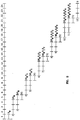
- Steps 2, 4, 6, 8, 10 and 12 compute the term needed for the multiplications and steps 3, 5, 7, 9, 11, and 13 compute the quotient. It must be observed that this is the fastest possible execution and it is assumed there is bypassing of the load cycles (i.e., the L cycles of the pipelines are not shown on the diagrams). Also it must be observed that steps 4, 6, 8, 10, and 12 can not be initiated earlier because these steps need the result of the multiplier that produces the previous D, in two's complement form. The previous observation implies that steps 5, 7, 9, 11 and 13 also cannot be initiated earlier. Finally, it can be observed that the total number of cycles required for implementation of the prior art divider of Fig. 1 is twenty.
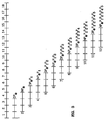
- the divider of the present invention can produce a quotient in fourteen cycles.
- the load cycle (L) of the multiplier does not appear because it has been assumed that the result is bypassed as it has been assumed in the previous discussion of the prior art divider.
- step 1 can immediately begin with the execution.
- the normalized result is loaded (i.e., the normalizer is not on the same chip)
- one extra cycle needs to be added for both implementations (i.e, the present invention and the prior art implementation), producing the quotient in fifteen and twenty one cycles, respectively.
- the proposed algorithm is noticeably faster than the quadratic convergence algorithm reported in the prior art.
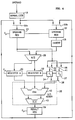
- FIG. 4 A preferred hardware embodiment of the proposed divider is shown in Fig. 4.
- the operands of interest are normalized at 18 and directed through appropriate multiplexing hardware 20a and 20b to a pair of operand registers 21 and 22.
- the output of each operand register is provided to an M/2 multiplier 25, with the output of operand register 22 inverted at 28 to provide the one's complement of the operand in the register.
- the register 21 is referred to as the "non-inverting" register
- the register 22 is referred to as the "inverting" register.
- the M/2 multiplier 25 produces partial products PP1 and PP2.
- a second registration path is through a multiplexer 36 and register 37.
- the multiplexer 36 receives as inputs either the contents of the non-inverting register 21 or the contents of the result register 39.
- the outputs of the registers 34 and 37 are input to a multiplexer 38 which selects the contents of one of the registers to provide as the third input for the 3/1 adder 35.
- the output from the 3/1 adder is provided to a result register 39.
- the output of the result register 39 and the output of the non-inverting register 21 are multiplexed to the input of the register 37 through a multiplexer 40.
- This adder 35 includes a carry-save adder (CSA) 41 which receives the three operands from the register 30, 32, and 37, combines them according to well-known principles, and produces carry (C) and save (S) outputs.
- the carry and save outputs of the CSA 41 are fed to the two inputs of a carry-lookahead adder (CLA) 43.
- the CLA 43 combines the C and S outputs according to well-known principles and produces a single output, which is provided to the result register 39.
- the single output from the CLA 43 is the sum of the three operands input to the CSA 41.
- connection between the result register 39 and the registers 21 and 22 is one-to-one.
- the cells in register 37 connect to cells of identical significance in registers 21 and 22.
- a hard-wired shift is provided in the connections between the outputs of the multiplexers 33 and 36 and the inputs of the register 34 and 37. This shift provides the required multiplication by 2 -(n-1) .
- the hardware inplementation of Figure 4 can be controlled to function in a manner corresponding to the iterative procedure of Figure 3.
- the inverting operand register 22 inverts D to obtain its one's complement ⁇ 0.
- the operands D and ⁇ 0 are input to the M/2 multiplier 25 and the partial products representing the product D ⁇ 0 are stored in registers 30 and 32.
- the operand D is gated through the multiplexer 33 into the register 34, with the result that the hardwiring 40 right-shifts the operand to obtain D2 -(n-1) , which is stored in register 34.
- the multiplexer 38 selects the output of the register 34 for provision as the third input to the 3/1 adder 35.
- the normalized numerator N is provided via the multiplexer 20a to the non-inverting operand register 21, while the normalized divisor D is retained in the inverting operand register 22.
- the divisor D is inverted to provide its one's complement ⁇ 0.
- the operands N and ⁇ 0 are input to the M/2 multiplier 25 and the partial products representing the product N ⁇ 0 are placed in the registers 30 and 32.
- the numerator operand N is right-shifted by the path 36, 41, 37 giving N2 -(n-1) in register 37.
- the multiplexer 38 changes to select the contents of register 37.
- the previous result DP0 is fed from the result register 39 through the multiplexers 20a and 20b to the registers 21 and 22. This positions them to begin the calculation of DP0P1.
- the multiplexers 33 and 36 are conditioned to select the output of the result register 39. These settings are maintained throughout the remaining operations.
- FIG. 3 shows how the multiply-add process according to the invention is carried out by the embodiment of Figure 4. It is contemplated that the divider of Figure 4 would be implemented in a pipelined machine which would have a conventional pipeline clock C P available for register synchronization. This is illustrated in Figure 4. In Figure 3, 18 periods of the pipeline clock are illustrated. In 14 of these periods, 12 overlapped pipeline cycles for calculation of the updated divisor and quotient are shown. Each cycle has the basic form LEW, with the three phases of the cycle being performed in three successive periods at the pipeline clock. In this regard, L stands for loading the operand registers 21 and 22 in clock period i.
- E stands for executing the multiplication-addition by entry of operands into the registers 30, 32, and 34 in clock period i+1; in the dividend update calculation, E stands for executing the miltiplication-addition by entry of operands into the registers 30, 32, and 37 in clock period i+1. In all calculation cycles, W stands for writing the result into the register 39 in clock period i+2.
- the apparatus of Figure 4 is initialized by setting the multiplexer 20a and 20b to feed the normalized divisor operand D to the non-inverting and inverting registers in period 1 of Figure 3, while in period 2, the multiplexers feed the normalized dividend N to the register 21 and divisor D to the register 22.
- the multiplexers 20a and 20b are both set to select the output of the result register 39.
- the multiplexer 33 selects the output of the non-inverting register 21 for entry into the register 34, while during the first and second periods, the multiplexer 36 selects the output of the register 21 for entry into the register 37.
- both of the multiplexers 33 and 36 are set to select the output of the result register 39 for entry into their respective associated registers.
- the multiplexer 38 is operated to provide the contents of the registers 34 and 37 out of phase to the 3/1 adder 35 in such a manner that the shifted current divisor DP0P1... P k-1 2 -(n-1) is available to the adder when the updated divisor DP0P1...P k is being calculated, while the shifted current dividend NP0P1...P k-1 2 -(n-1) is made available through the register 37 when the updated dividend NP0P1...P k is being calculated by the adder 35.
- the LEW calculation cycle for calculating the updated divisor DP0P1...Pk begins in pipeline clock period m.
- the non-inverting register 21 provides the value DP0P1...P k-1 to one input of the multiplier, while the one's complement of this value, ⁇ k , is provided to the other input.
- the current divisor DP0P1...P k-1 is entered into the register 21, it is also right-shifted via 33, 40 and entered into the register 34.
- the two partial products representing the multiplication of DP0P1...P k-1 ⁇ k are entered in the registers 30 and 32.
- the multiplexer 38 selects the contents of the register 34 and the adder 35 combines the contents of the registers 30, 32, and 34 to produce the updated divisor DP0P1...P k .
- the updated dividend NP0P1...P k-1 is entered into the non-inverting register 21 and is entered, right-shifted, into the register 37.
- the value ⁇ k continues to be provided through 22, 28.
- the updated divisor DP0P1...P k is written to the result register 39.
- the partial products representing NP0P1...P k-1 ⁇ k and the right-shifted term NP0P1...P k-1 2 -(n-1) are fed from the registers 30, 32, and from the register 37 via the multiplexer 38 to the adder 35.
- period m+3 the updated dividend NP0P1...P k is written to the result register 39.
- the inventors also contemplate that two apparatuses, each corresponding to the embodiment illustrated in Figure 4 could be operated in parallel, one for calculation of the updated divisor, the other for calculation of the updated quotient, with provision of the updated divisor from one unit being fed back to its own inverting and non-inverting registers and also to the inverting register of the unit for calculating the updated quotient.
- Fig. 4 is not the only possible embodiment of the invention and that the hardware organization may be modified to fit the implementation in a given technology.
- the invert operand may not be needed or the normalizer may be already necessary for other arithmetic hardware operations, etc.
- the following hardware would be required: the normalizer 18 (in general, needed for the convergence division algorithm), the register 37, a CSA adder for the extra 3/2 reduction, the inverters to produce the one's complement, and one extra input on the multiplexer in the operand register. It may be observed that there are bypassing buses that for a pipelined machine most likely already exist for fast multiplications.
- the hardware organization indicates that the additional hardware for the production of fast division cannot be considered prohibitive considering the amount of hardware needed to design two cycle multipliers. Also, considering the amount of hardware required to produce the same speed division using add/subtract algorithms, it can be stated that the extra hardware is negligible.
- a preferred implementation of the proposed divider requires a 3/2 adder, inverting logic and possibly an extra register whereas the prior art algorithm described above will require a dedicated two's complementer. It will be appreciated that the extra logic required by the proposed divider is less expensive than the dedicated adder. It can of course be stated that an existing adder may be used to accomplish the two's complementations required by the prior art algorithm. However, multiplexing logic must be added to the adder and penalties will result in moving and adding for two's complementation because, in general, floating point adders require more than one cycle to implement an addition if not pipelined.
Landscapes
- Physics & Mathematics (AREA)
- General Physics & Mathematics (AREA)
- Engineering & Computer Science (AREA)
- Computational Mathematics (AREA)
- Mathematical Analysis (AREA)
- Mathematical Optimization (AREA)
- Pure & Applied Mathematics (AREA)
- Theoretical Computer Science (AREA)
- Computing Systems (AREA)
- General Engineering & Computer Science (AREA)
- Complex Calculations (AREA)
Applications Claiming Priority (2)
| Application Number | Priority Date | Filing Date | Title |
|---|---|---|---|
| US07/655,316 US5140545A (en) | 1991-02-13 | 1991-02-13 | High performance divider with a sequence of convergence factors |
| US655316 | 1991-02-13 |
Publications (2)
| Publication Number | Publication Date |
|---|---|
| EP0499705A2 true EP0499705A2 (fr) | 1992-08-26 |
| EP0499705A3 EP0499705A3 (en) | 1993-03-10 |
Family
ID=24628407
Family Applications (1)
| Application Number | Title | Priority Date | Filing Date |
|---|---|---|---|
| EP19910121058 Withdrawn EP0499705A3 (en) | 1991-02-13 | 1991-12-09 | High performance divider with a sequence of convergence factors |
Country Status (3)
| Country | Link |
|---|---|
| US (1) | US5140545A (fr) |
| EP (1) | EP0499705A3 (fr) |
| JP (1) | JP2597775B2 (fr) |
Families Citing this family (10)
| Publication number | Priority date | Publication date | Assignee | Title |
|---|---|---|---|---|
| JPH07122846B2 (ja) * | 1990-04-04 | 1995-12-25 | インターナショナル・ビジネス・マシーンズ・コーポレーション | 3―1alu装置 |
| EP0498067A2 (fr) * | 1991-02-08 | 1992-08-12 | International Business Machines Corporation | Génération de microcodes pour une machine ayant un jeu échelonnable d'instructions combinées |
| JPH0535773A (ja) * | 1991-07-30 | 1993-02-12 | Nec Corp | ベクトル除算方式とその装置 |
| GB2293469A (en) * | 1994-09-22 | 1996-03-27 | Secr Defence | Error detection in arithmetic circuit. |
| US5696713A (en) * | 1995-08-21 | 1997-12-09 | International Business Machines Corporation | Method for faster division by known divisor while maintaining desired accuracy |
| US5825681A (en) * | 1996-01-24 | 1998-10-20 | Alliance Semiconductor Corporation | Divider/multiplier circuit having high precision mode |
| US6751645B1 (en) * | 1999-02-17 | 2004-06-15 | Elbrus International Limited | Methods and apparatus for performing pipelined SRT division |
| US20040117423A1 (en) * | 2002-12-11 | 2004-06-17 | Xiaohua Shi | Signed integer long division apparatus and methods for use with processors |
| US20140195581A1 (en) * | 2013-01-08 | 2014-07-10 | Analog Devices, Inc. | Fixed point division circuit utilizing floating point architecture |
| JP2022121055A (ja) | 2021-02-08 | 2022-08-19 | キオクシア株式会社 | 演算装置及び演算回路 |
Family Cites Families (6)
| Publication number | Priority date | Publication date | Assignee | Title |
|---|---|---|---|---|
| JPS60142738A (ja) * | 1983-12-30 | 1985-07-27 | Hitachi Ltd | 内挿近似を使用する除算装置 |
| JPS62118474A (ja) * | 1985-11-19 | 1987-05-29 | Hitachi Ltd | ベクトル除算装置の制御方式 |
| US4991132A (en) * | 1987-12-17 | 1991-02-05 | Matsushita Electric Industrial Co., Ltd. | Apparatus for executing division by high-speed convergence processing |
| JP2737933B2 (ja) * | 1988-06-23 | 1998-04-08 | 日本電気株式会社 | 除算装置 |
| US5046038A (en) * | 1989-07-07 | 1991-09-03 | Cyrix Corporation | Method and apparatus for performing division using a rectangular aspect ratio multiplier |
| US5065352A (en) * | 1989-08-16 | 1991-11-12 | Matsushita Electric Industrial Co., Ltd. | Divide apparatus employing multiplier with overlapped partial quotients |
-
1991
- 1991-02-13 US US07/655,316 patent/US5140545A/en not_active Expired - Fee Related
- 1991-10-23 JP JP3275744A patent/JP2597775B2/ja not_active Expired - Lifetime
- 1991-12-09 EP EP19910121058 patent/EP0499705A3/en not_active Withdrawn
Non-Patent Citations (1)
| Title |
|---|
| IBM JOURNAL OF RESEARCH AND DEVELOPMENT vol. 11, no. 1, January 1967, NEW YORK US pages 34 - 53 ANDERSON ET AL 'The IBM System/360 Model 91: Floating-Point Execution Unit' * |
Also Published As
| Publication number | Publication date |
|---|---|
| EP0499705A3 (en) | 1993-03-10 |
| JP2597775B2 (ja) | 1997-04-09 |
| US5140545A (en) | 1992-08-18 |
| JPH0628155A (ja) | 1994-02-04 |
Similar Documents
| Publication | Publication Date | Title |
|---|---|---|
| US5341321A (en) | Floating point arithmetic unit using modified Newton-Raphson technique for division and square root | |
| US7395304B2 (en) | Method and apparatus for performing single-cycle addition or subtraction and comparison in redundant form arithmetic | |
| US5262976A (en) | Plural-bit recoding multiplier | |
| US5046038A (en) | Method and apparatus for performing division using a rectangular aspect ratio multiplier | |
| US5258944A (en) | High performance mantissa divider | |
| US5220524A (en) | Machine method to perform newton iterations for reciprocals | |
| US5206823A (en) | Apparatus to perform Newton iterations for reciprocal and reciprocal square root | |
| US5157624A (en) | Machine method to perform newton iterations for reciprocal square roots | |
| US6782405B1 (en) | Method and apparatus for performing division and square root functions using a multiplier and a multipartite table | |
| US5751619A (en) | Recurrent adrithmetical computation using carry-save arithmetic | |
| JP2511914B2 (ja) | 複素乗算器及び複素乗算方法 | |
| EP0375947A2 (fr) | Multiplication à complément de deux avec un multiplicateur à signe et grandeur | |
| EP0356153B1 (fr) | Procédé et appareil de division en base 2**n à sélection chevauchée de bits de quotient, et arrondissement et correction simultanés de quotient | |
| US5132925A (en) | Radix-16 divider using overlapped quotient bit selection and concurrent quotient rounding and correction | |
| US5357455A (en) | Floating point remainder generator for a math processor | |
| JPH0368416B2 (fr) | ||
| EP0499705A2 (fr) | Diviseur à haute performance avec une série de facteurs de convergence | |
| EP0428942B1 (fr) | Multiplieur à recodage par plusieurs bits | |
| Ercegovac et al. | Very high radix division with selection by rounding and prescaling | |
| US3290493A (en) | Truncated parallel multiplication | |
| US5910910A (en) | Circuit and method for rapid calculation of quotients and square roots | |
| CA1321650C (fr) | Methodes de calcul pour unites fonctionnant en virgule flottante | |
| US5734600A (en) | Polynomial multiplier apparatus and method | |
| US5377134A (en) | Leading constant eliminator for extended precision in pipelined division | |
| US20050246406A9 (en) | Emod a fast modulus calculation for computer systems |
Legal Events
| Date | Code | Title | Description |
|---|---|---|---|
| PUAI | Public reference made under article 153(3) epc to a published international application that has entered the european phase |
Free format text: ORIGINAL CODE: 0009012 |
|
| AK | Designated contracting states |
Kind code of ref document: A2 Designated state(s): DE FR GB |
|
| PUAL | Search report despatched |
Free format text: ORIGINAL CODE: 0009013 |
|
| AK | Designated contracting states |
Kind code of ref document: A3 Designated state(s): DE FR GB |
|
| STAA | Information on the status of an ep patent application or granted ep patent |
Free format text: STATUS: THE APPLICATION IS DEEMED TO BE WITHDRAWN |
|
| 18D | Application deemed to be withdrawn |
Effective date: 19930913 |