EP0499981A2 - Schichtträger und Spulenkern für lichtempfindliches Material - Google Patents
Schichtträger und Spulenkern für lichtempfindliches Material Download PDFInfo
- Publication number
- EP0499981A2 EP0499981A2 EP92102508A EP92102508A EP0499981A2 EP 0499981 A2 EP0499981 A2 EP 0499981A2 EP 92102508 A EP92102508 A EP 92102508A EP 92102508 A EP92102508 A EP 92102508A EP 0499981 A2 EP0499981 A2 EP 0499981A2
- Authority
- EP
- European Patent Office
- Prior art keywords
- core
- base end
- photographic film
- substrate
- less
- Prior art date
- Legal status (The legal status is an assumption and is not a legal conclusion. Google has not performed a legal analysis and makes no representation as to the accuracy of the status listed.)
- Granted
Links
Images



Classifications
-
- G—PHYSICS
- G03—PHOTOGRAPHY; CINEMATOGRAPHY; ANALOGOUS TECHNIQUES USING WAVES OTHER THAN OPTICAL WAVES; ELECTROGRAPHY; HOLOGRAPHY
- G03C—PHOTOSENSITIVE MATERIALS FOR PHOTOGRAPHIC PURPOSES; PHOTOGRAPHIC PROCESSES, e.g. CINE, X-RAY, COLOUR, STEREO-PHOTOGRAPHIC PROCESSES; AUXILIARY PROCESSES IN PHOTOGRAPHY
- G03C1/00—Photosensitive materials
- G03C1/76—Photosensitive materials characterised by the base or auxiliary layers
- G03C1/765—Photosensitive materials characterised by the base or auxiliary layers characterised by the shape of the base, e.g. arrangement of perforations, jags
-
- B—PERFORMING OPERATIONS; TRANSPORTING
- B65—CONVEYING; PACKING; STORING; HANDLING THIN OR FILAMENTARY MATERIAL
- B65H—HANDLING THIN OR FILAMENTARY MATERIAL, e.g. SHEETS, WEBS, CABLES
- B65H75/00—Storing webs, tapes, or filamentary material, e.g. on reels
- B65H75/02—Cores, formers, supports, or holders for coiled, wound, or folded material, e.g. reels, spindles, bobbins, cop tubes, cans, mandrels or chucks
- B65H75/04—Kinds or types
- B65H75/08—Kinds or types of circular or polygonal cross-section
- B65H75/10—Kinds or types of circular or polygonal cross-section without flanges, e.g. cop tubes
-
- B—PERFORMING OPERATIONS; TRANSPORTING
- B65—CONVEYING; PACKING; STORING; HANDLING THIN OR FILAMENTARY MATERIAL
- B65H—HANDLING THIN OR FILAMENTARY MATERIAL, e.g. SHEETS, WEBS, CABLES
- B65H75/00—Storing webs, tapes, or filamentary material, e.g. on reels
- B65H75/02—Cores, formers, supports, or holders for coiled, wound, or folded material, e.g. reels, spindles, bobbins, cop tubes, cans, mandrels or chucks
- B65H75/18—Constructional details
-
- Y—GENERAL TAGGING OF NEW TECHNOLOGICAL DEVELOPMENTS; GENERAL TAGGING OF CROSS-SECTIONAL TECHNOLOGIES SPANNING OVER SEVERAL SECTIONS OF THE IPC; TECHNICAL SUBJECTS COVERED BY FORMER USPC CROSS-REFERENCE ART COLLECTIONS [XRACs] AND DIGESTS
- Y10—TECHNICAL SUBJECTS COVERED BY FORMER USPC
- Y10S—TECHNICAL SUBJECTS COVERED BY FORMER USPC CROSS-REFERENCE ART COLLECTIONS [XRACs] AND DIGESTS
- Y10S430/00—Radiation imagery chemistry: process, composition, or product thereof
- Y10S430/135—Cine film
Definitions
- This invention relates to a substrate of a photosensitive web material and a core for a photosensitive web material which improve marking troubles of the photosensitive web material formed near the core.
- the substrate base end of a conventional photosensitive web material is formed almost rectangular both in the section and in the plane figure, as shown by dashed lines in Figure 1.
- a difference in level is formed between the base end 4 of the web 1 and the core 11 due to the thickness t of the web 1.
- the conventional core for the photosensitive web is formed by winding in spiral a dense kraft paper, regenerated paper or the like.
- the core is rendered as hard as possible in order to prevent deformation of the core by the winding pressure of the photosensitive web, shocks got during physical distribution and the like, and therefore, its flattening compressive strength is high.
- a means for resolving the problem to form marks by the difference in level by the base end of the web is disclosed in Japanese Utility Model KOKAI Nos. 57-60141 and 63-41072 which forms a step portion 17 on the core corresponding to the thickness of the web in the axial direction, as shown in Figure 12, and the web is begun to be wound from the step portion.
- This means has not been put to practical use, because it is not easy to adjust the base end of the web to the step portion under a dark safty light.
- the manufacture of the core is a special order, and the height of the step must be changed according to the thickness of the web. As a result, the manufacturing cost of the core is expensive.
- a means for resolving the problem due to the hardness of the core surface is disclosed in Japanese Utility Model KOKOKU No. 2-24116 which covers the circumferential face of the core in the whole width with a sheet having cushioning characteristic and elasticity, such as low density papers of less than 0.5 g/cm3, synthetic papers and foamed resin sheet having an expansion ratio of 5 to 15 times.
- a sheet having cushioning characteristic and elasticity such as low density papers of less than 0.5 g/cm3, synthetic papers and foamed resin sheet having an expansion ratio of 5 to 15 times.
- the above core is used as the core for a roll of a photographic film of which the substrate is a plastic film having a less elasticity than the paper substrate, the marking troubles and pressure mark troubles occur in 5 to 6 folds of the film from the base end of the film.
- the Japanese Utility Model KOKOKU No. 2-24116 discloses a core provided nonwoven fabric. In this core, since the friction resistance is small between the photographic film and the nonwoven fabric, it is necessary to fix the photographic film to the nonwoven fabric using and adhesive tape.
- An object of the invention is to provide a means capable of decreasing sharply the physical marking troubles and pressure mark troubles of a photosensitive web material which is practical and which does not induce a loosing problem.
- Another object of the invention is to provide a means capable of decreasing sharply the physical marking troubles and pressure mark troubles of a photosensitive web material which is not necessary to form a step portion on the core and of which the workability is excellent.
- Another object of the invention is to provide a means capable of decreasing sharply the physical marking troubles and pressure mark troubles of a rolled photographic film.
- the present invention provides, as a means which has achieved the above objects, a substrate of a photosensitive web material, a core for a photographic film and rolls of a photographic film.
- the substrate of a photosensitive web material has the base end portion which is gradually thinned toward the base end.
- the core for a rolled photographic film comprises a core body and a crosslinked foamed sheet having an expansion ratio of 18 to 45 times and a thickness of 0.2 to 2.0 mm which contains more than 50 wt. % in the sum of one or more members selected from the group consisting of polyethylene resin having a density of less than 0.930 g/cm3, ethylene-vinyl acetate copolymer resin having a comonomer content of less than 25 wt. % and ethylene-ethyl acrylate copolymer resin having a comonomer content of less than 25 wt. % in disposed on the surface of the core body.
- One of the rolls of a photographic film comprises the above core and a rolled photographic film of which the substrate is made of plastic having a heat resistance of more than 250°F and a strength of more than 7,000 psi.
- Another roll of a photographic film comprises a core body, a cushioning material which is a member selected from the group consisting of paper synthetic paper and nonwoven fabric having a density of less than 0.5 g/cm3, foamed polyolefin sheet having an expansion ratio of 5 to 45 times disposed on the surface of the core body, and a rolled photographic film of which the base end portion is gradually thinned toward the base end wound around the cushioning material.
- Still another roll of a photographic film comprises a core body, a cushioning material which is a member selected from the group consisting of paper, synthetic paper and nonwoven fabric having a density of less than 0.5 g/cm3, and foamed polyolefin sheet having an expansion ratio of 5 to 45 times disposed on the surface of the core body, and a rolled photographic film of which the length of the base end is longer than the width of the photographic film.
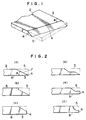
- Figure 1 is a perspective view illustrating the base end portion of the substrate of a photosensitive web material embodying the invention.
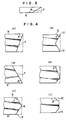
- Figures 2 and 3 are sectional views illustrating various thinned forms of the base end portion applicable to the invention.
- Figure 4 indicates plan views of various forms of the base end portion of which the length of the base end is lengthened than the width of the web material.
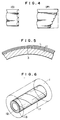
- Figure 5 is a partial sectional view illustrating a wound state of a photosensitive web material of which the base end portion is gradually thinned around a core.
- Figure 6 is a perspective view illustrating a roll of a photographic film wound around a core comprising the core body and the crosslinked foamed sheet.
- Figure 7 is a side view with a partially enlarged section.
- Figure 8 is a front view with a partially enlarged section.
- Figure 9 is a perspective view illustrating a winding state of a photographic film of which the base end is obliquely cut in the width direction.
- Figures 10 and 11 are partially sectional views of crosslinked foamed sheets applicable to the invention.
- Figure 12 is a partial perspective view of a conventional core.
- Figure 13 is a partial sectional view illustrating a conventional wound state of a photosensitive web material.
- the substrate of a photosensitive web material is made of polyester, polycarbonate, cellulose triacetate, cellulose diacetate, cellulose butylacetate, polystyrene, polypropylene, polyethylene terephthalate, cellulose nitrate, polyvinyl chloride, synthetic paper, thermoplastic resin coated paper, etc.
- the rolled photographic film is composed of a silver halide photographic photosensitive material emulsion layer and a plastic film substrate coated therewith, and includes films for printing (lithfilm), films for roentgenogram, films for computerized type-setting syentem, microfilms, positive films (such as Fuji Crystal Paper), and the like.
- the plastic film substrate is formed of polyester, polycarbonate, cellulose triacetate, polystyrene, polypropylene or the like, and it may be nonstretched, uniaxially stretched or biaxially stretched, and clear or colored with white or color pigment. Moreover, it may be metallized by deposition, sputtering, etc.
- a plastic film suitable for the core covered with the crosslinked foamed sheet has a heat resistance (ASTM D-759) of more than 250°F and a strength (ASTM D-882) of more than 7,000 psi.
- the substrate of the photosensitive web material is gradually thinned at the base end portion toward the base end, i.e. the end to start winding.
- the length in the longitudinal direction of the base end portion to be thinned is usually 0.1 to 10 times, particularly 0.5 to 5 times, the thickness of the substrate.
- a typical form is oblique as shown in Figure 2(a), and a suitable angle ⁇ between the reverse face of the substrate 2 and the oblique face 7 is 10 to 80 degrees, preferably 20 to 50 degrees, or as shown in Figure 3, 100 to 170 degrees, preferably 130 to 160 degrees. It is difficult to manufacture the oblique face having an angle of less than 10 degrees or more than 170 degrees, and in an angle of 80 to 100 degrees, marks and pressure marks are liable to occur. Thinning form may be discontinuous, such as stepwise, as well as continuous.
- Figure 2 (b) through (f) Several other forms of gradually thinned are illustrated in Figure 2 (b) through (f) which are applicable to the invention.
- the cut off portion 5 vertically descends from the upper face 8 and then obliquely cut.
- the base end portion 3 is obliquely cut, but the vertical base end 4 partially remains on the reverse face 6 side.
- the cut off portion 5 is cut obliquely, then horizontally and obliquely again.
- the cut off portion 5 is cut obliquely and then horizontally to leave a partial vertical base end 4 on the reverse face 6 side.
- the cut off portion 5 is almost a quarter cylinder to leave a partial vertical base end 4 on the reverse face 6 side.
- the length of the base end is preferably rendered longer than the width of the substrate, in order to prevent the occurrence of marking troubles and pressure mark troubles.
- a suitable length is 1.01 to 5.00 times the width of the substrate, and 1.02 to 2.00 times is preferred.
- a typical form is obliquely cut in the plane figure as shown in Figure 4(a) and (b) and a suitable angle ⁇ between a side end 9 and the base end 4 is 30 to 80 degrees.
- FIG. 4 (c) through (p) Several other base end forms are illustrated in Figure 4 (c) through (p) which are applicable to the invention.
- the base end portion 3 is obliquely cut from both side ends 9,9 toward the center of the base end 4 to form an equilateral triangle projection.
- the base end portion 3 is obliquely cut from both corners 10,10 toward the inside of the substrate to form an equilateral triangle recess.
- the base end portion is obliquely cut from both side ends at a different angle to form an inequilateral triangle projection.
- both corners 10,10 are cut at a different angle to form a trapezoidal projection.
- the base end portion is cut to form a circular are projection.
- the base end portion is cut to form a circular are recess.
- both corners are cut to form round corners.
- the base end portion is cut serrate to form uniformly equilateral triangle projections.
- the triangular serrate projection is ununiform.
- the triangular serrate projection is cut obliquely as a whole.
- the base end portion is cut to form several half circular projections having a same size.
- the base end portion is cut to form several half circular recesses having a same size.
- the half circular projections are arranged obliquely as a whole. Preferred forms are oblique cut as shown in Figure 4(a) and (b), serrate cut as shown in Figure 4(j) through (m), a plurality of circular projections as shown in Figure 4(n) and (p), and so on.
- the stress concentrated on the difference in level portion can be distributed to the oblique face, and as a result, the occurrence of marking troubles and pressure mark troubles are prevented.
- the dispersion of the stress is further proceeds, and the marking troubles and pressure mark troubles can further be reduced.
- the core for a rolled photographic film comprises a crosslinked foamed sheet and a core body.
- the crosslinked foamed sheet prevents the occurrence of various markings and pressure marks on the photographic film wound around the core by its elasticity, and contains at least one of polyethylene resin having a density of less than 0.930 g/cm3, ethylene-vinyl acetate (EVA) copolymer resin having a comonomer content of less than 25 wt. % and ethylene-ethyl acrylate (EEA) copolymer resin having a comonomer content of less than 25 wt. % in an amount of more than 50 wt. % in the sum of the above resins.
- EVA ethylene-vinyl acetate
- ESA ethylene-ethyl acrylate
- the foamed sheet is insufficient in the cushionability and great in slipping characteristics. As a result, the winding of a photographic film is difficult, unless the base end is fixed to the core by an adhesive tape or an adhesive agent, and various marking troubles and pressure mark troubles tend to occur on the rolled photographic film.
- the polyethylene resin may be selected from various high pressure branched low density homopolyethylene (LDPE) resins, linear low density polyethylene (L-LDPE) resins which are ethylene- ⁇ -olefin copolymer resins and blends of them.
- the L-LDPE resin is called the third polyethylene resin, and it is a low cost high strength resin having the advantages of both medium, low density polyethylene resin and high density polyethylene resin and meeting the requirements of the times of saving energy and resources.
- the L-LDPE resin is a copolymer produced by copolymerizing ethylene with an ⁇ -olefin having a number of carbon atoms of 3 to 13, preferably 4 to 10, through the low presure process or the modified high pressure process, and has a linear structure with short branches.
- Preferred ⁇ -olefins in view of physical strength and cost are butene-1, heptene-1, hexene-1, 4-methylpentene-1, octene-1 and the like.
- the density of polyethylene resin is less than 0.930 g/cm3, preferably 0.90 to 0.92 g/cm3, more preferably 0.910 to 0.925 g/cm3. When the density exceeds 0.930 g/cm3, it is difficult to manufacture a foamed sheet having an expansion ratio of 18 times or more.
- the foamed sheet is insufficient in the cushionability and great in slipping characteristics. As a result, the winding of a photographic film is difficult, unless the base end is fixed to the core by an adhesive tape or an adhesive agent, and various marking troubles and pressure mark troubles tend to occur on the rolled photographic film.
- the EVA resin having a comonomer content of less than 25 wt. % does not affect adversely photographic films, such as fogging or sensitivity deviation, and acetic acid odor is little.
- the EEA resin having a comonomer content of less than 25 wt. % does not affect adversely photographic films, such as fogging or sensitivity deviation, and acrylic acid odor, apple-like odor, is weak and does not give discomfort to uses.
- the EVA resin and the EEA resin adversely affects photographic films, such as fogging or sensitivity deviation.
- Acetic acid odor or acrylic acid odor becomes strong and give discomfort to users.
- the melt index (MI) of the above polyethylene resin, EVA resin and EEA resin is preferably less than 20 g/10 minutes, preferably 0.1 to 15 g/10 minutes, more preferably 0.5 to 10 g/10 minutes. When the MI exceeds 20 g/10 minutes, moldability is occasionally inferior.
- Blowing agents applicable to manufacturing the crosslinked foamed sheet are sodium hydrogen carbonate, azido compounds such as CaN6 and BaN6, light metals reacting with water to generate hydrogen gas such as Mg, Zn and Al, azo compounds such as azodicarbonamide and azobisisobutyronitrile, sulfonyl hydrazide compounds such as p-toluenesulfonyl hydrazide, volatile organic blowing agents of halogenated hydrocarbons and mixture thereof such as various mixtures of dichlorotetrafluoroethane with another halogenated hydrocarbon, e.g.
- Undesirable blowing agents are heat-decomposable blowing agents of which a principal component is an ammonium compound, a formalin compound or a sulfur compound, because they adversely affect photographic films, such as fogging or sensitivity deviation.
- Preferred blowing agents are those generating harmless gas to photographic films, such as N2 or carbon dioxide gas, which include azodicarbonamide and N,N'-dinitrosopentamethylenetetramine and 4,4'-hydroxybenzenesulfonyl hydrazide, mixtures of halogenated hydrocarbons which are volatile organic blowing agent, and the like.
- the crosslinking method may be chemical crosslinking or radiation crosslinked foamed sheet is 18 to 45 times, preferably 20 to 40 times, more preferably 25 to 35 times.
- the expansion ratio is less than 18 times, marking troubles are less than 18 times, marking troubles are liable to occur due to insufficient cushionability.
- the expansion ration exceeds 45 times, it is difficult to ensure wear resistance, surface strength, physical strength and productivity.
- the thickness of the crosslinked foamed sheet is 0.2 to 2,0 mm, preferably 0.3 to 1.5 mm, more preferably 0.45 to 1.2 mm, in view of ensuring various properties and productivity.
- the crosslinked famed sheet is attached to the core body in spiral (with spaces), the whole circumferential surface, stripes, or the like.
- the attached area is more than 70 % of the whole circumferential area.
- the core body may be a conventional core, such as a core produced by winding a dense kraft paper or regenerated paper in spiral, a core produced by winding a cardboard in spiral on a mandrel and then winding a surface layer sheet in spiral thereon, a core made of plastic, a core made of metal, and any other known cores.
- cores for taking up a web disclosed in Japanese Utility Model KOKOKU No. 3-28053 can also be applicable to the invention which have a mouthpiece portion, i.e. a contact portion with chucking apparatus which takes up a substrate used for manufacturing a photographic film or a photographic film manufactured by coating a photosensitive layer of silver halide emulsion or the like onto the substrate.
- the physical marking troubles and pressure mark troubles can also be removed by a combination of the aforementioned photographic film of which the base end portion is gradually thinned or the length of the base end is lengthened than the width of the photographic film with a cushioning material which is paper, synthetic paper or nonwoven fabric having a density of less than 0.5 g/cm3, or foamed polyolefin sheet having an expansion ratio of 5 to 45 times disposed on the surface of the aforementioned core body.
- a cushioning material which is paper, synthetic paper or nonwoven fabric having a density of less than 0.5 g/cm3, or foamed polyolefin sheet having an expansion ratio of 5 to 45 times disposed on the surface of the aforementioned core body.
- the paper having a density of less than 0.5 g/cm3 measured by JIS P-8118 is made so as not to add a pressure to the paper through the paper making process and the finishing process or so as to select the kind of pulp, the length of pulp, the thickness of pulp, additives, etc.
- the density exceeds 0.5 g/cm3
- various marking troubles and pressure mark troubles tend to occur, even if the base end portion of the photographic film is gradually thinned or the length of the base end is lengthened than the width.
- the synthetic paper there are film synthetic papers produced by the internal paperizing method, film synthetic papers produced by the surface coating method, fiber synthetic papers produced by the spunbonding method and fiber synthetic papers produced by the synthetic pulp method.
- these synthetic papers only those having a density of less than 0.5 g/cm3 can avoid the occurrence of various marking troubles and pressure mark troubles in a combination with the photographic film of which the base end portion is gradually thinned or the length of the base end is lengthened than the width.
- the nonwoven fabric can be divided into paper type nonwoven fabrics, felt type nonwoven fabrics, batting type nonwoven fabrics, wadding type nonwoven fabrics, punched type nonwoven fabrics, fabric type nonwoven fabrics, combination type nonwoven fabrics, and the like. Among these, only those having a density of less than 0.5 g/cm3 can avoid the occurrence of various marking troubles and pressure mark troubles in a combination with the photographic film of which the base end portion is gradually thinned or the length of the base end is lengthened than the width.
- the foamed polyolefin resin sheet having an expansion ratio of 5 to 45 times is produced using a polyolefin resin which does not affect adversely photographic photosensitive materials.
- a polyolefin resin includes low, medium, high density homopolyethylne resins, very low density polyethylene resins, ethylene- ⁇ -olefin copolymer resins, homopolypropylene resins, propylene- ⁇ -olefin copolymer resins, ethylene-vinyl acetate copolymer resins, ethylene-ethyl acrylate copolymer resins, ethylene-acrylic acid copolymer resins, ionomer resins, adhesive polyolefin resins (acid-modified polyolefin resins), ethylene-propylene copolymer resins, ethylene-butadiene copolymer resins, ethylene-propylene elastomers, ethylene-methyl acrylate copolymer resins, ethylene-vin
- suitable resin sheets are aforementioned ones produced by crosslinking a polyolefin resin containing at least one of polyethylene resin having a density of less than 0.930 g/cm3, EVA resin having a comonomer content of less than 25 wt. % and EEA resin having a comonomer content of less than 25 wt. % in an amount of more than 50 wt. % in the sum of the above resins.
- the expansion ratio is less than 5 times, various marking troubles and pressure mark troubles tend to occur, even if the base end portion of the photographic film is gradually thinned or the length of the base end is lengthened the width.
- the expansion ratio exceeds 45 times, wear resistance, surface strength, etc. are degraded. Moreover, compression deformation is too great, and therfore, the core cannot be put to practical use.
- the crosslinked foamed sheet sinks elastically to prevent the occurrence of physical marking troubles, pressure mark troubles and sensitivity deviation troubles.
- a positive color photographic photosensitive emulsion for movie was uniformly coated onto a cellulose triacetate web 135 ⁇ m in thickness.
- the base end portion of the web was processed into each form, as shown in Figure 1 and details are described in Table 1, and the positive color photographic film for movie 110 cm in width 4000 m in length was wound around a core 40 cm in diameter made of a synthetic resin at a winding tension of 70 kg/m width.
- the wound state is shown in Figure 5.
- the photographic film 1 was smoothly wound around the core 11 even at the base end portion 3.
- FIG. 6 An example of the roll of a photographic film of the invention is illustrated in Figures 6 and 7.
- the photographic film 1 which is a photosensitive web material is wound around a core 11 consisting of a core body 12 and a crosslinked foamed sheet 13.
- the core body 12 was made of brown paper composed of 30 wt. % of unbreached kraft paper and 70 wt. % of waste corrugated board paper wound in spiral, and the thickness was 5.5 mm.
- the crosslinked foamed homopolyethylene resin produced by foaming LDPE resin having a density of 0.920 g/cm3 at an expansion ratio of 30 times, and the thickness was 0.5 mm.
- the crosslinked foamed sheet 13 was wound around the core body 12 in a single fold in spiral.
- the photographic film 1 was a positive roll film 150 m in length of which the substrate 2 was a biaxially stretched polyester resin film about 170 ⁇ m in thickness rendered white opaque by blending BaSO4, coated with a photographic emulsion layer.
- the base end of the photographic film was conventional, i.e. cut in parallel to the width direction perpendicular to the longitudinal direction of the film.
- the base end portion was not thinned.
- the base end was fixed to the crosslinked foamed sheet by using an adhesive tape, and then started to winding. During winding, the base end 4 sank into the crosslinked foamed sheet 13 to dissolve the difference in level, as shown in Figure 8.
- the roll was left at 35°C for one week, and it was confirmed that no occurrence of physical marks around the base end portion. Pressure marks and sensitivity deviation did not occur, too. Flattening compressive strength was sufficient, and the roll form of the photographic film was excellent. Streaks were not formed. The core could readily be discriminated even under a safty light, and the photographic film was easily fixed to the core.
- thermoplastic resin layers 15,15 are laminated onto one or both sides of the crosslinked foamed sheet 13.
- Example VII Another roll was prepared in the same manner as Example VII, except that the crosslinked foamed sheet was produced by foaming L-LDPE resin (ethylene-butene-1 copolymer resin) having a density of 0.921 g/cm3 at an expansion ratio of 35 times, and the thickness was 1.0 mm.
- L-LDPE resin ethylene-butene-1 copolymer resin
- Example VII By conducting the same evaluation tests as Example VII, better results were obtained than Example VII, and the number of folds where troubles occurred was reduced by half, i.e. one fold.
- Example VII Another roll was prepared in the same manner as Example VII, except that the crosslinked foamed sheet was produced by foaming EVA resin having a density of 0.940 g/cm3 and a vinyl acetate comonomer content of 15 wt. % at an expansion ratio of 20 times, and the thickness of 0.5 mm, and that no adhesive tape was used.
- EVA resin having a density of 0.940 g/cm3 and a vinyl acetate comonomer content of 15 wt. % at an expansion ratio of 20 times, and the thickness of 0.5 mm, and that no adhesive tape was used.
- Example VII By conducting the same evaluation tests as Example VII, almost the same good results were obtained.
- the core had a great friction resistance with the positive roll film, and the film could be wound without using an adhesive tape.
- the core body was the same as Example VII.
- the crosslinked foamed sheet was produced by foaming a blend resin composed of 60 wt. % of the LDPE resin of Example VII and 40 wt. % of the L-LDPE resin of Example VIII at an expansion ratio of 30 times, and the thickness was 0.5 mm.
- the photographic film was a negative roll film 50 m in length of which the substrate was a biaxially stretched polyester resin film 100 ⁇ m in thickness, coated with a photographic emulsion layer for lithfilm.
- Example VII By conducting the same evaluation tests as Example VII, the physical marking troubles caused by the base end of the rolled photographic film were particularly improved.
- Example XI Another roll was prepared in the same manner as Example XI, except that a foamed polyethylene resin sheet ("Softron", Sekisui Chemical Co., Ltd.) 1 mm in thickness having an expansion ratio of 5 times was used instead of the crosslinked foamed sheet of Example XI.
- a foamed polyethylene resin sheet ("Softron", Sekisui Chemical Co., Ltd.) 1 mm in thickness having an expansion ratio of 5 times was used instead of the crosslinked foamed sheet of Example XI.
- Example VII By conducting the same evaluation tests as Example VII, various marking troubles and pressure mark troubles were sharply reduced compared with the conventional roll formed by using the conventional core and a rolled photographic negative film for printing of which the base end portion was cut in parallel to the width direction perpendicular to the longitudinal direction of the film. Besides, the troubles were reduced to one third in a practical level compared with the roll formed by using the core of Example 2 in Japanese Utility Model KOKOKU No. 2-24116 which is the same as employed in this example and the rolled photographic negative film for printing of which the base end portion was cut in parallel to the width direction perpendicular to the longitudinal direction of the film.
- Example XI Another roll was prepared in the same manner as Example XI, except that the base end was obliquely cut in the width direction as shown in Figure 4(a). The winding state is shown in Figure 9.
- Example VII By conducting the same evaluation tests as Example VII, various marking troubles and pressure mark troubles were slight similar to Example XI, and the part impossible for use is very little. The roll form was excellent, and streaks did not occur at all.
- the core body was made of kraft paper having a density of 0.75 g/cm3 wound in spiral, and the thickness was 6.0 mm.
- Nonwoven fabric having a density of 0.32 g/cm3 and an areal weight of about 130 g/cm3 was used instead of the foamed sheet, and wound thereon in spiral.
- the core body was the same as Example VIII.
- a foamed polyethylene sheet (“Softron", Sekisui Chimical Co., Ltd.) 1 mm in thickness having an expansion ratio of 5 times was used as the cushioning material, and wound around the core body in one fold.
- This roll was the same as Comparative I, except that chipboard paper having a density of 0.5 g/cm3 and a thickness of 1.0 mm was wound around the core body in one fold as the cushioning material.
- This roll was the same as Comparative I, except that kraft paper having a density of 0.75 g/cm3 was wound around the core body in spiral.
- the rolled film employed was a rolled photographic negative film 50 m in length composed of a biaxially stretched polyester resin film substrate 100 ⁇ m in thickness and a photographic emulsion layer for lithfilm coated thereon, and the others are the same as Conventional Example 2.
- This roll was the same as Comparative IV, except that the rolled film was the same as employed in Example XIII, and the base end was obliquely cut in the width direction as shown in Figure 4(a).
Landscapes
- Chemical & Material Sciences (AREA)
- Engineering & Computer Science (AREA)
- Materials Engineering (AREA)
- Physics & Mathematics (AREA)
- General Physics & Mathematics (AREA)
- Laminated Bodies (AREA)
- Manufacture Of Porous Articles, And Recovery And Treatment Of Waste Products (AREA)
Applications Claiming Priority (6)
| Application Number | Priority Date | Filing Date | Title |
|---|---|---|---|
| JP22265/91 | 1991-02-15 | ||
| JP2226591 | 1991-02-15 | ||
| JP3022265A JPH04260576A (ja) | 1991-02-15 | 1991-02-15 | 感光材料用支持体 |
| JP217191/91 | 1991-08-28 | ||
| JP21719191 | 1991-08-28 | ||
| JP3217191A JP2799788B2 (ja) | 1991-08-28 | 1991-08-28 | ロール状写真フイルムの巻取芯及び巻取体 |
Publications (3)
| Publication Number | Publication Date |
|---|---|
| EP0499981A2 true EP0499981A2 (de) | 1992-08-26 |
| EP0499981A3 EP0499981A3 (en) | 1992-12-09 |
| EP0499981B1 EP0499981B1 (de) | 2000-01-19 |
Family
ID=26359440
Family Applications (1)
| Application Number | Title | Priority Date | Filing Date |
|---|---|---|---|
| EP92102508A Expired - Lifetime EP0499981B1 (de) | 1991-02-15 | 1992-02-14 | Spulenkern für lichtempfindliches Material und fotografische Filmrolle |
Country Status (3)
| Country | Link |
|---|---|
| US (1) | US5286614A (de) |
| EP (1) | EP0499981B1 (de) |
| DE (1) | DE69230572T2 (de) |
Cited By (1)
| Publication number | Priority date | Publication date | Assignee | Title |
|---|---|---|---|---|
| US5857643A (en) * | 1995-06-07 | 1999-01-12 | Eastman Kodak Company | Core for winding a web of deformable material |
Families Citing this family (5)
| Publication number | Priority date | Publication date | Assignee | Title |
|---|---|---|---|---|
| US6045982A (en) * | 1998-12-11 | 2000-04-04 | Eastman Kodak Company | Film leader |
| US6440548B1 (en) * | 1999-12-22 | 2002-08-27 | Eastman Kodak Company | Photographic base with oriented polyefin and opacifying layer |
| JP2003195455A (ja) * | 2001-12-27 | 2003-07-09 | Fuji Photo Film Co Ltd | 感光材料遮光包装体 |
| SG11201502640XA (en) * | 2012-10-04 | 2015-05-28 | 3M Innovative Properties Co | Looped pile film roll core |
| US10472201B2 (en) | 2016-10-12 | 2019-11-12 | Sonoco Development, Inc. | Core with cushion strip |
Family Cites Families (8)
| Publication number | Priority date | Publication date | Assignee | Title |
|---|---|---|---|---|
| DE1447576A1 (de) * | 1964-03-04 | 1968-12-19 | Agfa Ag | Fotografischer Rollfilm |
| GB1146072A (en) * | 1965-04-26 | 1969-03-19 | Eastman Kodak Co | Photographic roll film |
| GB1537036A (en) * | 1975-04-22 | 1978-12-29 | Ici Ltd | Core for use in reeling up sheet materials |
| US4697757A (en) * | 1986-03-10 | 1987-10-06 | Okashiro Sangyo Kabushiki Kaisha | Sleeve to be attached to the reel on a winding or rewinding machine |
| DE8704557U1 (de) * | 1987-03-27 | 1987-07-23 | Luhn, Gerd, Dipl.-Ing., 8000 München | Rohrförmiger Wickelkern |
| US4906320A (en) * | 1988-04-15 | 1990-03-06 | The Interlake Companies, Inc. | Apparatus for infrared sealing of plastic strap |
| DE3830894A1 (de) * | 1988-09-10 | 1990-03-15 | Huels Troisdorf | Verfahren zum verpacken eines druckempfindlichen zylindrischen koerpers |
| US5046681A (en) * | 1990-03-08 | 1991-09-10 | Eastman Kodak Company | Film cassette |
-
1992
- 1992-02-14 DE DE69230572T patent/DE69230572T2/de not_active Expired - Fee Related
- 1992-02-14 US US07/835,585 patent/US5286614A/en not_active Expired - Fee Related
- 1992-02-14 EP EP92102508A patent/EP0499981B1/de not_active Expired - Lifetime
Cited By (2)
| Publication number | Priority date | Publication date | Assignee | Title |
|---|---|---|---|---|
| US5857643A (en) * | 1995-06-07 | 1999-01-12 | Eastman Kodak Company | Core for winding a web of deformable material |
| US6042048A (en) * | 1995-06-07 | 2000-03-28 | Eastman Kodak Company | Core for winding a web of deformable material |
Also Published As
| Publication number | Publication date |
|---|---|
| DE69230572T2 (de) | 2000-07-20 |
| EP0499981A3 (en) | 1992-12-09 |
| US5286614A (en) | 1994-02-15 |
| DE69230572D1 (de) | 2000-02-24 |
| EP0499981B1 (de) | 2000-01-19 |
Similar Documents
| Publication | Publication Date | Title |
|---|---|---|
| US4579781A (en) | Material for packaging light-sensitive materials | |
| US4584234A (en) | Wrapping materials for photographic materials | |
| EP0276018B1 (de) | Verpackungsmaterial für lichtempfindliches Material | |
| US5006451A (en) | Photographic support material comprising an antistatic layer and a barrier layer | |
| US4876129A (en) | Packaging material for photographic photosensitive materials | |
| JP2000162734A (ja) | 写真要素 | |
| JPH0530619B2 (de) | ||
| EP1003075B1 (de) | Abziehbare und wieder aufklebbare Rückseitenschicht für photographisches Element | |
| US5212011A (en) | Adhesive tape | |
| EP0880067A1 (de) | Photographisches Element, das durch orientierten Blätter das Aufrollen widersteht | |
| US5286614A (en) | Substrate of and core for photosensitive material | |
| US4188220A (en) | Supports for photographic paper and photographic light-sensitive material | |
| EP1003072B1 (de) | Photographisches Material mit einer Dämpfungsschicht | |
| US6762003B2 (en) | Imaging member with amorphous hydrocarbon resin | |
| US6132942A (en) | Imaging base with backside roughness at two frequencies | |
| JP3775882B2 (ja) | ロール状ハロゲン化銀感光材料包装体 | |
| US6114078A (en) | Imaging element with biaxially oriented face side with non glossy surface | |
| JPH11258729A (ja) | 画像形成要素及びその作製方法 | |
| US3853585A (en) | Process for the production of photographic materials | |
| JP2799788B2 (ja) | ロール状写真フイルムの巻取芯及び巻取体 | |
| JP2770949B2 (ja) | 写真印画紙用支持体 | |
| JP2728297B2 (ja) | 写真印画紙用支持体 | |
| US5914224A (en) | Silver halide photographic light-sensitive material | |
| US20030129342A1 (en) | Light-sensitive material light-shielding package | |
| US3832218A (en) | Light-intercepting paper for photographic film |
Legal Events
| Date | Code | Title | Description |
|---|---|---|---|
| PUAI | Public reference made under article 153(3) epc to a published international application that has entered the european phase |
Free format text: ORIGINAL CODE: 0009012 |
|
| AK | Designated contracting states |
Kind code of ref document: A2 Designated state(s): DE GB |
|
| PUAL | Search report despatched |
Free format text: ORIGINAL CODE: 0009013 |
|
| AK | Designated contracting states |
Kind code of ref document: A3 Designated state(s): DE GB |
|
| 17P | Request for examination filed |
Effective date: 19930428 |
|
| 17Q | First examination report despatched |
Effective date: 19961028 |
|
| GRAG | Despatch of communication of intention to grant |
Free format text: ORIGINAL CODE: EPIDOS AGRA |
|
| GRAG | Despatch of communication of intention to grant |
Free format text: ORIGINAL CODE: EPIDOS AGRA |
|
| GRAH | Despatch of communication of intention to grant a patent |
Free format text: ORIGINAL CODE: EPIDOS IGRA |
|
| GRAH | Despatch of communication of intention to grant a patent |
Free format text: ORIGINAL CODE: EPIDOS IGRA |
|
| GRAA | (expected) grant |
Free format text: ORIGINAL CODE: 0009210 |
|
| AK | Designated contracting states |
Kind code of ref document: B1 Designated state(s): DE GB |
|
| REF | Corresponds to: |
Ref document number: 69230572 Country of ref document: DE Date of ref document: 20000224 |
|
| PLBE | No opposition filed within time limit |
Free format text: ORIGINAL CODE: 0009261 |
|
| STAA | Information on the status of an ep patent application or granted ep patent |
Free format text: STATUS: NO OPPOSITION FILED WITHIN TIME LIMIT |
|
| 26N | No opposition filed | ||
| REG | Reference to a national code |
Ref country code: GB Ref legal event code: IF02 |
|
| PGFP | Annual fee paid to national office [announced via postgrant information from national office to epo] |
Ref country code: DE Payment date: 20040330 Year of fee payment: 13 |
|
| PGFP | Annual fee paid to national office [announced via postgrant information from national office to epo] |
Ref country code: GB Payment date: 20050201 Year of fee payment: 14 |
|
| PG25 | Lapsed in a contracting state [announced via postgrant information from national office to epo] |
Ref country code: DE Free format text: LAPSE BECAUSE OF NON-PAYMENT OF DUE FEES Effective date: 20050901 |
|
| PG25 | Lapsed in a contracting state [announced via postgrant information from national office to epo] |
Ref country code: GB Free format text: LAPSE BECAUSE OF NON-PAYMENT OF DUE FEES Effective date: 20060214 |
|
| GBPC | Gb: european patent ceased through non-payment of renewal fee |
Effective date: 20060214 |