EP0500510A1 - Apparat zur Drucktherapie - Google Patents
Apparat zur Drucktherapie Download PDFInfo
- Publication number
- EP0500510A1 EP0500510A1 EP92850025A EP92850025A EP0500510A1 EP 0500510 A1 EP0500510 A1 EP 0500510A1 EP 92850025 A EP92850025 A EP 92850025A EP 92850025 A EP92850025 A EP 92850025A EP 0500510 A1 EP0500510 A1 EP 0500510A1
- Authority
- EP
- European Patent Office
- Prior art keywords
- base member
- pressure
- primary pressure
- bodies
- support
- Prior art date
- Legal status (The legal status is an assumption and is not a legal conclusion. Google has not performed a legal analysis and makes no representation as to the accuracy of the status listed.)
- Granted
Links
Images

Classifications
-
- A—HUMAN NECESSITIES
- A61—MEDICAL OR VETERINARY SCIENCE; HYGIENE
- A61H—PHYSICAL THERAPY APPARATUS, e.g. DEVICES FOR LOCATING OR STIMULATING REFLEX POINTS IN THE BODY; ARTIFICIAL RESPIRATION; MASSAGE; BATHING DEVICES FOR SPECIAL THERAPEUTIC OR HYGIENIC PURPOSES OR SPECIFIC PARTS OF THE BODY
- A61H15/00—Massage by means of rollers, balls, e.g. inflatable, chains, or roller chains
-
- A—HUMAN NECESSITIES
- A61—MEDICAL OR VETERINARY SCIENCE; HYGIENE
- A61H—PHYSICAL THERAPY APPARATUS, e.g. DEVICES FOR LOCATING OR STIMULATING REFLEX POINTS IN THE BODY; ARTIFICIAL RESPIRATION; MASSAGE; BATHING DEVICES FOR SPECIAL THERAPEUTIC OR HYGIENIC PURPOSES OR SPECIFIC PARTS OF THE BODY
- A61H39/00—Devices for locating or stimulating specific reflex points of the body for physical therapy, e.g. acupuncture
- A61H39/04—Devices for pressing such points, e.g. Shiatsu or Acupressure
Definitions
- the invention in this case, concerns an apparatus for therapeutic pressure treatments of especially the human back, and also for reflexology.
- Back pain can, for example, be due to one or more vertebra which have rotated around their central axis and have become fixed in a new position, which simultaneously causes muscle tension in that area. This is often called locking or blocking, and can cause local pain together with radiating pain in the distribution area of a pinched nerve. This radiating pain is called sciatica or lumbago depending on at which level in the back the pinching occurs.
- the purpose of this invention is to produce a device for therapeutic pressure treatments to return a rotated vertebra to its proper position, so that the previously described pain is eliminated.
- the means by which this invention makes this possible are stated in the characteristics of the invention in the patent claims.
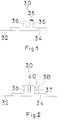
- Fig. 1 shows a side view of the first design of the device according to the invention
- Fig. 2 shows a side view of the device according to Fig. 1 when it is supplemented with two pressure rollers
- Fig. 3 shows a side view of a second design of the device according to the invention
- Fig 4 shows a top view of the second design of the invention
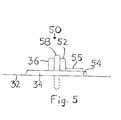
- Fig. 5 shows a side view of the second design when it is supplemented with a third pressure body.
- Fig. 1 shows the first design of the invention.
- Device 30 for therapeutic pressure treatments consists of a base member 34 together with two pymary pressure bodies 36 (preferably made of rubber or plastic) which, for example, can be formed in one piece together with the base member 34 or can be fastened to base member 34.
- Device 30 can, in the condition shown in fig. 1, be used for pressure treatments of a person's back if one person grips, with their hands, base member 34 on each side of the primary pressure bodies 36 and then presses these rigid pressure bodies 36 against another person's spinal column, so that the center of the spine lies midway between the two pressure bodies 36.
- the first person can then run device 30 up and down along the spinal column of the other person while applying pressure.
- device 30 includes an elevating body 35 which can be mounted on one of the pressure bodies 36. This elevating body 35 is removable and results in a higher pressure on one side of the spinal column, where device 30 has the elevating, body 35, when used with device 30.
- fig. 2 device 30 is shown, with reference to fig. 1, in another form.
- the primary pressure bodies 36 each contain a through-thickness hole (not shown) through which an axel 38 can be applied.
- device 30 can be supplied with an extra support member 37 containing a hole, which can be mounted on device 30 to give extra support for the axel 38.
- One or two secondary pressure bodies 40 can be mounted on this axel 38, preferably made of rubber or plastic, in the manner shown in fig. 2.
- Device 30, in this condition can be used in such a manner so that the secondary pressure bodies 40 press against the transverse process of the vertebrae and the overlaying muscles.
- another person than the person who receives the treatment can carry out the treatment in the manner described in connection with fig. 1.
- base member 34 On the bottom of base member 34 is placed an anti-slip body (not shown), for example made of rubber, and base member 34 can also be mounted on a flat body with rubber on the bottom (not shown), to obtain sufficient contact with the support 32, so that device 30 does not slip when it is used to treat one's self when one lies with their back on the device.
- an anti-slip body for example made of rubber
- base member 34 can also be mounted on a flat body with rubber on the bottom (not shown), to obtain sufficient contact with the support 32, so that device 30 does not slip when it is used to treat one's self when one lies with their back on the device.
- the apparatus as shown in fig. 2 is now used by placing device 30 on preferably a flat support 32.
- the person then lays on device 30 so that the center of the spine lies midway between the two pressure bodies 40.
- the pressure bodies 40 apply pressure on the transverse processes of the vertebrae and the overlaying muscles.
- the entire spine can be subject to a therapeutic pressure treatment when the person moves their body on pressure body 40 in a prone position.
- base member 34 with the rotatable pressure bodies 40 can be used separately for the treatment of another person.
- rotatable pointed rollers (not shown) can be mounted on an axel 38 for reflexology. The bottom of the foot is then placed on a roller and rolled back and forth.
- fig. 3 is shown a second design of the invention. Similar members in fig. 3 and 4 corresponding to fig. 1 and 2 respectively, have been given the same reference numbers. That which is the main difference between device 50 and device 30 is that device 50 (fig. 3 and 4) contains a primary pressure body 36 which is fastened to the base member 34 together with an additional pressure body 52 which can be slid laterally so that the relative distance between the primary pressure bodies (36, 52) can be changed and also the height can be changed. Device 50 can be adapted to the treatment of various individual's backs, since the relative distance between these primary pressure bodise can be altered.
- Two other pressure bodies 40 can be mounted on the axel 38, preferably in the form of rubber or plastic rollers, then device 50 can be used in the manner described in connection with fig. 2.
- Pressure body 52 can be fixed laterally with the help of a screw 56 which is applied from the bottom of the base member 34. Regulating the height of pressure body 52 is done with the help of spacer plates 55 of various thickness which are slid beneath pressure body 52 and fixed in place with a fastener (or screw) 57 which is applied from the bottom of the base member 34.
- An axel 38 can even be applied through the through-thickness hole in the primary pressure bodies (36, 52) and additional stability can be obtained with the help of an extra support member 37, naturally under the condition that the primary pressure bodies (36, 52) are located at the same height above the base member 34.
- Device 50 can even be placed between the primary pressure bodies (36, 52) with the aid of axel 38, and a screw (which is not shown) is the pressure body 58.
- the third pressure body 58 can even be attached to the bottom of the base member 34 using a screw from inside of the pressure body 58; this position is implied by the dashed line in fig. 5.
- This third pressure body 58 is applied between pressure bodies 36, 52, then device 50 is especially suitable for performing pressure treatments on the neck.
- Pressure body 58 is also good for performing pressure treatments of the back when a greater pressure is desired on one side of the spine's transverse process or even to apply pressure from one side of the spine on the spinous process.
- Device 50 in this form is also especially useful for treating one's self in a lying or standing position.
- pressure body 58 is mounted on the bottom of base member 34 and fixed in position with the help of a screw (not shown).
- Device 50 also has three ways to set the heights of the pressure bodies (fig. 3 and 5):
- Device 50 includes even two support members 54 which are flexibly joined to the base member 34 so that they can be placed in two orientations. One orientation is when they are placed parallel with the longitudinal axis of the base element 34 (not shown),and the other orientation is when they are placed at right angles in relation to the longitudinal axis of the base member 34 (fig. 4) for contact with the support surface 32. In this latter position, device 50 obtains additional stability when it is placed on a rubber bottom (not shown), for use in the manner described above.
- the devices shown in figures 1 - 5 can be mounted between two door posts so that the devices can be used for treatments of the back. In this way one can treat their own back.
- a support device (not shown) is fastened between the door posts for mounting the device 30, 50 between the door posts.
- the support device is comprised of two parts which can be displaced relative to each other so that the length of the support device can be adjusted for the distance between different door posts, and one end of the support device can be squeezed by the door.
- the support device also includes a mounting member (not shown) in, for example, the form of a U-shaped piece of sheet- metal into which one end of the base member 34 can be mounted with a fastening device (not shown) with which the other end of the base member 34 can be fastened so that the device 30, 50 is firmly fixed between the door posts.
- a mounting member in, for example, the form of a U-shaped piece of sheet- metal into which one end of the base member 34 can be mounted with a fastening device (not shown) with which the other end of the base member 34 can be fastened so that the device 30, 50 is firmly fixed between the door posts.
- An extra support member from the floor (not shown) to the middle of the support device can be adjusted for different heights, as the support device also can be.
Landscapes
- Health & Medical Sciences (AREA)
- Rehabilitation Therapy (AREA)
- Epidemiology (AREA)
- Pain & Pain Management (AREA)
- Physical Education & Sports Medicine (AREA)
- Life Sciences & Earth Sciences (AREA)
- Animal Behavior & Ethology (AREA)
- General Health & Medical Sciences (AREA)
- Public Health (AREA)
- Veterinary Medicine (AREA)
- Massaging Devices (AREA)
- Finger-Pressure Massage (AREA)
- Orthopedics, Nursing, And Contraception (AREA)
- Surgical Instruments (AREA)
Applications Claiming Priority (2)
| Application Number | Priority Date | Filing Date | Title |
|---|---|---|---|
| SE9100491 | 1991-02-19 | ||
| SE9100491A SE9100491D0 (sv) | 1991-02-19 | 1991-02-19 | Anordning foer terapeutisk tryckbehandling |
Publications (2)
| Publication Number | Publication Date |
|---|---|
| EP0500510A1 true EP0500510A1 (de) | 1992-08-26 |
| EP0500510B1 EP0500510B1 (de) | 1996-05-15 |
Family
ID=20381940
Family Applications (1)
| Application Number | Title | Priority Date | Filing Date |
|---|---|---|---|
| EP92850025A Expired - Lifetime EP0500510B1 (de) | 1991-02-19 | 1992-02-07 | Apparat zur Drucktherapie |
Country Status (6)
| Country | Link |
|---|---|
| EP (1) | EP0500510B1 (de) |
| DE (1) | DE69210649T2 (de) |
| ES (1) | ES2090585T3 (de) |
| FI (1) | FI103763B1 (de) |
| NO (1) | NO178283C (de) |
| SE (1) | SE9100491D0 (de) |
Cited By (2)
| Publication number | Priority date | Publication date | Assignee | Title |
|---|---|---|---|---|
| WO2001030297A1 (en) * | 1999-10-29 | 2001-05-03 | David Andrew Ponton | Back manipulator |
| US20110237990A1 (en) * | 2008-10-31 | 2011-09-29 | Lenaye Marsten | Massage Apparatus with Spherical Elements |
Families Citing this family (1)
| Publication number | Priority date | Publication date | Assignee | Title |
|---|---|---|---|---|
| DE102010006763A1 (de) * | 2010-02-04 | 2011-08-04 | Bültmann, Udo, 44339 | Ischiasblocker |
Citations (4)
| Publication number | Priority date | Publication date | Assignee | Title |
|---|---|---|---|---|
| US1984520A (en) * | 1932-05-11 | 1934-12-18 | Curtis Cecil Claud | Apparatus for applying heat, cold, and pressure to the body |
| US3831592A (en) * | 1973-01-15 | 1974-08-27 | W Lancellotti | Trigger point instrument |
| EP0097283A1 (de) * | 1982-06-17 | 1984-01-04 | Lionel Rex Willott | Gerät für die Behandlung der Wirbelsäule |
| DE9001721U1 (de) * | 1990-02-14 | 1990-07-26 | Schumacher, Bernd, Dipl.-Ing. (FH), 4400 Münster | Rückenmassagegerät |
-
1991
- 1991-02-19 SE SE9100491A patent/SE9100491D0/xx unknown
-
1992
- 1992-02-07 EP EP92850025A patent/EP0500510B1/de not_active Expired - Lifetime
- 1992-02-07 DE DE69210649T patent/DE69210649T2/de not_active Expired - Fee Related
- 1992-02-07 ES ES92850025T patent/ES2090585T3/es not_active Expired - Lifetime
- 1992-02-18 FI FI920701A patent/FI103763B1/fi active
- 1992-02-18 NO NO920640A patent/NO178283C/no not_active IP Right Cessation
Patent Citations (4)
| Publication number | Priority date | Publication date | Assignee | Title |
|---|---|---|---|---|
| US1984520A (en) * | 1932-05-11 | 1934-12-18 | Curtis Cecil Claud | Apparatus for applying heat, cold, and pressure to the body |
| US3831592A (en) * | 1973-01-15 | 1974-08-27 | W Lancellotti | Trigger point instrument |
| EP0097283A1 (de) * | 1982-06-17 | 1984-01-04 | Lionel Rex Willott | Gerät für die Behandlung der Wirbelsäule |
| DE9001721U1 (de) * | 1990-02-14 | 1990-07-26 | Schumacher, Bernd, Dipl.-Ing. (FH), 4400 Münster | Rückenmassagegerät |
Cited By (2)
| Publication number | Priority date | Publication date | Assignee | Title |
|---|---|---|---|---|
| WO2001030297A1 (en) * | 1999-10-29 | 2001-05-03 | David Andrew Ponton | Back manipulator |
| US20110237990A1 (en) * | 2008-10-31 | 2011-09-29 | Lenaye Marsten | Massage Apparatus with Spherical Elements |
Also Published As
| Publication number | Publication date |
|---|---|
| NO178283B (no) | 1995-11-20 |
| NO920640D0 (no) | 1992-02-18 |
| NO178283C (no) | 1996-02-28 |
| FI920701L (fi) | 1992-08-20 |
| FI920701A0 (fi) | 1992-02-18 |
| NO920640L (no) | 1992-08-20 |
| SE9100491D0 (sv) | 1991-02-19 |
| ES2090585T3 (es) | 1996-10-16 |
| DE69210649D1 (de) | 1996-06-20 |
| EP0500510B1 (de) | 1996-05-15 |
| FI103763B (fi) | 1999-09-30 |
| FI103763B1 (fi) | 1999-09-30 |
| DE69210649T2 (de) | 1997-01-16 |
Similar Documents
| Publication | Publication Date | Title |
|---|---|---|
| US6036719A (en) | Muscular therapy treatment apparatus for spine muscles | |
| US5935090A (en) | Device for treating muscular ailments | |
| US4126129A (en) | Method and apparatus for relieving backaches and pains without the use of drugs | |
| US4230099A (en) | Device for alining the spine | |
| US4402686A (en) | Pinched nerve instrument | |
| US6179756B1 (en) | Exercise method and apparatus for relieving hip and back pain | |
| EP0022838B1 (de) | Hängevorrichtung zum entlasten der bandscheiben | |
| EP3280366B1 (de) | Vorrichtung zur bandscheibedekompression | |
| US5007414A (en) | Spine stretcher and aligner | |
| US10660820B2 (en) | Unit for action on biologically active body points and the relief of paravertebral muscles | |
| KR101430899B1 (ko) | 척추 교정용 복합 지압기구 | |
| US5170778A (en) | Body massaging device | |
| US10966552B2 (en) | Cushioning posterior fulcrum back shaper | |
| EP0500510B1 (de) | Apparat zur Drucktherapie | |
| US6110194A (en) | Apparatus for aligning spinal vertebrae | |
| US12016822B2 (en) | Back brace with repositionable pressure nodules | |
| KR102899352B1 (ko) | 척추 교정용 운동 기구 | |
| US5810875A (en) | Low back and hip treatment device | |
| KR200417047Y1 (ko) | 건강운동기구 | |
| US5887589A (en) | Skeletal realignment system | |
| US4542738A (en) | Appliance | |
| FI75990C (fi) | Toejningsdyna foer laendkotorna. | |
| DE19508886C2 (de) | Therapiebank | |
| KR950009065Y1 (ko) | 드롭 테이블 | |
| JP2004033665A (ja) | 骨盤矯正装置 |
Legal Events
| Date | Code | Title | Description |
|---|---|---|---|
| PUAI | Public reference made under article 153(3) epc to a published international application that has entered the european phase |
Free format text: ORIGINAL CODE: 0009012 |
|
| AK | Designated contracting states |
Kind code of ref document: A1 Designated state(s): DE DK ES FR GB SE |
|
| 17P | Request for examination filed |
Effective date: 19930218 |
|
| 17Q | First examination report despatched |
Effective date: 19940929 |
|
| GRAA | (expected) grant |
Free format text: ORIGINAL CODE: 0009210 |
|
| AK | Designated contracting states |
Kind code of ref document: B1 Designated state(s): DE DK ES FR GB SE |
|
| PG25 | Lapsed in a contracting state [announced via postgrant information from national office to epo] |
Ref country code: DK Effective date: 19960515 |
|
| REF | Corresponds to: |
Ref document number: 69210649 Country of ref document: DE Date of ref document: 19960620 |
|
| ET | Fr: translation filed | ||
| REG | Reference to a national code |
Ref country code: ES Ref legal event code: FG2A Ref document number: 2090585 Country of ref document: ES Kind code of ref document: T3 |
|
| REG | Reference to a national code |
Ref country code: ES Ref legal event code: FG2A Ref document number: 2090585 Country of ref document: ES Kind code of ref document: T3 |
|
| PLBE | No opposition filed within time limit |
Free format text: ORIGINAL CODE: 0009261 |
|
| 26N | No opposition filed | ||
| PGFP | Annual fee paid to national office [announced via postgrant information from national office to epo] |
Ref country code: FR Payment date: 20000124 Year of fee payment: 9 |
|
| PGFP | Annual fee paid to national office [announced via postgrant information from national office to epo] |
Ref country code: ES Payment date: 20000217 Year of fee payment: 9 |
|
| PG25 | Lapsed in a contracting state [announced via postgrant information from national office to epo] |
Ref country code: ES Free format text: LAPSE BECAUSE OF NON-PAYMENT OF DUE FEES Effective date: 20010208 |
|
| PGFP | Annual fee paid to national office [announced via postgrant information from national office to epo] |
Ref country code: GB Payment date: 20010214 Year of fee payment: 10 |
|
| PGFP | Annual fee paid to national office [announced via postgrant information from national office to epo] |
Ref country code: DE Payment date: 20010216 Year of fee payment: 10 |
|
| PG25 | Lapsed in a contracting state [announced via postgrant information from national office to epo] |
Ref country code: FR Free format text: LAPSE BECAUSE OF NON-PAYMENT OF DUE FEES Effective date: 20011031 |
|
| REG | Reference to a national code |
Ref country code: FR Ref legal event code: ST |
|
| REG | Reference to a national code |
Ref country code: GB Ref legal event code: IF02 |
|
| PG25 | Lapsed in a contracting state [announced via postgrant information from national office to epo] |
Ref country code: GB Free format text: LAPSE BECAUSE OF NON-PAYMENT OF DUE FEES Effective date: 20020207 |
|
| PG25 | Lapsed in a contracting state [announced via postgrant information from national office to epo] |
Ref country code: DE Free format text: LAPSE BECAUSE OF NON-PAYMENT OF DUE FEES Effective date: 20020903 |
|
| GBPC | Gb: european patent ceased through non-payment of renewal fee |
Effective date: 20020207 |
|
| REG | Reference to a national code |
Ref country code: ES Ref legal event code: FD2A Effective date: 20021016 |
|
| PGFP | Annual fee paid to national office [announced via postgrant information from national office to epo] |
Ref country code: SE Payment date: 20050222 Year of fee payment: 14 |
|
| PG25 | Lapsed in a contracting state [announced via postgrant information from national office to epo] |
Ref country code: SE Free format text: LAPSE BECAUSE OF NON-PAYMENT OF DUE FEES Effective date: 20060208 |
|
| EUG | Se: european patent has lapsed |