EP0500538B1 - Construction de reservoir - Google Patents
Construction de reservoir Download PDFInfo
- Publication number
- EP0500538B1 EP0500538B1 EP90912833A EP90912833A EP0500538B1 EP 0500538 B1 EP0500538 B1 EP 0500538B1 EP 90912833 A EP90912833 A EP 90912833A EP 90912833 A EP90912833 A EP 90912833A EP 0500538 B1 EP0500538 B1 EP 0500538B1
- Authority
- EP
- European Patent Office
- Prior art keywords
- set forth
- vessel
- film
- liquid crystal
- crystal polymer
- Prior art date
- Legal status (The legal status is an assumption and is not a legal conclusion. Google has not performed a legal analysis and makes no representation as to the accuracy of the status listed.)
- Expired - Lifetime
Links
Images



Classifications
-
- B—PERFORMING OPERATIONS; TRANSPORTING
- B32—LAYERED PRODUCTS
- B32B—LAYERED PRODUCTS, i.e. PRODUCTS BUILT-UP OF STRATA OF FLAT OR NON-FLAT, e.g. CELLULAR OR HONEYCOMB, FORM
- B32B37/00—Methods or apparatus for laminating, e.g. by curing or by ultrasonic bonding
-
- B—PERFORMING OPERATIONS; TRANSPORTING
- B32—LAYERED PRODUCTS
- B32B—LAYERED PRODUCTS, i.e. PRODUCTS BUILT-UP OF STRATA OF FLAT OR NON-FLAT, e.g. CELLULAR OR HONEYCOMB, FORM
- B32B1/00—Layered products having a non-planar shape
-
- B—PERFORMING OPERATIONS; TRANSPORTING
- B32—LAYERED PRODUCTS
- B32B—LAYERED PRODUCTS, i.e. PRODUCTS BUILT-UP OF STRATA OF FLAT OR NON-FLAT, e.g. CELLULAR OR HONEYCOMB, FORM
- B32B27/00—Layered products comprising a layer of synthetic resin
- B32B27/06—Layered products comprising a layer of synthetic resin as the main or only constituent of a layer, which is next to another layer of the same or of a different material
- B32B27/08—Layered products comprising a layer of synthetic resin as the main or only constituent of a layer, which is next to another layer of the same or of a different material of synthetic resin
-
- F—MECHANICAL ENGINEERING; LIGHTING; HEATING; WEAPONS; BLASTING
- F17—STORING OR DISTRIBUTING GASES OR LIQUIDS
- F17C—VESSELS FOR CONTAINING OR STORING COMPRESSED, LIQUEFIED OR SOLIDIFIED GASES; FIXED-CAPACITY GAS-HOLDERS; FILLING VESSELS WITH, OR DISCHARGING FROM VESSELS, COMPRESSED, LIQUEFIED, OR SOLIDIFIED GASES
- F17C1/00—Pressure vessels, e.g. gas cylinder, gas tank, replaceable cartridge
- F17C1/16—Pressure vessels, e.g. gas cylinder, gas tank, replaceable cartridge constructed of plastics materials
-
- B—PERFORMING OPERATIONS; TRANSPORTING
- B32—LAYERED PRODUCTS
- B32B—LAYERED PRODUCTS, i.e. PRODUCTS BUILT-UP OF STRATA OF FLAT OR NON-FLAT, e.g. CELLULAR OR HONEYCOMB, FORM
- B32B2307/00—Properties of the layers or laminate
- B32B2307/50—Properties of the layers or laminate having particular mechanical properties
- B32B2307/514—Oriented
- B32B2307/518—Oriented bi-axially
-
- B—PERFORMING OPERATIONS; TRANSPORTING
- B32—LAYERED PRODUCTS
- B32B—LAYERED PRODUCTS, i.e. PRODUCTS BUILT-UP OF STRATA OF FLAT OR NON-FLAT, e.g. CELLULAR OR HONEYCOMB, FORM
- B32B2439/00—Containers; Receptacles
-
- F—MECHANICAL ENGINEERING; LIGHTING; HEATING; WEAPONS; BLASTING
- F17—STORING OR DISTRIBUTING GASES OR LIQUIDS
- F17C—VESSELS FOR CONTAINING OR STORING COMPRESSED, LIQUEFIED OR SOLIDIFIED GASES; FIXED-CAPACITY GAS-HOLDERS; FILLING VESSELS WITH, OR DISCHARGING FROM VESSELS, COMPRESSED, LIQUEFIED, OR SOLIDIFIED GASES
- F17C2203/00—Vessel construction, in particular walls or details thereof
- F17C2203/06—Materials for walls or layers thereof; Properties or structures of walls or their materials
- F17C2203/0602—Wall structures; Special features thereof
- F17C2203/0604—Liners
-
- F—MECHANICAL ENGINEERING; LIGHTING; HEATING; WEAPONS; BLASTING
- F17—STORING OR DISTRIBUTING GASES OR LIQUIDS
- F17C—VESSELS FOR CONTAINING OR STORING COMPRESSED, LIQUEFIED OR SOLIDIFIED GASES; FIXED-CAPACITY GAS-HOLDERS; FILLING VESSELS WITH, OR DISCHARGING FROM VESSELS, COMPRESSED, LIQUEFIED, OR SOLIDIFIED GASES
- F17C2203/00—Vessel construction, in particular walls or details thereof
- F17C2203/06—Materials for walls or layers thereof; Properties or structures of walls or their materials
- F17C2203/0602—Wall structures; Special features thereof
- F17C2203/0607—Coatings
-
- F—MECHANICAL ENGINEERING; LIGHTING; HEATING; WEAPONS; BLASTING
- F17—STORING OR DISTRIBUTING GASES OR LIQUIDS
- F17C—VESSELS FOR CONTAINING OR STORING COMPRESSED, LIQUEFIED OR SOLIDIFIED GASES; FIXED-CAPACITY GAS-HOLDERS; FILLING VESSELS WITH, OR DISCHARGING FROM VESSELS, COMPRESSED, LIQUEFIED, OR SOLIDIFIED GASES
- F17C2203/00—Vessel construction, in particular walls or details thereof
- F17C2203/06—Materials for walls or layers thereof; Properties or structures of walls or their materials
- F17C2203/0634—Materials for walls or layers thereof
- F17C2203/0658—Synthetics
- F17C2203/066—Plastics
-
- F—MECHANICAL ENGINEERING; LIGHTING; HEATING; WEAPONS; BLASTING
- F17—STORING OR DISTRIBUTING GASES OR LIQUIDS
- F17C—VESSELS FOR CONTAINING OR STORING COMPRESSED, LIQUEFIED OR SOLIDIFIED GASES; FIXED-CAPACITY GAS-HOLDERS; FILLING VESSELS WITH, OR DISCHARGING FROM VESSELS, COMPRESSED, LIQUEFIED, OR SOLIDIFIED GASES
- F17C2203/00—Vessel construction, in particular walls or details thereof
- F17C2203/06—Materials for walls or layers thereof; Properties or structures of walls or their materials
- F17C2203/0634—Materials for walls or layers thereof
- F17C2203/0658—Synthetics
- F17C2203/0663—Synthetics in form of fibers or filaments
- F17C2203/067—Synthetics in form of fibers or filaments helically wound
-
- F—MECHANICAL ENGINEERING; LIGHTING; HEATING; WEAPONS; BLASTING
- F17—STORING OR DISTRIBUTING GASES OR LIQUIDS
- F17C—VESSELS FOR CONTAINING OR STORING COMPRESSED, LIQUEFIED OR SOLIDIFIED GASES; FIXED-CAPACITY GAS-HOLDERS; FILLING VESSELS WITH, OR DISCHARGING FROM VESSELS, COMPRESSED, LIQUEFIED, OR SOLIDIFIED GASES
- F17C2203/00—Vessel construction, in particular walls or details thereof
- F17C2203/06—Materials for walls or layers thereof; Properties or structures of walls or their materials
- F17C2203/0634—Materials for walls or layers thereof
- F17C2203/0658—Synthetics
- F17C2203/0675—Synthetics with details of composition
-
- F—MECHANICAL ENGINEERING; LIGHTING; HEATING; WEAPONS; BLASTING
- F17—STORING OR DISTRIBUTING GASES OR LIQUIDS
- F17C—VESSELS FOR CONTAINING OR STORING COMPRESSED, LIQUEFIED OR SOLIDIFIED GASES; FIXED-CAPACITY GAS-HOLDERS; FILLING VESSELS WITH, OR DISCHARGING FROM VESSELS, COMPRESSED, LIQUEFIED, OR SOLIDIFIED GASES
- F17C2209/00—Vessel construction, in particular methods of manufacturing
- F17C2209/21—Shaping processes
- F17C2209/2109—Moulding
-
- F—MECHANICAL ENGINEERING; LIGHTING; HEATING; WEAPONS; BLASTING
- F17—STORING OR DISTRIBUTING GASES OR LIQUIDS
- F17C—VESSELS FOR CONTAINING OR STORING COMPRESSED, LIQUEFIED OR SOLIDIFIED GASES; FIXED-CAPACITY GAS-HOLDERS; FILLING VESSELS WITH, OR DISCHARGING FROM VESSELS, COMPRESSED, LIQUEFIED, OR SOLIDIFIED GASES
- F17C2209/00—Vessel construction, in particular methods of manufacturing
- F17C2209/21—Shaping processes
- F17C2209/2154—Winding
- F17C2209/2163—Winding with a mandrel
-
- F—MECHANICAL ENGINEERING; LIGHTING; HEATING; WEAPONS; BLASTING
- F17—STORING OR DISTRIBUTING GASES OR LIQUIDS
- F17C—VESSELS FOR CONTAINING OR STORING COMPRESSED, LIQUEFIED OR SOLIDIFIED GASES; FIXED-CAPACITY GAS-HOLDERS; FILLING VESSELS WITH, OR DISCHARGING FROM VESSELS, COMPRESSED, LIQUEFIED, OR SOLIDIFIED GASES
- F17C2209/00—Vessel construction, in particular methods of manufacturing
- F17C2209/22—Assembling processes
- F17C2209/221—Welding
-
- F—MECHANICAL ENGINEERING; LIGHTING; HEATING; WEAPONS; BLASTING
- F17—STORING OR DISTRIBUTING GASES OR LIQUIDS
- F17C—VESSELS FOR CONTAINING OR STORING COMPRESSED, LIQUEFIED OR SOLIDIFIED GASES; FIXED-CAPACITY GAS-HOLDERS; FILLING VESSELS WITH, OR DISCHARGING FROM VESSELS, COMPRESSED, LIQUEFIED, OR SOLIDIFIED GASES
- F17C2221/00—Handled fluid, in particular type of fluid
- F17C2221/01—Pure fluids
- F17C2221/011—Oxygen
-
- F—MECHANICAL ENGINEERING; LIGHTING; HEATING; WEAPONS; BLASTING
- F17—STORING OR DISTRIBUTING GASES OR LIQUIDS
- F17C—VESSELS FOR CONTAINING OR STORING COMPRESSED, LIQUEFIED OR SOLIDIFIED GASES; FIXED-CAPACITY GAS-HOLDERS; FILLING VESSELS WITH, OR DISCHARGING FROM VESSELS, COMPRESSED, LIQUEFIED, OR SOLIDIFIED GASES
- F17C2221/00—Handled fluid, in particular type of fluid
- F17C2221/01—Pure fluids
- F17C2221/012—Hydrogen
-
- F—MECHANICAL ENGINEERING; LIGHTING; HEATING; WEAPONS; BLASTING
- F17—STORING OR DISTRIBUTING GASES OR LIQUIDS
- F17C—VESSELS FOR CONTAINING OR STORING COMPRESSED, LIQUEFIED OR SOLIDIFIED GASES; FIXED-CAPACITY GAS-HOLDERS; FILLING VESSELS WITH, OR DISCHARGING FROM VESSELS, COMPRESSED, LIQUEFIED, OR SOLIDIFIED GASES
- F17C2221/00—Handled fluid, in particular type of fluid
- F17C2221/01—Pure fluids
- F17C2221/016—Noble gases (Ar, Kr, Xe)
- F17C2221/017—Helium
-
- F—MECHANICAL ENGINEERING; LIGHTING; HEATING; WEAPONS; BLASTING
- F17—STORING OR DISTRIBUTING GASES OR LIQUIDS
- F17C—VESSELS FOR CONTAINING OR STORING COMPRESSED, LIQUEFIED OR SOLIDIFIED GASES; FIXED-CAPACITY GAS-HOLDERS; FILLING VESSELS WITH, OR DISCHARGING FROM VESSELS, COMPRESSED, LIQUEFIED, OR SOLIDIFIED GASES
- F17C2221/00—Handled fluid, in particular type of fluid
- F17C2221/03—Mixtures
- F17C2221/032—Hydrocarbons
- F17C2221/033—Methane, e.g. natural gas, CNG, LNG, GNL, GNC, PLNG
-
- F—MECHANICAL ENGINEERING; LIGHTING; HEATING; WEAPONS; BLASTING
- F17—STORING OR DISTRIBUTING GASES OR LIQUIDS
- F17C—VESSELS FOR CONTAINING OR STORING COMPRESSED, LIQUEFIED OR SOLIDIFIED GASES; FIXED-CAPACITY GAS-HOLDERS; FILLING VESSELS WITH, OR DISCHARGING FROM VESSELS, COMPRESSED, LIQUEFIED, OR SOLIDIFIED GASES
- F17C2223/00—Handled fluid before transfer, i.e. state of fluid when stored in the vessel or before transfer from the vessel
- F17C2223/01—Handled fluid before transfer, i.e. state of fluid when stored in the vessel or before transfer from the vessel characterised by the phase
- F17C2223/0107—Single phase
- F17C2223/0123—Single phase gaseous, e.g. CNG, GNC
-
- F—MECHANICAL ENGINEERING; LIGHTING; HEATING; WEAPONS; BLASTING
- F17—STORING OR DISTRIBUTING GASES OR LIQUIDS
- F17C—VESSELS FOR CONTAINING OR STORING COMPRESSED, LIQUEFIED OR SOLIDIFIED GASES; FIXED-CAPACITY GAS-HOLDERS; FILLING VESSELS WITH, OR DISCHARGING FROM VESSELS, COMPRESSED, LIQUEFIED, OR SOLIDIFIED GASES
- F17C2223/00—Handled fluid before transfer, i.e. state of fluid when stored in the vessel or before transfer from the vessel
- F17C2223/01—Handled fluid before transfer, i.e. state of fluid when stored in the vessel or before transfer from the vessel characterised by the phase
- F17C2223/0146—Two-phase
- F17C2223/0153—Liquefied gas, e.g. LPG, GPL
- F17C2223/0161—Liquefied gas, e.g. LPG, GPL cryogenic, e.g. LNG, GNL, PLNG
-
- F—MECHANICAL ENGINEERING; LIGHTING; HEATING; WEAPONS; BLASTING
- F17—STORING OR DISTRIBUTING GASES OR LIQUIDS
- F17C—VESSELS FOR CONTAINING OR STORING COMPRESSED, LIQUEFIED OR SOLIDIFIED GASES; FIXED-CAPACITY GAS-HOLDERS; FILLING VESSELS WITH, OR DISCHARGING FROM VESSELS, COMPRESSED, LIQUEFIED, OR SOLIDIFIED GASES
- F17C2270/00—Applications
- F17C2270/01—Applications for fluid transport or storage
- F17C2270/0186—Applications for fluid transport or storage in the air or in space
- F17C2270/0192—Hot air balloons
-
- Y—GENERAL TAGGING OF NEW TECHNOLOGICAL DEVELOPMENTS; GENERAL TAGGING OF CROSS-SECTIONAL TECHNOLOGIES SPANNING OVER SEVERAL SECTIONS OF THE IPC; TECHNICAL SUBJECTS COVERED BY FORMER USPC CROSS-REFERENCE ART COLLECTIONS [XRACs] AND DIGESTS
- Y02—TECHNOLOGIES OR APPLICATIONS FOR MITIGATION OR ADAPTATION AGAINST CLIMATE CHANGE
- Y02E—REDUCTION OF GREENHOUSE GAS [GHG] EMISSIONS, RELATED TO ENERGY GENERATION, TRANSMISSION OR DISTRIBUTION
- Y02E60/00—Enabling technologies; Technologies with a potential or indirect contribution to GHG emissions mitigation
- Y02E60/30—Hydrogen technology
- Y02E60/32—Hydrogen storage
Definitions
- the present invention relates to vessels for containing mobile or highly permeating fluids and more particularly to such vessels which incorporate an improved barrier film.
- cryogenic tank structures far storing spacecraft fuels have typically been either entirely metallic or have employed a metal liner with a composite overwrap.
- These structures have not been entirely satisfactory in that the amount of metal employed, even as a liner, contributed inordinately to the weight of the spacecraft, As is understood, a certain minimum thickness of metal is required in order to permit welding far fabrication and this thickness is substantially greater than that thickness which would be necessary merely to provide the necessary impermeability.
- tanks constructed from metal liners with composite overwraps have exhibited a relatively short life due to the mismatch in the coefficients of thermal expansion between the metal and the composite overwrap.
- microcracking of the matrix is caused by the strain between the fiber bundles and the interlaminar resin. Leakage from the tanks occurs due to the porosity which is essentially inevitable in the usual method of construction which is filament winding.
- the permeability of most resin and polymer materials creates a similar problem with respect to this construction of scientific research balloon, particularly those intended for very high altitudes or very long duration flights.
- the problem with permeability is-particularly acute with so-called over-pressure balloon structures in which the pressure in the interior of the balloon is appreciably higher than that of the atmosphere in which the balloon is traveling.
- US-A-4,743,481 discloses a method for making an article having an irregular internal passage which utilizes a hollow polymer preform.
- the polymer material utilized to form the hollow preform and the shell thereabout can be any conventional polymer, including liquid crystal polymers, which have a high heat resistance and low shrinkage.
- the polymer preform is filled with a relatively incompressible material and placed in a mold for pressure molding.
- the filler material can be a fluid or a powder, in particular compressed air, and prevents the preform from collapsing under the pressures usually used in pressure molding. After the shell has been formed on the preform, the filler material is removed therefrom.
- US-A-4,743,481 does not specify the liquid crystal polymer.
- US-A-4,770,931 discloses shaped articles, such as bottles, comprising a continuous polyester phase having dispersed therein microbeads of cellulose acetate which are at least partially bordered by void space. These articles are said to have excellent physical properties, especially optical properties, and are said to be useful as paper substitutes. The presence of cellulose acetate particles which are at least partially bordered by void space, however, make these articles unsuitable for use as vessels for containing a mobile or permeating fluid.
- US-A-4,468,510 relates to polyesters of high molecular weight useful as films, fibers and molding plastics and, in particular, is concerned with copolyesters comprising repeating units from trans-4,4'-stilbenedicarboxylic acid, at least 10 mol % of one or more components selected from the group consisting of an aromatic dicarboxylic acid, aliphatic dicarboxylic acid, or aliphatic glycol, and 1,3-propanediol.
- the oxygen permeability of these compounds is reported to be up to about 10 times less than that of polyethylene terephthalate (PET).
- PET polyethylene terephthalate
- US-A-4,468,510 discloses neither any lyotropic properties of the respective copolyesters, nor the preparation of oriented polymers.
- Polybenzazole (PBZ) polymers are preferred liquid crystal polymers for use in the present invention.
- Preferred PBZ polymers are selected from the group consisting of polybenzoxazole (PBO), polybenzothiazole (PBT or PBZT) and polybenzimidazole (PBI) polymers, and random, sequential or block copolymers thereof.
- PBO polybenzoxazole
- PBT or PBZT polybenzothiazole
- PBI polybenzimidazole
- PBZ polymers preferably contain a plurality of mer units that are AB-PBZ mer units, as represented in Formula 1(a), and/or AA/BB-PBZ mer units, as represented in Formula 1(b) wherein:
- each azole ring is bonded to adjacent carbon atoms in the aromatic group, such that a five-membered azole ring fused with the aromatic group is formed.
- azole rings in AA/BB-PBZ mer units may be in cis- or trans-position with respect to each other, as illustrated in 11 Ency. Poly. Sci. & Eng ., 601, at 602, (J. Wiley & Sons 1988) which is incorporated herein by reference.
- the PBZ polymer may be rigid rod, semirigid rod or flexible coil. It is preferably rigid rod in the case of an AA/BB-PBZ polymer or semirigid in the case of an AB-PBZ polymer. It more preferably consists essentially of AA/BB-PBZ mer units. Exemplary highly preferred mer units are illustrated in Formulas 2 (a)-(e). and The polybenzazole polymer most preferably consists essentially either of the mer units illustrated Formula 2(a) (cis-PBO) or of the mer units illustrated in Formula 2(c) (trans-PBZT).
- Each polymer preferably contains on average at least about 25 mer units, more preferably at least about 50 mer units and most preferably at least about 100 mer units.
- the intrinsic viscosity of cis-PBO or trans-PBZT in methanesulfonic acid at 25°C is preferably at least about 10 dL/g, more preferably at least about 20 dL/g and most preferably at least about 30 dL/g.
- liquid crystal polymer molecules are rigid and rod-like.
- the micro structure consists of densely packed fibrous polymer chains or microfibrils.
- the microfibrils can be oriented through processing, e.g. by extruding the polymer through counter-rotating cylindrical dies followed by blowing and drawing, so as to yield a biaxial orientation.
- PBZT resin is a lyotropic liquid crystal polymer and the extrusion is typically performed into a bath of polyphosphoric acid or similar solvent so that the extrusion results in a water-swollen oriented film. After the forming steps, the film is typically washed, dried and rolled under controlled pressure to remove the solvent and densify the sheet.
- the vessel structures of the present invention are based in substantial part on the unexpected discovery that films comprising an oriented lyotropic liquid crystal polymers, such as PBZ polymers, are highly impermeable. Further, such films exhibit very high strength and toughness and these characteristics can be utilized to augment the structural properties of a composite structure while at the same time providing the barrier characteristics which are necessary in certain vessel applications.
- a vessel which is effective for containing a mobile or highly permeating fluid; the provision of such a vessel which provides very low leakage rates; the provision of such a vessel which is lightweight and strong; the provision of such a vessel which can withstand repeated and extreme variations in temperature; the provision of such a vessel which is highly reliable and which is of relatively simple and inexpensive construction.
- a vessel constructed in accordance with the present invention is adapted for containing a mobile or highly permeating fluid and escape of the fluid is inhibited by a barrier layer comprising an oriented liquid crystal polymer film or an oriented liquid crystal polymer film incorporating an interpenetrating resin.
- the liquid crystal polymer is a PBZ polymer.
- Preferred PBZ polymers are selected from the group consisting of PBO, PBT, and PBI polymers, and random, sequential or block copolymers thereof.
- one of the presently preferred lyotropic liquid crystal polymers for use in constructing barrier films and vessels in accordance with the present invention is poly p-phenylene benzobisthiazole.
- poly p-phenylene benzobisthiazole For the purpose of description only, the present invention will be illustrated by use of poly p-phenylene benzobisthiazole, but it will be appreciated that other lyotropic liquid crystalline polymers, including other PBZ polymers, may be employed in the practice of the present invention.
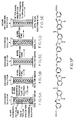
- the chemical structure of this polymer is shown in FiG. 1.
- this polymer is conveniently referred to as PBZT.
- this polymer was often referred to as PBT and this designation also appears herein.
- the PBZT film is biaxially oriented by stressing the film as it is being formed.
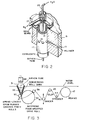
- Fig. 2 illustrates a system of counter-rotating cylindrical die elements for introducing such stressing.
- a mixture of the polymer and polyphosphoric acid is introduced, through a port 13 in a housing 15, to the outer surface of a counterclockwise rotating cylindrical die 17.
- the die 17 includes a plurality of ports 19 through which the mixture can flow to a space between the die 17 and a clockwise rotating cylindrical die 21.
- a siphon tube 25 is provided for equalizing water pressure within the tube of polymer being extruded and a neutral atmosphere of nitrogen is maintained by means of a gas port 27.
- the hollow tube of polymer being extruded is blown by gas pressure and allowed to balloon as indicated by reference character 31, and is then drawn down through a converging bank of rolls 33 by a neoprene foam-wrapped drive roll 35.
- the film is maintained in contact with the drive roll 35 by spring-loaded, rubber-covered pinch rolls 37 and 39.
- the collapsed film is wound up on a reel 47.
- the tube is subsequently slit and, if no interpenetrating resin is to be added, the strip is dried and rolled under appropriate temperature and pressure conditions to remove the water which swells the original extrudate and to densify the film.
- the film strip which results from this process is biaxially oriented.
- This biaxial orientation is illustrated in Fig. 4.
- the microfibrillar structure on the top portion of the film is aligned at an angle to one side of the machine direction while the microfibrillar structure of the bottom half of the film is oriented to the opposite side.
- the angles of the two orientations are substantially equal.
- the vessel structures of the present invention are to a large extent predicated upon the unexpected discovery that oriented lyotropic liquid crystal polymer films are highly impermeable to mobile fluids. It has further been found that the permeability of such films can be further reduced by the inclusion of an interpenetrating resin.
- a process for introducing an interpenetrating resin into a lyotropic liquid crystal polymer film was initially explored as a procedure for improving the strength and bondability of the films and is the subject of U.S. Patent No. 4,845,150, the disclosure of which is incorporated herein by reference. However, to facilitate an understanding of the present invention, it is appropriate to incorporate herein a general discussion of the interpenetrating process.
- the aqueous coagulant is replaced initially with a solvent and then with a mixture of the solvent and a resin precursor.
- One method of forming this substitution is to immerse the swollen film in a succession of containers, each container containing an increased proportion of the solvent in relation to the water.
- a mixture of the resin precursor in the solvent is utilized so that a suitable proportion of resin precursor infiltrates the microfibrillar structure.
- the water is gradually replaced with tetrahydrofuran (THF). Methanol or another water miscible solvent might also be used.
- the film is immersed in a mixture of 75 percent THF and 25 percent resin precursor.
- a preferred polyimide precursor is a thermosetting acetylene-terminated polyisoimide available, for example, under the trade name Thermid IP-600. This is a compound of formula as represented in Fig. 5E.
- Other resin systems can also be used; amongst thermosetting resins should be considered epoxides, polyurethanes, polyesters and polyimides. Any soluble polymer could be used, as is obvious to those skilled in the art.
- the concentration of the impregnant in the liquid crystal polymer can be varied as desired. For example, it can range from about 1 to 25% by volume but is often preferably 1 to 10% by volume.
- the time, temperature and pressure used during the impregnation step can be varied as desired.
- the films of the present invention are essentially self-reinforcing in one sense. Further, the orientation of the microfibrils substantially increases the strength of the film in the direction of orientation, effecting a biaxial orientation, high strength over a substantial range of angles in the plane of the film is obtained.
- a conventionally configured cylindrical tank can be constructed as illustrated in Figs. 6 and 7.
- a mandrel is rotated and wound with a PBZ tape, the winding taking place at a conventional shallow angle.
- a tape is applied in which the biaxial orientation is greater than 45 degrees to the axis of the tape. This winding gives axial strength and stiffness. Over this first winding is placed a second winding as illustrated in Fig. 7.
- This winding is performed utilizing a tape having a biaxial orientation in which the orientation is only at about three degrees to the tape axis.
- This secondary winding gives substantial hoop strength and stiffness to the overall structure.
- a layer of resin is applied to bond the film layers into an integral structure, just as fiber winding is normally bonded.
- a presently preferred resin is Tactix 695 manufactured by Dow Chemical Co.
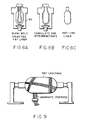
- FIGs. 8A-8C An alternative method of making a cryogenic tank is illustrated in Figs. 8A-8C.
- a parison of PBZT is extruded into a mold 63 and then is expanded by gas pressure as illustrated in Fig. 8B to fill the mold.
- the polymer While in the mold 63, the polymer is coagulated and interpenetrated with resin in a manner similar to forming the film strips as described earlier so as to result in a bottle-like liner 64 as Illustrated in Fig. 8C.
- the liner 4 is then supported on a rotating mandrel as illustrated in Fig. 9, Pressurized and wrapped with carbon filament tape pre-impregnated with a suitable bonding resin so as to form a composite structure in which the PBZD liner provides high impermeability and the graphite composite overwrap provides physical strength. Since the PBZT has a coefficient of thermal expansion which provides a close match with that of graphite composites, microcracking of the type which occurs with metal liners is not expected to occur with the construction illustrated.
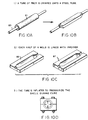
- FIGs. 10A-10C A still further method of constructing a cryogenic tank in accordance with the present invention is illustrated in Figs. 10A-10C, With reference to Fig. 10A, a tube 81 of PBZT is placed over a tubular mandrel 83. The ends of the PBZT tube are then crimped down onto the mandrel as Illustrated in Fig. 10B. A mold constructed in two halves 85 and 87 is provided with a central cavity corresponding to the expanded diameter of the PBZT tube and each half of this cavity is lined with an uncured carbon filament resin composite mixture. The crimped tube and mandrel are then placed between the mold halves, the PBZT tube is inflated to pressurize time shell and heat is applied to cure the reinforcing carbon filament composite as illustrated in Fig. 10D.
- Fig. 11 illustrates a balloon construction utilizing oriented PBZT film in accordance with the present invention.
- the balloon is made up of a series of gores 91 which are taper cut to provide the overall shape of the balloon.
- the individual gores are preferably made up of an oriented film in which the biaxal orientations are at a relatively high angle, i.e. 45 degrees, to the length of the gores.
- the edges between the gores are preferably butt-joined as illustrated in Fig. 12.
- the butt joint between the gores 91 is lapped on both sides with a narrow tape 93 of similar material and the several films are bonded to each other with a suitable thermoplastic adhesive, preferably a polyurethane.
- the balloon may also include a succession of vertically oriented tapes of PBZT film which reinforce the envelope and provide a load bearing structure.
- the tapes preferably have a relatively small angle biaxial orientation so as to provide a very high strength along the length of the tape.
- a major and somewhat surprising advantage of utilizing oriented PBZT film for the balloon vessel is that it exhibits very low permeability, e.g. 500 to 1000 times less than polyester, the material which is presently used for most scientific research balloons.
- the balloon when filled with a highly mobile lighter than air gas such as helium or hydrogen, the balloon will retain this gas for a very long time thereby permitting missions of long duration.
- the PBZT film has better UV resistance than polyethylene and better strength and abrasion resistance so that survivability of the balloon is improved.
Landscapes
- Engineering & Computer Science (AREA)
- Mechanical Engineering (AREA)
- General Engineering & Computer Science (AREA)
- Filling Or Discharging Of Gas Storage Vessels (AREA)
- Manufacture Of Macromolecular Shaped Articles (AREA)
- Containers Having Bodies Formed In One Piece (AREA)
- Laminated Bodies (AREA)
- Shaping By String And By Release Of Stress In Plastics And The Like (AREA)
- Table Devices Or Equipment (AREA)
- Packages (AREA)
Claims (13)
- Récipient destiné à contenir un fluide mobile ou pénétrant, pourvu d'une couche d'arrêt comprenant (a) un film de polymère cristallin liquide lyotrope orienté ou (b) un film de polymère cristallin liquide lyotrope orienté contenant une résine interpénétrante.
- Récipient selon la revendication 1, dans lequel ledit récipient est une cuve cryogénique.
- Récipient selon la revendication 1, dans lequel ledit récipient est un ballon contenant un gaz plus léger que l'air.
- Récipient selon les revendications 2 ou 3, dans lequel ledit polymère cristallin liquide est un polymère PBZ.
- Récipient selon la revendication 4, dans lequel le polymère PBZ est choisi dans le groupe composé des polymères PBO, PBZT et PBI, et des copolymères statistiques, séquencés ou en blocs de ceux-ci.
- Récipient selon la revendication 1, dans lequel ledit film présente une orientation biaxiale.
- Récipient selon la revendication 1, dans lequel ledit film contient la résine interpénétrante qui pénètre dans la structure microfibrillaire dudit polymère cristallin liquide.
- Procédé de fabrication de la cuve cryogénique selon la revendication 2 qui comprend les étapes qui consistent à :envelopper un mandrin cylindrique avec une première bande d'un film de polymère cristallin liquide lyotrope à orientation biaxiale présentant un grand angle d'orientation par rapport à l'axe de la bande ;envelopper ledit mandrin avec une seconde bande d'un film de polymère cristallin liquide lyotrope à orientation biaxiale présentant un petit angle d'orientation par rapport à l'axe de la bande ; etlier les couches de films l'une à l'autre à l'aide d'une résine compatible.
- Procédé de fabrication des cuves cryogéniques selon la revendication 2 qui comprend les étapes qui consistent à :former une enveloppe à partir d'un film de polymère cristallin liquide lyotrope orienté ;renforcer ladite enveloppe avec un composite de filaments de carbone.
- Procédé selon la revendication 9, dans lequel les filaments de carbone sont enroulés autour de ladite enveloppe et liés à l'aide d'une résine compatible.
- Procédé de fabrication du ballon selon la revendication 3 qui comprend les étapes qui consistent à :préparer une série de goussets coniques découpés dans un film de polymère cristallin liquide lyotrope orienté ;lier les bords desdits goussets ensemble pour former une enveloppe de ballon ; etremplir ladite enveloppe avec un gaz plus léger que l'air.
- Procédé selon l'une quelconque des revendications 8 à 11, dans lequel ledit polymère est un polymère PBZ.
- Procédé selon la revendication 12, dans lequel le polymère PBZ est choisi dans le groupe composé des polymères PBO, PBZT et PBI, et des copolymères statistiques, séquencés ou en blocs de ceux-ci.
Applications Claiming Priority (3)
| Application Number | Priority Date | Filing Date | Title |
|---|---|---|---|
| US39554889A | 1989-08-18 | 1989-08-18 | |
| US395548 | 1989-08-18 | ||
| PCT/US1990/004645 WO1991002645A1 (fr) | 1989-08-18 | 1990-08-17 | Construction de reservoir |
Publications (3)
| Publication Number | Publication Date |
|---|---|
| EP0500538A1 EP0500538A1 (fr) | 1992-09-02 |
| EP0500538A4 EP0500538A4 (en) | 1994-05-18 |
| EP0500538B1 true EP0500538B1 (fr) | 1999-12-08 |
Family
ID=23563514
Family Applications (1)
| Application Number | Title | Priority Date | Filing Date |
|---|---|---|---|
| EP90912833A Expired - Lifetime EP0500538B1 (fr) | 1989-08-18 | 1990-08-17 | Construction de reservoir |
Country Status (5)
| Country | Link |
|---|---|
| EP (1) | EP0500538B1 (fr) |
| JP (1) | JP2862672B2 (fr) |
| AT (1) | ATE187535T1 (fr) |
| DE (1) | DE69033389T2 (fr) |
| WO (1) | WO1991002645A1 (fr) |
Families Citing this family (3)
| Publication number | Priority date | Publication date | Assignee | Title |
|---|---|---|---|---|
| BE1012367A3 (fr) * | 1998-12-23 | 2000-10-03 | Solvay | Procede pour impermeabiliser un objet en matiere plastique. |
| WO2008097664A1 (fr) | 2007-02-11 | 2008-08-14 | Map Pharmaceuticals, Inc. | Procédé d'administration thérapeutique de dhe pour procurer un soulagement rapide de la migraine tout en minimisant le profil des effets secondaires |
| US8561829B1 (en) | 2009-10-23 | 2013-10-22 | The United States Of America As Represented By The Administrator Of The National Aeronautics And Space Administration | Composite pressure vessel including crack arresting barrier |
Citations (1)
| Publication number | Priority date | Publication date | Assignee | Title |
|---|---|---|---|---|
| US4468510A (en) * | 1983-03-15 | 1984-08-28 | Eastman Kodak Company | Polyesters of trans-4,4'-stilbenedicarboxylic acid, terephthalic acid or 2,6-naphthalenedicarboxylic acid, 1,2-propanediol and 1,3-propanediol |
Family Cites Families (8)
| Publication number | Priority date | Publication date | Assignee | Title |
|---|---|---|---|---|
| US4845150A (en) * | 1985-09-26 | 1989-07-04 | Foster-Miller Inc. | Interpenetrated polymer films |
| US4743481A (en) * | 1986-11-26 | 1988-05-10 | Flex Technologies, Inc. | Molding process for articles having an irregular shaped internal passage |
| US4966806A (en) * | 1986-12-16 | 1990-10-30 | Foster Miller, Inc. | Film-based structural components with controlled coefficient of thermal expansion |
| US4770931A (en) * | 1987-05-05 | 1988-09-13 | Eastman Kodak Company | Shaped articles from polyester and cellulose ester compositions |
| DE3739490A1 (de) * | 1987-11-21 | 1989-06-01 | Walter Ziegler | Besonders gearteter kugelfoermiger, aufblasbarer ballon bzw. behaelter zur aufnahme und zum lagern von pressluft und komprimierten gasen |
| WO1989012546A1 (fr) * | 1988-06-20 | 1989-12-28 | Foster Miller, Inc. | Composants tubulaires a orientation moleculaire presentant un coefficient regule de dilatation thermique |
| DE3923416A1 (de) * | 1989-07-12 | 1991-01-24 | Mecron Med Prod Gmbh | Verfahren zur herstellung eines ein hohlprofil aufweisenden koerpers |
| US5150812A (en) * | 1990-07-05 | 1992-09-29 | Hoechst Celanese Corporation | Pressurized and/or cryogenic gas containers and conduits made with a gas impermeable polymer |
-
1990
- 1990-08-17 AT AT90912833T patent/ATE187535T1/de not_active IP Right Cessation
- 1990-08-17 EP EP90912833A patent/EP0500538B1/fr not_active Expired - Lifetime
- 1990-08-17 WO PCT/US1990/004645 patent/WO1991002645A1/fr not_active Ceased
- 1990-08-17 DE DE69033389T patent/DE69033389T2/de not_active Expired - Fee Related
- 1990-08-17 JP JP2512264A patent/JP2862672B2/ja not_active Expired - Lifetime
Patent Citations (1)
| Publication number | Priority date | Publication date | Assignee | Title |
|---|---|---|---|---|
| US4468510A (en) * | 1983-03-15 | 1984-08-28 | Eastman Kodak Company | Polyesters of trans-4,4'-stilbenedicarboxylic acid, terephthalic acid or 2,6-naphthalenedicarboxylic acid, 1,2-propanediol and 1,3-propanediol |
Also Published As
| Publication number | Publication date |
|---|---|
| JP2862672B2 (ja) | 1999-03-03 |
| DE69033389T2 (de) | 2000-07-06 |
| EP0500538A1 (fr) | 1992-09-02 |
| EP0500538A4 (en) | 1994-05-18 |
| ATE187535T1 (de) | 1999-12-15 |
| JPH04507389A (ja) | 1992-12-24 |
| DE69033389D1 (de) | 2000-01-13 |
| WO1991002645A1 (fr) | 1991-03-07 |
Similar Documents
| Publication | Publication Date | Title |
|---|---|---|
| US5202165A (en) | Vessel construction | |
| US5150812A (en) | Pressurized and/or cryogenic gas containers and conduits made with a gas impermeable polymer | |
| US4927038A (en) | Container for high pressure gases | |
| US3390704A (en) | Polyolefin fluid conduit laminates | |
| EP2035204B1 (fr) | Procede de fabrication d'une vessie d'etancheite en polymere thermodurcissable pour un reservoir contenant un fluide sous pression, tel qu'un reservoir composite, et reservoir | |
| US3962506A (en) | Multi-chambered cellular structure and method for manufacture | |
| CA2671831C (fr) | Procede de fabrication de piece, piece et cuve | |
| JP2003521659A (ja) | 繊維強化圧力容器および繊維強化圧力容器の製造方法 | |
| JP5106105B2 (ja) | Iv型タンクの漏れ防止ブラダの製造方法、及びiv型タンク | |
| JP4578068B2 (ja) | シェル用積層体及びこれを用いた圧力容器 | |
| WO1998051480A1 (fr) | Dispositif, procede et corps creux associes au formage de composants en plastique | |
| US4684423A (en) | Method fabricating a collapsible mandrel structure to be used in manufacturing reinforced hollow tanks | |
| EP0500538B1 (fr) | Construction de reservoir | |
| US11873947B2 (en) | High pressure composite pressure vessel method of manufacture and product | |
| US20020155232A1 (en) | Multilayer composite pressure vessel | |
| KR102453290B1 (ko) | 강도전이율이 향상된 탄소섬유 복합재료와 그의 제조방법 및 이를 포함하는 압력용기 | |
| JP4431351B2 (ja) | 耐圧容器製造方法 | |
| JPH01113227A (ja) | 複合材料ボンベの製造方法 | |
| JPH0668359B2 (ja) | 複合材料ボンベ及びその製造方法 | |
| US20240166797A1 (en) | Cryogenic Elastomer from Ionic Liquid Epoxy | |
| Guiles | Liquid crystal polymer cryogenic storage tank with reduced thermal loss and weight | |
| WO2022248484A1 (fr) | Récipient sous pression en composite pour haute pression et procédé de fabrication et produit s'y rapportant | |
| JPH081872A (ja) | ガスおよび水分遮断性バッグ | |
| Thanh et al. | RESEARCH USING COMPOSITE MATERIALS IN MANUFACTURING PRESSURE-RESISTANT CIRCULAR DETAILS WITH THE TWO SPHERICAL BOTTOM BY WINDING TECHNOLOGY | |
| JPH0374913B2 (fr) |
Legal Events
| Date | Code | Title | Description |
|---|---|---|---|
| PUAI | Public reference made under article 153(3) epc to a published international application that has entered the european phase |
Free format text: ORIGINAL CODE: 0009012 |
|
| 17P | Request for examination filed |
Effective date: 19920207 |
|
| AK | Designated contracting states |
Kind code of ref document: A1 Designated state(s): AT BE CH DE DK ES FR GB IT LI LU NL SE |
|
| RHK1 | Main classification (correction) |
Ipc: F17C 3/00 |
|
| A4 | Supplementary search report drawn up and despatched |
Effective date: 19940330 |
|
| AK | Designated contracting states |
Kind code of ref document: A4 Designated state(s): AT BE CH DE DK ES FR GB IT LI LU NL SE |
|
| 17Q | First examination report despatched |
Effective date: 19941103 |
|
| GRAG | Despatch of communication of intention to grant |
Free format text: ORIGINAL CODE: EPIDOS AGRA |
|
| GRAG | Despatch of communication of intention to grant |
Free format text: ORIGINAL CODE: EPIDOS AGRA |
|
| GRAH | Despatch of communication of intention to grant a patent |
Free format text: ORIGINAL CODE: EPIDOS IGRA |
|
| RIC1 | Information provided on ipc code assigned before grant |
Free format text: 6F 17C 3/00 A, 6F 17C 1/16 B, 6B 29C 70/00 B, 6B 32B 1/02 B, 6B 32B 1/10 B |
|
| GRAH | Despatch of communication of intention to grant a patent |
Free format text: ORIGINAL CODE: EPIDOS IGRA |
|
| GRAA | (expected) grant |
Free format text: ORIGINAL CODE: 0009210 |
|
| AK | Designated contracting states |
Kind code of ref document: B1 Designated state(s): AT BE CH DE DK ES FR GB IT LI LU NL SE |
|
| PG25 | Lapsed in a contracting state [announced via postgrant information from national office to epo] |
Ref country code: IT Free format text: LAPSE BECAUSE OF FAILURE TO SUBMIT A TRANSLATION OF THE DESCRIPTION OR TO PAY THE FEE WITHIN THE PRESCRIBED TIME-LIMIT;WARNING: LAPSES OF ITALIAN PATENTS WITH EFFECTIVE DATE BEFORE 2007 MAY HAVE OCCURRED AT ANY TIME BEFORE 2007. THE CORRECT EFFECTIVE DATE MAY BE DIFFERENT FROM THE ONE RECORDED. Effective date: 19991208 Ref country code: CH Free format text: LAPSE BECAUSE OF FAILURE TO SUBMIT A TRANSLATION OF THE DESCRIPTION OR TO PAY THE FEE WITHIN THE PRESCRIBED TIME-LIMIT Effective date: 19991208 Ref country code: SE Free format text: THE PATENT HAS BEEN ANNULLED BY A DECISION OF A NATIONAL AUTHORITY Effective date: 19991208 Ref country code: LI Free format text: LAPSE BECAUSE OF FAILURE TO SUBMIT A TRANSLATION OF THE DESCRIPTION OR TO PAY THE FEE WITHIN THE PRESCRIBED TIME-LIMIT Effective date: 19991208 Ref country code: AT Free format text: LAPSE BECAUSE OF FAILURE TO SUBMIT A TRANSLATION OF THE DESCRIPTION OR TO PAY THE FEE WITHIN THE PRESCRIBED TIME-LIMIT Effective date: 19991208 Ref country code: ES Free format text: THE PATENT HAS BEEN ANNULLED BY A DECISION OF A NATIONAL AUTHORITY Effective date: 19991208 Ref country code: NL Free format text: LAPSE BECAUSE OF FAILURE TO SUBMIT A TRANSLATION OF THE DESCRIPTION OR TO PAY THE FEE WITHIN THE PRESCRIBED TIME-LIMIT Effective date: 19991208 |
|
| REF | Corresponds to: |
Ref document number: 187535 Country of ref document: AT Date of ref document: 19991215 Kind code of ref document: T |
|
| REG | Reference to a national code |
Ref country code: CH Ref legal event code: EP |
|
| REF | Corresponds to: |
Ref document number: 69033389 Country of ref document: DE Date of ref document: 20000113 |
|
| PG25 | Lapsed in a contracting state [announced via postgrant information from national office to epo] |
Ref country code: DK Free format text: LAPSE BECAUSE OF FAILURE TO SUBMIT A TRANSLATION OF THE DESCRIPTION OR TO PAY THE FEE WITHIN THE PRESCRIBED TIME-LIMIT Effective date: 20000308 |
|
| ET | Fr: translation filed | ||
| NLV1 | Nl: lapsed or annulled due to failure to fulfill the requirements of art. 29p and 29m of the patents act | ||
| REG | Reference to a national code |
Ref country code: CH Ref legal event code: PL |
|
| PGFP | Annual fee paid to national office [announced via postgrant information from national office to epo] |
Ref country code: GB Payment date: 20000703 Year of fee payment: 11 |
|
| PGFP | Annual fee paid to national office [announced via postgrant information from national office to epo] |
Ref country code: FR Payment date: 20000803 Year of fee payment: 11 |
|
| PG25 | Lapsed in a contracting state [announced via postgrant information from national office to epo] |
Ref country code: LU Free format text: LAPSE BECAUSE OF NON-PAYMENT OF DUE FEES Effective date: 20000817 |
|
| PGFP | Annual fee paid to national office [announced via postgrant information from national office to epo] |
Ref country code: DE Payment date: 20000830 Year of fee payment: 11 |
|
| PGFP | Annual fee paid to national office [announced via postgrant information from national office to epo] |
Ref country code: BE Payment date: 20000915 Year of fee payment: 11 |
|
| PLBE | No opposition filed within time limit |
Free format text: ORIGINAL CODE: 0009261 |
|
| STAA | Information on the status of an ep patent application or granted ep patent |
Free format text: STATUS: NO OPPOSITION FILED WITHIN TIME LIMIT |
|
| 26N | No opposition filed | ||
| PG25 | Lapsed in a contracting state [announced via postgrant information from national office to epo] |
Ref country code: GB Free format text: LAPSE BECAUSE OF NON-PAYMENT OF DUE FEES Effective date: 20010817 |
|
| PG25 | Lapsed in a contracting state [announced via postgrant information from national office to epo] |
Ref country code: BE Free format text: LAPSE BECAUSE OF NON-PAYMENT OF DUE FEES Effective date: 20010831 |
|
| BERE | Be: lapsed |
Owner name: FOSTER MILLER INC. Effective date: 20010831 |
|
| GBPC | Gb: european patent ceased through non-payment of renewal fee |
Effective date: 20010817 |
|
| PG25 | Lapsed in a contracting state [announced via postgrant information from national office to epo] |
Ref country code: FR Free format text: LAPSE BECAUSE OF NON-PAYMENT OF DUE FEES Effective date: 20020430 |
|
| PG25 | Lapsed in a contracting state [announced via postgrant information from national office to epo] |
Ref country code: DE Free format text: LAPSE BECAUSE OF NON-PAYMENT OF DUE FEES Effective date: 20020501 |
|
| REG | Reference to a national code |
Ref country code: FR Ref legal event code: ST |