EP0501014A2 - Circuit pour véhicule tracteur - Google Patents
Circuit pour véhicule tracteur Download PDFInfo
- Publication number
- EP0501014A2 EP0501014A2 EP91118013A EP91118013A EP0501014A2 EP 0501014 A2 EP0501014 A2 EP 0501014A2 EP 91118013 A EP91118013 A EP 91118013A EP 91118013 A EP91118013 A EP 91118013A EP 0501014 A2 EP0501014 A2 EP 0501014A2
- Authority
- EP
- European Patent Office
- Prior art keywords
- trailer
- circuit
- lamps
- circuit arrangement
- flashing light
- Prior art date
- Legal status (The legal status is an assumption and is not a legal conclusion. Google has not performed a legal analysis and makes no representation as to the accuracy of the status listed.)
- Granted
Links
- 238000001514 detection method Methods 0.000 claims description 120
- 230000002950 deficient Effects 0.000 claims description 11
- 238000012546 transfer Methods 0.000 claims description 4
- 241001417501 Lobotidae Species 0.000 description 65
- 230000008901 benefit Effects 0.000 description 9
- 239000003990 capacitor Substances 0.000 description 7
- 230000011664 signaling Effects 0.000 description 5
- 238000009420 retrofitting Methods 0.000 description 4
- 230000008859 change Effects 0.000 description 2
- 238000013461 design Methods 0.000 description 2
- 238000012544 monitoring process Methods 0.000 description 2
- 230000000712 assembly Effects 0.000 description 1
- 238000000429 assembly Methods 0.000 description 1
- 230000004397 blinking Effects 0.000 description 1
- 230000000903 blocking effect Effects 0.000 description 1
- 238000010276 construction Methods 0.000 description 1
- 230000008878 coupling Effects 0.000 description 1
- 238000010168 coupling process Methods 0.000 description 1
- 238000005859 coupling reaction Methods 0.000 description 1
- 230000007547 defect Effects 0.000 description 1
- 238000007599 discharging Methods 0.000 description 1
- 238000011156 evaluation Methods 0.000 description 1
- 230000001771 impaired effect Effects 0.000 description 1
- 238000009434 installation Methods 0.000 description 1
- 230000003993 interaction Effects 0.000 description 1
- 230000007257 malfunction Effects 0.000 description 1
- 238000005259 measurement Methods 0.000 description 1
- 238000012986 modification Methods 0.000 description 1
- 230000004048 modification Effects 0.000 description 1
- 230000000737 periodic effect Effects 0.000 description 1
- 238000010079 rubber tapping Methods 0.000 description 1
- 238000012360 testing method Methods 0.000 description 1
Images



Classifications
-
- B—PERFORMING OPERATIONS; TRANSPORTING
- B60—VEHICLES IN GENERAL
- B60Q—ARRANGEMENT OF SIGNALLING OR LIGHTING DEVICES, THE MOUNTING OR SUPPORTING THEREOF OR CIRCUITS THEREFOR, FOR VEHICLES IN GENERAL
- B60Q11/00—Arrangement of monitoring devices for devices provided for in groups B60Q1/00 - B60Q9/00
- B60Q11/005—Arrangement of monitoring devices for devices provided for in groups B60Q1/00 - B60Q9/00 for lighting devices, e.g. indicating if lamps are burning or not
- B60Q11/007—Arrangement of monitoring devices for devices provided for in groups B60Q1/00 - B60Q9/00 for lighting devices, e.g. indicating if lamps are burning or not the lighting devices indicating change of drive direction
Definitions
- the invention relates to a circuit arrangement for a towing vehicle of a wagon train consisting of the towing vehicle and a trailer, the towing vehicle having a flasher unit and a direction of travel switch for operating its flashing light system, which can be connected to a flashing light system of the trailer via the circuit arrangement, and furthermore the flasher unit in such a way is designed to operate at least two lamps in each direction of travel so that when an idle state, at least one of the lamps to be selected by the direction of travel switch detects such an error state and indicates this to a vehicle driver.
- Such circuit arrangements are known from practice and are used to connect the electrical system of a trailer to the electrical system of a towing vehicle.
- the flasher units installed in towing vehicles are designed to e.g. to drive two lamps and, in the event of failure of one of the two lamps, that is to say in the case of an idle state, for example due to a broken filament, to indicate this fault state to the vehicle driver by means of a changed flashing frequency.
- a new flasher unit must also be installed, which in this example is designed to operate three lamps in each direction of travel.
- all lamps in one direction of travel are connected in parallel to one another, so that the additional lamp per direction of travel causes the trailer to have a changed power requirement, which means that the power required to operate e.g. Flashers designed for each direction of travel can no longer differentiate between faultless and faulty operation.
- a new flasher unit must be installed in the towing vehicle, as I said.
- Retrofitting cannot be dispensed with, however, since for safety reasons the vehicle driver must also be informed whether a lamp in the trailer's turn signal system has failed.
- this circuit arrangement has the further disadvantage that the associated lamp of the towing vehicle also fails if there is a short circuit in a lamp of the trailer. As a rule, the fuse blown by such a short circuit, which is connected in series with the lamp of the towing vehicle.
- Securing the lamps of the trailer with its own fuses is problematic insofar as the known circuit arrangement is often only retrofitted into the towing vehicle, for example to prepare a car as a towing vehicle for a caravan. Since there is no holder in the towing vehicle for the subsequently installed fuses, the fuses will be found at different locations in the towing vehicle from case to case. In the event of an error, this can lead to a lengthy search.
- the lamps of the lighting and signal system are also monitored by a safety circuit in the form of a lamp test monitor, which indicate a malfunction even if the lamp current deviates slightly from a specified setpoint and, if necessary, open the lamp circuit.
- a safety circuit in the form of a lamp test monitor, which indicate a malfunction even if the lamp current deviates slightly from a specified setpoint and, if necessary, open the lamp circuit.
- circuit arrangement is designed for detecting an error state of a lamp of the turn signal system of the trailer selected by the direction switch.
- the object underlying the invention is completely achieved in this way. Because the circuit arrangement now detects the fault status of a lamp in the flashing light system of the trailer, it is ensured that an error status is recognized even without installing a new flasher unit, which could lead to a traffic hazard. In many cases it is the case that the following traffic can only see the lamps of the flashing light system of the trailer because the trailer completely covers the rear lamps of the flashing light system of the towing vehicle.
- the new circuit arrangement it is preferred if it transmits to the flasher unit the idle state of a lamp selected by the direction switch of the trailer's flashing light system as a fault state.
- the flasher unit indicates the failure of a lamp of the flashing light system in a known manner, so that no further changes have to be made to the towing vehicle.
- the failure of a lamp of the flashing light system of both the towing vehicle and the trailer is thus signaled to the vehicle driver via the change in the flashing frequency.
- the circuit arrangement has a switching device which optionally connects the lamps of the flashing light system of the trailer or the rear lamps of the flashing light system of the towing vehicle to the direction of travel switch.
- This measure is advantageous because in this way only two lamps are connected to the flasher unit in each direction of travel.
- the flasher unit is designed accordingly and always drives three lamps, either the lamps of the towing vehicle or - if the trailer is coupled - two lamps of the Towing vehicle and the lamp of the trailer. Since - as already mentioned - the trailer often hides the rear lamps of the towing vehicle, monitoring the rear lamps of the towing vehicle is not absolutely necessary for safety reasons.
- the switching device when the trailer's flashing light system is connected to the circuit arrangement, connects the lamps of the trailer's flashing light system directly to the direction switch and operates the two rear lamps of the towing vehicle's flashing light system, each via an assigned amplifier circuit.
- the circuit arrangement has a trailer detection circuit which detects a flashing light system of a trailer connected to the circuit arrangement and connects the lamps of the flashing light system directly to the direction switch.
- the circuit arrangement has an error detection circuit which detects an error state of a controlled rear lamp of the towing vehicle when the trailer has a flashing light system connected to the circuit arrangement.
- the fault detection circuit switches an amplifier circuit between the direction of travel switch and the lamp of the flashing light system of the trailer associated with the defective rear lamp in the event of a fault in a controlled rear lamp.
- the advantage here is that the error display is caused by the flasher itself. If one of the rear lamps fails, the fault detection circuit therefore switches the amplifiers between the direction switches and thus switched between the flasher unit and the associated lamp of the flashing light system of the trailer, the flasher unit is, as it were, a still intact lamp and a fault condition is simulated. Although the lamp of the trailer's turn signal system is still in operation, the flasher unit detects a fault condition, since it only operates the front lamp of the towing vehicle's turn signal system directly, while the corresponding lamp of the trailer is controlled with high resistance via a driver circuit.
- the amplifier circuit for operating the lamps of the flashing light system of the trailer is the amplifier circuit for operating the rear lamps of the flashing light system of the towing vehicle.
- This measure is particularly advantageous from a design point of view, because only one amplifier circuit per direction of travel is to be provided in the circuit arrangement. Since the lamp of the flashing light system of the trailer is only operated via the amplifier circuit if the assigned rear lamp of the flashing light system of the towing vehicle is defective, one and the same amplifier circuit can be used twice. This saves components and is therefore also advantageous for cost reasons.
- the switching device has a relay with a switch, which in its rest position connects the rear lamps of the turn signal system of the towing vehicle directly to the direction switch and in its working position the direction switch via an amplifier circuit with the rear lamps of the turn signal system of the towing vehicle connects, the relay further comprising a make contact which in its working position connects the lamps of the flashing light system of the trailer directly to the direction switch.
- both the rear lamps of the towing vehicle and the lamps of the trailer are connected to the direction of travel switch in the manner already described with a single relay. It should be noted here that either a common relay for both lamp sets (both directions of travel) can be provided that but it is also possible to provide a separate relay for each direction of travel.
- the relay is controlled via the trailer detection circuit, the relay being in its inoperative position assigned to the rest positions of the changeover switch and make contact when the trailer's flashing light system is switched off by the circuit arrangement.
- the relay with its coil is connected on the one hand to an operating voltage of the towing vehicle and on the other hand is connected to ground via the trailer detection circuit when the trailer's flashing light system is connected to the circuit arrangement.
- the relay is consequently brought out of its rest position into its working position as soon as the trailer is switched on.
- the trailer detection circuit has a parallel connection of diodes, the anodes of which are connected to the relay, and the cathodes of which are connected to the ground via the lamps of the trailer when the trailer's flashing light system is connected to the circuit arrangement.
- the advantage here is that no further contact is required to connect the coil of the relay to ground, rather the lamps of the flashing light and lighting system of the trailer, which are connected to ground anyway, are used for this purpose.
- the operating current of the relay is divided equally between the corresponding lamps of the trailer, so that the load on the individual lamps is low.
- the diodes also ensure that the individual lamps of the trailer are decoupled from one another are, so that there can be no "crosstalk" between different lamps of the pendant.
- a transfer device is provided between the circuit arrangement and the flashing light system of the trailer, which has a trailer detection contact, via which the relay can be connected to ground.
- the transfer device has a 13-pin connector according to the pre-standard DIN 72570, in which a special terminal is provided as trailer detection.
- the trailer detection circuit comprises a driver circuit which is controlled via a parallel connection of diodes which can be connected to the lamps of the trailer.
- the advantage here is that the lamps of the trailer only have to supply the control voltage for the driver circuit, while the operating current of the relay or coil is supplied via the driver circuit.
- the error detection circuit compares the currents through a rear lamp of the flashing light system of the towing vehicle and through a lamp of the flashing light system of the trailer in each direction of travel, and recognizes an error state in a controlled rear lamp of the towing vehicle from this comparison.
- the switching device when the trailer has a flashing light system connected to the circuit arrangement, describes the lamps of the flashing light system each via an associated amplifier circuit.
- the switching device does not - firstly - in contrast to the exemplary embodiment described above - have to be "active" when a trailer is attached to the towing vehicle.
- the front and rear lamps of the turn signal system of the towing vehicle are still controlled by the flasher unit, while the flasher lamps of the trailer are operated via amplifier circuits which, because of their high-impedance input, do not lead to any additional current flow through the flasher unit.
- the flasher unit does not "see” the trailer's flashing lamp, which it also operates. If a lamp in the flashing light system of the towing vehicle fails, this is registered by the flasher unit via the changed current consumption and displayed by a changed flashing frequency. If, however, a lamp of the trailer's turn signal system fails, this is recognized and displayed by the circuit arrangement, as already described above.
- the circuit arrangement has a trailer detection circuit which detects a flashing light system of a trailer connected to the circuit arrangement and reports it to the switching device.
- This measure is particularly advantageous in terms of design, because it is now automatically recognized, so to speak, whether a trailer is switched on or not. The driver of the vehicle consequently does not have to flip any switches in order to bring the circuit arrangement into a corresponding operating state.
- the switchover device has an error detection circuit which, when the trailer's turn signal system is connected to the circuit arrangement, detects an error state of a controlled lamp of the trailer's turn signal system.
- This measure is also of particular structural advantage.
- the fault detection circuit switches an amplifier circuit between the direction of travel switch and the rear lamp of the blinking light system of the towing vehicle associated with the defective lamp in the event of a fault state of a controlled rear lamp of the flashing light system of the trailer.
- the switching device switch an amplifier circuit between the flasher unit and one of the rear flasher lamps of the towing vehicle, so that the flasher unit itself also signals the fault status of a flasher lamp of the trailer.
- the amplifier circuit for operating the lamps of the flashing light system of the trailer is the amplifier circuit for operating the rear lamps of the flashing light system of the towing vehicle.
- This measure is particularly advantageous in terms of circuitry, because only a single amplifier circuit has to be used in each direction of travel.
- the switching device has a relay with a switch, which in its rest position connects the rear lamps directly to the direction switch, and in its working position connects the direction switch to the rear lamps via the amplifier circuit, the relay also having an opening contact comprises, which connects the lamps of the flashing light system of the trailer via the amplifier circuit with the direction switch in its closed rest position.
- This measure is structurally advantageous because the relay only has to take up its working position when a flashing lamp of the trailer has been identified as defective. This has the advantage that the relay is de-energized in fault-free operation, so that the battery of the towing vehicle is not unnecessarily loaded, in particular when the towing vehicle with trailer is parked.
- the relay is controlled via the trailer detection circuit, the relay being in its working position assigned to the working positions of the changeover switch and make contact, if, with the trailer's turn signal system connected, the error detection circuit is in an idle state of a controlled lamp of the trailer's turn signal system recognizes.
- the interaction of the trailer detection circuit and the error detection circuit means that the relay is only switched into the working position when an idle state has been detected in the case of a controlled lamp in the flashing light system of the trailer.
- the circuit arrangement is assigned to an interface circuit that connects lamps of a lighting system of the towing vehicle to associated lamps of a lighting system of the trailer via driver circuits that tap signal voltages with high impedance from the individual lamps of the towing vehicle.
- driver circuits are short-circuit proof at their output.
- This measure is particularly advantageous because a short circuit in the trailer does not lead to a defect in the circuit arrangement installed in the towing vehicle. In this way, the defective trailer can be uncoupled and a new trailer can be coupled without further measures being required on the towing vehicle. Only the short circuit in the defective trailer has to be eliminated. Additional safeguards in the towing vehicle do not have to be provided.
- the trailer detection circuit is connected to lamps of the trailer's lighting system.
- the trailer detection circuit recognizes from the mass available via the lamps of the trailer that a trailer has been switched on.
- the trailer detection circuit is connected to a trailer detection contact which is connected to ground.
- This measure is advantageously used in particular when the transfer device has a 13-pin connector according to the pre-standard DIN 72570, in which a special terminal is provided as trailer detection.
- trailer detection circuit is connected to selected driver circuits in such a way that it detects a current flow through the corresponding lamps.
- the trailer detection circuit also reliably recognizes a connected trailer when there is no trailer detection contact and, on the other hand, when all the lamps of the trailer are switched on.
- the trailer lamps are switched on, a voltage drops across the lamps which corresponds approximately to the operating voltage of the towing vehicle, so that the trailer detection circuit, which relies on ground detection, could no longer detect ground.
- This possible source of error is eliminated by the fact that the trailer detection circuit additionally monitors the current flow through selected lamps of the trailer.
- the trailer detection circuit measures the voltage drop across the driver circuits.
- This measure is structurally advantageous because only when the controlled lamps of the trailer draw current does voltage drop across the internal resistance of the driver circuits.
- the error detection circuit measures the voltage drop across the lamps of the flashing light system of the trailer.
- This measure is also advantageous in terms of circuitry, because the voltage drop can be used to immediately see whether the corresponding lamp is in the idle state and is therefore defective.
- the error detection circuit has an integrating element such that when the lamp of the trailer's flashing light system is flashing, the error detection circuit emits a constant signal at its output.
- This structurally and technically simple measure provides a constant evaluation signal, even though the voltage across the flashing lamp of the trailer is periodically switched on and off.
- the error detection circuit and the trailer detection circuit are linked to one another at their outputs via a logic circuit, the logic circuit switching on the relay as a function of the signals of the error detection circuit and the trailer detection circuit.
- This measure has the advantage that the information that the error detection circuit and the trailer detection circuit provide is used directly to switch the relay.
- the arrangement will be such that the fault detection circuit can only switch the relay at all if the trailer is detected. In this way, unnecessary switching operations of the relay are prevented and, as already mentioned, the battery of the towing vehicle is relieved.
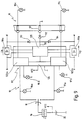
- Fig. 1 10 denotes an electrical flashing light system of a towing vehicle, not shown, which is connected to a circuit arrangement 11 installed in the towing vehicle.
- the circuit arrangement 11 has a socket 12, which is assigned a plug 13, via which an electrical flashing light system 14 of a trailer, also not shown, can be connected to the electrical system of the towing vehicle.
- 16 and 17 individual lamps of the turn signal systems 10 and 14 are designated.
- the lamps 16 are the left and the lamps 17 the right lamps of the turn signal system 10 and 14.
- 16a, 17a denote the front turn signals of the towing vehicle and 16b, 17b the rear turn signal lights of the towing vehicle, while 16c, 17c denote the turn signal lights of the trailer.
- the towing vehicle has a travel direction switch 18 which can take three positions. While it is ineffective in the center position shown, it connects a flasher unit 19 to the left or right flasher lights 16 and 17 in its other positions.
- the flasher unit 19 is connected to a battery 20 which supplies the towing vehicle with its operating voltage 21, which is also referred to below as VCC.
- VCC operating voltage
- the circuit arrangement 11 is connected to the operating voltage 21 and also has a ground connection 22.
- the trailer is connected to the ground of the towing vehicle via a ground line 23.
- the ground line 23 is not routed via socket 12 and plug 13.
- a status display 25 can also be seen, which provides the driver with information about the state of both the circuit arrangement 11 and the flashing lights 16b, 17b, 16c, 17c.
- the status display can also be used as a fault display and can be operated, for example, with a changed flashing frequency in the event of a fault.
- FIG. 1 it is shown in FIG. 1 that the left lamps 16 of the flashing light systems 10 and 14 are connected to an assembly 11a of the circuit arrangement 11, while an assembly 11b is provided for the right lamps 17.
- the two assemblies 11a and 11b are connected to one another via a line 24 and to contacts 26, 27 of the socket 12 via diodes 28, 29.
- the diodes 28 and 29 are connected together with their anodes and hang with their cathodes on the contacts 26 and 27, respectively Diodes 28, 29 are connected to line 24 via a trailer detection line 30 so that they represent a trailer detection circuit in a manner to be described.
- the circuit arrangement 11 detects this via the hanger detection line 30.
- the cathodes of the diodes 28 and 29 are namely via the Lamps 16c and 17c connected to ground so that a current can flow through the diodes 28, 29. Because the diodes 28 and 29 are connected in parallel, the current flowing on the trailer detection line 30 is halved, so that each of the lamps 16c, 17c only has to carry half of the current flowing in the trailer detection line 30.
- the flasher unit 19 recognizes this failure when the direction switch 18 is actuated accordingly by the changed intensity of the flowing current.
- the flashing frequency increases in a known manner, so that the driver of the towing vehicle recognizes the failure of a lamp 16, 17 of his flashing light system 10 on a control lamp inside the car. This applies if the plug 13 is not inserted into the socket 12.
- FIG. 2 in which the assembly 11b assigned to the right lamps 17 is shown in more detail.
- the assembly 11a constructed in the same way as the assembly 11b is only indicated schematically in FIG. 2.
- the trailer detection line 30 is connected via line 24 to two relays 32a and 32b, which are arranged in modules 11a and 11b.
- the relay 32b has a 2-pole changeover switch 33 and a make contact 34.
- the changeover switch and make contact of the relay 32a constructed in the same way are not shown in FIG. 2.
- a relay 32 with two change-over switches and two make contacts can also be provided.
- the relay 32b is connected with its coil to the operating voltage VCC and is connected to ground via the line 24 and the trailer detection line 30 via the parallel connection of the diodes 28, 29 when the plug 13 is plugged into the socket 12. In this case, the relay 32b picks up and switches the changeover switch 33 and the make contact 34.
- the current consumption of the relays 32a, 32b is so low that the function of the lamps 16c and 17c is not impaired by the flowing current. Even if one of the two lamps 16c, 17c fails, the relays 32a, 32b remain in the activated state because of the parallel connection via the diodes 28, 29.
- the changeover switch 33 and the make contact 34 assume a rest position, which is indicated in FIG. 2 by means of solid lines at 35 and 36.
- the changeover switch 33 connects the rear lamp 17b of the towing vehicle to the travel direction switch 18 via a supply line 37.
- the normally open contact 34 is via a line 38 also connected to the supply line 37, but does not loop through in its rest position 36.
- the changeover switch 33 and the make contact 34 are in their working positions indicated by dashed lines at 41 and 42, respectively.
- the make contact 34 now connects the supply line 37 via its output line 43 to the contact 27 provided for the right lamp 17c of the turn signal system 14 of the trailer.
- the changeover switch 33 conducts the flashing pulses present on the supply line 37 when the direction switch 18 is actuated in its now assumed working position 41 via a resistor 45 to an amplifier circuit 46, the output line 47 of which is connected to the lamp 17b.
- the amplifier circuit 46 has a high-impedance input resistance and only very slightly loads the supply line 37.
- the flasher unit 19 only has to supply the supply current for the lamps 17a and 17c, while the lamp 17b is operated via the amplifier circuit 46.
- the relay 32, the changeover switch 33, the make contact 34 and the amplifier circuit 46 consequently act as a changeover device which optionally connects the lamps 16b, 17b or 16c, 17c directly to the travel direction switch 18.
- the assembly 11b ensures that three flasher lights 17a, 17b and 17c can be controlled.
- the lamps 17a and 17b are operated directly by the flasher unit 19, as before, so that one of these two lamps fails when the direction switch 18 is actuated accordingly by the flasher unit 19 is recognized.
- the flasher unit 19 With the plug 13 inserted, however, the flasher unit 19 now monitors the front lamp 17a of the towing vehicle and the lamp 17c of the trailer. This is necessary for safety reasons, because in many cases the rear turn signals 16b and 17b of the towing vehicle cannot be recognized by the following traffic when the trailer is attached. The driver of such a wagon train must therefore be informed when the trailer's flashing lights 16c, 17c fail.
- the new circuit arrangement 11 it is no longer necessary to replace the original flasher unit 19 of a towing vehicle if it is to be converted to trailer operation.
- the new circuit arrangement 11 is also installed in the towing vehicle, so that automatically when the trailer is coupled - when plug 13 is plugged into socket 12 - it is ensured that the flasher unit 19 now monitors the lamp 16c, 17c of the trailer in addition to the front lamp 16a, 17a.
- the amplifier circuit 46 in the exemplary embodiment shown in FIG. 2 has a transistor 48, at the base of which a voltage divider 49 is switched on for setting the operating point.
- the voltage divider 49 is connected with its collector connection 50 to the operating voltage VCC.
- the transistor 48 is connected via its emitter 51 to the output line 57, so that when the switch 33 is in the working position 41, the lamp 17b draws its operating current directly from the operating voltage VCC via the collector connection 50, the emitter 51 and the output line 47.
- the transistor 48 is short-circuit proof on the output side, so that the operating voltage VCC does not break down in the event of a short circuit in the lamp 17b.
- a component commercially available under the designation BTS 432E can be used as an amplifier circuit 46.
- FIG. 3 shows that the error detection circuit 53 is interposed in the output lines 43 and 47 of the make contact 34 and the amplifier circuit 46, respectively.
- the output lines 43 and 47 have been separated, so to speak, and their sections 43a and 47a lead into the error detection circuit 53, while their sections 43b and 47b lead out of the error detection circuit 53 and, as already explained with reference to FIG. 2, with the contact 27 or are connected to the lamp 17b and thus to the contact 54 of the changeover switch 33 assigned to the rest position 35.
- FIG. 4 shows the error detection circuit of the assembly 11b in more detail, with only the lamps 17b and 17c additionally being indicated by dashed lines for reasons of clarity.
- the error detection circuit 53 - as shown in FIG. 3 - is connected to the assembly 11b via the output lines 43a and 47a.
- a corresponding error detection circuit is also provided in module 11a.
- FIG. 4 shows that a low-resistance measuring resistor 55 or 56 is connected into the output lines 43b and 47b, via which a voltage 57 or 58 drops.
- the resistance value of the measuring resistors 56, 55 is approximately 30 m ⁇ , so that the current flows through lamps 17c and 17b are not affected by measuring resistors 55, 56.
- the voltages 57, 58 are tapped from the measuring resistors 55 and 56 via differential amplifiers 61 and 62 and passed to an AND circuit 63. While the differential amplifier 61 has a non-inverting output 64, the differential amplifier 62 has an inverting output 65, which is indicated by the point at the output of the triangle symbolizing the differential amplifier 62.
- the AND circuit 63 is connected at its output Q via a series resistor 66 to a switching transistor 67 which drives a changeover relay 68.
- the changeover relay 68 has a changeover switch 69 which, in the rest position 70 indicated by solid lines, connects the section 43a of the output line 43 to the section 43b. In contrast, in its working position 71 shown in broken lines in FIG. 4, the changeover switch 69 connects the section 47a of the output line 47 to the section 43b via a connecting line 72.
- the error detection circuit 53 it is assumed that the plug 13 is inserted, so that the flasher unit 19 controls the lamp 17c of the flashing light system 14 of the trailer via the output line 43 and monitors for failure.
- the changeover switch 69 of the changeover relay 68 is in the rest position 70. If both lamps 17b and 17c are now ready for operation, voltages 57, 58 drop across both measuring resistors 55, 56, so that the signals of the outputs 64, 65 are different.
- the output Q of the AND circuit 63 is therefore logic L, so that the switching transistor 67 does not turn on, the relay 68 remains at rest.
- the voltage drop 57 returns to 0 V, so that the output 64 goes to logic L and the output Q of the AND circuit 63 also remains to logic L, so that the changeover relay 68 does not pick up . Because of the reduced power consumption - only the lamp 17a is driven directly by the flasher unit 19 - the flasher unit 19 detects the failure of one of the lamps 17a or 17c.
- the lamp 17c is now controlled by the amplifier circuit 46 via the connecting line 72, so that the lamps 17a and 17c continue to flash - which is advantageous for safety reasons - while the driver is informed of the failure of a lamp - in this case 17b.
- FIG. 5 shows the interconnection of the circuit arrangement described so far with an interface circuit 75, via which a lighting and signaling system 76 of the towing vehicle can be connected to a lighting and signaling system 77 of the trailer.
- a plug 13 ' is provided which connects the flashing lights 16c and 17c of the trailer to the circuit arrangement 11 via the contacts 26' and 27 '.
- the plug 13 ' has further contacts 78, 79 and 80, via which lamps 81, 82 and 83 of the trailer are connected to the interface 75 when the plug 13' is plugged into the associated socket 12 '.
- 84, 85 and 86 denote individual lamps of the electrical lighting and signaling system 76.
- the lamps 84, 85 and 86 can optionally be connected to the battery 20 via switches 87 and safety devices 88.
- the switches 87 are optionally closed by the driver of the towing vehicle in order to supply individual lamps 84-86 with power.
- the task of the safety devices 88 is to disconnect the lamps 84-86 from the battery 20 despite the switch 87 being closed in the event of an excessive current flow through the lamps, as can happen, for example, due to a short circuit, and thus to prevent the rest of the electrical system of the towing vehicle breaks down due to overloaded battery 20.
- signal voltages 90 drop across the lamps 84-86, as is illustrated with the aid of the lamp 86.
- the signal voltages 90 are tapped off with high impedance via driver circuits 91 and passed to the contacts 78-80 and thus to the lamps 81-83 of the trailer.
- the driver circuits 91 each have a high-impedance input which does not load the corresponding signal voltages 90 of the associated lamps 84-86.
- the driver circuits 91 are short-circuit proof at their outputs, so that the driver circuits 91 are not destroyed even when the lamps 81-83 are short-circuited.
- the task of the driver circuits 91 is to prevent the safety devices 88 from starting when the lamps 81-83 of the trailer are connected in parallel to the corresponding lamps 84-86 of the towing vehicle.
- the interface circuit 75 ensures that, despite the existing securing devices 88, a towing vehicle can be converted to trailer operation without modifications to the securing devices 88 having to be carried out. If the lamps 81-83 were connected directly in parallel to the lamps 84-86, the increased current flow during operation would lead to the fuse circuits 88 recognizing an error.
- the circuit arrangement 11 already integrated in the interface circuit 75 with reference to FIGS. 1-4 ensures the operation of the flashing lights 16c and 17c of the trailer in the manner described above.
- the lamps 81, 82 and 83 correspond, for example, to a brake light 81 and to the left and right parking lights 82 and 83.
- 84 denotes the brake light of the towing vehicle, while 85 and 86 indicate its left and right parking lights.
- the trailer detection line 30 can also be connected directly to the mass of the trailer via its own contact 97. This is possible, for example, with 13-pin plugs according to the pre-standard DIN 72570, in which a terminal is provided as trailer detection.
- the operating current of the relays 32a, 32b therefore no longer flows via the lamps 16c, 17c, 81, 82 and 83 of the trailer, but exclusively via the contact 97.
- FIG. 7 a representation similar to that of FIGS. 1 and 6 is shown in FIG. 7, which provides a driver circuit 98 between the line 24, which connects the two relays 32a and 32b, and the trailer detection line 30.
- the driver circuit 98 has a transistor 99, one contact of which is connected to line 24 and the other of which is connected to ground. At its base, the transistor 99 is driven by a voltage divider 100, one resistor of which is connected to the operating voltage VCC and the other of which is connected to the trailer detection line 30. In this way, the transistor 99 is blocked as long as no plug 13 has been inserted into the socket 12, and the relays 32a and 32b are in the rest position.
- the voltage divider 100 is connected to ground via the diodes 28 and 29 and the lamps 16c and 17c, so that the transistor 99 is turned on. Now a current flows through line 24 and the emitter collector path of transistor 99 to ground, so that relays 32a and 32b switch.
- the lamps 16c and 17c only need to drive the transistor 99, ie through receive the current divider 100 flowing current, which is significantly lower than the operating current of the relays 32a and 32b.
- FIG. 8 shows, as in FIG. 5, an interface circuit 75 'in which a circuit arrangement 111 in a further exemplary embodiment is connected to the driver circuits 91a, 91b via measuring lines 106, 107, 108 and 109.
- the trailer detection circuit 30 is connected to ground in addition to the diodes 93 and 94 via a diode 112 and the contact 97.
- the circuit arrangement 111 Via the measuring lines 106 and 107 or 108 and 109, the circuit arrangement 111 recognizes whether a current flows through the lamps 83 and 82 of the lighting system 77 of the trailer. This is determined in a manner to be described in more detail on the basis of the voltage drop across the associated driver circuits 91b, 91a.
- the measure of the voltage measurement makes it possible to recognize a connected trailer even if the trailer detection contact 97 is not yet provided for an older trailer and if, on the other hand, all the lamps of the trailer are in operation. In this case, a voltage so high drops across the lamps 82, 83 that the diodes 94, 93 block and thus the trailer detection line 30 no longer carries ground potential, but floats.
- reversing lights 114, 115 of the trailer and towing vehicle are also indicated, which can be switched on via a switch 116.
- the switch 116 connects the battery 20 via a contact 117 to a current relay 118, the changeover switch 119 of which, in the rest position shown in FIG. 8, connects the battery 20 to the reversing light 115 of the towing vehicle.
- relay 118 pulls through contact 121, the is connected to ground via the reversing light 114, current and switches.
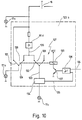
- FIG. 9 shows the circuit arrangement 111 from FIG. 8 in more detail. It can be seen that the left lamps 16a, 16b and 16c of the flashing light systems 10 and 14 are operated via a switching device 123a, while the right lamps 17a, 17b and 17c are connected to one another via a corresponding switching device 123b.
- the switching devices 123a and 123b which are completely identical to one another, are connected via a line 124 to a trailer detection circuit 125, which in turn is connected both to the trailer detection line 30 and to the driver circuits 91a and 91b. Based on the voltage drops U1, U2 across the driver circuits 91a, 91b, the trailer detection circuit 125 detects whether a current is flowing through the associated lamps 82, 83. Thus, even if the trailer detection line 30 is not pulled to ground, which normally detects a trailer, the trailer detection circuit 125 can detect a trailer based on the voltage drops U1, U2. How this happens will be described in detail later.
- One of the two switching devices 123a, 123b is shown in more detail in FIG. 10. For reasons of clarity, the representation of the switching device 123a, which is identical to the switching device 123b, is omitted.
- the switching device 123b has a driver circuit 91d which is identical to the other driver circuits 91, that is to say has a high-resistance input and a short-circuit-proof output.
- the output of the driver circuit 91d is connected via an output line 126 to a relay 127, more precisely both to its changeover switch 128 and to its opening contact 129.
- the relay 127 is switched by a coil indicated at 130, with two separate relays, of course 127 can be used.
- the changeover switch 128 In its inoperative position, indicated by a solid line at 131, the changeover switch 128 connects the front turn signal lamp 17a to the rear turn signal lamp 17b. At the same time, a line also goes from the travel direction switch 18 into the driver circuit 91d, so that the lamps 17a, 17b and the driver circuit 91d are connected in parallel with one another. Because of the high-impedance input of driver circuit 91d, however, the flasher unit is not additionally burdened by this.
- the opening contact 129 connects the output line 126 of the driver circuit 91d via a line 133 to an error detection circuit 134, which is thus connected when the relay 127 is at rest between the driver circuit 91d and the lamp 17c of the flashing light system 14 of the trailer. In the rest position of the relay 127 shown in FIG. 10, the lamp 17c is therefore controlled via the driver circuit 91d.
- the fault detection circuit 134 reports this via its output line 135 to a NOR gate 136.
- Line 124 which comes from trailer detection circuit 125, leads into the second input of NOR gate 136. With its output, the NOR gate 136 drives a switching transistor 137, via which the coil 130 of the relay 127 can be supplied with current.
- Relay 127 only switches when both output line 135 and line 124 are at logic low. If one of the two lines 124, 135 is at logic H, the relay 127 remains in its rest position. Line 124 is high as long as no hanger is connected to interface circuit 75 '. However, if a hanger was inserted, line 124 goes to logic L.
- the output line 135 always goes to logic L when the lamp 17c is either idle or is not present at all because no hanger has been inserted.
- the output line 135 is consequently L and because of the plugged in line 124 is also logic L so that the relay 127 switches over.
- the lamp 17b of the towing vehicle is now connected to the output line 126 of the driver circuit 91d via the changeover switch 128 in its working position indicated at 139, while at the same time the opening contact 129 switches the error detection circuit 134 off the line 126.
- both lamps 17a, 17b of the towing vehicle are still flashing, the flasher unit recognizes a changed current consumption and indicates by a changed flashing frequency that a flashing lamp has failed.
- the output line 135 goes to logic L even if there is no lamp 17c at all, but in this case the line 124 is open from the trailer detection circuit 125 logic high, so that the NOR gate 136 is locked and the relay 127 remains in the rest position.
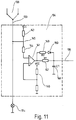
- the error detection circuit 134 has an operational amplifier 141, the inverting input of which is connected to VCC via a series connection of two resistors 143 and 144. Via their center tap 145, the two resistors 143, 144 are connected to the line 133, which - as shown in FIG. 11 - is only looped through by the error detection circuit 134 and connects the opening contact 129 to the lamp 17c of the trailer.
- the non-inverting input of operational amplifier 141 is connected to the center tap of a voltage divider 146, which supplies the non-inverting input with a reference voltage that is significantly lower than VCC.
- the reference voltage is approximately a quarter of VCC.
- the operational amplifier 141 has at its output a series resistor R1, designated 147, to which a capacitor C1, designated 148, is connected, the second leg of which is connected to ground.
- a series circuit comprising a second resistor R2 denoted by 149 and a diode 150 which is connected with its anode to the resistor R2.
- the arrangement is such that the capacitor C1 is charged via the parallel connection of R1 and R2, while it is only discharged via the resistor R1.
- the capacitor C1 Since the resistor R2 is much smaller than the resistor R1, the capacitor C1 is charged in a considerably shorter time than the discharge.
- the capacitor C1 thus acts like an integrator, which also compensates for short-term and periodic changes at the output of the operational amplifier 141.
- the lamp 17c is also OK, but is periodically supplied with current by the flasher unit via the opening contact 129.
- the clock ratio of the turn-on and turn-off times of the flasher unit is approximately 1: 1, so that the center tap 145 is switched to logic L and logic H for the same time periods.
- the output of the operational amplifier 141 now also alternates between logic H and logic L, since the charging of the capacitor C1, however, is considerably faster than the discharging - see description above - the signal on the output line 135 remains at logic H.
- the relay 127 switches the opening contact 129, but this does not change the voltage conditions at the inverting input of the operational amplifier 141, which is further kept at VCC via the resistors 143, 144 .
- the trailer detection circuit 125 is shown in terms of circuitry.
- the trailer detection circuit 125 initially has a comparator circuit 152, as is commercially available, for example, under the type designation U479B or U4790.
- the outputs of driver circuits 91a and 91b are connected to inputs IN1 and IN2 of comparator circuit 152 via measuring lines 107 and 109.
- the measuring lines 106 and 108 connected to the inputs of the driver circuits 91a, 91b lead via series resistors 153 and 154 to the associated outputs OUT1 and OUT2 of the comparator circuit 152.
- the voltage present at the output of the respective driver circuit 91a, 91b is compared with VCC via the input IN .
- the differential voltages thus formed between VCC and the outputs of driver circuits 91a, 91b are indicated by arrows at 156 and 157.
- the internal circuitry of the comparator circuit 152 is such that the outputs OUT1 and OUT2, which are open collector outputs, only block if the voltages 156, 157 are greater than 8 mV. In all other cases the output transistor is at OUT1 and OUT2 switched through, so that the outputs OUT1 and OUT2 are at logic low.
- a control voltage 90 is present on the lamp 86, it reaches the output OUT1 via the measuring line 106 and the series resistor 153. If a lamp 83 of the trailer is connected to the output of the driver circuit 91a, a voltage U1 drops across the driver circuit 91a, which leads to the voltage 156 blocking the output transistor of the output OUT1, so that the output OUT1 goes to logic high. If no lamp 83 is connected or the lamp 86 is not activated, the output OUT1 remains at logic L. The same applies to input IN2 and output OUT2.
- the two outputs OUT1 and OUT2 are connected via their connection points 158 and 159 to the series resistors 153 and 154 to inputs of a NOR gate 155.
- the NOR gate 155 has a logic L potential at its output 160 if a voltage U1 or U2 drops at least across the driver circuit 91a or across the driver circuit 91b. At the output 160 it can thus be seen whether the lamps 82 and / or 83 have current flowing through them. Whenever at least one lamp 82 or 83 has current flowing through it, the output 160 is at logic L.
- the output 160 is connected to the line 124 via a diode 161, the diode 161 being connected to the line 124 with its anode.
- the line 124 is also connected to VCC via a resistor 162, so that the line 124 is only at L potential if, for example, the output 160 is at logic L, that is to say if a connected hanger has been detected via the operating current of a hanger lamp.
- output 160 goes to logic H.
- a further diode 163 which is connected with its anode to the anode of diode 161, is connected further operational amplifier 164 is provided, the output of which is connected to the cathode of diode 163.
- the inverting input of operational amplifier 164 is supplied with a voltage which is significantly lower than VCC via a voltage divider 165.
- the non-inverting input is connected to VCC through a series resistor 166 and a pull-up resistor 167.
- the trailer detection line 30 leads to the common connection point of the resistors 166 and 167 and, as already described above, is always switched to logic L when a trailer has been switched on. In such a case, the output of operational amplifier 164 likewise goes to logic L, which is passed on to line 124 via diode 163.
- the hanger detection line 30 is logic H because of the pull-up resistor 167 and via the operational amplifier 164 and the diode 163 because of the further pull-up resistor 162 the line 124 also takes the value logic H.
- the output 160 of the NOR gate 155 cannot go to logic L, because there is no voltage drop U1 or U2 due to the lack of lamps 82, 83.
- connection with the comparator 152 now makes it possible to reliably detect a trailer even when all of the lamps 82, 83 of the trailer queried via diodes 93, 94 are supplied with current.
- the trailer detection line 30 carries H potential, so that the diode 163 blocks, but because of the voltage drops U1 and U2, the output 160 of the NOR gate 155 goes to logic L, which is sent via line 124 to the NOR gate 136 from FIG. 10 is passed on. The NOR gate 136 is therefore released. If the error detection circuit 134 now detects a broken filament in a controlled lamp of the flashing light system 14 of the trailer, the output line 135 likewise switches to logic L and the relay 127 switches over in the manner described.
Landscapes
- Engineering & Computer Science (AREA)
- Mechanical Engineering (AREA)
- Lighting Device Outwards From Vehicle And Optical Signal (AREA)
- Control Of Driving Devices And Active Controlling Of Vehicle (AREA)
- Vehicle Body Suspensions (AREA)
- Motorcycle And Bicycle Frame (AREA)
Applications Claiming Priority (4)
| Application Number | Priority Date | Filing Date | Title |
|---|---|---|---|
| DE4106166 | 1991-02-27 | ||
| DE4106166 | 1991-02-27 | ||
| DE4111779 | 1991-04-11 | ||
| DE4111779 | 1991-04-11 |
Publications (3)
| Publication Number | Publication Date |
|---|---|
| EP0501014A2 true EP0501014A2 (fr) | 1992-09-02 |
| EP0501014A3 EP0501014A3 (en) | 1993-01-13 |
| EP0501014B1 EP0501014B1 (fr) | 1996-07-03 |
Family
ID=25901426
Family Applications (1)
| Application Number | Title | Priority Date | Filing Date |
|---|---|---|---|
| EP91118013A Expired - Lifetime EP0501014B1 (fr) | 1991-02-27 | 1991-10-23 | Circuit pour véhicule tracteur |
Country Status (3)
| Country | Link |
|---|---|
| EP (1) | EP0501014B1 (fr) |
| AT (1) | ATE139955T1 (fr) |
| DE (2) | DE59107975D1 (fr) |
Cited By (15)
| Publication number | Priority date | Publication date | Assignee | Title |
|---|---|---|---|---|
| DE9302059U1 (de) * | 1993-02-13 | 1993-04-01 | Gebhard, Dietrich, 7502 Malsch | Schaltungsanordnung für ein Zugfahrzeug |
| EP0539705A3 (en) * | 1991-10-28 | 1994-05-18 | Dietrich Gebhard | Electrical circuit device for a towing vehicle |
| EP0693399A3 (fr) * | 1994-07-19 | 1996-07-10 | Kober Ag | Indicateur clignotant |
| EP0813995A3 (fr) * | 1996-06-21 | 1998-10-14 | Werner Gneiting | Circuit de connexion entre les centrales clignotantes d'un véhicule et de sa remorque |
| EP0906851A1 (fr) | 1997-07-14 | 1999-04-07 | ECS Electronics N.V. | Procédé et dispositif de détection de défaillance pour un indicateur lumineux |
| EP0900695A3 (fr) * | 1997-09-02 | 2003-04-09 | Autonetworks Technologies, Ltd. | Unité de détection d'ampoule grillée avec fonction de branchement en dérivation |
| WO2004048151A1 (fr) * | 2002-11-28 | 2004-06-10 | Ecs Electronics B.V. | Procede et circuit de detection d'une panne de feu de direction |
| DE102004042108A1 (de) * | 2004-08-30 | 2006-03-09 | Daimlerchrysler Ag | Fahrzeugbeleuchtungssystem |
| DE102005055574A1 (de) * | 2004-11-19 | 2006-07-20 | Malina, Jörg, Dipl.-Ing. | Vorrichtung zum Ansteuern von Fahrzeuglampen |
| EP1710123A1 (fr) * | 2005-04-07 | 2006-10-11 | Delphi Technologies, Inc. | Circuit de surveillance des clignotants d'un véhicule tracteur et d'une remorque |
| DE102005012460B3 (de) * | 2005-03-18 | 2006-12-07 | Erich Jaeger Gmbh & Co. Kg | Verfahren und Steuerung zum Ansteuern parallel betreibbarer Leuchten |
| DE102005012459A1 (de) * | 2005-03-18 | 2007-01-04 | Erich Jaeger Gmbh & Co. Kg | Verfahren und Steuerung zum Überwachen von Leuchten |
| EP1886848A1 (fr) * | 2006-08-12 | 2008-02-13 | ConWys AG | Appareil de raccordement de remorque électrique |
| EP1967393A1 (fr) * | 2007-03-03 | 2008-09-10 | ConWys AG | Dispositif de raccordement de remorque électrique |
| CN115968076A (zh) * | 2022-12-20 | 2023-04-14 | 国能朔黄铁路发展有限责任公司 | 一种轨道电路的修改方法 |
Families Citing this family (13)
| Publication number | Priority date | Publication date | Assignee | Title |
|---|---|---|---|---|
| DE4318879C2 (de) * | 1993-06-08 | 1996-01-25 | Dietrich Gebhard | Schaltungsanordnung für eine Blinklichtanlage |
| DE4445706C1 (de) | 1994-12-21 | 1996-05-23 | Dietrich Gebhard | Steckdose für eine mehrpolige Steckverbindung zwischen einem Zugfahrzeug und einem Anhänger |
| DE29502034U1 (de) * | 1995-02-08 | 1995-05-18 | Sperr, Dieter, 61130 Nidderau | Stromversorgungsgerät für Kfz-Anhänger |
| DE19814338C1 (de) * | 1998-03-31 | 1999-10-07 | Volta Kraftfahrzeug Elektrozub | Schaltungsanordnung für ein Zugfahrzeug |
| JP4038898B2 (ja) * | 1998-10-21 | 2008-01-30 | アンデン株式会社 | トレーラを牽引する車両用の方向指示装置およびその方向指示装置に用いられるトレーラ連結判定回路 |
| DE29920935U1 (de) * | 1999-11-29 | 2000-02-03 | Quante Ag, 42109 Wuppertal | Überspannungsschutzmagazin |
| DE19957666C2 (de) * | 1999-11-30 | 2003-04-17 | Volta Kraftfahrzeug Elektrozub | Schaltungsanordnung für ein Zugfahrzeug |
| DE10135272A1 (de) * | 2001-07-13 | 2003-01-30 | Volta Kraftfahrzeug Elektrozub | Steuerschaltung für ein Zugfahrzeug |
| US7277265B2 (en) | 2004-06-22 | 2007-10-02 | General Motors Corporation | Robust power take-off and cruise enable |
| DE102006022975A1 (de) * | 2006-05-15 | 2007-11-22 | Guido Kellermann Produktentwicklung & Handel | Zusatzlast für einen Fahrtrichtungsanzeiger, Fahrtrichtungsanzeiger sowie Blinkanlage |
| DE102009038282A1 (de) * | 2009-08-21 | 2011-02-24 | Bpw Bergische Achsen Kg | Fahrzeugbeleuchtungssystem mit Detektierung und Anzeige eines Ausfalls einer LED-Fahrzeugleuchte |
| DE202010005779U1 (de) | 2010-04-16 | 2010-08-05 | Conwys Ag | Anhängererkennungseinrichtung |
| DE102010051584A1 (de) | 2010-11-05 | 2012-05-10 | "Volta" Kraftfahrzeug-Elektrozubehör-Vertrieb GmbH | Schaltungsanordnung in einem Zugfahrzeug sowie einem Anhänger |
Family Cites Families (10)
| Publication number | Priority date | Publication date | Assignee | Title |
|---|---|---|---|---|
| DE1152629B (de) * | 1960-05-14 | 1963-08-08 | Westfaelische Metall Ind K G H | Schalt- und UEberwachungseinrichtung fuer Blinklichtsignalanlagen bei Kraftfahr-zeugen mit einer Mehrzahl von Blinkleuchten |
| FR2098700A5 (fr) * | 1970-07-24 | 1972-03-10 | Acea Guy | |
| GB1436112A (en) * | 1972-04-20 | 1976-05-19 | Cav Ltd | Direction indicator system for road vehicles |
| JPS5925697B2 (ja) * | 1976-12-25 | 1984-06-20 | 株式会社デンソー | 車両用点滅装置 |
| DE3038464C2 (de) * | 1980-10-11 | 1983-03-31 | Robert Bosch Gmbh, 7000 Stuttgart | Vorrichtung zum Erkennen eines an ein Zugfahrzeug angekoppelten Anhängers |
| DE3322314C2 (de) * | 1983-06-21 | 1986-01-02 | Gebhard, Dietrich, 7502 Malsch | Schaltungsanordnung für ein Zugfahrzeug |
| DE3531560A1 (de) * | 1985-09-04 | 1987-03-05 | Hella Kg Hueck & Co | Kontrolleinrichtung fuer die blinklichtsignalanlage von kraftfahrzeugen |
| DE3724916A1 (de) * | 1987-07-28 | 1989-02-09 | Eberhardt Peka Fahrzeug | Kraftfahrzeug fuer anhaengerbetrieb mit heckleuchten-ueberwachung |
| GB2215924B (en) * | 1988-03-17 | 1992-07-15 | David Anthony Ryder | Flasher unit current monitor |
| DE4010765C1 (fr) * | 1990-04-04 | 1991-04-11 | Mercedes-Benz Aktiengesellschaft, 7000 Stuttgart, De |
-
1991
- 1991-10-23 DE DE59107975T patent/DE59107975D1/de not_active Expired - Fee Related
- 1991-10-23 AT AT91118013T patent/ATE139955T1/de not_active IP Right Cessation
- 1991-10-23 DE DE4134993A patent/DE4134993A1/de active Granted
- 1991-10-23 EP EP91118013A patent/EP0501014B1/fr not_active Expired - Lifetime
Cited By (18)
| Publication number | Priority date | Publication date | Assignee | Title |
|---|---|---|---|---|
| EP0539705A3 (en) * | 1991-10-28 | 1994-05-18 | Dietrich Gebhard | Electrical circuit device for a towing vehicle |
| DE9302059U1 (de) * | 1993-02-13 | 1993-04-01 | Gebhard, Dietrich, 7502 Malsch | Schaltungsanordnung für ein Zugfahrzeug |
| EP0693399A3 (fr) * | 1994-07-19 | 1996-07-10 | Kober Ag | Indicateur clignotant |
| EP0813995A3 (fr) * | 1996-06-21 | 1998-10-14 | Werner Gneiting | Circuit de connexion entre les centrales clignotantes d'un véhicule et de sa remorque |
| EP0906851A1 (fr) | 1997-07-14 | 1999-04-07 | ECS Electronics N.V. | Procédé et dispositif de détection de défaillance pour un indicateur lumineux |
| EP0900695A3 (fr) * | 1997-09-02 | 2003-04-09 | Autonetworks Technologies, Ltd. | Unité de détection d'ampoule grillée avec fonction de branchement en dérivation |
| WO2004048151A1 (fr) * | 2002-11-28 | 2004-06-10 | Ecs Electronics B.V. | Procede et circuit de detection d'une panne de feu de direction |
| DE102004042108A1 (de) * | 2004-08-30 | 2006-03-09 | Daimlerchrysler Ag | Fahrzeugbeleuchtungssystem |
| DE102005055574A1 (de) * | 2004-11-19 | 2006-07-20 | Malina, Jörg, Dipl.-Ing. | Vorrichtung zum Ansteuern von Fahrzeuglampen |
| DE102005055574B4 (de) * | 2004-11-19 | 2007-03-01 | Malina, Jörg, Dipl.-Ing. | Vorrichtung zum Ansteuern von Fahrzeuglampen |
| DE102005063344B4 (de) * | 2004-11-19 | 2007-12-13 | Malina, Jörg | Vorrichtung zum Ansteuern von Fahrzeuglampen |
| DE102005012460B3 (de) * | 2005-03-18 | 2006-12-07 | Erich Jaeger Gmbh & Co. Kg | Verfahren und Steuerung zum Ansteuern parallel betreibbarer Leuchten |
| DE102005012459A1 (de) * | 2005-03-18 | 2007-01-04 | Erich Jaeger Gmbh & Co. Kg | Verfahren und Steuerung zum Überwachen von Leuchten |
| DE102005012459B4 (de) * | 2005-03-18 | 2007-07-26 | Erich Jaeger Gmbh & Co. Kg | Verfahren und Steuerung zum Überwachen von Leuchten |
| EP1710123A1 (fr) * | 2005-04-07 | 2006-10-11 | Delphi Technologies, Inc. | Circuit de surveillance des clignotants d'un véhicule tracteur et d'une remorque |
| EP1886848A1 (fr) * | 2006-08-12 | 2008-02-13 | ConWys AG | Appareil de raccordement de remorque électrique |
| EP1967393A1 (fr) * | 2007-03-03 | 2008-09-10 | ConWys AG | Dispositif de raccordement de remorque électrique |
| CN115968076A (zh) * | 2022-12-20 | 2023-04-14 | 国能朔黄铁路发展有限责任公司 | 一种轨道电路的修改方法 |
Also Published As
| Publication number | Publication date |
|---|---|
| DE59107975D1 (de) | 1996-08-08 |
| DE4134993A1 (de) | 1992-08-27 |
| DE4134993C2 (fr) | 1993-03-11 |
| EP0501014B1 (fr) | 1996-07-03 |
| EP0501014A3 (en) | 1993-01-13 |
| ATE139955T1 (de) | 1996-07-15 |
Similar Documents
| Publication | Publication Date | Title |
|---|---|---|
| EP0501014B1 (fr) | Circuit pour véhicule tracteur | |
| EP0450301B1 (fr) | Procédé et dispositif de surveillance des feux indicateurs de direction pour une remorque de véhicule | |
| EP0483650B1 (fr) | Aménagement de circuit pour un véhicule tracteur | |
| EP0539705B1 (fr) | Circuit électrique pour véhicule tracteur | |
| DE4137611A1 (de) | Richtungs- und warnblinkanlage fuer ein fahrzeug, insbesondere fuer ein kraftfahrzeug | |
| EP2633738B1 (fr) | Ensemble composé d'un appareil de commande de réseau électrique de bord et d'au moins un variateur d'éclairage d'un véhicule automobile | |
| EP0598379A2 (fr) | Circuit pour lampe clignotantes | |
| DE19624755A1 (de) | Schaltungsanordnung zur Verbindung der Blinklichtanlage eines Fahrzeuganhängers mit der Blinklichtanlage eines Zugfahrzeuges | |
| DE102005063344B4 (de) | Vorrichtung zum Ansteuern von Fahrzeuglampen | |
| DE4135546A1 (de) | Schaltungsanordnung fuer ein zugfahrzeug | |
| DE9302059U1 (de) | Schaltungsanordnung für ein Zugfahrzeug | |
| DE2753528C2 (de) | Überwachungsschaltung für eine Blinkanlage | |
| DE4334371C1 (de) | Richtungs- und Warnblinkanlage für ein Kraftfahrzeug | |
| DE19814338C1 (de) | Schaltungsanordnung für ein Zugfahrzeug | |
| DE4318879C2 (de) | Schaltungsanordnung für eine Blinklichtanlage | |
| DE102005012460B3 (de) | Verfahren und Steuerung zum Ansteuern parallel betreibbarer Leuchten | |
| DE102024108060A1 (de) | Heckleuchte | |
| DE19957666C2 (de) | Schaltungsanordnung für ein Zugfahrzeug | |
| DE20010363U1 (de) | Schaltungsanordnung für ein Zugfahrzeug | |
| DE19809880C1 (de) | Schaltungsanordnung für ein Kraftfahrzeug | |
| DE3206345A1 (de) | Lichtsignalanlage, insbesondere verkehrssignalanlage | |
| DE3616161C1 (en) | Monitoring device for the control lights of a motor vehicle | |
| EP1710123A1 (fr) | Circuit de surveillance des clignotants d'un véhicule tracteur et d'une remorque | |
| DE202010007913U1 (de) | Nebelschlußleuchtensteuerungseinrichtung |
Legal Events
| Date | Code | Title | Description |
|---|---|---|---|
| PUAI | Public reference made under article 153(3) epc to a published international application that has entered the european phase |
Free format text: ORIGINAL CODE: 0009012 |
|
| AK | Designated contracting states |
Kind code of ref document: A2 Designated state(s): AT BE DE FR GB IT LU NL |
|
| PUAL | Search report despatched |
Free format text: ORIGINAL CODE: 0009013 |
|
| AK | Designated contracting states |
Kind code of ref document: A3 Designated state(s): AT BE DE FR GB IT LU NL |
|
| 17P | Request for examination filed |
Effective date: 19930623 |
|
| 17Q | First examination report despatched |
Effective date: 19940829 |
|
| GRAH | Despatch of communication of intention to grant a patent |
Free format text: ORIGINAL CODE: EPIDOS IGRA |
|
| GRAH | Despatch of communication of intention to grant a patent |
Free format text: ORIGINAL CODE: EPIDOS IGRA |
|
| RAP1 | Party data changed (applicant data changed or rights of an application transferred) |
Owner name: GEBHARD, ANGELA BARBARA |
|
| RIN1 | Information on inventor provided before grant (corrected) |
Inventor name: GEBHARD, DIETRICH |
|
| GRAA | (expected) grant |
Free format text: ORIGINAL CODE: 0009210 |
|
| AK | Designated contracting states |
Kind code of ref document: B1 Designated state(s): AT BE DE FR GB IT LU NL |
|
| PG25 | Lapsed in a contracting state [announced via postgrant information from national office to epo] |
Ref country code: IT Free format text: LAPSE BECAUSE OF FAILURE TO SUBMIT A TRANSLATION OF THE DESCRIPTION OR TO PAY THE FEE WITHIN THE PRE;WARNING: LAPSES OF ITALIAN PATENTS WITH EFFECTIVE DATE BEFORE 2007 MAY HAVE OCCURRED AT ANY TIME BEFORE 2007. THE CORRECT EFFECTIVE DATE MAY BE DIFFERENT FROM THE ONE RECORDED.SCRIBED TIME-LIMIT Effective date: 19960703 |
|
| REF | Corresponds to: |
Ref document number: 139955 Country of ref document: AT Date of ref document: 19960715 Kind code of ref document: T |
|
| ET | Fr: translation filed | ||
| REF | Corresponds to: |
Ref document number: 59107975 Country of ref document: DE Date of ref document: 19960808 |
|
| PGFP | Annual fee paid to national office [announced via postgrant information from national office to epo] |
Ref country code: FR Payment date: 19960829 Year of fee payment: 6 |
|
| PGFP | Annual fee paid to national office [announced via postgrant information from national office to epo] |
Ref country code: LU Payment date: 19960901 Year of fee payment: 6 |
|
| GBT | Gb: translation of ep patent filed (gb section 77(6)(a)/1977) |
Effective date: 19960816 |
|
| PGFP | Annual fee paid to national office [announced via postgrant information from national office to epo] |
Ref country code: GB Payment date: 19960916 Year of fee payment: 6 |
|
| PGFP | Annual fee paid to national office [announced via postgrant information from national office to epo] |
Ref country code: BE Payment date: 19960924 Year of fee payment: 6 |
|
| PGFP | Annual fee paid to national office [announced via postgrant information from national office to epo] |
Ref country code: AT Payment date: 19961025 Year of fee payment: 6 |
|
| PG25 | Lapsed in a contracting state [announced via postgrant information from national office to epo] |
Ref country code: NL Effective date: 19970501 |
|
| PLBE | No opposition filed within time limit |
Free format text: ORIGINAL CODE: 0009261 |
|
| STAA | Information on the status of an ep patent application or granted ep patent |
Free format text: STATUS: NO OPPOSITION FILED WITHIN TIME LIMIT |
|
| 26N | No opposition filed | ||
| NLV4 | Nl: lapsed or anulled due to non-payment of the annual fee |
Effective date: 19970501 |
|
| NLXE | Nl: other communications concerning ep-patents (part 3 heading xe) |
Free format text: A REQUEST FOR RESTORATION TO THE PRIOR STATE HAS BEEN FILED ON 970808 |
|
| PG25 | Lapsed in a contracting state [announced via postgrant information from national office to epo] |
Ref country code: GB Free format text: LAPSE BECAUSE OF NON-PAYMENT OF DUE FEES Effective date: 19971023 Ref country code: LU Free format text: LAPSE BECAUSE OF NON-PAYMENT OF DUE FEES Effective date: 19971023 Ref country code: AT Free format text: LAPSE BECAUSE OF NON-PAYMENT OF DUE FEES Effective date: 19971023 |
|
| PG25 | Lapsed in a contracting state [announced via postgrant information from national office to epo] |
Ref country code: FR Free format text: THE PATENT HAS BEEN ANNULLED BY A DECISION OF A NATIONAL AUTHORITY Effective date: 19971031 Ref country code: BE Free format text: LAPSE BECAUSE OF NON-PAYMENT OF DUE FEES Effective date: 19971031 |
|
| NLXE | Nl: other communications concerning ep-patents (part 3 heading xe) |
Free format text: THE REQUEST FOR RESTORATION TO THE PRIOR STATE AS PROVIDED FOR IN ART.23 OF THE PATENT ACTS 1995(SEE PUBLICATION IN HEADING XE OF THE PATENT BULLETIN OF 01101997/10)HAS BEEN WITHDRAWN |
|
| BERE | Be: lapsed |
Owner name: GEBHARD ANGELA BARBARA Effective date: 19971031 |
|
| GBPC | Gb: european patent ceased through non-payment of renewal fee |
Effective date: 19971023 |
|
| REG | Reference to a national code |
Ref country code: FR Ref legal event code: ST |
|
| PGFP | Annual fee paid to national office [announced via postgrant information from national office to epo] |
Ref country code: DE Payment date: 20061125 Year of fee payment: 16 |
|
| PG25 | Lapsed in a contracting state [announced via postgrant information from national office to epo] |
Ref country code: DE Free format text: LAPSE BECAUSE OF NON-PAYMENT OF DUE FEES Effective date: 20080501 |