EP0501025A2 - Zentralisiertes und verteiltes Gleichzeitigkeitssteuerungsverfahren und Gerät mit Beschränkung der Wartetiefe - Google Patents
Zentralisiertes und verteiltes Gleichzeitigkeitssteuerungsverfahren und Gerät mit Beschränkung der Wartetiefe Download PDFInfo
- Publication number
- EP0501025A2 EP0501025A2 EP91121110A EP91121110A EP0501025A2 EP 0501025 A2 EP0501025 A2 EP 0501025A2 EP 91121110 A EP91121110 A EP 91121110A EP 91121110 A EP91121110 A EP 91121110A EP 0501025 A2 EP0501025 A2 EP 0501025A2
- Authority
- EP
- European Patent Office
- Prior art keywords
- transaction
- transactions
- waiting
- wait
- concurrency control
- Prior art date
- Legal status (The legal status is an assumption and is not a legal conclusion. Google has not performed a legal analysis and makes no representation as to the accuracy of the status listed.)
- Withdrawn
Links
Images




Classifications
-
- G—PHYSICS
- G06—COMPUTING OR CALCULATING; COUNTING
- G06F—ELECTRIC DIGITAL DATA PROCESSING
- G06F9/00—Arrangements for program control, e.g. control units
- G06F9/06—Arrangements for program control, e.g. control units using stored programs, i.e. using an internal store of processing equipment to receive or retain programs
- G06F9/46—Multiprogramming arrangements
- G06F9/466—Transaction processing
-
- Y—GENERAL TAGGING OF NEW TECHNOLOGICAL DEVELOPMENTS; GENERAL TAGGING OF CROSS-SECTIONAL TECHNOLOGIES SPANNING OVER SEVERAL SECTIONS OF THE IPC; TECHNICAL SUBJECTS COVERED BY FORMER USPC CROSS-REFERENCE ART COLLECTIONS [XRACs] AND DIGESTS
- Y10—TECHNICAL SUBJECTS COVERED BY FORMER USPC
- Y10S—TECHNICAL SUBJECTS COVERED BY FORMER USPC CROSS-REFERENCE ART COLLECTIONS [XRACs] AND DIGESTS
- Y10S707/00—Data processing: database and file management or data structures
- Y10S707/99931—Database or file accessing
- Y10S707/99938—Concurrency, e.g. lock management in shared database
Definitions
- This invention generally relates to concurrency control in a multi-user data processing environment and, more particularly, to a new concurrency control (CC) method which restricts the wait depth of waiting transactions to a predetermined depth and takes into account the progress made by transactions in conflict resolution.
- the wait depth may be limited to one.
- the invention is generalized to a distributed environment by adopting a time based wait function.
- concurrency control In a multi-user data processing environment, some sort of concurrency control is needed in order to avoid problems when two or more users attempt to update a field of a record in the database on the basis of an initial value of that field.
- One approach to concurrency control is known as locking.
- Another is known as time-stamping or optimistic concurrency control.
- locking is the more important as it is the method that is predominantly used.
- a transaction can obtain a lock on a record by issuing a request to a system component called the lock manager. If a transaction holds an exclusive lock on some object, say, a database record, then no other transaction can acquire a lock of any type on that object until the first transaction releases its lock. Any transaction that intends to update a record must first acquire a lock on it. If a lock cannot be acquired, the transaction is blocked and goes into a wait state. The transaction is restarted when the record becomes available and the lock can be granted. While this locking protocol solves the lost update problem, it introduces two others. One is the problem of deadlock, in which two or more transactions are in a simultaneous wait state, each waiting for the others to release a lock required for it to proceed.
- deadlock has been extensively studied.
- the lock manager must be capable of detecting the occurrence of deadlocks and resolve them. Resolving the deadlock amounts to choosing one of the locked transactions and rolling it back. This process involves terminating the transaction and undoing all its updates and releasing its locks so that the resources concerned can be allocated to other transactions.
- a running priority (RP) concurrency control (CC) is described in an article entitled “Limitations of Concurrency in Transaction Processing” by P. A. Franaszek and J. T. Robinson, published in ACM Transactions on Database Systems 10, March 1985, pp. 1 to 28.
- This method results in improved performance compared to standard locking because it approximates "essential blocking" by having no transaction blocked (i.e., waiting for a lock) held by another blocked transaction.
- the wait depth limited (WDL) concurrency control (CC) of a preferred embodiment of this invention while restricting the depth of the waiting tree to one as in the RP method so that no blocked transaction can block another, has the following additional advantages: First, it mitigates the problem that long transactions have disproportionally long response times by taking into account the number of data items accessed and locks obtained by transactions. Second, restarted transactions release their locks, but their restart is delayed until the conflicting transactions are completed or themselves restarted. This results in reduced wasted CPU processing, since such restarted transactions may be conflicted and restarted again by the original transactions.
- the WDL method of this invention is symmetrical in that an active transaction which encounters a lock conflict (with an active transaction) and is to be blocked, is itself considered for restart if it is blocking some other transactions. This assures that no transaction is ever blocked by another blocked transaction.
- the WDL method according to the invention defines the length of a transaction as the number of locks held by the transaction. This approach has been shown to yield good performance. However, in the distributed case, given a particular subtransaction, determination of the total number of locks held by a all subtransactions of the global transaction would involve excessive communication, and in any case the information could be obsolete by the time it was finally collected. Therefore, for distributed WDL, a length function based on time is preferred. Each global transaction is assigned a starting time, and this starting time is included in the startup message for each subtransaction, so that the starting time of a global transaction will be locally known at any node executing one of its subtransactions. Given a transaction, its length is defined as (current time) - (starting time of global transaction).
- a typical multi-user centralized computer system 10 on which the weight depth limited (WDL) concurrency control (CC) according to the invention may be implemented.
- the computer system 10 supports a plurality of on-line user terminals 12 via a terminal access network 14, which may be either local or remote or a combination of both.
- the computer system 10 also has attached a plurality of direct access storage devices (DASDs) 16 and 18, which may typically be disk packs. It will be understood, of course, that the attachment of the DASDs 16 and 18 to the computer system 10 is via control devices (not shown) which are commercially available and known in the art.
- DASDs direct access storage devices
- the computer system 10 supports several processes.
- the first of these is the communication access method 20 which provides the interface to the terminal access network 14.
- the communication access method 20 communicates with transaction queues 22 for various transaction processing regions 24.
- the transaction manager 26 controls the processing in the various transaction processing regions 24, accessing database disks in DASDs 16 via a buffer manager 27 and maintaining a log of transactions on log disks in DASDs 18 via a log manager 28. Since the system shown in Fig. 1 contemplates multiple users at the terminals 12 having simultaneous access to a common database, the transaction manager 26 must employ a concurrency control 29.
- Fig. 1 may be implemented with an IBM System/370 computer running the IBM MVS operating system (OS), both of which are well known in the art. Additional information of a general nature may be had by reference to Chapter 21, "MVS", of An Introduction to Operating Systems by Harvey M. Deitel, Addison-Wesley (1984). More detailed information on the IBM System/370 may be had by reference to IBM System/370, Principles of Operation, IBM Publication No. GA22-7000-10.
- OS IBM MVS operating system
- a transaction C running on computer system 10 requests a lock held by a transaction B, also running on computer system 10 but which itself is blocked by a third transaction A running on the computer system 10 (due to a different lock conflict than the current one), the transaction manager 26 takes action to resolve the conflict by restarting one of the transactions.
- An example of how the WDL method according to the invention would operate as follows. First, assume that transaction B is a transaction issuing a lock request, and that this request results in a conflict with transaction A. The WDL method reduces a wait tree to a depth of one by, in this case, restarting either transaction A or transaction B, based on properties of the transactions in the wait tree. This is merely an illustration, and a fully general description is given below.
- the class of concurrency control methods referred to here as WDL(d) is as follows.
- a concurrency control method is a member of WDL(d) if it restarts some subset of transactions ⁇ T i ⁇ j as a function of the tree structure and the length of each transaction in the tree denoted by [V j , ⁇ L(T j ) ⁇ j ] , so that the depth is reduced or kept to no more than d.
- L(T) is the number of locks currently held by transaction T.
- L(T) is the maximum of the number of locks held by any incarnation of transaction T, including the current one.
- L(T) is the sum of the number of locks held by each incarnation of T up to the current one.
- Other implementations of the length function may also be possible.
- Fig. 3A suppose there are two active transactions T' and T with m and n transactions waiting on each, respectively, shown in the figure as the initial state (where m or n could be zero). Since under WDL(1) no wait trees of depth greater than one will be allowed, there cannot be any transactions waiting on any of the transactions T i ' or the i transactions T j , and thus this represents the general case for two active transactions.
- transaction T' makes a lock request that conflicts with transaction T or with one of the transactions T j .
- Temporary states in which wait trees of depth two or three can occur are shown in Figs. 3B, 3C and 3D. Note that for the cases shown in Figs.
- n must be greater than zero in order for these cases to arise.
- the method is illustrated in the flow diagram of Fig. 4 follows. The process begins in function block 30 with an active transaction T' requesting a lock that conflicts with another transaction.
- Case I is illustrated.
- a test is first made in decision block 32 to determine if the other transaction is active. Since transaction T is active in Case I, the result of this test is positive.
- transaction T' is restarted in function block 38 unless L(T') ⁇ L(T) and, for each i, L(T') ⁇ L(T i ') , as determined in decision block 40, in which case priority is given to transaction T' and transaction T is restarted instead, as indicated in function block 42.
- Case II is illustrated.
- the test in decision block 32 is negative, and a test is made in decision block 44 to determine if any transactions are waiting on transaction T'.
- transaction T1 is restarted in function block 49 unless L(T1) ⁇ L(T) and L(T1) ⁇ L(T') , as determined by the test in decision block 46, in which case priority is given to transaction T1, and transaction T is restarted instead, as indicated by function block 45.
- Fig. 3D Case III is illustrated.
- the test in decision block 44 is positive; that is, there are other transactions waiting on the first or requesting transaction.
- the wait tree is therefore of depth three.
- transaction T' is restarted in function block 38 unless L(T') ⁇ L(T1) and, for each i, L(T') ⁇ L(T i '), as determined in function block 48, in which case priority is given to transaction T', and transaction T1 is restarted instead, as indicated in function block 45.
- the maximum temporary wait depth is five, which occurs only in the following case: (a) there are initially two wait chains of depth two, say transaction T3 waiting on transaction T2 which is waiting on transaction T1 which is running, and transaction T6 waiting on transaction T5 which is waiting on transaction T4 which is running; (b) transaction T4 issues a request which conflicts with transaction T3, resulting in the wait chain T6 ⁇ T5 ⁇ T4 ⁇ T3 ⁇ T2 ⁇ T1 (using the notation A ⁇ B for "A waiting on B").
- the design technique of restarting at most one transaction to reduce wait depth to the appropriate value which is a technique used in the preferred embodiment method in WDL(1), there are only two transactions that are candidates for restart in this case, namely transactions T3 or T4.
- multi-mode locks can be defined by a mode compatibility matrix, and the simplest example of multi-mode locks are share-exclusive locks, in which share mode is compatible with share mode and the other mode combinations (share-exclusive and exclusive-exclusive) are incompatible.
- Figs. 5A and 5B where for simplicity share-exclusive (S-X) mode locks are shown; however, it should be understood that the same type of graphs handle the general case of multi-mode locks since it is only mode compatibility that determines whether parallel or series waiting occurs, and not the actual modes.
- Figs. 5A and 5B are both for the case of a single lock, and when multiple locks are involved, directed series-parallel graphs of the types illustrated are combined to generate more complex directed graphs.
- a single transaction T1 can hold a lock in exclusive mode, with multiple transactions T2, T3, T4 waiting in parallel for share mode access, and with "series" waiting by T5 and T6 for exclusive access.
- a lock can be held by multiple transactions T1, T2, T3 in share mode, and with series waiting by T4 and T5 for exclusive and share access, respectively.
- transaction T5 is made to wait even though it has requested the lock in a mode that is compatible with the modes the lock is currently held in due to an earlier incompatible request by T4. This is the technique usually followed in practice in order to prevent "starvation"; i.e., indefinite delay of a request.
- the WDL methods for concurrency control previously described for the case of exclusive locks and wait trees can be used in this more general case by grouping together related transactions. This takes place as follows. Given any directed transaction wait graph, group together every collection of two or more transactions holding or waiting in parallel for a lock in compatible modes into a single "super-transaction". After all such collections of transactions have been grouped together, the result is a directed wait graph with nodes that are either single transactions or such super-transactions.
- restarting a super-transaction means restarting every transaction in the group making up the super-transaction, providing the length of a super-transaction can be determined.
- means for determining the length of a single transaction examples of which have previously been given, examples of means for determining the length of a super-transaction are (1) the length is the sum of the lengths of each single transaction in the group, (2) the length is the maximum of the lengths of each single transaction in the group, or (3) the length is the total number of distinct locks held by all transactions in the group.
- example (3) of the length of the super-transaction is not the same as example (1) since multi-mode locks are in use and a single lock may be held by multiple transactions.
- other means for determining the length of a super-transaction such as weighted sum of single transaction lengths, where the weight could be, for example, determined by whether a transaction is running or waiting) are possible and can be easily devised given the foregoing description.
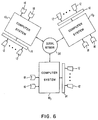
- the weight depth limited (WDL) concurrency control (CC) method is not limited to centralized environment as generally shown in Fig. 1. It may be applied to distributed environment of the type shown in Fig. 6.
- a plurality of computer systems 101, 102 and 103, each similar to computer system 10 in Fig. 1, are connected to global network 50.
- the WDL CC described above works well for centralized systems. However, extending WDL to distributed transaction processing in an efficient way is a non-trivial problem since centralized WDL makes use of global information on the number of locks held by each transaction and the wait relations among all transactions. According to the present invention, the WDL CC is applied to a distributed transaction processing system by adopting a different length function.
- a length function is used in conjunction with wait relations in order to make restart decisions.
- T the number of locks held by T
- this has been shown to yield good performance.
- determination of the total number of locks held by all subtransactions of the global transaction would involve excessive communication, and in any case the information could be obsolete by the time it was finally collected. Therefore, for distributed WDL, a length function based on time is used, as follows.
- Each global transaction is assigned a starting time, and this starting time is included int he startup message for each subtransaction, so that the starting time of the global transaction will be locally known at any node executing one of its subtransactions.
- its length is defined as (current time) - (starting time of global transaction). It is expected that the length defined in this fashion will be highly correlated with the total number of locks held by all subtransactions of a global transactions and, therefore, will have similar performance characteristics when used as a WDL length function.
- distributed clock synchronisation has been widely studied, extremely accurate clock synchronization is not required for the purposes of the invention as applied to the distributed systems since typical time-of-day clocks correctly set to an external standard reference time will suffice.
- the general idea of the invention as applied to distributed transaction processing systems is that (1) whenever a LCC schedules a wait between two subtransactions, this information is sent via messages to the GCCs of the primary nodes of the corresponding global transactions, and (2) each GCC will asynchronously determine if transactions should be restarted using its waiting and starting time information. Due to LCCs and GCCs operating asynchronously, conditions may temporarily arise in which the wait depth of subtransactions is greater than one; however, such conditions will eventually be resolved either by a transaction committing or by being restarted by a GCC.
- the operation of the invention as applied to a distributed system will now be described in more detail.
- Each GCC dynamically maintains a wait graph of global transactions which is updated using the messages it receives from LCCs of the form just described. Note that starting time and primary node information is included in these messages for those transactions that have a primary node different than that of the node to which the message was sent, so that each GCC has starting time and primary node information available for all transactions in its wait tree.
- Each GCC analyzes this wait information, either periodically or every time a message is received, and determines whether transactions should be restarted using the WDL method, as in the centralized case described above, but using a length function based on starting times.
- wait graphs may occur in which the wait depth is greater than one; however, this situation is covered in the general formulation of the WDL CC method.
- a restart message for transaction T i is sent to node P(T i ).
- no wait relations are modified by the GCC at this time, since transaction T i could currently be in a commit or abort phase. Instead, the status of transaction T i is marked as pending.
- the GCCs for the primary nodes of the transactions that are waiting on transaction T i or on which transaction T i is waiting must be notified.
- Each such GCC removes transaction T i from its wait tree and acknowledges.
- restart can be initiated after receiving acknowledgment from all subtransaction nodes and each such GCC.
- Fig. 7 The invention as applied to a distributed transaction processing system is illustrated by a simple example shown in Fig. 7.
- This simple distributed system comprises five nodes 51, 53, 55, 57, and 59.
- Each node has an LCC and a GCC as well as a local transaction coördinator.
- the coördinator 60 for node 59 is shown.
- T1, T2 and T3 there are three transactions T1, T2 and T3 at primary nodes 51, 55 and 59 with various subtransactions scattered around the system. Only those subtransactions that enter a wait relation are indicated in Fig. 7.
- subtransaction T13 requests a lock held in an incompatible mode by subtransaction T23.
- the LCC at node 53 schedules (T13 ⁇ T23), and messages are sent as shown to the GCCs at nodes 51 and 55 (i.e., P(T1) and P(T2), respectively).
- subtransaction T27 requests a lock held in an incompatible mode by subtransaction T37
- the LCC at node 57 schedules (T27 ⁇ T37)
- messages are sent as shown to the GCCs at nodes 55 and 59 (i.e., P(T2) and P(T3), respectively).
- these various messages are received and wait graphs are updated by the GCCs at nodes 51, 55 and 59.
- the GCC at node 55 determines, using local current time and the recorded starting time for each transaction that L(T2)>L(T3) and L(T2)>L(T1) . Therefore, following the WDL CC method, it decides to restart transaction T3 and sends a restart message to the transaction coöordinator 60 at node 59 (i.e., P(T3)).
- the transaction coöordinator 60 at node 59 receives the restart message and begins transaction restart by sending restart messages for all nodes executing a subtransaction T3k and GCC update messages to the local GCC and the GCC at node 55.
- Fig. 8 shows the flow diagram of the logic of the local concurrency control
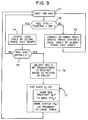
- Fig. 9 is a flow diagram of the logic of the global concurrency control in the distributed system.
- Fig. 8 the process for the local concurrency control begins in function block 62 waiting for a lock request.
- a lock request is received, it is processed using local lock tables, as indicated by function block 63 and then, in decision block 64, a test is made to determine if a wait T ik ⁇ T jk is scheduled. This is determined by examining the wait graphs stored at the node. If no such wait is scheduled, the processing for the lock request is complete using the local lock tables, and the process returns to function block 62 to await the next lock request.
- Fig. 9 the process for the GCC begins at function block 71 by waiting for a message as might be sent by function blocks 66, 67 or 68 of the LCC in Fig. 8.
- a test is made in decision block 72 to determine if the message type is a "waiting-on" type of message. If not, the transaction is either committed or aborted in function block 73 before a return is made to function block 71 to await another message.
- a transaction is committed by updating a transaction status and the local table of the global transaction wait graph.
- the local table of the global transaction wait graph is updated in function block 74, and then a test is made in decision block 75 to determine if the maximum wait depth has been exceeded. If not, a return is made to function block 71, but if the wait depth has been exceeded, a set of X transactions are selected in function block 76 for restart. Then transaction T k in the set X (T k ⁇ X) , (1) a message is sent to node P(T k ) to restart transaction T k and (2) the status of transaction T k is marked as "pending" in the local table, all as indicated by function block 77. A return is then made to function block 71 to await the next message.
Landscapes
- Engineering & Computer Science (AREA)
- Software Systems (AREA)
- Theoretical Computer Science (AREA)
- Physics & Mathematics (AREA)
- General Engineering & Computer Science (AREA)
- General Physics & Mathematics (AREA)
- Information Retrieval, Db Structures And Fs Structures Therefor (AREA)
Applications Claiming Priority (2)
| Application Number | Priority Date | Filing Date | Title |
|---|---|---|---|
| US660762 | 1991-02-25 | ||
| US07/660,762 US5193188A (en) | 1989-01-05 | 1991-02-25 | Centralized and distributed wait depth limited concurrency control methods and apparatus |
Publications (2)
| Publication Number | Publication Date |
|---|---|
| EP0501025A2 true EP0501025A2 (de) | 1992-09-02 |
| EP0501025A3 EP0501025A3 (de) | 1992-12-30 |
Family
ID=24650866
Family Applications (1)
| Application Number | Title | Priority Date | Filing Date |
|---|---|---|---|
| EP19910121110 Withdrawn EP0501025A3 (de) | 1991-02-25 | 1991-12-09 | Zentralisiertes und verteiltes Gleichzeitigkeitssteuerungsverfahren und Gerät mit Beschränkung der Wartetiefe |
Country Status (3)
| Country | Link |
|---|---|
| US (1) | US5193188A (de) |
| EP (1) | EP0501025A3 (de) |
| JP (1) | JP2531881B2 (de) |
Cited By (1)
| Publication number | Priority date | Publication date | Assignee | Title |
|---|---|---|---|---|
| WO2009132282A1 (en) * | 2008-04-24 | 2009-10-29 | University Of Southern California | Clustering and fanout optimizations of asynchronous circuits |
Families Citing this family (31)
| Publication number | Priority date | Publication date | Assignee | Title |
|---|---|---|---|---|
| JPH05197604A (ja) * | 1991-05-21 | 1993-08-06 | Digital Equip Corp <Dec> | マルチプロセッサ・コンピュータ及びその動作方法 |
| US5504899A (en) * | 1991-10-17 | 1996-04-02 | Digital Equipment Corporation | Guaranteeing global serializability by applying commitment ordering selectively to global transactions |
| US5701480A (en) * | 1991-10-17 | 1997-12-23 | Digital Equipment Corporation | Distributed multi-version commitment ordering protocols for guaranteeing serializability during transaction processing |
| US5544359A (en) * | 1993-03-30 | 1996-08-06 | Fujitsu Limited | Apparatus and method for classifying and acquiring log data by updating and storing log data |
| JP3512439B2 (ja) * | 1993-07-08 | 2004-03-29 | 富士通株式会社 | チェックイン・チェックアウトモデルにおける施錠方式 |
| US5524239A (en) * | 1994-04-28 | 1996-06-04 | The United States Of America As Represented By The Secretary Of The Navy | Replay recovery protocol for real-time database management systems |
| US5752026A (en) * | 1994-04-28 | 1998-05-12 | The United States Of America As Represented By The Secretary Of The Navy | Early commit locking computer database protocol |
| US5497487A (en) * | 1994-04-28 | 1996-03-05 | The United States Of America As Represented By The Secretary Of The Navy | Merge, commit recovery protocol for real-time database management systems |
| US5764976A (en) * | 1995-02-06 | 1998-06-09 | International Business Machines Corporation | Method and system of deadlock detection in a data processing system having transactions with multiple processes capable of resource locking |
| GB2302966A (en) * | 1995-06-30 | 1997-02-05 | Ibm | Transaction processing with a reduced-kernel operating system |
| US5860137A (en) * | 1995-07-21 | 1999-01-12 | Emc Corporation | Dynamic load balancing |
| US6144961A (en) * | 1995-08-31 | 2000-11-07 | Compuware Corporation | Method and system for non-intrusive measurement of transaction response times on a network |
| US5682537A (en) * | 1995-08-31 | 1997-10-28 | Unisys Corporation | Object lock management system with improved local lock management and global deadlock detection in a parallel data processing system |
| US5878235A (en) * | 1996-10-03 | 1999-03-02 | Micron Electronics, Inc. | Method and system for concurrent computer transaction processing |
| US5940828A (en) * | 1997-11-18 | 1999-08-17 | International Business Machines Corporation | Locking contention resolution for shared resources |
| SE521433C2 (sv) * | 1998-07-22 | 2003-11-04 | Ericsson Telefon Ab L M | En metod för hantering av risken för en total låsning mellan samtidiga transaktioner i en databas |
| US6571276B1 (en) | 2000-02-23 | 2003-05-27 | International Business Machines Corporation | System for managing asset access in a distributed storage system |
| US6671686B2 (en) * | 2000-11-02 | 2003-12-30 | Guy Pardon | Decentralized, distributed internet data management |
| US6915515B2 (en) | 2000-12-21 | 2005-07-05 | International Business Machines Corporation | Method for creating path-sensitive branch registry for cyclic distributed transactions |
| US6981110B1 (en) | 2001-10-23 | 2005-12-27 | Stephen Waller Melvin | Hardware enforced virtual sequentiality |
| US6874071B2 (en) * | 2001-12-13 | 2005-03-29 | International Business Machines Corporation | Database commit control mechanism that provides more efficient memory utilization through consideration of task priority |
| US7711721B2 (en) * | 2004-09-01 | 2010-05-04 | International Business Machines Corporation | Apparatus, system, and method for suspending a request during file server serialization reinitialization |
| GB0428109D0 (en) * | 2004-12-23 | 2005-01-26 | Ibm | A method for determining participation in a distributed transaction |
| US20080282244A1 (en) * | 2007-05-07 | 2008-11-13 | Microsoft Corporation | Distributed transactional deadlock detection |
| US8060878B2 (en) * | 2007-11-27 | 2011-11-15 | International Business Machines Corporation | Prevention of deadlock in a distributed computing environment |
| US9396227B2 (en) * | 2012-03-29 | 2016-07-19 | Hewlett Packard Enterprise Development Lp | Controlled lock violation for data transactions |
| US10019756B2 (en) | 2014-03-31 | 2018-07-10 | Mastercard International Incorporated | Systems and methods for throttling transaction processing based on constrained sub-systems |
| US9959308B1 (en) | 2014-09-29 | 2018-05-01 | Amazon Technologies, Inc. | Non-blocking processing of federated transactions for distributed data partitions |
| CN104391935B (zh) * | 2014-11-21 | 2017-12-12 | 华为技术有限公司 | 一种范围锁的实现方法及装置 |
| US10942823B2 (en) | 2018-01-29 | 2021-03-09 | Guy Pardon | Transaction processing system, recovery subsystem and method for operating a recovery subsystem |
| US11409559B2 (en) * | 2019-10-24 | 2022-08-09 | EMC IP Holding Company, LLC | System and method for weak lock allowing force preemption by high priority thread |
Family Cites Families (8)
| Publication number | Priority date | Publication date | Assignee | Title |
|---|---|---|---|---|
| FR2253423A5 (de) * | 1973-11-30 | 1975-06-27 | Honeywell Bull Soc Ind | |
| US4318182A (en) * | 1974-04-19 | 1982-03-02 | Honeywell Information Systems Inc. | Deadlock detection and prevention mechanism for a computer system |
| US4224664A (en) * | 1976-05-07 | 1980-09-23 | Honeywell Information Systems Inc. | Apparatus for detecting when the activity of one process in relation to a common piece of information interferes with any other process in a multiprogramming/multiprocessing computer system |
| US4814979A (en) * | 1981-04-01 | 1989-03-21 | Teradata Corporation | Network to transmit prioritized subtask pockets to dedicated processors |
| US4574350A (en) * | 1982-05-19 | 1986-03-04 | At&T Bell Laboratories | Shared resource locking apparatus |
| JPS61233849A (ja) * | 1985-04-08 | 1986-10-18 | Hitachi Ltd | デ−タベ−ス排他制御方法 |
| US4853843A (en) * | 1987-12-18 | 1989-08-01 | Tektronix, Inc. | System for merging virtual partitions of a distributed database |
| EP0377133B1 (de) * | 1989-01-05 | 1995-09-27 | International Business Machines Corporation | Gleichzeitigkeitssteuerungsverfahren mit Beschränkung der Warte-Tiefe |
-
1991
- 1991-02-25 US US07/660,762 patent/US5193188A/en not_active Expired - Fee Related
- 1991-12-04 JP JP3320458A patent/JP2531881B2/ja not_active Expired - Lifetime
- 1991-12-09 EP EP19910121110 patent/EP0501025A3/de not_active Withdrawn
Non-Patent Citations (2)
| Title |
|---|
| PROCEEDINGS OF THE ELEVENTH ANNUAL INTERNATIONAL COMPUTER SOFTWARE & APPLICATIONS CONFERENCE 9 October 1987, TOKYO, JAPAN pages 554 - 560 YAHIKO KAMBAYASHI, XINGGUO ZHONG 'CONTROLLABLE TIMESTAMP ORDERING AND ORIENTAL TIMESTAMP ORDERING CONCURRENCY CONTROL MECHANISMS' * |
| PROCEEDINGS OF THE MINI AND MICROCOMPUTERS AND THEIR APPLICATIONS CONFERENCE 30 June 1988, SANT FELIU DE GUIXOLS, SPAIN pages 197 - 201 SONG C. MOON, YOO S. KIM 'A HYBRID CONCURRENCY CONTROL SCHEME IN DISTRIBUTED DATABASE SYSTEMS' * |
Cited By (2)
| Publication number | Priority date | Publication date | Assignee | Title |
|---|---|---|---|---|
| WO2009132282A1 (en) * | 2008-04-24 | 2009-10-29 | University Of Southern California | Clustering and fanout optimizations of asynchronous circuits |
| US8448105B2 (en) | 2008-04-24 | 2013-05-21 | University Of Southern California | Clustering and fanout optimizations of asynchronous circuits |
Also Published As
| Publication number | Publication date |
|---|---|
| EP0501025A3 (de) | 1992-12-30 |
| JPH06103132A (ja) | 1994-04-15 |
| JP2531881B2 (ja) | 1996-09-04 |
| US5193188A (en) | 1993-03-09 |
Similar Documents
| Publication | Publication Date | Title |
|---|---|---|
| US5193188A (en) | Centralized and distributed wait depth limited concurrency control methods and apparatus | |
| Rosenkrantz et al. | System level concurrency control for distributed database systems | |
| EP0428006B1 (de) | Mehrstufiges Verriegelungssystem und -verfahren | |
| US7146366B2 (en) | Distributed concurrency control using serialization ordering | |
| Shanker et al. | SWIFT—A new real time commit protocol | |
| Stone | Database applications of the fetch-and-add instruction | |
| Lam et al. | On using real-time static locking protocols for distributed real-time databases | |
| Sinha | Commutable transactions and the time_pad synchronization mechanism for distributed systems | |
| CA2220612C (en) | Method and apparatus for inter-node deadlock avoidance on a parallel processing system | |
| Pang et al. | On using similarity for resolving conflicts at commit in mixed distributed real-time databases | |
| Son | Scheduling real-time transactions | |
| Yeung et al. | A new deadlock detection algorithms for distributed real-time database systems | |
| Ulusoy | Transaction processing in distributed active real-time database systems | |
| Lortz et al. | MDARTS: A multiprocessor database architecture for hard real-time systems | |
| EP0377133B1 (de) | Gleichzeitigkeitssteuerungsverfahren mit Beschränkung der Warte-Tiefe | |
| O'Neil et al. | Towards predictable transaction executions in real-time database systems | |
| Ragunathan et al. | Improving the performance of Read-only Transactions through Speculation | |
| Singh et al. | FIVE: A Real-Time Commit Protocol | |
| Son et al. | Scheduling and Concurrency Control for Real-Time Database Systems | |
| Baldoni et al. | Deadlock detection in multidatabase systems: a performance analysis | |
| Ulusoy | Lock-based concurrency control in distributed real-time database systems | |
| Kuo | Concurrency control system for a relational DBMS using two-phase locks | |
| Yun et al. | A pessimistic concurrency control algorithm in multidatabase systems | |
| Latham et al. | Implementing MPI-IO shared file pointers without file system support | |
| Son et al. | Prototyping environment for distributed database systems: Functional description |
Legal Events
| Date | Code | Title | Description |
|---|---|---|---|
| PUAI | Public reference made under article 153(3) epc to a published international application that has entered the european phase |
Free format text: ORIGINAL CODE: 0009012 |
|
| AK | Designated contracting states |
Kind code of ref document: A2 Designated state(s): DE FR GB |
|
| PUAL | Search report despatched |
Free format text: ORIGINAL CODE: 0009013 |
|
| AK | Designated contracting states |
Kind code of ref document: A3 Designated state(s): DE FR GB |
|
| 17P | Request for examination filed |
Effective date: 19921210 |
|
| STAA | Information on the status of an ep patent application or granted ep patent |
Free format text: STATUS: THE APPLICATION HAS BEEN WITHDRAWN |
|
| 18W | Application withdrawn |
Withdrawal date: 19961223 |