EP0501471A2 - Siedeverfahren und Wärmetauscher zur Verwendung in diesem Verfahren - Google Patents
Siedeverfahren und Wärmetauscher zur Verwendung in diesem Verfahren Download PDFInfo
- Publication number
- EP0501471A2 EP0501471A2 EP92103356A EP92103356A EP0501471A2 EP 0501471 A2 EP0501471 A2 EP 0501471A2 EP 92103356 A EP92103356 A EP 92103356A EP 92103356 A EP92103356 A EP 92103356A EP 0501471 A2 EP0501471 A2 EP 0501471A2
- Authority
- EP
- European Patent Office
- Prior art keywords
- liquid
- passages
- heat exchanger
- group
- oxygen
- Prior art date
- Legal status (The legal status is an assumption and is not a legal conclusion. Google has not performed a legal analysis and makes no representation as to the accuracy of the status listed.)
- Granted
Links
Images


Classifications
-
- F—MECHANICAL ENGINEERING; LIGHTING; HEATING; WEAPONS; BLASTING
- F28—HEAT EXCHANGE IN GENERAL
- F28D—HEAT-EXCHANGE APPARATUS, NOT PROVIDED FOR IN ANOTHER SUBCLASS, IN WHICH THE HEAT-EXCHANGE MEDIA DO NOT COME INTO DIRECT CONTACT
- F28D9/00—Heat-exchange apparatus having stationary plate-like or laminated conduit assemblies for both heat-exchange media, the media being in contact with different sides of a conduit wall
- F28D9/0062—Heat-exchange apparatus having stationary plate-like or laminated conduit assemblies for both heat-exchange media, the media being in contact with different sides of a conduit wall the conduits for one heat-exchange medium being formed by spaced plates with inserted elements
- F28D9/0068—Heat-exchange apparatus having stationary plate-like or laminated conduit assemblies for both heat-exchange media, the media being in contact with different sides of a conduit wall the conduits for one heat-exchange medium being formed by spaced plates with inserted elements with means for changing flow direction of one heat exchange medium, e.g. using deflecting zones
-
- F—MECHANICAL ENGINEERING; LIGHTING; HEATING; WEAPONS; BLASTING
- F25—REFRIGERATION OR COOLING; COMBINED HEATING AND REFRIGERATION SYSTEMS; HEAT PUMP SYSTEMS; MANUFACTURE OR STORAGE OF ICE; LIQUEFACTION SOLIDIFICATION OF GASES
- F25J—LIQUEFACTION, SOLIDIFICATION OR SEPARATION OF GASES OR GASEOUS OR LIQUEFIED GASEOUS MIXTURES BY PRESSURE AND COLD TREATMENT OR BY BRINGING THEM INTO THE SUPERCRITICAL STATE
- F25J3/00—Processes or apparatus for separating the constituents of gaseous or liquefied gaseous mixtures involving the use of liquefaction or solidification
- F25J3/02—Processes or apparatus for separating the constituents of gaseous or liquefied gaseous mixtures involving the use of liquefaction or solidification by rectification, i.e. by continuous interchange of heat and material between a vapour stream and a liquid stream
- F25J3/04—Processes or apparatus for separating the constituents of gaseous or liquefied gaseous mixtures involving the use of liquefaction or solidification by rectification, i.e. by continuous interchange of heat and material between a vapour stream and a liquid stream for air
- F25J3/04006—Providing pressurised feed air or process streams within or from the air fractionation unit
- F25J3/04078—Providing pressurised feed air or process streams within or from the air fractionation unit providing pressurized products by liquid compression and vaporisation with cold recovery, i.e. so-called internal compression
- F25J3/0409—Providing pressurised feed air or process streams within or from the air fractionation unit providing pressurized products by liquid compression and vaporisation with cold recovery, i.e. so-called internal compression of oxygen
-
- F—MECHANICAL ENGINEERING; LIGHTING; HEATING; WEAPONS; BLASTING
- F25—REFRIGERATION OR COOLING; COMBINED HEATING AND REFRIGERATION SYSTEMS; HEAT PUMP SYSTEMS; MANUFACTURE OR STORAGE OF ICE; LIQUEFACTION SOLIDIFICATION OF GASES
- F25J—LIQUEFACTION, SOLIDIFICATION OR SEPARATION OF GASES OR GASEOUS OR LIQUEFIED GASEOUS MIXTURES BY PRESSURE AND COLD TREATMENT OR BY BRINGING THEM INTO THE SUPERCRITICAL STATE
- F25J3/00—Processes or apparatus for separating the constituents of gaseous or liquefied gaseous mixtures involving the use of liquefaction or solidification
- F25J3/02—Processes or apparatus for separating the constituents of gaseous or liquefied gaseous mixtures involving the use of liquefaction or solidification by rectification, i.e. by continuous interchange of heat and material between a vapour stream and a liquid stream
- F25J3/04—Processes or apparatus for separating the constituents of gaseous or liquefied gaseous mixtures involving the use of liquefaction or solidification by rectification, i.e. by continuous interchange of heat and material between a vapour stream and a liquid stream for air
- F25J3/04406—Processes or apparatus for separating the constituents of gaseous or liquefied gaseous mixtures involving the use of liquefaction or solidification by rectification, i.e. by continuous interchange of heat and material between a vapour stream and a liquid stream for air using a dual pressure main column system
- F25J3/04412—Processes or apparatus for separating the constituents of gaseous or liquefied gaseous mixtures involving the use of liquefaction or solidification by rectification, i.e. by continuous interchange of heat and material between a vapour stream and a liquid stream for air using a dual pressure main column system in a classical double column flowsheet, i.e. with thermal coupling by a main reboiler-condenser in the bottom of low pressure respectively top of high pressure column
-
- F—MECHANICAL ENGINEERING; LIGHTING; HEATING; WEAPONS; BLASTING
- F25—REFRIGERATION OR COOLING; COMBINED HEATING AND REFRIGERATION SYSTEMS; HEAT PUMP SYSTEMS; MANUFACTURE OR STORAGE OF ICE; LIQUEFACTION SOLIDIFICATION OF GASES
- F25J—LIQUEFACTION, SOLIDIFICATION OR SEPARATION OF GASES OR GASEOUS OR LIQUEFIED GASEOUS MIXTURES BY PRESSURE AND COLD TREATMENT OR BY BRINGING THEM INTO THE SUPERCRITICAL STATE
- F25J3/00—Processes or apparatus for separating the constituents of gaseous or liquefied gaseous mixtures involving the use of liquefaction or solidification
- F25J3/02—Processes or apparatus for separating the constituents of gaseous or liquefied gaseous mixtures involving the use of liquefaction or solidification by rectification, i.e. by continuous interchange of heat and material between a vapour stream and a liquid stream
- F25J3/04—Processes or apparatus for separating the constituents of gaseous or liquefied gaseous mixtures involving the use of liquefaction or solidification by rectification, i.e. by continuous interchange of heat and material between a vapour stream and a liquid stream for air
- F25J3/04763—Start-up or control of the process; Details of the apparatus used
- F25J3/04769—Operation, control and regulation of the process; Instrumentation within the process
- F25J3/04854—Safety aspects of operation
- F25J3/0486—Safety aspects of operation of vaporisers for oxygen enriched liquids, e.g. purging of liquids
-
- F—MECHANICAL ENGINEERING; LIGHTING; HEATING; WEAPONS; BLASTING
- F25—REFRIGERATION OR COOLING; COMBINED HEATING AND REFRIGERATION SYSTEMS; HEAT PUMP SYSTEMS; MANUFACTURE OR STORAGE OF ICE; LIQUEFACTION SOLIDIFICATION OF GASES
- F25J—LIQUEFACTION, SOLIDIFICATION OR SEPARATION OF GASES OR GASEOUS OR LIQUEFIED GASEOUS MIXTURES BY PRESSURE AND COLD TREATMENT OR BY BRINGING THEM INTO THE SUPERCRITICAL STATE
- F25J5/00—Arrangements of cold exchangers or cold accumulators in separation or liquefaction plants
- F25J5/002—Arrangements of cold exchangers or cold accumulators in separation or liquefaction plants for continuously recuperating cold, i.e. in a so-called recuperative heat exchanger
- F25J5/005—Arrangements of cold exchangers or cold accumulators in separation or liquefaction plants for continuously recuperating cold, i.e. in a so-called recuperative heat exchanger in a reboiler-condenser, e.g. within a column
-
- F—MECHANICAL ENGINEERING; LIGHTING; HEATING; WEAPONS; BLASTING
- F28—HEAT EXCHANGE IN GENERAL
- F28D—HEAT-EXCHANGE APPARATUS, NOT PROVIDED FOR IN ANOTHER SUBCLASS, IN WHICH THE HEAT-EXCHANGE MEDIA DO NOT COME INTO DIRECT CONTACT
- F28D21/00—Heat-exchange apparatus not covered by any of the groups F28D1/00 - F28D20/00
- F28D21/0017—Flooded core heat exchangers
-
- F—MECHANICAL ENGINEERING; LIGHTING; HEATING; WEAPONS; BLASTING
- F25—REFRIGERATION OR COOLING; COMBINED HEATING AND REFRIGERATION SYSTEMS; HEAT PUMP SYSTEMS; MANUFACTURE OR STORAGE OF ICE; LIQUEFACTION SOLIDIFICATION OF GASES
- F25J—LIQUEFACTION, SOLIDIFICATION OR SEPARATION OF GASES OR GASEOUS OR LIQUEFIED GASEOUS MIXTURES BY PRESSURE AND COLD TREATMENT OR BY BRINGING THEM INTO THE SUPERCRITICAL STATE
- F25J2235/00—Processes or apparatus involving steps for increasing the pressure or for conveying of liquid process streams
- F25J2235/50—Processes or apparatus involving steps for increasing the pressure or for conveying of liquid process streams the fluid being oxygen
-
- F—MECHANICAL ENGINEERING; LIGHTING; HEATING; WEAPONS; BLASTING
- F25—REFRIGERATION OR COOLING; COMBINED HEATING AND REFRIGERATION SYSTEMS; HEAT PUMP SYSTEMS; MANUFACTURE OR STORAGE OF ICE; LIQUEFACTION SOLIDIFICATION OF GASES
- F25J—LIQUEFACTION, SOLIDIFICATION OR SEPARATION OF GASES OR GASEOUS OR LIQUEFIED GASEOUS MIXTURES BY PRESSURE AND COLD TREATMENT OR BY BRINGING THEM INTO THE SUPERCRITICAL STATE
- F25J2245/00—Processes or apparatus involving steps for recycling of process streams
- F25J2245/50—Processes or apparatus involving steps for recycling of process streams the recycled stream being oxygen
-
- F—MECHANICAL ENGINEERING; LIGHTING; HEATING; WEAPONS; BLASTING
- F25—REFRIGERATION OR COOLING; COMBINED HEATING AND REFRIGERATION SYSTEMS; HEAT PUMP SYSTEMS; MANUFACTURE OR STORAGE OF ICE; LIQUEFACTION SOLIDIFICATION OF GASES
- F25J—LIQUEFACTION, SOLIDIFICATION OR SEPARATION OF GASES OR GASEOUS OR LIQUEFIED GASEOUS MIXTURES BY PRESSURE AND COLD TREATMENT OR BY BRINGING THEM INTO THE SUPERCRITICAL STATE
- F25J2250/00—Details related to the use of reboiler-condensers
- F25J2250/04—Down-flowing type boiler-condenser, i.e. with evaporation of a falling liquid film
-
- F—MECHANICAL ENGINEERING; LIGHTING; HEATING; WEAPONS; BLASTING
- F25—REFRIGERATION OR COOLING; COMBINED HEATING AND REFRIGERATION SYSTEMS; HEAT PUMP SYSTEMS; MANUFACTURE OR STORAGE OF ICE; LIQUEFACTION SOLIDIFICATION OF GASES
- F25J—LIQUEFACTION, SOLIDIFICATION OR SEPARATION OF GASES OR GASEOUS OR LIQUEFIED GASEOUS MIXTURES BY PRESSURE AND COLD TREATMENT OR BY BRINGING THEM INTO THE SUPERCRITICAL STATE
- F25J2290/00—Other details not covered by groups F25J2200/00 - F25J2280/00
- F25J2290/32—Details on header or distribution passages of heat exchangers, e.g. of reboiler-condenser or plate heat exchangers
-
- F—MECHANICAL ENGINEERING; LIGHTING; HEATING; WEAPONS; BLASTING
- F28—HEAT EXCHANGE IN GENERAL
- F28D—HEAT-EXCHANGE APPARATUS, NOT PROVIDED FOR IN ANOTHER SUBCLASS, IN WHICH THE HEAT-EXCHANGE MEDIA DO NOT COME INTO DIRECT CONTACT
- F28D21/00—Heat-exchange apparatus not covered by any of the groups F28D1/00 - F28D20/00
- F28D2021/0019—Other heat exchangers for particular applications; Heat exchange systems not otherwise provided for
- F28D2021/0033—Other heat exchangers for particular applications; Heat exchange systems not otherwise provided for for cryogenic applications
-
- F—MECHANICAL ENGINEERING; LIGHTING; HEATING; WEAPONS; BLASTING
- F28—HEAT EXCHANGE IN GENERAL
- F28F—DETAILS OF HEAT-EXCHANGE AND HEAT-TRANSFER APPARATUS, OF GENERAL APPLICATION
- F28F2250/00—Arrangements for modifying the flow of the heat exchange media, e.g. flow guiding means; Particular flow patterns
- F28F2250/10—Particular pattern of flow of the heat exchange media
- F28F2250/108—Particular pattern of flow of the heat exchange media with combined cross flow and parallel flow
-
- Y—GENERAL TAGGING OF NEW TECHNOLOGICAL DEVELOPMENTS; GENERAL TAGGING OF CROSS-SECTIONAL TECHNOLOGIES SPANNING OVER SEVERAL SECTIONS OF THE IPC; TECHNICAL SUBJECTS COVERED BY FORMER USPC CROSS-REFERENCE ART COLLECTIONS [XRACs] AND DIGESTS
- Y10—TECHNICAL SUBJECTS COVERED BY FORMER USPC
- Y10S—TECHNICAL SUBJECTS COVERED BY FORMER USPC CROSS-REFERENCE ART COLLECTIONS [XRACs] AND DIGESTS
- Y10S62/00—Refrigeration
- Y10S62/902—Apparatus
- Y10S62/903—Heat exchange structure
Definitions
- the present invention is related to a downflow reboiler (heat exchanger) for use in processes for the cryogenic distillation of gas mixtures, in particular, air, to separate such into their constituent components.
- the present invention also relates to a boiling process using such downflow reboiler.
- Reboilers in thermally linked columns of air separation plants are generally of the thermosiphon type.
- the fluids exchanging heat are relatively pure nitrogen on the high temperature side and pure or impure oxygen on the low temperature side.
- the nitrogen condenses in downflow and serves as the reflux for the high pressure column, while the oxygen boils in upflow and serves as the boil-up for the low pressure column.
- the pressure in the high pressure column drives the flow of the nitrogen through the condensing side of the heat exchanger and the condensed nitrogen is then allowed to build static head equivalent to the pressure drop for it to flow back into the high pressure column.
- the flow on the oxygen side is driven by the density difference between the outside of the exchanger, which is essentially all liquid, and the inside of the exchanger, which is part vapor and part liquid.
- the heat exchanger is usually completely or partially submerged in the oxygen it boils.
- the resulting cooling curves are not parallel and this feature limits the approach temperatures of the two streams. For a given pressure in the low pressure column, this increases the pressure at which the high pressure column has to operate, and thereby the power consumption of the main air compressor. Any innovation that allows the two stream temperatures to approach more closely in a parallel fashion would be beneficial in terms of the overall thermodynamic efficiency of the plant.
- EP 0 303 492 A2 discloses a method of enhancing heat transfer coefficients for boiling by spraying the surface with a thermally conductive coating consisting of metallic and plastic particles.
- the reference cites experimental results that show the advantages of the sprayed surface over the unsprayed surface in pool boiling and of the sprayed surface over both of the above when boiling is in downflow.
- the reference makes specific references to reboiler/condensers used in air separation columns wherein the boiling is in downflow.
- the boiling liquid distribution is via a single stage intra-passage distribution using orifices from the top.
- the reference teaches that a typical exchanger has a spacing of about 100 mm with 6 mm high fins and 2.5 mm fin gap.
- U.S. Pat. No. Re 33,026 teaches a downflow heat exchanger which incorporates predistribution of a boiling liquid for reboil, e.g. liquid oxygen, by holes and fine distribution by means of a packing to form a continuous running liquid film.
- a boiling liquid for reboil e.g. liquid oxygen
- This principle is particularly applicable to air separation plants. While predistribution is accomplished by means of orifices, fine distribution can be achieved by means of serrated hardway finning or by means of a sprayed liquid on the primary surfaces or the parting sheets. Enhancement to distribution by horizontal ribbing is mentioned.
- Australian Pat. No. 28509/71 teaches a reboiler/condenser incorporating two stage or one stage distribution with restrictions, namely through orifices, that cause flashing to form vapor from the boiling liquid feed in order to get a two-phase mixture in the distribution zone.
- U.S. Pat. No. 3,992,168 teaches an exchanger which is a condenser and rectifier in one core.
- the core taught by this patent has provisions for splitting the vapor and liquid phases in the boiling stream, such that the vapor feeds directly from the header into the finning while the liquid has to pass through perforations before it rejoins the vapor.
- This backup upstream of these perforations is the coarse distribution analogous to the predistribution in U.S. Pat. No. Re 33,026.
- Another feature mentioned in the patent is decreasing fin density along the boiling side to reduce the pressure drop thereby accommodating the increasing vapor content.
- U.S. Pat. No. 4,646,822 discloses a mixing device that is used to distribute two-phase mixtures uniformly into the passages of a heat exchanger.
- the mixing device can be applied to both the hot and cold streams when they each consist of two phases.
- the approach is to introduce one phase, preferably the vapor, at one end of the core from a header into each passage and the other phase, preferably the liquid, from a header via slots with and without orifices into each passage where the latter phase mixes with the former.
- the pressure drop in the fins downstream of the mixing device is stated to ensure that the fluid is distributed uniformly.
- Several embodiments are shown which are different in mechanical detail but not in the purpose.
- the hot and cold streams are shown to be flowing in countercurrent fashion.
- the orientation of the core is not stated clearly to ascertain if the boiling occurs in upflow or downflow.
- the present invention is an improvement to a process for vaporizing a liquid by heat exchange with a second fluid in a heat exchanger designed to maintain no more than a small temperature difference between the liquid and the second fluid.
- the heat exchanger used in the process comprises a parallelpipedal body formed by an assembly of parallel vertical extending passages having generally vertical corrugated fins therein.
- the liquid is introduced into a first group of passages and the second fluid is introduced into a second group of passages constituting the remaining passages.
- the liquid is distributed at the top of and throughout the horizontal length of the first group of passages.
- the improvement which enhances performance of the process comprises three steps. In the first step, a fixed volume distribution zone is established and maintained above the vertical corrugated fins in the first group of passages.
- This distribution zone contains hardway finning.
- the liquid is passed downwardly and over the hardway finning at a rate such that at least twenty five percent (25%) of the available volume of said distribution zone is in the liquid phase.
- the liquid is passed downwardly over the generally vertical corrugated fins in the first group of passages as a thin film and controlling the liquid flow at a rate to maintain a local liquid film Reynolds number of at least 20 but not greater than 1000 throughout the upper seventy five percent (75%) of the generally vertical corrugated fins.
- the present invention is also an improvement to a heat exchanger comprising means for vaporizing a liquid by heat exchange with a second fluid while maintaining no more than a small temperature difference between the liquid and the second fluid.
- the exchanger includes a parallelpipedal body comprising an assembly of parallel plates having walls defining therebetween a multitude of flat, vertical passages having generally vertical corrugated fins therein.
- the flat passages comprise a first group of passages and a second group of passages constituting the remainder of the passages.
- the exchanger includes means for distributing the liquid at the top of and throughout the horizontal length of the first group of passages.
- the improvement for enhancing performance of the heat exchanger comprises two means.
- the first means is a means for providing an essentially uniform film of liquid onto the generally vertical corrugated fins in the first group of passages.
- the second means is means for enhancing wetting of at least the top seventy five percent (75%) of the generally vertical corrugated fins in the first group of passages.
- the improved boiling process and heat exchanger is particularly useful in an air separation process.
- the boiling process would be used to at least partially vaporize a liquid oxygen-enriched stream by means of heat exchange against a nitrogen rich fluid stream.
- Figure 1 is an isometric drawing of the preferred embodiment of the heat exchanger of the present invention.
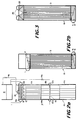
- Figure 2a is a schematic of the liquid passage of the heat exchanger shown in Figure 1.
- Figure 2b is a schematic of the second fluid passage of the heat exchanger shown in Figure 1.
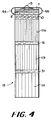
- Figure 3 is a schematic of an alternate embodiment of the second fluid passage of the present invention.
- Figure 4 is a schematic of an alternate embodiment of the liquid passage of the present invention.
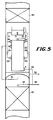
- FIGS 5 and 6 are schematic diagrams of the incorporation of the present invention into an air separation process.
- Boiling liquids in a downflow manner has many economic and technical advantages over the conventional thermosiphon manner, yet can be unstable leading to the formation of dry patches which are detrimental to heat transfer. This detriment is especially true as one tries to boil the boiling side fluid completely. It is, therefore, necessary to obtain good liquid distribution on the heat transfer surface and to minimize the liquid film's tendency to form rivulets along the length of the exchanger.
- the present invention is a downflow boiling heat exchanger including features which result in a design which can take full advantage of the benefits of downflow boiling in increasing the efficiency of plants such as those used for separating air into its constituents while overcoming the detriments known in the art.
- the main features of the heat exchanger of present invention are a means for providing an essentially uniform film of liquid onto the heat transfer surface (fins) in the boiling passages of the heat exchanger and the means for enhancing wetting of at least the top seventy five percent (75%) of the heat transfer surface in the boiling passages of the heat exchanger.
- the present invention is also a boiling process.
- the key mechanical and process features of the current invention which achieve the above objectives are best described with reference to several specific embodiments. Although the present invention has more general applicability, for the ease of discussion of these embodiments, the boiling and condensing fluids will be typically referred to as oxygen and nitrogen, respectively.
- FIG. 1 shows an isometric illustration of the first embodiment of the heat exchanger of the present invention.
- the present invention comprises means (exchanger) 20 for vaporizing a liquid by heat exchange with a second fluid.
- Exchanger 20 is essentially a parallelpipedal body comprising an assembly of parallel plates 21 having walls defining therebetween a multitude of flat, vertical passages having generally vertical corrugated fins 17. These passages comprise a first group of passages 18 and a second group of passages 19.
- Exchanger 20 includes means for distributing the liquid at the top of and throughout the horizontal length of the first group of passages 18.
- These means for distributing the liquid at the top of and throughout the horizontal length of the first group of passages 18 comprises a plurality of perforated, liquid injection tubes 7 located along the horizontal length of the first group of passages 18, wherein such perforation are of an effective orientation, size, and location so as to essentially evenly distribute the liquid.
- Liquid is fed to liquid injection tubes 7 by means of headers 6a and 6b.
- Exchanger 20 further includes means 10 for providing an essentially uniform film of liquid onto the generally vertical corrugated fins 17 in the first group of passages 18.
- Means 10 is preferably a hardway finning. These hardway finning 10 are designed to have an effective resistance to flow in the vertical direction to allow for flow in the horizontal direction so as during operation of the exchanger the liquid film on the hardway finning occupies at least twenty five percent (25%), preferably fifty percent (50%) of the void space of the hardway finning. To accomplish this liquid retention, the preferred hardway finning is a perforated corrugated finning.
- the generally vertical corrugated fins 17 of the first group of passages 18 are preferably serrated easyway finning. This serrated easyway finning is shown in the lower enlarged fragmentized view of Figure 1.
- Exchanger 20 includes means for enhancing wetting of at least the top seventy five percent (75%) of the generally vertical corrugated fins 17 in the first group of passages 18.
- the means for enhancing wetting of at least the top seventy five percent (75%) of the generally vertical corrugated fins 17 in the first group of passages 18 comprises one or both of the following.
- a plurality of successive generally vertical corrugated fin sections 11a, 11b and 11c of decreasing surface area are designed to have an effective surface area so that during operation of the heat exchanger a Reynolds number of at least 20, preferably 50, but not more than 1000, preferably 300, is maintained for the liquid film in each section.
- Exchanger 20 further includes means 15 which can be used to introduce additional liquid or vapor to the top of first group of passages 18.
- heat transfer fins 3 are comprised generally vertical corrugated fins; these fins can be perforated or serrated.
- Liquid oxygen is fed via headers 6a and 6b into injection tubes 7, which are positioned between support fins 8.
- the injection tubes have perforations which spray the oxygen into the passages.
- the resistance to flow by the injection tubes will force the liquid oxygen to back up into a head tank 9 and assure uniform passage-to-passage distribution of the oxygen. This is accomplished by the proper selection of the number of the injection tubes, their inner diameters, and the orientation, diameter, pitch and location of the holes in the injection tubes.
- the resistance to flow in the hardway finning will force the oxygen to spread across the width of each individual passage.
- the selection of the hardway finning is such that under normal operating conditions it is at least 25% or, preferably, at least 50% full of liquid.
- Such hardway finning can be of the perforated or serrated type with the former being preferred for its mechanical simplicity.
- Oxygen that is well distributed then flows over the heat transfer sections 11a, 11b and 11c (each of which can consist of multiple fin pads) largely in film-wise flow and begins to boil.
- additional means of introducing liquid oxygen is provided via the mid injection headers 12a and 12b and tube 13.
- liquid oxygen from fins 11a and injection tube 13 combine and flow over fins 11b.
- the ratio of the oxygen fed to the top and mid injection tubes 7 and 13 is controlled by valves 14a and 14b. In the limiting case, all the flow can be fed via the top tube alone when obtaining uniform thickness is not critical.
- the heat transfer fins in successive pads of 11a and 11b are so selected that there is less surface to be wetted as more and more boiling has taken place.
- This can be achieved by using less and less dense finning as one moves from the top to the bottom, i.e., reducing the heat transfer surface area to maintain a liquid local film Reynolds number above 20 and, preferably, above 50 yet not more than 1000, preferably 300, for at least 75% of the reboiler surface.
- the liquid film Reynolds number should be typically below 250. This method works well to satisfy the simultaneous need to increase the flow area to accommodate progressively increasing vapor flow but should be balanced against the need for maximizing the surface area for heat transfer.
- FIG 3 shows a variation of the nitrogen passage 19 of the embodiment shown in Figure 2b.
- nitrogen inlet distributors 25 and 26 are located at the top of exchanger 20 such that the sections of oxygen passage 18 containing injection tubes 7 and hardway finning 10 ( Figure 2a) are not adiabatic, i.e, heat exchange takes place.
- the additional heat exchange should be utilized when a controlled vaporization of the saturated liquid feed to hardway finning 10 is beneficial for intra passage liquid distribution or when the feed to hardway finning 10 is a subcooled liquid.
- oxygen vapor external to the exchanger is added in controlled fashion via port 15 ( Figure 2a) in order to improve liquid distribution inside the passages.
- oxygen vapor generated inside the exchanger is allowed to escape from the top of the exchanger via port 15 as well as the bottom of the exchanger in order to minimize the pressure drop in oxygen passage 18.
- oxygen liquid from the head tank 9 is allowed to overflow into the oxygen passages directly via port 15 bypassing the headers 6a and 6b and injection tubes 7. This bypass occurs only when the liquid oxygen reaches a level high enough to overflow via line 16.
- the liquid oxygen is redistributed along the exchanger by one or more devices 31 which respread it uniformly across the width.
- the vapor flows through redistributors 31.
- These redistributors are partial obstructions oriented perpendicular to the flow.
- the pressure drop per redistributor is in the range of 0.005 to 0.2 psi and preferably in the range of 0.01 to 0.05 psi. Examples would include appropriately selected hardway fins.
- the process (and heat exchanger) of the present invention can be used in any air separation process utilizing a cryogenic distillation column system having at least one column wherein a liquid oxygen-enriched stream is partially condensed by heat exchange against a nitrogen-rich fluid.
- the term “rich” when used to modify a component means that the named component is the major (>50%) component in the subject stream
- enriched when used to modify a component (i.e., oxygen-enriched) means that the named component has a concentration in the subject stream greater than its concentration in air (e.g., oxygen-enriched means an oxygen concentration greater than ⁇ 21 vol%).
- FIG. 5 presents a schematic diagram of the section of such an air separation process where the present invention would be used.
- compressed and cooled feed air is rectified in high pressure column 40 (only a portion of the column is shown) producing HP nitrogen overhead and a crude liquid oxygen bottoms.
- HP nitrogen overhead is removed from column 40 via line 41 and fed to reboiler/condenser 20 located in the bottom of low pressure column 50 via header 1.
- reboiler/condenser 20 the HP nitrogen overhead is condensed by heat exchange with boiling liquid oxygen from column 40.
- the condensed nitrogen is removed via header 5 into line 42 and then split into two portions.
- the liquid oxygen to be boiled in reboiler/condenser 20 is collected from the bottom tray of column 40 in heat tank 9. Liquid oxygen is removed from head tank 9 via line 51 and fed to headers 6a and 6b and, optionally, headers 12a and 12b. If used, flow to headers 12a and 12b would be controlled by valves 14a and 14b.
- reboiler/condenser 20 the bulk of the liquid oxygen boils and the gaseous oxygen and any unvaporized liquid oxygen is removed from the bottom.
- the gaseous oxygen rises up the column to provide vapor boil-up and the unboiled liquid is collected in a sump at the bottom of column 40. This liquid oxygen can be removed as a purge or product stream via line 52.
- the current invention allows the boiling and condensing streams in heat exchangers such as those used in air separation plants to achieve temperature approach in a nearer to parallel and therefore more close fashion than in conventional thermosiphons by boiling the lower temperature stream in downflow. This closer temperature approach reduces the power consumption of the plant.
- the invention also describes mechanical and process features that allow the adjustment of the boiling stream flow to optimize the performance of the heat exchanger. It works by distributing and maintaining the boiling fluid in uniform film-flow over all the heat transfer sections of the exchanger. Liquid oxygen from head tanks is fed uniformly to all the boiling passages by using the controlling resistance of injection tubes. Once inside the passage, completely or partially flooded hardway fins are used to distribute the liquid oxygen across the width of each passage.
- Embodiment 2 allows the controlled generation of vapor in the hardway fin section by exchange against the condensing nitrogen for enhanced intra-passage distribution. Further, Embodiment 8 uses frequent liquid redistributors along the length of the heat exchanger.
Landscapes
- Engineering & Computer Science (AREA)
- Physics & Mathematics (AREA)
- Mechanical Engineering (AREA)
- Thermal Sciences (AREA)
- General Engineering & Computer Science (AREA)
- Health & Medical Sciences (AREA)
- Emergency Medicine (AREA)
- Separation By Low-Temperature Treatments (AREA)
- Heat-Exchange Devices With Radiators And Conduit Assemblies (AREA)
Applications Claiming Priority (2)
| Application Number | Priority Date | Filing Date | Title |
|---|---|---|---|
| US663339 | 1991-03-01 | ||
| US07/663,339 US5122174A (en) | 1991-03-01 | 1991-03-01 | Boiling process and a heat exchanger for use in the process |
Publications (3)
| Publication Number | Publication Date |
|---|---|
| EP0501471A2 true EP0501471A2 (de) | 1992-09-02 |
| EP0501471A3 EP0501471A3 (en) | 1992-12-09 |
| EP0501471B1 EP0501471B1 (de) | 1995-06-28 |
Family
ID=24661399
Family Applications (1)
| Application Number | Title | Priority Date | Filing Date |
|---|---|---|---|
| EP92103356A Expired - Lifetime EP0501471B1 (de) | 1991-03-01 | 1992-02-27 | Siedeverfahren und Wärmetauscher zur Verwendung in diesem Verfahren |
Country Status (5)
| Country | Link |
|---|---|
| US (1) | US5122174A (de) |
| EP (1) | EP0501471B1 (de) |
| JP (1) | JPH0731015B2 (de) |
| DE (1) | DE69203111T2 (de) |
| ES (1) | ES2076581T3 (de) |
Cited By (4)
| Publication number | Priority date | Publication date | Assignee | Title |
|---|---|---|---|---|
| EP0695921A1 (de) * | 1994-08-05 | 1996-02-07 | Praxair Technology, Inc. | Abwärtsströmender dünner Wärmetauscher für kryogene Rektifikation |
| EP0866293A1 (de) * | 1997-03-21 | 1998-09-23 | The BOC Group plc | Abwärtsströmender Wärmetauscher mit Lufthebepumpe |
| FR2798599A1 (fr) * | 1999-09-21 | 2001-03-23 | Air Liquide | Vaporiseur-condenseur a thermosiphon et installation de distillation d'air correspondante |
| EP1067347A4 (de) * | 1998-10-05 | 2002-08-14 | Nippon Oxygen Co Ltd | Kondensationsverdampfer mit niederfluss-flüssigkeitsfilm-prinzip |
Families Citing this family (36)
| Publication number | Priority date | Publication date | Assignee | Title |
|---|---|---|---|---|
| FR2690231B1 (fr) * | 1992-04-17 | 1994-06-03 | Air Liquide | Echangeur de chaleur a ruissellement et installation de distillation d'air comportant un tel echangeur. |
| FR2707745B1 (fr) * | 1993-07-15 | 1995-10-06 | Technip Cie | Procédé autoréfrigéré de fractionnement cryogénique et de purification de gaz et échangeur de chaleur pour la mise en Óoeuvre de ce procédé. |
| US5410885A (en) * | 1993-08-09 | 1995-05-02 | Smolarek; James | Cryogenic rectification system for lower pressure operation |
| GB9405161D0 (en) * | 1994-03-16 | 1994-04-27 | Boc Group Plc | Method and apparatus for reboiling a liquified gas mixture |
| US5456083A (en) * | 1994-05-26 | 1995-10-10 | The Boc Group, Inc. | Air separation apparatus and method |
| US5730209A (en) * | 1995-04-28 | 1998-03-24 | Air Products And Chemicals, Inc. | Defrost and liquid distribution for plate-fin heat exchangers |
| US5699671A (en) * | 1996-01-17 | 1997-12-23 | Praxair Technology, Inc. | Downflow shell and tube reboiler-condenser heat exchanger for cryogenic rectification |
| DE19605500C1 (de) * | 1996-02-14 | 1997-04-17 | Linde Ag | Vorrichtung und Verfahren zum Verdampfen einer Flüssigkeit |
| US5709264A (en) * | 1996-03-18 | 1998-01-20 | The Boc Group, Inc. | Heat exchanger |
| US5775129A (en) * | 1997-03-13 | 1998-07-07 | The Boc Group, Inc. | Heat exchanger |
| GB2334327A (en) | 1998-02-17 | 1999-08-18 | Imi Marston Ltd | Heat exchangers |
| CA2268999C (en) * | 1998-04-20 | 2002-11-19 | Air Products And Chemicals, Inc. | Optimum fin designs for downflow reboilers |
| FR2786858B1 (fr) * | 1998-12-07 | 2001-01-19 | Air Liquide | Echangeur de chaleur |
| FR2798598B1 (fr) * | 1999-09-21 | 2002-05-24 | Air Liquide | Vaporiseur-condenseur a bain et appareil de distillation d'air correspondant |
| GB0005374D0 (en) * | 2000-03-06 | 2000-04-26 | Air Prod & Chem | Apparatus and method of heating pumped liquid oxygen |
| FR2807826B1 (fr) * | 2000-04-13 | 2002-06-14 | Air Liquide | Echangeur vaporisateur-condenseur du type a bain |
| US6295836B1 (en) * | 2000-04-14 | 2001-10-02 | Praxair Technology, Inc. | Cryogenic air separation system with integrated mass and heat transfer |
| JP3675725B2 (ja) * | 2001-03-05 | 2005-07-27 | 日産自動車株式会社 | 熱交換器 |
| US6393866B1 (en) | 2001-05-22 | 2002-05-28 | Praxair Technology, Inc. | Cryogenic condensation and vaporization system |
| US6718795B2 (en) | 2001-12-20 | 2004-04-13 | Air Liquide Process And Construction, Inc. | Systems and methods for production of high pressure oxygen |
| DE10205878A1 (de) * | 2002-02-13 | 2003-08-21 | Linde Ag | Tieftemperatur-Luftzerlegungsverfahren |
| US7163051B2 (en) * | 2003-08-28 | 2007-01-16 | Praxair Technology, Inc. | Heat exchanger distributor for multicomponent heat exchange fluid |
| US7421856B2 (en) * | 2005-06-17 | 2008-09-09 | Praxair Technology, Inc. | Cryogenic air separation with once-through main condenser |
| US20070028649A1 (en) * | 2005-08-04 | 2007-02-08 | Chakravarthy Vijayaraghavan S | Cryogenic air separation main condenser system with enhanced boiling and condensing surfaces |
| US7855625B2 (en) * | 2006-08-31 | 2010-12-21 | General Electric Company | Lamp transformer |
| US7760061B2 (en) * | 2006-08-31 | 2010-07-20 | General Electric Company | Lamp transformer |
| JP4818044B2 (ja) * | 2006-09-28 | 2011-11-16 | 三洋電機株式会社 | 熱交換器の製造方法 |
| US8161771B2 (en) | 2007-09-20 | 2012-04-24 | Praxair Technology, Inc. | Method and apparatus for separating air |
| US9476641B2 (en) * | 2007-09-28 | 2016-10-25 | Praxair Technology, Inc. | Down-flow condenser reboiler system for use in an air separation plant |
| FR2942657B1 (fr) * | 2009-03-02 | 2013-05-03 | Air Liquide | Echangeur de chaleur a plaques |
| US10337792B2 (en) * | 2014-05-01 | 2019-07-02 | Praxair Technology, Inc. | System and method for production of argon by cryogenic rectification of air |
| US10082333B2 (en) | 2014-07-02 | 2018-09-25 | Praxair Technology, Inc. | Argon condensation system and method |
| CA2966991C (en) | 2014-11-17 | 2019-04-09 | Exxonmobil Upstream Research Company | Heat exchange mechanism for removing contaminants from a hydrocarbon vapor stream |
| FR3053452B1 (fr) | 2016-07-01 | 2018-07-13 | L'air Liquide, Societe Anonyme Pour L'etude Et L'exploitation Des Procedes Georges Claude | Echangeur de chaleur comprenant un dispositif de distribution d'un melange liquide/gaz |
| FR3064345B1 (fr) * | 2017-03-24 | 2019-03-29 | L'air Liquide, Societe Anonyme Pour L'etude Et L'exploitation Des Procedes Georges Claude | Echangeur de chaleur avec dispositif melangeur liquide/gaz a orifices de forme amelioree |
| US11774189B2 (en) | 2020-09-29 | 2023-10-03 | Air Products And Chemicals, Inc. | Heat exchanger, hardway fin arrangement for a heat exchanger, and methods relating to same |
Family Cites Families (13)
| Publication number | Priority date | Publication date | Assignee | Title |
|---|---|---|---|---|
| US3282334A (en) * | 1963-04-29 | 1966-11-01 | Trane Co | Heat exchanger |
| US3568462A (en) * | 1967-11-22 | 1971-03-09 | Mc Donnell Douglas Corp | Fractionating device |
| US3992168A (en) * | 1968-05-20 | 1976-11-16 | Kobe Steel Ltd. | Heat exchanger with rectification effect |
| US3983191A (en) * | 1975-11-10 | 1976-09-28 | The Trane Company | Brazed plate-type heat exchanger for nonadiabatic rectification |
| FR2547898B1 (fr) * | 1983-06-24 | 1985-11-29 | Air Liquide | Procede et dispositif pour vaporiser un liquide par echange de chaleur avec un deuxieme fluide, et leur application a une installation de distillation d'air |
| USRE33026E (en) * | 1983-06-24 | 1989-08-22 | L'air Liquide, Societe Anonyme Pour L'etude Et L'exploitation Des Procedes Georges Claude | Process and device for vaporizing a liquid by heat exchange with a second fluid and their application in an air distillation installation |
| DE3415807A1 (de) * | 1984-04-27 | 1985-10-31 | Linde Ag, 6200 Wiesbaden | Waermetauscher |
| JPS60253782A (ja) * | 1984-05-30 | 1985-12-14 | 日本酸素株式会社 | 大型空気分離装置用凝縮器 |
| US4574007A (en) * | 1984-09-06 | 1986-03-04 | Yearout James D | Fractionating apparatus |
| US4699209A (en) * | 1986-03-27 | 1987-10-13 | Air Products And Chemicals, Inc. | Heat exchanger design for cryogenic reboiler or condenser service |
| US4715433A (en) * | 1986-06-09 | 1987-12-29 | Air Products And Chemicals, Inc. | Reboiler-condenser with doubly-enhanced plates |
| US4715431A (en) * | 1986-06-09 | 1987-12-29 | Air Products And Chemicals, Inc. | Reboiler-condenser with boiling and condensing surfaces enhanced by extrusion |
| GB8719349D0 (en) * | 1987-08-14 | 1987-09-23 | Boc Group Ltd | Liquefied gas boilers |
-
1991
- 1991-03-01 US US07/663,339 patent/US5122174A/en not_active Expired - Lifetime
-
1992
- 1992-02-26 JP JP4075512A patent/JPH0731015B2/ja not_active Expired - Lifetime
- 1992-02-27 DE DE69203111T patent/DE69203111T2/de not_active Expired - Lifetime
- 1992-02-27 EP EP92103356A patent/EP0501471B1/de not_active Expired - Lifetime
- 1992-02-27 ES ES92103356T patent/ES2076581T3/es not_active Expired - Lifetime
Cited By (6)
| Publication number | Priority date | Publication date | Assignee | Title |
|---|---|---|---|---|
| EP0695921A1 (de) * | 1994-08-05 | 1996-02-07 | Praxair Technology, Inc. | Abwärtsströmender dünner Wärmetauscher für kryogene Rektifikation |
| EP0866293A1 (de) * | 1997-03-21 | 1998-09-23 | The BOC Group plc | Abwärtsströmender Wärmetauscher mit Lufthebepumpe |
| US5924308A (en) * | 1997-03-21 | 1999-07-20 | The Boc Group Plc | Heat exchange method and apparatus |
| EP1067347A4 (de) * | 1998-10-05 | 2002-08-14 | Nippon Oxygen Co Ltd | Kondensationsverdampfer mit niederfluss-flüssigkeitsfilm-prinzip |
| FR2798599A1 (fr) * | 1999-09-21 | 2001-03-23 | Air Liquide | Vaporiseur-condenseur a thermosiphon et installation de distillation d'air correspondante |
| EP1088578A1 (de) * | 1999-09-21 | 2001-04-04 | L'air Liquide, Societe Anonyme Pour L'etude Et L'exploitation Des Procedes Georges Claude | Verdampfer/Kondensator mit Thermosiphon und entsprechende Luftdestillationsanlage |
Also Published As
| Publication number | Publication date |
|---|---|
| EP0501471B1 (de) | 1995-06-28 |
| US5122174A (en) | 1992-06-16 |
| JPH0579775A (ja) | 1993-03-30 |
| ES2076581T3 (es) | 1995-11-01 |
| DE69203111D1 (de) | 1995-08-03 |
| DE69203111T2 (de) | 1996-01-04 |
| JPH0731015B2 (ja) | 1995-04-10 |
| EP0501471A3 (en) | 1992-12-09 |
Similar Documents
| Publication | Publication Date | Title |
|---|---|---|
| EP0501471B1 (de) | Siedeverfahren und Wärmetauscher zur Verwendung in diesem Verfahren | |
| KR100228590B1 (ko) | 적당한 순도를 가진 산소의 제조방법 및 제조장치 | |
| KR100422890B1 (ko) | 극저온 정류 칼럼의 작동 방법 | |
| JP3051662B2 (ja) | 熱交換方法、熱交換器、及び熱交換器を含む複コラムシステム | |
| US4455158A (en) | Nitrogen rejection process incorporating a serpentine heat exchanger | |
| JPH0611253A (ja) | ガス状酸素を生成するための極低温式空気分離方法及びプラント | |
| US5868199A (en) | Method and apparatus for reboiling a liquefied gas mixture | |
| EP0742415B1 (de) | Verfahren zur Entfernung von Stickstoff aus flüssigem Erdgas | |
| CA2103221A1 (en) | Packed column distillation system | |
| SK32195A3 (en) | Method of criogene separating of mixture of athmospheric gases | |
| EP1067347B1 (de) | Fallfilm-verdampfer als kondensationsverdampfer | |
| KR100407184B1 (ko) | 초고순도 질소 및 초고순도 산소를 제조하기 위한 극저온 정류 시스템 | |
| KR100306957B1 (ko) | 저순도 산소와 고순도 산소를 제조하기 위한 저온정류 시스템 | |
| KR100208458B1 (ko) | 고압산소를 생성시키기 위한 공기 비등 저온 정류시스템 | |
| KR20010085483A (ko) | 극저온 정류 컬럼을 작동시키는 방법 | |
| EP0119611A2 (de) | Verfahren zur Kühlung und Kondensation eines wesentlich einzelkomponenthaltenden Gasstromes,Verfahren zur kriogenen Stickstofftrennung und Stickstofftrennvorrichung | |
| JPH08240380A (ja) | 空気の分離 | |
| KR100288569B1 (ko) | 저순도 산소를 제조하기 위한 단일 칼럼 극저온 정류 시스템 | |
| JP3980114B2 (ja) | 空気から第1の酸素産物及び第2の酸素産物を分離するための方法及び装置 | |
| KR20020027181A (ko) | 감소된 높이의 증류 칼럼용 구조적 충전 시스템 | |
| KR100782153B1 (ko) | 공기의 저온 분류 방법 및 장치 | |
| US5924308A (en) | Heat exchange method and apparatus | |
| JP2000111244A (ja) | 流下液膜式凝縮蒸発器 | |
| JP7512240B2 (ja) | 同位体分離装置の再起動方法 | |
| US2966038A (en) | Process and apparatus for the separation of gas mixtures |
Legal Events
| Date | Code | Title | Description |
|---|---|---|---|
| PUAI | Public reference made under article 153(3) epc to a published international application that has entered the european phase |
Free format text: ORIGINAL CODE: 0009012 |
|
| AK | Designated contracting states |
Kind code of ref document: A2 Designated state(s): BE DE ES FR GB IT NL |
|
| PUAL | Search report despatched |
Free format text: ORIGINAL CODE: 0009013 |
|
| AK | Designated contracting states |
Kind code of ref document: A3 Designated state(s): BE DE ES FR GB IT NL |
|
| 17P | Request for examination filed |
Effective date: 19930205 |
|
| 17Q | First examination report despatched |
Effective date: 19940228 |
|
| GRAA | (expected) grant |
Free format text: ORIGINAL CODE: 0009210 |
|
| AK | Designated contracting states |
Kind code of ref document: B1 Designated state(s): BE DE ES FR GB IT NL |
|
| REF | Corresponds to: |
Ref document number: 69203111 Country of ref document: DE Date of ref document: 19950803 |
|
| ITF | It: translation for a ep patent filed | ||
| ET | Fr: translation filed | ||
| REG | Reference to a national code |
Ref country code: ES Ref legal event code: FG2A Ref document number: 2076581 Country of ref document: ES Kind code of ref document: T3 |
|
| PLBE | No opposition filed within time limit |
Free format text: ORIGINAL CODE: 0009261 |
|
| STAA | Information on the status of an ep patent application or granted ep patent |
Free format text: STATUS: NO OPPOSITION FILED WITHIN TIME LIMIT |
|
| 26N | No opposition filed | ||
| PGFP | Annual fee paid to national office [announced via postgrant information from national office to epo] |
Ref country code: NL Payment date: 20011214 Year of fee payment: 11 |
|
| REG | Reference to a national code |
Ref country code: GB Ref legal event code: IF02 |
|
| PGFP | Annual fee paid to national office [announced via postgrant information from national office to epo] |
Ref country code: ES Payment date: 20020212 Year of fee payment: 11 |
|
| PGFP | Annual fee paid to national office [announced via postgrant information from national office to epo] |
Ref country code: BE Payment date: 20020318 Year of fee payment: 11 |
|
| PG25 | Lapsed in a contracting state [announced via postgrant information from national office to epo] |
Ref country code: BE Free format text: LAPSE BECAUSE OF NON-PAYMENT OF DUE FEES Effective date: 20030228 Ref country code: ES Free format text: LAPSE BECAUSE OF NON-PAYMENT OF DUE FEES Effective date: 20030228 |
|
| PG25 | Lapsed in a contracting state [announced via postgrant information from national office to epo] |
Ref country code: NL Free format text: LAPSE BECAUSE OF NON-PAYMENT OF DUE FEES Effective date: 20030901 |
|
| NLV4 | Nl: lapsed or anulled due to non-payment of the annual fee |
Effective date: 20030901 |
|
| REG | Reference to a national code |
Ref country code: ES Ref legal event code: FD2A Effective date: 20030228 |
|
| PG25 | Lapsed in a contracting state [announced via postgrant information from national office to epo] |
Ref country code: IT Free format text: LAPSE BECAUSE OF NON-PAYMENT OF DUE FEES;WARNING: LAPSES OF ITALIAN PATENTS WITH EFFECTIVE DATE BEFORE 2007 MAY HAVE OCCURRED AT ANY TIME BEFORE 2007. THE CORRECT EFFECTIVE DATE MAY BE DIFFERENT FROM THE ONE RECORDED. Effective date: 20050227 |
|
| PGFP | Annual fee paid to national office [announced via postgrant information from national office to epo] |
Ref country code: FR Payment date: 20110201 Year of fee payment: 20 Ref country code: DE Payment date: 20110228 Year of fee payment: 20 |
|
| PGFP | Annual fee paid to national office [announced via postgrant information from national office to epo] |
Ref country code: GB Payment date: 20110124 Year of fee payment: 20 |
|
| REG | Reference to a national code |
Ref country code: DE Ref legal event code: R071 Ref document number: 69203111 Country of ref document: DE |
|
| REG | Reference to a national code |
Ref country code: DE Ref legal event code: R071 Ref document number: 69203111 Country of ref document: DE |
|
| REG | Reference to a national code |
Ref country code: GB Ref legal event code: PE20 Expiry date: 20120226 |
|
| PG25 | Lapsed in a contracting state [announced via postgrant information from national office to epo] |
Ref country code: DE Free format text: LAPSE BECAUSE OF EXPIRATION OF PROTECTION Effective date: 20120228 |
|
| PG25 | Lapsed in a contracting state [announced via postgrant information from national office to epo] |
Ref country code: GB Free format text: LAPSE BECAUSE OF EXPIRATION OF PROTECTION Effective date: 20120226 |