EP0501691A1 - Alliage à base d'aluminium pour utilisation à des températures intermédiaires - Google Patents
Alliage à base d'aluminium pour utilisation à des températures intermédiaires Download PDFInfo
- Publication number
- EP0501691A1 EP0501691A1 EP92301463A EP92301463A EP0501691A1 EP 0501691 A1 EP0501691 A1 EP 0501691A1 EP 92301463 A EP92301463 A EP 92301463A EP 92301463 A EP92301463 A EP 92301463A EP 0501691 A1 EP0501691 A1 EP 0501691A1
- Authority
- EP
- European Patent Office
- Prior art keywords
- alloy
- aluminum
- alloys
- strengthener
- temperatures
- Prior art date
- Legal status (The legal status is an assumption and is not a legal conclusion. Google has not performed a legal analysis and makes no representation as to the accuracy of the status listed.)
- Withdrawn
Links
Images


Classifications
-
- C—CHEMISTRY; METALLURGY
- C22—METALLURGY; FERROUS OR NON-FERROUS ALLOYS; TREATMENT OF ALLOYS OR NON-FERROUS METALS
- C22C—ALLOYS
- C22C1/00—Making non-ferrous alloys
- C22C1/04—Making non-ferrous alloys by powder metallurgy
- C22C1/0408—Light metal alloys
- C22C1/0416—Aluminium-based alloys
-
- C—CHEMISTRY; METALLURGY
- C22—METALLURGY; FERROUS OR NON-FERROUS ALLOYS; TREATMENT OF ALLOYS OR NON-FERROUS METALS
- C22C—ALLOYS
- C22C1/00—Making non-ferrous alloys
- C22C1/10—Alloys containing non-metals
- C22C1/1084—Alloys containing non-metals by mechanical alloying (blending, milling)
-
- C—CHEMISTRY; METALLURGY
- C22—METALLURGY; FERROUS OR NON-FERROUS ALLOYS; TREATMENT OF ALLOYS OR NON-FERROUS METALS
- C22C—ALLOYS
- C22C21/00—Alloys based on aluminium
Definitions
- This invention relates to mechanical alloyed (MA) aluminum-base alloys.
- this invention relates to MA aluminum-base alloys strengthened with an Al3X type phase dispersoid for applications requiring engineering properties at temperatures up to about 316°C.
- Aluminum-base alloys have been designed to achieve improved intermediate temperature (ambient to about 600°F or 316°C) and high temperature (above about 316°C) for specialty applications such as aircraft components.
- Properties critical to improved alloy performance include density, modulus, tensile strength, ductility, creep resistance and corrosion resistance.
- aluminum-base alloys have been created by rapid solidification, strengthened by composite particles or whiskers and formed by mechanical alloying. These methods of forming lightweight elevated temperature alloys have produced products with impressive properties.
- manufacturers, especially manufacturers of aerospace components are constantly demanding increased physical properties with decreased density at increased temperatures.
- Jatkar et al. An example of a mechanical alloyed composite stiffened alloy was disclosed by Jatkar et al. in U.S. Patent No. 4,557,893.
- the MA aluminum-base structure of Jatkar et al. produced a product with superior properties to the Al-Fe-X rapid solidification alloys.
- an increased level of skill is required to produce such composite materials and a further increase in alloy performance would result in substantial benefit to aerospace structures.
- a combination rapid solidification and MA aluminum-titanium alloy, having 4-6% Ti, 1-2% C and 0.1-0.2% O, is disclosed by Frazier et al. in U.S. Patent No. 4,834,942. For purposes of this specification, all component percentages are expressed in weight percent unless specifically expressed otherwise.
- the alloy of Frazier et al. has lower than desired physical properties at intermediate temperatures.
- the invention comprises an alloy having improved intermediate temperature properties at temperatures up to about 316°C.
- the alloy contains a total of about 1-6% X contained as an intermetallic phase in the form of Al3X.
- X is at least one selected from the group consisting of Nb, Ti and Zr.
- the alloy also contains a total of 0.1-4% strengthener selected from the group consisting of Si and Mg.
- the alloy contains about 1-4% C and about 0.1-2% O.
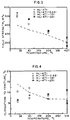
- Figure 1 is a plot of yield strength of MA Al-4(Ti, Nb or Zr)-0.5Mg alloys at temperatures between 24 and 316°C.
- Figure 2 is a plot of tensile elongation of MA Al-4(Ti, Nb or Zr)-0.5Mg alloys at temperatures between 24 and 316°C.
- Figure 3 is a plot of yield strength of MA Al-4Ti-Si alloys at temperatures between 24 and 316°C.
- Figure 4 is a plot of tensile elongation of MA Al-4Ti-Si alloys at temperatures between 24 and 316°C.
- Figure 5 is a plot of yield strength of MA Al-4Ti-Mg alloys at temperatures between 24 and 316°C.
- Figure 6 is a plot of tensile elongation of MA Al-4Ti-Mg alloys at temperatures between 24 and 316°C.
- the aluminum-base MA alloys of the invention provide excellent engineering properties for applications having operating temperatures up to about 316°C.
- the aluminum-base alloy is produced by mechanically alloying one or more elements selected from the group of Nb, Ti and Zr. In mechanical alloying, master alloy powders or elemental powders formed by liquid or gas atomization may be used. An Al3X type phase is formed with Nb, Ti and Zr. These Al3X type intermetallics provide strength at elevated temperatures because these Al3X type intermetallics have high stability, a high melting point and a relatively low density. In addition, Nb, Ti and Zr have low diffusivity at elevated temperatures.
- the MA aluminum-base alloy is produced by mechanically alloying elemental or intermetallic ingredients as previously described in U.S. Patent Nos.
- the process control agent is preferably an organic material such as organic acids, alcohols, heptanes, aldehydes and ether.
- process control aids such as stearic acid, graphite or a mixture of stearic acid and graphite are used to control the morphology of the mechanically alloyed powder.
- stearic acid is used as the process control aid.
- Powders may be mechanically alloyed in any high energy milling device with sufficient energy to bond powders together.
- Specific milling devices include attritors, ball mills and rod mills.
- Specific milling equipment most suitable for mechanical alloying powders of the invention includes equipment disclosed in U.S. Patents 4,603,814, 4,653,335, 4,679,736 and 4,887,773.
- the MA aluminum-base alloy is strengthened primarily with Al3X intermetallics and a dispersion of aluminum oxides and carbides.
- the Al3X intermetallics may be in the form of particles having a grain size about equal to the size of an aluminum grain or be distributed throughout the grain as a dispersoid.
- the aluminum oxide (Al2O3) and aluminum carbide (Al4C3) form dispersions which stabilize the grain structure.
- the MA aluminum-base alloy may contain a total of about 1-6% X, wherein X is selected from Nb, Ti and Zr and any combination thereof.
- the alloy contains about 1-4% C and about 0.1-2% O and most preferably contains about 0.7-1% O and about 1.2-2.3% C for grain stabilization.
- the MA aluminum-base alloy preferably ⁇ contains a total of about 2-6% X.
- ternary addition of Si or Mg may be used to increase tensile properties from ambient to intermediate temperatures. It is recognized that the ternary alloy contains carbon and oxygen in addition to aluminum, (titanium, niobium or zirconium) and (magnesium or silicon). Preferably, about 0.1-4% Si, Mg or a combination thereof is added to improve properties up to about 316°C. Most preferably, the strengthener is either 0.15-1% Mg or 0.5-2% Si.
- a series of alloys were prepared to compare the effects of Nb, Ti and Zr. Elemental powders were used in making Al-4Ti/Nb/Zr-0.5Mg. The powders were charged with 2.5% stearic acid in an attritor. The charge was then milled for 12 hours in argon. The milled powders were then canned and degassed at 493°C under a vacuum. of 50 microns of mercury. The canned and degassed powder was then consolidated to 9.2 cm diameter billets by upset compacting against a blank die in a 680 tonne extrusion press. The canning material was completely removed and the billets were then extruded at 371°C to 1.3 cm x 5.1 cm bars.
- Table 1 and Figures 1 and 2 show that an equal weight percent of Nb or Zr provide lower stength at ambient and elevated temperatures.
- Tensile elongation levels of (4Nb or 4Zr)-0.5Mg have a maximum at about 93°C and tensile elongation levels of Al-4Ti-0.5Mg generally increase with temperature.
- Al-(4Nb or 4Zr)-0.5Mg alloys contain only about half the amount of intermetallics by volume of Al-4Ti-0.5Mg alloy, the Al-(4Nb or 4Zr)-0.5Mg alloys have only marginally lower strength levels at ambient temperatures.
- Al3Ti particles have an average size of about 250 nm, roughly the same size as the MA aluminum grains.
- the larger grained Al3Ti particles are believed to strengthen the MA aluminum by a different mechanism than Al3Nb and Al3Zr particles.
- These Al3Ti particles do not strengthen primarily with Orowan strengthening and are believed to increase diffused slip at all temperatures, whereas an absence of diffused slip in alloys containing Al3Nb or Al3Zr leads to low ductility at elevated temperatures.
- a slight difference between the Al3Nb and Al3Zr may be attributed to slightly different lattice structures.
- Al3Nb and Al3Ti have a DO22 lattice structure and Al3Zr has a DO23 lattice structure.
- the differences in morphology appear to have the greatest effect on tensile properties.
- Titanium is the preferred element to use to form an Al3X type intermetallic. Titanium provides the best combination of ambient temperature and elevated temperature properties. Most preferably ⁇ , about 1.5-4.5% Ti is used. In addition, a combination of Ti and Zr or Nb may be used to optimize the strengthening mechanisms of Al3Ti and the Orowan mechanism. of Al3Zr and Al3Nb.
- Example 1 A series of Al-Ti-Si alloys were tested to determine the effect of Si on Al-Ti alloys stabilized with Al2O3 and Al4C3 dispersoids. The procedure of Example 1 was used except an Al-12Si master alloy was employed to mechanically alloy Al-4Ti-Si alloys for evaluation. Alternatively, elemental ingredients may be used. Table 3 below illustrates the improved tensile properties achieved when adding a Si strengthener.
- Figure 3 illustrates the improved yield strength obtained when adding Si
- Figure 4 illustrates the effect of Si on tensile elongation. Appreciable strengthening is achieved with Si at ambient temperatures. However, the strengthening effect of Si decreases with increasing temperature. Tensile elongation levels of the silicon-containing alloys at all temperatures tested were only moderately affected by the addition of Si. Preferably, for Al-X-Si ternary, 0.5-2.OSi is used to strengthen the alloy; and most preferably about 0.75-1.25% Si is used to strengthen the alloy.
- Elemental powders were mechanically alloyed with the process of Example 1 to produce MA Al-Ti-Mg alloys.
- Table 4 lists properties achieved with the MA Al-Ti-Mg series of alloys.
- Mg increased room and intermediate temperature strength properties at 2, 4 and 6% Ti. At temperatures above about 427°C, Mg no longer strengthens the alloy. However, Mg is a particularly effective strengthener at temperatures up to about 316°C. Furthermore, at about 4% Ti or between about 3 and 5% Ti, Mg increases ambient temperature strength and elevated temperature ductility.
- Mg strengthens by solid solution hardening and that Si strengthens by diffusing into Al3Ti and also by forming a ternary silicide having the composition Ti7Al5Si12. It is recognized that a combination of Mg and Si may be used. However, it has been found that a combination of Mg and Si strengtheners is not preferred. The combination of Mg and Si strengtheners has been found to have a negative effect upon physical properties in comparison to Mg without Si or Si without Mg. For this reason it is preferred that either Si or Mg be used as the ternary strengthener not a combination of Si and Mg.
- Table 5 below compares MA Al-4Ti-0.25Mg and MA Al-4Ti-lSi to state of the art high temperature alloys produced by rapid solidification.
- the alloy of the invention provides a significant improvement over the prior "state of the art" Al-Fe-X alloys.
- the major advantages are an increased ambient temperature yield strength with improved yield strength properties up to about 316°C and an improved specific modulus.
- Table 6 below contains specific examples of MA aluminum-base alloys within the scope of the invention (the balance of the composition being Al with incidental impurities). Furthermore, the invention contemplates any range definable by any two values specified in Table 6 or elsewhere in the specification and range definable between any specified values of Table 6 or elsewhere in the specification. For example, the invention contemplates Al-4Zr-2Si and Al-2.9Zr-1.75Si. TABLE 6 Ti Nb Zr Mg Si 2 1 1 1 4 0.2 2 2 2 2 1.2 4 0.5 4 1.1 6 0.25 5 0.5 0.5 1.0 4 0.35 4 0.9 2 0.5
- alloys strengthened by Al3X type phase are significantly improved by small amounts of Mg or Si.
- the addition of Si or Mg greatly increases tensile and yield strength with a minimal loss of ductility.
- Mg actually increases ductility at elevated temperatures.
- the alloys of the invention are formed simply by mechanically alloying with no rapid solidification or addition of composite whiskers or particles.
- the tensile properties and intermediate temperature properties of the ternary stiffened MA aluminum-base titanium alloy are significantly improved over the similar prior art alloys produced by rapid solidification, composite strengthening or mechanical alloying.
Landscapes
- Chemical & Material Sciences (AREA)
- Engineering & Computer Science (AREA)
- Materials Engineering (AREA)
- Mechanical Engineering (AREA)
- Metallurgy (AREA)
- Organic Chemistry (AREA)
- Manufacture Of Alloys Or Alloy Compounds (AREA)
- Powder Metallurgy (AREA)
- Sliding-Contact Bearings (AREA)
Applications Claiming Priority (2)
| Application Number | Priority Date | Filing Date | Title |
|---|---|---|---|
| US662721 | 1991-02-28 | ||
| US07/662,721 US5171381A (en) | 1991-02-28 | 1991-02-28 | Intermediate temperature aluminum-base alloy |
Publications (1)
| Publication Number | Publication Date |
|---|---|
| EP0501691A1 true EP0501691A1 (fr) | 1992-09-02 |
Family
ID=24658915
Family Applications (1)
| Application Number | Title | Priority Date | Filing Date |
|---|---|---|---|
| EP92301463A Withdrawn EP0501691A1 (fr) | 1991-02-28 | 1992-02-21 | Alliage à base d'aluminium pour utilisation à des températures intermédiaires |
Country Status (5)
| Country | Link |
|---|---|
| US (1) | US5171381A (fr) |
| EP (1) | EP0501691A1 (fr) |
| JP (1) | JPH0586433A (fr) |
| KR (1) | KR920016605A (fr) |
| CA (1) | CA2061931A1 (fr) |
Families Citing this family (4)
| Publication number | Priority date | Publication date | Assignee | Title |
|---|---|---|---|---|
| JP2785910B2 (ja) * | 1994-08-25 | 1998-08-13 | 本田技研工業株式会社 | 耐熱・耐摩耗性アルミニウム合金、アルミニウム合金製リテーナ及びアルミニウム合金製バルブリフタ |
| WO2001068936A1 (fr) * | 2000-03-13 | 2001-09-20 | Mitsui Mining & Smelting Co.,Ltd. | Matiere composite et son procede de production |
| US7468088B1 (en) * | 2000-03-15 | 2008-12-23 | Aluminastic Corporation | Aluminum composite composition and method |
| FR3000968B1 (fr) * | 2013-01-11 | 2015-07-03 | Commissariat Energie Atomique | Procede d'elaboration d'un materiau nanocomposite al/tic |
Citations (4)
| Publication number | Priority date | Publication date | Assignee | Title |
|---|---|---|---|---|
| US4624705A (en) * | 1986-04-04 | 1986-11-25 | Inco Alloys International, Inc. | Mechanical alloying |
| US4834942A (en) * | 1988-01-29 | 1989-05-30 | The United States Of America As Represented By The Secretary Of The Navy | Elevated temperature aluminum-titanium alloy by powder metallurgy process |
| EP0340788A1 (fr) * | 1988-05-06 | 1989-11-08 | Inco Alloys International, Inc. | Alliage d'aluminium à module d'élasticité élevé |
| EP0340789A1 (fr) * | 1988-05-06 | 1989-11-08 | Inco Alloys International, Inc. | Façonnage à chaud d'alliages à base d'aluminium |
Family Cites Families (5)
| Publication number | Priority date | Publication date | Assignee | Title |
|---|---|---|---|---|
| US4379719A (en) * | 1981-11-20 | 1983-04-12 | Aluminum Company Of America | Aluminum powder alloy product for high temperature application |
| US4557893A (en) * | 1983-06-24 | 1985-12-10 | Inco Selective Surfaces, Inc. | Process for producing composite material by milling the metal to 50% saturation hardness then co-milling with the hard phase |
| US4743317A (en) * | 1983-10-03 | 1988-05-10 | Allied Corporation | Aluminum-transition metal alloys having high strength at elevated temperatures |
| US4758273A (en) * | 1984-10-23 | 1988-07-19 | Inco Alloys International, Inc. | Dispersion strengthened aluminum alloys |
| US4643780A (en) * | 1984-10-23 | 1987-02-17 | Inco Alloys International, Inc. | Method for producing dispersion strengthened aluminum alloys and product |
-
1991
- 1991-02-28 US US07/662,721 patent/US5171381A/en not_active Expired - Fee Related
-
1992
- 1992-02-21 EP EP92301463A patent/EP0501691A1/fr not_active Withdrawn
- 1992-02-26 CA CA002061931A patent/CA2061931A1/fr not_active Abandoned
- 1992-02-26 JP JP4039822A patent/JPH0586433A/ja active Pending
- 1992-02-27 KR KR1019920003023A patent/KR920016605A/ko not_active Withdrawn
Patent Citations (4)
| Publication number | Priority date | Publication date | Assignee | Title |
|---|---|---|---|---|
| US4624705A (en) * | 1986-04-04 | 1986-11-25 | Inco Alloys International, Inc. | Mechanical alloying |
| US4834942A (en) * | 1988-01-29 | 1989-05-30 | The United States Of America As Represented By The Secretary Of The Navy | Elevated temperature aluminum-titanium alloy by powder metallurgy process |
| EP0340788A1 (fr) * | 1988-05-06 | 1989-11-08 | Inco Alloys International, Inc. | Alliage d'aluminium à module d'élasticité élevé |
| EP0340789A1 (fr) * | 1988-05-06 | 1989-11-08 | Inco Alloys International, Inc. | Façonnage à chaud d'alliages à base d'aluminium |
Also Published As
| Publication number | Publication date |
|---|---|
| US5171381A (en) | 1992-12-15 |
| JPH0586433A (ja) | 1993-04-06 |
| KR920016605A (ko) | 1992-09-25 |
| CA2061931A1 (fr) | 1992-08-29 |
Similar Documents
| Publication | Publication Date | Title |
|---|---|---|
| US6398843B1 (en) | Dispersion-strengthened aluminium alloy | |
| US4597792A (en) | Aluminum-based composite product of high strength and toughness | |
| US4804423A (en) | Al alloys having high proportions of Li and Si and a process for production thereof | |
| US4624705A (en) | Mechanical alloying | |
| US4464199A (en) | Aluminum powder alloy product for high temperature application | |
| EP0436952B1 (fr) | Poudre d'alliage d'aluminium, alliage d'aluminium fritté et méthode de préparation de cet alliage fritté | |
| JP2651975B2 (ja) | ガンマ・チタン・アルミナイド及びその製法 | |
| EP0013798A1 (fr) | Procédé de travail à chaud d'alliages aluminium-magnésium et alliage aluminium-magnésium | |
| US4758273A (en) | Dispersion strengthened aluminum alloys | |
| JP2761085B2 (ja) | Al−Si系合金粉末焼結部品用の原料粉末および焼結部品の製造方法 | |
| US4594222A (en) | Dispersion strengthened low density MA-Al | |
| US5169461A (en) | High temperature aluminum-base alloy | |
| EP0600474A1 (fr) | Alliage d'aliminium résistant à la chaleur et à l'abrasion | |
| US4944914A (en) | Titanium base alloy for superplastic forming | |
| EP0366134B1 (fr) | Alliage d'aluminium utile pour les procédés de la métallurgie de poudres | |
| EP0533780B1 (fr) | Procede destine a forger une billette en alliage metallique a base de magnesium et a solidification rapide | |
| US4676830A (en) | High strength material produced by consolidation of rapidly solidified aluminum alloy particulates | |
| US5171381A (en) | Intermediate temperature aluminum-base alloy | |
| EP0485055A1 (fr) | Matériaux microcomposites à base de titane | |
| US4693747A (en) | Alloy having improved fatigue crack growth resistance | |
| EP0427492A1 (fr) | Alliage composite à base d'aluminium | |
| EP0340789B1 (fr) | Façonnage à chaud d'alliages à base d'aluminium | |
| JPH05140685A (ja) | アルミニウム基合金集成固化材並びにその製造方法 | |
| EP0643145B1 (fr) | Matériaux à base d'alliages de magnésium, à haute résistance mécanique et procédé de fabrication de ces matériaux | |
| JP3053267B2 (ja) | アルミニウム基合金集成固化材の製造方法 |
Legal Events
| Date | Code | Title | Description |
|---|---|---|---|
| PUAI | Public reference made under article 153(3) epc to a published international application that has entered the european phase |
Free format text: ORIGINAL CODE: 0009012 |
|
| AK | Designated contracting states |
Kind code of ref document: A1 Designated state(s): AT BE CH DE DK ES FR GB GR IT LI LU MC NL PT SE |
|
| 17P | Request for examination filed |
Effective date: 19930325 |
|
| RBV | Designated contracting states (corrected) |
Designated state(s): AT BE CH DE DK ES FR GB GR IT LI LU NL SE |
|
| 17Q | First examination report despatched |
Effective date: 19960430 |
|
| 18D | Application deemed to be withdrawn |
Effective date: 19960911 |