EP0501838A2 - Waterproofing membrane - Google Patents
Waterproofing membrane Download PDFInfo
- Publication number
- EP0501838A2 EP0501838A2 EP92301764A EP92301764A EP0501838A2 EP 0501838 A2 EP0501838 A2 EP 0501838A2 EP 92301764 A EP92301764 A EP 92301764A EP 92301764 A EP92301764 A EP 92301764A EP 0501838 A2 EP0501838 A2 EP 0501838A2
- Authority
- EP
- European Patent Office
- Prior art keywords
- inches
- waterproofing membrane
- membrane
- waterproofing
- concrete
- Prior art date
- Legal status (The legal status is an assumption and is not a legal conclusion. Google has not performed a legal analysis and makes no representation as to the accuracy of the status listed.)
- Granted
Links
Images
Classifications
-
- E—FIXED CONSTRUCTIONS
- E01—CONSTRUCTION OF ROADS, RAILWAYS, OR BRIDGES
- E01D—CONSTRUCTION OF BRIDGES, ELEVATED ROADWAYS OR VIADUCTS; ASSEMBLY OF BRIDGES
- E01D19/00—Structural or constructional details of bridges
- E01D19/08—Damp-proof or other insulating layers; Drainage arrangements or devices ; Bridge deck surfacings
- E01D19/083—Waterproofing of bridge decks; Other insulations for bridges, e.g. thermal ; Bridge deck surfacings
-
- C—CHEMISTRY; METALLURGY
- C09—DYES; PAINTS; POLISHES; NATURAL RESINS; ADHESIVES; COMPOSITIONS NOT OTHERWISE PROVIDED FOR; APPLICATIONS OF MATERIALS NOT OTHERWISE PROVIDED FOR
- C09J—ADHESIVES; NON-MECHANICAL ASPECTS OF ADHESIVE PROCESSES IN GENERAL; ADHESIVE PROCESSES NOT PROVIDED FOR ELSEWHERE; USE OF MATERIALS AS ADHESIVES
- C09J7/00—Adhesives in the form of films or foils
- C09J7/20—Adhesives in the form of films or foils characterised by their carriers
- C09J7/21—Paper; Textile fabrics
-
- C—CHEMISTRY; METALLURGY
- C09—DYES; PAINTS; POLISHES; NATURAL RESINS; ADHESIVES; COMPOSITIONS NOT OTHERWISE PROVIDED FOR; APPLICATIONS OF MATERIALS NOT OTHERWISE PROVIDED FOR
- C09J—ADHESIVES; NON-MECHANICAL ASPECTS OF ADHESIVE PROCESSES IN GENERAL; ADHESIVE PROCESSES NOT PROVIDED FOR ELSEWHERE; USE OF MATERIALS AS ADHESIVES
- C09J7/00—Adhesives in the form of films or foils
- C09J7/20—Adhesives in the form of films or foils characterised by their carriers
- C09J7/22—Plastics; Metallised plastics
-
- C—CHEMISTRY; METALLURGY
- C09—DYES; PAINTS; POLISHES; NATURAL RESINS; ADHESIVES; COMPOSITIONS NOT OTHERWISE PROVIDED FOR; APPLICATIONS OF MATERIALS NOT OTHERWISE PROVIDED FOR
- C09J—ADHESIVES; NON-MECHANICAL ASPECTS OF ADHESIVE PROCESSES IN GENERAL; ADHESIVE PROCESSES NOT PROVIDED FOR ELSEWHERE; USE OF MATERIALS AS ADHESIVES
- C09J7/00—Adhesives in the form of films or foils
- C09J7/30—Adhesives in the form of films or foils characterised by the adhesive composition
- C09J7/38—Pressure-sensitive adhesives [PSA]
-
- E—FIXED CONSTRUCTIONS
- E04—BUILDING
- E04D—ROOF COVERINGS; SKY-LIGHTS; GUTTERS; ROOF-WORKING TOOLS
- E04D5/00—Roof covering by making use of flexible material, e.g. supplied in roll form
- E04D5/10—Roof covering by making use of flexible material, e.g. supplied in roll form by making use of compounded or laminated materials, e.g. metal foils or plastic films coated with bitumen
-
- Y—GENERAL TAGGING OF NEW TECHNOLOGICAL DEVELOPMENTS; GENERAL TAGGING OF CROSS-SECTIONAL TECHNOLOGIES SPANNING OVER SEVERAL SECTIONS OF THE IPC; TECHNICAL SUBJECTS COVERED BY FORMER USPC CROSS-REFERENCE ART COLLECTIONS [XRACs] AND DIGESTS
- Y10—TECHNICAL SUBJECTS COVERED BY FORMER USPC
- Y10T—TECHNICAL SUBJECTS COVERED BY FORMER US CLASSIFICATION
- Y10T428/00—Stock material or miscellaneous articles
- Y10T428/28—Web or sheet containing structurally defined element or component and having an adhesive outermost layer
- Y10T428/2835—Web or sheet containing structurally defined element or component and having an adhesive outermost layer including moisture or waterproof component
-
- Y—GENERAL TAGGING OF NEW TECHNOLOGICAL DEVELOPMENTS; GENERAL TAGGING OF CROSS-SECTIONAL TECHNOLOGIES SPANNING OVER SEVERAL SECTIONS OF THE IPC; TECHNICAL SUBJECTS COVERED BY FORMER USPC CROSS-REFERENCE ART COLLECTIONS [XRACs] AND DIGESTS
- Y10—TECHNICAL SUBJECTS COVERED BY FORMER USPC
- Y10T—TECHNICAL SUBJECTS COVERED BY FORMER US CLASSIFICATION
- Y10T428/00—Stock material or miscellaneous articles
- Y10T428/31504—Composite [nonstructural laminate]
- Y10T428/31855—Of addition polymer from unsaturated monomers
- Y10T428/31909—Next to second addition polymer from unsaturated monomers
- Y10T428/31913—Monoolefin polymer
- Y10T428/31917—Next to polyene polymer
Definitions
- the present invention relates to compositions and methods useful for waterproofing or dampproofing various water-penetrable materials used in building construction and other civil engineering projects. Specifically, the present invention relates to novel waterproofing membranes comprised of a carrier, a synthetic adhesive, and a protective layer.
- the waterproofing material is post applied to an existing concrete structure.
- Available conventional waterproofing agents include ethylene propylene diene monomer (EDPM) sheets, polyvinyl chloride sheets, neoprene sheets, bentonite panels, built-up asphalt systems, coal tar-based, and other asphalt-based compositions.
- Asphalt-based compositions are currently preferred; most preferred are preformed, flexible sheet-like waterproofing laminates of a support film(s) and a bituminous layer(s) such as described in U.S. Patent Nos. 3,741,856; 3,853,682; and 3,900,102.
- Bituthene® brand of waterproofing is an example of a popular commercial membrane.
- An objective of the present invention is to provide a waterproofing membrane which can be pre-applied to a concrete form and adhere strongly to the post cast concrete.
- Another objective is to provide a non-asphaltic waterproofing membrane.
- the present invention relates to a waterproofing membrane comprising a carrier layer, a layer of synthetic adhesive disposed upon one face of the carrier layer, and a protective layer disposed upon the synthetic adhesive layer, which membrane bonds without tackification to concrete cast against the protective coating.
- the present invention also relates to a method of waterproofing post cast concrete structures comprised of affixing a carrier to the inside of a concrete form and post casting concrete, wherein the carrier further comprises a synthetic adhesive coated with a protective coating.
- the present invention provides a method of waterproofing which comprises affixing to a concrete form a membrane comprising a carrier layer for disposition against the form, a synthetic adhesive layer disposed against one face of the carrier layer and a protective coating layer such that the membrane bonds with concrete cast against the membrane.
- the present invention relates to post cast concrete structures comprising a waterproofing membrane adhered to all or part of the exposed surface of said structure, wherein said membrane comprises a carrier, a synthetic adhesive coated on one face of the carrier substrate, and a protective coating on the synthetic adhesive, and wherein the protective coating face contacts said structure.
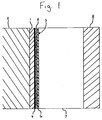
- Figure 1 is a lateral cross sectional view of an entire waterproofing system.
- the present invention solves these problems through the discovery that a waterproofing membrane comprised of a carrier, a synthetic adhesive coated on one face of the carrier, and a protective layer coated on the synthetic adhesive can still become fully adhered with post cast concrete after real time outdoor weathering exposure without the need for tackification.
- the carrier layer of the present invention can be fabricated from a thermoplastic, rubber, or metal in the form of a continuous film, a woven material, or a non-woven material.
- Thermoplastics particularly suited for use in the present invention include high density polyethylene (HDPE), polyethylene teraphthate (PET), polystyrene (PS), polyvinyl chloride (PVC), polyamides (PA), or combinations thereof.
- Preferred carriers are thermoplastic films of HDPE, PET, or PVC.
- the most preferred carrier is a HDPE film.
- the thickness of the carrier film is from about 0.002 inches to about 0.030 inches, preferably about 0.020 inches.
- the term "synthetic adhesive” refers to non-bituminous and non-asphaltic adhesives.
- the adhesive layers of the present are selected from butyl rubber based adhesives, polyisobutylene based adhesives, polyisobutyl based adhesives, acrylic based adhesives, vinyl ether based adhesives, styrene-isoprene-styrene based (SIS) adhesives, styrene-ethylene-butylene-styrene based (SEBS) adhesives, styrene-butadiene-styrene based (SBS) adhesives, and combinations thereof.
- Pressure sensitive adhesives are preferred.
- the synthetic adhesive is a pressure sensitive hot melt adhesive block copolymer of SIS, SBS or SEBS.
- the synthetic pressure sensitive hot melt adhesive is based on an SIS block copolymer.
- the synthetic adhesive layer can optionally contain typical additives which retard degradation by light, heat or oxygen, such as, light absorbers (i.e. carbon black, benzotriazoles, etc.), light stabilizers (i.e. hindered amines, benzophenones), antioxidants (i.e. hindered phenols), fillers (i.e. calcium carbonate, silica, titanium dioxide, etc.), plasticizers, rheological additives, and mixtures thereof.
- Preferred synthetic adhesive layers contain light absorbers, light stabilizers, and antioxidants.
- the "adhesive" nature of the synthetic pressure sensitive adhesive has the added benefit in that side laps and end laps of the membrane are easily formed.
- the thickness of the synthetic adhesive layer is from about 0.005 inches to about 0.080 inches, preferably greater than about 0.020 inches.
- the protective coating of the present invention is intended to have minimal tack and protects the synthetic adhesive from dust, dirt and the elements (particularly sunlight). At the same time, the protective coating does not hinder the ability of the membrane to form a fully adhered strong bond to the post cast concrete and the resulting structure.
- the protective coating is selected from the group consisting of sytrene butadiene rubber based (SBR) coatings, carboxylated SBR based coatings, acrylic based coatings, polyvinylidene chloride based (PVDC) coatings, polyvinyl chloride based (PVC) coatings, ethylene vinyl acetate copolymer based (EVA) coatings, ethylene ethyl acetate copolymer based (EEA) coatings, polychloroprene based coatings, polyester based coatings, polyurethane based coatings, styrene-isoprene-styrene based (SIS) coatings, styrene-butadiene-styrene based (SBS) coatings, and combinations thereof.
- Preferred protective coatings are acrylic based coatings. Most preferred are styrene butylacrylate based coatings.
- Elastomeric protective coatings are preferred.
- the term elastomer means an elastic polymer having properties, similar to those of vulcanized natural rubber; namely the ability to be stretched to at least twice its original length and to retract very rapidly to approximately its original length when released.
- Elastomeric acrylic based coatings are preferred and ,elastomeric styrene butylacrylate based coatings are most preferred.
- the protective coating may optionally contain typical additives including materials which retard degradation by light, heat or oxygen, such as, light absorbers (i.e. carbon black, benzotriazoles, etc.), light stabilizers (i.e. hindered amines, benzophenones), antioxidants (i.e. hindered phenols), fillers (i.e. calcium carbonate, silica, tiatnium dioxide, etc.) plasticizers, rheological additives and mixtures thereof.
- Preferred synthetic adhesive layers contain light absorbers, light stabilizers, and antioxidants.
- the thickness of the protective coating is from about 0.001 inches to about 0.020 inches, preferably about 0.005 inches.
- the geometric configuration of the present invention comprises a carrier, the synthetic adhesive layer affixed to one face of the carrier, and the protective layer affixed to the exposed face of the synthetic adhesive layer.
- the layers can be affixed together by any means.
- the preferred embodiment of the present invention comprises: a 0.020 inch high modulus thermoplastic HDPE carrier film; a 0.030 inch SIS block copolymer synthetic pressure sensitive adhesive layer containing at least one light absorber and at least one light stabiliser, preferably from 0 to about 10% carbon black (mostpreferably about 2%), 0 to about 5% benzophenone, and 0 to about 5% benzotriazole; and about a 0.005 inch elastomeric styrene butylacrylate protective coating containing at least one light reflector, at least one light absorber and at least one light-stabiliser.
- the preferred light reflectors, absorbers and stabilisers are titanium dioxide, carbon black, benzophenone and a hindered amine light stabiliser, preferably from about 0 to about 10% carbon black, (most preferably about 5%), 0 to about 5% benzophenone (most preferably about 5%, and 0 to about 5% benzotriazole (most preferably about 2.5%).
- the present waterproofing membranes are pre-applied to a substrate, and concrete is post cast against them.
- the carrier face of the above waterproofing membranes is affixed to a form prior to post casting the concrete.
- a "form" can be any container or any portion of a container which contacts cast concrete. This includes horizontal and vertical surfaces.
- the carrier is affixed to the form by mechanically fastening the sheet membrane along the side and end edges. Neighboring sheets are placed such that the mechanical fasteners are completely overlapped, creating a surface which is continuous and free of punctures.
- the waterproofing membrane can merely be rolled out without any means of fastening, although it is preferred to adhere or fasten the membrane to the substrate.
- the carrier can also be adhered to the form through the use of adhesives.
- the vertical lagging 1 is constructed against the exposed earth 2 .
- the waterproofing membrane 3 is affixed to the form 1 .
- the membrane comprises a carrier 4 , which is in contact with the form, a synthetic adhesive 5 and a protective layer 6 .
- Concrete 7 is poured against the waterproofing membrane.
- an inner form 8 is used to contain the lateral flow of concrete.
- the present method involves applying a carrier/synthetic adhesive composition to a form (synthetic adhesive side exposed). Thereafter, the protective layer is painted or sprayed on. This insures fully adhered side and end laps, creating a continuous waterproofing barrier. It should also be pointed out that the present invention contemplates applying a carrier/synthetic adhesive/protective layer composition in a single step. Other obvious variations on this theme are also contemplated.
- the interior forms(s) are removed and the exterior "lagging" form may be optionally removed. This determination of cure is with the general skill of the art.
- making a structure "waterproof” means eliminating the ability of water to penetrate the structure.
- the present invention is used to make waterproof structures constructed of materials which are water-penetrable either inherently or as a result of imperfections such as cracks or pores.
- the present invention relates to a post cast concrete structure comprising the above waterproofing membrane adhered to all or part of the surface of the structure.
- Various civil engineering structures including, for examples, building, bridges, roads, and tunnels, are made waterproof using the present invention. Building foundations are the preferred structures.
- the membrane forms a fully adhered, strong bond to the post cast concrete. After seven days, adhesion is believed to be about 95% of its final value (assuming no backfill pressure).
- the bond strength is at least about 2 lb/in (2 ⁇ /min. 70°F) as measured by the method described in ASTM D903-49, incorporated herein by reference. It has been discovered that this fully adhered bond (adhesion greater that 2 lb/in) is formed even after the protective coating face is exposed to over 40 megajoules of ultra violet light/square meter (MJUV/m2) of real time outdoor exposure prior to casting (ASTM G7, incorporated herein by reference).
- MJUV/m2 ultra violet light/square meter
- Contemplated equivalents of the present invention include other carriers, synthetic adhesives and protective coatings with characteristics similar to the specific materials described above. Additionally, waterproofing layers or components which do not interfere with the present invention are also contemplated. Alternative methods which result in a waterproofed structure utilizing analogous waterproofing membranes are also contemplated.
- a waterproofing sheet membrane is manufactured using a 20 mil HDPE carrier sheet coated on one face with 30 mil of an SIS based pressure sensitive hot melt adhesive, HM-1597 (H.B. Fuller, Vadnais Heights, MN), having a penetration of about 720 dmm.
- HM-1597 H.B. Fuller, Vadnais Heights, MN
- Ucar-123 Union Carbide, Cary, NC
- a polybutylene oil dispersion, 20 wt% carbon black, is added to the adhesive of the membrane composite described in Example 1.
- the resulting adhesive, HL2232-X (H.B. Fuller) having a penetration of about 205 dmm, is ,bout 2 wt% carbon black.
- Adhesion is measured after real time weathering as described in Example 1. Samples which experience no weathering develop excellent adhesion to the post cast concrete of greater than 9 lb/in. Adhesion to the concrete decreases as the samples experience increased exposure time and is about 1 lb/in after 40 MJUV/m2.
- a protective coating formulation was prepared by mixing a 32 wt% carbon aqueous dispersion WD-2345 (Daniel Products, Jersey City, NJ), a hindered amine light stabilizer Tinuvin 292 (Ciba Geigy, Hawthorne, NY), a benzotriazole light absorber Tinuvin 1130 (Ciba Geigy), and a styrene butylacrylate based latex Ucar-123 (Union Carbide), under high shear.
- the resulting formulation has a penetration of about 55 dmm and is 5% carbon black, 2.5% Tinuvin 1130, 5% Tinuvin 292, and 87.5% Ucar-123 based on solids.
- a 5 mil layer of the formulated protective coating is applied to the sheet waterproofing membrane composite (HM-1597 adhesive) described in Example 1.
- Samples which experience no outdoor weathering develop excellent adhesion to the post cast concrete of greater than about 7 lb/in. Adhesion to the cured concrete decreases as the samples experience increased exposure time and is about 1 lb/in after 40 MJUV/m2.
- the adhesive formulation (HL2232-X) described in Example 3 and the coating formulation described in Example 4 are used in the sheet waterproofing membrane composite described in Example 1.
- Samples which experience no outdoor weathering develop excellent adhesion to the post cast concrete of greater than 9 lb/in.
- Adhesion to the cured concrete remains relatively consistent at about 7 lb/in up to 20 MJUV/m2.
- Adhesion does not fall below about 3 lb/in for samples which have experienced up to 40 MJUV/m2 of real time outdoor exposure.
- the membrane is fully adhered over the entire area between the sheet membrane system and the cured concrete, resulting in an effective waterproofing barrier.
Landscapes
- Chemical & Material Sciences (AREA)
- Organic Chemistry (AREA)
- Architecture (AREA)
- Civil Engineering (AREA)
- Structural Engineering (AREA)
- Engineering & Computer Science (AREA)
- Laminated Bodies (AREA)
- Adhesives Or Adhesive Processes (AREA)
- Materials For Medical Uses (AREA)
- Orthopedics, Nursing, And Contraception (AREA)
- Wrappers (AREA)
- Building Environments (AREA)
- Separation Using Semi-Permeable Membranes (AREA)
- On-Site Construction Work That Accompanies The Preparation And Application Of Concrete (AREA)
- Tents Or Canopies (AREA)
Abstract
Description
- The present invention relates to compositions and methods useful for waterproofing or dampproofing various water-penetrable materials used in building construction and other civil engineering projects. Specifically, the present invention relates to novel waterproofing membranes comprised of a carrier, a synthetic adhesive, and a protective layer.
- Various materials used in building construction and other civil engineering projects such as roads and bridges are susceptible to water penetration resulting either from their inherent properties or imperfections such as cracks or pores. Reducing or eliminating water penetration through structures formed of these materials often is desirable such as for below grade building walls, and may be critical in certain structures such as those housing expensive electrical equipment or tunnels moving vehicular or pedestrian traffic under bodies of water.
- In conventional waterproofing applications, the waterproofing material is post applied to an existing concrete structure. Available conventional waterproofing agents include ethylene propylene diene monomer (EDPM) sheets, polyvinyl chloride sheets, neoprene sheets, bentonite panels, built-up asphalt systems, coal tar-based, and other asphalt-based compositions. Asphalt-based compositions are currently preferred; most preferred are preformed, flexible sheet-like waterproofing laminates of a support film(s) and a bituminous layer(s) such as described in U.S. Patent Nos. 3,741,856; 3,853,682; and 3,900,102. Bituthene® brand of waterproofing is an example of a popular commercial membrane.
- In many inner-city construction projects, the concrete foundation of one structure is poured very close to the foundation and/or property line of its neighbors. In these situations, a permanent concrete form is assembled along the exterior of the foundation. This is referred to as "vertical lagging" or simply "lagging". During a lagging operation, it is virtually impossible to apply a conventional post applied waterproofing membrane to the cured exterior of the foundation because the exterior surface of the concrete cannot be exposed. Accordingly, attempts have been made to affix a pre-applied waterproofing membrane to the lagging form before the wet concrete is poured. Pre-applied waterproofing systems have been limited to Bentonite based products including Volclay Panels, Paraseal, and Claymax. These products rely on the ability of the bentonite clay to expand on contact with water and create an impermeable layer to water migration. However, the rigidity of the lagging material/structure actually prevents the formation of an expanded wet clay layer of a desirable density high enough to qualify the material as impermeable.
- Conventionally preferred asphaltic based waterproofing membrane systems have several significant deficiencies when applied with the adhesive facing out in a lagging situation. First, they tend to oxidize during short periods of outdoor exposure and "mud cracks" develop on the adhesive surface. The oxidized surface does not bond to the post cast concrete. Second, the exposed adhesive surface of the waterproofing membrane tends to become fouled by the elements and by dust. Accordingly, it would be desirable to have an essentially non-tacky waterproofing membrane which can be pre-applied to a concrete form, resist chemical and physical changes from real time outdoor exposure, and develop a strong, fully adhered bond to the post cast concrete structure.
- An objective of the present invention is to provide a waterproofing membrane which can be pre-applied to a concrete form and adhere strongly to the post cast concrete.
- It is also an objective to provide a waterproofing membrane to resist chemical and physical changes during outside exposure and still have the capability for forming a strong and intimate bond to post-cast concrete.
- It is further an objective to provide a highly weatherable waterproofing membrane which is essentially not tacky to the touch.
- Another objective is to provide a non-asphaltic waterproofing membrane.
- It is still further an objective to provide a waterproofing membrane which is particularly suited for vertical lagging construction.
- Also, it is an objective to provide a method for pre-applying waterproofing membranes which become fully adhered to the resulting post cast concrete structure.
- It is yet another objective to provide a novel waterproofing post cast concrete structure.
- These and other objectives will become evident from the following:
- The present invention relates to a waterproofing membrane comprising a carrier layer, a layer of synthetic adhesive disposed upon one face of the carrier layer, and a protective layer disposed upon the synthetic adhesive layer, which membrane bonds without tackification to concrete cast against the protective coating. The present invention also relates to a method of waterproofing post cast concrete structures comprised of affixing a carrier to the inside of a concrete form and post casting concrete, wherein the carrier further comprises a synthetic adhesive coated with a protective coating. The present invention provides a method of waterproofing which comprises affixing to a concrete form a membrane comprising a carrier layer for disposition against the form, a synthetic adhesive layer disposed against one face of the carrier layer and a protective coating layer such that the membrane bonds with concrete cast against the membrane. Furthermore, the present invention relates to post cast concrete structures comprising a waterproofing membrane adhered to all or part of the exposed surface of said structure, wherein said membrane comprises a carrier, a synthetic adhesive coated on one face of the carrier substrate, and a protective coating on the synthetic adhesive, and wherein the protective coating face contacts said structure.
- Figure 1 is a lateral cross sectional view of an entire waterproofing system.
- As was mentioned above, conventional waterproofing membranes, particularly asphaltic-based membranes, suffer from many problems when applied with the adhesive facing out in a lagging situation. First, although the subterranean portion of asphaltic-based membranes perform well when properly applied to post cast concrete with no outdoor exposure of the asphaltic based adhesive, the exposed adhesive portions do not weather well. Second, the adhesives currently used in the waterproofing industry tend to foul by the elements and by dust. Their tenacious stickiness may also to be a nuisance to construction workers. The present invention solves these problems through the discovery that a waterproofing membrane comprised of a carrier, a synthetic adhesive coated on one face of the carrier, and a protective layer coated on the synthetic adhesive can still become fully adhered with post cast concrete after real time outdoor weathering exposure without the need for tackification.
- The carrier layer of the present invention can be fabricated from a thermoplastic, rubber, or metal in the form of a continuous film, a woven material, or a non-woven material. Thermoplastics particularly suited for use in the present invention include high density polyethylene (HDPE), polyethylene teraphthate (PET), polystyrene (PS), polyvinyl chloride (PVC), polyamides (PA), or combinations thereof. Preferred carriers are thermoplastic films of HDPE, PET, or PVC. The most preferred carrier is a HDPE film. The thickness of the carrier film is from about 0.002 inches to about 0.030 inches, preferably about 0.020 inches.
- As used herein, the term "synthetic adhesive" refers to non-bituminous and non-asphaltic adhesives. The adhesive layers of the present are selected from butyl rubber based adhesives, polyisobutylene based adhesives, polyisobutyl based adhesives, acrylic based adhesives, vinyl ether based adhesives, styrene-isoprene-styrene based (SIS) adhesives, styrene-ethylene-butylene-styrene based (SEBS) adhesives, styrene-butadiene-styrene based (SBS) adhesives, and combinations thereof. Pressure sensitive adhesives are preferred. Preferably, the synthetic adhesive is a pressure sensitive hot melt adhesive block copolymer of SIS, SBS or SEBS. Most preferably, the synthetic pressure sensitive hot melt adhesive is based on an SIS block copolymer. For a more detailed description of pressure sensitive adhesives, see Satas, Handbook of Pressure Sensitive Adhesive Technology, by Van Nostrand Reinhold Company, Inc. (1982), incorporated herein by reference.
- The synthetic adhesive layer can optionally contain typical additives which retard degradation by light, heat or oxygen, such as, light absorbers (i.e. carbon black, benzotriazoles, etc.), light stabilizers (i.e. hindered amines, benzophenones), antioxidants (i.e. hindered phenols), fillers (i.e. calcium carbonate, silica, titanium dioxide, etc.), plasticizers, rheological additives, and mixtures thereof. Preferred synthetic adhesive layers contain light absorbers, light stabilizers, and antioxidants.
- It has further been discovered that the adhesion to post cast concrete is improved when the synthetic adhesive layer has a penetration greater than about 30 decimillimeters (dmm) (150 g, 5 sec., 70°F) as measured according to ASTM D S-73, incorporated herein by reference.
- The "adhesive" nature of the synthetic pressure sensitive adhesive has the added benefit in that side laps and end laps of the membrane are easily formed. The thickness of the synthetic adhesive layer is from about 0.005 inches to about 0.080 inches, preferably greater than about 0.020 inches.
- The protective coating of the present invention is intended to have minimal tack and protects the synthetic adhesive from dust, dirt and the elements (particularly sunlight). At the same time, the protective coating does not hinder the ability of the membrane to form a fully adhered strong bond to the post cast concrete and the resulting structure.
- The protective coating is selected from the group consisting of sytrene butadiene rubber based (SBR) coatings, carboxylated SBR based coatings, acrylic based coatings, polyvinylidene chloride based (PVDC) coatings, polyvinyl chloride based (PVC) coatings, ethylene vinyl acetate copolymer based (EVA) coatings, ethylene ethyl acetate copolymer based (EEA) coatings, polychloroprene based coatings, polyester based coatings, polyurethane based coatings, styrene-isoprene-styrene based (SIS) coatings, styrene-butadiene-styrene based (SBS) coatings, and combinations thereof. Preferred protective coatings are acrylic based coatings. Most preferred are styrene butylacrylate based coatings.
- Elastomeric protective coatings are preferred. As used herein, the term elastomer means an elastic polymer having properties, similar to those of vulcanized natural rubber; namely the ability to be stretched to at least twice its original length and to retract very rapidly to approximately its original length when released. Elastomeric acrylic based coatings are preferred and ,elastomeric styrene butylacrylate based coatings are most preferred.
- The protective coating may optionally contain typical additives including materials which retard degradation by light, heat or oxygen, such as, light absorbers (i.e. carbon black, benzotriazoles, etc.), light stabilizers (i.e. hindered amines, benzophenones), antioxidants (i.e. hindered phenols), fillers (i.e. calcium carbonate, silica, tiatnium dioxide, etc.) plasticizers, rheological additives and mixtures thereof. Preferred synthetic adhesive layers contain light absorbers, light stabilizers, and antioxidants.
- It has further been discovered that the adhesion to post cast concrete is greatly improved when the protective coating has a penetration greater than about 30 dmm (150 g. 5 sec., 70°F) as measured according to ASTM D 5-73, incorporated herein by reference.
- The thickness of the protective coating is from about 0.001 inches to about 0.020 inches, preferably about 0.005 inches.
- The geometric configuration of the present invention comprises a carrier, the synthetic adhesive layer affixed to one face of the carrier, and the protective layer affixed to the exposed face of the synthetic adhesive layer. The layers can be affixed together by any means.
- The preferred embodiment of the present invention comprises: a 0.020 inch high modulus thermoplastic HDPE carrier film; a 0.030 inch SIS block copolymer synthetic pressure sensitive adhesive layer containing at least one light absorber and at least one light stabiliser, preferably from 0 to about 10% carbon black (mostpreferably about 2%), 0 to about 5% benzophenone, and 0 to about 5% benzotriazole; and about a 0.005 inch elastomeric styrene butylacrylate protective coating containing at least one light reflector, at least one light absorber and at least one light-stabiliser. The preferred light reflectors, absorbers and stabilisers are titanium dioxide, carbon black, benzophenone and a hindered amine light stabiliser, preferably from about 0 to about 10% carbon black, (most preferably about 5%), 0 to about 5% benzophenone (most preferably about 5%, and 0 to about 5% benzotriazole (most preferably about 2.5%).
- Unlike conventional waterproofing laminates, which are post-applied to existing concrete structures, the present waterproofing membranes are pre-applied to a substrate, and concrete is post cast against them.
- In a typical application, the carrier face of the above waterproofing membranes is affixed to a form prior to post casting the concrete. As used herein, a "form" can be any container or any portion of a container which contacts cast concrete. This includes horizontal and vertical surfaces. In most applications, the carrier is affixed to the form by mechanically fastening the sheet membrane along the side and end edges. Neighboring sheets are placed such that the mechanical fasteners are completely overlapped, creating a surface which is continuous and free of punctures. In horizontal waterproofing applications, the waterproofing membrane can merely be rolled out without any means of fastening, although it is preferred to adhere or fasten the membrane to the substrate. In applications where the form is permanent, such as in vertical lagging operations, the carrier can also be adhered to the form through the use of adhesives.
- As depicted in Figure 1, in a lagging operation, the vertical lagging 1 is constructed against the exposed
earth 2. Thewaterproofing membrane 3 is affixed to the form 1. The membrane comprises acarrier 4, which is in contact with the form, asynthetic adhesive 5 and aprotective layer 6.Concrete 7 is poured against the waterproofing membrane. Of course, an inner form 8 is used to contain the lateral flow of concrete. - Generally, the present method involves applying a carrier/synthetic adhesive composition to a form (synthetic adhesive side exposed). Thereafter, the protective layer is painted or sprayed on. This insures fully adhered side and end laps, creating a continuous waterproofing barrier. It should also be pointed out that the present invention contemplates applying a carrier/synthetic adhesive/protective layer composition in a single step. Other obvious variations on this theme are also contemplated.
- After the cast concrete has set sufficiently, the interior forms(s) are removed and the exterior "lagging" form may be optionally removed. This determination of cure is with the general skill of the art.
- As used herein, making a structure "waterproof" means eliminating the ability of water to penetrate the structure. The present invention is used to make waterproof structures constructed of materials which are water-penetrable either inherently or as a result of imperfections such as cracks or pores. The present invention relates to a post cast concrete structure comprising the above waterproofing membrane adhered to all or part of the surface of the structure. Various civil engineering structures including, for examples, building, bridges, roads, and tunnels, are made waterproof using the present invention. Building foundations are the preferred structures.
- Once the concrete has set, the membrane forms a fully adhered, strong bond to the post cast concrete. After seven days, adhesion is believed to be about 95% of its final value (assuming no backfill pressure). The bond strength is at least about 2 lb/in (2˝/min. 70°F) as measured by the method described in ASTM D903-49, incorporated herein by reference. It has been discovered that this fully adhered bond (adhesion greater that 2 lb/in) is formed even after the protective coating face is exposed to over 40 megajoules of ultra violet light/square meter (MJUV/m²) of real time outdoor exposure prior to casting (ASTM G7, incorporated herein by reference).
- Contemplated equivalents of the present invention include other carriers, synthetic adhesives and protective coatings with characteristics similar to the specific materials described above. Additionally, waterproofing layers or components which do not interfere with the present invention are also contemplated. Alternative methods which result in a waterproofed structure utilizing analogous waterproofing membranes are also contemplated.
- The following examples provide specific illustrations of the present invention, but are not intended to limit the scope of the invention as described above and claimed below:
- A waterproofing sheet membrane is manufactured using a 20 mil HDPE carrier sheet coated on one face with 30 mil of an SIS based pressure sensitive hot melt adhesive, HM-1597 (H.B. Fuller, Vadnais Heights, MN), having a penetration of about 720 dmm. A styrene butylacrylate latex, Ucar-123 (Union Carbide, Cary, NC), having a penetration of about 50 dmm, is coated onto the adhesive side of the sheet membrane at a thickness of about 5 mil. Concrete is post cast against the protective coating surface of the waterproofing membrane composite after the protective coating surface has been exposed by up to 40 megajoules of ultraviolet light/square meter (MJUV/m²) of real time weathering on a 34° south facing wall in Phoenix, AZ (ASTM G7). Adhesion is measured at a constant rate of extension (CRE) of 2 in/min at 70°F with an Instron (Model 100) CRE testing machine following ASTM D903-49. The concrete is allowed to cure a minimum of seven days at room temperature before testing.
- Samples of the waterproofing membrane described in Example 1 which experience no outdoor weathering develop excellent adhesion to the post cast concrete of greater than 9 lb/in. Adhesion of samples which have received real time exposure decreases sharply with increasing real time exposure and is about 0 lb/in after exposures of about 10 MJUV/m². Adhesion remains at about 0 lb/in for all exposure periods greater than 10 MJUV/m².
- A polybutylene oil dispersion, 20 wt% carbon black, is added to the adhesive of the membrane composite described in Example 1. The resulting adhesive, HL2232-X (H.B. Fuller) having a penetration of about 205 dmm, is ,
bout 2 wt% carbon black. A styrene butylacrylate latex, Ucar-123 (Union Carbide) having a penetration of about 50 dmm, is coated onto the adhesive side of the sheet membrane composite (HL2232-X adhesive) at a thickness of about 5 mil. Adhesion is measured after real time weathering as described in Example 1. Samples which experience no weathering develop excellent adhesion to the post cast concrete of greater than 9 lb/in. Adhesion to the concrete decreases as the samples experience increased exposure time and is about 1 lb/in after 40 MJUV/m². - A protective coating formulation was prepared by mixing a 32 wt% carbon aqueous dispersion WD-2345 (Daniel Products, Jersey City, NJ), a hindered amine light stabilizer Tinuvin 292 (Ciba Geigy, Hawthorne, NY), a benzotriazole light absorber Tinuvin 1130 (Ciba Geigy), and a styrene butylacrylate based latex Ucar-123 (Union Carbide), under high shear. The resulting formulation has a penetration of about 55 dmm and is 5% carbon black, 2.5
% Tinuvin 1130, 5% Tinuvin 292, and 87.5% Ucar-123 based on solids. A 5 mil layer of the formulated protective coating is applied to the sheet waterproofing membrane composite (HM-1597 adhesive) described in Example 1. Samples which experience no outdoor weathering develop excellent adhesion to the post cast concrete of greater than about 7 lb/in. Adhesion to the cured concrete decreases as the samples experience increased exposure time and is about 1 lb/in after 40 MJUV/m². - The adhesive formulation (HL2232-X) described in Example 3 and the coating formulation described in Example 4 are used in the sheet waterproofing membrane composite described in Example 1. Samples which experience no outdoor weathering develop excellent adhesion to the post cast concrete of greater than 9 lb/in. Adhesion to the cured concrete remains relatively consistent at about 7 lb/in up to 20 MJUV/m². Adhesion does not fall below about 3 lb/in for samples which have experienced up to 40 MJUV/m² of real time outdoor exposure. The membrane is fully adhered over the entire area between the sheet membrane system and the cured concrete, resulting in an effective waterproofing barrier.
Claims (23)
- A waterproofing membrane comprising a carrier layer, a layer of synthetic adhesive disposed upon one face of the carrier layer, and a protective layer disposed upon the synthetic adhesive layer, which membrane bonds without tackification to concrete cast against the protective coating.
- A waterproofing membrane according to claim 1 wherein the carrier layer is from 0.05 mm (0.002 inches) to 0.76 mm (0.030 inches) of a thermoplastic in the form of a woven or non-woven continuous film, selected from high density polyethylene (HDPE), polyethylene terephthalate (PET), polystyrene (PS), polypropylene (PP), polyvinylchloride (PVC) , polyamide (PA) and combinations thereof.
- A waterproofing membrane according to claim 1 or 2 wherein the synthetic adhesive layer is from about 0.13 mm (0.005 inches) to about 2.03 mm (0.080 inches) of a material selected from butyl rubber based adhesives, polyisobutylene based adhesives, acrylic based adhesives, vinyl ether based adhesives, styrene isoprene styrene (SIS) based adhesives, styrene butadiene styrene (SBS) based adhesives, styrene ethylene butylene styrene (SEBS) based adhesives, styrene butadiene rubber (SBR) based adhesives, and combinations thereof.
- A waterproofing membrane according to claim 1, 2 or 3 wherein the synthetic adhesive layer is pressure sensitive.
- A waterproofing membrane according to any one of the preceding claims wherein the synthetic adhesive layer further comprises at least one material which retards degradation by light, heat or oxygen.
- A waterproofing membrane according to any one of the preceding claims wherein the synthetic adhesive layer has a penetration greater than about 3 mm (30 dmm) (150 g, 5 sec 21.1°C (70°F)) according to ASTM D 5-73.
- A waterproofing membrane according to any one of the preceding claims wherein the protective layer comprises from 0.025 mm (0.001 inches) to about 0.51 mm (0.020 inches) of a coating selected from carboxylated SBR based coatings, acrylic based coatings, polyvinylidene chloride (PVDC) based coatings, PVC based coatings, ethylene vinyl acetate (EVA) copolymer based coatings, ethylene ethyl acetate (EEA) copolymer based coatings, polychloroprene based coatings, polyester based coatings, polyurethane based coatings, SIS based coatings, SBR based coatings, SBS based coatings, SEBS based coatings, and combinations thereof.
- A waterproofing membrane according to any one of the preceding claims wherein the protective layer further comprises at least one material which retards degradation by light, heat or oxygen.
- A waterproofing membrane according to any one of the preceding claims wherein the protective layer has a penetration greater than about 3 mm (30 dmm) (150 g, 5 sec, 21.1°C (70°F)) according to ASTM D 5-73.
- A waterproofing membrane according to any one of the preceding claims wherein the protective layer is elastomeric.
- A waterproofing membrane according to any one of the preceding claims wherein the membrane forms a fully adhered bond to concrete cast against the membrane.
- A waterproofing membrane according to any one of the preceding claims wherein the membrane is weatherable and forms a fully adhered bond to concrete cast against the membrane after the protective layer has been exposed by up to 40 MJUV/m² of outdoor exposure.
- A waterproofing membrane according to claim 11 or 12 wherein the membrane bonds to concrete cast against the membrane with a bond strength of at least 35.8 kg/m (2 lb/in): 21.1°C, 50.8 mm/min (70°F, 2˝/min) according to ASTM D903-49.
- A waterproofing membrane according to any one of the preceding claims wherein the carrier layer comprises from 0.051 mm to 0.76 mm (0.002 inches to 0.030 inches) of high modulus HDPE or PVC, the synthetic adhesive layer comprises from 0.13 mm to 2.03 mm (0.005 inches to 0.080 inches) of a pressure sensitive hot melt adhesive block copolymer of SIS, SBS, or SEBS, and the protective layer comprises from 0.025 mm to 0.51 mm (0.001 inches to 0.020 inches) of an elastomeric acrylic coating.
- A waterproofing membrane according to claim 14 wherein the carrier layer comprises 0.51 mm (0.020 inches) of a high modulus thermoplastic HDPE film, the synthetic pressure sensitive hot melt adhesive layer comprises 0.76 mm (0.030 inches) of a SIS pressure sensitive block copolymer, and the protective layer comprises 0.13 mm (0.005 inches) of an elastomeric styrene butylacrylate coating.
- A waterproofing membrane according to any one of claims 1 to 14 wherein the SIS pressure sensitive block copolymer comprises at least one light absorber and at least one light stabiliser and the protective layer comprises at least one light reflector, at least one light absorber and at least one light stabiliser.
- A waterproofing membrane according to claim 15 wherein the SIS block copolymer comprises 2 % carbon black, and the styrene butylacrylate coating comprises titanium dioxide, carbon black, 5 % benzophenone, and a hindered amine light stabiliser.
- A method of waterproofing which comprises affixing to a concrete form a membrane comprising a carrier layer for disposition against the form, a synthetic adhesive layer disposed against one face of the carrier layer and a protective coating layer such that the membrane bonds with concrete cast against the membrane.
- A method according to claim 18 wherein the protective layer is applied to the synthetic adhesive layer after the carrier and adhesive layers have been affixed to the form.
- A method according to claim 19 wherein the form is a lagging form.
- A post cast concrete structure comprising a waterproofing membrane as claimed in any one of claims 1 to 17 adhered to all or part of the exposed surface of said structure, and further comprising concrete cast against the membrane after the membrane is affixed to the form.
- A structure according to claim 21 wherein said structure is a foundation and wherein the membrane is affixed to a form by the steps comprised of affixing the carrier layer and synthetic adhesive layer to the form, post casting the concrete and allowing the concrete to set.
- A post cast concrete structure according to claim 22 wherein the exterior form is a lagging form.
Applications Claiming Priority (2)
| Application Number | Priority Date | Filing Date | Title |
|---|---|---|---|
| US66285391A | 1991-03-01 | 1991-03-01 | |
| US662853 | 1991-03-01 |
Publications (3)
| Publication Number | Publication Date |
|---|---|
| EP0501838A2 true EP0501838A2 (en) | 1992-09-02 |
| EP0501838A3 EP0501838A3 (en) | 1993-03-24 |
| EP0501838B1 EP0501838B1 (en) | 1996-09-11 |
Family
ID=24659502
Family Applications (1)
| Application Number | Title | Priority Date | Filing Date |
|---|---|---|---|
| EP92301764A Expired - Lifetime EP0501838B1 (en) | 1991-03-01 | 1992-03-02 | Waterproofing membrane |
Country Status (16)
| Country | Link |
|---|---|
| US (1) | US5316848A (en) |
| EP (1) | EP0501838B1 (en) |
| KR (1) | KR0140376B1 (en) |
| CN (1) | CN1050376C (en) |
| AT (1) | ATE142680T1 (en) |
| AU (1) | AU654838B2 (en) |
| CA (1) | CA2060446C (en) |
| DE (1) | DE69213507T2 (en) |
| ES (1) | ES2092025T3 (en) |
| HK (1) | HK78697A (en) |
| MX (1) | MX9200859A (en) |
| MY (1) | MY108402A (en) |
| NZ (1) | NZ241425A (en) |
| SG (1) | SG66215A1 (en) |
| TW (1) | TW233320B (en) |
| ZA (1) | ZA92828B (en) |
Cited By (15)
| Publication number | Priority date | Publication date | Assignee | Title |
|---|---|---|---|---|
| EP0574198A1 (en) * | 1992-06-05 | 1993-12-15 | W.R. Grace & Co.-Conn. | Aqueous-based waterproofing primer system and method |
| EP0607616A1 (en) * | 1993-01-20 | 1994-07-27 | Rolltec-Heizsysteme Vertriebsgesellschaft mit beschränkter Haftung | Insulation plate |
| FR2702183A1 (en) * | 1993-03-05 | 1994-09-09 | France Assessoires Automobiles | Carpet with securing by adhesion |
| DE9413290U1 (en) * | 1994-08-17 | 1995-12-14 | Ewald Dörken AG, 58313 Herdecke | Arrangement for the protection of structural parts arranged in the floor and foil therefor |
| US5496615A (en) * | 1991-03-01 | 1996-03-05 | W. R. Grace & Co.-Conn. | Waterproofing membrane |
| WO1996023937A1 (en) * | 1995-02-03 | 1996-08-08 | Poly Wall International, Inc. | Waterproof structural unit and a method of producing such a unit |
| GB2340070A (en) * | 1998-07-28 | 2000-02-16 | Fosroc International Ltd | Waterproofing membranre |
| WO2009049952A2 (en) | 2007-10-10 | 2009-04-23 | Roland Wolf | Formwork element, method of producing a part of a building using such a formwork element, and part of a building produced thereby |
| WO2011041263A1 (en) * | 2009-09-30 | 2011-04-07 | W.R. Grace & Co.-Conn. | Waterproofing membrane |
| US7968171B2 (en) | 2004-03-03 | 2011-06-28 | W. R. Grace & Co.-Conn. | Three-dimensional reverse tanking membranes |
| JP2012505982A (en) * | 2008-10-15 | 2012-03-08 | シーカ・テクノロジー・アーゲー | Watertight membrane |
| CN103358635A (en) * | 2013-07-19 | 2013-10-23 | 北京东方雨虹防水技术股份有限公司 | Waterproof coiled material having pre-laid anti-sticking function and preparation method thereof |
| EP3363958A1 (en) * | 2017-02-17 | 2018-08-22 | CEMproof Group GmbH | Sealing for a concrete element and a method for manufacturing a seal |
| EP3825374A1 (en) * | 2019-11-20 | 2021-05-26 | Jiangsu Canlon Building Materials Co., Ltd. | Pre-laid polymer waterproof rolling material |
| PL443778A1 (en) * | 2023-02-14 | 2024-08-19 | Stempin Jerzy Szklane Balkony J. S. | Waterproofing substrate and method of its production |
Families Citing this family (62)
| Publication number | Priority date | Publication date | Assignee | Title |
|---|---|---|---|---|
| GB2256445B (en) * | 1991-06-04 | 1994-12-07 | Grace W R & Co | Waterstops |
| US5882789A (en) * | 1995-06-07 | 1999-03-16 | Pechiney Recherche | Packaging material for forming an easy-opening reclosable packaging material and package |
| US5882749A (en) * | 1995-06-08 | 1999-03-16 | Pechiney Recherche | Easy-opening reclosable package |
| US6025032A (en) * | 1998-03-03 | 2000-02-15 | Poly Wall International, Inc. | Method and composition for waterproofing |
| US6479117B1 (en) * | 1998-07-16 | 2002-11-12 | Aaron R. Phillips | Combined waterproofing sheet and protection course membrane |
| CN1079104C (en) * | 1999-04-28 | 2002-02-13 | 中美合资宁波安达胶带制品有限公司 | Composite polyethylene antiseptic adhesive tape and production method thereof |
| AU4809000A (en) | 1999-05-04 | 2000-11-17 | Protective Coatings Technology, Inc. | Method and composition for waterproofing |
| US6500520B1 (en) | 2000-08-14 | 2002-12-31 | W. R. Grace & Co. -Conn. | Particle coated bonding systems for hydratable cementitious composition casting and methods for making same |
| US6898917B2 (en) * | 2002-08-15 | 2005-05-31 | W. R. Grace & Co.-Conn. | Avoiding cracking and curling in concrete flooring upon which water-based adhesives are employed |
| US20040059036A1 (en) * | 2002-09-23 | 2004-03-25 | Gaveske John H. | Method and composition for waterproofing |
| ES2244309B1 (en) * | 2004-02-02 | 2007-01-16 | Javier Leache Aristu | WATERPROOFING SYSTEM OF COVERS AND WATERPROOFING ELEMENT. |
| CA2513969A1 (en) * | 2004-08-02 | 2006-02-02 | W.R. Grace & Co.-Conn. | Method for fastening building materials together |
| US20060234029A1 (en) * | 2005-04-15 | 2006-10-19 | James Thompson-Colon | Belowgrade damp proofing and/or waterproofing with thermoplastic polyurethane (TPU) |
| KR100778232B1 (en) * | 2006-01-18 | 2007-11-28 | 김동영 | High Strength Water Soluble Coating Repellent |
| KR100778231B1 (en) * | 2006-01-18 | 2007-11-28 | 김동영 | Film forming products |
| KR100890435B1 (en) * | 2008-05-09 | 2009-03-26 | 이대우 | Manufacturing method of waterproof sheet and waterproof sheet and waterproof construction method using the same |
| BRPI0919657B1 (en) | 2008-10-23 | 2019-04-02 | Gcp Applied Technologies Inc. | WATERPROOF MEMBRANE |
| EP2333189A1 (en) * | 2009-12-01 | 2011-06-15 | Sika Technology AG | Sealing membrane with barrier for migrating plasticizers |
| SG183170A1 (en) | 2010-02-08 | 2012-09-27 | Grace W R & Co | Waterproofing membrane |
| CN103625077B (en) * | 2010-02-08 | 2015-10-28 | 格雷斯公司 | Waterproof membrane |
| DE102010015832A1 (en) | 2010-04-20 | 2011-10-20 | H-Bau Technik Gmbh | Device for sealing construction joint between two concrete components, has sealing plate, adjusting unit for sealing plate and sealing compound, where sealing plate is adjusted by adjusting unit |
| ES2534878T3 (en) | 2010-04-28 | 2015-04-29 | W. R. Grace & Co.-Conn | Waterproof membrane |
| US8931228B2 (en) * | 2010-04-28 | 2015-01-13 | W. R. Grace & Co.-Conn. | Waterproofing membrane |
| WO2011139692A1 (en) | 2010-04-28 | 2011-11-10 | W.R. Grace & Co.-Conn. | Waterproofing membrane |
| KR101295115B1 (en) * | 2010-06-11 | 2013-08-09 | 강정아 | proof paint |
| WO2012092019A1 (en) | 2010-12-29 | 2012-07-05 | W.R. Grace & Co.-Conn. | Waterproofing membrane |
| EP2554758A1 (en) * | 2011-08-02 | 2013-02-06 | DSM IP Assets B.V. | A water vapour control arranged facing the inside of a building |
| CN102432953B (en) * | 2011-09-22 | 2013-09-04 | 中国航天科工集团第二研究院二一〇所 | Sand blasted surface protective film and protective method for engine metal shell |
| TWI581965B (en) | 2011-10-25 | 2017-05-11 | Gcp應用技術有限公司 | Waterproofing membrane |
| TWI473716B (en) * | 2011-12-22 | 2015-02-21 | Taiwan Textile Res Inst | Waterproof sealing tape |
| CN102677785B (en) * | 2012-04-21 | 2015-06-17 | 衡水翰林工程材料科技发展股份有限公司 | Styrene-ethylene-butylene-styrene (SEBS) self-adhesion waterproof plate and production method thereof |
| CN102774057B (en) * | 2012-08-08 | 2015-04-22 | 中国建筑材料科学研究总院苏州防水研究院 | Macromolecule pre-laid waterproof coiled material |
| KR101435275B1 (en) * | 2012-10-15 | 2014-08-29 | 주식회사 남전산업 | the method of prepczring watenproof sheet made of syzhetics Resin |
| CN103396626B (en) * | 2013-07-15 | 2015-07-08 | 胡本巨 | Soft wear-resistant PVC (polyvinyl chloride) |
| CN103320042B (en) * | 2013-07-15 | 2014-07-23 | 张家港康得新光电材料有限公司 | Preparation method for PET-substrate rubber pressure-sensitive adhesive tape and adhesive tape |
| EP3108076B1 (en) | 2014-02-18 | 2025-03-26 | 3M Innovative Properties Company | Easy to apply air and water barrier articles |
| DE102014107424A1 (en) | 2014-05-27 | 2015-12-17 | Max Frank Gmbh & Co. Kg | Surface sealing element for building |
| DE102014107423A1 (en) | 2014-05-27 | 2015-12-03 | Max Frank Gmbh & Co. Kg | Surface sealing element for building |
| EP2995665B1 (en) * | 2014-09-09 | 2016-11-23 | Henkel AG & Co. KGaA | Film strip, window frame comprising one such strip, and use of said strip |
| CN107109152B (en) | 2014-12-22 | 2020-11-03 | 3M创新有限公司 | Air and Water Barrier Products |
| CN104476873A (en) * | 2014-12-26 | 2015-04-01 | 常熟市天力包装有限公司 | Waterproof packagingmaterial |
| WO2017031275A1 (en) | 2015-08-18 | 2017-02-23 | 3M Innovative Properties Company | Self-sealing articles including elastic porous layer |
| CN111622361B (en) | 2015-09-29 | 2022-04-29 | Gcp应用技术有限公司 | Convenient node processing of pre-laid waterproofing membrane |
| DE102015120401A1 (en) | 2015-11-25 | 2017-06-01 | Max Frank Gmbh & Co Kg | Surface sealing element for building |
| WO2017112756A1 (en) | 2015-12-22 | 2017-06-29 | 3M Innovative Properties Company | Roll including air and water barrier article and method of using the same |
| WO2017173407A1 (en) | 2016-04-01 | 2017-10-05 | Certainteed Gypsum, Inc. | Building board and method of forming the building board |
| WO2018156631A1 (en) | 2017-02-23 | 2018-08-30 | 3M Innovative Properties Company | Air and water barrier article including inelastic porous layer |
| EP3418050A1 (en) * | 2017-06-23 | 2018-12-26 | Sika Technology Ag | A waterproofing system |
| DE102017117375A1 (en) | 2017-08-01 | 2019-02-07 | Max Frank Gmbh & Co. Kg | Shuttering element for concrete construction |
| EP3704200A4 (en) | 2017-11-03 | 2021-06-30 | GCP Applied Technologies Inc. | PRE-APPLIED MEMBRANE HAVING AN EXTERNAL PROTECTIVE LAYER OF GRANULAR POLYMER |
| KR102573469B1 (en) * | 2017-11-29 | 2023-09-01 | 시카 테크놀러지 아게 | Sealing tape with functional layer |
| EP3727837A4 (en) | 2017-12-19 | 2021-09-08 | Saint-Gobain ADFORS Canada, Ltd. | REINFORCEMENT LAYER, CEMENT SHEET AND METHOD FOR MANUFACTURING THE CEMENT SHEET |
| CN108091272A (en) * | 2018-01-31 | 2018-05-29 | 深圳市德彩光电有限公司 | LED display mask and preparation method thereof |
| US12024878B2 (en) | 2018-08-10 | 2024-07-02 | OceanLink USA, Inc. | Waterproofing membrane system and method |
| US10745923B2 (en) * | 2019-01-07 | 2020-08-18 | VELOSIT GmbH & Co. KG | Moisture vapor reduction system |
| CN114206605A (en) | 2019-08-07 | 2022-03-18 | 3M创新有限公司 | Tape, article comprising tape and composite layer, and related methods |
| US12509878B2 (en) | 2019-08-09 | 2025-12-30 | OceanLink USA, Inc. | System and method for treating a substrate using a waterproofing membrane |
| CN111805994B (en) * | 2020-07-28 | 2021-02-12 | 天津卓宝科技有限公司 | Super-strong cross laminated film self-adhesive waterproof coiled material and preparation process thereof |
| US11530521B2 (en) | 2020-08-12 | 2022-12-20 | Beech Contractors, LLC | Seawall construction using concrete forms |
| CN113773803B (en) * | 2021-09-29 | 2022-06-10 | 山东泰东公路工程有限公司 | Asphalt pavement crack pouring adhesive, preparation method thereof and asphalt pavement crack repairing method |
| US20250171642A1 (en) | 2022-03-04 | 2025-05-29 | Gcp Applied Technologies Inc. | Preapplied waterproofing bonding coating and systems and methods involving the same and methods involving the same |
| DE102024118398A1 (en) | 2024-06-28 | 2025-12-31 | an.kox GmbH | Sealing element for building waterproofing |
Family Cites Families (16)
| Publication number | Priority date | Publication date | Assignee | Title |
|---|---|---|---|---|
| DE1156029B (en) * | 1953-08-17 | 1963-10-17 | Lechler Bautenschutzchemie K G | Waterproofing membrane intended for building insulation |
| US3853682A (en) * | 1969-02-28 | 1974-12-10 | Grace W R & Co | Waterproofed concrete structure |
| US3663350A (en) * | 1970-01-12 | 1972-05-16 | William S Stokes | Membrane system |
| US3900102A (en) * | 1970-01-14 | 1975-08-19 | Grace W R & Co | Waterproofing means and method |
| US3642559A (en) * | 1970-02-20 | 1972-02-15 | William S Stokes | Membrane-lined structural panel |
| GB1402424A (en) * | 1971-08-12 | 1975-08-06 | Evode Ltd | Sealing compositions |
| GB1518263A (en) * | 1974-06-20 | 1978-07-19 | Butyl Products Ltd | Method of lining a waterway or reservoir and a laminate suitable for such purpose |
| US4386981A (en) * | 1981-05-29 | 1983-06-07 | W. R. Grace & Co. | Method of waterproofing roofs and the like |
| US4589804A (en) * | 1983-03-28 | 1986-05-20 | Uniroyal Chemical Company, Inc. | Method for waterproofing surfaces |
| US4585682A (en) * | 1983-05-23 | 1986-04-29 | W. R. Grace & Co. | Roofing membranes |
| GB8611941D0 (en) * | 1986-05-16 | 1986-06-25 | Schlegel Uk Holdings | Protection membrane |
| US4775567A (en) * | 1986-10-24 | 1988-10-04 | Hyload Corporation | Waterproofing laminate |
| US4897313A (en) * | 1988-07-01 | 1990-01-30 | W. R. Grace & Co.-Conn. | Primer/membrane waterproofing system |
| ZA903738B (en) * | 1989-06-20 | 1991-03-27 | Grace W R & Co | Compositions and methods for waterproofing structures formed from water-penetrable construction materials |
| US4994328A (en) * | 1989-08-10 | 1991-02-19 | W. R. Grace & Co.-Conn. | Waterproofing membrane |
| US4948652A (en) * | 1989-10-06 | 1990-08-14 | Kelleher Denis M | Elastomeric composite membrane |
-
1992
- 1992-01-28 NZ NZ241425A patent/NZ241425A/en not_active IP Right Cessation
- 1992-01-31 CA CA002060446A patent/CA2060446C/en not_active Expired - Lifetime
- 1992-02-05 ZA ZA92828A patent/ZA92828B/en unknown
- 1992-02-06 AU AU10731/92A patent/AU654838B2/en not_active Expired
- 1992-02-28 MY MYPI92000335A patent/MY108402A/en unknown
- 1992-02-28 MX MX9200859A patent/MX9200859A/en unknown
- 1992-02-28 TW TW081101514A patent/TW233320B/zh active
- 1992-02-29 CN CN92101244A patent/CN1050376C/en not_active Expired - Lifetime
- 1992-02-29 KR KR1019920003365A patent/KR0140376B1/en not_active Expired - Lifetime
- 1992-03-02 ES ES92301764T patent/ES2092025T3/en not_active Expired - Lifetime
- 1992-03-02 SG SG1996000796A patent/SG66215A1/en unknown
- 1992-03-02 DE DE69213507T patent/DE69213507T2/en not_active Expired - Lifetime
- 1992-03-02 AT AT92301764T patent/ATE142680T1/en active
- 1992-03-02 EP EP92301764A patent/EP0501838B1/en not_active Expired - Lifetime
- 1992-08-17 US US07/931,121 patent/US5316848A/en not_active Expired - Lifetime
-
1997
- 1997-06-12 HK HK78697A patent/HK78697A/en not_active IP Right Cessation
Cited By (20)
| Publication number | Priority date | Publication date | Assignee | Title |
|---|---|---|---|---|
| US5496615A (en) * | 1991-03-01 | 1996-03-05 | W. R. Grace & Co.-Conn. | Waterproofing membrane |
| EP0574198A1 (en) * | 1992-06-05 | 1993-12-15 | W.R. Grace & Co.-Conn. | Aqueous-based waterproofing primer system and method |
| EP0607616A1 (en) * | 1993-01-20 | 1994-07-27 | Rolltec-Heizsysteme Vertriebsgesellschaft mit beschränkter Haftung | Insulation plate |
| FR2702183A1 (en) * | 1993-03-05 | 1994-09-09 | France Assessoires Automobiles | Carpet with securing by adhesion |
| EP0723570A4 (en) * | 1993-10-15 | 1998-04-08 | Grace W R & Co | Waterproofing membrane |
| DE9413290U1 (en) * | 1994-08-17 | 1995-12-14 | Ewald Dörken AG, 58313 Herdecke | Arrangement for the protection of structural parts arranged in the floor and foil therefor |
| WO1996023937A1 (en) * | 1995-02-03 | 1996-08-08 | Poly Wall International, Inc. | Waterproof structural unit and a method of producing such a unit |
| GB2340070A (en) * | 1998-07-28 | 2000-02-16 | Fosroc International Ltd | Waterproofing membranre |
| GB2340070B (en) * | 1998-07-28 | 2003-04-16 | Fosroc International Ltd | Waterproofing membranes and a method for their application |
| US7968171B2 (en) | 2004-03-03 | 2011-06-28 | W. R. Grace & Co.-Conn. | Three-dimensional reverse tanking membranes |
| US8475909B2 (en) | 2004-03-03 | 2013-07-02 | W. R. Grace & Co. —Conn. | Three-dimensional reverse tanking membranes |
| WO2009049952A3 (en) * | 2007-10-10 | 2009-06-11 | Roland Wolf | Formwork element, method of producing a part of a building using such a formwork element, and part of a building produced thereby |
| WO2009049952A2 (en) | 2007-10-10 | 2009-04-23 | Roland Wolf | Formwork element, method of producing a part of a building using such a formwork element, and part of a building produced thereby |
| JP2012505982A (en) * | 2008-10-15 | 2012-03-08 | シーカ・テクノロジー・アーゲー | Watertight membrane |
| WO2011041263A1 (en) * | 2009-09-30 | 2011-04-07 | W.R. Grace & Co.-Conn. | Waterproofing membrane |
| CN103358635A (en) * | 2013-07-19 | 2013-10-23 | 北京东方雨虹防水技术股份有限公司 | Waterproof coiled material having pre-laid anti-sticking function and preparation method thereof |
| CN103358635B (en) * | 2013-07-19 | 2016-06-22 | 北京东方雨虹防水技术股份有限公司 | A kind of waterproof roll with pre-installed and inverted adhered function and preparation method thereof |
| EP3363958A1 (en) * | 2017-02-17 | 2018-08-22 | CEMproof Group GmbH | Sealing for a concrete element and a method for manufacturing a seal |
| EP3825374A1 (en) * | 2019-11-20 | 2021-05-26 | Jiangsu Canlon Building Materials Co., Ltd. | Pre-laid polymer waterproof rolling material |
| PL443778A1 (en) * | 2023-02-14 | 2024-08-19 | Stempin Jerzy Szklane Balkony J. S. | Waterproofing substrate and method of its production |
Also Published As
| Publication number | Publication date |
|---|---|
| EP0501838B1 (en) | 1996-09-11 |
| ES2092025T3 (en) | 1996-11-16 |
| HK78697A (en) | 1997-06-20 |
| TW233320B (en) | 1994-11-01 |
| EP0501838A3 (en) | 1993-03-24 |
| DE69213507D1 (en) | 1996-10-17 |
| CA2060446A1 (en) | 1992-09-02 |
| SG66215A1 (en) | 1999-07-20 |
| AU654838B2 (en) | 1994-11-24 |
| NZ241425A (en) | 1994-10-26 |
| CN1064497A (en) | 1992-09-16 |
| MY108402A (en) | 1996-09-30 |
| CN1050376C (en) | 2000-03-15 |
| AU1073192A (en) | 1992-09-03 |
| DE69213507T2 (en) | 1997-04-03 |
| ATE142680T1 (en) | 1996-09-15 |
| MX9200859A (en) | 1992-09-01 |
| KR920017805A (en) | 1992-10-21 |
| ZA92828B (en) | 1992-11-25 |
| KR0140376B1 (en) | 1998-06-15 |
| US5316848A (en) | 1994-05-31 |
| CA2060446C (en) | 2000-05-02 |
Similar Documents
| Publication | Publication Date | Title |
|---|---|---|
| EP0501838B1 (en) | Waterproofing membrane | |
| EP0723570B1 (en) | Waterproofing membrane | |
| US10267049B2 (en) | Method for pre-applied waterproofing | |
| KR101619867B1 (en) | Waterproofing membrane | |
| WO2012092019A1 (en) | Waterproofing membrane | |
| US5028487A (en) | Primerless waterproofing laminates | |
| US12195648B2 (en) | Pre-applied membrane having granular polymer outer protective layer | |
| US5132183A (en) | Compositions and methods for waterproofing structures formed from water-penetrable construction materials | |
| US5576065A (en) | Multilayered system for waterproofing rigid structural materials | |
| US4992334A (en) | Low temperature waterproofing laminates | |
| HK1004748B (en) | Low temperature applicable waterproofing laminates | |
| JP2002307593A (en) | Waterproof laminate and waterproofing method | |
| CA2005219C (en) | Low temperature and primerless waterproofing laminates | |
| CA2036354A1 (en) | Low temperature acrylic latex compositions and methods for waterproofing structures | |
| AU640568B2 (en) | Waterstops |
Legal Events
| Date | Code | Title | Description |
|---|---|---|---|
| PUAI | Public reference made under article 153(3) epc to a published international application that has entered the european phase |
Free format text: ORIGINAL CODE: 0009012 |
|
| AK | Designated contracting states |
Kind code of ref document: A2 Designated state(s): AT BE CH DE DK ES FR GB GR IT LI LU MC NL PT SE |
|
| PUAL | Search report despatched |
Free format text: ORIGINAL CODE: 0009013 |
|
| AK | Designated contracting states |
Kind code of ref document: A3 Designated state(s): AT BE CH DE DK ES FR GB GR IT LI LU MC NL PT SE |
|
| 17P | Request for examination filed |
Effective date: 19930617 |
|
| 17Q | First examination report despatched |
Effective date: 19941208 |
|
| GRAH | Despatch of communication of intention to grant a patent |
Free format text: ORIGINAL CODE: EPIDOS IGRA |
|
| GRAA | (expected) grant |
Free format text: ORIGINAL CODE: 0009210 |
|
| GRAH | Despatch of communication of intention to grant a patent |
Free format text: ORIGINAL CODE: EPIDOS IGRA |
|
| AK | Designated contracting states |
Kind code of ref document: B1 Designated state(s): AT BE CH DE DK ES FR GB GR IT LI LU MC NL PT SE |
|
| PG25 | Lapsed in a contracting state [announced via postgrant information from national office to epo] |
Ref country code: GR Free format text: LAPSE BECAUSE OF FAILURE TO SUBMIT A TRANSLATION OF THE DESCRIPTION OR TO PAY THE FEE WITHIN THE PRESCRIBED TIME-LIMIT Effective date: 19960911 Ref country code: DK Effective date: 19960911 Ref country code: CH Effective date: 19960911 Ref country code: LI Effective date: 19960911 Ref country code: AT Effective date: 19960911 |
|
| REF | Corresponds to: |
Ref document number: 142680 Country of ref document: AT Date of ref document: 19960915 Kind code of ref document: T |
|
| REF | Corresponds to: |
Ref document number: 69213507 Country of ref document: DE Date of ref document: 19961017 |
|
| REG | Reference to a national code |
Ref country code: ES Ref legal event code: FG2A Ref document number: 2092025 Country of ref document: ES Kind code of ref document: T3 |
|
| ITF | It: translation for a ep patent filed | ||
| ET | Fr: translation filed | ||
| PG25 | Lapsed in a contracting state [announced via postgrant information from national office to epo] |
Ref country code: PT Effective date: 19961211 Ref country code: SE Effective date: 19961211 |
|
| REG | Reference to a national code |
Ref country code: CH Ref legal event code: PL |
|
| PG25 | Lapsed in a contracting state [announced via postgrant information from national office to epo] |
Ref country code: LU Free format text: LAPSE BECAUSE OF NON-PAYMENT OF DUE FEES Effective date: 19970331 |
|
| PLBE | No opposition filed within time limit |
Free format text: ORIGINAL CODE: 0009261 |
|
| 26N | No opposition filed | ||
| PG25 | Lapsed in a contracting state [announced via postgrant information from national office to epo] |
Ref country code: MC Effective date: 19970930 |
|
| REG | Reference to a national code |
Ref country code: GB Ref legal event code: IF02 |
|
| PGFP | Annual fee paid to national office [announced via postgrant information from national office to epo] |
Ref country code: NL Payment date: 20110329 Year of fee payment: 20 Ref country code: FR Payment date: 20110331 Year of fee payment: 20 |
|
| PGFP | Annual fee paid to national office [announced via postgrant information from national office to epo] |
Ref country code: ES Payment date: 20110328 Year of fee payment: 20 Ref country code: BE Payment date: 20110330 Year of fee payment: 20 Ref country code: GB Payment date: 20110325 Year of fee payment: 20 Ref country code: DE Payment date: 20110329 Year of fee payment: 20 |
|
| PGFP | Annual fee paid to national office [announced via postgrant information from national office to epo] |
Ref country code: IT Payment date: 20110329 Year of fee payment: 20 |
|
| REG | Reference to a national code |
Ref country code: DE Ref legal event code: R071 Ref document number: 69213507 Country of ref document: DE |
|
| REG | Reference to a national code |
Ref country code: DE Ref legal event code: R071 Ref document number: 69213507 Country of ref document: DE |
|
| REG | Reference to a national code |
Ref country code: NL Ref legal event code: V4 Effective date: 20120302 |
|
| REG | Reference to a national code |
Ref country code: GB Ref legal event code: PE20 Expiry date: 20120301 |
|
| BE20 | Be: patent expired |
Owner name: W.R. *GRACE & CO.-CONN. Effective date: 20120302 |
|
| PG25 | Lapsed in a contracting state [announced via postgrant information from national office to epo] |
Ref country code: DE Free format text: LAPSE BECAUSE OF EXPIRATION OF PROTECTION Effective date: 20120303 |
|
| REG | Reference to a national code |
Ref country code: ES Ref legal event code: FD2A Effective date: 20120604 |
|
| PG25 | Lapsed in a contracting state [announced via postgrant information from national office to epo] |
Ref country code: GB Free format text: LAPSE BECAUSE OF EXPIRATION OF PROTECTION Effective date: 20120301 |
|
| PG25 | Lapsed in a contracting state [announced via postgrant information from national office to epo] |
Ref country code: ES Free format text: LAPSE BECAUSE OF EXPIRATION OF PROTECTION Effective date: 20120303 |