EP0503394A2 - Procédé pour la préparation de (monoesters de polyoxyalkylèneglycol) d'acides monocarboxyliques - Google Patents
Procédé pour la préparation de (monoesters de polyoxyalkylèneglycol) d'acides monocarboxyliques Download PDFInfo
- Publication number
- EP0503394A2 EP0503394A2 EP92103413A EP92103413A EP0503394A2 EP 0503394 A2 EP0503394 A2 EP 0503394A2 EP 92103413 A EP92103413 A EP 92103413A EP 92103413 A EP92103413 A EP 92103413A EP 0503394 A2 EP0503394 A2 EP 0503394A2
- Authority
- EP
- European Patent Office
- Prior art keywords
- acid
- carboxylic acid
- catalyst
- process according
- heteropolyacid
- Prior art date
- Legal status (The legal status is an assumption and is not a legal conclusion. Google has not performed a legal analysis and makes no representation as to the accuracy of the status listed.)
- Granted
Links
Images
Classifications
-
- C—CHEMISTRY; METALLURGY
- C08—ORGANIC MACROMOLECULAR COMPOUNDS; THEIR PREPARATION OR CHEMICAL WORKING-UP; COMPOSITIONS BASED THEREON
- C08G—MACROMOLECULAR COMPOUNDS OBTAINED OTHERWISE THAN BY REACTIONS ONLY INVOLVING UNSATURATED CARBON-TO-CARBON BONDS
- C08G65/00—Macromolecular compounds obtained by reactions forming an ether link in the main chain of the macromolecule
- C08G65/02—Macromolecular compounds obtained by reactions forming an ether link in the main chain of the macromolecule from cyclic ethers by opening of the heterocyclic ring
- C08G65/04—Macromolecular compounds obtained by reactions forming an ether link in the main chain of the macromolecule from cyclic ethers by opening of the heterocyclic ring from cyclic ethers only
- C08G65/06—Cyclic ethers having no atoms other than carbon and hydrogen outside the ring
- C08G65/16—Cyclic ethers having four or more ring atoms
- C08G65/20—Tetrahydrofuran
Definitions
- the present invention relates to a process for the preparation of polyoxyalkylene glycol monoesters of monocarboxylic acids.
- Polyoxyalkylene glycol monoesters of carboxylic acids based on tetrahydrofuran (THF), hereinafter referred to as poly-THF monoesters, are prepared according to EP-A 286 454 by THF by a Lewis or Bronsted acid-catalyzed ring opening polymerization to polyoxybutylene glycol , also called polytetrahydrofuran (poly-THF), polymerizes and the polymerization is terminated by the addition of a carboxylic acid halide and subsequent hydrolytic work-up of the reaction mixture or by the addition of a carboxylic acid salt to form the poly-THF monoester.
- THF tetrahydrofuran
- JP-A 83 028/1983 teaches the polymerization of THF in the presence of a carboxylic acid halide or carboxylic anhydride, using a heteropoly acid as a catalyst under anhydrous conditions.
- a carboxylic acid halide or carboxylic anhydride using a heteropoly acid as a catalyst under anhydrous conditions.
- a process for the preparation of polyoxyalkylene glycol monoesters of carboxylic acids which is characterized in that tetrahydrofuran or mixtures of tetrahydrofuran with a total of up to 95 mol%, based on the amount of THF used, of one or more comonomers from the group the cyclic ethers and acetals polymerized in the absence of water and in the presence of a monocarboxylic acid and an anhydrous heteropolyacid catalyst.
- polyoxyalkylene glycol monoesters of carboxylic acids based on polyoxybutylene glycol are produced by the present process, ie the polyoxyalkylene glycol residue of the polyoxyalkylene glycol monoesters can consist exclusively of poly-THF, but it can also additionally consist of comonomeric building blocks from the group of cyclic ethers and Be built up acetals.
- cyclic ethers and / or acetals are advantageously used as comonomer cyclic ethers and acetals in the polymerization process according to the invention.
- higher-membered, cyclic ethers such as bicyclic ethers, crown ethers or oligomeric cyclic ethers from oxybutylene units, that is to say cyclic oligomers of THF, can also be used.
- comonomeric cyclic ethers and acetals ethylene oxide, propylene oxide, isobutylene oxide, epichlorohydrin, oxetane, 3,3-dimethyloxetane, 3,3-bis-chloromethyloxetane, methyltetrahydrofurane, 1,3-dioxolane, tetrahydropyran, dioxanes , Trioxane, oxepane.
- the comonomers are used in amounts of up to 95 mol% in total, preferably from 0.1 to 70 mol%, in particular from 1 to 30 mol%, based on the tetrahydrofuran used.
- Poly-THF monoesters of carboxylic acids are particularly preferably prepared solely from the monomer THF by the process according to the invention.
- the polymerization according to the invention is catalyzed by heteropolyacids.
- Heteropolyacids in the sense of the present invention are understood as meaning inorganic polyacids with at least two different central atoms, which consist of weak, polybasic oxygen acids of a metal, preferably those of chromium, molybdenum, vanadium and tungsten and / or the corresponding oxides of these metals CrO3, MoO3, V2O5 or WO3, and those of another metal or non-metal, such as arsenic, boron, iodine, phosphorus, selenium, silicon, germanium or tellurium as mixed, partial anhydrides are formed.
- the atomic ratio between the former and the latter elements in these heteropolyacids is 2.5 to 12, preferably the atomic ratio is 9 or 12.
- heteropolyacids which can be used in the process according to the invention: Dodecamolybdatophosphoric acid (H3PMo12O40 ⁇ nH2O), Dodecamolybdatosilicic acid (H4SiMo12O40 ⁇ nH2O), Dodecamolybdatocer (IV) acid (H8CeMo12O42 ⁇ nH2O), Dodecamolybdatoarsen (V) acid (H3AsMo12O40 ⁇ nH2O), Hexamolybdate chromium (III) acid (H3CrMo6O24H6 ⁇ nH2O), Hexamolybdatonickel (II) acid (H4NiMo6O24H6 ⁇ 5H2O), Hexamolybdatoiodic acid (H5JMo6O24 ⁇ nH2O), Octadecamo
- heteropolyacids can of course also be used. Because of their good availability, dodecotungstophosphoric acid, dodecotungstamosilicic acid, dodecamolybdatophosphoric acid, nonamolybdatophosphoric acid and dodecamolybdatosilicic acid are preferably used in the process according to the invention.
- the free heteropolyacids are preferably used according to the invention, but it is also possible to use their salts, in particular their alkali metal and alkaline earth metal salts, as catalysts.
- the heteropolyacids and their salts are known compounds and can be prepared by known methods, for example by the methods of Brauer (editor): Handbuch der preparative inorganic chemistry, volume III, pp. 1774-1798, Enke, Stuttgart, 1981 or by the methods of Top . Curr. Chem. 76 , 1 (1978).
- the heteropolyacids thus prepared are in hydrated form and are freed from the coordinatively bound water contained therein before they are used in the process according to the invention.
- This dehydration can advantageously be thermal, for example by the Makromol process. Chem. 190 , 929 (1989).
- Another possibility for dehydrating the heteropolyacids, depending on the heteropolyacid used, is to dissolve the heteropolyacid in an organic solvent, for example in a dialkyl ether or alcohol, to displace the water with the organic solvent from its coordinative bond with the heteropolyacid and to azeotrope with the solvent circled.
- Anhydrous heteropolyacids produced by these methods can be introduced directly into the process according to the invention as a catalyst.
- the heteropolyacid catalysts can also be used as heterogeneous catalysts in the process of the invention.
- the heteropolyacid is expediently applied to a carrier material which is inert under the reaction conditions, such as activated carbon, silicon dioxide, titanium dioxide or zirconium dioxide, according to conventional methods, for example in that the carrier material in question is dissolved with a solution of the heteropolyacid in a solvent, preferably an organic solvent , soaked and then dried at temperatures of 100 to 300, preferably 130 to 250 ° C, under reduced pressure.
- the reaction mixture for the preparation of polyoxyalkylene glycol monoesters of carboxylic acids according to the invention contains a monocarboxylic acid as a further essential component.
- monocarboxylic acids can be used in the process according to the invention, such as aliphatic, cycloaliphatic, aromatic and araliphatic carboxylic acids. These can also carry substituents which are inert under the reaction conditions, such as alkyl groups, halogen atoms or ether groups. Likewise, unsaturated aliphatic or cycloaliphatic carboxylic acids can advantageously be reacted.
- aliphatic C1 to C18 monocarboxylic acids and aromatic monocarboxylic acids such as benzoic acid are used in the process according to the invention.
- Aliphatic C1 to C8 monocarboxylic acids and benzoic acid are preferably used. It is particularly preferred to use C1 to C4 monocarboxylic acids such as formic acid, acetic acid, propionic acid, butyric acid, pivalic acid, acrylic acid or methacrylic acid.
- the carboxylic acid content of the reaction mixture influences the average molecular weight of the polymer formed.
- the higher the carboxylic acid content in the reaction mixture the lower the average molecular weight of the resulting polymer. Accordingly, the average molecular weight of the polymer produced increases as the carboxylic acid content of the reaction mixture decreases.
- cyclic oxyalkylene oligomers can increasingly form.
- average molecular weight or “average molecular weight” is understood here and below to mean the number average M n of the molecular weight of the polymers contained in the polymer formed.
- the carboxylic acid content of the reaction mixture influences its phase behavior.
- the reaction mixture consists of a homogeneous phase, which is why the separation of the catalyst can later be made more difficult when the reaction mixture is worked up.
- the heteropolyacid is not completely dissolved from the reaction mixture.
- the process according to the invention uses carboxylic acid contents of 0.1 to 15 mol, advantageously 1 to 8 mol of carboxylic acid per mol of heteropolyacid. Since in the continuous operation of the process according to the invention part of the carboxylic acid dissolved in the upper, product- and monomer-containing phase is continuously discharged together with the product from the reactor, the carboxylic acid located in the lower, catalyst-containing phase is used in the production of the polyoxyalkylene glycol. Monoesters is consumed, it is advantageous to control the carboxylic acid supply to the reaction mixture in order to supplement the consumed and discharged carboxylic acid so that the above-mentioned concentration ratios occur in the catalyst phase.
- reaction system described above is formed from two homogeneous, liquid phases, in which polyoxyalkylene glycol monoesters of practically any average molecular weight, in particular, however, those polyoxyalkylene glycol monoesters with the economically particularly important average molecular weight of 500 to 3500 can be produced in a targeted manner and with good selectivity.
- the carboxylic acid concentration required for the production of such a polymer is kept as constant as possible in the catalyst phase.
- the continuous process is therefore advantageously carried out in such a way that the carboxylic acid in the reaction mixture, according to its consumption during the reaction, taking into account the carboxylic acid discharged together with the product-containing upper phase and taking into account the distribution of the carboxylic acid between the catalyst phase and the upper phase, continuously by adding fresh or recycled carboxylic acid is supplemented in such a way that the carboxylic acid concentration in the catalyst phase is kept largely constant.
- the above-mentioned factors naturally do not generally have as critical an effect on the process result as in the continuous process.
- the concentration of the carboxylic acid in the catalyst phase can advantageously be determined by measuring the electrical conductivity of the liquid catalyst phase. Electrical conductivity can be measured, for example, using the techniques, circuits and measuring arrangements described by T. and L. Shedlovsky in A. Weissberger, BW Rossiter (Ed.) Techniques of Chemistry, Volume I, pages 163 to 204, Wiley- Interscience, New York, 1971, can be carried out in the process according to the invention.
- the concentration of the carboxylic acid in question in the catalyst phase can easily be determined with the aid of the conductivity measurement obtained using a previously determine the established calibration curve. As a rule, it is advisable to create individual calibration curves for the different carboxylic acid-heteropolyacid systems used.
- the conductivity measurement is an electrical measuring method
- the measuring device can be very easily coupled to the carboxylic acid metering device for the purpose of analog control of the carboxylic acid addition.
- This combined measuring and dosing method has a very advantageous effect on the product quality, in particular in the continuous configuration of the method according to the invention.
- the molecular weight of the polyoxyalkylene glycol monoester formed in the process according to the invention is not only dependent on the amount of heteropolyacid catalyst and carboxylic acid added, but is also influenced by the type of heteropolyacid or carboxylic acid used.
- a polymer with an average molecular weight of 1,500 is obtained in the reaction of THF and formic acid with anhydrous dodecotungstamophosphoric acid, whereas when using benzoic acid, a polymer with an average molecular weight of 2,900 is formed and when acetic acid is used as the carboxylic acid together with dodecamolybdatophosphoric acid, a poly-THF monoacetate with an average molecular weight of 1800 is obtained, whereas with dodecotungstamosilicic acid, a poly-THF monoacetate with an average molecular weight of 2000 is produced.
- polyoxyalkylene glycol monoesters with a certain average molecular weight and, at the same time, a relatively narrow molecular weight distribution can be produced in a tailored manner.
- the setting of these process parameters can usually be optimally coordinated with a few routine tests.
- the process according to the invention can be carried out continuously or batchwise.
- the heteropolyacid is expediently used in amounts of 10 to 300 parts by weight, preferably 50 to 150 parts by weight, based on 100 parts by weight of the monomer mixture used or 100 parts by weight of tetrahydrofuran. It is also possible to use larger amounts of the heteropolyacid catalyst.
- the heteropolyacid can be fed to the reaction in solid form, whereupon it is gradually solvated by contacting the other reactants to form the liquid catalyst phase.
- the procedure can also be such that the solid heteropolyacid is mixed with the carboxylic acid and / or the monomer to be used and the resulting catalyst solution is passed as a liquid catalyst phase into the reactor.
- Both the catalyst phase and the monomeric starting material can be placed in the reactor. However, both components can also be introduced into the reactor at the same time.
- the polymerization is usually carried out at temperatures from 0 to 150 ° C., preferably at 30 to 80 ° C.
- the process is preferably carried out under atmospheric pressure, but working under pressure, primarily under the autogenous pressure of the reaction system, can likewise prove expedient and advantageous.
- the polymerization is preferably carried out in a two-phase system, good mixing of the two phases must be ensured.
- the reactors are equipped with powerful mixing devices, for example agitators, both in the batchwise and in the continuous procedure.
- a stirred tank is generally used for this, the two liquid phases being separated from one another after the reaction has ended.
- the continuous procedure is preferably used.
- the reaction can be carried out in conventional reactors or reactor arrangements suitable for continuous processes, for example in tubular reactors which are equipped with interior fittings which ensure thorough mixing of the two-phase system or else in cascade tanks with stirring, the reaction still being carried out by continuous separation of the Catalyst phase from the monomer and product-containing upper phase connects.
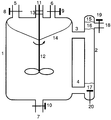
- An apparatus such as that shown schematically in the figure is advantageously used in the process according to the invention.
- This apparatus is a combined with a phase separator 2 stirred tank 1 of otherwise in itself and of conventional design, which can be equipped with either external or internal heating and with usually separate inlet nozzle 5 for the supply of the individual reactants and the fumigation is provided with inert gas.
- the boiler heating has been omitted and only one inlet connection 5, representative of all others, has been drawn in.
- a device for pressure compensation 6 and a drain port 7 are attached to the reactor. All of these devices are provided with separate control devices 8, 9 and 10, for example slides or valves, which enable the opening and closing of these nozzles and the regulation of the inlet.
- the reactor is provided with an agitator 12 which is sealed by the sleeve 13 Guide 11 is connected to the outside.
- the stirred tank 1 is connected to the phase separator 2 via the inlets 3 and 4, which are arranged approximately at the level of the upper and lower third.
- the product solution obtained in the reaction is withdrawn from the apparatus via the outlet connection 18, which is expediently arranged above the feed 3.
- the outflow of the product solution is regulated by the control device 19, which can be, for example, a slide or a valve.
- the reactants are placed in the reactor and mixed thoroughly with the stirrer 12 at the desired reaction temperature, an emulsion-like mixture of catalyst phase and upper phase being formed.
- the flow generated by the stirrer in the reaction mixture has the result that the emulsion-like mixture reaches the phase separator 2 via the feed 3, in which the catalyst phase and the monomer and product-containing upper phase separate due to their different densities.
- the product phase is drawn off via the outlet 18, meanwhile the catalyst phase flows back into the stirred tank via the feed 4, as a result of the suction generated by the agitator 12, where it is again swirled with the upper phase containing monomer and product.
- Lines 14 and 15 indicate the approximate liquid meniscus or level in the stirred tank or phase separator during operation.
- Fresh monomer and fresh carboxylic acid are introduced into the stirred tank via the filler neck 5.
- the carboxylic acid supply is controlled with the aid of the conductivity measuring cell 20 immersed in the liquid catalyst phase so that the desired carboxylic acid content in the catalyst phase remains constant within the control accuracy.
- Fresh monomer is usually metered into the reactor in a controlled manner via a fill level control. Fresh monomer is expediently fed in to the extent that product and unreacted monomer are discharged from the reaction apparatus.
- the reaction time, and hence the polymerization time can also be controlled, with which another means for influencing and adjusting the average molecular weight of the resulting polymer is available.
- the polymerization is carried out for a period of from 0.5 to 50 hours, preferably from 1 to 10 hours and particularly preferably from 1 to 8 hours. In the continuous process dwell times of 1 to 8 and preferably 2 to 5 hours are usually set.
- the reaction system described requires a certain time until a steady state equilibrium has been reached and during which it can be advantageous to keep the outlet 18 closed by means of the control device 19, that is to say not to discharge any product solution from the reaction apparatus.
- the catalyst phase remains in the reaction apparatus and is continuously supplemented by adding new and / or possibly recirculating the discharged catalyst in accordance with the catalyst losses which result from the discharge of small amounts of catalyst with the product-containing upper phase.
- a heteropolyacid heterogeneous catalyst is used to produce the poly-THF monoesters, this can be used as a suspension catalyst, but preferably as a fixed bed catalyst. When using a fixed bed catalyst, the reaction mixture can be passed over the heteropolyacid heterogeneous catalyst in the bottom or trickle mode.
- the process according to the invention is advantageously carried out under an inert gas atmosphere, it being possible to use any inert gases, such as nitrogen or argon.
- the reactants are freed of any water and peroxides contained therein before they are used.
- organic solvents which are inert under the reaction conditions, for example aliphatic and aromatic hydrocarbons and halogenated hydrocarbons, is possible and can have an advantageous effect in that the phase separation of the catalyst phase and the upper phase is facilitated.
- the monomer serves both as a reactant and as a solvent in the process according to the invention.
- the polymer-containing upper phase can be worked up, for example, by neutralizing traces of heteropolyacid contained therein by adding a base, such as dilute alkali metal or alkaline earth metal hydroxides, ammonia solution, alkali metal or alkaline earth metal carbonate solutions or hydrogen carbonate solutions, so that the monomer contained therein is distilled off and the polyoxyalkylene glycol monoester remaining in the distillation residue is filtered to remove precipitated salts.
- a base such as dilute alkali metal or alkaline earth metal hydroxides, ammonia solution, alkali metal or alkaline earth metal carbonate solutions or hydrogen carbonate solutions
- polyoxyalkylene glycol monoesters of monocarboxylic acids and in particular poly-THF monoesters of monocarboxylic acids can be obtained economically and in good yield, selectively and with a narrow molecular weight distribution and in a very pure form.
- the monoesters which can be prepared according to the invention are used, for example, as plasticizers (US Pat. No. 4,482,411), impregnating agents (DE-A 29 32 216), monomers (EP-A 286 454), emulsifiers and dispersing agents (JP-A 138 452/1987) are also used for deinking in the reprocessing of waste paper (JP-A 303 190/1988).
- the average molecular weights (M n ) of the polymers prepared according to the examples were determined by means of gel permeation chromatography, using a standardized polystyrene for calibration.
- anhydrous dodecotungstophosphoric acid 50 g were dissolved in 100 g of dry THF, which contained 2.7% by weight of benzoic acid, and stirred for 4 hours at 60 ° C. in a nitrogen atmosphere. After cooling to room temperature, the two liquid phases were separated. After the unreacted THF had been distilled off, 20 g of a clear, colorless, viscous polymer with an average molecular weight of 2900 were obtained from the upper phase. The dispersity was 2.0.
- a supported catalyst was used for the polymerization, which contained dodecotungstamophosphoric acid on activated carbon.
- the catalyst was prepared as follows: 150 g of undried dodecatungstophosphoric acid were dissolved in 1500 g of dry THF, 750 g of activated carbon (Merck, particle size 0.5 to 0.85 mm) were added and the mixture was stirred at room temperature for two hours. The supported catalyst was then filtered off and dried in vacuo at 150 ° C. until no more water was detectable in the catalyst.
- the supported catalyst contained 10 wt .-% H3PW12O40.
Landscapes
- Chemical & Material Sciences (AREA)
- Health & Medical Sciences (AREA)
- Chemical Kinetics & Catalysis (AREA)
- Medicinal Chemistry (AREA)
- Polymers & Plastics (AREA)
- Organic Chemistry (AREA)
- Polyethers (AREA)
- Polyoxymethylene Polymers And Polymers With Carbon-To-Carbon Bonds (AREA)
Applications Claiming Priority (2)
| Application Number | Priority Date | Filing Date | Title |
|---|---|---|---|
| DE4108046A DE4108046A1 (de) | 1991-03-13 | 1991-03-13 | Verfahren zur herstellung von polyoxyalkylenglykol-monoestern von monocarbonsaeuren |
| DE4108046 | 1991-03-13 |
Publications (3)
| Publication Number | Publication Date |
|---|---|
| EP0503394A2 true EP0503394A2 (fr) | 1992-09-16 |
| EP0503394A3 EP0503394A3 (en) | 1993-08-25 |
| EP0503394B1 EP0503394B1 (fr) | 1997-08-20 |
Family
ID=6427142
Family Applications (1)
| Application Number | Title | Priority Date | Filing Date |
|---|---|---|---|
| EP92103413A Expired - Lifetime EP0503394B1 (fr) | 1991-03-13 | 1992-02-28 | Procédé pour la préparation de (monoesters de polyoxyalkylèneglycol) d'acides monocarboxyliques |
Country Status (5)
| Country | Link |
|---|---|
| US (1) | US5659068A (fr) |
| EP (1) | EP0503394B1 (fr) |
| JP (1) | JP3181665B2 (fr) |
| DE (2) | DE4108046A1 (fr) |
| ES (1) | ES2104750T3 (fr) |
Cited By (11)
| Publication number | Priority date | Publication date | Assignee | Title |
|---|---|---|---|---|
| WO1996009335A1 (fr) * | 1994-09-21 | 1996-03-28 | Basf Aktiengesellschaft | Procede de fabrication de polytetrahydrofurane |
| US5561217A (en) * | 1992-12-23 | 1996-10-01 | Basf Aktiengesellschaft | Preparation of polyether glycols |
| EP0788470A4 (fr) * | 1994-10-27 | 1998-03-04 | Mobil Oil Corp | Lubrifiants constitues de polyether |
| US5741888A (en) * | 1994-10-07 | 1998-04-21 | Basf Aktiengesellschaft | Removal of heteropoly compounds from polyethers, polyesters and polyether esters |
| US5824769A (en) * | 1994-10-07 | 1998-10-20 | Basf Aktiengesellschaft | Polyether, polyester and polyether ester purification process |
| US5886139A (en) * | 1996-04-12 | 1999-03-23 | Polyplastics Co., Ltd. | Process for producing polyacetal copolymer |
| US5951829A (en) * | 1994-10-07 | 1999-09-14 | Basf Aktiengesellschaft | Separation of heteropoly compounds from polyethers, polyesters and polyether esters |
| EP1130044A4 (fr) * | 1998-05-26 | 2001-09-19 | Asahi Chemical Ind | Procede de regulation de la repartition des poids moleculaires du glycol de polyether |
| WO2004031260A1 (fr) * | 2002-09-12 | 2004-04-15 | Basf Aktiengesellschaft | Procede de production de mono- et de diesters de polytetrahydrofurane et de copolymeres de tetrahydrofurane |
| WO2005087757A1 (fr) * | 2004-03-12 | 2005-09-22 | Basf Aktiengesellschaft | Procede de production de tetrahydrofuranne a l'aide d'un heteropolyacide en tant que catalyseur et en l'absence d'oxygene |
| WO2014083983A1 (fr) * | 2012-11-27 | 2014-06-05 | ポリプラスチックス株式会社 | Procédé de production de copolymère polyacétal |
Families Citing this family (2)
| Publication number | Priority date | Publication date | Assignee | Title |
|---|---|---|---|---|
| JP4982596B2 (ja) | 2009-09-08 | 2012-07-25 | 株式会社東芝 | モジュールの接続構造 |
| JP7300830B2 (ja) * | 2018-12-28 | 2023-06-30 | 出光興産株式会社 | ポリアルキレングリコール系化合物 |
Family Cites Families (13)
| Publication number | Priority date | Publication date | Assignee | Title |
|---|---|---|---|---|
| DE2445961C2 (de) * | 1974-09-26 | 1983-12-01 | Basf Ag, 6700 Ludwigshafen | Verfahren zur Polymerisation von Tetrahydrofuran |
| US4243799A (en) * | 1978-01-14 | 1981-01-06 | Basf Aktiengesellschaft | Polymerization of tetrahydrofuran |
| US4189566A (en) * | 1978-01-14 | 1980-02-19 | Basf Aktiengesellschaft | Polymerization of tetrahydrofuran |
| JPS5525324A (en) * | 1978-08-11 | 1980-02-23 | Nippon Oils & Fats Co Ltd | Method of improving quality of material of fiber material |
| JPS5828A (ja) * | 1981-06-25 | 1983-01-05 | Hitachi Plant Eng & Constr Co Ltd | 蒸気加湿器 |
| US4482411A (en) * | 1983-05-23 | 1984-11-13 | The United States Of America As Represented By The Secretary Of The Air Force | Plasticizer system for propellant compositions |
| EP0158229B1 (fr) * | 1984-03-28 | 1988-06-22 | Asahi Kasei Kogyo Kabushiki Kaisha | Procédé pour la préparation de polyéther-polyol, le polyéther-polyol et la polyuréthane obtenue de celle-ci |
| JPS6279223A (ja) * | 1985-10-02 | 1987-04-11 | Asahi Chem Ind Co Ltd | ポリアルキレンエ−テルポリオ−ルの製造法 |
| JPH0657675B2 (ja) * | 1985-12-11 | 1994-08-03 | 日本油脂株式会社 | ポリアルキレングリコ−ルモノオレエ−トの製造法 |
| DE3606479A1 (de) * | 1986-02-28 | 1987-09-03 | Basf Ag | Verfahren zur herstellung von polyoxibutylenpolyoxialkylenglykolen mit enger molekulargewichtsverteilung und vermindertem gehalt an oligomeren cyclischen ethern |
| CA1317313C (fr) * | 1987-04-10 | 1993-05-04 | Hisaki Tanabe | Monomeres vinyliques polymerisables et resines vinyliques preparees a partir de ceux-ci |
| JPS63303190A (ja) * | 1987-06-03 | 1988-12-09 | ライオン株式会社 | 脱墨剤 |
| DE4108044A1 (de) * | 1991-03-13 | 1992-09-17 | Basf Ag | Verfahren zur herstellung von polyoxyalkylenglykolen |
-
1991
- 1991-03-13 DE DE4108046A patent/DE4108046A1/de not_active Withdrawn
-
1992
- 1992-02-28 ES ES92103413T patent/ES2104750T3/es not_active Expired - Lifetime
- 1992-02-28 DE DE59208803T patent/DE59208803D1/de not_active Expired - Lifetime
- 1992-02-28 EP EP92103413A patent/EP0503394B1/fr not_active Expired - Lifetime
- 1992-03-10 JP JP05139692A patent/JP3181665B2/ja not_active Expired - Fee Related
-
1994
- 1994-05-31 US US08/255,549 patent/US5659068A/en not_active Expired - Fee Related
Cited By (16)
| Publication number | Priority date | Publication date | Assignee | Title |
|---|---|---|---|---|
| US5561217A (en) * | 1992-12-23 | 1996-10-01 | Basf Aktiengesellschaft | Preparation of polyether glycols |
| US5773648A (en) * | 1994-09-21 | 1998-06-30 | Basf Aktiengesellschaft | Preparation of polytetrahydrofuran |
| CN1069663C (zh) * | 1994-09-21 | 2001-08-15 | 巴斯福股份公司 | 聚四氢呋喃的制备 |
| WO1996009335A1 (fr) * | 1994-09-21 | 1996-03-28 | Basf Aktiengesellschaft | Procede de fabrication de polytetrahydrofurane |
| AU690340B2 (en) * | 1994-09-21 | 1998-04-23 | Basf Aktiengesellschaft | Method of producing polytetrahydrofurane |
| US5951829A (en) * | 1994-10-07 | 1999-09-14 | Basf Aktiengesellschaft | Separation of heteropoly compounds from polyethers, polyesters and polyether esters |
| US5824769A (en) * | 1994-10-07 | 1998-10-20 | Basf Aktiengesellschaft | Polyether, polyester and polyether ester purification process |
| US5741888A (en) * | 1994-10-07 | 1998-04-21 | Basf Aktiengesellschaft | Removal of heteropoly compounds from polyethers, polyesters and polyether esters |
| EP0788470A4 (fr) * | 1994-10-27 | 1998-03-04 | Mobil Oil Corp | Lubrifiants constitues de polyether |
| US5886139A (en) * | 1996-04-12 | 1999-03-23 | Polyplastics Co., Ltd. | Process for producing polyacetal copolymer |
| EP1130044A4 (fr) * | 1998-05-26 | 2001-09-19 | Asahi Chemical Ind | Procede de regulation de la repartition des poids moleculaires du glycol de polyether |
| US6395938B1 (en) | 1998-05-26 | 2002-05-28 | Asahi Kasei Kabushiki Kaisha | Method of regulating molecular weight distribution of polyether glycol |
| WO2004031260A1 (fr) * | 2002-09-12 | 2004-04-15 | Basf Aktiengesellschaft | Procede de production de mono- et de diesters de polytetrahydrofurane et de copolymeres de tetrahydrofurane |
| US7276573B2 (en) | 2002-09-12 | 2007-10-02 | Basf Aktiengesellschaft | Method for producing monoesters and diesters of polytetrahydrofuran and of tetrahydrofuran copolymers |
| WO2005087757A1 (fr) * | 2004-03-12 | 2005-09-22 | Basf Aktiengesellschaft | Procede de production de tetrahydrofuranne a l'aide d'un heteropolyacide en tant que catalyseur et en l'absence d'oxygene |
| WO2014083983A1 (fr) * | 2012-11-27 | 2014-06-05 | ポリプラスチックス株式会社 | Procédé de production de copolymère polyacétal |
Also Published As
| Publication number | Publication date |
|---|---|
| ES2104750T3 (es) | 1997-10-16 |
| DE4108046A1 (de) | 1992-09-17 |
| US5659068A (en) | 1997-08-19 |
| JPH0517567A (ja) | 1993-01-26 |
| EP0503394B1 (fr) | 1997-08-20 |
| DE59208803D1 (de) | 1997-09-25 |
| EP0503394A3 (en) | 1993-08-25 |
| JP3181665B2 (ja) | 2001-07-03 |
Similar Documents
| Publication | Publication Date | Title |
|---|---|---|
| EP0503394B1 (fr) | Procédé pour la préparation de (monoesters de polyoxyalkylèneglycol) d'acides monocarboxyliques | |
| EP0503386B1 (fr) | Procédé pour la préparation de polyalkylèneglycols | |
| EP0503393B1 (fr) | Procédé pour la préparation de (monoéthers de polyoxyalkylèneglycol) d'alcools monohydroxyliques | |
| EP0428003A2 (fr) | Procédé de préparation de polyéther-glycols | |
| WO2007025881A1 (fr) | Procede pour produire des polyether-alcools | |
| EP0503392B1 (fr) | Procédé pour régler la distribution du poids moléculaire moyen de polyoxyalkylèneglycols et de dérivés de polyoxyalkylènes au cours de la polymérisation par ouverture de cycle d'éthers cycliques et/ou d'acétals catalysé par des hétéropolyacides | |
| DE10239947A1 (de) | Verfahren zur Herstellung von Tetrahydrofuran-Copolymeren | |
| EP1539854B1 (fr) | Procede de production de mono- et de diesters de polytetrahydrofurane et de copolymeres de tetrahydrofurane | |
| EP2079776B1 (fr) | Procédé de dépolymérisation de mono et/ou de diesters de mélanges contenant du polytétrahydrofurane | |
| EP1576030B1 (fr) | Procede de production de copolymeres de tetrahydrofurane | |
| DE69914363T2 (de) | Verfahren zur regulierung der molekulargewichtsverteilung von polyetherglykol | |
| EP0813561B1 (fr) | Copolymeres tetrahydrofurane/but-2-ine-1,4-diol contenant des triples liaisons c-c | |
| DE2724166C2 (de) | Verfahren zur Herstellung eines Polymers durch Additionspolymerisation in Gegenwart eines Starters | |
| DE69920374T2 (de) | Verfahren zur herstellung von polytetrahydrofuran | |
| DE10314648A1 (de) | Verfahren zur Herstellung von Tetrahydrofuran-Copolymeren | |
| EP4263653B1 (fr) | Procédé de fabrication d'un monol ou d'un polyol comprenant un bloc de polyoxyméthylène | |
| WO2005087840A1 (fr) | Procede de production de polytetrahydrofuranne ou de copolymeres de tetrahydrofuranne | |
| DE102004012114A1 (de) | Verfahren zur Herstellung von Tetrahydrofuran | |
| DE1049103B (de) | Verfahren zur Polymerisation von Olefinoxyden | |
| DE10210728A1 (de) | Verfahren zur Herstellung von Polytetrahydrofuran mit vermindertem Gehalt an oligomeren cyclischen Ethern | |
| DE2755274A1 (de) | Additionsmischpolymerisate | |
| DE3042695A1 (de) | Verfahren zur herstellung von estern | |
| DE10359810A1 (de) | Verfahren zur Herstellung von Mono- und Diestern des Polytetrahydrofurans oder der Tetrahydrofuran-Copolymere | |
| DE10359808A1 (de) | Verfahren zur Herstellung von Tetrahydrofuran-Copolymeren | |
| DD238788B1 (de) | Verfahren und vorrichtung zur herstellung von alkenoxid-anlagerungsprodukten |
Legal Events
| Date | Code | Title | Description |
|---|---|---|---|
| PUAI | Public reference made under article 153(3) epc to a published international application that has entered the european phase |
Free format text: ORIGINAL CODE: 0009012 |
|
| AK | Designated contracting states |
Kind code of ref document: A2 Designated state(s): BE DE ES FR GB IT NL |
|
| PUAL | Search report despatched |
Free format text: ORIGINAL CODE: 0009013 |
|
| AK | Designated contracting states |
Kind code of ref document: A3 Designated state(s): BE DE ES FR GB IT NL |
|
| 17P | Request for examination filed |
Effective date: 19930723 |
|
| 17Q | First examination report despatched |
Effective date: 19960409 |
|
| GRAG | Despatch of communication of intention to grant |
Free format text: ORIGINAL CODE: EPIDOS AGRA |
|
| GRAH | Despatch of communication of intention to grant a patent |
Free format text: ORIGINAL CODE: EPIDOS IGRA |
|
| GRAH | Despatch of communication of intention to grant a patent |
Free format text: ORIGINAL CODE: EPIDOS IGRA |
|
| GRAA | (expected) grant |
Free format text: ORIGINAL CODE: 0009210 |
|
| AK | Designated contracting states |
Kind code of ref document: B1 Designated state(s): BE DE ES FR GB IT NL |
|
| GBT | Gb: translation of ep patent filed (gb section 77(6)(a)/1977) |
Effective date: 19970901 |
|
| REF | Corresponds to: |
Ref document number: 59208803 Country of ref document: DE Date of ref document: 19970925 |
|
| REG | Reference to a national code |
Ref country code: ES Ref legal event code: FG2A Ref document number: 2104750 Country of ref document: ES Kind code of ref document: T3 |
|
| ITF | It: translation for a ep patent filed | ||
| ET | Fr: translation filed | ||
| PLBE | No opposition filed within time limit |
Free format text: ORIGINAL CODE: 0009261 |
|
| STAA | Information on the status of an ep patent application or granted ep patent |
Free format text: STATUS: NO OPPOSITION FILED WITHIN TIME LIMIT |
|
| 26N | No opposition filed | ||
| REG | Reference to a national code |
Ref country code: GB Ref legal event code: IF02 |
|
| PGFP | Annual fee paid to national office [announced via postgrant information from national office to epo] |
Ref country code: NL Payment date: 20050203 Year of fee payment: 14 |
|
| PGFP | Annual fee paid to national office [announced via postgrant information from national office to epo] |
Ref country code: FR Payment date: 20050208 Year of fee payment: 14 |
|
| PGFP | Annual fee paid to national office [announced via postgrant information from national office to epo] |
Ref country code: GB Payment date: 20050223 Year of fee payment: 14 |
|
| PGFP | Annual fee paid to national office [announced via postgrant information from national office to epo] |
Ref country code: DE Payment date: 20050224 Year of fee payment: 14 |
|
| PGFP | Annual fee paid to national office [announced via postgrant information from national office to epo] |
Ref country code: ES Payment date: 20050323 Year of fee payment: 14 |
|
| PGFP | Annual fee paid to national office [announced via postgrant information from national office to epo] |
Ref country code: BE Payment date: 20050420 Year of fee payment: 14 |
|
| PG25 | Lapsed in a contracting state [announced via postgrant information from national office to epo] |
Ref country code: GB Free format text: LAPSE BECAUSE OF NON-PAYMENT OF DUE FEES Effective date: 20060228 Ref country code: BE Free format text: LAPSE BECAUSE OF NON-PAYMENT OF DUE FEES Effective date: 20060228 |
|
| PGFP | Annual fee paid to national office [announced via postgrant information from national office to epo] |
Ref country code: IT Payment date: 20060228 Year of fee payment: 15 |
|
| PG25 | Lapsed in a contracting state [announced via postgrant information from national office to epo] |
Ref country code: ES Free format text: LAPSE BECAUSE OF NON-PAYMENT OF DUE FEES Effective date: 20060301 |
|
| PG25 | Lapsed in a contracting state [announced via postgrant information from national office to epo] |
Ref country code: DE Free format text: LAPSE BECAUSE OF THE APPLICANT RENOUNCES Effective date: 20060317 |
|
| PG25 | Lapsed in a contracting state [announced via postgrant information from national office to epo] |
Ref country code: NL Free format text: LAPSE BECAUSE OF NON-PAYMENT OF DUE FEES Effective date: 20060901 |
|
| GBPC | Gb: european patent ceased through non-payment of renewal fee |
Effective date: 20060228 |
|
| NLV4 | Nl: lapsed or anulled due to non-payment of the annual fee |
Effective date: 20060901 |
|
| REG | Reference to a national code |
Ref country code: FR Ref legal event code: ST Effective date: 20061031 |
|
| REG | Reference to a national code |
Ref country code: ES Ref legal event code: FD2A Effective date: 20060301 |
|
| BERE | Be: lapsed |
Owner name: *BASF A.G. Effective date: 20060228 |
|
| PG25 | Lapsed in a contracting state [announced via postgrant information from national office to epo] |
Ref country code: FR Free format text: LAPSE BECAUSE OF NON-PAYMENT OF DUE FEES Effective date: 20060228 |
|
| PG25 | Lapsed in a contracting state [announced via postgrant information from national office to epo] |
Ref country code: IT Free format text: LAPSE BECAUSE OF NON-PAYMENT OF DUE FEES Effective date: 20070228 |