EP0503668A2 - Alkenylgruppen aufweisende Organosiliciumverbindungen, Verfahren zu ihrer Herstellung und Verwendung dieser Organosiliciumverbindungen - Google Patents
Alkenylgruppen aufweisende Organosiliciumverbindungen, Verfahren zu ihrer Herstellung und Verwendung dieser Organosiliciumverbindungen Download PDFInfo
- Publication number
- EP0503668A2 EP0503668A2 EP92104409A EP92104409A EP0503668A2 EP 0503668 A2 EP0503668 A2 EP 0503668A2 EP 92104409 A EP92104409 A EP 92104409A EP 92104409 A EP92104409 A EP 92104409A EP 0503668 A2 EP0503668 A2 EP 0503668A2
- Authority
- EP
- European Patent Office
- Prior art keywords
- radical
- different
- same
- carbon atoms
- denotes
- Prior art date
- Legal status (The legal status is an assumption and is not a legal conclusion. Google has not performed a legal analysis and makes no representation as to the accuracy of the status listed.)
- Granted
Links
Classifications
-
- C—CHEMISTRY; METALLURGY
- C08—ORGANIC MACROMOLECULAR COMPOUNDS; THEIR PREPARATION OR CHEMICAL WORKING-UP; COMPOSITIONS BASED THEREON
- C08G—MACROMOLECULAR COMPOUNDS OBTAINED OTHERWISE THAN BY REACTIONS ONLY INVOLVING UNSATURATED CARBON-TO-CARBON BONDS
- C08G77/00—Macromolecular compounds obtained by reactions forming a linkage containing silicon with or without sulfur, nitrogen, oxygen or carbon in the main chain of the macromolecule
- C08G77/04—Polysiloxanes
- C08G77/38—Polysiloxanes modified by chemical after-treatment
-
- C—CHEMISTRY; METALLURGY
- C07—ORGANIC CHEMISTRY
- C07F—ACYCLIC, CARBOCYCLIC OR HETEROCYCLIC COMPOUNDS CONTAINING ELEMENTS OTHER THAN CARBON, HYDROGEN, HALOGEN, OXYGEN, NITROGEN, SULFUR, SELENIUM OR TELLURIUM
- C07F7/00—Compounds containing elements of Groups 4 or 14 of the Periodic Table
- C07F7/02—Silicon compounds
- C07F7/08—Compounds having one or more C—Si linkages
- C07F7/18—Compounds having one or more C—Si linkages as well as one or more C—O—Si linkages
- C07F7/1804—Compounds having Si-O-C linkages
-
- C—CHEMISTRY; METALLURGY
- C08—ORGANIC MACROMOLECULAR COMPOUNDS; THEIR PREPARATION OR CHEMICAL WORKING-UP; COMPOSITIONS BASED THEREON
- C08G—MACROMOLECULAR COMPOUNDS OBTAINED OTHERWISE THAN BY REACTIONS ONLY INVOLVING UNSATURATED CARBON-TO-CARBON BONDS
- C08G77/00—Macromolecular compounds obtained by reactions forming a linkage containing silicon with or without sulfur, nitrogen, oxygen or carbon in the main chain of the macromolecule
- C08G77/04—Polysiloxanes
- C08G77/20—Polysiloxanes containing silicon bound to unsaturated aliphatic groups
-
- C—CHEMISTRY; METALLURGY
- C08—ORGANIC MACROMOLECULAR COMPOUNDS; THEIR PREPARATION OR CHEMICAL WORKING-UP; COMPOSITIONS BASED THEREON
- C08L—COMPOSITIONS OF MACROMOLECULAR COMPOUNDS
- C08L83/00—Compositions of macromolecular compounds obtained by reactions forming in the main chain of the macromolecule a linkage containing silicon with or without sulfur, nitrogen, oxygen or carbon only; Compositions of derivatives of such polymers
- C08L83/04—Polysiloxanes
- C08L83/06—Polysiloxanes containing silicon bound to oxygen-containing groups
Definitions
- organopolysiloxane compositions Si-bonded higher alkenyl groups, such as e.g. 5-hexenyl groups, greater reactivity towards Si-bonded hydrogen than Si-bonded vinyl groups.
- the organopolysiloxanes containing higher alkenyl groups can be prepared by reacting organopolysiloxane containing Si-bonded hydrogen with a ,,,, - diene, but multiple addition always occurs.
- the organopolysiloxanes containing higher alkenyl groups are therefore preferably obtained from the corresponding silanes by reacting ⁇ , ⁇ -diene in a large excess with silane with hydrogen bonded with hydrogen and subsequent hydrolysis of these silanes and equilibration of these silanes with organopolysiloxanes.
- organosilicon compounds containing alkenyl groups are described in which the individual carbon-carbon double bonds are relatively close to each other within a molecular part, which can have an inhibitory effect in a reaction with Si-bonded hydrogen.
- the object was to provide organosilicon compounds containing alkenyl groups, which can be prepared in a simple process with high selectivity.
- the object is achieved by the invention.
- the invention further relates to a process for the preparation of the organosilicon compounds containing alkenyl groups, characterized in that an organic compound (1) of the formula where x, y, v and z each have the meaning given above, with the proviso that the sum x + y is 1 or 2 and in compound (1) at least one spacer - (R 5 0) - is present, and R 2 , R 3 , R 4 and R 5 may each be the same or different and have the meanings given above, to an organosilicon compound (2) having at least one Si-bonded hydrogen atom in its molecule in the presence of the addition of Si-bonded hydrogen aliphatic multiple bond promoting catalyst (3) is attached.
- an organic compound (1) of the formula where x, y, v and z each have the meaning given above with the proviso that the sum x + y is 1 or 2 and in compound (1) at least one spacer - (R 5 0) - is present, and R 2 , R 3 , R 4 and R 5 may each be
- organosilicon compounds according to the invention are preferably silanes or organopolysiloxanes.
- the organosilicon compounds according to the invention preferably have an average molecular weight of 200 to 100,000 g / mol, preferably 214 to 10,000 g / mol, and preferably a viscosity of 1 to 1,000,000 mm 2 ⁇ s -1 at 25 C, preferably 1 to 20 000 mm 2 ⁇ s -1 at 25 ° C.
- radicals R are alkyl radicals, such as the methyl, ethyl, n-propyl, iso-propyl, 1-n-butyl, 2-n-butyl, iso-butyl, tert-butyl, n-pentyl, iso-pentyl, neo-pentyl, tert-pentyl, hexyl, such as the n-hexyl, heptyl, such as the n-heptyl, octyl, such as the n-octyl and iso-octyl, such as the second , 2,4-trimethylpentyl radical, nonyl radicals such as the n-nonyl radical, decyl radicals such as the n-decyl radical, dodecyl radicals such as the n-dodecyl radical, octadecyl radicals such as the n-o
- halogenated radicals R are haloalkyl radicals, such as the 3,3,3-trifluoro-n-propyl radical, the 2,2,2,2 ', 2', 2'-hexafluoroisopropyl radical, the heptafluoroisopropyl radical, and haloaryl radicals, such as the o- , m-, and p-chlorophenyl.
- the radical R is preferably hydrocarbon radicals having 1 to 6 carbon atoms, particularly preferably the methyl radical.
- radical R 1 examples are the examples given for radical R for alkyl radicals having 1 to 8 carbon atoms and the methoxyethyl and ethoxyethyl radicals.
- the radical R 1 is preferably the ethyl and the methyl radical.
- alkylene radicals R 2 are those of the formula - (CH 2 ) -, -CH (CH 3 ) -, -C (CH 3 ) 2 -, -C (CH 3 ) (C 2 H 5 ) -, - (CH 2 ) 2 - and - (CH 2 ) 4 -.
- R 2 is preferably the —CH 2 group.
- the radical R 3 is preferably a hydrogen atom.
- the radical R 4 is preferably a hydrogen atom.
- radical R 5 are - (CH 2 ) 2 -, - (CH 2 ) 3 -, - (CH 2 ) 4 -, -CH 2 CH (CH 3 ) - and - (CH 2 ) 2 CH (CH 3 ) -, where R 5 preferably has the meaning of - (CH 2 ) group.
- the sum of x and y is preferably 1.
- V and w are preferably integers from 1 to 20, particularly preferably from 1 to 4.
- radicals A are those of the formula and and and and and and and The radical A is preferably as well as um where the pair of isomers is particularly preferred.
- the organopolysiloxanes with at least one Si-bonded hydrogen atom preferably contain at least 0.04% by weight, preferably 0.1 to 1.6% by weight, Si-bonded hydrogen and their average viscosity is preferably 2 to 20,000 mm 2 . s -1 at 25 ° C, preferably 2 to 2000 mm 2 ⁇ s -1 at 25 ° C.
- Preferred silanes with one Si-bonded hydrogen atom per molecule are those of the formula where R, R 1 and d have the meaning given above.
- Preferred organopolysiloxanes with at least one Si-bonded hydrogen atom per molecule are those of the formula where R, g, n and m have the meaning given above.
- a preferred example of silanes of the formula (V) is triethoxysilane.
- Preferred examples of organopolysiloxanes of the formula (VI) are copolymers of dimethylhydrosiloxane and dimethylsiloxane units, copolymers of dimethylhydrosiloxane, dimethylsiloxane and methylhydrogensiloxane units, copolymers of trimethylsiloxane and methylhydrogensiloxane units and trimethylsiloxane siloxane units, and methylethylsiloxane units of trimethylsiloxane units.
- organopolysiloxanes with at least one Si-bonded hydrogen atom per molecule including those of the preferred type, are generally known.
- Organic compound (1) is preferably used in the process according to the invention in amounts such that 1 to 2 mol, preferably 1.05 to 1.20 mol, of organic compound (1) per gram atom of Si-bonded hydrogen is present in the organosilicon compound (2) .
- catalysts (3) promoting the attachment of Si-bonded hydrogen to aliphatic multiple bonds the same catalysts can also be used in the process according to the invention as have previously been used to promote the attachment of Si-bonded hydrogen to aliphatic multiple bonds.
- the catalysts (3) are preferably a metal from the group of platinum metals or a compound or a complex from the group of platinum metals.
- platinum halides for example PtC1 4 , H 2 PtCl 6 .6H 2 O, Na 2 PtCl 4 ⁇ 4H 2 O, platinum-olefin complexes, platinum-alcohol complexes, platinum-alcoholate complexes, platinum-ether complexes, platinum-aldehyde complexes, platinum-ketone complexes, including reaction products from H 2 PtCl 6 ⁇ 6H 2 O and cyclohexanone, platinum-vinylsiloxane complexes, such as platinum-1,3-divinyl-1,1,3,3-tetramethyldisiloxane complexes with or without content of detectable inorganically bound halogen, bis (gamma-picolin) -platinum dichloride, trimethylene-dipyridineplatinum dichloride,
- the catalyst (3) is preferably in amounts of 0.5 to 200 ppm by weight (parts by weight per million parts by weight), preferably in amounts of 1 to 50 ppm by weight, in each case calculated as elemental platinum and based on the total weight of organic Compound (1) and organosilicon compound (2) used.
- the process according to the invention is preferably carried out at the pressure of the surrounding atmosphere, that is to say at about 1020 hPa (abs.), But it can also be carried out at higher or lower pressures. Furthermore, the process according to the invention is preferably carried out at a temperature of 80 ° C. to 150 ° C., preferably 100 ° C. to 150 ° C., particularly preferably 120 ° C. to 130 ° C.
- Organic solvents which are inert with respect to the reactants can be used in the process according to the invention, although the use of organic solvents which are inert with respect to the reactants is not preferred.
- Examples of organic solvents which are inert with respect to the reactants are toluene, xylene, octane isomers and butyl acetate.
- Excess organic compound (1) and any organic solvent which is also used and which is inert with respect to the reactants are preferably removed by distillation from the organosilicon compounds containing alkenyl groups and prepared by the process according to the invention. If a separation of excess organic compound (1) is desired, depending on the molecular weight of the organic compound (1), in particular with large values for v or w, further separation steps, such as extraction with water or alcohols, may be necessary .
- the process according to the invention has the advantage that organosilicon compounds containing alkenyl groups can be prepared both with a very high selectivity and with a very high conversion.
- Organopolysiloxanes containing alkenyl groups can be prepared directly from organopolysiloxane with Si-bonded hydrogen atoms and organic compound (1) without crosslinking via the terminal double bonds.
- organosilicon compounds containing alkenyl groups are obtained according to the invention without double bond isomerization of the terminal double bond (s) from the end position into the chain. Should, however, occur under certain conditions, such as under the influence of strong bases, double bond isomerization the organosilicon compounds according to the invention have the advantage that due to the spacer no Claisen rearrangement is possible as a subsequent thermal reaction.
- organosilicon compounds containing alkenyl groups according to the invention have the advantage that they are very well suited for hydrosilylation reactions since, owing to the spacer between the individual double bonds, they show no or only a relatively slight inhibiting effect.
- organopolysiloxanes (4) with which the organosilicon compound having alkenyl groups and which is present after the end of the first stage is optionally equilibrated, those selected from the group consisting of linear organopolysiloxanes of the formula having terminal triorganosiloxy groups are preferably selected where R 6 may be the same or different and has a meaning given for R above and r is 0 or an integer from 1 to 1500, linear, terminal hydroxyl-containing organopolysiloxanes of the formula where R 7 may be the same or different and has a meaning given above for R and s is an integer from 1 to 1500, cyclic organopolysiloxanes of the formula where R 8 can be the same or different and has a meaning given above for R and t is an integer from 3 to 12, and copolymers of units of the formula where R 9 can be the same or different and has a meaning given for R above.
- the quantitative ratios of the organopolysiloxanes used in the 2nd stage of the process according to the invention which are optionally carried out are determined only by the desired proportion of the alkenyl groups in the organopolysiloxanes produced in the 2nd stage of the process according to the invention which is optionally carried out and by the desired average chain length.
- the use of acidic equilibration catalysts is possible, but not preferred.
- the equilibration which is optionally carried out in the second stage of the process according to the invention is preferably carried out at 80 ° C. to 150 ° C. and at the pressure of the surrounding atmosphere, that is to say at about 1020 hPa (abs.). If desired, higher or lower pressures can also be used.
- the equilibration is preferably carried out in 5 to 20% by weight, based on the total weight of the organosilicon compounds used, in a water-immiscible solvent, such as toluene. Before working up the mixture obtained during equilibration, the catalyst can be deactivated.
- the various stages of the process according to the invention can be carried out in succession in one and the same reaction vessel or in separate reaction vessels. It is preferably carried out in succession in one and the same reaction vessel.
- the process according to the invention can be carried out batchwise, semi-continuously or fully continuously.
- organosilicon compounds according to the invention containing alkenyl groups can be subjected to the hydrolysis or condensation.
- Hydrolysis or condensation of organosilicon compounds with Organyloxy groups are already widely known.
- the organosilicon compounds according to the invention can be reacted with linear or cyclic organosilicon compounds having hydroxyl groups, such as, for example, a, w-dihydroxydimethylpolysiloxane, in the presence of a catalyst, such as, for example, organotin compounds, titanium and zirconium esters, quaternary nitrogen bases, and mineral acids, and, if appropriate, in the presence of solvents will.
- Hydrolysis and condensation are preferably carried out between 23 and 150 ° C, particularly preferably between 60 and 120 ° C and a pressure between 900 and 1110 hPa.
- organopolysiloxanes containing alkenyl groups according to the invention can be crosslinked with organopolysiloxanes containing Si-bonded hydrogen in the presence of hydrosilylation catalysts.
- Organopolysiloxanes of the formula (IV), preferably of the formula (VI), are preferably used as component (B).
- the above-mentioned catalysts (3) are preferably used as component (C).
- compositions can contain other substances (D), such as, for example, the addition of Si-bonded hydrogen to aliphatic multiple bonds at room temperature.
- D such as, for example, the addition of Si-bonded hydrogen to aliphatic multiple bonds at room temperature.
- Such inhibitors are e.g. B. described in US-A 3,933,880.
- Examples include acetylenically unsaturated alcohols, such as 3-methyl-1-butyn-3-ol, 1-ethynylcyclohexan-1-ol, 3,5-dimethyl-1-hexin-3-ol, 3-methyl-1-pentyn 3-ol and the like.
- compositions which contain the silicon compounds according to the invention containing alkenyl groups are suitable for the production of coatings which repel tacky substances, tack-free topcoats, rubber-like coatings or moldings and casting compounds.
- 50 g of the product from Example 1 are at a temperature of 90 ° C. with 140 g of a 75% by weight solution of a phenylmethylsiloxane with 3% by weight of Si-bonded hydroxyl groups, a molar ratio of Si-bonded phenyl groups to Si bound methyl groups of 37:63 and a viscosity of 90 mm 2 / s in xylene and 0.1 ml HCI0 4 mixed and stirred. After 3 hours, 1 g of sodium hydrogen carbonate is added with stirring, the mixture is allowed to cool and filtered.
- the organopolysiloxane thus obtained has an average respectively. as terminal as well as lateral groups and an average chain length between 70 and 80, the ratio of A: B being 39:61.
- a mixture is prepared from 20.0 g of the product from Example 4, 30 mg of 2-methyl-3-butyn-2-ol, 200 mg of a platinum catalyst solution (commercially available under the name "OL Solution” from Wacker-Chemie GmbH , D-8000 Kunststoff) and 400 mg of a hydrolyzate of methyldichlorosilane and trimethylchlorosilane with a viscosity of 20 mm 2 / s.
- a glass rod low-suction glassine paper is coated with it, the layer thickness being 2 to 3 ⁇ m, and allowed to crosslink in a convection oven preheated to 80 ° C. After 8 seconds the coating is tack-free and abrasion-resistant.
- the pot life is 20 hours. Without the addition of 2-methyl-3-butyn-2-ol, a tack-free, abrasion-resistant coating is achieved after 5 seconds under otherwise identical conditions. The pot life in this case is only 10 minutes.
- Example 2 5.6 g of the product from Example 2 are mixed with 3.3 g of the 3-mercaptopropyl-functional phenylmethyl resin described above under 111) and mixed with 0.2 g of a radical initiator (commercially available under the name Darocure 1173 from Merck, Darmstadt) and so much Xylene added that a processing viscosity of about 500 mm 2 / s is achieved.
- a medium-pressure mercury lamp with an output of 80 watt / cm light length hardens a thin (5 ⁇ m) coating coated with paper with the above mixture in less than one second without sticking and abrasion-resistant.
Landscapes
- Chemical & Material Sciences (AREA)
- Organic Chemistry (AREA)
- Health & Medical Sciences (AREA)
- Chemical Kinetics & Catalysis (AREA)
- Medicinal Chemistry (AREA)
- Polymers & Plastics (AREA)
- General Chemical & Material Sciences (AREA)
- Silicon Polymers (AREA)
- Compositions Of Macromolecular Compounds (AREA)
- Paints Or Removers (AREA)
Abstract

- R gleich oder verschieden sein kann und einen einwertigen, gegebenenfalls halogenierten Kohlenwasserstoffrest mit 1 bis 18 Kohlenstoffatom(en) je Rest bedeutet,
- R1 gleich oder verschieden sein kann und einen Alkylrest mit 1 bis 8 Kohlenstoffatom(en) je Rest, der durch ein oder mehrere Ethersauerstoffatom(e) substituiert sein kann, bedeutet,
- a 0 oder 1, durchschnittlich 0,003 bis 1,0,
- b 0, 1, 2 oder 3, durchschnittlich 0,0 bis 3,0,
- c 0, 1, 2 oder 3, durchschnittlich 0,0 bis 3,0, und die Summe a + b + c 4, durchschnittlich 1,5 bis 4,0 ist, mit der Maßgabe, daß mindestens ein Rest A je Molekül enthalten ist, und
- A ein Rest der Formel

- R2 gleich oder verschieden sein kann und einen Alkylenrest mit 1 bis 4 Kohlenstoffatom(en) ist,
- R3 gleich oder verschieden sein kann und ein Wasserstoffatom oder einen Methylrest bedeutet,
- R4 gleich oder verschieden sein kann und ein Wasserstoffatom, Methyl- oder Ethylrest bedeutet,
- R5 gleich oder verschieden sein kann und einen Alkylenrest mit 1 bis 4 Kohlenstoffatom(en) bedeutet,
- v 0 oder eine ganze Zahl und w 0 oder eine ganze Zahl bedeutet, mit der Maßgabe, daß im Rest A mindestens ein Spacer -(R50)- vorhanden ist, und
- x 0 oder 1 und y 0 oder 1 bedeutet, mit der Maßgabe, daß die Summe x + y oder 2 ist.
Description
- Gemäß US-A 4 609 574 (ausgegeben 2. September 1986, J. R. Keryk et al., Dow Corning Corporation) weisen in Organopolysiloxanzusammensetzungen Si-gebundene höhere Alkenylgruppen, wie z.B. 5-Hexenylgruppen, eine größere Reaktivität gegenüber Si-gebundenem Wasserstoff auf als Si-gebundene Vinylgruppen. Die höhere Alkenylgruppen enthaltenden Organopolysiloxane können durch Umsetzung von Si- gebundenen Wasserstoff aufweisendem Organopolysiloxan mit a,,,,-Dien hergestellt werden, wobei aber immer Mehrfachaddition auftritt. Bevorzugt werden daher die höhere Alkenylgruppen enthaltenden Organopolysiloxane aus den entsprechenden Silanen durch Umsetzung von α,ω-Dien in großem Überschuß mit Silan mit Sigebundenem Wasserstoff und anschließender Hydrolyse dieser Silane und Äquilibrierung dieser Silane mit Organopolysiloxanen gewonnen.
- In E. Lukevits et al., Zhurnal Obshchei Khimii, Vol. 56, 140-143, 1986 (Chemical Abstracts, Vol. 105, 226720 h, 1986) ist die Hydrosilylierung von Alkenen und Alkinen mit Dimethyl(2-thienyl)silan beschrieben. Die Dreifachbindung weist dabei eine größere Reaktivität als die Doppelbindung auf.
- In M.G. Voronkov, Irk. Inst. Org. Khim., 55(9), 2091-3 (Chemical Abstracts, Vol. 105, 97545d, 1986) wird die Reaktion von 1-Allyloxy-3-propargyloxy-2-propanol mit Trialkylsilanen beschrieben, wobei Ausbeuten bis zu 70 % erzielt werden.
- In M. Licchelli, A. Greco, Tetrahedron Lett. 28 (1987) 3719-22 wird die Hydrosilylierung von 2-Methyl-1-buten-3-in mit Methylchlorsilanen beschrieben, wobei die Hydrosilylierung dieses konjugierten Alkenins sowohl zur Mono- als auch zur Diaddition der verwendeten Silane führt.
- In M.G. Veliev, Azerb. Khim. Zh. 1987 (1) 60-4 (Chemical Abstracts, Vol. 110, 135304n) wird die Reaktion eines Silans mit einer organischen Verbindung, die sowohl eine Kohlenstoff-Kohlenstoff-Doppelbindung als auch eine Dreifachbindung aufweist, beschrieben, wobei diese organische Verbindung eine Epoxy- oder eine Cyanogruppe aufweist.
- In der deutschen Anmeldung mit dem Aktenzeichen P 3935775.9 (angemeldet am 27. Oktober 1989, Wacker-Chemie GmbH) bzw. der entsprechenden US-Anmeldung mit der Seriennummer 07/594,791 (angemeldet am 9. Oktober 1990) werden Alkenylgruppen aufweisende Organosiliciumverbindungen beschrieben, bei denen die einzelnen Kohlenstoff-Kohlenstoff-Doppelbindungen innerhalb eines Molekülteils relativ nah beieinander liegen, was sich bei einer Reaktion mit Si-gebundenem Wasserstoff als inhibierend auswirken kann.
- Es bestand die Aufgabe, Alkenylgruppen aufweisende Organosiliciumverbindungen bereitzustellen, die in einem einfachen Verfahren mit hoher Selektivität hergestellt werden können. Die Aufgabe wird durch die Erfindung gelöst.
- Gegenstand der Erfindung sind Alkenylgruppen aufweisende Organosiliciumverbindungen aus durchschnittlichen Einheiten der Formel

- R gleich oder verschieden sein kann und einen einwertigen, gegebenenfalls halogenierten Kohlenwasserstoffrest mit 1 bis 18 Kohlenstoffatom(en) je Rest bedeutet,
- R1 gleich oder verschieden sein kann und einen Alkylrest mit 1 bis 8 Kohlenstoffatom(en) je Rest, der durch ein oder mehrere Ethersauerstoffatom(e) substituiert sein kann, bedeutet,
- a 0 oder 1, durchschnittlich 0,003 bis 1,0,
- b 0, 1, 2 oder 3, durchschnittlich 0,0 bis 3,0,
- c 0, 1, 2 oder 3, durchschnittlich 0,0 bis 3,0, und die Summe a + b + c 4, durchschnittlich 1,5 bis 4,0 ist,
- A ein Rest der Formel

- R2 gleich oder verschieden sein kann und einen Alkylenrest mit 1 bis 4 Kohlenstoffatom(en) ist,
- R3 gleich oder verschieden sein kann und ein Wasserstoffatom oder einen Methylrest bedeutet,
- R4 gleich oder verschieden sein kann und ein Wasserstoffatom, Methyl- oder Ethylrest bedeutet,
- R5 gleich oder verschieden sein kann und einen Alkylenrest mit 1 bis 4 Kohlenstoffatome(en) bedeutet,
- v 0 oder eine ganze Zahl und w 0 oder eine ganze Zahl bedeutet, mit der Maßgabe, daß im Rest A mindestens ein Spacer -(R50)- vorhanden ist, sowie
- x 0 oder 1 und y 0 oder 1 bedeutet, mit der Maßgabe, daß die Summe x + y oder 2 ist.
- Gegenstand der Erfindung ist weiterhin ein Verfahren zur Herstellung der Alkenylgruppen aufweisenden Organosiliciumverbindungen, dadurch gekennzeichnet, daß eine organische Verbindung (1) der Formel

- Vorzugsweise sind die erfindungsmäßigen Organosiliciumverbindungen Silane oder Organopolysiloxane.
- Die erfindungsgemäßen Organosiliciumverbindungen besitzen vorzugsweise ein durchschnittliches Molekulargewicht von 200 bis 100 000 g/Mol, bevorzugt 214 bis 10 000 g/Mol, und vorzugsweise eine Viskosität von 1 bis 1 000 000 mm2·s-1 bei 25 C, bevorzugt 1 bis 20 000 mm2·s-1 bei 25 °C.
- Beispiele für Reste R sind Alkylreste, wie der Methyl-, Ethyl-, n-Propyl-, iso-Propyl-, 1-n-Butyl-, 2-n-Butyl-, iso-Butyl-, tert.-Butyl-, n-Pentyl-, iso-Pentyl-, neo-Pentyl, tert.-Pentylrest, Hexylreste, wie der n-Hexylrest, Heptylreste, wie der n-Heptylrest, Octylreste, wie der n-Octylrest und iso-Octylreste, wie der 2,2,4-Trimethylpentylrest, Nonylreste, wie der n-Nonylrest, Decylreste, wie der n-Decylrest, Dodecylreste, wie der n-Dodecylrest, Octadecylreste, wie der n-Octadecylrest; Cycloalkylreste, wie Cyclopentyl-, Cyclohexyl-, Cycloheptylreste und Methylcyclohexylreste; Arylreste, wie der Phenyl- Naphthyl- und Anthryl-und Phenanthrylrest; Alkarylreste, wie o-, m-, p-Tolylreste, Xylylreste und Ethylphenylreste; und Aralkylreste, wie der Benzylrest, der a- und der β-Phenylethylrest.
- Beispiele für halogenierte Reste R sind Halogenalkylreste, wie der 3,3,3-Trifluor-n-propylrest, der 2,2,2,2',2',2'-Hexafluorisopropylrest, der Heptafluorisopropylrest, und Halogenarylreste, wie der o-, m-, und p-Chlorphenylrest.
- Bei Rest R handelt es sich bevorzugt um Kohlenwasserstoffreste mit 1 bis 6 Kohlenstoffatom(en), besonders bevorzugt um den Methylrest.
- Beispiele für Rest R1 sind die für Rest R angegebenen Beispiele für Alkylreste mit 1 bis 8 Kohlenstoffatom(en) sowie der Methoxyethyl- und der Ethoxyethylrest.
- Bei Rest R1 handelt es sich bevorzugt um den Ethyl- und den Methylrest.
- Beispiele für Alkylenreste R2 sind solche der Formel -(CH2)-, -CH(CH3)-, -C(CH3)2-, -C(CH3)(C2H5)-, -(CH2)2- und -(CH2)4-.
- Bevorzugt handelt es sich bei R2 um die -CH2-Gruppe.
- Bei Rest R3 handelt es sich bevorzugt um Wasserstoffatome.
- Bei Rest R4 handelt es sich bevorzugt um Wasserstoffatome.
- Beispiele für Rest R5 sind -(CH2)2-, -(CH2)3-, -(CH2)4-, -CH2CH(CH3)- und -(CH2)2CH(CH3)-, wobei R5 bevorzugt die Bedeutung von -(CH2)-Gruppe hat.
- Bevorzugt beträgt die Summe aus x und y 1.
- Bevorzugt handelt es sich bei v und w jeweils um ganze Zahlen von 1 bis 20, besonders bevorzugt von 1 bis 4.
- Beispiele für Reste A sind solche der Formel






- Bevorzugt als Alkenylgruppen aufweisende Silane sind solche der Formel


- g 0 oder 1,
- n 0 oder eine ganze Zahl von 1 bis 1500 und
- m 0 oder eine ganze Zahl von 1 bis 100 ist,
- Beispiele für organische Verbindungen (1), die bei dem erfindungsgemäßen Verfahren eingesetzt werden, sind solche der Formel
- HC≡CCH2OCH2CH2OCH2CH=CH2 ,
- HC≡CCH(CH3)OCH2CH2OCH2CH=CH2 ,
- HC≡CCH2OCH2CH(CH3)OCH2CH=CH2 ,
- HC≡CCH2OCH2CH2OCH(CH3)CH=CH2 ,
- HC≡CCH2O(CH2CH2O)2CH2CH=CH2 ,
- H2C=CHCH2OCH2CH2OCH2C≡CCH2OCH2CH2OCH2CH=CH2 ,
- H2 C = CHCH2O(CH2CH2O)3CH2C=CCH2OCH2CH2OCH2CH = CH2 und
- H2 C = CHCH2 0(CH2CH20)2CH(CH3)C=CCH(CH3)OCH2CH20CH2CH = CH2.
- Verfahren zur Herstellung der organischen Verbindungen (1) sind in EP-B 46 731 (veröffentlicht 3. Oktobter 1984, F. Lohse et al., Ciba-Geigy AG) und US-A 3 149 168 (ausgegeben 15. September 1964, S. I. Karlan et al., Thiokol Chemical Corp.) beschrieben.
- Vorzugsweise werden als Organosiliciumverbindung (2) mit mindestens einem Si-gebundenem Wasserstoffatom je Molekül Silane mit einem Si-gebundenem Wasserstoffatom je Molekül oder Organopolysiloxane mit mindestens einem Si-gebundenem Wasserstoffatom je Molekül aus Einheiten der Formel

wobei - R die oben dafür angegebene Bedeutung hat,
- e 0 oder 1, durchschnittlich 0,003 bis 1,0,
- f 0, 1, 2 oder 3, durchschnittlich 0,0 bis 3,0 und
- Die Organopolysiloxane mit mindestens einem Si-gebundenen Wasserstoffatom enthalten vorzugsweise mindestens 0,04 Gew.-%, bevorzugt 0,1 bis 1,6 Gew.-%, Si-gebundenen Wasserstoff und ihre durchschnittliche Viskosität beträgt vorzugsweise 2 bis 20 000 mm2·s-1 bei 25°C, bevorzugt 2 bis 2000 mm2·s-1 bei 25 °C.
- Bevorzugt werden als Silane mit einem Si-gebundenen Wasserstoffatom je Molekül solche der Formel

wobei R, R1 und d die oben dafür angegebene Bedeutung haben, verwendet. - Bevorzugt werden als Organopolysiloxane mit mindestens einem Si-gebundenen Wasserstoffatom je Molekül solche der Formel

wobei R, g, n und m die oben dafür angegebene Bedeutung haben, verwendet. - Ein bevorzugtes Beispiel für Silane der Formel (V) ist Triethoxysilan. Bevorzugte Beispiele für Organopolysiloxane der Formel (VI) sind Mischpolymerisate aus Dimethylhydrogensiloxan- und Dimethylsiloxaneinheiten, Mischpolymerisate aus Dimethylhydrogensiloxan-, Dimethylsiloxan- und Methylhydrogensiloxaneinheiten, Mischpolymerisate aus Trimethylsiloxan- und Methylhydrogensiloxaneinheiten und Mischpolymerisate aus Trimethylsiloxan-, Dimethylsiloxan- und Methylhydrogensiloxaneinheiten.
- Verfahren zum Herstellen von Organopolysiloxanen mit mindestens einem Si-gebundenen Wasserstoffatom je Molekül, auch von solchen der bevorzugten Art, sind allgemein bekannt.
- Organische Verbindung (1) wird bei dem erfindungsgemäßen Verfahren vorzugsweise in solchen Mengen eingesetzt, daß 1 bis 2 Mol, bevorzugt 1,05 bis 1,20 Mol, organische Verbindung (1) je Grammatom Si-gebundenem Wasserstoff in der Organosiliciumverbindung (2) vorliegt.
- Als die Anlagerung von Si-gebundenem Wasserstoff an aliphatische Mehrfachbindung fördernde Katalysatoren (3) können auch bei dem erfindungsgemäßen Verfahren die gleichen Katalysatoren eingesetzt werden, die auch bisher zur Förderung der Anlagerung von Si-gebundenem Wasserstoff an aliphatische Mehrfachbindung eingesetzt werden konnten. Bei den Katalysatoren (3) handelt es sich vorzugsweise um ein Metall aus der Gruppe der Platinmetalle oder um eine Verbindung oder einen Komplex aus der Gruppe der Platinmetalle. Beispiele für solche Katalysatoren sind metallisches und feinverteiltes Platin, das sich auf Trägern, wie Siliciumdioxid, Aluminiumoxid oder Aktivkohle befinden kann, Verbindungen oder Komplexe von Platin, wie Platinhalogenide, z.B. PtC14, H2PtCl6·6H2O, Na2PtCl4·4H2O, Platin-Olefin-Komplexe, Platin-Alkohol-Komplexe, Platin-Alkoholat-Komplexe, Platin-Ether-Komplexe, Platin-Aldehyd-Komplexe, Platin-Keton-Komplexe, einschließlich Umsetzungsprodukten aus H2PtCl6·6H2O und Cyclohexanon, Platin-Vinylsiloxankomplexe, wie Platin-1,3-Divinyl-1,1,3,3-tetramethyldisiloxankomplexe mit oder ohne Gehalt an nachweisbarem anorganisch gebundenem Halogen, Bis(gamma-picolin)-platindichlorid, Trimethylendipyridinplatindichlorid, Dicyclopentadienplatindichlorid, Dimethylsulfoxidethylenplatin-(II)-dichlorid sowie Umsetzungsprodukte von Platintetrachlorid mit Olefin und primärem Amin oder sekundärem Amin oder primärem und sekundärem Amin gemäß US-A 4 292 434, wie das Umsetzungsprodukt aus in 1-Octen gelöstem Platintetrachlorid mit sec.-Butylamin, oder Ammonium-Platinkomplexe gemäß EP-B 110 370.
- Der Katalysator (3) wird vorzugsweise in Mengen von 0,5 bis 200 Gew.-ppm (Gewichtsteilen je Million Gewichtsteilen), bevorzugt in Mengen von 1 bis 50 Gew.-ppm, jeweils berechnet als elementares Platin und bezogen auf das Gesamtgewicht von organischer Verbindung (1) und Organosiliciumverbindung (2) eingesetzt.
- Das erfindungsgemäße Verfahren wird vorzugsweise beim Druck der umgebenden Atmosphäre, also etwa bei 1020 hPa (abs.), durchgeführt, es kann aber auch bei höheren oder niedrigeren Drücken durchgeführt werden. Ferner wird das erfindungsgemäße Verfahren vorzugsweise bei einer Temperatur von 80 °C bis 150°C, bevorzugt 100°C bis 150°C, besonders bevorzugt 120°C bis 130°C, durchgeführt.
- Bei dem erfindungsgemäßen Verfahren können in bezug auf die Reaktionsteilnehmer inerte, organische Lösungsmittel mitverwendet werden, obwohl die Mitverwendung von in bezug auf die Reaktionsteilnehmer inertem, organischem Lösungsmittel nicht bevorzugt ist. Beispiele für in bezug auf die Reaktionsteilnehmer inerte, organische Lösungsmittel sind Toluol, Xylol, Octanisomere und Butylacetat.
- Von den nach dem erfindungsgemäßen Verfahren hergestellten Alkenylgruppen enthaltenden Organosiliciumverbindungen wird vorzugsweise überschüssige organische Verbindung (1) sowie gegebenenfalls mitverwendetes, in bezug auf die Reaktionsteilnehmer inertes, organisches Lösungsmittel destillativ entfernt. Falls eine Abtrennung von überschüssiger organischer Verbindung (1) erwünscht wird, können unter Umständen, abhängig vom Molekulargewicht der organischen Verbindung (1), insbesondere bei großen Werten für v bzw. w, weitere Trennungsschritte, wie beispielsweise Extraktion mit Wasser oder Alkoholen, erforderlich sein.
- Das erfindungsgemäße Verfahren hat den Vorteil, daß Alkenylgruppen aufweisende Organosiliciumverbindungen sowohl mit einer sehr hohen Selektivität als auch mit einem sehr hohen Umsatz hergestellt werden können.
- Die Anlagerung von Organosiliciumverbindung (2) mit mindestens einem Si-gebundenen Wasserstoffatom je Molekül an organische Verbindung (1) erfolgt sowohl für x = und y = oder x = und y = 0 selektiv an der endständigen Dreifachbindung und nicht an der endständigen Doppelbindung als auch für x=1 und y = 1 selektiv an der mittelständigen Dreifachbindung und nicht an den endständigen Doppelbindungen. So lassen sich Alkenylgruppen enthaltende Organopolysiloxane direkt aus Organopolysiloxan mit Si-gebundenen Wasserstoffatomen und organischer Verbindung (1) herstellen, ohne daß es zu einer Vernetzung über die endständigen Doppelbindungen kommt. Weiterhin werden erfindungsgemäß Alkenylgruppen enthaltende Organosiliciumverbindungen erhalten, ohne daß eine Doppelbindungsisomerisierung bei der bzw. den endständigen Doppelbindung(en) von der Endposition in die Kette stattfindet. Sollte jedoch unter bestimmten Bedingungen, wie etwa unter Einfluß starker Basen, Doppelbindungsisomerisierung auftreten, so haben die erfindungsgemäßen Organosiliciumverbindungen den Vorteil, daß dabei aufgrund des Spacers keine Claisen-Umlagerung als thermische Folgereaktion möglich ist.
- Die erfindungsgemäßen Alkenylgruppen aufweisenden Organosiliciumverbindungen haben den Vorteil, daß sie für Hydrosilylierungsreaktionen sehr gut geeignet sind, da sie aufgrund des Spacers zwischen den einzelnen Doppelbindungen keinen bzw. nur einen relativ geringen inhibierenden Effekt zeigen.
- Als Organopolysiloxane (4), mit dem die nach Beendigung der 1. Stufe vorliegende, Alkenylgruppen aufweisende Organosiliciumverbindung gegebenenfalls äquilibriert wird, werden vorzugsweise solche ausgewählt aus der Gruppe bestehend aus linearen, endständige Triorganosiloxygruppen aufweisenden Organopolysiloxanen der Formel


- Die Mengenverhältnisse der in der gegebenenfalls durchgeführten 2. Stufe des erfindungsgemäßen Verfahrens eingesetzten Organopolysiloxane werden lediglich durch den gewünschten Anteil der Alkenylgruppen in dem in der gegebenenfalls durchgeführten 2. Stufe des erfindungsgemäßen Verfahrens erzeugten Organopolysiloxane und durch die gewünschte mittlere Kettenlänge bestimmt.
- Bei dem gegebenenfalls in der 2. Stufe des erfindungsgemäßen Verfahrens durchgeführten Äquilibrieren werden vorzugsweise basische Katalysatoren, welche die Äquilibrierung fördern, eingesetzt. Beispiele für solche Katalysatoren sind Alkalihydroxide, wie Natriumhydroxid und Kaliumhydroxid, Trimethylbenzylammoniumhydroxid und Tetramethylammoniumhydroxid, wobei Alkalihydroxide bevorzugt sind.
- Alkalihydroxide werden vorzugsweise in Mengen von 50 bis 10 000 Gew.-ppm (= Teile je Million), insbesondere 500 bis 2000 Gew.-ppm, jeweils bezogen auf das Gesamtgewicht der eingesetzten Organosiliciumverbindungen, verwendet. Die Verwendung saurer Äquilibrierungskatalysatoren ist zwar möglich, jedoch nicht bevorzugt.
- Die gegebenenfalls in der 2. Stufe des erfindungsgemäßen Verfahrens durchgeführte Äquilibrierung wird vorzugsweise bei 80 ° C bis 150°C und beim Druck der umgebenden Atmosphäre, also etwa bei 1020 hPa (abs.) durchgeführt. Falls erwünscht, können aber auch höhere oder niedrigere Drücke angewendet werden. Das Äquilibrieren wird vorzugsweise in 5 bis 20 Gew.-%, bezogen auf das Gesamtgewicht der jeweils eingesetzten Organosiliciumverbindungen, in mit Wasser nichtmischbarem Lösungsmittel, wie Toluol, durchgeführt. Vor dem Aufarbeiten des bei dem Äquilibrieren erhaltenen Gemisches kann der Katalysator unwirksam gemacht werden.
- Die verschiedenen Stufen des erfindungsgemäßen Verfahrens können in ein und demselben Reaktionsgefäß hintereinander oder in voneinander getrennten Reaktionsgefäßen durchgeführt werden. Vorzugsweise wird es in ein und demselben Reaktionsgefäß hintereinander durchgeführt. Das erfindungsgemäße Verfahren kann absatzweise, halbkontinuierlich oder vollkontinuierlich durchgeführt werden.
- Des weiteren können die erfindungsgemäßen, Alkenylgruppen aufweisenden Organosiliciumverbindungen, sofern sie OR'-Gruppen mit R1 gleich obengenannter Bedeutung aufweisen, der Hydrolyse bzw. Kondensation unterworfen werden. Hydrolyse bzw. Kondensation von Organosiliciumverbindungen mit Organyloxygruppen sind bereits vielfach bekannt. Beispielsweise können die erfindungsgemäßen Organosiliciumverbindungen mit Hydroxylgruppen aufweisenden linearen oder cyclischen Organosiliciumverbindungen, wie zum Beispiel a,w-Dihydroxydimethylpolysiloxan, in Anwesenheit von Katalysator, wie zum Beispiel Organozinnverbindungen, Titan- und Zirkonester, quaternären Stickstoffbasen, sowie Mineralsäuren, und gegebenenfalls in Anwesenheit von Lösungsmittel umgesetzt werden. Hydrolyse und Kondensation werden dabei vorzugsweise zwischen 23 und 150°C, besonders bevorzugt zwischen 60 und 120°C und einem Druck zwischen 900 und 1110 hPa durchgeführt.
- Die erfindungsgemäßen, Alkenylgruppen aufweisenden Organopolysiloxane können, wie auch die Si-gebundene Vinylgruppen aufweisenden Organopolysiloxane mit Si-gebundenen Wasserstoff aufweisenden Organopolysiloxanen, in Gegenwart von Hydrosilylierungskatalysatoren vernetzt werden.
- Beispielsweise können die erfindungsgemäßen Organosiliciumverbindungen in Zusammensetzungen, die
- (A) Alkenylgruppen aufweisende Organosiliciumverbindung der Formel (I), bevorzugt der Formel (III),
- (B) mindestens ein Si-gebundenes Wasserstoffatom aufweisendes Organopolysiloxan und
- (C) die Anlagerung von Si-gebundenem Wasserstoff an aliphatische Mehrfachbindung förderndem Katalysator
- Als Komponente (B) werden vorzugsweise Organopolysiloxane der Formel (IV), bevorzugt der Formel (VI) verwendet.
- Als Komponente (C) werden vorzugsweise die oben genannten Katalysatoren (3) verwendet.
- Darüber hinaus können die obengenannten Zusammensetzungen weitere Stoffe (D), wie beispielsweise die Anlagerung von Si-gebundenem Wasserstoff an aliphatische Mehrfachbindung bei Raumtemperatur verzögernde Mittel enthalten. Solche Inhibitoren sind z. B. in US-A 3 933 880 beschrieben. Beispiele hierfür sind acetylenisch ungesättigte Alkohole, wie 3-Methyl-1-butin-3-ol, 1-Ethinylcyclohexan-1-ol, 3,5-Dimethyl-1- hexin-3-ol, 3-Methyl-l-pentin-3-ol und dergleichen mehr.
- Zusammensetzungen, welche die erfindungsgemäßen, Alkenylgruppen aufweisenden Siliciumverbindungen enthalten, eignen sich zur Herstellung von klebrige Stoffe abweisenden Überzüge, von klebfreien Decklacken, von kautschukartigen Beschichtungen oder Formkörpern und von Vergußmassen.
- In den nachstehend beschriebenen Beispielen beziehen sich alle Viskositätsangaben auf eine Temperatur von 25 °C. Sofern nicht anders angegeben, werden die nachstehenden Beispiele bei einem Druck der umgebenden Atmosphäre, also etwa bei 1000 hPa, und bei Raumtemperatur, also bei etwa 23 °C, bzw. bei einer Temperatur, die sich beim Zusammengeben der Reaktanden bei Raumtemperatur ohne zusätzliche Heizung oder Kühlung einstellt, durchgeführt.
- I) 795 g 2-Propinoxyethanol (käuflich erhältlich unter der Bezeichnung Golpanol PME bei der BASF) werden mit 1200 g 50 Gew.-%iger NaOH, 705 g Allylchlorid und 21 g Trimethylbenzylammoniumchlorid für eine Dauer von 2 Stunden bei 42 °C gerührt. Sobald sich die zunächst exotherme Reaktion beruhigt hat, hält man die Temperatur des Gemisches unter gutem Rühren mit Hilfe eines warmen Wasserbads unter Rückfluß am Siedepunkt. Die Rückflußtemperatur erreicht ca. 65 °C. Nach dem Abkühlen werden 1200 ml Wasser zugegeben und anschließend die untere Phase abgetrennt. Das so erhaltene Rohprodukt wird zweimal mit je 300 ml Wasser gewaschen und im Vakuum destilliert. Bei 50°C bis 100°C und 5 hPa (abs.) erhält man 940 g eines farblosen Destillats. Entsprechend dem 'H-NMR-Spektrum hat es die durchschnittliche Zusammensetzung

- 153 g Allylether (1,05 Mol-C=C-), dessen Herstellung oben unter 1 beschrieben ist, werden mit 2 mg Platin in Form einer 1 Gew.-%igen Lösung von H2 PtC16 in Isopropanol vermischt, unter Stickstoff auf 120°C erwärmt und anschließend während 2 Stunden insgesamt 164 g Triethoxysilan (1,00 Mol) zugetropft. Nach einer Reaktionszeit von 4 bis 5 Stunden ergibt die alkalische Wasserstoffbestimmung einen Umsatz von über 99 % des Si-gebundenen Wasserstoffs im Triethoxysilan. Das so erhaltene Rohprodukt enthält weniger als 3 Gew.-% Allylether-Edukt. Laut 1H-NMR-Spektrum ist das Verhältnis von


- Durch Destillation im Vakuum erhält man von 110°C bis 160°C bei 5 hPa (abs.) 270 g einer farblosen Flüssigkeit mit einer Viskosität von 2,6 mm2/s der durchschnittlichen Formel


- 50 g des Produkts aus Beispiel 1 werden bei einer Temperatur von 90 °C mit 140 g einer 75 Gew.- %igen Lösung eines Phenylmethylsiloxans mit 3 Gew.-% Si-gebundenen Hydroxylgruppen, einem molaren Verhältnis von Si-gebundenen Phenylgruppen zu Si-gebundenen Methylgruppen von 37:63 und einer Viskosität von 90 mm2/s in Xylol und 0,1 ml HCI04 vermischt und gerührt. Nach 3 Stunden gibt man unter Rühren 1 g Natriumhydrogencarbonat zu, läßt die Mischung abkühlen und filtriert. Nach destillativem Entfernen von Xylol und entstandenem Ethanol (60°C / 5 hPa, abs.) werden 135 g eines doppelbindungshaltigen Harzes der Viskosität 4000 mm2/s mit der Jodzahl 45 erhalten. Demnach enthalten 564 g Harz genau 1,00 Mol aliphatische Doppelbindungen.
- 77 g Allylether (0,53 Mol -C=C-), dessen Herstellung in Beispiel 1 unter 1 beschrieben ist, werden unter Stickstoff auf 120°C erwärmt und anschließend während 2 Stunden ein Gemisch aus 127 g eines α,ω-Dihydrogendimethylpolysiloxans mit 0,394 Gew.-% Si-gebundenem Wasserstoff und 2 mg Platin in Form einer 1 Gew.-%igen Lösung von Platintetrachlorid in 1-Octen zugetropft. Nach einer Reaktionszeit von 1,5 Stunden ergibt die alkalische Wasserstoffbestimmung einen Umsatz von mehr als 99 % des Si-gebundenen Wasserstoffs im α,ω-Dihydrogendimethylpolysiloxan. Nach Entfernen der flüchtigen Bestandteile bei 120°C und 10-3 hPa erhält man 170 g eines klaren gelblichen Öls mit einer Viskosität von 13,5 mm2/s und einer Jodzahl von 112. Gemäß 1H-NMR-Spektrum hat das so erhaltene Dimethylpolysiloxan je einen Si- gebundenen Rest der durchschnittlichen Formel


- Eine Verschiebung der allylisch endständigen Doppelbindung zum Ethersauerstoff wird nicht beobachtet.

- 20 g des Produkts von Beispiel 3 werden mit 300 g α,ω-Dihydroxypolydimethylsiloxan der Viskosität 20 000 mPa·s vermischt und nach Zugabe von 100 ppm PNCI2 in Form einer 30 Gew.-%igen Lösung in 1,1,1-Trichlorethan bei 120°C äquilibriert. Die Viskositätskontrolle zeigt, daß das Siloxangemisch in weniger als 1 Stunde ausreagiert hat. Nach Filtration über Magnesiumoxid und Ausheizen bei 120°C und 2 hPa erhält man 290 g eines gelblichen Öls der Viskosität 800 mm2/s. Die Jodzahl von 6,6 ergibt eine berechnete durchschnittliche Kettenlänge von 204 Si-Einheiten.
- 120 g Allylether (0,82 Mol -C=C-), dessen Herstellung in Beispiel 1 unter I beschrieben ist, werden mit 7 mg Platin in Form einer 1 Gew.-%igen Lösung von Platintetrachlorid in 1-Octen unter Stickstoff auf 120°C erwärmt. Anschließend wird innerhalb 3 Stunden ein Äquilibrat aus Dimethylsiloxan-, Methylhydrogensiloxan- und Dimethylhydrogensiloxaneinheiten mit einer Viskosität von 70 mm2/s und 0,133 Gew.-% Si-gebundenem Wasserstoff zudosiert. Nach einer Reaktionszeit von 5 Stunden ergibt die alkalische Wasserstoffbestimmung einen Umsatz von über 99 % des Si-gebundenen Wasserstoffs des Äquilibrats. Nach Entfernen des überschüssigen Allyletheredukts bei 120°C und 10-3 hPa erhält man eine klare, gelbliche Flüssigkeit mit einer Viskosität von 210 mm2/s mit einer Jodzahl von 51. Gemäß 1H-NMR-Spektrum ist das Verhältnis der

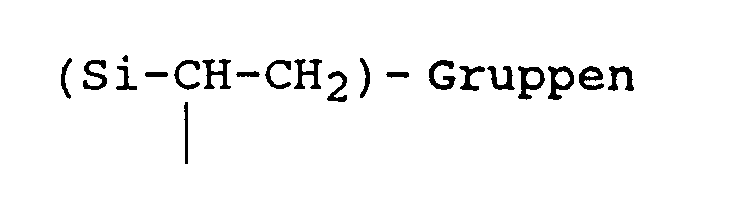
- Das so erhaltene Organopolysiloxan hat durchschnittlich


- 1H-NMR-Spektrum (CDCl3) terminale Gruppen:


- Eine Doppelbindungsisomerisierung von Allyloxy zu 1-Propenyloxy ist nicht erkennbar.
- II) Unter kräftigem Rühren vermischt man 1200 g 50 Gew.-%ige NaOH mit 690 g ethoxyliertem 2-Butin-1,4-diol (käuflich erhältlich unter der Bezeichnung Golpanol BEO bei der BASF) entsprechend 3,75 Mol -C=C-, 820 g Allylchlorid und 21 g Trimethylbenzylammoniumchlorid, wobei die Reaktionswärme zu schwachem Sieden führt. Danach wird unter Rückfluß solange erhitzt, bis die Rückflußtemperatur ca. 65 °C erreicht. Man kühlt ab und rührt 1200 ml Wasser ein, worauf sich das Gemisch in zwei klare Phasen trennen läßt. Die wäßrige Phase wird verworfen, das Rohprodukt noch zweimal mit je 300 ml Wasser gewaschen. Überschüssiges Allylchlorid wird ausdestilliert, der Allylether im Vakuum (11 hPa, abs.) zwischen 110°C und 160°C abgenommen. Man erhält 916 g eines farblosen Destillats mit der Jodzahl 286. Aus dem 1H-NMR-Spektrum ist eine durchschnittliche Zusammensetzung von

- In 139 g Diallylether, dessen Herstellung oben unter II beschrieben ist, werden 3,5 mg Platin in Form einer 1 Gew.-%igen Lösung von Platintetrachlorid in 1-Octen dispergiert und unter Stickstoff auf 130°C erwärmt. Innerhalb von 1,5 Stunden werden 227 g eines α,ω-Dihydrogenpolydimethylsiloxans mit einer Viskosität von 7 mm2/s zugetropft, wobei die Temperatur der Reaktionsmischung auf einem Wert zwischen 125°C und 130°C gehalten wird. Nach 3 Stunden Reaktionszeit ergibt die alkalische Wasserstoffbestimmung einen Umsatz von über 99 % des Si-gebundenen Wasserstoffs des Organopolysiloxans. Nach Entfernen flüchtiger Bestandteile bei 120°C und 2 hPa erhält man 340 g eines klaren gelben Öls mit der Jodzahl 134 und einer Viskosität von 30 mm2/s, wobei das Öl noch 2 Gew.-% des im Überschuß eingesetzten Diallylethers, bezogen auf das Gesamtgewicht des Öls, enthält. Gemäß 1H-NMR-Spektrum hat das so erhaltene Dimethylpolysiloxan je einen Si-gebundenen Rest der durchschnittlichen Formel

- in den endständigen Einheiten und eine durchschnittliche Kettenlänge von 15. Dem 1H-NMR-Spektrum ist weiterhin zu entnehmen, daß das Verhältnis der


- 67 g des Produkts aus Beispiel 6 werden mit 670 g Octamethylcyclotetrasiloxan verschnitten. Man setzt 2,0 g frische 40 %ige KOH-Lösung in Methanol zu und äquilibriert 4 Stunden bei 150°C. Während des Abkühlens gibt man 1,0 g Eisessig zu und rührt daraufhin 0,5 Stunden mit 8 g schwach saurer Tonerde. Nach der Filtration entfernt man flüchtige Cyclen bei 100°C im Vakuum (2 hPa). Man erhält 600 g eines gelblichen Öls der Viskosität 1290 mm2/s und der Jodzahl 7. Dies entspricht einer durchschnittlichen Kettenlänge von etwa 285 Si-Einheiten.
- Man vermischt 100 g des Produkts aus Beispiel 5 mit 300 g Octamethylcyclotetrasiloxan, setzt 1,0 g einer frischen 40 %igen KOH-Lösung in Methanol zu und erhitzt 5 Stunden auf 150°C. Der Katalysator wird während des Abkühlens mit 0,5 g Eisessig neutralisiert, das Gemisch nach Zusatz von 4 g schwach saurer Tonerde klar filtriert. Flüchtige Bestandteile entfernt man bei 100°C im Vakuum (2 hPa). Es verbleibt ein gelbliches Öl mit 1140 mm2/s Viskosität. Bei einer Jodzahl von 12 trägt circa jedes 50. Si-Atom der Polydimethylsiloxankette die in Beispiel 5 beschriebene Seitenkette A oder B.
- Man stellt eine Mischung her aus 20,0 g des Produkts aus Beispiel 4, 30 mg 2-Methyl-3-butin-2-ol, 200 mg einer Platinkatalysatorlösung (käuflich erhältlich unter der Bezeichnung "Lösung OL" bei der Wacker-Chemie GmbH, D-8000 München) und 400 mg eines Hydrolysats aus Methyldichlorsilan und Trimethylchlorsilan der Viskosität 20 mm2/s. Mit Hilfe eines Glasstabs beschichtet man damit saugarmes Pergaminpapier, wobei die Schichtdicke 2 bis 3 um beträgt, und läßt in einem auf 80 °C vorgeheizten Umluftofen vernetzen. Nach 8 Sekunden ist die Beschichtung klebfrei und abriebfest. Die Topfzeit beträgt 20 Stunden. Ohne Zusatz von 2-Methyl-3-butin-2-ol wird unter sonst gleichen Bedingungen eine klebfreie abriebfeste Beschichtung bereits nach 5 Sekunden erreicht. Die Topfzeit beträgt in diesem Fall nur 10 Minuten.
- 111) 90 g eines Phenylmethylpolysiloxans mit 14 Gew.-% Sigebundenen Methoxygruppen (unter der Handelsbezeichnung SY 231 bei der Wacker-Chemie GmbH erhältlich) werden mit 98 g 3-Mercaptopropyltrimethoxysilan, 3 g Eisessig und 10 ml Wasser 3 Stunden lang unter kräftigem Sieden äquilibriert und dann alle flüchtigen Bestandteile bei 80°C und 5 hPa destillativ entfernt. Es werden 162 g einer klaren farblosen Flüssigkeit mit einer Viskosität von 140 mm2·s-1 erhalten.
- 5,6 g des Produktes aus Beispiel 2 werden mit 3,3 g des oben unter 111) beschriebenen 3-Mercaptopropylfunktionellen Phenylmethylharzes gemischt und mit 0,2 g eines Radikalinitiators (käuflich erhältlich unter der Bezeichnung Darocure 1173 bei Merck, Darmstadt) versetzt und soviel Xylol zugegeben, daß eine Verarbeitungsviskosität von etwa 500 mm2/s erreicht wird. Eine Quecksilbermitteldrucklampe mit einer Leistung von 80 Watt/cm Leuchtlänge härtet eine dünn (5 um) auf Papier gestrichene Beschichtung mit obigem Gemisch in weniger als einer Sekunde klebfrei und abriebfest.
mit der Maßgabe, daß mindestens ein Rest A je Molekül enthalten ist, und
mit der Maßgabe, daß mindestens ein Rest A je Molekül enthalten ist.
die Summe von e + nicht größer als 3 ist, eingesetzt.
enthalten, verwendet werden.
Claims (10)

mit der Maßgabe, daß mindestens ein Rest A je Molekül enthalten ist, und


mit der Maßgabe, daß mindestens ein Rest A je Molekül enthalten ist,


wobei
an eine Organosiliciumverbindung (2) mit mindestens einem Si-gebundenen Wasserstoffatom in ihrem Molekül
die nach Beendigung der 1. Stufe vorliegende, Alkenylgruppen aufweisende Organosiliciumverbindung mit Organopolysiloxan (4) ausgewählt aus der Gruppe bestehend aus linearen, endständige Triorganosiloxygruppen aufweisenden Organopolysiloxanen, linearen, endständige Hydroxylgruppen aufweisenden Organopolysiloxanen, cyclischen Organopolysiloxanen und Mischpolymerisaten aus Diorganosiloxan- und Monoorganosiloxaneinheiten äquilibriert wird.

verwendet werden.

verwendet werden.
Applications Claiming Priority (2)
| Application Number | Priority Date | Filing Date | Title |
|---|---|---|---|
| DE4108334A DE4108334A1 (de) | 1991-03-14 | 1991-03-14 | Alkenylgruppen aufweisende organosiliciumverbindungen, verfahren zu ihrer herstellung und verwendung dieser organosiliciumverbindungen |
| DE4108334 | 1991-03-14 |
Publications (3)
| Publication Number | Publication Date |
|---|---|
| EP0503668A2 true EP0503668A2 (de) | 1992-09-16 |
| EP0503668A3 EP0503668A3 (en) | 1993-01-13 |
| EP0503668B1 EP0503668B1 (de) | 1996-01-17 |
Family
ID=6427309
Family Applications (1)
| Application Number | Title | Priority Date | Filing Date |
|---|---|---|---|
| EP92104409A Expired - Lifetime EP0503668B1 (de) | 1991-03-14 | 1992-03-13 | Alkenylgruppen aufweisende Organosiliciumverbindungen, Verfahren zu ihrer Herstellung und Verwendung dieser Organosiliciumverbindungen |
Country Status (5)
| Country | Link |
|---|---|
| US (1) | US5250647A (de) |
| EP (1) | EP0503668B1 (de) |
| JP (1) | JPH0721056B2 (de) |
| CA (1) | CA2061681A1 (de) |
| DE (2) | DE4108334A1 (de) |
Cited By (4)
| Publication number | Priority date | Publication date | Assignee | Title |
|---|---|---|---|---|
| EP0716114A1 (de) * | 1994-12-08 | 1996-06-12 | Wacker-Chemie GmbH | (Meth)acryloxygruppen aufweisende Organoiliciumverbindungen, deren Herstellung und Verwendung |
| EP0834527A1 (de) * | 1996-10-04 | 1998-04-08 | Wacker-Chemie GmbH | Verfahren zur Herstellung von (Meth)acryloxygruppen aufweisenden Organosilicium-verbindungen |
| WO1998027174A1 (de) * | 1996-12-16 | 1998-06-25 | Wacker-Chemie Gmbh | Strahlungshärtende zusammensetzungen |
| US6437015B2 (en) | 1996-12-16 | 2002-08-20 | Wacker-Chemie Gmbh | Radiation-curing compositions |
Families Citing this family (4)
| Publication number | Priority date | Publication date | Assignee | Title |
|---|---|---|---|---|
| DE4032006A1 (de) * | 1990-10-09 | 1992-04-16 | Wacker Chemie Gmbh | Verfahren zum entschaeumen und/oder entgasen von organischen systemen |
| DE4325359A1 (de) * | 1993-07-28 | 1995-02-02 | Wacker Chemie Gmbh | Estergruppen aufweisende Organopolysiloxane |
| JP3584410B2 (ja) * | 1994-09-01 | 2004-11-04 | 日本ペイント株式会社 | 複合塗膜形成方法 |
| DE19731961A1 (de) * | 1997-07-24 | 1999-01-28 | Wacker Chemie Gmbh | 1-Alkenyloxygruppen aufweisende Organosiliciumverbindungen, deren Herstellung und Verwendung |
Family Cites Families (10)
| Publication number | Priority date | Publication date | Assignee | Title |
|---|---|---|---|---|
| US3149168A (en) * | 1959-10-22 | 1964-09-15 | Thiokol Chemical Corp | Unsaturated diethers and method of making the same |
| US3271362A (en) * | 1966-02-07 | 1966-09-06 | Gen Electric | Process for reaction of silanic hydrogen with unsaturated organic compounds |
| US3661817A (en) * | 1970-05-04 | 1972-05-09 | Gen Electric | Curable compositions |
| US3989667A (en) * | 1974-12-02 | 1976-11-02 | Dow Corning Corporation | Olefinic siloxanes as platinum inhibitors |
| US4433179A (en) * | 1980-08-25 | 1984-02-21 | Ciba-Geigy Corporation | Process for the preparation of di- and poly-allyl ethers |
| US4617238A (en) * | 1982-04-01 | 1986-10-14 | General Electric Company | Vinyloxy-functional organopolysiloxane compositions |
| US4503208A (en) * | 1983-06-30 | 1985-03-05 | Loctite Corporation | Acrylic functional silicone copolymers |
| US4609574A (en) * | 1985-10-03 | 1986-09-02 | Dow Corning Corporation | Silicone release coatings containing higher alkenyl functional siloxanes |
| DE3914896A1 (de) * | 1989-05-05 | 1990-11-22 | Wacker Chemie Gmbh | Enoxyfunktionelle organosiliciumverbindungen, deren herstellung und verwendung |
| DE3935775A1 (de) * | 1989-10-27 | 1991-05-02 | Wacker Chemie Gmbh | Alkenylgruppen aufweisende organosiliciumverbindungen, verfahren zu ihrer herstellung und verwendung dieser organosiliciumverbindungen |
-
1991
- 1991-03-14 DE DE4108334A patent/DE4108334A1/de not_active Withdrawn
-
1992
- 1992-02-19 US US07/837,386 patent/US5250647A/en not_active Expired - Fee Related
- 1992-02-21 CA CA002061681A patent/CA2061681A1/en not_active Abandoned
- 1992-03-13 DE DE69207618T patent/DE69207618D1/de not_active Expired - Lifetime
- 1992-03-13 EP EP92104409A patent/EP0503668B1/de not_active Expired - Lifetime
- 1992-03-13 JP JP4054701A patent/JPH0721056B2/ja not_active Expired - Lifetime
Cited By (7)
| Publication number | Priority date | Publication date | Assignee | Title |
|---|---|---|---|---|
| EP0716114A1 (de) * | 1994-12-08 | 1996-06-12 | Wacker-Chemie GmbH | (Meth)acryloxygruppen aufweisende Organoiliciumverbindungen, deren Herstellung und Verwendung |
| US5593787A (en) * | 1994-12-08 | 1997-01-14 | Wacker-Chemie Gmbh | Organosilicon compounds containing (meth) acryloxy groups, their preparation and their use |
| EP0834527A1 (de) * | 1996-10-04 | 1998-04-08 | Wacker-Chemie GmbH | Verfahren zur Herstellung von (Meth)acryloxygruppen aufweisenden Organosilicium-verbindungen |
| US5869726A (en) * | 1996-10-04 | 1999-02-09 | Wacker-Chemie Gmbh | Process for preparing organosilicon compounds containing (meth)acryloxy groups |
| WO1998027174A1 (de) * | 1996-12-16 | 1998-06-25 | Wacker-Chemie Gmbh | Strahlungshärtende zusammensetzungen |
| EP1020491A1 (de) * | 1996-12-16 | 2000-07-19 | Wacker-Chemie GmbH | Strahlungshärtende Zusammensetzungen |
| US6437015B2 (en) | 1996-12-16 | 2002-08-20 | Wacker-Chemie Gmbh | Radiation-curing compositions |
Also Published As
| Publication number | Publication date |
|---|---|
| CA2061681A1 (en) | 1992-09-15 |
| JPH05112650A (ja) | 1993-05-07 |
| EP0503668A3 (en) | 1993-01-13 |
| EP0503668B1 (de) | 1996-01-17 |
| DE4108334A1 (de) | 1992-09-17 |
| JPH0721056B2 (ja) | 1995-03-08 |
| US5250647A (en) | 1993-10-05 |
| DE69207618D1 (de) | 1996-02-29 |
Similar Documents
| Publication | Publication Date | Title |
|---|---|---|
| EP0396130B1 (de) | Alkenyloxyfunktionelle Organosiliciumverbindungen, deren Herstellung und Verwendung | |
| EP0439777B1 (de) | Alkenyloxygruppen aufweisende Siloxancopolymere, deren Herstellung und Verwendung | |
| EP0415204A2 (de) | Anhydridfunktionelle Organo(poly)siloxane, Verfahren zu ihrer Herstellung und Verwendung dieser Organo(poly)siloxane | |
| EP0831111B1 (de) | Aminogruppen aufweisende Organosiliciumverbindungen, deren Herstellung und Verwendung | |
| EP1852456B1 (de) | Verfahren zur Herstellung von ß-Ketocarbonyl-funktionellen Organosiliciumverbindungen | |
| EP0503668B1 (de) | Alkenylgruppen aufweisende Organosiliciumverbindungen, Verfahren zu ihrer Herstellung und Verwendung dieser Organosiliciumverbindungen | |
| DE69403291T2 (de) | Organopolysiloxane und Verfahren zu dessen Herstellung | |
| EP0439778A2 (de) | Alkenylgruppen aufweisende Siloxancopolymere, deren Herstellung und Verwendung | |
| EP0508491B1 (de) | (Meth)acryloxygruppen aufweisende Organosiliciumverbindungen, deren Herstellung und Verwendung | |
| EP0639206B1 (de) | Vinyloxygruppen aufweisende siloxancopolymere, deren herstellung und verwendung | |
| EP0424960A2 (de) | Alkenylgruppen aufweisende Organosiliciumverbindungen, Verfahren zu ihrer Herstellung und Verwendung dieser Organosiliciumverbindungen | |
| EP0690062B1 (de) | Furanylgruppen aufweisende Organosiliciumverbindungen | |
| EP0924237B1 (de) | Amino-alkylenoxidfunktionelle Organosiliciumverbindungen, deren Herstellung und Verwendung | |
| EP0005787B1 (de) | Verfahren zur Herstellung von SiC-gebundene Vinylgruppen enthaltenden Organopolysiloxanharzen | |
| EP0413346B1 (de) | Verfahren zur Herstellung von Organo(poly)siloxanen mit Si-gebunden konjugierten Dienylgruppen | |
| EP0431609B1 (de) | Sulfosuccinatgruppen enthaltende Organopolysiloxane | |
| EP0401684A2 (de) | Verfahren zur Herstellung von Organosiloxanen | |
| EP0639205B1 (de) | Vinyloxygruppen aufweisende siloxancopolymere, deren herstellung und verwendung | |
| DE1229528B (de) | Verfahren zur Herstellung von fluessigen Organodisiloxanen | |
| EP0538868B1 (de) | Buntesalzgruppen aufweisende Organosiliciumverbindungen, Verfahren zu ihrer Herstellung sowie ihre Verwendung | |
| DE19754673A1 (de) | Verfahren zur Herstellung von linearen Organopolysiloxanen mit alpha,omega-endständigen Si-gebundenen Vinylgruppen- oder alpha,omega-endständigen Si-gebundenen Wasserstoffatomen | |
| DE19734251A1 (de) | Bicyclen aufweisende Organosiliciumverbindungen | |
| DE4410059A1 (de) | Metallkomplexe der 8. Nebengruppe mit ungesättigten Siloxanliganden, deren Herstellung und Verwendung |
Legal Events
| Date | Code | Title | Description |
|---|---|---|---|
| PUAI | Public reference made under article 153(3) epc to a published international application that has entered the european phase |
Free format text: ORIGINAL CODE: 0009012 |
|
| 17P | Request for examination filed |
Effective date: 19920313 |
|
| AK | Designated contracting states |
Kind code of ref document: A2 Designated state(s): BE DE FR GB IT NL |
|
| PUAL | Search report despatched |
Free format text: ORIGINAL CODE: 0009013 |
|
| AK | Designated contracting states |
Kind code of ref document: A3 Designated state(s): BE DE FR GB IT NL |
|
| 17Q | First examination report despatched |
Effective date: 19950405 |
|
| GRAA | (expected) grant |
Free format text: ORIGINAL CODE: 0009210 |
|
| AK | Designated contracting states |
Kind code of ref document: B1 Designated state(s): BE DE FR GB IT NL |
|
| ITF | It: translation for a ep patent filed | ||
| PGFP | Annual fee paid to national office [announced via postgrant information from national office to epo] |
Ref country code: FR Payment date: 19960221 Year of fee payment: 5 |
|
| ET | Fr: translation filed | ||
| PGFP | Annual fee paid to national office [announced via postgrant information from national office to epo] |
Ref country code: NL Payment date: 19960223 Year of fee payment: 5 |
|
| PGFP | Annual fee paid to national office [announced via postgrant information from national office to epo] |
Ref country code: BE Payment date: 19960226 Year of fee payment: 5 |
|
| PGFP | Annual fee paid to national office [announced via postgrant information from national office to epo] |
Ref country code: GB Payment date: 19960228 Year of fee payment: 5 |
|
| REF | Corresponds to: |
Ref document number: 69207618 Country of ref document: DE Date of ref document: 19960229 |
|
| GBT | Gb: translation of ep patent filed (gb section 77(6)(a)/1977) |
Effective date: 19960220 |
|
| PGFP | Annual fee paid to national office [announced via postgrant information from national office to epo] |
Ref country code: DE Payment date: 19960404 Year of fee payment: 5 |
|
| PG25 | Lapsed in a contracting state [announced via postgrant information from national office to epo] |
Ref country code: DE Effective date: 19960418 |
|
| PLBE | No opposition filed within time limit |
Free format text: ORIGINAL CODE: 0009261 |
|
| STAA | Information on the status of an ep patent application or granted ep patent |
Free format text: STATUS: NO OPPOSITION FILED WITHIN TIME LIMIT |
|
| 26N | No opposition filed | ||
| PG25 | Lapsed in a contracting state [announced via postgrant information from national office to epo] |
Ref country code: GB Effective date: 19970313 |
|
| PG25 | Lapsed in a contracting state [announced via postgrant information from national office to epo] |
Ref country code: BE Effective date: 19970331 |
|
| BERE | Be: lapsed |
Owner name: WACKER-CHEMIE G.M.B.H. Effective date: 19970331 |
|
| PG25 | Lapsed in a contracting state [announced via postgrant information from national office to epo] |
Ref country code: NL Effective date: 19971001 |
|
| GBPC | Gb: european patent ceased through non-payment of renewal fee |
Effective date: 19970313 |
|
| PG25 | Lapsed in a contracting state [announced via postgrant information from national office to epo] |
Ref country code: FR Free format text: LAPSE BECAUSE OF NON-PAYMENT OF DUE FEES Effective date: 19971128 |
|
| NLV4 | Nl: lapsed or anulled due to non-payment of the annual fee |
Effective date: 19971001 |
|
| REG | Reference to a national code |
Ref country code: FR Ref legal event code: ST |
|
| PG25 | Lapsed in a contracting state [announced via postgrant information from national office to epo] |
Ref country code: IT Free format text: LAPSE BECAUSE OF NON-PAYMENT OF DUE FEES;WARNING: LAPSES OF ITALIAN PATENTS WITH EFFECTIVE DATE BEFORE 2007 MAY HAVE OCCURRED AT ANY TIME BEFORE 2007. THE CORRECT EFFECTIVE DATE MAY BE DIFFERENT FROM THE ONE RECORDED. Effective date: 20050313 |