EP0504532A1 - Material für passive elektronische Bauelemente - Google Patents
Material für passive elektronische Bauelemente Download PDFInfo
- Publication number
- EP0504532A1 EP0504532A1 EP91420097A EP91420097A EP0504532A1 EP 0504532 A1 EP0504532 A1 EP 0504532A1 EP 91420097 A EP91420097 A EP 91420097A EP 91420097 A EP91420097 A EP 91420097A EP 0504532 A1 EP0504532 A1 EP 0504532A1
- Authority
- EP
- European Patent Office
- Prior art keywords
- expansion
- coefficient
- alloys
- graphite
- thermal conductivity
- Prior art date
- Legal status (The legal status is an assumption and is not a legal conclusion. Google has not performed a legal analysis and makes no representation as to the accuracy of the status listed.)
- Ceased
Links
Images

Classifications
-
- H—ELECTRICITY
- H10—SEMICONDUCTOR DEVICES; ELECTRIC SOLID-STATE DEVICES NOT OTHERWISE PROVIDED FOR
- H10W—GENERIC PACKAGES, INTERCONNECTIONS, CONNECTORS OR OTHER CONSTRUCTIONAL DETAILS OF DEVICES COVERED BY CLASS H10
- H10W40/00—Arrangements for thermal protection or thermal control
- H10W40/20—Arrangements for cooling
- H10W40/25—Arrangements for cooling characterised by their materials
- H10W40/258—Metallic materials
-
- H—ELECTRICITY
- H10—SEMICONDUCTOR DEVICES; ELECTRIC SOLID-STATE DEVICES NOT OTHERWISE PROVIDED FOR
- H10W—GENERIC PACKAGES, INTERCONNECTIONS, CONNECTORS OR OTHER CONSTRUCTIONAL DETAILS OF DEVICES COVERED BY CLASS H10
- H10W40/00—Arrangements for thermal protection or thermal control
- H10W40/20—Arrangements for cooling
- H10W40/25—Arrangements for cooling characterised by their materials
- H10W40/259—Ceramics or glasses
Definitions
- the invention relates to a material for passive electronic components having a high thermal conductivity, a low density, a low expandability.
- passive electronic components are understood to mean those which do not directly participate in electronic activity.
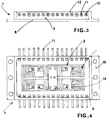
- This invention relates more particularly to materials intended to produce structures such as heat sinks, supports and pole pieces of power circuits, laser diode supports, thermal drains and encapsulation boxes for hybrid microelectronic circuits. power or microwave circuits.
- the term electronic also includes that which is related to optoelectronics.
- these materials are generally associated with ceramic insulating substrates such as alumina for example or with semiconductors such as silicon or gallium arsenide.
- alumina for example
- semiconductors such as silicon or gallium arsenide.
- these components include power elements, their operation leads to significant heat generation. It is therefore necessary, in order not to deteriorate them by excessive heating, to dissipate the calories emitted as quickly as possible.
- a material with the highest possible thermal conductivity is used. In spite of everything, there is a rise in temperature, and if the coefficient of expansion a of the material is too different from that of the alumina substrate, it develops in the latter stresses greater than the resistance of the ceramic resulting in ruptures which affect the conductivity of the assembly and its electrical isolation.
- the material must also have a coefficient compatible with that of alumina and preferably less than 16 ppm / K in the temperature range 30-400 ° C. Furthermore, the possible use of these circuits in vehicles powered by an energy source leads to the search for materials having the lowest possible density and preferably less than 3100 kg.m ⁇ 3 in order to minimize the energy consumption necessary for their propulsion.
- the material has a suitable non-magnetic character as well as a good seal against the outside environment.
- polygranular graphite is used in a volume proportion of between 65 and 90%.
- the material according to the invention differs from the previous ones in that it is no longer only constituted by one or more metals arranged in a sandwich, but by polyphase mixtures of metal and ceramic having an isotropic structure.
- the metal can be pure aluminum, pure magnesium or their alloys. Indeed, these metals combine good conductivity, low density and a low melting point.
- the alloys are chosen according to their conductivity, knowing that the value of this property decreases as a function of the nature and the quantity of the addition elements and that it decreases more when said elements are in solid solution than when they are present in the form of precipitates.
- aluminum alloys those which have little charge of addition elements are used: zinc, copper, magnesium, iron and nickel can be tolerated in small quantities; as for manganese, titanium, vanadium and lithium, they are to be avoided.
- the alloys of the 1000, 5000 and 6000 series are chosen according to the standards of the Aluminum Association, as well as casting alloys and more particularly from these, those containing 7, 10 and 13% of silicon, such as alloys. A356, A357 and A413.2 and among those of the 6000 series, alloys 6061 and 6101 according to the standards of the Aluminum Association.
- the material according to the invention also consists of ceramic elements in the form of equiaxed particles or porous polygranular clusters. All the ceramic elements do not have the same effectiveness and recourse is preferably had to those which have a low dilatability, a high thermal conductivity and a low density. More specifically, silicon carbide or polygranular graphite are used which have an excellent compromise in properties. As regards the particles of silicon carbide (SiC), they have a size of between 0.5 and 400 ⁇ m and more specifically between 3 and 50 ⁇ m.
- the SiC particles must necessarily have a high purity and an SiC content greater than 99% by mass.
- the usual name for this category of SiC is "Green SiC” which follows "GMELIN Handbook of Inorganic Chemistry "8th edition, Supplement Vol.B3, p.60, Ed.Springer Verlag, 1986, has the following composition: % in weight SiC 99.00 to 99.4 C free 0.05 to 0.10 If 0.40 to 0.60 Fe2O3 0.10 to 0.20 Al2O3 0.05 to 0.10 and to which one can compare the "black SiC” usually used in the prior art and the composition of which is as follows: % in weight SiC 98.75 to 99.2 C free 0.10 to 0.15 If 0.50 to 0.70 Fe2O3 0.10 to 0.20 Al2O3 0.25 to 0.35
- the applicant has retained porous preforms in which the volume fraction of the ceramic phase is greater than 50% and less than 90%.
- this preform is infiltrated by the liquid metal according to techniques known to a person skilled in the art (see for example AGKELLY and GI DAVIES, Metallurgical Reviews, 1965 Vol.10 n ° 37), which may require the use of 'applied pressure and / or preheating; but any other known impregnation or molding technique can be used (see US patents 4,376,804 and US 4,777,998, EP 0105,890 and EP 045,510 for example).
- the material is subjected after molding to a heat treatment of the annealed or tempered type to improve mechanical properties.
- the composite material thus obtained may require additional operations of machining and surface treatment (nickel plating, silvering or gilding) well known to those skilled in the art.
- This material is then able to provide the active and / or passive components associated with it with bonding functions (in the case of a support), bonding and heat dissipation functions (in the case of a heat sink) , link, heat dissipation and interconnection functions (in the case of an encapsulation unit) or link, heat dissipation, interconnection and environmental protection functions (in the case of '' an airtight encapsulation box).
- a box is first formed, inside which are housed the semiconductor elements or the insulators and the active circuits, which are closed with a cover which is fixed for example by laser brazing.
- composite materials formed from a metal chosen from AA1050 and A357 alloys and a ceramic were produced in the form of black SiC particles of purity less than 99% and having significant network impurities, on the other hand SiC green with a purity greater than 99% and having weak network impurities as follows: a 120 mm diameter preform was obtained by filtration of a suspension of SiC particles of average size 44.5 ⁇ m containing colloidal silica to ensure its cohesion. After drying, it contained by volume 55% of particles and 5.5% of silica. This preform was infiltrated by the lost wax casting foundry technique. After solidification and demolding, a composite material with a density of 2975 kg / m3 corresponding to the theoretical value was obtained.
- the average coefficient of expansion is 10.5 ppm / K between 30 ° C and 250 ° C. This coefficient is identical in all directions.
- the Young's modulus is 125 GPa and the flexural strength of 307 MPa.
- the electrical resistivity is 11 microhm-cm.
- the thermal conductivity of this composite material was calculated from measurements by the flash method of thermal diffusivity and volume heat; the experimental values (in W / m / k) are given in the following table according to the type of particles and the nature of the alloy:
- the purity of the SiC particles has a much greater impact than the choice of the alloy on the thermal conductivity of the composite material. It is therefore necessary to select SiC particles with a content of controlled network impurities, and an SiC content> 99% by mass (green SiC) to have a conductivity greater than 150 W / m / K.
- a composite material containing the AA1090 alloy and 18% by volume of carbon fibers e.g. P.A.N.
- the coefficient of expansion between 30 and 250 ° C is 55.5 p.p.m./K when it is measured in the direction normal to the plane.
- composite materials were produced comprising a polygranular graphite (reference S2457 from Carbone Lorraine) and various aluminum and magnesium alloys. It is aluminum of purity greater than 99.7% (AA1070), aluminum containing 5% magnesium (AG5), aluminum containing 5% nickel (AN5), aluminum containing 7% of silicon and 0.6% magnesium (AS7G0.6), magnesium containing 5% zinc and about 1% rare earths (RZ5). After solidification and demolding, composite materials were obtained, the properties of expansion, thermal conductivity, density and sometimes also bending, rigidity and electrical resistivity have been determined. All the characteristics obtained are isotropic.
- composite materials were produced comprising different types of polygranular graphites of different densities (references S2512 - S2457 - S2545 from Carbone Lorraine) and aluminum with a purity greater than 99.7%.
- the volume fraction of graphite in these composites is between 50% and 90%.
- All composite materials as well as the composite structures obtained from these materials described in examples 1 to 4 have an average coefficient of expansion between 30 ° C and 250 ° C less than 13 p.pm/K and more than 2 ppm / K in all directions.
Landscapes
- Ceramic Products (AREA)
- Cooling Or The Like Of Semiconductors Or Solid State Devices (AREA)
- Manufacture Of Alloys Or Alloy Compounds (AREA)
Priority Applications (3)
| Application Number | Priority Date | Filing Date | Title |
|---|---|---|---|
| CA002038832A CA2038832C (fr) | 1991-03-22 | 1991-03-22 | Materiau pour composants electroniques passifs |
| EP91420097A EP0504532A1 (de) | 1991-03-22 | 1991-03-22 | Material für passive elektronische Bauelemente |
| JP3104862A JPH0726174B2 (ja) | 1991-03-22 | 1991-04-10 | 補助電子部品材料 |
Applications Claiming Priority (3)
| Application Number | Priority Date | Filing Date | Title |
|---|---|---|---|
| CA002038832A CA2038832C (fr) | 1991-03-22 | 1991-03-22 | Materiau pour composants electroniques passifs |
| EP91420097A EP0504532A1 (de) | 1991-03-22 | 1991-03-22 | Material für passive elektronische Bauelemente |
| JP3104862A JPH0726174B2 (ja) | 1991-03-22 | 1991-04-10 | 補助電子部品材料 |
Publications (1)
| Publication Number | Publication Date |
|---|---|
| EP0504532A1 true EP0504532A1 (de) | 1992-09-23 |
Family
ID=27168885
Family Applications (1)
| Application Number | Title | Priority Date | Filing Date |
|---|---|---|---|
| EP91420097A Ceased EP0504532A1 (de) | 1991-03-22 | 1991-03-22 | Material für passive elektronische Bauelemente |
Country Status (3)
| Country | Link |
|---|---|
| EP (1) | EP0504532A1 (de) |
| JP (1) | JPH0726174B2 (de) |
| CA (1) | CA2038832C (de) |
Cited By (2)
| Publication number | Priority date | Publication date | Assignee | Title |
|---|---|---|---|---|
| EP0798393B1 (de) * | 1996-03-29 | 2001-11-21 | Hitachi Metals, Ltd. | Verfahren zur Herstellung von Aluminium-Verbundmaterial mit niedrigem thermischen Ausdehnungskoeffizient und hoher Wärmeleitfähigkeit |
| US6933531B1 (en) | 1999-12-24 | 2005-08-23 | Ngk Insulators, Ltd. | Heat sink material and method of manufacturing the heat sink material |
Families Citing this family (2)
| Publication number | Priority date | Publication date | Assignee | Title |
|---|---|---|---|---|
| JP5677685B2 (ja) | 2011-01-28 | 2015-02-25 | 株式会社日立製作所 | 回路基板、及びそれを用いた半導体装置 |
| JP2022091435A (ja) * | 2020-12-09 | 2022-06-21 | アドバンスコンポジット株式会社 | 易切削性金属基複合材料及び易切削性金属基複合材料の製造方法 |
Citations (6)
| Publication number | Priority date | Publication date | Assignee | Title |
|---|---|---|---|---|
| US4352120A (en) * | 1979-04-25 | 1982-09-28 | Hitachi, Ltd. | Semiconductor device using SiC as supporter of a semiconductor element |
| EP0064264A2 (de) * | 1981-04-30 | 1982-11-10 | Hitachi, Ltd. | Siliciumkarbidpulvermischung und Verfahren zur Herstellung von Sinterkörpern aus dieser Pulvermischung |
| US4569692A (en) * | 1983-10-06 | 1986-02-11 | Olin Corporation | Low thermal expansivity and high thermal conductivity substrate |
| CH656022A5 (en) * | 1984-02-17 | 1986-05-30 | Battelle Memorial Institute | Composite support for semiconductive units or electrical components |
| US4649990A (en) * | 1985-05-06 | 1987-03-17 | Hitachi, Ltd. | Heat-conducting cooling module |
| GB2206451A (en) * | 1987-04-09 | 1989-01-05 | Reginald John Glass | Substrates for circuit panels |
-
1991
- 1991-03-22 EP EP91420097A patent/EP0504532A1/de not_active Ceased
- 1991-03-22 CA CA002038832A patent/CA2038832C/fr not_active Expired - Fee Related
- 1991-04-10 JP JP3104862A patent/JPH0726174B2/ja not_active Expired - Lifetime
Patent Citations (6)
| Publication number | Priority date | Publication date | Assignee | Title |
|---|---|---|---|---|
| US4352120A (en) * | 1979-04-25 | 1982-09-28 | Hitachi, Ltd. | Semiconductor device using SiC as supporter of a semiconductor element |
| EP0064264A2 (de) * | 1981-04-30 | 1982-11-10 | Hitachi, Ltd. | Siliciumkarbidpulvermischung und Verfahren zur Herstellung von Sinterkörpern aus dieser Pulvermischung |
| US4569692A (en) * | 1983-10-06 | 1986-02-11 | Olin Corporation | Low thermal expansivity and high thermal conductivity substrate |
| CH656022A5 (en) * | 1984-02-17 | 1986-05-30 | Battelle Memorial Institute | Composite support for semiconductive units or electrical components |
| US4649990A (en) * | 1985-05-06 | 1987-03-17 | Hitachi, Ltd. | Heat-conducting cooling module |
| GB2206451A (en) * | 1987-04-09 | 1989-01-05 | Reginald John Glass | Substrates for circuit panels |
Non-Patent Citations (1)
| Title |
|---|
| 34TH ELECTRONIC COMPONENTS CONFERENCE 14 Mai 1984, NEW ORLEANS, US pages 388 - 393; M. KOHARA ET AL.: 'Thermal-stress-free package for flip-chip devices' * |
Cited By (2)
| Publication number | Priority date | Publication date | Assignee | Title |
|---|---|---|---|---|
| EP0798393B1 (de) * | 1996-03-29 | 2001-11-21 | Hitachi Metals, Ltd. | Verfahren zur Herstellung von Aluminium-Verbundmaterial mit niedrigem thermischen Ausdehnungskoeffizient und hoher Wärmeleitfähigkeit |
| US6933531B1 (en) | 1999-12-24 | 2005-08-23 | Ngk Insulators, Ltd. | Heat sink material and method of manufacturing the heat sink material |
Also Published As
| Publication number | Publication date |
|---|---|
| JPH04329845A (ja) | 1992-11-18 |
| CA2038832C (fr) | 1995-09-12 |
| JPH0726174B2 (ja) | 1995-03-22 |
Similar Documents
| Publication | Publication Date | Title |
|---|---|---|
| EP2130932B1 (de) | Dreiphasiger verbundwerkstoff mit hoher wärmeleitfähigkeit und seine herstellung | |
| US6270848B1 (en) | Heat sink material for use with semiconductor component and method for fabricating the same, and semiconductor package using the same | |
| KR101237578B1 (ko) | 열전도율이 높은 금속기질 복합체 | |
| JP3893681B2 (ja) | 半導体用ヒートシンクおよびその製造方法 | |
| US6737168B1 (en) | Composite material and semiconductor device using the same | |
| US5347426A (en) | Electronic device including a passive electronic component | |
| US20090075120A1 (en) | Thermally conductive graphite reinforced alloys | |
| KR20030074623A (ko) | 열전도성 재료 | |
| CN103501939B (zh) | 散热基板用复合材料及其制造方法 | |
| JP2000303126A (ja) | ダイヤモンド−アルミニウム系複合材料およびその製造方法 | |
| WO2007074720A1 (ja) | 半導体素子実装用基板とそれを用いた半導体装置および半導体素子実装用基板の製造方法 | |
| US4793967A (en) | Cermet substrate with spinel adhesion component | |
| EP1732128A1 (de) | Substrat für ein halbleiterbauelement und halbleiterbauelement | |
| EP0363286B1 (de) | Material für elektronische Komponente und Verfahren zur Herstellung dieser Komponente | |
| CA2038832C (fr) | Materiau pour composants electroniques passifs | |
| US4743299A (en) | Cermet substrate with spinel adhesion component | |
| EP0660400B1 (de) | In der Elektronik als Träger gedruckter Schaltungen oder Bauelemente verwendbares Wärmeleitungselement und Herstellungsverfahren dafür | |
| FR2843108A1 (fr) | Procede de fabrication d'un materiau a faible dilatation et dispositif a semi-conducteur utilisant le materiau a faible dilatation | |
| CN119491137B (zh) | 一种利用负膨胀材料降低热膨胀系数的金刚石/铝复合材料的制备方法 | |
| JP2001335859A (ja) | アルミニウム−炭化珪素系複合材料及びその製造方法 | |
| KR102921331B1 (ko) | Cu계 고밀도 방열 복합재 및 점진 액상 소결법을 이용한 이의 제조방법 | |
| JP3655207B2 (ja) | 電子機器用放熱部材およびその製造方法 | |
| JP2001073102A (ja) | 高熱伝導性、低熱膨張性を持つ炭素繊維分散アルミニウム基複合材料 | |
| KR950012940B1 (ko) | 수동전자 소자용 재료 | |
| Chuang et al. | A fluxless Au-Sn bonding process of tin-rich compositions achieved in ambient air |
Legal Events
| Date | Code | Title | Description |
|---|---|---|---|
| PUAI | Public reference made under article 153(3) epc to a published international application that has entered the european phase |
Free format text: ORIGINAL CODE: 0009012 |
|
| AK | Designated contracting states |
Kind code of ref document: A1 Designated state(s): AT BE CH DE ES FR GB IT LI LU NL SE |
|
| 17P | Request for examination filed |
Effective date: 19921008 |
|
| 17Q | First examination report despatched |
Effective date: 19950207 |
|
| STAA | Information on the status of an ep patent application or granted ep patent |
Free format text: STATUS: THE APPLICATION HAS BEEN REFUSED |
|
| 18R | Application refused |
Effective date: 19950731 |