EP0504715A2 - Electrode jetable pour le traitement de blessures, connecteur associé et méthode d'utilisation - Google Patents
Electrode jetable pour le traitement de blessures, connecteur associé et méthode d'utilisation Download PDFInfo
- Publication number
- EP0504715A2 EP0504715A2 EP92104107A EP92104107A EP0504715A2 EP 0504715 A2 EP0504715 A2 EP 0504715A2 EP 92104107 A EP92104107 A EP 92104107A EP 92104107 A EP92104107 A EP 92104107A EP 0504715 A2 EP0504715 A2 EP 0504715A2
- Authority
- EP
- European Patent Office
- Prior art keywords
- electrode
- conductive
- electrode assembly
- sheet
- wound
- Prior art date
- Legal status (The legal status is an assumption and is not a legal conclusion. Google has not performed a legal analysis and makes no representation as to the accuracy of the status listed.)
- Withdrawn
Links
Images
Classifications
-
- A—HUMAN NECESSITIES
- A61—MEDICAL OR VETERINARY SCIENCE; HYGIENE
- A61N—ELECTROTHERAPY; MAGNETOTHERAPY; RADIATION THERAPY; ULTRASOUND THERAPY
- A61N1/00—Electrotherapy; Circuits therefor
- A61N1/02—Details
- A61N1/04—Electrodes
- A61N1/0404—Electrodes for external use
- A61N1/0408—Use-related aspects
- A61N1/0468—Specially adapted for promoting wound healing
-
- A—HUMAN NECESSITIES
- A61—MEDICAL OR VETERINARY SCIENCE; HYGIENE
- A61B—DIAGNOSIS; SURGERY; IDENTIFICATION
- A61B5/00—Measuring for diagnostic purposes; Identification of persons
- A61B5/24—Detecting, measuring or recording bioelectric or biomagnetic signals of the body or parts thereof
- A61B5/25—Bioelectric electrodes therefor
- A61B5/251—Means for maintaining electrode contact with the body
-
- A—HUMAN NECESSITIES
- A61—MEDICAL OR VETERINARY SCIENCE; HYGIENE
- A61B—DIAGNOSIS; SURGERY; IDENTIFICATION
- A61B5/00—Measuring for diagnostic purposes; Identification of persons
- A61B5/24—Detecting, measuring or recording bioelectric or biomagnetic signals of the body or parts thereof
- A61B5/25—Bioelectric electrodes therefor
- A61B5/263—Bioelectric electrodes therefor characterised by the electrode materials
- A61B5/266—Bioelectric electrodes therefor characterised by the electrode materials containing electrolytes, conductive gels or pastes
-
- A—HUMAN NECESSITIES
- A61—MEDICAL OR VETERINARY SCIENCE; HYGIENE
- A61N—ELECTROTHERAPY; MAGNETOTHERAPY; RADIATION THERAPY; ULTRASOUND THERAPY
- A61N1/00—Electrotherapy; Circuits therefor
- A61N1/02—Details
- A61N1/04—Electrodes
- A61N1/0404—Electrodes for external use
- A61N1/0472—Structure-related aspects
- A61N1/048—Electrodes characterised by a specific connection between lead and electrode
-
- A—HUMAN NECESSITIES
- A61—MEDICAL OR VETERINARY SCIENCE; HYGIENE
- A61N—ELECTROTHERAPY; MAGNETOTHERAPY; RADIATION THERAPY; ULTRASOUND THERAPY
- A61N1/00—Electrotherapy; Circuits therefor
- A61N1/02—Details
- A61N1/04—Electrodes
- A61N1/0404—Electrodes for external use
- A61N1/0472—Structure-related aspects
- A61N1/0492—Patch electrodes
- A61N1/0496—Patch electrodes characterised by using specific chemical compositions, e.g. hydrogel compositions, adhesives
-
- A—HUMAN NECESSITIES
- A61—MEDICAL OR VETERINARY SCIENCE; HYGIENE
- A61N—ELECTROTHERAPY; MAGNETOTHERAPY; RADIATION THERAPY; ULTRASOUND THERAPY
- A61N1/00—Electrotherapy; Circuits therefor
- A61N1/18—Applying electric currents by contact electrodes
- A61N1/20—Applying electric currents by contact electrodes continuous direct currents
- A61N1/205—Applying electric currents by contact electrodes continuous direct currents for promoting a biological process
Definitions
- This invention relates to wound treatment, and, more particularly, relates to a disposable wound treatment electrode, combination and method for utilization.
- Skin-contacting (non-invasive) electrodes are now widely used in conjunction with medical apparatus both to monitor patient conditions and to deliver an electrical signal through the electrode to the patient, including delivery of such signals for a variety of purposes, including wound treatment, and, particularly, to enhance soft tissue wound healing.
- the requirements for such an electrode are not as strenuous as are the requirements for an active electrode used to deliver a voltage or current through the skin to the patient.
- the requirements for a non-invasive electrode to be in contact with intact skin is not as strenuous as are the requirements for such an electrode that is to be utilized in contact with a soft tissue wound, and particularly a soft tissue wound that is open as is most often the case.
- the electrode needs to be rated for blood contact (which requires a higher degree of biocompatibility than does an electrode that contacts intact skin), and the materials used in the electrode need to tolerate sterilization (including ability of the materials utilized to avoid break-down or thereafter present an undesirable appearance), must not be subject to ion or chemical migration (which can occur, for example, where the electrode is metallic and/or where potentially toxic materials are utilized), must not shed particles (which can occur, for example, where the skin contact layer is of cotton), and must not unduly cause corrosion (which can occur if a liquid, such as saline solution, escaping from the electrode comes into contact with metallic portions of the releasable connector through which current is applied to the electrode).
- an electrode used for wound contact needs to include materials that allow contouring of the electrode to effect good wound contact over the entire area of the electrode, not include materials that prevent uniform transfer of the signal (such as current) to the patient over the entire dispersing area of the electrode, not include materials that prevent or fail to provide proper skin moisture at the wound to be healed, and be sufficiently economical to allow the electrode to be disposable from a practical standpoint.
- U.S. Patent No. 4,817,594 shows a wound dressing with an envelope formed from sheets of permeable and semipermeable material at one side and a non-adherent, wound contactable sheet of permeable material at the other side, with an electrically non-conductive charcoal fabric (chosen specifically for its anti-bacterial characteristics) engaging an electrically conductive open mesh (which may be nylon impregnated with a metal such as silver) within the envelope.
- an electrically non-conductive charcoal fabric chosen specifically for its anti-bacterial characteristics
- an electrically conductive open mesh which may be nylon impregnated with a metal such as silver
- means may be provided to provide a voltage to the silver impregnated open mesh material and that good conductivity can be ensured by hydrating the dressing prior to use with isotonic saline.
- U.S. Patent No. 4,638,796 shows a method of dressing a wound that includes use of a non-adhering barrier material
- U.S. Patent No. 4,142,521 shows electrostatic soft tissue wound repair enhancement using electret elements with gauze between the electret elements and the wound site.
- U.S. Patent No. 4,919,148 shows transcutaneous electrical stimulation using an electrode assembly having a carbon-rubber electrode with a boss having a bore therein to receive a connector pin, with the electrode having a non-conductive sheet at one side and a woven fabric at the other side forming an enclosure with the electrode and a gel-receiving cavity therein.
- U.S. Patent No. 4,926,878 shows a medical electrode suitable for use with a TENS unit with the electrode including a stud fastener engaging a disperser layer and with the electrode having a gel, such as hydrogel, engaging the dispersive layer
- U.S. Patent No. 4,248,247 shows a post-operative electrode with a conductive sheet formed of rubber with carbon therein
- U.S. Patent No. 4,300,575 shows an air- permeable disposable TENS electrode that includes a carbon filled silicone rubber pad.
- U.S. Patent Nos. 4,934,383 and 4,422,461 show a TENS and/or post-operative (post-op) electrode having a metal layer and a carbon-containing conductive layer
- U.S. Patent No. 4,870,969 shows a medical electrode having a metal foil between a conductive plastic film and a layer of hydrogel and with a stud fastener extending through a backing layer
- U.S. Patent Nos. 4,777,954 and 4,706,680 show an electrode with a hydrogel layer in contact with a metal snap extending through a backing
- U.S. Patent No. 4,955,381 shows a stimulating and monitoring electrode having a metal disperser with wires connected thereto extending from the electrode through a plastic foam cover and with a conductive polymer (hydrogel) layer adjacent to the metal disperser
- U.S. Patent No. 4,771,783 shows a biomedical electrode having an electrically conductive metal film connected through the edge of the electrode to a lead wire
- U.S. Patent No. 4,911,657 (Berlin) shows an EKG electrode having a metal layer and gel matrix with a plug insertable through an insulating sheet to the metal layer
- 4,895,169 shows a stimulating electrode having a metal conductive plate, a porous foam disc to receive saline gel, and a holding ring at the opposite side from the foam base
- U.S. Patent No. 4,893,626 shows an electrode having a natural rubber insulating layer next to an adhesive tape backing and an aqueous gel layer that is conductive.
- U.S. Patent No. 4,635,642 shows a disposable electrode having spaced foam sheets, hydrogel between the sheets, and a plug-in connector insertable through a hole in the top of one sheet
- U.S. Patent No. 4,243,051 shows a disposable electrode with a mesh disperser that includes a metal and a fabric backing with the disperser connected to a wire lead that is positioned across the disperser
- U.S. Patent No. 4,237,886 shows an electrode having a substrate that includes a textile with conductive fibers and a conductive adhesive layer that includes carbon fibers.
- U.S. Patent No. 4,798,208 shows a diagnostic electrode with a tab extending from one edge thereof that is engagable by an alligator-type clip
- U.S. Patent No. 4,657,023 shows an electrode for use with ECG measuring apparatus having a metallic layer with an upwardly extending tab engagable with an alligator-type clip.
- This invention provides an improved electrode, combination and a method for utilization.
- the electrode of this invention will tolerate sterilization, is not subject to ion migration (which can occur where the electrode includes metal), toxicity (which can occur when the electrode includes toxic chemicals), shedding of particles and/or corrosion, is biocompatible and rated for blood contact, is flexible to allow contouring to the wound, provides uniform current density under the disperser sheet of the electrode, provides the proper moist environment to promote healing at the wound site, is non-adhering to the wound site, and is formed of sufficiently low cost materials with low cost assembly to allow practical use of the electrode as a disposable electrode intended for short term application.
- the releasable connector utilizable in combination with the electrode allows delivery of an electrical signal to the electrode and, in addition, the connector and electrode are configured to enable the connector to be used as a tool, as a method of utilization, to facilitate disposal of the electrode.
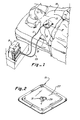
- signal generator 9 provides an electrical output signal, and this electrical output signal is coupled through cable 11, connector 13, and active electrode 15 to soft tissue wound site 17 of patient 19.
- a return electrode 21 engages a separate area of the patient spaced from the wound site, and a return path to generator 9 is provided through cable 23.
- Wound healing signal generator 9 provides an electrical output signal that is suitable for enhancing wound healing.
- Generator 9 may be a known type, and may be, for example, a generator as described in U.S. Patent No. 4,895,154 (Bartelt et al.).
- connector 13 For use as a wound treatment electrode, connector 13 transfers current into the electrode so that the current density remains substantially uniform. Wound treatment is intended to enhance at least wound healing, but with a suitable electrical signal supplied by generator 9, could also enhance edema reduction and/or provide pain suppression. In addition, connector 13 is configured to retard corrosion due to such factors as seepage of fluid from electrode 15.
- Active electrode 15 includes a disperser 25 that is preferably non-metallic and is formed at least in part by carbon.
- Disperser 25 is now preferably a sheet that is configured to be highly conductive (less than 4 ohms/square being preferred) so that the current density under the electrode is essentially flat over substantially the entire surface of the sheet, provides a soft, flexible, moist, and conforming engagement with the wound to be treated, is biocompatible and rated for blood contact (even with DC applied current) with no ion migration, is sterilizable (including gamma ray sterilization without causing chemical breakdown, unacceptable color change or loss of suppleness or strength), does not undergo electrolysis so as to deposit metal ions or other toxic materials into the wound, and is relatively easy and inexpensive to manufacture.
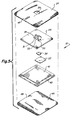
- an outer, or cover, layer 27 (preferably an electrically non-conductive, apertured polyester, non-woven, fabric composition laminated to a white polyethylene thin film that is waterproof, and having an adhesive on one side) has an aperture 29 formed, or cut, in the interior thereof (and preferably centrally positioned within the cover layer).
- the inner (adhesive) side of cover layer, or sheet, 27 engages one side of electrically conductive, disperser layer 25.
- Disperser 25 is now preferably a flexible, extruded carbon-containing silicone rubber sheet (preferably 50% carbon by weight) having no metal oxides or fillers, although other dispersers might be utilized, including dispersers formed of woven graphite cloth.
- carbon fibers might also be utilized with the fibers woven of themselves and/or included in a woven or non-woven electrically non-conductive carrier material, with such fibers being pitch or pan (polyacrylic nitrile) carbon fibers chosen for their low electrical resistivity, nearly pure (99%+) carbon composition, biocompatibility, low cost, and ease of manufacture.
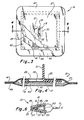
- Disperser 25 has fold-out connector tab 31 integrally formed as a part of the disperser, and tab 31 extends outwardly from a junction 33 formed with the remainder of disperser sheet 25 at the interior (preferably central) portion of the disperser layer (to improve the uniformity of current distribution).
- Tab 31 is extendable through aperture 29 in cover layer 27, with the aperture being preferably of substantially the same dimensions as is the tab (to assure that the tab and aperture have the same dimensions, they may be cut at the same time when the electrode is made). If carbon fibers can be utilized, a lead wire extending through aperture 29 in cover sheet 25 could be an extended carbon fiber.
- Disperser 25 is thin (preferably having a thickness of about 0.045 inches for a carbon-containing silicone rubber sheet) and is flexible so that the disperser can be closely contoured to the wound.
- Tab 31 preferably has holes, or apertures, 35 formed in the disperser tangent to the tops of the U-shaped tab so that the cut ends of the tabs are a radius contour rather than a sharp point where force can concentrate (this has been found to reduce susceptibility of the tab to being severed from the remainder of the disperser layer and thus provides tab protection).
- a reinforcing, or support, strip 37 (preferably a layer of polyethylene tape although medical grade adhesive tape could also be used) covers the entire U-shaped tab and the area immediately adjacent thereto at the side of disperser layer 25 opposite to that in engagement with cover layer 27, and a film, or ribbon, 39 (preferably a polyester film) of the same size as tab 31 is positioned on tape strip 37 at the same side as is tab 31.
- Tape strip 37 absorbs force to also protect the tab against severance from the remainder of the disperser, and the tape strip and polyester ribbon provide a fluid seal at aperture 29 to prevent seepage of fluid from the electrode at the cover side (this provides protection to the releasable connector (also positioned at the cover side of the electrode) from corrosion where saline solution, for example, is used in the electrode).
- Support strip 37 preferably covers only a small area relative to the size of the disperser since strip 37 is non-conductive, and ribbon segment 39 is preferably of the same size as the tab and is positioned in good alignment therewith. The ribbon segment prevents sticking of the tab to the tape strip.
- Sponge-like material is now preferably used to retain saline solution to moisturize the wound to be treated.
- This may be implemented by using one layer or, more preferably, by using a pair of absor- bant sponge-like layers, or sheets, 41 and 43 (preferably gauze sponges, or pads, made from rayon polyester blend, although urethane foam might also be utilized) to be filled, or saturated, with saline solution, with the layers positioned side- by-side in the electrode to provide a fluid retainer conductive medium (electrically conductive hydrogel may also be utilized in some cases in lieu of a gauze sponge).
- one side of layer 41 is in engagement with the side of disperser 25 opposite to the side in engagement with cover sheet 27.
- a layer, or sheet, of wound contacting material (preferably contact fabric) 45 has one side in engagement with one side of sponge layer 43.
- the other side of contact fiber 45 is directly engagable with the soft tissue wound to be treated, and contact fiber 45 therefore needs to be non-adherent to such a wound (contact fiber 45 is preferably a wound dressing material such as described in U.S. Patent No. 4,638,796).
- contact fiber 45 is preferably a wound dressing material such as described in U.S. Patent No. 4,638,796).
- this sheet if substantially non-adhering to the wound, might be used, at least in some cases, as the wound contacting sheet and thereby eliminate the need for the gauze layer or layers.
- Fabric cover layer 27 and wound contact layer 45 have substantially the same dimensions, and, as illustrated best in FIGURES 4 and 5, are larger than disperser layer 25 and sponge layers 41 and 43. As shown, the peripheries 47 and 49 of layers 27 and 45, respectively, are sealed together (by adhesive or heat sealing, for example) to provide an envelope, or bag, having the dispersive layer and the sponge layers (if utilized) enclosed therein.
- Outer cover sheet 27 and wound contact sheet 45 are preferably porous to the extent that the outer layer has the ability to pass water vapor into the air while retaining the fluid (saline solution) within the envelope, and the wound contact layer has the ability to pass fluid (saline solution) to the extent necessary to moisturize the wound.
- a removable release paper backing may be provided at the side of cover layer 27 opposite to the side engaging dispenser layer 31, and the entire assembled electrode may be stored, until use, in a container, such as a sealed paper container.
- the dimensions of the electrode may be varied, as needed, so long as the disperser and the fluid retainer/conductive medium are sufficiently small to be inserted into the envelope formed by the cover sheet and the wound contact sheet, with the portion of the disperser extending from the electrodes being configured to readily permit gripping by the releasable connector.
- a cover sheet and a wound contact sheet of about 4.2 inches square, a disperser sheet of about 3 inches square, fluid retainers of about 3.2 and 3.5 inches square, a tab of about 0.48 inches in length and 0.56 inches width, a protector tab strip of about 1 inch in length and 0.75 inches in width, and a total thickness of the electrode of between about 0.25 inches to 0.50 inches, has proved to be an effective combination, utilizable in conjunction with a releasable clip of about 1 inch in length.
- Releasable connector 13, as shown in FIGURE 6, is preferably an alligator-type clip that readily allows clamping of the connector onto tab 31.
- connector 13 includes two opposing segments, or arms, 51 and 53, each of which includes a jaw portion 55 having a small (preferably circular) metal-toothed gripping portion 57 (the metal teeth are preferably gold-plated to retard corrosion), and a handle portion 59.
- the segments are mounted for rotation with respect to one another about pin 61 so that jaw portions 55 oppose one another and are movable to bring the gripping portions 57 into and out of contact with one another as is common to an alligator-type clip.
- Spring 63 is utilized at handle portions 59 to bias the jaw portions toward one another.
- Connector 13 includes a housing preferably made of plastic material, except for the gripping portions and spring. Cable 11 provides an electrical connection to connector 13 from generator 9. Cable 11 preferably includes a pair of leads 65 and 67, with lead 65 providing current to jaw gripping portion 57 of connector segment 51, and with lead 67 providing current to jaw gripping portion 57 of connector segment 59, as indicated in FIGURE 6.
- Leads 65 and 67 are preferably kept completely insulated, insofar as is practical, and are connected to the toothed areas inside the plastic housing at the jaw portions to better provide insulation to the connecting wires. In this manner, the connector is minimally exposed to the danger of corrosion due to fluid escaping from the electrode and contact impedance is minimized. In addition, even though the spring is exposed to fluid from the electrode, the spring is not subject to electrically accelerated corrosion since the spring receives no treatment current (the jaw gripping portions are directly connected to leads 65 and 67).
- Connector 13 not only provides an effective and reliable connection to the connector tab of the electrode, but, in addition, provides a tool to facilitate handling of the electrode, and particularly for use in disposing of a used electrode.
- the electrode after assembly (and normally with no saline solution in the retainer pads if such pads are utilized), is placed in a sealed package, gamma ray sterilized, and then stored until use. When needed, the package containing the electrode is opened, saline solution is added to the retainer pads (if such pads have been utilized), and the backing on the cover sheet is removed (if such a backing has been used). Connector 13 is clamped onto the electrode tab 31, making sure that the teeth of the jaws are firmly in engagement with the electrically conductive tab, the electrode is placed on the wound and retained thereon by use of paper tape, or the like, placed over the cover sheet and extending to skin contact beyond the wound to be treated. After placement of the electrode on the wound, treatment is commenced.
- the connector may then be used as a tool to remove the used electrode from wound contact without requiring physical contact with the electrode.
- the electrode is intended for one-time temporary use (the connector, on the other hand, is intended for continued use with other electrodes), and the used electrode can be directly delivered by the connector to a disposal unit after use.
- the cable 11 may be disconnected from generator 9 (cables 11 and 23 are normally connected with generator 9 through the use of pin-type plugs or the like).
- the handle portions of the connector are moved toward one another to overcome the spring bias and move the connector jaws away from one another to release the electrode and allow deposit the electrode into the disposal unit.
- Convenience in handling and disposing of the used electrode is therefore enhanced, with isolation of the electrode being maintained throughout disposal to thereby aid in protection of the person responsible for disposing of the electrode, as well as preventing the spread of wound bacteria and the like.
- a person responsible for treatment and/or electrode disposal would be expected to take normal precautions, including, but not necessarily limited to, wearing protective gloves while contacting and/or handling the electrode and/or the connector, and, particularly, in contacting and/or handling the electrode and/or connector after use of the electrode.
- this invention provides for improved wound treatment, including providing an improved electrode, combination and method for utilization.
Landscapes
- Health & Medical Sciences (AREA)
- Life Sciences & Earth Sciences (AREA)
- Animal Behavior & Ethology (AREA)
- Veterinary Medicine (AREA)
- Public Health (AREA)
- Engineering & Computer Science (AREA)
- Biomedical Technology (AREA)
- General Health & Medical Sciences (AREA)
- Nuclear Medicine, Radiotherapy & Molecular Imaging (AREA)
- Molecular Biology (AREA)
- Radiology & Medical Imaging (AREA)
- Surgery (AREA)
- Medical Informatics (AREA)
- Heart & Thoracic Surgery (AREA)
- Pathology (AREA)
- Biophysics (AREA)
- Physics & Mathematics (AREA)
- Chemical & Material Sciences (AREA)
- Chemical Kinetics & Catalysis (AREA)
- General Chemical & Material Sciences (AREA)
- Electrotherapy Devices (AREA)
Applications Claiming Priority (2)
| Application Number | Priority Date | Filing Date | Title |
|---|---|---|---|
| US07/673,941 US5218973A (en) | 1991-03-22 | 1991-03-22 | Disposable wound treatment electrode |
| US673941 | 1991-03-22 |
Publications (2)
| Publication Number | Publication Date |
|---|---|
| EP0504715A2 true EP0504715A2 (fr) | 1992-09-23 |
| EP0504715A3 EP0504715A3 (en) | 1992-11-11 |
Family
ID=24704706
Family Applications (1)
| Application Number | Title | Priority Date | Filing Date |
|---|---|---|---|
| EP19920104107 Withdrawn EP0504715A3 (en) | 1991-03-22 | 1992-03-10 | Disposable wound treatment electrode, combination and method for utilization |
Country Status (3)
| Country | Link |
|---|---|
| US (1) | US5218973A (fr) |
| EP (1) | EP0504715A3 (fr) |
| CA (1) | CA2061837C (fr) |
Cited By (13)
| Publication number | Priority date | Publication date | Assignee | Title |
|---|---|---|---|---|
| WO1996000599A1 (fr) * | 1994-06-30 | 1996-01-11 | Physio-Control Corporation | Electrode a event |
| FR2766376A1 (fr) * | 1997-07-25 | 1999-01-29 | Lhd Lab Hygiene Dietetique | Dispositif de traitement therapeutique de plaies |
| EP1611874A1 (fr) * | 2004-06-29 | 2006-01-04 | Beaunix Co., Ltd. | Sandale ayant un générateur basses frequences |
| EP1808197A4 (fr) * | 2004-10-29 | 2008-04-23 | Transcu Ltd | Electrode et appareil de iontophorese |
| WO2009064641A1 (fr) * | 2007-11-16 | 2009-05-22 | Ethicon, Inc. | Timbres de stimulation de nerfs et méthodes de stimulation de nerfs sélectionnés |
| US7689285B2 (en) | 2003-02-07 | 2010-03-30 | Gerromed Pflege Und Medizintechnik Gmbh & Co. Kg | Multi-layer combination of an electric stimulation electrode and a wound dressing |
| US8062783B2 (en) | 2006-12-01 | 2011-11-22 | Tti Ellebeau, Inc. | Systems, devices, and methods for powering and/or controlling devices, for instance transdermal delivery devices |
| US8126530B2 (en) | 2009-10-26 | 2012-02-28 | Ethicon, Inc. | Offset electrode |
| DE102010053213A1 (de) | 2010-12-03 | 2012-06-06 | Gerromed Pflege- Und Medizintechnik Gmbh | Wundverband zur Elektrostimulation sowie Verfahren zur Herstellung eines solchen Wundverbands |
| US8367094B2 (en) | 2008-01-22 | 2013-02-05 | Michael Szycher | Antimicrobial material and method for making the same |
| EP2593180A4 (fr) * | 2010-07-12 | 2013-12-11 | Moelnlycke Health Care Ab | Pansement multicouche avec régions conductrices |
| DE102015102623A1 (de) | 2015-02-24 | 2016-08-25 | GVG Garabet Vermögensverwaltungsgesellschaft mbH | Autonomes Gewebebehandlungs- und Elektrostimulationssystem für Gewebe sowie Verfahren zum Betreiben und zur Herstellung des autonomen Gewebebehandlungssystems |
| US20250352395A1 (en) * | 2024-05-17 | 2025-11-20 | Teleflex Life Sciences Ii Llc | Antimicrobial hemostatic devices and methods of use and making |
Families Citing this family (56)
| Publication number | Priority date | Publication date | Assignee | Title |
|---|---|---|---|---|
| DK168420B1 (da) * | 1992-03-27 | 1994-03-28 | Coloplast As | Varmebandage |
| US5395398A (en) * | 1993-07-28 | 1995-03-07 | C. R. Bard, Inc. | Microelectric apparatus for the antisepsis, promulgation of healing and analgesia of wound and chronic skin ulcers |
| JP3287788B2 (ja) * | 1996-10-07 | 2002-06-04 | 株式会社脳機能研究所 | 脳波測定用ヘッドギア |
| JPH10230018A (ja) * | 1996-12-16 | 1998-09-02 | Setsuo Shimoda | 電気治療具,皮膚貼着用帯電盤付きバンド及び電荷注入器 |
| US5974344A (en) * | 1998-03-02 | 1999-10-26 | Shoemaker, Ii; Charles | Wound care electrode |
| USD434505S (en) * | 1999-06-17 | 2000-11-28 | Fabio Paolo Marchesi | Microelectric unit for producing stimuli for treatment of the human body |
| US6379427B1 (en) * | 1999-12-06 | 2002-04-30 | Harold E. Siess | Method for protecting exposed surfaces |
| US6716518B2 (en) * | 2000-04-12 | 2004-04-06 | International Business Machines Corporation | Method and system for absorbent sponge membrane for spill protection in electronic devices |
| EP1289602B1 (fr) * | 2000-06-01 | 2009-08-26 | Lifewave Ltd. | Stimulateur electrique relatif au traitement des escarres de decubitus par le biais d'impulsions electriques |
| US7157614B1 (en) * | 2000-12-21 | 2007-01-02 | Fountainhead, Llc | Treatment devices providing targeted antimicrobial action |
| US20030176908A1 (en) * | 2002-03-18 | 2003-09-18 | Hsin-Yi Lin | Water-impregnable electrode for electrical stimulation device |
| GB0224986D0 (en) | 2002-10-28 | 2002-12-04 | Smith & Nephew | Apparatus |
| GB0325126D0 (en) | 2003-10-28 | 2003-12-03 | Smith & Nephew | Apparatus with heat |
| US8758313B2 (en) * | 2003-10-28 | 2014-06-24 | Smith & Nephew Plc | Apparatus and method for wound cleansing with actives |
| GB0325120D0 (en) * | 2003-10-28 | 2003-12-03 | Smith & Nephew | Apparatus with actives |
| US11298453B2 (en) | 2003-10-28 | 2022-04-12 | Smith & Nephew Plc | Apparatus and method for wound cleansing with actives |
| US8062272B2 (en) | 2004-05-21 | 2011-11-22 | Bluesky Medical Group Incorporated | Flexible reduced pressure treatment appliance |
| US10058642B2 (en) | 2004-04-05 | 2018-08-28 | Bluesky Medical Group Incorporated | Reduced pressure treatment system |
| US7909805B2 (en) | 2004-04-05 | 2011-03-22 | Bluesky Medical Group Incorporated | Flexible reduced pressure treatment appliance |
| GB0408492D0 (en) * | 2004-04-16 | 2004-05-19 | Univ Strathclyde | Performance measurement of wound dressings |
| GB0409446D0 (en) | 2004-04-28 | 2004-06-02 | Smith & Nephew | Apparatus |
| JP4304613B2 (ja) * | 2004-07-28 | 2009-07-29 | 日本光電工業株式会社 | 生体用電極ユニット包装体およびその良否判定検査方法 |
| US20080161884A1 (en) * | 2004-12-23 | 2008-07-03 | Mark Chandler | Method and apparatus for treating or preventing a medical condition |
| GB2422549A (en) * | 2005-02-01 | 2006-08-02 | Wound Solutions Ltd | Flexible electrodes comprising a honey-comb mesh and integrated wound stimulation treatment devices |
| US7840272B2 (en) * | 2005-06-03 | 2010-11-23 | Medrelief Inc. | Methods for modulating osteochondral development using bioelectrical stimulation |
| US7933648B2 (en) * | 2005-07-21 | 2011-04-26 | Naim Erturk Tanrisever | High voltage transcutaneous electrical stimulation device and method |
| US8295922B2 (en) | 2005-08-08 | 2012-10-23 | Tti Ellebeau, Inc. | Iontophoresis device |
| US8386030B2 (en) | 2005-08-08 | 2013-02-26 | Tti Ellebeau, Inc. | Iontophoresis device |
| KR20080047600A (ko) | 2005-09-15 | 2008-05-29 | 티티아이 엘뷰 가부시키가이샤 | 로드형 이온토포레시스 장치 |
| GB0519836D0 (en) * | 2005-09-29 | 2005-11-09 | Smartlife Technology Ltd | Contact sensors |
| US7559945B2 (en) | 2006-01-13 | 2009-07-14 | Clarimedix Inc. | Multi-spectral photon therapy device and methods of use |
| GB2434544A (en) * | 2006-01-31 | 2007-08-01 | Wound Solutions Ltd | Wound dressing with skin stimulation electrodes |
| GB2439928A (en) * | 2006-07-13 | 2008-01-16 | Ethicon Inc | Hydrogel wound dressings exhibiting reduced fiber losses |
| US20080161893A1 (en) * | 2006-12-29 | 2008-07-03 | Saurav Paul | Fabric electrode head |
| US9174042B2 (en) | 2007-05-25 | 2015-11-03 | Empi, Inc. | Wound healing electrode set |
| US8298200B2 (en) | 2009-06-01 | 2012-10-30 | Tyco Healthcare Group Lp | System for providing continual drainage in negative pressure wound therapy |
| GB0902368D0 (en) | 2009-02-13 | 2009-04-01 | Smith & Nephew | Wound packing |
| GB0912009D0 (en) * | 2009-07-10 | 2009-08-19 | Univ Strathclyde | Sensor |
| GB0912821D0 (en) * | 2009-07-23 | 2009-08-26 | Univ Cardiff | Improvements in and relating to the reduction and removal of particles |
| CN105797224B (zh) | 2009-12-22 | 2019-11-08 | 史密夫和内修有限公司 | 用于负压伤口治疗的设备和方法 |
| US8791315B2 (en) | 2010-02-26 | 2014-07-29 | Smith & Nephew, Inc. | Systems and methods for using negative pressure wound therapy to manage open abdominal wounds |
| US8355770B2 (en) * | 2010-03-22 | 2013-01-15 | Idt Technology Limited | Conductive silicone material for human skin electrode |
| USD692565S1 (en) | 2010-06-03 | 2013-10-29 | Smith & Nephew, Inc. | Organ protection layer |
| CA140188S (en) | 2010-10-15 | 2011-11-07 | Smith & Nephew | Medical dressing |
| CA140189S (en) | 2010-10-15 | 2011-11-07 | Smith & Nephew | Medical dressing |
| CA2821681C (fr) * | 2010-12-22 | 2023-05-16 | Smith & Nephew, Inc. | Appareils et procedes pour therapie de plaie a pression negative |
| TW201622668A (zh) * | 2014-12-16 | 2016-07-01 | 準訊生醫股份有限公司 | 長效型貼片敷料結構 |
| DE102016117354A1 (de) | 2016-09-15 | 2018-03-15 | Ntt New Textile Technologies Gmbh | Auf der Haut tragbare Elektrode |
| JP6709771B2 (ja) * | 2017-10-05 | 2020-06-17 | アトムメディカル株式会社 | 生体情報検出装置 |
| DE102018104774B3 (de) | 2018-03-02 | 2019-02-28 | Ntt New Textile Technologies Gmbh | Auf der Haut tragbare Elektrode sowie Bekleidungsstück |
| GB201811449D0 (en) | 2018-07-12 | 2018-08-29 | Smith & Nephew | Apparatuses and methods for negative pressure wound therapy |
| RU189006U1 (ru) * | 2018-08-21 | 2019-05-06 | Федеральное государственное автономное образовательное учреждение высшего образования "Южно-Уральский государственный университет (национальный исследовательский университет)" (ФГАОУ ВО "ЮУрГУ (НИУ)") | Устройство контроля функционального состояния новорожденных |
| CA3131757A1 (fr) | 2019-03-07 | 2020-09-10 | Henkel Ag & Co. Kgaa | Adhesif pour electrode seche |
| JP7594805B2 (ja) * | 2019-07-11 | 2024-12-05 | ボマリス イノベーションズ インコーポレイテッド | 外部固定装置が体内に入る部位を治療するためのシステムおよび生体電気装置 |
| GB202000574D0 (en) | 2020-01-15 | 2020-02-26 | Smith & Nephew | Fluidic connectors for negative pressure wound therapy |
| WO2021152919A1 (fr) * | 2020-01-30 | 2021-08-05 | 株式会社村田製作所 | Enveloppe de capteur |
Family Cites Families (46)
| Publication number | Priority date | Publication date | Assignee | Title |
|---|---|---|---|---|
| US2943628A (en) * | 1957-02-27 | 1960-07-05 | William L Howell | Electrode assembly |
| US3565059A (en) * | 1968-06-07 | 1971-02-23 | Hauser Research And Engineerin | Biological electrode and method of making same |
| US4200348A (en) * | 1976-08-04 | 1980-04-29 | Bunker Ramo Corporation | Medical clip |
| US4166457A (en) * | 1976-08-16 | 1979-09-04 | University Of Utah Research Institute | Fluid self-sealing bioelectrode |
| US4142521A (en) * | 1976-12-23 | 1979-03-06 | Hoffmann-La Roche Inc. | Electrostatic soft tissue wound repair enhancement |
| CA1115351A (fr) * | 1977-03-19 | 1981-12-29 | Natsuo Uchiyama | Patte d'electrode de masse pour instrument d'electrochirurgie |
| CA1111503A (fr) * | 1977-04-02 | 1981-10-27 | Isoji Sakurada | Electrode biomedicale |
| US4243051A (en) * | 1979-01-08 | 1981-01-06 | Johnson & Johnson | Disposable electrode |
| US4243052A (en) * | 1979-01-08 | 1981-01-06 | Stimtech, Inc. | Disposable electrode |
| US4300575A (en) * | 1979-06-25 | 1981-11-17 | Staodynamics, Inc. | Air-permeable disposable electrode |
| US4248247A (en) * | 1979-06-28 | 1981-02-03 | Med General, Inc. | Low cost post-operative electrode |
| US4265253A (en) * | 1979-07-09 | 1981-05-05 | Consolidated Medical Equipment Inc. | Skin conducting electrode and electrode assembly |
| US4458696A (en) * | 1979-08-07 | 1984-07-10 | Minnesota Mining And Manufacturing Company | T.E.N.S. Electrode |
| US4633879A (en) * | 1979-11-16 | 1987-01-06 | Lec Tec Corporation | Electrode with disposable interface member |
| US4895169A (en) * | 1980-08-08 | 1990-01-23 | Darox Corporation | Disposable non-invasive stimulating electrode set |
| US4422461A (en) * | 1981-08-12 | 1983-12-27 | George Glumac | Electrode |
| US4638796A (en) * | 1982-02-25 | 1987-01-27 | Winfield Laboratories, Inc. | Method of dressing wounds |
| US4934383A (en) * | 1982-04-23 | 1990-06-19 | George Glumac | Electrode |
| CA1203286A (fr) * | 1982-06-16 | 1986-04-15 | Minnesota Mining And Manufacturing Company | Bioelectrode |
| US4640289A (en) * | 1983-11-14 | 1987-02-03 | Minnesota Mining And Manufacturing Company | Biomedical electrode |
| GB8509978D0 (en) * | 1985-04-18 | 1985-05-30 | Juhasz L | Wound dressings |
| US4635642A (en) * | 1985-07-18 | 1987-01-13 | American Hospital Supply Corporation | Medical electrode with reusable conductor |
| US4738250A (en) * | 1985-10-01 | 1988-04-19 | Mems Technology, Incorporated | Apparatus and method for micro-electric medical stimulation of cells of living animal tissue |
| WO1987003497A1 (fr) * | 1985-12-04 | 1987-06-18 | Kabushiki Kaisya Advance | Dispositif therapeutique compact de basse frequence |
| US4657023A (en) * | 1985-12-23 | 1987-04-14 | Lec Tec Corporation | Self-adhering electrode |
| JPH029771Y2 (fr) * | 1986-05-28 | 1990-03-12 | ||
| US4777954A (en) * | 1986-06-30 | 1988-10-18 | Nepera Inc. | Conductive adhesive medical electrode assemblies |
| US4706680A (en) * | 1986-06-30 | 1987-11-17 | Nepera Inc. | Conductive adhesive medical electrode assemblies |
| US4771783A (en) * | 1986-08-01 | 1988-09-20 | Minnesota Mining And Manufacturing Company | Flat, conformable, biomedical electrode |
| US4715382A (en) * | 1986-08-01 | 1987-12-29 | Minnesota Mining And Manufacturing Company | Flat biomedical electrode with reuseable lead wire |
| US4736752A (en) * | 1986-11-28 | 1988-04-12 | Axelgaard Manufacturing Co., Ltd. | Transcutaneous medical electrode |
| US4893626A (en) * | 1986-12-11 | 1990-01-16 | Henley Ernest J | Electrode for electrotherapy, electrosurgery and monitoring |
| JPH064096B2 (ja) * | 1987-03-25 | 1994-01-19 | 株式会社アドバンス | 皮膚貼着型低周波治療器 |
| US4852571A (en) * | 1987-09-03 | 1989-08-01 | Marquette Electronics | Disposable biopotential electrode |
| US4846181A (en) * | 1987-10-02 | 1989-07-11 | Staodynamics, Inc. | Soft tissue wound healing therapy utilizing pulsed electrical stimulation |
| SE467196B (sv) * | 1987-11-13 | 1992-06-15 | Bjoern Nordenstroem | Anordning foer att tillfoera elektrisk energi till biologisk vaevnad foer att simulera den fysiologiska laekningsprocessen |
| US4798208A (en) * | 1987-12-09 | 1989-01-17 | Faasse Jr Adrian L | Diagnostic electrode |
| US4895154A (en) * | 1988-02-19 | 1990-01-23 | Staodynamics, Inc. | Electronic stimulating device for enhanced healing of soft tissue wounds |
| US4919148A (en) * | 1988-06-13 | 1990-04-24 | Muccio Philip E | Apparatus and method for transcutaneous electrical stimulation |
| US4955381A (en) * | 1988-08-26 | 1990-09-11 | Cardiotronics, Inc. | Multi-pad, multi-function electrode |
| US4870969A (en) * | 1988-09-16 | 1989-10-03 | Somatics, Inc. | Electrode application system and method for electroconvulsive therapy |
| US5078139A (en) * | 1988-09-22 | 1992-01-07 | Minnesota Mining And Manufacturing Company | Biomedical electrode construction |
| CA1335303C (fr) * | 1988-09-22 | 1995-04-18 | Jerome E. Strand | Electrode biomedicale |
| US4926878A (en) * | 1988-12-29 | 1990-05-22 | Labeltape Meditect Inc. | Medical electrode |
| US4911657A (en) * | 1989-03-20 | 1990-03-27 | Lec Tec Corporation | Tethered biomedical electrode connector |
| US4989607A (en) * | 1989-03-30 | 1991-02-05 | Preston Keusch | Highly conductive non-stringy adhesive hydrophilic gels and medical electrode assemblies manufactured therefrom |
-
1991
- 1991-03-22 US US07/673,941 patent/US5218973A/en not_active Expired - Lifetime
-
1992
- 1992-02-25 CA CA002061837A patent/CA2061837C/fr not_active Expired - Lifetime
- 1992-03-10 EP EP19920104107 patent/EP0504715A3/en not_active Withdrawn
Cited By (19)
| Publication number | Priority date | Publication date | Assignee | Title |
|---|---|---|---|---|
| WO1996000599A1 (fr) * | 1994-06-30 | 1996-01-11 | Physio-Control Corporation | Electrode a event |
| FR2766376A1 (fr) * | 1997-07-25 | 1999-01-29 | Lhd Lab Hygiene Dietetique | Dispositif de traitement therapeutique de plaies |
| WO1999004852A1 (fr) * | 1997-07-25 | 1999-02-04 | Laboratoires D'hygiene Et De Dietetique (L.H.D.) | Dispositif de traitement therapeutique de plaies |
| US6411853B1 (en) | 1997-07-25 | 2002-06-25 | Laboratoires D'hygiene Et De Dietetique (L.H.D.) | Device for therapeutic treatment of wounds |
| US7689285B2 (en) | 2003-02-07 | 2010-03-30 | Gerromed Pflege Und Medizintechnik Gmbh & Co. Kg | Multi-layer combination of an electric stimulation electrode and a wound dressing |
| EP1611874A1 (fr) * | 2004-06-29 | 2006-01-04 | Beaunix Co., Ltd. | Sandale ayant un générateur basses frequences |
| EP1808197A4 (fr) * | 2004-10-29 | 2008-04-23 | Transcu Ltd | Electrode et appareil de iontophorese |
| US8062783B2 (en) | 2006-12-01 | 2011-11-22 | Tti Ellebeau, Inc. | Systems, devices, and methods for powering and/or controlling devices, for instance transdermal delivery devices |
| WO2009064641A1 (fr) * | 2007-11-16 | 2009-05-22 | Ethicon, Inc. | Timbres de stimulation de nerfs et méthodes de stimulation de nerfs sélectionnés |
| US8260439B2 (en) | 2007-11-16 | 2012-09-04 | Ethicon, Inc. | Nerve stimulation patches and methods for stimulating selected nerves |
| US8367094B2 (en) | 2008-01-22 | 2013-02-05 | Michael Szycher | Antimicrobial material and method for making the same |
| US8126530B2 (en) | 2009-10-26 | 2012-02-28 | Ethicon, Inc. | Offset electrode |
| US9333333B2 (en) | 2009-10-26 | 2016-05-10 | Ethicon, Inc. | Offset electrode |
| EP2593180A4 (fr) * | 2010-07-12 | 2013-12-11 | Moelnlycke Health Care Ab | Pansement multicouche avec régions conductrices |
| US9161859B2 (en) | 2010-07-12 | 2015-10-20 | Mölnlycke Health Care Ab | Multilayer wound dressing with conductive regions |
| DE102010053213A1 (de) | 2010-12-03 | 2012-06-06 | Gerromed Pflege- Und Medizintechnik Gmbh | Wundverband zur Elektrostimulation sowie Verfahren zur Herstellung eines solchen Wundverbands |
| WO2012072821A2 (fr) | 2010-12-03 | 2012-06-07 | Gerromed Pflege- Und Medizintechnik Gmbh | Pansement pour l'électrostimulation et procédé de fabrication d'un pansement de ce type |
| DE102015102623A1 (de) | 2015-02-24 | 2016-08-25 | GVG Garabet Vermögensverwaltungsgesellschaft mbH | Autonomes Gewebebehandlungs- und Elektrostimulationssystem für Gewebe sowie Verfahren zum Betreiben und zur Herstellung des autonomen Gewebebehandlungssystems |
| US20250352395A1 (en) * | 2024-05-17 | 2025-11-20 | Teleflex Life Sciences Ii Llc | Antimicrobial hemostatic devices and methods of use and making |
Also Published As
| Publication number | Publication date |
|---|---|
| CA2061837C (fr) | 2002-12-17 |
| CA2061837A1 (fr) | 1992-09-23 |
| US5218973A (en) | 1993-06-15 |
| EP0504715A3 (en) | 1992-11-11 |
Similar Documents
| Publication | Publication Date | Title |
|---|---|---|
| US5218973A (en) | Disposable wound treatment electrode | |
| US8868216B2 (en) | Electrode garment | |
| US11224739B2 (en) | Long-term wear electrode | |
| CA1284822C (fr) | Electrode de stimulation electrique | |
| US4867166A (en) | Electrical stimulation electrode | |
| US5133356A (en) | Biomedical electrode having centrally-positioned tab construction | |
| US7043308B2 (en) | Surface electrode for electrical stimulation of tissue | |
| EP2194948B1 (fr) | Electrode à diamètre différentiel | |
| US5571165A (en) | X-ray transmissive transcutaneous stimulating electrode | |
| US4715382A (en) | Flat biomedical electrode with reuseable lead wire | |
| US4708149A (en) | Electrical stimulation electrode | |
| CA2654069C (fr) | Electrode biomedicale | |
| US5226225A (en) | Method of making a biomedical electrode | |
| EP0269200A1 (fr) | Electrode biomédicale plane | |
| JPH065802Y2 (ja) | 電気治療器用導子 | |
| GB2209282A (en) | Improvements in iontophoretic apparatus |
Legal Events
| Date | Code | Title | Description |
|---|---|---|---|
| PUAI | Public reference made under article 153(3) epc to a published international application that has entered the european phase |
Free format text: ORIGINAL CODE: 0009012 |
|
| AK | Designated contracting states |
Kind code of ref document: A2 Designated state(s): DE FR GB IT NL SE |
|
| PUAL | Search report despatched |
Free format text: ORIGINAL CODE: 0009013 |
|
| AK | Designated contracting states |
Kind code of ref document: A3 Designated state(s): DE FR GB IT NL SE |
|
| 17P | Request for examination filed |
Effective date: 19930426 |
|
| 17Q | First examination report despatched |
Effective date: 19950404 |
|
| GRAG | Despatch of communication of intention to grant |
Free format text: ORIGINAL CODE: EPIDOS AGRA |
|
| GRAH | Despatch of communication of intention to grant a patent |
Free format text: ORIGINAL CODE: EPIDOS IGRA |
|
| STAA | Information on the status of an ep patent application or granted ep patent |
Free format text: STATUS: THE APPLICATION IS DEEMED TO BE WITHDRAWN |
|
| 18D | Application deemed to be withdrawn |
Effective date: 19970516 |