EP0506485A2 - Composition de revêtement anti-corrosion - Google Patents
Composition de revêtement anti-corrosion Download PDFInfo
- Publication number
- EP0506485A2 EP0506485A2 EP92302762A EP92302762A EP0506485A2 EP 0506485 A2 EP0506485 A2 EP 0506485A2 EP 92302762 A EP92302762 A EP 92302762A EP 92302762 A EP92302762 A EP 92302762A EP 0506485 A2 EP0506485 A2 EP 0506485A2
- Authority
- EP
- European Patent Office
- Prior art keywords
- weight
- composition
- coating composition
- coating
- electrodeposition
- Prior art date
- Legal status (The legal status is an assumption and is not a legal conclusion. Google has not performed a legal analysis and makes no representation as to the accuracy of the status listed.)
- Granted
Links
Images

Classifications
-
- C—CHEMISTRY; METALLURGY
- C09—DYES; PAINTS; POLISHES; NATURAL RESINS; ADHESIVES; COMPOSITIONS NOT OTHERWISE PROVIDED FOR; APPLICATIONS OF MATERIALS NOT OTHERWISE PROVIDED FOR
- C09D—COATING COMPOSITIONS, e.g. PAINTS, VARNISHES OR LACQUERS; FILLING PASTES; CHEMICAL PAINT OR INK REMOVERS; INKS; CORRECTING FLUIDS; WOODSTAINS; PASTES OR SOLIDS FOR COLOURING OR PRINTING; USE OF MATERIALS THEREFOR
- C09D5/00—Coating compositions, e.g. paints, varnishes or lacquers, characterised by their physical nature or the effects produced; Filling pastes
- C09D5/08—Anti-corrosive paints
Definitions
- This invention relates to an anticorrosive coating composition. More particularly, it relates to an anticorrosive coating composition to be used for the production of coating materials which allow ideal control of electrodepositing property, rustproofed steel sheets which excel in ability to withstand the electrodeposition property, stampping, and spot welding, exhibit high rustproofness, and retain excellent corrosionproofness and adhesion after water soaking of electrodeposition film, and applied to various kind of metals (inclusive of variegated substrates).
- Rustproofed steel plates are copiously used in automobiles and electrical appliances, particularly in doors and hoods and other parts of automobiles.
- the demand for the rustproof steel sheets has been growing at an accelerated rate.
- the rustproofed steel plate is what results from giving a cold rolled steel plate 1 a zinc-nickel plate 2, subjecting the plated steel sheet to a chromating treatment applied with roll coater 3, and depositing an organic coat 4 on the chromated substrate as illustrated in Fig. 1.
- this rustproofed steel sheet is coated with an electrodeposited film 5 and, if need be, further subjected to an intermediate coat and an overcoat.
- the rustproofed steel sheet of this construction is desired to be improved in the ability to withstand the electrodeposition property, stampping, and spot welding, exhibit high rustproofness, and retain corrosionproofness and adhesion after water soaking of electrodeposition film.
- JP-A-62-73,938(1987), JP-A-62-283,161(1987), and JP-A-64-65,179(1989) disclose methods which rely on incorporation of silica for the impartation of affinity during electrodeposition to anticorrosive compositions. Actually, for the acquisition of appropriate affinity for electrodeposition, these methods require their anticorrosive compositions to have silica contents of not less than 27.5%.
- JP-A-62-283,161(1987) discloses a method which relies on incorporation of a hydrophilic resin (such as, for example, polyamide resin) for the impartation of due affinity for electrodeposition to a an anticorrosive coating composition. For the acquisition of appropriate affinity for electrodeposition, this method requires the anticorrosive coating composition thereof to have a hydrophilic resin content of 5 to 40%.
- JP-A-50-146,340(1975) and JP-B-58-19,706(1983) disclose methods which involve incorporation of electroconductive pigments and metal pigments. Since these methods require their anticorrosive compositions to contain a metallic powder, zinc oxide, or a metal carbide which inherently has a relatively large particle diameter, the electrodeposition film coats formed of these anticorrosive coating compositions on steel plates suffer from the disadvantage that they lack smoothness of surface because of great protrusile of coarse underlying particles and betray deficiency in stampping.
- JP-A-62-283,161(1987) discloses a composition which comprises a urethanized polyester resin, a hydrophilic polyamide, and fumed silica. It further discloses a technique for producing an opalescent metallicized film by the incorporation of melamine cyanurate in a clear coating composition. This composition does not manifest an effect suitable for the kind of electrodeposition which is aimed at by this invention.
- An object of this invention is to provide an anticorrosive coating composition which obviates the necessity for incorporating silica, a hydrophilic resin, and an electroconductive pigment and allows control of the density of electrification points in a film of a coating material using the composition.
- Another object of this invention is to provide a coating composition for use on a rustproofed steel plate, which permits appropriate electrodeposition and excels in stampping, spot welding, high anticorrosive ability, and ability to retain anticorrosiveness and adhesion after water soaking electrodeposition film, specifically an anticorrosive coating composition applicable effectively to various materials inclusive of a plurality of substrates.
- an anticorrosive coating composition which comprises 0.05 to 20% by weight of a melamine cyanurate, 5 to 30% by weight of a thermosetting resin, 0 to 20% by weight of a curing agent, and 40 to 95% by weight of a solvent (providing that the total of these components is 100% by weight).
- an anticorrosive coating composition which comprises 0.05 to 20% by weight of a melamine cyanurate, 5 to 30% by weight of an epoxy resin, 1 to 15% by weight of a melamine resin or a blocked isocyanate, 1 to 50% by weight of an organic solvent, and 20 to 80% by weight of water (providing that the total of these components is 100% by weight).
- This invention offers a perfect solution to the problem of unbalanced manifestation of coating properties encountered by the conventional technique by incorporating a melamine cyanurate compound, i.e. an isocyanule ring-containing plane structure compound, in a coating material thereby enabling the produced coating material, when used as a thin-film type coating material for a rustproofed steel plate, to impart affinity for electrodeposition to the steel plate.
- the amount of the melamine cyanurate to be used is in the range of from 0.05 to 20% by weight, preferably 0.1 to 10% by weight, based on the solids content of the coating composition.
- the melamine cyanurate compound to be used in this invention is a compound represented by the chemical formula: (C6H9N9O3) n More specifically, it is an equimolar addition compound of 2,4,6-triamino-1,3,5-triazine (hereinafter referred to as "melamine”) and 2,4,6-trihydroxy-1,3,5-triazine (hereinafter referred to as "cyanuric acid”) and/or a tautomeric isomer thereof.
- melamine 2,4,6-triamino-1,3,5-triazine
- cyanuric acid 2,4,6-trihydroxy-1,3,5-triazine
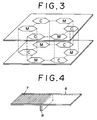
- the compound is presumed to form the so-called graphite type construction, i.e. a construction of layers superimposed as separated by a fixed spatial interval as illustrated in Fig. 3.
- C is a cyanuric acid molecule and M is a melamine molecule.
- the melamine cyanurate compounds answering the description given above are produced by a method which is disclosed in JP-B-33,850(1985), for example, and are commercially available from Nissan Chemical Industry Co., Ltd. as products of MC series (MC-FW, MC-PW, MC-UW, MC-420, MC-520, MC-600, etc.).
- melamine cyanurate is introduced as a flame-retardant for formed articles of polyester resins.
- the melamine cyanurate compounds excel in ability to resist acids and alkalis and are so stable as to yield to no chemical changes in the range of pH 1 to 14. This fact indicates that, since the film formed by cation type electrodeposition is exposed to the hydrogen ion activity of the level of about pH 12, the coating composition of this invention which contains this melamine cyanurate compound has an effect of preventing the electric load to be exerted during the electrodeposition from impairing the initial adhesiveness of the boundary face of the underlying metal to the formed film.
- the melamine cyanurate compounds are sparingly soluble in water and resistance to heat. Melamine cyanurate is not dissolved in organic solvents which are used for conventional coating composition. Melamine cyanurate is barely soluble in a ratio of 0.011 g/100 ml at 70°C in dimethyl sulfoxide. Thus, melamine cyanurate is not dissolved in water which possibly permeates under the film being formed by electrodeposition and do not suffer the water to form a cause for obstruction to the electrodeposition.
- the coating composition is required to contain the anticorrosive composition of this invention in such a ratio that the coating composition will have a melamine cyanurate compound content in the range of from 0.05 to 20% by weight, preferably from 0.1 to 10% by weight, and more preferably from 0.2 to 5% by weight.
- the coating composition is not restricted at all with respect to the other components thereof.
- the kind of main resin and the kind of curing agent may be freely selected from among those generally accepted in the field of coating materials.
- thermosetting resin to be effectively used as a vehicle in this invention such main resins as acrylic resins, polyester resins, alkyd resins, and epoxy resins may be cited.
- epoxy resins prove to be particularly desirable.
- the thermosetting resin may be used in combination with at least one curing agent to be selected from among amino resins such as melamine resins and benzoguanamine resins, isocyanates, and blocked isocyanates.
- melamine resins and blocked isocyanates prove to be particularly desirable.
- the amount of a thermosetting resin to be incorporated in the composition is in the range of from 5 to 30% by weight, preferably from 8 to 25 % by weight, and more preferably from 10 to 20 % by weight.
- the amount of a curing agent to be incorporated in the composition is in the range of from 0 to 50% by weight, preferably from 3 to 18 % by weight, and more preferably from 5 to 15 % by weight.
- a melamine resin or a blocked isocyanate is an ideal choice as the curing agent.
- the amount of the melamine resin or blocked isocyanate to be used in this case is in the range of from 1 to 15% by weight, preferably from 3 to 13 % by weight.
- thermoplastic resins which are effectively usable in this invention include chlorinated olefinic resins such as chlorinated polyethylene and chlorinated polypropylene, vinyl chloride resin, vinyl acetate, vinylidene chloride, and vinyl resins resulting from copolymerization thereof, celluloicresins, acetal resins, alkyd resin, and rubber chloride resins, for example.
- the coating composition of this invention is capable of air drying or curing by heat, for example.
- the pigments which are effectively usable in this invention are those generally used in the field of coating materials, including various organic and inorganic coloring pigments such as titanium dioxide, iron oxides (red oxide and yellow oxide), carbon black, lead chromate, phthalocyanine blue, phthalocyanine green, and quinacridone, extenders such as sedimenting calcium carbonate, vanadium sulfate, kaolin, clay, and calcium carbon, corrosionproofing pigments such as zinc chromate, strontium chromate, calcium chromate, barium chromate, magnesium chromate, red lead, lead suboxide, basic lead chromate, lead cyanamide, calcium metaplumbate, zinc phosphate, aluminum phosphate, calcium phosphate, and mixture of metallic zinc whiteand glass flake powder, brilliant pigments such as flaky aluminum powder paste and titanium-coated mica flake which are intended to emit a metallic like pigments, special pigments such as
- the anticorrosive composition when necessary, may incorporate therein a lubricant such as polyethylene or polyethylene fluoride powder or molybdenum difluoride for the purpose of imparting improved lubricity to the film to be obtained by coating a surface with the composition.
- a lubricant such as polyethylene or polyethylene fluoride powder or molybdenum difluoride
- the pigment and lubricant can be used for the incorporation in amounts not exceeding the critical concentration of extenders.
- the anticorrosive pigment is incorporated in an amount in the range of from 0.5 to 30% by weight, preferably 1 to 25% by weight.
- the solvents which are effectively usable in this invention are those generally used in the field of coating materials. They include aromatic hydrocarbons such as toluene and xylene, aliphatic hydrocarbons such as cyclohexane, ethyl cyclohexane, and perchloroethylene, alcohols such as methyl alcohol, ethyl alcohol, isopropyl alcohol, butyl alcohol, isobutyl alcohol, 2-butyl alcohol, benzyl alcohol, and cyclohexanol, esters such as ethyl acetate, butyl acetate, and isobutyl acetate, ketones such as acetone, methylethyl ketone, methylisobutyl ketone, cyclohexanone, isophorone, and diacetone alcohol, cellosolve, butyl cellosolve, cellosolve acetate, Carbitol acetate, dioxane, tetrahydrofur
- One solvent may be selected from among those cited above so as to suit the vehicle used for the coating composition and the pigment incorporated therein.
- the solvent is used in an amount in the range of from 40 to 95% weight, preferably from 45 to 90 % by weight, and more desirably from 40 to 85 % by weight.
- an epoxy resin is used as the vehicle and a melamine resin or a block isocyanate is used as the curing agent, it is desirable to use the organic solvent in an amount of from 1 to 50% by weight, preferably from 5 to 40 % by weight and water in an amount of from 20 to 80% by weight, preferably from 25 to 75 % by weight.
- the various additives which are effectively usable in this invention are those generally adopted in the field of coating materials. They include curing catalysts such as dodecylbenzene sulfonate, ultraviolet absorbents such as benzophenol-based absorbents, antioxidants such as phenol-based and sulfide-based compounds, surface adjusting agents such as silicones and organic macromolecular compounds, rheology control agents, antisagging agents, and lubricants, for example. These additives are incorporated in the coating composition in a total amount of not more than 5 parts by weight to improve the coating properties of the coating material and the performance of the film to be produced.
- the coating composition incorporating these additives like any conventional coating composition induces the phenomenon of expulsion of the coating composition from a given surface during the formation of a film on the surface and the adhesion of the coating composition to the opposed surfaces of the adjacent superposed surfaces is impaired.
- the coating composition when necessary for the purpose of improving the rust-proofing property thereof, may incorporate therein silica such as fumed silica preferably in an amount of from 0.05 to 20% by weight, more preferably from 0.1 to 10% by weight, based on the solids content of the coating composition.
- silica such as fumed silica preferably in an amount of from 0.05 to 20% by weight, more preferably from 0.1 to 10% by weight, based on the solids content of the coating composition.
- the substrates on which the coating composition of this invention can be effectively applied include not only steel plates but also sheets of electroconductive materials such as rolled steel plates, galvanized steel plates (using such alloys as zinc-aluminum and zinc-nickel), stainless steel plates, aluminum plates, copper plates, and brass plates and plates formed of nonconductive substrates such as FRP, polyethylene, polypropylene, polyamide, acrylic resin, polyvinyl chloride resin, polyvinylidene chloride, polycarbonate, polyurethane, and various species of rubber and modified to acquire electroconductivity as by the incorporation of an electroconductive material in the nonconductive substrates or by the use of the electroless coating technique.
- the plates which are obtained by uniting a plate of an electroconductive primer with a substrates of a nonconductive material by adhesion or fixation may be cited as other examples.
- the method for applying the coating composition of this invention to the surface of a substrate is not specifically limited.
- Such methods of coating as air spray coating, airless coating, electrostatic coating, and brushing which are generally employed are available for the application of the coating composition.
- the gravure coating method, the roll coating method, the curtain coating method, the offset gravure coating method, etc. which are excellent in point of the accuracy of thickness of the applied film and the smoothness of surface of the applied film are also available.
- the coating composition of this invention can be used for the coating which is carried out by any of the methods enumerated above and it can be used in the form of a cation type or anion type electrodepositing coatings.
- an increase density ofpoints of electrification is effective in enhancing characteristic properties such as the uniformity of coated film, the throwing power, the adhesion of the coating composition to and round the edge parts of a substrates, the power to rust-proof the edges, and the appearance of the film formed by electrodeposition.
- the electroconductivity of the coating composition for electrodeposition is improved, the film formed by the application of this coating composition can be increased in thickness.
- the coating composition of this invention allows formation of a coating film of two or more layers.
- the nitrogen atoms in the melamine cyanurate compound possessing a plane construction have a donative propensity (for cations).
- the nitrogen atoms are vertically vibrating and, depending on the electric charge particles closely approximating thereto, are enabled by their own vibration to invert the electric charge.
- the portions of the compound encircling the nitrogen atoms can serve as effective points of electrification. Owing to this fact, the coating composition of this invention is allowed by the melamine cyanurate compound contained only in asmall amount to acquire ideal affinity for electrodeposition and control the density of points of electrification by variation of the content of the melamine cyanurate compound.
- the coating has come to be performed prevalently by the cation type electrodeposition which produces a basic film and involves a reducing electrode reaction and, therefore, avoids desolution of metallic ions and excels in corrosionproofness and resistance to bases.
- the zeta potential of the coating composition of this invention assumes a minus mV above pH 7 and a plus mV below pH 7 as indicated in Table 1. This behavior of the zeta potential coincides with the mechanism of the formation of a film by the cation electrodeposition and, therefore, the formation of this film proceeds smoothly.
- the coating composition of the present invention is dissolved or dispersed to a solvent (e.g., an organic solvent, water, etc.) or a dispersant according as the purpose and use to obtain the paint, lacquer, or coating solution, or electrodeposition bath which is generally called “coating composition”, and then the dissolved or dispereed coating composition is coated on the substrate to form a film.
- a solvent e.g., an organic solvent, water, etc.
- a dispersant e.g., an organic solvent, water, etc.
- the dissolved or dispereed coating composition is coated on the substrate to form a film.
- said coated wet film is cured or hardened by heating, or stoving and baking.
- a coating material containing bisphenol-A type epoxy (produced by Toto Kasei K.K. and marketed under trademark designation of "Epototo YD017”) as a base resin and blocked isocyanate (produced by Nippon Polyurethane Kogyo K.K. and marketed under trademark designation of "Coronate 2513”) as a curing agent at a base resin/curing agent weight ratio (solids content ratio) of 10/3 (content is shown in Tables 2 and 3), containing 2% of polyethylene wax (produced by Hoechst Japan K.K.) as a lubricant, and further containing a melamine cyanurate compound (produced by Nissan Chemical Industry Co., Ltd.
- a cation type electrodeposition coating composition (produced by Nippon Paint Co., Ltd. and marketed under trademark designation of "Power Top U-600 Gray") was superimposed by electrodeposition performed at a voltage of 170 V for two minutes 30 seconds, with the valtage increased over a period of 30 seconds.
- the deposited coating composition was baked at 170°C for 20 minutes. Then, the produced coated steel sheet was subjected to the following tests.
- the content of the melamine cyanurate compound MC-600 and/or that of the silica particles A-300 in the coating composition and the test results are shown in Table 2 and Table 3.
- the coating composition was used for coating after diluting with 400 parts by weight of deionized water.
- o is satisfactory coating condition (showing the same appearance as the surface of a rolled steel sheet and a rolled steel sheet treated with zinc phosphate), ⁇ is inclination to (slight) surface coarseness, x is inclination of (heavy) surface coarseness, and xx is rough textureand gas pinhole.
- the electrodeposition films formed on steel sheets in the working examples and the controls were incised with hatching deep enough to reach the substrate, left standing for 10 days (240 hours) in an aqueous 5 wt% NaCl solution at 55°C, took out from the saline solution, and dried.
- An cellophance tape(2.4 cm in width was) applied to the hatching part of each electrodeposition film and then peeled off the tape to take count of squares peeled from the hatching part by way of determining the electrodeposition film.
- Table 2 and Table 3 The numerical values indicated therein each represent the maximum width of separation along the opposite edges of a given cross-cut part.
- the electrodeposited films formed on steel sheets in the working examples and the controls were incised with perpendicularly intersecting regularly spaced linear cuts defining a total of 100 small squares of 1 mm deep enough to reach the substrate left standing for 20 days (480 hours) in hot water at 50°C, took out the hot water, and dried.
- An cellophane tape 2.4 cm in width was applied to the hatching part and peeled off the the film to take count of squares peeled from the hatching part and evaluate the electrodeposition film based on the number of peeled squares reported in the multiple of 1/100.
- 100/100 is an ideal sample producing no separated square and 0/100 is a sample of total failure retaining absolutely no square.
- Table 2 and Table 3 The results are shown in Table 2 and Table 3.
- spot welding was performed with a single spot welder (produced by Daiden K.K. and marketed under product code of "SL-AJ") at a total of 5,000 points under the conditions of 8,000 A of welding current, 200 kg of electrode pressure, 0.2 second of welding time (three cycles of up-slope in a total of 10 cycles), electrode of chromium copper (copper content 1 to 2%) WR type, 4.5 mm of electrode diameter, 0.2 second of welding time (10 cycles), and 0.6 second of squeezing time (30 cycles).
- the condition of welded spots and the degree of defilement of nugget were visually examined. The results are shown in Table 2 and Table 3. The condition of welded spots and the degree of defilement of nuggest were rated on the following scales.
- o round welded spots without abnormality
- ⁇ forslight distortion round welded spots
- x is insufficient depth of welding
- - is absence of weldability (or no welding performed).
- o absence of defilement
- ⁇ slight defilement
- x heavy defilement
- Spot welding was evalvated by welding surface of a test priece coated with the coating composition of the present invention with surface of a bare steel sheet.
- Various coating compositions were prepared by combining varying main resin and curing agent with a melamine cyanurate compound MC-600, and/or silica particles A-300, and/or various pigments and additives (indicated in Table 4).
- the coating materials were respectively applied in a dry thickness of 1.0 ⁇ m to a substrate indicated in Table 5, and treated at temperatures up to 150°C for 20 seconds, and cured.
- a cation type electrodeposition coating material produced by Nippon Paint K.K.
- Example 30 to 36 about 100 parts of the resin content was diluted with 400 parts of cyclohexanone, in Examples 43-45, about 100 parts of the resin content was diluted with 900 parts of cyclohexanone, and in Examples 37 to 42, about 100 parts of the resin content was diluted with 400 parts of water to obtain the solid conten shown in Table 7.
- Example 1-13 Various coating compositions were prepared by a similar method to Example 1-13 as shown in Table 8. The compositions were subjected to test by a similar method to Examples 1-13. the test results are shown in Table 8.
- the anticorrosive coating composition of this invention having a melamine cyanurate compound incorporated in a coating composition allows control of the density of electrification points of the coat formed by electrodeposition by varying the melamine cyanurate compound content in the composition.
- this invention allows provision of coating compositions excelling in ability to withstand the spot welding, coating composition for rustproof steel plates excelling in ability to withstand the property of electrodeposition, press forming, and spot welding, exhibiting high rust-proofing property, and retaining excellent corrosionproofness and adhesion after water soaking of electrodeposition film, and coating composition effectively applicable to various materials.
- the electrodeposition coating composition using the rustproofing composition of this invention is effective in improving characteristic properties such as the throwing power, the power to rust-proof edges of test piece, and the appearance of an electrodeposition film. Further, the rustproofing composition is capable of improving the electroconductivity of the electrodeposition coating composition itself. Unlike the conventional electrodeposition coating which encounters difficulty in producing a coating in two layers and finds only limited utility in the production of a one-layer finishing the coating compositon using the anticorrosive coating composition of this invention is enabled to produce a coating of two or more layers.
Landscapes
- Chemical & Material Sciences (AREA)
- Life Sciences & Earth Sciences (AREA)
- Engineering & Computer Science (AREA)
- Materials Engineering (AREA)
- Wood Science & Technology (AREA)
- Organic Chemistry (AREA)
- Paints Or Removers (AREA)
Applications Claiming Priority (3)
| Application Number | Priority Date | Filing Date | Title |
|---|---|---|---|
| JP6607391 | 1991-03-29 | ||
| JP6607391 | 1991-03-29 | ||
| JP66073/91 | 1991-03-29 |
Publications (3)
| Publication Number | Publication Date |
|---|---|
| EP0506485A2 true EP0506485A2 (fr) | 1992-09-30 |
| EP0506485A3 EP0506485A3 (en) | 1993-03-10 |
| EP0506485B1 EP0506485B1 (fr) | 2000-03-08 |
Family
ID=13305304
Family Applications (1)
| Application Number | Title | Priority Date | Filing Date |
|---|---|---|---|
| EP92302762A Expired - Lifetime EP0506485B1 (fr) | 1991-03-29 | 1992-03-27 | Composition de revêtement anti-corrosion |
Country Status (5)
| Country | Link |
|---|---|
| US (1) | US5298059A (fr) |
| EP (1) | EP0506485B1 (fr) |
| JP (1) | JP2686205B2 (fr) |
| CA (1) | CA2064275A1 (fr) |
| DE (1) | DE69230737D1 (fr) |
Cited By (2)
| Publication number | Priority date | Publication date | Assignee | Title |
|---|---|---|---|---|
| EP0587038A1 (fr) * | 1992-09-02 | 1994-03-16 | Nippon Paint Co., Ltd. | Composition de revêtement thermodurcissable |
| CN111925724A (zh) * | 2020-07-09 | 2020-11-13 | 深圳市沛绅汇投资发展有限公司 | 一种市政设施用防腐涂料及其施工方法 |
Families Citing this family (19)
| Publication number | Priority date | Publication date | Assignee | Title |
|---|---|---|---|---|
| JP2696466B2 (ja) * | 1991-11-21 | 1998-01-14 | 住友金属工業株式会社 | 有機複合被覆鋼板 |
| TW272206B (fr) * | 1993-12-24 | 1996-03-11 | Nippon Paint Co Ltd | |
| US5560769A (en) * | 1995-09-20 | 1996-10-01 | Advanced Technical Products Supply Co., Inc. | Water-based ceramic marking ink for marking metal surfaces and method using same |
| JP3812035B2 (ja) * | 1997-02-10 | 2006-08-23 | オイレス工業株式会社 | 球帯状シール体ならびにその製造方法 |
| US6455100B1 (en) * | 1999-04-13 | 2002-09-24 | Elisha Technologies Co Llc | Coating compositions for electronic components and other metal surfaces, and methods for making and using the compositions |
| KR20010035294A (ko) * | 2001-02-01 | 2001-05-07 | 정형동 | 속건성 방청 코팅제 |
| EP1546438A2 (fr) * | 2002-09-23 | 2005-06-29 | Elisha Holding LLC | Compositions de revetement pour composants electriques et autres surfaces metalliques, et procedes relatifs a l'utilisation de ces compositions |
| CN1329464C (zh) * | 2002-10-28 | 2007-08-01 | 株式会社东芝 | 热固型涂料 |
| JP4340478B2 (ja) * | 2003-06-09 | 2009-10-07 | ユニプレス株式会社 | フィラーパイプ |
| WO2007013761A1 (fr) * | 2005-07-25 | 2007-02-01 | Posco | Feuille d'acier pre-scellee presentant une anticorrosion et une soudabilite ameliorees et procede de preparation de celle-ci |
| EP2104703B1 (fr) * | 2006-12-27 | 2013-05-29 | Posco | Composition de résine noire à excellente dissipation thermique, procédé de traitement de feuille d'acier revêtue de zinc utilisant cette composition et feuille d'acier ainsi traitée |
| CN101857767A (zh) * | 2010-06-04 | 2010-10-13 | 江苏兰陵涂料技术研究所有限公司 | 低温固化彩色卷材绒面涂料 |
| CN102643594A (zh) * | 2011-02-22 | 2012-08-22 | 项妙祥 | 一种久保新防腐底漆 |
| US9953739B2 (en) * | 2011-08-31 | 2018-04-24 | Tesla Nanocoatings, Inc. | Composition for corrosion prevention |
| MX2012007272A (es) | 2012-06-21 | 2013-12-23 | Mexicano Inst Petrol | Procedimiento de sintesis de una resina polimerica base agua podapa con nanotubos de dioxido de titanio con aplicacion como recubrimiento anticorrosivo. |
| CN104403500A (zh) * | 2014-11-24 | 2015-03-11 | 东莞市日信真空科技有限公司 | 一种高尔夫球杆杆头的防指纹漆及其加工工艺 |
| CN104356724B (zh) * | 2014-12-10 | 2017-01-04 | 李永志 | 一种亲水反射性涂料的制备方法 |
| CN105778672B (zh) * | 2014-12-19 | 2018-02-23 | 天津科瑞达涂料化工有限公司 | 一种超快干抗粘连铸管防腐涂料 |
| CN116179001A (zh) * | 2022-12-09 | 2023-05-30 | 衡阳泰豪通信车辆有限公司 | 一种水性无铬复合涂料及其涂料的制备方法、使用方法 |
Family Cites Families (11)
| Publication number | Priority date | Publication date | Assignee | Title |
|---|---|---|---|---|
| SU503893A1 (ru) * | 1974-07-23 | 1976-02-25 | Государственный Научно-Исследовательский И Проектный Институт Полимерных Клеев Им.Э.Л.Тер-Газаряна | Состав подсло под хлоропреновые клеи |
| DE3102169A1 (de) * | 1981-01-23 | 1982-08-05 | Skw Trostberg Ag, 8223 Trostberg | Waessrige dispersion und verfahren zur beschichtung von werkstoffen |
| JPS5819706A (ja) * | 1981-07-30 | 1983-02-04 | Washi Kosan Kk | 記録担体用ターンテーブル |
| JPS6033850A (ja) * | 1983-08-02 | 1985-02-21 | Mitsubishi Heavy Ind Ltd | 鋳型の塗型方法 |
| JPS6065035A (ja) * | 1983-09-20 | 1985-04-13 | Asahi Chem Ind Co Ltd | ポリアミド樹脂積層構造物 |
| JPS6273938A (ja) * | 1985-09-27 | 1987-04-04 | 日本ペイント株式会社 | 耐食性塗装積層体 |
| JPS62283161A (ja) * | 1986-05-30 | 1987-12-09 | Nippon Paint Co Ltd | 防錆鋼板用塗料組成物 |
| JPS6465179A (en) * | 1987-09-04 | 1989-03-10 | Nippon Paint Co Ltd | Coatings composition for rustpreventive steel sheet having thin coating film |
| JPH02149699A (ja) * | 1988-11-29 | 1990-06-08 | Sumitomo Metal Ind Ltd | 成形性に優れた複合めっき鋼板 |
| JPH0674389B2 (ja) * | 1988-12-09 | 1994-09-21 | タカタ株式会社 | 潤滑用被覆組成物 |
| JPH0328277A (ja) * | 1989-06-26 | 1991-02-06 | Shikoku Chem Corp | メタリック塗料組成物 |
-
1992
- 1992-03-27 EP EP92302762A patent/EP0506485B1/fr not_active Expired - Lifetime
- 1992-03-27 DE DE69230737T patent/DE69230737D1/de not_active Expired - Lifetime
- 1992-03-27 JP JP4071375A patent/JP2686205B2/ja not_active Expired - Lifetime
- 1992-03-27 CA CA002064275A patent/CA2064275A1/fr not_active Abandoned
- 1992-03-30 US US07/859,942 patent/US5298059A/en not_active Expired - Lifetime
Cited By (3)
| Publication number | Priority date | Publication date | Assignee | Title |
|---|---|---|---|---|
| EP0587038A1 (fr) * | 1992-09-02 | 1994-03-16 | Nippon Paint Co., Ltd. | Composition de revêtement thermodurcissable |
| US5439957A (en) * | 1992-09-02 | 1995-08-08 | Nippon Paint Co., Ltd. | Thermosetting coating composition |
| CN111925724A (zh) * | 2020-07-09 | 2020-11-13 | 深圳市沛绅汇投资发展有限公司 | 一种市政设施用防腐涂料及其施工方法 |
Also Published As
| Publication number | Publication date |
|---|---|
| DE69230737D1 (de) | 2000-04-13 |
| EP0506485A3 (en) | 1993-03-10 |
| JPH05279600A (ja) | 1993-10-26 |
| US5298059A (en) | 1994-03-29 |
| CA2064275A1 (fr) | 1992-09-30 |
| JP2686205B2 (ja) | 1997-12-08 |
| EP0506485B1 (fr) | 2000-03-08 |
Similar Documents
| Publication | Publication Date | Title |
|---|---|---|
| EP0506485B1 (fr) | Composition de revêtement anti-corrosion | |
| EP0587038B1 (fr) | Composition de revêtement thermodurcissable | |
| JP5308821B2 (ja) | アイオノマー樹脂を含有する水性分散体及びそれから製造された防錆性アイオノマー塗膜 | |
| KR100345100B1 (ko) | 도료조성물및수지피복금속판 | |
| MXPA02010415A (es) | Revestimientos organicos conductores. | |
| JPH0563302B2 (fr) | ||
| DE19681248B4 (de) | Pulverförmiges Anstrichmittel und Aufbringungsverfahren hierfür | |
| GB2129807A (en) | Cationic electrocoating paint compositions | |
| EP0952894B1 (fr) | Procede d'application de peinture en plusieurs couches | |
| CA2626285A1 (fr) | Procede pour appliquer sur des carrosseries de vehicule et des parties de celles-ci, des revetements ionomeres antirouille | |
| EP1951444A1 (fr) | Procede pour appliquer sur des carrosseries de vehicule et des parties de celles-ci, des revetements ionomeres antirouille | |
| JP4620949B2 (ja) | 耐汚染性と耐溶剤性に優れるプレコート金属板 | |
| JPS59166569A (ja) | メツキ鋼板用高耐食性下塗塗料 | |
| JP2524886B2 (ja) | 塗料組成物及び塗膜形成方法 | |
| JP2623365B2 (ja) | 塗料組成物及び塗膜形成方法 | |
| JP2006142642A (ja) | 耐食性に優れるプレコート金属板 | |
| JP4116945B2 (ja) | 曲げ加工性に優れるプレコート金属板 | |
| JPH08170046A (ja) | 水性コーティング組成物 | |
| JPH08225994A (ja) | 金属表面処理皮膜の形成方法 | |
| JPH04173877A (ja) | 塗料組成物及び塗膜形成方法 | |
| JPH11310749A (ja) | 水系表面処理剤、表面処理鋼板、及びその製造方法 | |
| JPS62952B2 (fr) | ||
| JP2001348673A (ja) | 耐食性に優れる有機被覆表面処理金属材およびその製造方法 | |
| JPH0466672A (ja) | クロメート処理液 | |
| JPH0693216A (ja) | 電着塗料組成物および塗膜形成方法 |
Legal Events
| Date | Code | Title | Description |
|---|---|---|---|
| PUAI | Public reference made under article 153(3) epc to a published international application that has entered the european phase |
Free format text: ORIGINAL CODE: 0009012 |
|
| AK | Designated contracting states |
Kind code of ref document: A2 Designated state(s): BE DE ES FR GB SE |
|
| PUAL | Search report despatched |
Free format text: ORIGINAL CODE: 0009013 |
|
| AK | Designated contracting states |
Kind code of ref document: A3 Designated state(s): BE DE ES FR GB SE |
|
| 17P | Request for examination filed |
Effective date: 19930902 |
|
| RAP1 | Party data changed (applicant data changed or rights of an application transferred) |
Owner name: SUMITOMO METAL INDUSTRIES, LTD. Owner name: NIPPON PAINT CO., LTD. |
|
| 17Q | First examination report despatched |
Effective date: 19950227 |
|
| GRAG | Despatch of communication of intention to grant |
Free format text: ORIGINAL CODE: EPIDOS AGRA |
|
| GRAG | Despatch of communication of intention to grant |
Free format text: ORIGINAL CODE: EPIDOS AGRA |
|
| GRAH | Despatch of communication of intention to grant a patent |
Free format text: ORIGINAL CODE: EPIDOS IGRA |
|
| GRAH | Despatch of communication of intention to grant a patent |
Free format text: ORIGINAL CODE: EPIDOS IGRA |
|
| GRAA | (expected) grant |
Free format text: ORIGINAL CODE: 0009210 |
|
| AK | Designated contracting states |
Kind code of ref document: B1 Designated state(s): BE DE ES FR GB SE |
|
| PG25 | Lapsed in a contracting state [announced via postgrant information from national office to epo] |
Ref country code: SE Free format text: THE PATENT HAS BEEN ANNULLED BY A DECISION OF A NATIONAL AUTHORITY Effective date: 20000308 Ref country code: FR Free format text: LAPSE BECAUSE OF FAILURE TO SUBMIT A TRANSLATION OF THE DESCRIPTION OR TO PAY THE FEE WITHIN THE PRESCRIBED TIME-LIMIT Effective date: 20000308 Ref country code: ES Free format text: THE PATENT HAS BEEN ANNULLED BY A DECISION OF A NATIONAL AUTHORITY Effective date: 20000308 Ref country code: BE Free format text: LAPSE BECAUSE OF FAILURE TO SUBMIT A TRANSLATION OF THE DESCRIPTION OR TO PAY THE FEE WITHIN THE PRESCRIBED TIME-LIMIT Effective date: 20000308 |
|
| REF | Corresponds to: |
Ref document number: 69230737 Country of ref document: DE Date of ref document: 20000413 |
|
| PG25 | Lapsed in a contracting state [announced via postgrant information from national office to epo] |
Ref country code: DE Free format text: LAPSE BECAUSE OF FAILURE TO SUBMIT A TRANSLATION OF THE DESCRIPTION OR TO PAY THE FEE WITHIN THE PRESCRIBED TIME-LIMIT Effective date: 20000609 |
|
| EN | Fr: translation not filed | ||
| PLBE | No opposition filed within time limit |
Free format text: ORIGINAL CODE: 0009261 |
|
| STAA | Information on the status of an ep patent application or granted ep patent |
Free format text: STATUS: NO OPPOSITION FILED WITHIN TIME LIMIT |
|
| 26N | No opposition filed | ||
| REG | Reference to a national code |
Ref country code: GB Ref legal event code: IF02 |
|
| PGFP | Annual fee paid to national office [announced via postgrant information from national office to epo] |
Ref country code: GB Payment date: 20030326 Year of fee payment: 12 |
|
| PG25 | Lapsed in a contracting state [announced via postgrant information from national office to epo] |
Ref country code: GB Free format text: LAPSE BECAUSE OF NON-PAYMENT OF DUE FEES Effective date: 20040327 |
|
| GBPC | Gb: european patent ceased through non-payment of renewal fee |
Effective date: 20040327 |