EP0507409A1 - Druckfilm - Google Patents
Druckfilm Download PDFInfo
- Publication number
- EP0507409A1 EP0507409A1 EP92200921A EP92200921A EP0507409A1 EP 0507409 A1 EP0507409 A1 EP 0507409A1 EP 92200921 A EP92200921 A EP 92200921A EP 92200921 A EP92200921 A EP 92200921A EP 0507409 A1 EP0507409 A1 EP 0507409A1
- Authority
- EP
- European Patent Office
- Prior art keywords
- ink receptive
- layer
- receptive layer
- ink
- printing film
- Prior art date
- Legal status (The legal status is an assumption and is not a legal conclusion. Google has not performed a legal analysis and makes no representation as to the accuracy of the status listed.)
- Granted
Links
- 238000007639 printing Methods 0.000 title claims abstract description 61
- 239000002904 solvent Substances 0.000 claims abstract description 55
- 238000001035 drying Methods 0.000 claims abstract description 41
- 229920000642 polymer Polymers 0.000 claims abstract description 32
- 229920001577 copolymer Polymers 0.000 claims abstract description 29
- 239000000758 substrate Substances 0.000 claims abstract description 17
- 239000002131 composite material Substances 0.000 claims abstract description 16
- CNPVJWYWYZMPDS-UHFFFAOYSA-N 2-methyldecane Chemical compound CCCCCCCCC(C)C CNPVJWYWYZMPDS-UHFFFAOYSA-N 0.000 claims abstract description 9
- 230000003746 surface roughness Effects 0.000 claims abstract description 6
- 150000001338 aliphatic hydrocarbons Chemical class 0.000 claims abstract description 3
- 239000010410 layer Substances 0.000 claims abstract 22
- 239000013047 polymeric layer Substances 0.000 claims abstract 2
- -1 poly(n-butyl methacrylate) Polymers 0.000 claims description 27
- 239000000203 mixture Substances 0.000 claims description 24
- VYPSYNLAJGMNEJ-UHFFFAOYSA-N Silicium dioxide Chemical compound O=[Si]=O VYPSYNLAJGMNEJ-UHFFFAOYSA-N 0.000 claims description 22
- SOGAXMICEFXMKE-UHFFFAOYSA-N Butylmethacrylate Chemical compound CCCCOC(=O)C(C)=C SOGAXMICEFXMKE-UHFFFAOYSA-N 0.000 claims description 18
- 229920005989 resin Polymers 0.000 claims description 12
- 239000011347 resin Substances 0.000 claims description 12
- RUMACXVDVNRZJZ-UHFFFAOYSA-N 2-methylpropyl 2-methylprop-2-enoate Chemical compound CC(C)COC(=O)C(C)=C RUMACXVDVNRZJZ-UHFFFAOYSA-N 0.000 claims description 9
- PPBRXRYQALVLMV-UHFFFAOYSA-N Styrene Chemical compound C=CC1=CC=CC=C1 PPBRXRYQALVLMV-UHFFFAOYSA-N 0.000 claims description 7
- 239000002216 antistatic agent Substances 0.000 claims description 6
- 229920000205 poly(isobutyl methacrylate) Polymers 0.000 claims description 5
- KAKZBPTYRLMSJV-UHFFFAOYSA-N Butadiene Chemical compound C=CC=C KAKZBPTYRLMSJV-UHFFFAOYSA-N 0.000 claims description 4
- 229920001490 poly(butyl methacrylate) polymer Polymers 0.000 claims description 4
- 239000000377 silicon dioxide Substances 0.000 claims description 4
- NIXOWILDQLNWCW-UHFFFAOYSA-M Acrylate Chemical compound [O-]C(=O)C=C NIXOWILDQLNWCW-UHFFFAOYSA-M 0.000 claims description 3
- CERQOIWHTDAKMF-UHFFFAOYSA-M Methacrylate Chemical compound CC(=C)C([O-])=O CERQOIWHTDAKMF-UHFFFAOYSA-M 0.000 claims description 2
- 239000011236 particulate material Substances 0.000 claims 1
- 238000001459 lithography Methods 0.000 abstract description 4
- 239000000976 ink Substances 0.000 description 153
- 238000000576 coating method Methods 0.000 description 31
- 239000011248 coating agent Substances 0.000 description 28
- 238000012360 testing method Methods 0.000 description 24
- ZWEHNKRNPOVVGH-UHFFFAOYSA-N 2-Butanone Chemical compound CCC(C)=O ZWEHNKRNPOVVGH-UHFFFAOYSA-N 0.000 description 21
- YXFVVABEGXRONW-UHFFFAOYSA-N Toluene Chemical compound CC1=CC=CC=C1 YXFVVABEGXRONW-UHFFFAOYSA-N 0.000 description 18
- 238000000034 method Methods 0.000 description 16
- 239000011230 binding agent Substances 0.000 description 15
- 238000007645 offset printing Methods 0.000 description 15
- OKKJLVBELUTLKV-UHFFFAOYSA-N Methanol Chemical compound OC OKKJLVBELUTLKV-UHFFFAOYSA-N 0.000 description 12
- 125000001931 aliphatic group Chemical group 0.000 description 10
- 230000003647 oxidation Effects 0.000 description 10
- 238000007254 oxidation reaction Methods 0.000 description 10
- 229920000139 polyethylene terephthalate Polymers 0.000 description 10
- 239000005020 polyethylene terephthalate Substances 0.000 description 10
- 239000003981 vehicle Substances 0.000 description 9
- 230000009102 absorption Effects 0.000 description 8
- 238000010521 absorption reaction Methods 0.000 description 8
- 239000002245 particle Substances 0.000 description 8
- 239000002985 plastic film Substances 0.000 description 8
- 229920006255 plastic film Polymers 0.000 description 8
- RSWGJHLUYNHPMX-UHFFFAOYSA-N Abietic-Saeure Natural products C12CCC(C(C)C)=CC2=CCC2C1(C)CCCC2(C)C(O)=O RSWGJHLUYNHPMX-UHFFFAOYSA-N 0.000 description 7
- 229920000877 Melamine resin Polymers 0.000 description 7
- KHPCPRHQVVSZAH-HUOMCSJISA-N Rosin Natural products O(C/C=C/c1ccccc1)[C@H]1[C@H](O)[C@@H](O)[C@@H](O)[C@@H](CO)O1 KHPCPRHQVVSZAH-HUOMCSJISA-N 0.000 description 7
- 239000000463 material Substances 0.000 description 7
- 239000003921 oil Substances 0.000 description 7
- 235000019198 oils Nutrition 0.000 description 7
- 239000000123 paper Substances 0.000 description 7
- 229920002689 polyvinyl acetate Polymers 0.000 description 7
- 239000011118 polyvinyl acetate Substances 0.000 description 7
- KHPCPRHQVVSZAH-UHFFFAOYSA-N trans-cinnamyl beta-D-glucopyranoside Natural products OC1C(O)C(O)C(CO)OC1OCC=CC1=CC=CC=C1 KHPCPRHQVVSZAH-UHFFFAOYSA-N 0.000 description 7
- 239000003086 colorant Substances 0.000 description 6
- 239000011159 matrix material Substances 0.000 description 6
- XTXRWKRVRITETP-UHFFFAOYSA-N Vinyl acetate Chemical compound CC(=O)OC=C XTXRWKRVRITETP-UHFFFAOYSA-N 0.000 description 5
- 229920006322 acrylamide copolymer Polymers 0.000 description 5
- 239000006258 conductive agent Substances 0.000 description 5
- 150000002148 esters Chemical class 0.000 description 5
- IVJISJACKSSFGE-UHFFFAOYSA-N formaldehyde;1,3,5-triazine-2,4,6-triamine Chemical compound O=C.NC1=NC(N)=NC(N)=N1 IVJISJACKSSFGE-UHFFFAOYSA-N 0.000 description 5
- 239000011521 glass Substances 0.000 description 5
- 239000000049 pigment Substances 0.000 description 5
- 229920006267 polyester film Polymers 0.000 description 5
- XNWFRZJHXBZDAG-UHFFFAOYSA-N 2-METHOXYETHANOL Chemical compound COCCO XNWFRZJHXBZDAG-UHFFFAOYSA-N 0.000 description 4
- VTYYLEPIZMXCLO-UHFFFAOYSA-L Calcium carbonate Chemical compound [Ca+2].[O-]C([O-])=O VTYYLEPIZMXCLO-UHFFFAOYSA-L 0.000 description 4
- 239000003377 acid catalyst Substances 0.000 description 4
- 229920000180 alkyd Polymers 0.000 description 4
- 229920001519 homopolymer Polymers 0.000 description 4
- 239000007788 liquid Substances 0.000 description 4
- OMNKZBIFPJNNIO-UHFFFAOYSA-N n-(2-methyl-4-oxopentan-2-yl)prop-2-enamide Chemical compound CC(=O)CC(C)(C)NC(=O)C=C OMNKZBIFPJNNIO-UHFFFAOYSA-N 0.000 description 4
- 229920003023 plastic Polymers 0.000 description 4
- 239000004033 plastic Substances 0.000 description 4
- 229920000728 polyester Polymers 0.000 description 4
- 230000008569 process Effects 0.000 description 4
- 150000003839 salts Chemical group 0.000 description 4
- 239000000126 substance Substances 0.000 description 4
- 238000012546 transfer Methods 0.000 description 4
- IMROMDMJAWUWLK-UHFFFAOYSA-N Ethenol Chemical compound OC=C IMROMDMJAWUWLK-UHFFFAOYSA-N 0.000 description 3
- AVKUERGKIZMTKX-NJBDSQKTSA-N ampicillin Chemical compound C1([C@@H](N)C(=O)N[C@H]2[C@H]3SC([C@@H](N3C2=O)C(O)=O)(C)C)=CC=CC=C1 AVKUERGKIZMTKX-NJBDSQKTSA-N 0.000 description 3
- 230000008901 benefit Effects 0.000 description 3
- 229920005596 polymer binder Polymers 0.000 description 3
- 239000002491 polymer binding agent Substances 0.000 description 3
- 229920002959 polymer blend Polymers 0.000 description 3
- 238000006116 polymerization reaction Methods 0.000 description 3
- 229920000098 polyolefin Polymers 0.000 description 3
- 238000012216 screening Methods 0.000 description 3
- 239000000344 soap Substances 0.000 description 3
- GCLGEJMYGQKIIW-UHFFFAOYSA-H sodium hexametaphosphate Chemical compound [Na]OP1(=O)OP(=O)(O[Na])OP(=O)(O[Na])OP(=O)(O[Na])OP(=O)(O[Na])OP(=O)(O[Na])O1 GCLGEJMYGQKIIW-UHFFFAOYSA-H 0.000 description 3
- 125000006850 spacer group Chemical group 0.000 description 3
- 238000005303 weighing Methods 0.000 description 3
- 241000865004 Alinda Species 0.000 description 2
- XEEYBQQBJWHFJM-UHFFFAOYSA-N Iron Chemical compound [Fe] XEEYBQQBJWHFJM-UHFFFAOYSA-N 0.000 description 2
- NIXOWILDQLNWCW-UHFFFAOYSA-N acrylic acid group Chemical group C(C=C)(=O)O NIXOWILDQLNWCW-UHFFFAOYSA-N 0.000 description 2
- 239000000654 additive Substances 0.000 description 2
- 125000005907 alkyl ester group Chemical group 0.000 description 2
- WPYMKLBDIGXBTP-UHFFFAOYSA-N benzoic acid Chemical compound OC(=O)C1=CC=CC=C1 WPYMKLBDIGXBTP-UHFFFAOYSA-N 0.000 description 2
- 229910000019 calcium carbonate Inorganic materials 0.000 description 2
- 125000004432 carbon atom Chemical group C* 0.000 description 2
- 150000001735 carboxylic acids Chemical class 0.000 description 2
- 229910017052 cobalt Inorganic materials 0.000 description 2
- 239000010941 cobalt Substances 0.000 description 2
- GUTLYIVDDKVIGB-UHFFFAOYSA-N cobalt atom Chemical compound [Co] GUTLYIVDDKVIGB-UHFFFAOYSA-N 0.000 description 2
- 230000001427 coherent effect Effects 0.000 description 2
- 230000001143 conditioned effect Effects 0.000 description 2
- 229910002026 crystalline silica Inorganic materials 0.000 description 2
- 239000000975 dye Substances 0.000 description 2
- 230000000694 effects Effects 0.000 description 2
- 239000011133 lead Substances 0.000 description 2
- 125000005481 linolenic acid group Chemical group 0.000 description 2
- 230000007246 mechanism Effects 0.000 description 2
- 238000012986 modification Methods 0.000 description 2
- 230000004048 modification Effects 0.000 description 2
- 125000004108 n-butyl group Chemical group [H]C([H])([H])C([H])([H])C([H])([H])C([H])([H])* 0.000 description 2
- 125000005608 naphthenic acid group Chemical group 0.000 description 2
- 125000005473 octanoic acid group Chemical class 0.000 description 2
- 150000007524 organic acids Chemical class 0.000 description 2
- 235000005985 organic acids Nutrition 0.000 description 2
- VLTOSDJJTWPWLS-UHFFFAOYSA-N pent-2-ynal Chemical compound CCC#CC=O VLTOSDJJTWPWLS-UHFFFAOYSA-N 0.000 description 2
- 239000004014 plasticizer Substances 0.000 description 2
- 229920003229 poly(methyl methacrylate) Polymers 0.000 description 2
- 235000013824 polyphenols Nutrition 0.000 description 2
- 239000012260 resinous material Substances 0.000 description 2
- 235000012239 silicon dioxide Nutrition 0.000 description 2
- 230000003068 static effect Effects 0.000 description 2
- JOXIMZWYDAKGHI-UHFFFAOYSA-N toluene-4-sulfonic acid Chemical compound CC1=CC=C(S(O)(=O)=O)C=C1 JOXIMZWYDAKGHI-UHFFFAOYSA-N 0.000 description 2
- SMZOUWXMTYCWNB-UHFFFAOYSA-N 2-(2-methoxy-5-methylphenyl)ethanamine Chemical compound COC1=CC=C(C)C=C1CCN SMZOUWXMTYCWNB-UHFFFAOYSA-N 0.000 description 1
- 229920000178 Acrylic resin Polymers 0.000 description 1
- 239000004925 Acrylic resin Substances 0.000 description 1
- 239000005711 Benzoic acid Substances 0.000 description 1
- OYPRJOBELJOOCE-UHFFFAOYSA-N Calcium Chemical compound [Ca] OYPRJOBELJOOCE-UHFFFAOYSA-N 0.000 description 1
- BVKZGUZCCUSVTD-UHFFFAOYSA-L Carbonate Chemical compound [O-]C([O-])=O BVKZGUZCCUSVTD-UHFFFAOYSA-L 0.000 description 1
- 229920008347 Cellulose acetate propionate Polymers 0.000 description 1
- 229920000742 Cotton Polymers 0.000 description 1
- 239000013032 Hydrocarbon resin Substances 0.000 description 1
- 235000004431 Linum usitatissimum Nutrition 0.000 description 1
- 240000006240 Linum usitatissimum Species 0.000 description 1
- WHXSMMKQMYFTQS-UHFFFAOYSA-N Lithium Chemical compound [Li] WHXSMMKQMYFTQS-UHFFFAOYSA-N 0.000 description 1
- PWHULOQIROXLJO-UHFFFAOYSA-N Manganese Chemical compound [Mn] PWHULOQIROXLJO-UHFFFAOYSA-N 0.000 description 1
- VVQNEPGJFQJSBK-UHFFFAOYSA-N Methyl methacrylate Chemical compound COC(=O)C(C)=C VVQNEPGJFQJSBK-UHFFFAOYSA-N 0.000 description 1
- 239000004642 Polyimide Substances 0.000 description 1
- 239000004793 Polystyrene Substances 0.000 description 1
- 229920000297 Rayon Polymers 0.000 description 1
- BZHJMEDXRYGGRV-UHFFFAOYSA-N Vinyl chloride Chemical compound ClC=C BZHJMEDXRYGGRV-UHFFFAOYSA-N 0.000 description 1
- QYKIQEUNHZKYBP-UHFFFAOYSA-N Vinyl ether Chemical compound C=COC=C QYKIQEUNHZKYBP-UHFFFAOYSA-N 0.000 description 1
- HCHKCACWOHOZIP-UHFFFAOYSA-N Zinc Chemical compound [Zn] HCHKCACWOHOZIP-UHFFFAOYSA-N 0.000 description 1
- QCWXUUIWCKQGHC-UHFFFAOYSA-N Zirconium Chemical compound [Zr] QCWXUUIWCKQGHC-UHFFFAOYSA-N 0.000 description 1
- 239000002253 acid Substances 0.000 description 1
- 229920006243 acrylic copolymer Polymers 0.000 description 1
- 229920006397 acrylic thermoplastic Polymers 0.000 description 1
- 230000002411 adverse Effects 0.000 description 1
- 229910052784 alkaline earth metal Inorganic materials 0.000 description 1
- RREGISFBPQOLTM-UHFFFAOYSA-N alumane;trihydrate Chemical compound O.O.O.[AlH3] RREGISFBPQOLTM-UHFFFAOYSA-N 0.000 description 1
- 229910052782 aluminium Inorganic materials 0.000 description 1
- 229910052787 antimony Inorganic materials 0.000 description 1
- WATWJIUSRGPENY-UHFFFAOYSA-N antimony atom Chemical compound [Sb] WATWJIUSRGPENY-UHFFFAOYSA-N 0.000 description 1
- 125000003118 aryl group Chemical group 0.000 description 1
- 235000010233 benzoic acid Nutrition 0.000 description 1
- 230000005540 biological transmission Effects 0.000 description 1
- 229910052797 bismuth Inorganic materials 0.000 description 1
- JCXGWMGPZLAOME-UHFFFAOYSA-N bismuth atom Chemical compound [Bi] JCXGWMGPZLAOME-UHFFFAOYSA-N 0.000 description 1
- 238000009835 boiling Methods 0.000 description 1
- VMRHCZNACCBXEJ-UHFFFAOYSA-N butyl 2-methylprop-2-enoate;butyl prop-2-enoate Chemical compound CCCCOC(=O)C=C.CCCCOC(=O)C(C)=C VMRHCZNACCBXEJ-UHFFFAOYSA-N 0.000 description 1
- BNMJSBUIDQYHIN-UHFFFAOYSA-N butyl dihydrogen phosphate Chemical compound CCCCOP(O)(O)=O BNMJSBUIDQYHIN-UHFFFAOYSA-N 0.000 description 1
- 229910052791 calcium Inorganic materials 0.000 description 1
- 239000011575 calcium Substances 0.000 description 1
- 239000003054 catalyst Substances 0.000 description 1
- 229920002678 cellulose Polymers 0.000 description 1
- 229920002301 cellulose acetate Polymers 0.000 description 1
- 229920006217 cellulose acetate butyrate Polymers 0.000 description 1
- 239000012612 commercial material Substances 0.000 description 1
- 230000003750 conditioning effect Effects 0.000 description 1
- 239000004020 conductor Substances 0.000 description 1
- 238000004132 cross linking Methods 0.000 description 1
- 238000007766 curtain coating Methods 0.000 description 1
- 230000007812 deficiency Effects 0.000 description 1
- 230000001934 delay Effects 0.000 description 1
- 230000001419 dependent effect Effects 0.000 description 1
- 238000013461 design Methods 0.000 description 1
- 230000006866 deterioration Effects 0.000 description 1
- 230000009977 dual effect Effects 0.000 description 1
- 229920001971 elastomer Polymers 0.000 description 1
- 238000005516 engineering process Methods 0.000 description 1
- 239000003822 epoxy resin Substances 0.000 description 1
- 150000002170 ethers Chemical class 0.000 description 1
- 238000001704 evaporation Methods 0.000 description 1
- 230000008020 evaporation Effects 0.000 description 1
- 239000007888 film coating Substances 0.000 description 1
- 238000009501 film coating Methods 0.000 description 1
- 235000004426 flaxseed Nutrition 0.000 description 1
- 238000007756 gravure coating Methods 0.000 description 1
- 238000007646 gravure printing Methods 0.000 description 1
- LNEPOXFFQSENCJ-UHFFFAOYSA-N haloperidol Chemical compound C1CC(O)(C=2C=CC(Cl)=CC=2)CCN1CCCC(=O)C1=CC=C(F)C=C1 LNEPOXFFQSENCJ-UHFFFAOYSA-N 0.000 description 1
- 229910001385 heavy metal Inorganic materials 0.000 description 1
- 229920006270 hydrocarbon resin Polymers 0.000 description 1
- 229910052738 indium Inorganic materials 0.000 description 1
- APFVFJFRJDLVQX-UHFFFAOYSA-N indium atom Chemical compound [In] APFVFJFRJDLVQX-UHFFFAOYSA-N 0.000 description 1
- 229910052500 inorganic mineral Inorganic materials 0.000 description 1
- 229910052742 iron Inorganic materials 0.000 description 1
- 238000009533 lab test Methods 0.000 description 1
- 238000007644 letterpress printing Methods 0.000 description 1
- 235000021388 linseed oil Nutrition 0.000 description 1
- 239000000944 linseed oil Substances 0.000 description 1
- 229910052744 lithium Inorganic materials 0.000 description 1
- 229910052748 manganese Inorganic materials 0.000 description 1
- 239000011572 manganese Substances 0.000 description 1
- WPBNNNQJVZRUHP-UHFFFAOYSA-L manganese(2+);methyl n-[[2-(methoxycarbonylcarbamothioylamino)phenyl]carbamothioyl]carbamate;n-[2-(sulfidocarbothioylamino)ethyl]carbamodithioate Chemical compound [Mn+2].[S-]C(=S)NCCNC([S-])=S.COC(=O)NC(=S)NC1=CC=CC=C1NC(=S)NC(=O)OC WPBNNNQJVZRUHP-UHFFFAOYSA-L 0.000 description 1
- 238000004519 manufacturing process Methods 0.000 description 1
- 238000005259 measurement Methods 0.000 description 1
- 229910052751 metal Inorganic materials 0.000 description 1
- 239000002184 metal Substances 0.000 description 1
- 150000002739 metals Chemical class 0.000 description 1
- 239000011707 mineral Substances 0.000 description 1
- 239000012860 organic pigment Substances 0.000 description 1
- 239000003960 organic solvent Substances 0.000 description 1
- 239000005022 packaging material Substances 0.000 description 1
- 238000004806 packaging method and process Methods 0.000 description 1
- 239000003208 petroleum Substances 0.000 description 1
- 229920001467 poly(styrenesulfonates) Polymers 0.000 description 1
- 229920002492 poly(sulfone) Polymers 0.000 description 1
- 229920000515 polycarbonate Polymers 0.000 description 1
- 239000004417 polycarbonate Substances 0.000 description 1
- 229920000647 polyepoxide Polymers 0.000 description 1
- 229920001225 polyester resin Polymers 0.000 description 1
- 239000004645 polyester resin Substances 0.000 description 1
- 229920001721 polyimide Polymers 0.000 description 1
- 239000004926 polymethyl methacrylate Substances 0.000 description 1
- 229920001296 polysiloxane Polymers 0.000 description 1
- 229920002223 polystyrene Polymers 0.000 description 1
- 229920000915 polyvinyl chloride Polymers 0.000 description 1
- 239000004800 polyvinyl chloride Substances 0.000 description 1
- 125000002924 primary amino group Chemical group [H]N([H])* 0.000 description 1
- 239000002964 rayon Substances 0.000 description 1
- 230000000717 retained effect Effects 0.000 description 1
- 238000007761 roller coating Methods 0.000 description 1
- 229920006395 saturated elastomer Polymers 0.000 description 1
- 238000007650 screen-printing Methods 0.000 description 1
- 238000007767 slide coating Methods 0.000 description 1
- 235000015096 spirit Nutrition 0.000 description 1
- ISXSCDLOGDJUNJ-UHFFFAOYSA-N tert-butyl prop-2-enoate Chemical compound CC(C)(C)OC(=O)C=C ISXSCDLOGDJUNJ-UHFFFAOYSA-N 0.000 description 1
- 229920001169 thermoplastic Polymers 0.000 description 1
- 229920002803 thermoplastic polyurethane Polymers 0.000 description 1
- 229910001887 tin oxide Inorganic materials 0.000 description 1
- QHGNHLZPVBIIPX-UHFFFAOYSA-N tin(ii) oxide Chemical class [Sn]=O QHGNHLZPVBIIPX-UHFFFAOYSA-N 0.000 description 1
- 235000015112 vegetable and seed oil Nutrition 0.000 description 1
- 239000008158 vegetable oil Substances 0.000 description 1
- XLYOFNOQVPJJNP-UHFFFAOYSA-N water Substances O XLYOFNOQVPJJNP-UHFFFAOYSA-N 0.000 description 1
- 239000002023 wood Substances 0.000 description 1
- 229910052725 zinc Inorganic materials 0.000 description 1
- 239000011701 zinc Substances 0.000 description 1
- 229910052726 zirconium Inorganic materials 0.000 description 1
Images
Classifications
-
- B—PERFORMING OPERATIONS; TRANSPORTING
- B41—PRINTING; LINING MACHINES; TYPEWRITERS; STAMPS
- B41M—PRINTING, DUPLICATING, MARKING, OR COPYING PROCESSES; COLOUR PRINTING
- B41M5/00—Duplicating or marking methods; Sheet materials for use therein
- B41M5/50—Recording sheets characterised by the coating used to improve ink, dye or pigment receptivity, e.g. for ink-jet or thermal dye transfer recording
- B41M5/52—Macromolecular coatings
- B41M5/5254—Macromolecular coatings characterised by the use of polymers obtained by reactions only involving carbon-to-carbon unsaturated bonds, e.g. vinyl polymers
-
- Y—GENERAL TAGGING OF NEW TECHNOLOGICAL DEVELOPMENTS; GENERAL TAGGING OF CROSS-SECTIONAL TECHNOLOGIES SPANNING OVER SEVERAL SECTIONS OF THE IPC; TECHNICAL SUBJECTS COVERED BY FORMER USPC CROSS-REFERENCE ART COLLECTIONS [XRACs] AND DIGESTS
- Y10—TECHNICAL SUBJECTS COVERED BY FORMER USPC
- Y10T—TECHNICAL SUBJECTS COVERED BY FORMER US CLASSIFICATION
- Y10T428/00—Stock material or miscellaneous articles
- Y10T428/25—Web or sheet containing structurally defined element or component and including a second component containing structurally defined particles
- Y10T428/259—Silicic material
-
- Y—GENERAL TAGGING OF NEW TECHNOLOGICAL DEVELOPMENTS; GENERAL TAGGING OF CROSS-SECTIONAL TECHNOLOGIES SPANNING OVER SEVERAL SECTIONS OF THE IPC; TECHNICAL SUBJECTS COVERED BY FORMER USPC CROSS-REFERENCE ART COLLECTIONS [XRACs] AND DIGESTS
- Y10—TECHNICAL SUBJECTS COVERED BY FORMER USPC
- Y10T—TECHNICAL SUBJECTS COVERED BY FORMER US CLASSIFICATION
- Y10T428/00—Stock material or miscellaneous articles
- Y10T428/27—Web or sheet containing structurally defined element or component, the element or component having a specified weight per unit area [e.g., gms/sq cm, lbs/sq ft, etc.]
-
- Y—GENERAL TAGGING OF NEW TECHNOLOGICAL DEVELOPMENTS; GENERAL TAGGING OF CROSS-SECTIONAL TECHNOLOGIES SPANNING OVER SEVERAL SECTIONS OF THE IPC; TECHNICAL SUBJECTS COVERED BY FORMER USPC CROSS-REFERENCE ART COLLECTIONS [XRACs] AND DIGESTS
- Y10—TECHNICAL SUBJECTS COVERED BY FORMER USPC
- Y10T—TECHNICAL SUBJECTS COVERED BY FORMER US CLASSIFICATION
- Y10T428/00—Stock material or miscellaneous articles
- Y10T428/31504—Composite [nonstructural laminate]
- Y10T428/31786—Of polyester [e.g., alkyd, etc.]
-
- Y—GENERAL TAGGING OF NEW TECHNOLOGICAL DEVELOPMENTS; GENERAL TAGGING OF CROSS-SECTIONAL TECHNOLOGIES SPANNING OVER SEVERAL SECTIONS OF THE IPC; TECHNICAL SUBJECTS COVERED BY FORMER USPC CROSS-REFERENCE ART COLLECTIONS [XRACs] AND DIGESTS
- Y10—TECHNICAL SUBJECTS COVERED BY FORMER USPC
- Y10T—TECHNICAL SUBJECTS COVERED BY FORMER US CLASSIFICATION
- Y10T428/00—Stock material or miscellaneous articles
- Y10T428/31504—Composite [nonstructural laminate]
- Y10T428/31844—Of natural gum, rosin, natural oil or lac
-
- Y—GENERAL TAGGING OF NEW TECHNOLOGICAL DEVELOPMENTS; GENERAL TAGGING OF CROSS-SECTIONAL TECHNOLOGIES SPANNING OVER SEVERAL SECTIONS OF THE IPC; TECHNICAL SUBJECTS COVERED BY FORMER USPC CROSS-REFERENCE ART COLLECTIONS [XRACs] AND DIGESTS
- Y10—TECHNICAL SUBJECTS COVERED BY FORMER USPC
- Y10T—TECHNICAL SUBJECTS COVERED BY FORMER US CLASSIFICATION
- Y10T428/00—Stock material or miscellaneous articles
- Y10T428/31504—Composite [nonstructural laminate]
- Y10T428/31855—Of addition polymer from unsaturated monomers
- Y10T428/3188—Next to cellulosic
- Y10T428/31895—Paper or wood
- Y10T428/31906—Ester, halide or nitrile of addition polymer
Definitions
- the present invention relates to a multilayer coated film or film composite for use in offset lithography and similar printing applications.
- Offset lithography printing is an important and widely used printing process which has many advantages. Offset plates are easily made from metals or photopolymers in the smallest printing shop. The process involves few mechanical operations and is more economical for short runs; half tones are produced in high fidelity. The range of application includes single or multicolor printing of books, periodicals, newspapers, and commercial and packaging materials.
- plastic film is not frequently used in offset printing applications, because of the following drawbacks: (1) Conventional solvent based inks most commonly used for offset printing take up to 24 hours to dry to a non-offsetting state which is unacceptably long. and (2) Plastic films generally do not possess the antistatic properties required to dissipate static charges. This latter deficiency causes frequent jams through the printing equipment.
- plastic films for general offset printing, these films would require a special coating that accepts conventional offset printing inks, dries substantially faster than currently available materials and feeds reliably.
- Plastic films offer opportunities for use in many applications because they are dimensionally stable, weather resistant, oil and water resistant, and highly durable. Some of the applications for such films include graphic art displays, overlays, book covers, packaging, labels and products which require long life and are in frequent use.
- This invention represents a major advance in plastic composite films by providing the qualities necessary to achieve acceptance for offset printing.
- the ink receptive layers disclosed in this invention accept most conventional printing inks and shorten the holding period before further handling usually to within thirty minutes or less of ink application without the need for any special drying equipment.
- the best currently commercially available material requires from 4 to 10 times longer to dry to the same condition than the product of this invention, the variation depending on the type and amount of ink.
- the film composite of the invention also has an antistatic property which prevents the jamming of the printing press at high printing speeds.
- the objective of the present invention is to provide a film which overcomes the deterrents to the use of plastic films for offset printing.
- a multilayer film composite and more particularly by a three layer film composite comprising an ink receptive layer, a support layer, and an antistatic layer.
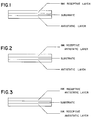
- the film composite of the invention There are three main configurations for the film composite of the invention, as shown in Figures 1 - 3 in the accompanying drawing.
- the first configuration in Figure 1 will be discussed herein, but the same principles would hold true for the other configurations as shown in Figures 2 and 3.
- the ink receptive layer is an essentially transparent film while the substrate may be transparent, translucent or opaque.
- the film composite is comprised of an ink receptive layer containing silica particulates dispersed in a copolymer of n-butyl methacrylate and isobutyl methacrylate, a supporting layer of polyethylene terephthalate and an antistatic layer opposite to the ink receptive layer side, said antistatic layer comprised of silica particulates dispersed in a binder of melamine-formaldehyde, partially hydrolyzed polyvinyl acetate, and a quaternary salt of an acrylamide copolymer.
- the solvent based inks that are applicable to the invention are normally comprised of three major material components:
- ink used in offset lithography is formulated to dry by oxidation of components of the binder and contains a substantial portion of unsaturated vegetable oils and oil modified alkyd resins for this purpose.
- Inks which dry by polymerization or by a combination of oxidation and polymerization may also be used.
- the conventional ink which is used for printing paper usually contains around 30% of aliphatic solvent.
- the most commonly used solvents are Magie Sol and Isopar.
- typical oils used in the ink are linseed, chinawood, and the like.
- resinous materials such as alkyds, rosin and phenolics may also be used in the ink.
- the oils and resinous materials are used to bind the colorants and provide a coherent film which adheres to the substrate upon drying.
- the colorants are pigments and/or dyes which are known in the art.
- Driers in the form of soaps of cobalt, manganese and lead formed with organic acids such as linolenic, naphthenic and octanoic acids, catalyze oxidation of the drying oils and are used in inks that dry by oxidation to accelerate drying.
- the plastic substrate could be printed using conventional inks and equipment.
- the film composite of the present invention comprises an essentially clear ink receptive layer, a support layer and an antistatic layer. This multilayer configuration of the film composite ensures good image qualities, fast drying of ink, and good transport properties through the offset printing machine.
- Typical solvent based inks employed in the printing process contain around 30 percent of high boiling aliphatic solvents such as Magie Sol 52.
- the balance of the composition comprises binders, pigments and additives.
- the drying mechanism of conventional ink on paper is by solvent absorption, evaporation, oxidation and/or polymerization.
- Conventional films that are insoluble or non-swellable in the ink vehicles are unable to absorb the solvents, which substantially delays the drying process. It is therefore believed therefore necessary to have an ink receptive layer in the film composite which has a strong affinity for aliphatic solvents to remove them from the surface of the film where the ink setting process takes place.
- the ink receptive layer of certain embodiments of the present invention comprises a polymer or blend of polymers and particulates.
- the matrix provides both the desired vehicle absorptive qualities and the surface qualities that accelerate the rate of ink drying and minimize ink offset.
- the ink receptive layer is generally characterized by its coating weight, solvent absorption, integrity, surface roughness, toughness and light transmission or haze.
- the ink receptive layers which were discovered to provide the advantages afforded by this invention have a strong affinity for the solvent.
- the binder portion of the vehicle oxidizes and/or polymerizes to form a coherent and tough image which basically completes the drying process.
- the drying mechanism enabled by the present invention produces results similar to that of a paper substrate. This eliminates the need for special inks and any special drying equipment.
- the key to successful absorption of the vehicle solvents is the affinity of the solvents to the polymer or polymer mixture in the ink receptive layer.
- the following test has been devised to identify potential polymers for use in the film matrix.
- the ink receptive coating is applied over a polyester substrate with a dry coat weight of around 4 grams per square meter.
- the procedure for coating is described in the Examples below.
- Absorptivity is determined by the following method.
- the specimens are exposed to the Isopar G vapor in the jar for 4 hours under standard TAPPI conditions.
- the specimens are then removed from the glass jar, placed in the weighing bottle and weighed (W2).
- the difference in the weight of the specimen before and after solvent exposure gives the amount of solvent absorbed.
- the ink receptive layer on each specimen is then removed by an active solvent such as methyl ethyl ketone.
- the specimens, after the ink receptive coatings have been removed, are then reconditioned at TAPPI conditions and reweighed in the weighing bottle (W3).
- the solvent absorptivity value is recorded as an average of six test results.
- the range for solvent absorption (% Absorbency) in the ink receptive layer is preferably from 14% to 45% and more preferably from 18% to 32% by weight of the ink receptive layer when tested as specified above.
- a screening test was employed to identify promising polymer candidates for the binder of the ink receptive layer, wherein the polymer candidates can be used singly or in combination to provide the required solvent absorption. It is possible to select a combination of polymers with solvent absorptions above and below the acceptable range which, when used together in the ink receptive matrix, fall within the acceptable solvent absorbency range. Table I lists the polymers and their % Absorbency determined in a screening test.
- the polymers are evaluated singly and in combination to determine which fall within the acceptable absorbency range of 14% - 45%.
- Copolymers consisting of moieties of higher and lower absorptivities may also be used and have been found to perform similar to or even better than homopolymer blends.
- its integrity must be taken into account.
- a solvent absorbency that is too high or an inappropriate choice of polymers will often be at the expense of film integrity. This will cause the matrix to become tacky or lose its cohesiveness or its adhesiveness to the base support, particularly during the ink drying period.
- the appropriate homopolymer, copolymer or polymeric combination for use in the ink receptive layer is determined by its conformance to the requirements of ink receptivity, dry time, integrity and print feed characteristics.
- the particulates function as spacers which prevent intimate contact between the consecutively printed sheets during sheet fed offset printing. This helps prevent wet ink transfer from the printed side to the unprinted side of the next sheet.
- the surface characteristic of the image receptive layer required to achieve suitable performance may be characterized by its Sheffield roughness value.
- this roughness parameter is below 140 cc of air/minute and preferably below 90 cc of air/minute as measured on a Sheffield smoothness tester. Excessive roughness of the ink receptive layer causes a deterioration of the image quality, adversely affecting, for example, image resolution.
- the surface characteristics depend on the type and size of particulates employed and their concentration in the polymer binders.
- inorganic, organic or polymeric particulates suitable for the image receptive layer include amorphous silica, crystalline silica, aluminum trihydrate, calcium carbonate, clays, aluminum silicates, polyolefin particulates, organic pigments and mixtures thereof.
- the surface roughness of the coating is measured on a Bendix Precisionaire Sheffield smoothness instrument. To obtain consistent values it is necessary to lower the testing head in a gentle and uniform manner with no discernible impact due to downward motion of the head.
- the Sheffield value is expressed as cc of air/minute. The higher the value, the rougher the surface.
- the Sheffield smoothness value reported represents an average of five tests for each specimen.
- the measurement of the haze value of the ink receptive layer is obtained by applying the coating from which the layer is made to the surface of a very clear film substrate such as ICI Melinex 505 (polyethylene terephthalate).
- the haze level of the ink receptive layer is the difference between the values obtained on the coated film and the uncoated film.
- the drying property of the ink is found to be also dependent on the coating weight of the ink receptive layer. If the coating weight is too low, the ink does not dry fast enough, whereas if the coating weight is too high, the film medium tends to curl on drying.
- the coating weight of the ink receptive layer typically ranges from 1 gram per square meter to 12 grams per square meter and more preferably from 3 to 7 grams per square meter.
- a fast ink drying rate is important to the acceptance of plastic films in commercial printing operations.
- dry-to-touch or dry time test was developed:
- a test specimen of ink receptive layer is prepared by the application of the coating solution on an 8 1/2 inch x 11 inch sheet of polyethylene terephthalate film using the Meyer rod technique and air dried in an oven as detailed in the Examples.
- the conventional offset ink used for this test is Offset Cyan T-11 obtained from National Printing Ink Company in Marietta, GA, USA.
- the ink is applied on the ink receptive layer using the "Quick Peek" Colorproofing Kit and procedure obtained from Thwing-Albert Instrument Company.
- the dry time of the ink is evaluated every 15 minutes by placing a 1 inch x 3 inch strip of Xerox 4024 DP Xerographic paper on the printed bars and applying firm finger pressure with a dual rubbing motion to the strip.
- the amount of ink transferred from the test specimen to the paper strip is used to judge the drying time of the ink.
- a dry-to-touch stage is deemed to be achieved and the time required to reach this stage is designated as the Offset Dry Time. This result means that the sheet can be handled without ink smearing or offsetting.
- the dry time in the offset printing test was devised to be longer than that obtained in commercial printing so that differences in dry time of test materials could be readily distinguished. This longer drying time was achieved by deleting the drier in the ink and utilizing a printing density of about 1.65.
- the ink receptive layer of the preferred embodiment was also evaluated under an actual industrial printing application. Printing film (sheet size 17" x 22") as described in Example I below was tested on a Four Color Heidelberg sheet fed offset press with a speed of 8000 impressions per hour. The ink used for this test was conventional offset ink obtained from Toyo Ink Company. The Offset Dry Time obtained was just 15 minutes. This confirms the superior drying characteristics of the printing film of the present invention.
- the printing film of this invention retained its integrity on printing and had the requisite surface properties required of printing films.
- the faster drying of the printing film of the invention is due to the fact that the ink receptive layer functions by absorbing the aliphatic solvents contained in the conventional offset ink.
- the binder of offset ink comprises linseed oil and alkyd resin which crosslinks by air oxidation. It is believed that the absorption of the aliphatic solvent by the ink receptive layer accelerates the air oxidation of the ink binder which quickly yields a tough crosslinked dried ink layer. This was confirmed by conducting a solvent rub test.
- the procedure for applying the ink on the ink receptive layer is described earlier herein. A piece of cotton was soaked with the solvent and hand rubbed against the ink layer at 30 minute intervals. After 8 hours of testing it was found that around 150 rubs of solvent were required to dissolve the ink layer in the Arkwright PC-405 printing film (made according to Example I herein), whereas only 15 rubs were required to remove the ink layer from the commercially available "Alinda" film (obtained from Dynic Corporation). This confirms that the ink receptive layer of the present invention aids the setting, via perhaps oxidation and crosslinking, of offset ink and hence has superior drying characteristics as compared to other commercially available printing films.
- the binder polymers for the ink receptive layer must have affinity for aliphatic solvents and at the same time maintain their integrity during the ink drying process.
- Polymers appropriate for the ink receptive layer are those which impart fast drying for conventional offset printing inks printed onto the film.
- Films with such polymers in the ink receptive layer have absorbency and dry-to-touch characteristics as described in the present specification.
- the integrity of the ink receptive layer can be determined while conducting the dry-to-touch test. If, in addition to the ink, the ink receptive layer also transfers to the paper in the dry-to-touch test, then the ink receptive layer is taken to have lost its integrity.
- the ink receptive layer is obtained through the use of polymers derived from alkyl esters of acrylic acid and alkyl acrylic acids and their copolymers, said polymers having monomeric units with the general structure A or B where, and R is an aliphatic group preferably having a chain length of 1 to 6 carbon atoms, and said copolymers are comprised of one or more of both A and B units or two or more A type units or two or more B type units, where the A and B type units differ in their respective aliphatic groups.
- Polymers suitably selected from this class for the ink receptive layer provide the requisite properties for printing film applications. These properties include clarity, solvent absorptivity, fast drying, integrity, toughness and light stability.
- the polymeric composition employed in the ink receptive layer of this invention has a solvent absorptivity of from 14 to 45% and an offset dry time of less than about two hours, preferably less than 75 minutes, maintains its integrity during printing and is essentially free of tack after drying.
- ink printed on the layer comprising a copolymer of isobutyl methacrylate and n-butyl methacrylate dried rapidly and well and that the film coating maintained its integrity. It is also possible to use blends of poly (n-butyl methacrylate) and poly(isobutyl methacrylate). Poly(n-butyl methacrylate) and poly(isobutyl methacrylate), when used individually in the ink receptive layer, do not dry the ink as well as a blend of both polymers.
- a higher plasticizer effect of the ink vehicle upon poly (n-butyl methacrylate) may give a more tacky surface on printing, whereas poly (isobutyl methacrylate) is not plasticized to the same extent.
- the plasticizer effect of the ink vehicle must be taken into consideration in selecting the polymer blend.
- a suitable selection of a blend of the individual polymer components is preferred in order to obtain optimal ink drying and freedom from tack.
- a copolymer may be used to achieve similar or superior results either alone or in combination with a homopolymer.
- the polymer components in the polymer blend or the moieties in the copolymer may be selected through the use of the solvent absorptivity test.
- the composition of lower and higher aliphatic solvent-absorbing polymers or copolymer moieties in the ink receptive matrix preferably should be in the ratio from 1:9 to 9:1 and more preferably in the ratio of 3:7 to 7:3 of the higher and lower aliphatic solvent absorptive polymers or copolymer moieties.
- solvent-absorptive copolymer moieties as used herein refers to the absorptivity of the homopolymers from which the copolymers are derived.
- Driers are metallic soaps containing alkaline earth or heavy metals combined with monobasic carboxylic acids of 7 to 22 carbon atoms. Examples are soaps of bismuth, calcium, lithium, cobalt, iron, lead, manganese, zinc and zirconium formed with organic acids such as linolenic, naphthenic and octanoic acids.
- the supporting layer or substrate of the present invention is a polymeric material which has suitable dimensional stability, transparency, translucency or opacity, tensile strength, adhesion characteristics, thermal stability and hardness.
- Suitable polymeric materials for use as a supporting layer are thermoplastic polymers, including polyesters, polysulfones, polycarbonates, polyvinyl chloride, polystyrene, polyimides, polyolefins, polymethyl methacrylate, cellulose esters such as cellulose acetate and others known in the art.
- a polyethylene terephthalate polyester film is particularly preferred.
- a pretreatment of the substrate as practiced in the trade may be required to achieve good adhesion to the ink receptive layer and/or the antistatic back coat layer.
- the thickness of the supporting layer is not particularly restricted, and is typically in the range of about 2 to 10 mils, and preferably in the range of 3.0 to about 5.0 mils.
- an antistatic layer is employed on the side opposite to the ink receptive layer of the print film. It comprises polymeric binders, inorganic or polymeric particulates, and conductive agents or materials. This layer may have a clear or matte finish.
- the weight ratio of polymer binder to particulates preferably should be about 100:1 to about 166:1, but a coating with a lower ratio can be used with a loss of transparency.
- the weight ratio of polymeric binder to particulates preferably should be lower than 1:1.
- the matte surface provides good drafting properties along with erasability characteristics for pencil and pen.
- the presence of particulates in the antistatic layer or back coat of the film also prevents intimate contact with the ink receptive layer, thereby helping to avoid transfer of the ink to the sheet which it contacts. It is possible to have a back coat on the film with no antistatic agent or to have no back coat at all, provided that the ink receptive layer contains an antistatic agent.
- the polymers used as binders in the antistatic or back coat layer include acrylic resins, vinyl acetate resins, hydrolyzed polyvinyl acetate, vinyl chloride resins, cellulose acetate butyrate resins, cellulose acetate propionate resins, carbonate resins, polyester resins, urethane resins, epoxy resins, melamine-formaldehyde resins and styrene resins.
- Preferred polymer binders useful in the composition of the coating are melamine-formaldehyde resins and 15-75% hydrolyzed polyvinyl acetate.
- Polymeric binders can be crosslinked using acid catalysts such as benzoic acid, p-toluene sulfonic acid, n-butyl phosphoric acid, amine salts of carboxylic acids and alkyl sulfonic acids.
- acid catalysts such as benzoic acid, p-toluene sulfonic acid, n-butyl phosphoric acid, amine salts of carboxylic acids and alkyl sulfonic acids.
- Particulates that can be used in the antistatic layer include amorphous silica, crystalline silica, calcium carbonate and polyolefins either singularly or in combination. It is also possible to include antistatic agents in the ink receptive layer as shown in Figures 2 and 3 in the drawing.
- the conductive property of the antistatic agent in the back coat layer is introduced by either organic conductive agents or inorganic conductive pigments.
- organic conductive agents used in the invention include sulfonated polystyrene, quaternized silicones, quaternized cellulosic ethers, quaternized acrylics, and the like.
- Inorganic conductive pigments suitable for the back coat layer include tin oxides doped with indium or antimony.
- a preferred antistatic layer has a surface resistivity of about 1 x 10⁶ to 1 x 10¹³ ohms/square at 25°C and 50% relative humidity (RH). It is also possible to incorporate antistatic materials in the ink receptive layer.
- the ink receptive antistatic coating may be applied to both sides of the polyester film which provides a printable surface on both sides of the film.
- the supporting layer is first coated with the ink receptive layer using the Meyer rod technique and dried in an air dried oven at a temperature range of 100 to 150°C for about two to four minutes.
- the antistatic layer may then be placed on the opposite or back side of the supporting layer using the Meyer rod technique and dried at a temperature range of 120 to 150°C for two to four minutes.
- Any of a number of methods may be employed in the production coating of the individual layers in the film composite, such as roller coating, rod coating, slide coating, curtain coating, doctor coating, flexographic coating or gravure coating. Such techniques are well known in the art.
- the multilayer film composite of the present invention has unique properties which enables it to dry conventional inks much faster than other plastic films and also ensures reliable feeding in the printing equipment.
- An ink receptive layer of the following composition was prepared: Copolymer of n-butyl methacrylate and isobutyl methacrylate (Ratio 50:50) 19.97 parts Amorphous silica (average particle size 8.4 microns) 0.17 part Methyl ethyl ketone 39.93 parts Toluene 39.93 parts
- Methyl ethyl ketone was mixed with toluene for five minutes.
- the copolymer of n-butyl methacrylate and isobutyl methacrylate was then added and mixed for thirty minutes or until the copolymer was completely dissolved.
- Amorphous silica was added and dispersed using high speed dispersing equipment.
- the mixture was then coated on a four mil thick transparent polyethylene terephthalate by means of a Pilot Coater at 50 feet per minute at a drying temperature of 130°C. This gave a film product with a transparent coating.
- the film product had a haze of 2.0 percent, surface smoothness of 33 cc of air/minute, solvent absorptivity of 22.5% by weight of coat weight, and coat weight of 5.7 grams per square meter.
- the antistatic layer was prepared by mixing Methyl Cellosolve, methanol and diacetone acrylamide copolymer for five minutes. To the solution, 35% hydrolyzed polyvinyl acetate, melamine-formaldehyde and amorphous silica were added and mixed for another twenty minutes. The catalyst was then added and the liquid was mixed for two minutes. The mixture was coated using a No. 8 Meyer rod onto the side opposite to the ink receptive layer by means of a Pilot Coater at 50 feet per minute at a drying temperature of 150° C.
- the haze, Sheffield roughness and surface resistivity of the antistatic coated film were found to be 2%, 14 cc of air/minute and 7.1 x 10⁹ ohm/square, respectively and the Offset Dry Time was found to be about 30 minutes.
- the Ink Receptive Layer The Ink Receptive Layer
- Copolymer of n-butyl methacrylate and isobutyl methacrylate (50:50) 18.58 parts Amorphous silica (Av. particle size 8.4 microns) 0.17 part Methyl ethyl ketone 37.15 parts Toluene 37.15 parts Dow Corning X1-6136 (Obtained from Dow Corning Corp.) 6.81 parts
- the Supporting Layer is :
- the Antistatic Layer The Antistatic Layer :
- Copolymer of n-butyl methacrylate and isobutyl methacrylate (50:50) 18.58 parts Amorphous silica (Av. particle size 8.4 micron) 0.17 part Methyl ethyl ketone 37.15 parts Toluene 37.15 parts Dow Corning X1-6136 6.81 parts
- the resulting opaque printing film has ink receptive and antistatic properties on both sides and is printable on either or both sides.
- the surface resistivity and Sheffield roughness were 7.1 x 10¹⁰ ohms/square and 39 cc of air/minute, respectively.
- the absorbency of the ink receptive coating was 20%.
- This printing film had an Offset Dry Time of 60 minutes, and the integrity and surface properties required for good offset printing film.
- Another printing film was prepared in the laboratory by applying the ink receptive layer mixture on 4 mil thick transparent polyester film using a No. 20 Meyer rod and dried at 130°C for two minutes.
- the composition of the coatings was as follows:
- the Ink Receptive Layer The Ink Receptive Layer :
- the haze and Sheffield values of the coating were 6.1 percent and 70 cc of air/minute, respectively.
- the solvent absorptivity of the ink receptive coating was 28.4 percent of the coat weight by weight.
- the Supporting Layer is :
- the Antistatic Layer The Antistatic Layer :
- the antistatic mix was applied with a No. 8 Meyer rod on the side opposite to the ink receptive layer and dried at 130°C. for 2 minutes.
- the haze, surface resistivity and Sheffield roughness of the antistatic layer were 2%, 6.3 X 10⁹ ohms/square and 12 cc of air/minute, respectively.
- This printing film had an Offset Dry Time of 45 minutes, and the integrity and surface properties required for good offset printing film.
- the Ink Receptive Layer The Ink Receptive Layer :
- the haze and Sheffield values of the coating were 10.5 percent and 135 cc of air/minute, respectively.
- the solvent absorptivity of the ink receptive coating was 28.4% of the coat weight by weight and the Offset Dry Time was 30 minutes.
- the Supporting Layer is :
- the Antistatic Layer The Antistatic Layer :
- the haze, surface resistivity and Sheffield roughness of the antistatic layer were 2%, 6.3 X 10⁹ ohms/square and 12 cc of air/minute, respectively.
Landscapes
- Chemical & Material Sciences (AREA)
- Chemical Kinetics & Catalysis (AREA)
- Ink Jet Recording Methods And Recording Media Thereof (AREA)
- Laminated Bodies (AREA)
- Duplication Or Marking (AREA)
Priority Applications (1)
| Application Number | Priority Date | Filing Date | Title |
|---|---|---|---|
| US08/135,304 USRE34933E (en) | 1991-04-05 | 1993-10-12 | Printing film |
Applications Claiming Priority (2)
| Application Number | Priority Date | Filing Date | Title |
|---|---|---|---|
| US680200 | 1984-12-10 | ||
| US07/680,200 US5215814A (en) | 1991-04-05 | 1991-04-05 | Printing film |
Publications (2)
| Publication Number | Publication Date |
|---|---|
| EP0507409A1 true EP0507409A1 (de) | 1992-10-07 |
| EP0507409B1 EP0507409B1 (de) | 1996-09-25 |
Family
ID=24730141
Family Applications (1)
| Application Number | Title | Priority Date | Filing Date |
|---|---|---|---|
| EP92200921A Expired - Lifetime EP0507409B1 (de) | 1991-04-05 | 1992-04-01 | Druckfilm |
Country Status (4)
| Country | Link |
|---|---|
| US (2) | US5215814A (de) |
| EP (1) | EP0507409B1 (de) |
| JP (1) | JPH05229248A (de) |
| DE (1) | DE69213982T2 (de) |
Cited By (3)
| Publication number | Priority date | Publication date | Assignee | Title |
|---|---|---|---|---|
| EP1095784A3 (de) * | 1999-10-25 | 2001-09-05 | Oji Paper Company Limited | Aufzeichnungsblatt für Tintenstrahldruck |
| FR2872180A1 (fr) * | 2004-06-24 | 2005-12-30 | Arjowiggins Papiers Couches So | Papier revetu d'une composition pigmentee comportant de la silice imprimable par offset |
| CN110077139A (zh) * | 2019-05-05 | 2019-08-02 | 东莞市恒凯印刷科技有限公司 | 一种图文印刷板材制造工艺 |
Families Citing this family (18)
| Publication number | Priority date | Publication date | Assignee | Title |
|---|---|---|---|---|
| US5407234A (en) * | 1992-12-11 | 1995-04-18 | Avery Dennison Corporation | Permanent xerographic toner-receptive index divider |
| JP3474244B2 (ja) * | 1994-02-03 | 2003-12-08 | 株式会社ユポ・コーポレーション | 印刷性に優れた熱可塑性樹脂フィルム及びその製造方法 |
| US5662997A (en) * | 1994-05-23 | 1997-09-02 | Seiko Epson Corporation | Ink jet recording film comprising cation-modified polyvinyl alcohol and recording method using the same |
| US7232602B2 (en) * | 1996-04-10 | 2007-06-19 | Dupont Teijin Films U.S. Limited Partnership | Multilayer card |
| US5974974A (en) | 1997-07-01 | 1999-11-02 | Polyfibron Technologies, Inc. | Substantially transparent printing blankets and methods for using same |
| US6153288A (en) * | 1997-07-24 | 2000-11-28 | Avery Dennison Corporation | Ink-receptive compositions and coated products |
| US6626985B1 (en) * | 1999-05-10 | 2003-09-30 | Victory Ink Company, Inc. | Matte ink composition and method of use |
| KR100478776B1 (ko) * | 2001-02-12 | 2005-03-24 | 이석기 | 자동산화 경화형의 내수성 및 내열성을 가지는 수성코팅 조성물 |
| US6881458B2 (en) * | 2002-06-03 | 2005-04-19 | 3M Innovative Properties Company | Ink jet receptive coating |
| AU2003256477A1 (en) * | 2002-07-19 | 2004-02-09 | Avery Dennison Corporation | Labeling method employing two-part curable adhesives |
| US6857737B2 (en) * | 2002-12-23 | 2005-02-22 | 3M Innovative Properties Company | UV ink printed graphic article |
| US7923412B1 (en) * | 2004-02-12 | 2011-04-12 | Kazdin Richard H | Creating background colors on thermal printing material |
| EP1743775A1 (de) * | 2005-07-13 | 2007-01-17 | SAPPI Netherlands Services B.V. | Beschichtetes Papier für den Bogenoffsetdruck |
| JP2010123815A (ja) * | 2008-11-20 | 2010-06-03 | Panasonic Electric Works Co Ltd | 印刷用基材 |
| JP6111036B2 (ja) * | 2012-09-28 | 2017-04-05 | セーレン株式会社 | グラビアオフセット印刷方法 |
| US11090912B2 (en) | 2018-08-07 | 2021-08-17 | Taj Tech Llc | Heat sealable thermo-printable tape |
| CN113767016B (zh) | 2019-01-30 | 2023-07-25 | 柯尼格及包尔纸币解决方案有限公司 | 用于制备聚合物安全制品的工艺 |
| AU2019426333B2 (en) * | 2019-01-30 | 2024-08-29 | Koenig & Bauer Banknote Solutions Sa | Process for preparing polymeric security articles |
Citations (1)
| Publication number | Priority date | Publication date | Assignee | Title |
|---|---|---|---|---|
| EP0262228A1 (de) * | 1986-04-09 | 1988-04-06 | Dynic Corporation | Durchsichtiger kunststoffilm zur verwendung beim drucken |
Family Cites Families (2)
| Publication number | Priority date | Publication date | Assignee | Title |
|---|---|---|---|---|
| DE68926236T2 (de) * | 1989-07-24 | 1996-12-05 | Tomoegawa Paper Mfg Co Ltd | Druckblätter |
| US5208092A (en) * | 1990-10-24 | 1993-05-04 | Minnesota Mining And Manufacturing Company | Transparent liquid absorbent materials for use as ink-receptive layers |
-
1991
- 1991-04-05 US US07/680,200 patent/US5215814A/en not_active Ceased
-
1992
- 1992-04-01 DE DE69213982T patent/DE69213982T2/de not_active Expired - Fee Related
- 1992-04-01 EP EP92200921A patent/EP0507409B1/de not_active Expired - Lifetime
- 1992-04-03 JP JP4127897A patent/JPH05229248A/ja active Pending
-
1993
- 1993-10-12 US US08/135,304 patent/USRE34933E/en not_active Expired - Lifetime
Patent Citations (1)
| Publication number | Priority date | Publication date | Assignee | Title |
|---|---|---|---|---|
| EP0262228A1 (de) * | 1986-04-09 | 1988-04-06 | Dynic Corporation | Durchsichtiger kunststoffilm zur verwendung beim drucken |
Cited By (5)
| Publication number | Priority date | Publication date | Assignee | Title |
|---|---|---|---|---|
| EP1095784A3 (de) * | 1999-10-25 | 2001-09-05 | Oji Paper Company Limited | Aufzeichnungsblatt für Tintenstrahldruck |
| US6783817B2 (en) | 1999-10-25 | 2004-08-31 | Oji Paper Co., Ltd. | Ink jet recording sheet |
| FR2872180A1 (fr) * | 2004-06-24 | 2005-12-30 | Arjowiggins Papiers Couches So | Papier revetu d'une composition pigmentee comportant de la silice imprimable par offset |
| WO2006010827A1 (fr) * | 2004-06-24 | 2006-02-02 | Arjowiggins Papiers Couches | Papier revetu d'une couche de surface comportant de la silice imprimable par offset |
| CN110077139A (zh) * | 2019-05-05 | 2019-08-02 | 东莞市恒凯印刷科技有限公司 | 一种图文印刷板材制造工艺 |
Also Published As
| Publication number | Publication date |
|---|---|
| DE69213982T2 (de) | 1997-02-27 |
| US5215814A (en) | 1993-06-01 |
| EP0507409B1 (de) | 1996-09-25 |
| USRE34933E (en) | 1995-05-09 |
| DE69213982D1 (de) | 1996-10-31 |
| JPH05229248A (ja) | 1993-09-07 |
Similar Documents
| Publication | Publication Date | Title |
|---|---|---|
| EP0507409B1 (de) | Druckfilm | |
| US4379804A (en) | Liquid sorbent materials | |
| JPS60214989A (ja) | インキ印刷可能シート,その製法,およびそれを含む画像付き透明体 | |
| WO2004003093A1 (en) | Coating compositions | |
| EP0262228B1 (de) | Durchsichtiger kunststoffilm zur verwendung beim drucken | |
| US5139903A (en) | Transparencies | |
| JPS62184879A (ja) | 透明シ−ト | |
| US3180752A (en) | Heat-sensitive copying sheets | |
| US3919450A (en) | Color developing high impact polystyrene sheet and method of developing color images inside the same | |
| JP3123268B2 (ja) | インクジェット記録用シート | |
| EP0579351B1 (de) | Aufnahmeträger für thermische Farbstoffübertragung | |
| US3824117A (en) | Stencil sheet and method of making an imaged stencil sheet | |
| JPH0545418B2 (de) | ||
| JP2713568B2 (ja) | 透明記録用フイルム | |
| JP2542506B2 (ja) | 熱転写用ohpシ―ト | |
| WO1995000340A1 (en) | Ink jet receiver sheet | |
| JPH06247036A (ja) | インクジェット記録用紙 | |
| JP3206663B2 (ja) | インク吸収性マットフィルム | |
| JPH07101155A (ja) | 熱転写記録媒体 | |
| JPH0781213A (ja) | インクジェット用記録シート | |
| US5525574A (en) | Thermal transfer printing receiver sheet | |
| CA1338242C (en) | Ink-setting layer | |
| JPH08244362A (ja) | 熱転写受像シート | |
| JPH06239015A (ja) | インクジェット記録用シート | |
| JPH10315614A (ja) | 記録用シート |
Legal Events
| Date | Code | Title | Description |
|---|---|---|---|
| PUAI | Public reference made under article 153(3) epc to a published international application that has entered the european phase |
Free format text: ORIGINAL CODE: 0009012 |
|
| AK | Designated contracting states |
Kind code of ref document: A1 Designated state(s): DE FR GB |
|
| 17P | Request for examination filed |
Effective date: 19930329 |
|
| 17Q | First examination report despatched |
Effective date: 19941207 |
|
| GRAH | Despatch of communication of intention to grant a patent |
Free format text: ORIGINAL CODE: EPIDOS IGRA |
|
| GRAA | (expected) grant |
Free format text: ORIGINAL CODE: 0009210 |
|
| AK | Designated contracting states |
Kind code of ref document: B1 Designated state(s): DE FR GB |
|
| REF | Corresponds to: |
Ref document number: 69213982 Country of ref document: DE Date of ref document: 19961031 |
|
| ET | Fr: translation filed | ||
| PLBE | No opposition filed within time limit |
Free format text: ORIGINAL CODE: 0009261 |
|
| STAA | Information on the status of an ep patent application or granted ep patent |
Free format text: STATUS: NO OPPOSITION FILED WITHIN TIME LIMIT |
|
| 26N | No opposition filed | ||
| REG | Reference to a national code |
Ref country code: GB Ref legal event code: IF02 |
|
| PGFP | Annual fee paid to national office [announced via postgrant information from national office to epo] |
Ref country code: GB Payment date: 20080320 Year of fee payment: 17 |
|
| PGFP | Annual fee paid to national office [announced via postgrant information from national office to epo] |
Ref country code: FR Payment date: 20080313 Year of fee payment: 17 Ref country code: DE Payment date: 20080320 Year of fee payment: 17 |
|
| GBPC | Gb: european patent ceased through non-payment of renewal fee |
Effective date: 20090401 |
|
| REG | Reference to a national code |
Ref country code: FR Ref legal event code: ST Effective date: 20091231 |
|
| PG25 | Lapsed in a contracting state [announced via postgrant information from national office to epo] |
Ref country code: DE Free format text: LAPSE BECAUSE OF NON-PAYMENT OF DUE FEES Effective date: 20091103 |
|
| PG25 | Lapsed in a contracting state [announced via postgrant information from national office to epo] |
Ref country code: FR Free format text: LAPSE BECAUSE OF NON-PAYMENT OF DUE FEES Effective date: 20091222 Ref country code: GB Free format text: LAPSE BECAUSE OF NON-PAYMENT OF DUE FEES Effective date: 20090401 |