EP0507460A1 - Kompensierter Übergang für eine Raumfahrzeug-Lageregelung - Google Patents
Kompensierter Übergang für eine Raumfahrzeug-Lageregelung Download PDFInfo
- Publication number
- EP0507460A1 EP0507460A1 EP92302068A EP92302068A EP0507460A1 EP 0507460 A1 EP0507460 A1 EP 0507460A1 EP 92302068 A EP92302068 A EP 92302068A EP 92302068 A EP92302068 A EP 92302068A EP 0507460 A1 EP0507460 A1 EP 0507460A1
- Authority
- EP
- European Patent Office
- Prior art keywords
- thruster
- spacecraft
- firing
- nutation
- pulse
- Prior art date
- Legal status (The legal status is an assumption and is not a legal conclusion. Google has not performed a legal analysis and makes no representation as to the accuracy of the status listed.)
- Granted
Links
Images



Classifications
-
- B—PERFORMING OPERATIONS; TRANSPORTING
- B64—AIRCRAFT; AVIATION; COSMONAUTICS
- B64G—COSMONAUTICS; VEHICLES OR EQUIPMENT THEREFOR
- B64G1/00—Cosmonautic vehicles
- B64G1/22—Parts of, or equipment specially adapted for fitting in or to, cosmonautic vehicles
- B64G1/24—Guiding or controlling apparatus, e.g. for attitude control
- B64G1/38—Guiding or controlling apparatus, e.g. for attitude control damping of oscillations, e.g. nutation dampers
-
- B—PERFORMING OPERATIONS; TRANSPORTING
- B64—AIRCRAFT; AVIATION; COSMONAUTICS
- B64G—COSMONAUTICS; VEHICLES OR EQUIPMENT THEREFOR
- B64G1/00—Cosmonautic vehicles
- B64G1/22—Parts of, or equipment specially adapted for fitting in or to, cosmonautic vehicles
- B64G1/24—Guiding or controlling apparatus, e.g. for attitude control
- B64G1/244—Spacecraft control systems
-
- B—PERFORMING OPERATIONS; TRANSPORTING
- B64—AIRCRAFT; AVIATION; COSMONAUTICS
- B64G—COSMONAUTICS; VEHICLES OR EQUIPMENT THEREFOR
- B64G1/00—Cosmonautic vehicles
- B64G1/22—Parts of, or equipment specially adapted for fitting in or to, cosmonautic vehicles
- B64G1/24—Guiding or controlling apparatus, e.g. for attitude control
- B64G1/26—Guiding or controlling apparatus, e.g. for attitude control using jets
Definitions
- This invention relates to a method of damping nutational motion in satellites and other spacecraft systems, and more particularly to providing a smooth transition from a station-keeping mode in which the spacecraft is under thruster control to an on-orbit operational status in which control is maintained using momentum wheels to make small orientational corrections.
- a method for eliminating nutation in a three-axis stabilized spacecraft (1) employing internal momentum wheels (3) as an attitude stabilizer. Nutation damping is effected using a closed loop control system in which the momentum wheels (3) work in conjunction with spacecraft thrusters (5).
- This invention discloses two advancements over the prior art. The first advancement is the addition of a thruster compensation mechanism (81,83) to the conventional transition mode control system. The second improvement is the incorporation of a modified deadbeat thruster timing sequence, in which the nutating spacecraft (1) is brought under on-orbit control within three pulses of the thrusters (5).
- the thruster compensation mechanism (81,83) comprises a method of correcting thruster (5) inefficiencies which occur in extremely short duration firings, often used in attitude control. During short pulsing periods, fuel is inadequately mixed in the combustion chamber, resulting in power loss.
- the method consists of equating empirical data on thruster (5) inefficiencies to a polynomial expression and using this polynomial to compensate the error correction coefficients in the solution of the control system equations.
- the second advancement presented is the disclosure of a modified thruster (5) sequence for stopping nutation and orienting the spacecraft (1) for on-orbit operation.
- the prior art teaches that a deadbeat sequence of two pulses is theoretically sufficient for transition from the station-keeping mode to on-orbit operation.
- nonlinearities of the dynamic system and non-idealities in the control mechanism require three or more pulsings for complete transition within the requirements of on-orbit operation.
- a first pulse (31) is used to minimize nonlinear spacecraft dynamics and to permit orientation using two additional adjustment pulses (35,39) which act as a deadbeat sequence.
- Figure 1 illustrates a conventional orbiting satellite 1. Under normal on-orbit operation, attitude control is maintained through one or more spinning momentum wheels 3. Each momentum wheel 3 is rigidly attached to frame 2 of the satellite 1 and provides inertial stability, represented by a perpendicular momentum vector 7, which in the example shown in FIG. 1, points along the -Y 7 direction. Small changes in satellite 1 orientation can be effected by changing the speed of one or more momentum wheels 3 and thereby redirecting momentum vector 7.
- satellite 1 Periodically, satellite 1 is commanded into a station-keeping mode in order to adjust the orbit or trajectory of operation.
- This station-keeping mode is implemented using one or more thrusters 5 which fire for a set duration to adjust the orbit of satellite 1.
- a byproduct of the station-keeping mode is the introduction of various attitudinal perturbations produced by the thruster 5 forces. Among these disturbances is the tendency of satellite 1 to develop a nutational motion about its pitch or Y-axis 6.
- This nutational motion can be understood by imagining the application of a momentary perpendicular force to the rotational axis of a spinning top or gyroscope. The perpendicular force will cause the top to begin to nutate around the axis of its new momentum vector.
- the satellite's nutation prevents momentum wheel 3 from controlling the attitude, since the momentum of the nutation greatly exceeds the momentum capability of control wheel 3.
- the goal of the transition mode correction sequence is to utilize short pulses of thruster 5 creating impulses to stop the nutation and to orient momentum vector 7 in a desired direction, such that attitudinal control by momentum wheel 3 can be resumed.
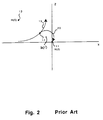
- Figure 2 shows a graphical representation of this transition mode, where H(0) represents the initial center 13 of the tip of momentum vector 7 in the X-Z plane nutating along an initial circular nutation path 15. From the example above, this graph can also be thought of as representing the view looking down on the nutating gyroscope along the momentum axis as momentum vector 7 traces the path of nutation.
- the spacecraft origin 11 formed by the intersection of the X (roll) and Z (yaw) axes including biases if desired, represents the desired momentum vector 7 position which, when achieved, will enable momentum wheel 3 to control spacecraft 1 stability during on-orbit mode operation.
- the present invention makes use of a compensated thruster 5 control system as well as a modified deadbeat sequence to more accurately and efficiently shift momentum vector 7 from any initial position to origin 11 in three thruster 5 firings.
- the modified deadbeat sequence is graphically illustrated in FIG. 3.
- spacecraft 1 nutation is represented by a momentum vector 7 tracing an initial nutation path 15 within the X-Z plane about an initial center of momentum 13.
- the first pulsing in this modified sequence occurs anywhere on this path after a fixed filter stabilization period in the control logic.
- thrusters 5 are pulsed for the exact duration necessary to eliminate most of the nutation and move the center of momentum from initial center 13 to approximately the first firing point 17.
- This first pulsing serves two purposes: first, momentum vector 7 is moved closer to the origin; second, the nutation is minimized, linearizing the dynamic system, and thus allowing more accurate calculation of the final deadbeat pulse firings remaining to create the remaining origin-intercept vectors.
- the 2nd pulse width calculation is allowed several seconds to stabilize, before a second firing initiates the nutational trajectory 20.
- the second firing causes the center of momentum to shift from first firing point 17 to the center of momentum 22 along the nutational trajectory 20, which is designed to intersect origin 11 in one-half of the nutation period.
- a final third pulse is delivered at the origin 11 to bring the nutation to a halt at a point where momentum wheel 3 control is possible. Additional firings should not be necessary, since dynamic nonlinearities were minimized by the first firing and the finest resolution of sensing and actuating has already been achieved.
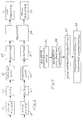
- Figure 4 shows a time-sequenced flow diagram of the disclosed transition mode.
- spacecraft 1 enters a transition mode 27 in which nutational motion is damped in preparation for on-orbit mode 43.
- the first step of the transition mode is a first wait period 29 in which the calculated pulse widths are allowed to reach a steady state. This first wait 29 nominally takes between 6 and 10 seconds.
- the first pulse 31 is then fired, transferring nutation path 15 to the first transient nutation path 20.
- a second wait 33 of 6 to 10 seconds is interjected to allow the calculated pulse widths to stabilize. In a sequence, the second pulse is fired, with more accurate pulse widths calculation, transferring the nutation path to a circular transient nutation path 204.
- a third wait 37 of one-half of a nutation period is required to allow the nutation path to intercept origin 11, at which time a third pulse 39 is fired, killing the nutational movement and stopping momentum vector 7 at origin 11.
- a fourth wait 41 of approximately one second is introduced to allow thruster 5 transients to settle. Conversion to an operational on-orbit mode 43 automatically follows the successful damping and spacecraft 1 orientation transition.
- Figure 5 shows the prior art transition control system which also forms the basis for thruster 5 compensation improvement of the present invention.
- error calculator 55 receives information relating to roll/yaw rates and yaw position from Digital Integrating Rate Assembly (DIRA) 51 and information relating to spacecraft 1 roll position from earth sensor 53.
- Error calculator 55 produces a pair of error coefficients which are ultimately used to determine thruster 5 pulse duration times for yaw and roll thrusters 71,73, respectively.
- Error calculator 55 produces yaw momentum error 57 and roll momentum error 59 and transmits these coefficients into a pair of low pass noise filters 61,63.
- DIRA Digital Integrating Rate Assembly
- noise filters 61,63 are multiplied by weighting factors 65,67 consisting of inertia components (I) divided by torque components (T). These coefficients are then quantized and advanced to thruster control timer 69 and used to control yaw and roll thrusters 71,73.
- a feedback network is present by way of spacecraft dynamics 75.
- the compensated thruster control system of the present invention is shown in FIG. 6.
- error coefficients are filtered in noise filters 61,63.
- the outputs of noise filters 61, 63 are then applied respectively to inertial and torque weighting factors in blocks 65 and 67.
- These are applied to thruster compensators 81, 83, wherein empirical information relating to the non-idealities of the averaged thruster's 5 performance is applied to the error coefficients.
- These coefficients are quantized in blocks 85,87, and these new error coefficients are implemented in a modified timing sequencer 89.
- This modified timing sequencer calculates and transmits firing durations in yaw and roll thrusters 71, 73, respectively.
- n represents the order of the polynomial function L(EPW).
- the value of n is chosen large enough to produce a close approximation of the emperical thruster 5 performance. Values between 3 and 6 are typical in the preferred embodiment of the present invention.
- this Loss function mathematically describes the thruster 5 non-idealities experienced at short firing durations, typically less than 40 msec.
- the object of the thruster 5 compensation is to generate a corresponding compensation function C which, when multiplied by the Loss equation, L(EPW), cancels the effects of the thruster 5 non-idealities.
- the equation is necessarily recursive since, in the region of non-ideality, the thruster 5 performance improves nonlinearly as pulsewidths increase.
- the compensation function implemented within the thruster 5 compensation block 81,83 can be expressed by the equation: where C(IPW) is in msec. Alternatively, piecewise linear segments can be used to approximate the polynomial in a numerically efficient method. In the preferred embodiment, IPW's of interest range from 2 msec. to 40 msec. Additional logic is provided to fix C at a constant value for IPW's less than 2 msec. and for IPW's greater than 40 msec.
- Figure 7 shows a flow chart for the method used in calculating the compensated thruster 5 coefficients.
- Block 91 refers to the generation of thruster 5 loss data based on empirical information taken from the individual thruster motors. This empirical data includes thruster 5 impulse as a function of burn time. This thruster 5 loss data is then used to create a derating model from which polynomial loss function coefficients can be generated as shown in step 93. The loss function coefficients are then used to solve a polynomial compensation function in step 95, from which compensation coefficients can be extracted. Alternatively the coefficients can be implemented in spacecraft as a piece-wise linear functions before quantization.
Landscapes
- Engineering & Computer Science (AREA)
- Remote Sensing (AREA)
- Chemical & Material Sciences (AREA)
- Combustion & Propulsion (AREA)
- Radar, Positioning & Navigation (AREA)
- Aviation & Aerospace Engineering (AREA)
- Automation & Control Theory (AREA)
- Control Of Position, Course, Altitude, Or Attitude Of Moving Bodies (AREA)
Applications Claiming Priority (2)
| Application Number | Priority Date | Filing Date | Title |
|---|---|---|---|
| US679655 | 1991-04-02 | ||
| US07/679,655 US5222023A (en) | 1991-04-02 | 1991-04-02 | Compensated transition for spacecraft attitude control |
Publications (2)
| Publication Number | Publication Date |
|---|---|
| EP0507460A1 true EP0507460A1 (de) | 1992-10-07 |
| EP0507460B1 EP0507460B1 (de) | 1995-05-17 |
Family
ID=24727796
Family Applications (1)
| Application Number | Title | Priority Date | Filing Date |
|---|---|---|---|
| EP92302068A Expired - Lifetime EP0507460B1 (de) | 1991-04-02 | 1992-03-11 | Kompensierter Übergang für eine Raumfahrzeug-Lageregelung |
Country Status (5)
| Country | Link |
|---|---|
| US (1) | US5222023A (de) |
| EP (1) | EP0507460B1 (de) |
| JP (1) | JP2623402B2 (de) |
| CA (1) | CA2062308C (de) |
| DE (1) | DE69202507T2 (de) |
Cited By (1)
| Publication number | Priority date | Publication date | Assignee | Title |
|---|---|---|---|---|
| EP0752366A1 (de) * | 1995-07-03 | 1997-01-08 | Space Systems / Loral, Inc. | System zur Beherrschung von Momentum nach einem Übergang |
Families Citing this family (26)
| Publication number | Priority date | Publication date | Assignee | Title |
|---|---|---|---|---|
| EP0496879B1 (de) * | 1990-08-22 | 1995-04-26 | Microcosm, Inc. | Vorrichtung zum halten eines satelliten auf seiner umlaufbahn |
| US5687084A (en) * | 1992-05-26 | 1997-11-11 | Microcosm, Inc. | Satellite orbit maintenance system |
| US5395076A (en) * | 1993-03-19 | 1995-03-07 | Martin Marietta Corporation | Spacecraft velocity change maneuvers by variable arcjets |
| US5459669A (en) * | 1994-02-14 | 1995-10-17 | Space Systems/Loral, Inc. | Control system and method for spacecraft attitude control |
| US6023291A (en) * | 1996-10-16 | 2000-02-08 | Space Systems/Loral, Inc. | Satellite camera attitude determination and image navigation by means of earth edge and landmark measurement |
| US6068217A (en) * | 1996-10-16 | 2000-05-30 | Space Systems/Loral, Inc. | Method to reorient a spacecraft using only initial single axis attitude knowledge |
| US6000661A (en) * | 1996-10-16 | 1999-12-14 | Space Systems/Loral, Inc. | Autonomous spacecraft payload base motion estimation and correction |
| US5996942A (en) * | 1996-10-16 | 1999-12-07 | Space Systems/Loral, Inc. | Autonomous solar torque management |
| WO1998032657A1 (en) | 1997-01-27 | 1998-07-30 | Space Systems/Loral, Inc. | Spacecraft attitude control system using low thrust thrusters |
| US5957411A (en) | 1997-01-31 | 1999-09-28 | Space Systems/Loral, Inc. | Method using double thruster firings to deadbeat flexible solar array structural oscillations |
| US6108593A (en) * | 1997-07-09 | 2000-08-22 | Hughes Electronics Corporation | Method and apparatus for estimating attitude sensor bias in a satellite |
| DE60032681T2 (de) * | 1999-08-13 | 2007-10-18 | Hughes Electronics Corp., El Segundo | Umlaufbahnsteuerung eines Raumfahrzeuges bei Rückmeldung der Lage der Umlaufbahn |
| ES2180367B1 (es) * | 2000-03-01 | 2004-04-01 | Centro De Investigacion De Tecnicas Aeroespaciales, S.A. (Cenita) | Nuevo procedimiento para modificar la trayectoria de un cuerpo movil o particula. |
| US6340138B1 (en) * | 2000-05-08 | 2002-01-22 | Hughes Electronics Corporation | Stationkeeping method utilizing open-loop thruster pulses and closed-loop authority limited momentum storage devices |
| ES2171355B1 (es) * | 2000-10-10 | 2003-12-01 | Cenita S A | Un sistema y un metodo para modificar y controlar trayectorias de ingenios en navegacion espacial o aerea, y para modificar trayectorias de cuerpos inertes que se desplazan por el espacio. |
| DE10342866A1 (de) * | 2003-09-15 | 2005-04-21 | Eads Astrium Gmbh | Verfahren zur Lagebestimmung eines Raumfahrzeuges mit Hilfe eines Richtungsvektors und einer Gesamtdrallmessung |
| US6921049B2 (en) * | 2003-11-18 | 2005-07-26 | The Boeing Company | System for counteracting a disturbance in a spacecraft |
| US7437222B2 (en) * | 2005-07-28 | 2008-10-14 | The Boeing Company | Gimbal disturbance calibration and compenstion |
| KR100837138B1 (ko) | 2006-07-18 | 2008-06-11 | 한국과학기술원 | 인공위성 자세 제어 명령 분배를 위한 동적 제어 할당 방법 |
| US8019493B1 (en) * | 2007-07-20 | 2011-09-13 | Lockheed Martin Corporation | Spacecraft thruster torque feedforward calibration system |
| US8763957B1 (en) * | 2012-10-08 | 2014-07-01 | Space Systems/Loral, Llc | Spacecraft transfer orbit techniques |
| US10501211B1 (en) * | 2015-12-17 | 2019-12-10 | Space Systems/Loral, Llc | Pre and post orbit maneuver pulses to reduce flexural oscillations |
| CN109649689B (zh) * | 2018-12-07 | 2021-10-01 | 北京空间飞行器总体设计部 | 一种有限推力变轨重力损耗计算方法、推力计算装置 |
| CN113060306B (zh) * | 2021-03-31 | 2022-02-08 | 中国空气动力研究与发展中心设备设计与测试技术研究所 | 有限推力的多脉冲交会迭代制导方法、装置及电子设备 |
| KR102716636B1 (ko) * | 2022-01-05 | 2024-10-15 | 한국항공우주연구원 | 카운트 기반 추진기 제어 시스템 및 추진기 제어 방법 |
| CN118468116B (zh) * | 2024-07-11 | 2024-10-25 | 湖南翰文云机电设备有限公司 | 一种用于钻机的姿态智能化感知方法及系统 |
Citations (4)
| Publication number | Priority date | Publication date | Assignee | Title |
|---|---|---|---|---|
| EP0119810A2 (de) * | 1983-03-12 | 1984-09-26 | British Aerospace Public Limited Company | Nutations-Dämpfung |
| US4504032A (en) * | 1982-03-10 | 1985-03-12 | Rca Corporation | Control of nutation in a spacecraft |
| EP0341130A1 (de) * | 1988-04-26 | 1989-11-08 | AEROSPATIALE Société Nationale Industrielle | Verfahren zur Ausrichtung des Rollträgheitsmomentes eines drehenden Körpers im Raum zu einer gegebenen Richtung |
| EP0347585A1 (de) * | 1988-05-26 | 1989-12-27 | Space Systems / Loral, Inc. | Uebergangs-Regelsystem zur Lageregelung eines Raumfahrzeuges |
Family Cites Families (17)
| Publication number | Priority date | Publication date | Assignee | Title |
|---|---|---|---|---|
| US3643897A (en) * | 1968-10-18 | 1972-02-22 | Communications Satellite Corp | Nutation correction system for spin-stabilized satellite |
| US3624367A (en) * | 1968-11-12 | 1971-11-30 | Gen Electric | Self-optimized and adaptive attitude control system |
| US3866025A (en) * | 1972-03-17 | 1975-02-11 | Rca Corp | Spacecraft attitude control system |
| US3944172A (en) * | 1972-04-14 | 1976-03-16 | Erno Raumfahrttechnik Gmbh | Attitude control for space vehicle |
| US3997137A (en) * | 1973-12-10 | 1976-12-14 | Rca Corporation | Minimization of residual spacecraft nutation due to disturbing torques |
| US4023752A (en) * | 1973-12-10 | 1977-05-17 | Rca Corporation | Elimination of residual spacecraft nutation due to propulsive torques |
| US3937423A (en) * | 1974-01-25 | 1976-02-10 | Hughes Aircraft Company | Nutation and roll error angle correction means |
| US3984071A (en) * | 1974-08-29 | 1976-10-05 | Trw Inc. | Satellite nutation attenuation apparatus |
| DE2642061C2 (de) * | 1976-09-18 | 1983-11-24 | Messerschmitt-Bölkow-Blohm GmbH, 8000 München | Lageregelungs- und Bahnänderungsverfahren für einen dreiachsenstabilisierbaren Satelliten, insbesondere für einen geostationären Satelliten und Einrichtung zur Durchführung des Verfahrens |
| DE2732201C2 (de) * | 1977-07-16 | 1983-01-13 | Messerschmitt-Bölkow-Blohm GmbH, 8000 München | Regler für die Lagestabilisierung eines Satelliten |
| FR2447320A1 (fr) * | 1979-01-23 | 1980-08-22 | Matra | Perfectionnements aux procedes et dispositifs d'amortissement actif de nutation pour vehicule spatial |
| US4386750A (en) * | 1980-08-29 | 1983-06-07 | The United States Of America As Represented By The Administrator Of The National Aeronautics And Space Administration | Method of damping nutation motion with minimum spin axis attitude disturbance |
| US4521855A (en) * | 1981-07-27 | 1985-06-04 | Ford Aerospace & Communications Corporation | Electronic on-orbit roll/yaw satellite control |
| US4537375A (en) * | 1983-04-21 | 1985-08-27 | Ford Aerospace & Communications Corporation | Method and apparatus for thruster transient control |
| US4758957A (en) * | 1985-05-17 | 1988-07-19 | General Electric Company | Spacecraft stabilization system and method |
| US4725024A (en) * | 1985-11-15 | 1988-02-16 | Ford Aerospace & Communications Corporation | Method for spinning up a three-axis controlled spacecraft |
| US5098041A (en) * | 1990-06-07 | 1992-03-24 | Hughes Aircraft Company | Attitude control system for momentum-biased spacecraft |
-
1991
- 1991-04-02 US US07/679,655 patent/US5222023A/en not_active Expired - Fee Related
-
1992
- 1992-03-04 CA CA002062308A patent/CA2062308C/en not_active Expired - Fee Related
- 1992-03-11 DE DE69202507T patent/DE69202507T2/de not_active Expired - Fee Related
- 1992-03-11 EP EP92302068A patent/EP0507460B1/de not_active Expired - Lifetime
- 1992-04-02 JP JP4108387A patent/JP2623402B2/ja not_active Expired - Lifetime
Patent Citations (4)
| Publication number | Priority date | Publication date | Assignee | Title |
|---|---|---|---|---|
| US4504032A (en) * | 1982-03-10 | 1985-03-12 | Rca Corporation | Control of nutation in a spacecraft |
| EP0119810A2 (de) * | 1983-03-12 | 1984-09-26 | British Aerospace Public Limited Company | Nutations-Dämpfung |
| EP0341130A1 (de) * | 1988-04-26 | 1989-11-08 | AEROSPATIALE Société Nationale Industrielle | Verfahren zur Ausrichtung des Rollträgheitsmomentes eines drehenden Körpers im Raum zu einer gegebenen Richtung |
| EP0347585A1 (de) * | 1988-05-26 | 1989-12-27 | Space Systems / Loral, Inc. | Uebergangs-Regelsystem zur Lageregelung eines Raumfahrzeuges |
Non-Patent Citations (2)
| Title |
|---|
| JOURNAL OF GUIDANCE AND CONTROL. vol. 3, no. 4, August 1980, NEW YORK US pages 361 - 368; YUAN, C.S.: 'DEADBEAT NUTATION CONTROLLER FOR MOMENTUM BIAS STABILIZED SPACECRAFT' * |
| PROCEEDINGS OF THE 1989 AMERICAN CONTROL CONFERENCE vol. 3, 23 June 1989, PITTSBURGH (USA) pages 2263 - 2268; EKE,F.O. ET AL.: 'BACKUP NUTATION DAMPING STRATEGY FOR THE GALILEO SPACECRAFT' * |
Cited By (2)
| Publication number | Priority date | Publication date | Assignee | Title |
|---|---|---|---|---|
| EP0752366A1 (de) * | 1995-07-03 | 1997-01-08 | Space Systems / Loral, Inc. | System zur Beherrschung von Momentum nach einem Übergang |
| US5655735A (en) * | 1995-07-03 | 1997-08-12 | Space Systems Loral, Inc. | Post transition momentum management |
Also Published As
| Publication number | Publication date |
|---|---|
| EP0507460B1 (de) | 1995-05-17 |
| CA2062308A1 (en) | 1992-10-03 |
| DE69202507T2 (de) | 1996-02-01 |
| CA2062308C (en) | 1999-08-03 |
| JP2623402B2 (ja) | 1997-06-25 |
| US5222023A (en) | 1993-06-22 |
| JPH06135396A (ja) | 1994-05-17 |
| DE69202507D1 (de) | 1995-06-22 |
Similar Documents
| Publication | Publication Date | Title |
|---|---|---|
| EP0507460B1 (de) | Kompensierter Übergang für eine Raumfahrzeug-Lageregelung | |
| US4567564A (en) | Arrangement for the attitude stabilization of flexible vehicles with weakly-dampened structural vibrations and discontinuous control intervention | |
| US5459669A (en) | Control system and method for spacecraft attitude control | |
| US8113468B2 (en) | Precision attitude control system for gimbaled thruster | |
| EP0453096B1 (de) | Vorrichtung zur Steuerung der Lage eines Satelliten in einer geneigten Umlaufbahn | |
| US6481672B1 (en) | Gimbaled thruster control system | |
| US5535965A (en) | Three-axis stabilized, earth-oriented satellite and a corresponding sun and earth acquisition process | |
| EP0225683B1 (de) | Methode zur Erhöhung der Spin-Rate bei einem in Richtung von drei Achsen steuerbaren Raumfahrzeug | |
| EP0568209B1 (de) | Lageregelung und Momentenausgleich für Raumfahrzeuge mittels kardanisch befestigten und kontinuierlich gedrosselten Triebwerken | |
| US5149022A (en) | Satellite roll and yaw attitude control method | |
| US6186446B1 (en) | Solar array control for electric propulsion system | |
| US6296207B1 (en) | Combined stationkeeping and momentum management | |
| US5806804A (en) | Adaptive harmonic disturbance compensation system | |
| US5400033A (en) | Tracking system for tracking targets with a spacecraft | |
| US5957411A (en) | Method using double thruster firings to deadbeat flexible solar array structural oscillations | |
| US5608634A (en) | Low noise spacecraft body rate sensing arrangement for attitude control | |
| US6347262B1 (en) | Minimum fuel attitude and nutation controller for spinning spacecraft | |
| US5984237A (en) | Delta-V targeting system for three-axis controlled spacecraft | |
| EP1103464A2 (de) | Raumfahrzeug und Schrittorientierungsverfahren für Ansatzteile um eine verbesserte Lageregelung des Raumfahrzeuges und den Ausgleich der Schwenkstörungen der Solarpaneele zu erreichen | |
| Coon et al. | Skylab attitude control system | |
| Spencer | Automatic magnetic control of a momentum-biased observatory in equatorial orbit | |
| LEE et al. | Space station RCS attitude control system | |
| Alldridge | AOCS technology (attitude and orbit control subsystem) | |
| BARBERA et al. | The design of a two wheel momentum bias system for the attitude control of spacecraft in low altitude orbits | |
| McEwen | Overview of the Miniature Sensor Technology Integration (MSTI) spacecraft attitude control system |
Legal Events
| Date | Code | Title | Description |
|---|---|---|---|
| PUAI | Public reference made under article 153(3) epc to a published international application that has entered the european phase |
Free format text: ORIGINAL CODE: 0009012 |
|
| AK | Designated contracting states |
Kind code of ref document: A1 Designated state(s): DE FR GB IT |
|
| 17P | Request for examination filed |
Effective date: 19921106 |
|
| 17Q | First examination report despatched |
Effective date: 19940121 |
|
| GRAA | (expected) grant |
Free format text: ORIGINAL CODE: 0009210 |
|
| AK | Designated contracting states |
Kind code of ref document: B1 Designated state(s): DE FR GB IT |
|
| ITF | It: translation for a ep patent filed | ||
| REF | Corresponds to: |
Ref document number: 69202507 Country of ref document: DE Date of ref document: 19950622 |
|
| ET | Fr: translation filed | ||
| PLBE | No opposition filed within time limit |
Free format text: ORIGINAL CODE: 0009261 |
|
| 26N | No opposition filed | ||
| REG | Reference to a national code |
Ref country code: GB Ref legal event code: IF02 |
|
| PGFP | Annual fee paid to national office [announced via postgrant information from national office to epo] |
Ref country code: FR Payment date: 20020221 Year of fee payment: 11 |
|
| PGFP | Annual fee paid to national office [announced via postgrant information from national office to epo] |
Ref country code: GB Payment date: 20020306 Year of fee payment: 11 |
|
| PGFP | Annual fee paid to national office [announced via postgrant information from national office to epo] |
Ref country code: DE Payment date: 20020320 Year of fee payment: 11 |
|
| PG25 | Lapsed in a contracting state [announced via postgrant information from national office to epo] |
Ref country code: GB Free format text: LAPSE BECAUSE OF NON-PAYMENT OF DUE FEES Effective date: 20030311 |
|
| PG25 | Lapsed in a contracting state [announced via postgrant information from national office to epo] |
Ref country code: DE Free format text: LAPSE BECAUSE OF NON-PAYMENT OF DUE FEES Effective date: 20031001 |
|
| GBPC | Gb: european patent ceased through non-payment of renewal fee |
Effective date: 20030311 |
|
| PG25 | Lapsed in a contracting state [announced via postgrant information from national office to epo] |
Ref country code: FR Free format text: LAPSE BECAUSE OF NON-PAYMENT OF DUE FEES Effective date: 20031127 |
|
| REG | Reference to a national code |
Ref country code: FR Ref legal event code: ST |
|
| PG25 | Lapsed in a contracting state [announced via postgrant information from national office to epo] |
Ref country code: IT Free format text: LAPSE BECAUSE OF NON-PAYMENT OF DUE FEES;WARNING: LAPSES OF ITALIAN PATENTS WITH EFFECTIVE DATE BEFORE 2007 MAY HAVE OCCURRED AT ANY TIME BEFORE 2007. THE CORRECT EFFECTIVE DATE MAY BE DIFFERENT FROM THE ONE RECORDED. Effective date: 20050311 |