EP0508237A1 - Mehrphasiges mikrolegiertes Stahl - Google Patents
Mehrphasiges mikrolegiertes Stahl Download PDFInfo
- Publication number
- EP0508237A1 EP0508237A1 EP92105273A EP92105273A EP0508237A1 EP 0508237 A1 EP0508237 A1 EP 0508237A1 EP 92105273 A EP92105273 A EP 92105273A EP 92105273 A EP92105273 A EP 92105273A EP 0508237 A1 EP0508237 A1 EP 0508237A1
- Authority
- EP
- European Patent Office
- Prior art keywords
- percent
- steel
- carbon
- molybdenum
- niobium
- Prior art date
- Legal status (The legal status is an assumption and is not a legal conclusion. Google has not performed a legal analysis and makes no representation as to the accuracy of the status listed.)
- Withdrawn
Links
- 229910000742 Microalloyed steel Inorganic materials 0.000 title description 3
- 229910000831 Steel Inorganic materials 0.000 claims abstract description 132
- 239000010959 steel Substances 0.000 claims abstract description 132
- 229910052799 carbon Inorganic materials 0.000 claims abstract description 43
- OKTJSMMVPCPJKN-UHFFFAOYSA-N Carbon Chemical compound [C] OKTJSMMVPCPJKN-UHFFFAOYSA-N 0.000 claims abstract description 42
- IJGRMHOSHXDMSA-UHFFFAOYSA-N Atomic nitrogen Chemical compound N#N IJGRMHOSHXDMSA-UHFFFAOYSA-N 0.000 claims abstract description 34
- ZOKXTWBITQBERF-UHFFFAOYSA-N Molybdenum Chemical compound [Mo] ZOKXTWBITQBERF-UHFFFAOYSA-N 0.000 claims abstract description 32
- 229910001563 bainite Inorganic materials 0.000 claims abstract description 32
- 229910052750 molybdenum Inorganic materials 0.000 claims abstract description 32
- 239000011733 molybdenum Substances 0.000 claims abstract description 32
- 238000005242 forging Methods 0.000 claims abstract description 31
- 229910052758 niobium Inorganic materials 0.000 claims abstract description 26
- 239000010955 niobium Substances 0.000 claims abstract description 26
- GUCVJGMIXFAOAE-UHFFFAOYSA-N niobium atom Chemical compound [Nb] GUCVJGMIXFAOAE-UHFFFAOYSA-N 0.000 claims abstract description 25
- 229910001566 austenite Inorganic materials 0.000 claims abstract description 24
- VYZAMTAEIAYCRO-UHFFFAOYSA-N Chromium Chemical compound [Cr] VYZAMTAEIAYCRO-UHFFFAOYSA-N 0.000 claims abstract description 23
- 229910052804 chromium Inorganic materials 0.000 claims abstract description 23
- 239000011651 chromium Substances 0.000 claims abstract description 23
- NINIDFKCEFEMDL-UHFFFAOYSA-N Sulfur Chemical compound [S] NINIDFKCEFEMDL-UHFFFAOYSA-N 0.000 claims abstract description 21
- 229910052717 sulfur Inorganic materials 0.000 claims abstract description 21
- 239000011593 sulfur Substances 0.000 claims abstract description 21
- XEEYBQQBJWHFJM-UHFFFAOYSA-N Iron Chemical compound [Fe] XEEYBQQBJWHFJM-UHFFFAOYSA-N 0.000 claims abstract description 20
- 229910000859 α-Fe Inorganic materials 0.000 claims abstract description 20
- 239000000203 mixture Substances 0.000 claims abstract description 19
- WPBNNNQJVZRUHP-UHFFFAOYSA-L manganese(2+);methyl n-[[2-(methoxycarbonylcarbamothioylamino)phenyl]carbamothioyl]carbamate;n-[2-(sulfidocarbothioylamino)ethyl]carbamodithioate Chemical compound [Mn+2].[S-]C(=S)NCCNC([S-])=S.COC(=O)NC(=S)NC1=CC=CC=C1NC(=S)NC(=O)OC WPBNNNQJVZRUHP-UHFFFAOYSA-L 0.000 claims abstract description 18
- 229910052710 silicon Inorganic materials 0.000 claims abstract description 18
- 239000010703 silicon Substances 0.000 claims abstract description 18
- 229910052757 nitrogen Inorganic materials 0.000 claims abstract description 17
- 239000012535 impurity Substances 0.000 claims abstract description 10
- 229910052742 iron Inorganic materials 0.000 claims abstract description 10
- 238000005096 rolling process Methods 0.000 claims description 18
- 238000001816 cooling Methods 0.000 claims description 16
- 230000006698 induction Effects 0.000 claims description 12
- 238000000034 method Methods 0.000 claims description 9
- 238000004519 manufacturing process Methods 0.000 claims description 8
- 230000008569 process Effects 0.000 claims description 6
- 229910000734 martensite Inorganic materials 0.000 claims description 4
- 238000005482 strain hardening Methods 0.000 claims 1
- 230000001143 conditioned effect Effects 0.000 abstract description 6
- 239000012467 final product Substances 0.000 abstract description 3
- 229910001562 pearlite Inorganic materials 0.000 description 11
- 238000010273 cold forging Methods 0.000 description 9
- 238000010438 heat treatment Methods 0.000 description 8
- 230000015572 biosynthetic process Effects 0.000 description 6
- 238000010586 diagram Methods 0.000 description 6
- 230000009467 reduction Effects 0.000 description 6
- 238000005275 alloying Methods 0.000 description 5
- 238000012545 processing Methods 0.000 description 5
- 239000000047 product Substances 0.000 description 5
- 230000008901 benefit Effects 0.000 description 4
- 238000001000 micrograph Methods 0.000 description 4
- 239000002244 precipitate Substances 0.000 description 4
- 230000009466 transformation Effects 0.000 description 4
- PWHULOQIROXLJO-UHFFFAOYSA-N Manganese Chemical compound [Mn] PWHULOQIROXLJO-UHFFFAOYSA-N 0.000 description 3
- 230000003750 conditioning effect Effects 0.000 description 3
- 229910052748 manganese Inorganic materials 0.000 description 3
- 239000011572 manganese Substances 0.000 description 3
- 150000001247 metal acetylides Chemical class 0.000 description 3
- 229910001568 polygonal ferrite Inorganic materials 0.000 description 3
- 238000010791 quenching Methods 0.000 description 3
- XLYOFNOQVPJJNP-UHFFFAOYSA-N water Substances O XLYOFNOQVPJJNP-UHFFFAOYSA-N 0.000 description 3
- -1 Carbon forms carbides Chemical class 0.000 description 2
- 229910000975 Carbon steel Inorganic materials 0.000 description 2
- 229910000760 Hardened steel Inorganic materials 0.000 description 2
- PXHVJJICTQNCMI-UHFFFAOYSA-N Nickel Chemical compound [Ni] PXHVJJICTQNCMI-UHFFFAOYSA-N 0.000 description 2
- 229910045601 alloy Inorganic materials 0.000 description 2
- 239000000956 alloy Substances 0.000 description 2
- 230000000694 effects Effects 0.000 description 2
- 239000000463 material Substances 0.000 description 2
- 230000007246 mechanism Effects 0.000 description 2
- 230000000171 quenching effect Effects 0.000 description 2
- 238000005728 strengthening Methods 0.000 description 2
- ZOXJGFHDIHLPTG-UHFFFAOYSA-N Boron Chemical compound [B] ZOXJGFHDIHLPTG-UHFFFAOYSA-N 0.000 description 1
- 229910000954 Medium-carbon steel Inorganic materials 0.000 description 1
- OAICVXFJPJFONN-UHFFFAOYSA-N Phosphorus Chemical compound [P] OAICVXFJPJFONN-UHFFFAOYSA-N 0.000 description 1
- RTAQQCXQSZGOHL-UHFFFAOYSA-N Titanium Chemical compound [Ti] RTAQQCXQSZGOHL-UHFFFAOYSA-N 0.000 description 1
- XAGFODPZIPBFFR-UHFFFAOYSA-N aluminium Chemical compound [Al] XAGFODPZIPBFFR-UHFFFAOYSA-N 0.000 description 1
- 229910052782 aluminium Inorganic materials 0.000 description 1
- 238000000137 annealing Methods 0.000 description 1
- 238000013459 approach Methods 0.000 description 1
- QVGXLLKOCUKJST-UHFFFAOYSA-N atomic oxygen Chemical compound [O] QVGXLLKOCUKJST-UHFFFAOYSA-N 0.000 description 1
- 230000009286 beneficial effect Effects 0.000 description 1
- 229910052796 boron Inorganic materials 0.000 description 1
- 150000001721 carbon Chemical class 0.000 description 1
- 229910021386 carbon form Inorganic materials 0.000 description 1
- 229910001567 cementite Inorganic materials 0.000 description 1
- 238000000641 cold extrusion Methods 0.000 description 1
- 230000006835 compression Effects 0.000 description 1
- 238000007906 compression Methods 0.000 description 1
- 230000003111 delayed effect Effects 0.000 description 1
- 238000013461 design Methods 0.000 description 1
- 238000010891 electric arc Methods 0.000 description 1
- 230000008030 elimination Effects 0.000 description 1
- 238000003379 elimination reaction Methods 0.000 description 1
- 238000001125 extrusion Methods 0.000 description 1
- 238000005098 hot rolling Methods 0.000 description 1
- 230000000977 initiatory effect Effects 0.000 description 1
- 238000003754 machining Methods 0.000 description 1
- VCTOKJRTAUILIH-UHFFFAOYSA-N manganese(2+);sulfide Chemical class [S-2].[Mn+2] VCTOKJRTAUILIH-UHFFFAOYSA-N 0.000 description 1
- 238000002844 melting Methods 0.000 description 1
- 230000008018 melting Effects 0.000 description 1
- 238000012986 modification Methods 0.000 description 1
- 230000004048 modification Effects 0.000 description 1
- 238000009740 moulding (composite fabrication) Methods 0.000 description 1
- 229910052759 nickel Inorganic materials 0.000 description 1
- 150000004767 nitrides Chemical class 0.000 description 1
- 238000005457 optimization Methods 0.000 description 1
- 229910052760 oxygen Inorganic materials 0.000 description 1
- 239000001301 oxygen Substances 0.000 description 1
- 229910052698 phosphorus Inorganic materials 0.000 description 1
- 239000011574 phosphorus Substances 0.000 description 1
- 238000001556 precipitation Methods 0.000 description 1
- 238000002360 preparation method Methods 0.000 description 1
- 238000007670 refining Methods 0.000 description 1
- 238000003303 reheating Methods 0.000 description 1
- 239000011265 semifinished product Substances 0.000 description 1
- 238000005549 size reduction Methods 0.000 description 1
- 238000009628 steelmaking Methods 0.000 description 1
- 150000004763 sulfides Chemical class 0.000 description 1
- 238000004381 surface treatment Methods 0.000 description 1
- 238000005496 tempering Methods 0.000 description 1
- 239000010936 titanium Substances 0.000 description 1
- 229910052719 titanium Inorganic materials 0.000 description 1
- 238000011282 treatment Methods 0.000 description 1
Images


Classifications
-
- C—CHEMISTRY; METALLURGY
- C22—METALLURGY; FERROUS OR NON-FERROUS ALLOYS; TREATMENT OF ALLOYS OR NON-FERROUS METALS
- C22C—ALLOYS
- C22C38/00—Ferrous alloys, e.g. steel alloys
- C22C38/18—Ferrous alloys, e.g. steel alloys containing chromium
- C22C38/38—Ferrous alloys, e.g. steel alloys containing chromium with more than 1.5% by weight of manganese
-
- C—CHEMISTRY; METALLURGY
- C22—METALLURGY; FERROUS OR NON-FERROUS ALLOYS; TREATMENT OF ALLOYS OR NON-FERROUS METALS
- C22C—ALLOYS
- C22C38/00—Ferrous alloys, e.g. steel alloys
- C22C38/18—Ferrous alloys, e.g. steel alloys containing chromium
- C22C38/22—Ferrous alloys, e.g. steel alloys containing chromium with molybdenum or tungsten
Definitions
- This invention relates to steels and to a multiphase microalloyed steel having particular utility in long product (e.g., bar, rod, and wire) applications.
- Forging is a commercially important method of producing finished or semi-finished steel products, wherein a piece of steel is deformed in compression into desired shapes. Forging may be accomplished with a wide range of processes.
- the steel may be heated to and forged at a high temperature, or forging may be accomplished at ambient temperature.
- the steel may be deformed continuously or with repeated blows.
- the steel may be formed without a die, or in a closed die to obtain closer tolerances of the final part.
- Steel forgings range in size from less than one pound to many tons in size, and hundreds of thousands of tons of steel are forged each year.
- the present invention provides an optimized multiphase microalloyed steel composition, microstructure, and processing for hot or cold forming as well as other applications such as extrusion or drawing.
- the steel achieves a good balance of excellent strength and toughness properties in the final components, whether processed by hot or cold deformation.
- the processing of semi-finished products can be accomplished in existing mill machinery on a commercial scale.
- One benefit of these new steels is that they develop high strength and toughness properties without the need for a post-forming heat treatment.
- the high ductility in the semi-finished form precludes the need for a spheroidizing anneal prior to the cold deformation processing.
- a steel composition of matter consists essentially of, in weight percent, from about 0.05 to about 0.35 percent carbon, from about 0.5 to about 2.0 percent manganese, from about 0.5 to about 1.75 percent molybdenum, from about 0.3 to about 1.0 percent chromium, from about 0.01 to about 0.1 percent niobium, from about 0.003 to about 0.06 percent sulfur, from about 0.003 to about 0.015 percent nitrogen, from about 0.2 to about 1.0 percent silicon, balance iron plus conventional impurities.
- a preferred steel composition has about 0.10 percent carbon if it is to be hot forged or cold forged (or formed) and not induction hardened, or about 0.25 percent carbon if it is to be hot forged and induction hardened.
- the preferred steel further has about 1.0 percent manganese, about 0.8 percent molybdenum, about 0.5 percent chromium, about 0.05 percent niobium, about 0.007 percent nickel, and about 0.36 percent silicon.
- the steel is preferably processed by continuous control rolling to a microstructure of ferrite and bainite, most preferably lower bainite.
- the ferrite preferably comprises from about 75 to about 90 volume percent of the steel, and the bainite the remainder. Small amounts of other phases such as pearlite may be present, but preferably not in excess of about 2 volume percent.
- the steel composition In preparation for cold forming, the steel composition is processed by working in the austenite range to produce a conditioned austenite structure. It is then cooled to transform the austenite to an appropriate microstructure, most preferably a fine grained ferrite structure with lower bainite distributed in islands throughout the ferrite. The selected composition cooperates with the processing to produce the desired final structure.
- the structure attained prior to forging is less important. Instead, the critical structure is that developed upon cooling after hot forging. A bainite-martensite structure is produced in these steels upon cooling from hot forging operations. An optimum microstructure for high strength in hot forged products is 80 percent by volume autotempered lath martensite and 20 percent by volume lower bainite.
- the present invention represents a significant advance in the art of steels, and particularly for use in forging applications.
- the steel of the invention may be hot, warm, or cold forged with excellent resulting properties and without the need for post-forging heat treatments.
- a steel has a composition consisting essentially of, in weight percent, from about 0.05 to about 0.15 percent carbon, from about 0.5 to about 2.0 percent manganese, from about 0.5 to about 1.75 percent molybdenum, from about 0.3 to about 1.0 percent chromium, from about 0.01 to about 0.1 percent niobium, from about 0.003 to about 0.06 percent sulfur, from about 0.003 to about 0.015 percent nitrogen, from about 0.2 to about 1.0 percent silicon, balance iron plus conventional impurities, and a microstructure consisting essentially of from about 15 to about 90 volume percent ferrite and the remainder lower bainite.
- the steel used for cold forging applications has a composition of from about 0.08 to about 0.12 percent carbon, from about 0.96 to about 1.05 percent manganese, from about 0.6 to about 1.0 percent molybdenum, from about 0.4 to about 0.75 percent chromium, from about 0.03 to about 0.07 percent niobium, from about 0.006 to about 0.01 percent nitrogen, and from about 0.2 to about 0.4 percent silicon.
- the steel has a composition of about 0.10 percent carbon, about 1.0 percent manganese, about 0.8 percent molybdenum, about 0.5 percent chromium, about 0.05 percent niobium, about 0.003 percent sulfur, about 0.007 percent nitrogen, and about 0.36 percent silicon.
- the steel for use in cold forming applications is hot worked in the austenite range and cooled at a rate sufficient to produce a ferritic-bainitic microstructure with an average ferrite grain size of less than about 15 micrometers. It is then cold formed by any operable cold forming process.
- a steel consists essentially of, in weight percent, from about 0.05 to about 0.35 percent carbon, from about 0.5 to about 2.0 percent manganese, from about 0.5 to about 1.75 percent molybdenum, from about 0.3 to about 1.0 percent chromium, from about 0.01 to about 0.1 percent niobium, from about 0.003 to about 0.06 percent sulfur, from about 0.003 to about 0.015 percent nitrogen, from about 0.2 to about 1.0 percent silicon, balance iron plus conventional impurities, and a microstructure consisting essentially of from about 70 to about 90 volume percent lath martensite and from about 10 to about 30 volume percent lower bainite.
- the hot forging grade of this steel there are two preferred embodiments of the hot forging grade of this steel, one used when the article is to be induction hardened and the other when the article is not to be induction hardened.
- the induction hardened steel preferably has a carbon content of from about 0.15 to about 0.35 percent, most preferably 0.25 percent
- the non-induction hardened steel preferably has a carbon content of from about 0.08 to about 0.15 percent, most preferably 0.10 percent.
- the preferred ranges for the remainder of the elements are the same, and are also the same as for the preferred and most preferred ranges of the steel to be used for cold forging applications.
- the steel may have amounts of minor elements conventionally found in commercial steelmaking practice.
- the boron content is desirably from about 0.0005 to about 0.002 percent, most preferably about 0.0015 percent.
- the titanium content is desirably from about 0.005 to about 0.04 percent, most preferably about 0.015 percent.
- All of the steels are manufactured by conventional practices. They may be prepared by melting the elements together in a furnace, or by refining operations in basic oxygen, open hearth, or electric furnaces.
- a steel (termed MPC steel) was prepared with a composition of 0.10 percent carbon, about 1.00 percent manganese, about 0.70 percent molybdenum, about 0.50 percent chromium, about 0.05 percent niobium, about 0.020 sulfur, about 0.007 percent nitrogen, about 0.30 percent silicon, about 0.01 percent phosphorus, about 0.04 percent aluminum, balance iron plus minor impurities. Heats of this steel were made in an electric arc furnace, cast into ingots, and conventionally rolled into billets ranging in cross section from 4-1/2 inches square to 6-3/4 inches square and lengths ranging from 18 to 54 feet.
- austenite When the steel is to be used in cold forming applications, it is important that the austenite be well conditioned prior to cooling transformation.
- "well conditioned" austenite has a fully recrystallized, equiaxed, fine grain structure, with the grain size preferably about 10-15 micrometers in diameter on average.
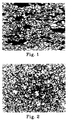
- Figure 1 illustrates the microstructure obtained by controlled rolling in the austenite range and then air cooling.
- the microstructure consists of approximately 75-80 percent polygonal ferrite and 20-25 percent of uniformly distributed islands of lower bainite.
- Figure 2 illustrates the microstructure obtained by conventional rolling and air cooling.
- the microstructure consists of approximately 50-65 percent polygonal ferrite, 35-45 percent upper bainite, and 2-5 percent pearlite.
- a comparison of Figures 1 and 2 indicates that the major differences between the microstructures obtained after conventional rolling and after control rolling are the amount of polygonal ferrite (58 percent in conventional rolling versus 77 percent in control rolling), and the type, amount, and morphology of the bainite phase.
- the steel of the invention is operable with the alloying elements varying over particular ranges.
- the other elements are maintained within their stated ranges.
- the present steel achieves its desirable properties as a result of a combination of elements, not any one element operating without regard to the others.
- the selection and amounts of the alloying elements are interdependent, and cannot be optimized without regard to the other elements present and their amounts.
- the alloying elements and their operable percentages are selected for the reasons set forth in the following paragraphs.
- the carbon content can vary from about 0.05 to about 0.35 weight percent. Carbon forms carbides and also contributes to the formation of the bainite phase. Increasing amounts of carbon increase the strength of the steel but also decrease its ductility and toughness. If the amount of carbon is less than about 0.05 percent, the yield strength of the steel is too low and expensive elements must be added to increase the yield strength. If the amount of carbon is greater than about 0.35 percent, the ductility of the steel is too low.
- the grade of steel for use in cold forging has about 0.08-0.12 percent carbon, most preferably 0.10 carbon, to produce the desired microstructure.
- the grade of steel for use in hot forging, without subsequent induction hardening has about 0.08-0.15 percent carbon, most preferably 0.10 percent carbon. If the steel is to be hot forged and then induction hardened, the carbon content is increased to about 0.15-0.35 percent, most preferably 0.25 percent, to permit the induction hardening.
- the molybdenum content can vary from about 0.5 to about 1.75 percent. Molybdenum affects the structure of the austenite during conditioning. If the molybdenum content is below about 0.5 percent, the grain size of the austenite during conditioning prior to cooling and transformation is too large, resulting in a coarse ferrite grain size and low strength upon cooling.
- Figure 3 is a graph of austenite grain size as a function of molybdenum content after reheating the steel to 1150 o C for various times (indicated in seconds), illustrating the reduction in grain size achieved with a sufficiently high molybdenum content. If the molybdenum content is too high, there may be molybdenum-based embrittlement at grain boundaries.
- the niobium content can vary from about 0.01 to about 0.10 percent.
- Niobium contributes to the strengthening and toughness of the steel through the formation of niobium carbides, nitrides, and carbonitrides.
- Niobium also contributes to strengthening by lowering the bainite start temperature when the niobium is in solution. If the niobium content is less than about 0.01 percent, insufficient niobium precipitates are formed to achieve acceptable toughness levels. If the niobium content is more than about 0.10 percent, the volume fraction of precipitates is too large, and there is a resulting reduction in toughness of the steel.
- the manganese content can vary from about 0.5 to about 2.0 weight percent, and the chromium content can vary from about 0.3 to about 1.0 weight percent.
- Manganese and chromium affect phase formation during cooling, as may be seen in the continuous-cooling-transformation (CCT) diagram, generally by suppressing transformation temperatures and delaying the start of pearlite formation. The result is a fine microstructure including the ferrite grain size, and production of bainite rather than pearlite during cooling.
- Figures 4 and 5 illustrate the effect of chromium on the continuous cooling transformation diagram.
- the CCT diagram for the MPC steel is depicted in Figure 4, while the CCT diagram for a comparable steel, except having only 0.1 percent molybdenum and 0.25 percent chromium, is depicted in Figure 5.
- the start of pearlite formation is delayed in the steel of the invention, resulting in a microstructure that is primarily fine ferrite and fine lower bainite. Alloying elements such as molybdenum move the ferrite-start temperature to the right in the non-control rolling processes whose results are depicted in Figures 4 and 5.
- Pearlite in the microstructure contributes to reduced toughness.
- the composition and processing of the present steel are selected to avoid or at least minimize the amount of pearlite present.
- a small amount of pearlite such as less than 2 percent by volume, may unavoidably be present, particularly in the center of large sections, but care is taken to minimize its presence and effects.
- the most preferred microstructure has fine grained ferrite, with a grain size of less than about 15 micrometers.
- the fineness of the microstructure contributes significantly to high strength and high toughness, and an increase above about 15 micrometers is not acceptable.
- the fine ferrite grain size originates in part with the well conditioned austenite having a fully recrystallized, fine grained, equiaxed structure.
- the most preferred microstructure also preferably has fine lower bainite in preference to coarse upper bainite.
- the fine lower bainite in combination with the fine ferrite grain size promote good notch toughness in the final product.
- the bainite microstructure essentially has a two-phase microstructure composed of ferrite and iron carbide. Depending on the composition of the austenite and the cooling rate, there is a variation in the morphology of the resulting bainite.
- the resulting microstructures are referred to as upper bainite or lower bainite.
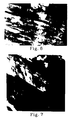
- Figure 6 shows an example of the steel of the invention with an upper bainite microstructure.
- Upper bainite can be described as aggregates of ferrite laths that usually are found in parallel groups to form plate-shaped regions.
- the carbide phase associated with upper bainite is precipitated at the prior austenite grain boundaries (interlath regions.), and depending on the carbon content, these carbides can form nearly complete carbide films between the lath boundaries, as shown in Figure 6.
- Lower bainite also consists of an aggregate of ferrite and carbides.
- the carbides precipitate inside of the ferrite plates.
- the carbide precipitates are on a very fine scale and in general have the shape of rods or blades.
- a typical example of lower bainite microstructure in a steel of the invention is illustrated in Figure 7.
- the sulfur content of the steel is selected depending upon the intended application of the steel.
- Manganese reacts with sulfur to form manganese sulfides, which act as crack initiation sites and reduce the toughness of the steel.
- these sulfides can contribute to the machinability of the steel through essentially the same mechanism.
- some sulfur is provided in those applications where machinability is desirable.
- the sulfur content can vary from about 0.015 percent to about 0.020 percent. If the sulfur content is less than about 0.015 percent, the steel cannot be readily machined.
- the sulfur content is more than about 0.020 percent, the toughness is reduced unacceptably.
- the steel can be used for other applications such as tire cord, where machinability is not required.
- the sulfur is preferably reduced further, and most preferably to about 0.003 percent.
- the sulfur content may be increased to from about 0.020 to about 0.060 percent to improve chip formation at a sacrifice in product toughness.
- the steel After the steel is prepared according to the invention, it is used in any of several applications. In one potential application of particular interest, the steel replaces a medium carbon steel in the fabrication by cold forming of a steering bracket. When a medium carbon 1038 steel is used to form the bracket, a number of heat treatments are required, which are not needed when the controlled rolled, and air cooled preferred steel of the invention is used.
- Table I compares the fabrication steps required for the two steels in making the bracket, and the resulting properties: (“ksi" is thousands of pounds per square inch, and "ft-lb" is foot pounds of energy absorbed.)
- the present steel is slightly more expensive than the 1038 steel in that it contains more expensive alloying elements, and requires mill control rolling procedures. This cost is more than offset by the elimination of three heat treatments during the fabrication operation, resulting in a less costly final part. Moreover, the properties of the part made with the present steel are superior to those of the part made with the plain carbon steel.
- the preferred MPC steel of the invention was comparatively tested against two prior steels used for forging applications.
- the results obtained for the steels are as follows: TABLE II Steel YS (ksi) TS (ksi) %RA CVN, ft-lb OF 75F 1045/WQ 82 123 40 12 20 10V45/HR 86 125 29 4 12 MPC/WQ 114 138 63 33 53 MPC/AC 62 97 61 46 68 (WQ is water quenched, HR is hot rolled, and AC is air cooled.
- YS yield strength
- TS tensile strength
- %RA percentage reduction in area
- CVN Charpy V-notch toughness at the indicated temperatures.
- the steel of the invention in the water quenched condition is superior to the prior steels in all respects. In the air cooled condition, it has lower strength properties but much better toughness properties. For some applications, the combination of properties offered by the air cooled steel of the present invention may be preferable to those of the prior steels.
- the preferred MPC steel of the invention was comparatively tested against hot rolled SAE grade 1541 steel in the manufacture of a centerlink for automotive applications.
- the preferred steel of the invention was control rolled, and could be cleaned and coated, cold drawn, extruded, bent, coined, drilled and magnaflux inspected.
- the SAE grade 1541 steel was conventionally rolled, spheroidize annealed (a step not required or used for the preferred steel of the invention), and could be cleaned and coated, cold drawn, extruded, bent, coined, drilled, and magnaflux inspected.
- the steel of the invention had a yield strength of 112,000 psi, a tensile strength of 120,000 psi, a Charpy V-Notch value at room temperature of 60-80 foot-pounds, and no split rejects in forming a number of the parts.
- the SAE grade 1541 steel had a yield strength of 100,000 psi, a tensile strength of 110,000 psi, a Charpy V-Notch value at room temperature of only 15-17 foot-pounds, and 8 percent split rejects in forming a number of the parts.
- the preferred MPC steel of the invention was comparatively tested against grades HSLA 90 and 1541H in the hot forging of lower control arms for automotive applications. Each steel was conventionally hot rolled and hot forged, and air cooled. The HSLA 90 and steel of the invention received no further heat treatment, while the grade 1541H steel was quenched and tempered.
- the steel of the invention had a yield strength of 122,000 psi, a tensile strength of 152,000 psi, a Charpy V-notch value at room temperature of 51-59 foot-pounds, and failed in fatigue at about 250,000 cycles.
- the HSLA 90 steel had a yield strength of 105,000 psi, a tensile strength of 133,000 psi, and a Charpy V-notch value at room temperature of 21-22 foot-pounds.
- the grade 1541H steel which was quenched and tempered, had a yield strength of 116,000 psi, a tensile strength of 135,000 psi, a Charpy V-notch value at room temperature of 45-68 foot-pounds, and failed in fatigue at about 80,000 cycles.
- the steel of the invention exhibited significantly better strength and toughness values than the HSLA 90 steel, and significantly better strength than the grade 1541 steel, with comparable toughness values.
- the present invention therefore provides a versatile steel material that can be used in a wide variety of applications without post rolling heat treatments.
Landscapes
- Chemical & Material Sciences (AREA)
- Engineering & Computer Science (AREA)
- Materials Engineering (AREA)
- Mechanical Engineering (AREA)
- Metallurgy (AREA)
- Organic Chemistry (AREA)
- Heat Treatment Of Steel (AREA)
Applications Claiming Priority (2)
| Application Number | Priority Date | Filing Date | Title |
|---|---|---|---|
| US682431 | 1991-04-08 | ||
| US07/682,431 US5213634A (en) | 1991-04-08 | 1991-04-08 | Multiphase microalloyed steel and method thereof |
Publications (1)
| Publication Number | Publication Date |
|---|---|
| EP0508237A1 true EP0508237A1 (de) | 1992-10-14 |
Family
ID=24739669
Family Applications (1)
| Application Number | Title | Priority Date | Filing Date |
|---|---|---|---|
| EP92105273A Withdrawn EP0508237A1 (de) | 1991-04-08 | 1992-04-07 | Mehrphasiges mikrolegiertes Stahl |
Country Status (5)
| Country | Link |
|---|---|
| US (1) | US5213634A (de) |
| EP (1) | EP0508237A1 (de) |
| JP (1) | JPH0734184A (de) |
| CA (1) | CA2065182A1 (de) |
| MX (1) | MX9201548A (de) |
Cited By (3)
| Publication number | Priority date | Publication date | Assignee | Title |
|---|---|---|---|---|
| EP0882808A1 (de) * | 1997-06-04 | 1998-12-09 | Thyssen France SA | Verfahren zur Herstellung eines Stahles für Formen grosser Abmessungen |
| WO2001048258A1 (fr) * | 1999-12-24 | 2001-07-05 | Nippon Steel Corporation | Produit en barre ou en fil a utiliser dans le forgeage a froid et procede de production de ce produit |
| WO2001048257A1 (fr) * | 1999-12-24 | 2001-07-05 | Nippon Steel Corporation | Produit en barre ou en fil a utiliser dans le forgeage a froid et procede de production de ce produit |
Families Citing this family (18)
| Publication number | Priority date | Publication date | Assignee | Title |
|---|---|---|---|---|
| JP3300500B2 (ja) * | 1993-10-12 | 2002-07-08 | 新日本製鐵株式会社 | 疲労強度、降伏強度および被削性に優れる熱間鍛造用鋼の製造方法 |
| DE69608179T2 (de) * | 1995-01-26 | 2001-01-18 | Nippon Steel Corp., Tokio/Tokyo | Schweissbarer hochfester stahl mit ausgezeichneter tieftemperaturzähigkeit |
| AU742179B2 (en) * | 1997-02-27 | 2001-12-20 | Exxon Production Research Company | High-tensile-strength steel and method of manufacturing the same |
| JPH10237583A (ja) | 1997-02-27 | 1998-09-08 | Sumitomo Metal Ind Ltd | 高張力鋼およびその製造方法 |
| US5928442A (en) * | 1997-08-22 | 1999-07-27 | Snap-On Technologies, Inc. | Medium/high carbon low alloy steel for warm/cold forming |
| DE19815022A1 (de) * | 1998-04-03 | 1999-10-21 | Daimler Chrysler Ag | Ziehteile aus Federstahlblech, insbesondere als Leichtbau- oder Karosserieteil |
| US6632301B2 (en) | 2000-12-01 | 2003-10-14 | Benton Graphics, Inc. | Method and apparatus for bainite blades |
| AU2002365596B2 (en) | 2001-11-27 | 2007-08-02 | Exxonmobil Upstream Research Company | CNG fuel storage and delivery systems for natural gas powered vehicles |
| US6852175B2 (en) * | 2001-11-27 | 2005-02-08 | Exxonmobil Upstream Research Company | High strength marine structures |
| FR2841947B1 (fr) * | 2002-07-05 | 2005-04-29 | Valmex | Vis en acier a tete creuse |
| JP4390576B2 (ja) * | 2003-03-04 | 2009-12-24 | 株式会社小松製作所 | 転動部材 |
| JP4390526B2 (ja) * | 2003-03-11 | 2009-12-24 | 株式会社小松製作所 | 転動部材およびその製造方法 |
| JP4470701B2 (ja) * | 2004-01-29 | 2010-06-02 | Jfeスチール株式会社 | 加工性および表面性状に優れた高強度薄鋼板およびその製造方法 |
| JP5319866B2 (ja) * | 2004-05-24 | 2013-10-16 | 株式会社小松製作所 | 転動部材およびその製造方法 |
| US7905301B2 (en) * | 2007-07-02 | 2011-03-15 | Baker Hughes Incorporated | Earth boring drill bits made from a low-carbon, high-molybdenum alloy |
| JP5768734B2 (ja) * | 2012-02-02 | 2015-08-26 | 新日鐵住金株式会社 | 冷鍛窒化用圧延鋼材 |
| KR101449511B1 (ko) * | 2014-07-29 | 2014-10-13 | 한국기계연구원 | 가공 경화형 항복비 제어강 및 그 제조방법 |
| JP2023539781A (ja) * | 2020-09-07 | 2023-09-19 | アルセロールミタル | 鋼の鍛造された部品及びその製造方法 |
Citations (4)
| Publication number | Priority date | Publication date | Assignee | Title |
|---|---|---|---|---|
| FR2000542A1 (de) * | 1968-01-22 | 1969-09-12 | Nippon Kokan Kk | |
| DE2144325A1 (de) * | 1971-09-03 | 1973-03-15 | Mim Comb Siderurg Galati | Schweissbare, witterungsbestaendige feinkorn-baustaehle |
| FR2290503A1 (fr) * | 1974-11-11 | 1976-06-04 | Dalmine Spa | Acier destine a des usages a temperature elevee |
| EP0411515A1 (de) * | 1989-07-31 | 1991-02-06 | Mitsubishi Jukogyo Kabushiki Kaisha | Hochfeste, hitzebeständige, niedrig legierte Stähle |
Family Cites Families (18)
| Publication number | Priority date | Publication date | Assignee | Title |
|---|---|---|---|---|
| US2158651A (en) * | 1936-06-24 | 1939-05-16 | Electro Metallurg Co | Steel |
| US2264355A (en) * | 1936-06-24 | 1941-12-02 | Electro Metallurg Co | Steel |
| US2194178A (en) * | 1936-06-24 | 1940-03-19 | Electro Metallurg Co | Low alloy steel |
| US3102831A (en) * | 1960-08-10 | 1963-09-03 | Molybdenum Corp | Production of columbium containing steels |
| US3010822A (en) * | 1961-01-23 | 1961-11-28 | Nat Steel Corp | Columbium containing steels, process for their manufacture and articles prepared therefrom |
| GB1191317A (en) * | 1966-07-21 | 1970-05-13 | Yawata Iron Steel Co Ltd | Weldable High Strength Structural Steel not Embrittled by Stress-Relieving Annealings |
| FR95362E (fr) * | 1967-08-08 | 1970-09-11 | Ct De Rech S De Pont A Mousson | Coquille pour la coulée de métal liquide et son procédé de fabrication. |
| US3424576A (en) * | 1968-04-23 | 1969-01-28 | Lukens Steel Co | Free machining steels |
| US3807990A (en) * | 1968-09-11 | 1974-04-30 | Nippon Steel Corp | Low-alloy high-tensile strength steel |
| CA1028535A (en) * | 1973-11-15 | 1978-03-28 | Bethlehem Steel Corporation | Method for controlling the temperature of steel during hot-rolling on a continuous hot-rolling mill |
| JPS5351115A (en) * | 1976-10-20 | 1978-05-10 | Sumitomo Metal Ind Ltd | Production of high tensile thin sheet |
| FR2428782A1 (fr) * | 1978-06-13 | 1980-01-11 | Pont A Mousson | Elements tubulaires en acier pour conduites en mer |
| JPS5818970B2 (ja) * | 1978-08-31 | 1983-04-15 | 川崎製鉄株式会社 | 冷間加工性の優れた高張力薄鋼板の製造方法 |
| JPS56123324A (en) * | 1981-01-12 | 1981-09-28 | Kobe Steel Ltd | Production of high-strength steel of superior workability |
| JPS57137426A (en) * | 1981-02-20 | 1982-08-25 | Kawasaki Steel Corp | Production of low yield ratio, high tensile hot rolled steel plate by mixed structure |
| JPS6023187B2 (ja) * | 1982-05-24 | 1985-06-06 | 株式会社日本製鋼所 | 溶接性の優れた耐硫化物割れ厚肉鋼 |
| US4671827A (en) * | 1985-10-11 | 1987-06-09 | Advanced Materials And Design Corp. | Method of forming high-strength, tough, corrosion-resistant steel |
| US4824492A (en) * | 1987-12-23 | 1989-04-25 | Chaparral Steel Company | Method for producing a precipitation hardenable martensitic low alloy steel forging |
-
1991
- 1991-04-08 US US07/682,431 patent/US5213634A/en not_active Expired - Fee Related
-
1992
- 1992-04-03 MX MX9201548A patent/MX9201548A/es unknown
- 1992-04-06 CA CA002065182A patent/CA2065182A1/en not_active Abandoned
- 1992-04-07 EP EP92105273A patent/EP0508237A1/de not_active Withdrawn
- 1992-04-08 JP JP4115348A patent/JPH0734184A/ja active Pending
Patent Citations (4)
| Publication number | Priority date | Publication date | Assignee | Title |
|---|---|---|---|---|
| FR2000542A1 (de) * | 1968-01-22 | 1969-09-12 | Nippon Kokan Kk | |
| DE2144325A1 (de) * | 1971-09-03 | 1973-03-15 | Mim Comb Siderurg Galati | Schweissbare, witterungsbestaendige feinkorn-baustaehle |
| FR2290503A1 (fr) * | 1974-11-11 | 1976-06-04 | Dalmine Spa | Acier destine a des usages a temperature elevee |
| EP0411515A1 (de) * | 1989-07-31 | 1991-02-06 | Mitsubishi Jukogyo Kabushiki Kaisha | Hochfeste, hitzebeständige, niedrig legierte Stähle |
Cited By (7)
| Publication number | Priority date | Publication date | Assignee | Title |
|---|---|---|---|---|
| EP0882808A1 (de) * | 1997-06-04 | 1998-12-09 | Thyssen France SA | Verfahren zur Herstellung eines Stahles für Formen grosser Abmessungen |
| FR2764308A1 (fr) * | 1997-06-04 | 1998-12-11 | Thyssen France Sa | Procede de fabrication d'un acier pour moules de grandes dimensions |
| CN1079839C (zh) * | 1997-06-04 | 2002-02-27 | 赛森法国公司 | 生产大型模具用钢的方法和大型模具用钢 |
| WO2001048258A1 (fr) * | 1999-12-24 | 2001-07-05 | Nippon Steel Corporation | Produit en barre ou en fil a utiliser dans le forgeage a froid et procede de production de ce produit |
| WO2001048257A1 (fr) * | 1999-12-24 | 2001-07-05 | Nippon Steel Corporation | Produit en barre ou en fil a utiliser dans le forgeage a froid et procede de production de ce produit |
| US6602359B1 (en) | 1999-12-24 | 2003-08-05 | Nippon Steel Corporation | Bar or wire product for use in cold forging and method for producing the same |
| US6866724B2 (en) | 1999-12-24 | 2005-03-15 | Nippon Steel Corporation | Steel bar or wire rod for cold forging and method of producing the same |
Also Published As
| Publication number | Publication date |
|---|---|
| US5213634A (en) | 1993-05-25 |
| CA2065182A1 (en) | 1992-10-09 |
| MX9201548A (es) | 1992-10-01 |
| JPH0734184A (ja) | 1995-02-03 |
Similar Documents
| Publication | Publication Date | Title |
|---|---|---|
| US5213634A (en) | Multiphase microalloyed steel and method thereof | |
| EP3715478B1 (de) | Walzdraht zum kaltstauchen, damit verarbeitetes produkt und herstellungsverfahren dafür | |
| CA1249207A (en) | Controlled rolling process for dual phase steels and application to rod, wire, sheet and other shapes | |
| KR19980064836A (ko) | 강 및 냉간 소성 변형에 의해 성형되는 강 부품의 제조 방법 | |
| JP2001240940A (ja) | 冷間鍛造用棒線材とその製造方法 | |
| KR100428581B1 (ko) | 강도 및 인성이 우수한 비조질강 및 이를 이용한 선재의 제조방법 | |
| US5454888A (en) | Warm forming high-strength steel structural members | |
| JP3554506B2 (ja) | 機械構造用熱間圧延線材・棒鋼の製造方法 | |
| JP2007513259A (ja) | 優れた低温衝撃特性を有する冷間圧造用鋼線及びその製造方法 | |
| JPH0425343B2 (de) | ||
| US4483722A (en) | Low alloy cold-worked martensitic steel | |
| KR100328039B1 (ko) | 냉간압조용선재의제조방법 | |
| KR950009168B1 (ko) | 고인성 열간단조용 비조질강의 제조방법 | |
| WO2013018893A1 (ja) | 熱間鍛造用非調質鋼および熱間鍛造非調質品、ならびにその製造方法 | |
| JPH0676619B2 (ja) | 高強度鋼板の製造方法及びその加工品の熱処理方法 | |
| KR102065266B1 (ko) | 연질 열처리 시간 단축형 냉간 압조용 선재 및 그 제조 방법 | |
| KR20030008852A (ko) | 자동차 샤시부품용 고강도 베이나이트계 비조질강 | |
| JPH09316540A (ja) | 冷鍛性に優れた輪郭高周波焼入用機械構造用鋼の製造方法及び冷間鍛造部品の製造方法 | |
| JPH02274810A (ja) | 高張力非調質ボルトの製造法 | |
| KR100232722B1 (ko) | 열간단조(熱間鍛造)에 의한 고장력 너트의 제조방법 | |
| KR940007365B1 (ko) | 고장력볼트용 강선재의 제조방법 | |
| JPS62263924A (ja) | 強靭鋼管の製造方法 | |
| KR20250158536A (ko) | 커넥팅로드용 비조질강 및 그 제조방법 | |
| JPH108209A (ja) | 冷間加工性に優れた非調質鋼とその製造方法ならびに非調質鋼鍛造部材の製造方法 | |
| JPH02163319A (ja) | 高靭性鋼の製造方法および高靭性鋼部品の製造方法 |
Legal Events
| Date | Code | Title | Description |
|---|---|---|---|
| PUAI | Public reference made under article 153(3) epc to a published international application that has entered the european phase |
Free format text: ORIGINAL CODE: 0009012 |
|
| AK | Designated contracting states |
Kind code of ref document: A1 Designated state(s): AT BE CH DE DK ES FR GB GR IT LI LU MC NL PT SE |
|
| 17P | Request for examination filed |
Effective date: 19930315 |
|
| 17Q | First examination report despatched |
Effective date: 19950406 |
|
| STAA | Information on the status of an ep patent application or granted ep patent |
Free format text: STATUS: THE APPLICATION IS DEEMED TO BE WITHDRAWN |
|
| 18D | Application deemed to be withdrawn |
Effective date: 19951017 |