EP0509623A2 - Système et méthode de traitement de programme - Google Patents
Système et méthode de traitement de programme Download PDFInfo
- Publication number
- EP0509623A2 EP0509623A2 EP92250089A EP92250089A EP0509623A2 EP 0509623 A2 EP0509623 A2 EP 0509623A2 EP 92250089 A EP92250089 A EP 92250089A EP 92250089 A EP92250089 A EP 92250089A EP 0509623 A2 EP0509623 A2 EP 0509623A2
- Authority
- EP
- European Patent Office
- Prior art keywords
- program
- module
- database processing
- procedure
- division
- Prior art date
- Legal status (The legal status is an assumption and is not a legal conclusion. Google has not performed a legal analysis and makes no representation as to the accuracy of the status listed.)
- Granted
Links
Images





Classifications
-
- G—PHYSICS
- G06—COMPUTING OR CALCULATING; COUNTING
- G06F—ELECTRIC DIGITAL DATA PROCESSING
- G06F8/00—Arrangements for software engineering
-
- G—PHYSICS
- G06—COMPUTING OR CALCULATING; COUNTING
- G06F—ELECTRIC DIGITAL DATA PROCESSING
- G06F8/00—Arrangements for software engineering
- G06F8/40—Transformation of program code
- G06F8/54—Link editing before load time
Definitions
- the present invention relates to a program processing system and its processing method. More particularly, this invention is concerned with a system for processing a database processing application program created by embedding a database processing program written in SQL or other database processing language into a program written in COBOL, FORTRAN, or another general-purpose programming language.
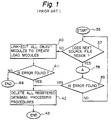
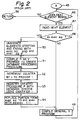
- Figures 1 and 2 are flowcharts showing the source program compilation procedure in a conventional database processing system.
- Figure 3 shows a compilation result of a source program.
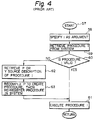
- Figure 4 is a flowchart showing the operation of the database processing request procedure required for executing a database processing program including compiled procedures.
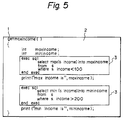
- Figure 5 shows an example of a database processing program used for explanation.
- a general-purpose programming language used to write a database processing program shall be X, and a database processing language, Y.
- 1 denotes a database processing program.
- 2 is a portion of the database processing program which is written in X, and 3, a portion written in Y.
- the Y portion starts and ends, for easy understanding, with "exec sq1" and "end exec".
- the portion is embedded in a program written in X.
- the program shown in Figure 5 retrieves a maximum income from a table s containing data under the condition that the income does not exceed 100, assigns the value to a variable, "maxincome", then outputs the result to a terminal.
- the program retrieves a minimum income from the table s containing data under the condition that the income exceeds 200, assigns the value to a variable, "minincome", then outputs the result to the terminal.
- the operation starts at a step 45. It is determined at a step 46 whether any element to be processed still resides. If it does not reside, the A returns to the caller at a step 55. If an element resides, it is read at a step 47. At a step 48, it is determined whether the read element is "exec sq1". If it is not "exec sq1", the element is passed to a general X compiler, then compiled as an X program. Then, the operation returns to the step 46.
- the read element is "exec sq1"
- the subsequent elements ending with "end exec” forms the Y program.
- This portion is designated as P at a step 50.
- the P is compiled to create an actual database processing procedure. Registered procedures are assigned mutually-different identifiers I so that they can be identified. The system, therefore, has a counter for generating the identifiers. Every time a procedure is created, the counter is incremented by 1 at a step 52 to provide a different identifier. The identifier is represented as I.
- the procedure and P as well as the identifier I are registered with the system.
- the generated identifier I of the procedure is used as an argument to create a description of an X procedure call for invoking a general-purpose procedure (herein "sqlexec") which activates precompiled database processing.
- Figure 3 shows an example of a result of converting an example of Figure 5 according to the procedure.
- two Y descriptions 3 are compiled to create procedures having procedure identifiers 11 and 12, and converted into X general-purpose procedure calls "sqlexec".
- the operation continues until no element is found in the source file.
- the operation is returned to the caller at a step 55.
- the general program division of the source file is stored as an object module in a file by the X compiler.
- the database processing division as well as its source description are registered in a database processing procedure registration area of the system. In addition, information indicating whether an error is detected during compilation is retained.
- the operation returns to the step 39. Then, it is determined whether an error is detected during compilation of the source file. If an error is found, all database processing procedures registered so far are invalidated. At a step 42, the procedures are deleted. The whole compilation procedure terminates with an error at a step 43. If no error is found, the operation returns to a step 37. Then, the next source file is handled. If no source file resides, object modules of general program divisions are link-edited at a step 40. If an error is detected in this process, all the database processing procedures are deleted at the step 42. The whole compilation procedure terminates with an error at the step 43. If link editing terminates normally, a sequence of compilation processes terminates normally at a step 44.
- a database processing program starts the operation as a program written and compiled by general X.
- database processing is carried out based on the logic shown in Figure 4. That is, "sqlexec” starts execution at a step 57, and retrieves a database processing procedure having a procedure identifier I given as an argument at a step 59.
- the P is dynamically recompiled as a Y description to re-create a valid database processing procedure. Then, the I is re-registered as an identifier in the system. The database processing procedure is executed as a step 61.
- a registered database processing procedure becomes inoperative and invalid if, for example, the indexes structure of data which the procedure uses is deleted.
- the database processing system of the prior art provides the aforesaid operations, posing the problems below.
- the present invention intends to solve the foregoing problems. More particularly, unique identifiers are assigned to database processing procedures without using a system-specific counter, thus preventing the operating procedure of a database management system from being complex because of rapid consumption of counter values. Unnecessary procedures are not registered to reduce contention among object-time procedure retrieval, and compile-time procedure registration and deregistration, and eventually improve system performance. Thus, the aforesaid problem (1) will be solved.
- a database processing program can be transferred to another system merely by moving load modules alone, wherein source files need not be recompiled. This provides a solution for the aforesaid problem (2).
- a program processing apparatus handles a program including a first program division written in a first programming language and a second program division written in a second programming language, comprising:
- a program processing method for compiling and editing a source program including a first program division written in a first programming language and a second program division written in a second programming language comprises:
- a program processing method for handling a program including a first program division written in a first programming language and a second program division written in a second programming language comprises at least:
- identifiers which an operating system assigns to files or modules are employed so that reference can be made from a first module to a second module. Identifiers which the operating system assigns are unique within the system. Using the identifiers, files or modules inside the system will not be indistinguishable from others.
- a program processor compiles and registers a first program division and a second program division so that a second module can be invoked with an identifier assigned to a first module. Then, a program executor retrieves the second module according to the identifier assigned to the first module while executing the first module, then executes the second module. This obviates conventional counter control, resulting in a simple system operating procedure.
- identifiers which an operating system assigns to files or modules are employed, and source programs are compiled to create executable modules.
- a first compilation process is implemented to compile a first program division and create a first module.
- a second compilation process translates a second program into a second module, references the first module to find the identifier of the first module, and provides the first module with reference information for referencing the second module.
- An editing process registers the first module with the operating system to obtain an identifier, and then registers the second module so that the second module can be referenced later with the identifier.
- an executable module is generated. Unlike in a conventional method, a counter need not be referenced. While the first module is being executed, reference information contained in the first module is used to retrieve the second module, and then the second module is executed.
- an identifier of a first module which an operating system assigns uniquely within a system is used to retrieve a second module for execution. This prevents unnecessary registration and provides a simple system operating procedure.
- a module can be executed on another system.
- a compilation editing process compiles and edits a first program division to create a module, and holds a second program division in the module with its source description unchanged.
- An execution process converts the second program division into an executable format at once, if necessary, and executes it while executing the module. This means that the second program division of a module can be executed within the first program division. Consequently, modules can be transferred to other systems.
- a portion which will be required after the module is transferred to other system is appended to the module. This permits creation of a module executable on other system to which the module is transferred.
- FIG. 6 is a block diagram of a program processing system according to the present invention.
- 100 denotes an operating system (hereafter, OS) for controlling compilation editing process of programs or execution of programs and managing by using identifiers source programs, object modules, load modules, and other program-related modules, and data files containing data.
- 200 denotes a program processor running under the OS to compile and edit programs, and 300, a program executor running under the OS 100 to execute programs.
- OS operating system
- 210 denotes a compiler for compiling programs, and 220, a linkage editor for editing programs.
- 211 denotes a general program compiler, and 212, a database processing compiler for compiling database processing program divisions.
- 310 denotes a general program executor, and 320, a database processing executor for executing database processing program divisions.
- 321 denotes a recompiler for recompiling database processing program divisions, and 322, a re-registration unit for registering database processing programs which the recompiler 321 has recompiled, in the OS 100.
- 400 is an intermediate file which the database processing compiler 212 of the program processor 200 uses.
- 500 is a file which the OS 100, program processor 200, or program executor 300 uses.
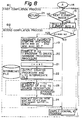
- Figures 7 and 8 are flowcharts showing a source program compilation procedure of a program processing method according to the present invention.
- Figure 9 shows a source program representing a compilation result.
- Figure 10 is a flowchart showing the operation of a database processing request procedure required for executing a database processing program including compiled procedures.
- 600 denotes a compilation editing process which the program processor 200 executes.
- 610 is a compilation process in the compilation editing process, and 620, an editing process.
- 611 denotes a first compilation process in the compilation process 610, and 612, a second compilation process.
- 700 is an execution process which the program executor 300 executes.
- 1 indicates a source program, and 2, a first program division expressed in a first programming language.
- the first programming language is a general-purpose programming language X.
- 3 indicates a second program division expressed in a second programming language.
- the second programming language is a database processing language Y.
- a program processor 200 When a source code of a database processing program is entered, a program processor 200 operates to compile the program as shown in Figures 7 and 8.
- the operation starts at a step 4.
- a counter i whose value is provided as a relative database processing procedure identifier which is exclusively for the compilation is initialised to -1.
- the system is provided with the counter i which is valid exclusively during the compilation period, and generates relative identifiers. Every time a procedure is created, the counter is incremented by 1 to provide a different relative procedure identifier.
- the processing A comprises a first compilation process 611 and a second compilation process 612.
- the first compilation process 611 compiles a first program division to create a first object module.
- the second compilation process 612 compiles a second program division to create a second object module, and provides the first object module with a call statement for referencing the second object module by using an identifier assigned to the load module of a program.
- the processing A starts up at a step 14, and determines at a step 15 whether an element to be processed still resides. If the element does not reside, the A returns to the caller at a step 25. If it resides, the element is read at a step 16. At a step 17, it is determined whether the read element is "exec sql". If the read element is not "exec sql", the element is passed to a general compiler for a general-purpose programming language X, and then is compiled as an X program. Then, the operation is returned to the step 15.
- the read element is "exec sql"
- the subsequent elements ending with "end exec” are identified as a program written in a database processing language Y.
- this portion is designated as P.
- the P is compiled to create an actual database processing procedure at a step 20.
- the i is incremented by 1 to generate a new relative identifier.
- the procedure is placed temporarily in an intermediate file 400 together with the identifier or the i value.
- the P is appended as an i-th value of a character string variable, "prog”, directly to the source program.
- a system procedure for getting file identifiers of load modules existent on an OS, an i value of a generated relative procedure identifier, and an address of an i-th element of "prog" are used as arguments to create a description of an X procedure call for invoking a precompiled general-purpose procedure (herein, " sqlexec ") for activating database processing.
- sqlexec a precompiled general-purpose procedure
- This description replaces the elements starting with "exec sql” and ending with "end exec”.
- Figure 9 shows an example of a result of converting an example of Figure 5 using the foregoing procedure.
- two Y descriptions 3 in Figure 5 are compiled to create procedures having relative procedure identifiers 0 and 1, and are converted to X general-purpose procedure calls, "sqlexec".
- the aforesaid operation continues until no element is found in the source file. Eventually, the operation is returned to the caller at a Step 25.
- the compiled result of the general program division of the source file is stored as an object module in a file by the X-compiler.
- the compiled result of a database processing division is placed in the intermediate file together with the relative identifier i.
- the source description of a database processing division is contained in the object module. In addition, information indicating whether any error is detected during the compilation is held.
- the operation returns to a step 8 shown in Figure 7. It is determined whether an error is detected during compilation of the source file. If an error is found, database processing procedures registered so far are all invalidated. At a step 9, the whole compilation procedure terminates with an error. At this time, since the database processing procedures have not been registered in the system, it is unnecessary to execute a procedure for deleting database processing procedures from a system. If no error is found, the operation returns to the step 6. Then, the next source file is handled.
- the program processor 200 passes the operation to a linkage editor 220.
- the linkage editor 220 edits first object modules of general program divisions to create a load module, and registers the module as a file in the OS 100.
- the linkage editor 220 also registers a second object module in the database processing procedure registration area so that the second object module can be referenced by using an identifier assigned to the load module.
- an editing process 620 link-edits object modules of a general program division.
- load modules of the general program division are created and placed in a file 500.
- the OS 100 assigns uniquely-identifying file identifiers to the load modules.
- the identifiers may be, for example, names of the load modules or numbers assigned to the load modules. Any lexical unit can be used as identifiers as far as modules can be defined uniquely within the system. However, the identifiers must be referenced by the aforesaid system procedure, "getfid()", for getting file identifiers.
- the whole compilation procedure terminates with an error at a step 13.
- database processing procedures have not been registered in the system. Therefore, it is unnecessary to execute a procedure for deleting database processing procedures from the system.
- the linkage editor terminates normally, the database processing procedures placed in the intermediate file are registered with procedure identifiers I in the system by using the file identifiers which have been already assigned by the OS 100 to the load modules and the relative identifiers i which have been used in the load modules. Then, the compilation editing process 600 terminates normally.
- a database processing program or a program written in a general X and compiled is executed by a program executor 300.
- database processing is done based on the logic shown in Figure 10. That is, a system procedure, "getfid()", is evaluated before “sqlexec” is executed, and then the file identifier of the load module existent on the OS is specified as the first argument of "sqlexec".
- the relative procedure identifier and the address of a source description of a Y database processing procedure area respectively specified as the second and third arguments.
- "sqlexec" starts execution at a step 27, specifies a combination of the first and second arguments of the three arguments as a procedure identifier I, and then retrieves a database processing procedure having the procedure identifier I as a step 28. At a step 30, it is checked if the retrieved procedure is valid. If the procedure is valid, the procedure is executed at a step 31. Then, the operation is returned to the caller at a step 35.
- a recompilation registration process 710 is caused to operate.
- the recompilation registration process 710 obtains a source description P specified in the third argument from its own load module at a step 32, and then dynamically recompiles the source description P as a Y description to recreate a valid database processing procedure at a step 33.
- the procedure is registered in the system at a step 34, and then is executed at a step 31.
- the recompilation has been executed by retrieving a source description P from a database processing procedure registration area. This has made recompilation possible within the same system but impossible after a source description is incorporated into any other system.
- the source description P resides in its own load module. Therefore, the recompilation can be done on any other system. Moreover, when the recompilation result is registered in the system by using the I, execution can be done on the different system thereafter.
- a database program processing system comprising: means for creating object modules from a database processing application program which is described with source programs each comprising at least a general program division written in a general-purpose programming language and a database processing division written in a dedicated database processing language, by independently compiling the general program division and the database processing division for each source program, and for storing the object modules in a file; means for creating executable load modules from the general program division under linkage editing operation, and for storing the load modules in the file; means for registering the database processing division as executable database processing procedures in a database processing procedure registration area of a database management system in the system; means for operating a database processing application by activating the load modules and, if necessary, invoking the database processing procedures registered in the database processing procedure registration area; and means for dynamically recompiling the database processing division, if the registered database processing procedures are unavailable or invalidated for some reason, and for re-registering the database processing procedures in the database processing procedure registration area for succeeding executions,
- a file identifier on an operating system of load modules invoking a procedure and an identifier comprising a combination of relative-number values in an application program of a database processing procedure are assigned to each database processing procedure. Since the file identifier of the load module is unique on the OS, overall identifiers of procedures become unique. That is, it is possible to assign unique identifiers of procedures, without assigning unique identifiers by counter values or the like which must be specifically managed in a system. Therefore, repeated compilation of a source program does not consume resources such as counter values.
- a file identifier on an operating system of load modules of an application program and an identifier comprising a combination of relative-number values in the application program of a database processing procedure are assigned to a database processing procedure written in a database processing language. It is possible, therefore, to assign unique identifiers of procedures only to a finally produced load module, without consuming resources such as counter values, even if a source program is compiled repeatedly.
- the produced database processing procedure can be stored in an intermediate file temporarily, and then be registered in a system after normal processing of a general program division and other divisions has been terminated and confirmed. It is possible, therefore, to reduce contention among object-time procedure retrieval, and compile-time procedure registration and deregigtration, and hence to improve system performance.
- a database program processing system in which, if a load module is transferred to another system, a source program of a database processing division is held in the load module corresponding to a general program division, the load module is executed on a destination database processing system, a database processing procedure corresponding to a database processing procedure registration area on the destination database processing system is retrieved by using an identifier of the database processing procedure. If no database processing procedure resides, the program of the database processing division in the load module is dynamically re-compiled and is newly registered in a database processing procedure registration area of a destination system by using a file identifier of a destination load module and relative numbers of the database processing procedure. Then, the database processing division is rerun.
- a user need not recompile a database application program, and can implant a database processing application merely by moving the load modules.
- Procedure identifiers defined as described above are used, and source program descriptions of database processing are held in a load module, not in a system, so that the load module is executed on a destination database processing system, and a database processing procedure corresponding to a database processing procedure registration area on the destination database processing system is retrieved by using the defined identifiers of the database processing procedure. If no database processing procedure resides, the program of the database processing division in the load module is dynamically re-compiled and is registered in a database processing procedure registration area of a destination system to further continue execution of the database processing division. Thus, a user need not re-compile a database application program, and can implant it only by means of the load module.
- the identifier of the database processing procedure is not a counter value or the like but a file identifier of the load module produced during execution on a system under which the application program is running. Therefore, the uniqueness of database processing procedures can be guaranteed.
- a file identifier and a relative identifier i are used in combination as a procedure identifier I, and then the procedure identifier I is assessed to retrieve a database processing procedure (second module). If only one database processing division 3 written in a database processing language is present within a source program 1, or database processing divisions 3 are integrated at one point within a source program, the relative identifier i may not be used. In this second embodiment, the database processing procedure (second module) can be retrieved by assessing the file identifier.
- a source program 1 is written in a general-purpose programming language and a database processing language. Other programming languages will also do.
- a third embodiment, in which a source program comprises a first program division written in a first programming language and a second program division written in a second programming language, will also have the aforesaid advantages.
- a third program division written in a third programming language may be existent.
Landscapes
- Engineering & Computer Science (AREA)
- General Engineering & Computer Science (AREA)
- Theoretical Computer Science (AREA)
- Software Systems (AREA)
- Physics & Mathematics (AREA)
- General Physics & Mathematics (AREA)
- Stored Programmes (AREA)
- Devices For Executing Special Programs (AREA)
- Information Retrieval, Db Structures And Fs Structures Therefor (AREA)
Applications Claiming Priority (3)
| Application Number | Priority Date | Filing Date | Title |
|---|---|---|---|
| JP8843591 | 1991-04-19 | ||
| JP88435/91 | 1991-04-19 | ||
| JP3088435A JP2811990B2 (ja) | 1991-04-19 | 1991-04-19 | プログラム処理装置及びプログラム処理方法 |
Publications (3)
| Publication Number | Publication Date |
|---|---|
| EP0509623A2 true EP0509623A2 (fr) | 1992-10-21 |
| EP0509623A3 EP0509623A3 (en) | 1993-08-25 |
| EP0509623B1 EP0509623B1 (fr) | 1999-12-22 |
Family
ID=13942719
Family Applications (1)
| Application Number | Title | Priority Date | Filing Date |
|---|---|---|---|
| EP92250089A Expired - Lifetime EP0509623B1 (fr) | 1991-04-19 | 1992-04-21 | Système et méthode de traitement de programme |
Country Status (6)
| Country | Link |
|---|---|
| US (1) | US5339424A (fr) |
| EP (1) | EP0509623B1 (fr) |
| JP (1) | JP2811990B2 (fr) |
| KR (1) | KR950001416B1 (fr) |
| CA (1) | CA2066295C (fr) |
| DE (1) | DE69230450T2 (fr) |
Families Citing this family (67)
| Publication number | Priority date | Publication date | Assignee | Title |
|---|---|---|---|---|
| EP0930566A3 (fr) * | 1992-07-06 | 2006-07-05 | Microsoft Corporation | Méthode et système pour composer des objets |
| US5555388A (en) * | 1992-08-20 | 1996-09-10 | Borland International, Inc. | Multi-user system and methods providing improved file management by reading |
| US5432930A (en) * | 1993-09-30 | 1995-07-11 | Eagle Crest Limited | System for accessing cobol data files by generating a dictionary of NF.sup.2 |
| EP0667574A3 (fr) * | 1994-02-14 | 1997-02-12 | Ibm | Système d'ordinateur. |
| US6401099B1 (en) | 1996-12-06 | 2002-06-04 | Microsoft Corporation | Asynchronous binding of named objects |
| US6460058B2 (en) | 1996-12-06 | 2002-10-01 | Microsoft Corporation | Object-oriented framework for hyperlink navigation |
| US7181454B1 (en) * | 1999-12-29 | 2007-02-20 | International Business Machines Corporation | Asset locator |
| US7013340B1 (en) * | 2000-05-18 | 2006-03-14 | Microsoft Corporation | Postback input handling by server-side control objects |
| US6874143B1 (en) | 2000-06-21 | 2005-03-29 | Microsoft Corporation | Architectures for and methods of providing network-based software extensions |
| US7155667B1 (en) | 2000-06-21 | 2006-12-26 | Microsoft Corporation | User interface for integrated spreadsheets and word processing tables |
| US7117435B1 (en) | 2000-06-21 | 2006-10-03 | Microsoft Corporation | Spreadsheet fields in text |
| US6883168B1 (en) | 2000-06-21 | 2005-04-19 | Microsoft Corporation | Methods, systems, architectures and data structures for delivering software via a network |
| JP4522650B2 (ja) | 2000-06-21 | 2010-08-11 | マイクロソフト コーポレーション | スプレッドシートとワードプロセッシングの表を統合するシステムと方法 |
| US7000230B1 (en) | 2000-06-21 | 2006-02-14 | Microsoft Corporation | Network-based software extensions |
| US6948135B1 (en) | 2000-06-21 | 2005-09-20 | Microsoft Corporation | Method and systems of providing information to computer users |
| US6836883B1 (en) * | 2000-06-21 | 2004-12-28 | Microsoft Corporation | Method and system for compiling multiple languages |
| US7346848B1 (en) | 2000-06-21 | 2008-03-18 | Microsoft Corporation | Single window navigation methods and systems |
| US7191394B1 (en) | 2000-06-21 | 2007-03-13 | Microsoft Corporation | Authoring arbitrary XML documents using DHTML and XSLT |
| US7624356B1 (en) | 2000-06-21 | 2009-11-24 | Microsoft Corporation | Task-sensitive methods and systems for displaying command sets |
| EP1174791B1 (fr) | 2000-07-10 | 2017-09-27 | Microsoft Technology Licensing, LLC | Système et methode de type de données unifié |
| US7493397B1 (en) | 2001-06-06 | 2009-02-17 | Microsoft Corporation | Providing remote processing services over a distributed communications network |
| US6915454B1 (en) | 2001-06-12 | 2005-07-05 | Microsoft Corporation | Web controls validation |
| US7278137B1 (en) | 2001-12-26 | 2007-10-02 | Arc International | Methods and apparatus for compiling instructions for a data processor |
| US7415672B1 (en) | 2003-03-24 | 2008-08-19 | Microsoft Corporation | System and method for designing electronic forms |
| US7275216B2 (en) | 2003-03-24 | 2007-09-25 | Microsoft Corporation | System and method for designing electronic forms and hierarchical schemas |
| US7370066B1 (en) | 2003-03-24 | 2008-05-06 | Microsoft Corporation | System and method for offline editing of data files |
| US7913159B2 (en) | 2003-03-28 | 2011-03-22 | Microsoft Corporation | System and method for real-time validation of structured data files |
| US7296017B2 (en) | 2003-03-28 | 2007-11-13 | Microsoft Corporation | Validation of XML data files |
| US7516145B2 (en) | 2003-03-31 | 2009-04-07 | Microsoft Corporation | System and method for incrementally transforming and rendering hierarchical data files |
| US7168035B1 (en) | 2003-06-11 | 2007-01-23 | Microsoft Corporation | Building a view on markup language data through a set of components |
| US7451392B1 (en) | 2003-06-30 | 2008-11-11 | Microsoft Corporation | Rendering an HTML electronic form by applying XSLT to XML using a solution |
| US7197515B2 (en) | 2003-06-30 | 2007-03-27 | Microsoft Corporation | Declarative solution definition |
| US7581177B1 (en) | 2003-08-01 | 2009-08-25 | Microsoft Corporation | Conversion of structured documents |
| US7406660B1 (en) | 2003-08-01 | 2008-07-29 | Microsoft Corporation | Mapping between structured data and a visual surface |
| US7334187B1 (en) | 2003-08-06 | 2008-02-19 | Microsoft Corporation | Electronic form aggregation |
| US8819072B1 (en) | 2004-02-02 | 2014-08-26 | Microsoft Corporation | Promoting data from structured data files |
| US7430711B2 (en) | 2004-02-17 | 2008-09-30 | Microsoft Corporation | Systems and methods for editing XML documents |
| US7318063B2 (en) | 2004-02-19 | 2008-01-08 | Microsoft Corporation | Managing XML documents containing hierarchical database information |
| US7496837B1 (en) | 2004-04-29 | 2009-02-24 | Microsoft Corporation | Structural editing with schema awareness |
| US7890604B2 (en) | 2004-05-07 | 2011-02-15 | Microsoft Corproation | Client-side callbacks to server events |
| US7568101B1 (en) | 2004-05-13 | 2009-07-28 | Microsoft Corporation | Digital signatures with an embedded view |
| US9026578B2 (en) | 2004-05-14 | 2015-05-05 | Microsoft Corporation | Systems and methods for persisting data between web pages |
| US7464386B2 (en) | 2004-05-17 | 2008-12-09 | Microsoft Corporation | Data controls architecture |
| US7281018B1 (en) | 2004-05-26 | 2007-10-09 | Microsoft Corporation | Form template data source change |
| US7774620B1 (en) | 2004-05-27 | 2010-08-10 | Microsoft Corporation | Executing applications at appropriate trust levels |
| US7692636B2 (en) | 2004-09-30 | 2010-04-06 | Microsoft Corporation | Systems and methods for handwriting to a screen |
| US7516399B2 (en) | 2004-09-30 | 2009-04-07 | Microsoft Corporation | Structured-document path-language expression methods and systems |
| US8487879B2 (en) | 2004-10-29 | 2013-07-16 | Microsoft Corporation | Systems and methods for interacting with a computer through handwriting to a screen |
| US7712022B2 (en) | 2004-11-15 | 2010-05-04 | Microsoft Corporation | Mutually exclusive options in electronic forms |
| US7584417B2 (en) | 2004-11-15 | 2009-09-01 | Microsoft Corporation | Role-dependent action for an electronic form |
| US7721190B2 (en) | 2004-11-16 | 2010-05-18 | Microsoft Corporation | Methods and systems for server side form processing |
| US7509353B2 (en) | 2004-11-16 | 2009-03-24 | Microsoft Corporation | Methods and systems for exchanging and rendering forms |
| US7904801B2 (en) | 2004-12-15 | 2011-03-08 | Microsoft Corporation | Recursive sections in electronic forms |
| US7437376B2 (en) | 2004-12-20 | 2008-10-14 | Microsoft Corporation | Scalable object model |
| US7937651B2 (en) | 2005-01-14 | 2011-05-03 | Microsoft Corporation | Structural editing operations for network forms |
| US7725834B2 (en) | 2005-03-04 | 2010-05-25 | Microsoft Corporation | Designer-created aspect for an electronic form template |
| US8010515B2 (en) | 2005-04-15 | 2011-08-30 | Microsoft Corporation | Query to an electronic form |
| US7543228B2 (en) | 2005-06-27 | 2009-06-02 | Microsoft Corporation | Template for rendering an electronic form |
| US8200975B2 (en) | 2005-06-29 | 2012-06-12 | Microsoft Corporation | Digital signatures for network forms |
| JP4725955B2 (ja) * | 2005-06-30 | 2011-07-13 | 株式会社リコー | 情報処理装置、メッセージ管理方法、プログラムおよび記憶媒体 |
| US7613996B2 (en) | 2005-08-15 | 2009-11-03 | Microsoft Corporation | Enabling selection of an inferred schema part |
| US8001459B2 (en) | 2005-12-05 | 2011-08-16 | Microsoft Corporation | Enabling electronic documents for limited-capability computing devices |
| US7779343B2 (en) | 2006-01-30 | 2010-08-17 | Microsoft Corporation | Opening network-enabled electronic documents |
| US8464212B2 (en) * | 2007-07-27 | 2013-06-11 | Canon Kabushiki Kaisha | Method, apparatus and storage medium for customizing application |
| JP6102136B2 (ja) * | 2012-09-20 | 2017-03-29 | 日本電気株式会社 | モジュール管理装置、モジュール管理システム及びモジュール管理方法 |
| KR102308990B1 (ko) * | 2021-07-20 | 2021-10-06 | (주) 에이블리 | 반도체 테스트 패턴 발생 장치 및 방법 |
| CN118259922B (zh) * | 2024-05-30 | 2024-09-06 | 腾讯科技(深圳)有限公司 | 应用程序的编译方法、装置、产品、设备和介质 |
Family Cites Families (7)
| Publication number | Priority date | Publication date | Assignee | Title |
|---|---|---|---|---|
| US4205371A (en) * | 1975-11-03 | 1980-05-27 | Honeywell Information Systems Inc. | Data base conversion system |
| US4734854A (en) * | 1985-10-08 | 1988-03-29 | American Telephone And Telegraph Company | System for generating software source code components |
| US4961133A (en) * | 1987-11-06 | 1990-10-02 | Visystems, Inc. | Method for providing a virtual execution environment on a target computer using a virtual software machine |
| JPH01162979A (ja) * | 1987-12-19 | 1989-06-27 | Ricoh Co Ltd | データベース管理システムの機能拡張装置 |
| US5230049A (en) * | 1988-11-29 | 1993-07-20 | International Business Machines Corporation | Program source code translator |
| US5117349A (en) * | 1990-03-27 | 1992-05-26 | Sun Microsystems, Inc. | User extensible, language sensitive database system |
| US5175856A (en) * | 1990-06-11 | 1992-12-29 | Supercomputer Systems Limited Partnership | Computer with integrated hierarchical representation (ihr) of program wherein ihr file is available for debugging and optimizing during target execution |
-
1991
- 1991-04-19 JP JP3088435A patent/JP2811990B2/ja not_active Expired - Fee Related
-
1992
- 1992-04-06 KR KR1019920005701A patent/KR950001416B1/ko not_active Expired - Fee Related
- 1992-04-16 CA CA002066295A patent/CA2066295C/fr not_active Expired - Fee Related
- 1992-04-17 US US07/869,957 patent/US5339424A/en not_active Expired - Lifetime
- 1992-04-21 DE DE69230450T patent/DE69230450T2/de not_active Expired - Fee Related
- 1992-04-21 EP EP92250089A patent/EP0509623B1/fr not_active Expired - Lifetime
Also Published As
| Publication number | Publication date |
|---|---|
| DE69230450T2 (de) | 2000-07-06 |
| EP0509623A3 (en) | 1993-08-25 |
| KR920020317A (ko) | 1992-11-21 |
| CA2066295A1 (fr) | 1992-10-20 |
| DE69230450D1 (de) | 2000-01-27 |
| KR950001416B1 (ko) | 1995-02-24 |
| CA2066295C (fr) | 1998-04-14 |
| EP0509623B1 (fr) | 1999-12-22 |
| US5339424A (en) | 1994-08-16 |
| JPH04320533A (ja) | 1992-11-11 |
| JP2811990B2 (ja) | 1998-10-15 |
Similar Documents
| Publication | Publication Date | Title |
|---|---|---|
| US5339424A (en) | System and method for compiling and executing a computer program written in more than one programming language | |
| US5230049A (en) | Program source code translator | |
| US6836884B1 (en) | Method and system for editing software programs | |
| US5956512A (en) | Computer program debugging in the presence of compiler synthesized variables | |
| Paleczny et al. | The java {HotSpot™} server compiler | |
| US8181170B2 (en) | Unwind information for optimized programs | |
| US5313387A (en) | Re-execution of edit-compile-run cycles for changed lines of source code, with storage of associated data in buffers | |
| US5586328A (en) | Module dependency based incremental compiler and method | |
| US5854932A (en) | Compiler and method for avoiding unnecessary recompilation | |
| US5182806A (en) | Incremental compiler for source-code development system | |
| US5170465A (en) | Incremental-scanning compiler for source-code development system | |
| US5201050A (en) | Line-skip compiler for source-code development system | |
| US7992141B2 (en) | Method and apparatus for building executable computer programs using compiled program libraries | |
| US5367683A (en) | Smart recompilation of performing matchup/difference after code generation | |
| US20070226720A1 (en) | System and Method for Efficiently Passing Information Between Compiler and Post-Compile-Time Software | |
| EP0543588A2 (fr) | Génération et traitement de programmes d'ordinateur | |
| US20020166115A1 (en) | System and method for computer program compilation using scalar register promotion and static single assignment representation | |
| US7086044B2 (en) | Method, article of manufacture and apparatus for performing automatic intermodule call linkage optimization | |
| US5581769A (en) | Multipurpose program object linkage protocol for upward compatibility among different compilers | |
| EP0406028A2 (fr) | Compilateur incrémentiel pour un système de développement de code source | |
| EP0790555B1 (fr) | Appareil et méthode de compilation | |
| US5150474A (en) | Method for transferring arguments between object programs by switching address modes according to mode identifying flag | |
| JP3019915B2 (ja) | 手続き呼出し方法 | |
| US5394550A (en) | System for affecting recompilation of source code | |
| JP3018783B2 (ja) | コンパイル方式 |
Legal Events
| Date | Code | Title | Description |
|---|---|---|---|
| PUAI | Public reference made under article 153(3) epc to a published international application that has entered the european phase |
Free format text: ORIGINAL CODE: 0009012 |
|
| AK | Designated contracting states |
Kind code of ref document: A2 Designated state(s): DE FR GB |
|
| PUAL | Search report despatched |
Free format text: ORIGINAL CODE: 0009013 |
|
| AK | Designated contracting states |
Kind code of ref document: A3 Designated state(s): DE FR GB |
|
| 17P | Request for examination filed |
Effective date: 19930924 |
|
| 17Q | First examination report despatched |
Effective date: 19970901 |
|
| GRAG | Despatch of communication of intention to grant |
Free format text: ORIGINAL CODE: EPIDOS AGRA |
|
| GRAG | Despatch of communication of intention to grant |
Free format text: ORIGINAL CODE: EPIDOS AGRA |
|
| GRAH | Despatch of communication of intention to grant a patent |
Free format text: ORIGINAL CODE: EPIDOS IGRA |
|
| GRAH | Despatch of communication of intention to grant a patent |
Free format text: ORIGINAL CODE: EPIDOS IGRA |
|
| GRAH | Despatch of communication of intention to grant a patent |
Free format text: ORIGINAL CODE: EPIDOS IGRA |
|
| GRAA | (expected) grant |
Free format text: ORIGINAL CODE: 0009210 |
|
| AK | Designated contracting states |
Kind code of ref document: B1 Designated state(s): DE FR GB |
|
| REF | Corresponds to: |
Ref document number: 69230450 Country of ref document: DE Date of ref document: 20000127 |
|
| ET | Fr: translation filed | ||
| PLBE | No opposition filed within time limit |
Free format text: ORIGINAL CODE: 0009261 |
|
| 26N | No opposition filed | ||
| REG | Reference to a national code |
Ref country code: GB Ref legal event code: IF02 |
|
| PGFP | Annual fee paid to national office [announced via postgrant information from national office to epo] |
Ref country code: DE Payment date: 20070419 Year of fee payment: 16 |
|
| PGFP | Annual fee paid to national office [announced via postgrant information from national office to epo] |
Ref country code: GB Payment date: 20070418 Year of fee payment: 16 |
|
| PGFP | Annual fee paid to national office [announced via postgrant information from national office to epo] |
Ref country code: FR Payment date: 20070411 Year of fee payment: 16 |
|
| GBPC | Gb: european patent ceased through non-payment of renewal fee |
Effective date: 20080421 |
|
| PG25 | Lapsed in a contracting state [announced via postgrant information from national office to epo] |
Ref country code: DE Free format text: LAPSE BECAUSE OF NON-PAYMENT OF DUE FEES Effective date: 20081101 |
|
| REG | Reference to a national code |
Ref country code: FR Ref legal event code: ST Effective date: 20081231 |
|
| PG25 | Lapsed in a contracting state [announced via postgrant information from national office to epo] |
Ref country code: FR Free format text: LAPSE BECAUSE OF NON-PAYMENT OF DUE FEES Effective date: 20080430 |
|
| PG25 | Lapsed in a contracting state [announced via postgrant information from national office to epo] |
Ref country code: GB Free format text: LAPSE BECAUSE OF NON-PAYMENT OF DUE FEES Effective date: 20080421 |