EP0509633A2 - Halbleiterspeicher - Google Patents
Halbleiterspeicher Download PDFInfo
- Publication number
- EP0509633A2 EP0509633A2 EP92301917A EP92301917A EP0509633A2 EP 0509633 A2 EP0509633 A2 EP 0509633A2 EP 92301917 A EP92301917 A EP 92301917A EP 92301917 A EP92301917 A EP 92301917A EP 0509633 A2 EP0509633 A2 EP 0509633A2
- Authority
- EP
- European Patent Office
- Prior art keywords
- data
- address
- prom
- modified
- memory
- Prior art date
- Legal status (The legal status is an assumption and is not a legal conclusion. Google has not performed a legal analysis and makes no representation as to the accuracy of the status listed.)
- Granted
Links
Images


Classifications
-
- G—PHYSICS
- G11—INFORMATION STORAGE
- G11C—STATIC STORES
- G11C29/00—Checking stores for correct operation ; Subsequent repair; Testing stores during standby or offline operation
- G11C29/70—Masking faults in memories by using spares or by reconfiguring
- G11C29/76—Masking faults in memories by using spares or by reconfiguring using address translation or modifications
-
- G—PHYSICS
- G11—INFORMATION STORAGE
- G11C—STATIC STORES
- G11C16/00—Erasable programmable read-only memories
-
- G—PHYSICS
- G11—INFORMATION STORAGE
- G11C—STATIC STORES
- G11C17/00—Read-only memories programmable only once; Semi-permanent stores, e.g. manually-replaceable information cards
- G11C17/08—Read-only memories programmable only once; Semi-permanent stores, e.g. manually-replaceable information cards using semiconductor devices, e.g. bipolar elements
- G11C17/10—Read-only memories programmable only once; Semi-permanent stores, e.g. manually-replaceable information cards using semiconductor devices, e.g. bipolar elements in which contents are determined during manufacturing by a predetermined arrangement of coupling elements, e.g. mask-programmable ROM
-
- G—PHYSICS
- G11—INFORMATION STORAGE
- G11C—STATIC STORES
- G11C29/00—Checking stores for correct operation ; Subsequent repair; Testing stores during standby or offline operation
- G11C29/70—Masking faults in memories by using spares or by reconfiguring
- G11C29/78—Masking faults in memories by using spares or by reconfiguring using programmable devices
- G11C29/80—Masking faults in memories by using spares or by reconfiguring using programmable devices with improved layout
- G11C29/816—Masking faults in memories by using spares or by reconfiguring using programmable devices with improved layout for an application-specific layout
- G11C29/822—Masking faults in memories by using spares or by reconfiguring using programmable devices with improved layout for an application-specific layout for read only memories
-
- G—PHYSICS
- G11—INFORMATION STORAGE
- G11C—STATIC STORES
- G11C8/00—Arrangements for selecting an address in a digital store
Definitions
- the present invention relates to a nonvolatile semiconductor memory in general, and to a nonvolatile semiconductor memory that is partially rewritable and inexpensive in construction in particular.
- Nonvolatile semiconductor memories are known in the art. Masked read-only memories (mask ROMs) have been used for applications that require low-cost large-volume production. For low volume-production or for applications that may subsequently require altering the stored data, programmable read-only memories (PROMs) have been the logical choice.
- mask ROMs Masked read-only memories
- PROMs programmable read-only memories
- the mask ROM is a type of read-only memory in which data is written using a mask during fabrication of the memory. Therefore, the stored data cannot be altered by any means once the memory is fabricated, but the advantage is that the mask ROM can be manufactured economically by large-volume production.
- the PROM though a nonvolatile memory, allows the stored data to be altered electrically under specified conditions. However, for large-volume production, the PROM is more expensive than the mask ROM of the comparable capacity.
- PROM erasable PROM
- EEPROM electrically erasable PROM
- PROMs of comparable memory size are used to avoid the above problem associated with ROMs, the major advantage of large-volume production will be lost. Furthermore, writing data to a PROM requires a great deal of time, and consequently productivity suffers greatly. This is particularly true in the case of EPROMs which are relatively cheap compared with EEPROMs. In the case of EPROMs, the entire chip must be rewritten even when only part of the data needs altering.
- the present invention overcomes the aforementioned and other short comings of the above known nonvolatile semiconductor memories.
- the present invention is summarized and described in detail below.
- the present invention provides a nonvolatile semiconductor memory that is partially rewritable and inexpensive in construction.
- the present invention combines a large-capacity mask ROM with a small-capacity PROM between which selection is made for use as required.
- the mask ROM used in the invention has a prescribed capacity that is large enough for the designed purpose, and data is written in the mask ROM during manufacture of the memory.
- the PROM in the preferred embodiment has a capacity sufficiently smaller than that of the mask ROM.
- An address storage circuit is formed from a nonvolatile semiconductor memory such as an EPROM and is capable of storing modified addresses by associating them with the addresses on the PROM.
- the modified addresses designate the data portions that were identified in accordance with the present invention as differing from the original data stored in the mask ROM when modified data was compared with the data stored in the mask ROM.
- the data stored in the mask ROM needs modification, the data is sequentially read out of the mask ROM for one-on-one comparison with the modified data, and only when a mismatch is found in the data, the modified data is written into the PROM, while the address of the modified data is stored as a modified address in the address storage circuit by associating it with the address on the PROM at which the modified data is written.
- Rewriting data can be done as many times as required by erasing the memory contents of the address storage circuit and the PROM.
- Associating the modified address with the address on the PROM can be easily accomplished by, for example, matching the address on the address storage at which the modified address is stored with the address on the PROM at which the modified data is stored.
- An address match detection means is used to determine if the accessed address matches any of the modified addresses stored in the address storage circuit.
- the output data selector When the address match detection means has detected the address match between them, the output data selector outputs the data that is read from the PROM at the address associated with the modified address. Therefore, in this case, the wrong or old data stored in the mask ROM is prevented from being output, and only the modified data is output.
- the output data selector outputs the data that is read from the mask ROM at the accessed address. Therefore, in this case, the original data remaining intact by the modification is output from the mask ROM. If no data modification has been done and therefore there is no modified address stored in the address storage, the data stored in the mask ROM is directly output at all times since no address match is detected by the address match detection means.
- the semiconductor memory of the present invention rewriting data is possible as much as the memory capacity of the PROM allows, and the modified data can be output in a reliable manner despite the original data being stored in the mask ROM. Furthermore, by making the memory capacity of the PROM sufficiently smaller than that of the mask ROM, the cost increase from a single mask ROM construction can be minimized.
- a semiconductor memory which includes a mask ROM, a PROM, an address storage for storing modified addresses by associating them with the addresses on the PROM, an address match detection means for detecting a match or mismatch between an accessed address and the addresses stored in the address storage, and an output data selector which, when the address match detection means has detected an address match, outputs the data that is read from the PROM at the address associated with the modified address, and when no address match exists, outputs the data that is read from the mask ROM at the accessed address.
- a comparator circuit which compares the modified data with the data read from the mask ROM at the time of data rewrite, and when the result of the comparison does not match, the associated address and the modified data are automatically stored in the address storage and the PROM, respectively.
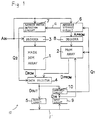
- the semiconductor memory 15 of the present embodiment is a partially rewritable read-only memory including, as shown in Figure 1 , a mask ROM array 1 and a PROM array 2 .
- the mask ROM array 1 is a large-capacity nonvolatile semiconductor memory array in which the stored data are written during manufacture of the memory.
- the PROM array 2 preferably has a relatively small memory capacity.
- An external input address A IN transferred through a plurality of address lines is input to the mask ROM array 1 via a decoder 3 , to an address storage circuit 6 , and to an address match detection circuit 7 .
- the addressed data D ROM is read from the mask ROM array 1 and is transferred via a data selector 4 and an output circuit 5 onto an external data bus 5′ .
- the PROM array 2 is a nonvolatile EPROM memory array in which data can be written electrically.
- An address A PROM which is output from the address storage circuit 6 is given to the PROM array 2 via a decoder 8 .
- modified data D PROM is read from the PROM array 2 and is transferred via the data selector 4 and the output circuit 5 onto the external data bus 5′ .
- the decoders 3 and 8 are provided to perform row decoding of addresses, etc. within the semiconductor memory.
- the output circuit 5 is an interface circuit that interfaces with the external data bus 5′ .
- the address storage circuit 6 is formed from a nonvolatile EPROM that stores modified addresses equivalent to the memory capacity of the PROM array 2 , and is capable of outputting the stored modified addresses sequentially to the address match detection circuit 7 via line 12 .
- the address match detection circuit 7 is a circuit which, when the input address A IN is given, compares the input address A IN with each modified address sent from the address storage circuit 6 , and when the addresses match, issues an active select signal Q2 to the data selector 4 .
- the address storage circuit 6 outputs the address at which the modified address is stored, to deliver it as the address A PROM to the PROM array 2 via the decoder 8 .
- the data selector 4 is a multiplexer that selects the modified data D PROM read from the PROM array 2 to be output as output data D OUT when the select signal Q2 from the address match detection circuit 7 is set active, and selects the data D ROM read from the mask ROM array 1 to be output as output data D OUT when the select signal Q2 is inactive.
- the input address A IN is also given to the address storage circuit 6 so that modified data can be input at the time of rewriting data as is described in detail below.
- the semiconductor memory 15 of the present embodiment is also provided with an input circuit 9 for inputting new data when rewriting data.
- the input circuit 9 is an interface circuit that interfaces with the external data bus 5′ , and the input data D IN transferred through the input circuit 9 from the external data bus 5′ is fed to a comparator circuit 10 and to the PROM array 2 .
- the output data D OUT from the data selector 4 is also fed to the comparator circuit 10 so that the input data D IN and the output data D OUT are compared.
- the comparator circuit 10 issues an active mismatch signal Q1 to the address storage circuit 6 and the PROM array 2 , causing them to store the input address A IN and the input data D IN , respectively.
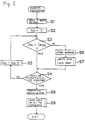
- step S1 shown in Figure 2 a high write voltage is applied to a write power supply terminal V pp (not shown) on the PROM array 2 , and then (in step S2), the lowest address 0 is set as the input address A IN , and at the same time, modified data corresponding to the address 0 is transferred onto the external data bus 5′ .
- step S2 Using the input address A IN , data D ROM is read from the mask ROM array 1 . Since no modified addresses are stored in the address storage circuit 6 yet in this particular example, the data selector 4 outputs the data D ROM as output data D OUT .
- the comparator circuit 10 compares the data D ROM , which is read from the mask ROM array 1 at the address corresponding to the input address A IN , with the input data D IN supplied through the input circuit 9 (step S3). If these data match, then it is checked if the processing has been done on all the addresses of the semiconductor memory (step S4), and if not yet, the process returns to step S3 after incrementing the input address A IN (step S5), the process being repeated thereafter as long as a data match exists.
- step S3 the output data D OUT read from the mask ROM array 1 does not match the input data D IN which is the modified data
- the input address A IN is stored as a modified address in the address storage circuit 6 (step S6), and at the same time, the input data D IN is written as modified data into the PROM array 2 (step S7).
- the address storage circuit 6 sends the address A PROM , at which the modified address is stored, to the PROM array 2 via the decoder 8 so that the input data D IN is written at the equivalent address. Therefore, the modified address stored in the address storage circuit 6 and the modified data stored in the PROM array 2 are related to each other in that the modified data is stored in the PROM array 2 at the same address at which the modified address is stored in the address storage circuit 6 .
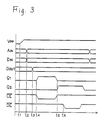
- step S7 The sequence of operation that leads to the writing of the input data D IN into the PROM array 2 (step S7) will be described below with reference to the timing chart of Figure 3 .
- step S1 a high write voltage is applied to the write power supply terminal V pp at time t1 , to ready the PROM array 2 for data write.
- step S2 the input address A IN and the input data D IN are entered to the semiconductor memory 15 .
- time t3 the output data D OUT becomes valid and is compared with the input data D IN .
- the mismatch signal Q1 is set active at time t4 , which causes the address storage circuit 6 to store the input address A IN as a modified address, while, at the same time, the chip enable signal CE ⁇ is set active (i.e., goes "low"), causing the PROM array 2 to store the input data D IN as modified data at the address A PROM given from the address storage circuit 6 .
- the actual write operation to the PROM preferably is performed in the procedure shown in Figure 4 .
- the counter n is set to 0 (step S11), and after incrementing the value of the counter n by 1 (step S12), data write is performed for 1 ms (step S13).
- read check is performed to verify the written data (step S14), and if the data write has not been successful, the loop starting from step S12 is repeated until the value of the counter n reaches 25 (step S15).
- step S16 If successful data write has not been attained until the value of the counter n has reached 25, the process is suspended and appropriate error processing is performed (step S16). If it is determined in the read check in step S14 that the write has been made successfully, the current value of the counter n that represents the number of writes so far tried is tripled, and additional write is performed for a duration of time equal to ((3 x n) ms) (step S17), then terminating the process normally. Thus, the average write time is reduced as compared with the case in which data write is performed only once.
- step S7 the process proceeds from step S7 to step S4 in which it is checked if the processing has been performed on all the addresses. If not yet, the processing of steps S6 and S7 is repeated each time a mismatch occurs between input data D IN and data D ROM .
- step S8 the write voltage applied to the write power supply terminal V pp is removed (step S8), and after read check is performed on all the addresses (step S9), the data rewrite process is completed.
- the modified data is compared with the original data stored in the mask ROM array 1 and only portions of data that differ from the original are stored in the PROM array 2 , thus achieving partial rewriting of data.
- the comparison check in step S3 of the above data rewrite process is performed using the comparator circuit 10 internal to the semiconductor memory, and the chip enable signals CE ⁇ , etc. are controlled externally by monitoring the state of the mismatch signal Q1 .
- all such processing may be performed by internal hardware of the semiconductor memory, or alternatively, the processing including the comparison check by the comparator circuit 10 may be performed using an external operation program.
- the input address A IN accessed by the system is input (step S21), and the address match detection circuit 7 checks if any modified address that matches the accessed address is stored in the address storage circuit 6 (step S22). If there is no address match, since the select signal Q2 remains inactive, the data D ROM read from the mask ROM array 1 is output as output data D OUT (step S23). Therefore, the data originally stored in the mask ROM array 1 is directly output for the portions of data that have not been modified.
- the address A PROM on the address storage circuit 6 at which the modified address is stored is transferred to the PROM array 2 to read modified data D PROM from the corresponding address.
- the modified address stored in the address storage circuit 6 represents the input address A IN which was input when a mismatch was detected between the data D ROM stored in the mask ROM array 1 and the input data D IN during the previous data rewrite process, and the modified data D PROM read from the PROM array 2 corresponds to the input data D IN that was input at that time.
- the address match detection circuit 7 sets the select signal Q2 active, which causes the data selector 4 to switch to the PROM array 2 side. As a result, the original data D ROM read from the mask ROM array 1 is blocked by the data selector 4 , allowing the modified data D PROM read from the PROM array 2 to be output as the output data D OUT (step S24).
- the data read from the mask ROM array 1 is directly output for the portions of data that were not the objects of modification at the time of rewriting data, while for the portions that were modified, the data read from the PROM array 2 is output, thus making it possible to essentially rewrite part of the stored data within the memory capacity of the PROM array 2 despite the construction being a read-only memory consisting primarily of an inexpensive mask ROM.
- the address match detection circuit 7 since the addresses of the semiconductor memory are random-accessed, it is necessary for the address match detection circuit 7 to compare the input address A IN with each modified address sequentially given from the address storage circuit 6 (though it is possible to speed up the detection process by such processing as determining that no address match exists when the modified address being given sequentially becomes higher than the input address A IN ). However, in cases where the data stored in the semiconductor memory is always accessed sequentially, it may be so configured that the address match detection circuit 7 first reads out the top modified address from the address storage circuit 6 and increments the modified address each time it matches the input address A IN , thus requiring comparison with only one modified address each time.
- the output data selector 4 automatically reads data from the PROM and outputs the thus readout data only for modified portions despite the original data being stored in the mask ROM, it is possible to essentially rewrite the stored data within the memory capacity of the PROM. Furthermore, by making the memory capacity of the PROM sufficiently smaller than that of the mask ROM, the cost increase from a single mask ROM construction can be minimized. It will be appreciated that only those data stored in the mask ROM array 1 which contain errors need be rewritten to the PROM array 2 , thus reducing the required memory capacity of the PROM 2 . Also, since an ordinary write algorithm can be used to rewrite the mask ROM, partially rewriting the mask ROM data can be achieved in a short time.
Landscapes
- Engineering & Computer Science (AREA)
- Microelectronics & Electronic Packaging (AREA)
- Read Only Memory (AREA)
- Non-Volatile Memory (AREA)
- For Increasing The Reliability Of Semiconductor Memories (AREA)
- Stored Programmes (AREA)
Applications Claiming Priority (2)
| Application Number | Priority Date | Filing Date | Title |
|---|---|---|---|
| JP3042072A JPH04278299A (ja) | 1991-03-07 | 1991-03-07 | 半導体記憶装置 |
| JP42072/91 | 1991-03-07 |
Publications (3)
| Publication Number | Publication Date |
|---|---|
| EP0509633A2 true EP0509633A2 (de) | 1992-10-21 |
| EP0509633A3 EP0509633A3 (en) | 1993-02-03 |
| EP0509633B1 EP0509633B1 (de) | 1995-01-18 |
Family
ID=12625868
Family Applications (1)
| Application Number | Title | Priority Date | Filing Date |
|---|---|---|---|
| EP92301917A Expired - Lifetime EP0509633B1 (de) | 1991-03-07 | 1992-03-05 | Halbleiterspeicher |
Country Status (4)
| Country | Link |
|---|---|
| EP (1) | EP0509633B1 (de) |
| JP (1) | JPH04278299A (de) |
| KR (1) | KR950010307B1 (de) |
| DE (1) | DE69201210T2 (de) |
Cited By (3)
| Publication number | Priority date | Publication date | Assignee | Title |
|---|---|---|---|---|
| EP0704801A3 (de) * | 1994-09-21 | 1999-03-10 | Texas Instruments Incorporated | Speicherarchitektur für Halbleiterfestplatten |
| WO2002039457A3 (de) * | 2000-11-07 | 2002-09-19 | Infineon Technologies Ag | Speicherverwaltungslogik zur erweiterten nutzung von festwertspeichern |
| FR2843824A1 (fr) * | 2002-08-23 | 2004-02-27 | Samsung Electronics Co Ltd | Dispositif de memoire morte ayant une fonction de reparation et procede de reparation de ce dispositif |
Families Citing this family (2)
| Publication number | Priority date | Publication date | Assignee | Title |
|---|---|---|---|---|
| US6026052A (en) * | 1994-05-03 | 2000-02-15 | Fujitsu Limited | Programmable semiconductor memory device |
| US5661694A (en) * | 1993-05-14 | 1997-08-26 | Fujitsu Limited | Programmable semiconductor memory device |
Family Cites Families (6)
| Publication number | Priority date | Publication date | Assignee | Title |
|---|---|---|---|---|
| DE2621399A1 (de) * | 1975-05-29 | 1976-12-09 | Int Standard Electric Corp | Speichereinrichtung |
| EP0086905B1 (de) * | 1982-02-18 | 1987-04-08 | Deutsche ITT Industries GmbH | Speichersystem mit einer integrierten Matrix aus nichtflüchtigen, umprogrammierbaren Speicherzellen |
| DE3588121T2 (de) * | 1984-05-31 | 1997-01-16 | Fujitsu Ltd | Halbleiterintegrierte Schaltung mit einer Ersatzredundanzschaltung |
| JPS62121979A (ja) * | 1985-11-22 | 1987-06-03 | Mitsubishi Electric Corp | 集積回路メモリ |
| DE69032844T2 (de) * | 1989-01-31 | 1999-05-12 | Fujitsu Ltd., Kawasaki, Kanagawa | Halbleiterspeicher mit Einrichtung zum Ersetzen defekter Speicherzellen |
| JP2547451B2 (ja) * | 1989-09-18 | 1996-10-23 | 富士通株式会社 | 半導体記憶装置 |
-
1991
- 1991-03-07 JP JP3042072A patent/JPH04278299A/ja not_active Withdrawn
-
1992
- 1992-03-05 DE DE69201210T patent/DE69201210T2/de not_active Expired - Lifetime
- 1992-03-05 EP EP92301917A patent/EP0509633B1/de not_active Expired - Lifetime
- 1992-03-06 KR KR1019920003708A patent/KR950010307B1/ko not_active Expired - Lifetime
Cited By (4)
| Publication number | Priority date | Publication date | Assignee | Title |
|---|---|---|---|---|
| EP0704801A3 (de) * | 1994-09-21 | 1999-03-10 | Texas Instruments Incorporated | Speicherarchitektur für Halbleiterfestplatten |
| WO2002039457A3 (de) * | 2000-11-07 | 2002-09-19 | Infineon Technologies Ag | Speicherverwaltungslogik zur erweiterten nutzung von festwertspeichern |
| US6874073B2 (en) | 2000-11-07 | 2005-03-29 | Infineon Technologies Ag | Method for managing data stored primarily in a read-only memory |
| FR2843824A1 (fr) * | 2002-08-23 | 2004-02-27 | Samsung Electronics Co Ltd | Dispositif de memoire morte ayant une fonction de reparation et procede de reparation de ce dispositif |
Also Published As
| Publication number | Publication date |
|---|---|
| DE69201210D1 (de) | 1995-03-02 |
| EP0509633B1 (de) | 1995-01-18 |
| JPH04278299A (ja) | 1992-10-02 |
| KR920018770A (ko) | 1992-10-22 |
| EP0509633A3 (en) | 1993-02-03 |
| KR950010307B1 (ko) | 1995-09-14 |
| DE69201210T2 (de) | 1995-07-20 |
Similar Documents
| Publication | Publication Date | Title |
|---|---|---|
| JP3764167B2 (ja) | プログラマブル不揮発性記憶装置用のオンチップメモリ冗長回路及びそのプログラミング方法 | |
| US5761222A (en) | Memory device having error detection and correction function, and methods for reading, writing and erasing the memory device | |
| KR100506430B1 (ko) | 불휘발성 반도체 기억 장치 | |
| US7974125B2 (en) | Flash memory device and method of controlling flash memory device | |
| US6646930B2 (en) | Non-volatile semiconductor memory | |
| US7885111B2 (en) | Flash memory device and method for providing initialization data | |
| US5841711A (en) | Semiconductor memory device with redundancy switching method | |
| US7366946B2 (en) | ROM redundancy in ROM embedded DRAM | |
| JPH08235887A (ja) | 電気的にプログラム可能なメモリ及びメモリへのデータ書き込み方法 | |
| US20080008001A1 (en) | Semiconductor device and boot method for the same | |
| JP2001503181A (ja) | エラー位置指定コードを用いて複数レベルセルメモリの訂正を行う方法および装置 | |
| US6915175B2 (en) | Method and device for programming nonvolatile semiconductor memory | |
| US6469932B2 (en) | Memory with row redundancy | |
| US6711056B2 (en) | Memory with row redundancy | |
| US5229972A (en) | Nonvolatile semiconductor memory system | |
| US5206866A (en) | Bit error correcting circuit for a nonvolatile memory | |
| EP0509633B1 (de) | Halbleiterspeicher | |
| US5986965A (en) | Method and device for writing data in non-volatile memory circuit | |
| US6381192B1 (en) | Address buffer in a flash memory | |
| US10732894B2 (en) | Method of writing in a non-volatile memory device and corresponding non-volatile memory device | |
| US20250370859A1 (en) | Method of operation of a memory device | |
| JPH05181665A (ja) | Rom格納内容修正方式 | |
| JP2002025293A (ja) | 不揮発メモリ救済装置 | |
| JPH04123398A (ja) | 複合半導体メモリ装置 |
Legal Events
| Date | Code | Title | Description |
|---|---|---|---|
| PUAI | Public reference made under article 153(3) epc to a published international application that has entered the european phase |
Free format text: ORIGINAL CODE: 0009012 |
|
| AK | Designated contracting states |
Kind code of ref document: A2 Designated state(s): DE FR GB |
|
| PUAL | Search report despatched |
Free format text: ORIGINAL CODE: 0009013 |
|
| AK | Designated contracting states |
Kind code of ref document: A3 Designated state(s): DE FR GB |
|
| 17P | Request for examination filed |
Effective date: 19930414 |
|
| 17Q | First examination report despatched |
Effective date: 19930928 |
|
| GRAA | (expected) grant |
Free format text: ORIGINAL CODE: 0009210 |
|
| AK | Designated contracting states |
Kind code of ref document: B1 Designated state(s): DE FR GB |
|
| REF | Corresponds to: |
Ref document number: 69201210 Country of ref document: DE Date of ref document: 19950302 |
|
| ET | Fr: translation filed | ||
| PLBE | No opposition filed within time limit |
Free format text: ORIGINAL CODE: 0009261 |
|
| 26N | No opposition filed | ||
| REG | Reference to a national code |
Ref country code: GB Ref legal event code: IF02 |
|
| PGFP | Annual fee paid to national office [announced via postgrant information from national office to epo] |
Ref country code: FR Payment date: 20110317 Year of fee payment: 20 |
|
| PGFP | Annual fee paid to national office [announced via postgrant information from national office to epo] |
Ref country code: GB Payment date: 20110302 Year of fee payment: 20 Ref country code: DE Payment date: 20110302 Year of fee payment: 20 |
|
| REG | Reference to a national code |
Ref country code: DE Ref legal event code: R071 Ref document number: 69201210 Country of ref document: DE |
|
| REG | Reference to a national code |
Ref country code: DE Ref legal event code: R071 Ref document number: 69201210 Country of ref document: DE |
|
| REG | Reference to a national code |
Ref country code: GB Ref legal event code: PE20 Expiry date: 20120304 |
|
| PG25 | Lapsed in a contracting state [announced via postgrant information from national office to epo] |
Ref country code: DE Free format text: LAPSE BECAUSE OF EXPIRATION OF PROTECTION Effective date: 20120306 |
|
| PG25 | Lapsed in a contracting state [announced via postgrant information from national office to epo] |
Ref country code: GB Free format text: LAPSE BECAUSE OF EXPIRATION OF PROTECTION Effective date: 20120304 |