EP0510575A1 - Mastitis-Infusionssystem und zerbrechbarer Mastitis-Kanülenverschluss dafür - Google Patents
Mastitis-Infusionssystem und zerbrechbarer Mastitis-Kanülenverschluss dafür Download PDFInfo
- Publication number
- EP0510575A1 EP0510575A1 EP92106788A EP92106788A EP0510575A1 EP 0510575 A1 EP0510575 A1 EP 0510575A1 EP 92106788 A EP92106788 A EP 92106788A EP 92106788 A EP92106788 A EP 92106788A EP 0510575 A1 EP0510575 A1 EP 0510575A1
- Authority
- EP
- European Patent Office
- Prior art keywords
- cannula
- cap
- mastitis
- tip end
- free tip
- Prior art date
- Legal status (The legal status is an assumption and is not a legal conclusion. Google has not performed a legal analysis and makes no representation as to the accuracy of the status listed.)
- Pending
Links
Images
Classifications
-
- A—HUMAN NECESSITIES
- A61—MEDICAL OR VETERINARY SCIENCE; HYGIENE
- A61D—VETERINARY INSTRUMENTS, IMPLEMENTS, TOOLS, OR METHODS
- A61D1/00—Surgical instruments for veterinary use
- A61D1/02—Trocars or cannulas for teats; Vaccination appliances
-
- A—HUMAN NECESSITIES
- A61—MEDICAL OR VETERINARY SCIENCE; HYGIENE
- A61M—DEVICES FOR INTRODUCING MEDIA INTO, OR ONTO, THE BODY; DEVICES FOR TRANSDUCING BODY MEDIA OR FOR TAKING MEDIA FROM THE BODY; DEVICES FOR PRODUCING OR ENDING SLEEP OR STUPOR
- A61M5/00—Devices for bringing media into the body in a subcutaneous, intra-vascular or intramuscular way; Accessories therefor, e.g. filling or cleaning devices, arm rests
- A61M5/178—Syringes
- A61M5/31—Details
- A61M5/32—Needles; Details of needles pertaining to their connection with syringe or hub; Accessories for bringing the needle into, or holding the needle on, the body; Devices for protection of needles
- A61M5/3202—Devices for protection of the needle before use, e.g. caps
Definitions
- the present invention relates generally to the administration of a veterinary pharmacological composition and, more particularly, is directed to a frangible mastitis cannula closure for an applicator used to administer the pharmacological composition.
- Mastitis is a disease that results in inflammation of the udder of a cow, caused by infection. As a result of this mastitis or inflammation, the milk production by the cow is substantially reduced, thereby detrimentally affecting profitability.
- veterinary pharmacological compositions such as anti-infectives or antibiotics
- veterinary pharmacological compositions are generally administered by injecting the same into the cow's udder through the teat canal by a cannula and infusion syringe assembly.
- the cannula which extends through the teat into the udder is generally made from a smooth plastic material to prevent damage or irritation to the animal's tissue.
- a single piece plastic, slip-type cap which snap-fittingly or frictionally engages the outer surface of the cannula or the hub of the syringe at the base of the cannula.
- the cannula is inserted into the cow's teat, passed through the teat canal and positioned within the teat cistern.
- the syringe is activated to inject the pharmacological composition directly into the cow's teat cistern. In such case, substantially the entire length of the cannula is inserted into the cow's teat canal.
- injection may occur directly into the cow's udder in order to kill any bacteria in the teat canal itself.
- injection may occur directly into the cow's udder in order to kill any bacteria in the teat canal itself.
- only a small tip portion of the cannula is inserted into the teat canal for a depth of approximately 3 mm.
- a two-part mastitis cannula cap in which an inner cap is snap-fittingly inserted over the cannula, the inner cap having an opening at the distal end thereof through which the tip of the cannula extends for use in the alternative procedure in which only the tip end of the cannula is inserted into the teat canal.
- the assembly further includes an outer cap which snap- fittingly is received over the inner cap and which covers the free distal end of the cannula.
- the two-cap system adds additional complexity and cost to the applicator.
- U.S. Patent No. 4,892,521 to Laico et al. discloses a protective cover assembly for a hypodermic needle in which the distal end of the cap has an interiorly projecting, internal protective flap which covers a central axial aperture that is dimensioned to accept the needle therethrough in the retracted mode.
- the needle base includes a slotted wing with diametrically spaced apertures therein which accept guide rods as part of the protective cover assembly and which guide the cap of the protective cover assembly to the protective position and retain the cap to the syringe.
- this assembly requires slotted wings and guide rods which further complicates the structure of the assembly. Also, the cover cannot be completely removed to allow complete insertion of the needle.
- Figs. 5-7 of this patent show a second embodiment of a protective cap assembly that includes three telescoping shield sections which can be compacted in a nested configuration, allowing the needle to be exposed for usage. See also U.S. Patent No. 4,897,083 to Martell for a similar disclosure.
- a third embodiment of the patent is shown in Figs. 8 and 9 in which the sheath for the needle is corrugated so as to be collapsible.
- this embodiment also requires guide rods externally of the corrugated sheath.
- U.S. Patent No. 4,968,304 to Alter et al. discloses a syringe which is mounted to a movable wall slidably retained within a hollow body having an opening at the opposite end thereof. The sheath or hollow body is moved rearwardly of the needle so as to expose the same. However, there is no seal at the distal end of the sheath that is pierced by the needle, but rather, a removable cap is provided thereat.
- U.S. Patent No. 4,915,697 to DuPont discloses a hypodermic needle assembly including a sleeve which telescopically fits over the needle and includes an axially rigid upper mounting portion which mounts over the needle base.
- the sleeve includes an axially collapsible intermediate portion and an axially rigid lower portion defining an axially extending central bore for receiving the needle therein.
- a sheath is designed to fit telescopically over the sleeve and has a length generally corresponding to the length of the sleeve.
- the sheath is removed and a downward pressure is exerted on the syringe so that the intermediate portion of the sleeve collapses axially as the pointed tip of the needle shaft enters the subject, to selectively expose the needle.
- the sleeve selectively expands axially to cover the needle tip as it emerges from the subject.
- to expose the needle requires a constant pressure on the sleeve, which renders the same impractical as a mastitis cannula closure.
- U.S. Patent No. 4,664,653 to Sagstetter et al. discloses a manually operated, reusable injection apparatus including a rubber sheath surrounding the needle and which is collapsible during insertion of the needle.
- a mastitis cannula closure for a mastitis infusion system of the type including a syringe barrel, a cannula having a free tip end with an opening thereat, and a connecting assembly which connects the cannula to the syringe barrel includes a cap-like member having a proximal end and a distal end, with a portion of the cap-like member being substantially rigid; restriction means for restricting passage of the free tip end of the cannula out of the cap-like member, the restriction means being connected with the distal end of the cap-like member; mounting means for removably holding the cap-like member in surrounding relation to the cannula at a first position at which the cap-like member is in covering relation to the free tip end of the cannula, the mounting means permitting removal of the cap-like member from the surrounding relation to expose at least substantially the entire length of the cannula; and the substantially rigid portion of the cap-like member being
- a mastitis cannula closure for a mastitis infusion system of the type including a syringe barrel, a cannula having a free tip end with an opening thereat, and a connecting assembly which connects the cannula to the syringe barrel includes a cap-like member having a proximal end and a distal end, the cap-like member including a substantially rigid portion and a collapsible portion connected with the substantially rigid portion; restriction means for restricting passage of the free tip end of the cannula out of the cap-like member, the restriction means being connected with the distal end of the cap-like member; mounting means for removably holding the cap-like member in surrounding relation to the cannula at a first position at which the cap-like member is in covering relation to the free tip end of the cannula, the mounting means permitting removal of the cap-like member from the surrounding relation to expose at least substantially the entire length of the cannula
- a mastitis cannula closure for a mastitis infusion system of the type including a syringe barrel, a cannula having a free tip end with an opening thereat, and a connecting assembly which connects the cannula to the syringe barrel includes a substantially rigid cap-like member having a proximal end and a distal end; restriction means for restricting passage of the free tip end of the cannula out of the cap-like member, the restriction means being connected with the distal end of the cap-like member; mounting means for removably holding the cap-like member in surrounding relation to the cannula at a first position at which the cap-like member is in covering relation to the free tip end of the cannula, the mounting means permitting removal of the cap-like member from the surrounding relation to expose at least substantially the entire length of the cannula; and the substantially rigid portion of the cap-like member being movable by an external force from the first position
- a mastitis infusion system includes a syringe barrel; a cannula having a free tip end with an opening thereat; a connecting assembly which connects the cannula to the syringe barrel; and mastitis cannula closure means for covering the cannula, the mastitis cannula closure means including a substantially rigid cap-like member having a proximal end and a distal end, restriction means for restricting passage of the free tip end of the cannula out of the cap-like member, the restriction means being connected with the distal end of the cap-like member, mounting means for removably holding the cap-like member in surrounding relation to the cannula at a first position at which the cap-like member is in covering relation to the free tip end of the cannula, the mounting means permitting removal of the cap-like member from the surrounding relation to expose at least substantially the entire length of the cannula, and the substantially rigid portion of the cap-
- a mastitis infusion system includes a syringe barrel; a cannula having a free tip end with an opening thereat; a connecting assembly which connects the cannula to the syringe barrel; and mastitis cannula closure means for covering the cannula, the mastitis cannula closure means including a cap-like member having a proximal end and a distal end, the cap-like member including a substantially rigid portion and a collapsible portion connected with the substantially rigid portion, restriction means for restricting passage of the free tip end of the cannula out of the cap-like member, the restriction means being connected with the distal end of the cap-like member, mounting means for removably holding the cap-like member in surrounding relation to the cannula at a first position at which the cap-like member is in covering relation to the free tip end of the cannula, the mounting means permitting removal of the cap-like member from the
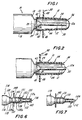
- a mastitis cannula closure 10 according to one embodiment of the present invention, is provided in covering relation to a cannula 12 of a mastitis infusion system 14 of the type generally described in U.S. Patent No. 4,850,970 to Sutherland and published PCT Application No. WO 90/07913, published on July 26, 1990, the entire disclosures of which are incorporated herein by reference.
- mastitis infusion system 14 generally includes a hypodermic syringe barrel 16 which is generally made from a sterile and disposable plastic material, such as a low density polyethylene.
- the distal end 18 of syringe barrel 16 is frusto-conically tapered, terminating in an annular neck 20 of a fixed diameter.
- a reduced diameter neck 22 is centrally formed at the distal end of annular neck 20 and has a fixed diameter less than that of annular neck 20.
- an annular front face 24 is formed as the distal face of annular neck 20 in surrounding relation to reduced diameter neck 22.
- a frusto-conical hub 26 has its greater diameter end mounted to reduced diameter neck 22 in spaced relation from front face 24.
- annular groove 28 is formed between the greater diameter end of frusto-conical hub 26 and annular front face 24 of annular neck 20.
- cannula 12 is of the same diameter as the smaller diameter end of frusto-conical hub 26 and is secured therewith. It will be appreciated that hypodermic syringe barrel 16, distal end 18, annular neck 20, reduced diameter neck 22, hub 26 and cannula 12 are all provided with a central or axial opening 30 therethrough to permit the supply of the veterinary pharmacological composition from syringe barrel 16 to the distal or free end 12a of cannula 12, which is open.
- Cannula 12 should be sufficiently long to provide deep penetration into the udder of the cow so as to penetrate into the cow's feat cistern. In this regard, although not necessary, it is preferable that cannula 12 be slightly tapered so as to facilitate insertion and removal thereof.
- cannula 22 can be 20 to 25 mm in length, although the size of mastitis infusion system 14, including the overall length of cannula 12 can be modified.
- mastitis infusion system 14, including hypodermic syringe barrel 16, distal end 18, annular neck 20, reduced diameter neck 22, frusto-conical hub 26 and cannula 14 are constructed of a one-piece molded plastic material, such as a low-density, polyethylene material.
- mastitis cannula closure 10 is formed by a collapsible section 32 removably mounted on mastitis infusion system 14, a rigid cover section 34 in covering relation to a substantial portion of cannula 12 and integrally formed with the distal end of collapsible section 32, a frangible seal section 36 secured to the distal end of rigid cover section 34, and engagement means 38 secured to rigid cover section 34 for permitting movement of rigid cover section 34 between a first position (Fig. 1) in covering relation to cannula 12 at which frangible seal section 36 is in covering relation to the open free tip end 12a of cannula 12, and a second position (Fig. 2) in partial covering relation to cannula 12 at which open free tip end 12a of cannula 12 ruptures frangible seal section 36 and extends partially therethrough a small distance, for example, 3 mm.
- collapsible section 32 includes an annular side wall 40 of a sufficiently small thickness such that an axial force thereon will cause annular side wall 40 to collapse in a corrugated or accordion-like fashion, as shown in Fig. 2.
- Side wall 40 may also be scored or formed in an already pleated manner to aid such collapsing.
- the proximal end of annular side wall 40 is formed with an annular inturned lip 42 which seats within annular groove 28 defined between frusto-conical hub 26 and front face 24, in a snap-fitting manner so as to releasably hold mastitis cannula closure 10 on mastitis infusion system 14. It will be appreciated that collapsible section 32 is thereby in covering relation to frusto-conical hub 26 and the proximal end of cannula 12.
- Rigid cover section 34 is formed by an annular side wall 44 which may have a slightly tapered configuration, as shown in the figures, and which is connected to the distal end of annular side wall 40 of collapsible section 32, as an axial extension thereof.
- annular side wall 44 has its distal or free end extending at least as far as the distal or free tip end 12a of cannula 12 at the distal end thereof.
- annular side wall 44 has a sufficient thickness, and is made of a sufficiently durable plastic material, so as to prevent collapsing thereof during normal use, thereby differing from the reduced thickness annular side wall 40 of collapsible section 32.
- frangible seal section 36 which can be made of a reduced thickness plastic, a foil or the like. Although frangible seal section 36 is shown in Fig. 1 in a dome-like configuration, frangible seal section 36 can be planar or have any other suitable configuration.
- engagement means 38 of mastitis cannula closure 10 includes diametrically opposite finger wings 46 and 48 extending radially outward from and connected with the outer surface of annular side wall 44 of rigid cover section 34 at the proximal end thereof.
- finger wings 46 and 48 can be replaced by an annular flange or the like.
- annular interned lip 42 is removed from annular groove 28 and pulled forward or distally so as to remove mastitis cannula closure 10 from mastitis infusion system 14, thereby exposing the entire length of cannula 12. In such case, substantially the entire length of cannula 12 is inserted into the cow's teat canal.
- injection may occur directly into the cow's udder in order to kill any bacteria in the teat canal itself.
- a single piece mastitis cannula closure 10 is provided which can be used to expose the entire cannula 12 by removal of closure 10, or alternatively, by collapsing collapsible section 32 in order to expose only free tip end 12a thereof.
- a mastitis cannula closure 110 according to another embodiment of the present invention will now be described in which elements corresponding to those of mastitis cannula closure 10 are identified by the same reference numerals augmented by 100, and a detailed description thereof will be omitted herein for the sake of brevity.
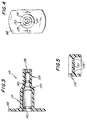
- mastitis infusion system 114 includes the same hypodermic syringe barrel 116, frusto-conical distal end 118 and annular neck 120 of a fixed diameter. From there, however, mastitis infusion system 114 differs from mastitis infusion system 14. Specifically, a hollow cylindrical section 121 extends axially from annular neck 120 and has a smaller diameter than annular neck 120 so as to produce the same annular front face 124. Cylindrical section 121 is provided with two axially spaced annular grooves 128a and 128b, annular groove 128b being positioned distally with respect to annular groove 128a.
- mastitis infusion system 114 includes the same frusto-conical hub 126 with the greater diameter end thereof having a diameter equal to that of cylindrical section 121 and connected therewith, and with cannula 112 extending from the lesser diameter end of hub 126 and in axial alignment therewith.
- mastitis cannula closure 110 is made entirely of a rigid plastic material, and particularly, includes a proximal cylindrical section 131 connected by a substantially frusto-conical connecting section 133 to a distal cylindrical section 135, with frusto-conical connecting section 133 being inclined at an angle similar to the inclination of frusto-conical hub 126.
- the inner diameter of distal cylindrical section 135 is less than that of proximal cylindrical section 131, but is still greater than the outer diameter of cannula 12.
- an annular flange 148 extends radially outward from the proximal end of proximal cylindrical section 131. In this manner, by grasping annular flange 148, mastitis cannula closure 110 can be moved from the position shown in Fig. 6 to the position shown in Fig. 7.
- annular bead 142 is formed along the inner wall of proximal cylindrical section 131 near the proximal end thereof, as best shown in Fig. 3.
- bead 142 engages within annular groove 128b so as to removably secure mastitis cannula closure 110 on cylindrical section 121 at the position of Fig. 6.
- annular flange 148 can be gripped to move mastitis cannula 110 to the left of Fig. 6, that is, to the position of Fig. 7.
- bead 142 engages within annular groove 128a to removably secure mastitis cannula closure 110 in the position of Fig. 7.
- the proximal face of annular flange 148 engages against annular front face 124 of annular neck 120 to prevent bead 142 from travelling past annular groove 128a and to define the extent that free tip end 112a of cannula 112 extends from mastitis cannula cover 110.
- frusto-conical connecting section 133 and frusto-conical hub 126 are substantially identical, frusto-conical connecting section 133 seats snugly against frusto-conical hub 126.
- mastitis cannula closure 110 includes an annular sealing bead 143 along the inner wall of distal cylindrical section 135, with annular sealing bead 143 engaging the outer surface of cannula 112 so as to provide a seal thereat.
- a rupturable seal section 136 is provided internally at the distal end of distal cylindrical section 135.
- a reinforced strip 137 extends diametrically across the inner bore of distal cylindrical section 135 and is integrally formed at opposite ends with the inner walls of distal cylindrical section 135.
- the outer ends of reinforced strip 137 are further reinforced by arcuate reinforcing strips 139 that extend partially around the inner wall of distal cylindrical section 135.
- mastitis cannula closure 110 when mastitis cannula closure 110 is moved from the position of Fig. 6 to the position of Fig. 7, the free tip end 112a thereof ruptures diametrically reinforced strip 137 so to extend partially therethrough.
- mastitis cannula closure 110 is removed in its entirety.
- mastitis cannula closure 110 is constructed as a single piece closure, contrary to the arrangement of U.S. Patent No. 4,850,970.
Landscapes
- Health & Medical Sciences (AREA)
- Life Sciences & Earth Sciences (AREA)
- Veterinary Medicine (AREA)
- Engineering & Computer Science (AREA)
- Public Health (AREA)
- General Health & Medical Sciences (AREA)
- Animal Behavior & Ethology (AREA)
- Biomedical Technology (AREA)
- Hematology (AREA)
- Heart & Thoracic Surgery (AREA)
- Anesthesiology (AREA)
- Vascular Medicine (AREA)
- Surgery (AREA)
- Wood Science & Technology (AREA)
- Zoology (AREA)
- Infusion, Injection, And Reservoir Apparatuses (AREA)
Applications Claiming Priority (2)
| Application Number | Priority Date | Filing Date | Title |
|---|---|---|---|
| US68941491A | 1991-04-22 | 1991-04-22 | |
| US689414 | 1991-04-22 |
Publications (1)
| Publication Number | Publication Date |
|---|---|
| EP0510575A1 true EP0510575A1 (de) | 1992-10-28 |
Family
ID=24768352
Family Applications (2)
| Application Number | Title | Priority Date | Filing Date |
|---|---|---|---|
| EP19920911976 Withdrawn EP0587699A1 (de) | 1991-04-22 | 1992-04-21 | Mastitisinfusionssystem und zerbrechbarer mastitiskanülenverschluss dafür |
| EP92106788A Pending EP0510575A1 (de) | 1991-04-22 | 1992-04-21 | Mastitis-Infusionssystem und zerbrechbarer Mastitis-Kanülenverschluss dafür |
Family Applications Before (1)
| Application Number | Title | Priority Date | Filing Date |
|---|---|---|---|
| EP19920911976 Withdrawn EP0587699A1 (de) | 1991-04-22 | 1992-04-21 | Mastitisinfusionssystem und zerbrechbarer mastitiskanülenverschluss dafür |
Country Status (5)
| Country | Link |
|---|---|
| EP (2) | EP0587699A1 (de) |
| JP (1) | JPH06506857A (de) |
| AU (1) | AU1988792A (de) |
| CA (1) | CA2102225A1 (de) |
| WO (1) | WO1992018064A1 (de) |
Cited By (1)
| Publication number | Priority date | Publication date | Assignee | Title |
|---|---|---|---|---|
| US5433711A (en) * | 1994-08-01 | 1995-07-18 | Monsanto Company | Syringe with cannula-protecting sheath and sealing center rod |
Families Citing this family (1)
| Publication number | Priority date | Publication date | Assignee | Title |
|---|---|---|---|---|
| CN115006043A (zh) * | 2022-07-07 | 2022-09-06 | 黑龙江职业学院(黑龙江省经济管理干部学院) | 一种手持式奶牛乳头通乳器工具及操作方法 |
Citations (4)
| Publication number | Priority date | Publication date | Assignee | Title |
|---|---|---|---|---|
| US2571653A (en) * | 1950-02-25 | 1951-10-16 | Bastien Victor Gerard | Syringe |
| US3134380A (en) * | 1962-02-08 | 1964-05-26 | Thomas A Armao | Shielded hypodermic needle |
| US4850970A (en) * | 1987-03-26 | 1989-07-25 | American Home Products, Corp. | Two part mastitis cannula cap |
| US4900311A (en) * | 1988-12-06 | 1990-02-13 | Lawrence Stern | Hypodermic syringe |
-
1992
- 1992-04-21 EP EP19920911976 patent/EP0587699A1/de not_active Withdrawn
- 1992-04-21 AU AU19887/92A patent/AU1988792A/en not_active Abandoned
- 1992-04-21 CA CA 2102225 patent/CA2102225A1/en not_active Abandoned
- 1992-04-21 EP EP92106788A patent/EP0510575A1/de active Pending
- 1992-04-21 JP JP4511746A patent/JPH06506857A/ja active Pending
- 1992-04-21 WO PCT/US1992/003107 patent/WO1992018064A1/en not_active Ceased
Patent Citations (4)
| Publication number | Priority date | Publication date | Assignee | Title |
|---|---|---|---|---|
| US2571653A (en) * | 1950-02-25 | 1951-10-16 | Bastien Victor Gerard | Syringe |
| US3134380A (en) * | 1962-02-08 | 1964-05-26 | Thomas A Armao | Shielded hypodermic needle |
| US4850970A (en) * | 1987-03-26 | 1989-07-25 | American Home Products, Corp. | Two part mastitis cannula cap |
| US4900311A (en) * | 1988-12-06 | 1990-02-13 | Lawrence Stern | Hypodermic syringe |
Cited By (1)
| Publication number | Priority date | Publication date | Assignee | Title |
|---|---|---|---|---|
| US5433711A (en) * | 1994-08-01 | 1995-07-18 | Monsanto Company | Syringe with cannula-protecting sheath and sealing center rod |
Also Published As
| Publication number | Publication date |
|---|---|
| JPH06506857A (ja) | 1994-08-04 |
| EP0587699A1 (de) | 1994-03-23 |
| WO1992018064A1 (en) | 1992-10-29 |
| AU1988792A (en) | 1992-11-17 |
| CA2102225A1 (en) | 1992-10-23 |
Similar Documents
| Publication | Publication Date | Title |
|---|---|---|
| US5085647A (en) | Rigid needle cover with needle sealing plug and method of manufacture thereof | |
| US4482348A (en) | Fitments for injection devices | |
| US6416323B1 (en) | Aspirating dental syringe with needle shield | |
| USRE37439E1 (en) | Disposable self-shielding aspirating syringe | |
| EP1048311B1 (de) | Nadel-Injektionsvorrichtung mit Flügel | |
| US6050977A (en) | Syringe with retractable needle assembly | |
| EP0607381B1 (de) | Anschlussstück | |
| US8079979B2 (en) | Trapping of intravenous needle associated with a long catheter, and related methods | |
| US6837872B2 (en) | Needle holder for use with safety needle assembly | |
| US4863431A (en) | Catheter assembly | |
| US6629957B1 (en) | Protection for puncture needles | |
| US20010016714A1 (en) | Needle point protection sheath | |
| KR870009732A (ko) | 의료기구 | |
| US5059172A (en) | Syringe with two part mastitis cannula cap | |
| JP2001513655A (ja) | 安全套管の結合システム | |
| US5098401A (en) | Disposable automatic needle cover assembly with safety lock | |
| JPH0847489A (ja) | 採血装置 | |
| US5413564A (en) | Predetermined dosage hypodermic syringe system | |
| MXPA04012801A (es) | Dispositivo de inyeccion desechable disenado para que se rellene previamente. | |
| WO1992011886A1 (en) | Single use syringe | |
| US6595978B2 (en) | Injection syringe, comprising suction means | |
| JP3300343B2 (ja) | 2個のカニューレを有するアプリケーター | |
| EP0429181B1 (de) | Kanülensatz für Spritzen | |
| HK1000504B (en) | Applicator having two cannulas | |
| WO1992018064A1 (en) | Mastitis infusion system and frangible mastitis cannula closure therefor |
Legal Events
| Date | Code | Title | Description |
|---|---|---|---|
| PUAI | Public reference made under article 153(3) epc to a published international application that has entered the european phase |
Free format text: ORIGINAL CODE: 0009012 |
|
| AK | Designated contracting states |
Kind code of ref document: A1 Designated state(s): PT |
|
| 17P | Request for examination filed |
Effective date: 19930422 |
|
| STAA | Information on the status of an ep patent application or granted ep patent |
Free format text: STATUS: PROCEEDINGS CLOSED FOLLOWING CONSOLIDATION WITH EP92911976.6 |
|
| XX | Miscellaneous (additional remarks) |
Free format text: VERFAHREN ABGESCHLOSSEN INFOLGE VERBINDUNG MIT 92911976.6/0587699 (EUROPAEISCHE ANMELDENUMMER/VEROEFFENTLICHUNGSNUMMER) DURCH ENTSCHEIDUNG VOM 30.03.94. |