EP0510632A2 - Reconnaissance de la parole au moyen d'un réseau neuronique adapté à l'apprentissage des éléments de référence - Google Patents
Reconnaissance de la parole au moyen d'un réseau neuronique adapté à l'apprentissage des éléments de référence Download PDFInfo
- Publication number
- EP0510632A2 EP0510632A2 EP92106933A EP92106933A EP0510632A2 EP 0510632 A2 EP0510632 A2 EP 0510632A2 EP 92106933 A EP92106933 A EP 92106933A EP 92106933 A EP92106933 A EP 92106933A EP 0510632 A2 EP0510632 A2 EP 0510632A2
- Authority
- EP
- European Patent Office
- Prior art keywords
- status
- category
- distance
- reference pattern
- time series
- Prior art date
- Legal status (The legal status is an assumption and is not a legal conclusion. Google has not performed a legal analysis and makes no representation as to the accuracy of the status listed.)
- Granted
Links
Images






Classifications
-
- G—PHYSICS
- G06—COMPUTING OR CALCULATING; COUNTING
- G06N—COMPUTING ARRANGEMENTS BASED ON SPECIFIC COMPUTATIONAL MODELS
- G06N3/00—Computing arrangements based on biological models
- G06N3/02—Neural networks
- G06N3/04—Architecture, e.g. interconnection topology
- G06N3/049—Temporal neural networks, e.g. delay elements, oscillating neurons or pulsed inputs
-
- G—PHYSICS
- G06—COMPUTING OR CALCULATING; COUNTING
- G06F—ELECTRIC DIGITAL DATA PROCESSING
- G06F18/00—Pattern recognition
- G06F18/20—Analysing
- G06F18/29—Graphical models, e.g. Bayesian networks
- G06F18/295—Markov models or related models, e.g. semi-Markov models; Markov random fields; Networks embedding Markov models
-
- G—PHYSICS
- G10—MUSICAL INSTRUMENTS; ACOUSTICS
- G10L—SPEECH ANALYSIS TECHNIQUES OR SPEECH SYNTHESIS; SPEECH RECOGNITION; SPEECH OR VOICE PROCESSING TECHNIQUES; SPEECH OR AUDIO CODING OR DECODING
- G10L15/00—Speech recognition
- G10L15/08—Speech classification or search
- G10L15/16—Speech classification or search using artificial neural networks
Definitions
- the present invention relates to a speech recognition method, and more particularly to a speech recognition method manifesting a high rate of recognition without requiring learning with a particularly large quantity of training data.
- the HMM assumes that the time series of feature vectors are generated by the Markov probability process.
- the standard patterns of the HMM are represented in a plurality of statuses and transitions between the statuses, and each status outputs a feature vector according to a predetermined distribution of probability density while each transition between statuses is accompanied by a predetermined probability of transition.
- the likelihood which represents the degree of matching between the input pattern and a reference pattern, is given by the probability of the Markov probability model to generate a series of input pattern vectors.
- the probability of transition between statuses and the parameter to define the function of probability density distribution, which characterize each reference pattern can be determined with the Baum Welch algorithm using a plurality of sets of vocalization data for the training purpose.
- the output pattern of MLP's is the predicted vector â t for the feature vector a t of input speech at time t.
- the recognition algorithm using the NPM's basically derives from pattern matching between input speech and a reference pattern model.
- the reference pattern model for discrete recognition is an NPM for a basic recognition unit, while that for continuous recognition is an NPM obtained by connecting basic unit NPMs, and in both cases it is a finite status transition network accompanied by said MLP predictor.
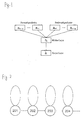
- continuous recognition is accomplished by taking note of the sound elements of speech signals, and therefore of the close correlation on the time axis of said feature vectors. For this reason, said finite status transition network is composed in a left-to-right pattern as shown in FIG. 2.
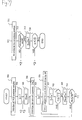
- FIG. 3 illustrates an outline of the recognition algorithm so far described.
- the evaluative function D total can be minimized in the optimal manner by the iterative algorithm stated below, combining DP and back-propagation (BP) (for more details on BP, reference may be made to R.P. Lippmann, "An Introduction to Computing with Neural Nets", IEEE ASSP Magazine, 3, 1987, pp. 4-22).
- t is a variable representing the time axis of the feature vector time series pattern of input speech, and takes one of integral values from 1 through T;
- n is a variable representing the status of the reference pattern model of each category, and takes one of integral values from 1 through N (S) (N (S) is the number of status of the reference pattern model of category s );
- d (S) t (n) is a variable for storing the local distance between the n -th status of category s and the feature vector a t of input speech at time t ; and
- g (S) t (n) is a variable for storing the accumulated prediction residual of the n -th status of category s at time t .
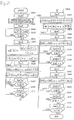
- the variables are initialized in order to calculate the global distance D of equation (7) by DP.
- a counter is initialized at steps 501 to 503.
- the storage areas for the local distance d st (n) and the accumulated prediction residual g st (n) are initialized.
- the increment and conditions of the counter are judged, and the initialization at step 504 is applied with respect to all the values of s , t and n .
- the value at the start point of the accumulated prediction residual of each category s is set.
- step 602 is calculated the distance d (S) t (n) from the input speech feature vector a t at time t and the predicted vector â t by the MLP predictor accompanying the n -th status of category , calculated at step 601.
- step 10301 of FIG. 10 which shows in further detail this calculation represented by the above cited equation (3), is the determinant of the covariance matrix in the n -th state of category s .
- the method to calculate the determinant is not explained here as it is evident from elementary linear algebra.
- the natural logarithm of the determinant of the covariance matrix is substituted for a variable X. Variables Y and X in FIG.
- the recognition result output section 8105 selects the shortest of the distances between the feature vector time series pattern of input speech and the reference pattern model of each category given from the distance calculator 8104, and supplies its category name as the recognition result. Its specific processing is step 415 in FIG. 4.
- a training speech database storage section 8106 stores the speech data of all the word/syllable categories which are the objects of recognition, i.e. the time series patterns of feature vectors corresponding to each category.
- a reference pattern corrector 8107 calculates the quantities of correction required for the parameters of the reference pattern model of each category read in from the reference pattern storage section 8103 on the basis of training speech data from the training speech database storage section 8106, and corrects the aforementioned parameters corresponding to the reference patterns stored in the reference pattern storage section 8103.
- (W F t ) hc is the element on the h -th row and the c -th column of the t -th inter-unit coupling matrix W F t for forward prediction of the MLP predictor accompanying the n -th status of the reference pattern model of the s -th category.
- "random" denotes random numbers, which specifically are uniform random numbers ranging from -0.3 to 0.3.
- the object parameter is supposed to be the parameter of the n -th status of the reference pattern model of the s -th category.
- D1 and D2 are initialized variables to be subsequently used for convergence decision at step 712, and another variable P.
- Y is an H-dimensional arrangement representing the output of the hidden layer unit calculated at step 13602; ⁇ Z, a C-dimensional arrangement representing the error regarding the output layer unit; ⁇ Y, an H-dimensional arrangement representing the error regarding the hidden layer unit; and ⁇ , a learning coefficient given in advance (specifically taking the value of 0.1 or the like).
- the nondiagonal terms of the covariance matrix are negligibly small, and the matrix accordingly is treated as a diagonal one, whose c -th diagonal component is at step 13607.
- the parameters of the n * t -th MLP predictor of the s -th category are so corrected as to reduce the prediction residuals.
- the above described corrective training is applied to all the sets of training data of the s -th category.
Landscapes
- Engineering & Computer Science (AREA)
- Physics & Mathematics (AREA)
- Theoretical Computer Science (AREA)
- Artificial Intelligence (AREA)
- Data Mining & Analysis (AREA)
- Evolutionary Computation (AREA)
- Health & Medical Sciences (AREA)
- Life Sciences & Earth Sciences (AREA)
- General Physics & Mathematics (AREA)
- Computational Linguistics (AREA)
- General Engineering & Computer Science (AREA)
- Computing Systems (AREA)
- Bioinformatics & Cheminformatics (AREA)
- General Health & Medical Sciences (AREA)
- Biophysics (AREA)
- Mathematical Physics (AREA)
- Software Systems (AREA)
- Biomedical Technology (AREA)
- Molecular Biology (AREA)
- Bioinformatics & Computational Biology (AREA)
- Computer Vision & Pattern Recognition (AREA)
- Evolutionary Biology (AREA)
- Audiology, Speech & Language Pathology (AREA)
- Human Computer Interaction (AREA)
- Acoustics & Sound (AREA)
- Multimedia (AREA)
- Image Analysis (AREA)
Applications Claiming Priority (2)
| Application Number | Priority Date | Filing Date | Title |
|---|---|---|---|
| JP3119086A JP2979711B2 (ja) | 1991-04-24 | 1991-04-24 | パターン認識方式および標準パターン学習方式 |
| JP119086/91 | 1991-04-24 |
Publications (3)
| Publication Number | Publication Date |
|---|---|
| EP0510632A2 true EP0510632A2 (fr) | 1992-10-28 |
| EP0510632A3 EP0510632A3 (en) | 1993-12-15 |
| EP0510632B1 EP0510632B1 (fr) | 1998-09-02 |
Family
ID=14752548
Family Applications (1)
| Application Number | Title | Priority Date | Filing Date |
|---|---|---|---|
| EP92106933A Expired - Lifetime EP0510632B1 (fr) | 1991-04-24 | 1992-04-23 | Reconnaissance de la parole au moyen d'un réseau neuronique adapté à l'apprentissage des éléments de référence |
Country Status (5)
| Country | Link |
|---|---|
| US (1) | US5600753A (fr) |
| EP (1) | EP0510632B1 (fr) |
| JP (1) | JP2979711B2 (fr) |
| CA (1) | CA2066952C (fr) |
| DE (1) | DE69226804T2 (fr) |
Cited By (11)
| Publication number | Priority date | Publication date | Assignee | Title |
|---|---|---|---|---|
| EP0582312A1 (fr) * | 1992-08-06 | 1994-02-09 | Seiko Epson Corporation | Dispositif pour la reconnaissance du langage |
| EP0606913A3 (fr) * | 1993-01-13 | 1994-12-28 | Nippon Electric Co | Méthode et système pour reconnaître un échantillon. |
| WO1995017054A1 (fr) * | 1993-12-14 | 1995-06-22 | Infobased Systems, Inc. | Systeme adaptatif d'identification et d'edition d'emissions radiophoniques |
| EP0629988A3 (fr) * | 1993-05-27 | 1996-08-28 | Hitachi Ltd | Dispositif d'entrée et de reconnaissance continue de langage des signes. |
| US5699441A (en) * | 1992-03-10 | 1997-12-16 | Hitachi, Ltd. | Continuous sign-language recognition apparatus and input apparatus |
| US5787393A (en) * | 1992-03-30 | 1998-07-28 | Seiko Epson Corporation | Speech recognition apparatus using neural network, and learning method therefor |
| DE19740565A1 (de) * | 1997-09-15 | 1999-03-18 | Max Planck Gesellschaft | Verfahren zur Erfassung zeitabhängiger Moden dynamischer Systeme |
| US6070139A (en) * | 1995-08-21 | 2000-05-30 | Seiko Epson Corporation | Bifurcated speaker specific and non-speaker specific speech recognition method and apparatus |
| US6151592A (en) * | 1995-06-07 | 2000-11-21 | Seiko Epson Corporation | Recognition apparatus using neural network, and learning method therefor |
| US6212509B1 (en) * | 1995-09-29 | 2001-04-03 | Computer Associates Think, Inc. | Visualization and self-organization of multidimensional data through equalized orthogonal mapping |
| WO2023088674A1 (fr) * | 2021-11-16 | 2023-05-25 | Robert Bosch Gmbh | Procédé, dispositif et programme informatique mis en oeuvre par ordinateur pour déterminer des trajectoires à partir d'un ensemble de trajectoires pour des mesures dans un système technique |
Families Citing this family (22)
| Publication number | Priority date | Publication date | Assignee | Title |
|---|---|---|---|---|
| DE19531967C2 (de) * | 1995-08-30 | 1997-09-11 | Siemens Ag | Verfahren zum Training eines neuronalen Netzes mit dem nicht deterministischen Verhalten eines technischen Systems |
| US6665639B2 (en) * | 1996-12-06 | 2003-12-16 | Sensory, Inc. | Speech recognition in consumer electronic products |
| US6012025A (en) * | 1998-01-28 | 2000-01-04 | Nokia Mobile Phones Limited | Audio coding method and apparatus using backward adaptive prediction |
| DE69941999D1 (de) * | 1998-10-09 | 2010-03-25 | Sony Corp | Erkennungsvorrichtung, Erkennungsverfahren und Aufzeichnungsmedium |
| US6782362B1 (en) * | 2000-04-27 | 2004-08-24 | Microsoft Corporation | Speech recognition method and apparatus utilizing segment models |
| US6845357B2 (en) * | 2001-07-24 | 2005-01-18 | Honeywell International Inc. | Pattern recognition using an observable operator model |
| DE10145913A1 (de) * | 2001-09-18 | 2003-04-03 | Philips Corp Intellectual Pty | Verfahren zur Bestimmung von zu Nichtterminalen einer Grammatik gehörigen Sequenzen von Terminalen oder von Terminalen und Platzhaltern |
| DE602005018552D1 (de) * | 2005-06-01 | 2010-02-04 | Loquendo Spa | Verfahren zum anpassen eines neuronalen netzwerks einer automatischen spracherkennungseinrichtung |
| JP5004743B2 (ja) * | 2007-10-10 | 2012-08-22 | 東芝情報システム株式会社 | データ処理装置 |
| US8560488B2 (en) * | 2008-08-08 | 2013-10-15 | Nec Corporation | Pattern determination devices, methods, and programs |
| EP2109096B1 (fr) * | 2008-09-03 | 2009-11-18 | Svox AG | Synthèse vocale avec contraintes dynamiques |
| US8972254B2 (en) * | 2011-06-28 | 2015-03-03 | Utah State University | Turbo processing for speech recognition with local-scale and broad-scale decoders |
| US9401148B2 (en) | 2013-11-04 | 2016-07-26 | Google Inc. | Speaker verification using neural networks |
| US9620145B2 (en) | 2013-11-01 | 2017-04-11 | Google Inc. | Context-dependent state tying using a neural network |
| US9514753B2 (en) | 2013-11-04 | 2016-12-06 | Google Inc. | Speaker identification using hash-based indexing |
| US9858919B2 (en) | 2013-11-27 | 2018-01-02 | International Business Machines Corporation | Speaker adaptation of neural network acoustic models using I-vectors |
| US9520128B2 (en) | 2014-09-23 | 2016-12-13 | Intel Corporation | Frame skipping with extrapolation and outputs on demand neural network for automatic speech recognition |
| US9786270B2 (en) | 2015-07-09 | 2017-10-10 | Google Inc. | Generating acoustic models |
| US10229672B1 (en) | 2015-12-31 | 2019-03-12 | Google Llc | Training acoustic models using connectionist temporal classification |
| WO2017168252A1 (fr) * | 2016-03-31 | 2017-10-05 | Maluuba Inc. | Procédé et système de traitement d'une requête d'entrée |
| US20180018973A1 (en) | 2016-07-15 | 2018-01-18 | Google Inc. | Speaker verification |
| US10706840B2 (en) | 2017-08-18 | 2020-07-07 | Google Llc | Encoder-decoder models for sequence to sequence mapping |
Family Cites Families (6)
| Publication number | Priority date | Publication date | Assignee | Title |
|---|---|---|---|---|
| US4587670A (en) * | 1982-10-15 | 1986-05-06 | At&T Bell Laboratories | Hidden Markov model speech recognition arrangement |
| US4805225A (en) * | 1986-11-06 | 1989-02-14 | The Research Foundation Of The State University Of New York | Pattern recognition method and apparatus |
| US4852180A (en) * | 1987-04-03 | 1989-07-25 | American Telephone And Telegraph Company, At&T Bell Laboratories | Speech recognition by acoustic/phonetic system and technique |
| US4975961A (en) * | 1987-10-28 | 1990-12-04 | Nec Corporation | Multi-layer neural network to which dynamic programming techniques are applicable |
| US4876731A (en) * | 1988-02-19 | 1989-10-24 | Nynex Corporation | Neural network model in pattern recognition using probabilistic contextual information |
| JP2545982B2 (ja) * | 1989-05-10 | 1996-10-23 | 日本電気株式会社 | パターン認識方法および標準パターン学習方法 |
-
1991
- 1991-04-24 JP JP3119086A patent/JP2979711B2/ja not_active Expired - Fee Related
-
1992
- 1992-04-23 CA CA002066952A patent/CA2066952C/fr not_active Expired - Fee Related
- 1992-04-23 DE DE69226804T patent/DE69226804T2/de not_active Expired - Fee Related
- 1992-04-23 EP EP92106933A patent/EP0510632B1/fr not_active Expired - Lifetime
-
1994
- 1994-07-05 US US08/270,416 patent/US5600753A/en not_active Expired - Fee Related
Cited By (16)
| Publication number | Priority date | Publication date | Assignee | Title |
|---|---|---|---|---|
| US5699441A (en) * | 1992-03-10 | 1997-12-16 | Hitachi, Ltd. | Continuous sign-language recognition apparatus and input apparatus |
| US5809461A (en) * | 1992-03-30 | 1998-09-15 | Seiko Epson Corporation | Speech recognition apparatus using neural network and learning method therefor |
| US5787393A (en) * | 1992-03-30 | 1998-07-28 | Seiko Epson Corporation | Speech recognition apparatus using neural network, and learning method therefor |
| US5481644A (en) * | 1992-08-06 | 1996-01-02 | Seiko Epson Corporation | Neural network speech recognition apparatus recognizing the frequency of successively input identical speech data sequences |
| EP0582312A1 (fr) * | 1992-08-06 | 1994-02-09 | Seiko Epson Corporation | Dispositif pour la reconnaissance du langage |
| EP0606913A3 (fr) * | 1993-01-13 | 1994-12-28 | Nippon Electric Co | Méthode et système pour reconnaître un échantillon. |
| EP0629988A3 (fr) * | 1993-05-27 | 1996-08-28 | Hitachi Ltd | Dispositif d'entrée et de reconnaissance continue de langage des signes. |
| US5581658A (en) * | 1993-12-14 | 1996-12-03 | Infobase Systems, Inc. | Adaptive system for broadcast program identification and reporting |
| WO1995017054A1 (fr) * | 1993-12-14 | 1995-06-22 | Infobased Systems, Inc. | Systeme adaptatif d'identification et d'edition d'emissions radiophoniques |
| US6151592A (en) * | 1995-06-07 | 2000-11-21 | Seiko Epson Corporation | Recognition apparatus using neural network, and learning method therefor |
| US6070139A (en) * | 1995-08-21 | 2000-05-30 | Seiko Epson Corporation | Bifurcated speaker specific and non-speaker specific speech recognition method and apparatus |
| US6212509B1 (en) * | 1995-09-29 | 2001-04-03 | Computer Associates Think, Inc. | Visualization and self-organization of multidimensional data through equalized orthogonal mapping |
| US6907412B2 (en) | 1995-09-29 | 2005-06-14 | Computer Associates Think, Inc. | Visualization and self-organization of multidimensional data through equalized orthogonal mapping |
| DE19740565A1 (de) * | 1997-09-15 | 1999-03-18 | Max Planck Gesellschaft | Verfahren zur Erfassung zeitabhängiger Moden dynamischer Systeme |
| US7277831B1 (en) | 1997-09-15 | 2007-10-02 | Fraunhofer-Gesellschaft Zur Forderung Der Angewandten Forschung E. V. | Method for detecting time dependent modes of dynamic systems |
| WO2023088674A1 (fr) * | 2021-11-16 | 2023-05-25 | Robert Bosch Gmbh | Procédé, dispositif et programme informatique mis en oeuvre par ordinateur pour déterminer des trajectoires à partir d'un ensemble de trajectoires pour des mesures dans un système technique |
Also Published As
| Publication number | Publication date |
|---|---|
| US5600753A (en) | 1997-02-04 |
| JPH04324500A (ja) | 1992-11-13 |
| CA2066952A1 (fr) | 1992-10-25 |
| EP0510632A3 (en) | 1993-12-15 |
| DE69226804T2 (de) | 1999-01-21 |
| JP2979711B2 (ja) | 1999-11-15 |
| EP0510632B1 (fr) | 1998-09-02 |
| DE69226804D1 (de) | 1998-10-08 |
| CA2066952C (fr) | 1997-03-04 |
Similar Documents
| Publication | Publication Date | Title |
|---|---|---|
| EP0510632B1 (fr) | Reconnaissance de la parole au moyen d'un réseau neuronique adapté à l'apprentissage des éléments de référence | |
| US5790754A (en) | Speech recognition apparatus for consumer electronic applications | |
| US6421640B1 (en) | Speech recognition method using confidence measure evaluation | |
| US4363102A (en) | Speaker identification system using word recognition templates | |
| US4908865A (en) | Speaker independent speech recognition method and system | |
| Iso et al. | Speaker-independent word recognition using a neural prediction model | |
| US5317673A (en) | Method and apparatus for context-dependent estimation of multiple probability distributions of phonetic classes with multilayer perceptrons in a speech recognition system | |
| US6041299A (en) | Apparatus for calculating a posterior probability of phoneme symbol, and speech recognition apparatus | |
| JP2733955B2 (ja) | 適応型音声認識装置 | |
| EP0623914B1 (fr) | Système de reconnaissance de mots isolés indépendant du locuteur utilisant un réseau de neurones | |
| EP0566884A2 (fr) | Dispositif de reconnaissance de parole dépendant du contexte, utilisant le contexte du mot estimé suivant | |
| EP0453649B1 (fr) | Méthode et dispositif pour former des modèles de mots au moyen de modèles de Markov composites | |
| US5737486A (en) | Pattern recognition method by using reference patterns each of which is defined by predictors | |
| US5461696A (en) | Decision directed adaptive neural network | |
| KR20010078746A (ko) | 다층 네트워크를 이용한 신호 분류를 위한 방법 및 장치 | |
| US5181256A (en) | Pattern recognition device using a neural network | |
| JP3521429B2 (ja) | ニューラルネットワークを用いた音声認識装置およびその学習方法 | |
| JPH0486899A (ja) | 標準パターン適応化方式 | |
| JPH01204099A (ja) | 音声認識装置 | |
| JP2545982B2 (ja) | パターン認識方法および標準パターン学習方法 | |
| JP2000200098A (ja) | 学習装置および学習方法、並びに認識装置および認識方法 | |
| Lawrence et al. | The gamma MLP-using multiple temporal resolutions for improved classification | |
| Matsumoto et al. | Unsupervised speaker adaptation from short utterances based on a minimized fuzzy objective function | |
| EP0190489B1 (fr) | Procédé et dispositif de reconnaissance de la parole indépendant du locuteur | |
| Castro et al. | The use of multilayer perceptrons in isolated word recognition |
Legal Events
| Date | Code | Title | Description |
|---|---|---|---|
| PUAI | Public reference made under article 153(3) epc to a published international application that has entered the european phase |
Free format text: ORIGINAL CODE: 0009012 |
|
| AK | Designated contracting states |
Kind code of ref document: A2 Designated state(s): DE FR GB |
|
| PUAL | Search report despatched |
Free format text: ORIGINAL CODE: 0009013 |
|
| AK | Designated contracting states |
Kind code of ref document: A3 Designated state(s): DE FR GB |
|
| 17P | Request for examination filed |
Effective date: 19931111 |
|
| GRAG | Despatch of communication of intention to grant |
Free format text: ORIGINAL CODE: EPIDOS AGRA |
|
| 17Q | First examination report despatched |
Effective date: 19970403 |
|
| GRAG | Despatch of communication of intention to grant |
Free format text: ORIGINAL CODE: EPIDOS AGRA |
|
| GRAG | Despatch of communication of intention to grant |
Free format text: ORIGINAL CODE: EPIDOS AGRA |
|
| GRAH | Despatch of communication of intention to grant a patent |
Free format text: ORIGINAL CODE: EPIDOS IGRA |
|
| GRAH | Despatch of communication of intention to grant a patent |
Free format text: ORIGINAL CODE: EPIDOS IGRA |
|
| GRAA | (expected) grant |
Free format text: ORIGINAL CODE: 0009210 |
|
| AK | Designated contracting states |
Kind code of ref document: B1 Designated state(s): DE FR GB |
|
| REF | Corresponds to: |
Ref document number: 69226804 Country of ref document: DE Date of ref document: 19981008 |
|
| ET | Fr: translation filed | ||
| PLBE | No opposition filed within time limit |
Free format text: ORIGINAL CODE: 0009261 |
|
| STAA | Information on the status of an ep patent application or granted ep patent |
Free format text: STATUS: NO OPPOSITION FILED WITHIN TIME LIMIT |
|
| 26N | No opposition filed | ||
| REG | Reference to a national code |
Ref country code: GB Ref legal event code: IF02 |
|
| PGFP | Annual fee paid to national office [announced via postgrant information from national office to epo] |
Ref country code: FR Payment date: 20040408 Year of fee payment: 13 |
|
| PGFP | Annual fee paid to national office [announced via postgrant information from national office to epo] |
Ref country code: GB Payment date: 20040421 Year of fee payment: 13 |
|
| PGFP | Annual fee paid to national office [announced via postgrant information from national office to epo] |
Ref country code: DE Payment date: 20040506 Year of fee payment: 13 |
|
| PG25 | Lapsed in a contracting state [announced via postgrant information from national office to epo] |
Ref country code: GB Free format text: LAPSE BECAUSE OF NON-PAYMENT OF DUE FEES Effective date: 20050423 |
|
| PG25 | Lapsed in a contracting state [announced via postgrant information from national office to epo] |
Ref country code: DE Free format text: LAPSE BECAUSE OF NON-PAYMENT OF DUE FEES Effective date: 20051101 |
|
| GBPC | Gb: european patent ceased through non-payment of renewal fee |
Effective date: 20050423 |
|
| PG25 | Lapsed in a contracting state [announced via postgrant information from national office to epo] |
Ref country code: FR Free format text: LAPSE BECAUSE OF NON-PAYMENT OF DUE FEES Effective date: 20051230 |
|
| REG | Reference to a national code |
Ref country code: FR Ref legal event code: ST Effective date: 20051230 |