EP0510960B1 - Matériau photographique à l'halogénure d'argent sensible à la lumière - Google Patents
Matériau photographique à l'halogénure d'argent sensible à la lumière Download PDFInfo
- Publication number
- EP0510960B1 EP0510960B1 EP19920303642 EP92303642A EP0510960B1 EP 0510960 B1 EP0510960 B1 EP 0510960B1 EP 19920303642 EP19920303642 EP 19920303642 EP 92303642 A EP92303642 A EP 92303642A EP 0510960 B1 EP0510960 B1 EP 0510960B1
- Authority
- EP
- European Patent Office
- Prior art keywords
- group
- represent
- hydrogen atom
- alkenyl
- heterocyclic
- Prior art date
- Legal status (The legal status is an assumption and is not a legal conclusion. Google has not performed a legal analysis and makes no representation as to the accuracy of the status listed.)
- Expired - Lifetime
Links
- 0 *C(C(N1*)=*)=C(*)N(*)C1=* Chemical compound *C(C(N1*)=*)=C(*)N(*)C1=* 0.000 description 42
- XDCXFAVLNRPRDT-UHFFFAOYSA-N C1C#CCC=C1 Chemical compound C1C#CCC=C1 XDCXFAVLNRPRDT-UHFFFAOYSA-N 0.000 description 1
Classifications
-
- G—PHYSICS
- G03—PHOTOGRAPHY; CINEMATOGRAPHY; ANALOGOUS TECHNIQUES USING WAVES OTHER THAN OPTICAL WAVES; ELECTROGRAPHY; HOLOGRAPHY
- G03C—PHOTOSENSITIVE MATERIALS FOR PHOTOGRAPHIC PURPOSES; PHOTOGRAPHIC PROCESSES, e.g. CINE, X-RAY, COLOUR, STEREO-PHOTOGRAPHIC PROCESSES; AUXILIARY PROCESSES IN PHOTOGRAPHY
- G03C1/00—Photosensitive materials
- G03C1/76—Photosensitive materials characterised by the base or auxiliary layers
- G03C1/825—Photosensitive materials characterised by the base or auxiliary layers characterised by antireflection means or visible-light filtering means, e.g. antihalation
- G03C1/83—Organic dyestuffs therefor
- G03C1/832—Methine or polymethine dyes
Definitions
- the present invention relates to a silver halide photographic light-sensitive material, specifically to a silver halide photographic light-sensitive material which is improved in sharpness and sensitivity, and hardly undergoes fogging when exposed to safe light.
- a color photographic light-sensitive material (hereinafter often abbreviated as "a color photographic light-sensitive material”) improved in image quality and handling properties.
- sharpness can be increased by coloring silver halide emulsion layers or other hydrophilic colloidal layers with a dye that absorbs light of specific wavelength, whereby the optical characteristics of a support can be improved and a light-sensitive material can be protected from halation or irradiation.
- Dyes are employed in a light-sensitive material normally for the following purposes:
- the spectral sensitivity distribution characteristics of a silver halide emulsion that has been spectrally sensitized and the spectral absorption characteristics of a dye be well-matched. If not, employment of a large amount of a dye will be necessary. Use of a large amount of a dye, however, results in a lowering in sensitivity. If the spectral sensitivity characteristics of an emulsion and the spectral absorption characteristics of a dye differ considerably, sharpness cannot be improved even when a large amount of a dye is employed.
- a cyan dye image In the case of a color photographic light-sensitive material for direct appreciation, a cyan dye image must be improved in sharpness to make users feel the photograph has a good image quality.
- improved cyan dye image sharpness in the negative-to-positive method, it is required that the spectral sensitivity distribution of a red-sensitive emulsion layer of a light-sensitive material for direct appreciation should not differ greatly from the spectral absorption distribution of a cyan dye image of an original.
- a red-sensitive emulsion layer of a light-sensitive material for direct appreciation is spectrally sensitized such that its spectral sensitivity distribution will culminate within the range of 670 to 720 nm, whereby the spectral sensitivity distribution of a red-sensitive emulsion layer can be prevented from overlapping with the longer wavelength region of the spectral sensitivity distribution of a green-sensitive layer. It is, therefore, preferred that a dye to be contained in a light-sensitive material have an absorption maxima in this wavelength region.
- Dyes which were found to satisfy the requirement include oxonol dyes (British Patent No. 506,385, U.S. Patent No. 3,247,127, Japanese Patent Examined Publication Nos. 22069/1964 and 13168/1968); styryl dyes (U.S. Patent No. 1,845,404); merocyanine dyes (U.S. Patent No. 2,493,747, British Patent No. 1,542,807); cyanine dyes (U.S. Patent Nos. 2,843,486 and 3,294,539); and anthraquinone dyes (U.S. Patent No. 2,865,752).
- oxonol dyes Bosh Patent No. 506,385, U.S. Patent No. 3,247,127, Japanese Patent Examined Publication Nos. 22069/1964 and 13168/1968
- styryl dyes U.S. Patent No. 1,845,404
- merocyanine dyes U.S. Patent No. 2,49
- oxonol dyes and anthraquinone dyes have been widely employed in silver halide photographic light-sensitive materials for direct appreciation due to their relatively small negative affects on photographic emulsions.
- the inventors made extensive studies to find a dye which satisfies all of the requirements, i.e., a dye having spectral absorption distribution characteristics which are well-matched with the spectral sensitivity distribution characteristics of a silver halide emulsion; capable of being bleached completely in a processing liquid and released readily from a light-sensitive material, and hence, unlikely to contaminate a photographic image; producing no adverse effects, such as sensitization and desensitization, on a silver halide emulsion that has been spectrally sensitized; and exhibiting good time stability in a solution or in a light-sensitive material.
- safe light which has spectral energy distribution characteristics suited to the spectral sensitivity distribution characteristics of the light-sensitive material is normally employed for enhanced working efficiency.
- a colored filter which has a maximum transmittance at around 590 nm (generally called "a safe light filter”).
- a light-sensitive material is required to have a higher sensitivity but not to safe light. Having a lower sensitivity to safe light will be referred to as "safe light suitability”.
- Japanese Patent Publication Open to Public Inspection (hereinafter referred to as "Japanese Patent O.P.I. Publication") No. 20830/1977, U.S. Patent No. 3,746,539 and FDR Patent No. 2,928,184 disclose use of specific oxonol dyes for improved safe light suitability.
- these oxonol dyes do not fully satisfy the above requirements.
- these dyes must be employed in a large amount, which results in lowered sensitivity.
- Another serious problem is that these oxonol dyes tend to sensitize or desensitize a silver halide emulsion.
- Japanese Patent O.P.I. Publication No. 235046 discloses the use of a specific oxonol dye in combination with other dyes, by which safe light suitability can be improved without adversely affecting a silver halide emulsion.
- This method is, however, still unsatisfactory in respect of sharpness. In addition, it cannot improve the safe light suitability of a light-sensitive material prepared from an emulsion with a higher silver chloride content, which is suited to rapid processing. In short, this method cannot improve sharpness and safe light suitability without affecting adversely sensitivity.
- An object of the invention is to provide a silver halide photographic light-sensitive material which is improved in sharpness, sensitivity and safe light suitability.
- Another object of the invention is to provide a silver halide photographic light-sensitive material which contains a novel dye which does not produce negative effects, such as sensitization, desensitization and fogging, on a silver halide emulsion; exhibits good time stability in a solution or in a light-sensitive material; and is readily released from a light-sensitive material after processing, therefore, arises no fear of contaminating a photographic image.
- a silver halide photographic light-sensitive material comprising a support and provided thereon at least one light-sensitive silver halide emulsion layer, wherein at least one layer selected from said light-sensitive emulsion layer and other hydrophilic colloidal layers contains at least one dye having an absorption maxima at 630-680 nm (the first dye) and at least one dye having an absorption maxima at 680 to 750 nm (the second dye), chosen from Formulae XII to XV below, as measured when they are present in a gelatin film.
- the first dye having an absorption maxima at 630-680 nm is preferably a compound represented by any one of Formulae I to XI
- the second dye having an absorption maxima at 680-750 nm is a compound represented by any one of Formulae XII to XV. Explanation will be made on these compounds.
- R 1 and R 2 each independently represent a hydrogen atom, an alkyl group, an aryl group, an alkenyl group, a heterocyclic group, -CONR 5 R 6 , -OR 5 , -NR 5 R 6 , -SR 5 , -SO 2 R 5 , -COR 5 , -SO 2 NR 5 R 6 , -SOR 5 , -COOH, -COOC 2 H 5 , -NHCON(CH 3 ) 2 , -NHCOCH 3 or a cyano group;
- R 3 and R 4 each represent a hydrogen atom, an alkyl group, an aryl group, an alkenyl group or a heterocyclic group;
- L 1 , L 2 , L 3 , L 4 and L 5 each represent a methine group;
- n 1 and n 2 each represent 0 or 1; and
- R 5 and R 6 each represent a hydrogen atom, an alkyl group, an aryl group
- R 5 and R 6 may combine with each other to form a 5- or 6-membered ring.
- R 7 and R 8 each represent a hydrogen atom, an alkyl group, an aryl group, an alkenyl group, a heterocyclic group, -NR 9 R 10 , -N(R 9 )CONR 10 R 11 , -N(R 9 )COR 10 or -N(R 9 )SO 2 R 10 ;
- Z 1 and Z 2 each represent a group of non-metallic atoms which are necessary to form a 5- or 6-membered ring;
- L 6 , L 7 , L 8 , L 9 and L 10 each represent a methine group;
- n 3 and n 4 each represent 0 or 1;
- R 9 , R 10 and R 11 each represent a hydrogen atom, an alkyl group, an aryl group, an alkenyl group or a heterocyclic group.
- R 9 and R 10 may combine with each other to form a 5- or 6-membered ring.
- R 10 and R 11 each represent an alkyl group, an aryl group, an alkenyl group, a heterocyclic group, -NR 16 R 17 , -OR 16 , -N(R 16 )COR 17 , -N(R 16 )SO 2 R 17 , -N(R 16 )CONR 17 R 18 , -COR 16 , -CONR 16 R 17 , -SO 2 R 16 , -SO 2 NR 16 R 17 , -COOR 16 -S-CH 3 or a cyano group;
- R 14 and R 15 each have the same meaning as R 7 or R 8 ;
- R 16 , R 17 and R 18 each have the same meaning as R 9 , R 10 or R 11 ;
- L 11 , L 12 , L 13 , L 14 and L 15 each represent a methine group; and n 5
- R 19 has the same meaning as R 7 or R 8 ;
- R 20 and R 21 each represent a hydrogen atom, an alkyl group, an aryl group, an alkenyl group or a heterocyclic group;
- Z 3 and Z 4 each represent a group of non-metallic atoms which are necessary to form a 5- or 6-membered ring;
- L 16 , L 17 , L 18 and L 19 each represent a methine group; and
- n 7 and n 8 each represent 0 or 1.
- R 20 and R 21 may combine with each other to form a 5- or 6-membered ring.
- R 22 represents a hydrogen atom, an alkyl group, an aryl group, an alkenyl group, a heterocyclic group, -CONR 5 R 6 , -OR 5 , -NR 5 R 6 , -SR 5 , -SO 2 R 5 , -COR 5 , -SO 2 NR 5 R 6 , -SOR 5 , -COOC 2 H 5 or a cyano group;
- R 23 has the same meaning as R 3 or R 4 ;
- R 24 and R 25 each have the same meaning as R 9 or R 10 ;
- R 26 , R 27 and R 28 each represent a hydrogen atom, a halogen atom, an alkyl group, an aryl group, an alkenyl group, a heterocyclic group, a cyano group, -COR 29 , -CONR 29 R 30 , -NR 29 R 30 , -OR 29 , -SO 2 R 29 , -N(R 29 )
- R 24 and R 25 may combine with each other to form a 5- or 6-membered ring.
- R 32 has the same meaning as R 7 or R 8 ;
- R 33 and R 34 each have the same meaning as R 9 or R 10 ;
- R 35 and R 36 each have the same meaning as R 26 , R 27 or R 28 ;
- Y 2 has the same meaning as Y 1 ;
- Z 5 has the same meaning as Z 3 ;
- L 23 and L 24 each represent a methine group; n 10 represents 0, 1 or 2;
- X 1 represents a group capable of being dissociated into anions; and
- n 11 represents 0, 1 or 2.
- R 33 and R 34 may combine with each other to form a 5- or 6-membered ring.
- R 37 and R 38 each have the same meaning as R 7 or R 8 ;
- R 20 and R 21 each represents a hydrogen atom, an alkyl group, an aryl group, an alkenyl group, a heterocyclic group;
- Z 6 and Z 7 each have the same meaning as Z 1 or Z 2 ;
- L 25 , L 26 , L 27 , L 28 and L 29 each represent a methine group;
- n 12 and n 13 each represent 0 or 1;
- X 2 has the same meaning as X 1 ; and
- n 14 represents 0, 1 or 2.
- R 39 , R 40 , R 41 , R 42 , R 43 and R 44 each represent a hydrogen atom, an alkyl group, an aryl group, an alkenyl group, a heterocyclic group;
- R 39 and R 40 may combine with each other to form a 5- or 6-membered ring,
- R 41 and R 42 may combine with each other to form a 5- or 6-membered ring,
- R 43 and R 44 may combine with each other to form a 5- or 6-membered ring,
- R 45 , R 46 , R 49 and R 50 each represent a hydrogen atom, an alkyl group, an aryl group, an alkenyl group, a heterocyclic group, a cyano group, -COR 29 , -CONR 29 R 30 , -NR 29 R 30 , -OR 29 , -SO 2 R 29 , -N(R 29 )COR 30 , -N(R 29 )SO 2 R 30 , -N
- R 39 and R 40 may combine with each other to form a 5- or 6-membered ring.
- the same can be applied to R 41 and R 42 , and R 43 and R 44 .
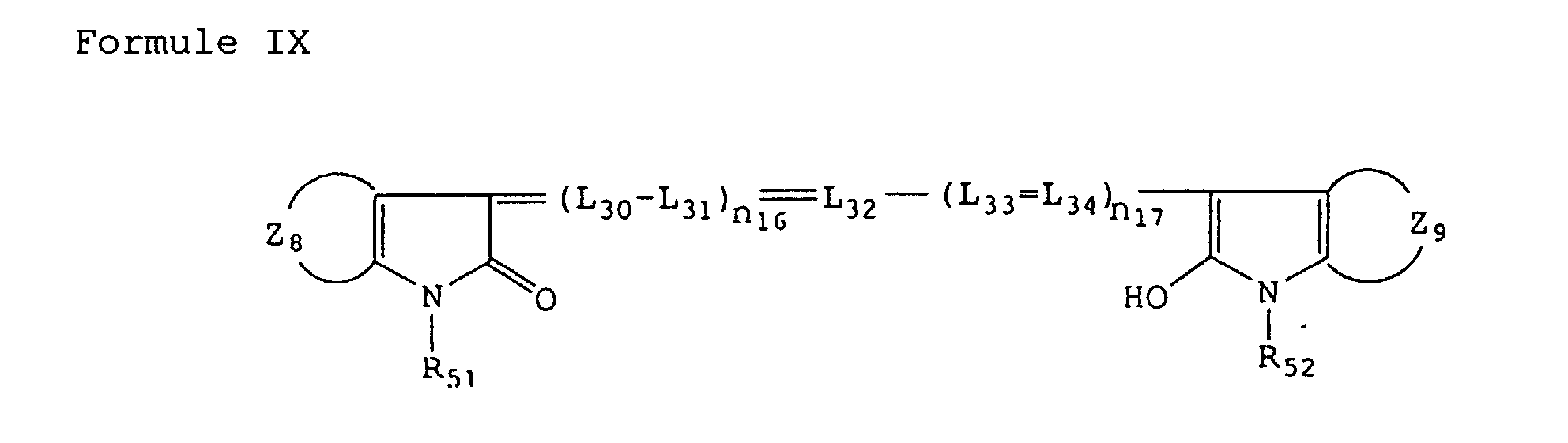
- R 51 and R 52 each have the same meaning as R 7 or R 8 ;
- Z 8 and Z 9 each have the same meaning as Z 1 or Z 2 ;
- L 30 , L 31 , L 32 , L 33 and L 34 each represent a methine group; and
- n 16 and n 17 each represent 0 or 1.
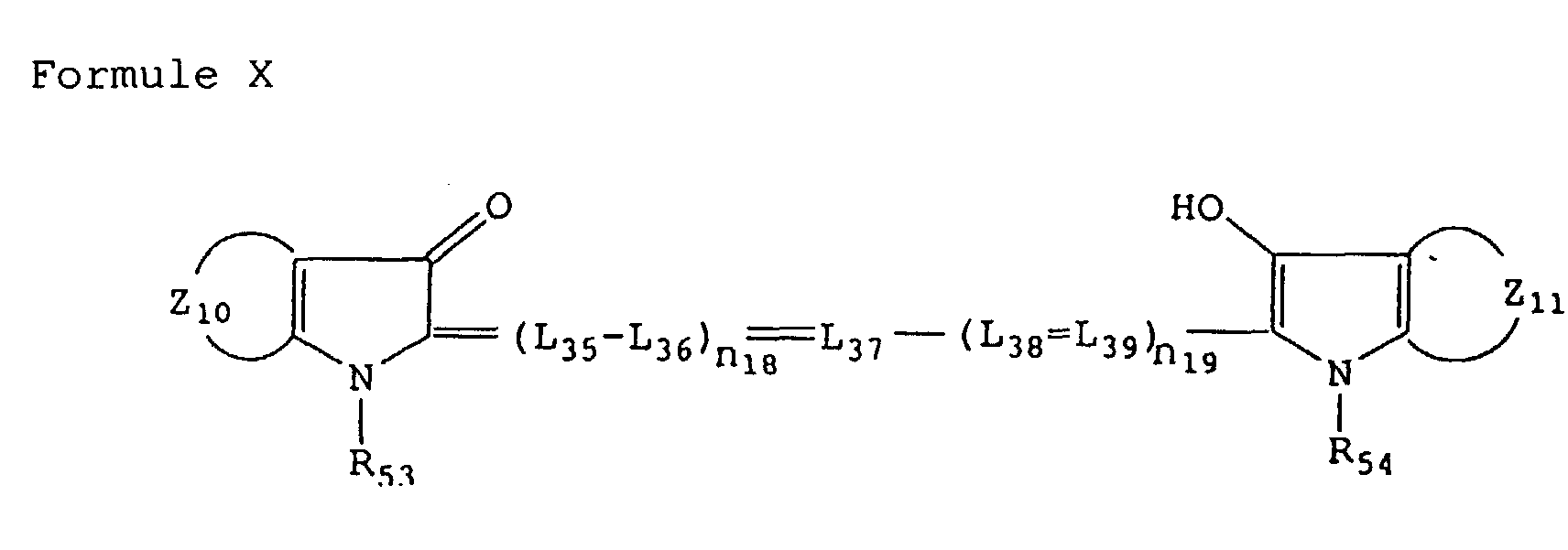
- R 53 and R 54 each have the same meaning as R 7 or R 8 ;
- Z 10 and Z 11 each have the same meaning as Z 1 or Z 2 ;
- L 35 , L 36 , L 37 , L 38 and L 39 each represent a methine group; and
- n 18 and n 19 each represent 0 or 1.
- R 55 , R 56 , R 57 and R 58 each have the same meaning as R 7 or R 8 ;
- X 1 , X 2 , X 3 , X 4 , X 5 and X 6 each represent an oxygen atom, a sulfur atom or -NR 59 R 60 ;
- R 59 and R 60 each represent a hydrogen atom, an alkyl group, an aryl group, an alkenyl group, a heterocyclic atom, a hydroxyl group or -OR 61 ;
- R 61 represents an alkyl group or an aryl group;
- L 40 , L 41 , L 42 , L 43 and L 44 each represent a methine group; and
- n 20 and n 21 each represent 0 or 1.
- R 62 and R 63 each represent a hydrogen atom, an alkyl group, an aryl group, an alkenyl group, a heterocyclic group, -CONR 5 R 6 , -OR 5 , -NR 5 R 6 , -SR 5 , -SO 2 R 5 , -COR 5 , -SO 2 NR 5 R 6 , - SOR 5 , -COOH, -COOC 2 H 5 , -NHCON(CH 3 ) 2, -NHCOCH 3 , or a cyano group;
- R 64 and R 65 each have the same meaning as R 3 or R 4 ;
- L 45 , L 46 , L 47 , L 48 and L 49 each represent a methine group; and
- n 32 and n 33 each represent 1 or 2.
- R 66 and R 67 each represent a hydrogen atom, an alkyl group, an aryl group, an alkenyl group, a heterocyclic group, -CONR 5 R 6 , -OR 5 , -NR 5 R 6 , -SR 5 , -SO 2 R 5 , -COR 5 , -SO 2 NR 5 R 6 , -SOR 5 or a cyano group;
- R 5 and R 6 are each as defined above;
- Z 12 and Z 13 each have the same meaning as Z 1 or Z 2 ;
- L 50 , L 51 , L 52 , L 53 and L 54 each represent a methine group; and n 34 and n 35 each represent 1 or 2.
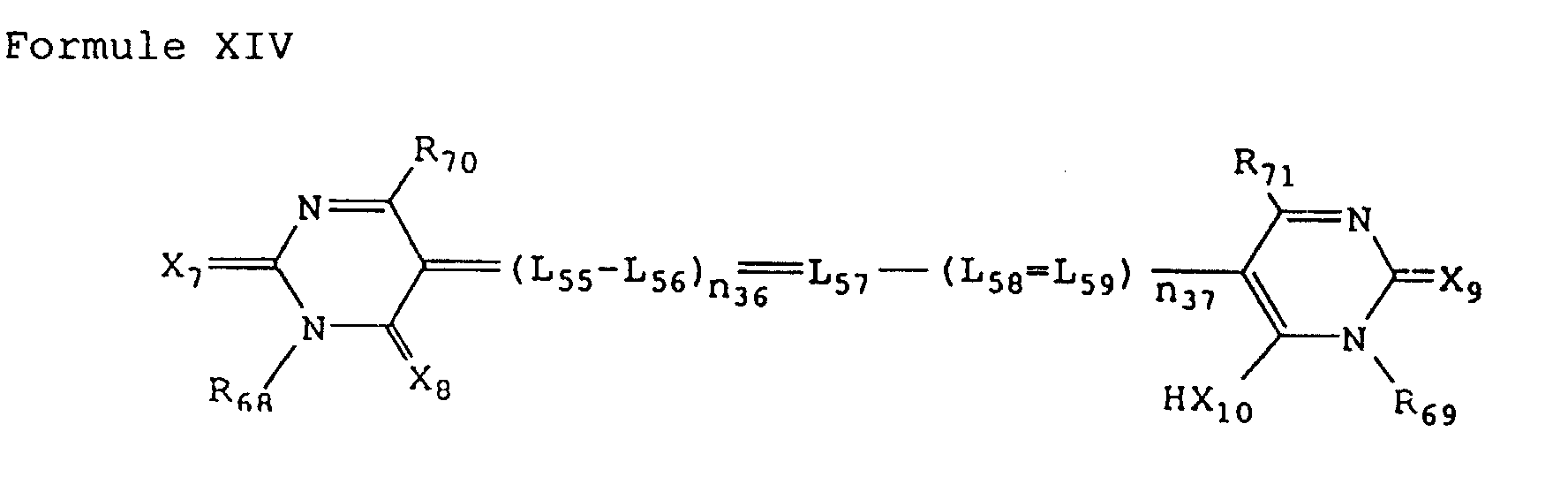
- R 68 and R 69 each represent a hydrogen atom, an alkyl group, an aryl group, an alkenyl group, a heterocyclic group, -CONR 5 R 6 , -OR 5 , -NR 5 R 6 , -SR 5 , -SO 2 R 5 , -COR 5 , -SO 2 NR 5 R 6 , -SOR 5 or a cyano group;
- R 5 and R 6 are each as defined above;
- R 70 and R 71 each have the same meaning as R 12 or R 13 ;
- X 7 , X 8 , X 9 and X 10 each have the same meaning as X 1 , X 2 , X 3 , X 4 , X 5 or X 6 ;
- L 55 , L 56 , L 57 , L 58 and L 59 each represent a methine group; and
- n 36 and n 37 each represent 1 or 2.
- R 72 and R 73 each represent a hydrogen atom, an alkyl group, an aryl group, an alkenyl group, a heterocyclic group, -CONR 5 R 6 , -OR 5 , -NR 5 R 6 , -SR 5 , -SO 2 R 5 , -COR 5 , -SO 2 NR 5 R 6 , -SOR 5 or a cyano group;
- R 74 , R 76 , R 77 , R 78 , R 80 and R 81 each represent a hydrogen atom, a halogen atom, an alkyl group, an aryl group, an alkenyl group, a heterocyclic group, a cyano group, -COR 29 , -CONR 29 R 30 , -NR 29 R 30 , -OR 29 , -SO 2 R 29 , -N(R 29 )COR 30 , -N(R 29 )SO 2 R 30 , -N(
- Examples of the alkyl group represented by any one of R 1 to R 81 include methyl, ethyl, propyl, i-propyl, butyl, t-butyl, cyclopentyl and cyclohexyl. These alkyl groups each may be substituted with a hydroxyl group, a cyano group, a sulfo group, a carboxyl group, a halogen atom, an alkoxy group (e.g. methoxy, ethoxy), an aryloxy group (e.g. phenoxy, 4-sulfophenoxy, 2,4-disulfophenoxy), an aryl group (e.g.
- phenyl 4-sulfophenyl, 2,5-disulfonyl
- an alkoxycarbonyl e.g. methoxycarbonyl, ethoxycarbonyl
- an aryloxycarbonyl e.g. phenoxycarbonyl
- Examples of the aryl group represented by any one of R 1 to R 81 include phenyl and naphthyl. These aryl groups each may be substituted. Suitable substituents include the alkyl groups represented by any one of R 1 to R 81 and the groups mentioned above as the substituents for the alkyl group.
- heterocyclic group represented by any one of R 1 to R 81 examples include pyridyl, thiazolyl, oxazolyl, imidazolyl, furyl, pyrrolyl, pyrazinyl, pyrizinyl, pyridazinyl, purinyl, selenazolyl, sulforanyl, piperidinyl, pyrazolyl and tetrazolyl. These heterocyclic groups each may be substituted. Suitable substituents include the alkyl groups represented by any one of R 1 to R 81 and the groups mentioned above as the substituents for the alkyl group.
- Examples of the alkenyl group represented by any one of R 1 to R 81 include vinyl, allyl and butenyl. These alkenyl groups may be substituted.
- Suitable substituents include the alkyl groups represented by any one of R 1 to R 81 and the groups mentioned above as the substituents for the alkyl group.
- Examples of the 5- or 6-membered ring formed by any one of Z 1 to Z 13 include benzene, naphthalene, thiophene, pyrrole, furan, pyrazole, indole, quinoline, pyridine, pyrazine, pyrimidine, cyclohexene and cyclopentene. These rings each may be substituted.
- Suitable substituents include the alkyl groups represented by any one of R 1 to R 81 and the groups mentioned above as the substituents for the alkyl group.
- the methine group represented by any one of L 1 to L 64 may have a substituent.
- Suitable substituents include an alkyl group (e.g. methyl, ethyl, i-butyl), an aryl group (e.g. phenyl, p-tolyl, p-carboxyphenyl), an aralkyl group (e.g. benzyl, phenethyl), alkoxy (e.g. methoxy, ethoxy), an aryloxy group (e.g. phenoxy), a halogen atom and a cyano group.
- alkyl group e.g. methyl, ethyl, i-butyl
- an aryl group e.g. phenyl, p-tolyl, p-carboxyphenyl
- an aralkyl group e.g. benzyl, phenethyl
- alkoxy e.g. me
- the first dye used according to the invention is characterized in that it has an absorption maxima, as measured when contained in a gelatin film, at from 630 to 680 nm, preferably from 640 to 670 nm.
- the second dye used according to the invention is characterized in that it has an absorption maxima, as measured when contained in a gelatin film, at from 680 to 750 nm, preferably from 690 to 740 nm.
- the maximum absorption wavelength of the second dye should be longer than that of the first dye by from 20 to 100 nm.
- the dyes used in the invention are contained in a silver halide emulsion layer or in a hydrophilic colloidal layer other than the emulsion layer. Good results can be obtained when these dyes are contained in a layer adjacent to a red-sensitive emulsion layer. If the dyes are diffusible, good results can also be obtained even when they are added to a layer far away from a red-sensitive layer (e.g. an intermediate layer, a protective layer).
- the amounts of the dyes are not limitative, but are preferably from 1 to 200 mg/m 2 for the first dye, and from 3 to 100 mg/m 2 for the second dye.
- the first and second dyes may be added either simultaneously or at an interval. They may be added in the form of two different solutions or dispersions, or in the form of a mixture.
- the amount ratio of the first dye to the second dye is not limitative, but is preferably from 1:10 to 5:1.
- the dyes used in the invention are contained in a silver halide emulsion layer or in a hydrophilic colloidal layer other than the emulsion layer by the following method: A dye or its organic or inorganic salt is dissolved in an aqueous solution or an organic solvent (e.g. alcohols, glycols, cellosolves, dimethylformamide, dibutyl phthalate, tricresyl phosphate), and emulsified, if necessary. The resultant is added to a coating composition.
- an organic solvent e.g. alcohols, glycols, cellosolves, dimethylformamide, dibutyl phthalate, tricresyl phosphate
- Silver halides usable in the invention include silver iodide, silver iodobromide, silver iodochloride, silver bromide, silver chlorobromide and silver chloride, which have been widely employed in the photographic industry. It is preferable to use silver halide grains having a silver chloride content of 95 mol% or more, a silver bromide content of 5 mol% or less and a silver iodide content of 0.5 mol% or less.
- the total amount of binders contained in the silver halide eight-sensitive emulsion layers and other hydrophilic colloid layers is 8.0 g/m 2 or less.
- a silver halide emulsion layer comprises silver halide grains with a silver chloride content of 95 mol% or more, the amount of such grains accounts for 60 wt% or more, preferably 80 wt% or more, of the total amount of silver halide grains contained therein.
- the halide composition of a silver halide grain may be uniform within the entire grain.
- the halide composition may change, either continuously or discontinuously, with the distance from the center of the grain.
- the size of a silver halide grain is not limitative, but is preferably from 0.2 to 1.6 ⁇ m, still preferably from 0.25 to 1.2 ⁇ m, for the attainment of rapid processing and improved sensitivity.
- Grain size measurement can be conducted by a known method, such as that described in Labrand: Grain Size Analysis Method (A.S.T.M. Symposium on Light Microscopy, 1955, pp. 94 to 122) or in Mees & James: Theory of Photographic Process (3rd ed., MacMillan Company, 966, Chapter 2).
- a grain size can be measured by using the area of a projected image of a grain or the approximate value of a grain diameter.
- An accurate grain size distribution can be obtained based on the project image area or the diameter, as long as grains are in substantially the same shape.
- the size distribution of silver halide grains to be used in the invention may be either monodispersed or polydispersed.
- monodispersed silver halide grains having a variation coefficient of 0.22 or less are preferable.
- Still preferable are monodispersed silver halide grains with a variation coefficient of 0.15 or less.
- Grain size represents the diameter of a grain when the grain is spherical. In the case of a grain which is cubic or in other shapes, grain size represents the diameter of a circle having the same area as that of the projected image of the grain.
- Silver halide grains to be employed in the invention can be prepared by any of the neutral method, the acid method or the ammonia method. Use of seed grains is permissible. Formation of seed grains and growing of silver halide grains may be performed by the same method.
- the shape of a silver halide grain is not limitative. Preferred is a cubic grain having a (100) face as a crystal face. Octahedral, tetradecahedral and dodecahedral silver halide grains may also be employed. Methods of preparing these grains are described in U.S. Patent Nos. 4,183,756, 4,225,666, Japanese Patent O.P.I. Publication No. 26589/1980, Japanese Patent Examined Publication No. 42737/1980 and The Journal of Photographic Science, 21, 39 (1973). Also usable are silver halide grains with a twin crystal face. Silver halide grains may be either identical or different in shape.
- a metal ion to a silver halide grain during forming and/or growing the grain so that the metal ion can be contained in its inside and/or on its surface.
- a metal ion can be contained in its inside and/or on its surface.
- use can be made of cadmium salts, zinc salts, lead salts, thallium salts, iridium salts (or complex salts), rhodium salts (or complex salts) or iron salts (or complex salts).
- a reduction sensitization nucleous can be formed in the inside and/or on the surface of a grain in a reductive atmosphere.
- a latent image may be formed in the inside of or on the surface of a silver halide grain.
- a silver halide emulsion is chemically sensitized by a known method, including the sulfur sensitization method (activated gelatin or a compound containing sulfur which is reactive to a silver ion is used as a sensitizer), the selenium sensitization method, the reduction sensitization method and the noble metal sensitization method. These sensitization methods can be applied either alone or in combination.
- a silver halide emulsion can be spectrally sensitized to a prescribed wavelength region with a sensitizing dye such as a cyanine dye, a merocyanine dye, a composite cyanine dye, a composite merocyanine dye, a holopolar cyanine dye, a hemicyanine dye, a styryl dye and a hemioxanol dye.
- a sensitizing dye such as a cyanine dye, a merocyanine dye, a composite cyanine dye, a composite merocyanine dye, a holopolar cyanine dye, a hemicyanine dye, a styryl dye and a hemioxanol dye.
- a silver halide emulsion for forming a red-sensitive emulsion layer be spectrally sensitized with a sensitizing dye represented by the following Formula RSI or RSII.
- R 1 and R 2 each represent an alkyl group or an aryl group
- L 1 , L 2 , L 3 , L 4 and L 5 each represent a methine group
- Y 1 and Y 2 each represent an oxygen atom, a sulfur atom or a selenium atom
- R 3 and R 4 each represent a lower alkyl group
- a 1 , A 2 , B 1 , B 2 , C 1 , C 2 , D 1 and D 2 each represent a hydrogen atom, a halogen atom, an alkyl group, an alkoxy group, a phenyl group, a cyano group, a nitro group or an alkoxycarbonyl group
- X + represents an acid anion
- n and 1 each represent 0
- sensitizing dyes may be employed either singly or in combination. They also may be used together with a dye which does not have a sensitizing effect or with a supersensitizer consisting of a compound which does not absorb UV rays, which serves to enhance the sensitizing effect of a sensitizing dye.
- the amount of a sensitizing dye is not limitative, but is preferably from 1 ⁇ 10 -7 to 1 x 10 -3 mol, still preferably from 5 ⁇ 10 -6 to 5 ⁇ 10 -4 mol, per mol silver halide.
- a sensitizing dye may be added by a known method.
- a sensitizing dye may be added in the form of a solution obtained by dissolving it in a water-soluble solvent such as pyridine, methyl alcohol, ethyl alcohol, methyl cellusolve, acetone or a mixture thereof, and optionally, diluting with water.
- a water-soluble solvent such as pyridine, methyl alcohol, ethyl alcohol, methyl cellusolve, acetone or a mixture thereof, and optionally, diluting with water.
- Water may be used instead of a water-solubloe solvent.
- Use of ultrasonic vibration is advisable to facilitate dissolving.
- a dye may be added in the form of a dispersion obtained by dissolving it in a volatile organic solvent and dispersing the resulting solution in a hydrophilic colloid.
- the dye may be added in the form of a dispersion obtained by dispersing it in a water-soluble solvent (see Japanese Patent Examined Publication No. 24185/1971).
- the sensitizing dyes When two or more sensitizing dyes are employed, it is possible to dissolve them separately in different solvents, and mix the resulting solutions before adding to an emulsion.
- the dye solutions may be added separately without mixing, in which case the order of addition, timing and interval are determined according to the purpose.
- a sensitizing dye may be added to a silver halide emulsion at any time during the process of preparing the emulsion, but preferably immediately before, during or immediately after the chemical ripening.
- the present invention can be applied to both single-colored and multi-colored light-sensitive materials including color negative films, color positive films, color printing paper, light-sensitive materials for display, and the like.
- the effects of the invention can be produced most satisfactorily when applied to light-sensitive materials for direct appreciation.
- a dye-forming coupler When the invention is applied to a color photographic light-sensitive material, a dye-forming coupler is normally employed.
- a silver halide emulsion layer contains a dye-forming coupler which can absorb spectral light to which the emulsion layer is sensitive. Therefore, a yellow dye-forming coupler, a magenta dye-forming coupler and a cyan dye-forming coupler are generally contained in a blue-sensitive emulsion layer, a green-sensitive emulsion layer and a red-sensitive emulsion layer, respectively. Combination of a coupler and an emulsion layer, however, is not limited thereto.
- acylacetoanilide-based couplers are preferable as a yellow dye-forming coupler.
- benzoylacetoanilide-based compounds and pivaloylacetoanilide-based compounds in particular, example compound Nos. Y-1 to Y-146 described in Japanese Patent O.P.I. Publication No. 85631/1988, example compound Nos. Y-1 to Y-98 described in Japanese Patent O.P.I. Publication No. 97951/1988, example compound Nos. I-1 to I-50 described in Japanese Patent O.P.I. Publication No. 298943/1990 and example compound Nos. Y-1 to Y-24 described in Japanese Patent O.P.I. Publication No. 156748/1989 are advantageous.
- magenta dye-forming coupler 5-pyrazolone-based compounds, pyrazoloazole-based compounds and pyrazolobenzimidazole-based compounds can be preferably employed.
- compound Nos. 1 to 4, 8 to 17, 19 to 24, 26 to 43, 45 to 59, 61 to 104, 106 to 121, 123 to 162, 164 to 233 described from page 18, upper right column to page 32, upper right column of Japanese Patent O.P.I. Publication No. 166339/1987, and compound Nos. M-1 to M-29 described in pages 5 to 6 of Japanese Patent O.P.I. Publication No. 100048/1990.
- cyan dye-forming coupler naphthol-based compounds and phenol-based compounds are preferable.
- Examples of a 2,5-diacylaminophenol-based compound include example compound Nos. C-1 to C-25 described in Japanese Patent O.P.I. Publication No. 96656/1988 and examples of a phenol-based compound include example compound Nos. IV-1 to IV-19 described in Japanese Patent O.P.I. Publication No. 196048/1989.
- phenol-based compounds described in Japanese Patent O.P.I. Publication No. 132437/1990, pages 31 to 32, in each of which a nitrogen-containing heterocyclic ring is condensed to a phenol nucleous, and phenylimidazole-based compounds.
- a dye-forming coupler is normally added to a hydrophilic colloidal layer in the form of a dispersion obtained by dissolving it in a high-boiling solvent (boiling point: 150°C or more) or a water-insoluble high-molecular substance (if need arises, a low-boiling and/or a water-soluble organic solvent are used in combination), and dispersing the resulting solution in a hydrophilic binder such as an aqueous gelatin solution in the presence of a surfactant.
- a hydrophilic binder such as an aqueous gelatin solution in the presence of a surfactant.
- a compound with a dielectric constant (at 30°C) of 6.5 or less such as esters including phosphoric esters, organic acid amides, ketones and hydrocarbons, are preferable. Combined use of two or more different types of high-boiling solvent is possible.
- a high-boiling solvent is employed in an amount of 0 to 400 wt%, preferably 10 to 100 wt%, based on the amount of a coupler.
- Gelatin is preferable as a binder.
- Either lime-treated gelatin or acid-treated gelatin is usable, and there is no restrictions on the raw material (a bone or hide of a cow, a hide of a pig) of gelatin. In the invention, however, it is preferable to use a lime-treated gelatin made from a bone of a cow.
- Silver halide emulsion layers and other hydrophilic colloidal layers may be hardened by the addition of one or more hardeners.
- Hardeners serve to allow molecules of a binder (or protective colloid) to be cross-linked, thus making these layers tougher.
- Hydrophilic colloidal layers such as a protective layer and an intermediate layer may contain a UV absorber, which serves to prevent fogging caused by electric discharge which is generated when a light-sensitive material is electrified by friction, as well as to prevent UV rays from adversely affecting the quality of a photographic image.
- a UV absorber which serves to prevent fogging caused by electric discharge which is generated when a light-sensitive material is electrified by friction, as well as to prevent UV rays from adversely affecting the quality of a photographic image.
- a light-sensitive material of the invention may contain auxiliary layers such as a filter layer, an anti-halation layer and/or an anti-irradiation layer. These layers and/or silver halide emulsion layers each may contain a dye other than the dye defined herein, which can be released from a light-sensitive material or can be bleached during processing.
- a light-sensitive material of the invention may contain a fluorescent brightener, such as those described in Japanese Patent O.P.I. Publication No. 71049/1984 and 71050/1984.
- a fluorescent brightener By the addition of a fluorescent brightener, it is possible to obtain a visually clear photographic image.
- a fluorescent brightener trapping agent may be added to prevent the brightener from flowing out.
- hydrophilic polymers such as polyvinyl pyrrolidone, a copolymer containing vinyl pyrrolidone as a repeating unit, a hydrophilic polymer containing a cationic nitrogen-containing active group (described in Japanese Patent O.P.I. Publication No. 42732/1973) and a copolymer of vinyl alcohol and vinyl pyrrolidone (described in Japanese Patent Examined Publication No. 20738/1972).
- Silver halide emulsion layers and/or other hydrophilic colloidal layers each may contain a matting agent, which serves to make a light-sensitive material less glossy, two improve writability and to prevent a light-sensitive material from adhering to other light-sensitive materials.
- a light-sensitive material of the invention may contain a lubricant which serves to minimize slide abrasion.
- a light-sensitive material of the invention may contain an anti-static agent.
- An anti-static agent may be contained in an anti-static layer provided on the opposite side of a support (where no emulsion layer is provided), or in a silver halide emulsion layer and/or a protective colloidal layer other than an emulsion layer provided on the emulsion layer side of a support.
- Silver halide emulsion layers and/or other hydrophilic colloidal layers each may contain a surfactant as a coating aid, an anti-static agent, a lubricant, an emulsifier, and to prevent a light-sensitive material from adhering to other light-sensitive materials, as well as to improve photographic properties (e.g. to accelerate development, to harden the layers of a light-sensitive material, to sensitize emulsions).
- Silver halide emulsion layers and other component layers of a light-sensitive material of the invention are provided on a variety of supports, in particular, a film of a semisynthetic or synthetic polymer such as cellulose acetate, cellulose nitrate, polystyrene, polyvinyl chloride, polyethylene terephthalate, polycarbonate and polyamide, as well as on paper supports, such as those which coated with baryta or a polymer of an ⁇ -olefin (an ⁇ -olefin layer may be one which can be removed readily), flexible reflective supports such as synthetic paper, and a rigid material such as glass, metals and ceramics.
- An extremely thin reflective support of 120 to 160 ⁇ m in thickness is also usable.
- a support to be employed in the invention may be either reflective or transparent.
- a white pigment may be contained in the support, or, a white pigment-containing hydrophilic colloidal layer may be provided on the support.
- Preferable white pigments include barium sulfate and titanium oxide.
- a support may be subjected to corona discharge treatment or flame treatment, or exposed to UV rays prior to the provision of layers.
- an undercoating layer may be formed to increase adhesion between the support and the layers, to prevent a light-sensitive material from getting electrified, as well as to improve the dimensional stability, abrasion resistance, hardness, anti-halation property, frictional characteristics and/or other photographic characteristics of a light-sensitive material. Provision of two or more undercoating layers is possible.
- conventional color developing agents can be employed.
- Examples include aminophenol-based compounds and p-phenylenediamine-based compounds. These compounds are normally employed in the form of a salt (e.g. hydrochloride, sulfate), since they are more stable in a salt form than in a free state.
- the amounts of these compounds are preferably 0.1 to 30 g, still preferably 1 to 15 g, per 1 l of a color developer.
- the most effective primary aromatic amine-based developing agent is an N,N-dialkyl-p-phenylenediamine-based compound.
- the alkyl group and the phenyl group each may be substituted with a substituent.
- a color developer may also contain various known additives, such as an alkalizing agent (e.g. sodium hydroxide, sodium carbonate, potassium carbonate), an alkali metal sulfite, an alkali metal bisulfite, an alkali metal thiocyanate, an alkali metal halide, benzyl alcohol, a water softener and a thickener.
- an alkalizing agent e.g. sodium hydroxide, sodium carbonate, potassium carbonate
- an alkali metal sulfite e.g. sodium hydroxide, sodium carbonate, potassium carbonate
- an alkali metal sulfite e.g. sodium hydroxide, sodium carbonate, potassium carbonate
- an alkali metal sulfite e.g. sodium hydroxide, sodium carbonate, potassium carbonate
- an alkali metal sulfite e.g. sodium hydroxide, sodium carbonate, potassium carbonate
- an alkali metal sulfite e.g.
- the pH of a color developer is 7 or more, normally 10 to 13.
- Color developing is performed at 15°C or more, normally 20°C to 50°C. For rapid processing, 30°C or more is preferable. Color developing is performed preferably for 20 to 60 seconds, still preferably 30 to 50 seconds.
- a light-sensitive material of the invention is subjected to bleaching and fixing after color developing. Bleaching may be performed simultaneously with fixing.
- a stabilizer may contain a pH controller, a chelating agent, a fungicide or other additives.
- Sample Nos. 1-2 to 1-25 were prepared in substantially the same manner as in the preparation of Sample No. 1-1, except that the type and amount (mg/m 2 ) of dyes contained in the 4th layer were changed to those shown in Table 1.
- dyes having an absorption maxima at 580 to 630 nm, dyes having an absorption maxima at 630 to 680 nm and dyes having an absorption maxima at 680 to 750 nm are designated as group A, group B and group C, respectively.
- Coating compositions for the 2nd to 7th layers were prepared in substantially the same manner as in the preparation of the 1st layer coating composition except for ingredients.
- H-1 and H-2 were added to the 2nd layer coating composition and the 4th layer coating composition, respectively.
- Surfactants SU-1 and SU-2 were added to each coating composition to adjust the surface tension.
- liquids A and B were added by the double-jet method over a period of 30 minutes, while controlling pAg and pH to 6.5 and 3.0, respectively. Then, liquids C and D were added over a period of 180 minutes, while controlling pAg and pH to 7.3 and 5.5, respectively.
- pAg was controlled according to the method described in Japanese Patent O.P.I. Publication No. 45437/1983, and pH was controlled by using an aqueous solution of sulfuric acid or sodium hydroxide. Liquid A Sodium chloride 3.42 g Potassium bromide 0.03 g Water was added to make the total quantity 200 ml.
- Liquid B Silver nitrate 10 g Water was added to make the total quantity 200 ml.
- Liquid C Sodium chloride 102.7 g Potassium bromide 1.0 g Water was added to make the total quantity 600 ml.
- Liquid D Silver nitrate 300 g Water was added to make the total quantity 600 ml.
- EMP-1 was chemically sensitized to an optimum level by using the following compounds, whereby a blue-sensitive silver halide emulsion was obtained (Em-B).
- Sodium thiosulfate 0.8 mg/mol AgX Chlorauric acid 0.5 mg/mol AgX Stabilizer STAB-1 6 ⁇ 10 -4 mol/mol AgX Sensitizing dye BS-1 4 ⁇ 10 -4 mol/mol AgX Sensitizing dye BS-2 1 ⁇ 10 -4 mol/mol AgX
- An emulsion consisting of monodispersed cubic grains with an average grain size of 0.43 ⁇ m, a variation coefficient of 0.08 and a silver chloride content of 99.5% was prepared in substantially the same manner as in the preparation of EMP-1, except that the addition time of liquids A and B and the addition time of liquids C and D were changed.
- EMP-2 was then chemically sensitized at 55°C to an optimum level by using the following compounds, whereby a green-sensitive silver halide emulsion (Em-G) was obtained.
- Em-G green-sensitive silver halide emulsion
- An emulsion consisting of monodispersed cubic grains with an average grain size of 0.50 ⁇ m, a variation coefficient of 0.08 and a silver chloride content of 99.5% was prepared in substantially the same manner as in the preparation of EMP-1, except that the addition time of liquids A and B and the addition time of liquids C and D were changed, and that the following metallic compounds were added to liquid C.
- EMP-3 emulsion consisting of monodispersed cubic grains with an average grain size of 0.50 ⁇ m, a variation coefficient of 0.08 and a silver chloride content of 99.5%
- EMP-3 was then chemically sensitized at 60°C to an optimum level by using the following compounds, whereby a red-sensitive silver halide emulsion (Em-R) was obtained.
- Em-R red-sensitive silver halide emulsion
- Sodium thiosulfate 1.8 mg/mol AgX Chlorauric acid 2.0 mg/mol AgX Stabilizer STAB-1 6 ⁇ 10 -4 mol/mol AgX Sensitizing dye RS-12 1 ⁇ 10 -4 mol/mol AgX Dyes in 4th Layer (mg/m 2 ) Sample No.
- Bleach-fixer Dihydrate of ferric ammonium ethylenediaminetetracetate 60 g Ethylenediaminetetracetic acid 3 g Ammonium thiosulfate (aqueous 70% solution) 100 ml Ammonium sulfite (aqueous 40% solution) 27.5 ml Water was added to make the total quantity 1 liter, and pH was adjusted to 5.7 with potassium carbonate or glacial acetic acid.
- Stabilizer 5-chloro-2-methyl-4-isothiazoline-3-one 1.0 g Ethylene glycol 1.0 g 1-hydroxyethylidene-1,1-diphosphonic acid 2.0 g Ethylenediaminetetracetic acid 1.0 g Ammonium hydroxide (aqueous 20% solution) 3.0 g Fluorescent brightener (4,4-diaminostilbene disulfonic acid derivative) 1.5 g Water was added to make the total quantity 1 liter, pH was adjusted to 7.0 with sulfuric acid or potassium hydroxide.
- each light-sensitive material was evaluated for sensitivity, gradation, sharpness, whiteness of background and safe light suitability.
- Sensitivity and gradation ( ⁇ value) were examined by means of a densitometer (PDA-65, manufactured by Konica Corp.).
- Each light-sensitive material was subjected to continuous processing using a color printer processor (CL-PP1701QA, manufactured by Konica Corp.).
- CPK-2-20 manufactured by Konica Corp. was employed as a processing liquid. The processing was continued until the amount of a replenisher exceeded that immediately after the start.
- the red light reflectance density (D R ) of the non-exposed area was measured by the same method as mentioned above.
- D R should be 0.02 or less. If it exceeds 0.02, users notice the deteriorated whiteness of the non-exposed area. A D R value exceeding 0.025 makes the photographic image practically unusable.
- a safe light glass for color printing paper (No. 9B, manufactured by Konica Corp.) was fixed to a tungsten light bulb. The resultant was employed as a light source. Each of the light-sensitive materials was exposed to this safe light through an optical wedge for 20 minutes, followed by the same processing as mentioned above.
- Safe light sensitivity Reciprocal of the amount of safe light exposure that gives a reflectance density higher than the minimum density by 0.1.
- Safe light suitability is indicated as a value relative to that of a control sample (set at 0). Smaller rel. SF values represent higher safe light suitability.
- Sensitivity was indicated as a value relative to that of sample No. 1-4 which was set at 100. Also, safe light suitability was indicated as a value relative to that of sample No. 1-4 which was set at 0.
- Light-sensitive materials (Sample Nos. 2-1 to 17) were prepared in substantially the same manner as in the preparation of Sample No. 1-1, except that the yellow coupler Y-8, the magenta coupler MC-10 in the 3rd layer and the cyan coupler in the 5th layer were replaced by YC-10, MC-13 and CC-3 (equimolar), respectively, a dye AI-2 was added to the intermediate layer in an amount of 7 mg/m 2 , the red-sensitive emulsion Em-R in the 5th layer was replaced by those shown in Table 3, and the dye in the 4th layer was changed to those shown in Table 3.
- liquids A and B were added by the double-jet method over a period of 15 minutes, while controlling pAg and pH to 6.5 and 3.0, respectively.
- liquids C and D were added also by the double-jet method over a period of 110 minutes, while controlling pAg and pH to 7.5 and 5.5, respectively.
- Liquid A Sodium chloride 3.18 g Potassium bromide 0.35 g Water was added to make the total quantity 200 ml.
- Liquid B Silver nitrate 10 g Water was added to make the total quantity 200 ml.
- Liquid C Sodium chloride 95.9 g Potassium bromide 13.7 g K 2 IrC 16 0.03 mg K 4 Fe(CN) 6 8.0 mg Water was added to make the total quantity 600 ml.
- Liquid D Silver nitrate 300 g Water was added to make the total quantity 600 ml.
- EMP-4 was then subjected to chemical ripening to an optimum level at 60°C by using the following compounds, thereby to obtain a red-sensitive silver halide emulsion (Em-R-11).
- Sodium thiosulfate 2.2 mg/mol AgX Chlorauric acid 2.0 mg/mol AgX Stabilizer STAB-2 5 ⁇ 10 -4 mol/mol AgX Sensitizing dye SR-15 1.5 ⁇ 10 -4 mol/mol AgX Sample No.
- Sensitivity was indicated as a value relative to that of Sample No. 2-9 which was set at 100. Also, safe light suitability was indicated as a value relative to that of Sample No. 2-9 which was set at 0.
Landscapes
- Chemical & Material Sciences (AREA)
- Engineering & Computer Science (AREA)
- Materials Engineering (AREA)
- Physics & Mathematics (AREA)
- General Physics & Mathematics (AREA)
- Silver Salt Photography Or Processing Solution Therefor (AREA)
Claims (4)
- Un matériau photographique photosensible à l'halogénure d'argent, comprenant un support et, appliquée sur celui-ci, au moins une couche d'émulsion photosensible à l'halogénure d'argent, dans laquelle au moins une couche choisie parmi la couche d'émulsion photosensible et d'autres couches colloïdales hydrophiles contient au moins un colorant ayant un maximum d'absorption à 630-680 nm (le premier colorant) et au moins un colorant ayant un maximum d'absorption à 680-750 nm (le second colorant), mesurés lorsqu'ils sont présents dans un film de gélatine, le second colorant étant un colorant choisi parmi la formule XII, la formule XIII, la formule XIV, la formule XV et le composé XV-16 ;dans laquelle R62 et R63 représentent, chacun indépendamment, un atome d'hydrogène, un groupe alkyle, un groupe aryle, un groupe alcényle, un groupe hétérocyclique, -CONR5R6, -OR5, -NR5R6, -SR5, -SO2R5, -COR5, -SO2NR5R6, -SOR5, -COOH, -COOC2H5, -NHCON(CH3)2, -NHCOCH3,
 ou un groupe cyano ;
R5 et R6 représentent chacun un atome d'hydrogène, un groupe alkyle, un groupe aryle, un groupe alcényle, un groupe hétérocyclique ; R5 et R6 peuvent se combiner entre eux pour former un cycle à 5 ou 6 chaínons ; R64 et R65 représentent chacun un atome d'hydrogène, un groupe alkyle, un groupe aryle, un groupe alcényle, un groupe hétérocyclique ; L45, L46, L47, L48 et L49 représentent chacun un groupe méthine ; n32 et n33 représentent chacun 1 ou 2 ;dans laquelle R66 et R67 représentent chacun un atome d'hydrogène, un groupe alkyle, un groupe aryle, un groupe alcényle, un groupe hétérocyclique, -CONR5R6, -OR5, -NR5R6, -SR5, -SO2R5, -COR5, -SO2NR5R6, -SOR5 ou un groupe cyano ; R5 et R6 sont chacun tels que définis ci-dessus ; Z12 et Z13 représentent chacun un groupe d'atomes non métalliques qui sont nécessaires pour former un cycle à 5 ou 6 chaínons ; L50, L51, L52, L53 et L54 représentent chacun un groupe méthine ; n34 et n35 représentent chacun 1 ou 2 ; dans laquelle R68 et R69 représentent chacun un atome d'hydrogène, un groupe alkyle, un groupe aryle, un groupe alcényle, un groupe hétérocyclique, -CONR5R6, -OR5, -NR5R6, -SR5, -SO2R5, -COR5, -SO2NR5R6, -SOR5 ou un groupe cyano ; R5 et R6 sont chacun tels que définis ci-dessus ; R70 et R71 représentent chacun un groupe alkyle, un groupe aryle, un groupe alcényle, un groupe hétérocyclique, -NR16R17, -OR16, -N(R16)COR17, -N(R16)SO2R17, -N(R16)CONR17R18, -COR16, -CONR16R17, -SO2R16, -SO2NR16R17, -COOR16 ou un groupe cyano ; R16, R17 et R18 représentent chacun un atome d'hydrogène, un groupe alkyle, un groupe aryle, un groupe alcényle ou un groupe hétérocyclique ; X7, X8, X9 et X10 représentent chacun un atome d'oxygène, un atome de soufre ou -NR59R60 ; R59 et R60 représentent chacun un atome d'hydrogène, un groupe alkyle, un groupe aryle, un groupe alcényle, un groupe hétérocyclique, un groupe hydroxy ou -OR61, où R61 représente un groupe alkyle ou un groupe aryle ; L55, L56, L57, L58 et L59 représentent chacun un groupe méthine ; n36 et n37 représentent chacun 1 à 2 ;
 dans laquelle R72 et R73 représentent chacun un atome d'hydrogène, un groupe alkyle, un groupe aryle, un groupe alcényle, un groupe hétérocyclique, -CONR5R6, -OR5, -NR5R6, -SR5, -SO2R5, -COR5, -SO2NR5R6, -SOR5 ou un groupe cyano ; R74, R76, R77, R78, R80 et R81 représentent chacun un atome d'hydrogène, un atome d'halogène, un groupe alkyle, un groupe aryle, un groupe alcényle, un groupe hétérocyclique, un groupe cyano, -COR29, -CONR29R30, -NR29R30, -OR29, -SO2R29, -N(R29)COR30, -N(R29)SO2R30, -N(R29)CONR30R31, -SR29, -COOR29 ou -SO2NR29R30 ; R75 et R79 représentent chacun un atome d'hydrogène, un atome d'halogène, un groupe alkyle, un groupe aryle, un groupe alcényle, un groupe hétérocyclique, un groupe cyano, -COR29, -CONR29R30, -NR29R30, -OR29, -SO2R29, -N(R29)COR30, -N(R29)SO2R30, -N(R29)CONR30R31, -SR29, -COOR29, -SO2NR29R30 ou -SO3K ; R29 représente un atome d'hydrogène, un groupe alkyle, un groupe aryle, un groupe hétérocyclique ou un groupe alcényle ; R30 et R31 représentent chacun un groupe alkyle, un groupe aryle, un groupe hétérocyclique ou un groupe alcényle ; X11 et X12 représentent chacun un atome d'oxygène, un atome de soufre ou -NR59R60 ; R59 et R60 représentent chacun un atome d'hydrogène, un groupe alkyle, un groupe aryle, un groupe alcényle, un groupe hétérocyclique, un groupe hydroxy ou -OR61; R61 représente un groupe alkyle ou un groupe aryle ; R5 et R6 sont chacun tels que définis ci-dessus ; L60, L61, L62, L63 et L64 représentent chacun un groupe méthine ; n38 et n39 représentent chacun 0, 1 ou 2,

- Un matériau photographique photosensible à l'halogénure d'argent selon la revendication 1, dans lequel le premier colorant est un colorant choisi parmi la formule I, la formule II, la formule III, la formule IV, la formule V, la formule VI, la formule VII, la formule VIII, la formule IX, la formule X, la formule XI et le composé VIII-3 ;dans laquelle R1 et R2 représentent, chacun indépendamment, un atome d'hydrogène, un groupe alkyle, un groupe aryle, un groupe alcényle, un groupe hétérocyclique, -CONR5R6, -OR5, -NR5R6, -SR5, -SO2R5, -COR5, -SO2NR5R6, -SOR5, -COOH, -COOC2H5, -NHCON(CH3)2, -NHCOCH3 ou un groupe cyano ; R3 et R4 représentent chacun un atome d'hydrogène, un groupe alkyle, un groupe aryle, un groupe alcényle, un groupe hétérocyclique ; L1, L2, L3, L4 et L5 représentent chacun un groupe méthine ; n1 et n2 représentent chacun 0 ou 1 ; et R5 et R6 représentent chacun un atome d'hydrogène, un groupe alkyle, un groupe aryle, un groupe alcényle, un groupe hétérocyclique ; R5 et R6 peuvent se combiner entre eux pour former un cycle à 5 ou 6 chaínons,
 dans laquelle R7 et R8 représentent chacun un atome d'hydrogène, un groupe alkyle, un groupe aryle, un groupe alcényle, un groupe hétérocyclique, -NR9R10, -N(R9)CONR10R11, -N(R9)COR10 ou -N(R9)SO2R10 ; Z1 et Z2 représentent chacun un groupe d'atomes non métalliques qui sont nécessaires pour former un cycle à 5 ou 6 chaínons ; L6, L7, L8, L9 et L10 représentent chacun un groupe méthine ; n3 et n4 représentent chacun 0 ou 1 ; et R9, R10 et R11 représentent chacun un atome d'hydrogène, un groupe alkyle, un groupe aryle, un groupe alcényle, un groupe hétérocyclique ; R9 et R10 peuvent se combiner entre eux pour former un cycle à 5 ou 6 chaínons, R10 et R11 peuvent se combiner entre eux pour former un cycle à 5 ou 6 chaínons,
 dans laquelle R12 et R13 représentent chacun un groupe alkyle, un groupe aryle, un groupe alcényle, un groupe hétérocyclique, -NR16R17, -OR16, -N(R16)COR17, -N (R16)SO2R17, -N(R16)CONR17R18, -COR16, -CONR16R17, -SO2R16, -SO2NR16R17, -COOR16, -SCH3 ou un groupe cyano ; R14 et R15 sont définis comme pour R7 et R8 ci-dessus ; R16, R17 et R18 représentent chacun un atome d'hydrogène, un groupe alkyle, un groupe aryle, un groupe alcényle, un groupe hétérocyclique, R16 et R17 peuvent se combiner entre eux pour former un cycle à 5 ou 6 chaínons, R17 et R18 peuvent se combiner entre eux pour former un cycle à 5 ou 6 chaínons ; L11, L12, L13, L14 et L15 représentent chacun un groupe méthine ; n5 et n6 représentent chacun 0 ou 1,
 dans laquelle R19 est tel que défini pour R7 ou R8 ci-dessus ; Y1 représente un atome d'oxygène, un atome de soufre, un atome de sélénium, un atome de tellure ou =CR20R21 ; R20 et R21 représentent chacun un atome d'hydrogène, un groupe alkyle, un groupe aryle, un groupe alcényle, un groupe hétérocyclique ; Z3 et Z4 représentent chacun un groupe d'atomes non métalliques qui sont nécessaires pour former un cycle à 5 ou 6 chaínons ; L16, L17, L18 et L19 représentent chacun un groupe méthine ; n7 et n8 représentent chacun 0 ou 1; R20 et R21 peuvent se combiner entre eux pour former un cycle à 5 ou 6 chaínons,
 dans laquelle R22 représente un atome d'hydrogène, un groupe alkyle, un groupe aryle, un groupe alcényle, un groupe hétérocyclique, -CONR5R6, -OR5, -NR5R6, -SR5, -SO2R5, -COR5, -SO2NR5R6, -SOR5, -COOC2H5 ou un groupe cyano ; R5 et R6 sont chacun tels que définis ci-dessus ; R23 représente un atome d'hydrogène, un groupe alkyle, un groupe aryle, un groupe alcényle, un groupe hétérocyclique ; R24 et R25 représentent chacun un atome d'hydrogène, un groupe alkyle, un groupe aryle, un groupe alcényle, un groupe hétérocyclique ; R24 et R25 peuvent se combiner entre eux pour former un cycle à 5 ou 6 chaínons ; R26, R27 et R28 représentent chacun un atome d'hydrogène, un atome d'halogène, un groupe alkyle, un groupe aryle, un groupe alcényle, un groupe hétérocyclique, un groupe cyano, -COR29, -CONR29R30, -NR29R30, -OR29, -SO2R29, -N(R29)COR30, -N(R29)SO2R30, -N(R29) CONR30R31, -SR29, -COOR29 ou -SO2NR29R30 ; R29 représente un atome d'hydrogène, un groupe alkyle, un groupe aryle, un groupe hétérocyclique ou un groupe alcényle ; R30 et R31 représentent chacun un groupe alkyle, un groupe aryle, un groupe hétérocyclique ou un groupe alcényle ; L20, L21 et L22 représentent chacun un groupe méthine ; et n9 représente 0 ou 1 ;
 dans laquelle R32 est défini comme pour R7 ou R8 ci-dessus ; R33 et R34 représentent chacun un atome d'hydrogène, un groupe alkyle, un groupe aryle, un groupe alcényle, un groupe hétérocyclique ; R33 et R34 peuvent se combiner entre eux pour former un cycle à 5 ou 6 chaínons ; R35 et R36 sont définis comme pour R26, R27 ou R28 ci-dessus ; Y2 représente un atome d'oxygène, un atome de soufre, un atome de sélénium, un atome de tellure ou =CR20R21 ; R20 et R21 représentent chacun un atome d'hydrogène, un groupe alkyle, un groupe aryle, un groupe alcényle, un groupe hétérocyclique ; Z5 représente un groupe d'atomes non métalliques qui sont nécessaires pour former un cycle à 5 ou 6 chaínons ; L23 et L24 représentent chacun un groupe méthine ; n10 représente 0, 1 ou 2 ; X1 représente un groupe apte à être dissocié en anions ; et n11 représente 0, 1 ou 2 ; R33 et R34 peuvent se combiner entre eux pour former un cycle à 5 ou 6 chaínons,
 dans laquelle R37 et R38 sont chacun définis comme pour R7 et R8 ci-dessus ; Y3 et Y4 représentent chacun un atome d'oxygène, un atome de soufre, un atome de sélénium, un atome de tellure, >NC2H5 ou =CR20R21 ; R20 et R21 représentent chacun un atome d'hydrogène, un groupe alkyle, un groupe aryle, un groupe alcényle, un groupe hétérocyclique ; Z6 et Z7 représentent chacun un groupe d'atomes non métalliques qui sont nécessaires pour former un cycle à 5 ou 6 chaínons ; L25, L26, L27, L28 et L29 représentent chacun un groupe méthine ; n12 et n13 représentent chacun 0 ou 1 ; X2 représente un groupe apte à être dissocié en anions ; et n14 représente 0, 1 ou 2,
 dans laquelle R39, R40, R41, R42, R43 et R44 représentent chacun un atome d'hydrogène, un groupe alkyle, un groupe aryle, un groupe alcényle, un groupe hétérocyclique ; R39 et R40 peuvent se combiner entre eux pour former un cycle à 5 ou 6 chaínons, R41 et R42 peuvent se combiner entre eux pour former un cycle à 5 ou 6 chaínons, R43 et R44 peuvent se combiner entre eux pour former un cycle à 5 ou 6 chaínons, R45, R46, R49 et R50 représentent chacun un atome d'hydrogène, un groupe alkyle, un groupe aryle, un groupe alcényle, un groupe hétérocyclique, un groupe cyano, -COR29, -CONR29R30, -NR29R30, -OR29, -SO2R29, -N(R29)COR30, -N(R29)SO2R30, -N(R29)CONR30R31, -SR29, -COOR29 ou -SO2NR29R30 ; R47 et R48 représentent chacun un atome d'hydrogène, un groupe alkyle, un groupe aryle, un groupe alcényle, un groupe hétérocyclique, un groupe cyano, -COR29, -CONR29R30, -NR29R30, -OR29, -SO2R29, -N(R29)COR30, -N(R29)SO2R30, -N(R29)CONR30R31, -SR29, -COOR29, -SO3 -, -SO3Na, -SO3K ou -SO2NR29R30 ; R29, R30 et R31 représentent chacun un groupe alkyle, un groupe aryle, un groupe hétérocyclique ou un groupe alcényle ; X3 représente un groupe apte à être dissocié en anions ; et n15 représente 0, 1 ou 2, m représente 0 ou 1 ;
 dans laquelle R51 et R52 sont chacun définis comme pour R7 ou R8 ci-dessus ; Z8 et Z9 représentent chacun un groupe d'atomes non métalliques qui sont nécessaires pour former un cycle à 5 ou 6 chaínons ; L30, L31, L32, L33 et L34 représentent chacun un groupe méthine ; n16 et n17 représentent chacun 0 ou 1 ;
 dans laquelle R53 et R54 sont tels que définis pour R7 ou R8 ci-dessus ; Z10 et Z11 représentent chacun un groupe d'atomes non métalliques qui sont nécessaires pour former un cycle à 5 ou 6 chaínons ; L35, L36, L37, L38 et L39 représentent chacun un groupe méthine ; n18 et n19 représentent chacun 0 ou 1 ;
 dans laquelle R55, R56, R57 et R58 sont chacun définis comme pour R7 ou R8 ci-dessus ; X1, X2, X3, X4, X5 et X6 représentent chacun un atome d'oxygène, un atome de soufre ou -NR59R60 ; R59 et R60 représentent chacun un atome d'hydrogène, un groupe alkyle, un groupe aryle, un groupe alcényle, un groupe hétérocyclique, un groupe hydroxy ou -OR61 ; R61 représente un groupe alkyle ou un groupe aryle ; L40, L41, L42, L43 et L44 représentent chacun un groupe méthine ; et n20 et n21 représentent chacun 0 ou 1 ;

- Un matériau photographique photosensible à l'halogénure d'argent selon l'une quelconque des revendications 1 ou 2, dans lequel au moins l'une des couches d'émulsion photosensibles à l'halogénure d'argent comprend une émulsion d'halogénure d'argent ayant une teneur en chlorure d'argent de 95 % en moles ou plus.
- Un matériau photographique photosensible à l'halogénure d'argent selon l'une quelconque des revendications précédentes, dans lequel la quantité totale de liants contenus dans les couches d'émulsion photosensibles à l'halogénure d'argent et les autres couches colloïdales hydrophiles est de 8,0 g/m2 ou moins.
Applications Claiming Priority (3)
| Application Number | Priority Date | Filing Date | Title |
|---|---|---|---|
| JP92176/91 | 1991-04-23 | ||
| JP03092176A JP3084454B2 (ja) | 1991-04-23 | 1991-04-23 | ハロゲン化銀写真感光材料 |
| JP9217691 | 1991-04-23 |
Publications (2)
| Publication Number | Publication Date |
|---|---|
| EP0510960A1 EP0510960A1 (fr) | 1992-10-28 |
| EP0510960B1 true EP0510960B1 (fr) | 1999-10-20 |
Family
ID=14047127
Family Applications (1)
| Application Number | Title | Priority Date | Filing Date |
|---|---|---|---|
| EP19920303642 Expired - Lifetime EP0510960B1 (fr) | 1991-04-23 | 1992-04-23 | Matériau photographique à l'halogénure d'argent sensible à la lumière |
Country Status (3)
| Country | Link |
|---|---|
| EP (1) | EP0510960B1 (fr) |
| JP (1) | JP3084454B2 (fr) |
| DE (1) | DE69230157D1 (fr) |
Cited By (1)
| Publication number | Priority date | Publication date | Assignee | Title |
|---|---|---|---|---|
| US9018396B2 (en) | 2000-09-29 | 2015-04-28 | Life Technologies Corporation | Modified carbocyanine dyes and their conjugates |
Families Citing this family (5)
| Publication number | Priority date | Publication date | Assignee | Title |
|---|---|---|---|---|
| US5204231A (en) * | 1992-03-31 | 1993-04-20 | Konica Imaging, U.S.A., Inc. | White safelight handleable photographic film containing a filter dye layer |
| DE69501861T2 (de) * | 1994-08-17 | 1998-07-23 | Fuji Photo Film Co Ltd | Photographisches Silberhalogenidmaterial enthaltend einen pyrasolon-pentamethin oxonol Farbstoff |
| GB9423571D0 (en) | 1994-11-22 | 1995-01-11 | Minnesota Mining & Mfg | Antihalation/acutance system for photographic materials |
| EP0781816B1 (fr) * | 1995-12-27 | 1999-06-16 | Agfa-Gevaert N.V. | Colorants utilisables dans différentes applications |
| US5683860A (en) * | 1996-12-18 | 1997-11-04 | Eastman Kodak Company | Silver halide light-sensitive element |
Family Cites Families (6)
| Publication number | Priority date | Publication date | Assignee | Title |
|---|---|---|---|---|
| JPS52111618A (en) * | 1976-03-16 | 1977-09-19 | Hitachi Kiden Kogyo Kk | Induction motor controller |
| JPS6013165B2 (ja) * | 1977-08-31 | 1985-04-05 | 富士写真フイルム株式会社 | 写真用ポリエステルフイルム支持体 |
| JPS5928898B2 (ja) * | 1978-12-26 | 1984-07-17 | 富士写真フイルム株式会社 | 染色された層を有する写真感光材料 |
| JPS61174540A (ja) * | 1985-01-29 | 1986-08-06 | Fuji Photo Film Co Ltd | ハロゲン化銀写真感光材料 |
| JP2649692B2 (ja) * | 1988-05-18 | 1997-09-03 | コニカ株式会社 | ハロゲン化銀写真感光材料 |
| JPH0297940A (ja) * | 1988-10-04 | 1990-04-10 | Konica Corp | ハロゲン化銀写真感光材料 |
-
1991
- 1991-04-23 JP JP03092176A patent/JP3084454B2/ja not_active Expired - Fee Related
-
1992
- 1992-04-23 EP EP19920303642 patent/EP0510960B1/fr not_active Expired - Lifetime
- 1992-04-23 DE DE69230157T patent/DE69230157D1/de not_active Expired - Lifetime
Cited By (2)
| Publication number | Priority date | Publication date | Assignee | Title |
|---|---|---|---|---|
| US9018396B2 (en) | 2000-09-29 | 2015-04-28 | Life Technologies Corporation | Modified carbocyanine dyes and their conjugates |
| US9423323B2 (en) | 2000-09-29 | 2016-08-23 | Life Technologies Corporation | Modified carbocyanine dyes and their conjugates |
Also Published As
| Publication number | Publication date |
|---|---|
| EP0510960A1 (fr) | 1992-10-28 |
| JP3084454B2 (ja) | 2000-09-04 |
| DE69230157D1 (de) | 1999-11-25 |
| JPH04323646A (ja) | 1992-11-12 |
Similar Documents
| Publication | Publication Date | Title |
|---|---|---|
| US4863846A (en) | Silver halide photographic light-sensitive material | |
| US5051345A (en) | Silver halide reversal photographic light-sensitive material | |
| EP0510960B1 (fr) | Matériau photographique à l'halogénure d'argent sensible à la lumière | |
| EP0683427B1 (fr) | Colorants sensibilisateurs pour le bleu substitués par des hétérocycles | |
| JPS59177551A (ja) | ハロゲン化銀カラ−写真感光材料 | |
| US5480767A (en) | Silver halide color photographic light-sensitive material and image-forming process | |
| EP0560198B1 (fr) | Matériau photographique couleur à l'halogénure d'argent et un procédé de formation d'une image couleur avec celui-ci | |
| US5338655A (en) | Method for manufacturing a silver halide emulsion | |
| JP2670610B2 (ja) | ハロゲン化銀写真感光材料 | |
| US5034310A (en) | Silver halide color photographic photosensitive material | |
| JPS60203936A (ja) | ハロゲン化銀写真感光材料 | |
| JPH0980675A (ja) | ハロゲン化銀カラー写真感光材料 | |
| EP0915370B1 (fr) | Matériau photographique à l'halogénure d'argent sensible à la lumiére | |
| US5869228A (en) | Silver halide color photographic light-sensitive material and method of forming color image | |
| EP0563910A1 (fr) | Matériau photographique couleur à l'halogénure d'argent sensible à la lumière | |
| JP2582566B2 (ja) | 迅速処理性に優れ、高感度でかつ、安全光耐性の付与された直接鑑賞用ハロゲン化銀写真感光材料 | |
| JP2879389B2 (ja) | ハロゲン化銀カラー写真感光材料 | |
| USH1450H (en) | Silver halide light-sensitive photographic material | |
| US5403705A (en) | Silver halide photographic emulsion and light-sensitive silver halide photographic material | |
| JPS62247361A (ja) | カラ−画像の形成方法 | |
| JPS6177045A (ja) | ハロゲン化銀写真感光材料 | |
| US5998117A (en) | Silver halide photographic light-sensitive material | |
| JP2913508B2 (ja) | ハロゲン化銀カラー写真感光材料 | |
| JPS58117542A (ja) | 天然色画像再現方法 | |
| JPH0827517B2 (ja) | ハロゲン化銀カラ−写真感光材料の処理方法 |
Legal Events
| Date | Code | Title | Description |
|---|---|---|---|
| PUAI | Public reference made under article 153(3) epc to a published international application that has entered the european phase |
Free format text: ORIGINAL CODE: 0009012 |
|
| AK | Designated contracting states |
Kind code of ref document: A1 Designated state(s): DE FR GB IT NL |
|
| 17P | Request for examination filed |
Effective date: 19930402 |
|
| 17Q | First examination report despatched |
Effective date: 19970917 |
|
| GRAG | Despatch of communication of intention to grant |
Free format text: ORIGINAL CODE: EPIDOS AGRA |
|
| GRAG | Despatch of communication of intention to grant |
Free format text: ORIGINAL CODE: EPIDOS AGRA |
|
| GRAH | Despatch of communication of intention to grant a patent |
Free format text: ORIGINAL CODE: EPIDOS IGRA |
|
| GRAH | Despatch of communication of intention to grant a patent |
Free format text: ORIGINAL CODE: EPIDOS IGRA |
|
| GRAA | (expected) grant |
Free format text: ORIGINAL CODE: 0009210 |
|
| AK | Designated contracting states |
Kind code of ref document: B1 Designated state(s): DE FR GB IT NL |
|
| PG25 | Lapsed in a contracting state [announced via postgrant information from national office to epo] |
Ref country code: IT Free format text: LAPSE BECAUSE OF FAILURE TO SUBMIT A TRANSLATION OF THE DESCRIPTION OR TO PAY THE FEE WITHIN THE PRE;WARNING: LAPSES OF ITALIAN PATENTS WITH EFFECTIVE DATE BEFORE 2007 MAY HAVE OCCURRED AT ANY TIME BEFORE 2007. THE CORRECT EFFECTIVE DATE MAY BE DIFFERENT FROM THE ONE RECORDED.SCRIBED TIME-LIMIT Effective date: 19991020 Ref country code: NL Free format text: LAPSE BECAUSE OF FAILURE TO SUBMIT A TRANSLATION OF THE DESCRIPTION OR TO PAY THE FEE WITHIN THE PRESCRIBED TIME-LIMIT Effective date: 19991020 Ref country code: FR Free format text: LAPSE BECAUSE OF FAILURE TO SUBMIT A TRANSLATION OF THE DESCRIPTION OR TO PAY THE FEE WITHIN THE PRESCRIBED TIME-LIMIT Effective date: 19991020 |
|
| REF | Corresponds to: |
Ref document number: 69230157 Country of ref document: DE Date of ref document: 19991125 |
|
| PG25 | Lapsed in a contracting state [announced via postgrant information from national office to epo] |
Ref country code: DE Free format text: LAPSE BECAUSE OF FAILURE TO SUBMIT A TRANSLATION OF THE DESCRIPTION OR TO PAY THE FEE WITHIN THE PRESCRIBED TIME-LIMIT Effective date: 20000121 |
|
| EN | Fr: translation not filed | ||
| NLV1 | Nl: lapsed or annulled due to failure to fulfill the requirements of art. 29p and 29m of the patents act | ||
| PLBE | No opposition filed within time limit |
Free format text: ORIGINAL CODE: 0009261 |
|
| STAA | Information on the status of an ep patent application or granted ep patent |
Free format text: STATUS: NO OPPOSITION FILED WITHIN TIME LIMIT |
|
| 26N | No opposition filed | ||
| PGFP | Annual fee paid to national office [announced via postgrant information from national office to epo] |
Ref country code: GB Payment date: 20010418 Year of fee payment: 10 |
|
| REG | Reference to a national code |
Ref country code: GB Ref legal event code: IF02 |
|
| PG25 | Lapsed in a contracting state [announced via postgrant information from national office to epo] |
Ref country code: GB Free format text: LAPSE BECAUSE OF NON-PAYMENT OF DUE FEES Effective date: 20020423 |
|
| GBPC | Gb: european patent ceased through non-payment of renewal fee |
Effective date: 20020423 |