EP0512056B1 - Alliages a base d'aluminium a resistance extremement elevee - Google Patents
Alliages a base d'aluminium a resistance extremement elevee Download PDFInfo
- Publication number
- EP0512056B1 EP0512056B1 EP91904116A EP91904116A EP0512056B1 EP 0512056 B1 EP0512056 B1 EP 0512056B1 EP 91904116 A EP91904116 A EP 91904116A EP 91904116 A EP91904116 A EP 91904116A EP 0512056 B1 EP0512056 B1 EP 0512056B1
- Authority
- EP
- European Patent Office
- Prior art keywords
- weight percent
- alloys
- alloy
- percent
- strength
- Prior art date
- Legal status (The legal status is an assumption and is not a legal conclusion. Google has not performed a legal analysis and makes no representation as to the accuracy of the status listed.)
- Expired - Lifetime
Links
Images

Classifications
-
- B—PERFORMING OPERATIONS; TRANSPORTING
- B23—MACHINE TOOLS; METAL-WORKING NOT OTHERWISE PROVIDED FOR
- B23K—SOLDERING OR UNSOLDERING; WELDING; CLADDING OR PLATING BY SOLDERING OR WELDING; CUTTING BY APPLYING HEAT LOCALLY, e.g. FLAME CUTTING; WORKING BY LASER BEAM
- B23K35/00—Rods, electrodes, materials, or media, for use in soldering, welding, or cutting
- B23K35/22—Rods, electrodes, materials, or media, for use in soldering, welding, or cutting characterised by the composition or nature of the material
- B23K35/24—Selection of soldering or welding materials proper
- B23K35/28—Selection of soldering or welding materials proper with the principal constituent melting at less than 950°C
- B23K35/286—Al as the principal constituent
-
- C—CHEMISTRY; METALLURGY
- C22—METALLURGY; FERROUS OR NON-FERROUS ALLOYS; TREATMENT OF ALLOYS OR NON-FERROUS METALS
- C22C—ALLOYS
- C22C21/00—Alloys based on aluminium
-
- C—CHEMISTRY; METALLURGY
- C22—METALLURGY; FERROUS OR NON-FERROUS ALLOYS; TREATMENT OF ALLOYS OR NON-FERROUS METALS
- C22C—ALLOYS
- C22C21/00—Alloys based on aluminium
- C22C21/06—Alloys based on aluminium with magnesium as the next major constituent
-
- C—CHEMISTRY; METALLURGY
- C22—METALLURGY; FERROUS OR NON-FERROUS ALLOYS; TREATMENT OF ALLOYS OR NON-FERROUS METALS
- C22C—ALLOYS
- C22C21/00—Alloys based on aluminium
- C22C21/12—Alloys based on aluminium with copper as the next major constituent
Definitions
- the present invention provides certain aluminum-base alloys comprising copper, lithium, magnesium, silver, and at least one element selected from zinc, germanium, tin, cadmium, indium, beryllium, strontium and calcium, which alloys have a unique combination of mechanical and physical properties.
- alloys of the present invention possess extremely desirable properties, such as high artificially-aged strength with and without cold work, strong natural aging response with and without prior cold work, high strength/ductility combinations, low density, and high modulus.
- the alloys possess good corrosion resistance, weldability, cryogenic properties and elevated temperature properties.
- alloys are particularly suited for aerospace, aircraft, armor, and armored vehicle applications where high specific strength (strength divided by density) is important and a good natural aging response is useful because of the impracticality in many cases of performing a full heat treatment.
- weldability of the present alloys allows for their use in structures which are joined by welding.
- the present invention provides an aluminum-base alloy consisting of from 1 to 7 weight percent Cu, from 0.1 to 4 weight percent Li, from 0.01 to 4 weight percent total of at least one element selected from Zn, Ge, Sn, Cd, In, Be, Sr, and Ca, from 0.05 to 3 weight percent Mg, from 0.01 to 2 weight percent Ag, from 0.01 to 2 weight percent grain refiner selected from Zr, Cr, Mn, Ti, Hf, V, Nb, B, TiB2 and combinations thereof, and optionally, when said at least one element is Zn, from 0.01 to 1.5 weight percent of an element selected from Ge, Sn, Cd, In, Be, Sr, Sc, Y, Ca, and combinations thereof, the balance being aluminum and incidental impurities.
- Solution heat treating consists of soaking the alloy at a temperature sufficiently high and for a long enough time to achieve a nearly homogeneous solid solution of precipitate-forming elements in aluminum.
- the objective is to take into solid solution the maximum practical amounts of the soluble hardening elements.
- Quenching involves the rapid cooling of the solid solution, formed during the solution heat treatment, to produce a supersaturated solid solution at room temperature.
- the aging step involves the formation of strengthening precipitates from the rapidly cooled supersaturated solid solution.
- Precipitates may be formed using natural (ambient temperature), or artificial (elevated temperature) aging techniques.
- natural aging the quenched alloy is held at temperatures in the range of -20 to +50°C, typically at room temperature, for relatively long periods of time.
- the precipitation hardening that results from natural aging alone produces useful physical and mechanical properties.
- artificial aging the quenched alloy is held at temperatures typically in the range of 100 to 200°C for periods of approximately 5 to 48 hours, typically, to effect precipitation hardening.
- the extent to which the strength of Al alloys can be increased by heat treatment is related to the type and amount of alloying additions used.
- the further addition of magnesium to Al-Cu alloys can improve resistance to corrosion, enhance natural aging response without prior cold work and increase strength. However, at relatively low Mg levels, i.e., 1.5 percent, weldability is decreased.
- Aluminum Association registered alloy 2024 having nominal composition Al - 4.4 Cu - 1.5 Mg - 0.6 Mn. Alloy 2024 is a widely used alloy with high strength, good toughness, good warm temperature properties and a good natural-aging response. However, its corrosion resistance is limited in some tempers, it does not provide the ultra high strength and exceptionally strong natural-aging response achievable with the alloys of the present invention, and it is only marginally weldable. In fact, 2024 welded joints are not considered commercially useful in most situations.
- Al-Cu-Mg alloy is Aluminum Association registered alloy 2519 having a nominal composition of Al - 5.6 Cu - 0.2 Mg - 0.3 Mn - 0.2 Zr - 0.06 Ti - 0.05 V. This alloy was developed by Alcoa as an improvement on alloy 2219, which is presently used in various aerospace applications. While the addition of Mg to the Al-Cu system can enable a natural-aging response without prior cold work, alloy 2519 has only marginally improved strengths over alloy 2219 in the highest strength tempers.
- Polmear in U.S. Patent 4,772,342, has added silver and magnesium to the Al-Cu system in order to increase elevated temperature properties.
- a preferred alloy has the composition Al - 6.0 Cu - 0.5 Mg - 0.4 Ag - 0.5 Mn - 0.15 Zr - 0.10 V - 0.05 Si.
- Polmear associates the observed increase in strength with the "omega phase" that arises in the presence of Mg and Ag (see “Development of an Experimental Wrought Aluminum Alloy for Use at Elevated Temperatures," Polmear, ALUMINUM ALLOYS: THEIR PHYSICAL AND MECHANICAL PROPERTIES, E.A. Starke, Jr. and T.H. Sanders, Jr., editors, Volume I of Conference Proceedings of International Conference, University of Virginia, Charlottesville, VA, 15-20 June 1986, pages 661-674, Chameleon Press, London).
- Al-Li melts can react with the refractory materials in furnace linings.
- the atmosphere above the melt should be controlled to reduce oxidation problems.
- lithium lowers the thermal conductivity of aluminum, making it more difficult to remove heat from an ingot during direct-chill casting, thereby decreasing casting rates.
- Al-Li melts containing 2.2 to 2.7 percent lithium typical of recently commercialized Al-Li alloys, there is considerable risk of explosion.
- the property benefits attributable to these new Al-Li alloys have not been sufficient to offset the increase in processing costs caused by the above-mentioned problems. As a consequence they have not been able to replace conventional alloys such as 2024 and 7075.
- the preferred alloys of the present invention do not create these melting and casting problems to as great a degree because of their lower Li content.
- Al-Li alloys containing Mg are well known, but they typically suffer from low ductility and low toughness.
- One such system is the low density, weldable Soviet alloy 01420 as disclosed in British Patent 1,172,736, to Fridlyander et al, of nominal composition Al - 5 Mg - 2 Li. This alloy is reported to have medium to high strength, low density, and a modulus of elasticity higher than standard aluminum alloys.
- U.S. Patent No. 3,346,370 to Jagaciak et al discloses Al-Mg base alloys to which minor amounts of Li in the range of 0.01 - 0.8 percent may be added.
- the alloys may also contain up to 0.72 percent Cu and up to 0.35 percent Zn.
- Al-Li alloys containing Cu are also well known, such as alloy 2020, which was developed in the 1950's, but was withdrawn from production because of processing difficulties, low ductility and low fracture toughness.
- Alloy 2020 falls within the range disclosed in U.S. Patent No. 2,381,219 to LeBaron, which teaches that the alloys are "magnesium-free", i.e., the alloys have less than 0.01 percent Mg, which is present only as an impurity.
- the alloys disclosed by LeBaron also require the presence of at least one element selected from Cd, Hg, Ag, Sn, In and Zn.
- the reference teaches that when zinc is used, levels below 0.5 percent are employed, with levels between 0.01 and 0.05 percent being preferred, due to the tendency for zinc to increase brittleness at higher levels.
- Alloy 8090 which is described in U.S. Patent No. 4,588,553 to Evans et al, contains 1.0 - 1.6 Cu, 2.2 - 2.7 Li, and 0.6 - 1.3 Mg.
- the alloy was designed with the following properties for aircraft applications: good exfoliation corrosion resistance, good damage tolerance, and a mechanical strength greater than or equal to 2024 in T3 and T4 conditions.
- Alloy 8090 does exhibit a natural-aging response without prior cold work, but not nearly as strong as that of the alloys of the present invention.
- 8090-T6 forgings have been found to possess low transverse elongation.
- Alloy 2091 with 1.8 - 2.5 Cu, 1.7 - 2.3 Li, and 1.1 - 1.9 Mg, was designed as a high strength, high ductility alloy. However, at heat treated conditions that produce maximum strength, ductility is relatively low in the short transverse direction. Additionally, strengths achieved by alloy 2091 in non-cold worked tempers are significantly below those attained by the alloy in cold-worked tempers.
- the strengths of both 8090-T6 and 2091-T6 forgings are still below those obtained in the T8 temper, e.g. for 8090-T851 extrusions, tensile properties are 77.6 ksi YS and 84.1 ksi UTS, while for 2091-T851 extrusions, tensile properties are 73.3 ksi YS and 84.1 ksi UTS.
- the alloys of the present invention possess highly improved properties compared to conventional 8090 and 2091 alloys in cold worked tempers, and possess even greater improvements in non-cold worked tempers.
- Alloy 2090 comprises 2.4 - 3.0 Cu, 1.9 - 2.6 Li and 0 - 0.25 Mg.
- the alloy was designed as a low-density replacement for high strength alloys such as 2024 and 7075. However, it has weldment strengths that are lower than those of conventional weldable alloys such as 2219 which possesses typical weld strengths of 35 - 40 ksi.
- weldment strengths that are lower than those of conventional weldable alloys such as 2219 which possesses typical weld strengths of 35 - 40 ksi.
- in the T6 temper alloy 2090 cannot consistently meet the strength, toughness, and stress-corrosion cracking resistance of 7075-T73 (see "First Generation Products - 2090," Bretz, ALITHALITE ALLOYS: 1987 UPDATE, J. Kar, S.P. Agrawal, W.E.
- Mg-free alloy 2020 of nominal composition Al - 4.5 Cu - 1.1 Li - 0.4 Mn - 0.2 Cd is even stronger than Mg containing alloy 8090.
- European Patent No. 158,571 to Dubost assigned to Cegedur Societe de Transformation de l'Aluminum Pechiney, relates to Al alloys comprising 2.75 - 3.5 Cu, 1.9 - 2.7 Li, 0.1 - 0.8 Mg, balance Al and grain refiners.
- the alloys which are commercially known as CP 276, are said to possess high mechanical strength combined with a decrease in density of 6 - 9 percent compared with conventional 2xxx (Al-Cu) and 7xxx (Al-Zn-Mg) alloys. While Dubost lists high yield strengths of 498 - 591 MPa (72 - 85 ksi) for his alloys in the T6 condition, the elongations achieved are relatively low (2.5 - 5.5 percent).
- U.S. Patent No. 4,652,314 to Meyer assigned to Cegedur Societe de Transformation de l'Aluminum Pechiney, is directed to a method of heat treating Al-Cu-Li-Mg alloys. The process is said to impart a high level of ductility and isotropy in the final product.
- the highest yield strength in the longitudinal direction achieved by Meyer is 504 MPa (73 ksi) for a cold worked, artificially aged alloy, which is significantly below the yield strengths attained in the alloys of the present invention in the cold worked, artificially aged condition.
- U.S. Patent No. 4,526,630 to Field relates to a method of heat treating Al-Li alloys containing Cu and/or Mg.
- the process which constitutes a modification of conventional homogenization techniques, involves heating an ingot to a temperature of at least 530°C and maintaining the temperature until the solid intermetallic phases present within the alloy enter into solid solution.
- the ingot is then cooled to form a product which is suitable for further thermomechanical treatment, such as rolling, extrusion or forging.
- the process disclosed is said to eliminate undesirable phases from the ingot, such as the coarse copper-bearing phase present in prior art Al-Li-Cu-Mg alloys.
- European Patent Application No. 227,563, to Meyer et al, assigned to Cegedur Societe de Transformation de l'Aluminum Pechiney, relates to a method of heat treating conventional Al-Li alloys to improve exfoliation corrosion resistance while maintaining high mechanical strength.
- the process involves the steps of homogenization, extrusion, solution heat treatment and cold working of an Al-Li alloy, followed by a final tempering step which is said to impart greater exfoliation corrosion resistance to the alloy, while maintaining high mechanical strength and good resistance to damage. Alloys subjected to the treatment have a sensitivity to the EXCO exfoliation test of less than or equal to EB (corresponding to good behavior in natural atmosphere) and a mechanical strength comparable with 2024 alloys.
- Meyer et al list broad ranges of alloying elements which, when combined with Al, can produce alloys that may be subjected to the final tempering treatment disclosed. The ranges listed include 1 - 4 Li, 0 - 5 Cu, and 0 - 7 Mg. While the reference lists very broad ranges of alloying elements, the actual alloys which Meyer et al utilize are the conventional alloys 8090, 2091, and CP 276. Thus, Meyer et al do not teach the formation of new alloy compositions, but merely teach a method of processing known Al-Li alloys.
- the highest yield strength achieved in accordance with the process of Meyer et al is 525 MPa (76 ksi) for alloy CP 276 (2.0 Li, 3.2 Cu, 0.3 Mg, 0.11 Zr, 0.04 Fe, 0.04 Si, balance Al) in the cold worked, artificially aged condition.
- the final tempering method of Meyer et al is said to improve exfoliation corrosion resistance in Al-Li alloys, whereby sensitivity to the EXCO exfoliation corrosion test is improved to a rating of less than or equal to EB.
- the alloys of the present invention do not require a final tempering step in order to achieve a favorable level of exfoliation corrosion resistance.
- U.K. Patent Application No. 2,134,925 assigned to Sumitomo Light Metal Industries Ltd., is directed to Al-Li alloys having high electrical resistivity.
- the alloys are suitable for use in structural applications, such as linear motor vehicles and nuclear fusion reactors, where large induced electrical currents are developed.
- the primary function of Li in the alloys of Sumimoto is to increase electrical resistivity.
- the disclosed ranges are 1.0 - 5.0 Li, one or more grain refiners selected from Ti, Cr, Zr, V and W, and the balance Al.
- the alloy may further include 0 - 5.0 Mn and/or 0.05 - 5.0 Cu and/or 0.05 - 8.0 Mg.
- Sumitomo discloses particular Al-Li-Cu and Al-Li-Mg based alloy compositions which are said to possess the improved electrical properties.
- Sumitomo also discloses one Al-Li-Cu-Mg alloy of the composition 2.7 Li, 2.4 Cu, 2.2 Mg, 0.1 Cr, 0.06 Ti, 0.14 Zr, balance aluminum, which possesses the desired increase in electrical resistivity.
- the strengths disclosed by Sumitomo are far below those achieved in the present invention.
- U.S. Patent No. 3,306,717 to Lindstrand et al relates to filler metal for welding Al-Zn-Mg base alloys.
- the filler metal comprises Al with 2 - 8 weight percent Mg, 0.1 - 10 weight percent Ag, and up to 8 weight percent Si.
- the filler metal may contain up to 1.0 weight percent each of Mn and Cr, up to 0.5 weight percent each of Cu, Ti and V, and up to 0.1 weight percent each of Li, Zr and B.
- the only example given by Lindstrand et al lists a filler metal composition of Al - 5 Mg - 0.9 Ag.
- U.S. Patent No. 4,584,173 to Gray et al relates to Al-Li-Mg base alloys containing minor amounts of Cu.
- the alloys comprise 2.1 - 2.9 percent Li, 3.0 - 5.5 percent Mg, and 0.2 - 0.7 percent Cu.
- Gray et al disclose that Zn may be added to these alloys in the range of 0 - 2.0 percent.
- U.S. Patent No. 4,758,286 to Dubost et al relates to aluminum-base alloys comprising 0.2 - 1.6 percent Cu, 1.8 - 3.5 percent Li, and 1.4 - 6.0 percent Mg.
- Dubost et al teach that up to 0.35 percent Zn may be included in the alloys.
- none of the Al-Cu-Li-Mg alloys actually produced by Dubost et al contain zinc.
- U.S. Patent No. 4,648,913 to Hunt et al assigned to Alcoa, the disclosure of which is hereby incorporated by reference, relates to a method of cold working Al-Li alloys wherein solution heat treated and quenched alloys are subjected to greater than 3 percent stretch at room temperature. The alloy is then artificially aged to produce a final alloy product.
- the cold work imparted by the process of Hunt et al is said to increase strength while causing little or no decrease in fracture toughness of the alloys.
- the particular alloys utilized by Hunt et al are chosen such that they are responsive to the cold working and aging treatment disclosed.
- the alloys must exhibit improved strength with minimal loss in fracture toughness when subjected to the cold working treatment recited (greater than 3 percent stretch) in contrast to the result obtained with the same alloy if cold worked less than 3 percent.
- Hunt et al broadly recite ranges of alloying elements which, when combined with Al, may produce alloys that are responsive to greater than 3 percent stretch. The disclosed ranges are 0.5 - 4.0 Li, 0 - 5.0 Mg, up to 5.0 Cu, 0 - 1.0 Zr, 0 - 2.0 Mn, 0 - 7.0 Zn, balance Al.
- While Hunt et al disclose very broad ranges of several alloying elements, there is only a limited range of alloy compositions that would actually exhibit the required combination of improved strength and retained fracture toughness when subjected to greater than 3 percent stretch. In contrast, large amounts of stretch are not required in order to produce favorable properties in the alloys of the present invention.
- the yield strengths attained in the alloys of the present invention are substantially above those achieved in the alloy compositions of Hunt et al. Further, Hunt et al indicate that it is preferred in their process to artificially age the alloy after cold working, rather than to naturally age. In contrast, the alloys of the present invention exhibit an extremely strong natural aging response.
- U.S. Patent No. 4,795,502 to Cho assigned to Alcoa, the disclosure of which is hereby incorporated by reference, is directed to a method of producing unrecrystallized wrought Al-Li sheet products having improved levels of strength and fracture toughness.
- Cho a homogenized aluminum alloy ingot is hot rolled at least once, cold rolled, and subjected to a controlled reheat treatment.
- the reheated product is then solution heat treated, quenched, cold worked to induce the equivalent of greater than 3 percent stretch, and artificially aged to provide a substantially unrecrystallized sheet product having improved levels of strength and fracture toughness.
- the final product is characterized by a highly worked microstructure which lacks well-developed grains.
- the Cho reference appears to be a modification of the Hunt et al reference listed above, in that a controlled reheat treatment is added prior to solution heat treatment which prevents recrystallization in the final product formed.
- Cho broadly states that aluminum base alloys within the following compositional ranges are suitable for the recited process: 0.5 - 4.0 Li, 0 - 5.0 Mg, up to 5.0 Cu, 0 - 1.0 Zr, 0 -2.0 Mn, and 0 - 7.0 Zn.
- the particular alloys utilized by Cho are apparently chosen such that they exhibit a combination of improved strength and fracture toughness when subjected to greater than 3 percent cold work.
- the alloys of Cho must further be susceptible to the reheat treatment recited.
- Cho provides a process which is said to increase strength in known Al-Li alloys, such as 2091, the strengths attained are substantially below those achieved in the alloys of the present invention. Cho also indicates that artificial aging should be used in his process to obtain advantageous properties. In contrast, the alloys of the present invention do not require artificial aging. Rather, the present alloys exhibit an extremely strong natural aging response which permits their use in applications where artificial aging is impractical.
- WO89/01531 relates to a family of aluminum base alloys exhibiting high ambient-and elevated-temperature strength with the following broad ranges: 2.0 - 9.8 Cu, Mg, or combinations thereof (with Mg being at least 0.01 weight percent); 0.01 to 2.0 Ag; 0.05 to 4.1 Li; and less than 1.0 grain refiner selected from Zr, Cr, Mn, Ti, B, Hf, V, TiB2, and mixtures thereof.
- No disclosure is made in the WO89/01513 publication of at least one of Zn, Ge, Sn, Cd, In, Be, Sr, and Ca from 0.01 to 4 weight percent.
- these additives may be substitutes for a portion of the Ag, thereby reducing costs.
- Tensile properties are improved in the Zn containing alloys of the present invention. Additionally, resistance to stress corrosion cracking may also be improved.
- the invention is capable of providing
- compositions are in weight percent.
- the alloy has a composition of 4.75 percent Cu, 1.3 percent Li, 0.5 percent Zn, 0.4 percent Mg, 0.4 percent Ag, 0.14 percent Zr, and the balance aluminum.
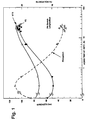
- Figure 2 is an aging curve showing strength and elongation vs. time for the same alloy in the non-cold worked condition.
- the alloys of the present invention contain the elements Al, Cu, Li, Mg, Ag, at least one element selected from Zn, Ge, Sn, Cd, In, Be, Sr, Sc, Y, and Ca, and a grain refiner or combination of grain refiners selected from Zr, Ti, Cr, Mn, B, Nb, V, Hf and TiB2. These elements are present within the following ranges: 1 - 7 Cu, 0.1 - 4 Li, 0.05 - 3 Mg, 0.01 - 2 Ag, 0.01 - 4 X, 0.01 - 2 grain refiner, with the balance Al and incidental impurities, where X represents Zn, Ge, Sn, Cd, In, Be, Sr, Sc, Y, Ca, or a combination thereof.
- Zinc is the most highly preferred alloying addition out of the above listed group of Zn, Ge, Sn, Cd, In, Be, Sr, Sc, Y, and Ca. Therefore, the present disclosure will focus mainly upon alloy compositions comprising the element Zn. However, it is to be understood that use of Ge, Sn, Cd, In, Be, Sr, Sc, Y, and Ca alloying additions is within the scope of the present invention, and that the partial or total substitution of Zn with one or more of these elements is contemplated.
- preferred ranges are from 3.0 to 6.5 Cu, from 0.5 to 2.6 Li, from 0.05 to 2 Zn, from 0.1 to 1.5 Mg, from 0.05 to 1 Ag, from 0.05 to 0.5 grain refiner(s), and the balance Al plus incidental impurities. More preferred ranges are from 3.5 to 5.5 Cu, from 0.8 to 2.0 Li, from 0.2 to 1.5 Zn, from 0.2 to 0.8 Mg, from 0.1 to 0.5 Ag, from 0.08 to 0.2 grain refiner(s), and the balance Al plus incidental impurities.
- Most preferred ranges are from 4.0 to 5.0 Cu, from 1.0 to 1.6 Li, from 0.25 to 0.75 Zn, from 0.3 to 0.5 Mg, from 0.1 to 0.4 Ag, from 0.08 to 0.2 grain refiner(s), and the balance Al plus incidental impurities.
- Preferred grain refiners include Zr and Ti, with the most preferred being Zr, since Zr may also serve as a potent recrystallization inhibitor. If Ge, Sn, Cd, In, Be, Sr, Sc, Y and Ca are used in place of, or in addition to, Zn, the total weight percentage of these elements falls within the above listed broad range of from 0.01 to 4 percent.
- the alloys of the present invention may further comprise a preferred range of from 0.01 to 1.5 percent of at least one of the elements Ge, Sn, Cd, In, Be, Sr, Sc, Y, and Ca. Table I lists compositional ranges for alloys of the present invention.
- Incidental impurities associated with aluminum such as Si and Fe may be present, especially when the alloy has been cast, rolled, forged, extruded, pressed or otherwise worked and then heat treated.
- the use of Cu in relatively high concentrations of 1 - 7 percent, and preferably in amounts greater than 3.0 percent results in increased tensile and yield strengths over conventional Al-Li alloys.
- the use of greater than 3.5 percent Cu is necessary to promote weldability of the alloys, with weldability being extremely good above 4.5 percent Cu. Weldability is defined as the resistance to solidification hot-cracking.
- Cu concentrations above about 3.0 percent are also useful in order to provide sufficient amounts of Cu to form high volume fractions of T1 (Al2CuLi) strengthening precipitates in artificially aged tempers. These precipitates act to increase strength in the alloys of the present invention substantially above the strengths achieved in conventional Al-Li alloys. While Cu concentrations above 3.0 percent are preferred, lower amounts of Cu down to 1 percent may be used, for example, to decrease density.
- Li in the alloys of the present invention permits a significant decrease in density over conventional Al alloys. Also, Li increases strength and improves elastic modulus. Advantageous physical and mechanical properties may be achieved with Li concentrations between 0.1 and 4 percent. Below 0.1 percent, significant reductions in density are not realized, while above about 4 percent, the solubility limit of Li may be exceeded. Tensile strengths are maximized with Li levels between 0.9 and 1.6 percent, with strengths decreasing below and above this range. Peak strengths fall within the range of 1.1 to 1.4 percent. For density limiting applications, higher levels of Li, i.e., 1.8 or 2.0 percent and higher, may be used to decrease density, although lower strengths may be realized at these higher levels.
- High Cu to Li weight percent ratios may be utilized in the alloys of the present invention in order to provide improved properties.
- Cu to Li weight percent ratios of greater than 2.5 or 3.0 may be used in alloys containing greater than 0.8 percent Li to produce high volume fractions of T1 strengthening precipitates in the T8 temper.
- Zn in the alloys of the present invention increases tensile properties significantly. For example, strength and short transverse ductility are increased in some tempers. Also, the presence of Zn may enhance resistance to corrosion.
- Ge, Sn, Cd, In, Be, Sr, Sc, Y, and/or Ca may aid, for example, in the nucleation and refinement of precipitates.
- Mg in the alloys of the present invention enhances nucleation, thereby increasing strength. Also, Mg enhances natural aging response without prior cold work. Tensile strengths of the present alloys may vary depending upon Mg content. Favorable physical and mechanical properties are achieved with Mg concentrations between 0.05 and 3 percent, with peak strengths generally falling within the range of from 0.2 to 0.8 percent.
- the use of Ag in the alloys of the present invention improves weldability and may increase strength to some degree.
- the highest strengths may be achieved in the present alloys with Ag concentrations of between 0.1 and 0.4 percent.
- Alloys I - IX listed above were cast and extruded using the following techniques.
- the elements were induction melted under an inert argon atmosphere and cast into 160 mm (6 1/4 in.) diameter, 23 kg (50 lb) billets.
- the billets were homogenized in order to affect compositional uniformity of the ingot using a two-stage homogenization treatment. In the first stage, the billets were heated for 16 hours at 454°C (850°F) to bring low melting temperature phases into solid solution, and in the second stage they were heated for 8 hours at 504°C (940°F).
- Stage I was carried out below the melting point of any nonequilibrium low-melting temperature phases that form in the as-cast structures, because melting of such phases can produce ingot porosity and/or poor workability.
- Stage II was carried out at the highest practical temperature without melting, to ensure rapid diffusion to homogenize the compositions.
- the billets were scalped and then extruded at a ram speed of 25 mm/s at approximately 370°C (700°F) to form rectangular bars having 10 mm by 102 mm (3/8 inch by 4 inch) cross sections.
- the alloys extruded extremely well with no cracking or surface tearing.
- the rectangular bar extrusions were subsequently solution heat treated at 504°C (940°F) for 1 hour and water quenched.
- segments of the extrusion were stretch straightened approximately 3 percent. This stretch straightening process straightens the extrusions and also introduces cold work. Some of the segments, both with and without cold work, were naturally aged at approximately 20°C (68°F). Other segments were artificially aged, at 160°C (320°F) if cold worked, or at 180°C (356°F) if not cold worked.
- Alloys X - XIV listed above were cast and rolled using the following techniques.
- the elements were induction melted under an inert argon atmosphere and cast to form 30 pound (13.6 Kg) ingots.
- the ingots were homogenized at 499°C (930°F) for 24 hours using a slow heat-up rate of 50°F (28°C) per hour.
- the homogenized ingots were scalped to approximately 3.25 inch (82.6 mm) by 5 inch (127 mm) cross section rolling stock and then hot rolled to nominal 0.5 inch (1.27 mm) thick gauge plate at a temperature range of 482°C (900°F) to 371°C (700°F).
- the rolled plates were solution heat treated at 504°C (940°F) for 1 hour and cold water quenched. Some of the plates were stretched 3 percent and artificially aged at 160°C (320°F) for 24 hours to provide T8 temper plate. Other plates were artificially aged at 177°C (350°F) without stretch to provide T6 temper plate.
- Table IV shows naturally aged tensile properties for Composition II alloy of the present invention. Unless stated otherwise, the tensile properties listed in the present disclosure are taken from the longitudinal direction (L). In some instances, properties in the long transverse direction (LT) are also given and are designated as such.
- the Composition II alloy of the present invention exhibits phenomenal natural aging response.
- the tensile properties of Composition II in the naturally aged condition without prior cold work, T4 temper are even superior to those of alloy 2219 in the artificially aged condition with prior cold work, i.e., in the fully heat treated condition or T81 temper. It is significant that this exceptional natural aging response exists without prior cold work, because it provides a vehicle for increasing the strength of weldments and forgings in which the induction of cold work is not practical.
- the handbook property minima for extrusions of 2219-T81, the current standard space alloy are 44.0 ksi YS, 61.0 ksi UTS and 6 percent elongation.
- the T81 temper is the highest strength standard temper for 2219 extrusions of similar geometry to the Composition II alloy.
- Composition II in the naturally aged tempers also has advantageous properties over alloy 2024 in the high strength T81 temper, one of the leading aircraft alloys, which has 58 ksi YS, 66 ksi UTS and 5 percent elongation handbook minima. Alloy 2024 exhibits a natural aging response, i.e., T42, but it is far less than that of Composition II.
- the superior properties of Composition II over conventional alloys 2219 and 2024 are shown in Table V. It should be emphasized that the naturally aged (T3 and T4) conditions for Composition II are being compared to the optimum high strength T8 tempers for the conventional 2219 and 2024 alloys, as well as to the T4 temper for the alloy 2024.
- the alloys of the present invention attain ultra high strength.
- peak tensile strengths (UTS) of well over 100 ksi with elongations of 5 percent may be obtained in both the T8 and T6 tempers.
- UTS peak tensile strengths
- Rockwell B hardness a measure of alloy hardness that corresponds approximately one-to-one with UTS for these alloys
- stretch amount of cold work
- Figure 2 illustrates the aging response of Composition II alloy in the non-cold worked condition. Ultimate tensile strength, yield strength, and elongation are plotted versus aging time at 180°C. Naturally aged (T4) properties are shown at the left hand side of the graph.
- alloys produced in accordance with the present invention having compositions in the range of from 4.0 to 5.5 Cu, from 0.9 to 1.6 Li, from 0.2 to 1 Zn, from 0.2 to 0.5 Mg, from 0.1 to 0.5 Ag, from 0.05 to 0.5 grain refiner, and the balance Al, possess extremely useful longitudinal strengths and elongations.
- alloys within the above mentioned compositional ranges may display a longitudinal YS range of from 50 to 75 ksi, a longitudinal UTS range of from 65 to 88 ksi, and a longitudinal elongation range of from 8 to 25 percent.
- alloys within this compositional range may display a longitudinal YS range of from 55 to 77 ksi, a longitudinal UTS range of from 67 to 100 ksi, and a longitudinal elongation range of from 8 to 25 percent. Additionally, in the T6 temper, these alloys may display a longitudinal YS range of from 70 to 110 ksi, a longitudinal UTS range of from 80 to 118 ksi, and a longitudinal elongation range of from 1 to 10 percent.
- alloys within the above-noted compositional range may display a YS range of from 70 to 110 ksi, a UTS range of from 80 to 118 ksi, and an elongation range of from 2 to 15 percent.
- T3 and T4 the properties listed above in the naturally aged tempers (T3 and T4) are for technologically practical aging times, i.e., 600 to 1200 hours, and that strengths will increase indefinitely with long term natural aging.
- it may be pdssible to increase the yield strengths and ultimate tensile strengths listed above in the cold worked tempers (T3 and T8) by working at high reduction ratios, i.e., high extrusion ratios.
- the alloys of the present invention may be readily produced by commercial scale production techniques.
- a 10,000 pound (4536 Kg) ingot was cast and rolled using the following procedures.
- An aluminum alloy consisting of 4.3 weight percent Cu, 1.21 weight percent Li, 0.56 weight percent Zn, 0.37 weight percent Mg, 0.37 weight percent Ag, and 0.14 weight percent Zr, the balance being aluminum and impurities was cast into an approximately 10,000 pound (4536 Kg) ingot having a 12 inch (305 mm) thick by 45 inch (1143 mm) wide cross section.
- the ingot was homogenized in a furnace at a temperature of 471°C (880°F) for 8 hours followed by a temperature of 499°C (930°F) for 36 hours and air cooled.
- the ingot was scalped and sawed to 10 inches (254 mm) thick, 40 inches (1016 mm) wide, and 135 inches (3429 mm) long.
- the ingot was then preheated in a furnace for 2 hours at 482°C (900°F) and hot rolled to 0.5 inch (12.7 mm) gauge plate.
- the plate was solution heat treated at 504°C (940°F) for 1.5 hours and immediately cold water quenched.
- the plate was then stretched 6 percent in the rolling direction at room temperature. Stretching was followed by artificial aging at 154°C (310°F) for times of 4 hours and 8 hours.
- Tensile test results and fracture toughness test results by compact tension specimens are listed in Table VII. The mechanical property values given are the averaged values from duplicates.
- processing steps are disclosed for the production of the alloy products of the present invention, these steps may be modified in order to achieve various desired results.
- artificial aging times and/or temperatures may be varied, homogenization times and/or temperatures may be altered, and the amount of cold work employed may be varied.
- the steps including casting, homogenizing, working, heat treating, and aging may be altered, or additional steps may be added, to affect, for example, the physical and mechanical properties of the final products formed. Characteristics such as the type, size and distribution of strengthening precipitates may thus be controlled to some degree depending upon processing techniques.
- grain size, grain aspect ratio, and the amount of recrystallization of the final product may be controlled to some extent.
- aging temperatures and aging times may be altered to increase production rates. Therefore, in addition to the processing techniques taught in the present specification, various modifications may be used in the production of the alloys of the present invention.
- the alloys may also be provided in billet form consolidated from fine particulate.
- the powder or particulate material can be produced by such processes as atomization, mechanical alloying and melt spinning. In such powder processing techniques, it may be possible to increase the level of grain refining and/or alloying elements present within the alloys. For example, levels of Zr may be increased to amounts of 2 or 3 weight percent, or greater.
- the alloys of the present invention may be subjected to rapid solidification techniques including spray forming, atomization, splat cooling, melt spinning, and the like.
- rapid solidification techniques include spray forming, atomization, splat cooling, melt spinning, and the like.
- Suitable spray forming techniques include Osprey processing and liquid dynamic compaction.
- the alloys of the present invention possess properties which make them extremely desirable for welding applications. Their ability to attain high strengths without the necessity of cold work provides advantages in welding operations where the use of cold wdrk is often not practical. Also, the strong natural aging response of the present alloys permits their use in welding applications where artificial aging after the welding operation is not feasible.
- the present alloys are highly resistant to hot cracking that can occur during welding, and may be welded using both conventional fillers and parent metal fillers, or modifications thereof.
- a Composition II plate was welded with an aluminum-base filler wire having the following composition: 5.0 weight percent Cu, 1.3 weight percent Li, 0.4 weight percent Mg, 0.4 weight percent Ag, 0.14 weight percent Zr, 0.1 weight percent Ti, and the balance aluminum.
- a highly constrained one pass variable polarity plasma arc (VPPA) welding was performed at 160 A current and 20 V potential at a travel speed of 5.5 ipm and a wire feed of 50 ipm.
- the composition II alloy was readily welded with no evidence of hot-cracking despite the high restraint imposed.
- the present alloys are suitable for use as welding filler alloys.
- the present alloys may be used as welding filler alloys for welding together aluminum-base alloys, including the alloys taught by the present invention, as well as conventional aluminum-base alloys.
- a welding test was performed using Composition II plate. The test, known as the circular patch test, involves making a circular weld on an alloy plate and measuring crack length in the weldment. This geometry purposely constrains the solidifying weld to a great degree, which may cause solidification hot-cracking.
- the same patch test performed using commercial alloys 2090 and 2091 yielded a crack length of 0.028 inch in a 2090 weldment, and a crack length of 0.64 inch in a 2091 weldment.
- compositions within the following ranges are suitable: from 4.0 to 6.5 weight percent Cu, from 0.5 to 2.6 weight percent Li, from 0.05 to 2 weight percent Zn, from 0.05 to 0.8 weight percent Mg, from 0.05 to 1 weight percent Ag, from 0.01 to 2 weight percent grain refiner selected from Zr, Cr, Mn, Ti, Hf, V, Nb, B, TiB2 and combinations thereof, and the balance aluminum.
- Preferred welding alloy compositions contain from 4.5 to 6 weight percent Cu, from 0.8 to 1.6 weight percent Li, from 0.25 to 0.75 weight percent Zn, from 0.2 to 0.5 weight percent Mg, from 0.1 to 0.4 weight percent Ag, from 0.05 to 0.5 weight percent grain refiner selected from Zr, Cr, Mn, Ti, Hf, V, Nb, B, TiB2 and combinations thereof, and the balance aluminum.
- grain refiner selected from Zr, Cr, Mn, Ti, Hf, V, Nb, B, TiB2 and combinations thereof, and the balance aluminum.
- Zirconium is the most preferred grain refiner.
- Small amounts of additional elements selected from Ge, Sn, Cd, In, Be, Sr, Sc, Y, and Ca may also be added to the above listed welding alloy compositions, for example, to act as nucleation aids. These elements may be added in a total range of from 0.01 to 1.5 percent.
- the alloys of the present invention possess excellent elevated temperature properties, retaining large portions of their strength and useful amounts of elongation at temperatures of 300°F (149°C) and above.
- the alloys of the present invention also possess excellent cryogenic properties. Strengths at cryogenic temperatures are actually increased over the room temperature strengths of the present alloys. In addition, useful amounts of elongation are retained at cryogenic temperatures. Cryogenic temperatures include -320°F (-196°C) and -80°F (-68°C). The excellent cryogenic properties attained with the alloys of the present invention give important implications for space applications where cryogenic alloys are often necessary for fuel and oxidizer tankage.
- High strength aluminum alloys typically have low resistance to various types of corrosion, particularly stress-corrosion cracking (SCC), which has limited the usefulness of many high-tech alloys.
- SCC stress-corrosion cracking
- the alloys of the present invention possess excellent resistance to stress corrosion cracking.
- the present alloys have only minimal susceptibility to exfoliation corrosion.
- a corrosion study is performed on a Composition II alloy. Ten specimens of extruded Composition II alloy in the cold worked, artificially aged temper (5 specimens aged 6 hours at 160°C and 5 specimens aged 16 hours at 160°C), prepared in accordance with ASTM standard G49, are loaded at 70 ksi in the long transverse (LT) direction.
- the specimens are subjected to an alternative immersion test conforming to ASTM standard G44 which involves alternating 50 minute dry exposures with 10 minute wet exposures in a 3.5 percent NaCl solution. All specimens survive the standard 40-day test (ASTM standard G64), indicating an extremely strong resistance to stress corrosion cracking. This is significant because it demonstrates excellent SCC resistance at stress levels above the yield strengths of existing aerospace alloys such as 2024 and 2014.
- compositions XII and XIII of the present invention represent the addition of Zn, Ag and Mg to recently commercialized aluminum-lithium alloy 2090, and that Composition XIV represents the addition of Zn and Ag to commercial alloy 8090.
- Zn and Ag additions may be made to alloys 2091 and CP 276. Accordingly, such additions are considered to be within the scope of the present invention.
Landscapes
- Chemical & Material Sciences (AREA)
- Engineering & Computer Science (AREA)
- Mechanical Engineering (AREA)
- Materials Engineering (AREA)
- Metallurgy (AREA)
- Organic Chemistry (AREA)
- Conductive Materials (AREA)
- Heat Treatment Of Steel (AREA)
- Powder Metallurgy (AREA)
- Laminated Bodies (AREA)
- Extrusion Of Metal (AREA)
- Materials For Medical Uses (AREA)
- Heat Treatment Of Nonferrous Metals Or Alloys (AREA)
Abstract
Claims (19)
- Alliage à base d'aluminium constitué de 1 à 7 % en poids de Cu, de 0,1 à 4 % en poids de Li, de 0,01 à 4 % en poids en tout d'au moins un élément choisi parmi Zn, Ge, Sn, Cd, In, Be, Sr et Ca, de 0,05 à 3 % en poids de Mg, de 0,01 à 2 % en poids d'Ag, de 0,01 à 2 % en poids d'un agent d'affinement du grain choisi parmi Zr, Cr, Mn, Ti, Hf, V, Nb, B, TiB₂ et leurs combinaisons, et éventuellement quand ledit au moins un élément est Zn, de 0,01 à 1,5 % en poids d'un élément choisi parmi Ge, Sn, Cd, In, Be, Sr, Sc, Y, Ca et leurs combinaisons, le reste étant constitué d'aluminium et d'impuretés accidentelles.
- Alliage selon la revendication 1, dans lequel ledit au moins un élément est Zn.
- Alliage selon la revendication 2, dans lequel l'agent d'affinement du grain comprend du Zr.
- Alliage selon la revendication 2, dans lequel le Cu est présent en une quantité de 3,0 à 6,5 % en poids.
- Alliage selon la revendication 2, dans lequel le Cu est présent en une quantité de 3,5 à 5,5 % en poids.
- Alliage selon la revendication 2, dans lequel le Cu est présent en une quantité de 4,0 à 5,0 % en poids.
- Alliage selon la revendication 2, dans lequel le Li est présent en une quantité de 0,8 à 2,0 % en poids.
- Alliage selon la revendication 2, dans lequel le Li est présent en une quantité de 1,0 à 1,6 % en poids.
- Alliage selon la revendication 2, dans lequel le Zn est présent en une quantité de 0,2 à 1,5 % en poids.
- Alliage selon la revendication 2, dans lequel le Zn est présent en une quantité de 0,25 à 0,75 % en poids.
- Alliage selon la revendication 2, dans lequel le Mg est présent en une quantité de 0,2 à 0,8 % en poids.
- Alliage selon la revendication 2, dans lequel le Mg est présent en une quantité de 0,3 à 0,5 % en poids.
- Alliage selon la revendication 2, dans lequel l'Ag est présent en une quantité de 0,1 à 0,5 % en poids.
- Alliage selon la revendication 2, dans lequel l'Ag est présent en une quantité de 0,1 à 0,4 % en poids.
- Alliage selon la revendication 2, dans lequel l'alliage comprend en outre de 0,01 à 1,5 % en poids d'un élément choisi par Ge, Sn, Cd, In, Be, Sr, Sc, Y, Ca et leurs combinaisons.
- Alliage selon la revendication 2, dans lequel le Cu est présent en une quantité de 4,0 à 5,5 % en poids, le Li est présent en une quantité de 0,9 à 1,6 % en poids, le Zn est présent en une quantité de 0,2 à 1 % en poids, le Mg est présent en une quantité de 0,2 à 0,5 % en poids, l'Ag est présent en une quantité de 0,1 à 0,5 % en poids, et l'agent d'affinement des grains est présent en une quantité de 0,05 à 0,5 % en poids, et dans lequel l'alliage est travaillé à froid et soumis à un vieillissement naturel, et dans lequel l'alliage, à l'état de trempe T3, possède une limite conventionnelle d'élasticité comprise entre 345 et 517 MPa (entre 50 et 75 ksi), une tension de rupture comprise entre 448 et 607 MPa (entre 65 et 80 ksi) et un allongement compris entre 8 et 25 %.
- Alliage selon la revendication 2, dans lequel le Cu est présent en une quantité de 4,0 à 5,5 % en poids, le Li est présent en une quantité de 0,9 à 1,6 % en poids, le Zn est présent en une quantité de 0,2 à 1 % en poids, le Mg est présent en une quantité de 0,2 à 0,5 % en poids, l'Ag est présent en une quantité de 0,1 à 0,5 % en poids, et l'agent d'affinement des grains est présent en une quantité de 0,05 à 0,5 % en poids, et dans lequel l'alliage n'est pas travaillé à froid et est soumis à un vieillissement naturel, et dans lequel l'alliage, à l'état de trempe T4, possède une limite conventionnelle d'élasticité comprise entre 379 et 531 MPa (entre 55 et 77 ksi), une tension de rupture comprise entre 462 et 690 MPa (entre 67 et 100 ksi) et un allongement compris entre 8 et 25 %.
- Alliage selon la revendication 2, dans lequel le Cu est présent en une quantité de 4,0 à 5,5 % en poids, le Li est présent en une quantité de 0,9 à 1,6 % en poids, le Zn est présent en une quantité de 0,2 à 1 % en poids, le Mg est présent en une quantité de 0,2 à 0,5 % en poids, l'Ag est présent en une quantité de 0,1 à 0,5 % en poids, et l'agent d'affinement des grains est présent en une quantité de 0,05 à 0,5 % en poids, et dans lequel l'alliage n'est pas travaillé à froid et est soumis à un vieillissement artificiel, et dans lequel l'alliage, à l'état de trempe T6, possède une limite conventionnelle d'élasticité comprise entre 483 et 758 MPa (entre 70 et 110 ksi), une tension de rupture comprise entre 552 et 814 MPa (entre 80 et 118 ksi) et un allongement compris entre 1 et 10 %.
- Alliage selon la revendication 2, dans lequel le Cu est présent en une quantité de 4,0 à 5,5 % en poids, le Li est présent en une quantité de 0,9 à 1,6 % en poids, le Zn est présent en une quantité de 0,2 à 1 % en poids, le Mg est présent en une quantité de 0,2 à 0,5 % en poids, l'Ag est présent en une quantité de 0,1 à 0,5 % en poids, et l'agent d'affinement des grains est présent en une quantité de 0,05 à 0,5 % en poids, et dans lequel l'alliage est travaillé à froid et soumis à un vieillissement artificiel, et dans lequel l'alliage, à l'état de trempe T8, possède une limite conventionnelle d'élasticité comprise entre 483 et 758 MPa (entre 70 et 110 ksi), une tension de rupture comprise entre 552 et 814 MPa (entre 80 et 118 ksi) et un allongement compris entre 2 et 15 %.
Applications Claiming Priority (3)
| Application Number | Priority Date | Filing Date | Title |
|---|---|---|---|
| US07/471,299 US5211910A (en) | 1990-01-26 | 1990-01-26 | Ultra high strength aluminum-base alloys |
| US471299 | 1990-01-26 | ||
| PCT/US1991/000185 WO1991011540A1 (fr) | 1990-01-26 | 1991-01-09 | Alliages a base d'aluminium a resistance extremement elevee |
Publications (2)
| Publication Number | Publication Date |
|---|---|
| EP0512056A1 EP0512056A1 (fr) | 1992-11-11 |
| EP0512056B1 true EP0512056B1 (fr) | 1996-02-28 |
Family
ID=23871065
Family Applications (1)
| Application Number | Title | Priority Date | Filing Date |
|---|---|---|---|
| EP91904116A Expired - Lifetime EP0512056B1 (fr) | 1990-01-26 | 1991-01-09 | Alliages a base d'aluminium a resistance extremement elevee |
Country Status (13)
| Country | Link |
|---|---|
| US (1) | US5211910A (fr) |
| EP (1) | EP0512056B1 (fr) |
| JP (1) | JP3197274B2 (fr) |
| KR (1) | KR100192936B1 (fr) |
| AU (1) | AU7243491A (fr) |
| CA (1) | CA2071555C (fr) |
| DE (1) | DE69117494T2 (fr) |
| ES (1) | ES2084154T3 (fr) |
| IL (1) | IL96809A (fr) |
| NO (1) | NO302040B1 (fr) |
| NZ (1) | NZ236886A (fr) |
| PT (1) | PT96582B (fr) |
| WO (1) | WO1991011540A1 (fr) |
Cited By (2)
| Publication number | Priority date | Publication date | Assignee | Title |
|---|---|---|---|---|
| CN101838763A (zh) * | 2010-03-15 | 2010-09-22 | 江苏大学 | 锶微合金化的高锌2099型铝合金及其制备方法 |
| CN102828085A (zh) * | 2011-06-14 | 2012-12-19 | 湖南创元新材料有限公司 | 一种Nb-Li铝合金及其制备方法 |
Families Citing this family (119)
| Publication number | Priority date | Publication date | Assignee | Title |
|---|---|---|---|---|
| US5455003A (en) * | 1988-08-18 | 1995-10-03 | Martin Marietta Corporation | Al-Cu-Li alloys with improved cryogenic fracture toughness |
| US5512241A (en) * | 1988-08-18 | 1996-04-30 | Martin Marietta Corporation | Al-Cu-Li weld filler alloy, process for the preparation thereof and process for welding therewith |
| US5133931A (en) | 1990-08-28 | 1992-07-28 | Reynolds Metals Company | Lithium aluminum alloy system |
| US5389165A (en) * | 1991-05-14 | 1995-02-14 | Reynolds Metals Company | Low density, high strength Al-Li alloy having high toughness at elevated temperatures |
| US5198045A (en) * | 1991-05-14 | 1993-03-30 | Reynolds Metals Company | Low density high strength al-li alloy |
| US5597529A (en) * | 1994-05-25 | 1997-01-28 | Ashurst Technology Corporation (Ireland Limited) | Aluminum-scandium alloys |
| US5601934A (en) * | 1994-09-01 | 1997-02-11 | Aluminum Company Of America | Memory disk sheet stock and method |
| US5554428A (en) * | 1994-09-01 | 1996-09-10 | Aluminum Company Of America | Memory disk sheet stock and method |
| US5630889A (en) * | 1995-03-22 | 1997-05-20 | Aluminum Company Of America | Vanadium-free aluminum alloy suitable for extruded aerospace products |
| US5652063A (en) * | 1995-03-22 | 1997-07-29 | Aluminum Company Of America | Sheet or plate product made from a substantially vanadium-free aluminum alloy |
| US5665306A (en) * | 1995-03-22 | 1997-09-09 | Aluminum Company Of America | Aerospace structural member made from a substantially vanadium-free aluminum alloy |
| JPH0992641A (ja) * | 1995-09-22 | 1997-04-04 | Mitsubishi Electric Corp | プラズマエッチング装置 |
| US5747135A (en) * | 1995-12-08 | 1998-05-05 | Aluminum Company Of America | Thin film pretreatment for memory disks and associated methods |
| JPH09296245A (ja) * | 1996-04-30 | 1997-11-18 | Kyushu Mitsui Alum Kogyo Kk | 鋳物用アルミニウム合金 |
| GB9804599D0 (en) * | 1998-03-05 | 1998-04-29 | Aeromet International Plc | Cast aluminium-copper alloy |
| US6168067B1 (en) * | 1998-06-23 | 2001-01-02 | Mcdonnell Douglas Corporation | High strength friction stir welding |
| US7438772B2 (en) * | 1998-06-24 | 2008-10-21 | Alcoa Inc. | Aluminum-copper-magnesium alloys having ancillary additions of lithium |
| US6579386B1 (en) * | 1999-03-15 | 2003-06-17 | Lockheed Martin Corporation | Filler wire for aluminum alloys and method of welding |
| FR2792001B1 (fr) * | 1999-04-12 | 2001-05-18 | Pechiney Rhenalu | Procede de fabrication de pieces de forme en alliage d'aluminium type 2024 |
| RU2163940C1 (ru) * | 1999-08-09 | 2001-03-10 | Государственное предприятие "Всероссийский научно-исследовательский институт авиационных материалов" | Сплав на основе алюминия и изделие, выполненное из него |
| US6139653A (en) * | 1999-08-12 | 2000-10-31 | Kaiser Aluminum & Chemical Corporation | Aluminum-magnesium-scandium alloys with zinc and copper |
| US6562154B1 (en) | 2000-06-12 | 2003-05-13 | Aloca Inc. | Aluminum sheet products having improved fatigue crack growth resistance and methods of making same |
| RU2180930C1 (ru) * | 2000-08-01 | 2002-03-27 | Государственное предприятие "Всероссийский научно-исследовательский институт авиационных материалов" | Сплав на основе алюминия и способ изготовления полуфабрикатов из этого сплава |
| EP1240973A1 (fr) * | 2001-03-15 | 2002-09-18 | McCook Metals L.L.C. | Fil d'apport amélioré pour le soudage d'alliages à base d'aluminium |
| US20030010411A1 (en) * | 2001-04-30 | 2003-01-16 | David Mitlin | Al-Cu-Si-Ge alloys |
| US8468047B2 (en) * | 2002-04-29 | 2013-06-18 | SAP Akteiengesellschaft | Appraisal processing |
| GB0225518D0 (en) * | 2002-11-01 | 2002-12-11 | Airbus Uk Ltd | Welding method |
| US7048815B2 (en) * | 2002-11-08 | 2006-05-23 | Ues, Inc. | Method of making a high strength aluminum alloy composition |
| US7060139B2 (en) * | 2002-11-08 | 2006-06-13 | Ues, Inc. | High strength aluminum alloy composition |
| FR2855083B1 (fr) * | 2003-05-20 | 2006-05-26 | Pechiney Rhenalu | Procede de fabrication de pieces en alliage d'aluminium soudees par friction |
| US7229508B2 (en) * | 2003-05-28 | 2007-06-12 | Alcan Rolled Products-Ravenswood, Llc | Al—Cu—Mg—Ag—Mn-alloy for structural applications requiring high strength and high ductility |
| EP1522600B1 (fr) * | 2003-09-26 | 2006-11-15 | Kabushiki Kaisha Kobe Seiko Sho | Alliage d' Aluminium forgé à haute résistance en fatigue |
| JP4821013B2 (ja) * | 2003-09-29 | 2011-11-24 | Dowaメタルテック株式会社 | アルミニウム−セラミックス接合基板およびその製造方法 |
| US7547366B2 (en) * | 2004-07-15 | 2009-06-16 | Alcoa Inc. | 2000 Series alloys with enhanced damage tolerance performance for aerospace applications |
| FR2875153B1 (fr) * | 2004-09-10 | 2008-02-01 | Pechiney Aluminium | Fil d'apport pour souder des alliages d'aluminium |
| US8133331B2 (en) | 2005-02-01 | 2012-03-13 | Surface Treatment Technologies, Inc. | Aluminum-zinc-magnesium-scandium alloys and methods of fabricating same |
| US20060289093A1 (en) * | 2005-05-25 | 2006-12-28 | Howmet Corporation | Al-Zn-Mg-Ag high-strength alloy for aerospace and automotive castings |
| US8157932B2 (en) * | 2005-05-25 | 2012-04-17 | Alcoa Inc. | Al-Zn-Mg-Cu-Sc high strength alloy for aerospace and automotive castings |
| DE602006003656D1 (de) | 2005-06-06 | 2008-12-24 | Alcan Rhenalu | Hochfestes aluminium-kupfer-lithium-blech für flugzeugrümpfe |
| US8083871B2 (en) | 2005-10-28 | 2011-12-27 | Automotive Casting Technology, Inc. | High crashworthiness Al-Si-Mg alloy and methods for producing automotive casting |
| CN101855376B (zh) * | 2007-09-21 | 2013-06-05 | 阿勒里斯铝业科布伦茨有限公司 | 适于航空应用的Al-Cu-Li合金产品 |
| US8118950B2 (en) * | 2007-12-04 | 2012-02-21 | Alcoa Inc. | Aluminum-copper-lithium alloys |
| US7811395B2 (en) * | 2008-04-18 | 2010-10-12 | United Technologies Corporation | High strength L12 aluminum alloys |
| US20090263273A1 (en) * | 2008-04-18 | 2009-10-22 | United Technologies Corporation | High strength L12 aluminum alloys |
| US7875133B2 (en) | 2008-04-18 | 2011-01-25 | United Technologies Corporation | Heat treatable L12 aluminum alloys |
| US7875131B2 (en) * | 2008-04-18 | 2011-01-25 | United Technologies Corporation | L12 strengthened amorphous aluminum alloys |
| US20090260724A1 (en) * | 2008-04-18 | 2009-10-22 | United Technologies Corporation | Heat treatable L12 aluminum alloys |
| US7871477B2 (en) * | 2008-04-18 | 2011-01-18 | United Technologies Corporation | High strength L12 aluminum alloys |
| US8017072B2 (en) * | 2008-04-18 | 2011-09-13 | United Technologies Corporation | Dispersion strengthened L12 aluminum alloys |
| US8409373B2 (en) * | 2008-04-18 | 2013-04-02 | United Technologies Corporation | L12 aluminum alloys with bimodal and trimodal distribution |
| US7879162B2 (en) * | 2008-04-18 | 2011-02-01 | United Technologies Corporation | High strength aluminum alloys with L12 precipitates |
| US8002912B2 (en) * | 2008-04-18 | 2011-08-23 | United Technologies Corporation | High strength L12 aluminum alloys |
| US9138831B2 (en) * | 2008-06-27 | 2015-09-22 | Lincoln Global, Inc. | Addition of rare earth elements to improve the performance of self shielded electrodes |
| DE102008033027B4 (de) * | 2008-07-14 | 2010-06-10 | Technische Universität Bergakademie Freiberg | Verfahren zur Erhöhung von Festigkeit und Verformbarkeit von ausscheidungshärtbaren Werkstoffen |
| US20100089977A1 (en) * | 2008-10-14 | 2010-04-15 | Gm Global Technology Operations, Inc. | Friction stir welding of dissimilar metals |
| US7997472B2 (en) * | 2008-10-14 | 2011-08-16 | GM Global Technology Operations LLC | Friction stir welding using an adhesive, copper, tin and zinc interlayer |
| US20100102049A1 (en) * | 2008-10-24 | 2010-04-29 | Keegan James M | Electrodes having lithium aluminum alloy and methods |
| FR2938553B1 (fr) * | 2008-11-14 | 2010-12-31 | Alcan Rhenalu | Produits en alliage aluminium-cuivre-lithium |
| US20100143177A1 (en) * | 2008-12-09 | 2010-06-10 | United Technologies Corporation | Method for forming high strength aluminum alloys containing L12 intermetallic dispersoids |
| US8778098B2 (en) * | 2008-12-09 | 2014-07-15 | United Technologies Corporation | Method for producing high strength aluminum alloy powder containing L12 intermetallic dispersoids |
| US8778099B2 (en) * | 2008-12-09 | 2014-07-15 | United Technologies Corporation | Conversion process for heat treatable L12 aluminum alloys |
| US8333853B2 (en) * | 2009-01-16 | 2012-12-18 | Alcoa Inc. | Aging of aluminum alloys for improved combination of fatigue performance and strength |
| US20100226817A1 (en) * | 2009-03-05 | 2010-09-09 | United Technologies Corporation | High strength l12 aluminum alloys produced by cryomilling |
| US20100252148A1 (en) * | 2009-04-07 | 2010-10-07 | United Technologies Corporation | Heat treatable l12 aluminum alloys |
| US20100254850A1 (en) * | 2009-04-07 | 2010-10-07 | United Technologies Corporation | Ceracon forging of l12 aluminum alloys |
| US9611522B2 (en) * | 2009-05-06 | 2017-04-04 | United Technologies Corporation | Spray deposition of L12 aluminum alloys |
| US9127334B2 (en) * | 2009-05-07 | 2015-09-08 | United Technologies Corporation | Direct forging and rolling of L12 aluminum alloys for armor applications |
| US20110044844A1 (en) * | 2009-08-19 | 2011-02-24 | United Technologies Corporation | Hot compaction and extrusion of l12 aluminum alloys |
| US8728389B2 (en) * | 2009-09-01 | 2014-05-20 | United Technologies Corporation | Fabrication of L12 aluminum alloy tanks and other vessels by roll forming, spin forming, and friction stir welding |
| US8409496B2 (en) * | 2009-09-14 | 2013-04-02 | United Technologies Corporation | Superplastic forming high strength L12 aluminum alloys |
| US20110064599A1 (en) * | 2009-09-15 | 2011-03-17 | United Technologies Corporation | Direct extrusion of shapes with l12 aluminum alloys |
| CN101805852B (zh) * | 2009-09-18 | 2011-06-29 | 贵州华科铝材料工程技术研究有限公司 | Mo-RE高强耐热铝合金材料及其制备方法 |
| CN101805851B (zh) * | 2009-09-18 | 2011-06-01 | 贵州华科铝材料工程技术研究有限公司 | W-re高强耐热铝合金材料及其制备方法 |
| CN101805853B (zh) * | 2009-09-21 | 2011-08-10 | 贵州华科铝材料工程技术研究有限公司 | 以C变质的Cr-RE高强耐热铝合金材料及其制备方法 |
| CN101805858B (zh) * | 2009-09-23 | 2011-11-09 | 贵州华科铝材料工程技术研究有限公司 | Li-RE高强耐热铝合金材料及其制备方法 |
| CN101805856B (zh) * | 2009-09-23 | 2011-06-29 | 贵州华科铝材料工程技术研究有限公司 | Ni-RE高强耐热铝合金材料及其制备方法 |
| CN101805857B (zh) * | 2009-09-23 | 2011-06-29 | 贵州华科铝材料工程技术研究有限公司 | Be-RE高强耐热铝合金材料及其制备方法 |
| CN101805855B (zh) * | 2009-09-23 | 2011-07-27 | 贵州华科铝材料工程技术研究有限公司 | Co-RE高强耐热铝合金材料及其制备方法 |
| CN101805859B (zh) * | 2009-09-23 | 2011-08-10 | 贵州华科铝材料工程技术研究有限公司 | Nb-RE高强耐热铝合金材料及其制备方法 |
| US9194027B2 (en) * | 2009-10-14 | 2015-11-24 | United Technologies Corporation | Method of forming high strength aluminum alloy parts containing L12 intermetallic dispersoids by ring rolling |
| US20110091346A1 (en) * | 2009-10-16 | 2011-04-21 | United Technologies Corporation | Forging deformation of L12 aluminum alloys |
| US20110091345A1 (en) * | 2009-10-16 | 2011-04-21 | United Technologies Corporation | Method for fabrication of tubes using rolling and extrusion |
| US8409497B2 (en) * | 2009-10-16 | 2013-04-02 | United Technologies Corporation | Hot and cold rolling high strength L12 aluminum alloys |
| CN101838764B (zh) * | 2010-03-29 | 2011-06-22 | 江苏大学 | 钪和锶复合微合金化的高锌2099型铝合金及其制备方法 |
| CA2793885C (fr) | 2010-04-12 | 2016-03-15 | Howmet Aerospace Inc. | Alliages d'aluminium lithium de serie 2xxx a faible differentiel de resistance |
| DE102010032768A1 (de) * | 2010-07-29 | 2012-02-02 | Eads Deutschland Gmbh | Hochtemperaturbelastbarer mit Scandium legierter Aluminium-Werkstoff mit verbesserter Extrudierbarkeit |
| DE102010053274A1 (de) * | 2010-12-02 | 2012-06-21 | Eads Deutschland Gmbh | Verfahren zum Herstellen einer AlScCa-Legierung sowie AlScCa-Legierung |
| FR2969177B1 (fr) * | 2010-12-20 | 2012-12-21 | Alcan Rhenalu | Alliage aluminium cuivre lithium a resistance en compression et tenacite ameliorees |
| CA2827530C (fr) | 2011-02-17 | 2019-12-03 | Arconic Technologies Llc | Alliages d'aluminium-lithium de la serie 2xxx |
| CN102828080A (zh) * | 2011-06-14 | 2012-12-19 | 湖南创元新材料有限公司 | Be-Cr-RE高强耐热铝合金材料 |
| US9011086B2 (en) | 2011-12-07 | 2015-04-21 | Honeywell International Inc. | Treated valve seat |
| US9458528B2 (en) | 2012-05-09 | 2016-10-04 | Alcoa Inc. | 2xxx series aluminum lithium alloys |
| US20140127076A1 (en) * | 2012-11-05 | 2014-05-08 | Alcoa Inc. | 5xxx-lithium aluminum alloys, and methods for producing the same |
| US10384939B2 (en) * | 2014-10-29 | 2019-08-20 | Toshiba Mitsubishi-Electric Industrial Systems Corporation | Ozone generation apparatus |
| CN105328360A (zh) * | 2015-10-29 | 2016-02-17 | 中国航空工业集团公司北京航空材料研究院 | 一种用于Al-Cu-Li系铝锂合金和Al-Cu系铝合金的焊丝 |
| CN105328359A (zh) * | 2015-10-29 | 2016-02-17 | 中国航空工业集团公司北京航空材料研究院 | 一种用于Al-Cu-Li系铝锂合金和Al-Cu系铝合金的焊丝 |
| CN105345308B (zh) * | 2015-10-29 | 2020-01-10 | 中国航发北京航空材料研究院 | 一种用于Al-Cu-Li系铝锂合金和Al-Cu系铝合金的焊丝 |
| CN105364334B (zh) * | 2015-11-25 | 2018-01-23 | 力创(台山)电子科技有限公司 | 一种用于焊接动力锂电池接头的活化乳剂 |
| CN105665957A (zh) * | 2016-01-28 | 2016-06-15 | 东北大学 | 一种含银铝焊丝及其制备方法 |
| CN106048312A (zh) * | 2016-05-31 | 2016-10-26 | 安徽潜山轴承制造有限公司 | 一种耐磨铝基合金轴承及其制备方法 |
| WO2018144568A1 (fr) | 2017-01-31 | 2018-08-09 | Universal Alloy Corporation | Extrusions d'alliage aluminium-cuivre-lithium de faible densité |
| US20180291489A1 (en) * | 2017-04-11 | 2018-10-11 | The Boeing Company | Aluminum alloy with additions of copper, lithium and at least one alkali or rare earth metal, and method of manufacturing the same |
| US20190233921A1 (en) * | 2018-02-01 | 2019-08-01 | Kaiser Aluminum Fabricated Products, Llc | Low Cost, Low Density, Substantially Ag-Free and Zn-Free Aluminum-Lithium Plate Alloy for Aerospace Application |
| JP7621248B2 (ja) * | 2018-11-07 | 2025-01-24 | アーコニック テクノロジーズ エルエルシー | 2xxxアルミニウムリチウム合金 |
| CN110423927A (zh) * | 2019-07-17 | 2019-11-08 | 中南大学 | 一种超高强铝锂合金及其制备方法 |
| CN111112875B (zh) * | 2019-12-31 | 2021-09-28 | 上海交通大学 | 一种含TiB2颗粒的铝合金焊丝及其制备方法 |
| DE102020108781A1 (de) | 2020-03-30 | 2021-09-30 | AM Metals GmbH | Mittels additiver Fertigung verarbeitbare hochfeste Aluminiumlegierungen für Strukturanwendungen |
| CN111500901A (zh) * | 2020-05-29 | 2020-08-07 | 中南大学 | 一种高锂铝锂合金及其制备方法 |
| RU2747180C1 (ru) * | 2020-09-17 | 2021-04-28 | Федеральное государственное бюджетное учреждение науки Самарский федеральный исследовательский центр Российской академии наук (СамНЦ РАН) | ВЫСОКОПРОЧНЫЙ ТЕРМОСТОЙКИЙ МЕЛКОЗЕРНИСТЫЙ СПЛАВ НА ОСНОВЕ СИСТЕМЫ Al-Cu-Mn-Mg-Sc-Nb-Hf И ИЗДЕЛИЕ ИЗ НЕГО |
| CN112626385B (zh) * | 2020-11-04 | 2022-08-16 | 佛山科学技术学院 | 一种高塑性快速时效响应的铝合金及其制备方法和应用 |
| CN112518170A (zh) * | 2020-12-10 | 2021-03-19 | 首都航天机械有限公司 | 一种增材制造用Al-Cu合金丝及其制备方法和应用 |
| US12203159B2 (en) | 2021-04-23 | 2025-01-21 | Universal Alloy Corporation | Method for producing aluminum-copper alloys containing scandium |
| CN113444911B (zh) * | 2021-06-23 | 2022-11-08 | 上海大学 | 一种高强高韧Al-Mg-(Al-Ti-Nb-B)合金及其制备方法 |
| CN114083173A (zh) * | 2021-11-17 | 2022-02-25 | 燕山大学 | 一种增材制造用的铝合金丝材及其应用 |
| CN115709350B (zh) * | 2022-09-26 | 2024-11-05 | 航天材料及工艺研究所 | 一种适合于Al-Li-Cu-Mg-Zn合金焊接的焊丝及其制备方法 |
| CN115627376B (zh) * | 2022-12-07 | 2023-04-11 | 北京航空航天大学 | 一种铸造铝硅合金用Al-Nb-TiB2细化剂的制备方法 |
| CN116121608B (zh) * | 2023-02-22 | 2023-09-05 | 北京航空航天大学 | 一种高强铸造铝锂合金及其制备方法 |
| CN119410977B (zh) * | 2024-10-24 | 2025-12-05 | 上海船舶动力创新中心有限公司 | TiB2/Al-Cu合金、其制备方法及增材制造用途 |
| CN120350276B (zh) * | 2025-06-20 | 2025-10-10 | 天目山实验室 | 一种Sc/Zr微合金化调控TiB2颗粒增强铝基复合材料及其制备方法 |
Family Cites Families (37)
| Publication number | Priority date | Publication date | Assignee | Title |
|---|---|---|---|---|
| US2381219A (en) * | 1942-10-12 | 1945-08-07 | Aluminum Co Of America | Aluminum alloy |
| US2915391A (en) * | 1958-01-13 | 1959-12-01 | Aluminum Co Of America | Aluminum base alloy |
| US3306717A (en) * | 1964-02-01 | 1967-02-28 | Svenska Metallverken Ab | Filler metal for welding aluminumbased alloys |
| DE1255456B (de) * | 1964-02-01 | 1967-11-30 | Svenska Metallverken Ab | Schweisszusatzwerkstoff zum korrosionsfesten Schmelzschweissen von Legierungen auf Aluminium-Basis, insbesondere AlZnMg-Legierungen |
| US3346370A (en) * | 1965-05-20 | 1967-10-10 | Olin Mathieson | Aluminum base alloy |
| GB1172736A (en) * | 1967-02-27 | 1969-12-03 | Iosif Naumovich Fridlyander | Aluminium-Base Alloy |
| SE398130B (sv) * | 1971-07-20 | 1977-12-05 | British Aluminium Co Ltd | Superplastiskt bearbetat alster, samt sett att framstella detta |
| US3925067A (en) * | 1974-11-04 | 1975-12-09 | Alusuisse | High strength aluminum base casting alloys possessing improved machinability |
| EP0088511B1 (fr) * | 1982-02-26 | 1986-09-17 | Secretary of State for Defence in Her Britannic Majesty's Gov. of the United Kingdom of Great Britain and Northern Ireland | Alliages d'aluminium |
| DE3365549D1 (en) * | 1982-03-31 | 1986-10-02 | Alcan Int Ltd | Heat treatment of aluminium alloys |
| AU573542B2 (en) * | 1982-10-05 | 1988-06-16 | Secretary Of State For Defence In Her Britannic Majesty's Government Of The United Kingdom Of Great Britain And Northern Ireland, The | Aluminium base-lithium, magnesium, zinc alloy |
| JPS59118848A (ja) * | 1982-12-27 | 1984-07-09 | Sumitomo Light Metal Ind Ltd | 電気抵抗を高めた構造用アルミニウム合金 |
| EP0124286B1 (fr) * | 1983-03-31 | 1986-08-27 | Alcan International Limited | Alliages d'aluminium |
| GB8327286D0 (en) * | 1983-10-12 | 1983-11-16 | Alcan Int Ltd | Aluminium alloys |
| US4758286A (en) * | 1983-11-24 | 1988-07-19 | Cegedur Societe De Transformation De L'aluminium Pechiney | Heat treated and aged Al-base alloys containing lithium, magnesium and copper and process |
| DE3483607D1 (de) * | 1983-12-30 | 1990-12-20 | Boeing Co | Alterung bei relativ niedrigen temperaturen von lithium enthaltenden aluminiumlegierungen. |
| US4603029A (en) * | 1983-12-30 | 1986-07-29 | The Boeing Company | Aluminum-lithium alloy |
| US4735774A (en) * | 1983-12-30 | 1988-04-05 | The Boeing Company | Aluminum-lithium alloy (4) |
| US4661172A (en) * | 1984-02-29 | 1987-04-28 | Allied Corporation | Low density aluminum alloys and method |
| FR2561260B1 (fr) * | 1984-03-15 | 1992-07-17 | Cegedur | Alliages al-cu-li-mg a tres haute resistance mecanique specifique |
| FR2561261B1 (fr) * | 1984-03-15 | 1992-07-24 | Cegedur | Alliages a base d'al contenant du lithium, du cuivre et du magnesium |
| FR2561264B1 (fr) * | 1984-03-15 | 1986-06-27 | Cegedur | Procede d'obtention de produits en alliages al-li-mg-cu a ductilite et isotropie elevees |
| US4806174A (en) * | 1984-03-29 | 1989-02-21 | Aluminum Company Of America | Aluminum-lithium alloys and method of making the same |
| US4797165A (en) * | 1984-03-29 | 1989-01-10 | Aluminum Company Of America | Aluminum-lithium alloys having improved corrosion resistance and method |
| US4648913A (en) * | 1984-03-29 | 1987-03-10 | Aluminum Company Of America | Aluminum-lithium alloys and method |
| JPS60238439A (ja) * | 1984-05-11 | 1985-11-27 | Kobe Steel Ltd | 展伸用アルミニウム合金およびその製造方法 |
| JPS61133358A (ja) * | 1984-11-30 | 1986-06-20 | Inoue Japax Res Inc | 高強度、高張力アルミニウム合金 |
| JPS61231145A (ja) * | 1985-04-03 | 1986-10-15 | Furukawa Alum Co Ltd | 低密度高力アルミニウム合金の製造法 |
| CH668269A5 (de) * | 1985-10-31 | 1988-12-15 | Bbc Brown Boveri & Cie | Aluminium-knetlegierung des typs al/cu/mg mit hoher festigkeit im temperaturbereich zwischen 0 und 250 c. |
| US4816087A (en) * | 1985-10-31 | 1989-03-28 | Aluminum Company Of America | Process for producing duplex mode recrystallized high strength aluminum-lithium alloy products with high fracture toughness and method of making the same |
| ES2014248B3 (es) * | 1985-11-28 | 1990-07-01 | Pechiney Rhenalu | Procedimiento de desensibilizacion a la corrosion exfoliante con obtencion simultanea de una elevada resistencia mecanica y buena resistencia frente a los deterioros de aleaciones de aluminio que contienen litio. |
| US4832910A (en) * | 1985-12-23 | 1989-05-23 | Aluminum Company Of America | Aluminum-lithium alloys |
| US4795502A (en) * | 1986-11-04 | 1989-01-03 | Aluminum Company Of America | Aluminum-lithium alloy products and method of making the same |
| EP0377640B1 (fr) * | 1987-08-10 | 1993-10-13 | Martin Marietta Corporation | Alliages d'aluminium-lithium soudables a resistance ultra elevee |
| CA1338007C (fr) * | 1988-01-28 | 1996-01-30 | Roberto J. Rioja | Alliages d'aluminium-lithium |
| US4848647A (en) * | 1988-03-24 | 1989-07-18 | Aluminum Company Of America | Aluminum base copper-lithium-magnesium welding alloy for welding aluminum lithium alloys |
| US5076859A (en) * | 1989-12-26 | 1991-12-31 | Aluminum Company Of America | Heat treatment of aluminum-lithium alloys |
-
1990
- 1990-01-26 US US07/471,299 patent/US5211910A/en not_active Expired - Lifetime
- 1990-12-27 IL IL9680990A patent/IL96809A/en not_active IP Right Cessation
-
1991
- 1991-01-09 EP EP91904116A patent/EP0512056B1/fr not_active Expired - Lifetime
- 1991-01-09 DE DE69117494T patent/DE69117494T2/de not_active Expired - Lifetime
- 1991-01-09 KR KR1019920701750A patent/KR100192936B1/ko not_active Expired - Lifetime
- 1991-01-09 CA CA002071555A patent/CA2071555C/fr not_active Expired - Lifetime
- 1991-01-09 AU AU72434/91A patent/AU7243491A/en not_active Abandoned
- 1991-01-09 JP JP50437291A patent/JP3197274B2/ja not_active Expired - Lifetime
- 1991-01-09 WO PCT/US1991/000185 patent/WO1991011540A1/fr not_active Ceased
- 1991-01-09 ES ES91904116T patent/ES2084154T3/es not_active Expired - Lifetime
- 1991-01-24 NZ NZ236886A patent/NZ236886A/xx unknown
- 1991-01-25 PT PT96582A patent/PT96582B/pt not_active IP Right Cessation
-
1992
- 1992-07-20 NO NO922877A patent/NO302040B1/no not_active IP Right Cessation
Non-Patent Citations (1)
| Title |
|---|
| Metals, (Warendale, US) S.F. Baumann et al.: "The effect of ternary additions on the 8'/x misfit and the 8' solvus line in Al-Li alloys", see pages 17-29 * |
Cited By (3)
| Publication number | Priority date | Publication date | Assignee | Title |
|---|---|---|---|---|
| CN101838763A (zh) * | 2010-03-15 | 2010-09-22 | 江苏大学 | 锶微合金化的高锌2099型铝合金及其制备方法 |
| CN101838763B (zh) * | 2010-03-15 | 2011-06-01 | 江苏大学 | 锶微合金化的高锌2099型铝合金及其制备方法 |
| CN102828085A (zh) * | 2011-06-14 | 2012-12-19 | 湖南创元新材料有限公司 | 一种Nb-Li铝合金及其制备方法 |
Also Published As
| Publication number | Publication date |
|---|---|
| JPH05503737A (ja) | 1993-06-17 |
| DE69117494D1 (de) | 1996-04-04 |
| CA2071555A1 (fr) | 1991-07-27 |
| IL96809A0 (en) | 1991-09-16 |
| NO922877L (no) | 1992-07-20 |
| EP0512056A1 (fr) | 1992-11-11 |
| KR920703864A (ko) | 1992-12-18 |
| IL96809A (en) | 1995-06-29 |
| ES2084154T3 (es) | 1996-05-01 |
| KR100192936B1 (ko) | 1999-06-15 |
| US5211910A (en) | 1993-05-18 |
| CA2071555C (fr) | 2002-06-25 |
| AU7243491A (en) | 1991-08-21 |
| NO302040B1 (no) | 1998-01-12 |
| WO1991011540A1 (fr) | 1991-08-08 |
| JP3197274B2 (ja) | 2001-08-13 |
| DE69117494T2 (de) | 1996-07-11 |
| PT96582B (pt) | 1998-08-31 |
| NO922877D0 (no) | 1992-07-20 |
| NZ236886A (en) | 1993-04-28 |
| PT96582A (pt) | 1991-10-15 |
Similar Documents
| Publication | Publication Date | Title |
|---|---|---|
| US5211910A (en) | Ultra high strength aluminum-base alloys | |
| US5462712A (en) | High strength Al-Cu-Li-Zn-Mg alloys | |
| EP0432184B1 (fr) | ALLIAGES Al-Cu-Li-Mg A RESISTANCE EXTREMEMENT ELEVEE | |
| KR100502776B1 (ko) | 브레이징 용도 및 용접 구조체용 고강도 알루미늄-마그네슘-아연-실리콘 합금, 그 용접 구조체와 브레이징 구조체 및 그 사용방법 | |
| EP0642598B1 (fr) | Alliage al-li de faible densite a haute resistance presentant une tenacite elevee a temperatures elevees | |
| US5431876A (en) | Aluminum-lithium alloys | |
| WO1995004837A1 (fr) | Alliages de al-cu-li presentant une resistance amelioree a la fracture cryogenique | |
| JPH11507102A (ja) | アルミニウム―マグネシウム合金の板または押出し加工品 | |
| EP0546103A1 (fr) | Systeme d'alliage de lithium et d'aluminium ameliore. | |
| WO1995028250A1 (fr) | Alliage d'apport de soudure al-cu-li, procede de preparation et procede de soudure | |
| JP2892666B2 (ja) | 超高強度溶接性アルミニウム‐リチウム合金 | |
| EP1078109B1 (fr) | Alliage d'aluminium et de magnesium extremement resistant pouvant etre fa onne et mis en application dans des structures soudees | |
| JP2000144293A (ja) | Al−Mg−Si系合金押出形材からなる曲げ加工及びアーク溶接用自動車フレーム構造材 | |
| JPH06212336A (ja) | 強度および曲げ加工性のすぐれたAl合金押出加工材 | |
| IL108872A (en) | Ultra-high strength al-cu-li-mg alloys | |
| JPH0689439B2 (ja) | 構造用Al―Cu―Mg―Li系アルミニウム合金材料の製造方法 | |
| NO310427B1 (no) | Al-Cu-Li-Mg-legeringer av ultrahöy fasthet | |
| JPH0941063A (ja) | 溶接構造用Al−Mg−Si系合金押出形材 | |
| JPH0514021B2 (fr) |
Legal Events
| Date | Code | Title | Description |
|---|---|---|---|
| PUAI | Public reference made under article 153(3) epc to a published international application that has entered the european phase |
Free format text: ORIGINAL CODE: 0009012 |
|
| 17P | Request for examination filed |
Effective date: 19920808 |
|
| AK | Designated contracting states |
Kind code of ref document: A1 Designated state(s): BE CH DE DK ES FR GB IT LI LU NL SE |
|
| 17Q | First examination report despatched |
Effective date: 19940628 |
|
| GRAA | (expected) grant |
Free format text: ORIGINAL CODE: 0009210 |
|
| AK | Designated contracting states |
Kind code of ref document: B1 Designated state(s): BE CH DE DK ES FR GB IT LI LU NL SE |
|
| PG25 | Lapsed in a contracting state [announced via postgrant information from national office to epo] |
Ref country code: DK Effective date: 19960228 |
|
| REG | Reference to a national code |
Ref country code: CH Ref legal event code: NV Representative=s name: MICHELI & CIE INGENIEURS-CONSEILS |
|
| REF | Corresponds to: |
Ref document number: 69117494 Country of ref document: DE Date of ref document: 19960404 |
|
| ET | Fr: translation filed | ||
| REG | Reference to a national code |
Ref country code: ES Ref legal event code: FG2A Ref document number: 2084154 Country of ref document: ES Kind code of ref document: T3 |
|
| ITF | It: translation for a ep patent filed | ||
| PLBE | No opposition filed within time limit |
Free format text: ORIGINAL CODE: 0009261 |
|
| STAA | Information on the status of an ep patent application or granted ep patent |
Free format text: STATUS: NO OPPOSITION FILED WITHIN TIME LIMIT |
|
| 26N | No opposition filed | ||
| REG | Reference to a national code |
Ref country code: GB Ref legal event code: IF02 |
|
| PGFP | Annual fee paid to national office [announced via postgrant information from national office to epo] |
Ref country code: LU Payment date: 20100203 Year of fee payment: 20 Ref country code: ES Payment date: 20100126 Year of fee payment: 20 Ref country code: CH Payment date: 20100125 Year of fee payment: 20 |
|
| PGFP | Annual fee paid to national office [announced via postgrant information from national office to epo] |
Ref country code: FR Payment date: 20100205 Year of fee payment: 20 Ref country code: IT Payment date: 20100127 Year of fee payment: 20 |
|
| PGFP | Annual fee paid to national office [announced via postgrant information from national office to epo] |
Ref country code: BE Payment date: 20100121 Year of fee payment: 20 Ref country code: GB Payment date: 20100125 Year of fee payment: 20 Ref country code: DE Payment date: 20100127 Year of fee payment: 20 |
|
| PGFP | Annual fee paid to national office [announced via postgrant information from national office to epo] |
Ref country code: NL Payment date: 20100124 Year of fee payment: 20 |
|
| PGFP | Annual fee paid to national office [announced via postgrant information from national office to epo] |
Ref country code: SE Payment date: 20100127 Year of fee payment: 20 |
|
| REG | Reference to a national code |
Ref country code: CH Ref legal event code: PL |
|
| REG | Reference to a national code |
Ref country code: NL Ref legal event code: V4 Effective date: 20110109 |
|
| BE20 | Be: patent expired |
Owner name: *MARTIN MARIETTA CORP. Effective date: 20110109 |
|
| REG | Reference to a national code |
Ref country code: GB Ref legal event code: PE20 Expiry date: 20110108 |
|
| PG25 | Lapsed in a contracting state [announced via postgrant information from national office to epo] |
Ref country code: NL Free format text: LAPSE BECAUSE OF EXPIRATION OF PROTECTION Effective date: 20110109 |
|
| PG25 | Lapsed in a contracting state [announced via postgrant information from national office to epo] |
Ref country code: GB Free format text: LAPSE BECAUSE OF EXPIRATION OF PROTECTION Effective date: 20110108 |
|
| PG25 | Lapsed in a contracting state [announced via postgrant information from national office to epo] |
Ref country code: DE Free format text: LAPSE BECAUSE OF EXPIRATION OF PROTECTION Effective date: 20110109 |
|
| REG | Reference to a national code |
Ref country code: ES Ref legal event code: FD2A Effective date: 20130801 |
|
| PG25 | Lapsed in a contracting state [announced via postgrant information from national office to epo] |
Ref country code: ES Free format text: LAPSE BECAUSE OF EXPIRATION OF PROTECTION Effective date: 20110110 |