EP0512856A2 - Système d'arme - Google Patents
Système d'arme Download PDFInfo
- Publication number
- EP0512856A2 EP0512856A2 EP92304165A EP92304165A EP0512856A2 EP 0512856 A2 EP0512856 A2 EP 0512856A2 EP 92304165 A EP92304165 A EP 92304165A EP 92304165 A EP92304165 A EP 92304165A EP 0512856 A2 EP0512856 A2 EP 0512856A2
- Authority
- EP
- European Patent Office
- Prior art keywords
- muzzle velocity
- aiming system
- weapon
- neural network
- muzzle
- Prior art date
- Legal status (The legal status is an assumption and is not a legal conclusion. Google has not performed a legal analysis and makes no representation as to the accuracy of the status listed.)
- Granted
Links
- 238000005259 measurement Methods 0.000 claims abstract description 57
- 238000000034 method Methods 0.000 claims abstract description 51
- 238000013528 artificial neural network Methods 0.000 claims abstract description 29
- 230000003044 adaptive effect Effects 0.000 claims abstract description 15
- 238000010304 firing Methods 0.000 claims description 48
- 238000012937 correction Methods 0.000 claims description 13
- 230000007613 environmental effect Effects 0.000 claims description 7
- 238000004422 calculation algorithm Methods 0.000 claims description 6
- 230000000306 recurrent effect Effects 0.000 claims description 5
- 230000000694 effects Effects 0.000 description 42
- 239000003380 propellant Substances 0.000 description 10
- 230000008859 change Effects 0.000 description 9
- 230000008569 process Effects 0.000 description 9
- 230000001537 neural effect Effects 0.000 description 8
- 230000006399 behavior Effects 0.000 description 6
- 238000004458 analytical method Methods 0.000 description 5
- 238000004364 calculation method Methods 0.000 description 5
- 230000006870 function Effects 0.000 description 5
- 230000000717 retained effect Effects 0.000 description 5
- 230000008901 benefit Effects 0.000 description 4
- 238000013459 approach Methods 0.000 description 3
- 230000001419 dependent effect Effects 0.000 description 3
- 210000002569 neuron Anatomy 0.000 description 3
- 230000002688 persistence Effects 0.000 description 3
- 239000006185 dispersion Substances 0.000 description 2
- 238000009472 formulation Methods 0.000 description 2
- 230000014509 gene expression Effects 0.000 description 2
- 238000004519 manufacturing process Methods 0.000 description 2
- 239000000203 mixture Substances 0.000 description 2
- 238000012549 training Methods 0.000 description 2
- 102100028043 Fibroblast growth factor 3 Human genes 0.000 description 1
- 102100024061 Integrator complex subunit 1 Human genes 0.000 description 1
- 101710092857 Integrator complex subunit 1 Proteins 0.000 description 1
- 108050002021 Integrator complex subunit 2 Proteins 0.000 description 1
- 210000004556 brain Anatomy 0.000 description 1
- 230000002301 combined effect Effects 0.000 description 1
- 238000004590 computer program Methods 0.000 description 1
- 238000007405 data analysis Methods 0.000 description 1
- 238000009795 derivation Methods 0.000 description 1
- 238000001514 detection method Methods 0.000 description 1
- 238000010586 diagram Methods 0.000 description 1
- 238000006073 displacement reaction Methods 0.000 description 1
- 238000009826 distribution Methods 0.000 description 1
- 230000002452 interceptive effect Effects 0.000 description 1
- 230000007774 longterm Effects 0.000 description 1
- 238000012423 maintenance Methods 0.000 description 1
- 230000014759 maintenance of location Effects 0.000 description 1
- 230000007246 mechanism Effects 0.000 description 1
- 230000005055 memory storage Effects 0.000 description 1
- 230000003287 optical effect Effects 0.000 description 1
- 230000002085 persistent effect Effects 0.000 description 1
- 238000012545 processing Methods 0.000 description 1
- 238000005295 random walk Methods 0.000 description 1
- 238000003860 storage Methods 0.000 description 1
- 230000036962 time dependent Effects 0.000 description 1
Images


Classifications
-
- F—MECHANICAL ENGINEERING; LIGHTING; HEATING; WEAPONS; BLASTING
- F41—WEAPONS
- F41G—WEAPON SIGHTS; AIMING
- F41G3/00—Aiming or laying means
- F41G3/12—Aiming or laying means with means for compensating for muzzle velocity or powder temperature with means for compensating for gun vibrations
-
- G—PHYSICS
- G01—MEASURING; TESTING
- G01S—RADIO DIRECTION-FINDING; RADIO NAVIGATION; DETERMINING DISTANCE OR VELOCITY BY USE OF RADIO WAVES; LOCATING OR PRESENCE-DETECTING BY USE OF THE REFLECTION OR RERADIATION OF RADIO WAVES; ANALOGOUS ARRANGEMENTS USING OTHER WAVES
- G01S13/00—Systems using the reflection or reradiation of radio waves, e.g. radar systems; Analogous systems using reflection or reradiation of waves whose nature or wavelength is irrelevant or unspecified
- G01S13/02—Systems using reflection of radio waves, e.g. primary radar systems; Analogous systems
- G01S13/50—Systems of measurement based on relative movement of target
- G01S13/58—Velocity or trajectory determination systems; Sense-of-movement determination systems
Definitions
- the present invention relates to improvements in weapons systems and in particular, to devices and methods for predicting parameters useful for determining the aim of projectiles. It is especially, although not exclusively, suited to applications concerning the aiming of a shell fired from a gun.
- the invention extends to prediction and aiming methods and devices per se and to weapons systems incorporating such devices.
- One important aspect of the invention entails prediction of muzzle velocity.
- the aiming system is integrated with the weapon itself, most preferably directly co-operating with the weapon's gun (barrel) laying system.
- the first aspect of the present invention also includes a method of determining an elevation setting for an indirect fire weapon, the method comprising firing the weapon and measuring the resultant muzzle velocity, and using the result of the measurement to make a prediction and thus determine a new elevation setting for the weapon.
- the predictor means utilizes previous measured muzzle velocities to predict new muzzle velocity under the conditions for the next firing and uses the predicted muzzle velocity to determine the elevation setting.
- prediction of other parameters useful in determining elevation is also within the ambit of the present invention.
- the muzzle velocity measuring device may for example be a Doppler radar device attached to the barrel of the weapon for measuring the velocity of a projectile as it leaves the barrel.
- an interface is also provided between the predictor means and the gun laying system used for setting the barrel, so that the quadrant elevation can be re-set automatically according to the new muzzle velocity predicted by the predictor means.
- the predictor may predict a new muzzle velocity based on the measured muzzle velocities from previous firings, it is also responsive to initial values to enable the first firing to be effected with reasonable accuracy.
- the electronic computer should consist of: a memory for storing program, parameters and data; one or more input ports for receiving the necessary inputs; and one or more output ports for communicating the predicted muzzle velocities to the Gun Laying System and, optionally to a display showing information to an operator.
- the prediction means and method utilizes an adaptive empirical prediction method (AEPM), that is a method which is capable of 'learning' from a comparison of its prediction and the subsequent-real life result and adapting the way in which it makes the next prediction accordingly.
- AEPM adaptive empirical prediction method
- the AEPM is used to estimate the various effects which influence muzzle velocity, in order to derive an improved RMV for input to the gun laying system. This is achieved by estimating the primary errors present in RMV calculations, ie the difference between the nominal (calibrated and corrected) RMV and the true muzzle velocity.
- the AEPM combines measurements taken at each firing to estimate the major errors present in the nominal estimate of RMV.
- the analysis of the available measurements permits the following major errors to be estimated separately.
- the following errors are separable:- Barrel Effect. This is a long term effect, particular to an individual barrel, which persists from series to series. Occasion to Occasion Effect. This effect persists for the duration of an individual firing series. Within Series Effect. This is a short term effect which is significant only for the early rounds of a series.
- Seating Depth Effect This is an effect due to the variation in muzzle velocity caused by variation in the Seating Depth of a shell (also called ramming depth).
- a second aspect of the present invention comprises a device for predicting a future muzzle velocity of an indirect fire weapon, the device comprising means responsive to a measurement of muzzle velocity and adapted to implement an adaptive empirical prediction method to predict the future muzzle velocity.
- the second aspect of the invention also includes a method of predicting a future muzzle velocity of an indirect fire weapon, the method comprising measuring a muzzle velocity and using an adaptive empirical prediction method to predict the future muzzle velocity.
- the device includes means responsive to (means for inputting) relevant environmental, projectile and other calibration data.
- appropriate means utilize future muzzle velocity to determine an elevation setting for the weapon.
- the AEPM is implemented as a Kalman Filter, most preferably in combination with a first round prediction algorithm (FRPA), or it is implemented as a neural network, which incorporates the FRPA.
- FRPA first round prediction algorithm
- the FRPA specifically estimates the combination of Barrel Effect and Within Series Effect for the first round of a series.
- the AEPM uses at least the following measurements:- Time. This may be 'time now' or time since the last firing of the gun. It is used to estimate 'cold barrel' in the absence of barrel temperature and to set up time dependent parameters.
- Projectile Mass This is the mass of the projectile to be fired. The mass of the projectile may be implied from its type (see below) in which case the device is set appropriately to a nominal value before firing commences and the data need not be entered again until projectiles with a different mass are used. It is used to compute the RMV. Projectile Type. Projectiles of different manufacture or configuration can give rise to quite different muzzle velocities, even for projectiles which have the same mass.
- the projectile type is input to the device at least whenever the type of projectile being fired is different to the type of projectile previously fired.
- each type of projectile may have a different nominal muzzle velocity. It is used in a similar way to charge identifier (see below).
- Charge Identifier is a means of determining how much propellant (and of which type) is being used to fire the projectile from the gun.
- the charge identifier is input to the device at least whenever the charge is different to the charge previously fired. It is used to identify the start of a series, to select charge dependent parameters within the Kalman Filter and as input to the FRPA. It is also used to calculate RMV. Previous Charge Temperature.
- the charge temperature is the temperature of the propellant used to fire the projectile from the gun.
- the charge temperature is input to the device at least whenever there is a significant change in the temperature of the propellant.
- Charge temperature is used to calculate the RMV.
- Muzzle Velocity, MV The muzzle velocity is input to the device immediately after each projectile firing. The muzzle velocity is measured and calculated by an external device such as a muzzle velocity measuring radar. The difference between previous Muzzle Velocity and the nominal muzzle velocity is used as a measurement of the combined effects defined above.
- Barrel Wear A measurement of the barrel wear (change in internal diameter) may be input to the device whenever such data becomes available. It is used as a measure of barrel effect.
- Shell Seating Depth The depth of seating of the shell (also called ramming depth) may be input to the device, if such data is available. It is used to remove some of the errors particular to an individual round which are not estimated by the model of Within Series Effect.
- Barrel Temperature The temperature of the barrel may be input to the device, if such data is available. It is used to detect 'cold barrel' and as a measurement of the Occasion to Occasion effect. Propellant Lot Identifier.
- EFC Effective Full Charge
- the EFC value for a charge is a measure of its contribution to barrel wear.
- the EFC value may be input to the device for each charge used. It is used as a measurement of Barrel Effect.
- Initialisation Parameters These are used for setting up the Kalman Filter for each gun, each charge and each projectile type to be used. They define the stochastic behaviour of the measurements and of the effects. These parameters must be determined for each new situation through a calibration procedure.
- Kalman filter was first developed during the 1960's.
- a Kalman filter contains a dynamic model of system errors, characterised as a set of first order linear differential equations.
- the Kalman filter comprises equations in which the variables (state-variables) correspond to respective error sources and the equations express the dynamic relationship between these error sources. Weighting factors are applied to take account of the relative contributions of the errors.
- the weighting factors are optimised at values depending on the calculated simultaneous minimum variance in the distributions of the errors.
- the filter constantly reassesses the values of the state-variables as it receives new measured values, simultaneously taking all past measurements into account. Therefore, the Kalman filter is able to predict a value of one or more chosen parameters based on a set of state-variables which are updated recursively from the respective inputs.
- the FRPA Whilst it is possible to initialise the prediction by the Kalman filter of the muzzle velocity for a first round, eg. using firing tables, it is much preferred to use a first round prediction algorithm.
- the FRPA utilises a weighted average of previous first round errors for similar charge/projectile combinations.
- the present invention may use a neural network (sometimes abbreviated to neural net), in particular, a recurrent multi-layer neural network.
- a neural net can be regarded either as a 'second order' Kalman Filter or as a separate entitity in its own right.
- a neural network is essentially an electronic or software equivalent of the network of neurons in the human brain. It consists of 'artificial neurons' which receive various inputs and apply weighting factors to each before combining them into a function to produce a required output result.
- a recurrent multi-layer neural network consists of at least an input layer and an output layer of artificial neurons, separated by hidden layers. The neural network compares errors and uses these to continuously adjust the weighting factors and/or the operative functions to minimise the errors and optimise the result. Therefore, unlike the Kalman Filter, it 'decides' for itself which inputs to use and what significance to attach to them and it continuously improves this model based on result.
- the theory and implementation of neural nets are well documented, for example in 'Neural Computing: An Introduction', R. Beale and T. Jackson, Adam Hilger 1990.
- the neural net does not require initialisation.
- the neural net receives all available inputs and through its internal 'learning process', applies appropriate weighting factors so that it takes as much or as little (including zero) account of each to find an optimum estimate of the parameter to be predicted, in the present case muzzle velocity.
- the neural net then computes an estimate of the correction to be applied to the nominal muzzle velocity. Like the Kalman Filter, the neural net continually updates the relative weighting it allocates to each variable, based on a comparison of its prediction of muzzle velocity and the subsequently measured real-time muzzle velocities.
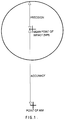
- a weapons system 1 comprises a gun barrel 3 on which is mounted a Doppler radar muzzle velocity detection device 5.
- the elevation ⁇ of the barrel is set by the gun laying system 7.
- Electronic circuitry includes means 9 for making an initial RMV calculation based on initial calibration values and projectile data.
- An adaptive empirical prediction device 11 also forming part of the circuitry, implements on AEPM. It utilises the initial RMV value and the measured muzzle velocity to predict the next muzzle velocity.
- the gun laying system utilises predicted muzzle velocity, together with environmental and positional information, to perform the ballistics calculations necessary to select the appropriate charge and shell type and determine the appropriate azimuth and elevation for the gun.
- the improved muzzle velocity prediction supplied by the AEPM permits the gun laying system to determine an improved elevation for the next firing.
- FIG. 3 shows the configuration of the circuitry which comprises a (microprocessor) processing unit CPU.
- the CPU is connected to a non-volatile memory MEM for back-up memory storage.
- the CPU is connected via a first interface INT1 to receive the output of a Doppler radar muzzle velocity measuring device MVMD (5) which in use is attached to a gun barrel to measure the muzzle velocity of shells as they are fired.
- MVMD Doppler radar muzzle velocity measuring device
- the CPU is also connected via second interface INT2 to an interactive display terminal TEM and to an automatic barrel laying system BLS.
- the CPU receives values of the available measurements such as projectile mass and type, charge type and temperature, estimated barrel wear, shell seating depth and the like. These may be programmed into the terminal by the operator.
- the muzzle velocity measurement is provided by the Doppler radar and time is derived from the internal clock of the CPU. Alternatively, measurements of some variables such as barrel temperature may be provided direct to the CPU by appropriate sensors (not shown).
- Initialisation parameters are resident in non-volatile memory together with the Computer program.
- Examples of environmental measurements are air temperature and pressure, and wind speed and direction.
- positional information examples include target position, gun position and terrain information.
- a multi-state Kalman Filter is used to estimate the major sources of error in muzzle velocity prediction, ie the difference between nominal Muzzle Velocity and measured muzzle velocity.
- the Kalman Filter embodies:
- the errors modelled are: barrel Effect, denoted b(t), (the notation b(t) indicates that the Barrel Effect b is a function of time), Occasion to Occasion Effect, denoted s(t), Within Series Effect, denoted w(t), Seating Depth Effect, denoted d(t).
- Barrel Effect is modelled as a time series with a time constant and variation chosen to reflect the persistence of the effect over a number of series.
- the variable a1 represents a white noise process with a specified variance v1(z), ie v1 is a function of z.
- Occasion to Occasion Effect is modelled as a time series with a time constant and variation chosen to reflect the persistence of the effect over one series.
- w(t) W w(this round) +a3, where W is a factor reflecting the variation of w from round to round (note that 0 ⁇ W ⁇ 1). Also a3 represents a white noise process with a specified variance v3(z).
- the state variable is modelled as a time series with a time constant and variation chosen to reflect the persistence of the effect over more than one series.
- the variables b, s, w and d are the state-variables.
- the above formulae represent the state variables in a way which completely defines the Kalman Filter propagation equation.
- the AEP measurements may be divided into Initialisation and Parametric Measurements and described in terms of their relationship to the state variables. This specifies the details necessary to implement the Kalman formulation.
- the following initialisation measurements indicate when the start of a series occurs, and the Kalman Filter is to be initialised with state estimates derived from the First Round Prediction Algorithm. They have the significance hereinbefore described and are: Time; Change in Projectile Type; Change in Charge Identifier; and Barrel Temperature.
- the correct RMV is known to decrease with increased Barrel Wear, and when available, measurements of barrel wear may be used to modify the input RMV in proportion to the measured Barrel Wear.
- Effective Full Charge (EFC) Value When available, measurements of EFC may be used to indicate barrel wear and thereby be used to modify the input RMV.
- the following measurements are input to the Kalman Filter as standard measurements.
- the relationship between each measurement and the state variables is specified, which defines the information necessary to carry out the Kalman Filter measurement update.
- Delta Muzzle Velocity is the computed difference between the Measured Muzzle Velocity, output from the Muzzle Velocity Measuring Device, and the nominal Muzzle Velocity.
- the term including SSD which denotes the measurement of Shell Seating Depth (as indicated below), is included only if this measurement is available.
- the measurement of depth of the seating of the shell may be input to the device if such data is available.
- the relationship described in the above equation incorporates the state variable s which estimates the correlation between SSD and RMV.
- a major benefit of the AEPM is that it can retain information about the significant characteristics of the gun between firings. For the Kalman filter this is achieved by retaining estimates of the state variables which persist longer than a single firing, ie Barrel Effect and Seating Depth Effect. At the end of each series, these variables, together with the associated co-variances (as computed in the Kalman filter), are stored in non-volatile memory. At the start of a new series, these variables are then restored.
- a Recurrent Multi-Layered Neural Network can also be configured to implement the AEPM and generate corrections to nominal muzzle velocities and to predict muzzle velocities for subsequent rounds.
- the benefit of the neural network approach over any other is that it is 'self tuning' and does not require the derivation of Initialisation Parameters.
- the neural Network self organises in the general manner hereinbefore described.
- the preferred mechanism offers the benefit that it modifies its weights, by back propagation, at every firing.
- the neural network further extends the concept of calibration of every gun by removing the need to carry out this initial data analysis. If the AEPM is implemented as a neural network, then the implementation effectively conducts this analysis for each gun. This reduces the effect of variations within guns and simplifies the calibration process.
- the specific implementation is a multilayered feed forward network, as represented diagrammatically in Figure 4. All nodes in one layer are connected to all nodes of the next layer. Associated with each link is a weight which is updated, by back propagation, following each measurement of muzzle velocity.
- Each input measurement has a set of nodes on which the input values are encoded.
- the input data In a neural network the input data must be encoded in an efficient and effective way.
- the appropriate mode applied to many of the measurements is called spread encoding.
- an input value is encoded on a number of input nodes, m say. This is achieved by dividing the range [a to b], over which the variable is encoded, into m-1 parts.
- the variable takes the value f, which lies in the range [a to b].
- i 1 + integer part of ( (m-1) x (f-a)/(b-a)).
- nodes i and i+1 All input nodes are set to zero, except nodes i and i+1. These nodes take values defined as follows.
- n j 1,2, .., m
- n j denote the value input to node j.
- the measurements input to the AEP device are those previously described under the heading Data Input. Each measurement is input to its designated input nodes in the way described below.
- Time Time is input by spread encoding the logarithm of the time since last firing.
- Projectile Type One binary node is associated with each projectile type. The relevant node is set to one, all other projectile type nodes are set to zero.
- Change in Projectile Type One binary input node is associated with each projectile type. The node is set to one for the projectile type of the previous series otherwise it is set to zero.
- Charge Identifier and Change in Charge Identifier The same approach is applied to Charge Identifier as is applied to Projectile Type.
- Barrel Temperature Barrel temperature is spread encoded. Change in Propellant Lot Identifier. A single node is associated with change in Propellant Lot. This node is set to one if the lot changes and is zero otherwise.
- EFC Barrel Wear and Effective Full Charge
- the neural network achieves muzzle velocity prediction by outputting the correction to be applied to the nominal muzzle velocity at each firing.
- the network is updated following each firing by performing back propagation.
- the actual muzzle velocity measurement is spread encoded onto the output nodes, and the procedure modifies the weights to reduce the difference between the predicted and the actual muzzle velocities.
- the new weights are then applied at the next prediction.
- the predicted muzzle velocity is generated on the output nodes in a spread encoded form.
- a benefit of the AEP is that it can be arranged to retain information about the significant characteristics of the gun between firings.
- the statistical behaviour of the gun are represented in the weights which are derived in the network. Therefore these weights should be retained between firings, even if the equipment is powered down. Retention of the weights permits effective First Round Prediction.
- the AEP Device maintains a table of First Round Corrections. These corrections are applied to the nominal RMV in order to predict the first round muzzle velocity.
- the table contains a correction appropriate to: previous charge type/current charge type pairs.
- the table is updated as follows.
- the measurements input to the FRPA are:
Landscapes
- Engineering & Computer Science (AREA)
- General Engineering & Computer Science (AREA)
- Aiming, Guidance, Guns With A Light Source, Armor, Camouflage, And Targets (AREA)
Priority Applications (1)
| Application Number | Priority Date | Filing Date | Title |
|---|---|---|---|
| EP98102311A EP0844457A3 (fr) | 1991-05-08 | 1992-05-08 | Système d'armes amélioré |
Applications Claiming Priority (5)
| Application Number | Priority Date | Filing Date | Title |
|---|---|---|---|
| GB919109954A GB9109954D0 (en) | 1991-05-08 | 1991-05-08 | Method and device for predicting the muzzle velocity of projectiles |
| GB9109954 | 1991-05-08 | ||
| GB9112793 | 1991-06-13 | ||
| GB919112793A GB9112793D0 (en) | 1991-05-08 | 1991-06-13 | Improvements in weapons systems |
| CA002082448A CA2082448C (fr) | 1991-05-08 | 1992-11-09 | Systemes d'armes |
Related Child Applications (1)
| Application Number | Title | Priority Date | Filing Date |
|---|---|---|---|
| EP98102311A Division EP0844457A3 (fr) | 1991-05-08 | 1992-05-08 | Système d'armes amélioré |
Publications (3)
| Publication Number | Publication Date |
|---|---|
| EP0512856A2 true EP0512856A2 (fr) | 1992-11-11 |
| EP0512856A3 EP0512856A3 (en) | 1993-09-01 |
| EP0512856B1 EP0512856B1 (fr) | 1998-11-04 |
Family
ID=27169240
Family Applications (1)
| Application Number | Title | Priority Date | Filing Date |
|---|---|---|---|
| EP92304165A Expired - Lifetime EP0512856B1 (fr) | 1991-05-08 | 1992-05-08 | Système d'arme |
Country Status (2)
| Country | Link |
|---|---|
| US (1) | US5267502A (fr) |
| EP (1) | EP0512856B1 (fr) |
Cited By (6)
| Publication number | Priority date | Publication date | Assignee | Title |
|---|---|---|---|---|
| EP0907117A1 (fr) * | 1997-09-05 | 1999-04-07 | Communauté Européenne (CE) | Système de contrÔle neuronale prédictif non-linéaire |
| SG83657A1 (en) * | 1996-04-19 | 2001-10-16 | Contraves Ag | Method for determining the disaggregation time, in particular of a programmable projectile |
| SG83656A1 (en) * | 1996-04-19 | 2001-10-16 | Contraves Ag | Method and device for determining the disaggregation time of a programmable projectile |
| SG83658A1 (en) * | 1996-04-19 | 2001-10-16 | Contraves Ag | Method for determining the disaggregation time of a programmable projectile |
| WO2009105038A1 (fr) | 2008-02-18 | 2009-08-27 | Advanced Material Engineering Pte Ltd. | Programmation en vol de l’instant de déclenchement d’un projectile |
| RU2649052C2 (ru) * | 2016-06-15 | 2018-03-29 | Федеральное государственное казенное военное образовательное учреждение высшего образования "Михайловская военная артиллерийская академия" МО РФ | Способ проведения метеорологической подготовки стрельбы артиллерии в горных условиях |
Families Citing this family (16)
| Publication number | Priority date | Publication date | Assignee | Title |
|---|---|---|---|---|
| JPH06131009A (ja) * | 1992-10-20 | 1994-05-13 | Fujitsu Ltd | フィードバック制御装置 |
| US5647558A (en) * | 1995-02-14 | 1997-07-15 | Bofors Ab | Method and apparatus for radial thrust trajectory correction of a ballistic projectile |
| GB2318856B (en) * | 1996-10-30 | 2000-07-05 | Secr Defence | Means for controlling the muzzle velocity of a projectile |
| US6988090B2 (en) * | 2000-10-25 | 2006-01-17 | Fujitsu Limited | Prediction analysis apparatus and program storage medium therefor |
| DK1329683T3 (da) * | 2002-01-16 | 2005-12-12 | Contraves Ag | Fremgangsmåde og apparat til kompensering af skydefejl og system-computer til våbensystem |
| RU2236665C2 (ru) * | 2002-08-20 | 2004-09-20 | Государственное унитарное предприятие "Конструкторское бюро приборостроения" | Способ стрельбы неуправляемыми снарядами с закрытых огневых позиций |
| US7549367B2 (en) * | 2004-01-20 | 2009-06-23 | Utah State University Research Foundation | Control system for a weapon mount |
| US7082823B1 (en) * | 2005-01-14 | 2006-08-01 | Honeywell International, Inc. | Digital signal processing back biased hall effect muzzle velocity measurement system |
| US8046203B2 (en) * | 2008-07-11 | 2011-10-25 | Honeywell International Inc. | Method and apparatus for analysis of errors, accuracy, and precision of guns and direct and indirect fire control mechanisms |
| DE102011106199B3 (de) * | 2011-06-07 | 2012-08-30 | Rheinmetall Air Defence Ag | Vorrichtung und Verfahren zur Thermalkompensation eines Waffenrohres |
| US9879963B2 (en) | 2013-03-27 | 2018-01-30 | Nostromo Holdings, Llc | Systems to measure yaw, spin and muzzle velocity of projectiles, improve fire control fidelity, and reduce shot-to-shot dispersion in both conventional and airbursting programmable projectiles |
| US9600900B2 (en) | 2013-03-27 | 2017-03-21 | Nostromo Holdings, Llc | Systems to measure yaw, spin and muzzle velocity of projectiles, improve fire control fidelity, and reduce shot-to-shot dispersion in both conventional and air-bursting programmable projectiles |
| US11933585B2 (en) | 2013-03-27 | 2024-03-19 | Nostromo Holdings, Llc | Method and apparatus for improving the aim of a weapon station, firing a point-detonating or an air-burst projectile |
| US10514234B2 (en) | 2013-03-27 | 2019-12-24 | Nostromo Holdings, Llc | Method and apparatus for improving the aim of a weapon station, firing a point-detonating or an air-burst projectile |
| CN115204357B (zh) * | 2022-05-18 | 2026-04-24 | 中国北方车辆研究所 | 一种基于火线运动轨迹预测的射击门控制方法 |
| CN115795925B (zh) * | 2023-02-08 | 2023-05-12 | 北京理工大学 | 基于反应气体爆轰驱动的二级轻气炮炮口速度计算方法 |
Family Cites Families (6)
| Publication number | Priority date | Publication date | Assignee | Title |
|---|---|---|---|---|
| US3538318A (en) * | 1968-08-21 | 1970-11-03 | Hughes Aircraft Co | Wear weighting function generator for the determination of the proper aiming of a gun |
| US3848509A (en) * | 1972-10-31 | 1974-11-19 | Us Navy | Closed-loop gun control system |
| US4457206A (en) * | 1979-07-31 | 1984-07-03 | Ares, Inc. | Microwave-type projectile communication apparatus for guns |
| GB2094950B (en) * | 1981-03-12 | 1984-08-30 | Barr & Stroud Ltd | Gun fire control systems |
| SE459993B (sv) * | 1985-01-25 | 1989-08-28 | Philips Norden Ab | Anordning foer eldledning vid en kanon innefattande en foeljeradarenhet med radarsaendare/mottagare och antennorgan |
| US4914604A (en) * | 1988-10-07 | 1990-04-03 | Hughes Aircraft Company | Processor for analyzing angle-only data |
-
1992
- 1992-05-08 US US07/880,454 patent/US5267502A/en not_active Expired - Lifetime
- 1992-05-08 EP EP92304165A patent/EP0512856B1/fr not_active Expired - Lifetime
Cited By (7)
| Publication number | Priority date | Publication date | Assignee | Title |
|---|---|---|---|---|
| SG83657A1 (en) * | 1996-04-19 | 2001-10-16 | Contraves Ag | Method for determining the disaggregation time, in particular of a programmable projectile |
| SG83656A1 (en) * | 1996-04-19 | 2001-10-16 | Contraves Ag | Method and device for determining the disaggregation time of a programmable projectile |
| SG83658A1 (en) * | 1996-04-19 | 2001-10-16 | Contraves Ag | Method for determining the disaggregation time of a programmable projectile |
| EP0907117A1 (fr) * | 1997-09-05 | 1999-04-07 | Communauté Européenne (CE) | Système de contrÔle neuronale prédictif non-linéaire |
| WO2009105038A1 (fr) | 2008-02-18 | 2009-08-27 | Advanced Material Engineering Pte Ltd. | Programmation en vol de l’instant de déclenchement d’un projectile |
| EP2245421A4 (fr) * | 2008-02-18 | 2013-07-10 | Advanced Material Engineering Pte Ltd | Programmation en vol de l'instant de déclenchement d'un projectile |
| RU2649052C2 (ru) * | 2016-06-15 | 2018-03-29 | Федеральное государственное казенное военное образовательное учреждение высшего образования "Михайловская военная артиллерийская академия" МО РФ | Способ проведения метеорологической подготовки стрельбы артиллерии в горных условиях |
Also Published As
| Publication number | Publication date |
|---|---|
| US5267502A (en) | 1993-12-07 |
| EP0512856B1 (fr) | 1998-11-04 |
| EP0512856A3 (en) | 1993-09-01 |
Similar Documents
| Publication | Publication Date | Title |
|---|---|---|
| US5413029A (en) | System and method for improved weapons systems using a Kalman filter | |
| EP0512856B1 (fr) | Système d'arme | |
| US3848509A (en) | Closed-loop gun control system | |
| US8936193B2 (en) | Optical device including an adaptive life-cycle ballistics system for firearms | |
| US5140329A (en) | Trajectory analysis radar system for artillery piece | |
| KR101919883B1 (ko) | 지능형 폐회로 탄착수정 시스템 | |
| CN102004238A (zh) | 自校准枪械估算 | |
| CN110597056A (zh) | 用于高炮火控系统的大闭环校射控制方法 | |
| EP3415859B1 (fr) | Procédé et système pour augmenter la précision de visée d'un fusil de tireur d'élite | |
| JPH02279994A (ja) | 受動的位置検出方法および装置 | |
| US8579194B2 (en) | Method for optimising the firing trigger of a weapon or artillery | |
| EP0844457A2 (fr) | Système d'armes amélioré | |
| US4856733A (en) | Method and arrangement for determining passage through an apogee | |
| AU669341B2 (en) | Improvements in weapons systems | |
| CA2023659A1 (fr) | Methode et dispositif pour ameliorer la precision du tir | |
| EP0009984B1 (fr) | Système de commande de la dispersion de tir d'un canon | |
| CN118296479A (zh) | 基于协方差自适应模型的拦截弹道导弹多目标决策算法 | |
| US7815115B2 (en) | Method of determining a fire guidance solution | |
| KR102823489B1 (ko) | 사격 제어 장치 및 방법 | |
| Chung et al. | New empirical method to enhance the accuracy in the erosion prediction of cannon tube | |
| RU2734144C1 (ru) | Устройство для моделирования процесса функционирования средств противовоздушной обороны | |
| JP2643241B2 (ja) | 目標・火器組合せ判定回路 | |
| RU2280227C1 (ru) | Способ командного телеуправления ракетой | |
| CN118171032B (zh) | 一种立靶密集度具有相关性的速射武器命中概率预测方法 | |
| Ignatkin et al. | SOME ISSUES OF NONLINEAR FILTERING FOR AIRCRAFT CONTROL SYSTEMS |
Legal Events
| Date | Code | Title | Description |
|---|---|---|---|
| PUAI | Public reference made under article 153(3) epc to a published international application that has entered the european phase |
Free format text: ORIGINAL CODE: 0009012 |
|
| AK | Designated contracting states |
Kind code of ref document: A2 Designated state(s): DE GB |
|
| PUAL | Search report despatched |
Free format text: ORIGINAL CODE: 0009013 |
|
| AK | Designated contracting states |
Kind code of ref document: A3 Designated state(s): DE GB |
|
| 17P | Request for examination filed |
Effective date: 19940221 |
|
| RAP1 | Party data changed (applicant data changed or rights of an application transferred) |
Owner name: ELECTRONIC DATA SYSTEMS CORPORATION |
|
| 17Q | First examination report despatched |
Effective date: 19951128 |
|
| GRAG | Despatch of communication of intention to grant |
Free format text: ORIGINAL CODE: EPIDOS AGRA |
|
| GRAG | Despatch of communication of intention to grant |
Free format text: ORIGINAL CODE: EPIDOS AGRA |
|
| GRAG | Despatch of communication of intention to grant |
Free format text: ORIGINAL CODE: EPIDOS AGRA |
|
| GRAH | Despatch of communication of intention to grant a patent |
Free format text: ORIGINAL CODE: EPIDOS IGRA |
|
| GRAH | Despatch of communication of intention to grant a patent |
Free format text: ORIGINAL CODE: EPIDOS IGRA |
|
| GRAA | (expected) grant |
Free format text: ORIGINAL CODE: 0009210 |
|
| AK | Designated contracting states |
Kind code of ref document: B1 Designated state(s): DE GB |
|
| REF | Corresponds to: |
Ref document number: 69227481 Country of ref document: DE Date of ref document: 19981210 |
|
| PLBE | No opposition filed within time limit |
Free format text: ORIGINAL CODE: 0009261 |
|
| STAA | Information on the status of an ep patent application or granted ep patent |
Free format text: STATUS: NO OPPOSITION FILED WITHIN TIME LIMIT |
|
| 26N | No opposition filed | ||
| REG | Reference to a national code |
Ref country code: GB Ref legal event code: IF02 |
|
| PGFP | Annual fee paid to national office [announced via postgrant information from national office to epo] |
Ref country code: DE Payment date: 20090528 Year of fee payment: 18 |
|
| REG | Reference to a national code |
Ref country code: GB Ref legal event code: 732E Free format text: REGISTERED BETWEEN 20100408 AND 20100414 |
|
| PGFP | Annual fee paid to national office [announced via postgrant information from national office to epo] |
Ref country code: GB Payment date: 20100401 Year of fee payment: 19 |
|
| PG25 | Lapsed in a contracting state [announced via postgrant information from national office to epo] |
Ref country code: DE Free format text: LAPSE BECAUSE OF NON-PAYMENT OF DUE FEES Effective date: 20101201 |
|
| GBPC | Gb: european patent ceased through non-payment of renewal fee |
Effective date: 20110508 |
|
| PG25 | Lapsed in a contracting state [announced via postgrant information from national office to epo] |
Ref country code: GB Free format text: LAPSE BECAUSE OF NON-PAYMENT OF DUE FEES Effective date: 20110508 |