EP0512879A2 - Composition cosmétique contenant un agent alcalinisant sans odeur - Google Patents
Composition cosmétique contenant un agent alcalinisant sans odeur Download PDFInfo
- Publication number
- EP0512879A2 EP0512879A2 EP92401140A EP92401140A EP0512879A2 EP 0512879 A2 EP0512879 A2 EP 0512879A2 EP 92401140 A EP92401140 A EP 92401140A EP 92401140 A EP92401140 A EP 92401140A EP 0512879 A2 EP0512879 A2 EP 0512879A2
- Authority
- EP
- European Patent Office
- Prior art keywords
- hair
- composition according
- diaminopropane
- agent
- intended
- Prior art date
- Legal status (The legal status is an assumption and is not a legal conclusion. Google has not performed a legal analysis and makes no representation as to the accuracy of the status listed.)
- Granted
Links
Classifications
-
- A—HUMAN NECESSITIES
- A61—MEDICAL OR VETERINARY SCIENCE; HYGIENE
- A61Q—SPECIFIC USE OF COSMETICS OR SIMILAR TOILETRY PREPARATIONS
- A61Q5/00—Preparations for care of the hair
- A61Q5/10—Preparations for permanently dyeing the hair
-
- A—HUMAN NECESSITIES
- A61—MEDICAL OR VETERINARY SCIENCE; HYGIENE
- A61K—PREPARATIONS FOR MEDICAL, DENTAL OR TOILETRY PURPOSES
- A61K8/00—Cosmetics or similar toiletry preparations
- A61K8/18—Cosmetics or similar toiletry preparations characterised by the composition
- A61K8/30—Cosmetics or similar toiletry preparations characterised by the composition containing organic compounds
- A61K8/40—Cosmetics or similar toiletry preparations characterised by the composition containing organic compounds containing nitrogen
- A61K8/41—Amines
-
- A—HUMAN NECESSITIES
- A61—MEDICAL OR VETERINARY SCIENCE; HYGIENE
- A61Q—SPECIFIC USE OF COSMETICS OR SIMILAR TOILETRY PREPARATIONS
- A61Q5/00—Preparations for care of the hair
- A61Q5/04—Preparations for permanent waving or straightening the hair
-
- A—HUMAN NECESSITIES
- A61—MEDICAL OR VETERINARY SCIENCE; HYGIENE
- A61Q—SPECIFIC USE OF COSMETICS OR SIMILAR TOILETRY PREPARATIONS
- A61Q5/00—Preparations for care of the hair
- A61Q5/08—Preparations for bleaching the hair
-
- A—HUMAN NECESSITIES
- A61—MEDICAL OR VETERINARY SCIENCE; HYGIENE
- A61Q—SPECIFIC USE OF COSMETICS OR SIMILAR TOILETRY PREPARATIONS
- A61Q7/00—Preparations for affecting hair growth
- A61Q7/02—Preparations for inhibiting or slowing hair growth
-
- Y—GENERAL TAGGING OF NEW TECHNOLOGICAL DEVELOPMENTS; GENERAL TAGGING OF CROSS-SECTIONAL TECHNOLOGIES SPANNING OVER SEVERAL SECTIONS OF THE IPC; TECHNICAL SUBJECTS COVERED BY FORMER USPC CROSS-REFERENCE ART COLLECTIONS [XRACs] AND DIGESTS
- Y10—TECHNICAL SUBJECTS COVERED BY FORMER USPC
- Y10S—TECHNICAL SUBJECTS COVERED BY FORMER USPC CROSS-REFERENCE ART COLLECTIONS [XRACs] AND DIGESTS
- Y10S424/00—Drug, bio-affecting and body treating compositions
- Y10S424/01—Aerosol hair preparation
-
- Y—GENERAL TAGGING OF NEW TECHNOLOGICAL DEVELOPMENTS; GENERAL TAGGING OF CROSS-SECTIONAL TECHNOLOGIES SPANNING OVER SEVERAL SECTIONS OF THE IPC; TECHNICAL SUBJECTS COVERED BY FORMER USPC CROSS-REFERENCE ART COLLECTIONS [XRACs] AND DIGESTS
- Y10—TECHNICAL SUBJECTS COVERED BY FORMER USPC
- Y10S—TECHNICAL SUBJECTS COVERED BY FORMER USPC CROSS-REFERENCE ART COLLECTIONS [XRACs] AND DIGESTS
- Y10S424/00—Drug, bio-affecting and body treating compositions
- Y10S424/03—Hair bleach
Definitions
- the invention relates to a cosmetic composition
- a cosmetic composition comprising at least one basifying agent which is practically odorless.
- compositions intended for the treatment of human keratin materials such as the hair, body hair or the skin, generally contain at least one basifying agent intended to bring the pH of the composition to a value generally between 5 and 12.5.
- the role of the alkalizing agent is different according to the type of composition concerned: for certain compositions using hydrogen peroxide as oxidant, it is necessary to bring the hydrogen peroxide to basic pH for allow its decomposition; for compositions intended for treating the hair in general, the adoption of a basic pH makes it possible to dilate the cuticular sheath of the hair and facilitates the passage of the treatment agents inside said sheath.
- cosmetic compositions whether they are depilatories, coloring or bleaching compositions for hair, pigmenting or depigmenting compositions for skin or permanent hair deformation compositions for permanent waving or straightening.
- the basifying agents generally used in cosmetic compositions are either ammonia or monoethanolamine. In both cases, these agents have an unpleasant odor, which is annoying for the user.
- the ammonia gives off a strong, pungent, suffocating odor: it is particularly inconvenient in hairdressing salons for users of perm, coloring or bleaching products.
- Monoethanolamine also does not always allow relatively high basic pHs to be reached. It is a fact that in some of the above-mentioned cosmetic compositions, for example depilatory compositions or perm compositions, reducing agents are used which have, by themselves, a rather unpleasant odor; however, the use of smelly alkalizing agents only reinforces the aforementioned olfactory disadvantage for said compositions.
- the aim of the present invention is therefore the use, in cosmetic compositions as an odorless basifying agent, of a particular category of diaminoalkanes corresponding to formula (I) below defined.
- the basifying agent comprises at least one compound chosen from the group formed by 1,3-diaminopropane, N, N'-diethyl 1,3-diaminopropane, N, N-diethyl 1, 3-diaminopropane, N, N-dimethyl 1,3-diaminopropane, 2-hydroxy 1- (N, N-diethyl) amino 3-aminopropane, 2-hydroxy N, N'-ditertiobutyl 1,3-diaminopropane, 2-hydroxy N, N'-tetramethyl 1,3-diaminopropane and 2-hydroxy 1,3-diaminopropane.
- the cosmetic composition is intended to be used for permanent deformation of the hair or depilation; in this case, it comprises, as active agent, a reducing agent; the reducing agent preferably comprises at least one compound chosen from the group formed by thioglycolic acid, thiolactic acid, cysteamine, cysteine, hydroxy-4 N- (2-mercapto-ethyl) butyramide and the 4-mercapto-butyramides N-mono or N, N-disubstituted described in application EP 638 763.
- the pH is generally between 5 and 10; when it is a depilatory composition, the pH is generally between 9 and 12.5.
- the application of an aqueous solution of diaminoalkanes of formula (I) in an amount sufficient for the pH to be greater than 7, and, preferably greater than 8, before or after the perm, or between the two steps reduction / fixing of the perm helps to combat the unpleasant residual odor permeating the hair, particularly noticeable when the treated hair is in the wet state or in a humid environment. It is preferable to carry out a pretreatment, that is to say an application before the perm.
- the composition according to the invention is intended to be used for dyeing the hair; in this case, it comprises an active agent consisting of at least one coloring compound chosen from the group formed by the oxidation dye precursors, the couplers, the rapid oxidation dyes and the precursors of melanin pigments; the coloring compound (s) is (are) preferably chosen from the group formed by ortho- or paraphenylenediamines, ortho- or paraaminophenols, aromatic metadiamines, metaaminophenols, metadiphenols, 5,6-dihydroxyindole and its derivatives; the pH of such a composition is generally adjusted between 5 and 11.
- the composition according to the invention is intended for bleaching the hair or for lightening the color of the hair; in this case, the composition comprises, as active agent, a powerful oxidizing agent; the pH of such a composition is generally between 7 and 12.
- the pH of the compositions according to the invention is, depending on the type of composition concerned, obtained by adding more or less significant amounts of diaminoalkanes of formula (I).
- diaminoalkanes of formula (I) for example, in the compositions intended for permanent waving of the hair, in order to obtain the desired pH by the addition of 1,3-diaminopropane, use is generally made of 3.7 to 12% by weight of the basifying agent, this percentage being given relative to the total weight of the composition.
- the same basifying agent as above mentioned is used in proportions comprised, preferably, between 4 and 10% by weight relative to the total weight of the composition.
- compositions are carried out as follows: each composition is applied to hair previously wound on curlers. The composition is left to act for 15 minutes and then rinsed with water. An oxidizing solution of hydrogen peroxide at 8 volumes is then applied and left to act for 10 minutes. Then rinse with water and unroll the hair. It is found that the crimp obtained is excellent and that the hair is in good condition. During the treatment, no discomfort was caused by the odors from the basifying agent.
- compositions have been formulated for bleaching or lightening the hair using, for each of them, as a basifying agent a compound of formula (I).
- the formulations thus produced are given in grams in Table III below:
- compositions of Examples 8 to 11 are mixed with an equal weight of hydrogen peroxide at 20 volumes. These compositions are applied to locks of brown hair. After a 30-minute break, the hair is rinsed, washed with shampoo and dried.
- the hair treated with the composition of Example 8 goes from brown to dark blonde; those treated with the composition of Examples 9, 10 and 11 go from chestnut to light chestnut.
- the hair is colored in bluish ash blonde or dark ash blue blonde depending on whether it is natural or permed hair respectively.
- a depilatory composition was prepared containing, as basifying agent, 1,3-diamino propane having the following composition:
- Part b is introduced at part 75 into part a and stirred.
- Part c is introduced into the mixture (a + b) while stirring the mixture thus formed at 70 ° C for 20 minutes.
- Part d is introduced into the mixture (a + b + c): after dissolution, the temperature is brought back to 20 ° C.
- Part e is then added. Make up to 100 g with water.
- a perm is made using cysteamine as a reducing agent with a pretreatment using a diaminopropane.
- the following compositions are applied successively to the hair:
- composition A Composition A
- composition B is applied.
- the hair is rolled up on curlers. After 15 minutes of application, rinse and apply the fixing composition C.
- the locks thus treated are left in the open air for 3 weeks at a temperature of 37 ° C.
- the odor emanating from the wicks is evaluated by a panel of testers, 1 minute after vaporization of a cloud of water, compared to wicks having undergone only the treatment with compositions B and C.
- Unanimously of the testers, the locks treated with compositions B and C have a much more unpleasant odor than those treated with compositions A, B and C.
Landscapes
- Health & Medical Sciences (AREA)
- Life Sciences & Earth Sciences (AREA)
- Animal Behavior & Ethology (AREA)
- General Health & Medical Sciences (AREA)
- Public Health (AREA)
- Veterinary Medicine (AREA)
- Dermatology (AREA)
- Birds (AREA)
- Epidemiology (AREA)
- Cosmetics (AREA)
Abstract
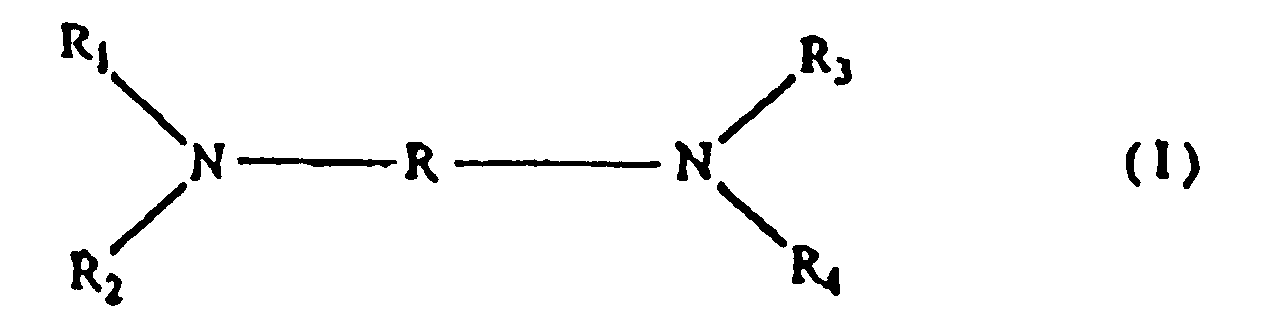
formule dans laquelle :
- - R est un reste propylène éventuellement substitué par un groupement hydroxyle ou un radical alkyle C1-C4;
- - R1, R2, R3 et R4, simultanément ou indépendamment l'un de l'autre, représentent l'hydrogène, un radical alkyle C1-C4 ou hydroxyalkyle (C1-C4).
Description
- L'invention concerne une composition cosmétique comportant au moins un agent alcalinisant pratiquement sans odeur.
- On sait que les compositions cosmétiques destinées au traitement des matières kératiniques humaines, telles que les cheveux, les poils ou la peau, contiennent, en général, au moins un agent alcalinisant destiné à amener le pH de la composition à une valeur généralement comprise entre 5 et 12,5. Dans le cas des compositions ayant un pH basique, le rôle de l'alcalinisant est différent selon le type de composition concerné : pour certaines compositions mettant en oeuvre de l'eau oxygénée comme oxydant, il faut amener l'eau oxygénée à pH basique pour permettre sa décomposition ; pour des compositions destinées à traiter les cheveux en général, l'adoption d'un pH basique permet de dilater la gaine cuticulaire des cheveux et facilite le passage des agents de traitement à l'intérieur de ladite gaine. Ces deux effets se retrouvent l'un ou l'autre, ou simultanément, dans la plupart des mises en oeuvre des compositions cosmétiques, qu'il s'agisse de dépilatoires, de compositions colorantes ou décolorantes pour cheveux, de compositions pigmentantes ou dépigmentantes pour la peau ou de compositions de déformation permanente des cheveux pour l'ondulation permanente ou le défri- sage.
- Dans l'état de la technique, les agents alcalinisants généralement utilisés dans les compositions cosmétiques, sont, soit l'ammoniaque, soit la monoéthanolamine. Dans les deux cas, ces agents ont une odeur désagréable, qui est gênante pour l'utilisateur. L'ammoniaque dégage une odeurforte, piquante, suffocante : elle est particulièrement incommodante dans les salons de coiffure pour les utilisateurs de produits de permanente, de coloration ou de décoloration. La monoéthanolamine ne permet, en outre, pas toujours d'atteindre des pH basiques relativement élevés. Il est un fait que, dans certaines des compositions cosmétiques susmentionnées, par exemple les compositions dépilatoires ou les compositions de permanente, on utilise des agents réducteurs qui ont, par eux-mêmes, une odeur assez désagréable ; néanmoins, l'utilisation d'agents d'alcalinisant malodorants ne fait que renforcer l'inconvénient olfactif susmentionné pour lesdites compositions.
- Selon l'invention, on a constaté qu'il était possible d'utiliser, comme alcalinisants pour des compositions cosmétiques, certains diaminoalcanes, qui, non seulement, ont l'avantage de ne pas être malodorants par eux-mêmes, mais qui, en outre, ont l'avantage de donner des résultats complémentaires intéressants et inattendus ; lesdits résultats sont diversifiés suivant la destination des compositions cosmétiques en cause :
- a) lorsqu'il s'agit d'une composition cosmétique destinée à l'ondulation permanente des cheveux, on a constaté qu'avec les alcalinisants proposés selon l'invention, la frisure était au moins aussi serrée que celle obtenue avec les compositions réductrices de l'art antérieur contenant de l'ammoniaque et était très nettement plus serrée que celle utilisant la monoéthanolamine ; en outre, les propriétés mécaniques des cheveux soumis à la permanente sont mieux préservées avec les alcalinisants proposés selon l'invention ; de plus, on a constaté que, lorsque la composition réductrice de la permanente contient de la cystéamine, on peut, en traitant les cheveux avec une solution contenant au moins un diaminoalcane, avant ou après l'application de la permanente ou entre les deux étapes de réduction et fixation de la permanente, combattre l'odeur désagréable résiduelle imprégnant les cheveux ;
- b) lorsqu'il s'agit de compositions de coloration pour cheveux, on constate qu'avec les alcalinisants proposés selon l'invention, on obtient des teintures présentant l'avantage de moins dégrader la fibre capillaire, lesdites teintures pouvant être, dans certains cas, aussi puissantes que celles de l'art antérieur utilisant l'ammoniaque ;
- c) lorsqu'il s'agit de compositions de décoloration des cheveux, ou éclaircissement de la couleur des cheveux, on a constaté qu'avec les alcalinisants proposés selon l'invention, elles présentent un pouvoir éclaircissant au moins égal à celui de compositions analogues alcalinisées à l'ammoniaque ;
- d) lorsqu'il s'agit de compositions pour la dépilation, on a constaté que l'utilisation des alcalinisants proposés selon l'invention permet d'obtenir des compositions moins agressives vis-à-vis de la peau que celles renfermant de la monoéthanolamine.
- La présente invention a donc pour but l'utilisation, dans des compositions cosmétiques en tant qu'agent alcalinisant inodore, d'une catégorie particulière de diaminoalcanes correspondant à la formule (I) ci-après définie.
- La présente invention a pour objet une composition cosmétique destinée à être appliquée sur un élément kératinique humain, tel que la peau, les cheveux et les poils, comprenant, en milieu aqueux à pH basique, d'une part, un agent actif approprié pour ledit traitement et, d'autre part, un agent alcalinisant caractérisé par le fait que l'agent alcalinisant est constitué par au moins un composé de formule (1) :

formule dans laquelle : - - R est un reste propylène éventuellement substitué par un groupement hydroxyle ou un radical alkyle C1-C4;
- - R1, R2, R3 et R4, simultanément ou indépendamment l'un de l'autre, représentent l'hydrogène, un radical alkyle Cl-C4 ou hydroxyalkyle (Ci-C4).
- Dans un mode préféré de réalisation, l'agent alcalinisant comprend au moins un composé choisi dans le groupe formé par le 1,3-diaminopropane, le N,N'-diéthyl 1,3-diaminopropane, le N,N-diéthyl 1,3-diaminopropane, le N,N-diméthyl 1,3-diaminopropane, le 2-hydroxy 1-(N,N-diéthyl)amino 3-aminopropane, le 2-hydroxy N,N'-ditertiobutyl 1,3-diaminopropane, le 2-hydroxy N,N'-tétraméthyl 1,3-diaminopropane et le 2-hydroxy 1,3-diaminopropane.
- Dans une première variante de réalisation de l'invention, la composition cosmétique est destinée à être utilisée pour la déformation permanente des cheveux ou la dépilation ; dans ce cas, elle comprend, comme agent actif, un agent réducteur ; l'agent réducteur comprend, de préférence, au moins un composé choisi dans le groupe formé par l'acide thioglycolique, l'acide thiolactique, la cystéamine, la cystéine, l'hydroxy-4 N-(mercapto-2 éthyl) butyramide et les mercapto-4 butyramides N-mono ou N,N-disubstitués décrits dans la demande EP 638 763. Lorsqu'il s'agit d'une composition pour la déformation permanente des cheveux, le pH est généralement compris entre 5 et 10 ; lorsqu'il s'agit d'une composition dépilatoire, le pH est généralement compris entre 9 et 12,5.
- Dans le cas de composition de permanente utilisant la cystéamine ou l'un de ses sels comme réducteur, l'application d'une solution aqueuse de diaminoalcanes de formule (I) en quantité suffisante pour que le pH soit supérieur à 7, et, de préférence supérieur à 8, avant ou après la permanente, ou entre les deux étapes réduction/fixation de la permanente, permet de combattre l'odeur désagréable résiduelle imprégnant les cheveux, particulièrement perceptible lorsque les cheveux traités sont à l'état mouillé ou dans un environnement humide. On préfère effectuer un prétraitement c'est-à-dire une application avant la permanente.
- Dans une seconde variante, la composition selon l'invention est destinée à être utilisée pour la teinture des cheveux ; dans ce cas, elle comprend un agent actif constitué d'au moins un composé de coloration choisi dans le groupe formé par les précurseurs de colorant d'oxydation, les coupleurs, les colorants d'oxydation rapide et les précurseurs de pigments mélaniques ; le(s) composé(s) de coloration est (sont), de préférence, choisi(s) dans le groupe formé par les ortho- ou paraphénylènediamines, les ortho- ou paraaminophénols, les métadiamines aromatiques, les métaaminophénols, les métadiphénols, le 5,6-dihydroxyindole et ses dérivés ; le pH d'une telle composition est généralement ajusté entre 5 et 11.
- Selon une troisième variante, la composition selon l'invention est destinée à la décoloration des cheveux ou à l'éclaircissement de la couleur des cheveux ; dans ce cas, la composition comprend, comme agent actif, un agent d'oxydation puissant ; le pH d'une telle composition est généralement compris entre 7 et 12.
- Le pH des compositions selon l'invention est, suivant le type de composition concernée, obtenu en ajoutant des quantités plus ou moins importantes de diaminoalcanes de formule (I). Par exemple, dans les compositions destinées à l'ondulation permanente des cheveux, pour obtenir le pH souhaité par addition de 1,3-diaminopropane, on utilise généralement de 3,7 à 12 % en poids de l'agent alcalinisant, ce pourcentage étant donné par rapport au poids total de la composition. Lorsque la composition selon l'invention est destinée à la coloration ou à la décoloration des cheveux, le même agent alcalinisant que ci-dessus mentionné est utilisé dans des proportions comprises, de préférence, entre 4 et 10 % en poids par rapport au poids total de la composition. Les chiffres ci-dessus donnés ne sont aucunement limitatifs et dépendent essentiellement d'une part, de l'utilisation de la composition cosmétique en cause, d'autre part, de la nature des agents actifs ou des adjuvants présents dans la composition et enfin, du ou des composés alcalinisants choisis parmi l'ensemble des composés de formule (I).
- Pour mieux faire comprendre l'objet de l'invention, on va décrire ci-après, à titre d'exemples purement il- pour chacune d'elles, comme agent alcalinisant, un composé de formule (I). Les formulations ainsi réalisées sont données en grammes dans le tableau ci-après :

- On constate tout d'abord que, pour chacune des compositions ci-dessus définies, l'odeur à l'utilisation est considérablement améliorée.
- La mise en oeuvre de ces compositions est effectuée comme suit : chaque composition est appliquée sur des cheveux préalablement enroulés sur bigoudis. On laisse la composition agir pendant 15 minutes puis on rince à l'eau. On applique alors une solution oxydante d'eau oxygénée à 8 volumes et on laisse agir pendant 10 minutes. On rince ensuite à l'eau puis on déroule les cheveux. On constate que la frisure obtenue est excellente et que les cheveux sont en bon état. Pendant le traitement, aucune gêne n'a été provoquée par les odeurs provenant de l'agent alcalinisant.
- On a réalisé une étude comparative de l'efficacité des compositions des exemples 1 à 6 pour la frisure des cheveux par rapport à des compositions correspondantes dans lesquelles l'agent alcalinisant utilisé était l'ammoniaque. Dans chaque cas, la quantité d'ammoniaque utilisée dans la composition comparative était celle nécessaire pour obtenir le pH indiqué pour chacune des formulations des exemples 1 à 6.
- L'étude a été réalisée sur des perruques de cheveux humains ; les mèches ont une longueur égale à 15 cm. Les mèches de cheveux normalisées ont été enroulées surdes bigoudis de 9 mm de diamètre. L'application des compositions des exemples 1 à 6 et des compositions correspondantes réalisées avec de l'ammoniaque, a été effectuée suivant le processus décrit pour les exemples 1 à 6.
- A la fin du traitement, on déroule les cheveux, et à mi-longueur des mèches humides, on mesure le rayon de courbure moyen des ondulations obtenues. L'efficacité de la composition testée est d'autant plus grande que le rayon de courbure est plus faible. Les résultats sont consignés dans le tableau Il ci-après :

- On a constaté, par ailleurs, qu'en utilisant les agents alcalinisants de formule (I) on obtenait, par rapport à l'utilisation de l'ammoniaque, une amélioration des propriétés mécaniques des cheveux après traitement.
- On a formulé 4 compositions pour la décoloration ou l'éclaircissement des cheveux en utilisant pour chacune d'elles, comme agent alcalinisant un composé de formule (I). Les formulations ainsi réalisées sont données en grammes dans le tableau III ci-après :

- Au moment de l'emploi, les compositions des exemples 8 à 11 sont mélangées à un poids égal d'eau oxygénée à 20 volumes. Ces compositions sont appliquées sur des mèches de cheveux châtains. Après 30 minutes de pause, les cheveux sont rincés, lavés au shampooing et séchés.
- Les cheveux traités avec la composition de l'exemple 8 passent du châtain au blond foncé ; ceux traités avec la composition des exemples 9, 10 et 11 passent du châtain au châtain clair.
- On constate que, pour chacune des compositions définies ci-dessus, l'odeur à l'utilisation est considérablement améliorée.
- On procède à la coloration de cheveux gris à 90 % de blancs en appliquant la composition colorante d'oxydation suivante, contenant comme agent alcalinisant du 1,3-diaminopropane :
- . Formulation colorante (A)
-

- constitué de motifs récurrents de formule :


- .Formulation oxydante (B)
- - Eau oxygénée 20 volumes à pH = 3
- Sur 3 g de cheveux, on applique 28 g du mélange poids pour poids des formulations (A) et (B). On laisse la composition agir pendant 30 minutes. On rince les cheveux à l'eau, on applique un shampooing et on sèche.
- Les cheveux sont colorés en blond cendré bleuté ou blond foncé bleu cendré suivant qu'il s'agit respectivement de cheveux naturels ou permanentés.
- On constate, qu'à l'utilisation, l'odeur de la composition colorante ci-dessus est considérablement améliorée.
- On a préparé une composition dépilatoire contenant comme agent alcalinisant du 1,3-diamino propane ayant la composition suivante :
-

-

- On introduit à 75°C la partie b dans la partie a et on agite. On introduit la partie c dans le mélange (a + b) en maintenant sous agitation le mélange ainsi formé à 70°C pendant 20 minutes. On introduit la partie d dans le mélange (a + b + c) : après dissolution, on ramène la température à 20°C. La partie e est alors ajoutée. On complète à 100 g avec de l'eau.
- On constate que, pour la composition ci-dessus, l'odeur est considérablement améliorée.
- On effectue une permanente utilisant la cystéamine comme agent réducteur avec un prétraitement à l'aide d'un diaminopropane. On applique successivement sur les cheveux les compositions suivantes :
-

- Cette composition est appliquée sur des cheveux naturels pendant 10 minutes. Après rinçage, on applique la composition B.
-

- Les cheveux sont enroulés sur des bigoudis. Après 15 minutes de pose, on rince et on applique la composition fixatrice C.
-

- Après 5 minutes de pose, on rince et on déroule les cheveux.
- Les mèches ainsi traitées sont laissées à l'air libre pendant 3 semaines à la température de 37°C. L'odeur se dégageant des mèches est évaluée par un panel de testeurs, 1 minute après vaporisation d'un nuage d'eau, comparativement à des mèches n'ayant subi que le traitement par les compositions B et C. A l'unanimité des testeurs, les mèches traitées avec les compositions B et C ont une odeur beaucoup plus désagréable que celles traitées avec les compositions A, B et C.
Claims (11)

formule dans laquelle :
Applications Claiming Priority (2)
| Application Number | Priority Date | Filing Date | Title |
|---|---|---|---|
| FR9105503 | 1991-05-06 | ||
| FR9105503A FR2676173B1 (fr) | 1991-05-06 | 1991-05-06 | Composition cosmetique contenant un agent alcalinisant sans odeur. |
Publications (4)
| Publication Number | Publication Date |
|---|---|
| EP0512879A2 true EP0512879A2 (fr) | 1992-11-11 |
| EP0512879A3 EP0512879A3 (fr) | 1992-11-25 |
| EP0512879B1 EP0512879B1 (fr) | 1994-12-28 |
| EP0512879B2 EP0512879B2 (fr) | 2003-06-04 |
Family
ID=9412535
Family Applications (1)
| Application Number | Title | Priority Date | Filing Date |
|---|---|---|---|
| EP92401140A Expired - Lifetime EP0512879B2 (fr) | 1991-05-06 | 1992-04-22 | Composition cosmétique contenant un agent alcalinisant sans odeur |
Country Status (5)
| Country | Link |
|---|---|
| US (1) | US5628991A (fr) |
| EP (1) | EP0512879B2 (fr) |
| JP (1) | JPH05246827A (fr) |
| DE (1) | DE69201009T3 (fr) |
| FR (1) | FR2676173B1 (fr) |
Cited By (16)
| Publication number | Priority date | Publication date | Assignee | Title |
|---|---|---|---|---|
| EP0636358A1 (fr) * | 1993-07-28 | 1995-02-01 | L'oreal | Nouvelles compositions à base d'eau oxygénée et leur utilisation comme fixateurs pour permanentes |
| EP0689827A1 (fr) * | 1994-06-30 | 1996-01-03 | L'oreal | Procédé pour la déformation permanente des matières kératiniques |
| US6045591A (en) * | 1997-12-05 | 2000-04-04 | L'oreal | Process for the two-step direct dyeing of keratin fibres using basic direct dyes |
| WO2002085317A1 (fr) * | 2001-04-20 | 2002-10-31 | L'oreal S.A. | Composition et procede de lanthionisation de fibres de keratine utilisant au moins un nucleophile organique et au moins un generateur d'ions hydroxydes |
| US7195755B2 (en) | 2001-08-20 | 2007-03-27 | L'oreal S.A. | Compositions comprising at least one hydroxide compound and at least one reducing agent, and methods for relaxing hair |
| US7468180B2 (en) | 2001-08-20 | 2008-12-23 | L'oreal, S.A. | Compositions comprising at least one hydroxide compound and at least one oxidizing agent, and methods to straighten curly hair |
| FR3058053A1 (fr) * | 2016-11-02 | 2018-05-04 | L'oreal | Procede de deformation permanente des cheveux mettant en oeuvre une diamine et un agent reducteur |
| EP3288520A4 (fr) * | 2015-05-01 | 2018-12-12 | L'oreal | Utilisation d'agents actifs pendant des traitements chimiques |
| US10441518B2 (en) | 2015-11-24 | 2019-10-15 | L'oreal | Compositions for treating the hair |
| US11083675B2 (en) | 2015-11-24 | 2021-08-10 | L'oreal | Compositions for altering the color of hair |
| US11090249B2 (en) | 2018-10-31 | 2021-08-17 | L'oreal | Hair treatment compositions, methods, and kits for treating hair |
| US11135150B2 (en) | 2016-11-21 | 2021-10-05 | L'oreal | Compositions and methods for improving the quality of chemically treated hair |
| US11213470B2 (en) | 2015-11-24 | 2022-01-04 | L'oreal | Compositions for treating the hair |
| US11419809B2 (en) | 2019-06-27 | 2022-08-23 | L'oreal | Hair treatment compositions and methods for treating hair |
| US11433011B2 (en) | 2017-05-24 | 2022-09-06 | L'oreal | Methods for treating chemically relaxed hair |
| US11596588B2 (en) | 2017-12-29 | 2023-03-07 | L'oreal | Compositions for altering the color of hair |
Families Citing this family (23)
| Publication number | Priority date | Publication date | Assignee | Title |
|---|---|---|---|---|
| US5902574A (en) * | 1994-05-23 | 1999-05-11 | The Gillette Company | Shaving preparation for improved shaving comfort |
| DE19824685A1 (de) * | 1998-06-03 | 1999-12-09 | Henkel Kgaa | Blondiermittel |
| US7147668B2 (en) | 2000-06-12 | 2006-12-12 | Kao Corporation | Hair bleach |
| DE60139730D1 (de) | 2000-12-28 | 2009-10-08 | Kao Corp | Haarbleichungszusammensetzung und Haarfärbezusammensetzung |
| US7118736B2 (en) | 2001-02-22 | 2006-10-10 | L'oreal | Hair relaxer compositions comprising at least one hydroxide compound and at least one activating agent, and methods of using the same |
| JP2003327515A (ja) * | 2002-05-10 | 2003-11-19 | Kao Corp | 毛髪処理剤 |
| JP2003327516A (ja) | 2002-05-10 | 2003-11-19 | Kao Corp | 縮毛矯正剤組成物 |
| UY27967A1 (es) * | 2002-09-10 | 2004-05-31 | Pfizer | Acetil 2-hindroxi-1,3-diaminoalcanos |
| US20040253283A1 (en) * | 2003-03-25 | 2004-12-16 | L'oreal S.A. | Composition for treating keratinous materials, comprising a hydroxycarboxylic acid and a protective and/or conditioning agent |
| FR2852828A1 (fr) * | 2003-03-25 | 2004-10-01 | Oreal | Composition de traitement des matieres keratiniques comprenant un acide hydroxycarboxylique et un agent protecteur ou conditionneur |
| US20050136019A1 (en) * | 2003-11-18 | 2005-06-23 | Gerard Malle | Hair shaping composition comprising at least one amine chosen from secondary and tertiary amines |
| US20050129645A1 (en) * | 2003-11-18 | 2005-06-16 | L'oreal | Hair shaping composition comprising at least one non-hydroxide imine |
| US20050136016A1 (en) * | 2003-11-18 | 2005-06-23 | Gerard Malle | Hair-relaxing composition comprising at least one base other than hydroxide |
| US20050186232A1 (en) * | 2003-11-18 | 2005-08-25 | Gerard Malle | Hair-relaxing composition comprising tetramethylguanidine |
| US20050136018A1 (en) * | 2003-11-18 | 2005-06-23 | Gerard Malle | Hair relaxing composition comprising at least one secondary or tertiary amine |
| US20050136017A1 (en) * | 2003-11-18 | 2005-06-23 | Gerard Malle | Hair relaxing composition comprising at least one non-hydroxide imine |
| JP2004123759A (ja) * | 2004-01-13 | 2004-04-22 | Kao Corp | 染毛剤組成物 |
| US7522940B2 (en) * | 2004-11-16 | 2009-04-21 | Sony Ericsson Mobile Communications Ab | Methods and mobile terminals for display of mobile terminal density information |
| JP2006347998A (ja) * | 2005-06-20 | 2006-12-28 | Moltobene:Kk | アンモニア臭低減剤 |
| FR2897533B1 (fr) * | 2006-02-22 | 2009-04-24 | Tagasako Internat Corp | Agent oxydant pour le traitement des cheveux |
| WO2008093735A1 (fr) * | 2007-01-30 | 2008-08-07 | Kao Corporation | Procédé d'évaluation et système capillaire |
| CN105267066B (zh) * | 2015-10-08 | 2019-06-11 | 知识产权全资有限公司 | 用于处理头发的方法及其试剂盒 |
| EP3651855B1 (fr) | 2017-07-10 | 2022-10-05 | Wella Operations US, LLC | Composition de durcissement des ongles et procédé d'utilisation |
Family Cites Families (4)
| Publication number | Priority date | Publication date | Assignee | Title |
|---|---|---|---|---|
| FR1146332A (fr) * | 1956-03-29 | 1957-11-08 | Produits de nettoyage de la chevelure et sels de diamines bitertiaires entrant dans la composition de ces produits | |
| FR2596985B1 (fr) * | 1986-04-10 | 1990-08-24 | Oreal | Compositions cosmetiques pour teindre ou pour decolorer les cheveux |
| JPS63270615A (ja) * | 1987-04-28 | 1988-11-08 | Toyama Chem Co Ltd | 養毛剤 |
| FR2654617B1 (fr) * | 1989-11-20 | 1993-10-08 | Oreal | Composition cosmetique reductrice pour permanente contenant, en tant qu'agent reducteur, de l'aletheine ou l'un de ses sels, et son utilisation dans un procede de deformation permanente des cheveux. |
-
1991
- 1991-05-06 FR FR9105503A patent/FR2676173B1/fr not_active Expired - Fee Related
-
1992
- 1992-04-22 DE DE69201009T patent/DE69201009T3/de not_active Expired - Fee Related
- 1992-04-22 EP EP92401140A patent/EP0512879B2/fr not_active Expired - Lifetime
- 1992-05-06 JP JP4157271A patent/JPH05246827A/ja not_active Ceased
-
1995
- 1995-05-10 US US08/437,970 patent/US5628991A/en not_active Expired - Fee Related
Cited By (28)
| Publication number | Priority date | Publication date | Assignee | Title |
|---|---|---|---|---|
| FR2708197A1 (fr) * | 1993-07-28 | 1995-02-03 | Oreal | Nouvelles compositions à base d'eau oxygénée et leur utilisation comme fixateurs pour permanentes. |
| US5833966A (en) * | 1993-07-28 | 1998-11-10 | L'oreal | Hydrogen peroxide-based compositions used as fixers for permanent-waving/straightening |
| EP0636358A1 (fr) * | 1993-07-28 | 1995-02-01 | L'oreal | Nouvelles compositions à base d'eau oxygénée et leur utilisation comme fixateurs pour permanentes |
| CN1070362C (zh) * | 1994-06-30 | 2001-09-05 | 莱雅公司 | 角质物质持久造型的方法 |
| EP0689827A1 (fr) * | 1994-06-30 | 1996-01-03 | L'oreal | Procédé pour la déformation permanente des matières kératiniques |
| FR2721823A1 (fr) * | 1994-06-30 | 1996-01-05 | Oreal | Procede pour la deformation permanente des matieres keratiniques |
| US5655552A (en) * | 1994-06-30 | 1997-08-12 | L'oreal | Process for the permanent reshaping of keratinous material |
| US6045591A (en) * | 1997-12-05 | 2000-04-04 | L'oreal | Process for the two-step direct dyeing of keratin fibres using basic direct dyes |
| WO2002085317A1 (fr) * | 2001-04-20 | 2002-10-31 | L'oreal S.A. | Composition et procede de lanthionisation de fibres de keratine utilisant au moins un nucleophile organique et au moins un generateur d'ions hydroxydes |
| US7195755B2 (en) | 2001-08-20 | 2007-03-27 | L'oreal S.A. | Compositions comprising at least one hydroxide compound and at least one reducing agent, and methods for relaxing hair |
| US7468180B2 (en) | 2001-08-20 | 2008-12-23 | L'oreal, S.A. | Compositions comprising at least one hydroxide compound and at least one oxidizing agent, and methods to straighten curly hair |
| US10993896B2 (en) | 2015-05-01 | 2021-05-04 | L'oreal | Compositions for altering the color of hair |
| EP3288520A4 (fr) * | 2015-05-01 | 2018-12-12 | L'oreal | Utilisation d'agents actifs pendant des traitements chimiques |
| US10231915B2 (en) | 2015-05-01 | 2019-03-19 | L'oreal | Compositions for altering the color of hair |
| RU2746990C2 (ru) * | 2015-05-01 | 2021-04-23 | Л'Ореаль | Применение активных агентов при химической обработке |
| US10441518B2 (en) | 2015-11-24 | 2019-10-15 | L'oreal | Compositions for treating the hair |
| US10828244B2 (en) | 2015-11-24 | 2020-11-10 | L'oreal | Compositions for treating the hair |
| US11083675B2 (en) | 2015-11-24 | 2021-08-10 | L'oreal | Compositions for altering the color of hair |
| US11191706B2 (en) | 2015-11-24 | 2021-12-07 | L'oreal | Compositions for altering the color of hair |
| US11213470B2 (en) | 2015-11-24 | 2022-01-04 | L'oreal | Compositions for treating the hair |
| US12048759B2 (en) | 2015-11-24 | 2024-07-30 | L'oreal | Compositions for treating the hair |
| FR3058053A1 (fr) * | 2016-11-02 | 2018-05-04 | L'oreal | Procede de deformation permanente des cheveux mettant en oeuvre une diamine et un agent reducteur |
| US11135150B2 (en) | 2016-11-21 | 2021-10-05 | L'oreal | Compositions and methods for improving the quality of chemically treated hair |
| US11433011B2 (en) | 2017-05-24 | 2022-09-06 | L'oreal | Methods for treating chemically relaxed hair |
| US11596588B2 (en) | 2017-12-29 | 2023-03-07 | L'oreal | Compositions for altering the color of hair |
| US11090249B2 (en) | 2018-10-31 | 2021-08-17 | L'oreal | Hair treatment compositions, methods, and kits for treating hair |
| US11975092B2 (en) | 2018-10-31 | 2024-05-07 | L'oreal | Hair treatment compositions, methods, and kits for treating hair |
| US11419809B2 (en) | 2019-06-27 | 2022-08-23 | L'oreal | Hair treatment compositions and methods for treating hair |
Also Published As
| Publication number | Publication date |
|---|---|
| FR2676173A1 (fr) | 1992-11-13 |
| EP0512879A3 (fr) | 1992-11-25 |
| DE69201009T3 (de) | 2004-01-29 |
| EP0512879B2 (fr) | 2003-06-04 |
| FR2676173B1 (fr) | 1993-08-13 |
| JPH05246827A (ja) | 1993-09-24 |
| EP0512879B1 (fr) | 1994-12-28 |
| DE69201009D1 (de) | 1995-02-09 |
| DE69201009T2 (de) | 1995-08-03 |
| US5628991A (en) | 1997-05-13 |
Similar Documents
| Publication | Publication Date | Title |
|---|---|---|
| EP0512879B1 (fr) | Composition cosmétique contenant un agent alcalinisant sans odeur | |
| CA1304202C (fr) | Procede de teinture des fibres keratiniques avec le 5, 6-dihydroxyindole associe a un iodure et une composition de peroxyde d'hydrogene a ph alcalin | |
| EP0723772B1 (fr) | Composition réductrice comprenant un acide aminé basique et un polymère cationique | |
| CA2214022C (fr) | Composition de teinture d'oxydation pour fibres keratiniques comprenant un polymere amphiphile anionique | |
| EP0702949B1 (fr) | Utilisation de gomme de guar dans des compositions non rincées pour la teinture des fibres kératiniques et procédé de teinture | |
| CH672731A5 (fr) | ||
| FR2870724A1 (fr) | Composition pour le traitement de matieres keratiniques comprenant un compose polycarboxylique particulier et un agent nacrant et/ou opacifiant et procedes la mettant en oeuvre | |
| EP0827739A1 (fr) | Composition de teinture d'oxydation pour fibres kératiniques comprenant un polymère amphiphile anionique | |
| FR2751533A1 (fr) | Composition de teinture d'oxydation pour fibres keratiniques comprenant un polymere amphiphile non-ionique | |
| CH676926A5 (fr) | ||
| WO1999037278A1 (fr) | Composition pour la coloration de fibres keratiniques depourvue d'ammoniaque | |
| EP0940136A1 (fr) | Agent réducteur à plusieurs composants et procédé de déformation permanente des cheveux le mettant en oeuvre | |
| LU87336A1 (fr) | Procede de teinture des fibres keratiniques avec un monohydroxyindole associe a un iodure et compositions mises en oeuvre | |
| CA2210367C (fr) | Compositions pour la teinture d'oxydation des fibres keratiniques et procede de teinture les mettant en oeuvre | |
| EP0930061A1 (fr) | Agent oxydant à plusiers composants et procédé de déformation permanente des cheveux le mettant en oeuvre | |
| CH648204A5 (fr) | Compositions tinctoriales pour cheveux a base de colorants directs nitres et procede de teinture utilisant lesdites compositions. | |
| JP4130797B2 (ja) | 毛髪処理方法 | |
| WO2018115791A1 (fr) | Procédé de coloration capillaire à partir de colorants acides comprenant un prétraitement mettant en œuvre un polymère cationique | |
| WO2011039098A1 (fr) | Composition cosmetique comprenant deux mercaptosiloxanes distincts, procede de deformation permanente des cheveux et utilisation. | |
| LU87270A1 (fr) | Procede de teinture des fibres keratiniques avec du 5,6-dihydroxyindole associe a un nitrite et composition de mise en oeuvre | |
| EP0884998B1 (fr) | Nouveau procede pour la deformation permanente des matieres keratiniques | |
| WO2002058660A1 (fr) | Composition oxydante pour le traitement des matieres keratiniques comprenant un poly(vinyllactame) cationique | |
| FR2870723A1 (fr) | Composition pour le traitement de matieres keratiniques comprenant un compose polycarboxylique particulier et un polyol particulier et procedes la mettant en oeuvre | |
| FR2857865A1 (fr) | Utilisation en coloration capillaire de derives de ninhydrine | |
| FR2857861A1 (fr) | Utilisation en coloration capillaire de derives de ninhydrine |
Legal Events
| Date | Code | Title | Description |
|---|---|---|---|
| PUAI | Public reference made under article 153(3) epc to a published international application that has entered the european phase |
Free format text: ORIGINAL CODE: 0009012 |
|
| PUAL | Search report despatched |
Free format text: ORIGINAL CODE: 0009013 |
|
| 17P | Request for examination filed |
Effective date: 19920429 |
|
| AK | Designated contracting states |
Kind code of ref document: A2 Designated state(s): BE CH DE ES FR GB GR IT LI |
|
| AK | Designated contracting states |
Kind code of ref document: A3 Designated state(s): BE CH DE ES FR GB GR IT LI |
|
| 17Q | First examination report despatched |
Effective date: 19940316 |
|
| GRAA | (expected) grant |
Free format text: ORIGINAL CODE: 0009210 |
|
| AK | Designated contracting states |
Kind code of ref document: B1 Designated state(s): BE CH DE ES FR GB GR IT LI |
|
| PG25 | Lapsed in a contracting state [announced via postgrant information from national office to epo] |
Ref country code: GR Free format text: LAPSE BECAUSE OF FAILURE TO SUBMIT A TRANSLATION OF THE DESCRIPTION OR TO PAY THE FEE WITHIN THE PRESCRIBED TIME-LIMIT Effective date: 19941228 Ref country code: ES Free format text: THE PATENT HAS BEEN ANNULLED BY A DECISION OF A NATIONAL AUTHORITY Effective date: 19941228 |
|
| ITF | It: translation for a ep patent filed | ||
| REF | Corresponds to: |
Ref document number: 69201009 Country of ref document: DE Date of ref document: 19950209 |
|
| GBT | Gb: translation of ep patent filed (gb section 77(6)(a)/1977) |
Effective date: 19950126 |
|
| PG25 | Lapsed in a contracting state [announced via postgrant information from national office to epo] |
Ref country code: LI Effective date: 19950430 Ref country code: CH Effective date: 19950430 Ref country code: BE Effective date: 19950430 |
|
| PLBI | Opposition filed |
Free format text: ORIGINAL CODE: 0009260 |
|
| BERE | Be: lapsed |
Owner name: L' OREAL Effective date: 19950430 |
|
| 26 | Opposition filed |
Opponent name: HENKEL KOMMANDITGESELLSCHAFT AUF AKTIEN Effective date: 19950925 |
|
| REG | Reference to a national code |
Ref country code: CH Ref legal event code: PL |
|
| PLBF | Reply of patent proprietor to notice(s) of opposition |
Free format text: ORIGINAL CODE: EPIDOS OBSO |
|
| PLBF | Reply of patent proprietor to notice(s) of opposition |
Free format text: ORIGINAL CODE: EPIDOS OBSO |
|
| PLAW | Interlocutory decision in opposition |
Free format text: ORIGINAL CODE: EPIDOS IDOP |
|
| APAC | Appeal dossier modified |
Free format text: ORIGINAL CODE: EPIDOS NOAPO |
|
| APAE | Appeal reference modified |
Free format text: ORIGINAL CODE: EPIDOS REFNO |
|
| APAC | Appeal dossier modified |
Free format text: ORIGINAL CODE: EPIDOS NOAPO |
|
| APAE | Appeal reference modified |
Free format text: ORIGINAL CODE: EPIDOS REFNO |
|
| REG | Reference to a national code |
Ref country code: GB Ref legal event code: IF02 |
|
| APAC | Appeal dossier modified |
Free format text: ORIGINAL CODE: EPIDOS NOAPO |
|
| PLAW | Interlocutory decision in opposition |
Free format text: ORIGINAL CODE: EPIDOS IDOP |
|
| PUAH | Patent maintained in amended form |
Free format text: ORIGINAL CODE: 0009272 |
|
| STAA | Information on the status of an ep patent application or granted ep patent |
Free format text: STATUS: PATENT MAINTAINED AS AMENDED |
|
| 27A | Patent maintained in amended form |
Effective date: 20030604 |
|
| AK | Designated contracting states |
Designated state(s): BE CH DE ES FR GB GR IT LI |
|
| GBTA | Gb: translation of amended ep patent filed (gb section 77(6)(b)/1977) | ||
| PG25 | Lapsed in a contracting state [announced via postgrant information from national office to epo] |
Ref country code: IT Free format text: LAPSE BECAUSE OF NON-PAYMENT OF DUE FEES;WARNING: LAPSES OF ITALIAN PATENTS WITH EFFECTIVE DATE BEFORE 2007 MAY HAVE OCCURRED AT ANY TIME BEFORE 2007. THE CORRECT EFFECTIVE DATE MAY BE DIFFERENT FROM THE ONE RECORDED. Effective date: 20050422 |
|
| APAH | Appeal reference modified |
Free format text: ORIGINAL CODE: EPIDOSCREFNO |
|
| PGFP | Annual fee paid to national office [announced via postgrant information from national office to epo] |
Ref country code: DE Payment date: 20070419 Year of fee payment: 16 |
|
| PGFP | Annual fee paid to national office [announced via postgrant information from national office to epo] |
Ref country code: GB Payment date: 20070418 Year of fee payment: 16 |
|
| PGFP | Annual fee paid to national office [announced via postgrant information from national office to epo] |
Ref country code: FR Payment date: 20080312 Year of fee payment: 17 |
|
| GBPC | Gb: european patent ceased through non-payment of renewal fee |
Effective date: 20080422 |
|
| PG25 | Lapsed in a contracting state [announced via postgrant information from national office to epo] |
Ref country code: DE Free format text: LAPSE BECAUSE OF NON-PAYMENT OF DUE FEES Effective date: 20081101 |
|
| PG25 | Lapsed in a contracting state [announced via postgrant information from national office to epo] |
Ref country code: GB Free format text: LAPSE BECAUSE OF NON-PAYMENT OF DUE FEES Effective date: 20080422 |
|
| REG | Reference to a national code |
Ref country code: FR Ref legal event code: ST Effective date: 20110923 |
|
| PG25 | Lapsed in a contracting state [announced via postgrant information from national office to epo] |
Ref country code: FR Free format text: LAPSE BECAUSE OF NON-PAYMENT OF DUE FEES Effective date: 20090430 |