EP0512977A1 - Procédé pour blanchir des matériaux contenant de la cellulose - Google Patents
Procédé pour blanchir des matériaux contenant de la cellulose Download PDFInfo
- Publication number
- EP0512977A1 EP0512977A1 EP92890101A EP92890101A EP0512977A1 EP 0512977 A1 EP0512977 A1 EP 0512977A1 EP 92890101 A EP92890101 A EP 92890101A EP 92890101 A EP92890101 A EP 92890101A EP 0512977 A1 EP0512977 A1 EP 0512977A1
- Authority
- EP
- European Patent Office
- Prior art keywords
- ozone
- gas
- bleaching
- oxygen
- bleached
- Prior art date
- Legal status (The legal status is an assumption and is not a legal conclusion. Google has not performed a legal analysis and makes no representation as to the accuracy of the status listed.)
- Granted
Links
Images
Classifications
-
- C—CHEMISTRY; METALLURGY
- C01—INORGANIC CHEMISTRY
- C01B—NON-METALLIC ELEMENTS; COMPOUNDS THEREOF; METALLOIDS OR COMPOUNDS THEREOF NOT COVERED BY SUBCLASS C01C
- C01B13/00—Oxygen; Ozone; Oxides or hydroxides in general
- C01B13/10—Preparation of ozone
- C01B13/11—Preparation of ozone by electric discharge
-
- D—TEXTILES; PAPER
- D21—PAPER-MAKING; PRODUCTION OF CELLULOSE
- D21C—PRODUCTION OF CELLULOSE BY REMOVING NON-CELLULOSE SUBSTANCES FROM CELLULOSE-CONTAINING MATERIALS; REGENERATION OF PULPING LIQUORS; APPARATUS THEREFOR
- D21C9/00—After-treatment of cellulose pulp, e.g. of wood pulp, or cotton linters ; Treatment of dilute or dewatered pulp or process improvement taking place after obtaining the raw cellulosic material and not provided for elsewhere
- D21C9/10—Bleaching ; Apparatus therefor
- D21C9/147—Bleaching ; Apparatus therefor with oxygen or its allotropic modifications
- D21C9/153—Bleaching ; Apparatus therefor with oxygen or its allotropic modifications with ozone
Definitions
- the invention relates to a method for bleaching cellulose-containing material, in particular cellulose, with ozone (O3).
- an ozone-containing gas is first generated using an ozone generator. If you start from oxygen and apply a silent electrical discharge to form ozone, you can reach concentrations of 100 to 130 g O3 / Nm3 oxygen, the current requirement increases the O3 content accordingly.
- the ozone-containing gas is mixed with the pulp to be bleached in a mixer or used in the form of an aqueous ozone solution.
- the bleaching gas containing ozone acts on the materials to be bleached, it is not the oxygen that reacts, but only the ozone it contains.
- the oxygen leaves the bleaching vessel at the end of the bleaching process and now contains various impurities, such as carbon monoxide, carbon dioxide and hydrocarbons and other undesirable constituents.
- the from Bleaching vessel coming oxygen are no longer used to extract ozone, but must either be discarded or subjected to extensive cleaning.
- the ozone content in the O2 / O3 mixture prepared according to a) can be 30 to 130 g O3 / Nm3 according to the invention. This content depends on the desired bleaching effect and on economic considerations. If the amount of ozone to be added to the pulp is increased to 4.5 to 8 kg O3 / t cellulose compared to the previous ozone addition, an ozone-containing gas will be obtained in the ozone generator at the upper limit of 130 g O3 / Nm3. If it is sufficient to keep the ozone addition lower, then a gas will be produced in the ozone generator at the lower limit of the range, which has the advantage that the electricity requirement is lower.
- the compression of the ozone-containing gas and the extraction of the aqueous solution (strong water) in an absorption vessel can take place at a pressure of 7 to 10 bar.
- the strong water can contain 200 to 350 g O3 / m3, whereby there is also a temperature dependence.
- the gas obtained in the relaxation zone according to c) with an increased O3 content contains more than 100 g O3 / Nm3, usually in the range of 200 to 250 g O3 / Nm3; it is diluted with ozone-free or low-oxygen gas, with low-oxygen gas being understood to be one which contains no more oxygen than air.
- the dilution must go so far that a risk of decomposition, which would occur above 250 g O3 / Nm3, is avoided; usually the gas is adjusted to a content of 100 to 180 g O3 / Nm3, preferably from 100 to 150 g O3 / Nm3.
- the measures a) to e) correspond to those of the first embodiment; however, the O3 content is reduced more in the dilution to avoid fiber damage.
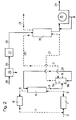
- a dedicated degassing station is also missing the bleach, but the exhaust gas from the bleach is recycled directly as a dilution gas. This process variant is explained in more detail in the diagram according to FIG. 2.
- the invention also encompasses a plant for carrying out the processes, with an ozone generator, an absorption column and a dryer which are connected to one another in the gas line, an expansion vessel which has a liquid space and a gas space, the liquid space being connected to the absorption column by a line for supplying ozone-containing solution and with a return line for returning return water to the absorption column, a bleaching tower or bleaching reactor which is provided with a supply line for supplying the material to be bleached and with a discharge for the bleached material, which system is characterized in that the bleaching tower or bleaching reactor is connected by an exhaust gas recirculation to the gas space of the expansion vessel, through which exhaust gas recirculation, ozone-free or low-oxygen gas can be supplied to the gas space as a dilution gas.
- the bleaching reactor is connected to a degassing or pressure control station.
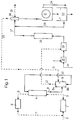
- the ozone generator to which oxygen is supplied through line 2 is designated by 1.
- a O2 / O3 mixture obtained with a content of, for example, 50 to 100 g O3 / Nm3 oxygen is compressed to a pressure of 7 to 10 bar and passed via line 3 into the absorption (washing) column 4. There is the ozone washed out of the oxygen by circulating water and goes into solution.
- the undissolved oxygen is fed via line 5 to dryer 6 and from there through line 7 to the ozone generator. In this cycle of the process, oxygen therefore only comes into contact with pure water and is therefore not contaminated.
- the aqueous ozone solution (pressurized water) produced under pressure is fed from the absorption column 4 through line 8 to the expansion vessel 9, which works without pressure. Since the solubility of the ozone in the unpressurized state is lower than under pressure, ozone and oxygen are outgassed from the solution.
- the ozone content in the gas space 9a of the expansion vessel can be up to 250 g O3 / Nm3. Above this content, however, there is already a risk of explosive decomposition, so that care must be taken to ensure that a diluent gas is fed through line 11 into the gas space 9a of the expansion vessel in order to reduce the ozone content, for example, to a content of 200 g / Nm3 or less belittling. In any case, the ozone content should be more than 100 g / Nm3 in order to be able to exert the desired bleaching effect.
- Backwater from the expansion zone 9 is returned to the washing column 4 through line 10.
- the diluted gas is withdrawn from the expansion zone 9 through line 12 and fed to the mixer 13.
- the line 14 for the material suspension to be bleached leads to this mixer 13, which is premixed in a mixer 15 and adjusted to an acidic pH of pH 4 or less becomes.
- This premixed suspension is mixed in the mixer 13 with the bleaching gas coming from the line 12.
- the bleaching gas advantageously has a concentration of 100 to 150 g O3 / Nm3.
- the actual bleaching i.e. the reaction of the bleaching gas with the material suspension takes place in the bleaching tower 16 with an exposure time of 5 to 10 minutes.
- the suspension i.e. the mixture of material suspension and bleaching gas, via line 17 into the pressure control zone 18, in which ozone-free or low-ozone gas is released. Air is introduced into this degassing zone via line 19.
- the air / oxygen mixture is fed via lines 20 and 11 to the gas space 9a of the expansion zone 9 as a diluent gas.
- the oxygen content of the bleaching gas in the circuit between the relaxation zone, bleaching tower and exhaust gas recirculation is reduced;
- the oxygen saving can be up to 80% compared to the previous method.
- the pulp suspension drawn off from the pressure control zone is washed in the washing filter 21, and the resulting waste water 22 is fed as dilution water through line 23 to line 17 leading the bleached suspension in front of the pressure control zone.
- the bleached pulp is discharged through line 24.
- the same parts of the plant are denoted by the same reference numerals, so the ozone generator 1, the oxygen supply line 2, the O2 / O3 line 3, the washing column 4, the oxygen return line 5 and the dryer 6 , so that this circuit corresponds to that of FIG. 1.
- the ozone solution coming from the washing column 4 is 8, which Relaxation zone designated 9 and the gas space of this zone with 9a.
- the outgassed ozone is diluted in the gas space 9a of the expansion zone, the diluent gas coming from the line 11, and is fed directly into the bleaching reactor 16 through the line 12.
- oxygen is also saved here by supplying the diluent gas.
- the path of the material to be bleached goes via line 25 to the press 26, where the material is at the desired concentration, e.g. to a consistency of more than 20%.
- the material is then fed to fluffer 27 where flakes are made. These flakes continue through line 25 into the bleaching reactor, which is provided with corresponding inlet and outlet openings.
- the bleached material leaving the bleaching reactor is diluted on the washing filter 21 and led to the pulp washing.
- Air 19 can also be supplied to the system via a pressure control system connected to the bleaching reactor 16. However, exhaust gas can also be removed from the system if the gas requirement for the dilution becomes lower than the gas generation. Exhaust gas from the bleaching reactor is fed through line 20 and line 11 as a diluent gas.
- the oxygen input is 15,500 g of oxygen and the oxygen consumption is 2,300 g. This leaves 13,200 g of oxygen which are recycled. Since small losses can still be expected when working up the oxygen, the amount is reduced by 5%, so that the amount of oxygen returned is therefore 12,540 g or 80.9% of the amount used.
Landscapes
- Chemical & Material Sciences (AREA)
- Organic Chemistry (AREA)
- Life Sciences & Earth Sciences (AREA)
- Engineering & Computer Science (AREA)
- Wood Science & Technology (AREA)
- Inorganic Chemistry (AREA)
- Paper (AREA)
- Detergent Compositions (AREA)
Applications Claiming Priority (2)
| Application Number | Priority Date | Filing Date | Title |
|---|---|---|---|
| AT918/91 | 1991-05-02 | ||
| AT0091891A AT395445B (de) | 1991-05-02 | 1991-05-02 | Verfahren zum bleichen von cellulosehaeltigem material |
Publications (2)
| Publication Number | Publication Date |
|---|---|
| EP0512977A1 true EP0512977A1 (fr) | 1992-11-11 |
| EP0512977B1 EP0512977B1 (fr) | 1996-09-18 |
Family
ID=3502826
Family Applications (1)
| Application Number | Title | Priority Date | Filing Date |
|---|---|---|---|
| EP92890101A Expired - Lifetime EP0512977B1 (fr) | 1991-05-02 | 1992-04-28 | Procédé pour blanchir des matériaux contenant de la cellulose |
Country Status (7)
| Country | Link |
|---|---|
| EP (1) | EP0512977B1 (fr) |
| AT (1) | AT395445B (fr) |
| CA (1) | CA2067844A1 (fr) |
| DE (1) | DE59207155D1 (fr) |
| ES (1) | ES2094337T3 (fr) |
| FI (1) | FI921962A7 (fr) |
| RU (1) | RU2096547C1 (fr) |
Cited By (1)
| Publication number | Priority date | Publication date | Assignee | Title |
|---|---|---|---|---|
| WO1994013393A1 (fr) * | 1992-12-07 | 1994-06-23 | Kamyr, Inc. | Regulation d'un flux d'ozone sous pression vers un reacteur de delignification de pate |
Families Citing this family (6)
| Publication number | Priority date | Publication date | Assignee | Title |
|---|---|---|---|---|
| US5409570A (en) * | 1989-02-15 | 1995-04-25 | Union Camp Patent Holding, Inc. | Process for ozone bleaching of oxygen delignified pulp while conveying the pulp through a reaction zone |
| US5520783A (en) * | 1990-10-26 | 1996-05-28 | Union Camp Patent Holding, Inc. | Apparatus for bleaching high consistency pulp with ozone |
| US5403441A (en) * | 1992-11-13 | 1995-04-04 | Union Camp Patent Holding, Inc. | Method for controlling an ozone bleaching process |
| US5554259A (en) | 1993-10-01 | 1996-09-10 | Union Camp Patent Holdings, Inc. | Reduction of salt scale precipitation by control of process stream Ph and salt concentration |
| US5672247A (en) * | 1995-03-03 | 1997-09-30 | Union Camp Patent Holding, Inc. | Control scheme for rapid pulp delignification and bleaching |
| US5736004A (en) * | 1995-03-03 | 1998-04-07 | Union Camp Patent Holding, Inc. | Control scheme for rapid pulp delignification and bleaching |
Citations (3)
| Publication number | Priority date | Publication date | Assignee | Title |
|---|---|---|---|---|
| EP0397308A2 (fr) * | 1989-05-10 | 1990-11-14 | A. Ahlstrom Corporation | Procédé de blanchiment à l'ozone de pâte cellulosique |
| EP0434662A1 (fr) * | 1989-12-22 | 1991-06-26 | SCHMIDDING-WERKE Wilhelm Schmidding GmbH & Co. | Procédé pour blanchir des matières cellulosiques et installation pour la mise en oeuvre de ce procédé |
| EP0442254A1 (fr) * | 1990-02-14 | 1991-08-21 | SCHMIDDING-WERKE Wilhelm Schmidding GmbH & Co. | Procédé et dispositif pour la production de gaz et de solutions ozonés |
Family Cites Families (1)
| Publication number | Priority date | Publication date | Assignee | Title |
|---|---|---|---|---|
| US4140608A (en) * | 1977-08-22 | 1979-02-20 | Vaseen Vesper A | Converting oxygen to ozone using a liquid dielectric containing dissolved oxygen |
-
1991
- 1991-05-02 AT AT0091891A patent/AT395445B/de not_active IP Right Cessation
-
1992
- 1992-04-28 EP EP92890101A patent/EP0512977B1/fr not_active Expired - Lifetime
- 1992-04-28 DE DE59207155T patent/DE59207155D1/de not_active Expired - Fee Related
- 1992-04-28 ES ES92890101T patent/ES2094337T3/es not_active Expired - Lifetime
- 1992-04-30 RU SU925011795A patent/RU2096547C1/ru active
- 1992-04-30 FI FI921962A patent/FI921962A7/fi unknown
- 1992-05-01 CA CA002067844A patent/CA2067844A1/fr not_active Abandoned
Patent Citations (3)
| Publication number | Priority date | Publication date | Assignee | Title |
|---|---|---|---|---|
| EP0397308A2 (fr) * | 1989-05-10 | 1990-11-14 | A. Ahlstrom Corporation | Procédé de blanchiment à l'ozone de pâte cellulosique |
| EP0434662A1 (fr) * | 1989-12-22 | 1991-06-26 | SCHMIDDING-WERKE Wilhelm Schmidding GmbH & Co. | Procédé pour blanchir des matières cellulosiques et installation pour la mise en oeuvre de ce procédé |
| EP0442254A1 (fr) * | 1990-02-14 | 1991-08-21 | SCHMIDDING-WERKE Wilhelm Schmidding GmbH & Co. | Procédé et dispositif pour la production de gaz et de solutions ozonés |
Non-Patent Citations (1)
| Title |
|---|
| ABSTRACT BULLETIN OF THE INSTITUTE OF PAPER CHEMISTRY. Bd. 58, Nr. 5, November 1987, APPLETON US Seite 635; JOEL, A. R.: 'Sorbozon process. Ozone generation with oxygen separation and recycle.' * |
Cited By (2)
| Publication number | Priority date | Publication date | Assignee | Title |
|---|---|---|---|---|
| WO1994013393A1 (fr) * | 1992-12-07 | 1994-06-23 | Kamyr, Inc. | Regulation d'un flux d'ozone sous pression vers un reacteur de delignification de pate |
| US5364505A (en) * | 1992-12-07 | 1994-11-15 | Kamyr, Inc. | Pressurized ozone pulp delignification reactor and a compressor for supplying ozone to the reactor |
Also Published As
| Publication number | Publication date |
|---|---|
| EP0512977B1 (fr) | 1996-09-18 |
| DE59207155D1 (de) | 1996-10-24 |
| ES2094337T3 (es) | 1997-01-16 |
| FI921962A7 (fi) | 1992-11-03 |
| RU2096547C1 (ru) | 1997-11-20 |
| AT395445B (de) | 1992-12-28 |
| ATA91891A (de) | 1992-05-15 |
| FI921962A0 (fi) | 1992-04-30 |
| CA2067844A1 (fr) | 1992-11-03 |
Similar Documents
| Publication | Publication Date | Title |
|---|---|---|
| EP0426652B2 (fr) | Procédé exempt de chlore pour le blanchiment de pâtes cellulosiques | |
| DE69019350T2 (de) | Umweltfreundlicheres verfahren zum bleichen von lignocellulosischen materialien. | |
| DE2141757C3 (de) | Verfahren zum Bleichen von Zellstoffbrei | |
| DE2936551C1 (de) | Verfahren zum Bleichen und Extrahieren eines Lignocellulose enthaltenden Materials | |
| DE3017712C2 (de) | Verfahren zur alkalischen Extraktion von Fasermaterial enthaltenden Cellulosesuspensionen nach Behandlung mit Chlor oder Chlordioxid oder Mischungen davon | |
| EP0171575B1 (fr) | Procédé de délignification et blanchiment de pâtes cellulosiques | |
| DE69012931T2 (de) | Verfahren zum Bleichen und zur Delignifizierung von lignozellulosehaltigen Materialien. | |
| EP0441113B1 (fr) | Procédé exempt de chlore pour le blanchiment de pâte cellulosique | |
| DE69402650T2 (de) | Bleichen von wiederverwendeten zellstoff mittels einer oxydativ-reduktivsequenz | |
| DE3938198C2 (de) | Verfahren zum Bleichen von Cellulosefasern enthaltendem Pulpen-Material | |
| DE69316652T2 (de) | Verfahren zum zellstoffbleichen ohne verwendung von chlor enthaltenden chemikalien | |
| DE69332725T2 (de) | Rückgewinnung von sauerstoffreichem Gas aus Bleichverfahren mittels Ozon | |
| DE69430009T2 (de) | Verfahren zur herstellung von gebleichtem zellstoff | |
| EP0512977B1 (fr) | Procédé pour blanchir des matériaux contenant de la cellulose | |
| DE602005001539T2 (de) | Verfahren zur Herstellung von Zusammensetzungen für die Konvertierung zu Lyocell-Fasern | |
| EP0087553A1 (fr) | Procédé de fabrication de pâtes cellulosiques semi-blanchies | |
| EP1631716B1 (fr) | Procede pour le blanchiment des matieres fibreuses | |
| DE69515066T2 (de) | Verfahren zum peroxidbleichen von cellulosischen und lignocellulosischen materialen | |
| AT393701B (de) | Verfahren zum bleichen von cellulosehaeltigen materialien sowie anlage zur durchfuehrung des verfahrens | |
| DE69408065T2 (de) | Bleichen von wiederverwendetem zellstoff mittels ozone und wasserstoffperoxyd | |
| DE2327900C3 (de) | Bleichaufschluß von Zellstoff mit erheblich reduziertem Chloreinsatz | |
| DE2407542A1 (de) | Verfahren zum bleichen von pulpe | |
| AT384837B (de) | Verfahren und anordnung zur delignifizierung von zellstoff mit sauerstoff | |
| DE69729215T2 (de) | Sauerstoffbehandlung von filtraten aus einer bleichanlage | |
| DE2261049B2 (de) | Verfahren zur Herstellung einer Zellulose-Pulpe |
Legal Events
| Date | Code | Title | Description |
|---|---|---|---|
| PUAI | Public reference made under article 153(3) epc to a published international application that has entered the european phase |
Free format text: ORIGINAL CODE: 0009012 |
|
| AK | Designated contracting states |
Kind code of ref document: A1 Designated state(s): DE ES FR IT PT SE |
|
| RAP1 | Party data changed (applicant data changed or rights of an application transferred) |
Owner name: VOEST-ALPINE INDUSTRIEANLAGENBAU GMBH |
|
| 17P | Request for examination filed |
Effective date: 19921128 |
|
| 17Q | First examination report despatched |
Effective date: 19940808 |
|
| GRAH | Despatch of communication of intention to grant a patent |
Free format text: ORIGINAL CODE: EPIDOS IGRA |
|
| GRAH | Despatch of communication of intention to grant a patent |
Free format text: ORIGINAL CODE: EPIDOS IGRA |
|
| GRAA | (expected) grant |
Free format text: ORIGINAL CODE: 0009210 |
|
| AK | Designated contracting states |
Kind code of ref document: B1 Designated state(s): DE ES FR IT PT SE |
|
| REF | Corresponds to: |
Ref document number: 59207155 Country of ref document: DE Date of ref document: 19961024 |
|
| ITF | It: translation for a ep patent filed | ||
| ET | Fr: translation filed | ||
| REG | Reference to a national code |
Ref country code: ES Ref legal event code: FG2A Ref document number: 2094337 Country of ref document: ES Kind code of ref document: T3 |
|
| REG | Reference to a national code |
Ref country code: PT Ref legal event code: SC4A Free format text: AVAILABILITY OF NATIONAL TRANSLATION Effective date: 19961105 |
|
| PLBE | No opposition filed within time limit |
Free format text: ORIGINAL CODE: 0009261 |
|
| 26N | No opposition filed | ||
| PGFP | Annual fee paid to national office [announced via postgrant information from national office to epo] |
Ref country code: FR Payment date: 19990324 Year of fee payment: 8 |
|
| PGFP | Annual fee paid to national office [announced via postgrant information from national office to epo] |
Ref country code: SE Payment date: 19990325 Year of fee payment: 8 |
|
| PGFP | Annual fee paid to national office [announced via postgrant information from national office to epo] |
Ref country code: DE Payment date: 19990326 Year of fee payment: 8 |
|
| PGFP | Annual fee paid to national office [announced via postgrant information from national office to epo] |
Ref country code: PT Payment date: 19990419 Year of fee payment: 8 |
|
| PGFP | Annual fee paid to national office [announced via postgrant information from national office to epo] |
Ref country code: ES Payment date: 19990423 Year of fee payment: 8 |
|
| PG25 | Lapsed in a contracting state [announced via postgrant information from national office to epo] |
Ref country code: SE Free format text: LAPSE BECAUSE OF NON-PAYMENT OF DUE FEES Effective date: 20000429 Ref country code: ES Free format text: THE PATENT HAS BEEN ANNULLED BY A DECISION OF A NATIONAL AUTHORITY Effective date: 20000429 |
|
| PG25 | Lapsed in a contracting state [announced via postgrant information from national office to epo] |
Ref country code: PT Free format text: LAPSE BECAUSE OF NON-PAYMENT OF DUE FEES Effective date: 20001031 |
|
| EUG | Se: european patent has lapsed |
Ref document number: 92890101.6 |
|
| PG25 | Lapsed in a contracting state [announced via postgrant information from national office to epo] |
Ref country code: FR Free format text: LAPSE BECAUSE OF NON-PAYMENT OF DUE FEES Effective date: 20001229 |
|
| PG25 | Lapsed in a contracting state [announced via postgrant information from national office to epo] |
Ref country code: DE Free format text: LAPSE BECAUSE OF NON-PAYMENT OF DUE FEES Effective date: 20010201 |
|
| REG | Reference to a national code |
Ref country code: FR Ref legal event code: ST |
|
| REG | Reference to a national code |
Ref country code: PT Ref legal event code: MM4A Free format text: LAPSE DUE TO NON-PAYMENT OF FEES Effective date: 20001031 |
|
| REG | Reference to a national code |
Ref country code: ES Ref legal event code: FD2A Effective date: 20020204 |
|
| PG25 | Lapsed in a contracting state [announced via postgrant information from national office to epo] |
Ref country code: IT Free format text: LAPSE BECAUSE OF NON-PAYMENT OF DUE FEES;WARNING: LAPSES OF ITALIAN PATENTS WITH EFFECTIVE DATE BEFORE 2007 MAY HAVE OCCURRED AT ANY TIME BEFORE 2007. THE CORRECT EFFECTIVE DATE MAY BE DIFFERENT FROM THE ONE RECORDED. Effective date: 20050428 |