EP0514023B1 - Utilisation de ligands du récepteur glycine/NMDA pour la fabrication d'un médicament pour le traitement de la dépendence aux drogues et du symptone d'abstinence - Google Patents
Utilisation de ligands du récepteur glycine/NMDA pour la fabrication d'un médicament pour le traitement de la dépendence aux drogues et du symptone d'abstinence Download PDFInfo
- Publication number
- EP0514023B1 EP0514023B1 EP92303527A EP92303527A EP0514023B1 EP 0514023 B1 EP0514023 B1 EP 0514023B1 EP 92303527 A EP92303527 A EP 92303527A EP 92303527 A EP92303527 A EP 92303527A EP 0514023 B1 EP0514023 B1 EP 0514023B1
- Authority
- EP
- European Patent Office
- Prior art keywords
- strychnine
- interacting
- hydrocarbon
- nmda receptor
- compound capable
- Prior art date
- Legal status (The legal status is an assumption and is not a legal conclusion. Google has not performed a legal analysis and makes no representation as to the accuracy of the status listed.)
- Expired - Lifetime
Links
- 0 *C(CN(C1=[U])O)C1N Chemical compound *C(CN(C1=[U])O)C1N 0.000 description 2
Images


Classifications
-
- A—HUMAN NECESSITIES
- A61—MEDICAL OR VETERINARY SCIENCE; HYGIENE
- A61K—PREPARATIONS FOR MEDICAL, DENTAL OR TOILETRY PURPOSES
- A61K31/00—Medicinal preparations containing organic active ingredients
- A61K31/33—Heterocyclic compounds
- A61K31/395—Heterocyclic compounds having nitrogen as a ring hetero atom, e.g. guanethidine or rifamycins
- A61K31/55—Heterocyclic compounds having nitrogen as a ring hetero atom, e.g. guanethidine or rifamycins having seven-membered rings, e.g. azelastine, pentylenetetrazole
-
- A—HUMAN NECESSITIES
- A61—MEDICAL OR VETERINARY SCIENCE; HYGIENE
- A61K—PREPARATIONS FOR MEDICAL, DENTAL OR TOILETRY PURPOSES
- A61K31/00—Medicinal preparations containing organic active ingredients
- A61K31/33—Heterocyclic compounds
- A61K31/395—Heterocyclic compounds having nitrogen as a ring hetero atom, e.g. guanethidine or rifamycins
- A61K31/40—Heterocyclic compounds having nitrogen as a ring hetero atom, e.g. guanethidine or rifamycins having five-membered rings with one nitrogen as the only ring hetero atom, e.g. sulpiride, succinimide, tolmetin, buflomedil
-
- A—HUMAN NECESSITIES
- A61—MEDICAL OR VETERINARY SCIENCE; HYGIENE
- A61K—PREPARATIONS FOR MEDICAL, DENTAL OR TOILETRY PURPOSES
- A61K31/00—Medicinal preparations containing organic active ingredients
- A61K31/33—Heterocyclic compounds
- A61K31/395—Heterocyclic compounds having nitrogen as a ring hetero atom, e.g. guanethidine or rifamycins
- A61K31/40—Heterocyclic compounds having nitrogen as a ring hetero atom, e.g. guanethidine or rifamycins having five-membered rings with one nitrogen as the only ring hetero atom, e.g. sulpiride, succinimide, tolmetin, buflomedil
- A61K31/4015—Heterocyclic compounds having nitrogen as a ring hetero atom, e.g. guanethidine or rifamycins having five-membered rings with one nitrogen as the only ring hetero atom, e.g. sulpiride, succinimide, tolmetin, buflomedil having oxo groups directly attached to the heterocyclic ring, e.g. piracetam, ethosuximide
-
- A—HUMAN NECESSITIES
- A61—MEDICAL OR VETERINARY SCIENCE; HYGIENE
- A61K—PREPARATIONS FOR MEDICAL, DENTAL OR TOILETRY PURPOSES
- A61K31/00—Medicinal preparations containing organic active ingredients
- A61K31/33—Heterocyclic compounds
- A61K31/395—Heterocyclic compounds having nitrogen as a ring hetero atom, e.g. guanethidine or rifamycins
- A61K31/435—Heterocyclic compounds having nitrogen as a ring hetero atom, e.g. guanethidine or rifamycins having six-membered rings with one nitrogen as the only ring hetero atom
- A61K31/47—Quinolines; Isoquinolines
-
- A—HUMAN NECESSITIES
- A61—MEDICAL OR VETERINARY SCIENCE; HYGIENE
- A61P—SPECIFIC THERAPEUTIC ACTIVITY OF CHEMICAL COMPOUNDS OR MEDICINAL PREPARATIONS
- A61P25/00—Drugs for disorders of the nervous system
- A61P25/30—Drugs for disorders of the nervous system for treating abuse or dependence
-
- A—HUMAN NECESSITIES
- A61—MEDICAL OR VETERINARY SCIENCE; HYGIENE
- A61P—SPECIFIC THERAPEUTIC ACTIVITY OF CHEMICAL COMPOUNDS OR MEDICINAL PREPARATIONS
- A61P39/00—General protective or antinoxious agents
- A61P39/02—Antidotes
-
- A—HUMAN NECESSITIES
- A61—MEDICAL OR VETERINARY SCIENCE; HYGIENE
- A61P—SPECIFIC THERAPEUTIC ACTIVITY OF CHEMICAL COMPOUNDS OR MEDICINAL PREPARATIONS
- A61P43/00—Drugs for specific purposes, not provided for in groups A61P1/00-A61P41/00
Definitions
- This invention relates to a new use for compounds capable of interacting with the strychnine-insensitive glycine modulatory site of the N-methyl-D-aspartate (NMDA) receptor. More particularly, the invention concerns the use of this class of compounds, referred to hereinafter as "glycine/NMDA receptor ligands", in the prevention or reduction of dependence on a dependence-inducing agent.
- glycine/NMDA receptor ligands this class of compounds
- Glycine/NMDA receptor ligands are known, inter alia , from EP-A-0303387, EP-A-0318091, EP-A-0362941, EP-A-0386839 and GB-A-2231048.
- these compounds are stated to be useful in the treatment and/or prevention of neurodegenerative disorders arising as a consequence of such pathological conditions as stroke, hypoglycaemia, cerebral palsy, transient cerebral ischaemic attack, cerebral ischaemia during cardiac pulmonary surgery or cardiac arrest, perinatal asphyxia, epilepsy, Huntington's chorea, Alzheimer's disease, Olivo-ponto-cerebellar atrophy, anoxia such as from drowning, spinal cord and head injury and poisoning by exogenous NMDA receptor agonists and neurotoxins.
- the compounds are also stated to be useful as anticonvulsant agents and muscle relaxants.
- Clonidine has the useful property of attenuating the increased activity of noradrenergic neurons induced in the locus coerulus during morphine withdrawal, but the compound is also hypotensive and sedative.
- the non-competitive NMDA receptor antagonist, dizocilpine maleate (MK-801) reduces both morphine tolerance and the effects of withdrawal (Trujillo & Akil, Science , 1991, 251 , 85-87), but only at doses that are known to induce marked behavioural stimulation and ataxia.
- repeated administration of MK-801 during exposure to morphine is required.
- glycine/NMDA receptor ligands have certain functional properties, e.g. anticonvulsant effects, in common with compounds, such as MK-801, which act at the ion channel of the NMDA receptor complex, the two classes of compounds are nevertheless known to possess substantially different behavioural profiles (see, for example, Singh et al ., Eur. J. Pharmacol. , 1990, 186 , 129; and Tricklebank and Saywell, Society for Neuroscience Abstracts , 1990, 16 , 200.1).
- glycine/NMDA receptor ligands possess the beneficial activity of MK-801 in preventing or reducing dependence on dependence-inducing agents, but lack the undesirable side-effects.
- acute treatment with a glycine/NMDA receptor ligand potentiates morphine antinociception, and reduces both the behavioural and neurochemical responses to morphine withdrawal at doses devoid of stimulant, depressant or cardiovascular effects.
- Glycine/NMDA receptor ligands have been found to attenuate the increase in activity of noradrenergic neurons induced in the locus coeruleus during morphine withdrawal; and also reduce the acute effect of morphine in increasing the activity of the mesolimbic dopamine system, consistent with the attenuation of the rewarding effects of morphine.
- MK-801 stimulates mesolimbic dopamine systems.
- multiple doses of MK-801 were utilised in the published studies, whereas glycine/NMDA receptor ligands have been found to be effective after a single dose.
- the present invention accordingly provides the use of a compound capable of interacting with the strychnine-insensitive glycine modulatory site of the N-methyl-D-aspartate (NMDA) receptor for the manufacture of a medicament for the prevention or reduction of dependence on a dependence-inducing agent.
- NMDA N-methyl-D-aspartate
- glycine/NMDA receptor ligands are of use in the treatment of withdrawal and dependence phenomena deriving from chronic exposure to a number of psychoactive drugs.
- the glycine/NMDA receptor ligand will be administered subsequent to ingestion of the dependence-inducing agent.
- the dependence-inducing agent is an otherwise beneficial pharmaceutical compound such as an opiate analgesic, e.g. morphine
- it may be administered concomitantly with, or even prior to, administration of the glycine/NMDA receptor ligand.
- glycine/NMDA receptor ligands are capable of potentiating the analgesic effect of a dependence-inducing analgesic agent such as morphine.
- the present invention provides a product containing: (a) a dependence-inducing agent selected from an opiate, a benzodiazepine receptor agonist, and a cocaine derivative; and (b) a compound capable of interacting with the strychnine-insensitive glycine modulatory site of the N-methyl-D-aspartate (NMDA) receptor; as a combined preparation for simultaneous, separate or sequential use in the therapy of a disorder against which the said dependence-inducing agent is beneficial.
- the said dependence-inducing agent is suitably an analgesic compound.
- this compound is morphine.
- the invention provides a pharmaceutical composition
- a pharmaceutical composition comprising a compound capable of interacting with the strychnine-insensitive glycine modulatory site of the N-methyl-D-aspartate (NMDA) receptor in association with a dependence-inducing agent selected from an opiate, a benzodiazepine receptor agonist, a cocaine derivative, and nicotine.
- NMDA N-methyl-D-aspartate
- the dependence-inducing agent in the aforementioned pharmaceutical composition is nicotine.
- the glycine/NMDA receptor ligands of use in the present invention may be any glycine/NMDA receptor ligand known from the art.
- suitable glycine/NMDA receptor ligands of use in this invention include those classes of compounds described in EP-A-0303387, EP-A-0318091, EP-A-0362941, EP-A-0386839 and GB-A-2231048.
- a particular glycine/NMDA receptor ligand of use in the invention is the R-(+) isomer of 3-amino-1-hydroxypyrrolidin-2-one, otherwise known as (+)-HA-966, having the structure and absolute stereochemistry depicted in formula I: or a pharmaceutically acceptable salt thereof.
- the glycine/NMDA receptor ligand may be a compound of formula II or a pharmaceutically acceptable salt thereof: such that both the substituents R and -NH2 are in a cis -configuration; wherein R represents a hydrocarbon group and U represents oxygen or sulphur.
- a particular glycine/NMDA receptor ligand of use in the present invention is that wherein R is methyl and U is oxygen, i.e. cis -3-amino-1-hydroxy-4-methylpyrrolidin-2-one, otherwise known as L-687,414.
- glycine/NMDA receptor ligand of use in the present invention may be a 4-oxo-1,4-dihydroquinoline having a 2-acidic group or a group convertible thereto in vivo ; or a pharmaceutically acceptable salt thereof.
- the benzo moiety in the dihydroquinoline ring system may be substituted or unsubstituted.
- Suitable substituents include a hydrocarbon group or a functional substituent such as hydroxy, halogen, amino, carboxy, alkoxy, alkylthio, trifluoromethyl or cyano.
- the acidic group at the 2-position of the dihydroquinoline nucleus may represent for example a carboxy or carboxyalkyl group or a group which is convertible to a carboxy or carboxyalkyl group; hydroxamic acid; tetrazolyl; or tetrazolylalkyl.
- the 4-oxo-1,4-dihydroquinoline derivative mentioned above may be a compound of formula IV: or a pharmaceutically acceptable salt thereof, wherein R42 represents an acidic group, or a group which is convertible thereto in vivo , and R45, R46 and R47 independently represent hydrogen, hydrocarbon, hydroxy, halogen, amino, carboxy, alkoxy, alkylthio, trifluoromethyl or cyano.
- a particular glycine/NMDA receptor ligand of use in the present invention is that wherein R42 is carboxy, R45 is iodo, R46 is hydrogen and R47 is chloro, i.e. 7-chloro-5-iodo-4-oxo-1,4-dihydroquinoline-2-carboxylic acid, otherwise known as 7-chloro-5-iodokynurenic acid.
- a further class of glycine/NMDA receptor ligands of use in the invention comprises the compounds of formula V and pharmaceutically acceptable salts thereof: wherein R51 represents an acidic group or a group which is convertible thereto in vivo ; R52 represents hydrogen or hydrocarbon; R53 represents hydrogen, hydrocarbon, -OR a , -SR a , -NR a R b , -NR a COR b , -NR a CO2R b , -NR a SO2R b , -NR i CTNR a R b ,-CO2R a or -CONR a R b ; R54 represents hydrocarbon, -OR a , -SR a , -NR a R b , -NR a COR b , -NR a CO2R b , -NR a SO2R b , -NR i CTNR a R b , -CO2R a or
- the acidic groups R42 and R51 in the compounds of formulae IV and V above may represent carboxy, carboxyalkyl, or a group convertible thereto in vivo such as an in vivo hydrolysable ester or amido group.
- Such groups may be represented by the moiety -(CH2) v COB wherein v is zero, 1 or 2, and B is OR t or NR p R q , where R t is hydrogen, hydrocarbon or an in vivo hydrolysable ester residue and R p and R q are independently hydrogen, hydrocarbon or in vivo hydrolysable amido residues.
- suitable in vivo hydrolysable ester and amido groups for R42 and R51 include those which break down readily in the human body to leave the parent acid or its salt.
- Typical ester and amido groups R42 and R51 of this type are illustrated in EP-A-0303387 and EP-A-0386839.
- the acidic groups R42 and R51 may represent any other group which can provide an anion, for example a hydroxamic acid derivative of formula -CONR p OH or -CONH.OR p where R p is as defined above; or tetrazolyl or tetrazolyl(C1 ⁇ 3)alkyl; or a derivative of any of these groups which is hydrolysable thereto in vivo .
- hydrocarbon as used herein includes straight-chained, branched and cyclic groups, including heterocyclic groups, containing up to 18 carbon atoms, suitably up to 15 carbon atoms, and conveniently up to 12 carbon atoms.
- Suitable hydrocarbon groups include C1 ⁇ 6 alkyl, C2 ⁇ 6 alkenyl, C2 ⁇ 6 alkynyl, C3 ⁇ 7 cycloalkyl, C3 ⁇ 7 cycloalkyl(C1 ⁇ 6)alkyl, aryl, aryl(C1 ⁇ 6)alkyl, C3 ⁇ 7 heterocycloalkyl, C3 ⁇ 7 heterocycloalkyl(C1 ⁇ 6)alkyl, heteroaryl and heteroaryl(C1 ⁇ 6)alkyl.
- Suitable alkyl groups include straight-chained and branched alkyl groups containing from 1 to 6 carbon atoms. Typical examples include methyl and ethyl groups, and straight-chained or branched propyl and butyl groups. Particular alkyl groups are methyl, ethyl and t-butyl.
- Suitable alkenyl groups include straight-chained and branched alkenyl groups containing from 2 to 6 carbon atoms. Typical examples include vinyl and allyl groups.
- Suitable alkynyl groups include straight-chained and branched alkynyl groups containing from 2 to 6 carbon atoms. Typical examples include ethynyl and propargyl groups.
- Suitable cycloalkyl groups include groups containing from 3 to 7 carbon atoms. Particular cycloalkyl groups are cyclopropyl and cyclohexyl.
- Suitable aryl groups include phenyl and naphthyl groups.
- a particular aryl(C1 ⁇ 6)alkyl group is benzyl.
- Suitable heterocycloalkyl groups include piperidyl, piperazinyl and morpholinyl groups.
- Suitable heteroaryl groups include pyridyl, quinolyl, isoquinolyl, pyridazinyl, pyrimidinyl, pyrazinyl, pyranyl, furyl, benzofuryl, thienyl, benzthienyl, imidazolyl, oxadiazolyl and thiadiazolyl groups.
- Particular heteroaryl groups are pyridyl and oxadiazolyl.
- the hydrocarbon group may in turn be optionally substituted by one or more groups selected from C1 ⁇ 6 alkyl, adamantyl, phenyl, halogen, C1 ⁇ 6 haloalkyl, trifluoromethyl, hydroxy, C1 ⁇ 6 alkoxy, aryloxy, keto, C1 ⁇ 3 alkylenedioxy, nitro, cyano, carboxy, C1 ⁇ 6 alkoxycarbonyl, C1 ⁇ 6 alkoxycarbonyl(C1 ⁇ 6)alkyl, C1 ⁇ 6 alkylcarbonyloxy, optionally substituted arylcarbonyloxy, C1 ⁇ 6 alkylcarbonyl, optionally substituted arylcarbonyl, C1 ⁇ 6 alkylcarbonyl, optionally substituted arylcarbonyl, C1 ⁇ 6 alkylthio, C1 ⁇ 6 alkylsulphinyl, C1 ⁇ 6 alkylsulphonyl, amino, mono- or di(C1 ⁇ 6)alkylamino, C1 ⁇ 6
- this group is suitably cyano, nitro, -COR a , -CO2R a or -SO2R a , in which R a is as defined above.
- halogen as used herein includes fluorine, chlorine, bromine and iodine, especially chlorine.
- the compounds of use in this invention generally have at least one asymmetric centre and often more than one; and can therefore exist both as enantiomers and as diastereoisomers.
- those compounds of formula III, possessing an unsymmetrical azabicyclic ring system may exist as exo and endo diastereoisomers. It is to be understood that the invention relates to the use of all such isomers and mixtures thereof.
- Suitable pharmaceutically acceptable salts of the glycine/NMDA receptor ligands of use in this invention include acid addition salts which may, for example, be formed by mixing a solution of the compound with a solution of a pharmaceutically acceptable non-toxic acid such as hydrochloric acid, fumaric acid, maleic acid, succinic acid, acetic acid, citric acid, tartaric acid, carbonic acid or phosphoric acid.
- Salts of amine groups may also comprise the quaternary ammonium salts in which the amino nitrogen atom carries an alkyl, alkenyl, alkynyl or aralkyl group.
- the invention also contemplates salts thereof, preferably non-toxic pharmaceutically acceptable salts thereof, such as the sodium, potassium and calcium salts thereof.
- Particularly preferred glycine/NMDA receptor ligands of use in the present invention include (+)-HA-966 and L-687,414, and pharmaceutically acceptable salts thereof.
- the glycine/NMDA receptor ligands of use in this invention can be administered orally, parenterally or rectally at a daily dose of 0.01 to 100 mg/kg of body weight, preferably 0.1 to 10 mg/kg, and may be administered on a regimen of 1 to 4 times a day.
- the pharmaceutical composition according to the present invention may conveniently be administered orally, rectally or parenterally.
- the formulation may conveniently be in the form of tablets, pills, capsules, powders or granules; for parenteral administration, sterile parenteral solutions or suspensions may conveniently be utilised; and for rectal administration, the formulation may conveniently be in the form of suppositories.
- compositions may be formulated by conventional methods known in the pharmaceutical art.
- the dependence-inducing agent and the glycine/NMDA receptor ligand When administered in combination, the dependence-inducing agent and the glycine/NMDA receptor ligand may be presented in a ratio which is consistent with the manifestation of the desired effect.
- the ratio by weight of the dependence-inducing agent to the glycine/NMDA receptor ligand will suitably be approximately 1 to 1.
- this ratio will be between 0.001 to 1 and 1000 to 1, and especially from 0.01 to 1 to 100 to 1.
- the dependence-inducing agent will suitably be administered in conventional doses.
- morphine may be administered to hospitalised patients at a dose of 10 mg s.c. or i.p. in order to elicit an analgesic effect.
- a suitable dosage level for the glycine/NMDA receptor ligand is about 0.01 to 50 mg/kg/day, preferably 0.05 to 25 mg/kg/day and especially 0.01 to 10 mg/kg/day.
- the pharmaceutical composition of the invention may conveniently be administered on a regimen of 1 to 4 times per day.
- the compounds of formulae I to V as defined above may be prepared by the methods described in EP-A-0318091, EP-A-0362941, GB-A-2231048, EP-A-0303387 and EP-A-0386839 respectively.
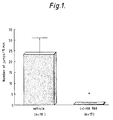
- mice Male BKTO mice (30-35 g) were treated with morphine.HCl (231 mg/kg; 718 ⁇ mol/kg s.c.) at 10:00, 14:00 and 17:00 h on day 1 and 70 mg/kg (215 ⁇ mol/kg s.c.) at the same times on days 2 and 3. On the fourth day, mice received morphine (215 ⁇ mol/kg s.c.) at 09:00 h.
- mice were injected with either saline (10 ml/kg i.p.) or (+)-HA-966 (100 mg/kg, 862 ⁇ mol/kg i.p.) and placed in perspex cages for 30 min at which time they were injected with naloxone.HCl (0.5 mg/kg, 1.5 ⁇ mol/kg i.p.) and replaced in the cages.
- naloxone.HCl 0.5 mg/kg, 1.5 ⁇ mol/kg i.p.
- Rats Male Sprague Dawley rats were made dependent on morphine following the method described by Collier et al ., Nature , 1972, 237 , 220-223. Rats were injected subcutaneously with morphine.HCl (150 mg/kg, 467 ⁇ mol/kg in 10 ml of 50:50 saline:Freunds incomplete adjuvant). 24 h later they were treated with either saline (1 ml/kg i.p.) or (+)-HA-966 (30 mg/kg, 258 ⁇ mol/kg i.p.) followed 30 min later by naloxone.HCl (2 mg/kg i.p., 6 ⁇ mol/kg i.p.).
- Noradrenaline (NA) concentration was determined using HPLC with electrochemical detection. The results obtained are plotted in Figure 2. From Figure 2 it is apparent that, in morphine-dependent rats, naloxone caused a significant decrease of locus coeruleus noradrenaline concentration when compared to morphine-treated rats given saline. Pretreatment with (+)-HA-966, meanwhile, had no effect on NA concentration in vehicle-treated rats, but prevented the naloxone-induced decrease of NA concentration. These data suggest that (+)-HA-966 prevents the change of noradrenaline metabolism in the locus coeruleus induced by naloxone in morphine-dependent rats.
- vehicle veh, 0.9% NaCl
- (+)-HA-966 (30 mg/kg i.p.)
- naloxone nal, 2 mg/kg i.p.
- (+)-HA-966 also significantly reduced irritability, but other components of the syndrome were not sufficiently intense for clear antagonism by (+)-HA-966 to be seen.
- mice Male BKTO mice (30-35 g) were injected i.p. with (+)-HA-966 (30 or 100 mg/kg) or saline, 20 min before the injection of morphine.HCl (10 mg/kg) and followed 20 min later by administration of the aromatic amino acid decarboxylase inhibitor, NSD 1015. After a further 30 min, mice were killed and the concentration of DOPA determined in the striatum and nucleus accumbens by HPLC with electrochemical detection. The results obtained are depicted in Figure 3, in which the blank bars indicate vehicle-treated mice and the hatched bars indicate morphine-treated mice. The data were analysed by 2-way ANOVA followed by Tukey test.
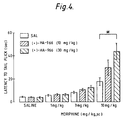
- (+)-HA-966 itself did not induce an analgesic response
- the increased tail removal latency seen following morphine (10 mg/kg) administration was dose-dependently and significantly enhanced in rats pretreated with (+)-HA-966 (10, 30 mg/kg i.p.).
Landscapes
- Health & Medical Sciences (AREA)
- General Health & Medical Sciences (AREA)
- Life Sciences & Earth Sciences (AREA)
- Chemical & Material Sciences (AREA)
- Veterinary Medicine (AREA)
- Medicinal Chemistry (AREA)
- Animal Behavior & Ethology (AREA)
- Public Health (AREA)
- Pharmacology & Pharmacy (AREA)
- Epidemiology (AREA)
- Nuclear Medicine, Radiotherapy & Molecular Imaging (AREA)
- Organic Chemistry (AREA)
- General Chemical & Material Sciences (AREA)
- Chemical Kinetics & Catalysis (AREA)
- Bioinformatics & Cheminformatics (AREA)
- Engineering & Computer Science (AREA)
- Psychiatry (AREA)
- Addiction (AREA)
- Biomedical Technology (AREA)
- Neurology (AREA)
- Neurosurgery (AREA)
- Toxicology (AREA)
- Pharmaceuticals Containing Other Organic And Inorganic Compounds (AREA)
- Medicines That Contain Protein Lipid Enzymes And Other Medicines (AREA)
Claims (11)
- Utilisation d'un composé capable d'interaction avec le site modulateur de glycine, insensible à la strychnine, du récepteur de N-méthyl-D-aspartate (NMDA), pour la fabrication d'un médicament destiné à la prévention ou à la réduction de la dépendance à l'égard d'un agent inducteur de dépendance.
- Produit contenant: (a) un agent inducteur de dépendance, choisi parmi un opiacé, un agoniste des récepteurs de benzodiazépines et un dérivé de cocaïne; et (b) un composé capable d'interaction avec le site modulateur de glycine, insensible à la strychnine, du récepteur de N-méthyl-D-aspartate (NMDA); sous forme d'une composition à plusieurs composants pour utilisation simultanée, séparée ou séquentielle dans le traitement d'un trouble contre lequel est bénéfique ledit agent inducteur de dépendance.
- Composition pharmaceutique comprenant un composé capable d'interaction avec le site modulateur de glycine, insensible à la strychnine, du récepteur de N-méthyl-D-aspartate (NMDA) en association avec un agent inducteur de dépendance, choisi parmi un opiacé, un agoniste des récepteurs de benzodiazépines, un dérivé de cocaïne et la nicotine.
- Utilisation selon la revendication 1, dans laquelle le composé capable d'interaction avec le site modulateur de glycine, insensible à la strychnine, du récepteur de NMDA est la R-(+)-3-amino-1-hydroxypyrrolidine-2-one ou un sel pharmaceutiquement acceptable de celle-ci.
- Utilisation selon la revendication 1, dans laquelle le composé capable d'interaction avec le site modulateur de glycine, insensible à la strychnine, du récepteur de NMDA est un composé de formule II ou un sel pharmaceutiquement acceptable de celui-ci:

R représentant un groupe hydrocarboné et U représentant un atome d'oxygène ou de soufre. - Utilisation selon la revendication 5, dans laquelle le composé capable d'interaction avec le site modulateur de glycine, insensible à la strychnine, du récepteur de NMDA est la cis-3-amino-1-hydroxy-4-méthylpyrrolidine-2-one ou un sel pharmaceutiquement acceptable de celle-ci.
- Utilisation selon la revendication 1, dans laquelle le composé capable d'interaction avec le site modulateur de glycine, insensible à la strychnine, du récepteur de NMDA est un composé de formule III ou un sel pharmaceutiquement acceptable de celui-ci:

R¹, R³ et R⁴ représentent indépendamment un atome d'hydrogène ou un groupe hydrocarboné;
R² représente un atome d'hydrogène ou d'halogène ou un groupe hydrocarboné, -ORa, -SRa, -NRaRb, -NRaCORb, -NRaCO₂Rb, -NRaSO₂Rb, -NRiCTNRaRb, -CO₂Ra ou -CONRaRb;
U représente un atome d'oxygène ou de soufre;
X, Y et Z représentent indépendamment une liaison ou un groupe de formule -(CH₂)m- ou -(CH₂)qCH=CH(CH₂)r-, étant entendu que X, Y et Z ne représentent pas simultanément chacun une liaison;
Ra, Rb et Ri représentent indépendamment un atome d'hydrogène ou un radical hydrocarboné;
T représente un atome d'oxygène ou de soufre, ou un groupe de formule =N.E;
E représente un radical hydrocarboné ou un groupe attirant les électrons;
m est un nombre entier allant de 1 à 4; et
q et r représentent indépendamment 0 ou 1. - Utilisation selon la revendication 7, dans laquelle le composé capable d'interaction avec le site modulateur de glycine, insensible à la strychnine, du récepteur de NMDA est choisi parmi les composés suivants:

- Utilisation selon la revendication 1, dans laquelle le composé capable d'interaction avec le site modulateur de glycine, insensible à la strychnine, du récepteur de NMDA est une 4-oxo-1,4-dihydroquinoléine comportant un groupe 2-acide ou un groupe pouvant être converti en celle-ci in vivo; ou un sel pharmaceutiquement acceptable de celle-ci.
- Utilisation selon la revendication 9, dans laquelle le composé capable d'interaction avec le site modulateur de glycine, insensible à la strychnine, du récepteur de NMDA est l'acide 7-chloro-5-iodo-4-oxo-1,4-dihydroquinoléine-2-carboxylique ou un sel pharmaceutiquement acceptable de celui-ci.
- Utilisation selon la revendication 1, dans laquelle le composé capable d'interaction avec le site modulateur de glycine, insensible à la strychnine, du récepteur de NMDA est un composé de formule V ou un sel pharmaceutiquement acceptable acceptable de celui-ci:

R⁵¹ représente un groupe acide ou un groupe pouvant être converti en celui-ci in vivo;
R⁵² représente un atome d'hydrogène ou un groupe hydrocarboné;
R⁵³ représente un atome d'hydrogène ou un groupe hydrocarboné, -ORa, -SRa, -NRaRb, -NRaCORb, -NRaCO₂Rb, -NRaSO₂Rb, -NRiCTNRaRb, -CO₂Ra ou -CONRaRb;
R⁵⁴ représente un groupe hydrocarboné, -ORa, -SRa, -NRaRb, -NRaCORb, -NRaCO₂Rb, -NRaSO₂Rb, -NRiCTNRaRb, -CO₂Ra ou -CONRaRb; ou
R⁵³ et R⁵⁴, conjointement avec l'atome de carbone concerné, représentent un groupe carbonyle (C=O), thiocarbonyle (C=S), imino (C=N.Ra), oxyimino (C=N.ORa), ou un cycle à 3-8 chaînons contenant de 0 à 4 hétéroatomes choisis parmi des atomes d'oxygène, d'azote, de soufre et de phosphore;
R⁵⁵, R⁵⁶, R⁵⁷ et R⁵⁸ représentent indépendamment un atome d'hydrogène ou d'halogène ou un groupe hydrocarboné, cyano, trifluorométhyle, nitro, -ORa, -SRa, -NRaRb ou -CO₂Ra; et
Ra, Rb, Ri, T et E sont tels que définis dans la revendication 7.
Applications Claiming Priority (2)
| Application Number | Priority Date | Filing Date | Title |
|---|---|---|---|
| GB919109007A GB9109007D0 (en) | 1991-04-26 | 1991-04-26 | Therapeutic method |
| GB9109007 | 1991-04-26 |
Publications (2)
| Publication Number | Publication Date |
|---|---|
| EP0514023A1 EP0514023A1 (fr) | 1992-11-19 |
| EP0514023B1 true EP0514023B1 (fr) | 1996-03-20 |
Family
ID=10693994
Family Applications (1)
| Application Number | Title | Priority Date | Filing Date |
|---|---|---|---|
| EP92303527A Expired - Lifetime EP0514023B1 (fr) | 1991-04-26 | 1992-04-21 | Utilisation de ligands du récepteur glycine/NMDA pour la fabrication d'un médicament pour le traitement de la dépendence aux drogues et du symptone d'abstinence |
Country Status (6)
| Country | Link |
|---|---|
| US (1) | US5629336A (fr) |
| EP (1) | EP0514023B1 (fr) |
| JP (1) | JP2575569B2 (fr) |
| CA (1) | CA2066834A1 (fr) |
| DE (1) | DE69209140T2 (fr) |
| GB (1) | GB9109007D0 (fr) |
Families Citing this family (14)
| Publication number | Priority date | Publication date | Assignee | Title |
|---|---|---|---|---|
| DE4222826A1 (de) * | 1992-07-09 | 1994-01-13 | Schering Ag | Arzneimittel zur Verhinderung der Toleranzentwicklung während der Behandlung mit Benzodiazepin-Rezeptor-Bindenen Wirkstoffen |
| US5854217A (en) | 1992-09-28 | 1998-12-29 | Bearsden Bio, Inc. | Allosteric modulators of the NMDA receptor and their use in the treatment of CNS disorders and enhancement of CNS function |
| JPH07505908A (ja) * | 1992-09-28 | 1995-06-29 | マックセチーニ、マリア ルイザ | Nmda受容体のアロステリックモジュレーター |
| US5523323A (en) * | 1993-09-14 | 1996-06-04 | Maccecchini; Maria-Luisa | Use of partial agonists of the NMDA receptor to reduce opiate induced tolerance and dependence |
| US6277825B1 (en) | 1996-07-22 | 2001-08-21 | University Of Utah Research Foundation | Use of conantokins for treating pain |
| JP2002513380A (ja) | 1996-07-22 | 2002-05-08 | コグネティックス・インコーポレイテッド | コナントキンの使用 |
| US6515103B1 (en) | 1996-07-22 | 2003-02-04 | University Of Utah Research Foundation | Conantokins |
| US6399574B1 (en) | 2000-03-22 | 2002-06-04 | University Of Utah Research Foundation | Use of conantokins |
| MXPA05011286A (es) | 2003-08-20 | 2006-01-24 | Axys Pharm Inc | Derivados de acetileno como inhibidores de histona deacetilasa. |
| ITTO20050691A1 (it) * | 2005-10-04 | 2007-04-05 | Rottapharm Spa | Uso di neboglamine nella terapia delle tossicodipendenze |
| CA3138387A1 (fr) * | 2019-05-02 | 2020-11-05 | Closed Loop Medicine Ltd | Procedes et systemes d'administration de medicament personnalise a un patient |
| US20230317230A1 (en) * | 2019-05-02 | 2023-10-05 | Closed Loop Medicine Ltd. | Method for treating obesity |
| US12597496B2 (en) | 2023-06-05 | 2026-04-07 | Closed Loop Medicine Ltd. | Dosing of incretin pathway drugs |
| US12420014B2 (en) | 2023-06-05 | 2025-09-23 | Closed Loop Medicine Ltd. | Dosing of incretin pathway drugs |
Citations (1)
| Publication number | Priority date | Publication date | Assignee | Title |
|---|---|---|---|---|
| EP0503349A1 (fr) * | 1991-03-15 | 1992-09-16 | Neurosearch A/S | Dérivés de l'hydrazone, leur préparation et leur utilisation |
Family Cites Families (5)
| Publication number | Priority date | Publication date | Assignee | Title |
|---|---|---|---|---|
| GB8719102D0 (en) * | 1987-08-12 | 1987-09-16 | Merck Sharp & Dohme | Therapeutic agents |
| GB8727792D0 (en) * | 1987-11-27 | 1987-12-31 | Merck Sharp & Dohme | Therapeutic agents |
| GB8823605D0 (en) * | 1988-10-07 | 1988-11-16 | Merck Sharp & Dohme | Therapeutic agents |
| IL93610A0 (en) * | 1989-03-08 | 1990-12-23 | Merck Sharp & Dohme | Tetrahydroquinoline derivatives,their preparation and pharmaceutical compositions containing them |
| GB8908529D0 (en) * | 1989-04-14 | 1989-06-01 | Merck Sharp & Dohme | Therapeutic agents |
-
1991
- 1991-04-26 GB GB919109007A patent/GB9109007D0/en active Pending
-
1992
- 1992-04-21 DE DE69209140T patent/DE69209140T2/de not_active Expired - Fee Related
- 1992-04-21 EP EP92303527A patent/EP0514023B1/fr not_active Expired - Lifetime
- 1992-04-22 CA CA002066834A patent/CA2066834A1/fr not_active Abandoned
- 1992-04-24 JP JP4106660A patent/JP2575569B2/ja not_active Expired - Lifetime
-
1994
- 1994-02-22 US US08/199,901 patent/US5629336A/en not_active Expired - Fee Related
Patent Citations (1)
| Publication number | Priority date | Publication date | Assignee | Title |
|---|---|---|---|---|
| EP0503349A1 (fr) * | 1991-03-15 | 1992-09-16 | Neurosearch A/S | Dérivés de l'hydrazone, leur préparation et leur utilisation |
Non-Patent Citations (6)
| Title |
|---|
| br.j.pharmacol., vol. 108, 1993, pages 1156-1163 * |
| eur.j.pharmacol., vol. 167, 1989, pages 127-135 * |
| EUR.J.PHARMACOL., vol. 197, no. 1, 1991, pages 9-16; RASMUSSEN ET AL.: 'NMDA receptor antagonists suppress behaviors but not norepinephrine turnover or locus coeruleus unit activity induced by opiate withdrawal' * |
| j.neurochem., vol. 51, 1988, pages 830-836 * |
| pain, vol. 51, 1992, pages 249-253 * |
| us priority 670061 of 1991 * |
Also Published As
| Publication number | Publication date |
|---|---|
| EP0514023A1 (fr) | 1992-11-19 |
| US5629336A (en) | 1997-05-13 |
| CA2066834A1 (fr) | 1992-10-27 |
| DE69209140T2 (de) | 1996-09-19 |
| JP2575569B2 (ja) | 1997-01-29 |
| JPH05132430A (ja) | 1993-05-28 |
| DE69209140D1 (de) | 1996-04-25 |
| GB9109007D0 (en) | 1991-06-12 |
Similar Documents
| Publication | Publication Date | Title |
|---|---|---|
| US5502058A (en) | Method for the treatment of pain | |
| US3966940A (en) | Analgetic compositions | |
| JP2000508341A (ja) | 片頭痛の治療法及び薬効の強化組成物 | |
| US6071918A (en) | Combination of an opioid antagonist and a selective serotonin reuptake inhibitor for treatment of alcoholism and alcohol dependence | |
| CN100448439C (zh) | 用于头痛、偏头痛、恶心和呕吐的药物组合物 | |
| EP0229022A2 (fr) | Compositions pharmaceutiques contenant des analgésiques et de la caféine | |
| US5629336A (en) | Use of glycine/NMDA receptor ligands for the treatment of drug dependence and withdrawal | |
| US6538008B1 (en) | Combination of a selective NMDA NR2B antagonist and an opioid analgesic | |
| EP1161263A1 (fr) | Compositions analgesiques comprenant des composes anti-epileptiques, et leurs procedes d'utilisation | |
| CA2197554A1 (fr) | Combinaison d'un antagoniste opioide et d'un inhibiteur de la reabsortion selective de serotonine pour le traitement de l'alcoolisme et de la dependance de l'alcool | |
| CA2723685A1 (fr) | Administration orale d'antagonistes des opioides agissant au niveau peripherique | |
| US5057519A (en) | 5-HT3 antagonists: use in reducing opiate tolerance | |
| CH708257B1 (de) | Zusammensetzung zur Behandlung einer Opioid-induzierten unerwünschten pharmakodynamischen Reaktion. | |
| JP2003520234A (ja) | 薬物中毒の治療方法 | |
| JPS6342605B2 (fr) | ||
| IE873005L (en) | The use of paroxetine for treatment of pain | |
| JPS63500598A (ja) | 抗けいれん剤組成物と方法 | |
| SE466481B (sv) | Analgetiska och anti-inflammatoriska kompositioner innefattande koffein | |
| JP2006131545A (ja) | 神経因性疼痛治療剤 | |
| US4479956A (en) | Analgesic compositions comprising propiram and methods of using same | |
| US4576951A (en) | Proglumide, pharmaceutical preparations and compositions including it for use in human pain relief | |
| CN116808038A (zh) | 阿片类物质和n-酰基乙醇胺的组合 | |
| EP0844241B1 (fr) | Inhibiteur de la dependance / de la resistance a l'egard des analgesiques narcotiques | |
| RU2003135201A (ru) | Применение антагониста опиоидов налтрексона для предупреждения и контроля побочных воздействий, вызванных опиоидами | |
| CN101600433B (zh) | 用于预防或治疗酒精依赖或药物依赖的药剂 |
Legal Events
| Date | Code | Title | Description |
|---|---|---|---|
| PUAI | Public reference made under article 153(3) epc to a published international application that has entered the european phase |
Free format text: ORIGINAL CODE: 0009012 |
|
| AK | Designated contracting states |
Kind code of ref document: A1 Designated state(s): CH DE FR GB IT LI NL |
|
| 17P | Request for examination filed |
Effective date: 19930406 |
|
| 17Q | First examination report despatched |
Effective date: 19930621 |
|
| GRAH | Despatch of communication of intention to grant a patent |
Free format text: ORIGINAL CODE: EPIDOS IGRA |
|
| GRAA | (expected) grant |
Free format text: ORIGINAL CODE: 0009210 |
|
| AK | Designated contracting states |
Kind code of ref document: B1 Designated state(s): CH DE FR GB IT LI NL |
|
| PG25 | Lapsed in a contracting state [announced via postgrant information from national office to epo] |
Ref country code: IT Free format text: LAPSE BECAUSE OF FAILURE TO SUBMIT A TRANSLATION OF THE DESCRIPTION OR TO PAY THE FEE WITHIN THE PRESCRIBED TIME-LIMIT;WARNING: LAPSES OF ITALIAN PATENTS WITH EFFECTIVE DATE BEFORE 2007 MAY HAVE OCCURRED AT ANY TIME BEFORE 2007. THE CORRECT EFFECTIVE DATE MAY BE DIFFERENT FROM THE ONE RECORDED. Effective date: 19960320 Ref country code: NL Free format text: LAPSE BECAUSE OF FAILURE TO SUBMIT A TRANSLATION OF THE DESCRIPTION OR TO PAY THE FEE WITHIN THE PRESCRIBED TIME-LIMIT Effective date: 19960320 |
|
| REG | Reference to a national code |
Ref country code: CH Ref legal event code: NV Representative=s name: E. BLUM & CO. PATENTANWAELTE |
|
| REF | Corresponds to: |
Ref document number: 69209140 Country of ref document: DE Date of ref document: 19960425 |
|
| ET | Fr: translation filed | ||
| NLV1 | Nl: lapsed or annulled due to failure to fulfill the requirements of art. 29p and 29m of the patents act | ||
| PLBE | No opposition filed within time limit |
Free format text: ORIGINAL CODE: 0009261 |
|
| STAA | Information on the status of an ep patent application or granted ep patent |
Free format text: STATUS: NO OPPOSITION FILED WITHIN TIME LIMIT |
|
| 26N | No opposition filed | ||
| PGFP | Annual fee paid to national office [announced via postgrant information from national office to epo] |
Ref country code: FR Payment date: 19990331 Year of fee payment: 8 |
|
| PGFP | Annual fee paid to national office [announced via postgrant information from national office to epo] |
Ref country code: DE Payment date: 19990402 Year of fee payment: 8 |
|
| PGFP | Annual fee paid to national office [announced via postgrant information from national office to epo] |
Ref country code: CH Payment date: 19990407 Year of fee payment: 8 |
|
| PG25 | Lapsed in a contracting state [announced via postgrant information from national office to epo] |
Ref country code: LI Free format text: LAPSE BECAUSE OF NON-PAYMENT OF DUE FEES Effective date: 20000430 Ref country code: CH Free format text: LAPSE BECAUSE OF NON-PAYMENT OF DUE FEES Effective date: 20000430 |
|
| REG | Reference to a national code |
Ref country code: CH Ref legal event code: PL |
|
| PG25 | Lapsed in a contracting state [announced via postgrant information from national office to epo] |
Ref country code: FR Free format text: LAPSE BECAUSE OF NON-PAYMENT OF DUE FEES Effective date: 20001229 |
|
| PG25 | Lapsed in a contracting state [announced via postgrant information from national office to epo] |
Ref country code: DE Free format text: LAPSE BECAUSE OF NON-PAYMENT OF DUE FEES Effective date: 20010201 |
|
| REG | Reference to a national code |
Ref country code: FR Ref legal event code: ST |
|
| PGFP | Annual fee paid to national office [announced via postgrant information from national office to epo] |
Ref country code: GB Payment date: 20010315 Year of fee payment: 10 |
|
| REG | Reference to a national code |
Ref country code: GB Ref legal event code: IF02 |
|
| PG25 | Lapsed in a contracting state [announced via postgrant information from national office to epo] |
Ref country code: GB Free format text: LAPSE BECAUSE OF NON-PAYMENT OF DUE FEES Effective date: 20020421 |
|
| GBPC | Gb: european patent ceased through non-payment of renewal fee |
Effective date: 20020421 |