EP0514112A2 - Structure de données enchaînée - Google Patents
Structure de données enchaînée Download PDFInfo
- Publication number
- EP0514112A2 EP0514112A2 EP92304236A EP92304236A EP0514112A2 EP 0514112 A2 EP0514112 A2 EP 0514112A2 EP 92304236 A EP92304236 A EP 92304236A EP 92304236 A EP92304236 A EP 92304236A EP 0514112 A2 EP0514112 A2 EP 0514112A2
- Authority
- EP
- European Patent Office
- Prior art keywords
- node
- access
- count
- counter
- link
- Prior art date
- Legal status (The legal status is an assumption and is not a legal conclusion. Google has not performed a legal analysis and makes no representation as to the accuracy of the status listed.)
- Withdrawn
Links
Images




Classifications
-
- G—PHYSICS
- G06—COMPUTING OR CALCULATING; COUNTING
- G06F—ELECTRIC DIGITAL DATA PROCESSING
- G06F9/00—Arrangements for program control, e.g. control units
- G06F9/06—Arrangements for program control, e.g. control units using stored programs, i.e. using an internal store of processing equipment to receive or retain programs
- G06F9/46—Multiprogramming arrangements
- G06F9/52—Program synchronisation; Mutual exclusion, e.g. by means of semaphores
-
- G—PHYSICS
- G06—COMPUTING OR CALCULATING; COUNTING
- G06F—ELECTRIC DIGITAL DATA PROCESSING
- G06F16/00—Information retrieval; Database structures therefor; File system structures therefor
- G06F16/90—Details of database functions independent of the retrieved data types
- G06F16/901—Indexing; Data structures therefor; Storage structures
- G06F16/9024—Graphs; Linked lists
-
- Y—GENERAL TAGGING OF NEW TECHNOLOGICAL DEVELOPMENTS; GENERAL TAGGING OF CROSS-SECTIONAL TECHNOLOGIES SPANNING OVER SEVERAL SECTIONS OF THE IPC; TECHNICAL SUBJECTS COVERED BY FORMER USPC CROSS-REFERENCE ART COLLECTIONS [XRACs] AND DIGESTS
- Y10—TECHNICAL SUBJECTS COVERED BY FORMER USPC
- Y10S—TECHNICAL SUBJECTS COVERED BY FORMER USPC CROSS-REFERENCE ART COLLECTIONS [XRACs] AND DIGESTS
- Y10S707/00—Data processing: database and file management or data structures
- Y10S707/99931—Database or file accessing
- Y10S707/99938—Concurrency, e.g. lock management in shared database
-
- Y—GENERAL TAGGING OF NEW TECHNOLOGICAL DEVELOPMENTS; GENERAL TAGGING OF CROSS-SECTIONAL TECHNOLOGIES SPANNING OVER SEVERAL SECTIONS OF THE IPC; TECHNICAL SUBJECTS COVERED BY FORMER USPC CROSS-REFERENCE ART COLLECTIONS [XRACs] AND DIGESTS
- Y10—TECHNICAL SUBJECTS COVERED BY FORMER USPC
- Y10S—TECHNICAL SUBJECTS COVERED BY FORMER USPC CROSS-REFERENCE ART COLLECTIONS [XRACs] AND DIGESTS
- Y10S707/00—Data processing: database and file management or data structures
- Y10S707/99951—File or database maintenance
- Y10S707/99952—Coherency, e.g. same view to multiple users
Definitions
- This invention relates to multiprocessing operating systems.
- One solution is to have readers check if the "target data" (the data being read) was modified during the read operation. If this condition is met and it is determined that the target data has been modified, the reader merely attempts to read again.
- This solution to the Reader-Writer problem may be suboptimal if writers (or modification operations) are relatively frequent and the read operations are of relatively long duration.
- the present system and method is directed to read only access without blocking, but the present invention does not address the problem of coordinating multiple writer processes.
- the present invention does not preclude a solution to the multiple writer problem.
- it is possible that mutual exclusion may be used in conjunction with the present invention to coordinate multiple writer processes.
- the present invention is also applicable to data accessed by multiple processes.
- the present system and method is complementary to conventional methods of serialisation, such as locking techniques.
- the present invention has less blocking and therefore permits more efficient read only access.
- Prior art reader processes do not access linked data structures at all during modification by virtue of conventional locks, so some mechanism, such as that described in US-A-4809168, must be employed to allow access to the data structure while it is being modified.
- the present invention employs access vectors which permit read only processes to continue while the list is being modified.
- the preferred embodiment is an implementation of the processing of linked lists where each data object is assigned an access vector and a plurality of read only processes proceed through each element of the list.
- Each access vector contains a pointer to other data objects in the data structure and contains a count of transfers of read access from the data object containing the access vector to the data object pointed to by the access vector. Comparison of the counts of transfers of read accesses to a data object and counts of subsequent transfers of read access from the data object allow determination of the number of current read accesses to the data object.
- a data structure can be modified by changing the pointers much in the same way that conventional linked data structures are changed.
- the access counts within the access vectors are adjusted if necessary to ensure accuracy of determination of the current read access counts.
- Deletion of a data object from a data structure should first remove all pointers to the data object to ensure no new read accesses to the data object occur, wait until all current read accesses have completed, remove all pointers from the data object to other data objects, and then discard the data object.
- Modifications of the contents of the access vectors are atomic to ensure accurate coordination of reader and writer processes.
- a computer platform 102 of one of several individual processors include a hardware unit 110, which includes a central processing unit (CPU) 114, a main memory or random access memory (RAM) 112, and an input/output interface 116.
- a hardware unit 110 which includes a central processing unit (CPU) 114, a main memory or random access memory (RAM) 112, and an input/output interface 116.
- CPU central processing unit
- RAM random access memory
- Each of the computer platforms 102 may include a micro instruction code 108 (or a reduced instruction set, for instance), and an operating system 106.
- the access vectors of the present system and method are assigned to data objects in a shared data storage 124, and may be processed by the operating systems 106 connected thereto by links 122.
- the shared data storage device 124 is also called a secondary non-volatile storage and may include hard disks and/or tape drives and their equivalents.
- External databases 134 may be stored on the shared data storage 124.
- Various peripheral components may be connected to a computer platform 102, such as a terminal 120, and a printing device 128.
- the operating system may use virtual memory and manage all paging.
- a user 132 can interact with the computer platform 102 via the terminal 120.
- the computer platform 102 includes a computer having an IBM System 390 architecture.
- the operating system 106 which runs thereon is an IBM Multiple Virtual Storage (MVS).
- MVS IBM Multiple Virtual Storage
- the amount of the current contents of the tank can be determined by subtracting the sum of the values of the output gauges from the sum of the values of the input gauges, and adjusting this result by an amount based on the initial values of the gauges and the amount of water initially contained in the tank.
- a tank may be discarded after its inputs have been disconnected and it has been drained.
- the present invention uses ACCESS VECTORs to permit read only processes (called "readers") to continue while the list is being modified.
- One or more ACCESS VECTORs are created and maintained for each data object.
- the ACCESS VECTOR contains a ACCESS COUNT of the number of accesses to a next data object and a pointer (or LINK) to the next data structure.
- an ACCESS VECTOR is a data object comprising:
- Each read only access to a data object causes the ACCESS COUNT in the accessing object vector to be incremented.
- the number of read only accesses in effect for a node is the sum of ACCESS COUNTs of all ACCESS VECTORs pointing to that node (hereafter called "IN-POINTERs"), minus the ADJ and minus the sum of ACCESS COUNTs of all ACCESS VECTORs with access to that node (hereafter called "OUT-POINTERs").
- the abbreviated form of the foregoing definition is: ⁇ (IN) ⁇ (ADJ + ⁇ (OUT))
- an “adjustment count” may be defined for each node (i.e., each data object) to eliminate the necessity for adjustments to ACCESS COUNTs.
- An ADJ may be considered an ACCESS VECTOR with its LINK pointer permanently set to nil. Propagation of adjustments can be stopped in looped data structures using the ADJ, because the LINK of the ADJ count is always nil.
- readers Traversal of nodes by read processes (called “readers") is accomplished by atomically incrementing the access count (p_av.cnt) and fetching the pointer value (p_av.link).
- An atomic operation is defined with respect to other processes, (as an operation which is instantaneous as viewed by other processes, thus, other processes can only see the final result of a grouped set of atomic steps and not partial results.
- This may be implemented via special hardware instructions such as IBM System 390 Compare Double and Swap, or by conventional methods of mutual exclusion such as spin locks, though using spin locks may somewhat reduce the advantages yielded by the present invention.
- the ADJ count for that node is incremented by the value of the IN-POINTER's ACCESS COUNT in effect at the time the IN-POINTER was added. If no ADJ count exists, then the ACCESS COUNT of a designated OUT-POINTER is incremented, and the designated OUT-POINTER of any node pointed to by any OUT-POINTER thus incremented, is also incremented by the same amount. This adjustment is propagated along the links of subsequent OUT-POINTERs until a nil or zero pointer is found.
- the ADJ count for that node is decremented by the value of the ACCESS COUNT in effect at the time the IN-POINTER was removed. Decrements of designated OUT-POINTER counts are similar in logic to the above described increment of OUT-POINTERS. In other words, the ADJ count for a node is decremented by the value of the ACCESS COUNT in effect at the time the OUT-POINTER was removed.
- Changing a LINK entails deleting a LINK for one node and adding it to another.
- nodes may be deleted by a polling operation or by a deallocation protocol.
- a data object (or node) in the list can be replaced or deleted by first changing the LINKs of all objects that point to that data object to point to a changed (or new) object, and then modifying the ACCESS COUNT of the data object by subtracting the maximum value of the ACCESS COUNTs pointing to the object from the value of the ACCESS COUNT in the object.
- Read only accesses out of the object continue to decrement the ACCESS COUNT of the object, and when the ACCESS COUNT reaches zero the object can be deleted. Because only the LINKs to the data object had been changed, read only processes can continue without pausing for the change or replacement event.
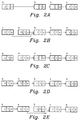
- Each access vector includes three fields, including an ACCESS COUNT field, a DEALLOCATION FLAG field (0 means that the node is to be deallocated), and a LINK field (0 means no link exists), for left to right, respectively.
- the linked list (FIG. 2A) is anchored by node q which is used to access the list and is not part of the list itself.
- the letter in the LINK field of each of the ACCESS VECTORS represents the next node pointed to by that specific ACCESS VECTOR.
- the LINK in q points to node b, the LINK in b points to node c, and so on.
- the 0 in the LINK of node d signifies that node d is the last node in the linked list.
- a first reader has completely traversed and exited the listing incrementing all the access counts to 1.
- a second reader has accessed the first element in the list via the access vector in q and thus incremented the ACCESS COUNT of node q to 2.
- the reader has fetched the LINK of q which points to the next node, then the reader incremented the ACCESS COUNT of node q and moved on to node b.
- the reader has not completed the operation(s) at node b.
- the number of readers with access to node b can be determined by summing the IN-POINTERs (2 from the ACCESS COUNT of node q) and subtracting the sum of the OUT-POINTERs (1 at node b), which equals 1 reader. This same analysis is performed on nodes c and d to determine that no readers have access to either node.
- the insertion of a new node a into the list by a writer is shown in FIG. 2B.
- the ACCESS COUNT of new node a is initially 0, because no reader process has yet accessed the node. (I.e., the sum of the IN-POINTERs are 0 at node a.) Therefore, no adjustment need be made.
- the LINK in node a points to node b.
- the ACCESS COUNT of node b has not changed, because adding 0 does not change it.
- FIG. 2C represents the deletion of an IN-POINTER at node b.
- the OUT-POINTER of node q had been deleted and its LINK is set to 0 to reflect this change.
- the ACCESS COUNT of node b must be adjusted.
- the ACCESS COUNT of node b is decremented by the value of 2, because the ACCESS COUNT of node q was 2 and to maintain the proper number or readers that have accessed node b the ACCESS COUNT must be changed to -1. To check if the number of readers that have accessed node b is correct, the values may be put into the equations. Zero IN-POINTERs minus -1 ACCESS COUNT yields 1, which is the correct number of readers that have accessed node b as the ACCESS COUNT is the same as the sum of the values of the OUT-POINTERs.
- the ACCESS COUNT propagates down the linked list.
- the proper number of readers that have access to nodes c and d must also be valid upon inspection of their respective ACCESS COUNTs.
- the ACCESS COUNTs of nodes c and d are also -1.
- FIG 2B to FIG 2D shows the switching of the OUT-POINTER of node q from node b to node a.
- the above discussed deletion of the LINK from node q to node b was to illustrate an intermediate step in the process of switching the LINK. In practice, however, this will never be seen because the LINK is switched, not deleted. Hence, adding the LINK from node q to node a will add 2 to all subsequent ACCESS COUNTs giving the result shown in FIG. 2D.
- the ACCESS COUNT of node a (FIG 2D) is 2, because no readers have accessed node a.
- the sum of the IN-POINTERs to node b is 2 from node a, minus the ACCESS COUNT of node b which is 1, yields 1 reader at node b.
- nodes c and d are 2, because no readers have accessed node a.
- the sum of the IN-POINTERs to node b is 2 from node a, minus the ACCESS COUNT of node b which is 1, yields 1 reader at no
- the delinking of node b is shown in FIG. 2E.
- the LINK of node a is switched from node b to node c.
- the ACCESS COUNT of node b is changed to -1 to reflect the fact that one reader still has access to node b (0 IN-POINTERS minus 1 OUT-POINTER equals -1). (There are no readers at nodes c and d.
- the DEALLOCATION FLAG of node b is then set to 0.
- the ACCESS COUNTs of nodes c and d appear unchanged. However, their ACCESS COUNTs did change during deallocation of node b.
- the ACCESS COUNT of nodes b and c changed from 1 to -1. Then, the ACCESS COUNT of node c changed back to 1 when LINK of node a was changed to point to node c.
- the ACCESS COUNT of node d tracked the changes to the ACCESS COUNT of node c.
- the deallocation of node c is shown in FIG. 2F.
- the ACCESS COUNT of node c is reduced by 2 from 1 to -1.
- the ACCESS COUNT of node d would be reduced by 2 from 1 to -1, but the addition of the new IN-POINTER from node a increases the ACCESS COUNT of node d from -1 back to 1.
- Node c can then be deleted because no readers have access to it. Alternatively, node c need not be deleted immediately, because if the reader was to move off node b and onto node c, the reader would see that the deallocation flag was set and the reader would delete node c and move onto node d.
- FIG. 2G shows the optional deletion of node c from the linked list.
- the LINK of node b is changed to point to node d, thus, the ACCESS COUNT of node d remains unchanged.
- the ACCESS COUNT of node d is 1.
- the reader moves off node b and onto node d, as shown in FIG. 2H, and the reader increments the ACCESS COUNT.
- the ACCESS COUNT of node b becomes 0, and node b is safe to delete from the list.
- the sum of the IN-POINTERs (2 from node a) minus the ACCESS COUNT (1) equals 1 reader.
- FIG. 2I shows the deletion of node b and the exit of the reader from the list.
- the ACCESS COUNT of node d was incremented to 2 by the departing reader.
- the first step to accomplish a traversal from one node to the next is to increment the value of the ACCESS COUNT (av.cnt) of the present node that p is pointing to.
- the second step is to fetch the value of the LINK field (av.link) of the next node , which is the pointer to the next node in the list.
- the above logic may be substituted in conventional systems to replace the conventional logic used to pick up the next link in the list.
- the write process (called the "writer") may delegate the responsibility of deallocating the node to the last reader with access to the node. This is sometimes called obligation passing. Accordingly, a protocol for recognition of this obligation is incorporated into the present system and method. Hence, the deletion of nodes in conjunction with the present invention may be done by polling or with the deallocation protocol. Both of these processes will be discussed in further detail hereafter.
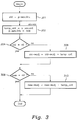
- the second step 302 is atomic: a temporary counter (temp_cnt) is set to the ACCESS COUNT (p->av.cnt) of the present node, and the pointer "new_link” pointing to the next node is stored in the current LINK field (p->av.link).
- the old_link value is evaluated in a conditional step 304. If the old ACCESS COUNT is not equal to zero (or "nil"), the old ADJ count (old_adj) is reduced by the temporary counter (temp_cnt) Flow then proceeds to a conditional step 308. Likewise, if the old ACCESS COUNT is verified as nil in the conditional step 304, the process flow continues to the conditional step 308 in which the value of new_link is then evaluated. If the value of new_link is not nil, the new ADJ count (new_adj) is reduced by the temporary counter (temp_cnt), in step 310. Flow then continues. Likewise, the process is complete if the new pointer value is verified as nil in the conditional step 308.
- the following is an example of the pseudo code for deletion of a node using the deallocation protocol.
- the following protocol uses the DEALLOCATION FLAG field of the ACCESS VECTOR.
- the node is made unreachable to readers (by deleting all LINKs to the node).
- the following steps are performed by the writer:
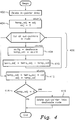
- step 416 The logic for deletion of the OUT-POINTERS in step 416 is the same as that described in connection with FIG. 2. If the above process continues and the temp_adj is not 0, the obligation of node deletion is passed to the reader.
- ADJ count is used to coordinate reader/writer deletion of the node.
- a designated OUT-POINTER ACCESS COUNT could be used as has been mentioned before, but depending on the data structure, the operation could become overly complicated.
- Linked lists enable simpler and more efficient modification techniques, because they have only one OUT-POINTER and are iterative in nature.
- the single OUT-POINTER of the linked list becomes the designated ADJ count for implementation of the present system and method.
- the linked list insert and delete node operations involve delinking and linking of the same sublist with the same increment and decrement count that propagates through the sublist, thus cancelling each other. Hence, it is only necessary to adjust the count in the node being added or deleted.
- a writer performs the following steps to add a new node to a linked list in connection with the present invention.
- the node labelled "prev” is similar to node q of FIG. 2a
- the node "new” is similar to node a
- the node “next” is similar to node b.
- node "cur” is similar to node b in Fig 2E and node "previous” is similar to node a.
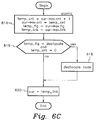
- a reader performs the following steps (Fig.6C) to traverse nodes in a linked list:
- the access vector, AVEC is a 64 bit doubleword defined as follows:
- the contents of the ACCESS VECTOR are loaded into registers 0 and 1 at Load Multiple (LM) 0,1 AVEC.
- (Register 0 is loaded with bits 0-31, the ACCESS VECTOR, and the last bit is loaded with the DEALLOCATION FLAG.
- Register 1 is loaded with the LINK pointer.
- LOOP is a label and the Declare Storage (DS 0H) is a placeholder for the label.
- the constant 2 is loaded into register 14 by the command Load Address (LA) 14,2.
- the 2 is "10" in binary; therefore, a 1 is placed in bits 0-30 of register 14, and a 0 is placed in bit 31.
- a mapping out of the ACCESS VECTOR in register 14 would yield a 1 in the ACCESS COUNT field, and a 0 in the FLAG field.
- a 1 is loaded into register 15 by the command Load Register (LR) 15,1.
- Add Logical Register (ALR) 14,0 adds the contents of register 0 to the contents of register 14.
- This command increments bits 0-30 (the ACCESS COUNT) which sets the condition code according to the results of the operation.
- Branch on Condition (BC) 10 where decimal 10 is a binary mask "1010", permits simultaneous testing for condition codes 0 and 2. For add logical, the result is a 0 with no carry and a 0 with carry, respectively. The carry bit is ignored. If the result of the ALR is not 0, the Compare Double and Swap (CDS) 0,14 AVEC command is executed. Registers 0 and 1, which contain the old value of the ACCESS VECTOR, will be compared to registers 14 and 15, which contain the new value of the ACCESS VECTOR.
- CDS Compare Double and Swap
- BE Branch on Equal condition
- the implementation using the present invention is approximately twice as efficient as the method using spin locks to achieve the same amount of granularity (i.e., the size of the unit of locking, like field or record units, for example).
- a spin lock is usually implemented by compare and swap logic. To achieve the same level of granularity, two spin locks would have to be used; one for accessing the link to the object, and another for accessing the data object itself. Every visitation of the object by a reader process would entail acquiring the spin lock for the link, accessing the object, acquiring the spin lock for the object, releasing the spin lock for the link, and after completing the visitation of the object, releasing the spin lock for the object.
- Four compare and swaps are required by the conventional spin lock technique, verses two for the access vectors of the present invention.
- read access by means of the present invention is independent of conventional techniques, processes with read access can do things not usually possible with conventional techniques, such as: acquiring write (exclusive) access while still holding read access; and removing a currently accessed node from the list.
- the present invention can also allow a list lookup for the purpose of removing a node without acquiring exclusive access immediately, thus minimising the amount of exclusive access held.
Landscapes
- Engineering & Computer Science (AREA)
- Theoretical Computer Science (AREA)
- Software Systems (AREA)
- Databases & Information Systems (AREA)
- Physics & Mathematics (AREA)
- General Engineering & Computer Science (AREA)
- General Physics & Mathematics (AREA)
- Data Mining & Analysis (AREA)
- Information Retrieval, Db Structures And Fs Structures Therefor (AREA)
- Memory System (AREA)
Applications Claiming Priority (2)
| Application Number | Priority Date | Filing Date | Title |
|---|---|---|---|
| US07/701,253 US5295262A (en) | 1991-05-16 | 1991-05-16 | Read-only access without blocking via access vectors |
| US701253 | 1991-05-16 |
Publications (2)
| Publication Number | Publication Date |
|---|---|
| EP0514112A2 true EP0514112A2 (fr) | 1992-11-19 |
| EP0514112A3 EP0514112A3 (en) | 1994-11-23 |
Family
ID=24816604
Family Applications (1)
| Application Number | Title | Priority Date | Filing Date |
|---|---|---|---|
| EP19920304236 Withdrawn EP0514112A3 (en) | 1991-05-16 | 1992-05-12 | Linked data structure |
Country Status (3)
| Country | Link |
|---|---|
| US (1) | US5295262A (fr) |
| EP (1) | EP0514112A3 (fr) |
| JP (1) | JPH0778105A (fr) |
Cited By (4)
| Publication number | Priority date | Publication date | Assignee | Title |
|---|---|---|---|---|
| WO1996037833A1 (fr) * | 1995-05-23 | 1996-11-28 | International Business Machines Corporation | Systeme et procede de traitement de donnees |
| EP0769740A1 (fr) * | 1995-10-17 | 1997-04-23 | International Business Machines Corporation | Communication interobjet |
| EP0807884A1 (fr) * | 1996-05-17 | 1997-11-19 | Sun Microsystems, Inc. | Procédé et dispositif pour l'élimination des objets dans un environnement à fils multiples |
| EP1186999A3 (fr) * | 2000-06-15 | 2004-04-28 | International Business Machines Corporation | Procédé et dispositif pour maintenir des listes chaínées |
Families Citing this family (14)
| Publication number | Priority date | Publication date | Assignee | Title |
|---|---|---|---|---|
| ATE192592T1 (de) * | 1995-01-26 | 2000-05-15 | Hans Verner Thorsen | Verfahren und system um auf daten zuzugreifen |
| US5832484A (en) * | 1996-07-02 | 1998-11-03 | Sybase, Inc. | Database system with methods for parallel lock management |
| US5924098A (en) * | 1997-06-30 | 1999-07-13 | Sun Microsystems, Inc. | Method and apparatus for managing a linked-list data structure |
| US6119115A (en) | 1998-03-12 | 2000-09-12 | Microsoft Corporation | Method and computer program product for reducing lock contention in a multiple instruction execution stream processing environment |
| US6185562B1 (en) | 1998-06-05 | 2001-02-06 | International Business Machines Corporation | Performing parallel cleanup of segments of a lock structure |
| US6233644B1 (en) * | 1998-06-05 | 2001-05-15 | International Business Machines Corporation | System of performing parallel cleanup of segments of a lock structure located within a coupling facility |
| US6178421B1 (en) | 1998-06-05 | 2001-01-23 | International Business Machines Corporation | Method of performing parallel cleanup of segments of a lock structure |
| US7013305B2 (en) | 2001-10-01 | 2006-03-14 | International Business Machines Corporation | Managing the state of coupling facility structures, detecting by one or more systems coupled to the coupling facility, the suspended state of the duplexed command, detecting being independent of message exchange |
| US6178473B1 (en) * | 1998-10-15 | 2001-01-23 | Compaq Computer Corporation | System for selectively incrementing a count number of an associated node only when the node is put in use in conjunction with a successful compare and swap operation |
| US8688853B2 (en) * | 2001-12-21 | 2014-04-01 | Agere Systems Llc | Method and apparatus for maintaining multicast lists in a data network |
| US7451146B2 (en) * | 2004-06-30 | 2008-11-11 | Hewlett-Packard Development Company, L.P. | Almost non-blocking linked stack implementation |
| US20080126787A1 (en) * | 2006-06-05 | 2008-05-29 | International Business Machines Corporation | System, method and program for managing default values for computer programs |
| KR102239280B1 (ko) * | 2014-04-30 | 2021-04-13 | 오라클 인터내셔날 코포레이션 | 트랜잭셔널 미들웨어 머신 환경에서 적응적 셀프-튜닝 락킹 메커니즘을 지원하는 시스템 및 방법 |
| US20210405913A1 (en) * | 2020-06-26 | 2021-12-30 | Micron Technology, Inc. | Host access tracking in a memory sub-system |
Family Cites Families (3)
| Publication number | Priority date | Publication date | Assignee | Title |
|---|---|---|---|---|
| GB8529890D0 (en) * | 1985-12-04 | 1986-01-15 | Watson P | Garbage collection in computer system |
| US4912629A (en) * | 1986-06-26 | 1990-03-27 | The United States Of America As Represented By The Administrator Of The National Aeronautics And Space Administration | Real-time garbage collection for list processing using restructured cells for increased reference counter size |
| US5113519A (en) * | 1989-05-15 | 1992-05-12 | International Business Machines Corporation | Maintenance of file attributes in a distributed data processing system |
-
1991
- 1991-05-16 US US07/701,253 patent/US5295262A/en not_active Expired - Fee Related
-
1992
- 1992-04-23 JP JP4104217A patent/JPH0778105A/ja active Pending
- 1992-05-12 EP EP19920304236 patent/EP0514112A3/en not_active Withdrawn
Cited By (6)
| Publication number | Priority date | Publication date | Assignee | Title |
|---|---|---|---|---|
| WO1996037833A1 (fr) * | 1995-05-23 | 1996-11-28 | International Business Machines Corporation | Systeme et procede de traitement de donnees |
| EP0769740A1 (fr) * | 1995-10-17 | 1997-04-23 | International Business Machines Corporation | Communication interobjet |
| US6587889B1 (en) | 1995-10-17 | 2003-07-01 | International Business Machines Corporation | Junction manager program object interconnection and method |
| EP0807884A1 (fr) * | 1996-05-17 | 1997-11-19 | Sun Microsystems, Inc. | Procédé et dispositif pour l'élimination des objets dans un environnement à fils multiples |
| US6247039B1 (en) | 1996-05-17 | 2001-06-12 | Sun Microsystems, Inc. | Method and apparatus for disposing of objects in a multi-threaded environment |
| EP1186999A3 (fr) * | 2000-06-15 | 2004-04-28 | International Business Machines Corporation | Procédé et dispositif pour maintenir des listes chaínées |
Also Published As
| Publication number | Publication date |
|---|---|
| US5295262A (en) | 1994-03-15 |
| JPH0778105A (ja) | 1995-03-20 |
| EP0514112A3 (en) | 1994-11-23 |
Similar Documents
| Publication | Publication Date | Title |
|---|---|---|
| EP0514112A2 (fr) | Structure de données enchaînée | |
| US7703098B1 (en) | Technique to allow a first transaction to wait on condition that affects its working set | |
| US8074030B1 (en) | Using transactional memory with early release to implement non-blocking dynamic-sized data structure | |
| US5742785A (en) | Posting multiple reservations with a conditional store atomic operations in a multiprocessing environment | |
| Stone et al. | Multiple reservations and the Oklahoma update | |
| JP5116794B2 (ja) | マルチプロセッサ・メモリ整合性の効率のよいエミュレーションのための方法 | |
| US6247025B1 (en) | Locking and unlocking mechanism for controlling concurrent access to objects | |
| Aiken et al. | Perfect pipelining: A new loop parallelization technique | |
| CA2082408C (fr) | Systeme et methode pour preserver l'atomicite des instructions d'une source dans un code de programme traduit | |
| EP1308837B1 (fr) | Procédé et dispositif pour changer la désignation de registres | |
| RU2109333C1 (ru) | Цифровой компьютер с возможностью параллельного выполнения двух и более команд | |
| US10061582B2 (en) | Method for increasing the speed of speculative execution | |
| US6141794A (en) | System and method for synchronizing access to shared variables in a virtual machine in a digital computer system | |
| US5347639A (en) | Self-parallelizing computer system and method | |
| DE112004002848B4 (de) | Mikroprozessor und Verfahren zum Verifizieren einer Speicherdatei in einem derartigen Mikroprozessor | |
| US8020160B2 (en) | User-level read-copy update that does not require disabling preemption or signal handling | |
| DE69033331T2 (de) | Sprungvorhersage | |
| Ladan-Mozes et al. | An optimistic approach to lock-free FIFO queues | |
| US5408658A (en) | Self-scheduling parallel computer system and method | |
| US5261067A (en) | Method and apparatus for providing synchronized data cache operation for processors in a parallel processing system | |
| KR20000068342A (ko) | 링크-리스트 데이터 구조를 관리하기 위한 방법 및 장치 | |
| JPH0324696B2 (fr) | ||
| US5412784A (en) | Apparatus for parallelizing serial instruction sequences and creating entry points into parallelized instruction sequences at places other than beginning of particular parallelized instruction sequence | |
| US7389291B1 (en) | Implementing optimistic concurrent data structures | |
| US20060037026A1 (en) | Lightweight reference counting using single-target synchronization |
Legal Events
| Date | Code | Title | Description |
|---|---|---|---|
| PUAI | Public reference made under article 153(3) epc to a published international application that has entered the european phase |
Free format text: ORIGINAL CODE: 0009012 |
|
| AK | Designated contracting states |
Kind code of ref document: A2 Designated state(s): DE FR GB |
|
| 17P | Request for examination filed |
Effective date: 19930331 |
|
| PUAL | Search report despatched |
Free format text: ORIGINAL CODE: 0009013 |
|
| AK | Designated contracting states |
Kind code of ref document: A3 Designated state(s): DE FR GB |
|
| STAA | Information on the status of an ep patent application or granted ep patent |
Free format text: STATUS: THE APPLICATION HAS BEEN WITHDRAWN |
|
| 18W | Application withdrawn |
Withdrawal date: 19960322 |