EP0514979A2 - Kassettenbandaufzeichnungsgerät - Google Patents
Kassettenbandaufzeichnungsgerät Download PDFInfo
- Publication number
- EP0514979A2 EP0514979A2 EP92201389A EP92201389A EP0514979A2 EP 0514979 A2 EP0514979 A2 EP 0514979A2 EP 92201389 A EP92201389 A EP 92201389A EP 92201389 A EP92201389 A EP 92201389A EP 0514979 A2 EP0514979 A2 EP 0514979A2
- Authority
- EP
- European Patent Office
- Prior art keywords
- dust
- protection
- cover
- dcc
- shaft
- Prior art date
- Legal status (The legal status is an assumption and is not a legal conclusion. Google has not performed a legal analysis and makes no representation as to the accuracy of the status listed.)
- Withdrawn
Links
Images



Classifications
-
- G—PHYSICS
- G11—INFORMATION STORAGE
- G11B—INFORMATION STORAGE BASED ON RELATIVE MOVEMENT BETWEEN RECORD CARRIER AND TRANSDUCER
- G11B15/00—Driving, starting or stopping record carriers of filamentary or web form; Driving both such record carriers and heads; Guiding such record carriers or containers therefor; Control thereof; Control of operating function
- G11B15/02—Control of operating function, e.g. switching from recording to reproducing
- G11B15/05—Control of operating function, e.g. switching from recording to reproducing by sensing features present on or derived from record carrier or container
- G11B15/06—Control of operating function, e.g. switching from recording to reproducing by sensing features present on or derived from record carrier or container by sensing auxiliary features on record carriers or containers, e.g. to stop machine near the end of a tape
- G11B15/07—Control of operating function, e.g. switching from recording to reproducing by sensing features present on or derived from record carrier or container by sensing auxiliary features on record carriers or containers, e.g. to stop machine near the end of a tape on containers
-
- G—PHYSICS
- G11—INFORMATION STORAGE
- G11B—INFORMATION STORAGE BASED ON RELATIVE MOVEMENT BETWEEN RECORD CARRIER AND TRANSDUCER
- G11B15/00—Driving, starting or stopping record carriers of filamentary or web form; Driving both such record carriers and heads; Guiding such record carriers or containers therefor; Control thereof; Control of operating function
- G11B15/675—Guiding containers, e.g. loading, ejecting cassettes
Definitions
- the invention relates to a cassette tape recorder wherein both of an analog compact cassette tape (hereinafter referred to as "ACC") and a digital compact cassette tape (hereinafter referred to as "DCC”) with a dust-protection-cover are recordable/readable, which recorder comprises a dust-protection-over slide arm and a tape discrimination piece.
- ACC analog compact cassette tape
- DCC digital compact cassette tape
- the digital audio cassette tape recorder (hereinafter referred to as "DAT" recorder) wherein reading and recording is performed with a digital signal has a complicated construction and is expensive because it uses a rotary head.
- a cassette tape recorder which uses the ACC is now widely spread because of its easy operation.
- the shape, thickness, etc. of the DAT be substantially the same as those of the ACC to the extent that the DCC can operate in common with the ACC.
- DCC compact cassette incorporating a digital tape
- ACC including operation system
- the ACC has windows which are necessary for bringing a head into contact with the magnetic tape and for other purposes. But, the DCC is easily affected by the dust, and when it is removed from the cassette tape recorder, the dust entering through the window could be the reason of an error in recording/reproducing. Therefore such windows should be covered by a dust-protection-cover under such conditions.
- An object of the invention is to provide a cassette tape recorder wherein both of an analog compact cassette tape and a digital compact cassette tape with a dust-protection-cover are compatibly readable/recordable.
- the invention is characterized in that at least one slide link is arranged on the slide arm in such a way that one end of the link engages with said slide arm; and in that said slide link is constructed to be pivotable over a predetermined angle in the direction of movement of the cassette tape.
- a preferred embodiment is characterized in that a plate movable in the upward and downward directions is provided on a frame plate for guiding a cassette; and in that the dust-protection-cover slide arm, the tape discrimination piece and the other end of the slide link are provided on the plate.
- Another preferred embodiment is characterized in that a second slide link is arranged on the slide arm in such a way that one end of the second link engages with said slide arm; and in that said second slide link is constructed to be pivotable over a predetermined angle in the direction of movement of the cassette tape.
- the ACC is loaded in such a way that the plate which is formed integrally with the tape discrimination piece shifts upward, so that the shaft also shifts up, whereby the slide mechanism does not operate.
- the shaft engages with a cut-out part of the DCC in the process of loading and shifts along an edge of the cut-out part, pushing the dust-protection-cover, whereby the dust-protection-cover is slid and opened.
- both types of tapes can be recorded/read.
- Fig. 4 to Fig. 7 show the shape of a DCC, which is newly developed to be applied to a cassette tape recorder according to the invention, in the respective states.
- Fig. 4 and Fig. 5 are perspective views of the DCC. More in detail, Fig. 4 shows it in a status wherein a dust-protection-cover 9 of the DCC is pushed and closed by resilient means (not shown).
- Fig. 5 shows the DCC in a status wherein the DCC is inserted in the cassette tape recorder, and a shaft 4a of a dust-protection-cover slide arm 4 is engaged with a cut-out part 12 (as shown in Fig. 4). Then, the shaft 4a shifts along the cut-out taper part 12a and makes the dust-protection-cover 9 slide against the resilient means. Then, the shaft 4c is locked at a stopping groove 12b, and the dust-protection-cover 9 is opened, whereby the DCC is ready for a magnetic head and a drive mechanism (not shown).
- Fig. 6 and Fig. 7 are rear views of Fig. 4 and Fig. 5 respectively.
- Fig. 1 is a top view of the relevant portion of a first embodiment of the cassette tape recorder according to the invention.
- F denotes a guide frame and 1 denotes a plate which is fitted movably in the upward and downward directions (for making a rattle) to the guide frame F.
- the plate 1 has a first guide hole 2 and a second guide hole 3 which have curved shapes and are adjacent to each other.
- the dust-protection-cover slide arm 4 which is long and slender in shape is fitted slidably via shafts 4a and 4d.
- a shaft 4c which slides the dust-protection-cover is provided.
- a slide link 6 is provided, of which one end is engaged with the arm 4 via the shaft 4a and of which other end is pivotally coupled to the plate via a shaft 6a.
- the dust-protection-cover slide arm 4 is located at a position "a" and the slide link 6 is located at a position "b".
- the arrow D shows the direction in which the tape is loaded.
- the tape discrimination piece 5 provided on the plate 1 detects the ACC 10 when it is loaded (the discrimination piece 5 is shifted upward by the protrusion 10a of the ACC) and does not allow the slide mechanism (such as the slide arm 4, the slide link 6, etc.) to operate.
- the shaft 4c Only when the DCC is loaded, the shaft 4c is engaged with a cut-out part 12 of the DCC and the dust-protection-cover slide arm 4 shifts from the position "a" to the position "b", describing a locus in the arrow direction X as shown in Fig. 1.
- the plate 1 which supports the discrimination piece 5 and the dust-protection-cover slide arm 4, etc. has a rattle whereby it can shift upward and downward to the surface contacted with the ACC or the DCC when they are detected.
- Fig. 2a is a front view wherein the ACC 10 being put on the tray T is inserted in the direction of the magnetic head (not shown). It also shows the status wherein the tape discrimination piece 5 formed integrally with the plate 1 runs onto the protrusion part 10a of the ACC, and therefore the shaft 4c shifts upward and is not in contact with the surface of the ACC 10.
- Fig. 2b is a side view wherein the ACC 10 is loaded in the cassette tape recorder. More in detail, Fig. 2b shows the status wherein the ACC 10 is loaded in the arrow direction D, and the tape discrimination piece 5 runs onto the protrusion 10a as described before (the dust-protection-cover slide arm 4 shifts upward). Thus, Fig. 2b clearly shows that the ACC 10 is loaded without the shaft 4c being in contact with the surface of the ACC (the dust-protection-cover slide arm 4 is located at the position "a" of Fig. 1).
- Fig. 3a is a front view wherein the DCC 11 is inserted in the direction of the magnetic head (not shown) and this time the situation is different from that of the ACC. Since the DCC 11 does not have the protrusion part 10a and is flat, the tape discrimination piece 5 stays in the lower position according to the rattle (in the arrow direction) and therefore the shaft 4c does not shift upward but is engaged with the cut-out part 12 of the DCC 11 as shown in Fig. 3a (in Fig. 3a, the shaft 4c is just engaged with the cut-out part 12, so the dust-protection-cover 9 is still closed).
- Fig. 3b is a side view wherein the DCC is loaded in the cassette tape recorder. In this case, as shown in Fig.
- the shaft 4c (which is indicated by a imaginary line) shifts along a cut-out taper part 12a and is locked at a stopping groove 12b, and the dust-protection-cover 9 is opened.
- the shaft 4c gets into the DCC. That is, when the DCC 11 is loaded in the direction of D, the tape discrimination piece 5 shifts downward according to the rattle and contacts directly a surface 11 S of the DCC, and the shaft 4c is engaged with the cut-out part 12.
- the shaft 4c starts shifting along the taper portion of the cut-out part 12 and is in contact with an end part 9a of the dust-protection-cover 9. Now, as described before, the dust-protection-over 9 is opened with the shaft 4c shifting more.
- the dust-protection-cover slide arm 4 shifts along the first and second holes 2 and 3, against the force of a spring (resilient means provided between the shafts 4d and 4a, but not shown).
- the dust-protection-cover slide arm 4 shifts from the position "a" to the position "b", describing a locus in the direction X as shown in Fig. 1.
- the dust-protection-cover 9 of the DCC 11 is completely slid as shown in Fig. 5 and the tape 13 is exposed.
- the shaft 4c is positioned at the stopping groove 12b which is provided at the end of the cut-out part 12, thus lightly locked, and pushing an end part 9a of the dust-protection-cover 9.
- the locked status is released by pulling the DCC in the opposite direction to the direction D.
- the dust-protection-cover slide arm 4 shifts from the position "b" via the shaft 4c to the position "a" in the direction X, against the force caused by the spring 8, describing a locus.
- the dust-protection-cover 9 operates to protect the tape as shown in Fig. 4 according to the force of resilient means (not shown) provided in the DCC 11, as a result of the shaft 4c returning along the cut-out taper portion 12a to the original position.
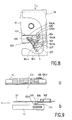
- Fig. 8 is a top view of the relevant portion of a second embodiment of the cassette tape recorder according to the invention.
- the plate 101 denotes a base plate which is illustrated with a portion thereof cut intentionally in order to show the inner system for a good understanding. Therefore the movable parts, etc. explained below look like floating but it should be understood that they are practically supported by or provided at the rear surface of the base plate 101.
- the plate 101 has a first guide hole 102 and a second guide hole 103 which have curved shapes and are adjacent to each other.
- the dust-protection-cover slide arm 104 which is long and slender in shape is fitted slidably via a shaft 104a.
- a shaft 105a which slides the dust-protection-cover 104 and a tape discrimination piece 105 which supports the shaft 105a are provided.
- a first dust-protection-cover slide link 106 is provided, of which one end is engaged with the arm 104 via the shaft 104a and of which other end is pivotally coupled to the base plate 101, via a shaft 106a.
- a second dust-protection-cover slide link 107 is provided, of which one end is engaged with the arm 104 via the shaft 104b and of which other end is pivotally coupled to the base plate 101 via a shaft 107a.
- a spring 108 is provided between one end 104b of the second dust-protection-cover slide link 107 and the shaft 106a of the first dust-protection-cover slide link 106 which is fixed to the base substrate 101.
- the dust-protection-cover slide arm 104 is located at a position "a" by the force of the spring 108 when the tape is not loaded.
- the arrow D shows the direction in which the tape is loaded and Fig. 8 shows the status wherein ACC 10 is loaded, as an example.
- the tape discrimination piece 105 detects the ACC when it is loaded (the discrimination piece 105 shifts upward by the protrusion 10a of the ACC) and does not allow the slider mechanism to operate. Only when the DCC is loaded, the shaft 105a is engaged with a cut-out part 12 of the DCC (see figure 4) and the dust-protection-cover slide arm 104 shifts to the position "b", describing a locus in the arrow direction X as shown in Fig. 8.
- the dust-protection-cover slide arm 104 has a rattle whereby it can shift upward and downward to the surface contacted with the ACC or the DCC when they are detected.
- Fig. 9a is a front view wherein the ACC 10 being put on the tray T is inserted in the direction of the magnetic head (not shown). It also shows the status wherein the tape discrimination piece 105 formed integrally with the dust-protection-cover slide arm 104 runs onto the protrusion part 10a of the ACC, and therefore the shaft 105a shifts upward and is not in contact with the surface of the ACC 10.
- Fig. 9b is a side view wherein the ACC 10 is loaded in the cassette tape recorder. More in detail, Fig.
- FIG. 9b shows the status wherein the ACC 10 is loaded in the arrow direction D, and the tape discrimination piece 105 runs onto the protrusion 10a as described before (the dust-protection-cover slide arm 104a shifts upward).
- Fig. 9b clearly shows that the ACC 10 is loaded without the shaft 105a being in contact with the surface of the ACC (the dust-protection-cover slide arm 104 is located at the position "a" of Fig. 8).
- Fig. 10a is a front view wherein the DCC 11 is inserted in the direction of the magnetic head (not shown) and this time the situation is different from that of the ACC. Since the DCC 11 does not have the protrusion part 10a and is flat, the tape discrimination piece 105 stays in the lower position according to the rattle (in the arrow direction) and therefore the shaft 105a does not shift upward but is engaged with the cut-out part 12 of the DCC 11 as shown in Fig. 10a (in Fig. 10a, the shaft 105a is just engaged with the cut-out part 12, so the dust-protection-cover 9 is still closed).
- Fig. 10b is a side view wherein the DCC is loaded in the cassette tape recorder. In this case, as shown in Fig.
- the shaft 105a corresponds with shaft 4c (which is indicated by a imaginary line) and shifts along a cut-out taper part 12a and is locked at a stopping groove 12b, and the dust-protection-cover 9 is opened.
- the shaft 105a gets into the DCC, That is, when the DCC 11 is loaded in the direction of D, the tape discrimination piece 105 shifts downward according to the rattle and contacts directly a surface 11 S of the DCC, and the shaft 105a is engaged with the cut-out part 12.
- the shaft 105a starts shifting along the taper portion of the cut-out part 12 and is in contact with an end part 9a of the dust-protection-cover 9. Now, as described before, the dust-protection-cover 9 is opened with the shaft 105a shifting more.
- the relative mechanism shifts from the position indicted by a solid line to that indicated by an imaginary line as shown in Fig. 8.
- the shaft 104a and 104b the shaft 104a is connected with the first dust-protection-cover slide link 106 of which the other end is pivotally coupled at 106a to the base plate 101, and the shaft 104b is connected with the second dust-protection-cover slide link 107 of which the other end is pivotally coupled at 107a to the base plate
- the dust-protection-cover slide arm 104 shifts along the first and second holes 102 and 103, against the force of the spring 108 spanned between the shafts 106a and 104b as the links 106 and 107 shift.
- the dust-protection-cover slide arm 104 shifts to the position "b", describing a locus in the direction X as shown in Fig. 8.
- the dust-protection-cover 9 of the DCC 11 is completely slided as shown in Fig. 5 and the tape 13 is exposed.
- the shaft 105a is positioned at the stopping groove 12b which is provided at the end of the cut-out part 12, thus lightly locked, and pushing an end part 9a of the dust-protection-cover 9.
- the dust-protection-cover slide arm shifts, describing a locus and causes the dust-protection-cover to slide.
Landscapes
- Casings For Electric Apparatus (AREA)
Applications Claiming Priority (4)
| Application Number | Priority Date | Filing Date | Title |
|---|---|---|---|
| JP44811/91 | 1991-05-20 | ||
| JP4481091U JPH04132637U (ja) | 1991-05-20 | 1991-05-20 | カセツトテ−プレコ−ダ |
| JP4481191U JP2506172Y2 (ja) | 1991-05-20 | 1991-05-20 | カセットテ−プレコ−ダ |
| JP44810/91 | 1991-05-20 |
Publications (2)
| Publication Number | Publication Date |
|---|---|
| EP0514979A2 true EP0514979A2 (de) | 1992-11-25 |
| EP0514979A3 EP0514979A3 (en) | 1993-12-01 |
Family
ID=26384774
Family Applications (1)
| Application Number | Title | Priority Date | Filing Date |
|---|---|---|---|
| EP19920201389 Withdrawn EP0514979A3 (en) | 1991-05-20 | 1992-05-15 | Cassette tape recorder |
Country Status (1)
| Country | Link |
|---|---|
| EP (1) | EP0514979A3 (de) |
Cited By (1)
| Publication number | Priority date | Publication date | Assignee | Title |
|---|---|---|---|---|
| EP0610985A3 (de) * | 1993-02-03 | 1995-04-26 | Philips Patentverwaltung | Laufwerk in einem elektromechanischen Informationsgerät. |
Family Cites Families (3)
| Publication number | Priority date | Publication date | Assignee | Title |
|---|---|---|---|---|
| US4620254A (en) * | 1983-01-04 | 1986-10-28 | Bsr North America, Ltd. | Information storage and retrieval system including a tape cartridge having a slidable cover |
| JPS6051682U (ja) * | 1983-09-16 | 1985-04-11 | 富士写真フイルム株式会社 | 磁気テ−プカセツト |
| YU123090A (sh) * | 1989-07-03 | 1994-04-05 | N.V. Philips Gloelampenfabrieken | Sistem za snemanje/reprodukcijo signalov na/s magnetnega traku v kaseti |
-
1992
- 1992-05-15 EP EP19920201389 patent/EP0514979A3/en not_active Withdrawn
Cited By (1)
| Publication number | Priority date | Publication date | Assignee | Title |
|---|---|---|---|---|
| EP0610985A3 (de) * | 1993-02-03 | 1995-04-26 | Philips Patentverwaltung | Laufwerk in einem elektromechanischen Informationsgerät. |
Also Published As
| Publication number | Publication date |
|---|---|
| EP0514979A3 (en) | 1993-12-01 |
Similar Documents
| Publication | Publication Date | Title |
|---|---|---|
| EP0163549B1 (de) | Bandkassettenaufzeichnungs- und/oder Wiedergabegerät | |
| GB2124012A (en) | Disc cassette loading apparatus | |
| EP0174111A2 (de) | Schliessmechanismus für eine Kassette | |
| CA1272801A (en) | Lock mechanism for tape protective closure for magnetic tape cassette | |
| CA1079399A (en) | Cassette tape recording and/or reproducing apparatus | |
| US4791511A (en) | Disk cartridge with slide door engageable in either of two orientations | |
| US4724962A (en) | Disk jacket | |
| KR950000317B1 (ko) | 카세트 장착장치 | |
| US4589609A (en) | Magnetic tape cassette | |
| US6842907B2 (en) | Cartridge transfer device for a disk loading mechanism | |
| US4577251A (en) | Magnetic disc cassette having disc flattening means | |
| US6002659A (en) | Disk drive device | |
| EP0557726B1 (de) | Kompatibles Bandkassettenwiedergabegerät für verschiedene Bandkassettenformate | |
| JP2506172Y2 (ja) | カセットテ−プレコ−ダ | |
| JPH05151739A (ja) | デイスクカートリツジ | |
| JPH0718040Y2 (ja) | カセットテープレコーダ | |
| JPH0447791Y2 (de) | ||
| JPH0729347A (ja) | ディスクカートリッジ装置 | |
| JPS5916178A (ja) | 磁気シート装置 | |
| JP2880129B2 (ja) | ディスクカートリッジ | |
| EP0516217A2 (de) | Kassettenbandaufzeichnungsgerät mit Kassettenbandladevorrichtung | |
| JP3097236B2 (ja) | テープカセット | |
| CA2262703C (en) | Magnetic disk cartridge | |
| JPS583307B2 (ja) | 円盤状記録媒体再生装置 | |
| JP3536721B2 (ja) | カートリッジ移送装置 |
Legal Events
| Date | Code | Title | Description |
|---|---|---|---|
| PUAI | Public reference made under article 153(3) epc to a published international application that has entered the european phase |
Free format text: ORIGINAL CODE: 0009012 |
|
| AK | Designated contracting states |
Kind code of ref document: A2 Designated state(s): DE FR GB IT |
|
| PUAL | Search report despatched |
Free format text: ORIGINAL CODE: 0009013 |
|
| AK | Designated contracting states |
Kind code of ref document: A3 Designated state(s): DE FR GB IT |
|
| STAA | Information on the status of an ep patent application or granted ep patent |
Free format text: STATUS: THE APPLICATION IS DEEMED TO BE WITHDRAWN |
|
| 18D | Application deemed to be withdrawn |
Effective date: 19940503 |
|
| RIN1 | Information on inventor provided before grant (corrected) |
Inventor name: OKABE, YOSHIHIRO Inventor name: YAMAURA, NORIAKI Inventor name: MURAKAMI, SATORU Inventor name: OHKI, ISAMU |