EP0514986A2 - Lernverfahren für neuronales Netzwerk und Klassifizieranlage zum Anwenden dieses Verfahrens - Google Patents
Lernverfahren für neuronales Netzwerk und Klassifizieranlage zum Anwenden dieses Verfahrens Download PDFInfo
- Publication number
- EP0514986A2 EP0514986A2 EP92201418A EP92201418A EP0514986A2 EP 0514986 A2 EP0514986 A2 EP 0514986A2 EP 92201418 A EP92201418 A EP 92201418A EP 92201418 A EP92201418 A EP 92201418A EP 0514986 A2 EP0514986 A2 EP 0514986A2
- Authority
- EP
- European Patent Office
- Prior art keywords
- vectors
- activations
- network
- class
- output
- Prior art date
- Legal status (The legal status is an assumption and is not a legal conclusion. Google has not performed a legal analysis and makes no representation as to the accuracy of the status listed.)
- Granted
Links
Images
Classifications
-
- G—PHYSICS
- G06—COMPUTING OR CALCULATING; COUNTING
- G06N—COMPUTING ARRANGEMENTS BASED ON SPECIFIC COMPUTATIONAL MODELS
- G06N3/00—Computing arrangements based on biological models
- G06N3/02—Neural networks
- G06N3/08—Learning methods
- G06N3/088—Non-supervised learning, e.g. competitive learning
-
- G—PHYSICS
- G06—COMPUTING OR CALCULATING; COUNTING
- G06N—COMPUTING ARRANGEMENTS BASED ON SPECIFIC COMPUTATIONAL MODELS
- G06N3/00—Computing arrangements based on biological models
- G06N3/02—Neural networks
- G06N3/06—Physical realisation, i.e. hardware implementation of neural networks, neurons or parts of neurons
- G06N3/063—Physical realisation, i.e. hardware implementation of neural networks, neurons or parts of neurons using electronic means
Definitions
- the present invention relates to a method for training a neural network for classifying vectors into a number of classes.
- the invention also relates to a vector classification device intended for the implementation of such a method.
- This invention can be used in many fields, and in particular in that of image segmentation.
- a neural network within the framework of a neurobiological interpretation, is supposed to function a little like the human brain, with a storage of information which is not more limited to specific localized memories but which, on the contrary, is distributed across the network.
- the advantages of structures based on neural networks are therefore essentially parallel and asynchronous processing, learning capacity, low sensitivity to noise, and high resistance to breakdowns (due to the distribution of information-carrying elements ).
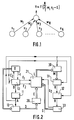
- a neuron an elementary cell of the network, is in its simplest version, as shown in the representation in Figure 1, a threshold automaton (therefore non-linear) delivering an output signal Y (also called activation or output potential) , whose amplitude depends on the result of the comparison between on the one hand a given threshold S and on the other hand a sum of signals which reach the neuron coming from a series of elements (for example from other neurons) placed upstream and which are themselves formed from input signals x1, x2, ..., x N weighted by respective coefficients w1, w2, ..., w N called synaptic coefficients.
- Y also called activation or output potential
- the neuron therefore carries out a weighted sum of the action potentials which reach it (that is to say of numerical values representing the state of the neurons having emitted these potentials), then activates at its turn if this weighted sum exceeds a certain threshold, the neuron thus activated transmitting a response (an unactivated neuron transmits nothing) in the form of a new action potential.
- layered networks in which neurons are grouped in successive layers where each neuron is connected to all the neurons of the next layer, information passing from layer d entry to any subsequent layers (so-called hidden layers) up to the exit layer.
- Such networks known as multi-layers, prove to be particularly suitable for solving classification problems.
- a neural network To perform a given treatment, however, a neural network must first learn to perform it, during a step called learning: first, like the neural network, whose characteristics are not yet adapted to the scheduled task, will deliver erroneous results, we determine a error on the results obtained, then, using a correction criterion, the network parameters (thresholds and synaptic coefficients) are modified to allow it to gradually adapt to the input information submitted to it. This correction step is reiterated on the number of examples (or input vectors) considered to be necessary for satisfactory learning of the network.
- This learning phase prior to that of normal operation of the network, is said to be supervised when the error is evaluated by comparison between the results obtained and those which should have been obtained, which in this case are known in advance. , and that the parameters of the neural network are modified according to this known state of the desired outputs.
- the learning in question is said to be unsupervised, the results to be obtained are not known in advance either because such prior knowledge is not possible, or because that the cost to get there is too high. Unsupervised learning therefore implies that the assignment of a class to each of the learning vectors or prototypes must be done automatically, without human intervention or any prior knowledge of the desired outings.
- the operating phase after learning is then a generalization phase, in which the parameters of the neural network, judged to be correct, are frozen.
- this phase it is possible to carry out the classification of prototypes other than those of the learning base, to each of them corresponding in fact a state of the outputs which allows its classification.
- a certain number of image elements, or "pixels”, serve as prototype examples and make it possible to extract considered images from textural or other characteristics.
- the network will gradually learn to classify these prototype examples, then generalize to the classification of other pixels in the image.
- the object of the invention is to propose a learning process based no longer on the formation of these clouds around points which are in some way the centers of gravity, but on the search for the boundaries between these clouds, it is ie empty or practically empty zones of these input vectors.
- the method according to the invention is here characterized in that at the end of the reinforcement step, the final assignment of a test vector to a respective class is carried out according to the respective configuration in which at minus one of the output activations has a value greater than the other activations of the same configuration.
- this method is characterized in that the predetermined criterion linked to the activations comprises the comparison of each output activation of said respective configurations with a threshold.
- the method is characterized in that all of the identification and reinforcement steps are preceded by a pretreatment step by transforming the space of the test vectors into a space of finite dimensions.
- a neural unsupervised learning technique made by AF Atiya, Department of Electrical Engineering, California Institute of Technology, Pasadena, Ca91125 USA, during the first symposium organized by the journal "The official journal of the International Neural Network Society” at Boston, September 6-10, 1988, describes unsupervised learning leading, as in the case of the invention, to strengthening the classification effect by determining regions of space in which the input vectors, or prototypes, have a density as low as possible, but this determination is carried out by stages of modification of the operational parameters of the neural network which differ from those of the method and the device described here.
- the partitioning of the space of the input vectors is carried out by following a process which uses a binary tree: at each stage of learning, there is separation of a part of the original space of the input vectors in two classes. We therefore only deal with a small part of the partition problem at each stage. This drawback, combined with that of the fact that the approach is not stochastic, leads to a non-negligible probability of leading to a final partition of the space of the input vectors which is not optimal.
- the choice of classes is made stochastically, with, associated with each class, a probability of being chosen.
- the neural network can carry out its learning with, for desired outputs, the values resulting from this stochastic choice, renewed after one or more periods of learning until learning is completed.
- Image segmentation consists, as we know, in trying to extract regions of major interest from an image.
- the regions correspond to different types of terrain such as urban areas, wooded areas, agricultural land, hydrographic network, etc. (in general, to significantly reduce the dimensionality from the problem to be solved and the information concentrated in a small number of parameters, certain texture characteristics known for their discriminatory power in terms of classification are extracted locally before being supplied to the neural network).
- the input layer of the network then comprises a number of individual inputs corresponding exactly to the number of selected characteristics, while the number of neurons leaving the network is equal to the number of texture types in the image.
- the neural network is able to operate the classification of image areas according to one of the texture classes on which it has been trained, this class corresponding to that of the output neurons whose the activity is the highest, that is to say which gives the most significant response for each of the input values.
- This base consists of a set of V test vectors (or prototypes) each made up of N characteristics of an object prototype, and these V vectors, of dimension N and of unknown class, must be classified in a certain number of classes less than or equal to a maximum number of classes K set by the user, K being of course less than or equal to V.
- V test vectors or prototypes
- K being of course less than or equal to V.
- the nonlinear function attached to each neuron is, in this case, of the arctan form, and the output of an output neuron (any) is given by the following formula (where Y i will therefore vary between -1 and 1 ): in which : is the vector representing the input pattern, i is the vector-weight associated with the output neuron of rank i, S i is an associated threshold, and T i is a coefficient of sensitivity of the neuron concerned with the inputs, also called temperature (by analogy with certain thermodynamic experiments - annealing - during which the temperatures serve as control parameters, the high temperatures allowing the leveling of the different outputs Y i , and the lowering of these temperatures allowing on the contrary to find more sensitivity).
- each of the test vectors, or prototype vectors, the expression of which can be written undergoes two transformations here. The first of these is as follows: each of the dimensions x1, x2, ..., x N of said prototype vectors is reduced to a unit -or normalized scale by a simple affine transformation, so for example that its mean be zero and its variance equal to unity.
- This phase firstly comprises a step called stochastic identification by determining, in response to a successive presentation, at the inputs of said network, of the test vectors, of the configuration of the network output activations respectively associated with each of said vectors. test and, as a function of the mutual correlation of said configurations, assignment of each of said test vectors to one of said classes.
- This step is carried out by reviewing all the test vectors of the learning base to determine the class of each of them, according to a stochastic teacher as we will see (i.e. by calling on a random draw process).
- this stochastic identification step is then followed by a step of strengthening the classification effect consecutive to the determined configurations, by modification of the operational parameters of the network in response to a predetermined criterion linked to said activations.
- This modification of parameters occurs in response to a new successive presentation, but in random order, of the test vectors which have just been classified in the previous step. Indeed, following this new presentation at the network inputs, new activation configurations are associated with the test vectors, the final assignment of a test vector to a class being carried out here as a function of that of the configurations in which at least one of the output activations has a value greater than the others.
- Said modification of parameters has the objective and effect, according to the invention, of increasing the differences between these configurations of output activations.
- This decision can be taken by simple random drawing when, on the contrary, this sign of Y i (v) is the same as that of said corresponding ideal output, and the deactivation decision is then taken following said random drawing (in the example here described, the probability of the deactivation decision is a fixed value P (anti) taken throughout the interval 0 - 1).
- the temperatures T i of the neurons are then reduced, for example by multiplying them by the same factor less than and close to unity , for a new era learning period (the learning period is called the period during which the V test vectors of the base have only been presented once) again comprising as many steps as there are test vectors in said base.
- the succession of such learning periods ends when a specific event occurs, such as, for example, the exceeding of a maximum value of the number of learning periods or the passing of a parameter (value of a calculated error, temperature of one of the neurons) below a threshold.
- the outputs Y i (v) of the neural network for the different test vectors define a new set of test vectors of dimension K, and this set can constitute the input vectors of a new learning base.
- this set can constitute the input vectors of a new learning base.
- this device here comprises, in the example described, firstly a first memory 10 for storing the test vectors of the learning base, here a random access memory.
- This memory 10 is associated with a sequencer 11, intended in particular to define (connection A) randomly the order of presentation of said vectors and itself controlled (connection B) by a master processor 12 which has the function of defining and monitoring the implementation of the process.
- This master processor 12 is for example a sequential computer and receives from the user U (connection C1) the information for defining the learning base: number of test vectors V, maximum number of classes K, dimension N of the vectors d input, and also the test vectors which the master processor 12 commands (connection C2) to send to the first memory 10.
- the test vectors receive, as we have seen, an additional dimension, in a preprocessing processor 20 receiving said vectors by connection D.
- the neural network is present in a neural processor 21 which receives (connection E) the output of the preprocessing processor 20, that is to say the test vectors of dimension (N + 1).
- This neural processor 21 also receives, from the master processor 12, a decision signal (connection F1) concerning the operating mode, said mode being the execution of either the classification phase proper, during which the evaluation is carried out.
- connection G2 These desired outputs, sent to the neural processor 21 via the connection G1, are defined using a determination processor 33 also delivering the adaptation decision or the deactivation decision (connection G2).
- This processor 33 receives (connection H) from a second memory of the classes of test vectors 32 the desired class for each vector.
- a third memory 30, with random access, is provided at the output (connection L) of the neural processor 21 for storing the K output activations corresponding to each input vector, that is to say for storing vectors of output of dimension K.
- the K activations thus obtained are supplied (connection M) to a stochastic processor 31 which determines from them the class of each test vector, by random drawing according to the method described above.
- the memory 30 of the output activations and the memory 32 of the classes of test vectors receive, like the memory 10 and by the same connection A, the indication of the order of presentation of the test vectors to the neural network of the neural processor. 21.
- connection F2 the temperatures of the neurons, here at a high value, close to 1, then sends (connection B) a signal of command to the sequencer 11 so that the latter defines an order of sequencing of all the test vectors present in the learning base.
- the master processor 12 further imposes (connection F1) on the neural processor 21 the "classification phase" operating mode. For each of the V test vectors of the learning base presented sequentially (after preprocessing in the processor 20) to the neural processor 21, the corresponding vector of the K output activations is evaluated by this processor 21, then stored in the third memory 30 .
- the stochastic processor 31 receives from the master processor 12 (connection P) a control signal ordering it the operation of definitive determination of the classes of the V test vectors.
- the classes thus defined are stored (connection R) in the second memory 32.
- the master processor 12 then sends (by connection B) a control signal carrying the order of execution of a learning epoch (it is recalled here, at a determined neuron temperature) on all the vectors test base and in the order defined above for these vectors by the sequencer 11, and imposes (connection F1) on the neural processor 21 the "learning" operating mode.
- This epoch includes, for each test vector v, all of the steps described above, namely presentation of the vectors at the input of the neural processor, assignment of the vectors to the classes, and modification of the operational parameters of the network, by adaptation or deactivation. , depending on the activation configurations obtained.
Landscapes
- Engineering & Computer Science (AREA)
- Physics & Mathematics (AREA)
- Theoretical Computer Science (AREA)
- Health & Medical Sciences (AREA)
- Life Sciences & Earth Sciences (AREA)
- Biomedical Technology (AREA)
- Biophysics (AREA)
- Evolutionary Computation (AREA)
- Computational Linguistics (AREA)
- Data Mining & Analysis (AREA)
- Artificial Intelligence (AREA)
- General Health & Medical Sciences (AREA)
- Molecular Biology (AREA)
- Computing Systems (AREA)
- General Engineering & Computer Science (AREA)
- General Physics & Mathematics (AREA)
- Mathematical Physics (AREA)
- Software Systems (AREA)
- Neurology (AREA)
- Image Analysis (AREA)
Applications Claiming Priority (4)
| Application Number | Priority Date | Filing Date | Title |
|---|---|---|---|
| FR9106278 | 1991-05-24 | ||
| FR9106278A FR2679055A1 (fr) | 1991-05-24 | 1991-05-24 | Procede d'apprentissage d'un reseau de neurones. |
| FR9109134 | 1991-07-19 | ||
| FR9109134A FR2679355A1 (fr) | 1991-07-19 | 1991-07-19 | Procede d'apprentissage dans un dispositif de classification de donnees comprenant un reseau de neurones et dispositif de classification pour la mise en óoeuvre de ce procede. |
Publications (3)
| Publication Number | Publication Date |
|---|---|
| EP0514986A2 true EP0514986A2 (de) | 1992-11-25 |
| EP0514986A3 EP0514986A3 (en) | 1994-11-09 |
| EP0514986B1 EP0514986B1 (de) | 1997-12-10 |
Family
ID=26228709
Family Applications (1)
| Application Number | Title | Priority Date | Filing Date |
|---|---|---|---|
| EP92201418A Expired - Lifetime EP0514986B1 (de) | 1991-05-24 | 1992-05-19 | Lernverfahren für neuronales Netzwerk und Klassifizieranlage zum Anwenden dieses Verfahrens |
Country Status (4)
| Country | Link |
|---|---|
| US (1) | US5469530A (de) |
| EP (1) | EP0514986B1 (de) |
| JP (1) | JPH05158910A (de) |
| DE (1) | DE69223447T2 (de) |
Cited By (1)
| Publication number | Priority date | Publication date | Assignee | Title |
|---|---|---|---|---|
| EP0814636A1 (de) * | 1996-06-21 | 1997-12-29 | Siemens Audiologische Technik GmbH | Hörgerät |
Families Citing this family (18)
| Publication number | Priority date | Publication date | Assignee | Title |
|---|---|---|---|---|
| US5517667A (en) * | 1993-06-14 | 1996-05-14 | Motorola, Inc. | Neural network that does not require repetitive training |
| JPH0744514A (ja) * | 1993-07-27 | 1995-02-14 | Matsushita Electric Ind Co Ltd | ニューラルネットの学習用データ縮約化方法 |
| EP0636991A3 (de) * | 1993-07-29 | 1997-01-08 | Matsushita Electric Industrial Co Ltd | Informationsverarbeitungsgerät zur Durchführung eines neuronalen Netzwerkes. |
| US5926804A (en) * | 1994-07-01 | 1999-07-20 | The Board Of Governors For Higher Education, State Of Rhode Island And Providence Plantations | Discriminant neural networks |
| US5942422A (en) * | 1996-11-14 | 1999-08-24 | The Trustees Of Columbia University In The City Of New York | Method for generating a directed, recombinant fusion nucleic acid |
| US6317658B1 (en) | 1997-10-15 | 2001-11-13 | The Boeing Company | Neurocomputing control distribution system |
| US20020159641A1 (en) * | 2001-03-14 | 2002-10-31 | Whitney Paul D. | Directed dynamic data analysis |
| US7287015B2 (en) * | 2004-09-30 | 2007-10-23 | International Business Machines Corporation | Methods and apparatus for transmitting signals through network elements for classification |
| US7331007B2 (en) * | 2005-07-07 | 2008-02-12 | International Business Machines Corporation | Harnessing machine learning to improve the success rate of stimuli generation |
| US8726144B2 (en) * | 2005-12-23 | 2014-05-13 | Xerox Corporation | Interactive learning-based document annotation |
| JP5246751B2 (ja) * | 2008-03-31 | 2013-07-24 | 独立行政法人理化学研究所 | 情報処理装置、情報処理方法、およびプログラム |
| US8874498B2 (en) | 2011-09-16 | 2014-10-28 | International Business Machines Corporation | Unsupervised, supervised, and reinforced learning via spiking computation |
| US8738554B2 (en) | 2011-09-16 | 2014-05-27 | International Business Machines Corporation | Event-driven universal neural network circuit |
| US8626684B2 (en) | 2011-12-14 | 2014-01-07 | International Business Machines Corporation | Multi-modal neural network for universal, online learning |
| US11163707B2 (en) * | 2018-04-23 | 2021-11-02 | International Business Machines Corporation | Virtualization in hierarchical cortical emulation frameworks |
| CN110610140B (zh) * | 2019-08-23 | 2024-01-19 | 平安科技(深圳)有限公司 | 人脸识别模型的训练方法、装置、设备及可读存储介质 |
| CN113673607B (zh) * | 2021-08-24 | 2025-05-13 | 支付宝(杭州)信息技术有限公司 | 图像标注模型的训练及图像标注的方法及装置 |
| CN118236070B (zh) * | 2024-03-26 | 2024-10-18 | 中国矿业大学 | 基于短时峰-峰间期信号及深度学习的识别分类方法 |
Family Cites Families (17)
| Publication number | Priority date | Publication date | Assignee | Title |
|---|---|---|---|---|
| US4858147A (en) * | 1987-06-15 | 1989-08-15 | Unisys Corporation | Special purpose neurocomputer system for solving optimization problems |
| US4979126A (en) * | 1988-03-30 | 1990-12-18 | Ai Ware Incorporated | Neural network with non-linear transformations |
| US4931868A (en) * | 1988-05-31 | 1990-06-05 | Grumman Aerospace Corporation | Method and apparatus for detecting innovations in a scene |
| US4972363A (en) * | 1989-02-01 | 1990-11-20 | The Boeing Company | Neural network using stochastic processing |
| US5140530A (en) * | 1989-03-28 | 1992-08-18 | Honeywell Inc. | Genetic algorithm synthesis of neural networks |
| EP0405174B1 (de) * | 1989-06-02 | 1998-03-11 | Yozan Inc. | Neuronales Datenverarbeitungssystem und Anpassungsverfahren |
| US5067164A (en) * | 1989-11-30 | 1991-11-19 | At&T Bell Laboratories | Hierarchical constrained automatic learning neural network for character recognition |
| US5142665A (en) * | 1990-02-20 | 1992-08-25 | International Business Machines Corporation | Neural network shell for application programs |
| WO1991014990A1 (en) * | 1990-03-28 | 1991-10-03 | Koza John R | Non-linear genetic algorithms for solving problems by finding a fit composition of functions |
| US5299284A (en) * | 1990-04-09 | 1994-03-29 | Arizona Board Of Regents, Acting On Behalf Of Arizona State University | Pattern classification using linear programming |
| US5218529A (en) * | 1990-07-30 | 1993-06-08 | University Of Georgia Research Foundation, Inc. | Neural network system and methods for analysis of organic materials and structures using spectral data |
| US5142612A (en) * | 1990-08-03 | 1992-08-25 | E. I. Du Pont De Nemours & Co. (Inc.) | Computer neural network supervisory process control system and method |
| US5150450A (en) * | 1990-10-01 | 1992-09-22 | The United States Of America As Represented By The Secretary Of The Navy | Method and circuits for neuron perturbation in artificial neural network memory modification |
| US5105468A (en) * | 1991-04-03 | 1992-04-14 | At&T Bell Laboratories | Time delay neural network for printed and cursive handwritten character recognition |
| US5214746A (en) * | 1991-06-17 | 1993-05-25 | Orincon Corporation | Method and apparatus for training a neural network using evolutionary programming |
| US5179596A (en) * | 1991-07-05 | 1993-01-12 | Booz, Allen & Hamilton, Inc. | Analog pattern categorization system having dual weighted connectivity between nodes |
| US5159644A (en) * | 1991-08-30 | 1992-10-27 | Eastman Kodak Company | Character recognition method using statistically weighted correlation |
-
1992
- 1992-05-19 DE DE69223447T patent/DE69223447T2/de not_active Expired - Fee Related
- 1992-05-19 EP EP92201418A patent/EP0514986B1/de not_active Expired - Lifetime
- 1992-05-22 US US07/887,636 patent/US5469530A/en not_active Expired - Fee Related
- 1992-05-25 JP JP4132556A patent/JPH05158910A/ja active Pending
Cited By (1)
| Publication number | Priority date | Publication date | Assignee | Title |
|---|---|---|---|---|
| EP0814636A1 (de) * | 1996-06-21 | 1997-12-29 | Siemens Audiologische Technik GmbH | Hörgerät |
Also Published As
| Publication number | Publication date |
|---|---|
| EP0514986A3 (en) | 1994-11-09 |
| JPH05158910A (ja) | 1993-06-25 |
| EP0514986B1 (de) | 1997-12-10 |
| DE69223447D1 (de) | 1998-01-22 |
| US5469530A (en) | 1995-11-21 |
| DE69223447T2 (de) | 1998-06-04 |
Similar Documents
| Publication | Publication Date | Title |
|---|---|---|
| EP0514986B1 (de) | Lernverfahren für neuronales Netzwerk und Klassifizieranlage zum Anwenden dieses Verfahrens | |
| EP0446084B1 (de) | Verfahren zur Klassifikation in einem hierarchisierten neuronalen Netzwerk | |
| FR2678407A1 (fr) | Procede et dispositif avec un reseau neuronal pour classer des donnees, et appareil d'authentification de signature. | |
| WO2020208153A1 (fr) | Procede de definition d'un chemin | |
| EP3582141B1 (de) | Verfahren zum lernen von parametern eines neuronalen netztes mit konvolution | |
| EP0875032B1 (de) | Lernverfahren das für datenklassifizierung kleine neuronale netze generiert | |
| EP4099228A1 (de) | Verbessertes maschinelles lernen ohne anmerkungen durch adaptive gruppierungen in offenen klassensätzen | |
| FR3114180A1 (fr) | Système et procédé pour éviter un oubli catastrophique dans un réseau neuronal artificiel | |
| EP0449353B1 (de) | Datenverarbeitungsgerät und Verfahren um in einem Wörterbuch enthaltene Datenwörter auszuwählen | |
| EP0454535B1 (de) | Neuronales Klassifikationssystem and -verfahren | |
| US20220180167A1 (en) | Memory-augmented neural network system | |
| FR3111216A1 (fr) | Procédé de génération d'un système d'aide à la décision et systèmes associés | |
| CA2709180C (fr) | Procedes de mise a jour et d'apprentissage d'une carte auto-organisatrice | |
| FR2658336A1 (fr) | Procede d'apprentissage d'un reseau de neurones en couches pour classification multiclasses et reseau de neurones en couches. | |
| EP0681270A1 (de) | Verfahren zur Bahnverfolgung von Objekten und Vorrichtung zur Durchführung des Verfahrens | |
| EP3966739A1 (de) | Automatisches bildanalyseverfahren zur automatischen erkennung von mindestens einer seltenen eigenschaft | |
| Cerrato et al. | Invariant representations with stochastically quantized neural networks | |
| EP0929867B1 (de) | Lernverfahren für die klassifizierung von durch eine trennfläche erster oder zweiter ordnung in zwei klassen getrennten daten | |
| Keddous et al. | Characters Recognition based on CNN-RNN architecture and Metaheuristic | |
| EP3825915A1 (de) | Klassifizierung eines biometrischen drucks, der durch ein eintragsbild vertreten wird | |
| FR2679355A1 (fr) | Procede d'apprentissage dans un dispositif de classification de donnees comprenant un reseau de neurones et dispositif de classification pour la mise en óoeuvre de ce procede. | |
| EP0619558B1 (de) | Verfahren und Vorrichtung zur Klassifizierung von Signalkonfigurationen | |
| FR3131413A1 (fr) | Réseau de neurones avec génération à la volée des paramètres du réseau | |
| FR3109002A1 (fr) | Dispositif et procédé pour le transfert de connaissance d’un réseau neuronal artificiel | |
| FR3083354A1 (fr) | Procede de modelisation pour le controle des resultats fournis par un reseau de neurones artificiels et autres procedes associes |
Legal Events
| Date | Code | Title | Description |
|---|---|---|---|
| PUAI | Public reference made under article 153(3) epc to a published international application that has entered the european phase |
Free format text: ORIGINAL CODE: 0009012 |
|
| AK | Designated contracting states |
Kind code of ref document: A2 Designated state(s): DE FR GB IT |
|
| PUAL | Search report despatched |
Free format text: ORIGINAL CODE: 0009013 |
|
| AK | Designated contracting states |
Kind code of ref document: A3 Designated state(s): DE FR GB IT |
|
| 17P | Request for examination filed |
Effective date: 19950509 |
|
| RAP1 | Party data changed (applicant data changed or rights of an application transferred) |
Owner name: PHILIPS ELECTRONICS N.V. Owner name: LABORATOIRES D'ELECTRONIQUE PHILIPS S.A.S. |
|
| GRAG | Despatch of communication of intention to grant |
Free format text: ORIGINAL CODE: EPIDOS AGRA |
|
| 17Q | First examination report despatched |
Effective date: 19970219 |
|
| GRAG | Despatch of communication of intention to grant |
Free format text: ORIGINAL CODE: EPIDOS AGRA |
|
| GRAH | Despatch of communication of intention to grant a patent |
Free format text: ORIGINAL CODE: EPIDOS IGRA |
|
| GRAH | Despatch of communication of intention to grant a patent |
Free format text: ORIGINAL CODE: EPIDOS IGRA |
|
| GRAA | (expected) grant |
Free format text: ORIGINAL CODE: 0009210 |
|
| AK | Designated contracting states |
Kind code of ref document: B1 Designated state(s): DE FR GB IT |
|
| REF | Corresponds to: |
Ref document number: 69223447 Country of ref document: DE Date of ref document: 19980122 |
|
| ITF | It: translation for a ep patent filed | ||
| GBT | Gb: translation of ep patent filed (gb section 77(6)(a)/1977) |
Effective date: 19980224 |
|
| RAP4 | Party data changed (patent owner data changed or rights of a patent transferred) |
Owner name: KONINKLIJKE PHILIPS ELECTRONICS N.V. Owner name: LABORATOIRES D'ELECTRONIQUE PHILIPS S.A.S. |
|
| PLBE | No opposition filed within time limit |
Free format text: ORIGINAL CODE: 0009261 |
|
| STAA | Information on the status of an ep patent application or granted ep patent |
Free format text: STATUS: NO OPPOSITION FILED WITHIN TIME LIMIT |
|
| 26N | No opposition filed | ||
| REG | Reference to a national code |
Ref country code: FR Ref legal event code: TP |
|
| REG | Reference to a national code |
Ref country code: GB Ref legal event code: IF02 |
|
| PGFP | Annual fee paid to national office [announced via postgrant information from national office to epo] |
Ref country code: FR Payment date: 20020527 Year of fee payment: 11 |
|
| PGFP | Annual fee paid to national office [announced via postgrant information from national office to epo] |
Ref country code: GB Payment date: 20020531 Year of fee payment: 11 |
|
| PGFP | Annual fee paid to national office [announced via postgrant information from national office to epo] |
Ref country code: DE Payment date: 20020719 Year of fee payment: 11 |
|
| PG25 | Lapsed in a contracting state [announced via postgrant information from national office to epo] |
Ref country code: GB Free format text: LAPSE BECAUSE OF NON-PAYMENT OF DUE FEES Effective date: 20030519 |
|
| PG25 | Lapsed in a contracting state [announced via postgrant information from national office to epo] |
Ref country code: DE Free format text: LAPSE BECAUSE OF NON-PAYMENT OF DUE FEES Effective date: 20031202 |
|
| GBPC | Gb: european patent ceased through non-payment of renewal fee |
Effective date: 20030519 |
|
| PG25 | Lapsed in a contracting state [announced via postgrant information from national office to epo] |
Ref country code: FR Free format text: LAPSE BECAUSE OF NON-PAYMENT OF DUE FEES Effective date: 20040130 |
|
| REG | Reference to a national code |
Ref country code: FR Ref legal event code: ST |
|
| PG25 | Lapsed in a contracting state [announced via postgrant information from national office to epo] |
Ref country code: IT Free format text: LAPSE BECAUSE OF NON-PAYMENT OF DUE FEES;WARNING: LAPSES OF ITALIAN PATENTS WITH EFFECTIVE DATE BEFORE 2007 MAY HAVE OCCURRED AT ANY TIME BEFORE 2007. THE CORRECT EFFECTIVE DATE MAY BE DIFFERENT FROM THE ONE RECORDED. Effective date: 20050519 |