EP0515116A2 - Rückgewinnung von Molybdän - Google Patents
Rückgewinnung von Molybdän Download PDFInfo
- Publication number
- EP0515116A2 EP0515116A2 EP92304463A EP92304463A EP0515116A2 EP 0515116 A2 EP0515116 A2 EP 0515116A2 EP 92304463 A EP92304463 A EP 92304463A EP 92304463 A EP92304463 A EP 92304463A EP 0515116 A2 EP0515116 A2 EP 0515116A2
- Authority
- EP
- European Patent Office
- Prior art keywords
- molybdenum
- tertiary butyl
- fraction
- ammonia
- distillation fraction
- Prior art date
- Legal status (The legal status is an assumption and is not a legal conclusion. Google has not performed a legal analysis and makes no representation as to the accuracy of the status listed.)
- Ceased
Links
Images
Classifications
-
- B—PERFORMING OPERATIONS; TRANSPORTING
- B01—PHYSICAL OR CHEMICAL PROCESSES OR APPARATUS IN GENERAL
- B01J—CHEMICAL OR PHYSICAL PROCESSES, e.g. CATALYSIS OR COLLOID CHEMISTRY; THEIR RELEVANT APPARATUS
- B01J31/00—Catalysts comprising hydrides, coordination complexes or organic compounds
- B01J31/26—Catalysts comprising hydrides, coordination complexes or organic compounds containing in addition, inorganic metal compounds not provided for in groups B01J31/02 - B01J31/24
- B01J31/34—Catalysts comprising hydrides, coordination complexes or organic compounds containing in addition, inorganic metal compounds not provided for in groups B01J31/02 - B01J31/24 of chromium, molybdenum or tungsten
-
- B—PERFORMING OPERATIONS; TRANSPORTING
- B01—PHYSICAL OR CHEMICAL PROCESSES OR APPARATUS IN GENERAL
- B01J—CHEMICAL OR PHYSICAL PROCESSES, e.g. CATALYSIS OR COLLOID CHEMISTRY; THEIR RELEVANT APPARATUS
- B01J31/00—Catalysts comprising hydrides, coordination complexes or organic compounds
- B01J31/02—Catalysts comprising hydrides, coordination complexes or organic compounds containing organic compounds or metal hydrides
- B01J31/0201—Oxygen-containing compounds
- B01J31/0202—Alcohols or phenols
-
- B—PERFORMING OPERATIONS; TRANSPORTING
- B01—PHYSICAL OR CHEMICAL PROCESSES OR APPARATUS IN GENERAL
- B01J—CHEMICAL OR PHYSICAL PROCESSES, e.g. CATALYSIS OR COLLOID CHEMISTRY; THEIR RELEVANT APPARATUS
- B01J31/00—Catalysts comprising hydrides, coordination complexes or organic compounds
- B01J31/40—Regeneration or reactivation
- B01J31/4015—Regeneration or reactivation of catalysts containing metals
-
- B—PERFORMING OPERATIONS; TRANSPORTING
- B01—PHYSICAL OR CHEMICAL PROCESSES OR APPARATUS IN GENERAL
- B01J—CHEMICAL OR PHYSICAL PROCESSES, e.g. CATALYSIS OR COLLOID CHEMISTRY; THEIR RELEVANT APPARATUS
- B01J38/00—Regeneration or reactivation of catalysts, in general
- B01J38/48—Liquid treating or treating in liquid phase, e.g. dissolved or suspended
- B01J38/64—Liquid treating or treating in liquid phase, e.g. dissolved or suspended using alkaline material; using salts
- B01J38/66—Liquid treating or treating in liquid phase, e.g. dissolved or suspended using alkaline material; using salts using ammonia or derivatives thereof
-
- C—CHEMISTRY; METALLURGY
- C07—ORGANIC CHEMISTRY
- C07C—ACYCLIC OR CARBOCYCLIC COMPOUNDS
- C07C29/00—Preparation of compounds having hydroxy or O-metal groups bound to a carbon atom not belonging to a six-membered aromatic ring
- C07C29/132—Preparation of compounds having hydroxy or O-metal groups bound to a carbon atom not belonging to a six-membered aromatic ring by reduction of an oxygen containing functional group
-
- C—CHEMISTRY; METALLURGY
- C07—ORGANIC CHEMISTRY
- C07D—HETEROCYCLIC COMPOUNDS
- C07D301/00—Preparation of oxiranes
- C07D301/32—Separation; Purification
-
- C—CHEMISTRY; METALLURGY
- C07—ORGANIC CHEMISTRY
- C07F—ACYCLIC, CARBOCYCLIC OR HETEROCYCLIC COMPOUNDS CONTAINING ELEMENTS OTHER THAN CARBON, HYDROGEN, HALOGEN, OXYGEN, NITROGEN, SULFUR, SELENIUM OR TELLURIUM
- C07F11/00—Compounds containing elements of Groups 6 or 16 of the Periodic Table
- C07F11/005—Compounds containing elements of Groups 6 or 16 of the Periodic Table compounds without a metal-carbon linkage
-
- C—CHEMISTRY; METALLURGY
- C22—METALLURGY; FERROUS OR NON-FERROUS ALLOYS; TREATMENT OF ALLOYS OR NON-FERROUS METALS
- C22B—PRODUCTION AND REFINING OF METALS; PRETREATMENT OF RAW MATERIALS
- C22B34/00—Obtaining refractory metals
- C22B34/30—Obtaining chromium, molybdenum or tungsten
- C22B34/34—Obtaining molybdenum
-
- B—PERFORMING OPERATIONS; TRANSPORTING
- B01—PHYSICAL OR CHEMICAL PROCESSES OR APPARATUS IN GENERAL
- B01J—CHEMICAL OR PHYSICAL PROCESSES, e.g. CATALYSIS OR COLLOID CHEMISTRY; THEIR RELEVANT APPARATUS
- B01J2231/00—Catalytic reactions performed with catalysts classified in B01J31/00
- B01J2231/70—Oxidation reactions, e.g. epoxidation, (di)hydroxylation, dehydrogenation and analogues
- B01J2231/72—Epoxidation
-
- Y—GENERAL TAGGING OF NEW TECHNOLOGICAL DEVELOPMENTS; GENERAL TAGGING OF CROSS-SECTIONAL TECHNOLOGIES SPANNING OVER SEVERAL SECTIONS OF THE IPC; TECHNICAL SUBJECTS COVERED BY FORMER USPC CROSS-REFERENCE ART COLLECTIONS [XRACs] AND DIGESTS
- Y02—TECHNOLOGIES OR APPLICATIONS FOR MITIGATION OR ADAPTATION AGAINST CLIMATE CHANGE
- Y02P—CLIMATE CHANGE MITIGATION TECHNOLOGIES IN THE PRODUCTION OR PROCESSING OF GOODS
- Y02P20/00—Technologies relating to chemical industry
- Y02P20/50—Improvements relating to the production of bulk chemicals
- Y02P20/52—Improvements relating to the production of bulk chemicals using catalysts, e.g. selective catalysts
-
- Y—GENERAL TAGGING OF NEW TECHNOLOGICAL DEVELOPMENTS; GENERAL TAGGING OF CROSS-SECTIONAL TECHNOLOGIES SPANNING OVER SEVERAL SECTIONS OF THE IPC; TECHNICAL SUBJECTS COVERED BY FORMER USPC CROSS-REFERENCE ART COLLECTIONS [XRACs] AND DIGESTS
- Y02—TECHNOLOGIES OR APPLICATIONS FOR MITIGATION OR ADAPTATION AGAINST CLIMATE CHANGE
- Y02P—CLIMATE CHANGE MITIGATION TECHNOLOGIES IN THE PRODUCTION OR PROCESSING OF GOODS
- Y02P20/00—Technologies relating to chemical industry
- Y02P20/50—Improvements relating to the production of bulk chemicals
- Y02P20/584—Recycling of catalysts
Definitions
- the present invention relates to an improvement in a process for resolving the reaction mixture that is formed in preparing propylene oxide and tertiary butyl alcohol by reacting propylene with tertiary butyl hydroperoxide in solution in tertiary butyl alcohol in the presence of a soluble molybdenum catalyst. More particularly, the present invention is directed to substantially removing molybdenum from the reaction mixture.
- Molybdenum compounds are somewhat toxic to livestock and, therefore, solutions containing molybdenum must be handled with care. Also, the presence of molybdenum in liquid by-products presents a disposal problem because of the limited toxicity of molybdenum to livestock.
- the epoxidation reaction mixture that is formed when propylene is reacted with tertiary butyl hydroperoxide in solution in tertiary butyl alcohol in the presence of a soluble molybdenum epoxidation catalyst will normally com prise unreacted propylene, propylene oxide, tertiary butyl alcohol, unreacted tertiary butyl hydroperoxide, the soluble molybdenum catalyst and impurities, including C1 to C4 lower aliphatic carboxylic acids.
- the reaction mixture is usually separated by distillation into a plurality of fractions including a recycle propylene fraction, a propylene oxide product fraction, a tertiary butyl alcohol product fraction and a heavy liquid distillation fraction containing tertiary butyl alcohol, unreacted tertiary butyl hydroperoxide and impurities, including substantially all of the dissolved molybdenum catalyst and a portion of the lower aliphatic carboxylic acid impurities.
- the heavy liquid distillation fraction is charged to a molybdenum precipitation reactor where it is brought into liquid phase contact with an excess of ammonia (based on the molybdenum content).
- the heavy liquid distillation fraction is saturated with ammonia.
- the ammonia will react with substantially all of the molybdenum to form a molybdate precipitate that can be separated from the thus-treated heavy liquid distillation fraction in a precipitate separation zone.
- the separate precipitate will comprise a concentrated solid molybdenum product that may be processed for the recovery of molybdenum.
- the precipitate will contain substantially all of the molybdenum present in the reaction mixture and, as a consequence, the thus-treated molybdenum fraction will pose a lesser environmental problem and can be disposed of more easily.
- the molybdenum-catalyzed epoxidation of alpha olefins and alpha substituted olefins with hydroperoxides less stable than tertiary butyl hydroperoxide may be accomplished according to U. S. Patent 3,862,961 to Sheng, et al.
- Maurin U. S. Patent No. 3,931,044 is directed to a method for recovering molybdenum catalyst values from a peroxidation reaction product for recycle.
- Maurin discloses one of three techniques.
- the residue fraction is calcined to provide molybdenum trioxide which is then used to prepare a soluble molybdenum compound by reaction with aqueous ammonia.
- the molybdenum-containing fraction is treated with aqueous ammonia without calcining to form an ammonium molybdate which is treated with a polyalcohol to give a molybdic ester.
- the molybdenum-containing fraction is treated with gaseous ammonia in order to form an ammonium molybdate precipitate which can be recovered by filtration.
- Levine U. S. Patent No. 3,819,663 is directed to a method for treating a heavy distillation fraction of this nature in order to recover the molybdenum in the concentrated bottoms fraction for recycle to the epoxidation reaction zone as makeup catalyst.
- Levine conducts his wiped-film evaporation process under conditions including a temperature of about 550-650°F (about 273°C to about 330°C) at atmospheric pressure to obtain his desired residual fraction for recycle as catalyst makeup and a distillate fraction comprising about 85% or more of the heavy distillation fraction.
- Levine states that the distillate fraction that is thus obtained can be used as a furnace fuel or can be worked up for recovery of the individual components contained therein.
- Levine et al. does not contain any teaching as to how the individual components in the fraction would be obtained.
- a heavy distillation fraction comprising tertiary butyl hydroperoxide, tertiary butyl alcohol and impurities including about 0.4 to about 0.8 wt.% of dissolved molybdenum catalyst and lower aliphatic carboxylic acids resulting from the removal of propylene, propylene oxide and tertiary butyl alcohol from an epoxidation reaction product is charged to a precipitation zone which may suitably comprise a reactor, such as an autoclave, provided with suitable agitating means (e.g., an impeller), temperature control means such as a jacket or coils through which a liquid heat exchange medium can be circulated, charge lines for the heavy distillation fraction and for the ammonia and a discharge line for withdrawal of the treated product.
- a precipitation zone which may suitably comprise a reactor, such as an autoclave, provided with suitable agitating means (e.g., an impeller), temperature control means such as a jacket or coils through which a liquid heat exchange medium can be circulated,
- the ammonia will react with the molybdenum compounds present in the heavy distillation fraction to form a reaction product comprising a molybdenum-containing precipitate that can be withdrawn from the precipitation zone.
- the precipitate can be removed in any desired manner in a precipitate removal zone (e.g., by filtration, centrifugation, etc.).
- the precipitate can be recovered for disposal in any suitable environmentally acceptable manner, such as for example by treatment in a metals-reclaiming plant for the recovery of the molybdenum.
- the concentration of molybdenum in the heavy distillation fraction to be charged to the precipitation zone may be adjusted, if too high, by the addition of an appropriate amount of another component of the heavy distillation fraction (e.g. t-butyl alcohol).
- another component of the heavy distillation fraction e.g. t-butyl alcohol
- the heavy distillation fraction will normally contain less than about 1 wt.% of water and, therefore, ammonia should be used, as such, rather than in the form of an aqueous ammoniacal solution.
- the ammonia should preferably be used in an amount which is equivalent to the amount of molybdenum in the heavy distillation fraction and, preferably, an excess of ammonia will be used, such as about 1 to about 200 moles of ammonia per gram atom of molybdenum present in the heavy distillation fraction.
- the heavy distillation fraction is saturated with ammonia.
- the precipitation reaction can be conducted under ambient conditions of temperature and pressure, although somewhat higher temperatures and pressures may be used, if desired, such as temperatures within the range of about 20° to 250°C. and pressures within the range of about 0 to 3,000 psig.
- the contact time should be sufficient to insure that the precipitation reaction goes to completion (e.g., 0.2 to 2 hours).
- the mixture of precipitate and treated heavy distillation fraction is withdrawn from the precipitation zone for removal of the precipitate.
- the precipitate can be removed in any desired manner, e.g., filtration, centrifugation, evaporation, etc. Since the precipitate constitutes only a minor amount of the mixture of precipitate and treated heavy distillation fraction, filtration is preferred.
- the filtrate obtained by the practice of the present invention will contain only a residual amount of molybdenum (e.g., from 10 to 100 ppm) and meets environmental guide lines.
- molybdenum e.g., from 10 to 100 ppm
- it can be charged to a boiler as a fuel, or further treated (e.g., by vacuum distillation for the recovery of at least a portion of the tertiary butyl alcohol and/or tertiary butyl hydroperoxide contained therein.
- the precipitate which will normally contain about 40 to about 58 wt.% of molybdenum can be disposed of in an environmentally acceptable manner. For example, it can be used as a feedstock in a metals-reclaiming plant or used as a raw material for the preparation of an additional amount of fresh molybdenum catalyst solution.
- an epoxidation reaction mixture which will contain not only unreacted feed components and the desired propylene oxide and tertiary butyl alcohol, but also impurities including the dissolved molybdenum catalyst, oxygen-containing impurities such as ditertiary butyl peroxide, lower aliphatic C1 to C4 carboxylic acids such as formic acid, acetic acid, isobutyric acid, etc., alcohols such as methanol, isopropyl alcohol, tertiary butyl alcohol, etc., esters such as methyl formate, methyl acetate, methyl isobutyrate, etc., ketones such as acetone, etc., aldehydes such as
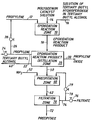
- the figure is a schematic drawing of a preferred reaction and purification sequence that may be used in the practice of the present invention.
- An epoxidation reaction zone 10 is provided and propyl ene is charged thereto by a line 12 together with a soluble molybdenum catalyst charged by a line 14.
- a solution of tertiary butyl hydroperoxide in tertiary butyl alcohol is charged by a line 16.
- the epoxidation reaction is an epoxidation reaction of the type disclosed by Kollar U. S. Patent No. 3,351,653 as further elaborated upon, for example, in British patent specification No. 1,298,253 wherein propylene is reacted with tertiary butyl hydroperoxide under reaction conditions including a reaction temperature within the range of about 180° to about 300°F., a pressure of about 300 to about 1000 psig. and, more preferably, a temperature of about 220°F. to about 280°F. and a pressure of about 500 to about 800 psig.
- the soluble molybdenum catalyst charged to the epoxidation reaction zone by the line 14 may be an epoxidation catalyst of the type known in the art such as those dis closed by the Kollar patent or the British patent or by Marquis et al. U. S. Patent No. 4,626,596, U. S. Patent No. 4,650,886, U. S. Patent No. 4,654,427, U. S. Patent No. 4,703,027, or U. S. Patent No. 4,758,681.
- the Marquis et al. patents are directed to molybdenum/alkanol complexes such as solutions of molybdenum compounds in ethylene glycol which contain a high concentration of molybdenum and are particularly useful as catalysts in the epoxidation reaction.
- Marquis et al. teach, for example, the epoxidation of propylene with tertiary butyl hydroperoxide with their catalyst under epoxidation conditions including a temperature of 50° to 180°C and a use of propylene to tertiary butyl hydroperoxide ratios within the range of about 0.9:1 to about 3.0:1.
- the tertiary butyl hydroperoxide that is charged to the epoxidation reaction zone 10 by way of line 16 is about a 40 to about 75 wt.% solution of tertiary butyl hydroperoxide in tertiary butyl alcohol.
- the catalyst is charged to the epoxidation reaction zone 10 by the charge line 14 in an amount such as to provide from about 50 to about 1000 ppm of molybdenum, based on the total of the reactants charged and, more preferably, from about 200 to 600 ppm.
- the reaction is preferably conducted at superatmospheric pressure such as a pressure of about 300 to 1000 psig.
- the feed materials are charged to the epoxidation reaction zone 10 through the lines 12, 14 and 16 at rates sufficient to maintain the desired concentration of reactants and an equivalent volume of epoxidation reaction mixture is withdrawn from the epoxidation reaction zone 10 by way of a discharge line 18.
- the reaction product discharged by the line 18 will normally comprise unreacted propylene, a minor amount of unreacted tertiary butyl hydro peroxide, propylene oxide, tertiary butyl alcohol, including tertiary butyl alcohol formed by the reaction of the tertiary butyl hydroperoxide with propylene, the molybdenum catalyst and impurities such as propane, propionaldehyde, acetone, methanol, isopropanol, water, acetaldehyde, methyl formate, acetic acid, formic acid, isobutyric acid, hydrocarbons containing 6 or more carbon atoms and high boiling residue components.
- the reaction product 18 is charged to an epoxidation reaction product distillation zone 20 where it is separated by distillation into desired fractions in accordance with methods known to those skilled in the art.
- the distillation sequence disclosed in British Patent No. 1,298,253 may be used.
- One of the distillate products that is recovered in the zone 20 is a propylene fraction which is discharged by a line 22 controlled by a valve 24 and provided with a branch line 26 controlled by a valve 28 in order to permit the recycle of unreacted propylene to the epoxidation reaction zone 10 through the propylene charge line 12.
- Another distillate fraction that is obtained is a propylene oxide product fraction 30 which is discharged by the line 30.
- the propylene oxide fraction may be purified in a propylene oxide purification zone (not shown) by known techniques such as, for example, those disclosed in Burnes et al. U. S. Patent No. 3,715,284, Schmidt et al. U. S. Patent No. 3,909,366, Schmidt U. S. Patent No. 3,881,996, Jubin U. S. Patent No. 3,607,669, Schmidt U. S. Patent No. 3,843,488 or Schmidt U. S. Patent No. 4,140,588.
- tertiary butyl alcohol distillate product 40 which may be further purified, if desired, to remove oxygenated impurities therefrom by catalytic treatment as disclosed, for example, in Sanderson et al. U. S. Patent No. 4,704,482, Sanderson et al. U. S. Patent No. 4,705,903 or Sanderson et al. U. S. Patent No. 4,742,149.
- a heavy distillation fraction 50 is also discharged from the epoxidation reaction product distillation zone 20.
- the heavy distillation fraction will contain substantially all of the molybdenum catalyst initially charged to the epoxidation reaction zone 10 by way of the line 14.
- the heavy distillation fraction 50 will contain other products such as tertiary butyl hydroperoxide, tertiary butyl alcohol and impurities including oxygenates lighter than tertiary butyl alcohol such as acetaldehyde, acetone, isopropyl alcohol, etc., oxygenates heavier than tertiary butyl alcohol but lighter than tertiary butyl hydroperoxide, and residue components heavier than tertiary butyl hydroperoxide such as propylene glycol tertiary butyl ethers, etc. As indicated, the heavy distillation fraction 50 will also contain carboxylic acids such as formic acid, acetic acid and isobutyric acid.
- carboxylic acids such as formic acid, acetic acid and isobutyric acid.
- the molybdenum catalyst is present in the epoxidation reaction zone 10 in an amount in the range of about 50 to 1,000 ppm, and usually 200 to 600 ppm, it is progressively concentrated in the epoxidation reaction product distillation zone 20 and is normally present in the heavy distillation fraction 50 in an amount in the range of about 0.4 to 0.8 wt.% (about 4,000 to 8,000 ppm).
- the molybdenum-contaminated heavy distillation fraction 50 in accordance with the present invention, is charged to a precipitation zone 60 which may comprise a reaction vessel such as an autoclave which is equipped with suitable agitation means (e.g., an impeller) and suitable temperature control means such as an external jacket or internal coils through which a heat exchange medium can be circulated.
- a precipitation zone 60 which may comprise a reaction vessel such as an autoclave which is equipped with suitable agitation means (e.g., an impeller) and suitable temperature control means such as an external jacket or internal coils through which a heat exchange medium can be circulated.
- suitable agitation means e.g., an impeller
- suitable temperature control means such as an external jacket or internal coils
- the ammonia is preferably used in the form of anhydrous ammonia in order to minimize the water content of the treated heavy distillation fraction 50.
- the ammonia is suitably brought into contact with the heavy distillation fraction 50 under ambient temperature and pressure conditions, although higher temperatures and/or pressures may be used, such as temperatures within the range of about 20° to 250°C. and pressures within the range of 0 to about 3,000 psig.
- the contact time should be sufficient to ensure as complete a reaction of the ammonia with the molybdenum as is reasonably possible and to ensure substantially complete precipitation of the product, such as a contact time of about 0.2 to 2 hours.
- the thus-formed slurry of precipitate in the treated heavy distillation fraction 50 is discharged from the precipitation zone 60 by a slurry discharge line 62 leading to a precipitate separating zone, such as a filtration zone 70 when the slurry is resolved into a precipitate that is re moved by a discharge line 72 and a substantially molybdenum- free filtrate fraction that is discharged by a filtrate discharge line 74 controlled by a valve 76.
- a portion of the filtrate may be recycled to the precipitation zone 60 by a filtrate recycle line 78 controlled by a valve 79.
- Experiment 6547-62 represented the single stage reaction with ammonia.
- Experiments 6547-70/76 represented the first and second stage reactions with a more concentrated molybdenum starting material. Molybdenum concentrations are higher in the solid and lower in the filtrate with the single reaction stage as compared to the two stage reaction sequence. Furthermore, milder operating conditions are utilized with the single stage reaction.
- Experiments 6547-70 and 76 represented a two-stage reaction sequence.
- the molybdenum content was reduced from 15,000 to 3,000 ppm.
- This filtrate was subjected to a secondary reaction with ammonia in which the level of molybdenum in the filtrate was reduced to 1,900 ppm.
Landscapes
- Chemical & Material Sciences (AREA)
- Organic Chemistry (AREA)
- Engineering & Computer Science (AREA)
- Materials Engineering (AREA)
- Chemical Kinetics & Catalysis (AREA)
- Manufacturing & Machinery (AREA)
- Mechanical Engineering (AREA)
- Metallurgy (AREA)
- Inorganic Chemistry (AREA)
- Catalysts (AREA)
- Organic Low-Molecular-Weight Compounds And Preparation Thereof (AREA)
- Epoxy Compounds (AREA)
Applications Claiming Priority (2)
| Application Number | Priority Date | Filing Date | Title |
|---|---|---|---|
| US702521 | 1985-02-19 | ||
| US07/702,521 US5101052A (en) | 1991-05-20 | 1991-05-20 | Molybdenum recovery |
Publications (2)
| Publication Number | Publication Date |
|---|---|
| EP0515116A2 true EP0515116A2 (de) | 1992-11-25 |
| EP0515116A3 EP0515116A3 (en) | 1993-03-31 |
Family
ID=24821545
Family Applications (1)
| Application Number | Title | Priority Date | Filing Date |
|---|---|---|---|
| EP19920304463 Ceased EP0515116A3 (en) | 1991-05-20 | 1992-05-18 | Molybdenum recovery |
Country Status (3)
| Country | Link |
|---|---|
| US (1) | US5101052A (de) |
| EP (1) | EP0515116A3 (de) |
| JP (1) | JPH05168952A (de) |
Cited By (1)
| Publication number | Priority date | Publication date | Assignee | Title |
|---|---|---|---|---|
| RU2393152C2 (ru) * | 2008-03-25 | 2010-06-27 | Общество с ограниченной ответственностью "Металлокрит" | Способ утилизации отхода процесса каталитического эпоксидирования олефинов |
Families Citing this family (8)
| Publication number | Priority date | Publication date | Assignee | Title |
|---|---|---|---|---|
| US5216182A (en) * | 1992-08-24 | 1993-06-01 | Texaco Chemical Company | Preparation of mono epoxides and tertiary butyl alcohol using regenerated catalyst |
| CA2087237A1 (en) * | 1992-08-24 | 1994-02-25 | Huntsman Specialty Chemicals Corporation | Preparation of mono epoxides and tertiary butyl alcohol using regenerated catalyst |
| US5290527A (en) * | 1992-11-05 | 1994-03-01 | Texaco Chemical Company | Molybdenum recovery |
| US5736112A (en) * | 1995-05-08 | 1998-04-07 | Huntsman Specialty Chemicals Corporation | Aqueous oxidation of organic molybdenum compounds |
| US5585077A (en) * | 1995-08-03 | 1996-12-17 | Arco Chemical Technology, L.P. | Molybdenum epoxidation catalyst recovery |
| US5731446A (en) * | 1996-06-04 | 1998-03-24 | Arco Chemical Technology, L.P. | Molybdenum epoxidation catalyst recovery |
| US6191060B1 (en) * | 1998-12-18 | 2001-02-20 | General Electric Company | Reclamation of metal catalysts used in the production of diaryl carbonates |
| US7223875B2 (en) * | 2003-01-09 | 2007-05-29 | Mobile Process Technology, Co. | Process for manufacturing propylene oxide |
Family Cites Families (14)
| Publication number | Priority date | Publication date | Assignee | Title |
|---|---|---|---|---|
| US3418340A (en) * | 1966-01-24 | 1968-12-24 | Halcon International Inc | Process for producing propylene oxide |
| US3351635A (en) * | 1966-03-14 | 1967-11-07 | Halcon International Inc | Epoxidation process |
| GB1191940A (en) * | 1966-10-26 | 1970-05-13 | Sir Soc Italiana Resine Spa | Method of Recovering Molybdenum from Spent Catalysts Containing Iron and Molybdenum Oxides |
| US3480563A (en) * | 1967-10-25 | 1969-11-25 | Atlantic Richfield Co | Organic-soluble molybdenum catalysts |
| US3567433A (en) * | 1968-02-14 | 1971-03-02 | Universal Oil Prod Co | Method of recovering metals from spent hydrorefining catalysts |
| US3573226A (en) * | 1969-04-02 | 1971-03-30 | Atlantic Richfield Co | Molybdenum-containing catalyst solutions and method of making and using same |
| FR2105500A5 (de) * | 1970-09-09 | 1972-04-28 | Raffinage Cie Francaise | |
| BE790548A (fr) * | 1971-10-27 | 1973-04-25 | Halcon International Inc | Recyclage de catalyseur d'époxydation |
| US4317801A (en) * | 1981-01-21 | 1982-03-02 | Atlantic Richfield Company | Recovery of molybdenum from spent catalyst solutions from hydroperoxide epoxidations |
| EP0060376B1 (de) * | 1981-03-18 | 1984-10-10 | Amax Inc. | Verfahren zur Rückgewinnung und Wiederverwendung von Molybdän aus Rückständen der Kohleverflüssigung |
| US4455283A (en) * | 1982-05-24 | 1984-06-19 | Atlantic Richfield Company | Molybdenum epoxidation catalyst recovery |
| US4554138A (en) * | 1984-10-30 | 1985-11-19 | Chevron Research Company | Leaching metals from spent hydroprocessing catalysts with ammonium sulfate |
| US4650886A (en) * | 1984-12-31 | 1987-03-17 | Texaco Inc. | Synthesis of ammonium molybdate/alkanol complexes |
| US4654427A (en) * | 1984-12-31 | 1987-03-31 | Texaco Inc. | Synthesis of molybdenum oxide/alkanol complexes |
-
1991
- 1991-05-20 US US07/702,521 patent/US5101052A/en not_active Expired - Fee Related
-
1992
- 1992-05-18 EP EP19920304463 patent/EP0515116A3/en not_active Ceased
- 1992-05-19 JP JP4150119A patent/JPH05168952A/ja active Pending
Cited By (1)
| Publication number | Priority date | Publication date | Assignee | Title |
|---|---|---|---|---|
| RU2393152C2 (ru) * | 2008-03-25 | 2010-06-27 | Общество с ограниченной ответственностью "Металлокрит" | Способ утилизации отхода процесса каталитического эпоксидирования олефинов |
Also Published As
| Publication number | Publication date |
|---|---|
| EP0515116A3 (en) | 1993-03-31 |
| JPH05168952A (ja) | 1993-07-02 |
| US5101052A (en) | 1992-03-31 |
Similar Documents
| Publication | Publication Date | Title |
|---|---|---|
| EP0415572B1 (de) | Abtrennung von sauren Verunreinigungen von Tertiärbutylhydroperoxid | |
| US4977285A (en) | Recovery of tertiary butyl hydroperoxide and tertiary butyl alcohol | |
| US5101052A (en) | Molybdenum recovery | |
| EP0581530A1 (de) | Katalytische Entfernung von Peroxidverunreinigungen aus einem t-Butylalkoholzurückführungsstrom | |
| US5106458A (en) | Method for the purification of propylene oxide | |
| US5093509A (en) | Removal of trace quantities of molybdenum | |
| EP0515115A2 (de) | Fällung von Molybdän | |
| US5151530A (en) | Treatment of tertiary butyl hydroperoxide distillation fraction to remove acidic contaminants | |
| US4992566A (en) | Recovery of tertiary butyl hydroperoxide and tertiary butyl alcohol | |
| US4046783A (en) | Method of olefin epoxidation | |
| EP0180418B1 (de) | Regenerierung von auflösbaren Molybdänkatalysatoren aus Strömen verwendeter Katalysatoren | |
| US5216182A (en) | Preparation of mono epoxides and tertiary butyl alcohol using regenerated catalyst | |
| US5773634A (en) | Tertiary butyl alcohol absorption process for recovering propylene and isobutane | |
| EP0584956B1 (de) | Verfahren zur Herstellung von Monoepoxiden und tert. Butylalkohol mit einem regeneriertem Katalysator | |
| CA2070127A1 (en) | Molybdenum recovery | |
| DE69004012T2 (de) | Verfahren zur Gewinnung von festen Molybdän-Verbindungen. | |
| US5232559A (en) | Separation of molybdenum | |
| US5736112A (en) | Aqueous oxidation of organic molybdenum compounds | |
| EP0191993B1 (de) | Synthese von Molybdän-Alkohol-Komplexen für den Gebrauch als Epoxydationskatalysatoren | |
| EP0710640B1 (de) | Gewinnung und Reinigung von tertiärem Butylalkohol | |
| EP0188912A2 (de) | Epoxidation von Propylen |
Legal Events
| Date | Code | Title | Description |
|---|---|---|---|
| PUAI | Public reference made under article 153(3) epc to a published international application that has entered the european phase |
Free format text: ORIGINAL CODE: 0009012 |
|
| AK | Designated contracting states |
Kind code of ref document: A2 Designated state(s): DE FR GB |
|
| PUAL | Search report despatched |
Free format text: ORIGINAL CODE: 0009013 |
|
| AK | Designated contracting states |
Kind code of ref document: A3 Designated state(s): DE FR GB |
|
| 17P | Request for examination filed |
Effective date: 19930817 |
|
| RAP1 | Party data changed (applicant data changed or rights of an application transferred) |
Owner name: TEXACO CHEMICAL INC. |
|
| 17Q | First examination report despatched |
Effective date: 19970305 |
|
| RAP1 | Party data changed (applicant data changed or rights of an application transferred) |
Owner name: HUNTSMAN SPECIALTY CHEMICALS CORPORATION |
|
| GRAG | Despatch of communication of intention to grant |
Free format text: ORIGINAL CODE: EPIDOS AGRA |
|
| STAA | Information on the status of an ep patent application or granted ep patent |
Free format text: STATUS: THE APPLICATION HAS BEEN REFUSED |
|
| 18R | Application refused |
Effective date: 19990522 |