EP0515253A1 - Prozess um eine Netzwerkkonfiguration automatisch zu erstellen - Google Patents
Prozess um eine Netzwerkkonfiguration automatisch zu erstellen Download PDFInfo
- Publication number
- EP0515253A1 EP0515253A1 EP92401341A EP92401341A EP0515253A1 EP 0515253 A1 EP0515253 A1 EP 0515253A1 EP 92401341 A EP92401341 A EP 92401341A EP 92401341 A EP92401341 A EP 92401341A EP 0515253 A1 EP0515253 A1 EP 0515253A1
- Authority
- EP
- European Patent Office
- Prior art keywords
- node
- port
- message
- tested
- master station
- Prior art date
- Legal status (The legal status is an assumption and is not a legal conclusion. Google has not performed a legal analysis and makes no representation as to the accuracy of the status listed.)
- Granted
Links
Images




Classifications
-
- G—PHYSICS
- G06—COMPUTING OR CALCULATING; COUNTING
- G06F—ELECTRIC DIGITAL DATA PROCESSING
- G06F15/00—Digital computers in general; Data processing equipment in general
- G06F15/16—Combinations of two or more digital computers each having at least an arithmetic unit, a program unit and a register, e.g. for a simultaneous processing of several programs
- G06F15/163—Interprocessor communication
- G06F15/173—Interprocessor communication using an interconnection network, e.g. matrix, shuffle, pyramid, star, snowflake
- G06F15/17337—Direct connection machines, e.g. completely connected computers, point to point communication networks
- G06F15/17343—Direct connection machines, e.g. completely connected computers, point to point communication networks wherein the interconnection is dynamically configurable, e.g. having loosely coupled nearest neighbor architecture
Definitions
- the invention relates to a method for automatically determining the configuration of a network.
- Determining the configuration of a network consists in determining which stations are present in the network and which are the links established between these stations. Each station constitutes a node of the network. Each station has at least one port and each port consists of an input and an output. Determining the configuration is essential for managing a network having a more complex structure than a bus structure, that is to say: a multi-point to point structure, in the form of a tree or a star; or a ring structure; or even a structure combining these different elementary structures.
- the knowledge of the configuration of the network, by each of the nodes of this network makes it possible in particular to determine a route for transmitting data from a node to another node, possibly via one or more nodes.
- the object of the invention is to provide a method for automatically determining the configuration of a network.
- the method thus characterized makes it possible to identify all the ports and therefore all the nodes of a network, whatever its form, from any node. It also makes it possible to know the links between a given node and other nodes, by providing the identity of each node which is connected to the given node. In addition, it makes it possible to distinguish privileged links by determining a hierarchical order of the nodes. These privileged links will constitute the main arteries for network management and data transfers. They can be used first to route test messages and response messages during the configuration procedure, and then to route any messages during normal network operation. The hierarchical order of the nodes makes it possible to determine a single path for routing a message from one node to another node.
- the method thus characterized makes it possible to identify in each node the port which leads to any higher hierarchical node, by means of the first marker. It also allows to know, in each node, who is the immediate supervisor; and which nodes are the hierarchical inferiors.
- this method makes it possible to minimize the number of port tests and therefore the time necessary for determining the configuration, by distinguishing by the second marker, in the response messages, the identities of the ports of a node having already been taken. into account, to avoid "backtracking" in the progress of the node test.
- the third marker allows the master station to know that the port tested is among the ports of the same node, the one which communicates with it. This port does not allow to know new nodes.
- the hierarchical order of the nodes can be represented by a tree.
- the nodes which are taken into account the earliest are located near the root of the tree, which is constituted by the master station; and their hierarchical rank is said to be higher than that of the nodes which are taken into account later in the configuration.
- Each branch represents a possibility of connection between two nodes. Depending on the network, this link possibility is bidirectional or monodirectional, and it can be provided by a direct physical link or by a series of physical links via nodes used as intermediaries. Each time a port is tested and it responds by giving the identity of the ports of another node, the tree can be extended provided that this node is not already taken into account in the configuration. Otherwise, the link is not a privileged link to constitute a branch. The distance, counted in number of nodes, between the master station and any node, is therefore minimal on this tree.
- the method notably consists in storing, in a memory specific to the port tested, part of the response message sent by the node interrogated to the port tested. The latter thus knows how to route a message to the node tested. If the node queried has not already been taken into account before, this path conforms to the hierarchical order. If it has already been taken into account, this path is not conforms to the hierarchical order, but it constitutes an advantageous "shortcut" in all cases where a message is to be transmitted between these two nodes, since their direct connection is necessarily shorter than the path conforming to the hierarchical order.
- the response sent by a tested port to the master station generally passes through intermediate nodes in hierarchical order, in general. Each intermediate node can therefore know this response and write it, at least partially, in a memory, to determine a "mini-tree" whose root is constituted by the intermediate node considered. This mini-tree is a part of the tree determined by the master station.
- the tree defines a single path, and of minimum length, for exchanging information between the master station and any node.
- Each mini-tree defines a unique path and minimum length, for exchanging information between the node which is the root of this mini-tree and any other node constituting this mini-tree.
- the node which is the root of this mini-tree can also exchange information with any other node which is not in its mini-tree, by the links which constitute the rest of the tree.
- this path does not always have a minimum length.
- the path is, in principle, a hierarchical path.
- a message to be routed from a sending node to a destination node which is not in its mini-tree, is routed to nodes higher and higher in the hierarchy, until the message finds a node which knows how to route it to the destination node, that is to say which has the identity of the destination node among the node identities stored in the memories associated respectively with its ports.
- the method according to the invention can be used as part of a network management system. If a node can be reached by at least two paths, the method according to the invention makes it possible to redefine a configuration in the event of a link failure on one of these paths, to maintain access to the node victim of this failure. .
- the point-to-point multi-point network represented in FIG. 1 is a computer network and comprises a master station and five nodes made up of any computer machines, each comprising in particular a processor, a program memory, and a memory lively.
- the nodes are identified by numbers, 1 to 5, and the master station is referenced PC.
- the master station can be a microcomputer, a mainframe, or a modem connecting this network to another network.
- Each node has three ports in this example. Each port constitutes an input-output and is designated by the node number and a letter.
- the ports of node 2 are designated by: 2a, 2b, 2c.
- Each link is bidirectional, and each port is linked to a single port, in this example.
- the PC master station runs a configuration program automatic, implementing the method according to the invention.
- the PC master station behaves like a port which is tested. It sends a query message to the node connected to it, to determine the identity of this node and the identity of the ports that this node has.
- the master station successively interrogates all the ports of which it already knows the existence, that is to say the ports of node 2, by sending them a so-called test message.
- a port that is tested performs a query procedure on the link it has.
- This procedure consists in: sending a so-called interrogation message over this link; then wait for a response message for a fixed time.
- the interrogated node gives the identity of all the ports it has.
- the link is bidirectional, as is the case for all the links in this example, the response obviously comes back on the same link. The case of unidirectional links will be described later.
- test messages, the interrogation messages, and the response messages each include: a destination node address, which allows each node to route them appropriately, and a sender node address.
- a node used as an intermediary does not change the identity of the original sender, before retransmitting the message.
- a node which is the recipient of a message but which retransmits this message to another node puts its identity as the sender address in place of that of the original sender.
- Test messages, query messages, and response messages have respectively different addresses and contents which allow each node to distinguish them and to route them according to their type.
- a response message sent by the tested node to its hierarchical superior is recognized as such by the hierarchical superior by the fact that its timer is started, and by the content of the message: port identities and possible marker. the superior therefore deduces that he must reissue it by addressing it to his own superior.
- the node which is connected to the master station sends a response message which contains: 2a, 2b, 2c.
- This response indicates to the PC master station that it is connected to node 2 and that it has 3 ports: 2a, 2b, 2c.
- the central station PC writes each port identity, constituting the response of node 2, in a memory, to an address pointed to by a first pointer providing an address called response writing address.
- the first pointer is incremented for each port identity or each marker contained in a response.
- a timer incorporated in node 2 is started when node 2 receives the interrogation message. This timer memorizes that node 2 has been taken into account in the configuration. The timer provides an e marker for a predetermined period of time, in response to any new interrogation.
- Node 2 finds that it has received an interrogation message, through its port 2c. It memorizes this fact by writing a marker: 0, in a random access memory specific to port 2c. He now knows by which port he must route a message that must go up the hierarchy of nodes.
- the node 2 also stores the identity of the node which sent the interrogation message. The query message therefore had the sender address: PC. Consequently, node 2 stores the PC identity in the memory specific to port 2c, in addition to the marker 0. It now knows by which port it must route a message whose recipient address is PC.
- the program will test all the ports so existence is known, that is to say those of node 2, for the time being.
- a second pointer provides an address called the port address to be tested. It is incremented each time a tested port has finished transmitting the response from the interrogated node to the master station.
- the second pointer rescans the sequence of addresses in the memory, so as to successively test all the ports which have been indicated in the responses which the ports sent, with the exception of those already tested.
- the master station will therefore, first of all, test the port 2a to determine which node is connected to it and which are the ports of this node.
- Port 2a sends a query message on the link it has, and it receives for response: 3a, 3b, 3c.
- the response from the interrogated node, 3, is retransmitted from node 2 which has the tested port, 2a, to its immediate hierarchical superior, with a view to sending it to the master station PC, following the hierarchical path.
- the hierarchical superior is determined by searching for the marker 0 in the memories specific to the ports of node 2, then by taking the port identity which immediately follows the marker 0 in the same memory. This identity is: PC.
- the response message is retransmitted by node 2 after replacing 2 by PC in the recipient address.
- the response arrives at the PC master station in a single step, because there is no intermediate hierarchical step between node 2 and the PC master station.
- the response 3a, 3b, 3c is recorded in full in the memory of the central station, at three addresses successively pointed to by the response writing address pointer. This response is partially stored in the node 2.
- the node 2 writes, in a memory specific to the port 2a, the number of the node which replied: 3, which is extracted from the port identities, 3a, 3b, 3c.
- Node 2 now knows by which port it can route a message to node 3.
- the fact that node 3 has received an interrogation message through port 3a is stored in the memory specific to this port 3a by writing a marker there. 0.
- Node 3 knows this way that it can route a message through this port which must ascend the hierarchical order.
- the port address pointer to be tested designates port 2b.
- the PC master station sends a test message to test port 2b.
- Port 2b sends a query message on the link it has.
- Port 2b receives for response: 4a, 4b, 4c.
- This response means that a node 4 is connected to port 2b, and that node 4 has three ports 4a, 4b, 4c.
- This response is retransmitted by node 2 to its immediate hierarchical superior, in order to send it to the master station PC.
- the immediate supervisor is the PC master station itself.
- the response is stored in the memory of the central station, at three addresses successively pointed to by the response address pointer, following the other responses.
- This response is partially stored in node 2, by writing, in the memory specific to port 2b, the number of the node which replied: 4.
- Node 2 thus knows that it can communicate with node 4 through its port 2b.
- the fact that node 4 has received an interrogation message through port'4a is stored in the memory specific to this port 4a by writing there the marker 0.
- Node 4 thus knows that it can route a message through this port who must go up the hierarchical order.
- the fact that the interrogation message originated from node 2 is stored in the memory specific to port 4a by writing to it 2.
- Node 4 thus knows that node 2 is its immediate hierarchical superior.
- the fact that node 4 has been taken into account is memorized by starting a timer, in node 4.
- the port address pointer to be tested designates port 2c.
- the central station sends a test message to test port 2c.
- Port 2c does not need to send an interrogation message to know the node to which it is connected.
- the simple fact that the test message arrives at node 2 via port 2c makes it possible to conclude that port 2c does not make it possible to extend the tree because this port is oriented towards the root of the tree.
- the method consists in detecting by a test that it is the port 2c which received the test message, and triggering the sending of a response message containing a marker p signifying that the tested port, 2c, does not allow extend the tree, because it is oriented towards the root of the tree.
- This response is stored in the memory of the master station, by registering only the marker p at the address pointed by the response address pointer.
- the program will not test a port, it will increment the port address pointer to be tested, to test another port.
- the node 2 interrogation procedure described above is repeated for other nodes, successively reviewing the ports which were identified during the interrogation of node 2, i.e. the ports node 3 then the ports of node 4.
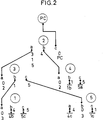
- FIG. 2 schematically represents a sub-network with a tree structure determined by the example of implementation of the method according to the invention, described here.
- a, b, c representing each port, is noted a list of numbers. These are the node numbers and the marker 0 which are stored in the memory specific to this port.
- the memory specific to node 2a contains the numbers of nodes 3, 1, 5.
- These numbers correspond to the links: 2a-3a, 3b-1a, 3c-5b which are paths that can be taken to route a message from node 2 respectively towards nodes 3, 1, 5.
- the program reads the memory location pointed to by the port address pointer to be tested. Its content is 3a.
- the PC master station sends a test message to port 3a. This message is transmitted by node 2, which knows that node 3 is connected to its port 2b, thanks to the memory specific to port 2b, which contains 3. Port 3a does not need to send a message from interrogation to know the node to which it is connected.
- the previously mentioned test for port 2C detects that the test message arrives at node 3 through port 3a.
- the node 3 then sends a response message containing the marker p to its hierarchical superior, 2, with a view to sending it to the master station PC. For node 2, the immediate superior is the PC master station, itself.
- Node 2 replaces recipient address 2 with PC, and replaces sender address, 3, with his identity, 2, then retransmits the response message on port 2c, which is designated by the marker 0 as the port routing to any superior.
- the response is transmitted by node 2 to the master station. It is written in the memory of the master station, at the location designated by the response write address pointer. This response p is not stored in station 2, because it does not allow station 2 to increase its knowledge of the configuration: station 2 already knew that its port 2a is connected to node 3.
- the port address pointer to be tested now points to port 3b.
- a test message including this address is sent by the master station. It is retransmitted by node 2 to node 3, node 2 knowing that it is connected to node 3 by its port 2a, thanks to the content of the memory of port 2a.
- Port 3b sends a query message on its link.
- Node 1 receives this message. It starts a timer incorporated in node 1 and causes writing 0.3 in the memory specific to port 1a.
- Node 1 responds to node 3: 1a, 1b, 1c. This response means that port 3b is connected to a node 1, and comprising three ports: 1a, 1b, 1c.
- the response from the interrogated node, 1, is retransmitted from node 3, which has the tested port, 3b, to its immediate hierarchical superior, 2, with a view to sending it to the master station PC, following the hierarchical path.
- the hierarchical superior is determined by searching for the marker 0 in the memories specific to the ports of node 3, then by taking the identity of the port which immediately follows the marker 0 in the same memory.
- the response message is retransmitted by node 3 after replacing 3 by 2 in the recipient address and after replacing the sender address 1, with its identity: 2.
- the response message arrives at node 2, where it is recognized as a response message to a test, and must be routed through the hierarchical channel. Node 2 retransmits this message after replacing 2 with PC in the recipient address, since its immediate hierarchical superior is the PC master station.
- the response is written to the memory of the PC master station, at the address designated by the response address pointer. This response is partially written in the memory specific to port 3b in node 3, and in the memory specific to port 2a in node 2, by writing there: 1.
- a similar test message addressed to port 3c receives for response: 5a, 5b, 5c.
- the memory specific to port 5b is written to put: 0.3.
- a timer is started in node 5.
- the master station stores 5a, 5b, 5c.
- the content of the memory of the PC master station is as follows: 2a 2b 2c 3a 3b 3c 4a 4b 4c p p 1a 1b 1 C 5a 5b 5c -
- the port address pointer to be tested points to an address that contains 4a.
- the case is similar to that of ports 2c, 3a, 1a.
- Node 4 responds by sending a marker: p, which means that node 4 does not allow the tree to be extended.
- the master station then tests port 4b. Its test message is transmitted by node 2.
- the memory specific to port 2b containing 4, the request can be routed to node 4 via port 2b.
- Port 4b interrogates the node to which it is connected. He receives for response: e1b. This response means that port 4b is connected to port 1b of node 1, but that the latter has already been taken into account, since the timer for node 1 has been started.
- the e marker indicates to the nodes located on the hierarchical channel, and indicates to the master station, that the link 4b-1b must not be integrated into the subnetwork in the course of determination, under penalty of forming a mesh, therefore no longer having a tree structure. In other words, there would no longer be a single path for routing a message from the master station PC to node 1, and certain paths would not have a minimum length. It should be noted that in such a case, it is useless for the node questioned to give the identity of all its ports: 1a and 1c are not mentioned. On the other hand, it is useful for the master station PC to know the identity of the port which responds to node 4, because there could be one or more other ports of node 2 which is connected to node 4. The master station can, in this In this case, distinguish the different links and can use this knowledge to determine a new hierarchical tree in the event of a link failure, without having to redo a complete determination of the configuration.
- the response e1b is partially written into the memory specific to port 4b in node 4, in the form: 1, which means that port 4b is connected to node 1.
- a path from the master station to node 1 is already known and is sufficient for the subnet to be determined. Consequently, the link 4b-1b will not be a privileged link in this configuration, to communicate between the master station and the node 1.
- the response e1b is transmitted by the hierarchical channel, that is to say by the node 2, without being stored in the node 2, since the messages intended for the node 1 should not transit through port 2b.
- the response e1b is recorded completely in the memory of the master station, at the address designated by the response address pointer.
- an intermediate node which is part of the hierarchical path, and which retransmits a response message to a test applies a rule consisting in memorizing the node numbers contained in the response message, except those accompanied by the marker e; and not to store the markers 0.
- the node tested which is a particular intermediate node belonging to the hierarchical path, stores the identity of a node contained in a response message and accompanied by the marker e , if this response message is sent by a node having this identity, in other words if the sender is an immediately neighboring node.
- node 4 which is the node tested, acts as an intermediate node to transmit the response message e1b sent by node 1 to the master station PC. So node 4, stores 1, in the proper memory of port 4b which receives this message. This will allow node 4 to route a message to node 1 by a "shortcut". When a message intended for node 1 is emitted or re-emitted by node 4, it would be penalizing to pass the message only through the branches of the tree. It would pass through nodes 2 and 3, while the link 4b-1b offers a "shortcut" without an intermediate node. In FIG. 2, near port 4b, this exceptional connection possibility is represented by a small segment with, at its end, the complete identity of port 1b to which port 4b is connected, but this identity is not represented. only to help understanding; it is not stored in this complete form, in node 4.
- the PC master station then tests port 4c.
- the answer is: e5a.
- This response means that the port 4c is connected to a port 5a of the node 5, but that the node 5 has already been interrogated previously during the same configuration procedure, its timer providing the marker e.
- This answer is memorized completely in the memory of the master station. It is partially stored in the form: 5, in the memory specific to port 4c. It is not stored in node 2.
- the content of the master station memory is as follows: 2a 2b 2c 3a 3b 3c 4a 4b 4c p p 1a 1b 1 C 5a 5b 5c p e1b e5a -
- the address pointed to by the port address pointer to be tested contains the p marker.
- the following address also contains the marker p.
- the master station reads the content of these addresses but does not take them into account, and further increments the port address pointer to be tested.
- the latter then points to an address which contains 1a.
- the master station then tests port 1a.
- the test message is transmitted by port 2a of node 2, since the memory specific to port 2a contains 1, which indicates that this port makes it possible to route a message to node 1.
- the test message arrives at node 3.
- port 3d since the memory specific to port 3d contains 1 indicating that this port makes it possible to route a message to node 1.
- This message arrives at node 1 by port 1a.
- Port 1a stores 0.3.
- a timer located in node 1 is started.
- the node 1 sends to the master station PC a response which is constituted by the marker 0. This case is similar to that of the ports 2c, 3a, 4a encountered previously.
- the central station then tests port 1b.
- the test message follows the same path as the previous one.
- the response retransmitted by port 1b is: e4b.
- This response is stored completely in the memory of the master station, and partially, in the form: 4, in the memory specific to port 4b. It is not stored in intermediate nodes 2 and 3, because these detect the presence of the marker e, and detect that the number contained in the response: 4, is different from the sender address: 1 and 3 respectively.
- the link 1b - 4b will only be used to route a message sent or re-sent by node 1 to node 4, because in this case it is a "shortcut" to a path on the tree.
- the PC master station then tests port 1c.
- the latter re-issues as response: e5c.
- This response is stored completely in the memory of the master station, and partially, in the form: 5, in the memory specific to port 1c. It is not stored in the intermediate nodes 2 and 3 because these detect the presence of the marker e, and detect that the number contained in the response: 5, is different from the sender address, respectively: 1 and 3.
- the link 1c - 5c will only be used to route a message sent or retransmitted by node 1 to node 5, because in this case it constitutes a "shortcut" compared to a path located on the tree.
- the master station then tests port 5a.
- the response reissued by port 5a is: e4c. This response is stored completely in the PC master station, and partially in the memory specific to port 5a.
- the master station then interrogates port 5b the response is: p. This response is only stored in the PC master station. Finally, the master station tests port 5c the response is: e1c. This response is stored completely in the memory of the PC master station, and partially in the memory specific to port 5c, in the form: 1.
- the content of the memory of the master station is as follows: 2a 2b 2c 3a 3b 3c 4a 4b 4c p p 1a 1b 1 C 5a 5b 5c p e1b e5a p e4b e5c e4c p e1c _
- the port address pointer to be tested points to an address that contains a p marker.
- the master station increments this pointer, because it is not the number of a port that can be usefully tested.
- the content of all the following addresses corresponds to ports which cannot be usefully tested because the e marker indicates that they have all already been tested during this same configuration procedure. This procedure therefore ends.
- the memory of the master station then contains the identity of all the ports of all the nodes of the network.
- the memory specific to each port, in the nodes contains the identity of all the other nodes which can be reached via this node and privileged links; and further contains the identity of immediately neighboring nodes which can be reached by unprivileged links, but which constitute useful shortcuts for improving network performance.
- the results of determining the configuration of a network are used to route a message as follows.
- the node's processor begins by searching, in the memories specific to the ports of this node, for the presence of the identity of the destination node. If it finds this identity, it deduces therefrom that the port to be used, for transmitting or re-transmitting the message, is that corresponding to the memory in which this identity was found.
- the node searches in the memories specific to its ports, the marker 0 which designates the port making it possible to go up the hierarchical path.
- node 3 wants to send a message to node 4.
- This message has the recipient address 4.
- Node 3 searches for 4 in the memories specific to ports 3a, 3b, 3c. He can't find it. It then searches for marker 0 in these memories. The 0 marker is found in the memory of port 3a.
- Node 3 sends its message through port 3a. The message goes up the hierarchy of nodes. This message arrives at node 2.
- Node 2 searches 4 in the memories specific to ports 2a, 2b, 2c. It finds it in the memory specific to port 2b. It will retransmit the message through port 2b.
- the message arrives at node 4 through port 4a.
- FIG. 3 illustrates an example of implementation of the method according to the invention for the example of network represented in FIG. 1, when a break in the link 3c-5b is detected by the nodes 3 and 5, and leads the PC master station to redo a network configuration determination.
- This new determination results in a new tree having a new branch 4c-5a connecting node 5 to the tree. In other words, there is a new path of minimum length connecting the master station to the node 5.
- the implementation of the method according to the invention is identical to that described above, until the master station PC tests the port 3c.
- the master station tests 3c without it being able to retransmit a response, consequently the existence of node 5 is no longer noted at this stage of the procedure, but at a later stage, when the master station tests port 4c.
- the interrogation procedure executed by the port 4c on its link enables it to note that it is connected to a node 5 comprising ports 5a, 5b, and 5c.
- Port 5a is the one that receives the test message, therefore a 0 marker is written in the memory specific to port 5a.
- Port 5a also notes that the identity of the node to which it is connected is 4. This number 4 is therefore also written in the proper memory of port 5a.
- the port 5b After a predetermined period, it concludes that the port 5b is connected to a defective or nonexistent link. Then, when the master station tests the port 5c, the latter performs an interrogation procedure on its link, with the same result as in the case corresponding to the figure 1.
- the method according to the invention is compatible with a network monitoring method consisting in periodically testing each port, to monitor the state of each link, and consisting, if a link is interrupted, in reporting this fact to the PC master station, to start a network configuration determination procedure again.
- the method according to the invention is applicable to more complex network forms than those of multi-point to point networks.
- networks where a port is connected directly to a neighboring node only by a unidirectional link, the transmission in opposite direction having to pass by intermediate nodes and another unidirectional link.
- the interrogated node cannot respond on the same unidirectional link.
- the response must be routed over another one-way link, possibly through other nodes.
- each node which has not yet been taken into account applies the following rule: it retransmits the message by the same port as the one which received the message, each port being, by hypothesis, an input-output connected to two unidirectional links or to a single bidirectional link. If the intermediate node has already been taken into account in the configuration, it searches in the memories specific to its ports, if one of them contains the identity of the node to which the message is addressed; and if not, it searches for the memory containing the marker 0 locating the hierarchical route; then it retransmits the message by the port corresponding to the memory thus determined. The message always ends up finding a node that knows the direction of the destination node, or at least the direction going up the hierarchy of nodes, to the root of the tree, from where it can descend to the destination node.
- FIG. 4 represents an example of a ring network, comprising 8 nodes numbered from 1 to 8, and a master station referenced PC.
- Stations 1 to 5 form a first ring and stations 3, 6, 7, 8 form a second ring, the two rings having station 3 in common.
- Station 2 has two ports, a and b.
- Port a consists of an input and an output connected respectively to two distinct unidirectional links
- port b consists of an input-output connected to the PC master station by a bidirectional link.
- the nodes 1, 4, 5, 6, 7, 8 each have a single port, referenced a, having an input and an output connected respectively to two distinct unidirectional links.
- Node 3 has two ports a, and b, each having a separate input and output connected respectively to two separate unidirectional links.
- the implementation of the method according to the invention is almost identical to that described above for a multipoint network with points, the only difference appears when a port is tested to know the identity of the nodes to which it is connected, and that it performs an interrogation procedure, on the unidirectional link connected to the output of the port in question. It sends the immediately neighboring node a query message asking for its identity. The neighboring node sends a response message which must return to the tested port and this must re-send it to the PC master station.
- the routing of this message must respect two constraints: the links are uni-directional; and the intermediate nodes, if they are already taken into account in the hierarchical tree, must be traversed in the hierarchical order defined by this tree being determined. Because of these two constraints, the response message may have to ring several times, as will appear below.
- FIG. 5 illustrates the implementation of the method according to the invention for the example of network represented in FIG. 4.
- the list of numbers written in the memory specific to a port is represented next to the symbol corresponding to this port.
- the program implemented by the processor of the master station consists first of all in interrogating the node which is connected to the master station PC, to determine the identity of this node and the identity of the ports that this node has. The answer is: 2a, 2b.
- This response is recorded in a memory of the master station, at addresses supplied by a response write address pointer.
- a port address pointer to be tested is incremented, in a manner identical to that described above.
- the marker 0 and the identity, PC, of the node at the origin of the test message are written to the memory specific to port 2b.
- a timer incorporated into node 2 is started, to memorize that node 2 has been taken into account in the configuration.
- a test message is sent to port 2a.
- Port 2a performs a query procedure on the link to which it is connected.
- Node 1 receives the test message and sends a response message through port 1a.
- the response consists of its port number: la.
- it writes in the memory specific to port 1a: a marker 0, because the message has been received by this port; and it writes down the identity, 2, of the node which sent the test message.
- This number is taken from the part of the query message containing the address, 2a, of the sender of the message.
- the response message contains 2 as the recipient address because it must return to node 2 to deliver the response to it.
- a timer, incorporated into node 1 is started, to memorize that node 1 has been taken into account in the configuration.
- the response message arrives at node 3.
- Node 3 has not yet been taken into account in the configuration, because it has never been queried.
- the processor of node 3 applies the rule according to which, when the node has not been taken into account in the configuration, that is to say when its timer is not started, the message is retransmitted by the same port .
- port 3a retransmits the response message, on its link towards node 4. It does not memorize anything because it is not the recipient.
- the nodes 3, 4, 5 successively retransmit the response message by not modifying either the recipient address or the sender address, and without storing the content of the message because they are not recipients.
- the message arrives at node 2 after having made a ring turn.
- Node 2 awaits this response because it is the node currently being tested. It stores 1 in the memory of its port 2a then retransmits the response by the hierarchical channel, in order to send it to the PC master station. It searches for the 0 marker in its port memories. It finds 0, PC in the memory of port 2b. It sets PC as the recipient address and retransmits the message via port 2b. The message arrives directly at the master station, because it is the immediate hierarchical superior of node 2. This stores the content of the response message: 1a.
- the port address pointer to be tested is incremented. It designates 0, then it designates the.
- the PC master station sends a test message to port 1a. Node 2 can route this message, because the port memory contains it 1.
- Port 1a sends a query message on its link. This message has the sender address: 1. It arrives at node 3. The latter starts a timer, and stores 0.1 in the memory of port 1a. Then it sends a response message with recipient address 1; having for content: 3a, 3b; and having the sender address: 3.
- This message is sent by port 3a which received the interrogation message. It is received and re-transmitted by node 4 through its port 4a, because it has not yet been taken into account in the configuration, and without storing anything since it is not a recipient. Node 4 puts its identity, 4, as the new sender address.
- the message arrives at node 5.
- the latter behaves like node 4, because it has not yet been taken into account in the configuration.
- the message arrives at node 2.
- the latter knows how to route the message to recipient 1 because it was taken into account in the configuration and the memory of port 2a contains 1.
- the response message has gone around the ring.
- node 1 It arrives at node 1 which awaits the response to its interrogation message.
- the node 1 inscribes in the memory of the port 1 has the identity 3 contained in the response message, then it retransmits the response message by the hierarchical channel, with a view to sending it to the master station PC. It searches for the 0 marker in its port memories. It finds 0.2 in the memory of port 1a. He puts the address of his supervisor, 2, as the recipient address. Node 1 sends this message on its port 1a, since the memory of this port contains 2. This message arrives at node 3 through the port 3a. Node 3 retransmits it via its port 3a since this node has not yet been taken into account.
- this message is retransmitted by nodes 4 and 5 by applying the retransmission rule by the reception port, since these nodes have not yet been taken into account in the configuration.
- the message arrives at node 2. The latter notes that it is a response message from a configuration procedure and that the recipient address is 2. It partially stores the response, writing 3 to the memory of port 2; since it is recipient. Then he retransmits the message by addressing it to his immediate supervisor: the PC master station.
- the memory content of port 2a is: 1.3.
- Node 2 thus knows that it can route messages to nodes 1,3.
- the master station PC stores the content 3a, 3b of the response message.
- the port address pointer to be tested designates 3a.
- the master station sends a test message to port 3a.
- Port 3a sends a query message on its link.
- the node 4 sends a response, 4a, which is retransmitted, without being stored, by the nodes 5, 2, 1 to the node 3 where the port 3a awaits a response.
- Node 3 stores 4 in the memory of port 3a. This memory now contains 0, 1, 4.
- Node 3 retransmits the response by the hierarchical channel, in order to send it to the master station PC. It therefore puts 1 as the recipient address and it transmits on port 3a, corresponding to this destination.
- the response message is retransmitted by nodes 4 and 5, without them memorizing its content. Then it is received by node 2 which does not memorize anything because it is not a recipient. Since node 2 forwards it to node 1, which stores 4. Node 1 forwards it to its hierarchical superior, putting 2 in the recipient address.
- the response message goes around the ring 3, 4, 5 again to go up a hierarchical level, to node 2.
- Nodes 3, 4, 5 retransmit the message without memorizing anything because they are not recipient.
- the message arrives at node 2.
- the latter notes that it is a response message to the configuration procedure and that the recipient address is 2. It therefore partially stores the content of the response by writing 4 in the port memory 2a who received the message; and it retransmits the message by addressing it to its immediate superior, who is the PC master station.
- the latter stores 4a.
- the port address pointer to be tested then designates port 3b.
- the master station sends a test message to port 3b.
- Port 3b sends a query message on its link.
- Node 7 receives it on its port 7a.
- the node 7 stores 0.3 in the memory of its port 7a and starts a timer incorporated in the node 7. It sends a response message, 7a, on the output of its port 7a, which is connected to the node 6.
- the response arrives at node 3 through port 3b after having made a tour of the loop 7, 6, 8.
- node 3 is the recipient, it stores 7 in the memory of port 3b then it re-issues the response to its hierarchical superior , in order to send it to the PC master station. It searches for the 0 marker in its port memories. It finds 0.1 in the memory of port 3A. It puts 1 as the recipient address and retransmits the response through port 3a. Nodes 4, 5, 2 retransmit the message without memorizing anything because they are not recipients.
- the message arrives at the destination node 1 which stores 7 and then retransmits the message by addressing it to its hierarchical superior, with a view to sending it to the master station PC.
- Node 1 finds 0.2 in the memory of port 1a. It retransmits the message by port 1a by putting as recipient address: 2. The message is retransmitted by nodes 3, 4, 5 which do not memorize nothing because they are not recipients. The message arrives at node 2. The latter notes that it is a response message to the configuration procedure and that the recipient address is 2. It therefore stores 7 in the memory of port 2a which received the message. Then it retransmits the response message to its immediate supervisor who is the PC master station. The latter stores 7a.
- the configuration tree is provided with "shortcuts" at the ends of its branches.
- the response message can reach the PC master station by using other "shortcuts" in some cases. This possibility only occurs in the case where the interrogated node has already been taken into account in the configuration. It then responds by giving the identity of its ports with the marker e.
- an optional rule consists in retransmitting the response message from the tested node to the master station by addressing it to any hierarchical superior, using the marker 0, and not to the immediate hierarchical superior of the tested node.
- this optional rule does not save any time because the two-way links do not require many rounds of rings to follow the hierarchical path.
- this optional rule is advantageous in the example of FIG. 4, because the unidirectional links and the ring structures require numerous ring turns to follow the hierarchical path.
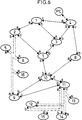
- FIG. 6 schematically represents an example of a mixed network, which is a mixture of multipoint point networks and rings.
- FIG. 7 illustrates an example of implementation of the method according to the invention, for the example of a mixed network represented in FIG. 6.
- the conventions of representation in FIG. 7 are similar to those of FIGS. 2, 3 and 5.
- the procedure is analogous to the procedures described for the two types of network taken separately; it applies all the rules mentioned above.
- the optional rule is applied to transmit the response messages sent by the nodes 16, 5, 12, 13 when ports 16a, 5a, 12b, 13a are tested. It makes it possible to find a shorter path than the hierarchical path in the case of ports 5a and 12b.
- the path is as long as that of the hierarchical path in the case of ports 16a and 13a.
Landscapes
- Engineering & Computer Science (AREA)
- Computer Hardware Design (AREA)
- Physics & Mathematics (AREA)
- Theoretical Computer Science (AREA)
- General Physics & Mathematics (AREA)
- General Engineering & Computer Science (AREA)
- Software Systems (AREA)
- Mathematical Physics (AREA)
- Data Exchanges In Wide-Area Networks (AREA)
- Small-Scale Networks (AREA)
- Two-Way Televisions, Distribution Of Moving Picture Or The Like (AREA)
- Paper (AREA)
- Investigating Or Analysing Biological Materials (AREA)
- Computer And Data Communications (AREA)
Applications Claiming Priority (2)
| Application Number | Priority Date | Filing Date | Title |
|---|---|---|---|
| FR9105886 | 1991-05-15 | ||
| FR9105886A FR2676558B1 (fr) | 1991-05-15 | 1991-05-15 | Procede pour determiner automatiquement la configuration d'un reseau. |
Publications (2)
| Publication Number | Publication Date |
|---|---|
| EP0515253A1 true EP0515253A1 (de) | 1992-11-25 |
| EP0515253B1 EP0515253B1 (de) | 1995-07-12 |
Family
ID=9412805
Family Applications (1)
| Application Number | Title | Priority Date | Filing Date |
|---|---|---|---|
| EP92401341A Expired - Lifetime EP0515253B1 (de) | 1991-05-15 | 1992-05-15 | Prozess um eine Netzwerkkonfiguration automatisch zu erstellen |
Country Status (5)
| Country | Link |
|---|---|
| EP (1) | EP0515253B1 (de) |
| AT (1) | ATE125052T1 (de) |
| DE (1) | DE69203392T2 (de) |
| ES (1) | ES2074344T3 (de) |
| FR (1) | FR2676558B1 (de) |
Cited By (5)
| Publication number | Priority date | Publication date | Assignee | Title |
|---|---|---|---|---|
| WO1994015305A1 (en) * | 1992-12-21 | 1994-07-07 | Apple Computer, Inc. | Method and apparatus for transforming an arbitrary acyclic topology collection of nodes into an acyclic directed graph |
| WO1994015302A1 (en) * | 1992-12-21 | 1994-07-07 | Apple Computer, Inc. | Method and apparatus for arbitrating on an acyclic directed graph |
| EP0631241A1 (de) * | 1993-05-28 | 1994-12-28 | International Business Machines Corporation | Initialisierung von Mehrfachbus-Netzwerken |
| WO1996018156A1 (en) * | 1994-12-07 | 1996-06-13 | Cray Research, Inc. | Maintenance channel for modular, highly interconnected computer systems |
| GB2372670A (en) * | 2001-02-27 | 2002-08-28 | 3Com Corp | Optimisation of network configuration |
Citations (3)
| Publication number | Priority date | Publication date | Assignee | Title |
|---|---|---|---|---|
| WO1985001850A1 (en) * | 1983-10-22 | 1985-04-25 | The General Electric Company Plc | Communication networks |
| EP0221360A2 (de) * | 1985-11-04 | 1987-05-13 | International Business Machines Corporation | Digitale Nachrichtenübertragungsnetzwerke und Aufbau von Übertragungswegen in diesen Netzwerken |
| EP0242765A2 (de) * | 1986-04-21 | 1987-10-28 | Geräte- und Regler-Werk Leipzig GmbH | Verfahren und Vorrichtung zur Informationsübertragung in Mehrrechnersystemen mit hierarchisch gegliedertem Übertragungsnetzwerk |
-
1991
- 1991-05-15 FR FR9105886A patent/FR2676558B1/fr not_active Expired - Fee Related
-
1992
- 1992-05-15 ES ES92401341T patent/ES2074344T3/es not_active Expired - Lifetime
- 1992-05-15 EP EP92401341A patent/EP0515253B1/de not_active Expired - Lifetime
- 1992-05-15 DE DE69203392T patent/DE69203392T2/de not_active Expired - Fee Related
- 1992-05-15 AT AT92401341T patent/ATE125052T1/de not_active IP Right Cessation
Patent Citations (3)
| Publication number | Priority date | Publication date | Assignee | Title |
|---|---|---|---|---|
| WO1985001850A1 (en) * | 1983-10-22 | 1985-04-25 | The General Electric Company Plc | Communication networks |
| EP0221360A2 (de) * | 1985-11-04 | 1987-05-13 | International Business Machines Corporation | Digitale Nachrichtenübertragungsnetzwerke und Aufbau von Übertragungswegen in diesen Netzwerken |
| EP0242765A2 (de) * | 1986-04-21 | 1987-10-28 | Geräte- und Regler-Werk Leipzig GmbH | Verfahren und Vorrichtung zur Informationsübertragung in Mehrrechnersystemen mit hierarchisch gegliedertem Übertragungsnetzwerk |
Non-Patent Citations (2)
| Title |
|---|
| AFIPS CONFERENCE PROCEEDING 1982 7 Juin 1982, HOUSTON, TEXAS, USA C DAVIS: 'Reconfigurable multicomputer networks for very fast real-time application' * |
| IEEE TRANSACTIONS ON COMPUTERS. vol. C-36, no. 7, 1987, NEW YORK US S.P. KARTASHEV: 'Analysis and synthesis of dynamic multicomputer networks that configure into rings, trees and stars' * |
Cited By (12)
| Publication number | Priority date | Publication date | Assignee | Title |
|---|---|---|---|---|
| WO1994015305A1 (en) * | 1992-12-21 | 1994-07-07 | Apple Computer, Inc. | Method and apparatus for transforming an arbitrary acyclic topology collection of nodes into an acyclic directed graph |
| WO1994015302A1 (en) * | 1992-12-21 | 1994-07-07 | Apple Computer, Inc. | Method and apparatus for arbitrating on an acyclic directed graph |
| US5630173A (en) * | 1992-12-21 | 1997-05-13 | Apple Computer, Inc. | Methods and apparatus for bus access arbitration of nodes organized into acyclic directed graph by cyclic token passing and alternatively propagating request to root node and grant signal to the child node |
| US5802289A (en) * | 1992-12-21 | 1998-09-01 | Apple Computer, Inc. | Method for propagating preemptive bus initialization on an acyclic directed graph |
| EP1132821A3 (de) * | 1992-12-21 | 2006-04-19 | Apple Computer, Inc. | Verfahren und Vorrichtung zur Arbitrierung auf einen acyclischen gerichteten Graph |
| EP0631241A1 (de) * | 1993-05-28 | 1994-12-28 | International Business Machines Corporation | Initialisierung von Mehrfachbus-Netzwerken |
| US5542055A (en) * | 1993-05-28 | 1996-07-30 | International Business Machines Corp. | System for counting the number of peripheral buses in each hierarch connected to primary bus for creating map of peripheral buses to locate peripheral devices |
| WO1996018156A1 (en) * | 1994-12-07 | 1996-06-13 | Cray Research, Inc. | Maintenance channel for modular, highly interconnected computer systems |
| US5692123A (en) * | 1994-12-07 | 1997-11-25 | Cray Research, Inc. | Maintenance channel for modulator, highly interconnected computer systems |
| GB2372670A (en) * | 2001-02-27 | 2002-08-28 | 3Com Corp | Optimisation of network configuration |
| GB2372670B (en) * | 2001-02-27 | 2003-01-08 | 3Com Corp | Optimisation of network configuration |
| US7340515B2 (en) | 2001-02-27 | 2008-03-04 | 3Com Corporation | Optimisation of network configuration |
Also Published As
| Publication number | Publication date |
|---|---|
| ATE125052T1 (de) | 1995-07-15 |
| DE69203392D1 (de) | 1995-08-17 |
| FR2676558B1 (fr) | 1993-07-23 |
| DE69203392T2 (de) | 1995-12-14 |
| ES2074344T3 (es) | 1995-09-01 |
| FR2676558A1 (fr) | 1992-11-20 |
| EP0515253B1 (de) | 1995-07-12 |
Similar Documents
| Publication | Publication Date | Title |
|---|---|---|
| EP0003493B2 (de) | Datenübertragungssystem zwischen Stationen die in einer Schleife miteinander verbunden sind | |
| EP2783500B1 (de) | Verfahren zur bearbeitung einer anforderung in einem informationszentrierten kommunikationsnetz | |
| EP0026135A1 (de) | Verfahren zum Prüfen einer Digitaldatenübertragungsleitung zwischen zwei Modems und Vorrichtung zur Durchführung dieses Verfahrens | |
| EP0479096A1 (de) | Brücke zur Verbindung eines lokalen, nach der Norm IEEE 802.3 gerichteten Netzes an ein ATM Fernmeldenetz | |
| WO2014122099A1 (fr) | Procédé pour router des données, programme d'ordinateur, contrôleur de réseau et réseaux associés | |
| EP0407279B1 (de) | Kommunikationsnetz zwischen Teilnehmereinrichtungen | |
| FR2711818A1 (fr) | Procédé de diffusion de données à train de données. | |
| EP0515253B1 (de) | Prozess um eine Netzwerkkonfiguration automatisch zu erstellen | |
| FR2690298A1 (fr) | Procédé et dispositif de gestion d'une ressource de diffusion. | |
| FR2893471A1 (fr) | Systeme et procede de routage statique de flux de paquets de donnees dans un reseau d'interconnexion | |
| EP1212879B1 (de) | Verfahren und system zur übertragung einer meldungskette für datenbanken | |
| FR2836611A1 (fr) | Procede de communication reseau avec une carte a puce par messages asynchrones | |
| EP0486915B1 (de) | Verfahren zur Übertragung von Kontrollinformation über eine asynchrone Zeitmultiplexzellen übertragende Verbindung | |
| WO2004080015A1 (fr) | Procede de gestion de presence selective pour service de messagerie instantanee au sein d’un reseau de telecommunication tel que le reseau internet | |
| EP2273759B1 (de) | Optimierte Datenreplikation in Peer-to-Peer-Netzen | |
| CN114697201A (zh) | 一种基于应用客户端代理请求的数据处理方法及装置 | |
| FR2838898A1 (fr) | Dispositif d'aiguillage a commutation et routage centralises | |
| WO2017016854A1 (fr) | Procede de determination d'une route dans un reseau cpl | |
| CH645223A5 (fr) | Dispositif de controle des communications dans un reseau de transmission en duplex. | |
| EP0637417B1 (de) | Datenübertragungseinrichtung und verfahren für funknetz | |
| EP0784270A1 (de) | Verfahren für die Ablauffolgeplanung von aufeinanderfolgenden Nachrichten aus einer Merhrzahl von Quellen, und System zur Ausführung dieses Verfahrens | |
| FR2791502A1 (fr) | Procede et dispositif de determination d'un chemin d'un paquet de donnees dans un reseau de communication | |
| WO1999048253A1 (fr) | Procede de distribution d'un message dans un reseau | |
| EP2835954A2 (de) | Datenverarbeitungsverfahren in einem Ad-hoc-Funknetz, entsprechende Funkstationen und Computerprogramme | |
| WO2002087174A1 (fr) | Procede de gestion d'une liste de paquets dans un port de sortie d'un commutateur de paquets. |
Legal Events
| Date | Code | Title | Description |
|---|---|---|---|
| PUAI | Public reference made under article 153(3) epc to a published international application that has entered the european phase |
Free format text: ORIGINAL CODE: 0009012 |
|
| AK | Designated contracting states |
Kind code of ref document: A1 Designated state(s): AT BE CH DE ES FR GB IT LI NL SE |
|
| 17P | Request for examination filed |
Effective date: 19930408 |
|
| 17Q | First examination report despatched |
Effective date: 19930831 |
|
| GRAA | (expected) grant |
Free format text: ORIGINAL CODE: 0009210 |
|
| AK | Designated contracting states |
Kind code of ref document: B1 Designated state(s): AT BE CH DE ES FR GB IT LI NL SE |
|
| REF | Corresponds to: |
Ref document number: 125052 Country of ref document: AT Date of ref document: 19950715 Kind code of ref document: T |
|
| ITF | It: translation for a ep patent filed | ||
| REF | Corresponds to: |
Ref document number: 69203392 Country of ref document: DE Date of ref document: 19950817 |
|
| REG | Reference to a national code |
Ref country code: ES Ref legal event code: FG2A Ref document number: 2074344 Country of ref document: ES Kind code of ref document: T3 |
|
| GBT | Gb: translation of ep patent filed (gb section 77(6)(a)/1977) |
Effective date: 19950905 |
|
| PLBE | No opposition filed within time limit |
Free format text: ORIGINAL CODE: 0009261 |
|
| STAA | Information on the status of an ep patent application or granted ep patent |
Free format text: STATUS: NO OPPOSITION FILED WITHIN TIME LIMIT |
|
| 26N | No opposition filed | ||
| PGFP | Annual fee paid to national office [announced via postgrant information from national office to epo] |
Ref country code: GB Payment date: 20000410 Year of fee payment: 9 |
|
| PGFP | Annual fee paid to national office [announced via postgrant information from national office to epo] |
Ref country code: CH Payment date: 20000412 Year of fee payment: 9 |
|
| PGFP | Annual fee paid to national office [announced via postgrant information from national office to epo] |
Ref country code: NL Payment date: 20000417 Year of fee payment: 9 |
|
| PGFP | Annual fee paid to national office [announced via postgrant information from national office to epo] |
Ref country code: FR Payment date: 20000418 Year of fee payment: 9 Ref country code: AT Payment date: 20000418 Year of fee payment: 9 |
|
| PGFP | Annual fee paid to national office [announced via postgrant information from national office to epo] |
Ref country code: SE Payment date: 20000420 Year of fee payment: 9 |
|
| PGFP | Annual fee paid to national office [announced via postgrant information from national office to epo] |
Ref country code: DE Payment date: 20000422 Year of fee payment: 9 |
|
| PGFP | Annual fee paid to national office [announced via postgrant information from national office to epo] |
Ref country code: BE Payment date: 20000428 Year of fee payment: 9 |
|
| PGFP | Annual fee paid to national office [announced via postgrant information from national office to epo] |
Ref country code: ES Payment date: 20000519 Year of fee payment: 9 |
|
| PG25 | Lapsed in a contracting state [announced via postgrant information from national office to epo] |
Ref country code: GB Free format text: LAPSE BECAUSE OF NON-PAYMENT OF DUE FEES Effective date: 20010515 Ref country code: AT Free format text: LAPSE BECAUSE OF NON-PAYMENT OF DUE FEES Effective date: 20010515 |
|
| PG25 | Lapsed in a contracting state [announced via postgrant information from national office to epo] |
Ref country code: SE Free format text: LAPSE BECAUSE OF NON-PAYMENT OF DUE FEES Effective date: 20010516 Ref country code: ES Free format text: LAPSE BECAUSE OF NON-PAYMENT OF DUE FEES Effective date: 20010516 |
|
| PG25 | Lapsed in a contracting state [announced via postgrant information from national office to epo] |
Ref country code: BE Free format text: LAPSE BECAUSE OF NON-PAYMENT OF DUE FEES Effective date: 20010531 |
|
| PG25 | Lapsed in a contracting state [announced via postgrant information from national office to epo] |
Ref country code: LI Free format text: LAPSE BECAUSE OF NON-PAYMENT OF DUE FEES Effective date: 20010614 Ref country code: CH Free format text: LAPSE BECAUSE OF NON-PAYMENT OF DUE FEES Effective date: 20010614 |
|
| BERE | Be: lapsed |
Owner name: S.A. OPTICABLE Effective date: 20010531 Owner name: ALCATEL N.V. Effective date: 20010531 |
|
| PG25 | Lapsed in a contracting state [announced via postgrant information from national office to epo] |
Ref country code: NL Free format text: LAPSE BECAUSE OF NON-PAYMENT OF DUE FEES Effective date: 20011201 |
|
| GBPC | Gb: european patent ceased through non-payment of renewal fee |
Effective date: 20010515 |
|
| REG | Reference to a national code |
Ref country code: CH Ref legal event code: PL |
|
| PG25 | Lapsed in a contracting state [announced via postgrant information from national office to epo] |
Ref country code: FR Free format text: LAPSE BECAUSE OF NON-PAYMENT OF DUE FEES Effective date: 20020131 |
|
| NLV4 | Nl: lapsed or anulled due to non-payment of the annual fee |
Effective date: 20011201 |
|
| PG25 | Lapsed in a contracting state [announced via postgrant information from national office to epo] |
Ref country code: DE Free format text: LAPSE BECAUSE OF NON-PAYMENT OF DUE FEES Effective date: 20020301 |
|
| REG | Reference to a national code |
Ref country code: ES Ref legal event code: FD2A Effective date: 20030203 |
|
| PG25 | Lapsed in a contracting state [announced via postgrant information from national office to epo] |
Ref country code: IT Free format text: LAPSE BECAUSE OF NON-PAYMENT OF DUE FEES;WARNING: LAPSES OF ITALIAN PATENTS WITH EFFECTIVE DATE BEFORE 2007 MAY HAVE OCCURRED AT ANY TIME BEFORE 2007. THE CORRECT EFFECTIVE DATE MAY BE DIFFERENT FROM THE ONE RECORDED. Effective date: 20050515 |