EP0515445B1 - Rutschhemmende oberflächen - Google Patents
Rutschhemmende oberflächen Download PDFInfo
- Publication number
- EP0515445B1 EP0515445B1 EP91903807A EP91903807A EP0515445B1 EP 0515445 B1 EP0515445 B1 EP 0515445B1 EP 91903807 A EP91903807 A EP 91903807A EP 91903807 A EP91903807 A EP 91903807A EP 0515445 B1 EP0515445 B1 EP 0515445B1
- Authority
- EP
- European Patent Office
- Prior art keywords
- coating
- particles
- paint
- slip
- beads
- Prior art date
- Legal status (The legal status is an assumption and is not a legal conclusion. Google has not performed a legal analysis and makes no representation as to the accuracy of the status listed.)
- Expired - Lifetime
Links
- 239000002245 particle Substances 0.000 claims abstract description 66
- 239000003973 paint Substances 0.000 claims abstract description 48
- 239000011324 bead Substances 0.000 claims abstract description 29
- PNEYBMLMFCGWSK-UHFFFAOYSA-N Alumina Chemical compound [O-2].[O-2].[O-2].[Al+3].[Al+3] PNEYBMLMFCGWSK-UHFFFAOYSA-N 0.000 claims abstract description 21
- 229920001971 elastomer Polymers 0.000 claims abstract description 7
- 239000003822 epoxy resin Substances 0.000 claims abstract description 7
- 229920000647 polyepoxide Polymers 0.000 claims abstract description 7
- 239000005060 rubber Substances 0.000 claims abstract description 7
- 229920000180 alkyd Polymers 0.000 claims abstract description 5
- QCWXUUIWCKQGHC-UHFFFAOYSA-N Zirconium Chemical compound [Zr] QCWXUUIWCKQGHC-UHFFFAOYSA-N 0.000 claims abstract description 4
- 229910052726 zirconium Inorganic materials 0.000 claims abstract description 4
- VYPSYNLAJGMNEJ-UHFFFAOYSA-N Silicium dioxide Chemical compound O=[Si]=O VYPSYNLAJGMNEJ-UHFFFAOYSA-N 0.000 claims abstract description 3
- 229910052814 silicon oxide Inorganic materials 0.000 claims abstract description 3
- 238000000576 coating method Methods 0.000 claims description 57
- 239000011248 coating agent Substances 0.000 claims description 49
- 238000000034 method Methods 0.000 claims description 34
- 229910052500 inorganic mineral Inorganic materials 0.000 claims description 16
- 239000011707 mineral Substances 0.000 claims description 16
- 239000000463 material Substances 0.000 claims description 8
- 239000007921 spray Substances 0.000 claims description 5
- 239000011521 glass Substances 0.000 abstract description 12
- 238000002310 reflectometry Methods 0.000 abstract description 8
- 229960005363 aluminium oxide Drugs 0.000 abstract description 6
- 239000004033 plastic Substances 0.000 abstract description 4
- 229920003023 plastic Polymers 0.000 abstract description 4
- 239000007799 cork Substances 0.000 abstract description 3
- 239000003365 glass fiber Substances 0.000 abstract description 2
- 230000000873 masking effect Effects 0.000 description 6
- 238000012360 testing method Methods 0.000 description 3
- 239000008187 granular material Substances 0.000 description 2
- 230000005484 gravity Effects 0.000 description 2
- 230000014759 maintenance of location Effects 0.000 description 2
- 229910052751 metal Inorganic materials 0.000 description 2
- 239000002184 metal Substances 0.000 description 2
- 239000003921 oil Substances 0.000 description 2
- 239000000049 pigment Substances 0.000 description 2
- 229910000831 Steel Inorganic materials 0.000 description 1
- 238000010521 absorption reaction Methods 0.000 description 1
- 239000000853 adhesive Substances 0.000 description 1
- 230000001070 adhesive effect Effects 0.000 description 1
- 238000010276 construction Methods 0.000 description 1
- 230000002939 deleterious effect Effects 0.000 description 1
- 230000008021 deposition Effects 0.000 description 1
- 230000000694 effects Effects 0.000 description 1
- 239000004744 fabric Substances 0.000 description 1
- 239000000945 filler Substances 0.000 description 1
- 239000004519 grease Substances 0.000 description 1
- 239000000203 mixture Substances 0.000 description 1
- 230000019612 pigmentation Effects 0.000 description 1
- 239000004814 polyurethane Substances 0.000 description 1
- 229920002635 polyurethane Polymers 0.000 description 1
- 239000011527 polyurethane coating Substances 0.000 description 1
- HBMJWWWQQXIZIP-UHFFFAOYSA-N silicon carbide Chemical compound [Si+]#[C-] HBMJWWWQQXIZIP-UHFFFAOYSA-N 0.000 description 1
- 229910010271 silicon carbide Inorganic materials 0.000 description 1
- 238000004513 sizing Methods 0.000 description 1
- 239000010959 steel Substances 0.000 description 1
- 230000001629 suppression Effects 0.000 description 1
- XLYOFNOQVPJJNP-UHFFFAOYSA-N water Substances O XLYOFNOQVPJJNP-UHFFFAOYSA-N 0.000 description 1
- 238000009736 wetting Methods 0.000 description 1
Images

Classifications
-
- C—CHEMISTRY; METALLURGY
- C09—DYES; PAINTS; POLISHES; NATURAL RESINS; ADHESIVES; COMPOSITIONS NOT OTHERWISE PROVIDED FOR; APPLICATIONS OF MATERIALS NOT OTHERWISE PROVIDED FOR
- C09D—COATING COMPOSITIONS, e.g. PAINTS, VARNISHES OR LACQUERS; FILLING PASTES; CHEMICAL PAINT OR INK REMOVERS; INKS; CORRECTING FLUIDS; WOODSTAINS; PASTES OR SOLIDS FOR COLOURING OR PRINTING; USE OF MATERIALS THEREFOR
- C09D5/00—Coating compositions, e.g. paints, varnishes or lacquers, characterised by their physical nature or the effects produced; Filling pastes
- C09D5/004—Reflecting paints; Signal paints
-
- B—PERFORMING OPERATIONS; TRANSPORTING
- B05—SPRAYING OR ATOMISING IN GENERAL; APPLYING FLUENT MATERIALS TO SURFACES, IN GENERAL
- B05D—PROCESSES FOR APPLYING FLUENT MATERIALS TO SURFACES, IN GENERAL
- B05D5/00—Processes for applying liquids or other fluent materials to surfaces to obtain special surface effects, finishes or structures
- B05D5/02—Processes for applying liquids or other fluent materials to surfaces to obtain special surface effects, finishes or structures to obtain a matt or rough surface
-
- B—PERFORMING OPERATIONS; TRANSPORTING
- B05—SPRAYING OR ATOMISING IN GENERAL; APPLYING FLUENT MATERIALS TO SURFACES, IN GENERAL
- B05D—PROCESSES FOR APPLYING FLUENT MATERIALS TO SURFACES, IN GENERAL
- B05D5/00—Processes for applying liquids or other fluent materials to surfaces to obtain special surface effects, finishes or structures
- B05D5/06—Processes for applying liquids or other fluent materials to surfaces to obtain special surface effects, finishes or structures to obtain multicolour or other optical effects
- B05D5/061—Special surface effect
- B05D5/063—Reflective effect
-
- E—FIXED CONSTRUCTIONS
- E01—CONSTRUCTION OF ROADS, RAILWAYS, OR BRIDGES
- E01C—CONSTRUCTION OF, OR SURFACES FOR, ROADS, SPORTS GROUNDS, OR THE LIKE; MACHINES OR AUXILIARY TOOLS FOR CONSTRUCTION OR REPAIR
- E01C11/00—Details of pavings
- E01C11/24—Methods or arrangements for preventing slipperiness or protecting against influences of the weather
-
- E—FIXED CONSTRUCTIONS
- E01—CONSTRUCTION OF ROADS, RAILWAYS, OR BRIDGES
- E01F—ADDITIONAL WORK, SUCH AS EQUIPPING ROADS OR THE CONSTRUCTION OF PLATFORMS, HELICOPTER LANDING STAGES, SIGNS, SNOW FENCES, OR THE LIKE
- E01F9/00—Arrangement of road signs or traffic signals; Arrangements for enforcing caution
- E01F9/50—Road surface markings; Kerbs or road edgings, specially adapted for alerting road users
- E01F9/506—Road surface markings; Kerbs or road edgings, specially adapted for alerting road users characterised by the road surface marking material, e.g. comprising additives for improving friction or reflectivity; Methods of forming, installing or applying markings in, on or to road surfaces
- E01F9/518—Road surface markings; Kerbs or road edgings, specially adapted for alerting road users characterised by the road surface marking material, e.g. comprising additives for improving friction or reflectivity; Methods of forming, installing or applying markings in, on or to road surfaces formed in situ, e.g. by painting, by casting into the road surface or by deforming the road surface
-
- Y—GENERAL TAGGING OF NEW TECHNOLOGICAL DEVELOPMENTS; GENERAL TAGGING OF CROSS-SECTIONAL TECHNOLOGIES SPANNING OVER SEVERAL SECTIONS OF THE IPC; TECHNICAL SUBJECTS COVERED BY FORMER USPC CROSS-REFERENCE ART COLLECTIONS [XRACs] AND DIGESTS
- Y10—TECHNICAL SUBJECTS COVERED BY FORMER USPC
- Y10T—TECHNICAL SUBJECTS COVERED BY FORMER US CLASSIFICATION
- Y10T428/00—Stock material or miscellaneous articles
- Y10T428/24—Structurally defined web or sheet [e.g., overall dimension, etc.]
- Y10T428/24355—Continuous and nonuniform or irregular surface on layer or component [e.g., roofing, etc.]
- Y10T428/24372—Particulate matter
- Y10T428/24421—Silicon containing
-
- Y—GENERAL TAGGING OF NEW TECHNOLOGICAL DEVELOPMENTS; GENERAL TAGGING OF CROSS-SECTIONAL TECHNOLOGIES SPANNING OVER SEVERAL SECTIONS OF THE IPC; TECHNICAL SUBJECTS COVERED BY FORMER USPC CROSS-REFERENCE ART COLLECTIONS [XRACs] AND DIGESTS
- Y10—TECHNICAL SUBJECTS COVERED BY FORMER USPC
- Y10T—TECHNICAL SUBJECTS COVERED BY FORMER US CLASSIFICATION
- Y10T428/00—Stock material or miscellaneous articles
- Y10T428/24—Structurally defined web or sheet [e.g., overall dimension, etc.]
- Y10T428/24802—Discontinuous or differential coating, impregnation or bond [e.g., artwork, printing, retouched photograph, etc.]
- Y10T428/24893—Discontinuous or differential coating, impregnation or bond [e.g., artwork, printing, retouched photograph, etc.] including particulate material
Definitions
- This invention relates to methods of providing traffic surfaces with anti-slip characteristic, and to anti-slip traffic surfaces themselves, the methods being of the kind which include the steps of applying to the surface a first coating of paint, distributing particles of mineral or other material on the coating before the coating has dried so that the particles sink partially into the coating, and then applying a second coating of paint over the particles and the first coating to lock the particles into the first coating.
- Anti-slip traffic surfaces and methods of the above-specified kind for providing them are known from US-A-4662972. Such methods include the step of spreading aluminium-oxide grit over a polyurethane coating while the coating is still wet so that the grit particles sink into the coating to an extent that one-half to two-thirds of each particle is embedded in the coating. Once the coating is dry, a thinner, second coating of polyurethane is applied to cover the first coating and encapsulate the exposed portions of the grit particles totally or at least sufficiently to leave just the sharp points of the grit particles projecting. The second coating traps any loose grit that is not well fastened in the first coating.
- a method of providing a traffic surface with anti-slip characteristic, of said above-specified kind is characterised in that the thicknesses of the first and second coatings are controlled in relation to the average size of the particles to leave substantially one-third of each particle projecting from the second coating.
- the method of the present invention results in an anti-slip or friction traffic surface that has particularly advantageous properties.
- substantially one-third of each particle projecting and two-thirds embedded in the first and second coatings very high frictional values can be obtained together with good retention of the particles so that for any particular surface the friction value obtained remains substantially constant throughout use.
- surfaces with specific frictional characteristics can be readily reproduced, allowing for tight specifications as to frictional values to be adopted and implemented widely and economically for paths, roadways, passageways, decks (for example on ships and oil platforms), helicopter landing pads and airfield runways and taxiways.
- the paint used which may be the same for both coatings and may contain fillers and/or pigments, may be based on an alkyd resin and may contain chlorinated rubber; alternatively, an epoxy-resin based paint may be used.
- the particles used may be of aluminium oxide, silicon oxide, zirconium or plastics material, or may be granules of rubber or cork. They may be applied by spray or a controlled gravity-feed system or by an electrostatic method.
- an anti-slip traffic surface in which the surface carries a first coating of paint that has particles of mineral or other material embedded within it to project from it, and a second coating of paint covers the first coating and the projecting particles to lock the particles in the first coating, characterised in that substantially one-third of each particle projects from the second coating.
- the first and second coatings of the traffic surface and of the method of providing it may be of the same thickness as one another.
- Figure 1 shows a section through a two-coat anti-slip paint system that has been applied to a blacktop (for example, bituminous or tar macadam) or concrete surface of a path, roadway or airfield runway or taxiway, in accordance with the present invention.
- the traffic surface may be a metal or other deck for helicopter use on a ship or oil rig.
- the paint used in the method to be described is based on an alkyd resin of medium chain length, containing chlorinated rubber and pigments. As an alternative, it may have an epoxy resin base.
- paint is applied to the traffic surface 1 after the surface 1 has been swept clear of loose stones and has been cleaned so as to be free from dirt and grease.
- a first coat 2 of the paint is applied to the cleaned, and dry, surface 1 by an airless spray to produce a film thickness of about 0.15 mm. While the paint is still wet, mineral particles 3 are distributed evenly over it, for example by spray.
- the mineral particles 3 used are particles of white aluminium oxide having a 36-mesh grit size. These sink partially into the wet paint, and if the paint were allowed to dry, without taking further steps, the resultant surface would, owing to these particles, have a distinct anti-slip characteristic. However, the particles 3 would tend to break free from the paint during use of the surface 1.
- a second coat 4 of the paint is applied to lock the particles 3 in the first coat 2.
- the second coat 4 of paint which is applied after about 20 minutes has passed from application of the first coat 2, is applied by airless spay over the mineral particles 3 and the first coat 2.
- the thickness of the wet film of the second coat 4 may be the same as, or less than, that of the first coat 2.
- the anti-slip surface is finished and may be put into immediate use.
- the particles 3 are bonded tightly within the two-layer paint coating, and have been found not to break free even under hard operational conditions.
- the surface 1 is generally non-porous so that little or none of the first coating 2 is absorbed into it. If the surface 1 is porous, it is primed before application of the first coat 2, so as to ensure that the first coat 2 remains as a distinct film for receiving and holding the particles 3.
- the primer may be applied simply as an initial thin coat of the same paint as is used for building up the coats 2 and 4.
- three surfaces prepared in that way have been submitted to testing by a friction-measuring device which measures load and drag on a wheel.
- the tests were carried out with the device moving over each of the three surfaces at a speed of about 5 km/hr and with water wetting the wheel at a rate of 4.5 litre/min, under known stresses applied in load and drag.
- the level of friction for an untethered and unchocked aircraft is to be no less than 0.61 and desirably 0.70 or more.
- the paint used, with included pigmentation may be that sold as CATAPHOS TYPE CR or CATAPHOS TYPE OPE by Berger Traffic Markings Limited of Midsomer Norton, Bath, England. These paints meet the standard BS 6044 of the British Standards Institution, for road marking.
- the particles used in the above-described method are of 36-mesh grit size, particles of finer or coarser size may be used; particles as large, say, as 8-mesh grit size, and mixtures of different sizes may be used.
- the particle grit size and the thicknesses of the two coats of paint it has been found advantageous for the particle grit size and the thicknesses of the two coats of paint to be chosen in relation to one another, such that for the average-dimension of particle within that grit sizing, about one third projects from the second coating.
- the particles need not be of aluminium oxide, but may be, for example, of silicon carbide (to give sharpness), zirconium (to give toughness), or plastics material (for example, for spark suppression), and may even be granules of rubber or cork (to give resilience and/or compliance).
- the surface may be given reflectivity by including glass beads.
- Such beads may be added by gravity feed or otherwise (for example by spray) either during application of the second coat of paint, or immediately afterwards before that paint has set.
- the beads, which are thus bonded to the surface by the second coat are preferably of significantly smaller dimension than the particles of aluminium oxide or other material used. They are preferably no more than two-thirds the size, so that they will nestle between the particles on the surface and be protected from dislodgement; more particularly, glass beads tend to present a slippery surface, especially when wet, but this does not have deleterious effect where they are interspersed between significantly larger friction-particles.
- an anti-slip surface manufactured as described with reference to Figure 1 it is possible by suitable masking following application of the second coat of paint, to delineate one or more areas to receive glass beads so that these areas are thereby distinguishable by their retro-reflectivity.
- these one or more areas can also be distinguished by colour by using an appropriately coloured paint for the second coat, or for both coats, where the beads are to be incorporated.
- the one or more areas may be blanked off by masking while the process described above with reference to Figure 1 is carried out. Once this is completed, the blanked-off area or areas are treated separately to build up a surfacing within them.
- the first coat of colour paint is applied, followed by the distribution of the mineral particles and application of the second coat of coloured paint, and then this is followed by application of the glass beads.
- the resultant marking is clearly visible in daylight by virtue of its colour, and at night by virtue of its colour and retro-reflectivity.
- a swept and cleaned traffic surface 5 is given a first coat 6 of an epoxy-resin based paint to a thickness of 0.3 mm; in the case illustrated, the surface 5 has been previously primed with the paint to the extent necessary to enable the first coat 6 to be established without absorption into its sub-surface 7. While the paint of the first coat 6 is still wet, mineral particles 8 having a 16-mesh grit size are applied evenly over the paint to sink into it, at a rate of some 1 to 1.5 kg/m2.
- a second coat 9 of the paint is applied to a thickness of 0.3 mm, over the first coat 6 to lock in the particles 8.
- glass beads 10 are distributed evenly over it to sink in partially, and to be firmly bonded into the coat 9 when it dries.
- the beads 10 which are at least nominally spherical, have diameters generally within the range 0.18 to 0.40 mm, and are applied at a rate of some 400 to 500 g/m2. They are interspersed between the significantly larger particles 8 to nestle down between them in the second coat 9. The beads 10 are accordingly protected by the particles 8 and overshadowed shielded by them so as not to have any effect on the overall anti-slip characteristic of the surface.
- the helicopter landing pad is a square area 11 marked with the conventional symbol consisting of an area 12 delineating the letter 'H', and an area 13 that delineates an enclosing circle.
- the whole of the square area 11 has the two-coat anti-slip surfacing system of the present invention, but it is only the areas 12 and 13 that also include glass beads in the manner described with reference to Figure 2.
- the resultant retro-reflectivity of the areas 12 and 13 make them distinctive, but they are also distinguished from their surrounds within the area 11 by use of coloured paint for the second coat or for both the first and second coats.
- strips or other narrow areas of the anti-slip surface may be masked so as to be left clear of the mineral particles, and then subsequently filled with beads to give that strip or other area retro-reflectivity.
- This latter technique may be adopted especially where narrow lettering or other marking is to be inset into the anti-slip surfacing, and is to be very clearly visible at night.
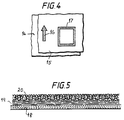
- An example of application of this technique to the marking of an airfield taxiway with an arrow and box symbol will now be described with reference to Figure 4.
- Figure 4 shows part of the taxiway with its anti-slip surfacing broken away to reveal the concrete base surface beneath.
- the concrete base 14 of the taxiway is surfaced with a two-coat anti-slip system 15 that is inset with strips 16 and 17 of glass beads which delineate an arrow and an open-box symbol respectively.
- the anti-slip system 15 is applied by the two-coat process described above with reference to Figure 1 after the concrete base 14 has first been treated with a primer to improve adhesion of the system 15 with it.
- the first coat of the paint system has been applied to cover the base 14, the areas to be occupied by the strips 16 and 17 are masked off in order to keep them clear of the mineral particles distributed on the first coat in the process.
- the masking is removed and the second coat of the system is then subsequently applied to cover the whole of the first coat, including the areas (for the strips 16 and 17) that are free of mineral particles.
- the beads within the strips 16 and 17 are of significantly smaller dimension than the mineral particles used for the anti-slip surfacing, so that the beads are protected (by being effectively overshadowed) to a certain degree by the mineral particles surrounding them in the surface.
- This protection is greater the narrower the strips 16 and 17, and provided the strips 16 and 17 are kept narrow, the anti-slip characteristic of the surface elsewhere can be maintained across the strips 16 and 17 without significant loss.
- the strip-width is desirably significantly less than the smallest 'footprint' likely to occur on the surface.
- the widths of the inset strips 16 and 17 of glass beads are significantly less than the widths of the narrowest tyres that are likely to be used on that surface.
- a significant proportion of the ground-contact area of that tyre overlaps the strip so as to remain in contact with the mineral-occupied surrounds of that strip and be afforded adequate anti-slip restraint.
- the present invention is also applicable to the provision of anti-slip tiles for surfacing an area, such as for example, the helicopter deck of an oil-rig.
- Such tiles which may, for example, be rectangular and be, specifically, 1 m square, may be bonded by adhesive, or bolted, to whatever, deck or other structure, is to be surfaced.
- the construction of a tile for this purpose is illustrated in Figure 5.
- the tile which has an overall thickness of some 5 mm to 10 mm, has a base comprising two (or more) crossed plies 18 and 19 of glass fibre that are bonded together with, for example, an epoxy resin applied in two coats to soak into and through them.
- An anti-slip system 20 is applied to the top plie 19 using any of the methods described above.
- the base of the tile may, as an alternative, be a steel or other metal plate, or a sheet of plastics material, or even cloth.
- the tile may have provision for interlocking with other tiles so that together they provide a continuous surface with firm retention between each tile and its neighbours. The interlocking may also incorporate provision for minimizing the gap between one tile and the next.
- the deposition of the mineral particles in any of the above-described methods may be made using electrostatic techniques rather than distribution by gravity.
Landscapes
- Engineering & Computer Science (AREA)
- Architecture (AREA)
- Civil Engineering (AREA)
- Structural Engineering (AREA)
- Chemical & Material Sciences (AREA)
- Life Sciences & Earth Sciences (AREA)
- Materials Engineering (AREA)
- Wood Science & Technology (AREA)
- Organic Chemistry (AREA)
- Application Of Or Painting With Fluid Materials (AREA)
Claims (18)
- Verfahren zur Bereitstellung einer Verkehrsoberfläche (1;5) mit rutschhemmender Eigenschaft, das folgende Schritte aufweist: Auftragen einer ersten Schicht (2;6) eines Anstrichs auf die Oberfläche (1;5), Verteilen von Partikeln (3;8) aus einem Mineral oder einem anderen Material auf der Schicht (2;6) bevor die Schicht (2;6) getrocknet ist, so daß die Partikel (3;8) teilweise in die Schicht (2;6) einsinken und daraufhin Auftragen einer zweiten Schicht (2;6) eines Anstrichs über den Partikeln (3;8) und der ersten Schicht (2;6), um die Partikel (3;8) in der ersten Schicht (2;6) zu fixieren, dadurch gekennzeichnet, daß die Dicke der ersten und der zweiten Schicht (2,4;6,9) entsprechend der durchschnittlichen Größe der Partikel (3;8) gesteuert wird, um im wesentlichen ein Drittel jedes Partikels (3;8) aus der zweiten Schicht (4;9) herausragen zu lassen.
- Verfahren nach Anspruch 1, wobei der Anstrich, der für mindestens eine der Schichten (2.4;6,9) verwendet wird, eine Alkyd- oder Epoxyharzbasis hat.
- Verfahren nach Anspruch 2, wobei der Anstrich auf Alkyd- oder Epoxyharzbasis chlorierten Gummi aufweist.
- Verfahren nach einem der Ansprüche 1 bis 3, wobei der gleiche Anstrich für die zweite Schicht (4;9) wie für die erste Schicht (2;6) verwendet wird.
- Verfahren nach einem der Ansprüche 1 bis 4, wobei beide Anstrichschichten (2,4;6,9) und/oder die Partikel (3;8) mittels Spray aufgetragen werden.
- Verfahren nach einem der Ansprüche 1 bis 5, wobei die Dicke der zweiten Schicht (4;9) die gleiche wie die der ersten Schicht (2,4) ist.
- Verfahren nach einem der Ansprüche 1 bis 6, wobei die Partikel (3;8) aus Aluminiumoxid, Siliziumoxid oder Zirkonium sind.
- Verfahren nach einem der Ansprüche 1 bis 7, wobei die Oberfläche (5) vor dem Auftragen der ersten Schicht (6) grundiert wird, um sicherzustellen, daß der Anstrich der ersten Schicht (6) nicht in der Oberfläche (5) absorbiert wird.
- Verfahren nach einem der Ansprüche 1 bis 8, wobei zurückreflektierende Perlen (10) hinzugefügt werden, um teilweise in die zweite Schicht (9) einzusinken und darin gebunden zu werden.
- Verfahren nach Anspruch 9, wobei die Perlen (10) auf einem Flächenbereich der zweiten Schicht (9) hinzugefügt werden, in dem keine Partikel (8) vorhanden sind.
- Verfahren nach Anspruch 10, wobei die Oberfläche eine Flugplatz-Startbahn oder Rollbahn (Fig. 4) oder ein Hubschrauberlandeplatz (Fig. 3) ist, und den Schritt des Zeichnens von Markierungen (16,17;12,13) auf der Startbahn, Rollbahn oder dem Landeplatz mit den Perlen (10) aufweist.
- Verfahren nach Anspruch 11, das einen weiteren Schritt des Zeichnens von Markierungen (12,13) unter Verwendung von Anstrichfarbunterschieden innerhalb mindestens der zweiten Schicht (9) aufweist.
- Rutschhemmende Verkehrsoberfläche, in welcher die Oberfläche (1;5) eine erste Schicht (2;6) eines Anstrichs trägt, in der Partikel (3;8) aus einem Mineral oder einem anderen Material eingebettet sind, um daraus herauszuragen, und eine zweite Schicht (4;9) eines Anstrichs die erste Schicht (2;6) und die herausragenden Partikel überdeckt, um die Partikel (3;8) in der ersten Schicht (2;6) zu fixieren, dadurch gekennzeichnet, daß im wesentlichen ein Drittel jedes Partikels (3;8) aus der zweiten Schicht (4;9) herausragt.
- Rutschhemmende Verkehrsoberfläche nach Anspruch 13, die teilweise in der zweiten Schicht (9) gebundene, zurückreflektierende Perlen (10) aufweist.
- Rutschhemmende Verkehrsoberfläche nach Anspruch 14, wobei die Perlen (10) einen Flächenbereich der zweiten Schicht (9) einnehmen, in dem keine Partikel (8) vorhanden sind.
- Rutschhemmende Verkehrsoberfläche nach einem der Ansprüche 13 bis 15, wobei die erste und die zweite Schicht (2,4;6,9) die gleiche Dicke haben.
- Rutschhemmende Verkehrsoberfläche nach einem der Ansprüche 13 bis 16 in Form einer Flugplatz-Startbahn oder Rollbahn (Fig. 4) oder in Form eines Hubschrauberlandeplatzes (Fig. 3), wobei Markierungen (16,17;12,13) der Startbahn, Rollbahn oder des Landeplatzes mit Perlen (10) gezeichnet sind.
- Rutschhemmende Verkehrsoberfläche nach Anspruch 17, wobei die Markierungen (12,13) ebenfalls mit Anstrichfarbunterschieden innerhalb mindestens der zweiten Schicht (9) gezeichnet sind.
Priority Applications (1)
| Application Number | Priority Date | Filing Date | Title |
|---|---|---|---|
| EP95108054A EP0676506A3 (de) | 1990-02-14 | 1991-02-14 | Gleitschutzflächen. |
Applications Claiming Priority (5)
| Application Number | Priority Date | Filing Date | Title |
|---|---|---|---|
| GB9003336 | 1990-02-14 | ||
| GB909003336A GB9003336D0 (en) | 1990-02-14 | 1990-02-14 | Anti-slip surfaces |
| GB9018524 | 1990-08-23 | ||
| GB909018524A GB9018524D0 (en) | 1990-02-14 | 1990-08-23 | Anti-slip surfaces |
| PCT/GB1991/000226 WO1991012090A1 (en) | 1990-02-14 | 1991-02-14 | Anti-slip surfaces |
Related Child Applications (1)
| Application Number | Title | Priority Date | Filing Date |
|---|---|---|---|
| EP95108054.8 Division-Into | 1991-02-14 |
Publications (2)
| Publication Number | Publication Date |
|---|---|
| EP0515445A1 EP0515445A1 (de) | 1992-12-02 |
| EP0515445B1 true EP0515445B1 (de) | 1996-05-15 |
Family
ID=26296661
Family Applications (1)
| Application Number | Title | Priority Date | Filing Date |
|---|---|---|---|
| EP91903807A Expired - Lifetime EP0515445B1 (de) | 1990-02-14 | 1991-02-14 | Rutschhemmende oberflächen |
Country Status (7)
| Country | Link |
|---|---|
| US (1) | US5380549A (de) |
| EP (1) | EP0515445B1 (de) |
| AU (1) | AU7237791A (de) |
| CA (1) | CA2075908A1 (de) |
| DE (1) | DE69119584T2 (de) |
| GB (1) | GB2242144B (de) |
| WO (1) | WO1991012090A1 (de) |
Families Citing this family (32)
| Publication number | Priority date | Publication date | Assignee | Title |
|---|---|---|---|---|
| SE469799B (sv) * | 1992-03-03 | 1993-09-13 | Cleanosol Ab | Markering för bildande av en luminant yta på ett underlag såsom vägar e dyl, där markeringen omfattar ett bindemedel som fluorescerar vid bestrålning med UVA-ljus, samt i bindemedlet nedbäddade glasp ärlor |
| FR2688524A1 (fr) * | 1992-03-10 | 1993-09-17 | Couverchel Daniel | Revetement anti-derapant et son procede d'obtention. |
| IT1261252B (it) * | 1993-09-06 | 1996-05-09 | Imper Italia Spa | Procedimento per realizzare un rivestimento avente proprieta' catarifrangenti sulla superficie di un sopporto sostanzialmente verticale, particolarmente sulla parete di una galleria. |
| US6402876B1 (en) | 1997-08-01 | 2002-06-11 | Loctite (R&D) Ireland | Method of forming a monolayer of particles, and products formed thereby |
| US6180226B1 (en) | 1996-08-01 | 2001-01-30 | Loctite (R&D) Limited | Method of forming a monolayer of particles, and products formed thereby |
| US5916641A (en) * | 1996-08-01 | 1999-06-29 | Loctite (Ireland) Limited | Method of forming a monolayer of particles |
| US6977025B2 (en) * | 1996-08-01 | 2005-12-20 | Loctite (R&D) Limited | Method of forming a monolayer of particles having at least two different sizes, and products formed thereby |
| US5782577A (en) * | 1996-08-07 | 1998-07-21 | Stephens; Dan | Roadway median stripe protective method |
| US5897914A (en) * | 1997-05-14 | 1999-04-27 | Depriest; Dennis K. | Retroreflective marking and process of applying the same |
| DE69804608T2 (de) * | 1997-05-20 | 2002-10-24 | Akzo Nobel N.V., Arnhem | Zurückreflektierendes strassenmarkierungssystem |
| JP3469786B2 (ja) * | 1998-02-16 | 2003-11-25 | 住友大阪セメント株式会社 | 高強度ポーラスコンクリート構造物およびその製造方法 |
| US6180228B1 (en) | 1998-03-02 | 2001-01-30 | 3M Innovative Properties Company | Outdoor advertising system |
| EP1082274A1 (de) | 1998-05-01 | 2001-03-14 | Mbt Holding Ag | Integriertes, rückstrahlendes markierungsmaterial |
| EP1144773B1 (de) | 1999-05-26 | 2006-09-13 | Basf Corporation | Metalldachschindelvorrat und verfahren zur herstellung davon |
| CA2337973A1 (en) * | 2000-03-22 | 2001-09-22 | Illinois Tool Works Inc. | Weather resistant anti-slip panels |
| GB0112139D0 (en) * | 2001-05-18 | 2001-07-11 | 3 D Composites Ltd | Anti slip surface |
| JP2003039582A (ja) * | 2001-07-19 | 2003-02-13 | Three M Innovative Properties Co | 湿潤防滑性シート及び湿潤防滑構造体 |
| US20050248951A1 (en) * | 2004-03-26 | 2005-11-10 | Hagen Douglas W | Slip-resistant apparatus and method |
| GB0421823D0 (en) * | 2004-10-01 | 2004-11-03 | Altro Ltd | Improvements in or relating to organic material |
| US20070190313A1 (en) * | 2006-01-24 | 2007-08-16 | Kenneth Willemse | Omnidirectionally reflective composite and process |
| GB2445150A (en) * | 2006-12-22 | 2008-07-02 | Saint Gobain Pipelines Plc | Surface access cover |
| US8061295B2 (en) * | 2007-10-25 | 2011-11-22 | Aexcel Corporation | Bead applicator |
| US8342700B2 (en) | 2008-09-25 | 2013-01-01 | Dow Global Technologies Llc | Wear and impact resistant reflective road lane markers |
| BE1018631A3 (nl) * | 2009-01-22 | 2011-05-03 | Ike Gidecke | Reclameadvertentie. |
| WO2011100135A1 (en) | 2010-02-11 | 2011-08-18 | Herman Miller, Inc. | Wall mounted assembly |
| US8443474B2 (en) * | 2011-10-21 | 2013-05-21 | Rite-Hite Holding Corporation | Dock levelers with thermally balanced traction decks |
| ES2516540B1 (es) * | 2013-04-30 | 2015-08-10 | Asociación Empresarial De Investigación Centro Tecnológico Del Mármol Y La Piedra | Procedimiento de aplicación de recubrimientos aislantes y antideslizantes a pavimentos de piedra |
| WO2015058098A1 (en) * | 2013-10-17 | 2015-04-23 | The Texas A&M University System | Highly visible colored pavement treatments |
| CN110802010A (zh) * | 2019-11-19 | 2020-02-18 | 沪东中华造船(集团)有限公司 | 一种重载zsj甲板防滑涂料的施工方法 |
| US20230312420A1 (en) * | 2021-08-20 | 2023-10-05 | W. Robert Wilson | Thin radiation reflecting dry polymer modified cement overlay for cooling underlying substrates |
| JP2023082518A (ja) * | 2021-12-02 | 2023-06-14 | 菊水化学工業株式会社 | 仮設路面標示の形成方法及びその除去方法 |
| JP2023082517A (ja) * | 2021-12-02 | 2023-06-14 | 菊水化学工業株式会社 | 仮設路面標示の形成方法及びその除去方法 |
Family Cites Families (26)
| Publication number | Priority date | Publication date | Assignee | Title |
|---|---|---|---|---|
| US2330843A (en) * | 1939-05-19 | 1943-10-05 | Rodli Gilbert | Marker and method |
| US2298664A (en) * | 1942-04-22 | 1942-10-13 | Leon Finch Ltd | Nonslip material and process of making same |
| GB578408A (en) * | 1942-07-15 | 1946-06-27 | Carborundum Co | Improvements in or relating to abrasive-coated sheets or belts |
| GB1184222A (en) * | 1966-03-16 | 1970-03-11 | Armour & Co | Method and Composition for reducing Friction on Coated Abrasive Cloth and Abrasive Product |
| SE374296B (de) * | 1967-12-22 | 1975-03-03 | Eka Fabriks Ab | |
| US3787273A (en) * | 1971-06-07 | 1974-01-22 | Norton Co | Low stretch sectional abrasive belts |
| US4020211A (en) * | 1971-06-15 | 1977-04-26 | Ludwig Eigenmann | Anti-skid and wear resistant road surface marking material |
| US3914468A (en) * | 1973-08-29 | 1975-10-21 | Minnesota Mining & Mfg | Method for marking paved surfaces |
| IT1022451B (it) * | 1974-09-30 | 1978-03-20 | Eigenmann Ludwig | Striscia prefabbricata per segnale tica stradale orizzontale e metodo per la sua prefabbricazione |
| US4117192A (en) * | 1976-02-17 | 1978-09-26 | Minnesota Mining And Manufacturing Company | Deformable retroreflective pavement-marking sheet material |
| CH616880A5 (en) * | 1977-03-23 | 1980-04-30 | Crystalon Sa | Process and means for the coating of surfaces for protecting against abrasion and corrosion |
| US4243696A (en) * | 1979-01-22 | 1981-01-06 | W. S. Rockwell Company | Method of making a particle-containing plastic coating |
| US4248932A (en) * | 1979-06-14 | 1981-02-03 | Minnesota Mining And Manufacturing Company | Extended-life pavement-marking sheet material |
| US4328274A (en) * | 1979-08-10 | 1982-05-04 | Minnesota Mining And Manufacturing Company | Transparent friction surface sheet material |
| US4282281A (en) * | 1979-11-02 | 1981-08-04 | Minnesota Mining And Manufacturing Company | Long-lived heavy-duty pavement marking |
| US4371663A (en) * | 1979-11-30 | 1983-02-01 | The Dow Chemical Company | Physically-ameliorated styrene polymer/thermoplastic elastomer polyblends |
| DE3101778A1 (de) * | 1981-01-21 | 1982-08-26 | Josef 7905 Dietenheim Maier | "verfahren zur herstellung einer rutschhemmenden oberflaeche" |
| US4405657A (en) * | 1981-02-24 | 1983-09-20 | Armstrong World Industries, Inc. | Non-skid plastic flooring product and method of manufacture |
| US4363145A (en) * | 1981-04-02 | 1982-12-14 | Stanley Kawesch | Traction means on showering surfaces and method of producing the same |
| US4418109A (en) * | 1982-03-29 | 1983-11-29 | Armstrong World Industries, Inc. | Durable, low-maintenance flooring tile |
| CH669138A5 (de) * | 1982-11-22 | 1989-02-28 | Schweizer Schmirgel Schleif | Schleifmittel auf dehnbarer und flexibler unterlage. |
| US4662972A (en) * | 1984-02-16 | 1987-05-05 | Thompson Thomas L | Method of forming a non-skid surfaced structure |
| US4555292A (en) * | 1984-02-16 | 1985-11-26 | Thom-Mci, Inc. | Method of forming a non-skid surface wood panel |
| US4622257A (en) * | 1985-08-08 | 1986-11-11 | Thom-Mci | Non-skid fiber/cement tile |
| EP0261343A3 (de) * | 1986-08-23 | 1989-04-26 | Blome GmbH & Co. Kommanditgesellschaft | Verfahren zur Schaffung von Profilierungsvorsprüngen auf kunststoffummantelten Stahlteilen sowie mit Profilierungsvorsprüngen versehene, kunststoffummantelte Stahlteile |
| JPH02115451A (ja) * | 1988-10-26 | 1990-04-27 | Matsushita Electric Works Ltd | 木質床材 |
-
1991
- 1991-02-14 DE DE69119584T patent/DE69119584T2/de not_active Expired - Fee Related
- 1991-02-14 CA CA002075908A patent/CA2075908A1/en not_active Abandoned
- 1991-02-14 US US07/920,305 patent/US5380549A/en not_active Expired - Fee Related
- 1991-02-14 AU AU72377/91A patent/AU7237791A/en not_active Abandoned
- 1991-02-14 EP EP91903807A patent/EP0515445B1/de not_active Expired - Lifetime
- 1991-02-14 GB GB9103084A patent/GB2242144B/en not_active Expired - Fee Related
- 1991-02-14 WO PCT/GB1991/000226 patent/WO1991012090A1/en not_active Ceased
Also Published As
| Publication number | Publication date |
|---|---|
| DE69119584D1 (de) | 1996-06-20 |
| US5380549A (en) | 1995-01-10 |
| GB9103084D0 (en) | 1991-04-03 |
| AU7237791A (en) | 1991-09-03 |
| GB2242144B (en) | 1994-05-18 |
| GB2242144A (en) | 1991-09-25 |
| EP0515445A1 (de) | 1992-12-02 |
| WO1991012090A1 (en) | 1991-08-22 |
| CA2075908A1 (en) | 1991-08-15 |
| DE69119584T2 (de) | 1997-01-16 |
Similar Documents
| Publication | Publication Date | Title |
|---|---|---|
| US5380549A (en) | Method for forming traffic surfaces having double-coated bonding of anti-slip particles and containing retro-reflective beads | |
| US2952192A (en) | Marker stripe | |
| JPS63277304A (ja) | 道路上に水平マーキングを作成または更新するための方法および装置,ならびに該方法により作成した水平マーキング | |
| US6624232B2 (en) | Pavement sealing composition and method of application | |
| KR100316083B1 (ko) | 미끄럼방지도로의시공방법 | |
| CN106833203A (zh) | 一种冷涂快干型彩色路面防滑涂料 | |
| WO2014197993A1 (en) | Freeze-thaw and abrasion resistant road markings | |
| US3900605A (en) | Method of forming traffic markers having short track-free times | |
| GB2270270A (en) | Anti-slip surfaces | |
| EP0676506A2 (de) | Gleitschutzflächen | |
| KR101344131B1 (ko) | 문양표현 탄성 포장 시공방법 | |
| KR100681878B1 (ko) | 어린이 보호구역 도로의 그루브 시공방법 | |
| US10221527B2 (en) | Dry polymer cement overlay for trafficked pavements | |
| FI73272C (fi) | Foerfarande foer foerverkligande av reflekterande vaegbanemarkeringar och blandning som anvaends vid foerfarandet. | |
| US2260461A (en) | Traffic guide | |
| Rodin III et al. | Evaluation of motorcyclists’ and bikers’ safety on wet pavement markings | |
| KR20050057864A (ko) | 야간시인성이 우수한 차선의 도색 방법 | |
| KR100193336B1 (ko) | 도로 표지선의 난-슬립 시공 방법 | |
| US12540104B2 (en) | Marking trafficked pavement substrates using a dry polymer modified cement | |
| KR0126104B1 (ko) | 포장도로의 차선 도색방법 | |
| KR101145816B1 (ko) | 요철을 갖는 재귀반사형 포장재 및 그 시공방법 | |
| KR20060124129A (ko) | 미끄럼방지설비 및 그 시공 방법 | |
| Nassiri | Evaluation of Motorcyclists' and Bikers' Safety on Wet Pavement Markings | |
| CN109056446A (zh) | 一种无震动止滑车道的施工方法 | |
| Drisko | AIRFIELD MARKING PAINTS STATE-OF-THE-ART |
Legal Events
| Date | Code | Title | Description |
|---|---|---|---|
| PUAI | Public reference made under article 153(3) epc to a published international application that has entered the european phase |
Free format text: ORIGINAL CODE: 0009012 |
|
| 17P | Request for examination filed |
Effective date: 19920915 |
|
| AK | Designated contracting states |
Kind code of ref document: A1 Designated state(s): DE DK FR IT NL SE |
|
| 17Q | First examination report despatched |
Effective date: 19941117 |
|
| RAP1 | Party data changed (applicant data changed or rights of an application transferred) |
Owner name: SAFEWAY TRAFFIC (UK) LIMITED |
|
| GRAA | (expected) grant |
Free format text: ORIGINAL CODE: 0009210 |
|
| RIN1 | Information on inventor provided before grant (corrected) |
Inventor name: HARVISON, ERIC JOSEPH |
|
| XX | Miscellaneous (additional remarks) |
Free format text: TEILANMELDUNG 95108054.8. |
|
| AK | Designated contracting states |
Kind code of ref document: B1 Designated state(s): DE DK FR IT NL SE |
|
| PG25 | Lapsed in a contracting state [announced via postgrant information from national office to epo] |
Ref country code: IT Free format text: LAPSE BECAUSE OF FAILURE TO SUBMIT A TRANSLATION OF THE DESCRIPTION OR TO PAY THE FEE WITHIN THE PRE;WARNING: LAPSES OF ITALIAN PATENTS WITH EFFECTIVE DATE BEFORE 2007 MAY HAVE OCCURRED AT ANY TIME BEFORE 2007. THE CORRECT EFFECTIVE DATE MAY BE DIFFERENT FROM THE ONE RECORDED.SCRIBED TIME-LIMIT Effective date: 19960515 Ref country code: NL Free format text: LAPSE BECAUSE OF FAILURE TO SUBMIT A TRANSLATION OF THE DESCRIPTION OR TO PAY THE FEE WITHIN THE PRESCRIBED TIME-LIMIT Effective date: 19960515 Ref country code: FR Effective date: 19960515 Ref country code: DK Effective date: 19960515 |
|
| XX | Miscellaneous (additional remarks) |
Free format text: TEILANMELDUNG 95108054.8. |
|
| REF | Corresponds to: |
Ref document number: 69119584 Country of ref document: DE Date of ref document: 19960620 |
|
| EN | Fr: translation not filed | ||
| NLV1 | Nl: lapsed or annulled due to failure to fulfill the requirements of art. 29p and 29m of the patents act | ||
| PLBE | No opposition filed within time limit |
Free format text: ORIGINAL CODE: 0009261 |
|
| STAA | Information on the status of an ep patent application or granted ep patent |
Free format text: STATUS: NO OPPOSITION FILED WITHIN TIME LIMIT |
|
| 26N | No opposition filed | ||
| PGFP | Annual fee paid to national office [announced via postgrant information from national office to epo] |
Ref country code: SE Payment date: 20000224 Year of fee payment: 10 |
|
| PGFP | Annual fee paid to national office [announced via postgrant information from national office to epo] |
Ref country code: DE Payment date: 20000428 Year of fee payment: 10 |
|
| PG25 | Lapsed in a contracting state [announced via postgrant information from national office to epo] |
Ref country code: SE Free format text: LAPSE BECAUSE OF NON-PAYMENT OF DUE FEES Effective date: 20010215 |
|
| EUG | Se: european patent has lapsed |
Ref document number: 91903807.5 |
|
| PG25 | Lapsed in a contracting state [announced via postgrant information from national office to epo] |
Ref country code: DE Free format text: LAPSE BECAUSE OF NON-PAYMENT OF DUE FEES Effective date: 20011201 |