EP0517389A2 - Alkalimetall enthaltendes Energieumwandlungselement - Google Patents
Alkalimetall enthaltendes Energieumwandlungselement Download PDFInfo
- Publication number
- EP0517389A2 EP0517389A2 EP92304470A EP92304470A EP0517389A2 EP 0517389 A2 EP0517389 A2 EP 0517389A2 EP 92304470 A EP92304470 A EP 92304470A EP 92304470 A EP92304470 A EP 92304470A EP 0517389 A2 EP0517389 A2 EP 0517389A2
- Authority
- EP
- European Patent Office
- Prior art keywords
- casing
- cell
- cell according
- connector member
- metal layer
- Prior art date
- Legal status (The legal status is an assumption and is not a legal conclusion. Google has not performed a legal analysis and makes no representation as to the accuracy of the status listed.)
- Withdrawn
Links
- 229910052783 alkali metal Inorganic materials 0.000 title claims abstract description 11
- 150000001340 alkali metals Chemical class 0.000 title claims abstract description 11
- 238000006243 chemical reaction Methods 0.000 title claims abstract description 11
- 239000007784 solid electrolyte Substances 0.000 claims abstract description 11
- 230000006835 compression Effects 0.000 claims abstract description 8
- 238000007906 compression Methods 0.000 claims abstract description 8
- 229910052751 metal Inorganic materials 0.000 claims description 30
- 239000002184 metal Substances 0.000 claims description 30
- 239000000758 substrate Substances 0.000 claims description 27
- 239000000463 material Substances 0.000 claims description 20
- 229910000831 Steel Inorganic materials 0.000 claims description 16
- 239000004411 aluminium Substances 0.000 claims description 16
- XAGFODPZIPBFFR-UHFFFAOYSA-N aluminium Chemical compound [Al] XAGFODPZIPBFFR-UHFFFAOYSA-N 0.000 claims description 16
- 229910052782 aluminium Inorganic materials 0.000 claims description 16
- 239000010959 steel Substances 0.000 claims description 16
- 238000009792 diffusion process Methods 0.000 claims description 13
- 239000002131 composite material Substances 0.000 claims description 10
- 238000004519 manufacturing process Methods 0.000 claims description 2
- 238000007493 shaping process Methods 0.000 claims description 2
- 229910052709 silver Inorganic materials 0.000 claims description 2
- 239000004332 silver Substances 0.000 claims description 2
- 238000004544 sputter deposition Methods 0.000 claims description 2
- 239000000919 ceramic Substances 0.000 description 25
- NINIDFKCEFEMDL-UHFFFAOYSA-N Sulfur Chemical compound [S] NINIDFKCEFEMDL-UHFFFAOYSA-N 0.000 description 15
- 239000005864 Sulphur Substances 0.000 description 15
- DGAQECJNVWCQMB-PUAWFVPOSA-M Ilexoside XXIX Chemical compound C[C@@H]1CC[C@@]2(CC[C@@]3(C(=CC[C@H]4[C@]3(CC[C@@H]5[C@@]4(CC[C@@H](C5(C)C)OS(=O)(=O)[O-])C)C)[C@@H]2[C@]1(C)O)C)C(=O)O[C@H]6[C@@H]([C@H]([C@@H]([C@H](O6)CO)O)O)O.[Na+] DGAQECJNVWCQMB-PUAWFVPOSA-M 0.000 description 12
- 229910052708 sodium Inorganic materials 0.000 description 12
- 239000011734 sodium Substances 0.000 description 12
- 239000003792 electrolyte Substances 0.000 description 10
- BNOODXBBXFZASF-UHFFFAOYSA-N [Na].[S] Chemical compound [Na].[S] BNOODXBBXFZASF-UHFFFAOYSA-N 0.000 description 8
- 238000000034 method Methods 0.000 description 8
- 238000003466 welding Methods 0.000 description 8
- PNEYBMLMFCGWSK-UHFFFAOYSA-N Alumina Chemical compound [O-2].[O-2].[O-2].[Al+3].[Al+3] PNEYBMLMFCGWSK-UHFFFAOYSA-N 0.000 description 6
- 230000008901 benefit Effects 0.000 description 5
- 230000015572 biosynthetic process Effects 0.000 description 5
- 239000007790 solid phase Substances 0.000 description 5
- 125000006850 spacer group Chemical group 0.000 description 4
- OKTJSMMVPCPJKN-UHFFFAOYSA-N Carbon Chemical compound [C] OKTJSMMVPCPJKN-UHFFFAOYSA-N 0.000 description 3
- 229910052799 carbon Inorganic materials 0.000 description 3
- 238000010276 construction Methods 0.000 description 3
- 239000000835 fiber Substances 0.000 description 3
- 229910000873 Beta-alumina solid electrolyte Inorganic materials 0.000 description 2
- VEXZGXHMUGYJMC-UHFFFAOYSA-M Chloride anion Chemical compound [Cl-] VEXZGXHMUGYJMC-UHFFFAOYSA-M 0.000 description 2
- 230000009471 action Effects 0.000 description 2
- 238000003491 array Methods 0.000 description 2
- 230000004323 axial length Effects 0.000 description 2
- 239000002585 base Substances 0.000 description 2
- 238000000576 coating method Methods 0.000 description 2
- 230000000694 effects Effects 0.000 description 2
- 239000011810 insulating material Substances 0.000 description 2
- 229910052573 porcelain Inorganic materials 0.000 description 2
- 230000009467 reduction Effects 0.000 description 2
- 238000007789 sealing Methods 0.000 description 2
- 238000005382 thermal cycling Methods 0.000 description 2
- 239000010405 anode material Substances 0.000 description 1
- 239000004568 cement Substances 0.000 description 1
- 239000011248 coating agent Substances 0.000 description 1
- 238000005097 cold rolling Methods 0.000 description 1
- 238000010292 electrical insulation Methods 0.000 description 1
- 239000002360 explosive Substances 0.000 description 1
- 238000011065 in-situ storage Methods 0.000 description 1
- 238000002347 injection Methods 0.000 description 1
- 239000007924 injection Substances 0.000 description 1
- 238000005304 joining Methods 0.000 description 1
- 239000007788 liquid Substances 0.000 description 1
- 230000007246 mechanism Effects 0.000 description 1
- 230000004048 modification Effects 0.000 description 1
- 238000012986 modification Methods 0.000 description 1
- 230000002093 peripheral effect Effects 0.000 description 1
- 230000008569 process Effects 0.000 description 1
- 230000000750 progressive effect Effects 0.000 description 1
- 238000005096 rolling process Methods 0.000 description 1
- 239000000126 substance Substances 0.000 description 1
Images


Classifications
-
- H—ELECTRICITY
- H01—ELECTRIC ELEMENTS
- H01M—PROCESSES OR MEANS, e.g. BATTERIES, FOR THE DIRECT CONVERSION OF CHEMICAL ENERGY INTO ELECTRICAL ENERGY
- H01M10/00—Secondary cells; Manufacture thereof
- H01M10/36—Accumulators not provided for in groups H01M10/05-H01M10/34
- H01M10/39—Accumulators not provided for in groups H01M10/05-H01M10/34 working at high temperature
- H01M10/3909—Sodium-sulfur cells
-
- H—ELECTRICITY
- H01—ELECTRIC ELEMENTS
- H01M—PROCESSES OR MEANS, e.g. BATTERIES, FOR THE DIRECT CONVERSION OF CHEMICAL ENERGY INTO ELECTRICAL ENERGY
- H01M50/00—Constructional details or processes of manufacture of the non-active parts of electrochemical cells other than fuel cells, e.g. hybrid cells
- H01M50/50—Current conducting connections for cells or batteries
-
- H—ELECTRICITY
- H01—ELECTRIC ELEMENTS
- H01M—PROCESSES OR MEANS, e.g. BATTERIES, FOR THE DIRECT CONVERSION OF CHEMICAL ENERGY INTO ELECTRICAL ENERGY
- H01M50/00—Constructional details or processes of manufacture of the non-active parts of electrochemical cells other than fuel cells, e.g. hybrid cells
- H01M50/10—Primary casings; Jackets or wrappings
- H01M50/102—Primary casings; Jackets or wrappings characterised by their shape or physical structure
- H01M50/107—Primary casings; Jackets or wrappings characterised by their shape or physical structure having curved cross-section, e.g. round or elliptic
-
- Y—GENERAL TAGGING OF NEW TECHNOLOGICAL DEVELOPMENTS; GENERAL TAGGING OF CROSS-SECTIONAL TECHNOLOGIES SPANNING OVER SEVERAL SECTIONS OF THE IPC; TECHNICAL SUBJECTS COVERED BY FORMER USPC CROSS-REFERENCE ART COLLECTIONS [XRACs] AND DIGESTS
- Y02—TECHNOLOGIES OR APPLICATIONS FOR MITIGATION OR ADAPTATION AGAINST CLIMATE CHANGE
- Y02E—REDUCTION OF GREENHOUSE GAS [GHG] EMISSIONS, RELATED TO ENERGY GENERATION, TRANSMISSION OR DISTRIBUTION
- Y02E60/00—Enabling technologies; Technologies with a potential or indirect contribution to GHG emissions mitigation
- Y02E60/10—Energy storage using batteries
Definitions
- the present invention relates primarily to an alkali metal energy conversion cell.
- the present invention relates to a high temperature cell which operates at an elevated temperature above ambient temperature, typically above 100 o C.
- an alkali metal energy conversion cell is a sodium sulphur cell whose operating temperature is between 300 o C and 400 o C, typically 350 o C.
- the present invention further relates to a series arrangement of such cells and to a battery comprising a plurality of such cells.
- WO89/00344 (Chloride Silent Power Limited) discloses a sodium sulphur cell and a battery comprising a plurality of sodium sulphur cells or series arrangement of sodium sulphur cells.
- Figures 1 and 2 of the present specification are based on Figures shown in that document.
- Figure 1 is a perspective view of a sodium sulphur cell with part broken away.
- the cell comprises a casing 1 of, for example, steel in the form of a right circular cylinder.
- a solid electrolyte cup 2 of beta alumina divides the casing 1 into two electrode regions.
- a sodium electrode 3 is contained within the cup 2 while a space between the casing 1 and the cup 2 contains a sulphur electrode 4.
- the sulphur electrode 4 is generally formed as a carbon fibre mat impregnated with sulphur.
- the cell is maintained at a temperature of between 300 o C and 400 o C such that the sodium and sulphur in the electrodes 3, 4 are in liquid form.
- the casing 1 serves as a terminal for the sulphur electrode 4.
- the terminal for the sodium electrode 3 is provided by a centre terminal disc 5 connected, by welding, to a elongate metal current collector 6.
- the current collector 6 extends axially into the sodium electrode 3.
- the open end of the cup 2 is closed by an insulating disc 7 of alpha alumina.
- the disc 7 also serves to hold the current collector 6 in position.
- the region containing the sulphur electrode 4 between the casing 1 and the cup 2 is closed by an annular sealing steel disc 8.
- the terminal disc 5 and the steel disc 8 are secured to the alpha alumina disc 7, by a technique such as diffusion bonding, to form seals.
- the steel disc 8 is itself secured to the casing 1 by a welding technique.
- alpha alumina is electrically insulating, it provides electrical insulation between the two terminals 5, 1 of the cell.
- the steel disc 8 extends inwardly from the casing 1 and has a small internal diameter.
- the seal between the steel disc 8 and the alpha alumina disc 7 is made near the internal circumference of the annular disc 8. This reduces the size of the seal between the alpha disc 7 and the steel disc 8 and so alleviates the risk of the seal breaking due to differential thermal expansion of the two discs 7, 8 due to thermal cycling during operation of the cell.
- the sodium and sulphur electrodes 3, 4 can have their locations reversed.
- Figure 2 also taken from WO89/00344, is a side view, partly in section, of a series arrangement of two sodium sulphur cells 10, 11. Each cell 10, 11 is constructed as described in Figure 1.
- Each cell 10, 11 has a cylindrical casing 12 constituting one terminal and a centre terminal disc 13, at one end of the casing 12, constituting the other terminal.
- the cells 10, 11 are arranged end-to-end with the centre terminal disc 13 of one cell 10 (the lower cell, as shown) adjacent an integral surface 14 of the casing 12 of the other cell 11 (the upper cell, as shown).
- An annular spacer member 15 of insulating ceramic or porcelain material is interposed between the two cells 10, 11 and serves to prevent contact between the cases 12 of the two cells 10, 11.
- the spacer member can be of any suitable insulating material, such as a ceramic or porcelain material, and can either be preformed, for example in the shape of an annulus, or otherwise formed in situ, for example, by injection of a cement material between the two cells.
- a strip 16 of conductive metal extends across the integral surface 14 of the casing 12 of the upper cell 11.
- the free ends of the strip 16 are welded to the casing of the upper cell 11.
- the strip 16 is formed to extend downwardly through an aperture 17 in the spacer member 15 to engage over the current collector 18 of the lower cell 10.
- the strip is welded to the centre terminal disc 13 of the lower cell 10 and, thus, provides electrical connection between the centre terminal disc 13 of the lower cell 10 and the casing 12 of the upper cell 11.
- an alkali metal energy conversion cell comprising: an external casing; a solid electrolyte cup to divide the interior of the casing into two electrode regions; and an electrically insulating element joined to the cup; wherein one end of the casing is formed with a first and a second annular flange, said first annular flange being secured to one surface of said insulating element by a compression bond and said second annular flange extending outward of the casing and solidly bearing on a second surface of said insulating element opposed said one surface.
- a cell provided in accordance with said first aspect of the present invention enables pressure to be applied to said first annular flange and said electrically insulating element, during construction of the cell, without the need for pressure to be applied to the cell as a whole. Accordingly, an annular hermetic seal can be produced between the casing and said electrically insulating element by any one of a number of methods of bonding using compression, which require the application of pressure to the components to be joined. Examples of methods of producing compression bonds are ultrasonic welding, as disclosed in WO91/00255 (Chloride Silent Power Limited) and high speed diffusion bonding (thermocompression bonding).
- a further advantage of forming said first and second annular flanges from one end of the external casing is a reduction in the number of components of the cell and, in particular, the number of seals that need to be made between different components.
- the diameter of a cell according to said first aspect of the present invention may be chosen so that the length of the seal between the casing and the ceramic disc is not so great that differential thermal expansion of the two components, during operation of the cell, becomes a significant problem.
- said insulating element has an external diameter less than the maximum diameter of the casing so that the overall diameter of the cell is no more than the basic diameter of the casing.
- a second aspect of the present invention provides a method of manufacturing a cell according to said first aspect including the steps of first shaping one end of the casing to form a first and second annular flange and then securing said first annular flange to one surface of said insulating element by a compression bond.
- At least a part of said insulating element may protrude axially of the cell beyond any part of the casing.
- the protruding part of the said insulating element, so formed, may be effective as a spacer member to prevent contact between the cases of two cells which are to be connected in series and arranged end-to-end.
- a third aspect of the present invention provides an alkali metal energy conversion cell having an external casing, a solid electrolyte to divide the interior of the casing into two electrode regions and an electrically insulating element joined to the solid electrolyte and to the external casing, at least a part of said electrically insulating element protruding axially of the cell beyond the casing and any electrically conducting element electrically connected to the casing.
- Another preferred feature of a cell according to said first aspect of the present invention is the provision of an electrically conductive cup-shaped connector member electrically connected to the current collector, wherein each of the connector member and the casing is made of a composite material comprising a substrate layer and a metal layer capable of forming at least a partial diffusion bond with an adjacent metal layer under its operating conditions, the substrate layer having a thermal coefficient of expansion no greater than the thermal coefficient of expansion of the metal layer, the casing being configured with a said metal layer on its external surface and the connector member being dimensioned and configured, with a said metal layer on the internal surface of the connector member, for receiving and engaging, in an interference fit, the casing of another cell to be connected in series.
- a fourth aspect of the present invention provides an alkali metal energy conversion cell comprising an external casing, a solid electrolyte cup to divide the interior of the casing into two electrode regions, means closing the cup, a current collector extending through said closing means and into the cup, and an electrically conductive cup-shaped connector member electrically connected to the current collector, wherein each of the connector member and the casing is made of a composite material comprising a substrate layer and a metal layer capable of forming at least a partial diffusion bond with an adjacent metal layer under its operating conditions, the substrate layer having a thermal coefficient of expansion no greater than the thermal coefficient of expansion of the metal layer, the casing being configured with a said metal layer on its external surface and the connector member being dimensioned and configured, with a said metal layer on the internal surface of the connector member, for receiving and engaging, in an interference fit, the casing of another cell to be connected in series.
- an electrically conductive cup-shaped connector may be provided which is electrically connected to a bus plate, the cup-shaped connector being dimensioned and configured for receiving and engaging the casing of an adjacent cell.
- a fifth aspect of the present invention provides a device for operation at an elevated temperature, the device comprising a first component and a second component structurally connected to each other in an interference fit with adjacent surfaces of said first component and said second component including respectively a first and a second layer of material between which at least a partial diffusion bond can be produced under the operating conditions of the device, the material on either side of said adjacent surfaces having a thermal coefficient of expansion no greater than the thermal coefficient of expansion of said first and said second layers of material.
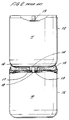
- the two cells 20a, 20b shown in Figure 3, are connected in series between a first bus bar 22 and a second bus bar 24.
- the two cells 20a and 20b are substantially identifcal. Accordingly, like parts in the cells 20a and 20b are designated by like reference numerals with the addition, respectively of the letters "a" and "b".
- Each cell 20a, 20b includes an external casing 26a, 26b.
- the casing 26a, 26b is made of a composite material formed of at least two layers.
- One of the layers is a deformable layer which can be used to effect a weld to another component.
- the other layer is a substrate formed of a material that is stronger, harder or tougher than the first layer.
- the layer of deformable material is mechanically fixed in position relative to the substrate layer by any of a number of processes such as cold rolling, diffusion bonding, explosive welding, ultrasonic welding or by mechanical or chemical means.
- An example of a composite material which can be used for the external casing 26a, 26b is a steel substrate of thickness 0.25 mm on either side of which is solid phase welded a layer of aluminium.
- the two aluminium coatings have a respective thickness of 25 and 60 microns.
- the provision of a layer of aluminium protects the steel from corrosive attack by the contents of the cell.
- the aluminium coating further enables a solid phase bond to be formed between the composite material and another component.
- a solid electrolyte cup 28a, 28b of beta alumina divides the external casing into two electrode regions.
- a sulphur electrode 30a, 30b formed as a carbon fibre mat impregnated with sulphur.
- the carbon fibre provides electrical connection between the casing 26a, 26b and the cup 28a, 28b as sulphur is essentially non-conducting. Accordingly, the casing 26a, 26b is effective as one terminal of the cell 20a, 20b.
- the inside of the cup 28a, 28b forms an anode region 32a, 32b.
- Sodium 33a, 33b is contained in a reservoir 34a, 34b which is of generally cylindrical shape.
- the reservoir 34a, 34b is sized to fit snuggly within the cup 28a, 28b leaving only a narrow space or active region 36a, 36b between the reservoir 34a, 34b and the internal surface of the cup 28, 28b.
- An outlet 38a, 38b is provided from the reservoir 34a, 34b into the active region 36a, 36b such that a film of molten sodium can be drawn into the active region by capillary action. Because of capillary action, a major part of the internal surfaces of the electrolyte cup 28a, 28b is wetted by the molten sodium, even when the amount of sodium in the anode region, as a whole, is low.
- the open end of the cup 28a, 28b is closed by a cap of insulating material, typically a disc of 40a, 40b of a ceramic such as alpha alumina.
- the disc 40a, 40b is sealed to the cup 28a, 28b by glazing.
- An elongate current collector 42a, 42b extends through an aperture in the alpha alumina disc 40a, 40b into the anode region 32a, 32b.
- the current collector 42a, 42b provides electrical connection between the anode material and a central terminal disc 44a, 44b.
- the current collector 42a, 42b may make electrical connection to the sodium 33a, 33b directly or via the reservoir 34a, 34b.
- the terminal disc 44a, 44b provides the second terminal of the cell 20a, 20b and is electrically insulated from the casing 26a, 26 by the ceramic disc 40a, 40b.
- the two cells 20a, 20b are arranged end-to-end, as shown in Figure 3 and electrically connected in series between the terminal disc 40b of one cell 20b and the casing 26a of the other cell 20a.
- An electrically conductive connector member 46b is electrically connected and mechanically fixed to the terminal disc 40b of the cell 20b (the lower cell as shown).
- the connector member 46b is cup-shaped and dimensioned and configured to engage the casing 26a of the adjacent cell 20a.
- the connector member 46b is made of the same composite material as the casing 26a and has an internal diameter which is no greater than the external diameter of the adjacent casing 26a.
- the internal diameter of the connector member 46b may be the same as the external diameter of the casing 26a or upto 4 thou less.
- a certain amount of force (of between 10 and 55 kg) is required to insert the cell 20a into the connector member 46b.
- the open end of the connector member 46b springs back to hold the cell 20a structurally.
- the linear contact length between the connector 46b and the casing 26a is between 3 to 10 mm depending on the diameter of the cell case.
- the connector member 46b may be provided integral with the terminal disc 40b.
- a stand-alone cup-shaped connector member 48 provides electrical and structural connection between the casing 26b of the cell 20b and the adjacent bus bar 24.
- the stand-alone connector member 48 is similar in all respects to the connector member 46b of the cell 20b but is connected to the bus bar and not to a cell.
- the closed end of the casing may be configured to be smaller than the body of the casing so that the external diameter of the connector member 46b is the same as the external diameter of the body of the casing so that the volumetric efficiency of the cell is not degraded.
- the required reduction in diameter of the closed end of the casing need only be sufficient to accommodate the connector member.
- the connector member is preferably made of the same material as the casing to avoid expansion mismatch during thermal cycling.
- the materials should further be chosen to be capable of withstanding the normal operating temperatures of the cell, to be electrically conductive and to be mechanically strong.
- both the casing and the connector member were made of a composite material in which a layer of aluminium was coated onto a substrate layer of steel. It was found that the strength of the press fit connection was increased after the cells had been heated to their operating temperature of 350 o C and then held at that operating temperature for a short period (typically two hours). Furthermore, the strength of the connection increased with the time for which the cells were held at their operating temperature. This finding indicates that, although the press fit connection is purely structural in origin, at least a partial solid phase weld was produced as the construction was exposed to a temperature of 350 o C for a period of time.
- the base of the connector member 46b is supported by a portion 50b of the ceramic disc 40b.
- the portion 50b protrudes axially of the cell 20b beyond any part of the casing 26b. Accordingly, despite the arrangement of the cells 20a, 20b end-to-end, the connector member 46b, and hence the terminal disc 44b of the cell 20b and the casing 26a of the cell 20a, is electrically insulated from the casing 26b. Because of this, no short-circuit route is provided between the two cells 20a, 20b during normal operation of the series arrangement of cells 20a, 20b. As the ceramic disc 40b closes the cup 28a, 28b, the support provided by the protruding portion 50b is relatively even across the base of the connector 46b.
- the cell 20a, 20b itself is closed by a hermetic seal between the ceramic disc 40a, 40b and an annular flange 52a, 52b at the end of the casing 26a, 26b.
- the hermetic seal is a solid phase bond formed by a method such as ultrasonic welding or high speed diffusion bonding (thermocompression). These methods require the application of pressure to the components to be joined.
- the ceramic disc 40a, 40b is configured so that its external diameter is greater than the diameter of at least a part of the casing 26a, 26b.
- the ceramic disc 40a, 40b is formed with a collar 54a, 54b and the annular flange 52a, 52b of the casing is sealed to the top of the collar 54a, 54b which is the peripheral step of the ceramic disc 40a, 40b.
- the end of the casing 26a, 26b is formed around the collar 54a, 54b of the ceramic disc with a second annular flange 56a, 56b being formed parallel with the first annular flange 52a, 52b and bearing solidly on the surface of the ceramic disc opposed to the surface on which the annular flange 52a, 52b has been sealed to the ceramic disc 40a, 40b.
- a neck 58a, 58b is formed in the casing 26a, 26b above the top of the sulphur electrode 30a, 30b.
- the external diameter of the ceramic disc 40a, 40b is greater than the external diameter of the neck 58a, 58b, formation of the end of the casing around the collar 54a, 54b of the ceramic disc 40a, 40b ensures that the casing is kinked inwardly below the second flange 56a, 56b of the casing 26a, 26b.
- a tool can be inserted below the second flange 56a, 56b so that the axial pressure required during formation of the seal is applied to the combination of the casing and the ceramic disc.
- the cells shown in Figure 3 have been designed for high discharge rate (HDR) operation.
- the HDR cell has the following dimensions: DIMENSION HDR CELL Maximum external diameter of casing 29.54 mm Internal diameter of electrolyte cup 28a, 28b 17.80 mm Axial length of the electrolyte cup 28a, 28b 81.10 mm Internal surface area of electrolyte cup 28a, 28b 1.46 m2 Internal diameter of connector member 46b 29.54 mm Axial length of connector member 46b 3 to 10 mm depending on diameter of cell
- a HDR cell can be discharged at a rate 27% faster than prior art cells.
- the first annular flange of the casing may be bonded directly to the uppermost part of the ceramic disc if a separate separator is used to separate the casings of adjacent cells in a series arrangement.
- the ceramic disc may be configured to protrude above a metallic closure member or other electrically conductive component electrically connected to the external casing. Furthermore, the protruding portion of the ceramic disc may support the external casing of an adjacent cell directly if connections between the terminals of the cells are made as shown in the prior art.
- such connector members may be used with prior art cells.
- an interconnection described with respect to the casing and the connector member may be applicable to other devices for operation at elevated temperatures.
Landscapes
- Chemical & Material Sciences (AREA)
- Chemical Kinetics & Catalysis (AREA)
- Electrochemistry (AREA)
- General Chemical & Material Sciences (AREA)
- Engineering & Computer Science (AREA)
- Manufacturing & Machinery (AREA)
- Secondary Cells (AREA)
- Connection Of Batteries Or Terminals (AREA)
- Sealing Battery Cases Or Jackets (AREA)
Applications Claiming Priority (2)
| Application Number | Priority Date | Filing Date | Title |
|---|---|---|---|
| GB919111982A GB9111982D0 (en) | 1991-06-04 | 1991-06-04 | An alkali metal energy conversion cell |
| GB9111982 | 1991-06-04 |
Publications (2)
| Publication Number | Publication Date |
|---|---|
| EP0517389A2 true EP0517389A2 (de) | 1992-12-09 |
| EP0517389A3 EP0517389A3 (en) | 1993-03-31 |
Family
ID=10696062
Family Applications (2)
| Application Number | Title | Priority Date | Filing Date |
|---|---|---|---|
| EP92910115A Withdrawn EP0587597A1 (de) | 1991-06-04 | 1992-05-18 | Alkali-metall energieumwandlungszelle |
| EP19920304470 Withdrawn EP0517389A3 (en) | 1991-06-04 | 1992-05-18 | An alkali metal energy conversion cell |
Family Applications Before (1)
| Application Number | Title | Priority Date | Filing Date |
|---|---|---|---|
| EP92910115A Withdrawn EP0587597A1 (de) | 1991-06-04 | 1992-05-18 | Alkali-metall energieumwandlungszelle |
Country Status (6)
| Country | Link |
|---|---|
| EP (2) | EP0587597A1 (de) |
| JP (1) | JPH06510623A (de) |
| GB (1) | GB9111982D0 (de) |
| IE (1) | IE921794A1 (de) |
| WO (1) | WO1992022097A2 (de) |
| ZA (1) | ZA923690B (de) |
Family Cites Families (12)
| Publication number | Priority date | Publication date | Assignee | Title |
|---|---|---|---|---|
| US2983899A (en) * | 1958-05-26 | 1961-05-09 | Olin Mathieson | Connector device |
| FR2309049A1 (fr) * | 1975-04-24 | 1976-11-19 | Comp Generale Electricite | Generateur electrochimique sodium-soufre |
| FR2333358A1 (fr) * | 1975-11-28 | 1977-06-24 | Comp Generale Electricite | Generateur electrochimique du type soufre-sodium |
| GB1586072A (en) * | 1977-05-05 | 1981-03-18 | Chloride Silent Power Ltd | Sealing of ceramic electrolyte material in electrochemical cells |
| GB1548384A (en) * | 1976-07-08 | 1979-07-11 | Chloride Silent Power Ltd | Alkali metal-sulphur cells |
| US4245012A (en) * | 1979-08-28 | 1981-01-13 | Ford Motor Company | Sodium sulfur battery seal |
| JPS5678063A (en) * | 1979-11-30 | 1981-06-26 | Japan Storage Battery Co Ltd | Sodium-sulfur battery |
| DE3033438C2 (de) * | 1980-09-05 | 1986-08-21 | Brown, Boveri & Cie Ag, 6800 Mannheim | Elektrochemische Speicherzelle |
| CA1193653A (en) * | 1982-06-04 | 1985-09-17 | Michael F. Roche | Electrochemical cell having a alkali metal nitrate electrode |
| GB8715708D0 (en) * | 1987-07-03 | 1987-08-12 | Chloride Silent Power Ltd | Batteries |
| GB8915316D0 (en) * | 1989-07-04 | 1989-08-23 | Chloride Silent Power Ltd | Metal/ceramic bonds |
| GB8917022D0 (en) * | 1989-07-25 | 1989-09-13 | Chloride Silent Power Ltd | Sodium/sulphur cell |
-
1991
- 1991-06-04 GB GB919111982A patent/GB9111982D0/en active Pending
-
1992
- 1992-05-18 JP JP4509264A patent/JPH06510623A/ja active Pending
- 1992-05-18 EP EP92910115A patent/EP0587597A1/de not_active Withdrawn
- 1992-05-18 EP EP19920304470 patent/EP0517389A3/en not_active Withdrawn
- 1992-05-18 WO PCT/GB1992/000893 patent/WO1992022097A2/en not_active Ceased
- 1992-05-21 ZA ZA923690A patent/ZA923690B/xx unknown
- 1992-07-01 IE IE179492A patent/IE921794A1/en unknown
Also Published As
| Publication number | Publication date |
|---|---|
| JPH06510623A (ja) | 1994-11-24 |
| EP0517389A3 (en) | 1993-03-31 |
| IE921794A1 (en) | 1992-12-16 |
| GB9111982D0 (en) | 1991-07-24 |
| WO1992022097A3 (en) | 1993-03-18 |
| ZA923690B (en) | 1993-01-27 |
| WO1992022097A2 (en) | 1992-12-10 |
| EP0587597A1 (de) | 1994-03-23 |
Similar Documents
| Publication | Publication Date | Title |
|---|---|---|
| US4687717A (en) | Bipolar battery with array of sealed cells | |
| US5254415A (en) | Stacked cell array bipolar battery with thermal sprayed container and cell seal | |
| EP0147091B1 (de) | Elektrolytischer Kondensator mit hermetischer Dichtung | |
| EP0379066B1 (de) | Mit Keramik umgebener Kondensator | |
| US4567121A (en) | Insulating seal for electrochemical cells | |
| JP2002083576A (ja) | 集合密閉型二次電池 | |
| KR20240045988A (ko) | 전지 캔의 캡 조립 구조 및 조립 방법 | |
| US4759999A (en) | Sodium sulphur cells and their manufacture | |
| US4564568A (en) | Electrochemical storage cell | |
| US7286335B2 (en) | Electric double layer capacitor | |
| US4317869A (en) | Battery structure | |
| US5578394A (en) | Seal assembly for high temperature bipolar Li alloy metal sulfide battery | |
| US5118574A (en) | Alkali metal energy conversion device and method of construction | |
| EP0517389A2 (de) | Alkalimetall enthaltendes Energieumwandlungselement | |
| GB2270794A (en) | Arrangement of cell terminals permitting side-by-side connection of identical cells in a battery | |
| US4242425A (en) | Novel lithium halide battery structure | |
| JPH0766798B2 (ja) | 蓄電池端子部の気密形成法 | |
| US4452871A (en) | Alkali metal cells and batteries and the manufacture thereof | |
| GB2102622A (en) | Alkali metal cell seal | |
| JP2002151365A (ja) | キャパシタモジュール及びその製造方法 | |
| US3842489A (en) | Process for treating thermopile | |
| JPH0766799B2 (ja) | 蓄電池端子部の気密形成法 | |
| SU1542429A3 (ru) | Способ изготовлени натрийсерного элемента | |
| US3936320A (en) | Header | |
| RU2041516C1 (ru) | Конденсатор с двойным электрическим слоем |
Legal Events
| Date | Code | Title | Description |
|---|---|---|---|
| PUAI | Public reference made under article 153(3) epc to a published international application that has entered the european phase |
Free format text: ORIGINAL CODE: 0009012 |
|
| AK | Designated contracting states |
Kind code of ref document: A2 Designated state(s): PT |
|
| PUAL | Search report despatched |
Free format text: ORIGINAL CODE: 0009013 |
|
| AK | Designated contracting states |
Kind code of ref document: A3 Designated state(s): PT |
|
| STAA | Information on the status of an ep patent application or granted ep patent |
Free format text: STATUS: THE APPLICATION IS DEEMED TO BE WITHDRAWN |
|
| 18D | Application deemed to be withdrawn |
Effective date: 19931004 |