EP0518062A1 - In-situ Polymerlegierungen und Mikroverbunde sowie Verfahren zu ihrer Herstellung - Google Patents
In-situ Polymerlegierungen und Mikroverbunde sowie Verfahren zu ihrer Herstellung Download PDFInfo
- Publication number
- EP0518062A1 EP0518062A1 EP92107923A EP92107923A EP0518062A1 EP 0518062 A1 EP0518062 A1 EP 0518062A1 EP 92107923 A EP92107923 A EP 92107923A EP 92107923 A EP92107923 A EP 92107923A EP 0518062 A1 EP0518062 A1 EP 0518062A1
- Authority
- EP
- European Patent Office
- Prior art keywords
- component
- mixtures according
- aromatic
- aliphatic
- copolymers
- Prior art date
- Legal status (The legal status is an assumption and is not a legal conclusion. Google has not performed a legal analysis and makes no representation as to the accuracy of the status listed.)
- Granted
Links
- 229920000642 polymer Polymers 0.000 title claims abstract description 22
- 239000000956 alloy Substances 0.000 title claims description 9
- 229910045601 alloy Inorganic materials 0.000 title claims description 9
- 229920001410 Microfiber Polymers 0.000 title description 10
- 239000003658 microfiber Substances 0.000 title description 10
- 239000002131 composite material Substances 0.000 title description 5
- 238000011065 in-situ storage Methods 0.000 title description 3
- 150000003951 lactams Chemical class 0.000 claims abstract description 26
- 238000000034 method Methods 0.000 claims abstract description 23
- 125000001931 aliphatic group Chemical group 0.000 claims abstract description 21
- 125000003118 aryl group Chemical group 0.000 claims abstract description 20
- 229920001169 thermoplastic Polymers 0.000 claims abstract description 18
- 239000000155 melt Substances 0.000 claims abstract description 17
- 150000001875 compounds Chemical class 0.000 claims abstract description 11
- 125000005842 heteroatom Chemical group 0.000 claims abstract description 11
- 125000001424 substituent group Chemical group 0.000 claims abstract description 7
- 125000000623 heterocyclic group Chemical group 0.000 claims abstract description 6
- 229920002959 polymer blend Polymers 0.000 claims abstract description 6
- 238000006243 chemical reaction Methods 0.000 claims abstract description 5
- 238000002360 preparation method Methods 0.000 claims abstract description 5
- -1 araliphatic Chemical group 0.000 claims description 34
- 239000000203 mixture Substances 0.000 claims description 28
- 229920002292 Nylon 6 Polymers 0.000 claims description 19
- 239000000835 fiber Substances 0.000 claims description 17
- 125000000524 functional group Chemical group 0.000 claims description 12
- 239000004416 thermosoftening plastic Substances 0.000 claims description 12
- 239000004952 Polyamide Substances 0.000 claims description 10
- 239000007795 chemical reaction product Substances 0.000 claims description 10
- 229920002647 polyamide Polymers 0.000 claims description 10
- 150000004985 diamines Chemical class 0.000 claims description 9
- 229920001577 copolymer Polymers 0.000 claims description 8
- KAKZBPTYRLMSJV-UHFFFAOYSA-N Butadiene Chemical compound C=CC=C KAKZBPTYRLMSJV-UHFFFAOYSA-N 0.000 claims description 6
- 238000006116 polymerization reaction Methods 0.000 claims description 6
- VXNZUUAINFGPBY-UHFFFAOYSA-N 1-Butene Chemical compound CCC=C VXNZUUAINFGPBY-UHFFFAOYSA-N 0.000 claims description 4
- KWKAKUADMBZCLK-UHFFFAOYSA-N 1-octene Chemical compound CCCCCCC=C KWKAKUADMBZCLK-UHFFFAOYSA-N 0.000 claims description 4
- QIGBRXMKCJKVMJ-UHFFFAOYSA-N Hydroquinone Chemical compound OC1=CC=C(O)C=C1 QIGBRXMKCJKVMJ-UHFFFAOYSA-N 0.000 claims description 4
- 229920002302 Nylon 6,6 Polymers 0.000 claims description 4
- PPBRXRYQALVLMV-UHFFFAOYSA-N Styrene Chemical compound C=CC1=CC=CC=C1 PPBRXRYQALVLMV-UHFFFAOYSA-N 0.000 claims description 4
- FPYJFEHAWHCUMM-UHFFFAOYSA-N maleic anhydride Chemical compound O=C1OC(=O)C=C1 FPYJFEHAWHCUMM-UHFFFAOYSA-N 0.000 claims description 4
- 229920000728 polyester Polymers 0.000 claims description 4
- 229920000570 polyether Polymers 0.000 claims description 4
- NLHHRLWOUZZQLW-UHFFFAOYSA-N Acrylonitrile Chemical compound C=CC#N NLHHRLWOUZZQLW-UHFFFAOYSA-N 0.000 claims description 3
- 101100294106 Caenorhabditis elegans nhr-3 gene Chemical group 0.000 claims description 3
- 125000003277 amino group Chemical group 0.000 claims description 3
- 239000010408 film Substances 0.000 claims description 3
- 229920000515 polycarbonate Polymers 0.000 claims description 3
- 239000004417 polycarbonate Substances 0.000 claims description 3
- NEQFBGHQPUXOFH-UHFFFAOYSA-N 4-(4-carboxyphenyl)benzoic acid Chemical compound C1=CC(C(=O)O)=CC=C1C1=CC=C(C(O)=O)C=C1 NEQFBGHQPUXOFH-UHFFFAOYSA-N 0.000 claims description 2
- CERQOIWHTDAKMF-UHFFFAOYSA-N Methacrylic acid Chemical compound CC(=C)C(O)=O CERQOIWHTDAKMF-UHFFFAOYSA-N 0.000 claims description 2
- 229920000571 Nylon 11 Polymers 0.000 claims description 2
- 229920001007 Nylon 4 Polymers 0.000 claims description 2
- XTXRWKRVRITETP-UHFFFAOYSA-N Vinyl acetate Chemical compound CC(=O)OC=C XTXRWKRVRITETP-UHFFFAOYSA-N 0.000 claims description 2
- 239000000853 adhesive Substances 0.000 claims description 2
- 230000001070 adhesive effect Effects 0.000 claims description 2
- 238000000576 coating method Methods 0.000 claims description 2
- 238000000354 decomposition reaction Methods 0.000 claims description 2
- 239000000975 dye Substances 0.000 claims description 2
- 125000001495 ethyl group Chemical group [H]C([H])([H])C([H])([H])* 0.000 claims description 2
- 239000000945 filler Substances 0.000 claims description 2
- 239000011888 foil Substances 0.000 claims description 2
- TVMXDCGIABBOFY-UHFFFAOYSA-N n-Octanol Natural products CCCCCCCC TVMXDCGIABBOFY-UHFFFAOYSA-N 0.000 claims description 2
- 239000000049 pigment Substances 0.000 claims description 2
- 239000004014 plasticizer Substances 0.000 claims description 2
- 150000001336 alkenes Chemical class 0.000 claims 3
- NXXYKOUNUYWIHA-UHFFFAOYSA-N 2,6-Dimethylphenol Chemical compound CC1=CC=CC(C)=C1O NXXYKOUNUYWIHA-UHFFFAOYSA-N 0.000 claims 2
- SOGAXMICEFXMKE-UHFFFAOYSA-N Butylmethacrylate Chemical compound CCCCOC(=O)C(C)=C SOGAXMICEFXMKE-UHFFFAOYSA-N 0.000 claims 2
- 229920001038 ethylene copolymer Polymers 0.000 claims 2
- JRZJOMJEPLMPRA-UHFFFAOYSA-N olefin Natural products CCCCCCCC=C JRZJOMJEPLMPRA-UHFFFAOYSA-N 0.000 claims 2
- QQONPFPTGQHPMA-UHFFFAOYSA-N propylene Natural products CC=C QQONPFPTGQHPMA-UHFFFAOYSA-N 0.000 claims 2
- 125000004805 propylene group Chemical group [H]C([H])([H])C([H])([*:1])C([H])([H])[*:2] 0.000 claims 2
- ARCGXLSVLAOJQL-UHFFFAOYSA-N trimellitic acid Chemical compound OC(=O)C1=CC=C(C(O)=O)C(C(O)=O)=C1 ARCGXLSVLAOJQL-UHFFFAOYSA-N 0.000 claims 2
- VGGSQFUCUMXWEO-UHFFFAOYSA-N Ethene Chemical compound C=C VGGSQFUCUMXWEO-UHFFFAOYSA-N 0.000 claims 1
- 239000005977 Ethylene Substances 0.000 claims 1
- 239000004962 Polyamide-imide Substances 0.000 claims 1
- 229920001903 high density polyethylene Polymers 0.000 claims 1
- 239000004413 injection moulding compound Substances 0.000 claims 1
- 150000002605 large molecules Chemical class 0.000 claims 1
- 229920001684 low density polyethylene Polymers 0.000 claims 1
- 125000005397 methacrylic acid ester group Chemical group 0.000 claims 1
- 125000002496 methyl group Chemical group [H]C([H])([H])* 0.000 claims 1
- 238000000465 moulding Methods 0.000 claims 1
- 239000004033 plastic Substances 0.000 claims 1
- 229920003023 plastic Polymers 0.000 claims 1
- 229920002312 polyamide-imide Polymers 0.000 claims 1
- 229920001230 polyarylate Polymers 0.000 claims 1
- 229920001707 polybutylene terephthalate Polymers 0.000 claims 1
- 238000006068 polycondensation reaction Methods 0.000 claims 1
- 229920000139 polyethylene terephthalate Polymers 0.000 claims 1
- 239000005020 polyethylene terephthalate Substances 0.000 claims 1
- 150000003384 small molecules Chemical class 0.000 claims 1
- 239000003381 stabilizer Substances 0.000 claims 1
- 150000003628 tricarboxylic acids Chemical class 0.000 claims 1
- JJHFJUSRPNQGIC-UHFFFAOYSA-N 3-(4-aminobenzoyl)azepan-2-one Chemical compound NC1=CC=C(C(=O)C2C(=O)NCCCC2)C=C1 JJHFJUSRPNQGIC-UHFFFAOYSA-N 0.000 description 11
- 239000004760 aramid Substances 0.000 description 9
- 230000003014 reinforcing effect Effects 0.000 description 9
- QAOWNCQODCNURD-UHFFFAOYSA-N Sulfuric acid Chemical compound OS(O)(=O)=O QAOWNCQODCNURD-UHFFFAOYSA-N 0.000 description 8
- 239000004743 Polypropylene Substances 0.000 description 6
- 229920003235 aromatic polyamide Polymers 0.000 description 6
- 239000012779 reinforcing material Substances 0.000 description 6
- 229920006231 aramid fiber Polymers 0.000 description 5
- 150000002009 diols Chemical class 0.000 description 5
- 239000003365 glass fiber Substances 0.000 description 5
- 229920001155 polypropylene Polymers 0.000 description 5
- 238000012360 testing method Methods 0.000 description 4
- 239000004953 Aliphatic polyamide Substances 0.000 description 3
- VZCYOOQTPOCHFL-OWOJBTEDSA-N Fumaric acid Chemical compound OC(=O)\C=C\C(O)=O VZCYOOQTPOCHFL-OWOJBTEDSA-N 0.000 description 3
- 229920003231 aliphatic polyamide Polymers 0.000 description 3
- IISBACLAFKSPIT-UHFFFAOYSA-N bisphenol A Chemical compound C=1C=C(O)C=CC=1C(C)(C)C1=CC=C(O)C=C1 IISBACLAFKSPIT-UHFFFAOYSA-N 0.000 description 3
- MTHSVFCYNBDYFN-UHFFFAOYSA-N diethylene glycol Chemical compound OCCOCCO MTHSVFCYNBDYFN-UHFFFAOYSA-N 0.000 description 3
- 238000010348 incorporation Methods 0.000 description 3
- 239000011159 matrix material Substances 0.000 description 3
- 238000002844 melting Methods 0.000 description 3
- 230000008018 melting Effects 0.000 description 3
- 239000002245 particle Substances 0.000 description 3
- 230000002787 reinforcement Effects 0.000 description 3
- VZCYOOQTPOCHFL-UHFFFAOYSA-N trans-butenedioic acid Natural products OC(=O)C=CC(O)=O VZCYOOQTPOCHFL-UHFFFAOYSA-N 0.000 description 3
- LBIFWKFJCOUADQ-UHFFFAOYSA-N 1-(4-aminobenzoyl)azepan-2-one Chemical group C1=CC(N)=CC=C1C(=O)N1C(=O)CCCCC1 LBIFWKFJCOUADQ-UHFFFAOYSA-N 0.000 description 2
- LIKMAJRDDDTEIG-UHFFFAOYSA-N 1-hexene Chemical compound CCCCC=C LIKMAJRDDDTEIG-UHFFFAOYSA-N 0.000 description 2
- FJKROLUGYXJWQN-UHFFFAOYSA-N 4-hydroxybenzoic acid Chemical compound OC(=O)C1=CC=C(O)C=C1 FJKROLUGYXJWQN-UHFFFAOYSA-N 0.000 description 2
- WSSSPWUEQFSQQG-UHFFFAOYSA-N 4-methyl-1-pentene Chemical compound CC(C)CC=C WSSSPWUEQFSQQG-UHFFFAOYSA-N 0.000 description 2
- 241000531908 Aramides Species 0.000 description 2
- 229920000106 Liquid crystal polymer Polymers 0.000 description 2
- 239000000654 additive Substances 0.000 description 2
- 150000001298 alcohols Chemical class 0.000 description 2
- 150000001412 amines Chemical class 0.000 description 2
- 125000004429 atom Chemical group 0.000 description 2
- WERYXYBDKMZEQL-UHFFFAOYSA-N butane-1,4-diol Chemical compound OCCCCO WERYXYBDKMZEQL-UHFFFAOYSA-N 0.000 description 2
- BVKZGUZCCUSVTD-UHFFFAOYSA-N carbonic acid Chemical class OC(O)=O BVKZGUZCCUSVTD-UHFFFAOYSA-N 0.000 description 2
- 150000001991 dicarboxylic acids Chemical class 0.000 description 2
- 239000006185 dispersion Substances 0.000 description 2
- 230000008030 elimination Effects 0.000 description 2
- 238000003379 elimination reaction Methods 0.000 description 2
- JBKVHLHDHHXQEQ-UHFFFAOYSA-N epsilon-caprolactam Chemical compound O=C1CCCCCN1 JBKVHLHDHHXQEQ-UHFFFAOYSA-N 0.000 description 2
- 239000001530 fumaric acid Substances 0.000 description 2
- 125000002887 hydroxy group Chemical group [H]O* 0.000 description 2
- 238000004519 manufacturing process Methods 0.000 description 2
- 238000002156 mixing Methods 0.000 description 2
- 239000000178 monomer Substances 0.000 description 2
- 150000002989 phenols Chemical class 0.000 description 2
- 239000002861 polymer material Substances 0.000 description 2
- 238000012545 processing Methods 0.000 description 2
- 238000007142 ring opening reaction Methods 0.000 description 2
- 239000000126 substance Substances 0.000 description 2
- WZCQRUWWHSTZEM-UHFFFAOYSA-N 1,3-phenylenediamine Chemical compound NC1=CC=CC(N)=C1 WZCQRUWWHSTZEM-UHFFFAOYSA-N 0.000 description 1
- CBCKQZAAMUWICA-UHFFFAOYSA-N 1,4-phenylenediamine Chemical compound NC1=CC=C(N)C=C1 CBCKQZAAMUWICA-UHFFFAOYSA-N 0.000 description 1
- 238000004922 13C solid-state nuclear magnetic resonance spectroscopy Methods 0.000 description 1
- NYHNVHGFPZAZGA-UHFFFAOYSA-N 2-hydroxyhexanoic acid Chemical compound CCCCC(O)C(O)=O NYHNVHGFPZAZGA-UHFFFAOYSA-N 0.000 description 1
- 229940090248 4-hydroxybenzoic acid Drugs 0.000 description 1
- KXDHJXZQYSOELW-UHFFFAOYSA-N Carbamic acid Chemical class NC(O)=O KXDHJXZQYSOELW-UHFFFAOYSA-N 0.000 description 1
- LYCAIKOWRPUZTN-UHFFFAOYSA-N Ethylene glycol Chemical compound OCCO LYCAIKOWRPUZTN-UHFFFAOYSA-N 0.000 description 1
- JHWNWJKBPDFINM-UHFFFAOYSA-N Laurolactam Chemical compound O=C1CCCCCCCCCCCN1 JHWNWJKBPDFINM-UHFFFAOYSA-N 0.000 description 1
- 229920003189 Nylon 4,6 Polymers 0.000 description 1
- ISWSIDIOOBJBQZ-UHFFFAOYSA-N Phenol Chemical compound OC1=CC=CC=C1 ISWSIDIOOBJBQZ-UHFFFAOYSA-N 0.000 description 1
- 239000004698 Polyethylene Substances 0.000 description 1
- 239000004721 Polyphenylene oxide Substances 0.000 description 1
- 239000004734 Polyphenylene sulfide Substances 0.000 description 1
- 239000004793 Polystyrene Substances 0.000 description 1
- OFOBLEOULBTSOW-UHFFFAOYSA-N Propanedioic acid Natural products OC(=O)CC(O)=O OFOBLEOULBTSOW-UHFFFAOYSA-N 0.000 description 1
- BZHJMEDXRYGGRV-UHFFFAOYSA-N Vinyl chloride Chemical compound ClC=C BZHJMEDXRYGGRV-UHFFFAOYSA-N 0.000 description 1
- 239000002253 acid Substances 0.000 description 1
- 125000002947 alkylene group Chemical group 0.000 description 1
- 150000001408 amides Chemical class 0.000 description 1
- 239000003963 antioxidant agent Substances 0.000 description 1
- 150000004982 aromatic amines Chemical class 0.000 description 1
- 150000008378 aryl ethers Chemical class 0.000 description 1
- RXQNHIDQIJXKTK-UHFFFAOYSA-N azane;pentanoic acid Chemical compound [NH4+].CCCCC([O-])=O RXQNHIDQIJXKTK-UHFFFAOYSA-N 0.000 description 1
- 229940054066 benzamide antipsychotics Drugs 0.000 description 1
- UHOVQNZJYSORNB-UHFFFAOYSA-N benzene Substances C1=CC=CC=C1 UHOVQNZJYSORNB-UHFFFAOYSA-N 0.000 description 1
- HFACYLZERDEVSX-UHFFFAOYSA-N benzidine Chemical group C1=CC(N)=CC=C1C1=CC=C(N)C=C1 HFACYLZERDEVSX-UHFFFAOYSA-N 0.000 description 1
- BLFLLBZGZJTVJG-UHFFFAOYSA-N benzocaine Chemical compound CCOC(=O)C1=CC=C(N)C=C1 BLFLLBZGZJTVJG-UHFFFAOYSA-N 0.000 description 1
- 230000005540 biological transmission Effects 0.000 description 1
- 230000015572 biosynthetic process Effects 0.000 description 1
- VCCBEIPGXKNHFW-UHFFFAOYSA-N biphenyl-4,4'-diol Chemical group C1=CC(O)=CC=C1C1=CC=C(O)C=C1 VCCBEIPGXKNHFW-UHFFFAOYSA-N 0.000 description 1
- 229920001400 block copolymer Polymers 0.000 description 1
- 125000000484 butyl group Chemical group [H]C([*])([H])C([H])([H])C([H])([H])C([H])([H])[H] 0.000 description 1
- 125000004432 carbon atom Chemical group C* 0.000 description 1
- 150000004649 carbonic acid derivatives Chemical class 0.000 description 1
- 150000001244 carboxylic acid anhydrides Chemical group 0.000 description 1
- 238000012512 characterization method Methods 0.000 description 1
- AJPXTSMULZANCB-UHFFFAOYSA-N chlorohydroquinone Chemical compound OC1=CC=C(O)C(Cl)=C1 AJPXTSMULZANCB-UHFFFAOYSA-N 0.000 description 1
- PMMYEEVYMWASQN-IMJSIDKUSA-N cis-4-Hydroxy-L-proline Chemical compound O[C@@H]1CN[C@H](C(O)=O)C1 PMMYEEVYMWASQN-IMJSIDKUSA-N 0.000 description 1
- 230000001143 conditioned effect Effects 0.000 description 1
- 239000004035 construction material Substances 0.000 description 1
- 238000007334 copolymerization reaction Methods 0.000 description 1
- 239000007799 cork Substances 0.000 description 1
- 239000013078 crystal Substances 0.000 description 1
- 238000005520 cutting process Methods 0.000 description 1
- 230000007423 decrease Effects 0.000 description 1
- 238000007872 degassing Methods 0.000 description 1
- 230000001419 dependent effect Effects 0.000 description 1
- 230000006866 deterioration Effects 0.000 description 1
- 229910003460 diamond Inorganic materials 0.000 description 1
- 239000010432 diamond Substances 0.000 description 1
- 230000000694 effects Effects 0.000 description 1
- 239000000806 elastomer Substances 0.000 description 1
- 229920001971 elastomer Polymers 0.000 description 1
- 238000001493 electron microscopy Methods 0.000 description 1
- 239000003822 epoxy resin Substances 0.000 description 1
- 150000002148 esters Chemical class 0.000 description 1
- 238000001125 extrusion Methods 0.000 description 1
- 239000003063 flame retardant Substances 0.000 description 1
- 150000002238 fumaric acids Chemical class 0.000 description 1
- 229920006158 high molecular weight polymer Polymers 0.000 description 1
- 238000003384 imaging method Methods 0.000 description 1
- 239000004611 light stabiliser Substances 0.000 description 1
- 229940018564 m-phenylenediamine Drugs 0.000 description 1
- VZCYOOQTPOCHFL-UPHRSURJSA-N maleic acid Chemical compound OC(=O)\C=C/C(O)=O VZCYOOQTPOCHFL-UPHRSURJSA-N 0.000 description 1
- 239000011976 maleic acid Substances 0.000 description 1
- 150000002689 maleic acids Chemical class 0.000 description 1
- 229920001911 maleic anhydride grafted polypropylene Polymers 0.000 description 1
- 239000000463 material Substances 0.000 description 1
- 238000005259 measurement Methods 0.000 description 1
- 239000010445 mica Substances 0.000 description 1
- 229910052618 mica group Inorganic materials 0.000 description 1
- MNZMMCVIXORAQL-UHFFFAOYSA-N naphthalene-2,6-diol Chemical compound C1=C(O)C=CC2=CC(O)=CC=C21 MNZMMCVIXORAQL-UHFFFAOYSA-N 0.000 description 1
- UFWIBTONFRDIAS-UHFFFAOYSA-N naphthalene-acid Natural products C1=CC=CC2=CC=CC=C21 UFWIBTONFRDIAS-UHFFFAOYSA-N 0.000 description 1
- SLCVBVWXLSEKPL-UHFFFAOYSA-N neopentyl glycol Chemical compound OCC(C)(C)CO SLCVBVWXLSEKPL-UHFFFAOYSA-N 0.000 description 1
- 229910052757 nitrogen Inorganic materials 0.000 description 1
- 229920000620 organic polymer Polymers 0.000 description 1
- 238000010587 phase diagram Methods 0.000 description 1
- 238000005191 phase separation Methods 0.000 description 1
- 229910052698 phosphorus Inorganic materials 0.000 description 1
- 229920000647 polyepoxide Polymers 0.000 description 1
- 229920000573 polyethylene Polymers 0.000 description 1
- 230000000379 polymerizing effect Effects 0.000 description 1
- 229920001955 polyphenylene ether Polymers 0.000 description 1
- 229920006380 polyphenylene oxide Polymers 0.000 description 1
- 229920000069 polyphenylene sulfide Polymers 0.000 description 1
- 229920002223 polystyrene Polymers 0.000 description 1
- 239000000843 powder Substances 0.000 description 1
- 239000011541 reaction mixture Substances 0.000 description 1
- 239000012783 reinforcing fiber Substances 0.000 description 1
- 238000007151 ring opening polymerisation reaction Methods 0.000 description 1
- 229910001927 ruthenium tetroxide Inorganic materials 0.000 description 1
- 229920006012 semi-aromatic polyamide Polymers 0.000 description 1
- 239000002904 solvent Substances 0.000 description 1
- IIACRCGMVDHOTQ-UHFFFAOYSA-N sulfamic acid Chemical class NS(O)(=O)=O IIACRCGMVDHOTQ-UHFFFAOYSA-N 0.000 description 1
- 150000003457 sulfones Chemical class 0.000 description 1
- 229910052717 sulfur Inorganic materials 0.000 description 1
- 239000000454 talc Substances 0.000 description 1
- 229910052623 talc Inorganic materials 0.000 description 1
- 238000009864 tensile test Methods 0.000 description 1
- 229920002397 thermoplastic olefin Polymers 0.000 description 1
- 150000003568 thioethers Chemical class 0.000 description 1
- XLYOFNOQVPJJNP-UHFFFAOYSA-N water Substances O XLYOFNOQVPJJNP-UHFFFAOYSA-N 0.000 description 1
Classifications
-
- C—CHEMISTRY; METALLURGY
- C08—ORGANIC MACROMOLECULAR COMPOUNDS; THEIR PREPARATION OR CHEMICAL WORKING-UP; COMPOSITIONS BASED THEREON
- C08L—COMPOSITIONS OF MACROMOLECULAR COMPOUNDS
- C08L83/00—Compositions of macromolecular compounds obtained by reactions forming in the main chain of the macromolecule a linkage containing silicon with or without sulfur, nitrogen, oxygen or carbon only; Compositions of derivatives of such polymers
-
- C—CHEMISTRY; METALLURGY
- C08—ORGANIC MACROMOLECULAR COMPOUNDS; THEIR PREPARATION OR CHEMICAL WORKING-UP; COMPOSITIONS BASED THEREON
- C08L—COMPOSITIONS OF MACROMOLECULAR COMPOUNDS
- C08L77/00—Compositions of polyamides obtained by reactions forming a carboxylic amide link in the main chain; Compositions of derivatives of such polymers
- C08L77/02—Polyamides derived from omega-amino carboxylic acids or from lactams thereof
-
- C—CHEMISTRY; METALLURGY
- C08—ORGANIC MACROMOLECULAR COMPOUNDS; THEIR PREPARATION OR CHEMICAL WORKING-UP; COMPOSITIONS BASED THEREON
- C08L—COMPOSITIONS OF MACROMOLECULAR COMPOUNDS
- C08L101/00—Compositions of unspecified macromolecular compounds
-
- C—CHEMISTRY; METALLURGY
- C08—ORGANIC MACROMOLECULAR COMPOUNDS; THEIR PREPARATION OR CHEMICAL WORKING-UP; COMPOSITIONS BASED THEREON
- C08L—COMPOSITIONS OF MACROMOLECULAR COMPOUNDS
- C08L23/00—Compositions of homopolymers or copolymers of unsaturated aliphatic hydrocarbons having only one carbon-to-carbon double bond; Compositions of derivatives of such polymers
- C08L23/02—Compositions of homopolymers or copolymers of unsaturated aliphatic hydrocarbons having only one carbon-to-carbon double bond; Compositions of derivatives of such polymers not modified by chemical after-treatment
Definitions
- Component B is reacted in the melt of component A to form low- or high-molecular reaction products, where if X is also an N-substituted lactam activated with an electron-withdrawing substituent Y, one or more aliphatic, aromatic, araliphatic or cycloaliphatic diamines are added will. If rigid-chain residues R1 are used, microcomposites can be formed, which are characterized in that microphases consisting of the reaction product of component B are dispersed in the continuous phase of component A. In the case of anisotropic microphases with a length / diameter ratio> 1, the stiffness of component A can be increased.
- rigid polymers are also used for stiffening.
- the mixture of the two polymers can be homogeneous or heterogeneous, ie one or two phases, and in particular the reinforcing polymer can be present in the mixture in the form of fibers.
- organic polymer fibers consisting of a thermoplastic polymer are not known to have any particular reinforcing effects.
- stretched polyethylene fibers which have a high strength, but because of their low melting point they cannot be used in polypropylene or polyamide, for example, and because of their non-polar character they cannot always be used without additional measures to improve the adhesion to the surrounding polymer matrix.
- the non-thermoplastic polyparabenzamides (aramids) as short fibers in polyamide 66 have a reinforcing effect, for example like glass fibers, with the outstanding advantage over glass fiber reinforcement that the, for example, extruded composite materials have a strength behavior are isotropic.
- the incorporation of prefabricated aramid fibers in thermoplastics is, as with glass fibers, technically complex insofar as a break in the fibers must be avoided. Uniform dispersion of the aramid fibers in, for example, polyamide is only possible with the use of special phase mediators that ensure the connection of the aramid fibers to the PA matrix (synthec, 9403 Goldach, 1 (1989), pp. 8-11).
- PA66 the modulus of elasticity is increased by 71% by 20% by weight of aramid fibers.
- Another known example of the use of an aramide as reinforcing fiber is the incorporation of polyparaterephthalamide (PPTA) in polyamide 6 via the common sulfuric acid solution according to Takayanagi et al., J. Macromol. Sci. Phys., B 17, 591 (1980).
- PPTA polyparaterephthalamide
- the PPTA forms microfibers that are dispersed in the PA6 matrix.
- the modulus of elasticity of PA6 is almost doubled with 5% by weight of PPTA fibers.
- the aim of the work which led to the present invention was to effect a reinforcement of a polymer A by organic fibers by means of a simple and suitable process for industrial practice.
- the object was to be achieved in that monomers B in the melt of polymer A are converted into linear, branched or crosslinked, high or low molecular weight reaction products which are as stiff as possible.
- the mixtures can be produced using a melt extrusion process, in particular with aramides as the reinforcing polymer, and on the other hand the technically complex dispersion of prefabricated aramid fibers in, for example, polyamide can be dispensed with.
- the proportion of the reinforcing polymer should be comparable with reinforcement be as small as possible according to the state of the art in order to keep a negative influence, for example on the weldability of the composite material, as low as possible.
- N-substituted lactams activated by electron-withdrawing substituents which contain a further functional group
- N-activated lactams can react with N-activated lactams to give higher molecular weight compounds.
- p-aminobenzoylcapro- or laurine lactams as described by LJ Mathias, DR Moore, CASmith in J.Polym.Sci., Polym.Chem.Ed., 25 , 2699 (1987), either at temperatures ⁇ 200 ° C by lactam elimination or polymerized at temperatures> 200 ° C by ring-opening polymerization, insoluble, thermoplastic non-processable polyparabenzamides or mixed aromatic / aliphatic polyamides are formed.
- component B N-activated lactams which contain a further functional group, referred to as component B, was carried out in the melt of thermoplastics, referred to as component A.
- component A polyamide 6
- B N- (p-aminobenzoyl) -caprolactam
- aromatic / aliphatic polyamide copolymers were formed which are dispersed as microfibers in PA6, whereby the modulus of elasticity of the polyamide 6 when only 5% by weight of N was added - (p-aminobenzoyl) -caprolactam is increased to almost double.
- the surface of molded parts made of such a composite material is smooth due to the small fiber dimensions.
- the polyamide copolymers formed in the thermoplastic melt aggregate into microfibers and not as particles without a preferred axis or, as is usual with polymer mixtures produced via the melt, as a disperse phase with, for example, a spherical shape or as induced by the flow Coarse fibers arise.
- the formation of the anisotropic particles results from the polymerization
- p-aminobenzoylcaprolactam in PA6 or PP is not dependent on the expansion flow.
- the microfibers are aliphatic / aromatic polyamides.
- microfibers obtained from p-aminobenzoylcaprolactam in polyamide 6 show a reinforcing effect comparable to that of polyparaterephthalamide microfibers (PPTA), introduced to Takayanagi via a sulfuric acid solution from PA6 and PPTA, is comparable (78% modulus of elasticity increase compared to 67% with PPTA, molecular weight approx. 1000 g / mol).
- PPTA polyparaterephthalamide microfibers
- the method according to the invention is also straightforward suitable for industrial use, whereas this would only be possible with considerable effort in the known method of producing PPTA microfiber-reinforced polyamide 6 using the sulfuric acid solution.
- the in-situ polymer alloys made of PA6 and only 5% by weight of p-aminobenzoyl-caprolactam according to the invention achieve a modulus of elasticity almost double, and thus the level of higher-quality partially aromatic polyamides or polyamide 46 that are customary today.
- the process according to the invention for polymerizing N-activated caprolactams in the melt of a polymer can also be used to produce polymer alloys whose polymer components are entirely thermoplastic.
- polymer alloys whose polymer components are entirely thermoplastic.
- homogeneous or multiphase polymer mixtures with reinforcing microfibers can also be created here.
- Component A is a thermoplastically processible low and high molecular weight polymer, preferably with a number average molecular weight (M n ) 1000 ⁇ M n ⁇ 700000.
- Suitable components are one or more thermoplastic olefin homo- and copolymers, for example of ethylene, propylene, butene-1, 4-methyl-1-pentene, 1-octene, 1-hexene, vinyl acetate, methacrylic acid and their derivatives, in particular methyl -, Ethyl and butyl esters, styrene, acrylonitrile, butadiene, vinyl chloride, maleic or fumaric acid and their derivatives, in particular maleic anhydride and fumaric acid diesters.
- component A can be processed thermoplastically, preferably at temperatures ⁇ 100 ° C.
- Component A may also consist of one or more polar, heteroatom-containing thermoplastic polymers. Examples are polycondensates of aromatic, aliphatic, araliphatic, cycloaliphatic diols or diamines with aromatic, aliphatic, araliphatic, cycloaliphatic dicarboxylic acids or hydroxycarboxylic acids.
- diol examples include 1,2-ethanediol, 1,4-butanediol, neopentyl glycol, diethylene glycol, 1,4-cyclohexanediol, bisphenol A, 1,4- and 2,6-dihydroxynaphthalene, hydroquinone, 2-chlorohydroquinone, 4,4'-dihydroxybiphenyl .
- diamines are p-phenylenediamine, m-phenylenediamine, 4,4'-diaminobiphenyl, naphthalene diamines, bis- (p-aminobenzoyl) -functional compounds.
- dicarboxylic acids examples include terephthalic, isophthalic, 4,4'-biphenyldicarboxylic acid, succinic, adipic, sebacic, cork, fumaric and maleic acids.
- hydroxycarboxylic acids examples include hydroxycaproic acid, p-hydroxybenzoic acid. These monomer units can be copolymerized by the processes known to the person skilled in the art. Containing heteroatoms means that a segment can also have atoms in the main chain which are different from C. Polyester carbonates, polycarbonates and polyethers, in particular polyphenylene ether, polyphenylene oxide and polyphenylene sulfide, can also be used.
- Components A can be amorphous, partially crystalline or liquid-crystalline polymers. Block copolymers or alloys of the polymers described above can also be used.
- this component B are diols or diamines, preferably 1 mol OH or NH2 / 1 mol N-activated lactam, added to convert this component B to higher molecular weight compounds.
- the lactam is split off and must be removed from the reaction mixture, for example by degassing. Examples of these components are terephthaloyl lactams.
- component B can be reacted without further additives.
- the polymerization can take place with elimination of the lactams or by ring opening of the lactam.
- Caprolactam and laurolactam are particularly preferred as lactams.
- the lactams can be obtained in a manner known to those skilled in the art, e.g. from mono- and polyfunctional cyclic ketone compounds or from amine carboxylic acid or.
- Preferred as component B are compounds containing N-substituted cyclic lactams activated by electron-withdrawing substituents Y and aromatic amines, phenols or alcohols, the nucleophilicity of the phenols, amines or alcohols being varied so that a rapid reaction does not occur until heated.
- P-Aminobenzoyllactams e.g. p-aminobenzoylcaprolactam.
- the radical R1 is two or more aliphatic, aromatic, araliphatic, cycloaliphatic, heterocyclic or heteroatom-containing segments.
- Heteroatom-containing means that aliphatic, aromatic, araliphatic or cycloaliphatic segments in the backbone can also contain other atoms such as N, S, P in addition to carbon atoms; aromatic ethers, sulfones, thioethers and esters or amides are very particularly preferred.
- Examples of R1 are 1,3- and 1,4-benzene, 4,4'-stilbene, alkylene, 1,4-cyclohexane, hydrogenated bisphenol A after removal of the two OH groups, oligomeric polyamides, polyesters, polyethers, polycarbonates.
- the radicals R 1 are derived from symmetrically or asymmetrically substituted compounds, very particularly preferably from amine carboxylic acids and aminosulfonic acids after removal of the functional groups.
- the mixture of components A and polymerized component B can be single or multi-phase. Mixtures which are characterized in that microphases of component B are dispersed in the continuous phase of component A are preferred.
- the percentage by weight of component B is therefore preferably less than 50, very particularly preferably less than 25. If the reaction products of component B themselves are thermoplastic, up to 90 percent by weight of component B can be added.
- auxiliaries can be added to improve the connection of the microphases.
- These auxiliaries are preferably functionalized polymers derived from component A, the functional group of which can react with the groups X.
- the functional groups X amine
- carboxylic anhydride functionalized polymers are of particular importance, e.g. maleic anhydride grafted polypropylene if component A is polypropylene, or styrene / maleic anhydride copolymers with less than 50% by weight, preferably less than 10% by weight maleic anhydride if component A is polystyrene.
- components are preferably chosen where component A and B are melt-miscible and phase separation occurs only when component B reacts.
- components B are preferred which are stiff or liquid-crystalline polymers after the reaction form.
- component A is polyamides, in particular polyamide-6, polyamide-66, polyamide-4, polyamide-11
- component B is p-aminobenzoyl lactams, in particular p-aminobenzoylcaprolactam and p-aminobenzoyl laurinlactam.
- component B is added in percentages by weight ⁇ 50, particularly preferably ⁇ 10. Temperatures above the softening temperature of component A are preferred.
- Component A can be combined with component B before melting or after melting.
- Component B is preferably added to the melt of A as a powder.
- the functional groups must be selected so that component B is implemented within less than 10 minutes. In this way the mixture can be processed in-situ, i.e. be carried out during the processing of component A.
- component B is polymerized, more or less large portions of the N-activated lactams are eliminated and can be removed from the melt in vacuo.
- the polylactam where the addition of diol or diamine is required, the polylactam can be premixed with component A and then combined with the diol or diamine component, or the reverse procedure can also be used.
- Processes are particularly preferred where p-aminobenzoyllactam is metered into the melt of a polyamide-6 at temperatures> 220 ° C. and polymerized within less than 10 minutes.
- the mixtures can be produced in a single- or twin-screw extruder or in a kneader.
- additives and auxiliaries can be added.
- antioxidants light stabilizers, flame retardants, plasticizers, flexibilizers, elastomers, fillers, fibers, short fibers, dyes, pigments and other substances customary in thermoplastic processing.
- the mixtures according to the invention can be processed using the methods customary for thermoplastics and are therefore suitable for the production of injection-molded, extruded and extruded blow molded parts, of adhesives, coatings, fibers, films and foils.
- the polypropylene alloys were contrasted with ruthenium tetroxide. Thin sections from 70 to 120nm in diameter were made with the ultramicrotome (Reichert Jung, Ultracut E with diamond knife). The images taken with the Zeiss CEM 902 transmission electron microscope with elastic bright field imaging show needle-shaped microphases with a diameter of 300nm and a length of 1200nm.
- Polyamide alloys were used to produce 0.1mm thick films in the press at 240 ° C, which were contrasted with 10% phosphorotungstic acid for 12 hours at 90 ° C. After embedding in epoxy resin, 0.1 ⁇ m thin sections were prepared using the wet cutting method. Fibril bundles of fine needle-shaped crystals are seen in the electron microscope.
- the mixtures were pressed at 260 ° C in a vacuum to 1.6 mm thick plates.
- Test specimens scaled down to size of 18mm and measured at a crosshead speed of 10mm / min.
- the polyamide test specimens were conditioned before the measurement (3 days at 60 ° C. in water, then 4 days at room temperature). Young modulus, yield stress and elongation at break were determined on 5 test specimens. The results are summarized in the table.
Landscapes
- Chemical & Material Sciences (AREA)
- Health & Medical Sciences (AREA)
- Chemical Kinetics & Catalysis (AREA)
- Medicinal Chemistry (AREA)
- Polymers & Plastics (AREA)
- Organic Chemistry (AREA)
- Compositions Of Macromolecular Compounds (AREA)
- Polyamides (AREA)
- Polymers With Sulfur, Phosphorus Or Metals In The Main Chain (AREA)
- Polyoxymethylene Polymers And Polymers With Carbon-To-Carbon Bonds (AREA)
- Polyesters Or Polycarbonates (AREA)
- Other Resins Obtained By Reactions Not Involving Carbon-To-Carbon Unsaturated Bonds (AREA)
- Paints Or Removers (AREA)
- Adhesives Or Adhesive Processes (AREA)
- Artificial Filaments (AREA)
Abstract
Description
- Die vorliegende Erfindung betrifft neuartige Polymer-Mischungen sowie Verfahren zu ihrer Herstellung, die dadurch gekennzeichnet sind, daß in der Schmelze der Komponente A, bestehend aus einem oder mehreren thermoplastischen Polymeren, die Komponente B, bestehend aus einer oder mehreren Verbindungen mit der Struktur

zu linearen, verzweigten oder vernetzten, hoch- oder niedermolekularen Reaktionsprodukten umgesetzt wird, wobei X = NH₂, NHR³, OH oder ein N-substituiertes, mit einem elektronenziehenden Substituenten Y aktiviertes Lactam des Typs
Y = CO, SO₂, R⁵P=O, R¹, R², R⁴ zwei- oder mehrwertige aliphatische, aromatische, heterocyclische oder heteroatomhaltige Segmente, R² und R⁴ vorzugsweise einen zweiwertigen aliphatischen Rest (CH₂)₀ mit 1<o<15, R³ und R⁵ aliphatische, cycloaliphatische und aromatische Reste und n,m ganze Zahlen mit 1<m,n<5, vorzugsweise m=n=1, bedeuten. Die Komponente B wird in der Schmelze der Komponente A zu nieder- oder hochmolekularen Reaktionsprodukten umgesetzt, wobei dann, wenn X ebenfalls ein N-substituiertes, mit einem elektronenziehenden Substituenten Y aktiviertes Lactam darstellt, ein oder mehrere aliphatische, aromatische, araliphatische oder cycloaliphatische Diamine zugesetzt werden. Verwendet man steifkettige Reste R1, so können sich Mikroverbunde bilden, die dadurch gekennzeichnet sind, daß in der kontinuierlichen Phase der Komponente A Mikrophasen, bestehend aus dem Reaktionsprodukt der Komponente B, dispergiert sind. Bei anisotropen Mikrophasen mit einem Längen/Durchmesserverhältnis >1 kann die Steifigkeit der Komponente A erhöht werden. - Eine wichtige Eigenschaft von Polymer-Werkstoffen, insbesondere von Konstruktionswerkstoffen, ist die Steifigkeit. Häufig wird bei der Konzeption solcher Werkstoffe u.a. aus Kostengründen so vorgegangen, daß ein weniger steifes Polymermaterial mit anorganischen Verstärkungsstoffen wie Talkum, Kreide, Glimmer oder Glasfasern versetzt wird. Nachteilig dabei ist, daß in der Regel die Schlagzähigkeit erniedrigt wird. Gleichzeitig werden durch die Zugabe des Verstärkungsstoffes andere Eigenschaften, z.B. das Fließverhalten und die Verschweißbarkeit, negativ beeinflußt. Die beispielhaft erwähnten Eigenschaftsverschlechterungen sind umso ausgeprägter, je mehr Verstärkungsstoff beigegeben wird. Es wird deshalb angestrebt, Verstärkungsstoffe mit möglichst hoher Verstärkungswirkung und in nur geringen Konzentrationen einzusetzen. Für technische Anwendungen sind in dieser Hinsicht faserförmige Verstärkungsstoffe, insbesondere Kurz- und Langglasfasern , am besten geeignet, die andererseits aber besondere Maßnahmen zur Verhinderung von Faserbrüchen bei der Fasereinarbeitung erfordern und zu oft unerwünschten Faserabzeichnungen an der Oberfläche der Werkstücke führen.
- Neben anorganischen Verstärkungsstoffen werden zur Versteifung auch steife Polymere eingesetzt. Die Mischung der beiden Polymere kann dabei homogen oder heterogen, d.h. ein- oder zweiphasig, sein und insbesondere kann in der Mischung das verstärkende Polymer in Form von Fasern vorliegen. Besondere verstärkende Wirkungen sind von organischen Polymer-Fasern, die aus einem thermoplastischen Polymer bestehen, jedoch nicht bekannt. Eine Ausnahme bilden gereckte Polyethylenfasern, die zwar eine hohe Festigkeit aufweisen, aber aufgrund ihres niedrigen Schmelzpunktes z.B. nicht in Polypropylen oder Polyamid und wegen ihres unpolaren Charakters nicht immer ohne zusätzliche Maßnahmen der Haftungsverbesserung zur umgebenden Polymermatrix eingesetzt werden können. Eine Verstärkungswirkung etwa wie Glasfasern zeigen die nicht-thermoplastischen Polyparabenzamide (Aramide) als Kurzfasern in Polyamid 66 mit dem gegenüber der Glasfaserverstärkung herausragenden Vorteil, daß die z.B. extrudierten Verbundwerkstoffe in ihrem Festigkeitsverhalten isotrop sind. Die Einarbeitung von vorgefertigten Aramidfasern in Thermoplaste ist wie bei Glasfasern insofern technisch aufwendig, als dabei ein Bruch der Fasern vermieden werden muß. Eine gleichmäßige Dispergierung der Aramidfasern in z.B. Polyamid gelingt nur unter Einsatz spezieller Phasenvermittler, die die Anbindung der Aramidfaser an die PA-Matrix gewährleisten (synthec, 9403 Goldach, 1 (1989), S. 8-11). In PA66 wird nach diesem Verfahren der E-Modul durch 20 Gew.% Aramid-Fasern um 71% erhöht.
Ein weiteres bekanntes Beispiel für den Einsatz eines Aramids als Verstärkungsfaser ist die Einarbeitung von Polyparaterephthalamid (PPTA) in Polyamid 6 über die gemeinsame Schwefelsäurelösung nach Takayanagi et al., J. Macromol. Sci. Phys., B 17, 591 (1980). Das PPTA bildet beim Ausfällen Mikrofasern, die in der PA6-Matrix dispergiert sind. Hier wird der E-Modul von PA6 bereits bei 5 Gew.% PPTA-Fasern auf fast das Doppelte erhöht. Da PPTA nicht schmelzbar ist, ist es allerdings nicht möglich, ein PPTA-Mikrofaser-verstärktes PA6 z.B. über ein Schmelzemischverfahren herzustellen, so daß diese interessanten Verbundwerkstoffe nach dem Verfahren von Takayanagi im industriellen Maßstab nur mit erheblichem Aufwand erhältlich wären. - Die Arbeiten, die zu der vorliegenden Erfindung geführt haben, hatten zum Ziel, über ein für die industrielle Praxis geeignetes und einfaches Verfahren eine Verstärkung eines Polymers A durch organische Fasern zu bewirken. Die Aufgabe sollte dadurch gelöst werden, daß Monomere B in der Schmelze des Polymers A zu möglichst steifen linearen, verzweigten oder vernetzten, hoch- oder niedermolekularen Reaktionsprodukten umgesetzt werden. Gegenüber dem bekannten Stand der Technik sollte dadurch erreicht werden, daß speziell mit Aramiden als verstärkendem Polymer die Mischungen über einen Schmelze-Extrusionsprozeß hergestellt werden können und andererseits die technisch aufwendige Dispergierung vorgefertigter Aramidfasern in z.B. Polyamid entfallen kann. Gleichzeitig sollte der Anteil des verstärkenden Polymers bei vergleichbarer Verstärkung möglichst geringer sein als nach dem Stand der Technik, um eine negative Beeinflussung z.B. der Verschweißbarkeit des Verbundwerkstoffes so gering wie möglich zu halten.
- Zur Lösung der Aufgabe wurde herangezogen, daß N-substituierte, durch elektronenziehende Substituenten aktivierte Lactame, welche eine weitere funktionelle Gruppe enthalten, mit N-aktivierten Lactamen zu höhermolekularen Verbindungen reagieren können. Werden p-Aminobenzoylcapro- oder -laurinlactame, wie von L.J. Mathias, D.R. Moore, C.A.Smith in J.Polym.Sci.,Polym.Chem.Ed., 25, 2699 (1987) beschrieben, entweder bei Temperaturen <200°C durch Lactamabspaltung oder bei Temperaturen >200°C durch ringöffnende Polymerisation polymerisiert, so entstehen unlösliche, thermoplastisch nicht verarbeitbare Polyparabenzamide oder gemischt aromatisch/aliphatische Polyamide.
- Die gestellte Aufgabe wurde erfindungsgemäß dadurch gelöst, daß die Polymerisation N-aktivierter Lactame, die eine weitere funktionelle Gruppe enthalten, bezeichnet als Komponente B, in der Schmelze von Thermoplasten, bezeichnet als Komponente A, durchgeführt wurde. Im Falle A = Polyamid 6 und B = N-(p-aminobenzoyl)-caprolactam wurden aromatisch/aliphatische Polyamidcopolymere gebildet, die als Mikrofasern in PA6 dispergiert sind, wodurch der E-Modul des Polyamids 6 bei Zugabe von nur 5 Gew.% N-(p-aminobenzoyl)-caprolactam auf fast das Doppelte erhöht wird. Die Oberfläche von Formstücken aus einem solchen Verbundwerkstoff ist aufgrund der geringen Faserabmessungen glatt.
- Neu und nicht vorhersehbar war der Befund, daß die in der Thermoplast-Schmelze gebildeten Polyamid-Copolymere sich zu Mikrofasern aggregieren und nicht als Partikel ohne Vorzugsachse oder, wie bei über die Schmelze hergestellten Polymermischungen üblich, als disperse Phase mit z.B. kugelförmiger Gestalt oder als dehnströmungsinduzierte Grobfasern anfallen. Die Bildung der anisotropen Partikel resultierend aus der Polymerisation von z.B. p-Aminobenzoylcaprolactam in PA6 oder PP ist nicht dehnströmungsabhängig.
- Überraschend war auch der Befund, daß die Polymerisation von p-Amino-benzoesäureethylester, der anders als B keine aktivierte Lactamstruktur enthält, in der Schmelze eines Thermoplasten nicht zu anisotropen Partikeln führt, obwohl die entstehenden Poly-p-benzamide ebenfalls zur Faserbildung befähigt wären.
- Die nach dem erfindungsgemäßen Verfahren aus B = N-(p-aminobenzoyl)-caprolactam erhaltenen Mikrofasern sind nicht unzersetzt schmelzbar, in Schwefelsäure nicht löslich, hochkristallin, und enthalten nach 13C-Festkörper-NMR aliphatische und aromatische Gruppen. Somit stellen die Mikrofasern aliphatisch/ aromatische Polyamide dar.
- Es war daher überraschend, daß die aus p-Aminobenzoylcaprolactam in Polyamid 6 erhaltenen Mikrofasern trotz der vorhandenen, aus der Ringöffnung des Lactams resultierenden aliphatischen Gruppen, eine Verstärkungswirkung zeigen, die der von Polyparaterephthalamid-Mikrofasern (PPTA), eingebracht nach Takayanagi über eine Schwefelsäurelösung von PA6 und PPTA, vergleichbar ist (78% E-Modulerhöhung gegenüber 67 % mit PPTA, Molgewicht ca. 1000g/mol).
- Es ist somit gelungen, in bisher nicht bekannter Weise durch Hochmodulmikrofasern verstärkte Thermoplaste herzustellen, die nach den bekannten Verfahren der Herstellung speziell zweiphasiger Legierungen einerseits über die Lösung der beiden Legierungspartner nicht erhalten werden können, da die disperse Phase in den bekannten Lösemitteln nicht löslich ist, andererseits auch über die Schmelze nicht erhalten werden können, da die polymere Komponente B mit B = p-Aminobenzoylcaprolactam nicht unzersetzt schmelzbar ist.
- Das erfindungsgemäße Verfahren ist darüberhinaus ohne weiteres für die technische Anwendung geeignet, während dies bei dem erwähnten bekannten Verfahren der Herstellung von PPTA-mikrofaserverstärktem Polyamid 6 über die Schwefelsäurelösung nur mit erheblichem Aufwand möglich wäre.
- Gegenüber reinem PA6 wird mit den erfindungsgemäßen in situ - Polymerlegierungen aus PA6 und nur 5 Gew.% p-Aminobenzoyl-caprolactam eine E-Modul-Steigerung auf fast das Doppelte und damit das Niveau von heute üblichen höherwertigen teilaromatischen Polyamiden oder von Polyamid 46 erreicht.
- Nach dem erfindungsgemäßen Verfahren der Polymersiation N-aktivierter Caprolactame in der Schmelze eines Polymers können auch solche Polymerlegierungen hergestellt werden, deren Polymerkomponenten durchwegs thermoplastisch sind. Je nach Phasendiagramm der entstehenden Polymermischungen können auch hier homogene oder mehrphasische Polymermischungen mit verstärkenden Mikrofasern entstehen.
- Bei der Komponente A handelt es sich um thermoplastisch verarbeitbare nieder- und hochmolekulare Polymere, vorzugsweise mit Zahlenmittel des Molekulargewichtes (Mn) 1000<Mn<700000. Geeignet als Komponenten sind ein oder mehrere thermoplastische Olefinhomo- und -copolymere, z.B. von Ethylen, Propylen, Buten-1, 4-Methyl-1-penten, 1-Octen, 1-Hexen, Vinylacetat, Methacrylsäure und deren Derivaten, insbesondere den Methyl-, Ethyl- und Butyl-estern, Styrol, Acrylnitril, Butadien, Vinylchlorid, Malein- oder Fumarsäure sowie deren Derivaten, insbesondere Maleinsäureanhydrid und Fumarsäurediestern. Die Copolymerisation muß so durchgeführt werden, daß Komponente A thermoplastisch verarbeitbar ist, vorzugsweise bei Temperaturen <100°C. Ferner kann Komponente A aus einem oder mehreren polaren, heteroatomhaltigen thermoplastischen Polymeren bestehen. Beispiele sind Polykondensate aus aromatischen, aliphatischen, araliphatischen, cycloaliphatischen Diolen oder Diaminen mit aromatischen, aliphatischen, araliphatischen, cycloaliphatischen Dicarbonsäuren oder Hydroxycarbonsäuren. Als Diol sind geeignet 1,2-Ethandiol, 1,4-Butandiol, Neopentylglykol, Diethylenglykol, 1,4-Cyclohexandiol, Bisphenol A, 1,4- und 2,6-Dihydroxynaphthalin, Hydrochinon, 2-Chlorhydrochinon, 4,4'-Dihydroxybiphenyl. Beispiele für Diamine sind p-Phenylendiamin, m-Phenylendiamin, 4,4'-Diaminobiphenyl, Napthalindiamine, Bis-(p-aminobenzoyl)-funktionelle Verbindungen. Beispiele für Dicarbonsäuren sind Terephthal-, Isophthal-, 4,4'-Biphenyldicarbonsäure, Bernstein-, Adipin-, Sebazin-, Kork-, Fumar- und Maleinsäure. Beispiele für Hydroxycarbonsäuren sind Hydroxycapronsäure, p-Hydroxybenzoesäure. Diese Monomerbausteine können nach den dem Fachmann bekannten Verfahren copolymerisiert werden. Heteroatomhaltig bedeutet, daß ein Segment auch Atome in der Hauptkette aufweisen kann, die von C verschieden sind. Ferner können Polyestercarbonate, Polycarbonate und Polyether, insbesondere Polyphenylenether, Polyphenylenoxid und Polyphenylensulfid, verwendet werden. Bei den Komponenten A kann es sich um amorphe, teilkristalline oder flüssigkristalline Polymere handeln. Es können auch Blockcopolymere oder Legierungen der oben beschrieben Polymeren eingesetzt werden.
- Bei der Komponente B handelt es sich um Lactamverbindungen, bestehend aus einer oder mehreren Verbindungen mit der Struktur

die zu linearen, verzweigten oder vernetzten, hoch- oder niedermolekularen Polymeren umgesetzt wird, wobei X = NH₂, NHR³, OH oder ein N-substituiertes, mit einem elektronenziehenden Substituenten Y aktiviertes Lactam des Typs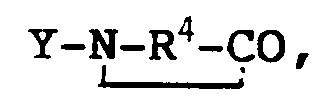
Y = CO, SO₂, R⁵P=O, R¹, R², R⁴ zwei- oder mehrwertige aliphatische, aromatische, heterocyclische oder heteroatomhaltige Segmente, R² und R⁴ vorzugsweise einen zweiwertigen aliphatischen Rest (CH₂)₀ mit 1<o<15, R³ und R⁵ aliphatische, cycloaliphatische und aromatische Reste und n,m ganze Zahlen mit 1<m,n<5, vorzugsweise m=n=1, bedeuten. - Handelt es sich um polyfunktionelle Lactame, wo X ebenfalls ein N-aktiviertes Lactam darstellt, so werden dieser Komponente B Diole oder Diamine, vorzugsweise 1Mol OH bzw. NH₂ / 1 Mol N-aktiviertem Lactam, zugesetzt, um diese Komponente B zu höhermolekularen Verbindungen umzusetzen. Dabei wird das Lactam abgespalten und muß aus der Reaktionsmischung, z.B. durch Entgasen, entfernt werden. Beispiele für diese Komponenten sind Terephthaloyllactame.
- Handelt es sich um N-aktivierte Lactame, wo die funktionelle Gruppe X kein Lactam, sondern eine Hydroxy-, Phenol- oder Amingruppe darstellt, so kann Komponente B ohne weitere Zusätze umgesetzt werden.
- In Abhängigkeit von den Reaktionsbedingungen und der chemischen Zusammensetzung von Komponente B kann die Polymerisation unter Abspaltung der Lactame oder durch Ringöffnung des Lactams erfolgen.
- Als Lactame sind besonders bevorzugt Caprolactam und Laurinlactam. Die Lactame lassen sich in dem Fachmann bekannter Weise z.B. aus mono- und polyfunktionellen cyclischen Ketonverbindungen oder aus Amincarbonsäure-bzw. Aminocarbonsäurederivaten, bevorzugt der Aminocapron- oder Aminovaleriansäure, herstellen. Als Komponente B bevorzugt sind Verbindungen enthaltend N-substituierte, durch elektronenziehende Substituenten Y aktivierte cyclische Lactame und aromatische Amine, Phenole, oder Alkohole, wobei die Nucleophilie der Phenole, Amine oder Alkohole so zu variieren ist, daß erst beim Erhitzen eine schnelle Reaktion eintritt. Ganz besonders bevorzugt sind p-Aminobenzoyllactame, z.B. p-Aminobenzoylcaprolactam.
- Bei dem Rest R¹ handelt es sich um zwei oder mehrwertige aliphatische, aromatische, araliphatische, cycloaliphatische, heterocyclische oder heteroatomhaltige Segmente. Heteroatomhaltig bedeutet, daß aliphatische, aromatische, araliphatische oder cycloaliphatische Segmente im Rückgrat neben C-Atomen auch andere Atome wie N,S,P enthalten können, ganz besonders bevorzugt sind aromatische Ether, Sulfone, Thioether sowie Ester oder Amide. Beispiele für R1 sind 1,3- und 1,4- Benzol, 4,4'-Stilben, Alkylene, 1,4-Cyclohexan, hydriertes Bisphenol A nach Entfernen der beiden OH-Gruppen, Oligomere Polyamide, Polyester, Polyether, Polycarbonate. In Abhängigkeit der Natur der funktionellen Gruppen X und Y leiten sich die Reste R ¹ von symmetrisch oder asymmetrisch substituierten Verbindungen ab, ganz besonders bevorzugt von Amincarbonsäuren und Aminosulfonsäuren nach Entfernen der funktionellen Gruppen.
- Die Mischung der Komponenten A und der polymerisierten Komponente B kann ein- oder mehrphasig sein. Bevorzugt sind Mischungen, die dadurch gekennzeichnet sind, daß in der kontinuierlichen Phase der Komponente A Mikrophasen der Komponente B dispergiert sind. Vorzugsweise beträgt deshalb der Gewichtsprozent-Anteil der Komponente B weniger als 50, ganz besonders bevorzugt weniger als 25. Falls die Reaktionsprodukte der Komponente B selbst thermoplastisch sind, können bis zu 90 Gewichtsprozent der Komponente B zugesetzt werden.
- Neben den Komponenten A und B können Hilfsmittel zugesetzt werden, um die Anbindungen der Mikrophasen zu verbessern. Bei diesen Hilfsmitteln, den sogenannten Phasenvermittlern, handelt es sich bevorzugt um funktionalisierte Polymere abgeleitet von Komponente A, deren funktionelle Gruppe mit den Gruppen X reagieren kann. Bei den funktionellen Gruppen X = Amin sind carbonsäureanhydrid-funktionalisierte Polymere von besonderer Bedeutung., z.B. maleinsäureanhydridgepfropftes Polypropylen, falls es sich bei Komponente A um Polypropylen handelt, oder Styrol/Maleinsäureanhydrid-Copolymere mit weniger als 50 Gew.%, bevorzugt weniger als 10 Gew.% Maleinsäureanhydridgehalt, falls es sich bei Komponente A um Polystyrol handelt.
- Für Mikroverbunde mit Verstärkungswirkung werden bevorzugt Komponenten gewählt, wo Komponente A und B in der Schmelze mischbar sind und Phasentrennung erst bei der Reaktion der Komponente B eintritt. Zudem sind Komponenten B bevorzugt, die nach erfolgter Reaktion steife oder flüssigkristalline Polymere bilden. Ganz besonders bevorzugt sind Kombinationen, wo es sich bei Komponente A um Polyamide, insbesondere Polyamid-6, Polyamid-66, Polyamid-4, Polyamid-11, und bei Komponente B um p-Aminobenzoyllactame, insbesondere p-Aminobenzoylcaprolactam und p-Aminobenzoyl-laurinlactam, handelt. Die Komponente B wird im Fall von Polyamid/p-Aminobenzoyllactam in Gewichtsprozenten <50, besonders bevorzugt <10, zugesetzt. Bevorzugt sind Temperaturen oberhalb der Erweichungstemperatur der Komponente A.
- Die Komponente A kann vor dem Aufschmelzen oder nach dem Aufschmelzen mit der Komponente B kombiniert werden. Vorzugsweise wird die Komponente B als Pulver in die Schmelze von A gegeben. Die funktionellen Gruppen sind so zu wählen, daß die Umsetzung der Komponete B innerhalb von weniger als 10 Minuten erfolgt. Auf diese Weise kann die Mischung in-situ, d.h. während der Verarbeitung der Komponente A durchgeführt werden. Bei der Polymerisation der Komponente B werden mehr oder weniger große Anteile der N-aktivierte Lactame abgespalten und können im Vakuum aus der Schmelze entfernt werden. Im Fall der polyfunktionellen Lactame, wo ein Zusatz von Diol bzw. Diamin erforderlich ist, kann das Polylactam mit Komponente A vorgemischt und dann mit der Diol- bzw. Diamin-Komponente kombiniert werden, oder es kann auch umgekehrt verfahren werden. Ganz besonders bevorzugt sind Verfahren, wo p-Aminobenzoyllactam zur Schmelze eines Polyamid-6 bei Temperaturen >220°C zudosiert und innerhalb von weniger als 10 Minuten polymerisiert wird. Die Herstellung der Mischungen kann im Ein-oder Zweischneckenextruder oder in einem Kneter erfolgen.
- Neben den Komponenten A und B können weitere Zusatzstoffe und Hilfsmittel zugesetzt werden. Beispiele sind Antioxidantien, Lichtschutzmittel, Flammschutzmittel, Weichmacher, Flexibilisatoren, Elastomere, Füllstoffe, Fasern, Kurzfasern, Farbstoffe, Pigmente und andere in der Thermoplastverarbeitung üblichen Stoffe.
- Die erfindungsgemäßen Mischungen sind mit den für Thermoplaste üblichen Verfahren verarbeitbar und eignen sich daher für die Herstellung von spritzgegossenen, extrudierten und blasextruten Formteilen, von Klebstoffen, Beschichtungen, Fasern, Filmen, und Folien.
- In einem Haake Rheomix Meßkneter werden in einer auf 220°C vorgeheizten 60ml Meßkammer 31g Polypropylen (Schmelzindex 2g/min bei 230°C/2.13kg) und 5g carbonsäureanhydridfunktionelles Polypropylen ( 0.37 Gew.% gepfropftes Maleinsäureanhydrid, Schmelzindex 125.3 g/min bei 230°C/2.16kg) 2 Minuten bei 220°C und 60U/min aufgeschmolzen. Dann gibt man 4g p-Aminobenzoylcaprolactam zur Schmelze. Während 30 Sekunden nimmt das Drehmoment von 4.3 auf 0.5 Nm ab und steigt nach weiteren 30 Sekunden auf 3.8 Nm an. Dann wird weitere 7 Minuten geknetet.
- Es wird wie in Beispiel 1 verfahren, doch setzt man statt 10 Gew.% nun 30 Gew.% p-Aminobenzoylcaprolactam zu.
- In einem Haake Rheomix Kneter mit einer auf 240°C vorgeheizten 60ml Mischkammer werden 36g Polyamid-6 (Zahlenmittel des Molekulargewichtes von 23000 g/mol) 2 Minuten bei 240°C und 60U/min aufgeschmolzen. Dann gibt man 4g p-Aminobenzoylcaprolactam zu. Innerhalb von 30 Sekunden fällt das Drehmoment von 2.5 auf 0.5Nm, steigt über eine Minute auf 2.4 Nm. In den weiteren 2.5 Minuten wird keine Änderung des Drehmomentes festgestellt.
- Nach dem Verfahren von Beispiel 1 werden 0.8g p-Aminobenzoylcaprolactam und 39.2 g Polyamid-6 gemischt.
- Nach dem Verfahren von Beispiel 1 werden 2g p-Aminobenzoylcaprolactam und 38g Polyamid-6 gemischt.
- Die Polypropylenlegierungen wurden mit Rutheniumtetroxid kontrastiert. Dünnschnitte von 70 bis 120nm Durchmesser wurden mit dem Ultramikrotom (Reichert Jung, Ultracut E mit Diamantmesser) hergestellt. Die Aufnahmen mit dem Zeiss CEM 902 Transmissionselektronenmikroskop mit elastischer Hellfeldabbildung zeigen nadelförmige Mikrophasen mit 300nm Durchmesser und 1200nm Länge.
- Aus Polyamidlegierungen wurden in der Presse bei 240°C 0.1mm dicke Filme hergestellt, die 12h bei 90°C mit 10% Phosphorwolframsäure kontrastiert wurden. Nach Einbettung in Epoxidharz wurden im Naßschneideverfahren 0.1µm dünne Schnitte präpariert. Im Elektronenmikroskop zeigen sich Fibrillenbündel von feinen nadelförmigen Kristallen.
- Die Mischungen wurden bei 260°C im Vakuum zu 1.6mm dicken Platten gepresst. Für die Zugprüfung wurden nach DIN 53455 maßstabsgetreu verkleinerte Prüfkörper von 18mm heregestellt und mit einer Querhauptsgeschwindigkeit von 10mm/min vermessen. Die Polyamidprüfkörper wurden vor der Messung konditioniert (3 Tage bei 60°C in Wasser, dann 4 Tage bei Raumtemperatur). An 5 Prüfkörpern wurden Young-Modul, Streckspannung und Reißdehnung ermittelt. Die Ergebnisse sind in der Tabelle zusammengestellt.

Claims (17)
- Polymer-Mischungen und Verfahren zu ihrer Herstellung, dadurch gekennzeichnet, daß in Komponente A, bestehend aus einem oder mehreren thermoplastischen Polymeren, Komponente B, bestehend aus einer oder mehreren Verbindungen mit der Struktur Xn-R¹-(Y-N-R²-CO)m, zu linearen, verzweigten oder vernetzten, hoch- oder niedermolekularen Polymeren umgesetzt wird, wobei X = NH₂, NHR³, OH oder ein N-substituiertes, mit einem elektronenziehenden Substituenten Y aktiviertes Lactam des Typs Y-N-R⁴-CO, Y = CO, SO₂, R⁵P=O, R¹, R², R⁴ zwei- oder mehrwertige aliphatische, aromatische, heterocyclische oder heteroatomhaltige Segmente, R² und R⁴ vorzugsweise einen zweiwertigen aliphatischen Rest (CH₂)₀ mit 1<o<15, R³ und R⁵ aliphatische, cycloaliphatische und aromatische Reste und n,m ganze Zahlen mit 1<m,n<5, vorzugsweise m=n=1, bedeuten.
- Mischungen gemäß Anspruch 1, dadurch gekennzeichnet, daß Komponente A bestehen kann aus Olefinhomo- oder copolymeren, vorzugsweise Polyethylenen hoher oder niederer Dichte, Ethylencopolymeren mit 1-Olefinen, insbesondere enthaltend 1-Buten, 1-Octen, Ethylencopolymeren mit Vinylacetat und/oder Methacrylsäure und deren Derivaten, darunter insbesondere Methyl-, Ethyl-, Butylmethacrylat, Propylenhomo- und copolymeren, insbesondere enthaltend Propylen/Ethylen, oder Styrolhomo- und copolymeren, inbesondere enthaltend Methacrylsäureester, Butadien, Acrylnitril, Butadien/Acrylnitril.
- Mischungen gemäß Anspruch 1, dadurch gekennzeichnet, daß Komponente A ein polares heteroatomhaltiges thermoplastisches Polymer ist, insbesondere Polyester, Polyamide, Polyamidimide, Polycarbonate, Polyether, ganz besonders bevorzugt Homo- und Copolyamide, hergestellt durch Polykondensation von aliphatischen, araliphatischen, aromatischen, cycloaliphatischen Diaminen mit aromatischen, aliphatischen, cycloaliphatischen, heterocyclischen Dicarbonsäuren oder durch Polymerisation von Lactamen des Typs HN-R ²-CO , wobei R² vorzugsweise einen zweiwertigen aliphatischen Rest darstellt, oder Polyester aus aromatischen Dicarbonsäuren mit aliphatischen Diolen, insbesondere Polyethylenterephthalat oder Polybutylenterephthalat, oder Polyarylate auf der Basis aromatischer Di- und Tricarbonsäuren und aromatischen Diolen, inbesondere Hydroxybenzoat-Copolymere, Hydrochinon-Polymere mit aromatischen Dicarbonsäuren, insbesondere Terephthal-,Isopthal-, Trimellithsäure-, 2,6- oder 1,4-Naphthalin-, oder 4,4'-Diphenyldicarbonsäure, oder Polyether, insbesondere Poly-(2,6-dimethyl-phenol), wobei die genannten Polymerklassen auch als Legierungen, einschließlich der in Anspruch 2 bezeichneten Komponenten A, eingesetzt werden können; besonders bevorzugt sind Polyamid-6, Polyamid-6,6, Polyamid-11, Polyamid-4 sowie deren Mischungen.
- Mischungen gemäß Anspruch 1, wobei Komponente B bevorzugt aus difunktionellen N-substituierten mit elektronenziehenden Substituenten aktivierten Acyl-Lactamen (Bis-acyllactamen) besteht, die mit aromatischen, aliphatischen, cycloaliphatischen oder araliphatischen Diaminen bei einem Lactam/Diamin Molverhältnis größer als 0,5 und kleiner als 1,5 zur Reaktion gebracht werden.
- Mischungen gemäß Anspruch 1, wobei Komponente B bevorzugt aus aromatischen, aliphatischen, cycloaliphatischen, araliphatischen, heterocyclischen oder heteroatomhaltigen Verbindungen enthaltend eine Aminogruppe, vorzugsweise eine aromatische Aminogruppe, und eine N-Carbonyllactamgruppe, vorzugsweise ein N-Carbonylcaprolactam oder N-Carbonyllaurinlactam, insbesondere p-Aminobenzoyllactame, besteht.
- Mischungen gemäß Anspruch 1, dadurch gekennzeichnet, daß Komponente A und Komponenten B in der Schmelze mischbar sind.
- Mischungen gemäß Anspruch 1, dadurch gekennzeichnet, daß bei der Polymerisation der Komponente B ein nieder- oder hochmolekulares Reaktionsprodukt ensteht, das in der Komponente A nicht mehr löslich ist.
- Mischungen gemäß Anspruch 1 dadurch gekennzeichnet, daß Komponente A eine nieder- oder hochmolekulare Verbindung enthält, welche über eine funktionelle Gruppe verfügt, die mit der Endgruppe der Komponente B oder ihrer nieder- oder hochmolekularen Reaktionsprodukte reagieren kann, wobei das Molverhältnis der funktionellen Gruppe X im Verhältnis zur funktionellen Gruppe der Komponente A <1 ist; ganz besonders bevorzugt sind funktionelle Gruppen X = NH₂ und maleinsäureanhydridgepfropfte Komponenten A, insbesondere maleinsäureanhydridgepfropfte Olefinhomo- und copolymere und Copolymere aus Maleinsäureanhydrid und Olefinen.
- Mischungen gemäß Anspruch 6, dadurch gekennzeichnet, daß die gebildete Mikrophase anisotrop ist, bevorzugt nadelförmig mit Längen/Durchmesser-Verhältnissen >1.
- Mischungen gemäß Anspruch 1, dadurch gekennzeichnet, daß das aus Komponente B gebildete nieder- oder hochmolekulare Reaktionsprodukt oberhalb der Erweichungstemperatur der Komponente A erweicht, ganz besonders bevorzugt oberhalb der Zersetzungstemperatur der Komponente A.
- Mischungen gemäß Anspruch 1, dadurch gekennzeichnet, daß der Rest R¹ der Komponente B aus steifen, insbesondere aromatischen oder steifen heteroatomhaltigen Segmenten zusammengeetzt ist, die bei der Reaktion der Komponente B ein nieder- oder hochmolekulares steifkettiges Reaktionsprodukt bilden, besonders bevorzugt sind flüssigkristalline Reaktionsprodukte.
- Mischungen gemäß Anspruch 1, dadurch gekennzeichnet, daß neben den Komponenten A und B weitere Komponenten anwesend sind, insbesondere Füllstoffe, Stabilisatoren, Pigmente, Farbstoffe, Weichmacher.
- Mischungen gemäß Anspruch 1, dadurch gekennzeichnet, daß weniger als 50 Gewichtsprozent der Komponente B, bezogen auf die Mischung von A und B zugegeben werden, mit der Maßgabe, daß die Komponente A die kontinuierliche Phase darstellt; ganz besonders bevorzugt sind Anteile der Komponente B kleiner als 25 Gewichtsprozent.
- Mischungen gemäß Anspruch 1, dadurch gekennzeichnet, daß, falls die polymerisierte Komponente B thermoplastisch ist, der Anteil von B bis zu 90 Gew.% beträgt.
- Verfahren zur Herstellung von Mischungen gemäß Anspruch 1, dadurch gekennzeichnet, daß die Komponente B zur Schmelze der Komponente A zugesetzt wird, ganz besonders bevorzugt bei Temperaturen oberhalb von 100°C.
- Verfahren zur Herstellung von Mischungen gemäß Anspruch 1, dadurch gekennzeichnet, daß Komponenten B und Komponenten A unterhalb der Erweichungstemperatur von Komponente A vorgemischt werden.
- Verwendungen von Mischungen gemäß Anspruch 1 als selbstverstärkende Kunststoffe, Formmassen, Mikroverbunde, Spritzgußmasse, Röhren, Stangen, Profile, Fasern, Beschichtungen, Folien, Filme, Klebstoffe, Extrudate.
Applications Claiming Priority (2)
| Application Number | Priority Date | Filing Date | Title |
|---|---|---|---|
| DE4119146A DE4119146C2 (de) | 1991-06-11 | 1991-06-11 | Polymer-Mischungen Verfahren zu ihrer Herstellung und ihre Verwendung |
| DE4119146 | 1991-06-11 |
Publications (2)
| Publication Number | Publication Date |
|---|---|
| EP0518062A1 true EP0518062A1 (de) | 1992-12-16 |
| EP0518062B1 EP0518062B1 (de) | 1994-12-28 |
Family
ID=6433650
Family Applications (1)
| Application Number | Title | Priority Date | Filing Date |
|---|---|---|---|
| EP92107923A Expired - Lifetime EP0518062B1 (de) | 1991-06-11 | 1992-05-12 | In-situ Polymerlegierungen und Mikroverbunde sowie Verfahren zu ihrer Herstellung |
Country Status (11)
| Country | Link |
|---|---|
| US (2) | US5369171A (de) |
| EP (1) | EP0518062B1 (de) |
| JP (1) | JPH05178987A (de) |
| KR (1) | KR930000610A (de) |
| AT (1) | ATE116349T1 (de) |
| CA (1) | CA2070761A1 (de) |
| DE (1) | DE4119146C2 (de) |
| ES (1) | ES2068635T3 (de) |
| FI (1) | FI922700L (de) |
| MY (1) | MY109882A (de) |
| NO (1) | NO180237C (de) |
Cited By (1)
| Publication number | Priority date | Publication date | Assignee | Title |
|---|---|---|---|---|
| EP0553846B1 (de) * | 1992-01-29 | 1998-10-07 | Mazda Motor Corporation | Herstellung eines Polymerverbundmaterials |
Families Citing this family (7)
| Publication number | Priority date | Publication date | Assignee | Title |
|---|---|---|---|---|
| DE69331761T2 (de) * | 1992-07-24 | 2002-09-12 | The Regents Of The University Of California, Oakland | Arzneimittel, die den durch ampa rezeptoren vermittelten synaptischen respons erhöhen |
| US5667890A (en) * | 1996-04-02 | 1997-09-16 | Shakespeare Company | Monofilaments extruded from compatibilized polymer blends containing polyphenylene sulfide, and fabrics thereof |
| JP2001226537A (ja) * | 2000-02-17 | 2001-08-21 | Toray Ind Inc | 熱可塑性樹脂構造体および成形品 |
| DE10220896A1 (de) * | 2002-05-10 | 2003-11-20 | Faist Automotive Gmbh & Co Kg | Verfahren zur Herstellung eines Schaumstofformteils und Bindemittel hierfür |
| WO2006079890A1 (de) * | 2005-01-27 | 2006-08-03 | Ems-Chemie Ag | Hochviskose formmassen auf basis von thermoplastischen polymeren sowie deren verwendung |
| FR3057569B1 (fr) * | 2016-10-13 | 2018-11-30 | Universite de Bordeaux | Nouvelle voie de synthese de copolyamides aliphatiques-aromatiques statistiques et les copolyamides aliphatiques-aromatiques statistiques obtenus. |
| US10745579B2 (en) | 2018-08-31 | 2020-08-18 | International Business Machines Corporation | Extrudable poly(propylene) compositions |
Citations (2)
| Publication number | Priority date | Publication date | Assignee | Title |
|---|---|---|---|---|
| GB2060649A (en) * | 1979-10-04 | 1981-05-07 | Asahi Dow Ltd | Co-grafted polymers |
| EP0408166A2 (de) * | 1989-07-11 | 1991-01-16 | Gencorp Inc. | Polymere Verbundwerkstoffe |
Family Cites Families (1)
| Publication number | Priority date | Publication date | Assignee | Title |
|---|---|---|---|---|
| DE4018549A1 (de) * | 1990-06-09 | 1991-12-12 | Huels Chemische Werke Ag | Thermoplastische formmassen auf basis von polyphenylenethern und polyestern |
-
1991
- 1991-06-11 DE DE4119146A patent/DE4119146C2/de not_active Expired - Fee Related
-
1992
- 1992-05-12 AT AT92107923T patent/ATE116349T1/de not_active IP Right Cessation
- 1992-05-12 EP EP92107923A patent/EP0518062B1/de not_active Expired - Lifetime
- 1992-05-12 ES ES92107923T patent/ES2068635T3/es not_active Expired - Lifetime
- 1992-05-19 NO NO921964A patent/NO180237C/no unknown
- 1992-05-26 MY MYPI92000898A patent/MY109882A/en unknown
- 1992-06-03 JP JP4142318A patent/JPH05178987A/ja active Pending
- 1992-06-09 CA CA002070761A patent/CA2070761A1/en not_active Abandoned
- 1992-06-10 US US07/895,368 patent/US5369171A/en not_active Expired - Fee Related
- 1992-06-10 FI FI922700A patent/FI922700L/fi not_active Application Discontinuation
- 1992-06-10 KR KR1019920010009A patent/KR930000610A/ko not_active Ceased
-
1993
- 1993-08-20 US US08/109,711 patent/US5312875A/en not_active Expired - Fee Related
Patent Citations (2)
| Publication number | Priority date | Publication date | Assignee | Title |
|---|---|---|---|---|
| GB2060649A (en) * | 1979-10-04 | 1981-05-07 | Asahi Dow Ltd | Co-grafted polymers |
| EP0408166A2 (de) * | 1989-07-11 | 1991-01-16 | Gencorp Inc. | Polymere Verbundwerkstoffe |
Non-Patent Citations (2)
| Title |
|---|
| JOURNAL OF APPLIED POLYMER SCIENCE. Bd. 32, 1986, NEW YORK US Seiten 6299 - 6315; D. ROGER MOORE ET AL.: 'MOLECULAR COMPOSITES VIA IN SITU POLYMERIZATION : POLY(PHENYLENE TEREPHTHALAMIDE)-NYLON 3' * |
| POLYMER BULLETIN Bd. 18, 1987, BERLIN Seiten 397 - 401; ALLISON M. SIKES ET AL.: 'SYNTHESIS AND CHARACTERIZATION OF IN SITU ANIONICALLY POLYMERIZED P-AMINOBENZOYLCAPROLACTAM USING DI AND TRI-FUNCTIONAL INITIATOR SYSTEMS' * |
Cited By (1)
| Publication number | Priority date | Publication date | Assignee | Title |
|---|---|---|---|---|
| EP0553846B1 (de) * | 1992-01-29 | 1998-10-07 | Mazda Motor Corporation | Herstellung eines Polymerverbundmaterials |
Also Published As
| Publication number | Publication date |
|---|---|
| NO921964D0 (no) | 1992-05-19 |
| MY109882A (en) | 1997-09-30 |
| JPH05178987A (ja) | 1993-07-20 |
| FI922700A7 (fi) | 1992-12-12 |
| NO921964L (no) | 1992-12-14 |
| FI922700A0 (fi) | 1992-06-10 |
| ES2068635T3 (es) | 1995-04-16 |
| CA2070761A1 (en) | 1992-12-12 |
| NO180237B (no) | 1996-12-02 |
| FI922700L (fi) | 1992-12-12 |
| NO180237C (no) | 1997-03-12 |
| US5312875A (en) | 1994-05-17 |
| EP0518062B1 (de) | 1994-12-28 |
| ATE116349T1 (de) | 1995-01-15 |
| US5369171A (en) | 1994-11-29 |
| KR930000610A (ko) | 1993-01-15 |
| DE4119146A1 (de) | 1992-12-17 |
| DE4119146C2 (de) | 2001-01-11 |
Similar Documents
| Publication | Publication Date | Title |
|---|---|---|
| EP0523445B1 (de) | Thermoplastische Formmassen aus semikristallinem und amorphem Polyamid, deren Verwendung und Verfahren zu ihrer Herstellung | |
| DE2847782C2 (de) | Zusammengesetztes Polymermaterial | |
| DE3750485T2 (de) | Harzzusammensetzung mit anisotropischen Schmelzeigenschaften. | |
| DE3403576A1 (de) | Elastomere thermoplastische formmassen und deren herstellung | |
| EP0840758B1 (de) | Verfahren zur herstellung von verkappten polyarylenethern | |
| DE3037520A1 (de) | Thermoplastisches polymermaterial und verfahren zu seiner herstellung | |
| EP0106241B1 (de) | Schlagzähe Polyamide | |
| EP0141950A2 (de) | Kerbschlagzähe, in der Schmelze leichtfliessende Polyamide | |
| DE3806271A1 (de) | Thermoplastische formmassen auf der basis von polyamiden und ethylencopolymerisaten | |
| EP0399415B1 (de) | Thermoplastische verarbeitbare elastomere Blockcopolyetheresteretheramide, Verfahren zu ihrer Herstellung und ihre Verwendung | |
| DE2612011A1 (de) | Verfahren zur herstellung von schlagzaehen thermoplastischen formmassen | |
| EP0518062B1 (de) | In-situ Polymerlegierungen und Mikroverbunde sowie Verfahren zu ihrer Herstellung | |
| DE69103171T2 (de) | Polyamid-Harzmasse. | |
| DE68920622T2 (de) | Polyketonzusammensetzungen. | |
| DE3617501A1 (de) | Thermoplastische formmassen | |
| EP0613916A1 (de) | Formmasse auf der Grundlage von Polyarylenethern mit Anhydridendgruppen | |
| DE60022474T2 (de) | Polymermischungen aus poly(phenylen oxid) und flüssigkristallinem polymer mit verbessertem cti (comparative tracking index) | |
| DE3508531A1 (de) | Hydrophobierte, leichtfliessende thermoplastische polyamide | |
| DE19702590A1 (de) | Thermoplastische Formmassen | |
| DE69031977T2 (de) | Polyarylensulfidsulfon-Harzzusammensetzung und Verfahren zu ihrer Herstellung | |
| EP0855429A1 (de) | Thermoplastische Formmassen mit verbesserter Chemikalienresistenz | |
| DE2343445B2 (de) | Verwendung von epoxidharzen zum verbessern der verarbeitbarkeit thermoplastischer kunstharzmassen | |
| DE69200511T2 (de) | Mit Keton- oder Ätherketon-Gruppenhaltigen Verbindungen modifizierte Konsensationspolymere. | |
| EP0275518B1 (de) | Thermoplastische Formmassen auf der Basis von Polyamiden und Ethylencopolymerisaten | |
| DE1221009B (de) | Thermoplastisch verarbeitbare Formmasse |
Legal Events
| Date | Code | Title | Description |
|---|---|---|---|
| PUAI | Public reference made under article 153(3) epc to a published international application that has entered the european phase |
Free format text: ORIGINAL CODE: 0009012 |
|
| 17P | Request for examination filed |
Effective date: 19920512 |
|
| AK | Designated contracting states |
Kind code of ref document: A1 Designated state(s): AT BE CH ES FR GB IT LI NL SE |
|
| 17Q | First examination report despatched |
Effective date: 19930416 |
|
| GRAA | (expected) grant |
Free format text: ORIGINAL CODE: 0009210 |
|
| AK | Designated contracting states |
Kind code of ref document: B1 Designated state(s): AT BE CH ES FR GB IT LI NL SE |
|
| REF | Corresponds to: |
Ref document number: 116349 Country of ref document: AT Date of ref document: 19950115 Kind code of ref document: T |
|
| ITF | It: translation for a ep patent filed | ||
| EAL | Se: european patent in force in sweden |
Ref document number: 92107923.2 |
|
| GBT | Gb: translation of ep patent filed (gb section 77(6)(a)/1977) |
Effective date: 19950202 |
|
| ET | Fr: translation filed | ||
| REG | Reference to a national code |
Ref country code: ES Ref legal event code: FG2A Ref document number: 2068635 Country of ref document: ES Kind code of ref document: T3 |
|
| PLBE | No opposition filed within time limit |
Free format text: ORIGINAL CODE: 0009261 |
|
| STAA | Information on the status of an ep patent application or granted ep patent |
Free format text: STATUS: NO OPPOSITION FILED WITHIN TIME LIMIT |
|
| 26N | No opposition filed | ||
| PGFP | Annual fee paid to national office [announced via postgrant information from national office to epo] |
Ref country code: ES Payment date: 19970527 Year of fee payment: 6 |
|
| PGFP | Annual fee paid to national office [announced via postgrant information from national office to epo] |
Ref country code: FR Payment date: 19970531 Year of fee payment: 6 |
|
| PGFP | Annual fee paid to national office [announced via postgrant information from national office to epo] |
Ref country code: SE Payment date: 19970602 Year of fee payment: 6 Ref country code: BE Payment date: 19970602 Year of fee payment: 6 |
|
| PGFP | Annual fee paid to national office [announced via postgrant information from national office to epo] |
Ref country code: GB Payment date: 19970609 Year of fee payment: 6 |
|
| PGFP | Annual fee paid to national office [announced via postgrant information from national office to epo] |
Ref country code: AT Payment date: 19970612 Year of fee payment: 6 |
|
| PGFP | Annual fee paid to national office [announced via postgrant information from national office to epo] |
Ref country code: NL Payment date: 19970619 Year of fee payment: 6 Ref country code: CH Payment date: 19970619 Year of fee payment: 6 |
|
| PG25 | Lapsed in a contracting state [announced via postgrant information from national office to epo] |
Ref country code: GB Free format text: LAPSE BECAUSE OF NON-PAYMENT OF DUE FEES Effective date: 19980512 Ref country code: AT Free format text: LAPSE BECAUSE OF NON-PAYMENT OF DUE FEES Effective date: 19980512 |
|
| PG25 | Lapsed in a contracting state [announced via postgrant information from national office to epo] |
Ref country code: SE Free format text: LAPSE BECAUSE OF NON-PAYMENT OF DUE FEES Effective date: 19980513 Ref country code: ES Free format text: LAPSE BECAUSE OF EXPIRATION OF PROTECTION Effective date: 19980513 |
|
| PG25 | Lapsed in a contracting state [announced via postgrant information from national office to epo] |
Ref country code: LI Free format text: LAPSE BECAUSE OF NON-PAYMENT OF DUE FEES Effective date: 19980531 Ref country code: FR Free format text: LAPSE BECAUSE OF NON-PAYMENT OF DUE FEES Effective date: 19980531 Ref country code: CH Free format text: LAPSE BECAUSE OF NON-PAYMENT OF DUE FEES Effective date: 19980531 Ref country code: BE Free format text: LAPSE BECAUSE OF NON-PAYMENT OF DUE FEES Effective date: 19980531 |
|
| BERE | Be: lapsed |
Owner name: REHAU A.G. + CO. Effective date: 19980531 |
|
| PG25 | Lapsed in a contracting state [announced via postgrant information from national office to epo] |
Ref country code: NL Free format text: LAPSE BECAUSE OF NON-PAYMENT OF DUE FEES Effective date: 19981201 |
|
| GBPC | Gb: european patent ceased through non-payment of renewal fee |
Effective date: 19980512 |
|
| REG | Reference to a national code |
Ref country code: CH Ref legal event code: PL |
|
| EUG | Se: european patent has lapsed |
Ref document number: 92107923.2 |
|
| NLV4 | Nl: lapsed or anulled due to non-payment of the annual fee |
Effective date: 19981201 |
|
| REG | Reference to a national code |
Ref country code: FR Ref legal event code: ST |
|
| REG | Reference to a national code |
Ref country code: ES Ref legal event code: FD2A Effective date: 20000601 |
|
| PG25 | Lapsed in a contracting state [announced via postgrant information from national office to epo] |
Ref country code: IT Free format text: LAPSE BECAUSE OF NON-PAYMENT OF DUE FEES Effective date: 20050512 |