EP0518149A2 - Kernbromierte Phthalsäurederivate als stabilisatoren für Polycarbonate gegen Gammastrahlung - Google Patents
Kernbromierte Phthalsäurederivate als stabilisatoren für Polycarbonate gegen Gammastrahlung Download PDFInfo
- Publication number
- EP0518149A2 EP0518149A2 EP92109189A EP92109189A EP0518149A2 EP 0518149 A2 EP0518149 A2 EP 0518149A2 EP 92109189 A EP92109189 A EP 92109189A EP 92109189 A EP92109189 A EP 92109189A EP 0518149 A2 EP0518149 A2 EP 0518149A2
- Authority
- EP
- European Patent Office
- Prior art keywords
- weight
- phthalic acid
- bis
- hydroxyphenyl
- alkyl
- Prior art date
- Legal status (The legal status is an assumption and is not a legal conclusion. Google has not performed a legal analysis and makes no representation as to the accuracy of the status listed.)
- Withdrawn
Links
Classifications
-
- C—CHEMISTRY; METALLURGY
- C08—ORGANIC MACROMOLECULAR COMPOUNDS; THEIR PREPARATION OR CHEMICAL WORKING-UP; COMPOSITIONS BASED THEREON
- C08K—Use of inorganic or non-macromolecular organic substances as compounding ingredients
- C08K5/00—Use of organic ingredients
- C08K5/04—Oxygen-containing compounds
- C08K5/09—Carboxylic acids; Metal salts thereof; Anhydrides thereof
-
- C—CHEMISTRY; METALLURGY
- C08—ORGANIC MACROMOLECULAR COMPOUNDS; THEIR PREPARATION OR CHEMICAL WORKING-UP; COMPOSITIONS BASED THEREON
- C08K—Use of inorganic or non-macromolecular organic substances as compounding ingredients
- C08K5/00—Use of organic ingredients
- C08K5/04—Oxygen-containing compounds
- C08K5/15—Heterocyclic compounds having oxygen in the ring
- C08K5/151—Heterocyclic compounds having oxygen in the ring having one oxygen atom in the ring
- C08K5/1535—Five-membered rings
- C08K5/1539—Cyclic anhydrides
Definitions
- the present invention relates to the use of core-brominated phthalic acid derivatives for stabilizing thermoplastic polycarbonates against the action of gamma rays.
- thermoplastic polycarbonates are suitable for applications in the medical field. For these applications, it is important that the corresponding articles and moldings made of the thermoplastic polycarbonates must be sterilizable, as often as desired, without being degraded. The sterilization is carried out by irradiation with ⁇ -rays, since the treatment with water vapor permanently damages the polycarbonates.
- Irradiation with ⁇ -rays also causes damage to the polycarbonates in the long run by coloring them yellow.
- this damage by ⁇ -rays is largely suppressed.
- thermoplastic polycarbonates resistant to the action of ⁇ -rays
- EP-OS 0 376 289 US Pat. No. 4,624,972, US Pat. No. 4,904,710
- EP-OS 0 152 012 EP -OS 0 296 473
- US Pat. No. 4,804,692 Mo 3005
- US Pat. No. 4,963,598 Mo 3047
- US Pat. No. 4,874 802 Mo 3071
- EP-OS 3 841 110 Mo 3170
- U.S. Patent 4,873,271 Mo 3208
- EP-OS 0 376 289 describes the combined use of polyalkylene glycols with bromine-containing oligocarbonates for radiation protection for polycarbonates.
- the combination of tetrabromophthalic anhydride with polypropylene glycols according to the invention has advantages, just as tetrabromophthalic anhydride alone has advantages over brominated oligocarbonate alone as a stabilizer of polycarbonates against ⁇ -rays.
- brominated phthalic acid derivatives to polycarbonates for the purpose of flame retardancy is known (see, for example, DE-OS 1 802 184 (Mo 981) or US Pat. No. 3,535,300, DE-OS 2,013,496, US Pat. No. 3,873,567, DE-PS 2 740 850 (Le A 18 401), US-PS 4 208 489 and US-PS 4 673 699).
- the use of brominated phthalic acid derivatives for stabilizing molded polycarbonate parts against ⁇ -rays is not addressed and is not suggested in these literature references.
- Nucleated brominated phthalic acid derivatives are preferably brominated phthalic anhydrides, phthalic acid imides, phthalic diesters and phthalic acid diamides, where the bromine substituents can take 1, 2, 3 or 4 positions in the phthalic acid aromatic.
- Suitable alkyl radicals are, for example, methyl, ethyl, propyl, isopropyl and butyl.
- Suitable alkylene radicals are, for example, ethylene, propylene, butylene and 1,6-hexamethylene.
- Suitable cycloalkyl radicals and cycloalkylene radicals are, for example, cyclohexyl, cyclopentyl, cyclohexylene and cyclopentylene.
- Suitable aralkyl radicals are, for example, benzyl and phenethyl.
- Suitable alkyl radicals in (III) and (IV) are methyl, ethyl, propyl and butyl.
- Suitable cycloalkyl radicals in (III) and (IV) are cyclohexyl and cyclopentyl.
- Suitable aryl radicals in (III) and (IV) are phenyl and naphthyl.
- Suitable aralkyl radicals in (III) and (IV) are benzyl, methylbenzyl, ethylbenzyl and propylbenzyl.
- An example of the compounds of formula (I) is tetrabromophthalic anhydride.
- An example of the compounds of the formula (II) is hexamethylenediamine-bis-tetrabromophthalic acid diimide.
- Examples of compounds of the formula (III) are dimethyl tetrabromophthalate and diethyl ester.
- An example of the compounds of the formula (IV) is tetrabromophthalic acid di (N-phenyl) amide.
- the core-brominated phthalic acid derivatives are used to sterilize the thermoplastic polycarbonates in amounts of from 0.01% by weight to 10% by weight, preferably from 0.1% by weight to 5.0% by weight and in particular from 0, 5 wt .-% to 1.5 wt .-%, each based on the weight of thermoplastic polycarbonate and core-brominated phthalic acid derivative.
- thermoplastic polycarbonates to be stabilized according to the invention are known from the literature.
- Polycarbonates to be stabilized according to the invention are thermoplastic, aromatic homopolycarbonates and copolycarbonates, which are based, for example, on one or more of the following diphenols: Hydroquinone Resorcinol Dihydroxydiphenyls Bis (hydroxyphenyl) alkanes Bis (hydroxyphenyl) cycloalkanes Bis (hydroxyphenyl) sulfides Bis (hydroxyphenyl) ether Bis (hydroxyphenyl) ketones Bis (hydroxyphenyl) sulfoxides Bis (hydroxyphenyl) sulfones ⁇ , ⁇ '-bis (hydroxyphenyl) diisopropylbenzenes and their nuclear alkylated and nuclear halogenated compounds.
- Preferred diphenols are, for example: 4,4'-dihydroxydiphenyl 2,2-bis (4-hydroxyphenyl) propane 2,4-bis (4-hydroxyphenyl) -2-methylbutane 1,1-bis (4-hydroxyphenyl) cyclohexane ⁇ , ⁇ '-bis (4-hydroxyphenyl) -p-diisopropylbenzene 2,2-bis (3-methyl-4-hydroxyphenyl) propane 2,2-bis (3-chloro-4-hydroxyphenyl) propane Bis (3,5-dimethyl-4-hydroxyphenyl) methane 2,2-bis (3,5-dimethyl-4-hydroxyphenyl) methane Bis (3,5-dimethyl-4-hydroxyphenyl) sulfone 2,4-bis (3,5-dimethyl-4-hydroxyphenyl) -2-methylbutane 1,1-bis (3,5-dimethyl-4-hydroxyphenyl) cyclohexane ⁇ , ⁇ '-bis (3,5-dimethyl-4-hydroxyphen
- diphenols are, for example: 2,2-bis (4-hydroxyphenyl) propane 2,2-bis (3,5-dimethyl-4-hydroxyphenyl) propane 2,2-bis (3,5-dichloro-4-hydroxyphenyl) propane 2,2-bis (3,5-dibromo-4-hydroxyphenyl) propane 1,1-bis (4-hydroxyphenyl) cyclohexane and 1,1-bis (4-hydroxyphenyl) -3,3,5-trimethylcyclohexane.
- Preferred aromatic polycarbonates are those based on one or more of the diphenols mentioned as preferred.
- Copolycarbonates based on 2,2-bis (4-hydroxyphenyl) propane and one of the other diphenols mentioned as particularly preferred are particularly preferred.
- Polycarbonates based solely on 2,2-bis (4-hydroxyphenyl) propane or 1,1-bis (4-hydroxyphenyl) -3,3,5-trimethylcyclohexane are also particularly preferred.
- the aromatic polycarbonates can be prepared by known methods, e.g. by the melt transesterification process from bisphenol and diphenyl carbonate and the two-phase interface process from bisphenols and phosgene, as described in the literature mentioned above.
- the aromatic polycarbonates can by the incorporation of small amounts, preferably amounts between 0.05 and 2.0 mol% (based on the diphenols used), of three or more than three-functional compounds, for example those with three or more than three phenolic hydroxyl groups be branched.
- Polycarbonates of this type are e.g. in German laid-open publications 1 570 533, 1 595 762, 2 116 974, 2 113 347, British patent specification 1 079 821, US patent specification 3 544 514 and in German laid-open specification 2,500,092.
- Some of the usable compounds with three or more than three phenolic hydroxyl groups are, for example, phloroglucin, 4,6-dimethyl-2.4.6-tri- (4-hydroxyphenyl) -hepten-2, 4.6-dimethyl-2.4.6-tri- (4 -hydroxyphenyl) -heptane, 1.3.5-tri- (4-hydroxyphenyl) -benzene, 1.1.1-tri- (4-hydroxyphenyl) -ethane, tri- (4-hydroxyphenyl) -phenylmethane, 2.2-bis- [4.4 bis (4-hydroxyphenyl) cyclohexyl] propane, 2,4-bis (4-hydroxyphenylisopropyl) phenol, 2,6-bis (2'-hydroxy-5'-methylbenzyl) -4-methylphenol, 2- (4-hydroxyphenyl) -2- (2,4-dihydroxyphenyl) propane, Hexa- (4- (4-hydroxyphenylisopropyl) phenyl) ortho
- Some of the other three-functional compounds are 2,4-dihydroxybenzoic acid, trimesic acid, cyanuric chloride and 3,3-bis (4-hydroxy-3-methylphenyl) -2-oxo-2,3-dihydroindole.
- the aromatic polycarbonates are generally intended to have average weight-average molecular weights M ⁇ w from 10,000 to over 200,000, preferably from 20,000 to 80,000, determined by measuring the rel. Viscosity in CH2Cl2 at 25 ° C and a concentration of 0.5 g in 100 ml CH2Cl2.
- chain terminators such as, for example, phenol or halophenols or alkylphenols, are used in a known manner in the calculated amounts.
- the core-brominated phthalic acid derivatives are incorporated into the polycarbonates to be stabilized in a known manner.
- the amount of (V) in the polycarbonate to be stabilized is likewise 0.01 to 10% by weight, preferably 0.1 to 5.0% by weight, based on the weight of thermoplastic polycarbonate and polyalkylene oxide (V).
- the present invention thus also relates to the combined use of core-brominated phthalic acid derivatives and polyalkylene oxides of the formula (V) wherein R, R 'and X have the meaning given above, for stabilizing thermoplastic polycarbonates against the action of gamma rays.
- Suitable polyalkylene oxides (V) are, for example, polypropylene glycols M ⁇ n , measured according to GPC, between 500 and 3500, which are equipped with dihydropyran end groups.
- the polyalkylene oxides (V) are also incorporated into the thermoplastic polycarbonates in a known manner.
- the present invention also relates to thermoplastic polycarbonates with a combined addition of core-brominated phthalic acid derivatives in amounts from 0.01% by weight to 10% by weight, preferably from 0.1% by weight to 5.0% by weight, and polyalkylene oxides of the formula (V) likewise in amounts from 0.01% by weight to 10% by weight, preferably from 0.1% by weight to 5.0% by weight, based in each case on the weight of thermoplastic polycarbonate and nuclear brominated phthalic acid derivative or by weight of thermoplastic polycarbonate and polyalkylene oxide (V).
- the present invention also relates to stabilizer combinations of core-brominated phthalic acid derivatives in amounts of 0.01 to 10 parts by weight, preferably 0.1 to 5.0 parts by weight with polyalkylene oxides (V) in amounts of 0.01 to 10 parts by weight .
- the conventional additives such as mold release agents, plasticizers, fillers and reinforcing materials can also be added to the polycarbonates to be stabilized according to the invention in a known manner.
- the polycarbonates stabilized according to the invention are processed into moldings of the most varied types in a known manner by extrusion or injection molding.
- Suitable molded articles which can be used in medicine are, for example, lines for the supply of oxygen to the blood, vessels for kidney dialysis, tube connections and heart probes.
- These stabilized shaped bodies are treated with ⁇ -rays, for example by irradiation with a 2 MeV van de Graff generator.
- This radiation source is calibrated according to the DIN regulations. A dose of 30 kGy (3 Mrad) can be applied within approximately 6 minutes.
- the generator generates an electron current of 100 ⁇ A.
- the loss of energy of the electrons in the material is mainly caused by ionization, but also by braking radiation. Direct access to the radiation source allows physical examination of the samples immediately after irradiation (the biggest changes occur here). Another advantage is that the radiation parameters can be varied here. Such variations are difficult in commercial radiation sterilization.
- the additives were worked into a polycarbonate resin by extrusion molding and then sprayed.
- the molded parts were irradiated with 3.0 Mrad.
- the radical concentration and the yellowing number were then measured over a period of 10 days.
- Table 1 shows the delta yellowness index (Delta-VZ), which were measured for the polycarbonate and the additive-containing compositions three hours and 10 days after the irradiation, respectively.
- compositions containing tetrabromophthalic anhydride bring about significantly better stabilization of the polycarbonates against the action of gamma rays than tetrabromobisphenol oligocarbonate or other bromine-containing compounds.
- Table 1 composition Delta-VZ (after 3 hours) Delta VZ (after 10 days) Polycarbonate component 3 (control) 57.3 39.4 Polycarbonate component 3 (0.5% NaBr) * 42.6 26.0 Polycarbonate component 3 (0.5% KBr) * 44.7 23.5 Polycarbonate component 3 (1.0% tetrachlorophthalic anhydride) 41.3 21.4 Polycarbonate component 3 (1.0 tetrabromo bisphenol A oligocarbonate) 35.4 19.5 Polycarbonate component 3 (1.0% tetrabromophthalic anhydride) * 23.2 10.7 * Higher amounts lead to clouding of the polycarbonates
- the stability of a material against the effects of radiation can also be measured by determining the radical concentration of the material after the irradiation. Radical concentrations can be determined using electron spin resonance (ESR) methods. After irradiation, the bisphenol A polycarbonate contains a large number of radicals. The decrease in this number in stabilizer-containing polycarbonate compositions is evidence of stabilizing properties.
- Table 2 compares the relative radical concentration of polycarbonate with compositions containing bromine as a radical scavenger, three hours and ten days after irradiation, respectively. The data show the effectiveness of the tetrabromophthalic anhydride derivatives as radiation traps. Table 2 composition Relative radical conc. (After 3 hours) Relative radical conc.
- the additives were worked into a polycarbonate resin by extrusion molding and then sprayed.
- the molded parts were at 3.0 Mrad. irradiated.
- the radical concentration and the yellowing number were then measured over a period of 10 days.
- Table 1 shows the delta yellowness index (Delta-VZ), which were measured for the polycarbonate and the additive-containing compositions three hours and 10 days after the irradiation, respectively.
- the compositions containing tetrabromophthalic anhydride bring about a significantly better stabilization of the polycarbonates against the action of gamma rays than tetrabromobisphenol A oligocarbonate or other bromine-containing compounds.
- the radical concentration is determined as in Example 2.
- the data show the effectiveness of the tetrabromophthalic anhydride derivatives as radiation traps.
- Table 4 composition Relative radical concentration (after 3 hours, after 10 days) Polycarbonate component 3 339 595 34 522 Polycarbonate component 3 (1.0% component 6) 255 083 8 212 Polycarbonate component 3 (1.0% tetrabromo bisphenol A oligocarbonate) 236 388 8,628 Polycarbonate component 3 (1.0% tetrachlorophthalic anhydride) 333 255 28 347 Polycarbonate component 3 (1.0% tetrabromo-bisphenol A oligocarbonate and 1% component 6) 100 794 3 935 Polycarbonate component 3 (1.0% tetrabromophthalic anhydride) (1.0% component 6) 12 697 1 162
Landscapes
- Chemical & Material Sciences (AREA)
- Health & Medical Sciences (AREA)
- Chemical Kinetics & Catalysis (AREA)
- Medicinal Chemistry (AREA)
- Polymers & Plastics (AREA)
- Organic Chemistry (AREA)
- Compositions Of Macromolecular Compounds (AREA)
Abstract
Gegenstand der vorliegenden Erfindung ist die Verwendung von kernbromierten Phthalsäurederivaten, gegebenenfalls in Kombination mit Polyalkylenoxiden der Formel (V)
worin
worin
- R
- H, C₁-C₆-Alkyl, Tetrahydropyranyl oder ein Silyl-Rest,
- R'
- H oder C₁-C₆-Alkyl und
- X
- eine ganze Zahl von 1 bis 100 sind,
Description
- Gegenstand der vorliegenden Erfindung ist die Verwendung von kernbromierten Phthalsäurederivaten zur Stabilisierung von thermoplastischen Polycarbonaten gegen die Einwirkung von Gammastrahlen.
- Die thermoplastischen Polycarbonate sind aufgrund ihrer physikalischen Eigenschaften für Anwendungen im medizinischen Bereich geeignet. Für diese Anwendungen ist es wichtig, daß die entsprechenden Artikel und Formkörper aus den thermoplastischen Polycarbonaten sterilisierbar sein müssen, und zwar beliebig oft, ohne daß sie dabei abgebaut werden. Die Sterilisierung erfolgt hierbei durch Bestrahlung mit γ-Strahlen, da die Behandlung mit Wasserdampf die Polycarbonate auf Dauer schädigt.
- Die Bestrahlung mit γ-Strahlen verursacht jedoch auf Dauer ebenfalls eine Schädigung der Polycarbonate, indem diese gelb gefärbt werden. Durch die erfindungsgemäße Verwendung von kernbromierten Phthalsäurederivaten wird diese Schädigung durch γ-Strahlen weitgehend unterdrückt.
- Es gibt verschiedene Methoden, die thermoplastischen Polycarbonate gegen die Einwirkung von γ-Strahlen resistent zu machen (siehe beispielsweise EP-OS 0 376 289, US-PS 4 624 972, US-PS 4 904 710, EP-OS 0 152 012, EP-OS 0 296 473 (Mo 2971), US-PS 4 804 692 (Mo 3005), US-PS 4 963 598 (Mo 3047) US-PS 4 874 802 (Mo 3071), EP-OS 3 841 110 (Mo 3170) und US-PS 4 873 271 (Mo 3208)). Kernbromierte Phthalsäurederivate werden darin nicht erwähnt.
- In der EP-OS 0 376 289 ist der kombinierte Einsatz von Polyalkylenglykolen mit bromhaltigen Oligocarbonaten zum Strahlenschutz für Polycarbonate beschrieben. Demgegenüber hat die erfindungsgemäße Kombination von Tetrabromphthalsäureanhydrid mit Polypropylenglykolen Vorteile, ebenso wie Tetrabromphthalsäureanhydrid allein gegenüber bromiertem Oligocarbonat allein als Stabilisator von Polycarbonaten gegen γ-Strahlen Vorteile zeigt.
- Andererseits ist der Zusatz von bromierten Phthalsäurederivaten zu Polycarbonaten zum Zwecke der Flammfestausrüstung bekannt (siehe beispielsweise DE-OS 1 802 184 (Mo 981) bzw. US-PS 3 535 300, DE-OS 2 013 496, US-PS 3 873 567, DE-PS 2 740 850 (Le A 18 401), US-PS 4 208 489 und US-PS 4 673 699). Die Verwendung von bromierten Phthalsäurederivaten zur Stabilisierung von Polycarbonatformteilen gegen γ-Strahlen wird in diesen Literatur-Stellen nicht angesprochen und nicht nahegelegt.
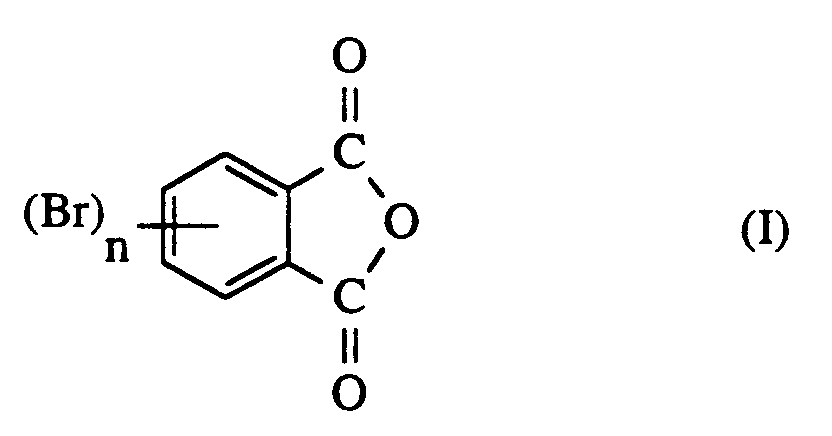
- Kernbromierte Phthalsäurederivate sind vorzugsweise bromierte Phthalsäureanhydride, Phthalsäureimide, Phthalsäurediester und Phthalsäurediamide, wobei die Bromsubstituenten 1, 2, 3 oder 4 Positionen im Phthalsäurearomat einnehmen können.
- Geeignete bromierte Phthalsäureanhydride sind somit solche der Formel (I)

worin - n
- 1, 2, 3 oder 4 ist.
- Geeignete kernbromierte Phthalsäureimide sind solche der Formel (II)

worin - n
- 1, 2, 3 oder 4 ist,
- Y
- 1, 2, 3 oder 4 ist, und worin
- Z
- Wasserstoff oder ein ein-, zwei-, drei- oder vierbindiger organischer Rest ist, beispielsweise ein C₁-C₁₈-Alkyl, C₂-C₁₈-Alkylen, ein dreibindiger C₃-C₁₈-Alkanrest oder ein vierbindiger C₄-C₁₈-Alkanrest ist, oder beispielsweise ein C₅-C₆-Cycloalkyl oder C₅-C₆-Cycloalkylenrest ist, oder beispielsweise ein C₇-C₁₂-Aralkylrest ist.
- Geeignete Alkyl-Reste sind beispielsweise Methyl, Ethyl, Propyl, Isopropyl und Butyl.
- Geeignete Alkylen-Reste sind beispielsweise Ethylen, Propylen, Butylen und 1,6-Hexamethylen.
- Geeignete Cycloalkyl-Reste und Cycloalkylen-Reste sind beispielsweise Cyclohexyl, Cyclopentyl, Cyclohexylen und Cyclopentylen.
- Geeignete Aralkyl-Reste sind beispielsweise Benzyl und Phenethyl.
- Geeignete kernbromierte Phthalsäurediester sind solche der Formel (III)

worin - n
- 1, 2, 3 oder 4 ist, und
- R
- ein C₁-C₁₈-Alkyl, C₅-C₆-Cycloalkyl, C₆-C₁₀-Aryl oder C₇-C₁₂-Aralkyl ist.
- Geeignete kernbromierte Phthalsäurediamide sind solche der Formel (IV)

worin - n
- 1, 2, 3 oder 4 ist und
- R
- ein C₁-C₁₈-Alkyl, C₅-C₆-Cycloalkyl, C₆-C₁₀-Aryl oder C₇-C₁₂-Aralkyl ist.
- Geeignete Alkyl-Reste in (III) und (IV) sind Methyl, Ethyl, Propyl und Butyl.
- Geeignete Cycloalkyl-Reste in (III) und (IV) sind Cyclohexyl und Cyclopentyl.
- Geeignete Aryl-Reste in (III) und (IV) sind Phenyl und Naphthyl.
- Geeignete Aralkyl-Reste in (III) und (IV) sind Benzyl, Methylbenzyl, Ethylbenzyl und Propylbenzyl.
- Ein Beispiel für die Verbindungen der Formel (I) ist Tetrabromphthalsäureanhydrid.
- Ein Beispiel für die Verbindungen der Formel (II) ist Hexamethylendiamin-bis-tetrabromphthalsäurediimid.
- Beispiele für Verbindungen der Formel (III) sind die Tetrabromphthalsäuredimethylester und -diethylester.
- Ein Beispiel für die Verbindungen der Formel (IV) ist Tetrabromphthalsäuredi-(N-phenyl)-amid.
- Die Verwendung der kernbromierten Phthalsäurederivate zur Sterilisierung der thermoplastischen Polycarbonate erfolgt in Mengen von 0,01 Gew.-% bis 10 Gew.-%, vorzusweise von 0,1 Gew.-% bis 5,0 Gew.-% und insbesondere von 0,5 Gew.-% bis 1,5 Gew.-%, bezogen jeweils auf Gewicht an thermoplastischem Polycarbonat und kernbromiertem Phthalsäurederivat.
- Die erfindungsgemäß zu stabilisierenden thermoplastischen Polycarbonate sind literaturbekannt.
- Erfindungsgemäß zu stabilisierende Polycarbonate sind thermoplastische, aromatische Homopolycarbonate und Copolycarbonate, denen z.B. ein oder mehrere der folgenden Diphenole zugrundeliegen:
Hydrochinon
Resorcin
Dihydroxydiphenyle
Bis-(hydroxyphenyl)-alkane
Bis-(hydroxyphenyl)-cycloalkane
Bis-(hydroxyphenyl)-sulfide
Bis-(hydroxyphenyl)-ether
Bis-(hydroxyphenyl)-ketone
Bis-(hydroxyphenyl)-sulfoxide
Bis-(hydroxyphenyl)-sulfone
α,α'-Bis-(hydroxyphenyl)-diisopropylbenzole
sowie deren kernalkylierte und kernhalogenierte Verbindungen. Diese und weitere geeignete Diphenole sind z.B. in den US-Patentschriften 3 028 365, 3 275 601, 3 148 172, 3 062 781, 2 991 273, 3 271 367, 2 999 835, 4 982 014 und 2 999 846, in den deutschen Offenlegungsschriften 1 570 703, 2 063 050, 2 063 052, 2 211 956, 2 211 957, der franz. Patentschrift, 1 561 518 und in der Monographie "H. Schnell, Chemistry and Physics of Polycarbonates, Intersciene Publishers, New York, 1964" beschrieben. - Bevorzugte Diphenole sind z.B.:
4,4'-Dihydroxydiphenyl
2,2-Bis-(4-hydroxyphenyl)-propan
2,4-Bis-(4-hydroxyphenyl)-2-methylbutan
1,1-Bis-(4-hydroxyphenyl)-cyclohexan
α,α'-Bis-(4-hydroxyphenyl)-p-diisopropylbenzol
2,2-Bis-(3-methyl-4-hydroxyphenyl)-propan
2,2-Bis-(3-chlor-4-hydroxyphenyl)-propan
Bis-(3,5-dimethyl-4-hydroxyphenyl)-methan
2,2-Bis-(3,5-dimethyl-4-hydroxyphenyl)-methan
Bis-(3,5-Dimethyl-4-hydroxyphenyl)-sulfon
2,4-Bis-(3,5-dimethyl-4-hydroxyphenyl)-2-methylbutan
1,1-Bis-(3,5-dimethyl-4-hydroxyphenyl)-cyclohexan
α,α'- Bis-(3,5-dimethyl-4-hydroxyphenyl)-p-diisopropylbenzol
2,2-Bis-(3,5-dichlor-4-hydroxyphenyl)-propan und
1,1-Bis-(4-hydroxyphenyl)-3,3,5-trimethylcylohexan. - Besonders bevorzugte Diphenole sind z.B.:
2,2-Bis-(4-hydroxyphenyl)-propan
2,2-Bis-(3,5-dimethyl-4-hydroxyphenyl)-propan
2,2-Bis-(3,5-dichlor-4-hydroxyphenyl)-propan
2,2-Bis-(3,5-dibrom-4-hydroxyphenyl)-propan
1,1-Bis-(4-hydroxyphenyl)-cyclohexan und
1,1-Bis-(4-hydroxyphenyl)-3,3,5-trimethyl-cyclohexan. - Bevorzugte aromatische Polycarbonate sind solche, denen ein oder mehrere der als bevorzugt genannten Diphenole zugrundliegen. Besonders bevorzugt werden Copolycarbonate, denen 2,2-Bis-(4-hydroxyphenyl)-propan und eines der anderen als besonders bevorzugt genannten Diphenole zugrundeliegen. Besonders bevorzugt sind weiterhin Polycarbonate allein auf Basis von 2,2-Bis-(4-hydroxyphenyl)-propan oder 1,1-Bis-(4-hydroxyphenyl)-3,3,5-trimethylcyclohexan.
- Die aromatischen Polycarbonate können nach bekannten Verfahren hergestellt werden, so z.B. nach dem Schmelzumesterungsverfahren aus Bisphenol und Diphenylcarbonat und dem Zweiphasengrenzflächenverfahren aus Bisphenolen und Phosgen, wie es in der obengenannten Literatur beschreiben ist.
- Die aromatischen Polycarbonate können durch den Einbau geringer Mengen, vorzugsweise von Mengen zwischen 0,05 und 2,0 Mol-% (bezogen auf eingesetzte Diphenole), an drei- oder mehr als dreifunktionellen Verbindungen, beispielsweise solchen mit drei oder mehr als drei phenolischen Hydroxygruppen verzweigt sein.
- Polycarbonate dieser Art sind z.B. in den deutschen Offenlegungsschriften 1 570 533, 1 595 762, 2 116 974, 2 113 347, der britischen Patentschrift 1 079 821, der US-Patentschrift 3 544 514 und in der deutschen Offenlegungsschrift 2 500 092 beschrieben.
- Einige der verwendbaren Verbindungen mit drei oder mehr als drei phenolischen Hydroxygruppen sind beispielsweise Phloroglucin, 4,6-Dimethyl-2.4.6-tri-(4-hydroxyphenyl)-hepten-2, 4.6-Dimethyl-2.4.6-tri-(4-hydroxyphenyl)-heptan, 1.3.5-Tri-(4-hydroxyphenyl)-benzol, 1.1.1-Tri-(4-hydroxyphenyl)-ethan, Tri-(4-hydroxyphenyl)-phenylmethan, 2.2-Bis-[4.4-bis-(4-hydroxyphenyl)-cyclohexyl]-propan, 2.4-Bis-(4-hydroxyphenyl-isopropyl)-phenol, 2.6-Bis-(2'-hydroxy-5'-methyl-benzyl)-4-methylphenol, 2-(4-Hydroxyphenyl)-2-(2.4-dihydroxyphenyl)-propan, Hexa-(4-(4-hydroxyphenylisopropyl)phenyl)-ortho-terephthalsäureester, Tetra-(4-hydroxyphenyl)-methan, Tetra-(4-(4-hydroxyphenylisopropyl)-phenoxy)-methan und 1.4-Bis-((4'.4''-dihydroxytriphenyl)-methyl)-benzol. Einige der sonstigen dreifunktionellen Verbindungen sind 2.4-Dihydroxybenzoesäure, Trimesinsäure, Cyanurchlorid und 3.3-Bis-(4-hydroxy-3-methyl-phenyl)-2-oxo-2,3-dihydroindol.
- Die aromatischen Polycarbonate sollen in der Regel mittlere Gewichtsmittel-Molekulargewichte

- Zur Einstellung des Molekulargewichts

- Die Einarbeitung der kernbromierten Phthalsäurederivate in die zu stabilisierenden Polycarbonate erfolgt in bekannter Weise.
- Die Verwendung der kernbromierten Phthalsäurederivate kann auch in Kombination mit Polyalkylenoxiden der Formel (V)
worin - R
- H, C₁-C₆-Alkyl, Tetrahydropyranyl oder ein Silyl-Rest,
- R'
- H oder C₁-C₆-Alkyl und
- X
- eine ganze Zahl von 1 bis 100, vorzugsweise von 10 bis 60 sind, erfolgen.
- Die Menge an (V) im zu stabilisierenden Polycarbonat beträgt ebenfalls 0,01 bis 10 Gew.-%, vorzugsweise 0,1 bis 5,0 Gew.-%, bezogen auf Gewicht an thermoplastischem Polycarbonat und Polyalkylenoxid (V).
- Gegenstand der vorliegenden Erfindung ist somit auch die kombinierte Verwendung von kernbromierten Phthalsäurederivaten und Polyalkylenoxiden der Formel (V)

worin R, R' und X die vorstehend genannte Bedeutung haben, zur Stabilisierung von thermoplastischen Polycarbonaten gegen die Einwirkung von Gammastrahlen. - Geeignete Polyalkylenoxide (V) sind beispielsweise Polypropylenglykole mit

- Die Einarbeitung der Polyalkylenoxide (V) in die thermoplastischen Polycarbonate erfolgt ebenfalls in bekannter Weise.
- Die kombinierte Einarbeitung mit den bromierten Phthalsäurederivaten erfolgt ebenfalls in bekannter Weise.
- Gegenstand der vorliegenden Erfindung sind außerdem thermoplastische Polycarbonate mit einem kombinierten Zusatz von kernbromierten Phthalsäurederivaten in Mengen von 0,01 Gew.-% bis 10 Gew.-%, vorzugsweise von 0,1 Gew.-% bis 5,0 Gew.-%, und Polyalkylenoxiden der Formel (V) ebenfalls in Mengen von 0,01 Gew.-% bis 10 Gew.-%, vorzugsweise von 0,1 Gew.-% bis 5,0 Gew.-%, bezogen jeweils auf Gewicht an thermoplastischem Polycarbonat und kernbromiertem Phthalsäurederivat bzw. auf Gewicht an thermoplastischem Polycarbonat und Polyalkylenoxid (V).
- Gegenstand der vorliegenden Erfindung sind außerdem Stabilisatorkombinationen von kernbromierten Phthalsäurederivaten in Mengen von 0,01 bis 10 Gew.-Teilen, vorzugsweise von 0,1 bis 5,0 Gew.-Teilen mit Polyalkylenoxiden (V) in Mengen von 0,01 bis 10 Gew.-Teilen, vorzugsweise von 0,1 bis 5,0 Gew.-Teilen, wobei die Gew.-Teile der Komponenten innerhalb des definierten Bereichs unabhängig voneinander beliebig gewählt sein können.
- Den erfindungsgemäß zu stabilisierenden Polycarbonaten können noch die üblichen Additive wie Entformungsmittel, Weichmacher, Füllstoffe und Verstärkungsstoffe in bekannter Weise zugesetzt sein.
- Die Verarbeitung der erfindungsgemäß stabilisierten Polycarbonate zu Formkörpern der verschiedensten Art erfolgt in bekannter Weise durch Extrusion oder Spritzguß.
- Geeignete, in der Medizin einsetzbare Formkörper sind beispielsweise Leitungen für die Sauerstoffzufuhr zum Blut, Gefäße für die Nierendialyse, Schlauchverbindungen und Herzsonden.
- Die Behandlung dieser stabilisierten Formkörper mit γ-Strahlen erfolgt beispielsweise durch Bestrahlung mit einem 2 MeV van de Graff Generator. Diese Strahlungsquelle ist gemäß den DIN-Vorschriften geeicht. Eine Dosis von 30 kGy (3 Mrad) kann innerhalb von ca. 6 Minuten aufgebracht werden. Der Generator erzeugt einen Elektronenstrom von 100 µA. Im Material wird der Energieverlust der Elektronen hauptsächlich durch Ionisation, aber auch durch Bremsstrahlung bewirkt. Der direkte Zugriff auf die Strahlungsquelle erlaubt die physikalische Untersuchung der Proben direkt nach der Bestrahlung (hier treten die größten Änderungen auf). Außerdem ist von Vorteil, daß hier die Strählungsparameter variiert werden können. Bei kommerzieller Strahlensterilisation sind solche Variationen schwierig.
- Eingesetzte Komponenten:
- 1. Tetrabromphthalsäureanhydrid
- 2. Tetrabrombisphenol-A-Oligocarbonat mit einem Polymerisationsgrad von 4 bis 6.
- 3. Bisphenol-A-Homopolycarbonat mit Mw von etwa 28 000.
- 4. Tetrachlorphthalsäureanhydrid
- 5. NaBr und KBr
- 6. Polypropylenoxid der Formel (PPG) ist ein Dihydropyran terminiertes Polypropylenglykol der Formel

- Die Additive wurden durch Mischextrusion in ein Polycarbonatharz eingearbeitet und anschließend verspritzt. Die Spritzteile wurden mit 3,0 Mrad bestrahlt. Danach wurden die Radikalkonzentration und die Vergilbungszahl über einen Zeitraum von 10 Tagen gemessen. In Tabelle 1 sind die Deltavergilbungszahlen (Delta-VZ) angegeben, die für das Polycarbonat und die additiventhaltenden Zusammensetzungen jeweils drei Stunden und 10 Tage nach der Bestrahlung gemessen wurden.
- Die Tetrabromphthalsäureanhydrid enthaltenden Zusammensetzungen bewirken eine deutlich bessere Stabilisierung der Polycarbonate gegen die Einwirkung von Gammastrahlen als Tetrabrombisphenol-Oligocarbonat oder andere bromhaltige Verbindungen.
Tabelle 1 Zusammensetzung Delta-VZ (nach 3 Stunden) Delta-VZ (nach 10 Tagen) Polycarbonat Komponente 3 (Kontrolle) 57,3 39,4 Polycarbonat Komponente 3 (0,5 % NaBr)* 42,6 26,0 Polycarbonat Komponente 3 (0,5 % KBr)* 44,7 23,5 Polycarbonat Komponente 3 (1,0 % Tetrachlorphthalsäureanhydrid) 41,3 21,4 Polycarbonat Komponente 3 (1,0 Tetrabrom-bisphenol-A-Oligocarbonat) 35,4 19,5 Polycarbonat Komponente 3 (1,0 % Tetrabromphthalsäureanhydrid)* 23,2 10,7 * höhere Mengen führen zur Trübung der Polycarbonate - Es ist allgemein bekannt, daß die Stabilität eines Materials gegen die Einwirkung von Strahlen sich auch durch die Bestimmung der Radikalkonzentration des Materials nach der Bestrahlung messen laßt. Radikalkonzentrationen lassen sich u.a. durch Elektronenspinresonanzmethoden (ESR) bestimmen. Nach der Bestrahlung enthält das Bisphenol-A-polycarbonat eine große Anzahl von Radikalen. Die Abnahme dieser Anzahl in stabilisatorenhaltigen Polycarbonatzusammensetzungen ist ein Nachweis für stabilisierende Eigenschatten. Tabelle 2 vergleicht die relative Radikalkonzentration von Polycarbonat mit Zusammensetzungen, die Brom als Radikalfänger enthalten, jeweils drei Stunden und zehn Tage nach der Bestrahlung. Die Angaben zeigen die Wirksamkeit der Tetrabromphthalsäureanhydridderivate als Strahlenfänger.
Tabelle 2 Zusammensetzung Relative Radikalkonz. (nach 3 Stunden) Relative Radikalkonz. (nach 10 Tagen) Polycarbonat Komponente 3 215 581 19 913 Polycarbonat Komponente 3 (0,5 % NaBr) 337 958 16 857 Polycarbonat Komponente 3 (0,5 % KBr) 309 337 23 109 Polycarbonat Komponente 3 (1,0 % Tetrachlorphthalsäureanhydrid) 332 255 28 347 Polycarbonat Komponente 3 (1,0 Tetrabrom-bisphenol-A-Oligocarbonat 190 901 12 314 Polycarbonat Komponente 3 (1,0 % Tetrabromphthalsäureanhydrid) 26 876 2 292 - Die Additive wurden durch Mischextrusion in ein Polycarbonatharz eingearbeitet und anschließend verspritzt. Die Spritzteile wurden mit 3,0 Mrad. bestrahlt. Danach wurden die Radikalkonzentration und die Vergilbungszahl über einen Zeitraum von 10 Tagen gemessen. In Tabelle 1 sind die Deltavergilbungszahlen (Delta-VZ) angegeben, die für das Polycarbonat und die additiventhaltenden Zusammensetzungen jeweils drei Stunden und 10 Tage nach der Bestrahlung gemessen wurden. Die Tetrabromphthalsäureanhydrid-enthaltenden Zusammensetzungen bewirken eine deutlich bessere Stabilisierung der Polycarbonate gegen die Einwirkung von Gammastrahlen als Tetrabrom-Bisphenol-A-Oligocarbonat oder andere bromhaltige Verbindungen.
Tabelle 3 Zusammensetzung Delta-VZ (nach 3 Stunden) Delta-VZ (nach 10 Tagen) Polycarbonat Komponente 3 (Kontrolle) 57,3 39,4 Polycarbonat Komponente 3 (1,0 % Komponente 6) 37,5 19,8 Polycarbonat Komponente 3 (1,0 % Tetrabrom-bisphenol-A-Oligocarbonat) 30,8 12,6 Polycarbonat Komponente 3 (1,0 % Tetrachlorphthalsäureanhydrid) 41,3 19,9 Polycarbonat Komponente 3 (1,0 % Tetrabrom-bisphenol-A-Oligocarbonat und 1 % Komponente 6) 28,9 9,4 Polycarbonat Komponente 3 (1,0 % Tetrabromphthalsäureanhydrid) (1,0 % Komponente 6) 12,3 6,3 - Die Radikalkonzentration wird wie im Beispiel 2 ermittelt. Die Angaben zeigen die Wirksamkeit der Tetrabromphthalsäureanhydridderivate als Strahlenfänger.
Tabelle 4 Zusammensetzung Relative Radikalkonzentration (nach 3 Stunden, nach 10 Tagen) Polycarbonat Komponente 3 339 595 34 522 Polycarbonat Komponente 3 (1,0 % Komponente 6) 255 083 8 212 Polycarbonat Komponente 3 (1,0 % Tetrabrom-bisphenol-A-Oligocarbonat) 236 388 8 628 Polycarbonat Komponente 3 (1,0 % Tetrachlorphthalsäureanhydrid) 333 255 28 347 Polycarbonat Komponente 3 (1,0 % Tetrabrom-bisphenol-A-Oligocarbonat und 1 % Komponente 6) 100 794 3 935 Polycarbonat Komponente 3 (1,0 % Tetrabromphthalsäureanhydrid) (1,0 % Komponente 6) 12 697 1 162
Claims (3)
- Verwendung von kernbromierten Phthalsäurederivaten, gegebenenfalls in Kombination mit Polyalkylenoxiden der Formel (V)
 R H, C₁-C₆-Alkyl, Tetrahydropyranyl oder ein Silyl-Rest,R' H oder C₁-C₆-Alkyl undX eine ganze Zahl von 1 bis 100 sind,zur Stabilisierung von thermoplastischen Polycarbonaten gegen die Einwirkung von Gammastrahlen.
 - Thermoplastische Polycarbonate mit einem kombinierten Zusatz von kernbromierten Phthalsäurederivaten in Mengen von 0,01 Gew.-% bis 10 Gew.-%, bezogen auf Gewicht an Polycarbonat und kernbromierten Phthalsäurederivat, und Polyalkylenoxiden der Formel (V)
 R H, C₁-C₆-Alkyl, Tetrahydropyranyl oder ein Silyl-Rest,R' H oder C₁-C₆-Alkyl undX eine ganze Zahl von 1 bis 100 sind,in Mengen von 0,01 Gew.-% bis 10 Gew.-%, bezogen auf Gewicht an Polycarbonat und Polyalkylenoxid (V).
 - Stabilisatorkombinationen von kernbromierten Phthalsäurederivaten in Mengen von 0,01 bis 10 Gew.-Teilen mit Polyalkylenoxiden (V) in Mengen von 0,01 bis 10 Gew.-Teilen,
 R H, C₁-C₆-Alkyl, Tetrahydropyranyl oder ein Silyl-Rest,R' H oder C₁-C₆-Alkyl undX eine ganze Zahl von 1 bis 100 sind,wobei die Gew.-Teile der Komponenten innerhalb des definierten Bereichs unabhängig voneinander beliebig gewählt sein können.
Applications Claiming Priority (2)
| Application Number | Priority Date | Filing Date | Title |
|---|---|---|---|
| DE4119329 | 1991-06-12 | ||
| DE4119329A DE4119329A1 (de) | 1991-06-12 | 1991-06-12 | Verwendung von kernbromierten phthalsaeurederivaten zur stabilisierung von thermoplastischen polycarbonaten gegen die einwirkung von gammastrahlen |
Publications (2)
| Publication Number | Publication Date |
|---|---|
| EP0518149A2 true EP0518149A2 (de) | 1992-12-16 |
| EP0518149A3 EP0518149A3 (en) | 1993-01-27 |
Family
ID=6433750
Family Applications (1)
| Application Number | Title | Priority Date | Filing Date |
|---|---|---|---|
| EP19920109189 Withdrawn EP0518149A3 (en) | 1991-06-12 | 1992-06-01 | Ringbrominated derivatives of phthalic acid used as stabilisers for polycarbonates against gamma radiation |
Country Status (4)
| Country | Link |
|---|---|
| US (1) | US5476893A (de) |
| EP (1) | EP0518149A3 (de) |
| JP (1) | JPH05179127A (de) |
| DE (1) | DE4119329A1 (de) |
Cited By (2)
| Publication number | Priority date | Publication date | Assignee | Title |
|---|---|---|---|---|
| EP0733670A1 (de) * | 1995-03-21 | 1996-09-25 | Bayer Corporation | Polycarbonatzusammensetzungen stabilisiert gegen ionisierende Strahlung |
| EP0753540A3 (de) * | 1995-07-12 | 1999-08-25 | Mitsubishi Engineering-Plastics Corporation | Polycarbonatharzzusammensetzung |
Families Citing this family (4)
| Publication number | Priority date | Publication date | Assignee | Title |
|---|---|---|---|---|
| DE4440684A1 (de) * | 1994-11-15 | 1996-05-23 | Bayer Ag | Flammwidrige Polycarbonatformmassen |
| US6485657B1 (en) | 1998-06-11 | 2002-11-26 | Teijin, Limited | Gamma-ray stabilizer and thermoplastic polymer compound including the said stabilizer |
| EP0970996B1 (de) * | 1998-07-03 | 2004-01-28 | Becton Dickinson Infusion Therapy AB | Polymermischung zur Herstellung von medizinischen Vorrichtungen |
| US7078447B2 (en) * | 2003-11-21 | 2006-07-18 | General Electric Company | Ionizing radiation stable polyarylestercarbonate compositions |
Family Cites Families (19)
| Publication number | Priority date | Publication date | Assignee | Title |
|---|---|---|---|---|
| US3535300A (en) * | 1967-10-12 | 1970-10-20 | Mobay Chemical Corp | Flame resistant polycarbonates |
| US3873567A (en) * | 1968-09-05 | 1975-03-25 | Universal Oil Prod Co | N-substituted polybromoaromatic ortho-dicarboximides |
| GB1273071A (en) * | 1969-03-21 | 1972-05-03 | Hooker Chemical Corp | Fire retardant additive systems |
| US4208489A (en) * | 1977-01-29 | 1980-06-17 | Bayer Aktiengesellschaft | Polycarbonate molding compositions with improved flame-repellency |
| EP0152012A3 (de) * | 1984-02-10 | 1986-03-12 | General Electric Company | Verfahren zur Verbesserung der Beständigkeit gegen ionisierende Strahlung von Polymerzusammensetzungen |
| US4673699A (en) * | 1984-11-19 | 1987-06-16 | Mobay Corporation | Flame retardant molding compositions |
| US4904710A (en) * | 1985-10-31 | 1990-02-27 | The Dow Chemical Company | Gamma radiation resistant carbonate polymer compositions |
| US4624972A (en) * | 1985-11-25 | 1986-11-25 | The Dow Chemical Company | Gamma radiation resistant carbonate polymer compositions |
| US4743637A (en) * | 1986-08-01 | 1988-05-10 | General Electric Company | Flame retardant compounds and thermoplastic compositions containing the same |
| CA1338226C (en) * | 1987-06-26 | 1996-04-02 | Charles E. Lundy | Gamma radiation resistant polycarbonate compositions |
| US4912158A (en) * | 1988-03-25 | 1990-03-27 | Pennwalt Corporation | Tetrahalophthalate esters as flame retardants for polycarbonate resins |
| US4804692A (en) * | 1987-11-09 | 1989-02-14 | Mobay Corporation | Gamma-radiation resistant polycarbonate compositions |
| US4963598A (en) * | 1988-04-18 | 1990-10-16 | Mobay Corporation | Gamma radiation resistant polycarbonate compositions |
| US4874802A (en) * | 1988-06-16 | 1989-10-17 | Mobay Corporation | Polycarbonate compositions resistant to gamma radiation |
| DE68913633T2 (de) * | 1988-09-06 | 1994-06-09 | Mitsubishi Chem Ind | Medizinische Formkörper und Verfahren zu ihrer Herstellung. |
| DE68924969T2 (de) * | 1988-12-28 | 1996-05-15 | Mitsubishi Gas Chemical Co | Polycarbonatharzzusammensetzung zur Sterilisation durch Bestrahlung. |
| US5006572A (en) * | 1989-01-24 | 1991-04-09 | Mobay Corporation | Gamma radiation resistant polycarbonate composition |
| US4873271A (en) * | 1989-04-25 | 1989-10-10 | Mobay Corporation | Gamma radiation rsistant polycarbonate compositions |
| US5280050A (en) * | 1991-06-20 | 1994-01-18 | Miles Inc. | Color-stable polycarbonate composition resistant to gamma-radiation |
-
1991
- 1991-06-12 DE DE4119329A patent/DE4119329A1/de not_active Withdrawn
-
1992
- 1992-06-01 EP EP19920109189 patent/EP0518149A3/de not_active Withdrawn
- 1992-06-05 JP JP4169933A patent/JPH05179127A/ja active Pending
-
1993
- 1993-09-21 US US08/124,904 patent/US5476893A/en not_active Expired - Fee Related
Cited By (2)
| Publication number | Priority date | Publication date | Assignee | Title |
|---|---|---|---|---|
| EP0733670A1 (de) * | 1995-03-21 | 1996-09-25 | Bayer Corporation | Polycarbonatzusammensetzungen stabilisiert gegen ionisierende Strahlung |
| EP0753540A3 (de) * | 1995-07-12 | 1999-08-25 | Mitsubishi Engineering-Plastics Corporation | Polycarbonatharzzusammensetzung |
Also Published As
| Publication number | Publication date |
|---|---|
| EP0518149A3 (en) | 1993-01-27 |
| DE4119329A1 (de) | 1992-12-17 |
| US5476893A (en) | 1995-12-19 |
| JPH05179127A (ja) | 1993-07-20 |
Similar Documents
| Publication | Publication Date | Title |
|---|---|---|
| EP0535464B1 (de) | Verwendung von kern-aromatischen Sulfonsäureestern zur Stabilisierung von thermoplastischen Polycarbonaten gegen Einwirkung von Gammastrahlen | |
| DE3875284T2 (de) | Gegen gammastrahlung bestaendige polycarbonatzusammensetzungen. | |
| DE68924969T2 (de) | Polycarbonatharzzusammensetzung zur Sterilisation durch Bestrahlung. | |
| DE60007638T2 (de) | CARBPMATPOLYMERZUSAMMENSETZUNGEN,STABILISIERT GEGEN FÄRBUNG UND vERÄNDERUNG DER PHYSIKALISCHEN EIGENSCHAFTEN BEI STERILISATION DURCH IONISIERENDE STRAHLUNG | |
| DE69023937T2 (de) | Gammastrahlung widerstandsfähige Polycarbonat-Zusammensetzung. | |
| EP0096818A1 (de) | Stabilisatorkombinationen, ihre Verwendung zur Stabilisierung von thermoplastischen Polycarbonaten sowie stabilisierte, thermoplastische Polycarbonate | |
| DE68924671T2 (de) | Gegen Gammastrahlung beständige Polycarbonatzusammensetzungen. | |
| DE68922931T2 (de) | Gammastrahlenbeständige Polycarbonatzusammensetzungen. | |
| EP0518149A2 (de) | Kernbromierte Phthalsäurederivate als stabilisatoren für Polycarbonate gegen Gammastrahlung | |
| DE3784470T2 (de) | Farbstabilisierte bestrahlte polycarbonatmassen. | |
| EP0019217A1 (de) | Verwendung von organischen Siliciumverbindungen in Kombination mit Oxetanverbindungen, Dioxanen oder Tetrahydrofuranen zum Stabilisieren und Aufhellen von phosphitfreien und borsäureesterfreien Polycarbonaten | |
| EP0742260B1 (de) | Gegen gamma-Strahlung stabilisierte (Co)Polycarbonate | |
| EP0566952B1 (de) | Thermostabilisierung von aromatischen Polycarbonaten | |
| DE19857149A1 (de) | Röntgenkontrastierbare Kunststoffmassen | |
| DE60107830T2 (de) | Gegen gammastrahlung beständige polycarbonatzusammensetzung | |
| EP0664321B1 (de) | Strahlenfeste Polycarbonate | |
| DE4127079C2 (de) | Thermoplastische Polycarbonate mit einem Gehalt von 0,01-10 Gew.-% an Polyalkylenoxiden und an 0,01-10 Gew.-% aromatischen Verbindungen, welche Isopropylsubstituenten haben, Verfahren zu deren Herstellung, deren Verwendung sowie Verfahren zur Herstellung von daraus erhältlichen Produkten | |
| EP0732365B1 (de) | Gegen Gamma-Strahlung stabilisierte (Co)Polycarbonate | |
| DE68910746T2 (de) | Hydrolysestabile Polycarbonatzusammensetzungen. | |
| EP0531861A1 (de) | Flammwidrige Polycarbonatformmassen | |
| DE68920660T2 (de) | Polycarbonatzusammensetzung. | |
| DE2510463A1 (de) | Stabilisatormischungen | |
| EP0327951A2 (de) | Polycarbonate mit Aralkylphenylendgruppen, ihre Herstellung und Verwendung | |
| EP0450178B1 (de) | Oxidiertes Polyethylen enthaltende glasfaserverstärkte Polycarbonate | |
| EP0778312B1 (de) | Gegen Gamma-Strahlung stabilisierte (Co)Polycarbonate |
Legal Events
| Date | Code | Title | Description |
|---|---|---|---|
| PUAI | Public reference made under article 153(3) epc to a published international application that has entered the european phase |
Free format text: ORIGINAL CODE: 0009012 |
|
| PUAL | Search report despatched |
Free format text: ORIGINAL CODE: 0009013 |
|
| AK | Designated contracting states |
Kind code of ref document: A2 Designated state(s): BE DE FR GB IT |
|
| AK | Designated contracting states |
Kind code of ref document: A3 Designated state(s): BE DE FR GB IT |
|
| 17P | Request for examination filed |
Effective date: 19930426 |
|
| STAA | Information on the status of an ep patent application or granted ep patent |
Free format text: STATUS: THE APPLICATION HAS BEEN WITHDRAWN |
|
| 18W | Application withdrawn |
Withdrawal date: 19930818 |