EP0518821A2 - Insektenlockhalter - Google Patents
Insektenlockhalter Download PDFInfo
- Publication number
- EP0518821A2 EP0518821A2 EP92810440A EP92810440A EP0518821A2 EP 0518821 A2 EP0518821 A2 EP 0518821A2 EP 92810440 A EP92810440 A EP 92810440A EP 92810440 A EP92810440 A EP 92810440A EP 0518821 A2 EP0518821 A2 EP 0518821A2
- Authority
- EP
- European Patent Office
- Prior art keywords
- bait
- ants
- insecticide
- insect growth
- igr
- Prior art date
- Legal status (The legal status is an assumption and is not a legal conclusion. Google has not performed a legal analysis and makes no representation as to the accuracy of the status listed.)
- Ceased
Links
Images
Classifications
-
- A—HUMAN NECESSITIES
- A01—AGRICULTURE; FORESTRY; ANIMAL HUSBANDRY; HUNTING; TRAPPING; FISHING
- A01M—CATCHING, TRAPPING OR SCARING OF ANIMALS; APPARATUS FOR THE DESTRUCTION OF NOXIOUS ANIMALS OR NOXIOUS PLANTS
- A01M1/00—Stationary means for catching or killing insects
- A01M1/02—Stationary means for catching or killing insects with devices or substances, e.g. food, pheronones attracting the insects
- A01M1/026—Stationary means for catching or killing insects with devices or substances, e.g. food, pheronones attracting the insects combined with devices for monitoring insect presence, e.g. termites
-
- A—HUMAN NECESSITIES
- A01—AGRICULTURE; FORESTRY; ANIMAL HUSBANDRY; HUNTING; TRAPPING; FISHING
- A01M—CATCHING, TRAPPING OR SCARING OF ANIMALS; APPARATUS FOR THE DESTRUCTION OF NOXIOUS ANIMALS OR NOXIOUS PLANTS
- A01M1/00—Stationary means for catching or killing insects
- A01M1/20—Poisoning, narcotising, or burning insects
- A01M1/2005—Poisoning insects using bait stations
- A01M1/2011—Poisoning insects using bait stations for crawling insects
-
- A—HUMAN NECESSITIES
- A01—AGRICULTURE; FORESTRY; ANIMAL HUSBANDRY; HUNTING; TRAPPING; FISHING
- A01M—CATCHING, TRAPPING OR SCARING OF ANIMALS; APPARATUS FOR THE DESTRUCTION OF NOXIOUS ANIMALS OR NOXIOUS PLANTS
- A01M2200/00—Kind of animal
- A01M2200/01—Insects
- A01M2200/011—Crawling insects
Definitions
- the present invention concerns a bait station device for the control of ants, especially of Pharaoh's or Sugar Ant.
- Pharaoh's or Sugar ants have become a major pest due to the combination of their propensity for indoor infestation and synanthropic existence as well as an ability to survive pest control techniques.
- IGRs insect growth regulators
- the invention therefore concerns a pesticidal device which comprises a housing containing an insecticidal bait and an insect growth regulant bait and having therein at least one opening whereby said insecticidal bait is so disposed within said housing that it may only be reached from said opening by removing or passing through said insect growth regulator bait.
- the devices according to the invention thus provide ready to use control measures for one-off treatment.
- insecticide insecticide, IGR and bait is not critical to the functioning of the device.
- suitable insecticides are those which are known to be effective on ants.
- suitable insecticides or toxins include boric acid, propetamphos, diazinon, bendiocarb, hydramethylnon, fluvalinate, chlorpyrifos, cypermethrin, cyhalothrin, cyfluthrin, fenvalerate, deltamethrin, fenpropathrin, bifenthrin, permethrin, etofenprox, tralomethrin, or mixtures of suitable insecticides such as these.
- IGRs as used herein belong to a class of compounds known to affect the development, growth and/or maturation of insects especially ants and in particular to prevent their survival. Examples include, methoprene, hydroprene, kinoprene, fenoxycarb, fluphenacur, cyromazine, chlorfluazuraon, hexaflumuron, diflubenzuron, flucycloxuron, teflubenzuron, flufenoxuron, triflumuron, pyriproxyfen, N-[[[3,5-dichloro-4-(3,4,5-trichloro-pyrazol-1-yl)phenyl]amino]carbonyl]-2-chlorobenzamide, or mixtures of suitable IGRs such as these.
- Baits suitable for use in preparation of insecticide- and IGR-baits are those conventionally used in ant baits, for example eg. peanut butter, fishmeal, honey, sugar, mint apple jelly, strained egg yolk, liver, sponge cake, etc. or mixtures thereof. Such baits may also contain attractants such as trail pheromones, queen pheromones, neocembrene-pharoes ant, fire ant pheromones, (E)-6-(1-pentenyl)-2H-pyran-2-one, tetrahydro-3,5-dimethyl-butyl-2H-pyran-2-one, and dihydroactindiolide.
- attractants such as trail pheromones, queen pheromones, neocembrene-pharoes ant, fire ant pheromones, (E)-6-(1-pentenyl)-2H-pyran-2-one, tetrahydr
- Bait material is mixed separately with IGR and insecticide whereby different baits may be used for the two types of active ingredient. For example, it may be desirable to employ a slightly more attractant bait for the insecticide to increase the incentive for the worker ants to work their way through the IGR bait. Baits are preferably not intermingled but are preferably disposed in contact with each other in the device.
- the precise nature of the housing is also not essential to the invention provided that it is so arranged as to allow the insecticide bait to be placed in such a manner as to be reachable only through or by removal of the IGR bait.
- truncated cylindrical housings such as those used in commercially available devices having a series of substantially axially orientated passages leading from the outer circumference of the cylinder to the center may be employed whereby the insecticide bait is placed at the center of the housing and the IGR bait used to fill the axial entry passages.
- tubular housings may be used which may be opened at one end and closed at the other whereby insecticide bait is filled in first to the closed end of the tube followed by IGR bait to close off access to the insecticide bait.
- the tube may also be open at both ends and contain insecticide bait surrounded on both ends by IGR bait.
- the housing may be made from any materials which are convention for such devices.
- the material will be chosen so as to be compatible with the insecticide and IGR to be employed and be of such thickness and consistency as to prevent loss of active ingredient, and other bait substituents and to prevent absorption and/or loss of moisture from the bait composition.
- examples of such materials include eg polyvinylchloride, polyethylene terephthalate, high- and low-density polyethylene, polypropylene, glass and the like. Tubes can for example be similar to those used for the imbibing of soft drinks and constructed from heatsealable plastic material such as low-density polyethylene. Other suitable materials will be evident to those skilled in the art.
- the size of the device is not critical and will usually be dictated by convenience of packaging and handling and will be large enough to contain sufficient bait but sufficiently small to allow easy concealment.
- a cylindrical device such as described above and below would conveniently be of diameter between 3 and 6 cms.
- a tubular device would for example have a diameter of eg 3 to 7 mm and a length of 6 to 18 cms depending on amount of bait/a.i. required.
- Such devices can be used in any area where control of ants, especially pharaoh and in desired eg. single and multi-family dwellings, restaurants, zoos, nursing homes, pet shops, etc.
- the number and placing of the devices will depend upon the size and layout of the area to be treated and the efficacy of the a. i.'s employed and will lie within the experience of the man skilled in the art.
- the total number of bait stations may vary from 25 for 0-100 ants monitored/2500 sq. ft. (232m2) to 200 for 500-1000 ants/5000 sq. ft. (465m2).
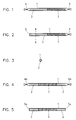
- Fig. 1 shows a longitudinal cross-sectional side elevation of a device according to the invention prior to use.
- Fig. 2 shows the same view as Fig. 1 with one end of the device opened for use.
- Fig. 3 shows a cross section at A-A of Fig. 2.
- Fig. 4 shows a longitudinal, cross-sectional side elevation of an alternative device according to the invention prior to use.
- Fig. 5 shows the same view as Fig. 4 with both ends of the device opened for use.
- the device comprises a hollow tube 1 which may be made of plastic material and preferably clear thermoplastic material such as a drinking straw-like tube.
- a hollow tube 1 which may be made of plastic material and preferably clear thermoplastic material such as a drinking straw-like tube.
- insecticide bait 3 followed by IGR bait 2 to enclose the insecticide bait for example by injection.
- IGR bait 2 to enclose the insecticide bait for example by injection.
- suitable bait composition are given hereinafter.
- the tube is sealed at each end 4 for example by heat sealing. In this form the device may be stored until ready for use.
- the end 5 of the tube 1 which is proximal to the IGR-bait 2 is cut open to expose the bait. Foraging ants attracted by the bait will enter the tube and collect IGR bait which they take back to the nest thus exposing queens and brood. Upon exhaustion of IGR-bait workers collect and ingest insecticide bait causing rapid mortality.
- Fig. 4 differs from the specific embodiment above in that the insecticide bait 3 is placed in the middle of the tube and is followed by IGR-bait 2 at each end to enclose the insecticide bait 3.
- the ends 4a are then sealed as described above. In use both ends 5a of the tube are cut open to allow access to the IGR bait.
- the trial is carried out in single family homes with existing Pharaoh Ant infestation.
- test devices are straws with both boric acid and methoprene. These were prepared by placing (via syringe) one gm of boric acid bait (Ex 1 ii)b)) in the center of each straw, then with a second syringe 0.5 gm of methoprene bait (Ex 1 i)) at each end of the straw touching the boric acid bait. The ends of each straw are then sealed to be opened at time of treatment.
- the ant population is monitored before treatment by counting the ants around peanut butter placements.
- Each placement is ca one gm peanut butter in a plastic weigh boat (1.75 in. square, 19.7 cm2). These are placed in the immediate area of ant activity.
- the recommended placement is five stations in kitchen, two stations in each bathroom, and one station in each of the other rooms. The monitoring stations are left overnight and counts of the ants present on and around each station recorded.
- This monitoring is done twice pre-treatment and once/week post treatment until ant activity ceases or until four months post treatment.
- the locations of the monitoring sites are marked and numbered.
- one to four (based on number of ants) of the bait stations are opened and placed at each marked monitoring site, and the weekly post treatment ant counts are made around these.
- the bait stations in the marked monitoring sites are used post treatment instead of the trays with peanut butter.
- the total number of bait stations for treatment is based on the number of ants counted in the pretreatment survey. The following guidelines are used.
- the majority of the bait stations are placed in areas having the most ant activity. A few stations are placed in each room of the house. Several stations are put around each source of water within the structure.
Landscapes
- Life Sciences & Earth Sciences (AREA)
- Pest Control & Pesticides (AREA)
- Engineering & Computer Science (AREA)
- Insects & Arthropods (AREA)
- Wood Science & Technology (AREA)
- Zoology (AREA)
- Environmental Sciences (AREA)
- Health & Medical Sciences (AREA)
- General Health & Medical Sciences (AREA)
- Toxicology (AREA)
- Catching Or Destruction (AREA)
- Agricultural Chemicals And Associated Chemicals (AREA)
Applications Claiming Priority (2)
| Application Number | Priority Date | Filing Date | Title |
|---|---|---|---|
| US71348091A | 1991-06-11 | 1991-06-11 | |
| US713480 | 1991-06-11 |
Publications (2)
| Publication Number | Publication Date |
|---|---|
| EP0518821A2 true EP0518821A2 (de) | 1992-12-16 |
| EP0518821A3 EP0518821A3 (en) | 1993-05-26 |
Family
ID=24866313
Family Applications (1)
| Application Number | Title | Priority Date | Filing Date |
|---|---|---|---|
| EP19920810440 Ceased EP0518821A3 (en) | 1991-06-11 | 1992-06-09 | Bait station |
Country Status (5)
| Country | Link |
|---|---|
| EP (1) | EP0518821A3 (de) |
| CS (1) | CS174492A3 (de) |
| HU (2) | HU9201745D0 (de) |
| IE (1) | IE921870A1 (de) |
| RU (1) | RU2045900C1 (de) |
Cited By (3)
| Publication number | Priority date | Publication date | Assignee | Title |
|---|---|---|---|---|
| WO1994022299A1 (en) * | 1993-03-31 | 1994-10-13 | Zeneca Limited | Insecticidal compositions |
| CN1054496C (zh) * | 1992-09-08 | 2000-07-19 | B·L·桑 | 监控白蚁的方法及其组合物 |
| EP0933990A4 (de) * | 1996-09-05 | 2000-07-26 | R & C Products Pty Ltd | Insektizide zusammensetzungen |
Families Citing this family (2)
| Publication number | Priority date | Publication date | Assignee | Title |
|---|---|---|---|---|
| RU2166251C1 (ru) * | 1999-12-07 | 2001-05-10 | ООО "Насса" | Средство для борьбы с бытовыми муравьями |
| RU2209549C2 (ru) * | 2000-07-24 | 2003-08-10 | ООО "Фирма "Зеленая Аптека Садовода" | Способ борьбы с садовыми муравьями |
Family Cites Families (3)
| Publication number | Priority date | Publication date | Assignee | Title |
|---|---|---|---|---|
| JPS5081868A (de) * | 1973-11-13 | 1975-07-02 | ||
| US4999346A (en) * | 1984-12-20 | 1991-03-12 | Sandoz Ltd. | Novel composition and process for control of cockroach population |
| US5057316A (en) * | 1989-03-15 | 1991-10-15 | Ecoscience Laboratories, Inc. | Method and device for the biological control of insects |
-
1992
- 1992-05-26 HU HU9201745A patent/HU9201745D0/hu unknown
- 1992-05-28 HU HU9201783A patent/HUT67343A/hu unknown
- 1992-06-09 CS CS921744A patent/CS174492A3/cs unknown
- 1992-06-09 EP EP19920810440 patent/EP0518821A3/en not_active Ceased
- 1992-06-10 RU SU5011949 patent/RU2045900C1/ru active
- 1992-07-01 IE IE187092A patent/IE921870A1/en not_active Application Discontinuation
Cited By (4)
| Publication number | Priority date | Publication date | Assignee | Title |
|---|---|---|---|---|
| CN1054496C (zh) * | 1992-09-08 | 2000-07-19 | B·L·桑 | 监控白蚁的方法及其组合物 |
| WO1994022299A1 (en) * | 1993-03-31 | 1994-10-13 | Zeneca Limited | Insecticidal compositions |
| EP0933990A4 (de) * | 1996-09-05 | 2000-07-26 | R & C Products Pty Ltd | Insektizide zusammensetzungen |
| US6544538B1 (en) | 1996-09-05 | 2003-04-08 | Reckitt Benckiser (Australia) Pty Limited | Insecticidal composition |
Also Published As
| Publication number | Publication date |
|---|---|
| EP0518821A3 (en) | 1993-05-26 |
| RU2045900C1 (ru) | 1995-10-20 |
| HU9201783D0 (en) | 1992-08-28 |
| CS174492A3 (en) | 1992-12-16 |
| HUT67343A (en) | 1995-03-28 |
| HU9201745D0 (en) | 1992-08-28 |
| IE921870A1 (en) | 1992-12-16 |
Similar Documents
| Publication | Publication Date | Title |
|---|---|---|
| US5152096A (en) | Bait station | |
| EP1142475B1 (de) | Methoden zur Termitenbekämpfung | |
| US6298597B1 (en) | Non-edible foraging matrix insert for subterranean termite control | |
| US20120124890A1 (en) | Arthropod Bioassay and Control Device | |
| US6928770B2 (en) | Alternating layer non-edible foraging matrix configurations for crawling arthropods | |
| US20040057976A1 (en) | Insect bait | |
| Murillo et al. | Laboratory and field assessment of cyantraniliprole relative to existing fly baits | |
| US8850741B2 (en) | Device for controlling pests | |
| US20030157062A1 (en) | Method for exterminating termites | |
| IE921870A1 (en) | Bait station | |
| KR102377395B1 (ko) | 살충제 및 이를 이용한 해충 구제 방법 | |
| JP7652481B2 (ja) | ハチの巣崩壊剤 | |
| JP2022054757A (ja) | 害虫用ベイト剤、害虫駆除方法及び害虫駆除キット | |
| JPH1192301A (ja) | 害虫防除用毒餌剤、害虫誘引剤および害虫の防除方法 | |
| US20070014826A1 (en) | Roach bait attractive to many species of roach and useful in their rapid control | |
| JP2001061397A (ja) | 匍匐害虫の防除器およびその防除方法 | |
| Šifner et al. | Pheromone traps for the pest management of phycitid moths | |
| Logan et al. | Laboratory trials on the toxicity of hydramethylnon (Amdro; AC 217,300) to Reticulitermes santonensis Feytaud (Isoptera: Rhinotermitidae) and Microtermes lepidus Sjöstedt (Isoptera: Termitidae) | |
| Buchelos et al. | Evaluation of the effectiveness of a new pheromonic trap for monitoring Lasioderma serricorne (F.) in tobacco stores | |
| JP5093947B2 (ja) | シロアリ嗜好物 | |
| JP7590754B2 (ja) | 害虫用薬剤付着器 | |
| JP7740786B2 (ja) | 肉食系ハチ誘引剤 | |
| Drees et al. | House infesting ants and their management | |
| JP2003095813A (ja) | 動物の外部寄生虫駆除用液剤 | |
| Drees | Managing household ant pests |
Legal Events
| Date | Code | Title | Description |
|---|---|---|---|
| PUAI | Public reference made under article 153(3) epc to a published international application that has entered the european phase |
Free format text: ORIGINAL CODE: 0009012 |
|
| AK | Designated contracting states |
Kind code of ref document: A2 Designated state(s): AT BE CH DE DK ES FR GB GR IT LI LU NL PT SE |
|
| PUAL | Search report despatched |
Free format text: ORIGINAL CODE: 0009013 |
|
| AK | Designated contracting states |
Kind code of ref document: A3 Designated state(s): AT BE CH DE DK ES FR GB GR IT LI LU NL PT SE |
|
| 17P | Request for examination filed |
Effective date: 19931005 |
|
| 17Q | First examination report despatched |
Effective date: 19941223 |
|
| 18R | Application refused |
Effective date: 19950813 |