EP0519101A1 - Méthode d'adressage de données pour un système de base de données - Google Patents
Méthode d'adressage de données pour un système de base de données Download PDFInfo
- Publication number
- EP0519101A1 EP0519101A1 EP91110107A EP91110107A EP0519101A1 EP 0519101 A1 EP0519101 A1 EP 0519101A1 EP 91110107 A EP91110107 A EP 91110107A EP 91110107 A EP91110107 A EP 91110107A EP 0519101 A1 EP0519101 A1 EP 0519101A1
- Authority
- EP
- European Patent Office
- Prior art keywords
- address
- determined
- data
- memory
- addressing
- Prior art date
- Legal status (The legal status is an assumption and is not a legal conclusion. Google has not performed a legal analysis and makes no representation as to the accuracy of the status listed.)
- Withdrawn
Links
Images


Classifications
-
- G—PHYSICS
- G06—COMPUTING OR CALCULATING; COUNTING
- G06F—ELECTRIC DIGITAL DATA PROCESSING
- G06F16/00—Information retrieval; Database structures therefor; File system structures therefor
- G06F16/90—Details of database functions independent of the retrieved data types
- G06F16/901—Indexing; Data structures therefor; Storage structures
- G06F16/9017—Indexing; Data structures therefor; Storage structures using directory or table look-up
- G06F16/902—Indexing; Data structures therefor; Storage structures using directory or table look-up using more than one table in sequence, i.e. systems with three or more layers
Definitions
- the invention relates to a method for addressing data records stored in a freely addressable memory in a database system according to the preamble of patent claims 1, 2 or 3.
- Such data handling enables very fast access times to the data stock, which is why it is implemented in particular in real-time processing data processing devices.
- this data storage is so rigid that a restructuring of data or an expansion of the data stock is only possible through a corresponding adjustment of the system program in connection with a generally inevitable redefinition of the respective storage location of the data in the data memory.
- data storage structured according to database principles has proven to be advantageous.
- the main advantages of such data storage are the fact that both the amount of data and the data structures can be changed dynamically, whereby the system program itself does not have to be changed. Different data structures and the accesses to them are carried out with the same program sequences, whereby a better manageability of the entire system can be achieved and the occurrence of errors in the program creation phase is reduced.
- the conditions for the use of data description languages are created, as z. B. are known in relational database systems. With these data description languages, the documentation can be improved and the structural design of a database can be facilitated. Due to standardized access functions, the protective mechanisms for data protection and data protection against the consequences of technical malfunctions can also be designed uniformly for different data structures.
- the data of the entire database is on a mass storage device, such as. B. deposited a disk storage.
- a mass storage device such as. B. deposited a disk storage.
- a sequential addressing of the data is possible with such a storage medium.
- the amount of data containing the searched data record and accessible by addressing - generally referred to as a data block - must first be read from the mass storage device and transferred to the main memory of the data processing device . Only then is it possible to access the relevant data record and the data in the data record can be read out or changed.
- the addressing method according to the invention enables fast access to in a freely addressable memory, for. B. the memory of a data processing device, stored and can be localized according to database principles via a key address.
- a freely addressable memory for. B. the memory of a data processing device, stored and can be localized according to database principles via a key address.
- high access speeds can be achieved, because relatively few instructions to the processor device are required to implement these methods, and in particular no instructions, such as multiplication or division instructions, which require a long execution time are used.
- the inventive method are suitable for conventional processor devices such as. B. the well-known and widespread microprocessors Intel 8086 or 80286, which provide for addressing a physical memory area of at least one Mbyte addressing mechanisms, in which a formation of the physical address with a segment register for defining a memory segment within the memory and at least one index register for determining the address takes place within the memory segment.
- Intel 8086 or 80286 which provide for addressing a physical memory area of at least one Mbyte addressing mechanisms, in which a formation of the physical address with a segment register for defining a memory segment within the memory and at least one index register for determining the address takes place within the memory segment.
- the first part of the key address is used to determine the relation (object-oriented assignment criterion in a relational database) into which the data record sought is classified.
- the second part of the key address an address information block assigned to the relation is selected, and the third part of the key address is used to select the data record.
- a separate segment is provided both for the relation selection table and for the relation-specific address information blocks belonging to a relation, so that this method is particularly suitable for cases in which the number of relations and the number of entries in the address information blocks is significant.
- the addressing method according to the invention according to claim 3 provides that the relation selection table and the relation-specific address information blocks are stored in a common segment. This method is particularly advantageous in cases where the number of relations and data blocks is rather small and the time requirements for access are more stringent. Compared to the method according to claim 1, this method saves a change in the segment register.
- the addressing method according to claim 2 is particularly advantageous when the data records belonging to a data block can have different lengths.
- the addressing methods according to the invention create particularly good preconditions for reorganization methods which eliminate the fragmentation of the memory areas that occurs during operation or periodically due to the deletion of data records and thus enlarge the available memory area again.
- the method according to claim 4 is particularly advantageous for those cases in which a common segment for the relation selection table and the relation-specific address information blocks is no longer sufficient and the segment register is only to be changed twice in order to achieve the fastest possible access times.
- the address value stored in a segment register is supplemented by four low-order bits with the binary value "0" to form a 20-bit address (ie with a factor of 16 multiplied) and to this the content of one or two index registers with the same value is added.
- the segment register defines the start address of a 64 Kbyte memory area within which the address values of the index registers are used for addressing.
- a key address SA composed of three parts is symbolically represented in FIG. 1, with a relation identifier RELID as the first, a high-quality key HIK as the second and a low-value key LOK as the third part of the key address SA.
- the relation identifier RELID can e.g. B. 16 bits and the two keys HIK, LOK each be eight bits long.
- segment and index registers DS, BX which are relevant for a first and a second addressing step V1, V2, as well as the memory area SB which can be addressed thereby, are shown symbolically next to one another.
- a key address SA is assigned to each data record
- a first addressing step V1 for addressing a data record the start address ADR of a relation selection table RT known in the database system is entered into the segment register DS and the relation identifier RELID belonging to the relevant data record Key address SA stored in an index register BX.
- the content (16 bits) of the memory cell addressed thereby represents the start address ADI of a relation-specific address information block AB.
- This start address ADI is read out by a read operation and stored in the segment register DS in preparation for a second addressing step V2.
- the high-quality key HIK is loaded into the index register BX, as a result of which a memory cell (16 bits) is addressed within the relation-specific address information block AB.
- the content of this memory cell represents the start address ADD of a data block DB (not shown), specifically that of the data block DB in which the searched data record DSA (not shown) is contained.
- This memory cell is read out by a read operation and, as indicated in FIG. 2, its content is stored in the segment register DS.
- FIG. 2 shows a symbolic representation of the key address SA and the respectively relevant segment and index registers DS, BX for addressing the searched data record DSA within the relevant data block DB for the addressing steps following the first and second addressing steps V1, V2.
- attachment address table AT At the beginning of the data block DB, that is from its start address ADD, there is a so-called attachment address table AT.
- This record address table AT contains for each data record DSA of the data block DB the address of the relevant data record DSA relevant within the data block DB.
- the data records DSA are stored in the data block DB following the attachment address table AT.
- the low-order key LOK is stored in an index register BX, as a result of which a memory cell within the set address table AT is addressed.
- the content of this addressed memory cell represents the start address ASD of the data record DSA that is relevant within the data block DB.
- the start address ASD is read out by a read operation and loaded into an index register BX. If the segment register DS is left unchanged, the first memory cell of the data record DSA can be read out or written to using an addressing process. By gradually increasing the index register BX, all of the memory cells of the data record DSA can be addressed.
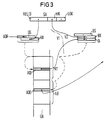
- FIG. 3 illustrates an alternative to the first and second addressing steps V1, V2 according to FIG. 1.
- the relation selection table RT and the relation-specific address information blocks AB are arranged within a 64 KB memory block. Therefore, in this alternative, only one segment register loading process is required for the first and second addressing steps V1, V2, as a result of which the addressing method is eliminated due to the elimination of the relatively long time Execution time of a segment register loading process is accelerated compared to the addressing method described in connection with FIG.
- FIG. 3 shows the key address SA as well as the segment and index registers DS, BX which are respectively relevant for a first and second addressing step V1, V2 and the addressable memory area SB.
- the start address ADR of a relation selection table RT known in the database system is stored in the segment register DS and the relation identifier RELID of the key address SA is stored in an index register BX.
- the content of the memory cell thus addressed within the relation selection table RT represents a start address ADI of a relation-specific address information block AB which is relevant within the segment of the relation selection table RT.
- this start address ADI of the relation-specific address information block AB is stored in a first index register DI.
- the high-quality key address HIK which represents the address of a memory cell within the relation-specific address information block AB, is stored in a second index register BX. Addressing takes place via the unchanged segment register DS and the two index registers DI, BX, which are equivalent to one another.
- the addressed memory cell is read out with a read operation and its content, which represents the start address ADD of a data block DB, is then, as shown in FIG. 2, stored in the segment register DS.
- the addressing steps required for addressing the data record DSA sought have already been explained in connection with FIG. 2.
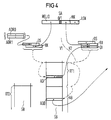
- FIG. 4 illustrates a variant for the first and second addressing steps V1 and V2 according to FIG. 3, the actual difference only relating to the first method step V1.
- the variant shown is of interest in cases in which the relation selection table, together with all relation-specific address information blocks, occupies a memory area which can no longer be addressed from a segment address (16-bit address), that is to say which exceeds the range of 64 Kbit.
- the contents of the relation selection table and the relation-specific address information blocks (cf. and the associated relations-specific information blocks can be addressed.
- relation selection tables can also be formed accordingly, the 2, 3, 4 etc. least significant bits of the relation identifier RELID then being used to select the relation selection tables.
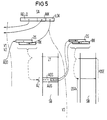
- FIG. 5 illustrates a variant in which the two first addressing steps V1, V2 take place in the same way as in the previously described methods and supply a start address ADD; a segment address is then stored there, which is used together with the low-order key LOK for addressing an address pointer AZ, which is composed of the start address ADS of a data page DSE (essentially corresponds to a data block) and a set address AUS within the data page DSE.
- the data page DSE is to be regarded as a memory area which contains a large number of data records, including the data record DSA searched for; however, an attachment address table AT can be omitted.
- the data record sought is then addressed with the start address ADS in the segment register DS and the set address AUS in an index register BX.
- segment register For other 8086 family microprocessors such as B. the SAB 80286, or SAB 80386, the value stored in the segment register (selector) is used to use indirect addressing to select from a table of segment addresses that which is then considered a segment address in the sense of the examples above.
- an address value serves as a selector for selecting a segment address or as a segment address itself.
- segment register changes are relatively time-consuming, so that the variant described in connection with FIG. 4 also proves to be advantageous in terms of runtime.
Landscapes
- Engineering & Computer Science (AREA)
- Databases & Information Systems (AREA)
- Theoretical Computer Science (AREA)
- Software Systems (AREA)
- Data Mining & Analysis (AREA)
- Physics & Mathematics (AREA)
- General Engineering & Computer Science (AREA)
- General Physics & Mathematics (AREA)
- Information Retrieval, Db Structures And Fs Structures Therefor (AREA)
Priority Applications (1)
| Application Number | Priority Date | Filing Date | Title |
|---|---|---|---|
| EP91110107A EP0519101A1 (fr) | 1991-06-19 | 1991-06-19 | Méthode d'adressage de données pour un système de base de données |
Applications Claiming Priority (1)
| Application Number | Priority Date | Filing Date | Title |
|---|---|---|---|
| EP91110107A EP0519101A1 (fr) | 1991-06-19 | 1991-06-19 | Méthode d'adressage de données pour un système de base de données |
Publications (1)
| Publication Number | Publication Date |
|---|---|
| EP0519101A1 true EP0519101A1 (fr) | 1992-12-23 |
Family
ID=8206846
Family Applications (1)
| Application Number | Title | Priority Date | Filing Date |
|---|---|---|---|
| EP91110107A Withdrawn EP0519101A1 (fr) | 1991-06-19 | 1991-06-19 | Méthode d'adressage de données pour un système de base de données |
Country Status (1)
| Country | Link |
|---|---|
| EP (1) | EP0519101A1 (fr) |
Citations (3)
| Publication number | Priority date | Publication date | Assignee | Title |
|---|---|---|---|---|
| FR2022059A1 (fr) * | 1968-10-31 | 1970-07-24 | Philips Nv | |
| US4876646A (en) * | 1984-12-24 | 1989-10-24 | Hitachi, Ltd. | Data processor having multilevel address translation tables |
| EP0369829A2 (fr) * | 1988-11-18 | 1990-05-23 | Sharp Kabushiki Kaisha | Dispositif de recherche d'information |
-
1991
- 1991-06-19 EP EP91110107A patent/EP0519101A1/fr not_active Withdrawn
Patent Citations (3)
| Publication number | Priority date | Publication date | Assignee | Title |
|---|---|---|---|---|
| FR2022059A1 (fr) * | 1968-10-31 | 1970-07-24 | Philips Nv | |
| US4876646A (en) * | 1984-12-24 | 1989-10-24 | Hitachi, Ltd. | Data processor having multilevel address translation tables |
| EP0369829A2 (fr) * | 1988-11-18 | 1990-05-23 | Sharp Kabushiki Kaisha | Dispositif de recherche d'information |
Non-Patent Citations (1)
| Title |
|---|
| MINI MICRO CONFERENCE RECORD. 8. November 1983, NEW YORK, US Seiten 1 - 8; S.J.GROSS: 'An IEEE-696 bus, virtual memory, desktop computer architecture' * |
Similar Documents
| Publication | Publication Date | Title |
|---|---|---|
| DE2227882C2 (de) | Virtuelle Speicheranordnung | |
| DE3011552C2 (fr) | ||
| DE4410060B4 (de) | Übersetzungsvorrichtung zum Umsetzen einer virtuellen Speicheradresse in eine physikalische Speicheradresse | |
| DE2302074A1 (de) | Speicherschutzanordnung in einem multiprozessorsystem | |
| DE1499182C3 (de) | Datenspeichersystem | |
| DE2556661A1 (de) | Steuerschaltung mit adressenerweiterung | |
| DE1524129A1 (de) | Datenverarbeitungssystem mit gemeinsamem Zugang | |
| DE2346525B2 (de) | Virtuelle Speichereinrichtung | |
| EP0013737A1 (fr) | Hiérarchie de mémoire à plusieurs étages pour un système de traitement des données | |
| DE1956604A1 (de) | Datenverarbeitungsanlage mit einem Speichersystem | |
| DE2310631A1 (de) | Speicherhierarchie fuer ein datenverarbeitungssystem | |
| DE2432608A1 (de) | Speicheranordnung fuer datenverarbeitungseinrichtungen | |
| EP1079307B1 (fr) | Procédé de fonctionnement d'un système de mémoire ainsi que système de mémoire | |
| DE3689217T2 (de) | Datenverarbeitungseinrichtung mit einer Schaltung zur Prüfung der Adressgrenzen in einem virtuellen Speicher. | |
| DE3025167C2 (de) | Datenverarbeitungseinrichtung | |
| DE2556357A1 (de) | Adressiereinrichtung | |
| EP1332501A2 (fr) | Logique de gestion de memoire pour exploitation elargie de memoires mortes | |
| DE1499286B2 (de) | Datenbearbeitungsanlage | |
| DE2355814C2 (de) | Kanalzugriffseinrichtung für eine hierarchische Speicheranordnung | |
| DE1549454A1 (de) | Einrichtung zur abgerundeten Anzeige einer gespeicherten Zahl | |
| DE1774212B2 (de) | En 20417 12.08.67 " 37132 bez: datenverarbeitungsanlage | |
| DE3140310C1 (de) | Schaltungsanordnung zur Speicherung von eine Datenverarbeitungseinrichtung weiterzugebenden Daten | |
| DE2332603C3 (de) | Virtuelle Speichereinrichtung mit zusätzlichem Pufferspeicher | |
| EP1429254B1 (fr) | Traitement d'interruptions dans un noeud CAN | |
| DE3007381A1 (de) | Verfahren und system zum verarbeiten von videodaten |
Legal Events
| Date | Code | Title | Description |
|---|---|---|---|
| PUAI | Public reference made under article 153(3) epc to a published international application that has entered the european phase |
Free format text: ORIGINAL CODE: 0009012 |
|
| AK | Designated contracting states |
Kind code of ref document: A1 Designated state(s): AT BE CH DE DK ES FR GB GR IT LI LU NL SE |
|
| RBV | Designated contracting states (corrected) |
Designated state(s): AT DE |
|
| 17P | Request for examination filed |
Effective date: 19930204 |
|
| STAA | Information on the status of an ep patent application or granted ep patent |
Free format text: STATUS: THE APPLICATION IS DEEMED TO BE WITHDRAWN |
|
| 18D | Application deemed to be withdrawn |
Effective date: 19940104 |