EP0520232A2 - Verfahren und Gerät um Funktionsergebnisse zu speichern und aufzufinden - Google Patents
Verfahren und Gerät um Funktionsergebnisse zu speichern und aufzufinden Download PDFInfo
- Publication number
- EP0520232A2 EP0520232A2 EP92109675A EP92109675A EP0520232A2 EP 0520232 A2 EP0520232 A2 EP 0520232A2 EP 92109675 A EP92109675 A EP 92109675A EP 92109675 A EP92109675 A EP 92109675A EP 0520232 A2 EP0520232 A2 EP 0520232A2
- Authority
- EP
- European Patent Office
- Prior art keywords
- function
- signature
- constant
- set forth
- storing
- Prior art date
- Legal status (The legal status is an assumption and is not a legal conclusion. Google has not performed a legal analysis and makes no representation as to the accuracy of the status listed.)
- Withdrawn
Links
Images


Classifications
-
- G—PHYSICS
- G06—COMPUTING OR CALCULATING; COUNTING
- G06F—ELECTRIC DIGITAL DATA PROCESSING
- G06F16/00—Information retrieval; Database structures therefor; File system structures therefor
- G06F16/90—Details of database functions independent of the retrieved data types
- G06F16/901—Indexing; Data structures therefor; Storage structures
- G06F16/9014—Indexing; Data structures therefor; Storage structures hash tables
-
- Y—GENERAL TAGGING OF NEW TECHNOLOGICAL DEVELOPMENTS; GENERAL TAGGING OF CROSS-SECTIONAL TECHNOLOGIES SPANNING OVER SEVERAL SECTIONS OF THE IPC; TECHNICAL SUBJECTS COVERED BY FORMER USPC CROSS-REFERENCE ART COLLECTIONS [XRACs] AND DIGESTS
- Y10—TECHNICAL SUBJECTS COVERED BY FORMER USPC
- Y10S—TECHNICAL SUBJECTS COVERED BY FORMER USPC CROSS-REFERENCE ART COLLECTIONS [XRACs] AND DIGESTS
- Y10S707/00—Data processing: database and file management or data structures
- Y10S707/99931—Database or file accessing
-
- Y—GENERAL TAGGING OF NEW TECHNOLOGICAL DEVELOPMENTS; GENERAL TAGGING OF CROSS-SECTIONAL TECHNOLOGIES SPANNING OVER SEVERAL SECTIONS OF THE IPC; TECHNICAL SUBJECTS COVERED BY FORMER USPC CROSS-REFERENCE ART COLLECTIONS [XRACs] AND DIGESTS
- Y10—TECHNICAL SUBJECTS COVERED BY FORMER USPC
- Y10S—TECHNICAL SUBJECTS COVERED BY FORMER USPC CROSS-REFERENCE ART COLLECTIONS [XRACs] AND DIGESTS
- Y10S707/00—Data processing: database and file management or data structures
- Y10S707/99941—Database schema or data structure
- Y10S707/99942—Manipulating data structure, e.g. compression, compaction, compilation
Definitions
- This invention relates generally to data processing methods and apparatus and, in particular, to methods and apparatus for managing input data and intermediate results during the execution of a functional network, such as a Directed Acyclic Graph (DAG).
- a functional network such as a Directed Acyclic Graph (DAG).
- DAG Directed Acyclic Graph
- a functional network may be represented as a DAG that is constructed of interposed levels of data and functional nodes.
- the boxes labelled A, B, D, E, F, G, and H correspond to functional nodes, or transformations, of the DAG.
- the circles labelled x, y, and z correspond to inputs to the DAG.
- the circles labelled a, b0, b1, d, e, f, and g correspond to values derived as intermediate results during the execution of the functional nodes. It should be realized that the functional network depicted in Fig. 1 represents a typical, and not a limiting, structure of a DAG.
- the management technique should in itself not be computationally expensive. Also, the technique should preferably operate in an efficient manner such that a determination of the existence of, and access to, the input data and intermediate values can occur in a rapid manner.
- the foregoing and other problems are overcome and the objects of the invention are realized by method and apparatus for managing input data and intermediate values calculated during the execution of a functional network.
- the invention employs a technique whereby unique, readily computable signatures are assigned to input data and intermediate values. Subsequently, these signatures are used to determine whether the input data or intermediate values exist and, if so, to access them.
- the method and apparatus of the invention function independently of any hardware caching mechanisms that operate on either virtual or physical memory addresses.
- the method and apparatus of the invention also function independently of any hardware and software memory management mechanisms, such as paging, swapping, and segmentation, which typically operate on memory addresses rather than functional derivations.
- the method and apparatus of the invention differ from conventional, memory-oriented caching and memory management schemes, which typically manage only fixed-size, contiguous areas of memory, in that there is provided access to arbitrary data items such as individual bytes, words, lists, or complex, hierarchical, linked data structures.
- the method and apparatus of the invention employ a combination of three elements: an assignment of a unique signature to each constant value, an assignment of a unique signature to each output of a function, and the storage of each of the constants and function outputs along with their assigned signatures.
- the signatures operate as an access key to the associated stored constants and function outputs.
- a storage element, or dictionary, employed by the invention stores data units, such as input data, intermediate values, and/or pointers to same, each with a unique signature.
- the storage element further enables the deletion of a stored data unit that is associated with a specified signature and the retrieval of a stored data unit that is associated with a specified signature.
- a method for use in a digital data processing system of a type that repetitively evokes a set of Functions to process data, including one or more constants, a method that includes the following steps.
- a first step evaluates a network constant to determine identifying characteristics thereof.
- a second step combines the characteristics with the value of the constant.
- a third step encodes the combination to obtain a Constant signature.
- a fourth step stores the Constant signature with a representation of the value.
- a fifth step evaluates a Function to determine identifying characteristics of an output of the Function.
- a sixth step combines the characteristics with an identification of the Function.
- a seventh step encodes the combination to obtain a Function signature.
- An eighth step stores the Function signature with a representation of the output of the Function.
- System 10 includes a data processor 12.
- Data processor 12 may be embodied by any suitable data processing apparatus such as a microprocessor or an assemblage of microprocessors interconnected together as a multiprocessor.
- a function of the data processor 12 is to receive input constants and input functions so as to evaluate a functional network of a type represented by the DAG of Fig. 1.
- data processor 12 is bidirectionally coupled to an encoder, preferably a cyclic redundancy check (CRC) generator 14.
- CRC cyclic redundancy check
- the encoder may operate in accordance with the well-known Data Encryption Standard as described in FIPS Publication 46, 1/15/77, or with any suitable technique for obtaining a unique or semi-unique representation of an input.
- a data element storage (DES) 16 which may be embodied in a semiconductor memory, a disk, or a tape memory system.
- the DES 16 is employed for storing constant data, results, and partial results, including intermediate values, that are input to or calculated during the evaluation of the functional network.
- a Dictionary Controller 16 having a plurality of control outputs coupled to a Dictionary 20.
- the data processor 12 further has an output coupled to Dictionary 20 for providing signatures thereto, the signatures each being computed, in a manner described below, and then encoded by the CRC generator 14.
- the signatures are stored within the Dictionary 20 as "keys", each of the keys being associated with an element of data.
- the element of data may be a number, or a pointer to an array of data, or a pointer to any hierarchical linked data structure.
- the Dictionary 20 is embodied as a hash table having a plurality of hash cells that are addressed by the signatures. The use of a hash table is presently preferred in that a constant search time is obtained. It should be realized however that the Dictionary 20 may be embodied in other suitable data structures, including, but not limited to, a linear array, a tree structure, or a linked list.
- the Dictionary Controller 18 is employed to insert, delete, search, and purge the stored signatures, or keys.
- the system 10 further includes a display, such as a high resolution graphics display 22, upon which textual and graphical data is displayed to a user of the system.
- System 10 also includes a user input device, such as a keyboard 24, whereby the user is enabled to enter commands and instructions into the data processor 12, including commands that cause the data processor 12 to execute a functional network of the type shown in Fig. 1.
- a display such as a high resolution graphics display 22
- System 10 also includes a user input device, such as a keyboard 24, whereby the user is enabled to enter commands and instructions into the data processor 12, including commands that cause the data processor 12 to execute a functional network of the type shown in Fig. 1.
- a first method is applied to Input Constants to determine a first Signature (Sc).
- Input Constants are the inputs to the functional network represented in Fig. 1 by the circles x, y, and z.
- a second method is applied to Functional Results to determine a second Signature (Sf), which operates on the signatures of the Function inputs, as well as other relevant data, as will be described.
- the signature generators are structured in such a manner that Input Constants, Functional Results derived along different functional paths, and Functional Results derived along the same functional path, but with different input parameters, each generate a unique signature.
- the Functional Result designated as (e) in Fig. 1 is computed as E(B(x,y)). That is, the Functional Result (e) results from the application of the Function E to the first result (b0) of the Function B, which operates on the Input Constants (x) and (y).
- Function B has two outputs, b0 and b1, with b0 indicating the first result computed by Function B and b1 indicating the second result computed by Function B.
- the invention does not specify any one specific signature function or signature-determining algorithm, but rather the assigning of unique signatures to input data, these signatures thereafter being combined to derive signatures for functional results.
- An input constant is characterized by several attributes. These include the data type, e.g. character, integer, single-precision floating point, double-precision floating point; the category, or mathematical field from which the constant is drawn, e.g. real, complex, quaternion, etc.; the rank or dimensionality of the constant; and, if the constant is multidimensional, e.g. vectors, matrices, and tensors, the size of the constant in each dimension.
- the constant's attributes which are independent of a constant's actual value
- an input constant is also characterized by its value, which may be defined as the bits or bytes used by the system 10 to represent the value.
- Any generator that incorporates these elements, or intermediate representations or encodings thereof, may be employed as an input constant signature generator.
- a simple character string concatenation of the alphanumeric form of each of these items may serve as a signature generator. While this approach may be effective for small constants, it tends to produce signatures that are effectively unbounded in size for large constants, e.g. multidimensional tensors with large sizes of each dimension.
- the method employs a constant signature generating function that combines all of the attributes of a constant into a single, fixed size number.
- a presently preferred input constant signature generator computes a CRC polynomial of the constant value and the attributes associated with same. In this manner an input constant's characterization and its value-representing data are merged together into an effectively unique, fixed-size signature.
- the function 'crc' computes the CRC polynomial of a previous CRC polynomial, which is initialized to -1, and a data item.
- the initialization to -1 is a convenience in that a two's complement representation of data is preferably employed, resulting in an initialized item being represented with all ones.
- an encoding of this information is preferably performed. This encoding is accomplished through the use of character strings or unique numeric assignments.
- the actual numeric value is encoded.
- the dimensions are encoded as the numeric sizes associated with each dimension.
- the determination of the CRC of the data is accomplished by applying the CRC polynomial function to the binary representation of the data.
- the signature associated with a Function's outputs is a combination of (a) the Function's inputs, (b) the Function itself, and (c) the identity of the Function's output, that is, which output if the Function generates multiple outputs, as does Function B in Fig. 1. From this definition it can be seen that a signature of a Function incorporates all of these elements, and need not incorporate any others.
- the signature of the Function's outputs requires (n + 2) inputs and may be defined as: Sf(name, out, i1, i2, ..., in), where "name” is the Function's name, or rather a signature of the name generated by treating the name as a character string input constant, as described above, and "out” is an index of the output of the Function being assigned the signature.
- the index 0 is considered to be the first output
- the index 1 is considered to be the second output, etc.
- Any signature generator capable of incorporating all of these elements may be used as a Function signature generator.
- a simple string concatenation by the processor 12 of the alphanumeric form of each of these items may serve as a signature generator.
- this form of a Function signature generator results in an explosive growth in the size of the Function signatures, especially for Functions lower-down in a network, such as Function G.
- a preferred embodiment of the Function signature generator employs the CRC generator 14 to determine the CRC polynomial of the Function's attributes. In this manner a particular Function's name, output identifier, and inputs are merged together into an effectively unique, fixed-size signature.
- Sf(name, out, i1,i2,...,in) CRCn+2(name, out, i1,i2, ...,in).
- the actual data to be input to a Function need not exist for the signatures of the Function's outputs to be generated. That is, all that is required is that the signatures of the Function's inputs exist at the time that the signature of the Function is generated.
- the Dictionary Controller 18 and Dictionary 20 cooperate to insert, delete, enumerate, and search for signatures and their associated data elements.
- the Dictionary 20 is preferably implemented as a data structure stored within a memory of the system 10.
- the Dictionary Controller 18 operates in response to input from the data processor 12.
- insertion into the Dictionary 20 associates a "key" with an element of data, or Value.
- a signature determined in accordance with one of the foregoing methods, is employed as the key.
- the data element may be, by example, an integer, character, or string of characters.
- the key and an associated constant are both stored within the Dictionary 20.
- the data element is an integer that functions as a pointer to a location within the DES 16. In either case, a subsequent identification of a desired key provides access to the associated data or data structure.
- Deletion removes a data item, associated with a specified signature or key, from the Dictionary 20, and optionally invokes a system deletion function to release memory.
- Searching operates with a signature as a key and returns either (a) the data that was associated with that key by a previous insertion, or (b) an indication that no key was found that corresponds to the input signature. Searching compares an input signature to the keys stored within the Dictionary 20 to locate an exact match. If a matching key is found, the associated data element is accessed. If the data element is a pointer, the DES 16 is accessed to obtain the stored information.
- the Dictionary 20 also accommodates a method of enumerating each currently stored element to support a purging operation. Purging may be accomplished to provide free space and/or to remove entries that meet certain criteria.
- the purging operation may take into account the cost of computing the data associated with each signature, the last time an element was accessed, and other parameters. To this end additional information is associated with each item entered into the Dictionary 20, the additional information being subsequently modified and updated during the use of the Dictionary 20.
- An aspect of Dictionary Deletion and Dictionary Purging is memory reclamation.
- Memory reclamation is preferably accomplished by interpreting additional information associated with the signature. This is particularly useful when the stored data structures are not simple linear arrays or constants. To this end there is associated with each key additional information.
- additional information is a time stamp (TS) indicating a time when the data element associated with a signature was last accessed. Further information may also be provided.
- TS time stamp
- C expressed in, by example, computation time, can be associated with each key.
- an access count (AC) may also be provided.
- a Least Recently Used (LRU) type of memory reclamation procedure may be executed by the Dictionary Controller 18, or the processor 12, to determine which Dictionary 20 entries to remove.
- the LRU technique may consider only the time stamp information, so as to remove entries from the Dictionary 20 that have not been accessed within some predetermined interval. By employing the other information, the LRU technique may also consider the cost information. For example, a computationally expensive entry may be retained at the expense of a more recently accessed, but less computationally expensive, entry. Furthermore, the access count information may be employed to retain a frequently accessed entry at the expensive of a less frequently accessed entry that has, however, been accessed more recently than the former.
- a preferred embodiment for the Dictionary 20 is a hash table that maintains, in addition to the data elements associated with each key, the items of additional information (TS, C, AC) previously described.
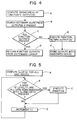
- a first application of the invention is in a runtime environment where, before executing a Function, the signatures of each of its outputs are computed (Block A), and the Dictionary 20 is searched to retrieve the data elements associated with each signature (Block B). If the data elements are found to all exist in the Dictionary 20 (Block C), then the Function need not be executed, and the retrieved data items are simply returned to the caller of the Function (Block D). If one or more of the data elements are found not to exist in the Dictionary 20 at Block C, then the Function is executed, and the computed data items are returned to the caller of the Function (Block E). The data items may also be inserted into the Dictionary 20 or DES 16, along with their respective keys (Block E).
- node a's signature Sf(a, 0, x)
- node b0's signature Sf(B,0,x,y)
- node b1's signature Sf(B, 1, x, y)
- signatures for the lower nodes d and e are computed, and then those for nodes f and g.
- a "placeholder" data structure effectively a level of indirection which allows actual data to be filled in at a later time, is inserted into the Dictionary 20, or DES 16, with each of the associated signatures.
- Block B After the signatures are computed, there is performed at Block B a bottom-up traversal of the DAG. This entails, at each functional node, a search of the Dictionary for the data items associated with the signatures of the inputs. If all of these data items are found, and if all are either constants or previously computed results, then the Function is scheduled for execution (Block C). Otherwise, the method recursively examines, at Blocks D and B, nodes further up the DAG so as to determine the required constants or results required by the lower node or nodes, such as the Function G.
- Block B of Fig. 5 is not intended to represent that a breadth-first search of all nodes on a given level is performed. Instead, the method is applied to specified nodes.
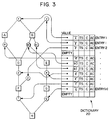
- Fig. 3 depicts the constant and Function signatures as being stored within the Dictionary 20 in a specific order
- the entries may typically be sorted and stored by their respective hexadecimal signature values.
- the resultant order is , , , , , , , , and .
- a full signature comparison is not required for all entries when accessing the Dictionary 20.
- the least significant nibble of the search signature may be employed to obtain an enhanced search efficiency.
- the stored signatures for a and y have an identical least significant nybble (9)
- the corresponding Dictionary entry may have a pointer to entries for both and .
- a full signature (32 bit) comparison may be employed. With 32-bit signatures the probability of a collision occurring becomes small. However, it is within the scope of the invention to employ a 64-bit signature or to employ any number of bits so as to reduce the probability of a collision to a very small number.
- the teaching of the invention is also amenable to the following optimizations.
- the number of elements in the cache may be minimized.
- the intermediate result e is not stored, in that if Function G must be recomputed then Function E will also be required to be recomputed.
- intermediate result d is stored in that, although Function F may be recomputed, such may be accomplished because of a change in the constant z, while the intermediate result d remains unchanged.
- Another optimization may be employed if a particular path of the DAG is determined to be constantly changing. This condition may occur if an input, for example the output of a counter, is changing monotonically. For this case the elements generated along the affected path are marked as non-cachable, thereby further reducing the number of elements stored in the Dictionary 20.
Landscapes
- Engineering & Computer Science (AREA)
- Databases & Information Systems (AREA)
- Theoretical Computer Science (AREA)
- Software Systems (AREA)
- Data Mining & Analysis (AREA)
- Physics & Mathematics (AREA)
- General Engineering & Computer Science (AREA)
- General Physics & Mathematics (AREA)
- Information Retrieval, Db Structures And Fs Structures Therefor (AREA)
Applications Claiming Priority (2)
| Application Number | Priority Date | Filing Date | Title |
|---|---|---|---|
| US721807 | 1991-06-26 | ||
| US07/721,807 US5347652A (en) | 1991-06-26 | 1991-06-26 | Method and apparatus for saving and retrieving functional results |
Publications (2)
| Publication Number | Publication Date |
|---|---|
| EP0520232A2 true EP0520232A2 (de) | 1992-12-30 |
| EP0520232A3 EP0520232A3 (en) | 1993-12-15 |
Family
ID=24899384
Family Applications (1)
| Application Number | Title | Priority Date | Filing Date |
|---|---|---|---|
| EP19920109675 Withdrawn EP0520232A3 (en) | 1991-06-26 | 1992-06-09 | Method and apparatus for saving and retrieving functional results |
Country Status (3)
| Country | Link |
|---|---|
| US (1) | US5347652A (de) |
| EP (1) | EP0520232A3 (de) |
| JP (1) | JP2769065B2 (de) |
Cited By (2)
| Publication number | Priority date | Publication date | Assignee | Title |
|---|---|---|---|---|
| WO2002084527A1 (en) * | 2001-04-12 | 2002-10-24 | Fifth Web Limited | System and method for facilitating information transformations |
| EP1208471A4 (de) * | 1999-06-01 | 2008-05-28 | Fair Isaac Corp | System und verfahren um eine datenbank zu verwalten. |
Families Citing this family (16)
| Publication number | Priority date | Publication date | Assignee | Title |
|---|---|---|---|---|
| KR100326655B1 (ko) * | 1993-08-03 | 2002-06-29 | 후루타 다케시 | 카바레이필름또는fpc제작용베이스필름에사용되는폴리이미드적층체및그적층체의제조방법 |
| US5790416A (en) * | 1995-09-18 | 1998-08-04 | Motorola, Inc. | Updating hierarchical DAG representations through a bottom up method |
| US6885994B1 (en) * | 1995-12-26 | 2005-04-26 | Catalina Marketing International, Inc. | System and method for providing shopping aids and incentives to customers through a computer network |
| US5765165A (en) * | 1996-02-29 | 1998-06-09 | Sun Microsystems, Inc. | Fast method of determining duplicates on a linked list |
| US5898836A (en) | 1997-01-14 | 1999-04-27 | Netmind Services, Inc. | Change-detection tool indicating degree and location of change of internet documents by comparison of cyclic-redundancy-check(CRC) signatures |
| AU6151598A (en) * | 1997-02-11 | 1998-08-26 | Connected Corporation | File comparison for data backup and file synchronization |
| US6311311B1 (en) | 1999-08-19 | 2001-10-30 | International Business Machines Corporation | Multiple input shift register (MISR) signatures used on architected registers to detect interim functional errors on instruction stream test |
| US7093236B2 (en) * | 2001-02-01 | 2006-08-15 | Arm Limited | Tracing out-of-order data |
| US20050166047A1 (en) * | 2004-01-23 | 2005-07-28 | Tollett Wayne J. | Intra-encapsulation intelligent searching of an object |
| US7558935B1 (en) * | 2004-05-04 | 2009-07-07 | Sun Microsystems, Inc. | Method and system for optimizing memory allocation |
| US7539661B2 (en) * | 2005-06-02 | 2009-05-26 | Delphi Technologies, Inc. | Table look-up method with adaptive hashing |
| US10452716B2 (en) * | 2008-06-07 | 2019-10-22 | International Business Machines Corporation | Optimizing complex path endpoint resolution |
| US20110252046A1 (en) * | 2008-12-16 | 2011-10-13 | Geza Szabo | String matching method and apparatus |
| US8280869B1 (en) * | 2009-07-10 | 2012-10-02 | Teradata Us, Inc. | Sharing intermediate results |
| WO2017117216A1 (en) * | 2015-12-29 | 2017-07-06 | Tao Tao | Systems and methods for caching task execution |
| JP7225554B2 (ja) | 2018-04-02 | 2023-02-21 | 富士通株式会社 | 情報処理装置、情報処理システムおよび情報処理プログラム |
Family Cites Families (6)
| Publication number | Priority date | Publication date | Assignee | Title |
|---|---|---|---|---|
| US4281391A (en) * | 1979-01-15 | 1981-07-28 | Leland Stanford Junior University | Number theoretic processor |
| US4588985A (en) * | 1983-12-30 | 1986-05-13 | International Business Machines Corporation | Polynomial hashing |
| US4611280A (en) * | 1984-03-12 | 1986-09-09 | At&T Bell Laboratories | Sorting method |
| US5123101A (en) * | 1986-11-12 | 1992-06-16 | Xerox Corporation | Multiple address space mapping technique for shared memory wherein a processor operates a fault handling routine upon a translator miss |
| US4974191A (en) * | 1987-07-31 | 1990-11-27 | Syntellect Software Inc. | Adaptive natural language computer interface system |
| JP2760794B2 (ja) * | 1988-01-29 | 1998-06-04 | 株式会社日立製作所 | データベース処理方法および装置 |
-
1991
- 1991-06-26 US US07/721,807 patent/US5347652A/en not_active Expired - Fee Related
-
1992
- 1992-05-08 JP JP4115920A patent/JP2769065B2/ja not_active Expired - Lifetime
- 1992-06-09 EP EP19920109675 patent/EP0520232A3/en not_active Withdrawn
Cited By (2)
| Publication number | Priority date | Publication date | Assignee | Title |
|---|---|---|---|---|
| EP1208471A4 (de) * | 1999-06-01 | 2008-05-28 | Fair Isaac Corp | System und verfahren um eine datenbank zu verwalten. |
| WO2002084527A1 (en) * | 2001-04-12 | 2002-10-24 | Fifth Web Limited | System and method for facilitating information transformations |
Also Published As
| Publication number | Publication date |
|---|---|
| US5347652A (en) | 1994-09-13 |
| EP0520232A3 (en) | 1993-12-15 |
| JPH05189490A (ja) | 1993-07-30 |
| JP2769065B2 (ja) | 1998-06-25 |
Similar Documents
| Publication | Publication Date | Title |
|---|---|---|
| US5347652A (en) | Method and apparatus for saving and retrieving functional results | |
| US6212525B1 (en) | Hash-based system and method with primary and secondary hash functions for rapidly identifying the existence and location of an item in a file | |
| US6862602B2 (en) | System and method for rapidly identifying the existence and location of an item in a file | |
| EP0268373B1 (de) | Verfahren und Einrichtung um eine Datenbankadresse zu bestimmen | |
| US5692177A (en) | Method and system for data set storage by iteratively searching for perfect hashing functions | |
| Moret | Towards a discipline of experimental algorithmics | |
| KR100414236B1 (ko) | 데이터의 검색을 위한 서치 시스템 및 방법 | |
| US6678687B2 (en) | Method for creating an index and method for searching an index | |
| EP0510634B1 (de) | Datenbankauffindungssystem | |
| US5808615A (en) | Process and system for mapping the relationship of the content of a collection of documents | |
| US6523030B1 (en) | Sort system for merging database entries | |
| US5592666A (en) | Method and system for storing and retrieving data from a multidimensional array using database pointers | |
| US5713016A (en) | Process and system for determining relevance | |
| US5848416A (en) | Method and apparatus for storing and retrieving data and a memory arrangement | |
| US5893120A (en) | Methods and apparatus for information storage and retrieval using a hashing technique with external chaining and on-the-fly removal of expired data | |
| WO1998039715A9 (en) | System and method for rapidly identifying the existence and location of an item in a file | |
| US6247014B1 (en) | Method and apparatus for performing hash lookups using valid bit tables with pointers | |
| US7031985B1 (en) | Lexical cache | |
| US20050234868A1 (en) | Systems and methods for fragment-based serialization | |
| US6438556B1 (en) | Method and system for compressing data which allows access to data without full uncompression | |
| US6446066B1 (en) | Method and apparatus using run length encoding to evaluate a database | |
| US5787424A (en) | Process and system for recursive document retrieval | |
| JP3258063B2 (ja) | データベース検索システム及び方法 | |
| JP3151730B2 (ja) | データベース検索システム | |
| US6886161B1 (en) | Method and data structure for compressing file-reference information |
Legal Events
| Date | Code | Title | Description |
|---|---|---|---|
| PUAI | Public reference made under article 153(3) epc to a published international application that has entered the european phase |
Free format text: ORIGINAL CODE: 0009012 |
|
| AK | Designated contracting states |
Kind code of ref document: A2 Designated state(s): DE FR GB |
|
| 17P | Request for examination filed |
Effective date: 19930427 |
|
| PUAL | Search report despatched |
Free format text: ORIGINAL CODE: 0009013 |
|
| AK | Designated contracting states |
Kind code of ref document: A3 Designated state(s): DE FR GB |
|
| STAA | Information on the status of an ep patent application or granted ep patent |
Free format text: STATUS: THE APPLICATION HAS BEEN WITHDRAWN |
|
| 18W | Application withdrawn |
Withdrawal date: 19960716 |