EP0520754A2 - Elément d'affichage à cristal liquide - Google Patents
Elément d'affichage à cristal liquide Download PDFInfo
- Publication number
- EP0520754A2 EP0520754A2 EP92305778A EP92305778A EP0520754A2 EP 0520754 A2 EP0520754 A2 EP 0520754A2 EP 92305778 A EP92305778 A EP 92305778A EP 92305778 A EP92305778 A EP 92305778A EP 0520754 A2 EP0520754 A2 EP 0520754A2
- Authority
- EP
- European Patent Office
- Prior art keywords
- liquid crystal
- display element
- dispersion type
- crystal display
- type liquid
- Prior art date
- Legal status (The legal status is an assumption and is not a legal conclusion. Google has not performed a legal analysis and makes no representation as to the accuracy of the status listed.)
- Granted
Links
Images

Classifications
-
- G—PHYSICS
- G02—OPTICS
- G02F—OPTICAL DEVICES OR ARRANGEMENTS FOR THE CONTROL OF LIGHT BY MODIFICATION OF THE OPTICAL PROPERTIES OF THE MEDIA OF THE ELEMENTS INVOLVED THEREIN; NON-LINEAR OPTICS; FREQUENCY-CHANGING OF LIGHT; OPTICAL LOGIC ELEMENTS; OPTICAL ANALOGUE/DIGITAL CONVERTERS
- G02F1/00—Devices or arrangements for the control of the intensity, colour, phase, polarisation or direction of light arriving from an independent light source, e.g. switching, gating or modulating; Non-linear optics
- G02F1/01—Devices or arrangements for the control of the intensity, colour, phase, polarisation or direction of light arriving from an independent light source, e.g. switching, gating or modulating; Non-linear optics for the control of the intensity, phase, polarisation or colour
- G02F1/13—Devices or arrangements for the control of the intensity, colour, phase, polarisation or direction of light arriving from an independent light source, e.g. switching, gating or modulating; Non-linear optics for the control of the intensity, phase, polarisation or colour based on liquid crystals, e.g. single liquid crystal display cells
-
- C—CHEMISTRY; METALLURGY
- C09—DYES; PAINTS; POLISHES; NATURAL RESINS; ADHESIVES; COMPOSITIONS NOT OTHERWISE PROVIDED FOR; APPLICATIONS OF MATERIALS NOT OTHERWISE PROVIDED FOR
- C09K—MATERIALS FOR MISCELLANEOUS APPLICATIONS, NOT PROVIDED FOR ELSEWHERE
- C09K19/00—Liquid crystal materials
- C09K19/52—Liquid crystal materials characterised by components which are not liquid crystals, e.g. additives with special physical aspect: solvents, solid particles
- C09K19/54—Additives having no specific mesophase characterised by their chemical composition
- C09K19/542—Macromolecular compounds
- C09K19/544—Macromolecular compounds as dispersing or encapsulating medium around the liquid crystal
-
- C—CHEMISTRY; METALLURGY
- C09—DYES; PAINTS; POLISHES; NATURAL RESINS; ADHESIVES; COMPOSITIONS NOT OTHERWISE PROVIDED FOR; APPLICATIONS OF MATERIALS NOT OTHERWISE PROVIDED FOR
- C09K—MATERIALS FOR MISCELLANEOUS APPLICATIONS, NOT PROVIDED FOR ELSEWHERE
- C09K19/00—Liquid crystal materials
- C09K19/52—Liquid crystal materials characterised by components which are not liquid crystals, e.g. additives with special physical aspect: solvents, solid particles
- C09K19/60—Pleochroic dyes
-
- G—PHYSICS
- G02—OPTICS
- G02F—OPTICAL DEVICES OR ARRANGEMENTS FOR THE CONTROL OF LIGHT BY MODIFICATION OF THE OPTICAL PROPERTIES OF THE MEDIA OF THE ELEMENTS INVOLVED THEREIN; NON-LINEAR OPTICS; FREQUENCY-CHANGING OF LIGHT; OPTICAL LOGIC ELEMENTS; OPTICAL ANALOGUE/DIGITAL CONVERTERS
- G02F1/00—Devices or arrangements for the control of the intensity, colour, phase, polarisation or direction of light arriving from an independent light source, e.g. switching, gating or modulating; Non-linear optics
- G02F1/01—Devices or arrangements for the control of the intensity, colour, phase, polarisation or direction of light arriving from an independent light source, e.g. switching, gating or modulating; Non-linear optics for the control of the intensity, phase, polarisation or colour
- G02F1/13—Devices or arrangements for the control of the intensity, colour, phase, polarisation or direction of light arriving from an independent light source, e.g. switching, gating or modulating; Non-linear optics for the control of the intensity, phase, polarisation or colour based on liquid crystals, e.g. single liquid crystal display cells
- G02F1/133—Constructional arrangements; Operation of liquid crystal cells; Circuit arrangements
- G02F1/1333—Constructional arrangements; Manufacturing methods
- G02F1/1334—Constructional arrangements; Manufacturing methods based on polymer dispersed liquid crystals, e.g. microencapsulated liquid crystals
-
- G—PHYSICS
- G02—OPTICS
- G02F—OPTICAL DEVICES OR ARRANGEMENTS FOR THE CONTROL OF LIGHT BY MODIFICATION OF THE OPTICAL PROPERTIES OF THE MEDIA OF THE ELEMENTS INVOLVED THEREIN; NON-LINEAR OPTICS; FREQUENCY-CHANGING OF LIGHT; OPTICAL LOGIC ELEMENTS; OPTICAL ANALOGUE/DIGITAL CONVERTERS
- G02F1/00—Devices or arrangements for the control of the intensity, colour, phase, polarisation or direction of light arriving from an independent light source, e.g. switching, gating or modulating; Non-linear optics
- G02F1/01—Devices or arrangements for the control of the intensity, colour, phase, polarisation or direction of light arriving from an independent light source, e.g. switching, gating or modulating; Non-linear optics for the control of the intensity, phase, polarisation or colour
- G02F1/13—Devices or arrangements for the control of the intensity, colour, phase, polarisation or direction of light arriving from an independent light source, e.g. switching, gating or modulating; Non-linear optics for the control of the intensity, phase, polarisation or colour based on liquid crystals, e.g. single liquid crystal display cells
- G02F1/133—Constructional arrangements; Operation of liquid crystal cells; Circuit arrangements
- G02F1/1333—Constructional arrangements; Manufacturing methods
- G02F1/1347—Arrangement of liquid crystal layers or cells in which the final condition of one light beam is achieved by the addition of the effects of two or more layers or cells
- G02F1/13476—Arrangement of liquid crystal layers or cells in which the final condition of one light beam is achieved by the addition of the effects of two or more layers or cells in which at least one liquid crystal cell or layer assumes a scattering state
-
- C—CHEMISTRY; METALLURGY
- C09—DYES; PAINTS; POLISHES; NATURAL RESINS; ADHESIVES; COMPOSITIONS NOT OTHERWISE PROVIDED FOR; APPLICATIONS OF MATERIALS NOT OTHERWISE PROVIDED FOR
- C09K—MATERIALS FOR MISCELLANEOUS APPLICATIONS, NOT PROVIDED FOR ELSEWHERE
- C09K19/00—Liquid crystal materials
- C09K19/52—Liquid crystal materials characterised by components which are not liquid crystals, e.g. additives with special physical aspect: solvents, solid particles
- C09K19/54—Additives having no specific mesophase characterised by their chemical composition
- C09K19/542—Macromolecular compounds
- C09K2019/546—Macromolecular compounds creating a polymeric network
-
- G—PHYSICS
- G02—OPTICS
- G02F—OPTICAL DEVICES OR ARRANGEMENTS FOR THE CONTROL OF LIGHT BY MODIFICATION OF THE OPTICAL PROPERTIES OF THE MEDIA OF THE ELEMENTS INVOLVED THEREIN; NON-LINEAR OPTICS; FREQUENCY-CHANGING OF LIGHT; OPTICAL LOGIC ELEMENTS; OPTICAL ANALOGUE/DIGITAL CONVERTERS
- G02F1/00—Devices or arrangements for the control of the intensity, colour, phase, polarisation or direction of light arriving from an independent light source, e.g. switching, gating or modulating; Non-linear optics
- G02F1/01—Devices or arrangements for the control of the intensity, colour, phase, polarisation or direction of light arriving from an independent light source, e.g. switching, gating or modulating; Non-linear optics for the control of the intensity, phase, polarisation or colour
- G02F1/13—Devices or arrangements for the control of the intensity, colour, phase, polarisation or direction of light arriving from an independent light source, e.g. switching, gating or modulating; Non-linear optics for the control of the intensity, phase, polarisation or colour based on liquid crystals, e.g. single liquid crystal display cells
- G02F1/133—Constructional arrangements; Operation of liquid crystal cells; Circuit arrangements
- G02F1/1333—Constructional arrangements; Manufacturing methods
- G02F1/1347—Arrangement of liquid crystal layers or cells in which the final condition of one light beam is achieved by the addition of the effects of two or more layers or cells
- G02F1/13475—Arrangement of liquid crystal layers or cells in which the final condition of one light beam is achieved by the addition of the effects of two or more layers or cells in which at least one liquid crystal cell or layer is doped with a pleochroic dye, e.g. GH-LC cell
-
- G—PHYSICS
- G02—OPTICS
- G02F—OPTICAL DEVICES OR ARRANGEMENTS FOR THE CONTROL OF LIGHT BY MODIFICATION OF THE OPTICAL PROPERTIES OF THE MEDIA OF THE ELEMENTS INVOLVED THEREIN; NON-LINEAR OPTICS; FREQUENCY-CHANGING OF LIGHT; OPTICAL LOGIC ELEMENTS; OPTICAL ANALOGUE/DIGITAL CONVERTERS
- G02F2202/00—Materials and properties
- G02F2202/04—Materials and properties dye
Definitions
- the present invention relates to a dispersion type liquid crystal display element useful as, for example, a flat panel display device.
- Liquid crystal display elements of TN type and of STN type using a nematic liquid crystal have already been put to a practical use. Also, a liquid crystal display element using a ferroelectric liquid crystal is being proposed. In forming such an element, an orientation treatment or the like is required. This requirement is a serious problem to be solved for easily manufacturing a large liquid crystal display element.
- liquid crystal molecules are encapsulated in polyvinyl alcohol or the like so as to disperse the liquid crystal molecules in the polymer.
- a thin film formed of the polymer prepared by the known method described above can be used for forming a liquid crystal display element.
- the encapsulated liquid crystal molecules exhibit a positive dielectric anisotropy within the thin film, the encapsulated liquid crystal molecules are oriented in the direction of the electric field upon application of an electric field.
- the liquid crystal element If the refractive index no of the liquid crystal becomes equal to the refractive index n p of the polymer upon application of the electric field, the liquid crystal element is turned transparent. After removal of the electric field, the liquid crystal molecules are brought back to the state of random arrangement. As a result, the refractive index no of the liquid crystal is deviated from the refractive index n p of the polymer. It follows that the light is scattered at the boundary between the liquid crystal phase and the polymer phase so as to make the liquid crystal display element turbidly.
- the dispersion type liquid crystal display element described above is certainly simpler in construction than the conventional element constructed such that a liquid crystal material is held between a pair of glass substrates and sealed, making it possible to form easily a larger element.
- a voltage application to the element simply brings about transmission and scattering of light, though the voltage application directly leads to an improved brightness of the background light in the conventional device noted above.
- the contrast is determined by the ratio in intensity of the transmitting light to the scattered light.
- An object of the present invention is to provide a liquid crystal display element of a satisfactory contrast, which can be of a large size and can be manufactured with a low cost.
- a liquid crystal display element having a pair of substrates at least one of which is transparent, and a light control layer consisting of a dispersion type liquid crystal material held between the substrates, the dispersion type liquid crystal material consisting of a supporting medium, liquid crystal molecules and a dichromatic dye which is oriented within the dispersion type liquid crystal material.
- a polarized light selecting element may be disposed outside the substrate.
- a liquid crystal display element having a pair of substrates at least one of which is transparent, and a light control layer consisting of a dispersion type liquid crystal material held between the substrates, the dispersion type liquid crystal material consisting of a supporting medium, liquid crystal molecules and a dichromatic dye, and the light control layer being of a laminate structure consisting of a first dispersion type liquid crystal layer prepared by allowing the dichromatic dye to be dispersed and oriented in a first direction within the dispersion type liquid crystal material and a second dispersion type liquid crystal layer prepared by allowing another dichromatic dye, which is of the same type as that of the dichromatic dye dispersed in the first dispersion type liquid crystal layer, to be dispersed and oriented in a second direction within the dispersion type liquid crystal.
- the dispersion type liquid crystal used in the present invention may be of the structure that liquid crystal portions are independently dispersed or of a three dimensional network structure. What is important in the present invention is that a matrix, i.e., a supporting medium of the dispersion type liquid crystal, is allowed to contain an oriented dichromatic dye. Specifically, the dichromatic dye may be mixed with the liquid crystal phase. Alternatively, liquid crystal molecules may be encapsulated in the form of micro droplets or spongy network so as to be separated from the dye. For preparing micro droplets or spongy network of the liquid crystal molecules, it is possible to use, for example, surfactant type monomer such as sodium undecylenate, as an encapsulating material.
- surfactant type monomer such as sodium undecylenate
- the dichromatic dyes used in the present invention include a positive dichromatic dye (p-type dye), in which the absorbance of the polarized light in a direction parallel with the molecular axis is greater than that of the polarized light in a direction perpendicular to the molecular axis, and a negative dichromatic dye (n-type dye) opposite to the p-type dye in the absorbance characteristics noted above.
- p-type dye positive dichromatic dye
- n-type dye negative dichromatic dye
- the dichromatic dye used in the liquid crystal display element of the present invention is required to exhibit a high dispersion capability in the matrix and should desirably exhibit a high resistivity for improving the holding characteristics of the liquid crystal display.
- the dichromatic dye tends to cause a decreased light transmission when voltage is applied to the liquid crystal display element, making it necessary not to unduly increase the content of the dichromatic dye.
- the polarized light selecting element used in the present invention may be suitably selected from the known elements such as a polaroid plate, a Nicol prism, a Glan-Taylor prism, and a Glan-Thomson prism.
- the liquid crystal displayer element of the particular construction described above permits forming a satisfactory dark state adapted for enabling the dichromatic dye to absorb the scattered light when a voltage is not applied to the element, making it possible to achieve a high contrast.
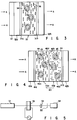
- Fig. 1 shows a liquid crystal display element according to one embodiment of the present invention.
- a p-type dichromatic dye in which the long axis of the dye molecule coincides with the absorption axis, is oriented within a matrix.
- the liquid crystal display element comprises a pair of substrates 12a and 12b each formed of, for example, glass.
- Transparent electrodes 11a, 11b each formed of ITO are on the inner surfaces of the substrates 12a, 12b, respectively.
- a light control layer 13 consisting of a dispersion type liquid crystal is held between the substrates 12a, 12b.
- the light control layer 13 is prepared by dispersing liquid crystal capsules 15 and p-type dichromatic dye 16 in a supporting medium 14 consisting of a photo-setting resin such as acrylic resin. It should be noted that the p-type dichromatic dye 16 are dispersed within the supporting medium 14 such that the light absorption axes of the dye molecules are oriented in a light transmitting direction denoted by arrows "A" in Fig. 1. In this case, the absorption axis of the p-type dichromatic dye 16 is parallel with the molecular axis.
- the absorption axes of the p-type dichromatic dye 16 are oriented in the light transmitting direction "A".
- the light in which the electric field is vibrated within the display plane i.e., the light transmitted in a direction substantially parallel with the orientation direction of the absorption axis, is transmitted as it is.
- the light transmitted in a direction making a certain angle with the direction of orientation is absorbed by the p-type dichromatic dye.
- the liquid crystal display element where an electric field is not applied to the liquid crystal display element, the light scattered by the liquid crystal portion is absorbed by the p-type dichromatic dye 16, and the transmitted light alone, which was not scattered, is emitted as a parallel light.
- the liquid crystal molecules are oriented so as to make the refractive index of the liquid crystal portion equal to that of the matrix and, thus, to permit the incident light to be transmitted as it is. Since the scattered light during non-application of an electric field is not transmitted, the dark state is markedly improved so as to provide a liquid crystal display element of a high contrast.
- Fig. 2 shows a liquid crystal display element according to another embodiment of the present invention.
- n-type dichromatic dye particles in which the long axis of the dye molecule is perpendicular to the absorption axis, are oriented within the matrix.
- the liquid crystal display element comprises a pair of transparent substrates 22a and 22b.
- Transparent electrodes 21a, 21b each formed of ITO are formed on the inner surfaces of the substrates 22a, 22b, respectively.
- a light control layer 23 consisting of a dispersion type liquid crystal is held between the substrates 22a, 22b.
- the light control layer 23 is prepared by dispersing liquid crystal capsules 25 and n-type dichromatic dye particles 26 in a supporting medium 24 consisting of a photo-setting resin such as acrylic resin. It should be noted that the n-type dichromatic dye particles 26 are dispersed within the supporting medium 24 such that the light absorption axes of the dye molecules are oriented in a light transmitting direction denoted by arrows "A" in Fig. 2. In this case, the absorption axis of the n-type dichromatic dye particle 26 is perpendicular to the molecular axis.
- the absorption axes of the n-type dichromatic dye particles 26 are oriented in the light transmitting direction "A".
- the light in which the electric field is vibrated within the display plane i.e., the light transmitted in a direction substantially parallel with the orientation direction of the absorption axis (direction perpendicular to the molecular axis) is transmitted as it is.
- the light transmitted in a direction making a certain angle with the direction of orientation is absorbed by the n-type dichromatic dye.
- the liquid crystal display element where an electric field is not applied to the liquid crystal display element, the light scattered by the liquid crystal portion is absorbed by the n-type dichromatic dye particles 26, and the transmitted light alone, which was not scattered, is emitted as a parallel light.
- the liquid crystal molecules are oriented so as to make the refractive index of the liquid crystal portion equal to that of the matrix and, thus, to permit the incident light to be transmitted as it is. Since the scattered light during non-application of an electric field is not transmitted, the dark state is markedly improved so as to provide a liquid crystal display element of a high contrast.
- Fig. 3 shows a liquid crystal display element according to another embodiment of the present invention.
- p-type dichromatic dye particles in which the long axis of the dye molecule coincides with the absorption axis, is oriented within a matrix.
- a polarized light selecting element is disposed to cover the outer surface of the substrate.
- the liquid crystal display element of this embodiment comprises a pair of transparent substrates 32a and 32b. Transparent electrodes 31a, 31b each formed of ITO are formed on the inner surfaces of the substrates 32a, 32b, respectively.
- a light control layer 33 consisting of a dispersion type liquid crystal is held between the substrates 32a and 32b.
- the display element further comprises a polarized light secting element 37 disposed to cover the outer surface of the substrate 32a on the incident side in a manner to face the light incident side of the light control layer 33.
- the light control layer 33 is prepared by dispersing liquid crystal capsules 35 and p-type dichromatic dye particles 36 in a supporting medium 34 consisting of a photo-setting resin such as acrylic resin. It should be noted that the p-type dichromatic dye particles 36 are dispersed within the supporting medium 34 such that the light absorption axes of the dye molecules are oriented in a light transmitting direction denoted by arrows "A" in Fig. 3. In this case, the absorption axis of the p-type dichromatic dye particle 36 is oriented in a direction perpendicular to the light transmitting direction "A".
- the molecular axes of the p-type dichromatic dye particles 36 are oriented in a direction perpendicular to the light transmitting direction. Since the incident light is selected by the polarized light selecting element 37 to select the polarization in the orienting direction of the dye, the liquid crystal molecules are oriented upon electric field application, with the result that the incident light is not scattered within the liquid crystal portion. It follows that, when voltage is applied to the element, the light incident to the matrix is absorbed substantially completely by the p-type dye which is oriented so as to achieve a very good dark state. On the other hand, the incident light is scattered in the liquid crystal portion, when voltage is not applied, so as to obtain a transmitted light.
- Fig. 4 shows a liquid crystal display element according to still another embodiment of the present invention.
- the light control layer included in the element is of a two-layer structure consisting of a first layer prepared by dispersing p-type dichromatic dye particles oriented in a light transmitting direction within a matrix and a second layer prepared by dispersing p-type dichromatic dye particles oriented in a direction perpendicular to the light transmitting direction within the matrix.
- first and second layers are superposed one upon the other such that the molecular axis of the p-type dichromatic dye in the first layer is perpendicular to that in the second layer.
- the liquid crystal display element of the embodiment shown in Fig. 4 comprises a pair of transparent substrates 42a and 42b.
- Transparent electrodes 41a, 41b each formed of ITO are formed on the inner surfaces of the substrates 42a, 42b, respectively.
- a light control layer 43 consisting of a dispersion type liquid crystal is held between the substrates 42a and 42b.
- the light control layer 43 comprises a first dispersion type liquid crystal layer 43a and a second dispersion type liquid crystal layer 43b, which are laminated one upon the other.
- the first dispersion type liquid crystal layer 43a is prepared by dispersing liquid crystal capsules 45 and p-type dichromatic dye particles 46a in a supporting medium 44 consisting of a photo-setting resin such as an acrylic resin. It should be noted in particular that the p-type dichromatic dye particles 46a are dispersed such that the absorption axes of the particles 46 are oriented in a direction perpendicular to the light transmitting direction denoted by arrows "A" in the drawing.
- the second dispersion type liquid crystal layer 43b is prepared by dispersing liquid crystal capsules 45 and p-type dichromatic dye particles 46b in the supporting medium 44 consisting of a photo-setting resin such as an acrylic resin.
- the dichromatic dye particles 46b which are of the same type as the p-type dichromatic dye particles 46a dispersed in the first dispersion type liquid crystal layer 43a, are dispersed so as to orient in a direction perpendicular to the orienting direction of the dichromatic dye particles 46a within the first dispersion type liquid crystal layer 43a.
- the first and second dispersion type liquid crystal layers superposed one upon the other in the embodiment shown in Fig. 4 such that the orienting direction of the dichromatic dye particles within the first layer is perpendicular to that within the second layer.
- the scattered light is effectively absorbed by the dichromatic dye particles oriented at right angles, with the result that the liquid crystal display element constructed as shown in Fig. 4 permits achieving a contrast equivalent or superior to that of the liquid crystal display element constructed as shown in Fig. 3, though the element shown in Fig. 4 is not provided with a polarized light selecting element.
- the light control layer included in the element shown in Fig. 4 may be of a laminate structure consisting of three or more dispersion type liquid crystal layers.
- the dichromatic dye particles are oriented within the matrix such that the long axis of the dye molecule is parallel with the light transmitting direction, as described previously. It is possible to achieve the particular construction by applying an electric field or a magnetic field in the step of obtaining the dispersion type liquid crystal by mixing the dichromatic dye particles with the matrix material. It should be noted, however, that, if the dichromatic dye particles are dispersed at a temperature lower than the level at which the host liquid crystal exhibits an isotropic phase, the light transmittance during non-application of an electric field is increased, leading to a lowered contrast, though the threshold value of the electric field is lowered by the orientation of the liquid crystal molecules regulated by the external field.
- the orientation of the dichromatic dye particles In order to avoid the impaired contrast, it is desirable to carry out the orientation of the dichromatic dye particles at a temperature higher than the level at which the host liquid crystal exhibits an isotropic phase. Further, where the matrix material contains a polymer compound, it is desirable to set the temperature at a level higher than the glass transition temperature of the polymer compound in order to facilitate the orientation of the dichromatic dye particles.
- the dichromatic dye particles are oriented within the matrix such that the long axis of the dye molecule is perpendicular to the light transmitting direction, as described previously. It is possible to achieve the particular orientation by applying a drawing treatment to the dispersion type liquid crystal layer mixed with the dichromatic dye particles in a direction perpendicular to the light transmitting direction.
- the contrast of the liquid crystal display element can be improved with increase in the drawing rate in the drawing treatment. It is desirable in some cases to carry out the drawing treatment at a temperature higher than a level at which the host crystal exhibits an isotropic phase. It should also be noted that the moderating time of response of the liquid crystal display element is affected by the drawing treatment.
- a transparent electrode consisting of ITO is formed on the inner surface of the substrate.
- ITO indium oxide-semiconductor
- a liquid crystal mixture was obtained by dispersing spacer material sized at 13 microns in a solution containing 11% by weight of butyl acrylate, 8% by weight of M-120 (trade name of an acrylic oligomer manufactured by Toa Gosei Kagaku Inc.), 1.0% by weight of Darocure 1116 (trade name of a photo-setting initiator manufactured by E. Merk Ltd.), 79% by weight of E-8 (registered trade mark of a host liquid crystal manufactured by BDH Ltd.), and 1% by weight of D-37 (registered trade mark of an anthraquinone series dye manufactured by BDH Inc.) which was used as a p-type dye.
- used as the spacer material was micropearl SP-213 (registered trade name, Sekisui Fine Chemical Inc.).
- a pair of glass substrates each covered with an ITO film were coated with the liquid crystal mixture thus prepared, followed by superposing the glass substrates one upon the other such that the coating layers were in direct contact with each other. Then, a poling treatment was applied for 30 minutes at 85°C under a poling electric field of 300 kV/cm, followed by applying an light exposure treatment for 2 minutes with the electric field kept applied so as to prepare a dispersion type liquid crystal display element constructed as shown in Fig. 1, i.e., a p-type dye particle perpendicular-orientation type element.
- the light exposure treatment noted above was carried out by using Minicure 450 (registered trade mark of an ultraviolet light irradiating apparatus manufactured by Ushio Denki Inc.).
- the contrast of the liquid crystal display element thus prepared was measured by using an optical system shown in Fig. 5.
- the optical system is formed by arranging a helium-neon laser 51, a lens 52, an aperture 53 and a photodiode 54 on an optical path.
- the dispersion type liquid crystal display element 55 was disposed between the helium-neon laser 51 and the lens 52, and a voltage ranging between 0 and 20v was applied to the dispersion type liquid crystal display element by using a function generator under a condition of wavelength of 633 nm, pulse signal of a rectangular waveform of 1 kHz, output power of 0.5 mW.
- the contrast thus measured was found to be 1 : 101.
- a liquid crystal mixture was obtained by dispersing a spacer material sized at 13 microns in a solution containing 15% by weight of isododecyl acrylate, 10% by weight of C-2000 (registered trade mark of an aliphatic diacrylate having a long carbon chain, which is manufactured by SATOMER Inc.), 1.0% by weight of Darocure 1116, i.e., a photo-setting initiator referred to previously, 73.2% by weight of E-7 (registered trade mark of a host liquid crystal manufactured by BDH Ltd.), and 0.8% by weight of D-37, i.e., an anthraquinone series dye which was also used in Example 1 as a p-type dye.
- C-2000 registered trade mark of an aliphatic diacrylate having a long carbon chain, which is manufactured by SATOMER Inc.
- Darocure 1116 i.e., a photo-setting initiator referred to previously
- E-7 registered trade mark of a host liquid crystal manufactured by
- a pair of glass substrates each covered with an ITO film were coated with the liquid crystal mixture thus prepared, followed by superposing the glass substrates one upon the other such that the coating layers were in direct contact with each other. Then, a poling treatment was applied for 30 minutes at 75°C under a poling electric field of 300 kV/cm, followed by applying an light exposure treatment for 90 seconds with the electric field kept applied so as to prepare a dispersion type liquid crystal display element constructed as shown in Fig. 1.
- the light exposure treatment noted above was carried out by using Minicure 450 referred to previously.
- the contrast of the liquid crystal display element thus prepared was measured as in Example 1, with the result that the contrast was found to be 1 : 98.
- the film thus prepared was drawn by 200% by a drawing machine under a nitrogen gas atmosphere of 120°C, followed by coating the both surfaces of the drawn film with an optical adhesive No. 68 manufactured by Norland Products, Inc. by using a bar coater. Further, the coated film was held between and compressed by a pair of glass substrates each having an ITO film formed on one surface in advance so as to prepare dispersion type liquid crystal display element constructed as shown in Fig. 2, i.e., a n-type dye particles paralle-orientation type element.
- the contrast of the liquid crystal display element thus prepared was measured as in Example 1, with the result that the contrast was found to be 1 : 95.
- a mixture was prepared first by sufficiently dispersing 11% by weight of butyl acrylate, 8% by weight of M-120, i.e., an acrylic oligomer referred to in Example 1, 1.0% by weight of Dalocure 1116, i.e., a photo-setting initiator referred to in Example 1, 79% by weight of E-8, i.e., a host liquid crystal referred to previously, and 1% by weight of an anthraquinone series dye which is shown as compound No. 17 in Table 3 and used as an n-type dye.
- a Teflon plate was coated with the mixture by using a bar coater, followed by applying a light exposure treatment for 2 minutes by using Minicure 450, i.e., an ultraviolet light irradiating apparatus referred to previously, so as to prepare a dispersion type liquid crystal display element constructed as shown in Fig. 2 and containing n-type dichromatic dye particles.
- Minicure 450 i.e., an ultraviolet light irradiating apparatus referred to previously
- the film thus prepared was drawn by 150% by a drawing machine at 90°C, followed by coating the both surfaces of the drawn film with an optical adhesive No. 68 manufactured by Norland Products, Inc. by using a bar coater. Further, the coated film was held between and compressed by a pair of glass substrates each having an ITO film formed one surface in advance so as to prepare dispersion type liquid crystal display element constructed as shown in Fig. 2.
- the contrast of the liquid crystal display element thus prepared was measured as in Example 1, with the result that the contrast was found to be 1 : 96.
- the film thus prepared was drawn by 200% by a drawing machine under a nitrogen gas atmosphere of 120°C, followed by coating the both surfaces of the drawn film with an optical adhesive No. 68 manufactured by Norland Products, Inc. by using a bar coater. Further, the coated film was held between and compressed by a pair of glass substrates each having an ITO film formed on one surface in advance. Finally, a light deflecting plate was attached to one of the substrates so as to prepare dispersion type liquid crystal display element constructed as shown in Fig. 3, i.e. a p-type dye particles parallel-orientation type element.
- the contrast of the liquid crystal display element thus prepared was measured as in Example 1, with the result that the contrast was found to be 1 : 96.
- Two dispersion type liquid crystal films each containing p-type dye particles were prepared as in Example 5. Each of these films was drawn by 200% by using a drawing machine under a nitrogen gas atmosphere of 120°C, followed by coating one surface of each of these films with an optical adhesive No. 68 manufactured by Norland Inc. by using a bar coater. Then, these two films were superposed one upon the other such that the orienting axes of the films are perpendicular to each other so as to obtain a film of a laminated structure. Further, the both surfaces of the laminated film were coated with an optical adhesive.
- the laminated film was held between and compressed by a pair of glass substrates each having an ITO film formed on one surface in advance so as to obtain a dispersion type liquid crystal display element constructed as shown in Fig. 4, in which the orienting direction of the p-type dyes parallel-orientation-perpendicular-stack type element.
- the contrast of the liquid crystal display element thus prepared was measured as in Example 1, with the result that the contrast was found to be 1 : 99.
- the present invention provides a liquid crystal display element in which dichromatic dye particles are contained and oriented in a dispersion type liquid crystal matrix.
- the particular construction of the present invention makes it possible to manufacture even a large liquid crystal display device very easily and with a low cost. In addition, it is possible to markedly improve the contrast of the liquid crystal display element.
- a complex optical system or the like need not be used in the dispersion type liquid crystal display element of the present invention and, thus, the element of the present invention is economical.
Landscapes
- Physics & Mathematics (AREA)
- Chemical & Material Sciences (AREA)
- Nonlinear Science (AREA)
- Crystallography & Structural Chemistry (AREA)
- General Physics & Mathematics (AREA)
- Optics & Photonics (AREA)
- Organic Chemistry (AREA)
- Mathematical Physics (AREA)
- Materials Engineering (AREA)
- Engineering & Computer Science (AREA)
- Dispersion Chemistry (AREA)
- Liquid Crystal (AREA)
- Devices For Indicating Variable Information By Combining Individual Elements (AREA)
Applications Claiming Priority (2)
| Application Number | Priority Date | Filing Date | Title |
|---|---|---|---|
| JP03151656A JP3086718B2 (ja) | 1991-06-24 | 1991-06-24 | 液晶表示素子 |
| JP151656/91 | 1991-06-24 |
Publications (3)
| Publication Number | Publication Date |
|---|---|
| EP0520754A2 true EP0520754A2 (fr) | 1992-12-30 |
| EP0520754A3 EP0520754A3 (en) | 1993-08-18 |
| EP0520754B1 EP0520754B1 (fr) | 1996-12-11 |
Family
ID=15523347
Family Applications (1)
| Application Number | Title | Priority Date | Filing Date |
|---|---|---|---|
| EP92305778A Expired - Lifetime EP0520754B1 (fr) | 1991-06-24 | 1992-06-24 | Elément d'affichage à cristal liquide |
Country Status (5)
| Country | Link |
|---|---|
| US (1) | US5303073A (fr) |
| EP (1) | EP0520754B1 (fr) |
| JP (1) | JP3086718B2 (fr) |
| KR (1) | KR960011199B1 (fr) |
| DE (1) | DE69215769T2 (fr) |
Cited By (3)
| Publication number | Priority date | Publication date | Assignee | Title |
|---|---|---|---|---|
| FR2725544A1 (fr) * | 1994-10-11 | 1996-04-12 | Morin Francois | Ecran d'affichage a cristaux liquides disperses dans un polymere |
| EP0851018A1 (fr) * | 1996-12-24 | 1998-07-01 | Dai Nippon Printing Co., Ltd. | Milieu d'enregistrement et d'affichage et son utilisation |
| US8284374B2 (en) | 2007-05-18 | 2012-10-09 | Lg Display Co., Ltd. | Liquid crystal display device |
Families Citing this family (74)
| Publication number | Priority date | Publication date | Assignee | Title |
|---|---|---|---|---|
| DE69306201T2 (de) * | 1992-09-01 | 1997-05-28 | Philips Electronics Nv | Einrichtung zur optischen Modulation |
| JPH06102490A (ja) * | 1992-09-19 | 1994-04-15 | Semiconductor Energy Lab Co Ltd | 分散型液晶電気光学装置の作製方法 |
| US5559615A (en) * | 1993-10-07 | 1996-09-24 | Casio Computer Co., Ltd. | Polymer dispersed liquid crystal display device |
| DE69431337T2 (de) * | 1993-12-17 | 2003-05-22 | Matsushita Electric Industrial Co., Ltd. | Flüssigkristall-Projektionsvorrichtung und Flüssigkristall-Anzeigevorrichtung |
| US5790215A (en) * | 1995-03-15 | 1998-08-04 | Kabushiki Kaisha Toshiba | Liquid crystal display device |
| US7071913B2 (en) * | 1995-07-20 | 2006-07-04 | E Ink Corporation | Retroreflective electrophoretic displays and materials for making the same |
| US6262706B1 (en) | 1995-07-20 | 2001-07-17 | E Ink Corporation | Retroreflective electrophoretic displays and materials for making the same |
| US6120839A (en) | 1995-07-20 | 2000-09-19 | E Ink Corporation | Electro-osmotic displays and materials for making the same |
| US6515649B1 (en) * | 1995-07-20 | 2003-02-04 | E Ink Corporation | Suspended particle displays and materials for making the same |
| US6727881B1 (en) | 1995-07-20 | 2004-04-27 | E Ink Corporation | Encapsulated electrophoretic displays and methods and materials for making the same |
| US7109968B2 (en) | 1995-07-20 | 2006-09-19 | E Ink Corporation | Non-spherical cavity electrophoretic displays and methods and materials for making the same |
| US7106296B1 (en) | 1995-07-20 | 2006-09-12 | E Ink Corporation | Electronic book with multiple page displays |
| US7167155B1 (en) | 1995-07-20 | 2007-01-23 | E Ink Corporation | Color electrophoretic displays |
| JP3727728B2 (ja) * | 1996-08-29 | 2005-12-14 | 株式会社東芝 | 液晶表示素子 |
| US6243152B1 (en) * | 1996-12-17 | 2001-06-05 | Duke University | Contrast polymer dispersed liquid crystal projection display system |
| US7247379B2 (en) | 1997-08-28 | 2007-07-24 | E Ink Corporation | Electrophoretic particles, and processes for the production thereof |
| US6839158B2 (en) | 1997-08-28 | 2005-01-04 | E Ink Corporation | Encapsulated electrophoretic displays having a monolayer of capsules and materials and methods for making the same |
| US7002728B2 (en) | 1997-08-28 | 2006-02-21 | E Ink Corporation | Electrophoretic particles, and processes for the production thereof |
| US7242513B2 (en) * | 1997-08-28 | 2007-07-10 | E Ink Corporation | Encapsulated electrophoretic displays having a monolayer of capsules and materials and methods for making the same |
| US6067185A (en) | 1997-08-28 | 2000-05-23 | E Ink Corporation | Process for creating an encapsulated electrophoretic display |
| US6300932B1 (en) | 1997-08-28 | 2001-10-09 | E Ink Corporation | Electrophoretic displays with luminescent particles and materials for making the same |
| KR100477123B1 (ko) * | 1997-09-09 | 2005-08-05 | 삼성전자주식회사 | 고분자분산형액정표시장치 |
| AU3190499A (en) | 1998-03-18 | 1999-10-11 | E-Ink Corporation | Electrophoretic displays and systems for addressing such displays |
| US6704133B2 (en) | 1998-03-18 | 2004-03-09 | E-Ink Corporation | Electro-optic display overlays and systems for addressing such displays |
| US7075502B1 (en) | 1998-04-10 | 2006-07-11 | E Ink Corporation | Full color reflective display with multichromatic sub-pixels |
| JP4664501B2 (ja) | 1998-04-10 | 2011-04-06 | イー インク コーポレイション | 有機系電界効果トランジスタを用いる電子ディスプレイ |
| JP4651193B2 (ja) | 1998-05-12 | 2011-03-16 | イー インク コーポレイション | ドローイングデバイス用途のためのマイクロカプセル化した電気泳動性の静電的にアドレスした媒体 |
| EP1093600B1 (fr) * | 1998-07-08 | 2004-09-15 | E Ink Corporation | Procedes permettant d'ameliorer la couleur des dispositifs electrophoretiques microencapsules |
| USD485294S1 (en) | 1998-07-22 | 2004-01-13 | E Ink Corporation | Electrode structure for an electronic display |
| US6704077B1 (en) * | 1998-08-31 | 2004-03-09 | Casio Computer Co., Ltd. | Reflection type liquid crystal display with selective reflector |
| AU6293499A (en) | 1998-10-07 | 2000-04-26 | E-Ink Corporation | Capsules for electrophoretic displays and methods for making the same |
| AU6295899A (en) | 1998-10-07 | 2000-04-26 | E-Ink Corporation | Illumination system for nonemissive electronic displays |
| US6312304B1 (en) | 1998-12-15 | 2001-11-06 | E Ink Corporation | Assembly of microencapsulated electronic displays |
| CA2365847A1 (fr) | 1999-04-06 | 2000-10-12 | Gregg M. Duthaler | Procedes de production de gouttelettes destines a des afficheurs par electrophorese encapsules |
| US6842657B1 (en) | 1999-04-09 | 2005-01-11 | E Ink Corporation | Reactive formation of dielectric layers and protection of organic layers in organic semiconductor device fabrication |
| US6498114B1 (en) | 1999-04-09 | 2002-12-24 | E Ink Corporation | Method for forming a patterned semiconductor film |
| US6531997B1 (en) | 1999-04-30 | 2003-03-11 | E Ink Corporation | Methods for addressing electrophoretic displays |
| US6504524B1 (en) | 2000-03-08 | 2003-01-07 | E Ink Corporation | Addressing methods for displays having zero time-average field |
| US8115729B2 (en) | 1999-05-03 | 2012-02-14 | E Ink Corporation | Electrophoretic display element with filler particles |
| US7038655B2 (en) | 1999-05-03 | 2006-05-02 | E Ink Corporation | Electrophoretic ink composed of particles with field dependent mobilities |
| US6693620B1 (en) | 1999-05-03 | 2004-02-17 | E Ink Corporation | Threshold addressing of electrophoretic displays |
| US7030412B1 (en) | 1999-05-05 | 2006-04-18 | E Ink Corporation | Minimally-patterned semiconductor devices for display applications |
| WO2001007961A1 (fr) * | 1999-07-21 | 2001-02-01 | E Ink Corporation | Utilisation d'un condensateur de memorisation pour ameliorer la performance d'un affichage electronique matriciel actif |
| US7893435B2 (en) | 2000-04-18 | 2011-02-22 | E Ink Corporation | Flexible electronic circuits and displays including a backplane comprising a patterned metal foil having a plurality of apertures extending therethrough |
| US6825068B2 (en) | 2000-04-18 | 2004-11-30 | E Ink Corporation | Process for fabricating thin film transistors |
| US6683333B2 (en) | 2000-07-14 | 2004-01-27 | E Ink Corporation | Fabrication of electronic circuit elements using unpatterned semiconductor layers |
| US7230750B2 (en) | 2001-05-15 | 2007-06-12 | E Ink Corporation | Electrophoretic media and processes for the production thereof |
| US20050156340A1 (en) | 2004-01-20 | 2005-07-21 | E Ink Corporation | Preparation of capsules |
| US20100148385A1 (en) * | 2001-05-15 | 2010-06-17 | E Ink Corporation | Electrophoretic media and processes for the production thereof |
| US6967640B2 (en) * | 2001-07-27 | 2005-11-22 | E Ink Corporation | Microencapsulated electrophoretic display with integrated driver |
| WO2003050607A1 (fr) * | 2001-12-13 | 2003-06-19 | E Ink Corporation | Afficheurs electroniques electrophoretiques dotes de films ayant un faible indice de refraction |
| US6900851B2 (en) | 2002-02-08 | 2005-05-31 | E Ink Corporation | Electro-optic displays and optical systems for addressing such displays |
| US7312916B2 (en) | 2002-08-07 | 2007-12-25 | E Ink Corporation | Electrophoretic media containing specularly reflective particles |
| JP4268391B2 (ja) * | 2002-09-20 | 2009-05-27 | 日本放送協会 | 液晶光変調膜の製造方法 |
| US7632540B2 (en) * | 2003-07-01 | 2009-12-15 | Transitions Optical, Inc. | Alignment facilities for optical dyes |
| US7719656B2 (en) * | 2003-09-24 | 2010-05-18 | Sharp Kabushiki Kaisha | Liquid crystal display device |
| JP3942609B2 (ja) * | 2003-09-24 | 2007-07-11 | シャープ株式会社 | 液晶表示装置 |
| US8451201B2 (en) * | 2005-09-30 | 2013-05-28 | Sharp Kabushiki Kaisha | Liquid crystal display device drive method, liquid crystal display device, and television receiver |
| US7800714B2 (en) * | 2005-09-30 | 2010-09-21 | Sharp Kabushiki Kaisha | Liquid crystal display and television receiver |
| WO2007040127A1 (fr) | 2005-09-30 | 2007-04-12 | Sharp Kabushiki Kaisha | Affichage à cristaux liquides et téléviseur |
| JP4870151B2 (ja) * | 2006-03-22 | 2012-02-08 | シャープ株式会社 | 液晶表示装置およびテレビジョン受信機 |
| WO2007125628A1 (fr) * | 2006-04-28 | 2007-11-08 | Sharp Kabushiki Kaisha | Écran à cristaux liquides, son pp de commande et dispositif électronique |
| CN101467199B (zh) * | 2006-08-02 | 2011-08-31 | 夏普株式会社 | 液晶显示装置、液晶显示方法以及电视接收机 |
| US8294736B2 (en) * | 2006-11-20 | 2012-10-23 | Sharp Kabushiki Kaisha | Display device driving method, driving circuit, liquid crystal display device, and television receiver |
| CN101627334B (zh) | 2007-04-16 | 2011-07-20 | 夏普株式会社 | 显示装置、显示装置的驱动装置、及电子设备 |
| KR20120056528A (ko) * | 2010-11-25 | 2012-06-04 | 삼성전자주식회사 | 반사형 폴리머 분산 액정 디스플레이 장치 |
| CN102736304A (zh) * | 2012-06-21 | 2012-10-17 | 京东方科技集团股份有限公司 | 单基板显示面板及其制造方法 |
| KR102202689B1 (ko) * | 2015-11-17 | 2021-01-14 | 한국전자통신연구원 | 표시 장치 및 이를 구동하는 방법 |
| KR20170088476A (ko) * | 2016-01-22 | 2017-08-02 | 한국전자통신연구원 | 컬러 디스플레이 장치 |
| WO2019035464A1 (fr) * | 2017-08-15 | 2019-02-21 | 凸版印刷株式会社 | Variateur |
| KR102380640B1 (ko) * | 2017-11-23 | 2022-03-29 | 엘지디스플레이 주식회사 | 액정캡슐을 포함하는 액정표시장치 |
| JP7081178B2 (ja) * | 2018-01-31 | 2022-06-07 | 大日本印刷株式会社 | 反射スクリーン、映像表示装置 |
| DE102020214238A1 (de) | 2020-11-12 | 2022-05-12 | Siemens Aktiengesellschaft | Bedieneinheit für eine Ladeinfrastruktureinheit |
| US12312294B2 (en) | 2021-10-14 | 2025-05-27 | Nippon Kayaku Kabushiki Kaisha | Anthraquinone compound, liquid crystal composition containing said compound, and dimming element |
Family Cites Families (14)
| Publication number | Priority date | Publication date | Assignee | Title |
|---|---|---|---|---|
| US3726584A (en) * | 1971-05-28 | 1973-04-10 | Xerox Corp | Light modulation system |
| JPS53101296A (en) * | 1977-02-16 | 1978-09-04 | Seiko Epson Corp | Display unit |
| US4435047A (en) * | 1981-09-16 | 1984-03-06 | Manchester R & D Partnership | Encapsulated liquid crystal and method |
| US4856876A (en) * | 1983-03-30 | 1989-08-15 | Manchester R & D Partnership | Fluorescent colored encapsulated liquid crystal apparatus using enhanced scattering |
| US4581608A (en) * | 1983-06-13 | 1986-04-08 | General Electric Company | Multi-color liquid crystal display and system |
| AU4117585A (en) * | 1984-03-19 | 1985-10-11 | Kent State University | Light modulating material comprising a liquid crystal dispersion in a synthetic resin matrix |
| US4878741A (en) * | 1986-09-10 | 1989-11-07 | Manchester R & D Partnership | Liquid crystal color display and method |
| US5132815A (en) * | 1985-03-01 | 1992-07-21 | Manchester R&D Partnership | Liquid crystal color display having volumes of the liquid crystal material without separating electrode means therebetween |
| US5018840A (en) * | 1985-07-31 | 1991-05-28 | Matsushita Electric Industrial Co., Ltd. | Image display device having a photosetting binder |
| US4693560A (en) * | 1986-09-25 | 1987-09-15 | Taliq Corporation | Double layer display |
| JPS6398631A (ja) * | 1986-10-16 | 1988-04-30 | Nec Home Electronics Ltd | カプセル型液晶表示装置 |
| JPH0283534A (ja) * | 1988-09-20 | 1990-03-23 | Seiko Epson Corp | 画像形成装置 |
| GB2226174A (en) * | 1988-12-14 | 1990-06-20 | Philips Electronic Associated | Liquid crystal display devices |
| JPH04199024A (ja) * | 1990-11-29 | 1992-07-20 | Hitachi Ltd | 液晶表示素子およびそれを用いた表示装置 |
-
1991
- 1991-06-24 JP JP03151656A patent/JP3086718B2/ja not_active Expired - Fee Related
-
1992
- 1992-06-24 DE DE69215769T patent/DE69215769T2/de not_active Expired - Fee Related
- 1992-06-24 KR KR1019920010954A patent/KR960011199B1/ko not_active Expired - Fee Related
- 1992-06-24 EP EP92305778A patent/EP0520754B1/fr not_active Expired - Lifetime
- 1992-06-24 US US07/903,282 patent/US5303073A/en not_active Expired - Lifetime
Cited By (4)
| Publication number | Priority date | Publication date | Assignee | Title |
|---|---|---|---|---|
| FR2725544A1 (fr) * | 1994-10-11 | 1996-04-12 | Morin Francois | Ecran d'affichage a cristaux liquides disperses dans un polymere |
| EP0851018A1 (fr) * | 1996-12-24 | 1998-07-01 | Dai Nippon Printing Co., Ltd. | Milieu d'enregistrement et d'affichage et son utilisation |
| US6059993A (en) * | 1996-12-24 | 2000-05-09 | Dai Nippon Printing Co., Ltd. | Record display medium and use thereof |
| US8284374B2 (en) | 2007-05-18 | 2012-10-09 | Lg Display Co., Ltd. | Liquid crystal display device |
Also Published As
| Publication number | Publication date |
|---|---|
| DE69215769D1 (de) | 1997-01-23 |
| US5303073A (en) | 1994-04-12 |
| EP0520754B1 (fr) | 1996-12-11 |
| EP0520754A3 (en) | 1993-08-18 |
| JP3086718B2 (ja) | 2000-09-11 |
| JPH052194A (ja) | 1993-01-08 |
| KR930000990A (ko) | 1993-01-16 |
| DE69215769T2 (de) | 1997-05-07 |
| KR960011199B1 (ko) | 1996-08-21 |
Similar Documents
| Publication | Publication Date | Title |
|---|---|---|
| EP0520754B1 (fr) | Elément d'affichage à cristal liquide | |
| US5570216A (en) | Bistable cholesteric liquid crystal displays with very high contrast and excellent mechanical stability | |
| JP3060656B2 (ja) | 液晶表示素子 | |
| US5342545A (en) | Polymer dispersion type liquid crystal display element and reflection type liquid crystal display device | |
| US5216530A (en) | Encapsulated liquid crystal having a smectic phase | |
| JP3146945B2 (ja) | 液晶表示装置及びその製造方法 | |
| JP2775769B2 (ja) | 投射型アクティブマトリクス液晶表示装置及びその製造方法 | |
| EP0749030A1 (fr) | Element d'affichage a cristaux liquides et son procede de production | |
| US6737126B2 (en) | Liquid crystal mixture and liquid crystal cell for LCDs and use of a dye with a dipole for a liquid crystal mixture | |
| JP3317158B2 (ja) | 反射型液晶表示体 | |
| JP3708983B2 (ja) | 含液晶/高分子マイクロカプセル及び液晶電気光学素子 | |
| US5477352A (en) | Liquid crystal display device with liquid crystal dispersed or impregnated in a perfluoro-type polymer of perfluoroalkyl acrylate or methacrylate | |
| JP3407451B2 (ja) | 液晶表示装置の製造方法 | |
| JPH01255832A (ja) | 液晶表示装置 | |
| JP3225932B2 (ja) | 液晶表示素子の製造方法 | |
| JPH1090728A (ja) | 反射型液晶表示素子 | |
| KR100321255B1 (ko) | 고분자분산형액정표시소자의제조방법 | |
| KR100403787B1 (ko) | 고 휘도 및 고 대비비 구현 고분자 분산 액정 | |
| JP2775042B2 (ja) | 液晶電気光学装置 | |
| JP3055275B2 (ja) | 液晶表示素子 | |
| JP3322501B2 (ja) | 液晶表示媒体およびその駆動方法 | |
| JP2558949B2 (ja) | 液晶表示素子およびその製造方法 | |
| JP2000066177A (ja) | 高分子分散型液晶の光吸収評価法、液晶表示素子および液晶プロジェクター | |
| RU2081443C1 (ru) | Жидкокристаллическое устройство | |
| JPH0358021A (ja) | アクティブマトリクス液晶表示素子及び投射型アクティブマトリクス液晶表示装置 |
Legal Events
| Date | Code | Title | Description |
|---|---|---|---|
| PUAI | Public reference made under article 153(3) epc to a published international application that has entered the european phase |
Free format text: ORIGINAL CODE: 0009012 |
|
| 17P | Request for examination filed |
Effective date: 19920717 |
|
| AK | Designated contracting states |
Kind code of ref document: A2 Designated state(s): DE FR GB |
|
| PUAL | Search report despatched |
Free format text: ORIGINAL CODE: 0009013 |
|
| AK | Designated contracting states |
Kind code of ref document: A3 Designated state(s): DE FR GB |
|
| 17Q | First examination report despatched |
Effective date: 19950424 |
|
| GRAG | Despatch of communication of intention to grant |
Free format text: ORIGINAL CODE: EPIDOS AGRA |
|
| GRAH | Despatch of communication of intention to grant a patent |
Free format text: ORIGINAL CODE: EPIDOS IGRA |
|
| GRAH | Despatch of communication of intention to grant a patent |
Free format text: ORIGINAL CODE: EPIDOS IGRA |
|
| GRAA | (expected) grant |
Free format text: ORIGINAL CODE: 0009210 |
|
| AK | Designated contracting states |
Kind code of ref document: B1 Designated state(s): DE FR GB |
|
| REF | Corresponds to: |
Ref document number: 69215769 Country of ref document: DE Date of ref document: 19970123 |
|
| ET | Fr: translation filed | ||
| ET | Fr: translation filed |
Free format text: CORRECTIONS |
|
| PLBE | No opposition filed within time limit |
Free format text: ORIGINAL CODE: 0009261 |
|
| STAA | Information on the status of an ep patent application or granted ep patent |
Free format text: STATUS: NO OPPOSITION FILED WITHIN TIME LIMIT |
|
| 26N | No opposition filed | ||
| REG | Reference to a national code |
Ref country code: GB Ref legal event code: 746 Effective date: 19981010 |
|
| REG | Reference to a national code |
Ref country code: FR Ref legal event code: D6 |
|
| REG | Reference to a national code |
Ref country code: GB Ref legal event code: IF02 |
|
| PGFP | Annual fee paid to national office [announced via postgrant information from national office to epo] |
Ref country code: DE Payment date: 20080703 Year of fee payment: 17 |
|
| PGFP | Annual fee paid to national office [announced via postgrant information from national office to epo] |
Ref country code: FR Payment date: 20080617 Year of fee payment: 17 |
|
| PGFP | Annual fee paid to national office [announced via postgrant information from national office to epo] |
Ref country code: GB Payment date: 20080625 Year of fee payment: 17 |
|
| GBPC | Gb: european patent ceased through non-payment of renewal fee |
Effective date: 20090624 |
|
| REG | Reference to a national code |
Ref country code: FR Ref legal event code: ST Effective date: 20100226 |
|
| PG25 | Lapsed in a contracting state [announced via postgrant information from national office to epo] |
Ref country code: FR Free format text: LAPSE BECAUSE OF NON-PAYMENT OF DUE FEES Effective date: 20090630 |
|
| PG25 | Lapsed in a contracting state [announced via postgrant information from national office to epo] |
Ref country code: GB Free format text: LAPSE BECAUSE OF NON-PAYMENT OF DUE FEES Effective date: 20090624 |
|
| PG25 | Lapsed in a contracting state [announced via postgrant information from national office to epo] |
Ref country code: DE Free format text: LAPSE BECAUSE OF NON-PAYMENT OF DUE FEES Effective date: 20100101 |