EP0520977A2 - Procédé et dispositif pour la carbonisation à basse température de déchets au moins partiellement organiques - Google Patents
Procédé et dispositif pour la carbonisation à basse température de déchets au moins partiellement organiques Download PDFInfo
- Publication number
- EP0520977A2 EP0520977A2 EP92890153A EP92890153A EP0520977A2 EP 0520977 A2 EP0520977 A2 EP 0520977A2 EP 92890153 A EP92890153 A EP 92890153A EP 92890153 A EP92890153 A EP 92890153A EP 0520977 A2 EP0520977 A2 EP 0520977A2
- Authority
- EP
- European Patent Office
- Prior art keywords
- smoldering
- waste materials
- gases
- gas
- treatment section
- Prior art date
- Legal status (The legal status is an assumption and is not a legal conclusion. Google has not performed a legal analysis and makes no representation as to the accuracy of the status listed.)
- Withdrawn
Links
Images

Classifications
-
- C—CHEMISTRY; METALLURGY
- C10—PETROLEUM, GAS OR COKE INDUSTRIES; TECHNICAL GASES CONTAINING CARBON MONOXIDE; FUELS; LUBRICANTS; PEAT
- C10B—DESTRUCTIVE DISTILLATION OF CARBONACEOUS MATERIALS FOR PRODUCTION OF GAS, COKE, TAR, OR SIMILAR MATERIALS
- C10B53/00—Destructive distillation, specially adapted for particular solid raw materials or solid raw materials in special form
-
- C—CHEMISTRY; METALLURGY
- C10—PETROLEUM, GAS OR COKE INDUSTRIES; TECHNICAL GASES CONTAINING CARBON MONOXIDE; FUELS; LUBRICANTS; PEAT
- C10B—DESTRUCTIVE DISTILLATION OF CARBONACEOUS MATERIALS FOR PRODUCTION OF GAS, COKE, TAR, OR SIMILAR MATERIALS
- C10B49/00—Destructive distillation of solid carbonaceous materials by direct heating with heat-carrying agents including the partial combustion of the solid material to be treated
- C10B49/02—Destructive distillation of solid carbonaceous materials by direct heating with heat-carrying agents including the partial combustion of the solid material to be treated with hot gases or vapours, e.g. hot gases obtained by partial combustion of the charge
- C10B49/04—Destructive distillation of solid carbonaceous materials by direct heating with heat-carrying agents including the partial combustion of the solid material to be treated with hot gases or vapours, e.g. hot gases obtained by partial combustion of the charge while moving the solid material to be treated
- C10B49/08—Destructive distillation of solid carbonaceous materials by direct heating with heat-carrying agents including the partial combustion of the solid material to be treated with hot gases or vapours, e.g. hot gases obtained by partial combustion of the charge while moving the solid material to be treated in dispersed form
- C10B49/10—Destructive distillation of solid carbonaceous materials by direct heating with heat-carrying agents including the partial combustion of the solid material to be treated with hot gases or vapours, e.g. hot gases obtained by partial combustion of the charge while moving the solid material to be treated in dispersed form according to the "fluidised bed" technique
Definitions
- the invention relates to a smoldering process for the low-temperature coking of at least partially organic waste materials which, after preliminary screening, are heated to a suitable smoldering temperature while being continuously conveyed along a treatment section with a substantial absence of air, at least some of the smoldering gases drawn off in the region of the treatment section in one cycle is fed back to the treatment section on the input side, and to a device for carrying out the method.
- the treatment room receiving the conveyor belt is heated from the outside with the help of flue gases, while the treatment room itself is flown through by the smoldering gases which are drawn off on the output side from the treatment room and, after condensation of the vapors carried in a partial flow, are fed back to the treatment room on the input side in order to maintain a low-oxygen furnace atmosphere that ensures coking.
- a disadvantage of this known low-temperature coking is that due to the indirect heating of the waste materials by heating the treatment room, a comparatively large construction effort is required.
- the waste materials applied to the conveyor belt in a certain layer thickness can hardly be heated uniformly. The waste materials tend to clump when they are conveyed on the conveyor belt, which additionally affects the even heat transfer.
- non-coking waste materials with the organic components have to be heated to the smoldering temperature, so that there is an increased energy requirement.
- non-coking waste materials are contaminated by slag formation and are therefore not immediately available as starting materials for further processing.
- the invention is therefore based on the object to avoid these deficiencies and to improve a smoldering process for the low-temperature coking of waste materials of the type described in such a way that, due to an advantageous heat transfer, uniform heating of the goods is ensured with simple means and a reduction in the energy requirement by early withdrawal is not coking Residues can be achieved.
- the invention solves this problem in that the carbonization gases supplied to the treatment section on the inlet side, flowing upward at least in the feed area of the waste materials, are guided in front of or in the feed area of the waste materials with a greater flow rate than in the area of the subsequent treatment line, the flow rate being through the carbonization gases as the conveying gas stream entrained waste materials are heated free-floating in the hot smoldering gases, while the non-coking residues are separated from the conveying gas flow against the upward gas flow.
- the conveyance of the free-flying waste materials in a hot gas stream enables uniform heating of the good particles flushed around on all sides by the hot gases, which is a prerequisite represents an advantageous coking.
- the gas flow directed upwards at least in the feed area of the waste materials also results in a visual effect because only correspondingly light good particles are entrained by the gas flow. Since generally the non-coking residues such as glass, stones, metals and. Like., the heavier constituents of the waste materials, the piece size does not exceed a predetermined maximum size according to a pre-screening, these non-coking residues can be separated from the conveying gas flow against the upward gas flow, with the advantage that these residues do not have to be heated and are not subject to any risk of slagging. On the one hand, this reduces the energy requirement and, on the other hand, facilitates the recycling of the residual materials.
- the necessary exclusion of air in the area of the treatment section can advantageously be achieved by circulating at least some of the smoldering gases obtained if these smoldering gases form the conveying gas stream and are heated accordingly. To minimize the energy requirement, it is therefore advisable not to supply the carbonization gases for the conveying gas flow to a condensate stage, which is a cooling of the Brings smoldering gases with it.
- the carbonization gases circulated can be heated using heating devices or heat exchangers. In this context, particularly simple conditions result when hot flue gases are added to the carbonization gases before they are fed to the treatment line.
- the burners to be provided for this must, however, be set in such a way that there is no excess air which would impair the smoldering process.
- the drying of the usually moist, organic waste materials can advantageously be supported in that the treatment section is divided into a drying zone and a smoldering zone and that at the end of the drying zone the waste materials are separated from the conveying gas stream and are fed back to the conveying gas stream in the smoldering zone.
- the treatment section is divided into a drying zone and a smoldering zone and that at the end of the drying zone the waste materials are separated from the conveying gas stream and are fed back to the conveying gas stream in the smoldering zone.
- the exhaust gases from the drying zone and the smoldering zone can be separated from one another separately in an at least partial circulation of the input side of the associated zone as a feed gas stream. Because of the separate exhaust gas routing in the area of the drying and the smoldering zone, the comparatively high vapor saturation of the exhaust gases from the drying zone cannot impair the calorific value of the smoldering gases from the smoldering zone.
- a further adaptation to the respective heat requirement can be achieved in that the waste materials in the smoldering zone in a multi-stage heat exchange with the conveying gas stream be heated so that the course of coking can be largely controlled.
- the necessary treatment room which is provided with an input-side feed, a gas outlet on the outlet side and a gas duct, can have at least one riser to which the gas feed line and a gas separator on the outlet side are connected, of which the one with a blower for a conveying gas flow passes through the riser duct equipped gas duct, and that the riser tapers in the area of the gas duct connection and is provided below the gas duct connection with a removal device for non-coking residues.
- the blower for the conveying gas flow preferably a suction fan arranged downstream of the riser, causes a conveying gas flow within the riser that carries along the waste materials in the area of the good task, while the heavier, generally non-coking residues are discharged against the conveying gas flow via the extraction device at the lower end of the riser can be.
- the entrained waste materials are heated free-flying, which ensures a particularly advantageous heat transfer due to the all-round hot gas purging of the particles.
- the heated particles are then separated from the conveying gas stream in the output separator, some of which is fed back to the lower end of the riser through the gas recirculation line, after appropriate heating either in a heat exchanger or by admixing hot flue gases.
- the tapering of the riser in the area of the bypass line connection results in a greater flow velocity of the conveying gas flow in the area of the good task that is required for the desired visual effect.
- the subdivision of the treatment section into a drying zone and a smoldering zone can be structurally solved by connecting the discharge line of the material separator to a preferably multi-stage heat exchanger, the heat transfer medium of which is at least essentially recirculated from the heat treatment of the waste materials, at least partially there are heated smoldering gases outside the heat exchanger. If dilution of the carbonization gases by exhaust gases from the drying zone is to be avoided in such a division, the carbonization gases from the heat exchanger can be conducted in a separate circuit, a separate conveying blower being provided for the material transfer by the heat exchanger.
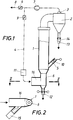
- the device shown consists of a riser 1, which has a separator 2 in the form of a cyclone on the outlet side, from the exhaust pipe 3 of which a gas pipe 4 branches off, which flows below a feed 5 into a tapered section 6 of the riser 1.
- the distribution of the gas flow conveyed through the riser 1 by means of an induced draft fan 7 to the bypass line 4 and an exhaust gas line 8 is forced via control flaps 9 in these lines 4 and 8.
- the coking Waste materials which do not exceed a predetermined piece size due to a pre-screening, are passed through a heating device 11, for example a heat exchanger, via the feed task 5, which is provided with a weight-loaded pendulum flap 10 for airtight closure and flows through the gas duct 4 into the riser 1.
- warmed conveying gas flow abandoned which carries the waste with the exception of the heavy particles, which are generally formed by the non-coking residues such as glass, stones and metals.
- the increasing weight loss with increasing drying causes a corresponding entrainment by the conveying gas flow, with an advantageous heat transfer between the free-flying waste materials and the hot gases flowing around them, which ensures uniform coking of the waste materials.
- the coked waste materials are discharged from the riser 1 with the carbonization gases and separated from the exhaust gas stream in the subsequent material separator, so that the coked waste materials can be fed into the discharge line 13, which also has an airtight closure 14, for further use.
- Part of the exhaust gas flow is conveyed back to the riser 1 via the gas duct 4, but after a corresponding supply of heat.
- the heating device 11 can be used for this purpose.
- Another possibility is to add hot flue gases to the gas flow, as shown in FIG. 2.
- the burner 15 provided for this ends in the gas duct connection 16 to the riser shaft 1. The burner must of course be set so that the flue gases do not have an excess of air which adversely affects the smoldering process.
- the gases supplied to the riser in an amount of, for example, 4.1 m3 / sec with a temperature of 600 ° C. are accelerated in the tapered section 6 of the riser 1 to a flow rate of 30 to 50 m / sec, while in the riser 1 a flow rate have from 5 to 15 m.
- the riser 1 is generally 5 to 30 m high.
- the gas temperature in the area of the exhaust gas line 3 is approximately 400 ° C.
- the treatment section for the waste materials can be divided into a drying zone 17 and a smoldering zone 18, as is indicated in FIG. 3.
- the drying zone 17 consists of a riser 1 according to the embodiment of FIGS. 1 and 2, but is designed so that the waste materials are essentially only dried.
- the dried waste materials are then fed via the discharge line 13, at most via a screening device 19, to a multi-stage heat exchanger 20, the heat exchanger stages a, b, and c of which a hot conveying gas stream flows through, each consisting of a riser pipe 21 with a subsequent separator 22 designed as a cyclone.
- the dried waste materials are passed to the last heat exchanger stage a with the lowest temperature level with regard to the gas flow in order to be subjected to complete coking in stages via the middle heat exchanger stage b and the heat exchanger stage c with the highest temperature level.
- the smoldering gases occurring in the area of the heat exchanger 20 are partly conducted in a circuit via a gas recirculation line 23 between the gas outlet 24 and the gas inlet 25 of the heat exchanger 20 and are heated outside the heat exchanger 20, the heat being analogous via a heating device 11 or a burner 15 can be supplied from the drying zone 17 for heating the exhaust gases.
- the heat transfer medium for the heat exchanger 20 which at least essentially consists of the carbonization gases produced, is conveyed through the heat exchanger 20 via a suction fan 26 and forms a conveying gas flow for the material to be treated.
- the distribution of the exhaust gases from the heat exchanger 20 to the gas line 23 and the exhaust gas line 27 is again controlled by control flaps 9.
Landscapes
- Chemical & Material Sciences (AREA)
- Engineering & Computer Science (AREA)
- Oil, Petroleum & Natural Gas (AREA)
- Combustion & Propulsion (AREA)
- Materials Engineering (AREA)
- Organic Chemistry (AREA)
- Dispersion Chemistry (AREA)
- Chemical Kinetics & Catalysis (AREA)
- General Chemical & Material Sciences (AREA)
- Treatment Of Sludge (AREA)
Applications Claiming Priority (2)
| Application Number | Priority Date | Filing Date | Title |
|---|---|---|---|
| AT1264/91 | 1991-06-25 | ||
| AT126491A AT398206B (de) | 1991-06-25 | 1991-06-25 | Schwelverfahren und vorrichtung zur freifliegenden niedertemperaturverkokung von zumindest teilweise organischen abfallstoffen |
Publications (2)
| Publication Number | Publication Date |
|---|---|
| EP0520977A2 true EP0520977A2 (fr) | 1992-12-30 |
| EP0520977A3 EP0520977A3 (en) | 1993-01-13 |
Family
ID=3510130
Family Applications (1)
| Application Number | Title | Priority Date | Filing Date |
|---|---|---|---|
| EP19920890153 Withdrawn EP0520977A3 (en) | 1991-06-25 | 1992-06-24 | Process and apparatus for the low temperature carbonization of at least partially organic waste |
Country Status (2)
| Country | Link |
|---|---|
| EP (1) | EP0520977A3 (fr) |
| AT (1) | AT398206B (fr) |
Cited By (3)
| Publication number | Priority date | Publication date | Assignee | Title |
|---|---|---|---|---|
| CN105586078A (zh) * | 2014-10-21 | 2016-05-18 | 中国石油化工股份有限公司 | 一种重油焦化方法 |
| CN105586079A (zh) * | 2014-10-21 | 2016-05-18 | 中国石油化工股份有限公司 | 一种重油焦化方法 |
| CN105586077A (zh) * | 2014-10-21 | 2016-05-18 | 中国石油化工股份有限公司 | 一种重油焦化设备 |
Family Cites Families (6)
| Publication number | Priority date | Publication date | Assignee | Title |
|---|---|---|---|---|
| DE1160823B (de) * | 1954-10-14 | 1964-01-09 | Kloeckner Humboldt Deutz Ag | Verfahren zum kontinuierlichen Entgasen, wie Schwelen und/oder Verkoken, von feinkoernigen, nicht backenden, wasserhaltigen Brennstoffen mittels heisser Gasstroeme |
| US3776150A (en) * | 1972-03-06 | 1973-12-04 | Awt Systems Inc | Fluidized bed system for solid wastes |
| US3977947A (en) * | 1972-07-26 | 1976-08-31 | The Kingsford Company | Fluidized bed carbonization |
| US4239599A (en) * | 1978-08-23 | 1980-12-16 | Occidental Petroleum Corporation | Process for stripping oil from fluidized ash and char particles to prepare the particles for decarbonization |
| GB2041396B (en) * | 1979-01-09 | 1983-01-19 | G N I Energeti I Im G K Krzhiz | Method and apparatus for heat processing pulverized brown coal |
| AT389886B (de) * | 1987-12-24 | 1990-02-12 | Waagner Biro Ag | Verfahren und einrichtung zur verkohlung von biomassen in zwei fluidisierungsstufen |
-
1991
- 1991-06-25 AT AT126491A patent/AT398206B/de not_active IP Right Cessation
-
1992
- 1992-06-24 EP EP19920890153 patent/EP0520977A3/de not_active Withdrawn
Cited By (6)
| Publication number | Priority date | Publication date | Assignee | Title |
|---|---|---|---|---|
| CN105586078A (zh) * | 2014-10-21 | 2016-05-18 | 中国石油化工股份有限公司 | 一种重油焦化方法 |
| CN105586079A (zh) * | 2014-10-21 | 2016-05-18 | 中国石油化工股份有限公司 | 一种重油焦化方法 |
| CN105586077A (zh) * | 2014-10-21 | 2016-05-18 | 中国石油化工股份有限公司 | 一种重油焦化设备 |
| CN105586077B (zh) * | 2014-10-21 | 2017-05-24 | 中国石油化工股份有限公司 | 一种重油焦化设备 |
| CN105586078B (zh) * | 2014-10-21 | 2017-11-03 | 中国石油化工股份有限公司 | 一种重油焦化方法 |
| CN105586079B (zh) * | 2014-10-21 | 2017-11-03 | 中国石油化工股份有限公司 | 一种重油焦化方法 |
Also Published As
| Publication number | Publication date |
|---|---|
| AT398206B (de) | 1994-10-25 |
| EP0520977A3 (en) | 1993-01-13 |
| ATA126491A (de) | 1994-02-15 |
Similar Documents
| Publication | Publication Date | Title |
|---|---|---|
| DE2929056C2 (fr) | ||
| EP2388542B1 (fr) | Procédé et dispositif destiné au séchage en continu de matériaux en vrac, en particulier de fibres de bois et/ou de copeaux de bois | |
| DE4017806A1 (de) | Verfahren und anlage zur kontinuierlichen trocknung von holzspaenen, holzfasern oder anderen schuettguetern | |
| DE2256385A1 (de) | Verfahren und vorrichtung zum kontinuierlichen erhitzen feinkoerniger materialien, insbesondere kohle, auf eine gleichmaessige genau kontrollierte endtemperatur | |
| EP0067299A2 (fr) | Procédé et dispositif pour l'exploitation d'une batterie de fours à coke | |
| DE3118931A1 (de) | Verfahren und vorrichtung zum betrieb einer kokereianlage | |
| DE3715668A1 (de) | Verfahren und anlage zum reinigen von trocknungsabgasen beim trocknen von holzspaenen, holzfasern oder dergleichen | |
| DE2626653C3 (de) | Verfahren und Vorrichtung zum Trocknen und Vorerhitzen von Kokskohle | |
| DE2643406B2 (de) | Tunnelofen mit Direktbefeuerung | |
| DE102010014479B4 (de) | Vorrichtung und Verfahren zur Heißgaserzeugung mit integrierter Erhitzung eines Wärmeträgermediums | |
| DE3237791A1 (de) | Mehrstufiges verfahren und einrichtung zum trocknen von teilchenfoermigem kohlenstoffhaltigem material | |
| DE3047060C2 (de) | Verfahren und Vorrichtung zum Trocknen und Verbrennen von Schlamm | |
| DE2451197A1 (de) | Verfahren und vorrichtung zum calzinieren von pulvermaterial | |
| AT398206B (de) | Schwelverfahren und vorrichtung zur freifliegenden niedertemperaturverkokung von zumindest teilweise organischen abfallstoffen | |
| DE2851005C2 (de) | Verfahren und Vorrichtung zum Trocknen von Schlamm | |
| DE2415024B2 (fr) | ||
| EP0030376B1 (fr) | Procédé et dispositif de séchage et de réchauffage de charbon humide | |
| DE2819232C2 (de) | Verfahren zum Vorerhitzen und unmittelbar anschließenden Verkoken von Kohle | |
| DE4022702C1 (fr) | ||
| DE2812005C3 (de) | Verfahren zur Herstellung von abtriebfesten Koksformlingen | |
| DE3509275C2 (de) | Verfahren zur thermischen Behandlung von Waschbergen | |
| DE3831270A1 (de) | Verfahren und vorrichtung zum trocknen und klassifizieren von schuettgut | |
| DE1218927B (de) | Vorrichtung zum thermischen Behandeln von Magnesit, Dolomit und Kalk und Verfahren zu deren Betrieb | |
| DE1160823B (de) | Verfahren zum kontinuierlichen Entgasen, wie Schwelen und/oder Verkoken, von feinkoernigen, nicht backenden, wasserhaltigen Brennstoffen mittels heisser Gasstroeme | |
| DE2514356A1 (de) | Pyroscrubber |
Legal Events
| Date | Code | Title | Description |
|---|---|---|---|
| PUAI | Public reference made under article 153(3) epc to a published international application that has entered the european phase |
Free format text: ORIGINAL CODE: 0009012 |
|
| PUAL | Search report despatched |
Free format text: ORIGINAL CODE: 0009013 |
|
| AK | Designated contracting states |
Kind code of ref document: A2 Designated state(s): CH DE DK FR LI NL SE |
|
| AK | Designated contracting states |
Kind code of ref document: A3 Designated state(s): CH DE DK FR LI NL SE |
|
| 18D | Application deemed to be withdrawn |
Effective date: 19930714 |