EP0522307A2 - Thermoplastische Formmassen auf der Basis von Polyarylethern und teilaromatischen Copolyamiden - Google Patents
Thermoplastische Formmassen auf der Basis von Polyarylethern und teilaromatischen Copolyamiden Download PDFInfo
- Publication number
- EP0522307A2 EP0522307A2 EP92109979A EP92109979A EP0522307A2 EP 0522307 A2 EP0522307 A2 EP 0522307A2 EP 92109979 A EP92109979 A EP 92109979A EP 92109979 A EP92109979 A EP 92109979A EP 0522307 A2 EP0522307 A2 EP 0522307A2
- Authority
- EP
- European Patent Office
- Prior art keywords
- weight
- units
- molding composition
- composition according
- derived
- Prior art date
- Legal status (The legal status is an assumption and is not a legal conclusion. Google has not performed a legal analysis and makes no representation as to the accuracy of the status listed.)
- Withdrawn
Links
- ATECOPMLLFWKKT-UHFFFAOYSA-N CCC(CC)C(CC1)CCC1C(C)(C)C(CC1)=CC=C1Oc(cc1)ccc1S(C(CC1)CCC1OC(CC)CC)(=O)=O Chemical compound CCC(CC)C(CC1)CCC1C(C)(C)C(CC1)=CC=C1Oc(cc1)ccc1S(C(CC1)CCC1OC(CC)CC)(=O)=O ATECOPMLLFWKKT-UHFFFAOYSA-N 0.000 description 1
Images


Classifications
-
- C—CHEMISTRY; METALLURGY
- C08—ORGANIC MACROMOLECULAR COMPOUNDS; THEIR PREPARATION OR CHEMICAL WORKING-UP; COMPOSITIONS BASED THEREON
- C08L—COMPOSITIONS OF MACROMOLECULAR COMPOUNDS
- C08L77/00—Compositions of polyamides obtained by reactions forming a carboxylic amide link in the main chain; Compositions of derivatives of such polymers
-
- C—CHEMISTRY; METALLURGY
- C08—ORGANIC MACROMOLECULAR COMPOUNDS; THEIR PREPARATION OR CHEMICAL WORKING-UP; COMPOSITIONS BASED THEREON
- C08L—COMPOSITIONS OF MACROMOLECULAR COMPOUNDS
- C08L71/00—Compositions of polyethers obtained by reactions forming an ether link in the main chain; Compositions of derivatives of such polymers
-
- C—CHEMISTRY; METALLURGY
- C08—ORGANIC MACROMOLECULAR COMPOUNDS; THEIR PREPARATION OR CHEMICAL WORKING-UP; COMPOSITIONS BASED THEREON
- C08L—COMPOSITIONS OF MACROMOLECULAR COMPOUNDS
- C08L79/00—Compositions of macromolecular compounds obtained by reactions forming in the main chain of the macromolecule a linkage containing nitrogen with or without oxygen or carbon only, not provided for in groups C08L61/00 - C08L77/00
- C08L79/02—Polyamines
-
- C—CHEMISTRY; METALLURGY
- C08—ORGANIC MACROMOLECULAR COMPOUNDS; THEIR PREPARATION OR CHEMICAL WORKING-UP; COMPOSITIONS BASED THEREON
- C08L—COMPOSITIONS OF MACROMOLECULAR COMPOUNDS
- C08L81/00—Compositions of macromolecular compounds obtained by reactions forming in the main chain of the macromolecule a linkage containing sulfur with or without nitrogen, oxygen or carbon only; Compositions of polysulfones; Compositions of derivatives of such polymers
- C08L81/06—Polysulfones; Polyethersulfones
Definitions
- thermoplastic molding compositions namely mixtures (blends) of a polyaryl ether and a partially aromatic copolyamide, which may also contain fibrous or particulate fillers, and their use for the production of moldings.
- Blends made of polyaryl ethers and polyamides are described, for example, in DE-OS 21 22 735.
- the addition of polyamide is said to improve the flowability of the polysulfone used.
- Blends made from polyamide and the highly heat-resistant polysulfone, on the other hand, have significantly better heat resistance than pure polyamide.
- the blends have only a slightly improved stiffness compared to polyaryl ether.
- polyaryl ethers A The production of polyaryl ethers A is generally known (cf. e.g. GB 1 152 035; US 4,870,153), as is the production of polyaryl ethers with a block structure (DE 3 742 264).
- the polyaryl ethers can have any end groups, such as. B. halogen, methoxy, hydroxyl, phenoxy, benzyloxy or amino end groups.
- the molecular weight of suitable polyaryl ethers (I) is generally in the range from 1500 to 60,000 g / mol.
- the polyaryl ether segments are present in copolymers - insofar as can be produced - with structural units of polyamides, polyesters, aromatic polycarbonates or polyester carbonates, polysiloxanes, polyimides or polyetherimides, the molecular weights of the blocks or of the graft arms in the copolymers are in the range from 1000 to 30,000 g / mol ; the blocks of different structure can be arranged alternately or randomly in the copolymers.
- the proportion by weight of the polyaryl ethers in the copolymers should be 3-97, preferably 10-90 and in particular 20-80% by weight. Methods for the synthesis of such copolymers are described by A. Noshay et. al., Block Copolymers, Academic Press, 1977.
- reaction of the monomers in aprotic polar solvents in the presence of anhydrous alkali carbonate is particularly suitable.
- a particularly preferred combination is N-methylpyrrolidone as a solvent and potassium carbonate as a catalyst or the reaction in the melt.
- the proportion by weight of the polyaryl ethers in the molding compositions according to the invention is 5 to 95, 15 to 85% by weight being particularly preferred.
- up to 2% by weight of at least one aromatic, secondary amine and / or up to 2000 ppm of at least one phosphorus-containing inorganic acid or derivatives thereof can also be added to the copolyamide or the blend to be prepared (stabilizers), the proportion of stabilizers based on the proportionate amount of copolyamide.
- the proportion of units derived from ⁇ -caprolactam is preferably 20 to 50% by weight, in particular 25 to 40% by weight, while the proportion of units derived from adipic acid and hexamethylenediamine is preferably 30 to 75% by weight .-% and in particular 35 to 60 wt .-%.
- the copolyamides can contain units of ⁇ -caprolactam as well as units of adipic acid and hexamethylenediamine; the proportion of such units which are free from aromatic groups is at least 10% by weight, preferably at least 20% by weight.
- the ratio of the units derived from ⁇ -caprolactam and from adipic acid and hexamethylenediamine can be any.
- the partially aromatic copolyamides can contain up to 40, preferably 10-30% by weight and in particular 20-30% by weight of further polyamide-forming monomers B3, as are known from other polyamides.
- suitable aromatic dicarboxylic acids such as isophthalic acid, substituted terephthalic and isophthalic acids such as 3-t-butylisophthalic acid, polynuclear dicarboxylic acids, e.g. B. 4,4'-diphenyldicarboxylic acid, 4,4'-diphenylmethane dicarboxylic acid, 4,4'- and 3,3'-diphenylsulfone dicarboxylic acid, 1,4- or 2,6-naphthalenedicarboxylic acid, phenoxy terephthalic acid, isophthalic acid being particularly preferred.
- aromatic dicarboxylic acids such as isophthalic acid, substituted terephthalic and isophthalic acids such as 3-t-butylisophthalic acid
- polynuclear dicarboxylic acids e.g. B. 4,4'-diphenyldicarboxylic acid, 4,4'-diphenylmethane dicarboxylic acid, 4,4
- polyamide-forming dicarboxylic acids are aliphatic dicarboxylic acids with 4 to 16 carbon atoms and as polyamide-forming diamines aliphatic or cycloaliphatic diamines with 4 to 16 carbon atoms.
- Suitable monomers of this type are suberic acid, Azelaic acid or sebacic acid or 1,4-butanediamine, 1,5-pentanediamine, piperazine, 4,4'-diaminodicyclohexylmethane, 2,2- (4,4'-diaminodicyclohexyl) propane or 3,3'-dimethyl-4,4 '-Diaminodicyclohexylmethane called.
- Capryllactam, enanthlactam, ⁇ -aminoundecanoic acid and laurolactam from the group of the lactams or aminocarboxylic acids are suitable as suitable.
- the partially aromatic copolyamides have a triamine content of less than 0.5, preferably less than 0.3% by weight.
- Partly aromatic copolyamides produced by most known processes have triamine contents which are above 0.5% by weight, which leads to a deterioration in product quality and to problems in continuous production.
- the diamine which causes these problems is, in particular, the dihexamethylene triamine which is formed from the hexamethylene diamine used in the preparation.
- Copolyamides with a low triamine content, with the same solution viscosity, have lower melt viscosities compared to products of the same composition, which have a higher triamine content. This significantly improves both the processability and the product properties.
- the melting points of the partially aromatic copolyamides are in the range from 270 ° C. to 325 ° C., preferably from 280 to 310 ° C., this high melting point also with a high glass transition temperature of generally more than 75, in particular more than 85 ° C. (in dry state).
- Binary copolyamides based on terephthalic acid, hexamethylene diamine and ⁇ -caprolactam have a melting point in the range of 300 ° C and (in the dry state) a glass transition temperature at contents of about 70% by weight of units derived from terephthalic acid and hexamethylene diamine of more than 110 ° C.
- Binary copolyamides based on terephthalic acid, adipic acid and hexamethylenediamine reach a melting point of 300 ° C and more even at a lower content (e.g. of about 55% by weight of units) of terephthalic acid and hexamethylenediamine (HMD), the glass temperature not quite as high is like binary copolyamides which contain ⁇ -caprolactam instead of adipic acid or adipic acid / HMD.
- partially aromatic copolyamides is preferably understood to mean those which have a degree of crystallinity of more than 10%, preferably more than 15% and in particular more than 20%.
- the degree of crystallinity is a measure of the proportion of crystalline fragments in the copolyamide and is determined by X-ray diffraction.
- the preferred partially aromatic copolyamides with a low triamine content are reliably obtained by the processes described in EP-A 129 195 and 129 196.
- the relative viscosity of the partially aromatic copolyamides measured in 1% by weight solution in 96% by weight H2SO4 at 23 ° C., is generally in the range from 2.2 to 5.0, preferably from 2.3 to 4.5 .
- copolyamides B Mixtures of different copolyamides can of course also be used as copolyamides B, the mixing ratio being arbitrary.
- Preferred radicals A or B are symmetrically substituted tertiary carbon atoms, with dimethyl-substituted tertiary carbon being particularly preferred. Also preferred are tertiary carbons which have 1 to 3 phenyl groups as substituents.
- R 1 or R 2 are para t-butyl or tetramethyl-substituted n-butyl, where the methyl groups can preferably be replaced by 1 to 3 phenyl groups.
- Preferred halogens are chlorine and bromine.
- Preferred secondary aromatic amines are diphenylamine and its derivatives, which are commercially available as Naugard® (Uniroyal).
- the molding compositions according to the invention contain e.g. 100 to 2000, preferably 200 to 500 and in particular 200 to 400 ppm of at least one phosphorus-containing inorganic acid or derivatives thereof (based on the polyamide B in the molding composition).
- Preferred acids are hypophosphorous acid, phosphorous acid or phosphoric acid and their salts with alkali metals, sodium and potassium being particularly preferred.
- Preferred mixtures are in particular hypophosphorous and phosphorous acid or their alkali metal salts in a ratio of 3: 1 to 1: 3.
- Organic derivatives of these acids are preferably understood to mean ester derivatives of the abovementioned acids.
- the partially aromatic copolyamides are characterized by very good heat resistance and good mechanical properties, the good property level being maintained by the high glass transition temperature even after conditioning over a relatively large temperature range. These properties are also imparted to the blends according to the invention with polyaryl ethers which are highly heat-resistant.
- the molding compositions according to the invention can e.g. contain up to 40, preferably from 5 to 35 wt .-% fibrous or particulate fillers or mixtures thereof.
- fillers are carbon or glass fibers in the form of glass fabrics, glass mats or glass silk rovings, glass balls and wollastonite.
- Preferred fibrous fill reinforcing materials are carbon fibers, potassium titanate whiskers, aramid fibers and particularly preferably glass fibers.
- glass fibers are used, they can be equipped with a size and an adhesion promoter for better compatibility with the matrix material.
- the carbon and glass fibers used have a diameter in the range from 6 to 20 ⁇ m.
- the glass fibers can be incorporated both in the form of short glass fibers and in the form of endless strands (rovings).
- the average length of the glass fibers is preferably in the range from 0.08 to 0.5 mm.
- Suitable particulate fillers are amorphous silica, asbestos, magnesium carbonate (chalk), powdered quartz, mica, talc, feldspar and in particular calcium silicates such as wollastonite and kaolin (preferably calcined kaolin).
- Preferred combinations of fillers are e.g. 20% by weight of glass fibers with 15% by weight of wollastonite and 15% by weight of glass fibers with 15% by weight of wollastonite.
- the molding compositions according to the invention can e.g. contain up to 40% by weight of other additives such as flame retardants and UV stabilizers.
- thermoplastic molding compositions according to the invention can be produced by processes known per se by mixing in customary mixing devices such as kneaders or screw extruders, preferably twin-screw extruders, Brabender mills or Banbury mills, and then extruding them.
- customary mixing devices such as kneaders or screw extruders, preferably twin-screw extruders, Brabender mills or Banbury mills, and then extruding them.
- Intensive mixing is necessary to obtain the most homogeneous molding material possible. Average mixing times of 0.2 to 30 minutes at a temperature of 280 to 380 ° C. are generally required for this.
- the order of mixing the components can be varied, so 2 components can be premixed if necessary, but all components can also be mixed together.
- the molding compositions according to the invention are distinguished by high heat resistance, good flowability and excellent rigidity (modulus of elasticity).
- the molding compositions according to the invention are suitable for producing molded parts, in particular for electrical and electronic device components.
- the high heat resistance in combination with good chemical resistance also enables applications in chemical-technical plant construction.
- the ingredients were mixed in a twin-screw extruder at a melt temperature of 310 to 350 ° C.
- the melt was passed through a water bath and granulated.
- the polyamides used each contain, based on the proportion of polyamides in the blend, 1% by weight 4,4'-bis ( ⁇ , ⁇ -dimethylbenzyl) diphenylamine (Naugard® 445, Uniroyal) and 500 ppm NaH2PO3 x 5 H2O (commercial product from Merck).
- the dried granulate was processed into shoulder sticks and standard small sticks at 310 to 330 ° C.
- the Vicat softening temperature was determined according to DIN 53 460, with a force of 49.05 N and a temperature increase of 50 K per hour, on standard small bars.
- the modulus of elasticity was determined according to DIN 53 457-3 on shoulder bars.
- Table 1 Molding compound no. 1 2nd 3rd 4th 5 V1 V2 V3 Component [% by weight] A1 100 75 50 25th 0 50 25th - B - 25th 50 75 100 - - - PA - - - - - 50 75 100 T Vicat [° C] 182 178 179 185 285 nb nb nb Modulus of elasticity [N / mm2] 2700 3100 3300 3470 3500 2700 2720 2790 nb: not determined Molding compound no.
- the molding compositions according to the invention are notable for high heat resistance and rigidity.
Landscapes
- Chemical & Material Sciences (AREA)
- Health & Medical Sciences (AREA)
- Chemical Kinetics & Catalysis (AREA)
- Medicinal Chemistry (AREA)
- Polymers & Plastics (AREA)
- Organic Chemistry (AREA)
- Compositions Of Macromolecular Compounds (AREA)
Abstract
Description
- Die Erfindung betrifft thermoplastische Formmassen, nämlich Mischungen (Blends) aus einem Polyarylether und einem teilaromatischen Copolyamid, die außerdem faser- oder teilchenförmige Füllstoffe enthalten können und deren Verwendung zur Herstellung von Formkörpern.
- Blends aus Polyarylethern und Polyamiden werden beispielsweise in der DE-OS 21 22 735 beschrieben. Der Zusatz von Polyamid soll die Fließfähigkeit des eingesetzten Polysulfons verbessern. Aus Polyamid und dem hochwärmeformbeständigen Polysulfon hergestellte Blends haben andererseits im Vergleich zum reinen Polyamid eine deutlich verbesserte Wärmeformbeständigkeit.
- Werden aliphatische Polyamide verwendet, weisen die Blends im Vergleich zum Polyarylether eine nur geringfügig verbesserte Steifigkeit auf.
- Es wurde nun gefunden, daß sich Mischungen aus Polyarylethern und teilaromatischen Copolyamiden durch hervorragende Steifigkeit und hohe Wärmeformbeständigkeit auszeichnen.
- Unmittelbarer Erfindungsgegenstand sind Formmassen, die enthalten - bezogen auf die Summe aus A bis C -
- A:
- 5 bis 95 Gew.-% eines Polyarylethers,
- B:
- 5 bis 95 Gew.-% eines teilaromatischen Copolyamids sowie im Bedarfsfalle
- C:
- bis 40 Gew.-% eines faser- oder teilchenförmigen Füllstoffs oder deren Mischungen.
- Die Herstellung der Polyarylether A ist allgemein bekannt (vgl. z.B. GB 1 152 035; US 4 870 153), ebenso die Herstellung von Polyarylethern mit Blockstruktur (DE 3 742 264).
- Polyarylether sind gekennzeichnet durch wiederholte Strukturelemente I

oder deren kernsubstituierte C₁-C₆-Alkyl-, Alkoxy-, Aryl-, Chlor- oder Fluorderivate, wobei
X und Z unabhängig voneinander
-SO₂-, -SO-, -O-, -CO- oder -N=N-,
und Z außerdem
-S-, -CR''=CR'''- eine chemische Bindung oder -CRR'- bedeuten, mit der Maßgabe, daß mindestens eine der Variablen X oder Z -SO₂- oder -CO-bedeuten, wobei R und R' jeweils Wasserstoffatome, C₁-C₆-Alkyl oder C₁-C₆-Alkoxy, Aryl oder deren Fluor- oder Chlorderivate und R'' und R''' jeweils Wasserstoffatome oder C₁-C₆-Alkyl darstellen. - Die Polyarylether können beliebige Endgruppen, wie z. B. Halogen-, Methoxy-, Hydroxy-, Phenoxy-, Benzyloxy- oder Aminoendgruppen enthalten.
- Das Molekulargewicht geeigneter Polyarylether (I) liegt im allgemeinen im Bereich von 1500 - 60000 g/mol.
- Liegen die Polyarylethersegmente in Copolymeren - soweit herstellbar - mit Struktureinheiten von Polyamiden, Polyestern, aromatischen Polycarbonaten oder Polyestercarbonaten, Polysiloxanen, Polyimiden oder Polyetherimiden vor, sind die Molekulargewichte der Blöcke- bzw. der Pfropfarme in den Copolymeren im Bereich von 1000 - 30000 g/mol; die Blöcke unterschiedlicher Struktur können in den Copolymeren alternierend oder statistisch angeordnet sein. Der Gewichtsanteil der Polyarylether in den Copolymeren soll 3 - 97, vorzugsweise 10 - 90 und insbesondere 20 - 80 Gew.-% betragen. Methoden zur Synthese solcher Copolymerer sind bei A. Noshay et. al., Block Copolymers, Academic Press, 1977, beschrieben.
- Geeignete Verfahrensbedingungen zur Synthese von Polyarylethern sind beispielsweise in den EP-A-113 112 und EP-A-135 130 beschrieben.
- Besonders geeignet ist die Umsetzung der Monomeren in aprotischen polaren Lösungsmitteln in Gegenwart von wasserfreiem Alkalicarbonat. Eine besonders bevorzugte Kombination ist N-Methylpyrrolidon als Lösungsmittel und Kaliumcarbonat als Katalysator oder die Umsetzung in der Schmelze.
- Der Gewichtsanteil der Polyarylether an den erfindungsgemäßen Formmassen beträgt 5 bis 95, besonders bevorzugt sind 15 bis 85 Gew.-%.
- Die für die erfindungsgemäßen Formmassen verwendeten teilaromatischen Copolyamide B bestehen z.B. aus
- B1:
- 20 bis 90 Gew.-% Einheiten, die sich von Terephthalsäure und Hexamethylendiamin ableiten und
- B2:
- 10 bis 80 Gew.-% Einheiten mindestens eines der Bausteine B 21, B 22 und/oder B 23, nämlich
- B21:
- bis zu 50 Gew.-% Einheiten B 21, die sich von ε-Caprolactam ableiten,
- B22:
- bis zu 80 Gew.-% Einheiten B 22, die sich von Adipinsäure und Hexamethylendiamin ableiten und/oder
- B23:
- bis zu 40 Gew.-% Einheiten B 23 aus weiteren polyamidbildenden Monomeren.
- Zur Stabilisierung gegen oxydativen und thermischen Abbau können darüber hinaus dem Copolyamid oder dem herzustellenden Blend bis zu 2 Gew.-% mindestens eines aromatischen, sekundären Amins und/oder bis zu 2000 ppm mindestens einer phosphorhaltigen anorganischen Säure oder deren Derivate zugesetzt werden (Stabilisatoren), wobei der Anteil an Stabilisatoren sich auf die anteilige Menge an Copolyamid bezieht.
- Der Anteil an Einheiten, die sich von ε-Caprolactam ableiten, beträgt vorzugsweise 20 bis 50 Gew.-%, insbesondere 25 bis 40 Gew.-%, während der Anteil an Einheiten die sich von Adipinsäure und Hexamethylendiamin ableiten, vorzugsweise 30 bis 75 Gew.-% und insbesondere 35 bis 60 Gew.-% beträgt.
- Die Copolyamide können sowohl Einheiten von ε-Caprolactam als auch Einheiten von Adipinsäure und Hexamethylendiamin enthalten; dabei beträgt der Anteil an solchen Einheiten, die frei von aromatischen Gruppen sind, mindestens 10 Gew.-%, vorzugsweise mindestens 20 Gew.-%. Das Verhältnis der Einheiten, die sich von ε-Caprolactam und von Adipinsäure und Hexamethylendiamin ableiten, kann ein beliebiges sein.
- Bevorzugt werden Copolyamide, deren Zusammensetzung in einem Dreistoffdiagramm (vgl. Fig. 1) innerhalb des durch Eckpunkte X₁ bis X₅ festgelegten Fünfecks liegt, wobei die Punkte X₁ bis X₅ folgendermaßen definiert sind:
- X₁:
- 40 Gew.-% Einheiten B1
60 Gew.-% Einheiten B22 - X₂:
- 60 Gew.-% Einheiten B1
40 Gew.-% Einheiten B22 - X₃:
- 80 Gew.-% Einheiten B1
5 Gew.-% Einheiten B21 15 Gew.-% Einheiten B22 - X₄:
- 80 Gew.-% Einheiten B1
20 Gew.-% Einheiten B21 - X₅:
- 50 Gew.-% Einheiten B1
50 Gew.-% Einheiten B21 - Neben den vorstehend beschriebenen Einheiten B1 bis B22 können die teilaromatischen Copolyamide bis zu 40, vorzugsweise 10 - 30 Gew.-% und insbesondere 20 - 30 Gew.-% weitere polyamidbildende Monomeren B3 enthalten, wie sie von anderen Polyamiden bekannt sind.
- Zur Einbringung des Bausteins B 23 sind z.B. geeignet aromatische Dicarbonsäuren wie beispielsweise Isophthalsäure, substituierte Terephthal- und Isophthalsäuren wie 3-t-Butylisophthalsäure, mehrkernige Dicarbonsäuren, z. B. 4,4'-Diphenyldicarbonsäure, 4,4'-Diphenylmethandicarbonsäure, 4,4'- und 3,3'-Diphenylsulfondicarbonsäure, 1,4- oder 2,6-Naphthalindicarbonsäure, Phenoxyterephthalsäure, wobei Isophthalsäure besonders bevorzugt ist.
- Ferner geeignet als polyamidbildende Dicarbonsäuren sind aliphatische Dicarbonsäuren mit 4 bis 16 Kohlenstoffatomen und als polyamidbildende Diamine aliphatische oder cycloaliphatische Diamine mit 4 bis 16 Kohlenstoffatomen. Als geeignete Monomere dieser Art seien Suberinsäure, Azelainsäure oder Sebacinsäure bzw. 1,4-Butandiamin, 1,5-Pentandiamin, Piperazin, 4,4'-Diaminodicyclohexylmethan, 2,2-(4,4'-Diaminodicyclohexyl)propan oder 3,3'-Dimethyl-4,4'-Diaminodicyclohexylmethan genannt. Aus der Gruppe der Lactame bzw. Aminocarbonsäuren kommen Capryllactam, Önanthlactam, ω-Aminoundecansäure und Laurinlactam als geeignet infrage.
- Hierbei sind folgende Zusammensetzungen der Komponente B besonders bevorzugt:
- B1:
- 65 bis 85 Gew.-% Einheiten, die sich von Terephthalsäure und Hexamethylendiamin ableiten und
- B23:
- 15 bis 35 Gew.-% Einheiten, die sich von Isophthalsäure und Hexamethylendiamin ableiten
oder - B₁:
- 50 bis 70 Gew.-% Einheiten, die sich von Terephthalsäure und Hexamethylendiamin ableiten und
- B22:
- 10 bis 20 Gew.-% Einheiten, die sich von Adipinsäure und Hexamethylendiamin ableiten und
- B23:
- 20 bis 30 Gew.-% Einheiten, die sich von Isophthalsäure und Hexamethylendiamin ableiten
- Es sollte darauf geachtet werden, daß die teilaromatischen Copolyamide einen Triamingehalt von weniger als 0,5, vorzugsweise von weniger als 0,3 Gew.-% aufweisen.
- Nach den meisten bekannten Verfahren (vgl. US-A 4 603 166) hergestellte teilaromatische Copolyamide weisen Triamingehalte auf, die über 0,5 Gew.-% liegen, was zu einer Verschlechterung der Produktqualität und zu Problemen bei der kontinuierlichen Herstellung führt. Als Triamin, welches diese Probleme verursacht, ist insbesondere das Dihexamethylentriamin zu nennen, welches sich aus dem bei der Herstellung eingesetzten Hexamethylendiamin bildet.
- Copolyamide mit niedrigem Triamingehalt weisen bei gleicher Lösungsviskosität niedrigere Schmelzviskositäten im Vergleich zu Produkten gleicher Zusammensetzung auf, die einen höheren Triamingehalt aufweisen. Dies verbessert sowohl die Verarbeitbarkeit als auch die Produkteigenschaften erheblich.
- Die Schmelzpunkte der teilaromatischen Copolyamide liegen im Bereich von 270°C bis 325°C, bevorzugt von 280 bis 310°C, wobei dieser hohe Schmelzpunkt auch mit einer hohen Glasübergangstemperatur von in der Regel mehr als 75, insbesondere mehr als 85°C (im trockenen Zustand) verbunden ist.
- Binäre Copolyamide auf der Basis von Terephthalsäure, Hexamethylendiamin und ε-Caprolactam haben bei Gehalten von etwa 70 Gew.-% an Einheiten, die sich von Terephthalsäure und Hexamethylendiamin ableiten, einen Schmelzpunkt im Bereich von 300°C und (im trockenen Zustand) eine Glasübergangstemperatur von mehr als 110°C.
- Binäre Copolyamide auf der Basis von Terephthalsäure, Adipinsäure und Hexamethylendiamin erreichen bereits bei niedrigerem Gehalt (z.B. von etwa 55 Gew.-% Einheiten) an Terephthalsäure und Hexamethylendiamin (HMD) einen Schmelzpunkt von 300°C und mehr, wobei die Glastemperatur nicht ganz so hoch liegt wie bei binären Copolyamiden, die anstelle von Adipinsäure bzw. Adipinsäure/HMD ε-Caprolactam enthalten.
- Die Herstellung teilaromatischer Copolyamide mit hoher Wärmeformbeständigkeit und guten mechanischen Eigenschaften wird z.B. in der DE-OS 3 723 688 beschrieben.
- Unter dem Begriff "teilaromatische Copolyamide" werden erfindungsgemäß solche bevorzugt verstanden, die einen Kristallinitätsgrad mehr als 10 %, bevorzugt mehr als 15 %, und insbesondere mehr als 20 % aufweisen.
- Der Kristallinitätsgrad ist ein Maß für den Anteil an kristallinen Fragmenten im Copolyamid und wird durch Röntgenbeugung bestimmt.
- Die bevorzugten teilaromatischen Copolyamide mit niedrigem Triamingehalt werden nach den in den EP-A 129 195 und 129 196 beschriebenen Verfahren sicher erhalten.
- Die relative Viskosität der teilaromatischen Copolyamide, gemessen in 1 Gew.-% Lösung in 96 Gew.-% H₂SO₄ bei 23°C, liegt im allgemeinen im Bereich von 2,2 bis 5,0, vorzugsweise von 2,3 bis 4,5.
- Als Copolyamide B können natürlich auch Mischungen verschiedener Copolyamide eingesetzt werden, wobei das Mischungsverhältnis beliebig ist.
- Als Stabilisatoren enthalten die erfindungsgemäßen Formmassen üblicherweise entweder ein aromatisches sekundäres Amin oder eine Phosphorverbindung oder beides. Das aromatische sekundäre Amin wird z.B. in Mengen von 0,1 bis 2, vorzugsweise 0,5 bis 1,5 und insbesondere 0,7 bis 1 Gew.-%, verwendet. Geeignete derartige Amine können z.B. durch die allgemeine Formel
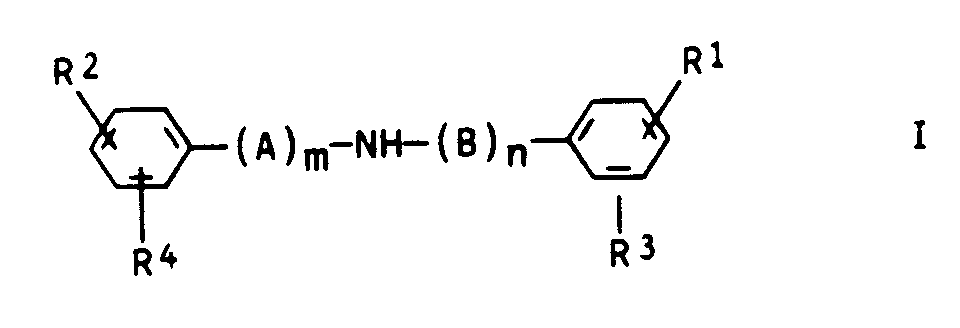
beschrieben werden, in der bedeuten - m, n:
- 0 oder 1;
- A, B:
- durch C₁-C₄-Alkyl oder Phenyl substituiertes tertiäres C;
- R¹, R³:
- Wasserstoff oder eine C₁-C₆-Alkylgruppe in ortho- oder para-Stellung, welche gegebenenfalls substituiert sein kann durch 1 bis 3 Phenylreste, Halogen, Carboxylgruppe oder ein übergangsmetallsalz dieser Carboxylgruppe und
- R³, R⁴:
- Wasserstoff oder einen Methylrest in ortho- oder para-Position, wenn m plus n für 1 steht oder eine tertiäre C₃-C₉-Alkylgruppe in ortho- oder para-Position, welche gegebenenfalls durch 1 bis 3 Phenylreste substituiert sein kann, wenn m plus n für 0 oder 1 steht.
- Bevorzugte Reste A oder B sind symmetrisch substituierte tertiäre Kohlenstoffatome, wobei dimethylsubstituierter tertiärer Kohlenstoff besonders bevorzugt ist. Ebenso bevorzugt sind tertiäre Kohlenstoffe, welche 1 bis 3 Phenylgruppen als Substituenten aufweisen.
- Bevorzugte Reste R¹ oder R² sind para t-butyl oder tetramethylsubstituiertes n-butyl, wobei die Methylgruppen vorzugsweise durch 1 bis 3 Phenylgruppen ersetzt sein können. Bevorzugte Halogene sind Chlor und Brom. Übergangsmetalle sind beispielsweise Kupfer oder Nickel, welche mit R¹ oder R² = Carboxyl-Übergangsmetallsalze bilden können.
- Bevorzugte Reste R³ oder R⁴ sind für m plus n = 2 Wasserstoff, sowie für m plus n = 0 oder 1 ein t-Butylrest in ortho- oder para-Position, welcher insbesondere durch 1 bis 3 Phenylreste substituiert sein kann.
- Beispiele für geeignete sekundäre aromatische Amine sind der nicht vorveröffentlichten deutschen Patentanmeldung P 4 112 324.7 zu entnehmen.
- Bevorzugte sekundäre aromatische Amine sind Diphenylamin und dessen Derivate, welche als Naugard® (Firma Uniroyal) im Handel erhältlich sind.
- Außerdem enthalten die erfindungsgemäßen Formmassen z.B. 100 bis 2000, bevorzugt 200 - 500 und insbesondere 200 bis 400 ppm mindestens einer phosphorhaltigen anorganischen Säure oder deren Derivate, (bezogen auf das Polyamid B in der Formmasse).
- Bevorzugte Säuren sind hypophosphorige Säure, phosphorige Säure oder Phosphorsäure sowie deren Salze mit Alkalimetallen, wobei Natrium und Kalium besonders bevorzugt sind. Bevorzugte Mischungen sind insbesondere hypophosphorige und phosphorige Säure bzw. deren Alkalimetallsalze im Verhältnis 3 : 1 bis 1 : 3. Unter organischen Derivaten dieser Säuren sollen vorzugsweise Esterderivate oben genannter Säuren verstanden werden.
- Die teilaromatischen Copolyamide zeichnen sich durch eine sehr gute Wärmeformbeständigkeit bei guten mechanischen Eigenschaften aus, wobei das gute Eigenschaftsniveau durch die hohe Glastemperatur auch nach Konditionierung über einen relativ großen Temperaturbereich aufrechterhalten wird. Diese Eigenschaften teilen sich auch den erfindungsgemäßen Blends mit hochwärmeformbeständigen Polyarylethern mit.
- Über die vorstehenden Bestandteile hinaus können die erfindungsgemäßen Formmassen z.B. bis 40, vorzugsweise von 5 bis 35 Gew.-% faser- oder teilchenförmige Füllstoffe oder deren Mischungen enthalten. Als Beispiele für Füllstoffe seien Kohlenstoff- oder Glasfasern in Form von Glasgeweben, Glasmatten oder Glasseidenrovings, Glaskugeln sowie Wollastonit genannt.
- Bevorzugte faserförmige Füllverstärkungsstoffe sind Kohlenstoffasern, Kaliumtitanatwhisker, Aramidfasern und besonders bevorzugt Glasfasern.
- Bei der Verwendung von Glasfasern können diese zur besseren Verträglichkeit mit dem Matrixmaterial mit einer Schlichte und einem Haftvermittler ausgerüstet sein. Im allgemeinen haben die verwendeten Kohlenstoff- und Glasfasern einen Durchmesser im Bereich von 6 bis 20 µm.
- Die Einarbeitung der Glasfasern kann sowohl in Form von Kurzglasfasern als auch in Form von Endlossträngen (Rovings) erfolgen. Im fertigen Spritzgußteil liegt die mittlere Länge der Glasfasern vorzugsweise im Bereich von 0,08 bis 0,5 mm.
- Als teilchenförmige Füllstoffe eignen sich amorphe Kieselsäure, Asbest, Magnesiumcarbonat (Kreide), gepulverter Quarz, Glimmer, Talkum, Feldspat und insbesondere Calciumsilikate wie Wollastonit und Kaolin (vorzugsweise kalzinierter Kaolin).
- Bevorzugte Kombinationen von Füllstoffen sind z.B. 20 Gew.-% Glasfasern mit 15 Gew.-% Wollastonit und 15 Gew.-% Glasfasern mit 15 Gew.-% Wollastonit.
- Zusätzlich zu den beschriebenen Bestandteilen können die erfindungsgemäßen Formmassen z.B. noch bis zu 40 Gew.-% weiterer Additive wie Flammschutzmittel und UV-Stabilisatoren enthalten.
- Die erfindungsgemäßen thermoplastischen Formmassen können nach an sich bekannten Verfahren hergestellt werden, indem man in üblichen Mischvorrichtungen wie Knetern oder Schneckenextrudern, vorzugsweise Zweischneckenextrudern, Brabender-Mühlen oder Banbury-Mühlen mischt und anschließend extrudiert.
- Um eine möglichst homogene Formmasse zu erhalten, ist eine intensive Durchmischung notwendig. Dazu sind im allgemeinen mittlere Mischzeiten von 0,2 bis 30 Minuten bei einer Temperatur von 280 bis 380°C erforderlich. Die Reihenfolge der Mischung der Komponenten kann variiert werden, so können 2 Komponenten ggf. vorgemischt werden, es können aber auch alle Komponenten gemeinsam gemischt werden.
- Die erfindungsgemäßen Formmassen zeichnen sich durch hohe Wärmeformbeständigkeit, gute Fließfähigkeit sowie hervorragende Steifigkeit (E-Modul) aus.
- Aufgrund ihrer hohen Wärmeformbeständigkeit und guten mechanischen Eigenschaften eignen sich die erfindungsgemäßen Formmassen zum Herstellen von Formteilen, insbesondere für elektrische und elektronische Gerätebauteile. Die hohe Wärmeformbeständigkeit in Kombination mit guter Chemikalienbeständigkeit ermöglicht auch Anwendungen im chemisch-technischen Anlagenbau.
- Es wurden die nachstehenden Rohstoffe bereitgestellt
-
- A₁:
- Polyarylether der überwiegenden Grundstruktur entsprechend Formel A₁, charakterisiert durch eine VZ von 64 ml/g, gemessen 1 %ig in Phenol/1,2 Dichlorbenzol 1:1.

-
- A₂:
- Polyarylether mit einer überwiegenden Grundstruktur entsprechend Formel A₂, charakterisiert durch eine VZ von 59 ml/g gemessen 1%-ig in Phenol/1,2-Dichlorbenzol 1:1.

-
- B:
- Teilaromatisches Copolyamid bestehend aus 55 Tl. Terephthalsäure, 35 Tl. ε-Caprolactam und 38,5 Tl. Hexamethylendiamin, charakterisiert durch eine relative Viskosität von 2,4 (gemessen 1%-ig in 96%-iger Schwefelsäure).
-
- C:
- Glasfaserrovings mit einer Dicke von 10 µm
Vergleichspolyamid
Für Vergleichsexperimente wurde ein aliphatisches Polyamid eingesetzt (PA): - PA:
- Polyhexamethylenadipinsäureamid mit einem K-Wert (nach Fikentscher) von 76; entsprechend einer relativen Viskosität ηrel von 2,95 gemessen 1%-ig in 96%-iger Schwefelsäure.
- Die Bestandteile wurden in einem Zweiwellenextruder bei einer Massetemperatur von 310 bis 350°C gemischt. Die Schmelze wurde durch ein Wasserbad geleitet und granuliert.
- Die verwendeten Polyamide (Komponente B und PA) enthalten jeweils, bezogen auf den Anteil der Polyamide im Blend, 1 Gew.-% 4,4'-Bis(α,α-dimethylbenzyl)diphenylamin (Naugard® 445, Firma Uniroyal) sowie 500 ppm NaH₂PO₃ x 5 H₂O (Handelsprodukt der Firma Merck).
- Das getrocknete Granulat wurde bei 310 bis 330°C zu Schulterstäben und Normkleinstäben verarbeitet.
- Die Vicat-Erweichungstemperatur wurde nach DIN 53 460, mit einer Kraft von 49,05 N und einer Temperatursteigerung von 50 K je Stunde, an Normkleinstäben bestimmt.
- Der Elastizitätsmodul wurde nach DIN 53 457-3 an Schulterstäben bestimmt.
- Zusammensetzung der Formmassen und Ergebnisse der Messungen sind den Tabellen 1 und 2 zu entnehmen.
Tabelle 1 Formmasse Nr. 1 2 3 4 5 V₁ V₂ V₃ Komponente [Gew.-%] A₁ 100 75 50 25 0 50 25 - B - 25 50 75 100 - - - PA - - - - - 50 75 100 TVicat [°C] 182 178 179 185 285 n.b. n.b. n.b. E-Modul [N/mm²] 2700 3100 3300 3470 3500 2700 2720 2790 n.b.: nicht bestimmt Tabelle 2 Formmasse Nr. 6 7 V4 8 9 10 11 12 13 Komponente [Gew.-%] A₁ - - - - 47 47 70 - - A₂ 67 50 50 100 - - - 70 47 B 33 50 - - 23 - - - 23 C - - - - 30 30 30 30 30 PA - - 50 - - 23 - - - TVicat [°C] 208 207 n.b. 217 183 211 184 214 212 E-Modul [N/mm²] 3300 3400 2750 2860 11000 9200 9300 9700 11600 n.b.: nicht bestimmt - Wie die Beispiele zeigen, zeichnen sich die erfindungsgemäßen Formmassen durch hohe Wärmeformbeständigkeit und Steifigkeit aus.
- Bemerkenswert ist insbesondere, daß die E-Moduli der Blends über den theoretischen Werten (berechnet aus den Gewichtsanteilen und E-Moduli der Komponenten) liegen (Fig. 2 u. 3).
Claims (9)
- Thermoplastische Formmasse, enthaltend - bezogen auf die Summe aus A bis C -A: 5 bis 95 Gew.-% eines Polyarylethers A, mit wiederholten Strukturelementen I

X und Z unabhängig voneinander
-SO₂-, -SO-, -O-, -CO- oder -N=N-,
und Z außerdem
-S-, -CR''=CR'''- eine chemische Bindung oder -CRR'- bedeuten, mit der Maßgabe, daß mindestens eine der Variablen X oder Z -SO₂-oder -CO- bedeuten, wobei R und R' jeweils Wasserstoffatome, C₁-C₆-Alkyl oder C₁-C₆-Alkoxy, Aryl oder deren Fluor- oder Chlorderivate und R'' und R''' jeweils Wasserstoffatome oder C₁-6₆-Alkyl darstellenB: 5 bis 95 Gew.-% eines teilaromatischen Copolyamids B sowie im BedarfsfalleC: bis 40 Gew.-% eines faser- oder teilchenförmigen Füllstoffs C oder deren Mischungen. - Formmasse nach Anspruch 1, enthaltend
15 bis 85 Gew.-% A,
15 bis 85 Gew.-% B,
5 bis 35 Gew.-% C.
- Formmasse nach Anspruch 1, enthaltend als teilaromatisches Copolyamid B ein Copolyamid ausB1: 20 bis 90 Gew.-% Einheiten, die sich von Terephthalsäure und Hexamethylendiamin ableiten undB2: 10 bis 80 Gew.-% Einheiten mindestens eines der Bausteine B 21, B 22 und/oder B 23, nämlichB21: bis zu 50 Gew.-% Einheiten B21, die sich von ε-Caprolactam ableitenB22: bis zu 80 Gew.-% Einheiten B 22, die sich von Adipinsäure und Hexamethylendiamin ableiten und/oderB23: bis zu 40 Gew.-% Einheiten B 23 aus weiteren polyamidbildenden Monomeren.
- Formmasse nach Anspruch 1, enthaltend als Polyarylether ein Polysulfon mit überwiegenden Struktureinheiten der allgemeinen Formel

- Formmasse nach Anspruch 1, enthaltend ein Polyethersulfon, mit Struktureinheiten der allgemeinen Formel

- Formmasse nach Anspruch 5, enthaltend einen Polyarylether mit einer reduzierten Viskosität (gemessen in N-Methylpyrrolidon bei 25°C) von 0,3 bis 2,5.
- Formmasse nach Anspruch 1, enthaltend ein teilaromatisches Copolyamid aus
50 bis 80 Gew.-% Einheiten, die sich von Terephthalsäure und Hexamethylendiamin, sowie
20 bis 50 Gew.-% Einheiten, die sich von ε-Caprolactam ableiten. - Formmasse nach Anspruch 1, enthaltend, bezogen auf den Anteil an Copolyamid,
0,1 bis 2 Gew.-% mindestens eines aromatischen, sekundären Amins und
100 bis 2000 ppm mindestens einer phosphorhaltigen anorganischen Säure oder eines ihrer Derivate. - Formmasse nach Anspruch 1, enthaltend einen Füllstoff, nämlich Glasfasern, Wollastonit, Kohlenstoff-Fasern oder eine Mischung dieser Stoffe.
Applications Claiming Priority (2)
| Application Number | Priority Date | Filing Date | Title |
|---|---|---|---|
| DE4121705 | 1991-07-01 | ||
| DE4121705A DE4121705A1 (de) | 1991-07-01 | 1991-07-01 | Thermoplastische formmassen auf der basis von polyarylenethern und teilaromatischen copolyamiden |
Publications (2)
| Publication Number | Publication Date |
|---|---|
| EP0522307A2 true EP0522307A2 (de) | 1993-01-13 |
| EP0522307A3 EP0522307A3 (en) | 1993-08-04 |
Family
ID=6435148
Family Applications (1)
| Application Number | Title | Priority Date | Filing Date |
|---|---|---|---|
| EP19920109979 Withdrawn EP0522307A3 (en) | 1991-07-01 | 1992-06-13 | Thermoplastic moulding compounds on the basis of polyaryleneether and partially aromatic copolyamides |
Country Status (3)
| Country | Link |
|---|---|
| US (1) | US5527844A (de) |
| EP (1) | EP0522307A3 (de) |
| DE (1) | DE4121705A1 (de) |
Cited By (6)
| Publication number | Priority date | Publication date | Assignee | Title |
|---|---|---|---|---|
| EP0586985A1 (de) * | 1992-09-04 | 1994-03-16 | BASF Aktiengesellschaft | Stabilisierte Polyamid/Polyphenylenetherformmassen |
| EP0590392A3 (de) * | 1992-09-23 | 1994-11-09 | Basf Ag | Formmassen auf der Basis von Polyarylethern und schlagzähmodifizierten teilaromatischen Copolyamiden. |
| EP0666286A3 (de) * | 1994-02-07 | 1996-01-24 | Basf Ag | Formmassen auf der Basis von Polyarylenetherblends und Kohlefasern. |
| EP0702058A1 (de) * | 1994-08-17 | 1996-03-20 | Basf Aktiengesellschaft | Formmassen aus Polyarylenethern und Copolyamiden |
| US5981692A (en) * | 1997-05-15 | 1999-11-09 | Du Pont Canada Inc. | Semi-crystalline, semi-aromatic terpolymers with superior post-molding shrinkage and balance of mechanical performance |
| EP2594610B1 (de) | 2010-07-16 | 2018-11-07 | Nitto Shinko Corporation | Elektrisch isolierende harzzusammensetzung und laminatfolie daraus |
Families Citing this family (4)
| Publication number | Priority date | Publication date | Assignee | Title |
|---|---|---|---|---|
| DE19513848A1 (de) * | 1995-04-12 | 1996-10-17 | Basf Ag | Thermoplastische Formmassen auf der Basis von teilaromatischen Polyamiden und Polyetheramiden |
| DE19702590A1 (de) * | 1997-01-24 | 1998-07-30 | Basf Ag | Thermoplastische Formmassen |
| DE19731230A1 (de) | 1997-07-21 | 1999-01-28 | Basf Ag | Statistische Copolyamide enthaltende Formmassen, Verfahren zu ihrer Herstellung und ihre Verwendung |
| DE19839331A1 (de) | 1998-08-28 | 2000-03-02 | Basf Ag | Formmassen auf der Basis von Polyarylenethersulfonen und aliphatischen Polyamiden |
Family Cites Families (15)
| Publication number | Priority date | Publication date | Assignee | Title |
|---|---|---|---|---|
| GB1334857A (en) * | 1970-05-07 | 1973-10-24 | Ici Ltd | Thermoplastic polymer blends |
| US3904705A (en) * | 1973-11-30 | 1975-09-09 | Ici Ltd | Thermally stabilized synthetic polyamides |
| WO1980000349A1 (fr) * | 1978-08-04 | 1980-03-06 | Toray Industries | Composition de resine de moulage a resistance thermique |
| US4442249A (en) * | 1982-10-07 | 1984-04-10 | Fiber Industries, Inc. | Partially oriented polyester yarn finish |
| JPS59226082A (ja) * | 1983-06-06 | 1984-12-19 | Otsuka Chem Co Ltd | 熱可塑型耐熱性接着剤 |
| DE3321581A1 (de) * | 1983-06-15 | 1984-12-20 | Basf Ag, 6700 Ludwigshafen | Verfahren zur kontinuierlichen herstellung von polyamiden |
| DE3321579A1 (de) * | 1983-06-15 | 1984-12-20 | Basf Ag, 6700 Ludwigshafen | Verfahren zur kontinuierlichen herstellung von polyamiden |
| DE3641498A1 (de) * | 1986-12-04 | 1988-06-16 | Basf Ag | Thermoplastische formmassen auf der basis von polyamiden und polyaryletherketonen |
| US5252661A (en) * | 1987-07-17 | 1993-10-12 | Basf Aktiengesellschaft | Impact modifying rubber and partly aromatic copolyamides |
| DE3723688A1 (de) * | 1987-07-17 | 1989-01-26 | Basf Ag | Teilaromatische copolyamide mit verringertem triamingehalt |
| US5218082A (en) * | 1987-07-17 | 1993-06-08 | Basf Aktiengesellschaft | Partly aromatic copolyamide of reduced triamine content |
| DE3742444A1 (de) * | 1987-12-15 | 1989-07-06 | Basf Ag | Thermoplastische formmassen |
| DE3926904A1 (de) * | 1989-08-16 | 1991-02-21 | Basf Ag | Verfahren zur herstellung von verstaerkten, zaehmodifizierten thermoplastischen formmassen |
| CA2050512A1 (en) * | 1990-09-20 | 1992-03-21 | Pradeep M. Bapat | Polyamide-poly (aryl ether sulfone) blends |
| DE4039420A1 (de) * | 1990-12-08 | 1992-06-11 | Basf Ag | Thermoplastische formmassen auf der basis von polyamiden und thermoplastischen polyester-elastomeren |
-
1991
- 1991-07-01 DE DE4121705A patent/DE4121705A1/de not_active Withdrawn
-
1992
- 1992-06-13 EP EP19920109979 patent/EP0522307A3/de not_active Withdrawn
-
1995
- 1995-02-13 US US08/387,380 patent/US5527844A/en not_active Expired - Fee Related
Cited By (8)
| Publication number | Priority date | Publication date | Assignee | Title |
|---|---|---|---|---|
| EP0586985A1 (de) * | 1992-09-04 | 1994-03-16 | BASF Aktiengesellschaft | Stabilisierte Polyamid/Polyphenylenetherformmassen |
| EP0590392A3 (de) * | 1992-09-23 | 1994-11-09 | Basf Ag | Formmassen auf der Basis von Polyarylethern und schlagzähmodifizierten teilaromatischen Copolyamiden. |
| EP0666286A3 (de) * | 1994-02-07 | 1996-01-24 | Basf Ag | Formmassen auf der Basis von Polyarylenetherblends und Kohlefasern. |
| EP0702058A1 (de) * | 1994-08-17 | 1996-03-20 | Basf Aktiengesellschaft | Formmassen aus Polyarylenethern und Copolyamiden |
| US5639833A (en) * | 1994-08-17 | 1997-06-17 | Basf Aktiengesellschaft | Molding materials comprising polyarylene ethers and copolyamides |
| US5981692A (en) * | 1997-05-15 | 1999-11-09 | Du Pont Canada Inc. | Semi-crystalline, semi-aromatic terpolymers with superior post-molding shrinkage and balance of mechanical performance |
| EP2594610B1 (de) | 2010-07-16 | 2018-11-07 | Nitto Shinko Corporation | Elektrisch isolierende harzzusammensetzung und laminatfolie daraus |
| US11331876B2 (en) | 2010-07-16 | 2022-05-17 | Nitto Shinko Corporation | Electrically insulating resin composition and laminate sheet |
Also Published As
| Publication number | Publication date |
|---|---|
| DE4121705A1 (de) | 1993-01-07 |
| EP0522307A3 (en) | 1993-08-04 |
| US5527844A (en) | 1996-06-18 |
Similar Documents
| Publication | Publication Date | Title |
|---|---|---|
| EP1341849B1 (de) | Polyamid-formmassen mit verbesserten eigenschaften | |
| EP1994075B1 (de) | Teilaromatische Copolyamide mit hoher Kristallinität | |
| EP1276816B1 (de) | Polyarylethersulfon/polyamid-blends mit verbesserter zähigkeit und fliessfähigkeit | |
| DE3717928C2 (de) | ||
| EP1242538B1 (de) | Thermoplastische formmassen mit verbessertem verarbeitungsverhalten auf basis von polyarylenethersulfonen und polyamiden | |
| EP0355315A1 (de) | Thermoplastische Formmassen auf der Basis von Polyamidmischungen | |
| DE4404250A1 (de) | Teilaromatische Copolyamidformmassen mit hoher Kristallinität | |
| EP0509282B1 (de) | Stabilisierte thermoplastische teilaromatische Polyamidformmassen | |
| DE4414044A1 (de) | Polyphenylenether/Polyamid-Formmassen | |
| EP0621304B1 (de) | Verfahren zur Herstellung von flammgeschützten thermoplastischen Formmassen auf der Basis von Polyamiden. | |
| EP0490155B1 (de) | Thermoplastische Formmassen auf der Basis von Polyamiden und thermoplastischen Polyester-Elastomeren | |
| EP0702058B1 (de) | Formmassen aus Polyarylenethern und Copolyamiden | |
| EP0518022A1 (de) | Formmassen auf Basis aromatischer Polyamide | |
| DE68920526T2 (de) | Polyamid-Polyarylensulfid Blends. | |
| DE4121705A1 (de) | Thermoplastische formmassen auf der basis von polyarylenethern und teilaromatischen copolyamiden | |
| EP0728812B1 (de) | Thermoplastische Formmassen aus teilaromatischen und amorphen Copolyamiden | |
| DE3903364A1 (de) | Schlagzaehe polyamidformmassen | |
| EP0737719A2 (de) | Thermoplastische Formmassen auf der Basis von teilaromatischen Polyamiden und Polyetherimiden | |
| DE4444378A1 (de) | Thermoplastische Formmassen auf der Basis von teilaromatischen Polyamiden und Polymethacrylimiden | |
| EP0532963A2 (de) | Thermoplastische Formmassen auf der Basis von Polyamidmischungen | |
| WO1998036022A1 (de) | Flammgeschützte thermoplastische formmassen | |
| EP0590392B1 (de) | Formmassen auf der Basis von Polyarylethern und schlagzähmodifizierten teilaromatischen Copolyamiden | |
| DE1222674B (de) | Verfahren zur Herstellung von Polyamiden | |
| EP0350689B1 (de) | Flammgeschützte thermoplastische Formmassen auf der Basis teilaromatischer Copolyamide | |
| DE3641498A1 (de) | Thermoplastische formmassen auf der basis von polyamiden und polyaryletherketonen |
Legal Events
| Date | Code | Title | Description |
|---|---|---|---|
| PUAI | Public reference made under article 153(3) epc to a published international application that has entered the european phase |
Free format text: ORIGINAL CODE: 0009012 |
|
| AK | Designated contracting states |
Kind code of ref document: A2 Designated state(s): BE DE FR GB NL |
|
| PUAL | Search report despatched |
Free format text: ORIGINAL CODE: 0009013 |
|
| RHK1 | Main classification (correction) |
Ipc: C08L 77/00 |
|
| AK | Designated contracting states |
Kind code of ref document: A3 Designated state(s): BE DE FR GB NL |
|
| 17P | Request for examination filed |
Effective date: 19930705 |
|
| 17Q | First examination report despatched |
Effective date: 19950913 |
|
| STAA | Information on the status of an ep patent application or granted ep patent |
Free format text: STATUS: THE APPLICATION HAS BEEN WITHDRAWN |
|
| 18W | Application withdrawn |
Withdrawal date: 19960118 |