EP0522841A2 - Zersetzung von organischen Hydroperoxiden - Google Patents
Zersetzung von organischen Hydroperoxiden Download PDFInfo
- Publication number
- EP0522841A2 EP0522841A2 EP92306269A EP92306269A EP0522841A2 EP 0522841 A2 EP0522841 A2 EP 0522841A2 EP 92306269 A EP92306269 A EP 92306269A EP 92306269 A EP92306269 A EP 92306269A EP 0522841 A2 EP0522841 A2 EP 0522841A2
- Authority
- EP
- European Patent Office
- Prior art keywords
- decomposition
- catalyst
- hydroperoxide
- metal
- ligand
- Prior art date
- Legal status (The legal status is an assumption and is not a legal conclusion. Google has not performed a legal analysis and makes no representation as to the accuracy of the status listed.)
- Granted
Links
Images
Classifications
-
- C—CHEMISTRY; METALLURGY
- C07—ORGANIC CHEMISTRY
- C07C—ACYCLIC OR CARBOCYCLIC COMPOUNDS
- C07C45/00—Preparation of compounds having >C = O groups bound only to carbon or hydrogen atoms; Preparation of chelates of such compounds
- C07C45/51—Preparation of compounds having >C = O groups bound only to carbon or hydrogen atoms; Preparation of chelates of such compounds by pyrolysis, rearrangement or decomposition
- C07C45/53—Preparation of compounds having >C = O groups bound only to carbon or hydrogen atoms; Preparation of chelates of such compounds by pyrolysis, rearrangement or decomposition of hydroperoxides
-
- A—HUMAN NECESSITIES
- A62—LIFE-SAVING; FIRE-FIGHTING
- A62D—CHEMICAL MEANS FOR EXTINGUISHING FIRES OR FOR COMBATING OR PROTECTING AGAINST HARMFUL CHEMICAL AGENTS; CHEMICAL MATERIALS FOR USE IN BREATHING APPARATUS
- A62D3/00—Processes for making harmful chemical substances harmless or less harmful, by effecting a chemical change in the substances
- A62D3/30—Processes for making harmful chemical substances harmless or less harmful, by effecting a chemical change in the substances by reacting with chemical agents
- A62D3/37—Processes for making harmful chemical substances harmless or less harmful, by effecting a chemical change in the substances by reacting with chemical agents by reduction, e.g. hydrogenation
-
- C—CHEMISTRY; METALLURGY
- C07—ORGANIC CHEMISTRY
- C07C—ACYCLIC OR CARBOCYCLIC COMPOUNDS
- C07C29/00—Preparation of compounds having hydroxy or O-metal groups bound to a carbon atom not belonging to a six-membered aromatic ring
- C07C29/132—Preparation of compounds having hydroxy or O-metal groups bound to a carbon atom not belonging to a six-membered aromatic ring by reduction of an oxygen containing functional group
-
- A—HUMAN NECESSITIES
- A62—LIFE-SAVING; FIRE-FIGHTING
- A62D—CHEMICAL MEANS FOR EXTINGUISHING FIRES OR FOR COMBATING OR PROTECTING AGAINST HARMFUL CHEMICAL AGENTS; CHEMICAL MATERIALS FOR USE IN BREATHING APPARATUS
- A62D2101/00—Harmful chemical substances made harmless, or less harmful, by effecting chemical change
- A62D2101/20—Organic substances
- A62D2101/28—Organic substances containing oxygen, sulfur, selenium or tellurium, i.e. chalcogen
Definitions
- This invention relates to the decomposition of organic hydroperoxides with metal catalysts which provide desirably high reaction rates, to produce the corresponding alcohol.
- the catalysts employed according to the invention provide very high reaction rates at relatively low temperatures such as room temperature, in contrast to prior art catalysts which catalyze decomposition of organic hydroperoxides much more slowly and require elevated temperatures in order to achieve satisfactory reaction rates.
- Taylor et al U. S. patent 4,551,553 discloses decomposition of hydroperoxide by contact with a catalyst system comprising an admixture of Cr and Ru compounds which are soluble in the liquid hydroperoxide to be decomposed or in a diluent used in the process, such as a hydrocarbon, acid, ester or alcohol diluent, the reaction being conducted at 25° C to 250°C and atmospheric to 150 atmospheres pressure, to maintain the reactants in liquid phase. Mixtures of Cr and Ru acetylacetonates are given as examples of the catalysts used.
- Taylor et al disclose catalytic oxidation of hydrocarbons using organic hydroperoxide in the presence of Cr catalyst to produce alcohols and ketones, in U. S.
- Patent 3,879,467 the decomposition of cycloalkyl hydroperoxides with catalyst comprising a soluble derivative of V, Mo or Ru, in U. S. Patent 3,925,316; decomposition of hydroperoxides with binary homogeneous catalyst combinations of particular salts of Fe and Cu, in U. S. Patent 3,401,193; cyclohexane oxidation and decomposition of resultant cumene hydroperoxide using nonsoluble Re compound, in U. S.
- Patent 4,173,587 cumene hydroperoxide decomposition studies, employing certain forms of ruthenium, in "Use of the Proton NMR Relaxation Method to Study the Coordination of Cumene Hydroperoxide With Cobalt and Ruthenium Carboxylates" V. M. Nekipelov, Dokl. Akad. Nauk SSSR, V 261 (6), 1377-81 (1981); "NMR Studies of Mu3-Oxo-triruthenium Hexacarboxylate Cumene Hydroperoxide Interaction", A.M. Trzeciak, Oxid. Commun., V. 1(4), p.
- Worrell et al U. S. Patent 4,527,852 discloses a distillation process for purifying t-butyl hydoperoxide from an isobutane oxidate mixture.
- Other components of the oxidate mixture are t-butyl alcohol, water, acetone, organic acids, esters, peroxides.
- Patent 4,910,349 discloses the preparation of t-butyl alcohol by the catalytic decomposition of t-butyl hydroperoxide, preferably in solution in t-butyl alcohol, in the presence of a metal phthalocyanine of a metal of Group IB, Group VIIB or Group VIIIB, for example chloroferric phthalocyanine and rhenium heptoxide-p-dioxane or oxotrichloro-bis-(triphenylphosphine) rhenium V; at column 7, lines 27 to 35, this patent discloses that iron (III) phthalocyanine is more active than the cobalt (II) phthalocyanine and only 0.05% TBHP remains at 60 °C and 2.0 hours reaction time.
- a metal phthalocyanine of a metal of Group IB, Group VIIB or Group VIIIB for example chloroferric phthalocyanine and rhenium heptoxide-p-dioxane
- Grane et al U. S. Patent 4,296,262 discloses oxidation of isobutane with oxygen-containing as using Mo catalyst, and subsequently recovering t-butyl alcohol from the product mixture by distillation.
- PCY metal phthalocyanine
- Patent 4,022,034 discloses decomposition of t-butyl hydroperoxide to t-butyl alcohol using a metal porphine catalyst, for example tetraphenylporphine, optionally promoted with a thiol and a heterocyclic amine.
- a metal porphine catalyst for example tetraphenylporphine, optionally promoted with a thiol and a heterocyclic amine.
- Patent 4,922,033 discloses decomposition of t-butyl hydroperoxide to t-butyl alcohol with a soluble Ru catalyst such as Ru acetylacetonate, promoted with a bidentate ligand such as 2,2′-dipyridyl.
- Patent 4,912,266 discloses decomposition of t-butyl hydroperoxide with an imidazole-promoted metal PCY catalyst, for example Fe(III)PCYCl or Mn(II)PCY or VOPCY.
- an imidazole-promoted metal PCY catalyst for example Fe(III)PCYCl or Mn(II)PCY or VOPCY.
- Marquis et al U. S. Patent 4,992,602 discloses a continuous method for converting isobutane to isobutyl alcohol including the step of decomposing t-butyl hydroperoxide to t-butyl alcohol, using a monocyclic aromatic solvent and a PCY decomposition catalyst.
- Alkyl hydroperoxides are the products of alkane oxidation and their alcohol decomposition products are useful fuel and chemical products.
- t-butyl hydroperoxide is made by the oxidation of isobutane and can be decomposed to the high octane fuel additive, t-butyl alcohol, in the presence of metal complexes. Elevated temperature and/or high catalyst concentration is often needed, and product selectivity is often below 90%.
- the process of the invention provides a process for decomposing hydroperoxides to the corresponding alcohol which gives a desired decomposition at a faster rate, allowing lower temperatures and/or lower catalyst concentrations than those required in the prior art and a higher product selectivity at a given reaction temperature.
- the greater activity of the catalysts of this invention allows them to be used in much lower concentrations resulting in considerable savings in catalyst costs.
- the process of the invention provides the above and/or other advantages in the decomposition of organic hydroperoxides generally to the corresponding alcohols.
- the catalyst used according to the invention is a metal coordination complex catalyst containing a transition metal center and a ligand having the structure: where M is Fe, Mn, Co, Ru or Cr, Fe being preferred, is a ligand, X is one or more electron-withdrawing substituents for hydrogen in the ligand molecule, for example chloride, bromide, iodide, fluoride, or combinations thereof, or nitro or cyano, or combinations thereof with halogen and A is an anion or is absent.
- Preferred anions are azide, halide, hydroxide or nitride.
- the catalyst used according to one embodiment of the invention is a metal coordination complex catalyst containing a transition metal center and a halogenated ligand, where the ligand is for example tetraphenylporphyrin, related porphyrinato ligands, porphycenes, porphenes, phthalocyanines, 1,3-bis(2-pyridylimino)isoindoline (“BPI”) and other 1,3-bis(arylimino)-isoindolines, acetylacetonates, acetates, hydroxides, or a Schiff base such as salen, saleph or the like.
- the transition metal is iron and the ligand is a perhalogenated porphyrin.
- Halogenation of the ligand itself by replacement of hydrogen atoms therein with halogen atoms, and particularly perhalogenation, has been found to increase the activity of these catalysts for the decomposition of hydroperoxides according to the invention by increasing the rate of decomposition to the desired products.
- the catalyst according to this embodiment of the invention may have, in addition to the halogen atoms in the ligand, an anion, A, namely chloride, fluoride, bromide, iodide, azide, hydroxide or nitride.
- ligands are such macrocyclic groups as halogenated porphyrins, phthalocyanines, BPI, 1,3-bis(arylamino)isoindolines, Schiff bases and the like.
- ligands which may be employed in the catalysts of this invention are halogenated mono-, bi-, tri, and tetradentate ligand systems such as: propanates, butyrates, benzoates, naphthenates, stearates, acetylacetonates, and other betadiketones, 1,3-bis(arylimino)-isoindolates, salen, saleph, porphyrinates, porphycenates, porphenates, phthalocyanates, and like systems.
- Bipyridines terpyridines, phenanthrolines, dithio-carbamates, xanthates, salicylaldimines, cyclam, dioxy-cyclams, pyrazoylborates, and tetraazamacrocycles such as tetramethyltetraazadibenzocycloheptadecane, may also be used.
- the halogenated ligands are ligands in which halogen has been substituted for hydrogen in the ligand molecule. The halogens are believed to act as electron-withdrawing agents when the ligand is used as a catalyst for the decomposition of hydroperoxides. Other electron-withdrawing substituents than halogen may also be used, such as nitro or cyano.
- Cyano-substituted ligands like halogen-substituted ligands, are known for their electron withdrawal capabilities. Increased electron withdrawal from halogenation of the porphyrin ring has been correlated to increased catalytic air oxidation activity. J. E. Lyons & P. E. Ellis, Jr., Catalysis Letters, 8, 45 (1991).
- Cyano groups are known for their large electron-withdrawing inductive effects, and cyano-containing metalloporphyrins with cyano groups in the beta or pyrrolic positions have been shown to be more easily reduced than their precursors without cyano substitution.
- R. J. Donohoe, M. Atamian and D.F. Bocian J. Amer. Chem. Soc., 109, 5593 (1987).
- such cyano-substituted compounds are used in the catalytic decomposition of hydroperoxides.
- nitrated metalloporphyrins as catalysts for decomposition of hydroperoxides is contemplated in another embodiment of the invention.
- Successive nitration at the meso-positions of Zn(octaethylporphine), eventually giving Zn (meso-tetranitrooctaethyl porphine) has been found to lead to more easily reduced porphyrins, which is evidence for electron withdrawal from the rings.
- L. C. Gong and D.Dolphin Can. J. Chem, 63,401-5(1985).
- Other workers such as Catalano et al in J. Chem.
- the catalysts used according to the invention have been previously disclosed for use in oxidizing alkanes to the corresponding alcohols.
- Perhalogenated metal complexes have been disclosed in Ellis et al copending application Serial No. 07/568,118 filed August 16, 1990, the disclosure of which is herein incorporated by reference.
- Other patents disclosing use of metal coordination complex catalysts in oxidation of alkanes are Ellis et al U. S. Patents 4,895,680; 4,895,682 and 4,970,348.
- ligand is used herein in its conventional meaning and refers generically to a group or system of atoms which form one or more bonds to a metal ion, i.e., forms a coordination complex, and stabilizes the coordination complex in desirable oxidation states.
- Suitable ligands for the present purpose are the well-known phthalocyanines and porphyrins such as alkyl and aryl porphyrins such as tetraphenylporphyrins, octaethylporphyrins, tetramethylporphyrins and the like.
- alkyl or aryl on the basic porphyrin structure, the alkyls are C1-C4 and the aryls contain 1 or 2 rings which may themselves have alkyl substitutents.
- the electron-withdrawing component of the ligand, X can be fluoride, chloride, bromide, iodide or mixtures thereof, or cyano or nitro, but preferably among the halogens is one of the first three mentioned, more preferably fluoride.
- the degree of ligand halogenation should be complete, i.e., at least 90%, preferably 100%, which is customarily referred to as perhalogenation for which the conventional symbols are F -, Cl -, etc. We have found that complete halogenation may provide substantially superior results.
- the catalysts of our invention can be readily prepared by simple modifications of procedures described in the art for preparing unhalogenated ligands.
- the unhalogenated Fe(TPP)Cl complex in which "TPP” is tetraphenylporphyrinato
- TPP tetraphenylporphyrinato
- (TPP)H2 and Fe(II) (or other metal) chloride are refluxed together in a dimethylformamide solution. Purification is achieved by chromatography.
- TPP e.g., A. D. Adler et al, J. Inorg. Nucl. Chem ., 32, 2443 (1970).
- From these metal salts the corresponding azides may be prepared by metathesis reactions with dissolved NaN3 or hydrazoic acid.
- TPPF20 fluorination of benzaldehyde followed by condensation with pyrrole yields TPPF20 in which F20 refers to twenty fluorine atoms on the four phenyls.
- F20 refers to twenty fluorine atoms on the four phenyls.
- Substituting this TPPF20 for TPP in the aforementioned method of refluxing in a dimethylformamide solution containing the Fe(II) will yield the corresponding Fe(TPPF20) salt.
- the zinc is removed by acid treatment and the iron complex Fe(TPPF20Br8)Cl, is prepared by FeCl2 treatment in refluxing DMF.
- the azide, Fe(TPPF20Br8)N3, can be prepared by reaction of the chloride salt with NaN3 in acetone.
- the ruthenium, chromium and manganese complexes are prepared similarly.
- the hydroxo salt, Fe(TPPF20Br8) OH is prepared from the chloro salt by treatment with dilute aqueous KOH in CH2Cl2 /H2O.
- the perhalogenated metal porphyrin Fe(TPPF20Cl8) Cl is prepared as follows: under N2, 0.5 g of Zn(TPPF20) dissolved in 500 ml of CCl4 is refluxed for 5 hr. while Cl2 gas is bubbled slowly through the solution. After cooling the mixture is filtered and chromatographed on alumina, yielding 0.4 g of pure Zn(TPPF20Cl8)Cl8. The zinc is removed by trifluoroacetic acid treatment, and the iron is then inserted by reaction with FeCl2 in DMF. The resulting Fe(TPPF20Cl8)Cl is characterized by UV/VIS, IR, and elemental analysis.
- the ruthenium, manganese, and chromium complexes are prepared similarly.
- the azide salts are prepared from the chloride salts by metathesis with NaN3 in acetone.
- the hydroxo salt, Fe(TPPF20Cl8) OH is prepared from the chloro salt by treatment with dilute aqueous KOH solution in CH2Cl2.
- the perfluorinated metal porphyrin, iron perfluoro-tetraphenylporphyrin chloride, Fe(TPPF28)Cl (28 F atoms) can be prepared by the reaction of dilute F2 gas in N2 with Zn(TPPF20) in CCl4, with small added amounts of CoF3, followed by removal of zinc and incorporation of iron as before.
- This porphyrin complex is analyzed by IR, UV/VIS, and elemental analysis.
- the ruthenium, chromium, and manganese complexes are pepared in analagous fashion.
- the azide salts are prepared from the chloride salts by reaction with NaN3 in acetone.
- the hydroxo salt, Fe (TPPF28)OH is prepared by the dilute aqueous KOH treatment of the chloro salt in CH2Cl2.
- the azide and hydroxide complexes are prepared by metathesis with NaN3 in acetone and aqueous KOH in CH2Cl2, respectively.
- the pyrrolic hydrogens of this porphyrin can be partially or fully halogenated with Br, Cl, or F using the same techniques used for the tetraphenylporphyrins.
- dilute F2 gas treatment of Zn(TTFMP) in the presence of CoF3 in CCl4 leads to isolation of the perfluorinated zinc porphyrin, zinc perfluorotetramethylporphyrin Zn( F TMP).
- H2( F TMP) from which the iron complex Fe( F TMP)Cl can be prepared by FeCl2/ DMF treatment.
- the azide, hydroxide, and nitride complexes are prepared in similar fashion to those described before.
- the chromium, manganese, and ruthenium complexes can be prepared from H2 F TMP by use of the appropriate metal chloride or metal acetate in DMF.
- the catalysts used in the process of the invention are comprised of the component parts: the ligand moiety, which has been substituted with electron-withdrawing elements or groups, for example having been halogenated or substituted with cyano or nitro groups, the metal center which is bound to (i.e., complexed with) the ligand, and as anion, azide, chloride, hydroxide or nitride or the like, which is bound to the metal.:.
- the metal-ligand portion is also frequently described in the art as a metal coordination complex.
- dimetal ⁇ -oxo compounds commonly known as ⁇ -oxo dimers, are suitable catalysts and should be regarded as the equivalent thereof.
- each of the two iron centers is bound to one anion moiety.
- a typical structure for such compounds is: where M and X are as previously defined.
- This compound may also be characterized by the structure: where M and X are as previously defined and A is:
- the catalyst used in the process according to the invention may also be prepared by the method disclosed and claimed in Ellis et al U. S. patent application Serial No. 07/634,261 filed December 7, 1990, the disclosure of which is herein incorporated by reference.
- the perhalogenation is performed by reaction of iron tetrakispentafluorophenyl)-porphyrinato with bromine.
- Nitro-substituted porphyrins are prepared for example by reacting iron tetrakispentafluorophenyl chloride with 1 to 8 equivalents of nitrogen dioxide in methylene dichloride or benzene, leading to various amounts of nitration at the beta positions on the ring according to the severity of the reaction conditions. Beta positions left unnitrated are subsequently halogenated using normal chlorination, bromination or fluorination techniques.
- the general structure for this preparation is: where M is Fe, Cr, Mn, Ru, Co, or Cu, X is NO2, Y is NO2, Cl, Br or F and Z is H, Cl or F.
- Zn(porphine) is reacted with nitrogen dioxide in methylene chloride to produce Zn (mesotetranitroporphine).
- the zinc is removed by acid treatment and Fe or other transition metal, M, is inserted by the usual method of ferrous chloride or metal dichloride in dimethylformamide.
- the beta or pyrrolic hydrogens can be further nitrated or halogenated as desired.
- the general structure for this preparation is: where M is Fe, Cr, Mn, Ru, Cu or Co, X is NO2, Y is NO2, Cl, F, Br or any combination thereof.
- Cyano-substituted porphyrins are prepared for example by bromination of Zn(tetrakispentafluoroporphine) with bromine in carbon tetrachloride to obtain Zn(tetrakispentafluorophenyl-beta-octabromoporphine), which is then treated with 9 equivalents of CuCN in pyridine at reflux for several hours. After chromatography several of the bromines are replaced with CN groups giving, according to the conditions, Zn(TPPF20-beta-CN4 ⁇ 8). The zinc is removed by mild treatment with lM HCl and recovered by chromatography on alumina.
- Metals can be inserted into the product, H2(TPPF20-beta-CN4 ⁇ 8) by treatment with the metal salt in DMF, e.g., ferrous chloride in DMF, leading to the production of Fe(TPPF20beta-CN4 ⁇ 8)Cl.
- DMF e.g., ferrous chloride in DMF
- Meso-perfluorinated alkyl porphyrins can also be converted to cyano derivatives as shown in the previous examples.
- the general structure is: where M is Fe, Cr, Mn, Ru, Cu or Co, X is 0 to 6, and Y is CN and Cl, Br or F.
- the decomposition of hydroperoxide according to the invention is preferably carried out in a solution of the hydroperoxide, preferably a solution containing from about 5 to about 50 wt. % of hydroperoxide.
- Suitable solvents include benzene, chlorobenzene, o-dichlorobenzene, acetonitrile, benzonitrile, alcohols, ketones and the like.
- a useful solvent is the alcohol which is formed by decomposition of the hydroperoxide, for example, t-butanol formed by decomposition of t-butylhydroperoxide.
- a suitable solvent can be selected by a person skilled in the art. Any suitable temperature and pressure may be used. Preferably the temperature is in the range from 25 to 100 °C.
- the time of reaction may be relatively short, in view of the rapid reaction rate with the catalysts employed according to the invention, but will typically be in the range from 0.1 to 5 hours.
- the hydroperoxide dissolved in a solvent is introduced into a reaction zone wherein it is contacted with catalyst, in the substantial absence of added oxidizing agent, to convert the hydroperoxide, ROOH, where R is an organic radical, to the corresponding alcohol, ROH.
- Hydroperoxides which may be decomposed according to the invention include compounds having the formula ROOH, where R is an organic radical, typically a straight or branched chain alkyl or cycloalkyl group containing 2 to 15 carbon atoms, an aryl group such as a monocyclic or polycyclic group in which the cyclic groups may optionally be substituted with one or more substituents inert to the decomposition reaction, such as alkyl or alkoxy, containing 1 to 7 carbon atoms, nitro, carboxyl or carboxyl ester containing up to about 15 carbon atoms and a halogen atom such as chloride, bromide, or an alkaryl group in which the alkyl chain contains from 1 to 15 carbon atoms and the aryl group is as above described.
- R is an organic radical, typically a straight or branched chain alkyl or cycloalkyl group containing 2 to 15 carbon atoms, an aryl group such as a monocyclic or polycyclic group
- R is an alkyl or cycloalkyl group containing 4 to 12 carbon atoms or an alkaryl group in which the aromatic moiety is phenyl and the alkyl substitutent is straight or branched chain alkyl or cycloalkyl containing up to about 6 carbon atoms.
- Examples are t-butyl and isobutyl hydroproxide, isoamyl hydroperoxide, 2-methylbutyl-2-hydroperoxide, cyclohexyl hydroperoxide, alpha- and beta-ethylbenzene hydroperoxide, cumyl hydroperoxide, phenethyl hydroperoxide and cyclohexylphenyl hydroperoxide. Phenethyl hydroperoxide and cumyl hydroperoxide are each converted to phenethyl alcohol.
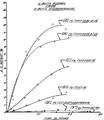
- Fig. 1 is a plot of t-butyl alcohol produced in examples according to the invention and comparison examples, against reaction time.
- Fig. 1 is a plot of weight percent t-butyl alcohol formed against reaction time in the reactions carried out as described in Example 1, using different complexes in each of six runs.
- Complexes A and B as shown in Fig. 1 were perhalogenated iron porphyrin complexes, complex C a partially halogenated complex, complex D contained an unhalogenated porphyrin complex, complex E was Fe(II)acetylacetonate and complex F was Cr(TPPF)OH where TPPF is perfluorinated porphyrin.
- Table II shows in Runs 1-6 and 11, the results after one hour reaction time for the seven catalysts shown in Fig. 1. Table II also shows the results after one hour reaction time for the other catalysts identified in Table II.
- the reactions were carried out in the same manner as described in Example 1.
- "AA” is acetylacetonate
- "PcF” is perfluorophthalocyanine
- N3 is azide
- BPI is 1,3-bis-(2-pyridylimino)isoindoline
- OAc is acetate
- "OO-t-C4" is tertiarybutylperoxy
- Pc is phthalocyanine
- F3AAF3 is perfluoroacetylacetonate.
- the values given for "Wt. % C4OH” include 0.6 (plus or minus 0.2) wt. % C4OH(t-butyl alcohol) in the starting material.
- Runs 1, 2, 3, 4, 7, 8, 11, 12, 13 and 17 in Table II were performed with catalysts according to the invention. The best results were obtained with catalysts containing Fe and porphyrin (Runs 1-4). Runs with Fe and halogenated phathalocyanine (Runs 7 and 8), Cr and halogenated porphyrin (Run 11), Co and halogenated porphyrin (Run 12), Mn and halogenated porphyrin (Run 13), Fe and halogenated acetylacetonate (Run 15) gave poorer results.
Landscapes
- Chemical & Material Sciences (AREA)
- Organic Chemistry (AREA)
- Health & Medical Sciences (AREA)
- General Health & Medical Sciences (AREA)
- Toxicology (AREA)
- Chemical Kinetics & Catalysis (AREA)
- General Chemical & Material Sciences (AREA)
- Business, Economics & Management (AREA)
- Emergency Management (AREA)
- Organic Low-Molecular-Weight Compounds And Preparation Thereof (AREA)
- Catalysts (AREA)
- Low-Molecular Organic Synthesis Reactions Using Catalysts (AREA)
Applications Claiming Priority (2)
| Application Number | Priority Date | Filing Date | Title |
|---|---|---|---|
| US727194 | 1991-07-09 | ||
| US07/727,194 US5120886A (en) | 1991-07-09 | 1991-07-09 | Decomposition of organic hydroperoxides |
Publications (3)
| Publication Number | Publication Date |
|---|---|
| EP0522841A2 true EP0522841A2 (de) | 1993-01-13 |
| EP0522841A3 EP0522841A3 (de) | 1993-04-21 |
| EP0522841B1 EP0522841B1 (de) | 1996-10-16 |
Family
ID=24921710
Family Applications (1)
| Application Number | Title | Priority Date | Filing Date |
|---|---|---|---|
| EP92306269A Expired - Lifetime EP0522841B1 (de) | 1991-07-09 | 1992-07-08 | Zersetzung von organischen Hydroperoxiden |
Country Status (5)
| Country | Link |
|---|---|
| US (1) | US5120886A (de) |
| EP (1) | EP0522841B1 (de) |
| JP (1) | JPH05208926A (de) |
| CA (1) | CA2073157A1 (de) |
| DE (1) | DE69214537T2 (de) |
Cited By (6)
| Publication number | Priority date | Publication date | Assignee | Title |
|---|---|---|---|---|
| EP0628529A1 (de) * | 1993-06-09 | 1994-12-14 | SUN COMPANY, INC. (R&M) | Zersetzung von organischen Hydroperoxiden durch nitrierte Metalloporphyrine |
| EP0665056A3 (de) * | 1993-12-29 | 1995-08-09 | Sun Co Inc R & M | |
| EP0676221A1 (de) * | 1994-04-04 | 1995-10-11 | SUN COMPANY, INC. (R&M) | Getrocknetes Katalysatorsysteme zur Zersetzung von organischen Hydroperoxiden |
| EP0665230A3 (de) * | 1993-12-29 | 1996-01-17 | Sun Co Inc R & M | Halocarbyl-substituierte Porphyrine und deren Herstellung aus meso-Halocarbyl-dipyrromethanen mit Aldehyden. |
| EP0700915A1 (de) * | 1994-09-07 | 1996-03-13 | SUN COMPANY, INC. (R&M) | Haloporphyrine und Verfahren zu ihrer Herstellung |
| EP0704447A1 (de) * | 1994-09-07 | 1996-04-03 | SUN COMPANY, INC. (R&M) | Durch Haloporphyrinen katalysierte Reaktionen |
Families Citing this family (12)
| Publication number | Priority date | Publication date | Assignee | Title |
|---|---|---|---|---|
| US4900871A (en) | 1987-01-02 | 1990-02-13 | Sun Refining And Marketing Company | Hydrocarbon oxidations catalyzed by iron coordination complexes containing a halogenated ligand |
| US5196603A (en) * | 1991-02-12 | 1993-03-23 | Uop | Process for decomposing peroxide impurities in a teritary butyl alcohol feedstock using an iron (II) compound |
| US5493017A (en) * | 1992-08-14 | 1996-02-20 | The Trustees Of The University Of Pennsylvania | Ring-metalated porphyrins |
| US5599924A (en) * | 1992-08-14 | 1997-02-04 | Trustees Of The University Of Pennsylvania | Electron-deficient porphyrins and processes and intermediates for preparing same |
| US5817830A (en) * | 1992-08-14 | 1998-10-06 | Trustees Of The University Of Pennsylvania | Pyrrolic compounds |
| US5371199B1 (en) * | 1992-08-14 | 1995-12-26 | Univ Pennsylvania | Substituted porphyrins porphyrin-containing polymers and synthetic methods therefor |
| US5243100A (en) * | 1992-09-08 | 1993-09-07 | Texaco Chemical Company | Preparation of tertiary butyl alcohol using promoted cycloalkenyl iron catalyst |
| US5464741A (en) * | 1993-10-08 | 1995-11-07 | Henwell, Inc. | Palladium (II) octaethylporphine alpha-isothiocyanate as a phosphorescent label for immunoassays |
| US5608054A (en) * | 1993-12-29 | 1997-03-04 | Sun Company, Inc. (R&M) | Porphyrins and metal complexes thereof having haloalkyl side chains |
| US5395988A (en) * | 1994-04-04 | 1995-03-07 | Sun Company, Inc. (R&M) | Metal-ligand catalyzed decomposition of organic hydroperoxides |
| US5728890A (en) * | 1994-06-10 | 1998-03-17 | Ube Industries, Ltd. | Process for producing a cycloalkanol and cycloalkanone |
| US6124452A (en) * | 1997-12-19 | 2000-09-26 | University Of Nebraska-Lincoln | Octafluoro-meso-tetraarylporphyrins and methods for making these compounds |
Family Cites Families (10)
| Publication number | Priority date | Publication date | Assignee | Title |
|---|---|---|---|---|
| US4922602A (en) * | 1981-03-16 | 1990-05-08 | Creative Research And Manufacturing, Inc. | Method of manufacturing a biopsy needle |
| EP0308101B1 (de) * | 1987-09-08 | 1992-07-22 | Texaco Development Corporation | Herstellung von tertiärem Butylalkohol |
| US4912267A (en) * | 1987-09-08 | 1990-03-27 | Texaco Inc. | Catalytic conversion of tertiary butyl hydroperoxide to tertiary butyl alcohol |
| US4912266A (en) * | 1987-09-08 | 1990-03-27 | Texaco Inc. | Catalytic decomposition of tertiary butyl hydroperoxide |
| US4922035A (en) * | 1987-09-08 | 1990-05-01 | Texaco Inc. | Catalytic preparation of tertiary butyl alcohol by decomposition of tertiary butyl hydroperoxide |
| US4922036A (en) * | 1987-09-08 | 1990-05-01 | Texaco Inc. | Tertiary butyl hydroperoxide decomposition |
| US4910349A (en) * | 1987-09-08 | 1990-03-20 | Texaco Inc. | Catalyst production of tertiary butyl alcohol from tertiary butyl hydroperoxide |
| NL8802592A (nl) * | 1988-10-21 | 1990-05-16 | Stamicarbon | Werkwijze voor de bereiding van een k/a-mengsel. |
| US4978799A (en) * | 1989-10-30 | 1990-12-18 | Texaco Chemical Company | Production of detergent range alcohols and ketones using porphyrin catalysts |
| US4992602A (en) * | 1990-01-29 | 1991-02-12 | Texaco Chemical Company | Preparation of tertiary butyl alcohol |
-
1991
- 1991-07-09 US US07/727,194 patent/US5120886A/en not_active Expired - Fee Related
-
1992
- 1992-07-06 CA CA002073157A patent/CA2073157A1/en not_active Abandoned
- 1992-07-08 JP JP4203216A patent/JPH05208926A/ja active Pending
- 1992-07-08 EP EP92306269A patent/EP0522841B1/de not_active Expired - Lifetime
- 1992-07-08 DE DE69214537T patent/DE69214537T2/de not_active Expired - Fee Related
Cited By (6)
| Publication number | Priority date | Publication date | Assignee | Title |
|---|---|---|---|---|
| EP0628529A1 (de) * | 1993-06-09 | 1994-12-14 | SUN COMPANY, INC. (R&M) | Zersetzung von organischen Hydroperoxiden durch nitrierte Metalloporphyrine |
| EP0665056A3 (de) * | 1993-12-29 | 1995-08-09 | Sun Co Inc R & M | |
| EP0665230A3 (de) * | 1993-12-29 | 1996-01-17 | Sun Co Inc R & M | Halocarbyl-substituierte Porphyrine und deren Herstellung aus meso-Halocarbyl-dipyrromethanen mit Aldehyden. |
| EP0676221A1 (de) * | 1994-04-04 | 1995-10-11 | SUN COMPANY, INC. (R&M) | Getrocknetes Katalysatorsysteme zur Zersetzung von organischen Hydroperoxiden |
| EP0700915A1 (de) * | 1994-09-07 | 1996-03-13 | SUN COMPANY, INC. (R&M) | Haloporphyrine und Verfahren zu ihrer Herstellung |
| EP0704447A1 (de) * | 1994-09-07 | 1996-04-03 | SUN COMPANY, INC. (R&M) | Durch Haloporphyrinen katalysierte Reaktionen |
Also Published As
| Publication number | Publication date |
|---|---|
| EP0522841B1 (de) | 1996-10-16 |
| US5120886A (en) | 1992-06-09 |
| DE69214537T2 (de) | 1997-05-22 |
| CA2073157A1 (en) | 1993-01-10 |
| EP0522841A3 (de) | 1993-04-21 |
| JPH05208926A (ja) | 1993-08-20 |
| DE69214537D1 (de) | 1996-11-21 |
Similar Documents
| Publication | Publication Date | Title |
|---|---|---|
| US5120886A (en) | Decomposition of organic hydroperoxides | |
| EP0296712B1 (de) | Durch einen halogenierten Liganden enthaltende Eisenkoordinationskomplexe katalisierte Oxidation von Kohlenwasserstoffen | |
| US4970348A (en) | Chromium halogenated coordination complexes for the oxidation of butane to methylethylketone | |
| EP0532326B1 (de) | Nitrierten Metalloporphyrine als Katalysatoren bei der Oxydierung von Alkanen | |
| EP0532327B1 (de) | Cyano- und Polycyanometalloporphyrine als Katalysatoren bei der Oxydierung von Alkanen | |
| US5120882A (en) | Nitrated metalloporphyrins as catalysts for alkane oxidation | |
| EP0471561A2 (de) | Einen haloginierten Liganden enthaltende Metall-Koordinationskomplexkatalysatoren für die Kohlenwasserstoffoxidation | |
| US5672778A (en) | Process for increased yields of oxygenated products in two-step oxidation of hydrocarbons | |
| US5723677A (en) | Method for hydroperoxide decomposition using novel porphyrins synthesized from dipyrromethanes and aldehydes | |
| CA2171680A1 (en) | Porphyrins and metal complexes thereof having haloalkyl side chains, their preparation and use as catalysts in chemical reactions | |
| EP0308101B1 (de) | Herstellung von tertiärem Butylalkohol | |
| US4922033A (en) | Preparation of tertiary butyl alcohol by the catalytic decomposition of tertiary butyl hydroperoxide | |
| US5489716A (en) | Reactions catalyzed by haloporphyrins | |
| US5345008A (en) | Decomposition of organic hydroperoxides with nitrated porphyrin complexes | |
| EP0527623B1 (de) | Allylische Oxidation von Olefinen | |
| US5663328A (en) | Haloporphyrins and their preparation and use as catalysts | |
| US5723697A (en) | Catalytic oxidation of light alkanes in presence of a base | |
| EP0700915A1 (de) | Haloporphyrine und Verfahren zu ihrer Herstellung | |
| Lyons | Reactions catalyzed by haloporphyrins |
Legal Events
| Date | Code | Title | Description |
|---|---|---|---|
| PUAI | Public reference made under article 153(3) epc to a published international application that has entered the european phase |
Free format text: ORIGINAL CODE: 0009012 |
|
| AK | Designated contracting states |
Kind code of ref document: A2 Designated state(s): BE DE FR GB IT NL |
|
| PUAL | Search report despatched |
Free format text: ORIGINAL CODE: 0009013 |
|
| AK | Designated contracting states |
Kind code of ref document: A3 Designated state(s): BE DE FR GB IT NL |
|
| 17P | Request for examination filed |
Effective date: 19931015 |
|
| 17Q | First examination report despatched |
Effective date: 19950515 |
|
| GRAG | Despatch of communication of intention to grant |
Free format text: ORIGINAL CODE: EPIDOS AGRA |
|
| GRAH | Despatch of communication of intention to grant a patent |
Free format text: ORIGINAL CODE: EPIDOS IGRA |
|
| GRAH | Despatch of communication of intention to grant a patent |
Free format text: ORIGINAL CODE: EPIDOS IGRA |
|
| GRAA | (expected) grant |
Free format text: ORIGINAL CODE: 0009210 |
|
| AK | Designated contracting states |
Kind code of ref document: B1 Designated state(s): BE DE FR GB IT NL |
|
| REF | Corresponds to: |
Ref document number: 69214537 Country of ref document: DE Date of ref document: 19961121 |
|
| ET | Fr: translation filed | ||
| ITF | It: translation for a ep patent filed | ||
| PLBE | No opposition filed within time limit |
Free format text: ORIGINAL CODE: 0009261 |
|
| STAA | Information on the status of an ep patent application or granted ep patent |
Free format text: STATUS: NO OPPOSITION FILED WITHIN TIME LIMIT |
|
| 26N | No opposition filed | ||
| PGFP | Annual fee paid to national office [announced via postgrant information from national office to epo] |
Ref country code: FR Payment date: 19990621 Year of fee payment: 8 |
|
| PGFP | Annual fee paid to national office [announced via postgrant information from national office to epo] |
Ref country code: NL Payment date: 19990622 Year of fee payment: 8 Ref country code: GB Payment date: 19990622 Year of fee payment: 8 |
|
| PGFP | Annual fee paid to national office [announced via postgrant information from national office to epo] |
Ref country code: DE Payment date: 19990623 Year of fee payment: 8 |
|
| PGFP | Annual fee paid to national office [announced via postgrant information from national office to epo] |
Ref country code: BE Payment date: 19990729 Year of fee payment: 8 |
|
| PG25 | Lapsed in a contracting state [announced via postgrant information from national office to epo] |
Ref country code: GB Free format text: LAPSE BECAUSE OF NON-PAYMENT OF DUE FEES Effective date: 20000708 |
|
| PG25 | Lapsed in a contracting state [announced via postgrant information from national office to epo] |
Ref country code: BE Free format text: LAPSE BECAUSE OF NON-PAYMENT OF DUE FEES Effective date: 20000731 |
|
| BERE | Be: lapsed |
Owner name: SUN CY INC. (R&M) Effective date: 20000731 |
|
| PG25 | Lapsed in a contracting state [announced via postgrant information from national office to epo] |
Ref country code: NL Free format text: LAPSE BECAUSE OF NON-PAYMENT OF DUE FEES Effective date: 20010201 |
|
| GBPC | Gb: european patent ceased through non-payment of renewal fee |
Effective date: 20000708 |
|
| PG25 | Lapsed in a contracting state [announced via postgrant information from national office to epo] |
Ref country code: FR Free format text: LAPSE BECAUSE OF NON-PAYMENT OF DUE FEES Effective date: 20010330 |
|
| NLV4 | Nl: lapsed or anulled due to non-payment of the annual fee |
Effective date: 20010201 |
|
| REG | Reference to a national code |
Ref country code: FR Ref legal event code: ST |
|
| PG25 | Lapsed in a contracting state [announced via postgrant information from national office to epo] |
Ref country code: DE Free format text: LAPSE BECAUSE OF NON-PAYMENT OF DUE FEES Effective date: 20010501 |
|
| PG25 | Lapsed in a contracting state [announced via postgrant information from national office to epo] |
Ref country code: IT Free format text: LAPSE BECAUSE OF NON-PAYMENT OF DUE FEES;WARNING: LAPSES OF ITALIAN PATENTS WITH EFFECTIVE DATE BEFORE 2007 MAY HAVE OCCURRED AT ANY TIME BEFORE 2007. THE CORRECT EFFECTIVE DATE MAY BE DIFFERENT FROM THE ONE RECORDED. Effective date: 20050708 |