EP0522931A1 - Block kontaminierte Ionenaustauschharze enthaltend und Herstellung davon - Google Patents
Block kontaminierte Ionenaustauschharze enthaltend und Herstellung davon Download PDFInfo
- Publication number
- EP0522931A1 EP0522931A1 EP92401879A EP92401879A EP0522931A1 EP 0522931 A1 EP0522931 A1 EP 0522931A1 EP 92401879 A EP92401879 A EP 92401879A EP 92401879 A EP92401879 A EP 92401879A EP 0522931 A1 EP0522931 A1 EP 0522931A1
- Authority
- EP
- European Patent Office
- Prior art keywords
- exchange resins
- cement
- ion exchange
- water
- epoxy resin
- Prior art date
- Legal status (The legal status is an assumption and is not a legal conclusion. Google has not performed a legal analysis and makes no representation as to the accuracy of the status listed.)
- Granted
Links
- 239000003456 ion exchange resin Substances 0.000 title claims abstract description 46
- 229920003303 ion-exchange polymer Polymers 0.000 title claims abstract description 46
- 238000002360 preparation method Methods 0.000 title claims abstract description 5
- 238000000034 method Methods 0.000 title claims description 25
- 230000008569 process Effects 0.000 title claims description 20
- 239000004568 cement Substances 0.000 claims abstract description 55
- XLYOFNOQVPJJNP-UHFFFAOYSA-N water Substances O XLYOFNOQVPJJNP-UHFFFAOYSA-N 0.000 claims abstract description 53
- 239000003822 epoxy resin Substances 0.000 claims abstract description 32
- 229920000647 polyepoxide Polymers 0.000 claims abstract description 32
- 239000011159 matrix material Substances 0.000 claims abstract description 23
- 239000002893 slag Substances 0.000 claims abstract description 14
- 230000036571 hydration Effects 0.000 claims abstract description 13
- 238000006703 hydration reaction Methods 0.000 claims abstract description 13
- 239000002131 composite material Substances 0.000 claims abstract description 12
- 238000003860 storage Methods 0.000 claims abstract description 9
- 229920005989 resin Polymers 0.000 claims description 25
- 239000011347 resin Substances 0.000 claims description 25
- 239000004848 polyfunctional curative Substances 0.000 claims description 21
- 239000000203 mixture Substances 0.000 claims description 13
- 229920006395 saturated elastomer Polymers 0.000 claims description 10
- 125000002091 cationic group Chemical group 0.000 claims description 8
- 125000000129 anionic group Chemical group 0.000 claims description 7
- 238000003756 stirring Methods 0.000 claims description 7
- IISBACLAFKSPIT-UHFFFAOYSA-N bisphenol A Chemical compound C=1C=C(O)C=CC=1C(C)(C)C1=CC=C(O)C=C1 IISBACLAFKSPIT-UHFFFAOYSA-N 0.000 claims description 4
- GYZLOYUZLJXAJU-UHFFFAOYSA-N diglycidyl ether Chemical compound C1OC1COCC1CO1 GYZLOYUZLJXAJU-UHFFFAOYSA-N 0.000 claims description 4
- 239000010881 fly ash Substances 0.000 claims description 4
- 239000000725 suspension Substances 0.000 claims description 4
- 239000002956 ash Substances 0.000 claims description 3
- 238000006243 chemical reaction Methods 0.000 claims description 3
- 125000002924 primary amino group Chemical group [H]N([H])* 0.000 claims description 2
- 229930185605 Bisphenol Natural products 0.000 claims 1
- LCFVJGUPQDGYKZ-UHFFFAOYSA-N Bisphenol A diglycidyl ether Chemical compound C=1C=C(OCC2OC2)C=CC=1C(C)(C)C(C=C1)=CC=C1OCC1CO1 LCFVJGUPQDGYKZ-UHFFFAOYSA-N 0.000 claims 1
- 238000006116 polymerization reaction Methods 0.000 description 14
- 238000000576 coating method Methods 0.000 description 13
- 239000011248 coating agent Substances 0.000 description 12
- 150000001412 amines Chemical class 0.000 description 8
- 150000002500 ions Chemical class 0.000 description 8
- 239000004593 Epoxy Substances 0.000 description 7
- 238000010521 absorption reaction Methods 0.000 description 7
- 238000010586 diagram Methods 0.000 description 6
- 239000011398 Portland cement Substances 0.000 description 4
- 230000008901 benefit Effects 0.000 description 4
- 239000011230 binding agent Substances 0.000 description 4
- 238000013019 agitation Methods 0.000 description 3
- 239000003957 anion exchange resin Substances 0.000 description 3
- 230000001143 conditioned effect Effects 0.000 description 3
- 239000000470 constituent Substances 0.000 description 3
- 229920006333 epoxy cement Polymers 0.000 description 3
- 230000002285 radioactive effect Effects 0.000 description 3
- 230000009467 reduction Effects 0.000 description 3
- 229920001187 thermosetting polymer Polymers 0.000 description 3
- MYRTYDVEIRVNKP-UHFFFAOYSA-N 1,2-Divinylbenzene Chemical compound C=CC1=CC=CC=C1C=C MYRTYDVEIRVNKP-UHFFFAOYSA-N 0.000 description 2
- 230000015556 catabolic process Effects 0.000 description 2
- 238000006731 degradation reaction Methods 0.000 description 2
- 239000012530 fluid Substances 0.000 description 2
- LNEPOXFFQSENCJ-UHFFFAOYSA-N haloperidol Chemical compound C1CC(O)(C=2C=CC(Cl)=CC=2)CCN1CCCC(=O)C1=CC=C(F)C=C1 LNEPOXFFQSENCJ-UHFFFAOYSA-N 0.000 description 2
- 239000004850 liquid epoxy resins (LERs) Substances 0.000 description 2
- 230000014759 maintenance of location Effects 0.000 description 2
- 238000004519 manufacturing process Methods 0.000 description 2
- 239000000463 material Substances 0.000 description 2
- 150000002823 nitrates Chemical class 0.000 description 2
- 239000007787 solid Substances 0.000 description 2
- 150000003467 sulfuric acid derivatives Chemical class 0.000 description 2
- 230000008961 swelling Effects 0.000 description 2
- 239000002699 waste material Substances 0.000 description 2
- NWUYHJFMYQTDRP-UHFFFAOYSA-N 1,2-bis(ethenyl)benzene;1-ethenyl-2-ethylbenzene;styrene Chemical compound C=CC1=CC=CC=C1.CCC1=CC=CC=C1C=C.C=CC1=CC=CC=C1C=C NWUYHJFMYQTDRP-UHFFFAOYSA-N 0.000 description 1
- 235000002918 Fraxinus excelsior Nutrition 0.000 description 1
- 241001415961 Gaviidae Species 0.000 description 1
- 230000001133 acceleration Effects 0.000 description 1
- -1 aliphatic amines Chemical class 0.000 description 1
- 239000012736 aqueous medium Substances 0.000 description 1
- 239000007864 aqueous solution Substances 0.000 description 1
- 125000003118 aryl group Chemical group 0.000 description 1
- XUCHXOAWJMEFLF-UHFFFAOYSA-N bisphenol F diglycidyl ether Chemical compound C1OC1COC(C=C1)=CC=C1CC(C=C1)=CC=C1OCC1CO1 XUCHXOAWJMEFLF-UHFFFAOYSA-N 0.000 description 1
- ODINCKMPIJJUCX-UHFFFAOYSA-N calcium oxide Inorganic materials [Ca]=O ODINCKMPIJJUCX-UHFFFAOYSA-N 0.000 description 1
- 239000000292 calcium oxide Substances 0.000 description 1
- 239000003729 cation exchange resin Substances 0.000 description 1
- 229940023913 cation exchange resins Drugs 0.000 description 1
- 238000000975 co-precipitation Methods 0.000 description 1
- 230000000052 comparative effect Effects 0.000 description 1
- 150000001875 compounds Chemical class 0.000 description 1
- 230000006835 compression Effects 0.000 description 1
- 238000007906 compression Methods 0.000 description 1
- 239000004567 concrete Substances 0.000 description 1
- 230000003750 conditioning effect Effects 0.000 description 1
- 230000001627 detrimental effect Effects 0.000 description 1
- 230000008034 disappearance Effects 0.000 description 1
- 238000004821 distillation Methods 0.000 description 1
- 230000000694 effects Effects 0.000 description 1
- 238000005538 encapsulation Methods 0.000 description 1
- 239000011521 glass Substances 0.000 description 1
- 238000000227 grinding Methods 0.000 description 1
- 239000008240 homogeneous mixture Substances 0.000 description 1
- 125000002887 hydroxy group Chemical group [H]O* 0.000 description 1
- 238000009434 installation Methods 0.000 description 1
- 230000003993 interaction Effects 0.000 description 1
- 238000005342 ion exchange Methods 0.000 description 1
- 238000002386 leaching Methods 0.000 description 1
- 239000007788 liquid Substances 0.000 description 1
- 238000005259 measurement Methods 0.000 description 1
- 239000002609 medium Substances 0.000 description 1
- 239000002184 metal Substances 0.000 description 1
- 229910052751 metal Inorganic materials 0.000 description 1
- 150000002739 metals Chemical class 0.000 description 1
- 238000002156 mixing Methods 0.000 description 1
- 239000010850 non-combustible waste Substances 0.000 description 1
- 239000010816 packaging waste Substances 0.000 description 1
- 239000002245 particle Substances 0.000 description 1
- 230000035699 permeability Effects 0.000 description 1
- 229920005990 polystyrene resin Polymers 0.000 description 1
- 239000002901 radioactive waste Substances 0.000 description 1
- 150000003839 salts Chemical class 0.000 description 1
- 239000010802 sludge Substances 0.000 description 1
- 239000000126 substance Substances 0.000 description 1
- 239000004634 thermosetting polymer Substances 0.000 description 1
- 231100000331 toxic Toxicity 0.000 description 1
- 230000002588 toxic effect Effects 0.000 description 1
- 238000009834 vaporization Methods 0.000 description 1
- 230000008016 vaporization Effects 0.000 description 1
- 238000005303 weighing Methods 0.000 description 1
Images


Classifications
-
- G—PHYSICS
- G21—NUCLEAR PHYSICS; NUCLEAR ENGINEERING
- G21F—PROTECTION AGAINST X-RADIATION, GAMMA RADIATION, CORPUSCULAR RADIATION OR PARTICLE BOMBARDMENT; TREATING RADIOACTIVELY CONTAMINATED MATERIAL; DECONTAMINATION ARRANGEMENTS THEREFOR
- G21F9/00—Treating radioactively contaminated material; Decontamination arrangements therefor
- G21F9/28—Treating solids
- G21F9/30—Processing
- G21F9/301—Processing by fixation in stable solid media
- G21F9/302—Processing by fixation in stable solid media in an inorganic matrix
- G21F9/304—Cement or cement-like matrix
-
- G—PHYSICS
- G21—NUCLEAR PHYSICS; NUCLEAR ENGINEERING
- G21F—PROTECTION AGAINST X-RADIATION, GAMMA RADIATION, CORPUSCULAR RADIATION OR PARTICLE BOMBARDMENT; TREATING RADIOACTIVELY CONTAMINATED MATERIAL; DECONTAMINATION ARRANGEMENTS THEREFOR
- G21F9/00—Treating radioactively contaminated material; Decontamination arrangements therefor
- G21F9/28—Treating solids
- G21F9/30—Processing
- G21F9/301—Processing by fixation in stable solid media
- G21F9/307—Processing by fixation in stable solid media in polymeric matrix, e.g. resins, tars
Definitions
- the present invention relates to a block containing ion exchange resins contaminated, for example by toxic or radioactive elements, as well as a process for preparing such a block. It is particularly applicable in the field of storage of ion exchange resins contaminated by radioactive elements of low and medium activity.
- the ion exchange resins used to purify water in nuclear installations undergo degradation phenomena after a certain time and consequently lose their effectiveness. It is then a question of storing these used ion exchange resins which, during their use, have fixed various radioelements giving them a certain radioactivity.
- thermosetting resins such as those described in documents FR-A- 2 251 081, FR-A- 2 361 724 and EP-A- 0 127 490 are satisfactory because they allow to ensure good retention of radioactivity, but they nevertheless have certain drawbacks.
- EP-A-0 127 490 also makes it possible to incorporate cationic resins which still have active sites into an epoxy resin, but it has the disadvantage of requiring the use of particular amine hardeners which are relatively expensive products. .
- thermosetting resins are sensitive to the initial temperature which accelerates the polymerization and / or leads to a release of heat detrimental to the quality of the block formed.
- radioactive waste consists of chemical co-precipitation sludge which may contain 20 to 40% of water, dry pulverulent waste such as the incineration ashes of combustible materials or technological, non-combustible waste such as glass and metals.
- the present invention specifically relates to a block containing ion exchange resins contaminated for storage, which overcomes the drawbacks mentioned above of the known methods.
- the block containing ion exchange resins contaminated for storage is characterized in that the ion exchange resins are incorporated in a composite matrix consisting of a hardened hydrophilic epoxy resin and a cement. hardened chosen from Clinker's slag cements and slag and ash cements.
- the choice of a hydrophilic epoxy resin and a cement with a low heat of hydration constitutes by a clinker slag cement (CLK) and / or a slag cement and with fly ash ( CLC) provides a matrix compatible with ion exchange resins, even when these are saturated with water and contain, for example, 50 to 55% by weight of water, and / or contain active sites usually requiring pretreatment.
- CLK clinker slag cement
- CLC fly ash
- this matrix makes it possible to obtain a high coating coefficient and a block having very interesting physical and mechanical properties, in particular better resistance to compression.
- CLC and CLK cements have very different compositions from those of Portland cements and aluminous cements.
- CLK and CLC cements have lower hydration heats than those of Portland and aluminous cements and a slower hydration kinetics.
- the temperature can reach 120 ° C at the core, which causes the distillation of the water included in the exchange resins d 'ions and a degradation of the properties of the barrel.
- the proportions by weight of hardened cement and epoxy resin used in the constitution of the matrix are chosen so as to obtain the desired characteristics of radioelement retention, resistance to leaching and mechanical resistance for storage. of the block with a high degree of safety.
- ion exchange resins With this matrix, relatively large amounts of ion exchange resins can be included in the block; it can thus contain up to 45% by weight of contaminated ion exchange resins, saturated with water, whereas in the in the case of CLK cement alone, only 15 to 20% by weight of ion exchange resins could be coated.
- ion exchange resins can be constituted by cationic exchange resins, anionic resins or mixtures of these resins, in the form of grains or particles obtained by grinding.
- organic ion exchange resins such as polystyrene resins crosslinked with divinyl benzene which comprise, for example, sulfonic groups or hydroxyl groups.
- a hydrophilic epoxy resin is used, compatible both with the cement used and with the ion exchange resin to be conditioned.
- hydrophilic epoxy resins By way of example of such hydrophilic epoxy resins, mention may be made of the diglycidyl ether of bis-phenol-A and the diglycidyl ether of bis-phenol-F hardened by reaction with an amino hardener.
- the diglycidyl ether of bis phenol A corresponds to the formula:
- the bis-phenol F diglycidyl ether corresponds to the formula:
- the use of a hydrophilic epoxy resin is advantageous because it facilitates obtaining a homogeneous mixture with the cement, in the presence of water.
- the invention also relates to a process for the preparation of the block containing the contaminated ion exchange resins, described above.
- the contaminated ion exchange resins are saturated with water, which is done by immersing these resins in water for a sufficient time, for example for 24 hours. After this operation, the ion exchange resins are drained until disappearance of the water flow in order to ensure that the ion exchange resins contain only their saturation water which generally represents approximately 50 to 55% by weight of the saturated ion exchange resins, but can go in certain case up to 65% by weight.
- the water necessary for the hydration of the cement is then added to the resins by carrying out this operation with stirring.
- the amount of water of hydration needed for curing Clinker's slag cements or slag and fly ash cements depends on the amount of cement that will be introduced into the block. It is generally such that the hydration water / cement weight ratio is from 0.25 to 0.35.
- the cement After introduction of the water, the cement is added with stirring and this stirring is continued until a fluid paste is obtained, then the epoxy resin in the liquid state and its amine hardener are added, continuing the agitation.
- the operations of adding water, cement and epoxy resin are carried out in a mixer.
- the mixture After adding the epoxy resin and its hardener, the mixture can be emulsified by rotation at high speed, left to stand and poured into a mold having the dimensions of the block to be manufactured.
- the block is allowed to harden in the mold, which can be obtained relatively quickly, for example in 12 hours.
- the choice of the amine hardener is also important, because by choosing an appropriate amine hardener, the epoxy resin is allowed to harden in the presence of large amounts of water.
- amine hardeners containing a combination of aromatic and aliphatic amines it is possible to use amine hardeners containing a combination of aromatic and aliphatic amines, and by varying the amounts of these different amines, an optimized hardener can be obtained, suitable for the preparation of an epoxy composite matrix. cement suitable for coating ion exchange resins saturated with water to be conditioned.
- the proportion of amine hardener is such that the hardener / epoxy resin weight ratio is preferably from 0.5 to 0.6.
- the contaminated water exchange resins are saturated with water by swelling them in water for 24 h and then subjected to a spin. 400 g of drained anionic resins are then weighed and the 78 g of water added to them, that is to say the amount sufficient to hydrate the 222 g of CLK 45 cement.
- the resins are mixed with water, then the CLK 45 cement is added to the suspension and the mixture is kneaded so as to obtain a very fluid paste.
- the block obtained is also subjected to a water absorption test by immersing it for one month in water. After this period, it can be seen that the mass coefficient of water absorption is of the order of 1 to 3%.
- the block obtained therefore has very satisfactory characteristics for the storage of anion exchange resins.
- Example 2 The same contaminated anion exchange resins and the same matrix constituents are used as in Example 1, except the hardener which in this example is the product sold by Spado Lassailly under the reference SL D 2005.
- Example 2 The same procedure is followed as in Example 1, using the same proportions for coating 400 g of anion exchange resins in the composite matrix.
- a solid block is thus obtained having properties practically identical to those of the block obtained in Example 1, except that its external appearance is more shiny.
- Example 2 The same procedure is followed and the same matrix is used as in Example 1 to coat 400 g of cationic ion exchange resins of the Rohm and Haas IR 120 type.
- the block obtained also has very good properties.
- the coating of contaminated ion exchange resins is carried out using only as coating component an epoxy resin and its hardener.
- an epoxy-cement composite matrix makes it possible, during polymerization, to limit the core temperature of the block to a value lower than that which is obtained with an epoxy resin alone.
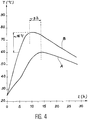
- the core temperature is limited to 58-63 ° C, while in the case of an epoxy resin alone, it can reach 78 ° C for a block of 0.5 l. Also, for blocks of larger volume, the core temperature can become higher than 100 ° C with an epoxy resin alone. However, at this temperature, the water contained in the ion-exchange resins saturated with water is brought to the boil and the water vapor generated in the block is the cause of more or less significant damage.
- the enthalpy corresponding to the setting of the binder is very substantially lower than the enthalpy of polymerization of the epoxy part.
- curve A corresponds to the average values of the two curves in FIG. 2
- curve B corresponds to the average values of the two curves of FIG. 3.
- the reduction of the peak of the polymerization exotherm is particularly sought after, because it increases the intrinsic safety of the process, in particular in the event of acceleration of the polymerization rate observed in hot weather: in this case, in Indeed, the polymerization kinetics is increased, and the temperature obtained at the core of the coating must imperatively be below the vaporization temperature of the REI water.
- the lengthening of the hardening time is an interesting phenomenon at the industrial stage because it allows increased possibilities of intervention on the process.
- Another important advantage of the process of the invention is that it allows the coating of anionic, cationic or mixed ion exchange resins without requiring pretreatment. Indeed, the use of a hydraulic binder which releases in the aqueous medium dissociated ions, avoids prior saturation of any active sites of cation exchange resins since the ions released by the cement are capable of achieving this saturation.
Landscapes
- Physics & Mathematics (AREA)
- Engineering & Computer Science (AREA)
- General Engineering & Computer Science (AREA)
- High Energy & Nuclear Physics (AREA)
- Chemical & Material Sciences (AREA)
- Inorganic Chemistry (AREA)
- Epoxy Resins (AREA)
- Processing Of Solid Wastes (AREA)
- Curing Cements, Concrete, And Artificial Stone (AREA)
Applications Claiming Priority (2)
| Application Number | Priority Date | Filing Date | Title |
|---|---|---|---|
| FR9108309 | 1991-07-03 | ||
| FR9108309A FR2678761B1 (fr) | 1991-07-03 | 1991-07-03 | Bloc contenant des resines echangeuses d'ions contaminees et son procede de preparation. |
Publications (2)
| Publication Number | Publication Date |
|---|---|
| EP0522931A1 true EP0522931A1 (de) | 1993-01-13 |
| EP0522931B1 EP0522931B1 (de) | 1997-04-02 |
Family
ID=9414660
Family Applications (1)
| Application Number | Title | Priority Date | Filing Date |
|---|---|---|---|
| EP19920401879 Expired - Lifetime EP0522931B1 (de) | 1991-07-03 | 1992-07-01 | Block kontaminierte Ionenaustauschharze enthaltend und Herstellung davon |
Country Status (4)
| Country | Link |
|---|---|
| EP (1) | EP0522931B1 (de) |
| DE (1) | DE69218680T2 (de) |
| ES (1) | ES2102477T3 (de) |
| FR (1) | FR2678761B1 (de) |
Cited By (9)
| Publication number | Priority date | Publication date | Assignee | Title |
|---|---|---|---|---|
| DE4324818A1 (de) * | 1993-07-23 | 1995-01-26 | Siemens Ag | Verfahren zum Entsorgen von Ionenaustauscherharz |
| FR2742256A1 (fr) * | 1995-12-11 | 1997-06-13 | Korea Atomic Energy Res | Methode de solidification de dechets radioactifs sans bore sous forme vitrifiee en utilisant des cendres volantes et des dechets radioactifs contenant du bore en tant que frittes de verre borosilicate |
| US6231664B1 (en) * | 1998-06-30 | 2001-05-15 | Halliburton Energy Services, Inc. | Well sealing compositions and methods |
| US6234251B1 (en) | 1999-02-22 | 2001-05-22 | Halliburton Energy Services, Inc. | Resilient well cement compositions and methods |
| US6244344B1 (en) | 1999-02-09 | 2001-06-12 | Halliburton Energy Services, Inc. | Methods and compositions for cementing pipe strings in well bores |
| US6279652B1 (en) | 1998-09-23 | 2001-08-28 | Halliburton Energy Services, Inc. | Heat insulation compositions and methods |
| US6287772B1 (en) | 1998-04-29 | 2001-09-11 | Boston Probes, Inc. | Methods, kits and compositions for detecting and quantitating target sequences |
| FR2825182A1 (fr) * | 2001-05-23 | 2002-11-29 | Qualia | Systeme matriciel pour l'enrobage et le stockage d'un produit dangereux, procede de preparation et utilisation notamment pour les resines echangeuses d'ions faiblement radioactives |
| WO2009090209A1 (de) * | 2008-01-17 | 2009-07-23 | Areva Np Gmbh | Verfahren zur konditionierung radioaktiver ionenaustauscherharze |
Citations (4)
| Publication number | Priority date | Publication date | Assignee | Title |
|---|---|---|---|---|
| EP0124825A2 (de) * | 1983-04-29 | 1984-11-14 | W.R. Grace & Co. | Einkapseln von radioaktiven Abfällen |
| EP0127490A1 (de) * | 1983-04-21 | 1984-12-05 | Commissariat A L'energie Atomique | Verfahren zur Konditionierung von in saurem Medium kontaminierten Abfällen, insbesondere von Kationenaustauschermaterialien |
| FR2607957A1 (fr) * | 1986-12-05 | 1988-06-10 | Commissariat Energie Atomique | Bloc contenant des dechets en vue de leur stockage et procede de realisation d'un tel bloc |
| EP0318367A1 (de) * | 1987-11-23 | 1989-05-31 | Commissariat A L'energie Atomique | Verfahren zur Konditionierung von radioaktiven oder toxischen Abfällen in wärmehärtbaren Harzen |
-
1991
- 1991-07-03 FR FR9108309A patent/FR2678761B1/fr not_active Expired - Fee Related
-
1992
- 1992-07-01 DE DE1992618680 patent/DE69218680T2/de not_active Expired - Fee Related
- 1992-07-01 ES ES92401879T patent/ES2102477T3/es not_active Expired - Lifetime
- 1992-07-01 EP EP19920401879 patent/EP0522931B1/de not_active Expired - Lifetime
Patent Citations (4)
| Publication number | Priority date | Publication date | Assignee | Title |
|---|---|---|---|---|
| EP0127490A1 (de) * | 1983-04-21 | 1984-12-05 | Commissariat A L'energie Atomique | Verfahren zur Konditionierung von in saurem Medium kontaminierten Abfällen, insbesondere von Kationenaustauschermaterialien |
| EP0124825A2 (de) * | 1983-04-29 | 1984-11-14 | W.R. Grace & Co. | Einkapseln von radioaktiven Abfällen |
| FR2607957A1 (fr) * | 1986-12-05 | 1988-06-10 | Commissariat Energie Atomique | Bloc contenant des dechets en vue de leur stockage et procede de realisation d'un tel bloc |
| EP0318367A1 (de) * | 1987-11-23 | 1989-05-31 | Commissariat A L'energie Atomique | Verfahren zur Konditionierung von radioaktiven oder toxischen Abfällen in wärmehärtbaren Harzen |
Cited By (11)
| Publication number | Priority date | Publication date | Assignee | Title |
|---|---|---|---|---|
| DE4324818A1 (de) * | 1993-07-23 | 1995-01-26 | Siemens Ag | Verfahren zum Entsorgen von Ionenaustauscherharz |
| DE4324818C2 (de) * | 1993-07-23 | 2002-06-27 | Framatome Anp Gmbh | Verfahren zum Entsorgen von Ionenaustauscherharz |
| FR2742256A1 (fr) * | 1995-12-11 | 1997-06-13 | Korea Atomic Energy Res | Methode de solidification de dechets radioactifs sans bore sous forme vitrifiee en utilisant des cendres volantes et des dechets radioactifs contenant du bore en tant que frittes de verre borosilicate |
| US6287772B1 (en) | 1998-04-29 | 2001-09-11 | Boston Probes, Inc. | Methods, kits and compositions for detecting and quantitating target sequences |
| US6231664B1 (en) * | 1998-06-30 | 2001-05-15 | Halliburton Energy Services, Inc. | Well sealing compositions and methods |
| US6279652B1 (en) | 1998-09-23 | 2001-08-28 | Halliburton Energy Services, Inc. | Heat insulation compositions and methods |
| US6244344B1 (en) | 1999-02-09 | 2001-06-12 | Halliburton Energy Services, Inc. | Methods and compositions for cementing pipe strings in well bores |
| US6234251B1 (en) | 1999-02-22 | 2001-05-22 | Halliburton Energy Services, Inc. | Resilient well cement compositions and methods |
| FR2825182A1 (fr) * | 2001-05-23 | 2002-11-29 | Qualia | Systeme matriciel pour l'enrobage et le stockage d'un produit dangereux, procede de preparation et utilisation notamment pour les resines echangeuses d'ions faiblement radioactives |
| WO2009090209A1 (de) * | 2008-01-17 | 2009-07-23 | Areva Np Gmbh | Verfahren zur konditionierung radioaktiver ionenaustauscherharze |
| US8372289B2 (en) | 2008-01-17 | 2013-02-12 | Areva Np Gmbh | Method for conditioning radioactive ion exchange resins |
Also Published As
| Publication number | Publication date |
|---|---|
| DE69218680T2 (de) | 1997-10-23 |
| EP0522931B1 (de) | 1997-04-02 |
| FR2678761A1 (fr) | 1993-01-08 |
| ES2102477T3 (es) | 1997-08-01 |
| FR2678761B1 (fr) | 1994-07-01 |
| DE69218680D1 (de) | 1997-05-07 |
Similar Documents
| Publication | Publication Date | Title |
|---|---|---|
| EP0522931B1 (de) | Block kontaminierte Ionenaustauschharze enthaltend und Herstellung davon | |
| EP0127490B1 (de) | Verfahren zur Konditionierung von in saurem Medium kontaminierten Abfällen, insbesondere von Kationenaustauschermaterialien | |
| JPS60184806A (ja) | 木材の保存のための組成物及び方法 | |
| CH620462A5 (de) | ||
| US1901325A (en) | Abrasive body and method of making the same | |
| FR2719840A1 (fr) | Compositions céramiques et métalliques moulables par injection et procédé pour leur préparation. | |
| CA2726062C (fr) | Composition d'enrobage pour le stockage de dechets toxiques pour la sante et/ou l'environnement depourvue d'agent durcisseur amine aromatique | |
| EP1418593A1 (de) | Neutronenschutzmaterial für unterkritische Aufbewahrung, sine Herstellung und seine Verwendung | |
| CN1175069C (zh) | 密封补强用甲基丙烯酸酯型真空浸渗剂 | |
| FR2525803A1 (fr) | Procede pour ameliorer la retention des radionucleides par les dechets radioactifs solidifies | |
| CH518993A (fr) | Procédé de fabrication d'un produit moulé durci non poreux et résistant | |
| EP0274927B1 (de) | Block mit Abfällen zur Endlagerung derselben und Verfahren zur Herstellung eines solchen Blocks | |
| CA2089471C (fr) | Procede d'inclusion dans des resines (meth)acryliques de substances de consistance liquide a solide | |
| FR2995234A1 (fr) | Procede d'obtention d'un corps pour fonderie a partir d'un melange granulaire comprenant une resine polycondensee contenant des motifs aromatiques et un capteur de formaldehyde | |
| FR2505539A1 (fr) | Procede de solidification des dechets radio-actifs contenus dans des resines echangeuses d'ions, articles solides ainsi obtenus et composition contenant une matiere radioactive a base de resines echangeuses d'ions | |
| EP1135776B1 (de) | Einschluss von caesium und/oder rbidium in apatitkeramik | |
| FR2572722A1 (fr) | Procede de carbonatation du beton | |
| FR2535103A1 (fr) | Procede pour la reduction de volume de dechets radioactifs aqueux | |
| EP0703586B1 (de) | Block zur Endladerung von Pulverabfällen und Verfahren zur Herstellung eines solchen Blocks | |
| EP0929080B1 (de) | Verfahren zur Konditionierung von mit Radioactiv- und/oder Verunreinigenden Ionen beladenen Ionenaustauschharzen | |
| CN117887312B (zh) | 一种uhpc防护剂及其制备方法 | |
| SU1574445A1 (ru) | Масса дл изготовлени абразивного инструмента | |
| FR2825182A1 (fr) | Systeme matriciel pour l'enrobage et le stockage d'un produit dangereux, procede de preparation et utilisation notamment pour les resines echangeuses d'ions faiblement radioactives | |
| EP0500544B1 (de) | Verfahren zur behandlung von pulverförmigen, mineralischen oder organischen stoffen mit in wärme aushärtenden substanzen | |
| JPS5932898A (ja) | 放射性廃溶媒の固化処理方法 |
Legal Events
| Date | Code | Title | Description |
|---|---|---|---|
| PUAI | Public reference made under article 153(3) epc to a published international application that has entered the european phase |
Free format text: ORIGINAL CODE: 0009012 |
|
| AK | Designated contracting states |
Kind code of ref document: A1 Designated state(s): BE CH DE ES GB LI |
|
| 17P | Request for examination filed |
Effective date: 19930621 |
|
| 17Q | First examination report despatched |
Effective date: 19950526 |
|
| GRAG | Despatch of communication of intention to grant |
Free format text: ORIGINAL CODE: EPIDOS AGRA |
|
| GRAH | Despatch of communication of intention to grant a patent |
Free format text: ORIGINAL CODE: EPIDOS IGRA |
|
| GRAH | Despatch of communication of intention to grant a patent |
Free format text: ORIGINAL CODE: EPIDOS IGRA |
|
| GRAA | (expected) grant |
Free format text: ORIGINAL CODE: 0009210 |
|
| AK | Designated contracting states |
Kind code of ref document: B1 Designated state(s): BE CH DE ES GB LI |
|
| REG | Reference to a national code |
Ref country code: CH Ref legal event code: EP |
|
| REF | Corresponds to: |
Ref document number: 69218680 Country of ref document: DE Date of ref document: 19970507 |
|
| GBT | Gb: translation of ep patent filed (gb section 77(6)(a)/1977) |
Effective date: 19970625 |
|
| REG | Reference to a national code |
Ref country code: ES Ref legal event code: FG2A Ref document number: 2102477 Country of ref document: ES Kind code of ref document: T3 |
|
| PLBE | No opposition filed within time limit |
Free format text: ORIGINAL CODE: 0009261 |
|
| STAA | Information on the status of an ep patent application or granted ep patent |
Free format text: STATUS: NO OPPOSITION FILED WITHIN TIME LIMIT |
|
| 26N | No opposition filed | ||
| PGFP | Annual fee paid to national office [announced via postgrant information from national office to epo] |
Ref country code: GB Payment date: 19980626 Year of fee payment: 7 |
|
| PGFP | Annual fee paid to national office [announced via postgrant information from national office to epo] |
Ref country code: ES Payment date: 19980709 Year of fee payment: 7 Ref country code: BE Payment date: 19980709 Year of fee payment: 7 |
|
| PGFP | Annual fee paid to national office [announced via postgrant information from national office to epo] |
Ref country code: DE Payment date: 19980711 Year of fee payment: 7 |
|
| PGFP | Annual fee paid to national office [announced via postgrant information from national office to epo] |
Ref country code: CH Payment date: 19980730 Year of fee payment: 7 |
|
| PG25 | Lapsed in a contracting state [announced via postgrant information from national office to epo] |
Ref country code: GB Free format text: LAPSE BECAUSE OF NON-PAYMENT OF DUE FEES Effective date: 19990701 |
|
| PG25 | Lapsed in a contracting state [announced via postgrant information from national office to epo] |
Ref country code: ES Free format text: LAPSE BECAUSE OF NON-PAYMENT OF DUE FEES Effective date: 19990702 |
|
| PG25 | Lapsed in a contracting state [announced via postgrant information from national office to epo] |
Ref country code: LI Free format text: LAPSE BECAUSE OF NON-PAYMENT OF DUE FEES Effective date: 19990731 Ref country code: CH Free format text: LAPSE BECAUSE OF NON-PAYMENT OF DUE FEES Effective date: 19990731 Ref country code: BE Free format text: LAPSE BECAUSE OF NON-PAYMENT OF DUE FEES Effective date: 19990731 |
|
| BERE | Be: lapsed |
Owner name: COMMISSARIAT A L'ENERGIE ATOMIQUE Effective date: 19990731 |
|
| GBPC | Gb: european patent ceased through non-payment of renewal fee |
Effective date: 19990701 |
|
| REG | Reference to a national code |
Ref country code: CH Ref legal event code: PL |
|
| PG25 | Lapsed in a contracting state [announced via postgrant information from national office to epo] |
Ref country code: DE Free format text: LAPSE BECAUSE OF NON-PAYMENT OF DUE FEES Effective date: 20000503 |
|
| REG | Reference to a national code |
Ref country code: ES Ref legal event code: FD2A Effective date: 20020603 |