EP0522966B1 - Procédé et station d'épuration d'eaux usées par déphosphoration et traitement anaérobie resp. aérobie - Google Patents
Procédé et station d'épuration d'eaux usées par déphosphoration et traitement anaérobie resp. aérobie Download PDFInfo
- Publication number
- EP0522966B1 EP0522966B1 EP19920401990 EP92401990A EP0522966B1 EP 0522966 B1 EP0522966 B1 EP 0522966B1 EP 19920401990 EP19920401990 EP 19920401990 EP 92401990 A EP92401990 A EP 92401990A EP 0522966 B1 EP0522966 B1 EP 0522966B1
- Authority
- EP
- European Patent Office
- Prior art keywords
- waste water
- tank
- anaerobic
- solution
- aerobic
- Prior art date
- Legal status (The legal status is an assumption and is not a legal conclusion. Google has not performed a legal analysis and makes no representation as to the accuracy of the status listed.)
- Expired - Lifetime
Links
- 239000002351 wastewater Substances 0.000 title claims abstract description 63
- 238000000034 method Methods 0.000 title claims description 72
- 238000011282 treatment Methods 0.000 title description 5
- 238000000746 purification Methods 0.000 title 1
- 239000000243 solution Substances 0.000 claims abstract description 45
- XLYOFNOQVPJJNP-UHFFFAOYSA-N water Substances O XLYOFNOQVPJJNP-UHFFFAOYSA-N 0.000 claims abstract description 37
- 239000008394 flocculating agent Substances 0.000 claims abstract description 33
- 239000007787 solid Substances 0.000 claims abstract description 32
- 239000007789 gas Substances 0.000 claims abstract description 28
- 238000004064 recycling Methods 0.000 claims abstract description 27
- OAICVXFJPJFONN-UHFFFAOYSA-N Phosphorus Chemical compound [P] OAICVXFJPJFONN-UHFFFAOYSA-N 0.000 claims abstract description 26
- 229910052698 phosphorus Inorganic materials 0.000 claims abstract description 26
- 239000011574 phosphorus Substances 0.000 claims abstract description 26
- 150000003018 phosphorus compounds Chemical class 0.000 claims abstract description 24
- 150000002823 nitrates Chemical class 0.000 claims abstract description 20
- 150000002826 nitrites Chemical class 0.000 claims abstract description 20
- 238000002156 mixing Methods 0.000 claims abstract description 17
- 239000010414 supernatant solution Substances 0.000 claims abstract description 17
- 238000005189 flocculation Methods 0.000 claims abstract description 12
- 229910017464 nitrogen compound Inorganic materials 0.000 claims abstract description 12
- 150000002830 nitrogen compounds Chemical class 0.000 claims abstract description 12
- 230000016615 flocculation Effects 0.000 claims abstract description 11
- 150000003868 ammonium compounds Chemical class 0.000 claims abstract description 10
- 239000010812 mixed waste Substances 0.000 claims description 27
- 239000000126 substance Substances 0.000 claims description 14
- IJGRMHOSHXDMSA-UHFFFAOYSA-N Atomic nitrogen Chemical compound N#N IJGRMHOSHXDMSA-UHFFFAOYSA-N 0.000 claims description 11
- 239000002699 waste material Substances 0.000 claims description 10
- 241000894006 Bacteria Species 0.000 claims description 8
- MYMOFIZGZYHOMD-UHFFFAOYSA-N Dioxygen Chemical compound O=O MYMOFIZGZYHOMD-UHFFFAOYSA-N 0.000 claims description 7
- 229910001882 dioxygen Inorganic materials 0.000 claims description 7
- 239000003344 environmental pollutant Substances 0.000 claims description 7
- 231100000719 pollutant Toxicity 0.000 claims description 7
- 230000003311 flocculating effect Effects 0.000 claims description 6
- 229910001873 dinitrogen Inorganic materials 0.000 claims description 5
- 229910052757 nitrogen Inorganic materials 0.000 claims description 3
- 230000001590 oxidative effect Effects 0.000 claims description 2
- CURLTUGMZLYLDI-UHFFFAOYSA-N Carbon dioxide Chemical compound O=C=O CURLTUGMZLYLDI-UHFFFAOYSA-N 0.000 abstract description 15
- 239000000203 mixture Substances 0.000 abstract description 9
- VTEIFHQUZWABDE-UHFFFAOYSA-N 2-(2,5-dimethoxy-4-methylphenyl)-2-methoxyethanamine Chemical compound COC(CN)C1=CC(OC)=C(C)C=C1OC VTEIFHQUZWABDE-UHFFFAOYSA-N 0.000 abstract 1
- 244000005700 microbiome Species 0.000 description 14
- 238000005273 aeration Methods 0.000 description 11
- 239000010802 sludge Substances 0.000 description 8
- 239000001569 carbon dioxide Substances 0.000 description 7
- 229910002092 carbon dioxide Inorganic materials 0.000 description 7
- 238000007599 discharging Methods 0.000 description 5
- 238000004062 sedimentation Methods 0.000 description 5
- 239000003795 chemical substances by application Substances 0.000 description 4
- 239000007788 liquid Substances 0.000 description 4
- 238000004519 manufacturing process Methods 0.000 description 4
- 125000000129 anionic group Chemical group 0.000 description 3
- 238000001914 filtration Methods 0.000 description 3
- 238000005469 granulation Methods 0.000 description 3
- 235000015097 nutrients Nutrition 0.000 description 3
- 238000003756 stirring Methods 0.000 description 3
- VTYYLEPIZMXCLO-UHFFFAOYSA-L Calcium carbonate Chemical compound [Ca+2].[O-]C([O-])=O VTYYLEPIZMXCLO-UHFFFAOYSA-L 0.000 description 2
- ODINCKMPIJJUCX-UHFFFAOYSA-N Calcium oxide Chemical compound [Ca]=O ODINCKMPIJJUCX-UHFFFAOYSA-N 0.000 description 2
- VEXZGXHMUGYJMC-UHFFFAOYSA-M Chloride anion Chemical compound [Cl-] VEXZGXHMUGYJMC-UHFFFAOYSA-M 0.000 description 2
- 241000196324 Embryophyta Species 0.000 description 2
- XEEYBQQBJWHFJM-UHFFFAOYSA-N Iron Chemical compound [Fe] XEEYBQQBJWHFJM-UHFFFAOYSA-N 0.000 description 2
- 229910002651 NO3 Inorganic materials 0.000 description 2
- NHNBFGGVMKEFGY-UHFFFAOYSA-N Nitrate Chemical compound [O-][N+]([O-])=O NHNBFGGVMKEFGY-UHFFFAOYSA-N 0.000 description 2
- IOVCWXUNBOPUCH-UHFFFAOYSA-M Nitrite anion Chemical compound [O-]N=O IOVCWXUNBOPUCH-UHFFFAOYSA-M 0.000 description 2
- NBIIXXVUZAFLBC-UHFFFAOYSA-N Phosphoric acid Chemical compound OP(O)(O)=O NBIIXXVUZAFLBC-UHFFFAOYSA-N 0.000 description 2
- 239000004411 aluminium Substances 0.000 description 2
- 229910052782 aluminium Inorganic materials 0.000 description 2
- XAGFODPZIPBFFR-UHFFFAOYSA-N aluminium Chemical compound [Al] XAGFODPZIPBFFR-UHFFFAOYSA-N 0.000 description 2
- 239000011575 calcium Substances 0.000 description 2
- 238000005119 centrifugation Methods 0.000 description 2
- 150000001875 compounds Chemical class 0.000 description 2
- 238000007796 conventional method Methods 0.000 description 2
- 239000003657 drainage water Substances 0.000 description 2
- BHEPBYXIRTUNPN-UHFFFAOYSA-N hydridophosphorus(.) (triplet) Chemical class [PH] BHEPBYXIRTUNPN-UHFFFAOYSA-N 0.000 description 2
- 238000009434 installation Methods 0.000 description 2
- 230000000813 microbial effect Effects 0.000 description 2
- 239000002244 precipitate Substances 0.000 description 2
- 239000000047 product Substances 0.000 description 2
- 230000029058 respiratory gaseous exchange Effects 0.000 description 2
- 150000003839 salts Chemical class 0.000 description 2
- 238000000926 separation method Methods 0.000 description 2
- OYPRJOBELJOOCE-UHFFFAOYSA-N Calcium Chemical compound [Ca] OYPRJOBELJOOCE-UHFFFAOYSA-N 0.000 description 1
- OKTJSMMVPCPJKN-UHFFFAOYSA-N Carbon Chemical compound [C] OKTJSMMVPCPJKN-UHFFFAOYSA-N 0.000 description 1
- XZMCDFZZKTWFGF-UHFFFAOYSA-N Cyanamide Chemical compound NC#N XZMCDFZZKTWFGF-UHFFFAOYSA-N 0.000 description 1
- 102000004190 Enzymes Human genes 0.000 description 1
- 108090000790 Enzymes Proteins 0.000 description 1
- 229910021578 Iron(III) chloride Inorganic materials 0.000 description 1
- 244000046052 Phaseolus vulgaris Species 0.000 description 1
- 235000010627 Phaseolus vulgaris Nutrition 0.000 description 1
- 240000004808 Saccharomyces cerevisiae Species 0.000 description 1
- 235000014680 Saccharomyces cerevisiae Nutrition 0.000 description 1
- 229920002472 Starch Polymers 0.000 description 1
- 150000001298 alcohols Chemical class 0.000 description 1
- PNEYBMLMFCGWSK-UHFFFAOYSA-N aluminium oxide Inorganic materials [O-2].[O-2].[O-2].[Al+3].[Al+3] PNEYBMLMFCGWSK-UHFFFAOYSA-N 0.000 description 1
- 229910000147 aluminium phosphate Inorganic materials 0.000 description 1
- 229910000329 aluminium sulfate Inorganic materials 0.000 description 1
- DIZPMCHEQGEION-UHFFFAOYSA-H aluminium sulfate (anhydrous) Chemical compound [Al+3].[Al+3].[O-]S([O-])(=O)=O.[O-]S([O-])(=O)=O.[O-]S([O-])(=O)=O DIZPMCHEQGEION-UHFFFAOYSA-H 0.000 description 1
- 235000011128 aluminium sulphate Nutrition 0.000 description 1
- 229920006318 anionic polymer Polymers 0.000 description 1
- QVGXLLKOCUKJST-UHFFFAOYSA-N atomic oxygen Chemical compound [O] QVGXLLKOCUKJST-UHFFFAOYSA-N 0.000 description 1
- 235000013405 beer Nutrition 0.000 description 1
- 230000015572 biosynthetic process Effects 0.000 description 1
- 229910052791 calcium Inorganic materials 0.000 description 1
- 235000010216 calcium carbonate Nutrition 0.000 description 1
- 229910000019 calcium carbonate Inorganic materials 0.000 description 1
- AXCZMVOFGPJBDE-UHFFFAOYSA-L calcium dihydroxide Chemical compound [OH-].[OH-].[Ca+2] AXCZMVOFGPJBDE-UHFFFAOYSA-L 0.000 description 1
- 239000000920 calcium hydroxide Substances 0.000 description 1
- 235000011116 calcium hydroxide Nutrition 0.000 description 1
- 229910001861 calcium hydroxide Inorganic materials 0.000 description 1
- 235000012255 calcium oxide Nutrition 0.000 description 1
- 239000000292 calcium oxide Substances 0.000 description 1
- 229910052799 carbon Inorganic materials 0.000 description 1
- 125000002091 cationic group Chemical group 0.000 description 1
- 229920006317 cationic polymer Polymers 0.000 description 1
- 239000010883 coal ash Substances 0.000 description 1
- 238000010411 cooking Methods 0.000 description 1
- 230000007423 decrease Effects 0.000 description 1
- 230000003247 decreasing effect Effects 0.000 description 1
- 230000008021 deposition Effects 0.000 description 1
- 239000010840 domestic wastewater Substances 0.000 description 1
- 150000002148 esters Chemical class 0.000 description 1
- 238000000855 fermentation Methods 0.000 description 1
- 230000004151 fermentation Effects 0.000 description 1
- 235000003891 ferrous sulphate Nutrition 0.000 description 1
- 239000011790 ferrous sulphate Substances 0.000 description 1
- 235000013305 food Nutrition 0.000 description 1
- 230000003179 granulation Effects 0.000 description 1
- 239000010800 human waste Substances 0.000 description 1
- 239000000852 hydrogen donor Substances 0.000 description 1
- 230000003100 immobilizing effect Effects 0.000 description 1
- 239000010842 industrial wastewater Substances 0.000 description 1
- 229910052742 iron Inorganic materials 0.000 description 1
- RBTARNINKXHZNM-UHFFFAOYSA-K iron trichloride Chemical compound Cl[Fe](Cl)Cl RBTARNINKXHZNM-UHFFFAOYSA-K 0.000 description 1
- BAUYGSIQEAFULO-UHFFFAOYSA-L iron(2+) sulfate (anhydrous) Chemical compound [Fe+2].[O-]S([O-])(=O)=O BAUYGSIQEAFULO-UHFFFAOYSA-L 0.000 description 1
- 229910000359 iron(II) sulfate Inorganic materials 0.000 description 1
- 229910052751 metal Inorganic materials 0.000 description 1
- 239000002184 metal Substances 0.000 description 1
- 150000007524 organic acids Chemical class 0.000 description 1
- 235000005985 organic acids Nutrition 0.000 description 1
- 239000011368 organic material Substances 0.000 description 1
- 239000001301 oxygen Substances 0.000 description 1
- 229910052760 oxygen Inorganic materials 0.000 description 1
- 238000010979 pH adjustment Methods 0.000 description 1
- 239000002245 particle Substances 0.000 description 1
- 229920001495 poly(sodium acrylate) polymer Polymers 0.000 description 1
- 229920002401 polyacrylamide Polymers 0.000 description 1
- 229920000193 polymethacrylate Polymers 0.000 description 1
- 239000011148 porous material Substances 0.000 description 1
- 230000035755 proliferation Effects 0.000 description 1
- 239000004576 sand Substances 0.000 description 1
- 229920006395 saturated elastomer Polymers 0.000 description 1
- 239000002893 slag Substances 0.000 description 1
- 235000019698 starch Nutrition 0.000 description 1
- 239000008107 starch Substances 0.000 description 1
- -1 wine Chemical class 0.000 description 1
- 229910052725 zinc Inorganic materials 0.000 description 1
Images
Classifications
-
- C—CHEMISTRY; METALLURGY
- C02—TREATMENT OF WATER, WASTE WATER, SEWAGE, OR SLUDGE
- C02F—TREATMENT OF WATER, WASTE WATER, SEWAGE, OR SLUDGE
- C02F3/00—Biological treatment of water, waste water, or sewage
- C02F3/02—Aerobic processes
- C02F3/12—Activated sludge processes
- C02F3/1205—Particular type of activated sludge processes
- C02F3/1215—Combinations of activated sludge treatment with precipitation, flocculation, coagulation and separation of phosphates
-
- C—CHEMISTRY; METALLURGY
- C02—TREATMENT OF WATER, WASTE WATER, SEWAGE, OR SLUDGE
- C02F—TREATMENT OF WATER, WASTE WATER, SEWAGE, OR SLUDGE
- C02F3/00—Biological treatment of water, waste water, or sewage
- C02F3/30—Aerobic and anaerobic processes
-
- C—CHEMISTRY; METALLURGY
- C02—TREATMENT OF WATER, WASTE WATER, SEWAGE, OR SLUDGE
- C02F—TREATMENT OF WATER, WASTE WATER, SEWAGE, OR SLUDGE
- C02F3/00—Biological treatment of water, waste water, or sewage
- C02F3/30—Aerobic and anaerobic processes
- C02F3/308—Biological phosphorus removal
-
- Y—GENERAL TAGGING OF NEW TECHNOLOGICAL DEVELOPMENTS; GENERAL TAGGING OF CROSS-SECTIONAL TECHNOLOGIES SPANNING OVER SEVERAL SECTIONS OF THE IPC; TECHNICAL SUBJECTS COVERED BY FORMER USPC CROSS-REFERENCE ART COLLECTIONS [XRACs] AND DIGESTS
- Y02—TECHNOLOGIES OR APPLICATIONS FOR MITIGATION OR ADAPTATION AGAINST CLIMATE CHANGE
- Y02W—CLIMATE CHANGE MITIGATION TECHNOLOGIES RELATED TO WASTEWATER TREATMENT OR WASTE MANAGEMENT
- Y02W10/00—Technologies for wastewater treatment
- Y02W10/10—Biological treatment of water, waste water, or sewage
-
- Y—GENERAL TAGGING OF NEW TECHNOLOGICAL DEVELOPMENTS; GENERAL TAGGING OF CROSS-SECTIONAL TECHNOLOGIES SPANNING OVER SEVERAL SECTIONS OF THE IPC; TECHNICAL SUBJECTS COVERED BY FORMER USPC CROSS-REFERENCE ART COLLECTIONS [XRACs] AND DIGESTS
- Y10—TECHNICAL SUBJECTS COVERED BY FORMER USPC
- Y10S—TECHNICAL SUBJECTS COVERED BY FORMER USPC CROSS-REFERENCE ART COLLECTIONS [XRACs] AND DIGESTS
- Y10S210/00—Liquid purification or separation
- Y10S210/902—Materials removed
- Y10S210/903—Nitrogenous
-
- Y—GENERAL TAGGING OF NEW TECHNOLOGICAL DEVELOPMENTS; GENERAL TAGGING OF CROSS-SECTIONAL TECHNOLOGIES SPANNING OVER SEVERAL SECTIONS OF THE IPC; TECHNICAL SUBJECTS COVERED BY FORMER USPC CROSS-REFERENCE ART COLLECTIONS [XRACs] AND DIGESTS
- Y10—TECHNICAL SUBJECTS COVERED BY FORMER USPC
- Y10S—TECHNICAL SUBJECTS COVERED BY FORMER USPC CROSS-REFERENCE ART COLLECTIONS [XRACs] AND DIGESTS
- Y10S210/00—Liquid purification or separation
- Y10S210/902—Materials removed
- Y10S210/906—Phosphorus containing
Definitions
- the present invention relates to a process for disposing waste water and a plant therefor. More particularly, the present invention relates to a process for disposing waste water and a waste water-disposal plant in which not only organic materials but also nitrogen compounds and phosphorus compounds in waste water are removed efficiently.
- waste water One of conventional methods for disposing drainage and industrial waste water (both being generally referred to hereinafter as waste water) is an activated sludge method.
- BOD component microbially decomposable organic substances contained in waste water are removed with a percentage as high as of 80 - 90%, but nitrogen compounds and phosphorus compounds are removed in a quite low percentage (percentages of removing nitrogen compounds and phosphorus compounds referred to hereinafter as denitrification rate and dephosphorization rate, respectively).
- denitrification rate and dephosphorization rate percentages of removing nitrogen compounds and phosphorus compounds referred to hereinafter as denitrification rate and dephosphorization rate, respectively.
- the disposal of these compounds requires a long time of ten and several hours and a large installation cost and also requires a large area and space for the installation.
- waste water from which deposits have been removed in an initial settling pond is supplied to a denitrification tank for anaerobical disposal, then the treated waste water is introduced into a nitrification tank where a treatment is effected in an aerobic atmosphere, and further introduced into a final settling pond while a part of nitrified solution is recycled into the aforementioned denitrification tank.
- sludge in the final settling pond is recycled to the denitrification tank after being mixed with the waste water from the initial settling pond.
- This method requires a residence time in a biological reactor as long as of 13 - 16 hours. Although, since denitrification capacity according to this method reaches a level as high as 70 - 80%, denitrification is conducted effectively, dephosphorization is not satisfactory for practical use. Although phosphorus compounds are once fixed to excess sludge, they are released again under an anaerobic state. Furthermore, a sludge concentration is kept at so low level that a reactor having a large capacity is required in the recycling method.
- an anaerobic tank is further provided in front of the denitrification tank provided in the aforementioned recycling method.
- a mixture of the recycling sludge from the final settling pond and the waste water from the initial deposition is subjected to a reaction with a BOD component under an anaerobic condition in the anaerobic tank in order to release the phosphorus from microorganisms in sludge and to promote the taking in of phosphorus under an aerobic condition.
- denitrification and aerobic nitrification are effected so that denitrification and dephosphorization are simultaneously conducted.
- time required for the disposal is extensively decreased but denitrification rate and dephosphorization rate is not satisfactory for practical use and the problem of re-release of phosphorus compounds still remains unsolved.
- the following methods have been hitherto believed to be useful. That is, there are a method for removing phosphorus compounds as precipitates by directly pouring chemical solutions of aluminium, calcium and the like into an aeration tank and reacting the chemicals with the phosphorus compounds, a method for removing the phosphorus compounds by passing through a tower or a tank in which adsorbing agents such as activated alumina and the like are packed and adsorbing the phosphorous compounds on the adsorbing agents, and a crystallizing-dephosphorization method by controlling the pH of a phosphorus-containing solution to lead the phosphorus compounds to a metastable super-saturated state and crystallizing the phosphorus on a variety of particles. These methods, however, are able to remove only the phosphorus compounds, but hardly remove the other pollutants such as the BOD component and the nitrogen compounds.
- the present inventors have succeeded in a process for removing pollutants such as suspended solid components (referred to hereafter as SS components), BOD components, nitrogen compounds, phosphorus compounds and the like from waste water in a short period and at a high removing efficiency without causing bulking, and miniatuarizing the apparatus.
- pollutants such as suspended solid components (referred to hereafter as SS components), BOD components, nitrogen compounds, phosphorus compounds and the like
- SS components suspended solid components
- BOD components nitrogen compounds
- a process for disposing of waste water is conducted by providing the first anaerobic disposal process and the second aerobic disposal process in series and continuously removing at least SS components, BOD components, nitrogen compounds and phosphorus compounds in waste water, comprising
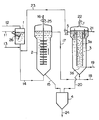
- Fig. 1 shows a flow-sheet of one of examples of a waste water disposal apparatus of the present invention.
- the kind and the composition of waste water treated in the present invention is not specifically limited so long as the waste water contains at least the SS components, the BOD components, the nitrogen compounds and the phosphorus compounds.
- the typical examples are stockbreeding wastes, waste waters discharged from pulp manufacturing factories, waste waters in various food industries such as production of bread yeast, processing of fluits, production of sugar and starch, production of alcohols such as wine, beer and the like, waste waters in fermentation industries such as bean paste, soy and the like as well as general drainage and domestic waste waters such as drawn human waste and waste water of cooking.
- the present invention can also be applied to the waste water which has been subjected to preliminary treatments such as filtration and treatment with active carbon.
- waste water 1 liter of waste water practically comprises BOD: 1,000 mg or less, total nitrogen (T-N): 100 mg or less, total phosphoric acid (T-P): 40 mg or less, suspended solid component (SS): 1,000 mg or less, organic suspended substance (VSS): 1,000 mg or less.
- T-N total nitrogen
- T-P total phosphoric acid
- SS suspended solid component
- VSS organic suspended substance
- waste water having a high content of organic suspended substances is treated, and such waste water having a high content of organic suspended substances is more preferably treated.
- a flocculating agent for dephosphorization is added to and mixed with waste water to be treated to form phosphorus-containing flocs.
- the flocculating agent for dephosphorization is not specifically limited so long as it reacts with phosphorus compounds to form water-insoluble flocs.
- As the typical examples of the flocculating agent there are mentioned:
- An amount of the flocculating agent for dephosphorization is enough to be the stoichiometric amount to the amount of the phosphorus compounds present in waste water. Practical amount is preferably in a proportion of about 2 moles, particularly about 3 - 5 moles to 1 mole of the phosphorous compounds. In this connection, it is preferred to bring the flocculating agent for dephosphorization in contact with waste water and to stir vigorously the mixture to form phosphorus-containing flocs smoothly.
- the other flocculating agent such as polymeric flocculating agents is preferably added.
- the polymeric flocculating agents are, for example, anionic polymeric flocculating agents such as an anionic polyacrylamide and anionic polysodium acrylate.
- the polymeric flocculating agents are usually used in a concentration within the range of about 0.1 - 20 ppm. Formation of flocculated flocs greatly decreases an amount of phosphorus compounds remaining in the waste water. When both dephosphorization agents and polymeric flocculating agents are used, any of them are firstly added, but preferably first dephosphorization agents.
- a recycling solution resulting from the second aerobic disposal process and containing nitrates and nitrites (referred to hereinafter as a recycling solution) is mixed with the phosphorus-containing flocculated waste water to give a mixed waste water having the phosphorus-containing flocs (referred to as mixed waste water).
- the ratio of the recycling solution added to the phosphorus-containing flocculated waste water (referred to hereinafter as recycling ratio) should be determined so that the ratio of the BOD component to the total nitrogen dissolved in the solution to be treated in the next anaerobic disposal process (mixed waste water) be in the range of 2.86 or more which is the theoretical value in the anaerobic disposal of waste water.
- the recycling ratio volume ratio
- the flocculation process is applied to a waste water having a pH in the range of about 5 - 9 at a temperature of about 8 - 40°C.
- waste water has usually pH and temperature of the above-described ranges, and thus no further artificial control is usually required.
- the mixed waste water which contain the phosphorus-containing flocs thus obtained is delivered to the next anaerobic disposal process.
- the BOD components, nitrates and nitrites are anaerobically reduced and decomposed by microorganisms in the same manner as in the conventional anaerobic waste water-disposal process, and finally gas such as nitrogen gas or the like is produced.
- the SS components are hydrolyzed and solubilized by microorganisms.
- the BOD components dissolved in the mixed waste water and the solubilized BOD components are converted to gases such as carbon dioxide gas or the like via organic acids.
- the nitrates and the nitrites are finally converted to nitrogen gas by the nitrate respiration and the nitrite respiration of facultative anaerobes.
- the aforementioned BOD component works as a hydrogen donor in this case.
- the ammonium compounds in the mixed waste water is consumed only as a nutrient of various microorganisms in the anaerobic disposal process and receives substantially no chemical changes.
- Phosphorus compounds eluted from the phosphorus-containing flocs, a small amount of phosphorus compounds dissolved in the mixed waste water and a part of the nitrates and the nitrites are also comsumed as the nutrient of various microorganisms.
- No artificial procedures such as pH adjustment and temperature control are usually required specifically in this process.
- anaerobic disposal solution water treated in the first anaerobic disposal process
- the conventional solid-liquid separating means such as sedimentation, centrifugation, filtration or the like
- a supernatant solution referred to hereinafter as anaerobically treated-supernatant solution
- the solids removed herein include mainly phosphorus-containing flocs and microorganisms.
- the supernatant solution contains the BOD component, the ammonium compounds and a small amount of phosphorus compounds.
- the anaerobically treated-supernatant solution is delivered to the next aerobic disposal process.
- the BOD components and the ammonium compounds are aerobically oxidized by microorganisms in the presence of a molecular oxygen-containing gas such as air, and finally carbon dioxide gas, nitrates and nitrites are produced in the same way as in the conventional aerobic waste water disposal process. That is, the BOD components are oxidized by microorganisms and finally changed into carbon dioxide gas. The carbon dioxide gas is exhausted together with a molecular oxygen-containing gas from the aerobic disposal process.
- the ammonium compounds are changed into nitrates and nitrites by nitrate bacteria and nitrite bacteria.
- the BOD components, the ammonium compounds, a part of the nitrates and the nitrites, and a small amount of residual phosphorus compounds are comsumed as nutrients of various microorganisms in the aerobic disposal process.
- a molecular oxygen-containing gas such as air, an oxygen-mixed gas or oxygen is aerated through the water in order to supply molecular oxygen and to avoid the insufficiency of dissolved molecular oxygen in the water.
- the suspended activated sludge process When the suspended activated sludge process is applied as the aerobic disposal process, it is preferred to add a small amount of 0.01 - 0.05 ppm of cationic polymeric flocculating agents in order to prevent bulking. In the aerobic disposal process, no other artificial operations than aeration, such as the adjustment of pH and control of temperature, are required specifically.
- Solids are usually removed from the water treated in the second aerobic disposal process by the conventional solid-liquid separation means such as sedimentation, centrifugation, filtration and the like to give a supernatant solution.
- the conventional solid-liquid separation means such as sedimentation, centrifugation, filtration and the like.
- At least a part of the water aerobically treated or a part of the supernatant solution obtained after any suspended solids are removed from the aerobically treated solution is recycled to the inlet of the anaerobic disposal process. The remainder is discharged or subjected to reuse directly or after various treatments are applied to, depending on necessities.
- a waste water-disposal apparatus suitable for the disposal process of the present invention is further described.
- the waste water-disposal apparatus comprises at least three tanks, i.e. (1) a flocculation-mixing tank provided with a waste water-supply pipe, a supply pipe of flocculating agents for dephosphorization and a stirrer, (2) an anaerobic tank for anaerobically and microbially decomposing pollutants in waste water, said tank being provided with a gas exhaust outlet at the upper part, and (3) an aerobic tank provided with a gas-exhaust outlet and an overflow pipe at the upper part and a means for feeding a molecular oxygen-containing gas at the lower part and for microbially oxidizing pollutants in a supernatant solution delivered from the anaerobic tank (2).
- a flocculation-mixing tank provided with a waste water-supply pipe, a supply pipe of flocculating agents for dephosphorization and a stirrer
- an anaerobic tank for anaerobically and microbially decomposing pollutants in waste water, said tank being provided with
- the flocculation mixing tank and the anaerobic tank are connected by a mixed waste water pipe.
- the anaerobic tank and the aerobic tank are connected by a pipe for delivering the supernatant solution in the anaerobic tank.
- the aerobic tank and the inlet of the anaerobic tank are connected by a recycling solution-supply pipe.
- the anaerobic tank and the aerobic tank are provided with a solid-separating means, respectively.
- a polymeric flocculating agent-supply pipe is preferably connected to the mixed waste water pipe.
- a flocculation-mixing tank and an anaerobic tank may be integrated. Furthermore, a solid-separating means may be built in the anaerobic tank. Furthermore, the flocculation-mixing tank, the anaerobic tank and the solid-separating means may be integrated.
- anaerobic tank Any type of an anaerobic tank is used.
- a vertical tank in which the lower layer is a floc layer and solution is flowed ascendingly within the tank through the floc layer is preferred. It is also preferred to provide a stirrer such as a rotary stirrer or the like within the tank.
- a complete-mixing type reactor may also be used.
- Any aerobic tank is used.
- a reactor in which a solid-separating means is built may be used.
- a fixed bed reactor or a fluidized bed reactor wherein immobilized products obtained by immobilizing microorganisms, enzymes or activated sludges containing them by the conventional method are provided may be used.
- an aerobic self-granulation reactor wherein granulation ability of the microorganisms is utilized may also be used. Solutions aerobically treated, e.g. those obtained from the fixed bed reactor or the fluidized bed reactor wherein the immobilized products are provided or the aerobic self-granulation reactor, do not contain so much SS components that they are able to recycle as they are without any separation of solids from the solution.
- the solid-separating means include the conventional solid-liquid separating means such as a sedimentation tank, a centrifuge and a filter and the means for discharging the solid separated by the solid-liquid separating means from the process, e.g. solid-discharging pipe.
- the conventional solid-liquid separating means such as a sedimentation tank, a centrifuge and a filter
- the means for discharging the solid separated by the solid-liquid separating means from the process e.g. solid-discharging pipe.
- the waste water disposal apparatus comprises a flocculation mixing tank 1, an anaerobic tank 2 and aerobic tank 3.
- the flocculation mixing tank 1 have a built-in rotary stirrer 26, and a waste water-supply pipe 11 and a supply pipe of a flocculating agent for dephosphorization 12.
- the anaerobic tank 2 is a vertical tank in which a stirrer 16 is provided and a gas exhaust pipe 25 is further provided at the upper part.
- the inside of the tank works as a sedimentation tank.
- the aerobic tank 3 is a vertical tank in which an aeration cylinder 3a is provided at the center and a sparger 3b communicated with an air-feeding pipe 19 is also provided under the aeration cylinder 3a.
- a hollow cylinder part formed by the outer circumference of the aeration cylinder 3a and the inner circumference of the aerobic tank 3 works as a sedimentation tank.
- the bottom of the flocculation mixing tank 1 and the bottom of the anaerobic tank 2 are connected by a mixed waste water pipe 14.
- To the mixed waste water pipe 14 is connected a polymeric flocculating agent supply pipe 13.
- the upper part of the anaerobic tank 2 and the bottom part of the aerobic tank 3 are connected by an overflow pipe 17.
- the overflow pipe 17 is communicated with a polymeric flocculating agent-supply pipe 18 at the bottom part of the aerobic tank 3.
- the upper part of the aerobic tank 3 and the mixed waste water pipe 14 are connected via a pump 5 by a recycling solution-supply pipe 23.
- Solid-discharging pipes 15 and 20 are provided at the bottom parts of the anaerobic tank 2 and the aerobic tank 3, respectively. These pipes 15 and 20 are respectively connected to a solid reservoir 4. A solid-drawing pipe 24 is provided at the bottom part of the solid reservoir 4.
- Waste water containing at least the SS components, the BOD components, the nitrogen compounds and the phosphorus compounds is supplied from the waste water-supply pipe 11 to the flocculation mixing tank 1.
- a flocculating agent for dephosphorization is added to the waste water through a supply pipe of flocculating agents for dephosphorization 12.
- the waste water is vigorously stirred until phosphorus-containing flocs are formed.
- Phosphorus-containing flocculated waste water is discharged from the flocculation mixing tank 1 and to the water is added a polymeric flocculating agent through a polymeric flocculating agent-supply pipe 13. Then, the mixture was mixed with a recycling solution led by a recycling solution-supply pipe 23.
- the mixed waste water having the phosphorus-containing flocs is delivered through a mixed waste water-supply pipe 14 to the bottom part of the anaerobic tank 2.
- the mixed waste water was brought in contact with a variety of microorganisms while being ascended in the anaerobic tank 2 until the BOD components, the nitrates and the nitrites contained in the mixed waste water are anaerobically decomposed to produce gas such as the nitrogen gas and the carbon dioxide gas. These gases form bubbles, ascend through the tank 2 together with the mixed waste water and are finally released from a gas exhaust 25.
- solids such as phosphorus-containing flocs and microbial cells descend through the anaerobic tank 2, deposit on the bottom of the tank and form a layer of the solids. Excess solids are discharged from the bottom part of the layer of the solids through the solid-discharge pipe 15 to the outside of the tank. The mixed waste water ascends through the layer of the solids.
- Anaerobically treated transparent solution in which the solids have been sedimented while the waste water acends in the tank is fed from the upper part of the anaerobic tank 2 to the bottom part of the next aerobic tank 3 via an overflow pipe 17.
- the BOD components, the ammonium compounds and the like are contained in the anaerobically treated solution.
- the anaerobically treated transparent solution is mixed with a polymeric flocculating agent supplied through a polymeric flocculating agent-supply pipe 18 which is connected with the overflow pipe 17 below the aerobic tank 3.
- the anaerobically treated transparent solution supplied from the bottom part of the aerobic tank 3 is brought in contact with air which is supplied by an air-feeding pipe 19 and released from pores at the sparger 3b in the aeration cylinder 3a.
- the BOD components and the ammonium compounds contained in the transparent solution is oxidized by microorganisms, and finally carbon dioxide gas, nitrates and nitrites are produced.
- the carbon dioxide gas and the supplied air ascend through the aeration cylinder 3a together with the solution and released from the aerobic tank 3 via the opening at the top of the tank and a gas exhaust pipe 22.
- Solids containing the microbial cells or the like are sedimented in the hollow cylinder which is defined by the exterior side of the aeration cylinder 3a and the interior side of the aerobic tank 3.
- the sedimented solids deposit on the bottom of the aerobic tank 3 until the layer of the solids is formed.
- Excess solids at the bottom of the layer of the solids are gradually discharged from the tank via the solid-discharging pipe 20.
- the transparent solution stay at the upper part of the hollow cylinder of the aerobic tank 3.
- the transparent solution contains nitrates, nitrites and the like.
- At least a part of the transparent solution is recycled to the anaerobic tank 2 from the inlet of the tank 2 in the form of mixed waste water via a pump 5, the recycling solution-supply pipe 23 and the mixed waste water pipe 14.
- the remainder of the transparent solution is discharged from an overflow pipe 21 to the outside of the tank.
- the solids discharged from the bottoms of the anaerobic tank 2 and the aerobic tank 3 via the solid-discharging pipes 15 and 20, respectively, are stored in a solid reservoir tank 4 and appropriately discharged via a solid-drawing pipe 24.
- Length 100 mm, width: 100mm and depth: 150 mm; Internal volume: 1.43 liter; A paddle having a paddle part of 80 mm long is provided.
- Waste water feed Drainage in which untreated city drainage obtained after merge drainage had been passed through a rough meshed screen and a sand settling pond was further passed through a screen (2.5 mm mesh).
- the composition of the drainage is shown in Table 1.
- the composition of the solution is shown in Table 1.
- Flocculating agent for dephosphorization polyaluminium chloride, amount: 8 - 11 ppm pH: 7.0. Temperature: 8 - 18°C. Stirring: Rotation rate of paddle, 200 rpm. Residence period: 5 minutes.
- Discharged anaerobically treated transparent solution 15.6 - 46.8 l/hr.
- the composition is shown in Table 1.
- Discharged solid 50 g/day in terms of dry amount.
- volume of aeration cylinder 13 liter.
- Aeration rate 2.6 l/min.
- Residence period 2 hours.
- Polymeric flocculating agent Strong cationic polymer (Polymethacrylate ester "C-48OH", trade name, Mitsui Cyanamide K.K.), concentration, 0.1 mg/l.
- Discharged aerobically treated transparent solution 15.6 - 46.8 l/hr.
- Discharged solid ca. 1 - 2 g/day in terms of dry amount.
- SRT sludge residence time
- the specific proliferation rate » of dinitrification bacteria in the anaerobic tank was in the range of 0.2 - 0.4/hr, so that it was possible to maintain the concentration of the denitrification bacteria at a high level.
- no problems such as bulking or the like happened during this period.
- pollutants such as the BOD components, the nitrogen compounds and the phosphorus compounds are removed from various waste waters in a short time and at a high removal ratio without bulking, and the solid precipitates are easily dehydrated.
- the present invention allows to miniatuarize the apparatus.
Landscapes
- Life Sciences & Earth Sciences (AREA)
- Biodiversity & Conservation Biology (AREA)
- Chemical & Material Sciences (AREA)
- Engineering & Computer Science (AREA)
- Microbiology (AREA)
- Hydrology & Water Resources (AREA)
- Environmental & Geological Engineering (AREA)
- Water Supply & Treatment (AREA)
- Organic Chemistry (AREA)
- Analytical Chemistry (AREA)
- Health & Medical Sciences (AREA)
- Molecular Biology (AREA)
- Separation Of Suspended Particles By Flocculating Agents (AREA)
- Purification Treatments By Anaerobic Or Anaerobic And Aerobic Bacteria Or Animals (AREA)
- Removal Of Specific Substances (AREA)
Claims (7)
- Procédé d'épuration d'eau usée en prévoyant un premier procédé d'épuration anaérobie et un second procédé d'épuration aérobie en série et en éliminant en continu au moins les solides en suspension, les substances organiques décomposables par voie microbienne, les composés azotés et les composés phosphorés de l'eau usée, qui consistea) à ajouter un agent floculant de déphosphorisation à la charge d'eau usée jusqu'à production de flocons renfermant du phosphore et à mélanger l'eau à une solution de recyclage provenant du second procédé d'épuration aérobie, cette solution de recyclage contenant au moins des nitrates et des nitrites pour obtenir de l'eau usée mélangée contenant les flocs renfermant du phosphore,b) à introduire l'eau usée mélangée contenant les flocs renfermant du phosphore dans le premier procédé d'épuration anaérobie contenant au moins une bactérie de dénitrification, à y transformer les nitrates et les nitrites en hydrogène gazeux et à décomposer par voie anaérobie les substances organiques décomposables par voie microbienne, et à évacuer le gaz obtenu de ce procédé,c) à éliminer les solides de la solution qui ont été traités dans le procédé d'épuration anaérobie afin d'obtenir une solution surnageante,d) à introduire la solution transparente provenant du procédé d'épuration anaérobie dans le second procédé d'épuration aérobie contenant au moins une bactérie de nitrification, à y transformer les composés d'ammonium de la solution surnageante en nitrates et en nitrites, et à décomposer par voie aérobie des substances organiques résiduelles décomposables par voie microbienne, et à évacuer les gaz du procédé, ete) à recycler au moins une partie de la solution traitée par voie aérobie ou une partie de la solution surnageante obtenue après avoir éliminé les constituants solides en suspension de la solution ci-dessus à l'entrée du procédé d'épuration par voie anaérobie.
- Procédé d'épuration d'eau usée selon la revendication 1, qui consiste à ajouter à la charge d'eau usée un agent de floculation de déphosphorisation avec un agent de floculation polymère.
- Procédé d'épuration d'eau usée selon la revendication 1, qui consiste à régler le rapport des substances organiques décomposables par voie microbienne à l'azote total présent dans le procédé d'épuration par voie anaérobie à l'équivalent théorique de 2,86 ou plus.
- Procédé d'épuration d'eau usée selon la revendication 1 ou la revendication 3, dans lequel le rapport en volume de la solution de recyclage à l'eau usée est compris entre 0,5 et 5.
- Procédé d'épuration d'eau usée selon la revendication 1, qui consiste à régler dans le procédé de floculation le pH entre 5 et 9 environ et la température entre 8 et 40°C environ.
- Installation d'épuration d'eau usée comprenant au moins trois cuves consistant en (1) une cuve de mélange de floculation munie d'un conduit d'entrée d'eau usée, d'un conduit d'entrée d'agent de floculation pour la déphosphorisation et d'un agitateur (2), en une cuve anaérobie pour décomposer par voie anaérobie et par voie microbienne des polluants de l'eau usée, cette cuve étant munie d'une sortie de gaz à la partie supérieure et (3) en une cuve aérobie pour oxyder par voie microbienne des polluants de la solution traitée par voie anaérobie et provenant de la cuve anaérobie, la cuve aérobie étant munie d'un conduit de sortie des gaz et d'un conduit de débordement à la partie supérieure et d'un moyen pour envoyer un gaz contenant de l'oxygène moléculaire à la partie inférieure, la cuve de mélange de floculation et la cuve anaérobie communiquant par un conduit pour de l'eau usée mélangée, la cuve anaérobie et la cuve aérobie communiquant par un conduit pour envoyer une solution surnageante à la cuve anaérobie, la cuve aérobie et l'entrée de la cuve anaérobie communiquant par un conduit pour envoyer une solution de recyclage, et la cuve anaérobie et la cuve aérobie étant munies respectivement de moyens de séparation de matières solides.
- Installation d'épuration d'eau usée selon la revendication 6, dans laquelle un agent d'envoi d'agent de floculation polymère communique avec le conduit pour l'eau usée mélangée.
Applications Claiming Priority (2)
| Application Number | Priority Date | Filing Date | Title |
|---|---|---|---|
| JP197265/91 | 1991-07-12 | ||
| JP19726591 | 1991-07-12 |
Publications (2)
| Publication Number | Publication Date |
|---|---|
| EP0522966A1 EP0522966A1 (fr) | 1993-01-13 |
| EP0522966B1 true EP0522966B1 (fr) | 1995-08-23 |
Family
ID=16371600
Family Applications (1)
| Application Number | Title | Priority Date | Filing Date |
|---|---|---|---|
| EP19920401990 Expired - Lifetime EP0522966B1 (fr) | 1991-07-12 | 1992-07-09 | Procédé et station d'épuration d'eaux usées par déphosphoration et traitement anaérobie resp. aérobie |
Country Status (5)
| Country | Link |
|---|---|
| US (2) | US5407566A (fr) |
| EP (1) | EP0522966B1 (fr) |
| KR (1) | KR960013338B1 (fr) |
| AT (1) | ATE126783T1 (fr) |
| DE (1) | DE69204233T2 (fr) |
Cited By (3)
| Publication number | Priority date | Publication date | Assignee | Title |
|---|---|---|---|---|
| AT407245B (de) * | 1998-12-07 | 2001-01-25 | Vta Engineering Und Umwelttech | Verfahren zum biologischen reinigen phosphorhältiger abwässer |
| CN106430573A (zh) * | 2016-11-30 | 2017-02-22 | 中冶华天南京工程技术有限公司 | 一种集截留污泥、加热及循环功能于一体的厌氧循环系统 |
| CN106995256A (zh) * | 2016-01-26 | 2017-08-01 | 中国环境科学研究院 | 一种淀粉废水的处理工艺 |
Families Citing this family (40)
| Publication number | Priority date | Publication date | Assignee | Title |
|---|---|---|---|---|
| FR2707621B1 (fr) * | 1993-07-12 | 1995-10-20 | Omnium Traitement Valorisa | Procédé et installation d'épuration d'eau à boues physico-chimiques dénitrifiantes. |
| US5651892A (en) * | 1996-03-14 | 1997-07-29 | Deep Shaft Technology Inc. | Biodegradeable effluent nutrient removal |
| GB2317169A (en) | 1996-09-13 | 1998-03-18 | Kvaerner Davy Ltd | Anoxic and aerobic metabolisation of waste |
| US6007720A (en) * | 1998-03-11 | 1999-12-28 | Organo Corp. | Process for treatment of organic wastewater |
| GB9805714D0 (en) | 1998-03-17 | 1998-05-13 | Kvaerner Construction Limited | Liquid effluent treatment process and plant |
| US6235196B1 (en) * | 1998-04-23 | 2001-05-22 | Alliedsignal Inc. | Biological wastewater treatment system |
| CO5040141A1 (es) * | 1998-06-24 | 2001-05-29 | Barrenechea Luis Perez | Procedimiento para la elaboracion de complejos polimericos a partir de residuos o subproductos efluentes de destilerias |
| US6464875B1 (en) * | 1999-04-23 | 2002-10-15 | Gold Kist, Inc. | Food, animal, vegetable and food preparation byproduct treatment apparatus and process |
| DE19938818A1 (de) * | 1999-08-19 | 2001-02-22 | Envicon Klaertech Verwalt | Kleinkläranlage |
| AT409857B (de) * | 2000-08-30 | 2002-12-27 | Vta Engineering Und Umwelttech | Verfahren zum unterdrücken einer schwimm- und blähschlammbildung in der aeroben behandlungsstufe einer biologischen abwasserreinigung |
| US7261811B2 (en) * | 2000-10-02 | 2007-08-28 | The University Of Western Ontario | Liquid-solid circulating fluidized bed waste water treatment system for simultaneous carbon, nitrogen and phosphorus removal |
| US6391203B1 (en) * | 2000-11-22 | 2002-05-21 | Alexander G. Fassbender | Enhanced biogas production from nitrogen bearing feed stocks |
| US6660163B2 (en) | 2001-03-02 | 2003-12-09 | Daniel Robert Miklos | Waste treatment with control over biological solids |
| US7854842B2 (en) * | 2001-03-02 | 2010-12-21 | Daniel Robert Miklos | Apparatus and methods for control of waste treatment processes |
| US8002986B2 (en) * | 2001-03-02 | 2011-08-23 | Daniel R. Miklos | Apparatus and methods for control of waste treatment processes |
| KR100415252B1 (ko) * | 2001-03-09 | 2004-01-16 | 주식회사 제일엔지니어링 | 부분 아질산화 및 혐기성 암모니아 산화를 이용한 고농도질소폐수 처리방법 |
| US6592762B2 (en) * | 2001-08-29 | 2003-07-15 | United States Filter Corporation | Process for treating BOD-containing wastewater |
| KR100397606B1 (ko) * | 2001-12-17 | 2003-09-13 | 주식회사 화인프로텍 | 무기응집제와 생물막 여과조를 이용한 수처리 방법 및 장치 |
| KR100468997B1 (ko) * | 2002-08-17 | 2005-01-29 | 주식회사 에코다임 | 슬러지 배출억제형 상향류 혐기반응조를 갖는 폐수처리장치 |
| US7060185B2 (en) * | 2003-04-21 | 2006-06-13 | Korea Institute Of Construction Technology | Sewage treatment apparatus using self-granulated activated sludge and sewage treatment method thereof |
| US6896805B2 (en) * | 2003-10-20 | 2005-05-24 | Dharma Living Systems, Inc. | Tidal vertical flow wastewater treatment system and method |
| WO2006105875A2 (fr) * | 2005-04-08 | 2006-10-12 | Phoenix Beteiligungs Gmbh | Procede et dispositif de production d'engrais azotes a partir de dechets organiques, de suppression de phosphates de dechets organiques et de limitation de la teneur en potassium |
| US7344643B2 (en) * | 2005-06-30 | 2008-03-18 | Siemens Water Technologies Holding Corp. | Process to enhance phosphorus removal for activated sludge wastewater treatment systems |
| WO2007028149A2 (fr) * | 2005-09-02 | 2007-03-08 | Siemens Water Technologies Corp. | Tamisage de solides inertes dans le cadre d'un processus de traitement d'eaux usees a faible rendement |
| WO2007103499A2 (fr) * | 2006-03-07 | 2007-09-13 | Siemens Water Technologies Corp. | Contrôle d'ions métalliques multivalents pour des procédés de traitement de de boues à faible rendement |
| WO2008141113A1 (fr) * | 2007-05-10 | 2008-11-20 | O'regan Patrick T Jr | Systemes, procedes et composants de traitement des eaux et d'action corrective |
| US8894856B2 (en) | 2008-03-28 | 2014-11-25 | Evoqua Water Technologies Llc | Hybrid aerobic and anaerobic wastewater and sludge treatment systems and methods |
| WO2009120384A2 (fr) | 2008-03-28 | 2009-10-01 | Siemens Water Technologies Corp. | Systèmes et procédés de traitement hybride aérobie et anaérobie des eaux usées et des boues |
| US8894857B2 (en) | 2008-03-28 | 2014-11-25 | Evoqua Water Technologies Llc | Methods and systems for treating wastewater |
| US20110210049A1 (en) * | 2008-11-02 | 2011-09-01 | O'regan Jr Patrick T | Water treatment systems with communication network links and methods |
| WO2011068931A1 (fr) * | 2009-12-03 | 2011-06-09 | Siemens Industry, Inc. | Systèmes et procédés d'extraction de nutriments dans des systèmes de traitement biologiques systems and methods for nutrient removal in biological treatment systems |
| US9359236B2 (en) | 2010-08-18 | 2016-06-07 | Evoqua Water Technologies Llc | Enhanced biosorption of wastewater organics using dissolved air flotation with solids recycle |
| WO2012024279A1 (fr) | 2010-08-18 | 2012-02-23 | Siemens Industry, Inc. | Systèmes hybrides de stabilisation par contact-flottation primaire |
| CN103663843B (zh) * | 2012-09-06 | 2015-05-13 | 中国石油化工股份有限公司 | 一种对氨基二苯胺生产装置废水的处理方法 |
| CN103663846B (zh) * | 2012-09-07 | 2015-07-22 | 中国石油化工股份有限公司 | 对氨基二苯胺生产废水短程反硝化积累亚硝态氮的方法 |
| US10131550B2 (en) | 2013-05-06 | 2018-11-20 | Evoqua Water Technologies Llc | Enhanced biosorption of wastewater organics using dissolved air flotation with solids recycle |
| CN104250053B (zh) * | 2013-06-27 | 2016-01-13 | 中国石油化工股份有限公司 | 一种处理含氨氮对氨基二苯胺生产废水的方法 |
| CN111115849A (zh) * | 2020-01-03 | 2020-05-08 | 王小龙 | 一种微生物污水净化处理剂的制备方法 |
| CN113429022B (zh) * | 2021-07-01 | 2022-09-16 | 江西省科学院微生物研究所 | 一种模块化的养殖沼液废水快速处理系统及其运行方法 |
| CN120717667B (zh) * | 2025-08-27 | 2025-11-25 | 内蒙古科技大学 | 一种集成式农村厕所粪污深度分离处理设备 |
Family Cites Families (8)
| Publication number | Priority date | Publication date | Assignee | Title |
|---|---|---|---|---|
| DE1642399A1 (de) * | 1967-09-12 | 1971-05-06 | Dorr Oliver Inc | Verfahren zur Abwasserbehandlung unter Phosphorentfernung |
| US3764523A (en) * | 1972-05-01 | 1973-10-09 | Union Carbide Corp | Nitrification of bod-containing water |
| DE3109848A1 (de) * | 1980-09-25 | 1982-05-27 | Metallgesellschaft Ag, 6000 Frankfurt | Verfahren zum behandeln von abwasser |
| DE3206444A1 (de) * | 1982-02-23 | 1983-09-01 | Linde Ag, 6200 Wiesbaden | Verfahren und vorrichtung zur biologischen reinigung von phosphathaltigem abwasser |
| SE456500B (sv) * | 1985-09-16 | 1988-10-10 | Boliden Ab | Forfarande for rening av vatten for eliminering av kveve |
| US4894162A (en) * | 1988-04-27 | 1990-01-16 | Ciba-Geigy Corporation | Treatment of volatile organic substances at waste water treatment plants |
| US5006251A (en) * | 1989-09-27 | 1991-04-09 | Director General, Public Works Research Institute, Ministry Of Construction | Process for treating organic waste water |
| SE468985B (sv) * | 1990-09-07 | 1993-04-26 | Johnson Axel Eng Ab | Foerfarande foer rening av avloppsvatten |
-
1992
- 1992-07-09 AT AT92401990T patent/ATE126783T1/de active
- 1992-07-09 KR KR1019920012243A patent/KR960013338B1/ko not_active Expired - Fee Related
- 1992-07-09 DE DE69204233T patent/DE69204233T2/de not_active Expired - Fee Related
- 1992-07-09 EP EP19920401990 patent/EP0522966B1/fr not_active Expired - Lifetime
- 1992-07-13 US US07/912,519 patent/US5407566A/en not_active Expired - Fee Related
-
1995
- 1995-01-20 US US08/375,729 patent/US5531896A/en not_active Expired - Fee Related
Cited By (4)
| Publication number | Priority date | Publication date | Assignee | Title |
|---|---|---|---|---|
| AT407245B (de) * | 1998-12-07 | 2001-01-25 | Vta Engineering Und Umwelttech | Verfahren zum biologischen reinigen phosphorhältiger abwässer |
| CN106995256A (zh) * | 2016-01-26 | 2017-08-01 | 中国环境科学研究院 | 一种淀粉废水的处理工艺 |
| CN106430573A (zh) * | 2016-11-30 | 2017-02-22 | 中冶华天南京工程技术有限公司 | 一种集截留污泥、加热及循环功能于一体的厌氧循环系统 |
| CN106430573B (zh) * | 2016-11-30 | 2019-07-05 | 中冶华天南京工程技术有限公司 | 一种集截留污泥、加热及循环功能于一体的厌氧循环系统 |
Also Published As
| Publication number | Publication date |
|---|---|
| DE69204233D1 (de) | 1995-09-28 |
| KR960013338B1 (ko) | 1996-10-04 |
| EP0522966A1 (fr) | 1993-01-13 |
| DE69204233T2 (de) | 1996-01-25 |
| US5531896A (en) | 1996-07-02 |
| KR930002253A (ko) | 1993-02-22 |
| ATE126783T1 (de) | 1995-09-15 |
| US5407566A (en) | 1995-04-18 |
Similar Documents
| Publication | Publication Date | Title |
|---|---|---|
| EP0522966B1 (fr) | Procédé et station d'épuration d'eaux usées par déphosphoration et traitement anaérobie resp. aérobie | |
| CA2498747C (fr) | Procede de traitement d'eaux usees par des granules de boue | |
| CA2083199C (fr) | Methode et installation de traitement des eaux usees | |
| US5393427A (en) | Process for the biological treatment of wastewater | |
| EP0382340B1 (fr) | Procédé anaérobie/aérobie à deux étages pour le traitement d'eau usée | |
| CA1078977A (fr) | Preparation de boues activees non agglomerantes | |
| USRE32429E (en) | Production of non-bulking activated sludge | |
| EP0964831B1 (fr) | Procede d'obtention de la recristallisation secondaire d'un micro-organisme dans un reacteur | |
| US4183808A (en) | Phosphate removal from wastewater | |
| AU2661292A (en) | Method and system for biologically removing nitrogen from wastewater | |
| CN1102130C (zh) | 生物除去污水和废水中的氮和磷的系统和方法 | |
| WO1994011313A1 (fr) | Elimination biologique du phosphore des eaux usees | |
| US5480550A (en) | Biotreatment process for caustics containing inorganic sulfides | |
| US4507207A (en) | Process for the chemical removal of phosphorus compounds from waste water | |
| JP3122654B2 (ja) | 高濃度廃水を処理する方法および装置 | |
| KR100461919B1 (ko) | 연속 회분식 단일 반응조와 접촉 폭기조를 조합한 하수처리 장치 및 이를 이용한 하수의 처리 방법 | |
| JP3799557B2 (ja) | 廃水処理方法 | |
| EP0710626A2 (fr) | Procédé pour réduire la teneur en azote dans des l'eaux usées | |
| KR100292432B1 (ko) | 산화구형자연정화처리방법 | |
| JP3281885B2 (ja) | 廃水処理方法および廃水処理装置 | |
| KR100294863B1 (ko) | 산화구형자연정화처리장치 | |
| AU665138C (en) | Biological phosphorus removal from waste water | |
| AU665138B2 (en) | Biological phosphorus removal from waste water |
Legal Events
| Date | Code | Title | Description |
|---|---|---|---|
| PUAI | Public reference made under article 153(3) epc to a published international application that has entered the european phase |
Free format text: ORIGINAL CODE: 0009012 |
|
| AK | Designated contracting states |
Kind code of ref document: A1 Designated state(s): AT BE CH DE DK ES FR GB GR IT LI LU MC NL PT SE |
|
| 17P | Request for examination filed |
Effective date: 19930616 |
|
| 17Q | First examination report despatched |
Effective date: 19941220 |
|
| GRAA | (expected) grant |
Free format text: ORIGINAL CODE: 0009210 |
|
| AK | Designated contracting states |
Kind code of ref document: B1 Designated state(s): AT BE CH DE DK ES FR GB GR IT LI LU MC NL PT SE |
|
| PG25 | Lapsed in a contracting state [announced via postgrant information from national office to epo] |
Ref country code: MC Free format text: LAPSE BECAUSE OF NON-PAYMENT OF DUE FEES Effective date: 19950823 Ref country code: GR Free format text: LAPSE BECAUSE OF FAILURE TO SUBMIT A TRANSLATION OF THE DESCRIPTION OR TO PAY THE FEE WITHIN THE PRESCRIBED TIME-LIMIT Effective date: 19950823 Ref country code: ES Free format text: THE PATENT HAS BEEN ANNULLED BY A DECISION OF A NATIONAL AUTHORITY Effective date: 19950823 Ref country code: DK Effective date: 19950823 Ref country code: BE Effective date: 19950823 |
|
| REF | Corresponds to: |
Ref document number: 126783 Country of ref document: AT Date of ref document: 19950915 Kind code of ref document: T |
|
| REF | Corresponds to: |
Ref document number: 69204233 Country of ref document: DE Date of ref document: 19950928 |
|
| ET | Fr: translation filed | ||
| ITF | It: translation for a ep patent filed | ||
| PG25 | Lapsed in a contracting state [announced via postgrant information from national office to epo] |
Ref country code: PT Effective date: 19951123 |
|
| PLBE | No opposition filed within time limit |
Free format text: ORIGINAL CODE: 0009261 |
|
| STAA | Information on the status of an ep patent application or granted ep patent |
Free format text: STATUS: NO OPPOSITION FILED WITHIN TIME LIMIT |
|
| PG25 | Lapsed in a contracting state [announced via postgrant information from national office to epo] |
Ref country code: LU Free format text: LAPSE BECAUSE OF NON-PAYMENT OF DUE FEES Effective date: 19960731 |
|
| 26N | No opposition filed | ||
| PGFP | Annual fee paid to national office [announced via postgrant information from national office to epo] |
Ref country code: SE Payment date: 20000511 Year of fee payment: 9 |
|
| PGFP | Annual fee paid to national office [announced via postgrant information from national office to epo] |
Ref country code: AT Payment date: 20000519 Year of fee payment: 9 |
|
| PGFP | Annual fee paid to national office [announced via postgrant information from national office to epo] |
Ref country code: CH Payment date: 20000704 Year of fee payment: 9 |
|
| PG25 | Lapsed in a contracting state [announced via postgrant information from national office to epo] |
Ref country code: AT Free format text: LAPSE BECAUSE OF NON-PAYMENT OF DUE FEES Effective date: 20010709 |
|
| PG25 | Lapsed in a contracting state [announced via postgrant information from national office to epo] |
Ref country code: SE Free format text: LAPSE BECAUSE OF NON-PAYMENT OF DUE FEES Effective date: 20010710 |
|
| PG25 | Lapsed in a contracting state [announced via postgrant information from national office to epo] |
Ref country code: LI Free format text: LAPSE BECAUSE OF NON-PAYMENT OF DUE FEES Effective date: 20010731 Ref country code: CH Free format text: LAPSE BECAUSE OF NON-PAYMENT OF DUE FEES Effective date: 20010731 |
|
| REG | Reference to a national code |
Ref country code: GB Ref legal event code: IF02 |
|
| EUG | Se: european patent has lapsed |
Ref document number: 92401990.4 |
|
| REG | Reference to a national code |
Ref country code: CH Ref legal event code: PL |
|
| PGFP | Annual fee paid to national office [announced via postgrant information from national office to epo] |
Ref country code: NL Payment date: 20050703 Year of fee payment: 14 |
|
| PGFP | Annual fee paid to national office [announced via postgrant information from national office to epo] |
Ref country code: GB Payment date: 20050706 Year of fee payment: 14 |
|
| PGFP | Annual fee paid to national office [announced via postgrant information from national office to epo] |
Ref country code: DE Payment date: 20050707 Year of fee payment: 14 |
|
| PGFP | Annual fee paid to national office [announced via postgrant information from national office to epo] |
Ref country code: FR Payment date: 20050708 Year of fee payment: 14 |
|
| PG25 | Lapsed in a contracting state [announced via postgrant information from national office to epo] |
Ref country code: IT Free format text: LAPSE BECAUSE OF NON-PAYMENT OF DUE FEES;WARNING: LAPSES OF ITALIAN PATENTS WITH EFFECTIVE DATE BEFORE 2007 MAY HAVE OCCURRED AT ANY TIME BEFORE 2007. THE CORRECT EFFECTIVE DATE MAY BE DIFFERENT FROM THE ONE RECORDED. Effective date: 20050709 |
|
| PG25 | Lapsed in a contracting state [announced via postgrant information from national office to epo] |
Ref country code: GB Free format text: LAPSE BECAUSE OF NON-PAYMENT OF DUE FEES Effective date: 20060709 |
|
| PG25 | Lapsed in a contracting state [announced via postgrant information from national office to epo] |
Ref country code: NL Free format text: LAPSE BECAUSE OF NON-PAYMENT OF DUE FEES Effective date: 20070201 Ref country code: DE Free format text: LAPSE BECAUSE OF NON-PAYMENT OF DUE FEES Effective date: 20070201 |
|
| GBPC | Gb: european patent ceased through non-payment of renewal fee |
Effective date: 20060709 |
|
| NLV4 | Nl: lapsed or anulled due to non-payment of the annual fee |
Effective date: 20070201 |
|
| REG | Reference to a national code |
Ref country code: FR Ref legal event code: ST Effective date: 20070330 |
|
| PG25 | Lapsed in a contracting state [announced via postgrant information from national office to epo] |
Ref country code: FR Free format text: LAPSE BECAUSE OF NON-PAYMENT OF DUE FEES Effective date: 20060731 |